

ASTM F3028-24
(Guide)Standard Guide for Training of Search and Rescue Personnel Operating in the Alpine Environment (Alpine Endorsement)
General Information
- Abstract
SIGNIFICANCE AND USE
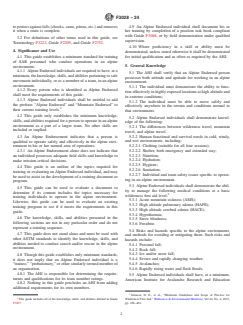
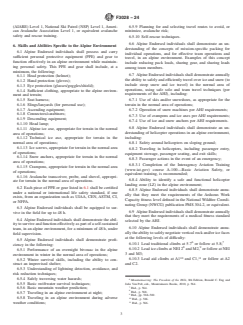
4.1 This guide establishes a minimum standard for training of SAR personnel who conduct operations in an alpine environment.
4.1.1 Alpine Endorsed individuals are required to have, at a minimum, the knowledge, skills, and abilities pertaining to safe movement individually, or as a member of a team, in an alpine environment.
4.1.2 Every person who is identified as Alpine Endorsed shall meet the requirements of this guide.
4.1.3 Alpine Endorsed individuals shall be entitled to add the prefixes “Alpine Endorsed” and “Mountain Endorsed” to their current training levels.4
4.2 This guide only establishes the minimum knowledge, skills, and abilities required for a person to operate in an alpine environment as a part of a larger team. No other skills are included or implied.
4.3 An Alpine Endorsement indicates that a person is qualified to operate safely and effectively in the alpine environment in his or her normal area of operations.
4.3.1 An Alpine Endorsement alone does not indicate that an individual possesses adequate field skills and knowledge to make mission-critical decisions.
4.4 This guide is an outline of the topics required for training or evaluating an Alpine Endorsed individual, and may be used to assist in the development of a training document or program.
4.5 This guide can be used to evaluate a document to determine if its content includes the topics necessary for training individuals to operate in the alpine environment. Likewise, this guide can be used to evaluate an existing training program to see if it meets the requirements in this guide.
4.6 The knowledge, skills, and abilities presented in the following sections are not in any particular order and do not represent a training sequence.
4.7 This guide does not stand alone and must be used with other ASTM standards to identify the knowledge, skills, and abilities needed to conduct search and/or rescue in the alpine environment.
4.8 Though this guide establishes only mi...
SCOPE
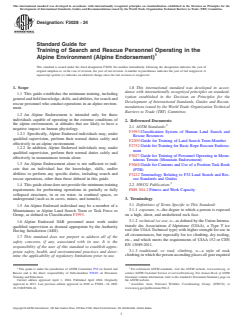
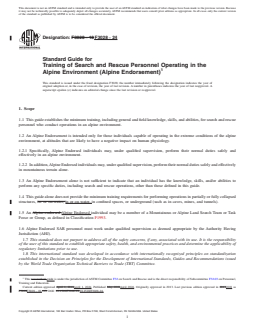
1.1 This guide establishes the minimum training, including general and field knowledge, skills, and abilities, for search and rescue personnel who conduct operations in an alpine environment.
1.2 An Alpine Endorsement is intended only for those individuals capable of operating in the extreme conditions of the alpine environment, at altitudes that are likely to have a negative impact on human physiology.
1.2.1 Specifically, Alpine Endorsed individuals may, under qualified supervision, perform their normal duties safely and effectively in an alpine environment.
1.2.2 In addition, Alpine Endorsed individuals may, under qualified supervision, perform their normal duties safely and effectively in mountainous terrain alone.
1.3 An Alpine Endorsement alone is not sufficient to indicate that an individual has the knowledge, skills, and/or abilities to perform any specific duties, including search and rescue operations, other than those defined in this guide.
1.4 This guide alone does not provide the minimum training requirements for performing operations in partially or fully collapsed structures, in or on water, in confined spaces, or underground (such as in caves, mines, and tunnels).
1.5 An Alpine Endorsed individual may be a member of a Mountainous or Alpine Land Search Team or Task Force or Group, as defined in Classification F1993.
1.6 Alpine Endorsed SAR personnel must work under qualified supervision as deemed appropriate by the Authority Having Jurisdiction (AHJ).
1.7 This standard does not purport to address all of the safety concerns, if any, associated with its use. It is the responsibility of the user of this standard to establish appropriate safety, health, and environmental practices and determine the applicability of regulatory limitations prior to use.
1.8 This international standard was developed in accordance with internationally recognized principles on standardization established i...
- Status
- Published
- Publication Date
- 31-Mar-2024
- Technical Committee
- F32 - Search and Rescue
- Drafting Committee
- F32.03 - Personnel, Training and Education
Buy Documents

ASTM F3028-24 - Standard Guide for Training of Search and Rescue Personnel Operating in the Alpine Environment (Alpine Endorsement)
REDLINE ASTM F3028-24 - Standard Guide for Training of Search and Rescue Personnel Operating in the Alpine Environment (Alpine Endorsement)
Overview
ASTM F3028-24, Standard Guide for Training of Search and Rescue Personnel Operating in the Alpine Environment (Alpine Endorsement), provides a comprehensive framework for the training of search and rescue (SAR) personnel who operate in challenging alpine environments. It establishes minimum standards for knowledge, skills, and abilities required for individuals to be recognized as “Alpine Endorsed.” The guide is intended for organizations seeking to ensure the proficiency and safety of their SAR teams operating at high altitudes and under extreme conditions.
Key Topics
This standard covers essential aspects of alpine SAR training, including:
General and Field Knowledge
- Understanding differences between wilderness, mountain, and alpine travel
- Identifying functional and survival needs in cold, windy, and wet environments
- Recognizing medical risks such as acute mountain sickness, hypothermia, and frostbite
Skills and Abilities
- Demonstrating safe movement as an individual or team in alpine terrain
- Risk assessment and hazard mitigation (e.g., avalanche, rock fall, severe weather)
- Proficiency with essential alpine equipment-helmets, harnesses, ice axes, crampons, avalanche transceivers, etc.
- Survival skills including bivouac, improvised shelters, and survival for up to 48 hours
- Navigation, route planning, and avalanche safety techniques
- Helicopter operations in alpine environments (safety, landing zones, emergency procedures)
- Rope and vertical rescue techniques tailored to snow, ice, and rock surfaces
Operational Limitations
- Requirement for Alpine Endorsed personnel to work under qualified supervision
- Emphasis that this endorsement alone does not qualify individuals for incident command or all SAR scenarios (e.g., collapsed structures, water, confined spaces)
Applications
ASTM F3028-24 is widely relevant for organizations and authorities involved with mountain rescue, outdoor emergency services, and disaster response in high-altitude or extreme alpine zones. Its primary applications include:
Development of Training Programs
- Helping organizations build or evaluate SAR training that meets recognized minimum standards for alpine operations
- Providing content requirements for position task books and documentation of field competencies
Qualification of Personnel
- Supporting the identification and credentialing of Alpine Endorsed individuals within rescue teams, task forces, or groups
- Ensuring SAR teams have members with proven abilities to operate safely under supervision in alpine settings
Evaluation and Compliance
- Serving as a benchmark for auditing or assessing existing rescue training programs
- Assisting agencies with meeting legal, safety, or jurisdictional requirements for SAR readiness in mountainous terrain
Related Standards
ASTM F3028-24 integrates and is best used alongside various other international and ASTM standards, including:
- ASTM F1993 – Classification System of Human Land Search and Rescue Resources
- ASTM F2209 – Guide for Training of Land Search Team Member
- ASTM F2752 – Guide for Training for Basic Rope Rescuer Endorsement
- ASTM F3027 – Guide for Training of Personnel Operating in Mountainous Terrain (Mountain Endorsement)
- ASTM F3068 – Guide for Contents and Use of a Position Task Book (PTB)
- ASTM F3222 – Terminology Relating to F32 Land Search and Rescue Standards and Guides
Additional references:
- NWCG PMS 304-2 “Fitness and Work Capacity”
- “Mountaineering: The Freedom of the Hills,” 8th ed.
Summary
ASTM F3028-24 offers critical guidance to ensure that search and rescue teams operating in the alpine environment meet internationally recognized training standards. Using this standard helps maximize responder effectiveness and safety, supports regulatory compliance, and elevates the overall quality of search and rescue operations in extreme terrains.
Keywords: alpine search and rescue, SAR training, mountain rescue standards, alpine endorsement, avalanche safety, wilderness survival, rope rescue, helicopter operations, ASTM standards.
Relations
- Effective Date
- 01-Apr-2024
- Effective Date
- 01-Apr-2024
- Effective Date
- 01-Apr-2024
- Refers
ASTM F1993-16(2022) - Standard Classification System of Human Land Search and Rescue Resources - Effective Date
- 01-Nov-2022
- Effective Date
- 01-Nov-2018
- Referred By
ASTM F3222-16 - Standard Terminology Relating to F32 Land Search and Rescue Standards and Guides - Effective Date
- 01-Apr-2024
- Effective Date
- 01-Apr-2024
Buy Documents
ASTM F3028-24 - Standard Guide for Training of Search and Rescue Personnel Operating in the Alpine Environment (Alpine Endorsement)
REDLINE ASTM F3028-24 - Standard Guide for Training of Search and Rescue Personnel Operating in the Alpine Environment (Alpine Endorsement)
Get Certified
Connect with accredited certification bodies for this standard

BSI Group
BSI (British Standards Institution) is the business standards company that helps organizations make excellence a habit.

Bureau Veritas
Bureau Veritas is a world leader in laboratory testing, inspection and certification services.

DNV
DNV is an independent assurance and risk management provider.
Sponsored listings
Frequently Asked Questions
ASTM F3028-24 is a guide published by ASTM International. Its full title is "Standard Guide for Training of Search and Rescue Personnel Operating in the Alpine Environment (Alpine Endorsement)". This standard covers: SIGNIFICANCE AND USE 4.1 This guide establishes a minimum standard for training of SAR personnel who conduct operations in an alpine environment. 4.1.1 Alpine Endorsed individuals are required to have, at a minimum, the knowledge, skills, and abilities pertaining to safe movement individually, or as a member of a team, in an alpine environment. 4.1.2 Every person who is identified as Alpine Endorsed shall meet the requirements of this guide. 4.1.3 Alpine Endorsed individuals shall be entitled to add the prefixes “Alpine Endorsed” and “Mountain Endorsed” to their current training levels.4 4.2 This guide only establishes the minimum knowledge, skills, and abilities required for a person to operate in an alpine environment as a part of a larger team. No other skills are included or implied. 4.3 An Alpine Endorsement indicates that a person is qualified to operate safely and effectively in the alpine environment in his or her normal area of operations. 4.3.1 An Alpine Endorsement alone does not indicate that an individual possesses adequate field skills and knowledge to make mission-critical decisions. 4.4 This guide is an outline of the topics required for training or evaluating an Alpine Endorsed individual, and may be used to assist in the development of a training document or program. 4.5 This guide can be used to evaluate a document to determine if its content includes the topics necessary for training individuals to operate in the alpine environment. Likewise, this guide can be used to evaluate an existing training program to see if it meets the requirements in this guide. 4.6 The knowledge, skills, and abilities presented in the following sections are not in any particular order and do not represent a training sequence. 4.7 This guide does not stand alone and must be used with other ASTM standards to identify the knowledge, skills, and abilities needed to conduct search and/or rescue in the alpine environment. 4.8 Though this guide establishes only mi... SCOPE 1.1 This guide establishes the minimum training, including general and field knowledge, skills, and abilities, for search and rescue personnel who conduct operations in an alpine environment. 1.2 An Alpine Endorsement is intended only for those individuals capable of operating in the extreme conditions of the alpine environment, at altitudes that are likely to have a negative impact on human physiology. 1.2.1 Specifically, Alpine Endorsed individuals may, under qualified supervision, perform their normal duties safely and effectively in an alpine environment. 1.2.2 In addition, Alpine Endorsed individuals may, under qualified supervision, perform their normal duties safely and effectively in mountainous terrain alone. 1.3 An Alpine Endorsement alone is not sufficient to indicate that an individual has the knowledge, skills, and/or abilities to perform any specific duties, including search and rescue operations, other than those defined in this guide. 1.4 This guide alone does not provide the minimum training requirements for performing operations in partially or fully collapsed structures, in or on water, in confined spaces, or underground (such as in caves, mines, and tunnels). 1.5 An Alpine Endorsed individual may be a member of a Mountainous or Alpine Land Search Team or Task Force or Group, as defined in Classification F1993. 1.6 Alpine Endorsed SAR personnel must work under qualified supervision as deemed appropriate by the Authority Having Jurisdiction (AHJ). 1.7 This standard does not purport to address all of the safety concerns, if any, associated with its use. It is the responsibility of the user of this standard to establish appropriate safety, health, and environmental practices and determine the applicability of regulatory limitations prior to use. 1.8 This international standard was developed in accordance with internationally recognized principles on standardization established i...
SIGNIFICANCE AND USE 4.1 This guide establishes a minimum standard for training of SAR personnel who conduct operations in an alpine environment. 4.1.1 Alpine Endorsed individuals are required to have, at a minimum, the knowledge, skills, and abilities pertaining to safe movement individually, or as a member of a team, in an alpine environment. 4.1.2 Every person who is identified as Alpine Endorsed shall meet the requirements of this guide. 4.1.3 Alpine Endorsed individuals shall be entitled to add the prefixes “Alpine Endorsed” and “Mountain Endorsed” to their current training levels.4 4.2 This guide only establishes the minimum knowledge, skills, and abilities required for a person to operate in an alpine environment as a part of a larger team. No other skills are included or implied. 4.3 An Alpine Endorsement indicates that a person is qualified to operate safely and effectively in the alpine environment in his or her normal area of operations. 4.3.1 An Alpine Endorsement alone does not indicate that an individual possesses adequate field skills and knowledge to make mission-critical decisions. 4.4 This guide is an outline of the topics required for training or evaluating an Alpine Endorsed individual, and may be used to assist in the development of a training document or program. 4.5 This guide can be used to evaluate a document to determine if its content includes the topics necessary for training individuals to operate in the alpine environment. Likewise, this guide can be used to evaluate an existing training program to see if it meets the requirements in this guide. 4.6 The knowledge, skills, and abilities presented in the following sections are not in any particular order and do not represent a training sequence. 4.7 This guide does not stand alone and must be used with other ASTM standards to identify the knowledge, skills, and abilities needed to conduct search and/or rescue in the alpine environment. 4.8 Though this guide establishes only mi... SCOPE 1.1 This guide establishes the minimum training, including general and field knowledge, skills, and abilities, for search and rescue personnel who conduct operations in an alpine environment. 1.2 An Alpine Endorsement is intended only for those individuals capable of operating in the extreme conditions of the alpine environment, at altitudes that are likely to have a negative impact on human physiology. 1.2.1 Specifically, Alpine Endorsed individuals may, under qualified supervision, perform their normal duties safely and effectively in an alpine environment. 1.2.2 In addition, Alpine Endorsed individuals may, under qualified supervision, perform their normal duties safely and effectively in mountainous terrain alone. 1.3 An Alpine Endorsement alone is not sufficient to indicate that an individual has the knowledge, skills, and/or abilities to perform any specific duties, including search and rescue operations, other than those defined in this guide. 1.4 This guide alone does not provide the minimum training requirements for performing operations in partially or fully collapsed structures, in or on water, in confined spaces, or underground (such as in caves, mines, and tunnels). 1.5 An Alpine Endorsed individual may be a member of a Mountainous or Alpine Land Search Team or Task Force or Group, as defined in Classification F1993. 1.6 Alpine Endorsed SAR personnel must work under qualified supervision as deemed appropriate by the Authority Having Jurisdiction (AHJ). 1.7 This standard does not purport to address all of the safety concerns, if any, associated with its use. It is the responsibility of the user of this standard to establish appropriate safety, health, and environmental practices and determine the applicability of regulatory limitations prior to use. 1.8 This international standard was developed in accordance with internationally recognized principles on standardization established i...
ASTM F3028-24 is classified under the following ICS (International Classification for Standards) categories: 03.100.30 - Management of human resources; 13.200 - Accident and disaster control. The ICS classification helps identify the subject area and facilitates finding related standards.
ASTM F3028-24 has the following relationships with other standards: It is inter standard links to ASTM F3028-18, ASTM F3027-24, ASTM F1993-24, ASTM F1993-16(2022), ASTM F3027-18, ASTM F3222-16, ASTM F3193-16. Understanding these relationships helps ensure you are using the most current and applicable version of the standard.
ASTM F3028-24 is available in PDF format for immediate download after purchase. The document can be added to your cart and obtained through the secure checkout process. Digital delivery ensures instant access to the complete standard document.
Standards Content (Sample)
This international standard was developed in accordance with internationally recognized principles on standardization established in the Decision on Principles for the
Development of International Standards, Guides and Recommendations issued by the World Trade Organization Technical Barriers to Trade (TBT) Committee.
Designation: F3028 − 24
Standard Guide for
Training of Search and Rescue Personnel Operating in the
Alpine Environment (Alpine Endorsement)
This standard is issued under the fixed designation F3028; the number immediately following the designation indicates the year of
original adoption or, in the case of revision, the year of last revision. A number in parentheses indicates the year of last reapproval. A
superscript epsilon (´) indicates an editorial change since the last revision or reapproval.
1. Scope 1.8 This international standard was developed in accor-
dance with internationally recognized principles on standard-
1.1 This guide establishes the minimum training, including
ization established in the Decision on Principles for the
general and field knowledge, skills, and abilities, for search and
Development of International Standards, Guides and Recom-
rescue personnel who conduct operations in an alpine environ-
mendations issued by the World Trade Organization Technical
ment.
Barriers to Trade (TBT) Committee.
1.2 An Alpine Endorsement is intended only for those
individuals capable of operating in the extreme conditions of
2. Referenced Documents
the alpine environment, at altitudes that are likely to have a
2.1 ASTM Standards:
negative impact on human physiology.
F1993 Classification System of Human Land Search and
1.2.1 Specifically, Alpine Endorsed individuals may, under
Rescue Resources
qualified supervision, perform their normal duties safely and
F2209 Guide for Training of Land Search Team Member
effectively in an alpine environment.
F2752 Guide for Training for Basic Rope Rescuer Endorse-
1.2.2 In addition, Alpine Endorsed individuals may, under
ment
qualified supervision, perform their normal duties safely and
F3027 Guide for Training of Personnel Operating in Moun-
effectively in mountainous terrain alone.
tainous Terrain (Mountain Endorsement)
1.3 An Alpine Endorsement alone is not sufficient to indi-
F3068 Guide for Contents and Use of a Position Task Book
cate that an individual has the knowledge, skills, and/or
(PTB)
abilities to perform any specific duties, including search and
F3222 Terminology Relating to F32 Land Search and Res-
rescue operations, other than those defined in this guide.
cue Standards and Guides
1.4 This guide alone does not provide the minimum training 2.2 NWCG Publication:
requirements for performing operations in partially or fully PMS 304-2 Fitness and Work Capacity
collapsed structures, in or on water, in confined spaces, or
3. Terminology
underground (such as in caves, mines, and tunnels).
3.1 Definitions of Terms Specific to This Standard:
1.5 An Alpine Endorsed individual may be a member of a
3.1.1 exposure, n—the degree to which a person is exposed
Mountainous or Alpine Land Search Team or Task Force or
on a high, sheer, and unsheltered rock face.
Group, as defined in Classification F1993.
3.1.2 technical ice axe, n—as defined by the Union Interna-
1.6 Alpine Endorsed SAR personnel must work under
tionale des Associations d’Alpinisme (UIAA), a Type T ice
qualified supervision as deemed appropriate by the Authority
tool (the UIAA Technical type) with higher strength for use in
Having Jurisdiction (AHJ).
all circumstances, but especially for ice climbing, dry tooling,
1.7 This standard does not purport to address all of the
etc., and which meets the requirements of UIAA 152 or CEN
safety concerns, if any, associated with its use. It is the
EN 13089:2011.
responsibility of the user of this standard to establish appro-
3.1.3 traditional, or trad, climbing, n—a style of rock
priate safety, health, and environmental practices and deter-
climbing in which the person ascending places all gear required
mine the applicability of regulatory limitations prior to use.
1 2
This guide is under the jurisdiction of ASTM Committee F32 on Search and For referenced ASTM standards, visit the ASTM website, www.astm.org, or
Rescue and is the direct responsibility of Subcommittee F32.03 on Personnel, contact ASTM Customer Service at service@astm.org. For Annual Book of ASTM
Training and Education. Standards volume information, refer to the standard’s Document Summary page on
Current edition approved April 1, 2024. Published April 2024. Originally the ASTM website.
approved in 2013. Last previous edition approved in 2018 as F3028 – 18. DOI: Available from National Wildfire Coordinating Group (NWCG) at
10.1520/F3028-24. www.nwcg.gov/publications/304-2.
Copyright © ASTM International, 100 Barr Harbor Drive, PO Box C700, West Conshohocken, PA 19428-2959. United States
F3028 − 24
to protect against falls (chocks, cams, pitons, etc.) and removes 4.9 An Alpine Endorsed individual shall document his or
it when a route is complete. her training by completion of a position task book compliant
with Guide F3068, or by field demonstration under qualified
3.2 For definitions of other terms used in this guide, see
supervision.
Terminology F3222, Guide F2209, and Guide F2752.
4.10 Where proficiency in a skill or ability must be
4. Significance and Use
demonstrated, unless stated otherwise it shall be demonstrated
4.1 This guide establishes a minimum standard for training for initial qualification and as often as required by the AHJ.
of SAR personnel who conduct operations in an alpine
environment. 5. General Knowledge
4.1.1 Alpine Endorsed individuals are required to have, at a
5.1 The AHJ shall verify that an Alpine Endorsed person
minimum, the knowledge, skills, and abilities pertaining to safe
possesses both attitude and aptitude for working in an alpine
movement individually, or as a member of a team, in an alpine
environment:
environment.
5.1.1 The individual must demonstrate the ability to func-
4.1.2 Every person who is identified as Alpine Endorsed
tion effectively in highly exposed locations at high altitude and
shall meet the requirements of this guide.
in extreme conditions;
4.1.3 Alpine Endorsed individuals shall be entitled to add
5.1.2 The individual must be able to move safely and
the prefixes “Alpine Endorsed” and “Mountain Endorsed” to
effectively anywhere in the terrain and conditions normal to
their current training levels.
that environment.
4.2 This guide only establishes the minimum knowledge,
5.2 Alpine Endorsed individuals shall demonstrate knowl-
skills, and abilities required for a person to operate in an alpine
edge of the following:
environment as a part of a larger team. No other skills are
5.2.1 The differences between wilderness travel, mountain
included or implied.
travel, and alpine travel.
4.3 An Alpine Endorsement indicates that a person is 5.2.2 Human functional and survival needs in cold, windy,
qualified to operate safely and effectively in the alpine envi- and wet environments, including:
5.2.2.1 Clothing (suitable for all four seasons);
ronment in his or her normal area of operations.
4.3.1 An Alpine Endorsement alone does not indicate that 5.2.2.2 Shelter, both emergency and extended stay;
5.2.2.3 Nutrition;
an individual possesses adequate field skills and knowledge to
make mission-critical decisions. 5.2.2.4 Hydration;
5.2.2.5 Hygiene;
4.4 This guide is an outline of the topics required for
5.2.2.6 Sanitation;
training or evaluating an Alpine Endorsed individual, and may
5.2.2.7 Individual and team safety issues specific to operat-
be used to assist in the development of a training document or
ing in an alpine environment.
program.
5.3 Alpine Endorsed individuals shall demonstrate the abil-
4.5 This guide can be used to evaluate a document to
ity to manage the following medical conditions at a basic
determine if its content includes the topics necessary for
wilderness first aid level:
training individuals to operate in the alpine environment.
5.3.1 Acute mountain sickness (AMS);
Likewise, this guide can be used to evaluate an existing
5.3.2 High altitude pulmonary edema (HAPE);
training program to see if it meets the requirements in this
5.3.3 High altitude cerebral edema (HACE);
guide.
5.3.4 Hypothermia;
4.6 The knowledge, skills, and abilities presented in the
5.3.5 Snow blindness;
following sections are not in any particular order and do not
5.3.6 Frostbite.
represent a training sequence.
5.4 Risks and hazards specific to the alpine environment,
4.7 This guide does not stand alone and must be used with
and methods for avoiding or mitigating them. Such risks and
other ASTM standards to identify the knowledge, skills, and
hazards include:
abilities needed to conduct search and/or rescue in the alpine
5.4.1 Personal fall;
environment.
5.4.2 Rock fall;
5.4.3 Ice and/or snow fall;
4.8 Though this guide establish
...
This document is not an ASTM standard and is intended only to provide the user of an ASTM standard an indication of what changes have been made to the previous version. Because
it may not be technically possible to adequately depict all changes accurately, ASTM recommends that users consult prior editions as appropriate. In all cases only the current version
of the standard as published by ASTM is to be considered the official document.
Designation: F3028 − 18 F3028 − 24
Standard Guide for
Training of Search and Rescue Personnel Operating in the
Alpine Environment (Alpine Endorsement)
This standard is issued under the fixed designation F3028; the number immediately following the designation indicates the year of
original adoption or, in the case of revision, the year of last revision. A number in parentheses indicates the year of last reapproval. A
superscript epsilon (´) indicates an editorial change since the last revision or reapproval.
1. Scope
1.1 This guide establishes the minimum training, including general and field knowledge, skills, and abilities, for search and rescue
personnel who conduct operations in an alpine environment.
1.2 An Alpine Endorsement is intended only for those individuals capable of operating in the extreme conditions of the alpine
environment, at altitudes that are likely to have a negative impact on human physiology.
1.2.1 Specifically, Alpine Endorsed individuals may, under qualified supervision, perform their normal duties safely and
effectively in an alpine environment.
1.2.2 In addition, Alpine Endorsed individuals may, under qualified supervision, perform their normal duties safely and effectively
in mountainous terrain alone.
1.3 An Alpine Endorsement alone is not sufficient to indicate that an individual has the knowledge, skills, and/or abilities to
perform any specific duties, including search and rescue operations, other than those defined in this guide.
1.4 This guide alone does not provide the minimum training requirements for performing operations in partially or fully collapsed
structures, in- or on-water, in or on water, in confined spaces, or underground (such as in caves, mines, and tunnels).
1.5 An Alpine-endorsed Alpine Endorsed individual may be a member of a Mountainous or Alpine Land Search Team or Task
Force or Group, as defined in Classification F1993.
1.6 Alpine Endorsed SAR personnel must work under qualified supervision as deemed appropriate by the Authority Having
Jurisdiction (AHJ).
1.7 This standard does not purport to address all of the safety concerns, if any, associated with its use. It is the responsibility
of the user of this standard to establish appropriate safety, health, and environmental practices and determine the applicability of
regulatory limitations prior to use.
1.8 This international standard was developed in accordance with internationally recognized principles on standardization
established in the Decision on Principles for the Development of International Standards, Guides and Recommendations issued
by the World Trade Organization Technical Barriers to Trade (TBT) Committee.
This test method guide is under the jurisdiction of ASTM Committee F32 on Search and Rescue and is the direct responsibility of Subcommittee F32.03 on Personnel,
Training and Education.
Current edition approved April 1, 2018April 1, 2024. Published May 2018April 2024. Originally approved in 2013. Last previous edition approved in 20132018 as
F3028F3028 – 18.–13. DOI: 10.1520/F3028-18.10.1520/F3028-24.
Copyright © ASTM International, 100 Barr Harbor Drive, PO Box C700, West Conshohocken, PA 19428-2959. United States
F3028 − 24
2. Referenced Documents
2.1 ASTM Standards:
F1773 Terminology Relating to Climbing, Mountaineering, Search and Rescue Equipment and Practices (Withdrawn 2024)
F1993 Classification System of Human Land Search and Rescue Resources
F2209 Guide for Training of Land Search Team Member
F2752 Guide for Training for Basic Rope Rescuer Endorsement
F3027 Guide for Training of Personnel Operating in Mountainous Terrain (Mountain Endorsement)
F3068 Guide for Contents and Use of a Position Task Book (PTB)
F3222 Terminology Relating to F32 Land Search and Rescue Standards and Guides
2.2 Other References:NWCG Publication:
National Wildfire Coordinating Group (NWCG) publication PMS 304-2,PMS 304-2 “FitnessFitness and Work Capacity”Ca-
pacity
“Mountaineering: The Freedom of the Hills,” 8th ed., Ronald C. Eng and Julie Van Pelt, eds.
3. Terminology
3.1 Definitions of Terms Specific to This Standard:
3.1.1 alpine ice axe, n—as defined by the UIAA (Union Internationale Des Associations D’Alpinisme), a Type B ice tool (the
UIAA Basic type) with lower strength, for use in general circumstances, as on glacier for snow hiking, for ski mountaineering, etc.,
and which meets the requirements of UIAA 152 or CE EN 13089:2011.
3.1.1 exposure, n—the degree to which a person is exposed on a high, sheer, and unsheltered rock face.
3.1.2 technical ice axe, n—as defined by the Union Internationale Des Associations D’Alpinismedes Associations d’Alpinisme
(UIAA), a Type T ice tool (the UIAA Technical type) with higher strength for use in all circumstances, but especially for ice
climbing, dry tooling, etc., and which meets the requirements of UIAA 152 or CECEN EN 13089:2011.
3.1.3 traditional, or trad, climbing, n—a style of rock climbing in which the person ascending places all gear required to protect
against falls (chocks, cams, pitons, etc.),etc.) and removes it when a route is complete.
3.2 For definitions of other terms used in this guide, see Terminology F1773, Terminology F3222, Guide F2209, and Guide F2752.
4. Significance and Use
4.1 This guide establishes a minimum standard for training of SAR personnel who conduct operations in an alpine environment.
4.1.1 Alpine Endorsed individuals are required to have, at a minimum, the knowledge, skills, and abilities pertaining to safe
movement individually, or as a member of a team, in an alpine environment.
4.1.2 Every person who is identified as Alpine Endorsed shall meet the requirements of this guide.
4.1.3 Alpine Endorsed individuals shall be entitled to add the prefixes “Alpine Endorsed” and “Mountain Endorsed” to their
current training levels.
4.2 This guide only establishes the minimum knowledge, skills, and abilities required for a person to operate in an alpine
environment as a part of a larger team. No other skills are included or implied.
4.3 An Alpine Endorsement indicates that a person is qualified to operate safely and effectively in the alpine environment in his
or her normal area of operations.
For referenced ASTM standards, visit the ASTM website, www.astm.org, or contact ASTM Customer Service at service@astm.org. For Annual Book of ASTM Standards
volume information, refer to the standard’s Document Summary page on the ASTM website.
The last approved version of this historical standard is referenced on www.astm.org.Available from National Wildfire Coordinating Group (NWCG) at www.nwcg.gov/
publications/304-2.
This guide includes all of the knowledge, skills, and abilities defined in Guide F3027.
F3028 − 24
4.3.1 An Alpine Endorsement alone does not indicate that an individual possesses adequate field skills and knowledge to make
mission-critical decisions.
4.4 This guide is an outline of the topics required for training or evaluating an Alpine Endorsed individual, and may be used to
assist in the development of a training document or program.
4.5 This guide can be used to evaluate a document to determine if its content includes the topics necessary for training individuals
to operate in the alpine environment. Likewise, this guide can be used to evaluate an existing training program to see if it meets
the requirements in this guide.
4.6 The knowledge, skills, and abilities presented in the following sections are not in any particular order and do not represent
a training sequence.
4.7 This guide does not stand alone and must be used with other ASTM Standardsstandards to identify the knowledge, skills, and
abilities needed to conduct search and/or rescue in the alpine environment.
4.8 Though this guide establishes only minimum standards, it does not imply that an Alpine Endorsed individual is a “trainee,”
“probationary,” or other similarly termed member of an organization.
4.8.1 The AHJ is responsible for determining the requirements and qualifications for its team member ratings.
4.8.2 Nothing in this guide precludes an AHJ from adding additional requirements for its own members.
4.9 An Alpine-endorsed Alpine Endorsed individual shall document his or her training by completion of a position task book,book
compliant with Guide F3068, or by field demonstration under qualified supervision.
4.10 Where proficiency in a skill or ability must be demonstrated, unless stated otherwise,otherwise it shall be demonstrated for
initial qualification and as often as required by the AHJ.
5. General Knowledge
5.1 The AHJ shall verify that an Alpine Endorsed person possesses both attitude and aptitude for working in an alpine
environment:
5.1.1 The individual must demonstrate the ability to function effectively in highly exposed locations at high altitude and in extreme
conditions;
5.1.2 The individual must be able to move safely and effectively anywhere in the terrain and conditions normal to that
environment.
5.2 Alpine Endorsed individuals shall demonstrate knowledge of the following:
5.2.1 The differences between wilderness travel, mountain travel, and alpine travel.
5.2.2 Human functional and survival needs in cold, windy, and wet environments, including:
5.2.2.1 Clothing (suitable for all four seasons);
5.2.2.2 Shelter, both emergency and extended stay;
5.2.2.3 Nutrition;
5.2.2.4 Hydration;
5.2.2.5 Hygiene;
F3028 − 24
5.2.2.6 Sanitation;
5.2.2.7 Individual and team safety issues specific to operating in an alpine environment.
5.2.3 Medical conditions such as:
5.2.3.1 Acute Mountain Sickness (AMS);
5.2.3.2 High Altitude Pulmo
...