

ASTM F2662-08(2020)
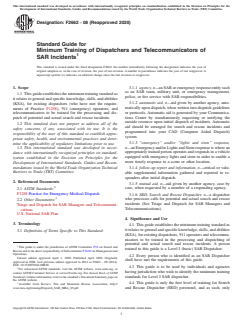
(Guide)Standard Guide for Minimum Training of Dispatchers and Telecommunicators of SAR Incidents
General Information
- Abstract
SIGNIFICANCE AND USE
4.1 This guide establishes the minimum training standard as it relates to general and specific knowledge, skills, and abilities (KSA), for existing dispatchers, 911 operators and telecommunicators to be trained in the processing and dispatching of potential and actual search and rescue incidents. A person trained to this guide is a Level I (basic) SAR Dispatcher.
4.2 Every person who is identified as an SAR Dispatcher shall have met the requirements of this guide.
4.3 This guide is to be used by individuals and agencies having jurisdiction who wish to identify the minimum training standards for Level I SAR dispatcher.
4.4 This guide is only the first level of training for Search and Rescue Dispatcher (SRD) personnel, and as such, only establishes the minimum knowledge, skills, and abilities required for a person to perform SAR Dispatch.
4.5 Nothing in this guide precludes a user of this guide from adding additional requirements for its own members.
4.6 This guide by itself is not a training document. It is only an outline of the topics required for training or evaluating a Level I SRD, but it can be used to develop a training document or program.
4.7 It is up to the training authority to determine the depth or detail of training to meet its needs.
4.8 This guide does not stand alone and must be used with the referenced documents to provide the specific information needed by the user.
4.9 This guide can be used to evaluate a book or other document to determine if its content meets the necessary topics for training an SRD. Likewise, the guide can be used to evaluate an existing training program to see if it meets the requirements of this guide.
4.10 The knowledge, skills, and abilities requirements presented in the following sections are not presented in any particular order and do not represent a training sequence.
4.11 Except where a physical skill needs to be shown, it is up to the instructor, evaluator, or tester to determine the best...
SCOPE
1.1 This guide establishes the minimum training standard as it relates to general and specific knowledge, skills, and abilities (KSA), for existing dispatchers (who have met the requirements of Practice F1258), 911 (emergency) operators, and telecommunicators to be trained for the processing and dispatch of potential and actual search and rescue incidents.
1.2 This standard does not purport to address all of the safety concerns, if any, associated with its use. It is the responsibility of the user of this standard to establish appropriate safety, health, and environmental practices and determine the applicability of regulatory limitations prior to use.
1.3 This international standard was developed in accordance with internationally recognized principles on standardization established in the Decision on Principles for the Development of International Standards, Guides and Recommendations issued by the World Trade Organization Technical Barriers to Trade (TBT) Committee.
- Status
- Published
- Publication Date
- 31-Mar-2020
- Technical Committee
- F32 - Search and Rescue
- Drafting Committee
- F32.02 - Management and Operations


Overview
ASTM F2662-08(2020), Standard Guide for Minimum Training of Dispatchers and Telecommunicators of SAR Incidents, provides the foundational framework for agencies and individuals involved in search and rescue (SAR) operations. The guide establishes the minimum knowledge, skills, and abilities (KSA) necessary for existing dispatchers, 911 operators, and telecommunicators who process and dispatch both potential and actual SAR incidents. By defining a standardized baseline for training, this guide aids organizations in developing consistent, reliable response capabilities and ensures personnel are prepared for the diverse challenges of SAR environments.
Key Topics
This ASTM standard covers a comprehensive range of issues critical to the effective dispatch and coordination of search and rescue missions, including:
- Minimum Knowledge Areas: Understanding urban versus rural/wilderness SAR dispatch, terrain and weather considerations, resource selection, and scenario-based responses.
- SAR-Specific Legal Issues: Awareness of mandated and authorized agencies, legal boundaries, and local protocols.
- Resource Coordination: Utilizing local, automatic, and mutual aid resources, managing multi-jurisdictional incidents, and integrating with law enforcement, emergency medical services (EMS), and fire services.
- Dispatch Protocols: Prioritizing simultaneous SAR calls, processing emergency vs. non-emergency responses, and knowing when to dispatch specialized teams.
- Call Gathering and Triaging: Collecting critical information in time-sensitive situations, particularly with technology limitations such as wireless phone issues or computer-aided dispatch system interruptions.
- Scenario Handling: Addressing incidents such as high angle rescues, water rescues, hazardous materials, missing persons, avalanches, blizzards, and disaster response.
- Skill Demonstration: Performing simulated or real SAR dispatch activities, including the use of maps, CAD systems, and follow-up reporting.
- Training Evaluation: Using the standard's outline to assess whether training programs or materials meet key requirements for Level I SAR Dispatcher qualification.
Applications
The guide's practical value extends to a broad range of public safety environments where search and rescue dispatch is essential:
- Training Program Development: Agencies can design or evaluate dispatcher training curricula to ensure all essential topics are covered, developing competent Level I SAR Dispatchers.
- Personnel Evaluation: Use as a benchmark for certifying dispatcher readiness or identifying areas for further professional development.
- Mutual Aid and Automatic Aid Agreements: Enables consistent expectations across jurisdictions, improving interagency cooperation and response times during SAR incidents.
- Quality Assurance: Evaluators and trainers can cross-reference course content, guidelines, and field practices to maintain alignment with ASTM’s standardized requirements.
- Resource Management: Supports effective mobilization and coordination of SAR resources both locally and through mutual aid channels.
- Continuous Improvement: Agencies may supplement the minimum requirements with additional topics specific to their operational context, as the guide allows for adaptation and expansion.
Related Standards
The ASTM F2662-08(2020) standard references and complements several key documents and standards relevant to emergency response and SAR dispatch roles:
- ASTM F1258 - Practice for Emergency Medical Dispatch, which outlines requirements for EMS call processing and dispatch.
- U.S. National SAR Plan - Federal guidelines for search and rescue operations coordination.
- Triage and Dispatch for SAR Managers and Telecommunications - Supplemental resources for SAR-specific call handling.
By adhering to ASTM F2662-08(2020), public safety agencies, dispatch centers, and training organizations can strengthen the preparedness and effectiveness of personnel tasked with the critical responsibility of managing search and rescue incidents. The guide’s application ensures a higher standard of safety and coordination within the SAR community, reinforcing a culture of excellence in emergency telecommunications.
Relations
- Effective Date
- 01-Apr-2020
- Effective Date
- 01-Mar-2006
- Effective Date
- 01-Jan-2001
- Effective Date
- 01-Jan-2001
Get Certified
Connect with accredited certification bodies for this standard

BSI Group
BSI (British Standards Institution) is the business standards company that helps organizations make excellence a habit.

Bureau Veritas
Bureau Veritas is a world leader in laboratory testing, inspection and certification services.

DNV
DNV is an independent assurance and risk management provider.
Sponsored listings
Frequently Asked Questions
ASTM F2662-08(2020) is a guide published by ASTM International. Its full title is "Standard Guide for Minimum Training of Dispatchers and Telecommunicators of SAR Incidents". This standard covers: SIGNIFICANCE AND USE 4.1 This guide establishes the minimum training standard as it relates to general and specific knowledge, skills, and abilities (KSA), for existing dispatchers, 911 operators and telecommunicators to be trained in the processing and dispatching of potential and actual search and rescue incidents. A person trained to this guide is a Level I (basic) SAR Dispatcher. 4.2 Every person who is identified as an SAR Dispatcher shall have met the requirements of this guide. 4.3 This guide is to be used by individuals and agencies having jurisdiction who wish to identify the minimum training standards for Level I SAR dispatcher. 4.4 This guide is only the first level of training for Search and Rescue Dispatcher (SRD) personnel, and as such, only establishes the minimum knowledge, skills, and abilities required for a person to perform SAR Dispatch. 4.5 Nothing in this guide precludes a user of this guide from adding additional requirements for its own members. 4.6 This guide by itself is not a training document. It is only an outline of the topics required for training or evaluating a Level I SRD, but it can be used to develop a training document or program. 4.7 It is up to the training authority to determine the depth or detail of training to meet its needs. 4.8 This guide does not stand alone and must be used with the referenced documents to provide the specific information needed by the user. 4.9 This guide can be used to evaluate a book or other document to determine if its content meets the necessary topics for training an SRD. Likewise, the guide can be used to evaluate an existing training program to see if it meets the requirements of this guide. 4.10 The knowledge, skills, and abilities requirements presented in the following sections are not presented in any particular order and do not represent a training sequence. 4.11 Except where a physical skill needs to be shown, it is up to the instructor, evaluator, or tester to determine the best... SCOPE 1.1 This guide establishes the minimum training standard as it relates to general and specific knowledge, skills, and abilities (KSA), for existing dispatchers (who have met the requirements of Practice F1258), 911 (emergency) operators, and telecommunicators to be trained for the processing and dispatch of potential and actual search and rescue incidents. 1.2 This standard does not purport to address all of the safety concerns, if any, associated with its use. It is the responsibility of the user of this standard to establish appropriate safety, health, and environmental practices and determine the applicability of regulatory limitations prior to use. 1.3 This international standard was developed in accordance with internationally recognized principles on standardization established in the Decision on Principles for the Development of International Standards, Guides and Recommendations issued by the World Trade Organization Technical Barriers to Trade (TBT) Committee.
SIGNIFICANCE AND USE 4.1 This guide establishes the minimum training standard as it relates to general and specific knowledge, skills, and abilities (KSA), for existing dispatchers, 911 operators and telecommunicators to be trained in the processing and dispatching of potential and actual search and rescue incidents. A person trained to this guide is a Level I (basic) SAR Dispatcher. 4.2 Every person who is identified as an SAR Dispatcher shall have met the requirements of this guide. 4.3 This guide is to be used by individuals and agencies having jurisdiction who wish to identify the minimum training standards for Level I SAR dispatcher. 4.4 This guide is only the first level of training for Search and Rescue Dispatcher (SRD) personnel, and as such, only establishes the minimum knowledge, skills, and abilities required for a person to perform SAR Dispatch. 4.5 Nothing in this guide precludes a user of this guide from adding additional requirements for its own members. 4.6 This guide by itself is not a training document. It is only an outline of the topics required for training or evaluating a Level I SRD, but it can be used to develop a training document or program. 4.7 It is up to the training authority to determine the depth or detail of training to meet its needs. 4.8 This guide does not stand alone and must be used with the referenced documents to provide the specific information needed by the user. 4.9 This guide can be used to evaluate a book or other document to determine if its content meets the necessary topics for training an SRD. Likewise, the guide can be used to evaluate an existing training program to see if it meets the requirements of this guide. 4.10 The knowledge, skills, and abilities requirements presented in the following sections are not presented in any particular order and do not represent a training sequence. 4.11 Except where a physical skill needs to be shown, it is up to the instructor, evaluator, or tester to determine the best... SCOPE 1.1 This guide establishes the minimum training standard as it relates to general and specific knowledge, skills, and abilities (KSA), for existing dispatchers (who have met the requirements of Practice F1258), 911 (emergency) operators, and telecommunicators to be trained for the processing and dispatch of potential and actual search and rescue incidents. 1.2 This standard does not purport to address all of the safety concerns, if any, associated with its use. It is the responsibility of the user of this standard to establish appropriate safety, health, and environmental practices and determine the applicability of regulatory limitations prior to use. 1.3 This international standard was developed in accordance with internationally recognized principles on standardization established in the Decision on Principles for the Development of International Standards, Guides and Recommendations issued by the World Trade Organization Technical Barriers to Trade (TBT) Committee.
ASTM F2662-08(2020) is classified under the following ICS (International Classification for Standards) categories: 03.100.30 - Management of human resources; 13.200 - Accident and disaster control. The ICS classification helps identify the subject area and facilitates finding related standards.
ASTM F2662-08(2020) has the following relationships with other standards: It is inter standard links to ASTM F2662-08(2014), ASTM F1258-95(2006), ASTM F1258-95(2001), ASTM F1258-95. Understanding these relationships helps ensure you are using the most current and applicable version of the standard.
ASTM F2662-08(2020) is available in PDF format for immediate download after purchase. The document can be added to your cart and obtained through the secure checkout process. Digital delivery ensures instant access to the complete standard document.
Standards Content (Sample)
This international standard was developed in accordance with internationally recognized principles on standardization established in the Decision on Principles for the
Development of International Standards, Guides and Recommendations issued by the World Trade Organization Technical Barriers to Trade (TBT) Committee.
Designation: F2662 − 08 (Reapproved 2020)
Standard Guide for
Minimum Training of Dispatchers and Telecommunicators of
SAR Incidents
This standard is issued under the fixed designation F2662; the number immediately following the designation indicates the year of
original adoption or, in the case of revision, the year of last revision. A number in parentheses indicates the year of last reapproval. A
superscript epsilon (´) indicates an editorial change since the last revision or reapproval.
1. Scope 3.1.1 agency, n—anSARoremergencyresponseentitysuch
as an SAR team, military unit, or emergency management,
1.1 This guide establishes the minimum training standard as
police, or fire service with SAR responsibilities.
it relates to general and specific knowledge, skills, and abilities
3.1.2 automatic aid, n—aid given by another agency, auto-
(KSA), for existing dispatchers (who have met the require-
matically upon dispatch, when written into dispatch guidelines
ments of Practice F1258), 911 (emergency) operators, and
or protocols. Automatic aid is generated by your Communica-
telecommunicators to be trained for the processing and dis-
tions Center by simultaneously requesting or notifying the
patch of potential and actual search and rescue incidents.
outside resource upon initial dispatch of incidents. Automatic
1.2 This standard does not purport to address all of the
aid should be arranged for search and rescue incidents and
safety concerns, if any, associated with its use. It is the
programmed into your CAD (Computer Aided Dispatch)
responsibility of the user of this standard to establish appro-
system.
priate safety, health, and environmental practices and deter-
3.1.3 “emergency” and/or “lights and siren” response,
mine the applicability of regulatory limitations prior to use.
n—an Emergency and/or Lights and Siren response is where an
1.3 This international standard was developed in accor-
appropriately trained person operates and responds in a vehicle
dance with internationally recognized principles on standard-
equipped with emergency lights and siren in order to enable a
ization established in the Decision on Principles for the
more timely response to a scene or other location.
Development of International Standards, Guides and Recom-
mendations issued by the World Trade Organization Technical
3.1.4 follow-up report and information, n—critical or valu-
Barriers to Trade (TBT) Committee.
able supplemental information gathered and reported to re-
sponders after initial dispatch.
2. Referenced Documents
3.1.5 mutual aid, n—aid given by another agency, case by
case, when requested by a member of a responding agency.
2.1 ASTM Standards:
F1258 Practice for Emergency Medical Dispatch
3.1.6 SRD, Search and Rescue Dispatcher, n—a dispatcher
who processes calls for potential and actual search and rescue
2.2 Other Documents:
incidents (See Triage and Dispatch for SAR Managers and
Triage and Dispatch for SAR Managers and Telecommuni-
Telecommunications).
cations
U.S. National SAR Plan
4. Significance and Use
3. Terminology
4.1 This guide establishes the minimum training standard as
it relates to general and specific knowledge, skills, and abilities
3.1 Definitions of Terms Specific to This Standard:
(KSA), for existing dispatchers, 911 operators and telecommu-
nicators to be trained in the processing and dispatching of
potential and actual search and rescue incidents. A person
This guide is under the jurisdiction of ASTM Committee F32 on Search and
trained to this guide is a Level I (basic) SAR Dispatcher.
Rescue and is the direct responsibility of Subcommittee F32.02 on Management and
Operations.
4.2 Every person who is identified as an SAR Dispatcher
Current edition approved April 1, 2020. Published April 2020. Originally
shall have met the requirements of this guide.
approved in 2008. Last previous edition approved in 2014 as F2662 – 08 (2014).
DOI: 10.1520/F2662-08R20.
4.3 This guide is to be used by individuals and agencies
For referenced ASTM standards, visit the ASTM website, www.astm.org, or
having jurisdiction who wish to identify the minimum training
contact ASTM Customer Service at service@astm.org. For Annual Book of ASTM
Standards volume information, refer to the standard’s Document Summary page on standards for Level I SAR dispatcher.
the ASTM website.
4.4 This guide is only the first level of training for Search
Available from Kovacs, Tim and Mountain Rescue Association, http://
www.mra.org/training/Dispatch_SAR_MRA_05.pdf and Rescue Dispatcher (SRD) personnel, and as such, only
Copyright © ASTM International, 100 Barr Harbor Drive, PO Box C700, West Conshohocken, PA 19428-2959. United States
F2662 − 08 (2020)
establishes the minimum knowledge, skills, and abilities re- 5.1.12 Ability to operate in “manual mode” (when comput-
quired for a person to perform SAR Dispatch. ers and related aids are inoperable or not available).
5.1.13 Multi-jurisdictional, automatic aid and mutual aid
4.5 Nothing in this guide precludes a user of this guide from
issues.
adding additional requirements for its own members.
5.1.14 Processing, dispatching and prioritizing simultane-
4.6 This guide by itself is not a training document. It is only
ous and multiple different SAR calls.
an outline of the topics required for training or evaluating a
5.1.15 Guidelines for determining responses, including
Level I SRD, but it can be used to develop a training document
emergency lights and siren responses and non-emergency
or program.
responses.
4.7 It is up to the training authority to determine the depth 5.1.16 Guidelines for dispatching SAR resources out of
or detail of training to meet its needs. primary jurisdiction or area of operations.
5.1.17 The need for call monitoring of medical and fire calls
4.8 This guide does not stand alone and must be used with
for latent SAR calls.
the referenced documents to provide the specific information
5.1.18 Needforautomaticandmutualaidandinterfacewith
needed by the user.
law enforcement, EMS (Emergency Medical Dispatch), and
4.9 This guide can be used to evaluate a book or other
Fire dispatch agencies for SAR (Search and Rescue) calls.
document to determine if its content meets the necessary topics
5.1.19 Differences between disaster and urban SAR re-
for training an SRD. Likewise, the guide can be used to
sourcesversuscivil(non-militarycombatSAR)SARresources
evaluate an existing training program to see if it meets the
under the U.S. National SAR Plan or the country’s equivalent.
re
...