

ASTM F2751-16
(Guide)Standard Guide for Training of a Land Search and Rescue Team Member
General Information
- Abstract
SIGNIFICANCE AND USE
4.1 This guide establishes the minimum knowledge, skills, and abilities that a person shall have to perform as a Land Search and Rescue Team Member. No other skills are included or implied.
4.2 Every person who is identified as a Land Search and Rescue Team Member shall have met the requirements of this guide.
4.3 This guide is to be used by individuals and agencies having jurisdiction that wish to identify the minimum training required for a Land Search and Rescue Team Member.
4.3.1 Although this guide establishes the minimum training required for a Land Search and Rescue Team Member, it does not imply that a Land Search and Rescue Team Member is a “trainee,” “probationary,” or other similar term member of an AHJ.
4.3.2 Determining the requirements and qualifications for land search and rescue team members is the responsibility of the AHJ.
4.3.3 The AHJ shall determine the depth or detail of training required to meet these needs.
4.3.4 Nothing in this guide precludes an AHJ from adding additional requirements for its own members.
4.4 This guide can be used to evaluate a document or training program to determine if its content includes the topics necessary for training individuals to operate as a Land Search and Rescue Team Member.
4.5 This guide by itself is not a training document. It is an outline of the topics required for training or evaluating a Land Search and Rescue Team Member, although it can be used to develop a training document or program.
4.6 This guide does not stand alone and shall be used with the referenced documents to provide the specific information needed by a Land Search and Rescue Team Member or AHJ.
4.7 This guide can be used to evaluate a document to determine if its content meets the necessary topics for training a Land Search and Rescue Team Member. Likewise, the guide can be used to evaluate an existing training program to see if it meets the requirements of this guide.
4.8 The knowledge and skills presen...
SCOPE
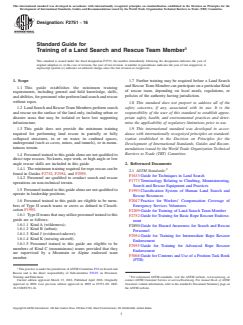
1.1 This guide establishes the minimum training requirements, including general and field knowledge, skills, and abilities, for personnel who perform land search and rescue without ropes.
1.2 Land Search and Rescue Team Members perform search and rescue on the surface of the land only, including urban or disaster areas that may be isolated or have lost supporting infrastructure.
1.3 This guide does not provide the minimum training required for performing land rescue in partially or fully collapsed structures, in or on water, in confined spaces, underground (such as caves, mines, and tunnels), or in mountainous terrain.
1.4 Personnel trained to this guide alone are not qualified to direct rope rescues. No knots, rope work, or high angle or low angle rescue skills are included in this guide.
1.4.1 The minimum training required for rope rescue can be found in Guides F2752, F2954, and F2955.
1.4.2 Personnel are qualified to conduct search and rescue operations on non-technical terrain.
1.5 Personnel trained to this guide alone are not qualified to operate in leadership positions.
1.6 Personnel trained to this guide are eligible to be members of Type II search teams or crews as defined in Classification F1993.
1.6.1 Type II teams that may utilize personnel trained to this guide are as follows:
1.6.1.1 Kind A (wilderness);
1.6.1.2 Kind B (urban);
1.6.1.3 Kind J (evidence/cadaver);
1.6.1.4 Kind K (missing aircraft).
1.6.1.5 Personnel trained to this guide are eligible to be members of Kind C (mountainous) teams provided that they are supervised by a Mountain or Alpine endorsed team member.
1.7 Further training may be required before a Land Search and Rescue Team Member can participate on a particular Kind of rescue team, depending on local needs, regulations, or policies of the authority having jurisdiction.
1.8 This standard does not purport to address all of the safety concerns, if any...
- Status
- Published
- Publication Date
- 14-Mar-2016
- Technical Committee
- F32 - Search and Rescue
- Drafting Committee
- F32.03 - Personnel, Training and Education

Overview
ASTM F2751-16 – Standard Guide for Training of a Land Search and Rescue Team Member defines the minimum requirements for the training of personnel assigned as Land Search and Rescue (SAR) Team Members. This standard guide, developed by ASTM International, sets out the essential knowledge, skills, and abilities necessary for effective performance in land-based SAR operations, excluding technical rope rescue and other specialized disciplines.
ASTM F2751-16 is a critical resource for agencies, organizations, and authorities having jurisdiction (AHJ) seeking to identify, develop, or assess SAR team member training. It ensures personnel are equipped to carry out search and rescue missions safely and efficiently on non-technical terrain, including areas affected by disasters or infrastructure loss.
Key Topics
Scope and Limitations
- Applies to land SAR operations without ropes or technical rescues
- Does not cover collapsed structures, water rescues, confined spaces, underground, or mountainous rescues
- Excludes rope work and high/low angle rescue skills
Training Requirements
- Outlines minimum knowledge, skills, and abilities for SAR team members
- Covers both general and field-specific competencies
- Medical and physical fitness standards set by AHJ
- CPR and first aid certification required
Team Types and Roles
- Qualifies personnel for Type II search teams: wilderness, urban, evidence/cadaver, missing aircraft
- Permits assignment to mountainous teams under supervision
- Does not qualify for leadership or technical rescue roles
Evaluation and Documentation
- Can be used to develop or assess training content and programs
- Requires demonstration of skills through a position task book or field evaluation
Use by Authorities Having Jurisdiction
- AHJ determines depth and detail of training and may set additional requirements
- Flexibility to adapt the guide to local operational needs and regulations
Applications
ASTM F2751-16 is designed for practical adoption by:
- Public safety agencies, emergency services, and rescue organizations that field teams for land search and rescue operations
- Regulatory authorities and standards bodies establishing baseline qualifications for SAR responders
- Training coordinators and program evaluators tasked with developing, delivering, or reviewing SAR training courses
- SAR team members and candidates seeking clear guidance on the competencies required for operational readiness
- Quality assurance professionals measuring the compliance of training programs or evaluating readiness and qualification of SAR personnel
Typical use cases include:
- Formalizing SAR team training programs to meet the minimum industry standard
- Auditing or benchmarking existing land search and rescue training for content completeness
- Structuring entry-level SAR training for volunteers and career rescuers
- Supporting mutual aid agreements by clarifying baseline team member qualifications
Related Standards
To ensure comprehensive training and operational safety, ASTM F2751-16 should be used in conjunction with related standards and guidance, including:
- ASTM F2209 – Guide for Training of Land Search Team Member
- ASTM F1591 – Practice for Visual Signals Between Persons on the Ground and in Aircraft During Ground Emergencies
- ASTM F1633 – Guide for Techniques in Land Search
- ASTM F2047 – Practice for Workers’ Compensation Coverage of Emergency Services Volunteers
- ASTM F2752, F2954, F2955 – Guides for Rope Rescue Training (Levels I-III)
- ASTM F1993 – Classification System of Human Search and Rescue Resources
- ASTM F2890 – Guide for Hazard Awareness for Search and Rescue Personnel
- ASTM F1768 – Guide for Using Whistle Signals During Rope Rescue Operations
- ASTM F3068 – Guide for Contents and Use of a Position Task Book
- NWCG PMS 307 – Work Capacity Test
Summary
ASTM F2751-16 is integral for establishing competency and performance expectations for land SAR team members, supporting public safety and operational consistency across jurisdictions. Its adoption enhances responder effectiveness, ensures baseline qualification, and contributes to safer, more coordinated SAR missions. For comprehensive land rescue training, this guide should be integrated with relevant ASTM and national SAR standards.
Keywords: Land Search and Rescue, ASTM F2751-16, SAR Training Standard, Rescue Team Member, Search and Rescue Qualifications, Emergency Response Training, Non-technical Terrain, Public Safety Standards, Authority Having Jurisdiction, Personnel Competence
Relations
- Effective Date
- 01-Apr-2024
- Effective Date
- 01-Apr-2024
- Effective Date
- 01-Apr-2019
- Effective Date
- 01-Apr-2019
- Effective Date
- 01-Apr-2019
- Effective Date
- 01-Apr-2019
- Effective Date
- 01-Dec-2015
- Effective Date
- 01-Mar-2014
- Effective Date
- 01-Sep-2012
- Refers
ASTM F2955-12 - Standard Guide for Training for Level III Rope Rescue (R3) Rescuer Endorsement - Effective Date
- 01-Jun-2012
- Effective Date
- 01-Jun-2012
- Effective Date
- 01-May-2012
- Effective Date
- 01-May-2010
- Effective Date
- 01-Oct-2009
- Effective Date
- 01-Apr-2009
Get Certified
Connect with accredited certification bodies for this standard

CIS Institut d.o.o.
Personal Protective Equipment (PPE) certification body. Notified Body NB-2890 for EU Regulation 2016/425 PPE.

Kiwa BDA Testing
Building and construction product certification.
Kmetijski inštitut Slovenije
Agricultural Institute of Slovenia. Soil testing, plant health, agricultural product analysis.
Sponsored listings
Frequently Asked Questions
ASTM F2751-16 is a guide published by ASTM International. Its full title is "Standard Guide for Training of a Land Search and Rescue Team Member". This standard covers: SIGNIFICANCE AND USE 4.1 This guide establishes the minimum knowledge, skills, and abilities that a person shall have to perform as a Land Search and Rescue Team Member. No other skills are included or implied. 4.2 Every person who is identified as a Land Search and Rescue Team Member shall have met the requirements of this guide. 4.3 This guide is to be used by individuals and agencies having jurisdiction that wish to identify the minimum training required for a Land Search and Rescue Team Member. 4.3.1 Although this guide establishes the minimum training required for a Land Search and Rescue Team Member, it does not imply that a Land Search and Rescue Team Member is a “trainee,” “probationary,” or other similar term member of an AHJ. 4.3.2 Determining the requirements and qualifications for land search and rescue team members is the responsibility of the AHJ. 4.3.3 The AHJ shall determine the depth or detail of training required to meet these needs. 4.3.4 Nothing in this guide precludes an AHJ from adding additional requirements for its own members. 4.4 This guide can be used to evaluate a document or training program to determine if its content includes the topics necessary for training individuals to operate as a Land Search and Rescue Team Member. 4.5 This guide by itself is not a training document. It is an outline of the topics required for training or evaluating a Land Search and Rescue Team Member, although it can be used to develop a training document or program. 4.6 This guide does not stand alone and shall be used with the referenced documents to provide the specific information needed by a Land Search and Rescue Team Member or AHJ. 4.7 This guide can be used to evaluate a document to determine if its content meets the necessary topics for training a Land Search and Rescue Team Member. Likewise, the guide can be used to evaluate an existing training program to see if it meets the requirements of this guide. 4.8 The knowledge and skills presen... SCOPE 1.1 This guide establishes the minimum training requirements, including general and field knowledge, skills, and abilities, for personnel who perform land search and rescue without ropes. 1.2 Land Search and Rescue Team Members perform search and rescue on the surface of the land only, including urban or disaster areas that may be isolated or have lost supporting infrastructure. 1.3 This guide does not provide the minimum training required for performing land rescue in partially or fully collapsed structures, in or on water, in confined spaces, underground (such as caves, mines, and tunnels), or in mountainous terrain. 1.4 Personnel trained to this guide alone are not qualified to direct rope rescues. No knots, rope work, or high angle or low angle rescue skills are included in this guide. 1.4.1 The minimum training required for rope rescue can be found in Guides F2752, F2954, and F2955. 1.4.2 Personnel are qualified to conduct search and rescue operations on non-technical terrain. 1.5 Personnel trained to this guide alone are not qualified to operate in leadership positions. 1.6 Personnel trained to this guide are eligible to be members of Type II search teams or crews as defined in Classification F1993. 1.6.1 Type II teams that may utilize personnel trained to this guide are as follows: 1.6.1.1 Kind A (wilderness); 1.6.1.2 Kind B (urban); 1.6.1.3 Kind J (evidence/cadaver); 1.6.1.4 Kind K (missing aircraft). 1.6.1.5 Personnel trained to this guide are eligible to be members of Kind C (mountainous) teams provided that they are supervised by a Mountain or Alpine endorsed team member. 1.7 Further training may be required before a Land Search and Rescue Team Member can participate on a particular Kind of rescue team, depending on local needs, regulations, or policies of the authority having jurisdiction. 1.8 This standard does not purport to address all of the safety concerns, if any...
SIGNIFICANCE AND USE 4.1 This guide establishes the minimum knowledge, skills, and abilities that a person shall have to perform as a Land Search and Rescue Team Member. No other skills are included or implied. 4.2 Every person who is identified as a Land Search and Rescue Team Member shall have met the requirements of this guide. 4.3 This guide is to be used by individuals and agencies having jurisdiction that wish to identify the minimum training required for a Land Search and Rescue Team Member. 4.3.1 Although this guide establishes the minimum training required for a Land Search and Rescue Team Member, it does not imply that a Land Search and Rescue Team Member is a “trainee,” “probationary,” or other similar term member of an AHJ. 4.3.2 Determining the requirements and qualifications for land search and rescue team members is the responsibility of the AHJ. 4.3.3 The AHJ shall determine the depth or detail of training required to meet these needs. 4.3.4 Nothing in this guide precludes an AHJ from adding additional requirements for its own members. 4.4 This guide can be used to evaluate a document or training program to determine if its content includes the topics necessary for training individuals to operate as a Land Search and Rescue Team Member. 4.5 This guide by itself is not a training document. It is an outline of the topics required for training or evaluating a Land Search and Rescue Team Member, although it can be used to develop a training document or program. 4.6 This guide does not stand alone and shall be used with the referenced documents to provide the specific information needed by a Land Search and Rescue Team Member or AHJ. 4.7 This guide can be used to evaluate a document to determine if its content meets the necessary topics for training a Land Search and Rescue Team Member. Likewise, the guide can be used to evaluate an existing training program to see if it meets the requirements of this guide. 4.8 The knowledge and skills presen... SCOPE 1.1 This guide establishes the minimum training requirements, including general and field knowledge, skills, and abilities, for personnel who perform land search and rescue without ropes. 1.2 Land Search and Rescue Team Members perform search and rescue on the surface of the land only, including urban or disaster areas that may be isolated or have lost supporting infrastructure. 1.3 This guide does not provide the minimum training required for performing land rescue in partially or fully collapsed structures, in or on water, in confined spaces, underground (such as caves, mines, and tunnels), or in mountainous terrain. 1.4 Personnel trained to this guide alone are not qualified to direct rope rescues. No knots, rope work, or high angle or low angle rescue skills are included in this guide. 1.4.1 The minimum training required for rope rescue can be found in Guides F2752, F2954, and F2955. 1.4.2 Personnel are qualified to conduct search and rescue operations on non-technical terrain. 1.5 Personnel trained to this guide alone are not qualified to operate in leadership positions. 1.6 Personnel trained to this guide are eligible to be members of Type II search teams or crews as defined in Classification F1993. 1.6.1 Type II teams that may utilize personnel trained to this guide are as follows: 1.6.1.1 Kind A (wilderness); 1.6.1.2 Kind B (urban); 1.6.1.3 Kind J (evidence/cadaver); 1.6.1.4 Kind K (missing aircraft). 1.6.1.5 Personnel trained to this guide are eligible to be members of Kind C (mountainous) teams provided that they are supervised by a Mountain or Alpine endorsed team member. 1.7 Further training may be required before a Land Search and Rescue Team Member can participate on a particular Kind of rescue team, depending on local needs, regulations, or policies of the authority having jurisdiction. 1.8 This standard does not purport to address all of the safety concerns, if any...
ASTM F2751-16 is classified under the following ICS (International Classification for Standards) categories: 13.200 - Accident and disaster control. The ICS classification helps identify the subject area and facilitates finding related standards.
ASTM F2751-16 has the following relationships with other standards: It is inter standard links to ASTM F1993-24, ASTM F2890-17(2024), ASTM F2047-00(2019), ASTM F2954-19, ASTM F2752-19, ASTM F2955-19, ASTM F1773-09(2015), ASTM F2752-09(2014), ASTM F2890-12, ASTM F2955-12, ASTM F2954-12, ASTM F2047-00(2012), ASTM F2209-10, ASTM F1773-09, ASTM F2752-09. Understanding these relationships helps ensure you are using the most current and applicable version of the standard.
ASTM F2751-16 is available in PDF format for immediate download after purchase. The document can be added to your cart and obtained through the secure checkout process. Digital delivery ensures instant access to the complete standard document.
Standards Content (Sample)
This international standard was developed in accordance with internationally recognized principles on standardization established in the Decision on Principles for the
Development of International Standards, Guides and Recommendations issued by the World Trade Organization Technical Barriers to Trade (TBT) Committee.
Designation: F2751 − 16
Standard Guide for
Training of a Land Search and Rescue Team Member
This standard is issued under the fixed designation F2751; the number immediately following the designation indicates the year of
original adoption or, in the case of revision, the year of last revision. A number in parentheses indicates the year of last reapproval. A
superscript epsilon (´) indicates an editorial change since the last revision or reapproval.
1. Scope 1.7 Further training may be required before a Land Search
and Rescue Team Member can participate on a particular Kind
1.1 This guide establishes the minimum training
of rescue team, depending on local needs, regulations, or
requirements, including general and field knowledge, skills,
policies of the authority having jurisdiction.
and abilities, for personnel who perform land search and rescue
without ropes.
1.8 This standard does not purport to address all of the
1.2 Land Search and Rescue Team Members perform search safety concerns, if any, associated with its use. It is the
and rescue on the surface of the land only, including urban or responsibility of the user of this standard to establish appro-
disaster areas that may be isolated or have lost supporting
priate safety, health, and environmental practices and deter-
infrastructure.
mine the applicability of regulatory limitations prior to use.
1.3 This guide does not provide the minimum training 1.9 This international standard was developed in accor-
required for performing land rescue in partially or fully dance with internationally recognized principles on standard-
collapsed structures, in or on water, in confined spaces,
ization established in the Decision on Principles for the
underground (such as caves, mines, and tunnels), or in moun-
Development of International Standards, Guides and Recom-
tainous terrain.
mendations issued by the World Trade Organization Technical
Barriers to Trade (TBT) Committee.
1.4 Personnel trained to this guide alone are not qualified to
direct rope rescues. No knots, rope work, or high angle or low
2. Referenced Documents
angle rescue skills are included in this guide.
1.4.1 The minimum training required for rope rescue can be
2.1 ASTM Standards:
found in Guides F2752, F2954, and F2955.
F1633 Guide for Techniques in Land Search
1.4.2 Personnel are qualified to conduct search and rescue
F1773 Terminology Relating to Climbing, Mountaineering,
operations on non-technical terrain.
Search and Rescue Equipment and Practices
1.5 Personnel trained to this guide alone are not qualified to
F1993 Classification System of Human Land Search and
operate in leadership positions.
Rescue Resources
1.6 Personnel trained to this guide are eligible to be mem- F2047 Practice for Workers’ Compensation Coverage of
bers of Type II search teams or crews as defined in Classifi-
Emergency Services Volunteers
cation F1993.
F2209 Guide for Training of Land Search Team Member
1.6.1 Type II teams that may utilize personnel trained to this
F2752 Guide for Training for Basic Rope Rescuer Endorse-
guide are as follows:
ment
1.6.1.1 Kind A (wilderness);
F2890 Guide for Hazard Awareness for Search and Rescue
1.6.1.2 Kind B (urban);
Personnel
1.6.1.3 Kind J (evidence/cadaver);
F2954 Guide for Training for Intermediate Rope Rescuer
1.6.1.4 Kind K (missing aircraft).
Endorsement
1.6.1.5 Personnel trained to this guide are eligible to be
F2955 Guide for Training for Advanced Rope Rescuer
members of Kind C (mountainous) teams provided that they
Endorsement
are supervised by a Mountain or Alpine endorsed team
F3068 Guide for Contents and Use of a Position Task Book
member.
(PTB)
This practice is under the jurisdiction of ASTM Committee F32 on Search and
Rescue and is the direct responsibility of Subcommittee F32.03 on Personnel,
Training and Education. For referenced ASTM standards, visit the ASTM website, www.astm.org, or
Current edition approved March 15, 2016. Published April 2016. Originally contact ASTM Customer Service at service@astm.org. For Annual Book of ASTM
approved in 2009. Last previous edition approved in 2009 as F2751–09. DOI: Standards volume information, refer to the standard’s Document Summary page on
10.1520/F2751-16. the ASTM website.
Copyright © ASTM International, 100 Barr Harbor Drive, PO Box C700, West Conshohocken, PA 19428-2959. United States
F2751 − 16
2.2 Other Documents: 4.4 This guide can be used to evaluate a document or
NWCG PMS 307 Work Capacity Test training program to determine if its content includes the topics
necessary for training individuals to operate as a Land Search
3. Terminology
and Rescue Team Member.
3.1 Definitions of Terms Specific to This Standard:
4.5 This guide by itself is not a training document. It is an
3.1.1 high angle, n—terrain whose average slope has an
outline of the topics required for training or evaluating a Land
angle greater than 50° from horizontal.
Search and Rescue Team Member, although it can be used to
3.1.2 land rescue team, n—organized group of people who
develop a training document or program.
perform rescue on the surface of the earth without the use of
4.6 This guide does not stand alone and shall be used with
ropes.
the referenced documents to provide the specific information
3.1.3 low angle, n—terrain whose average slope has an
needed by a Land Search and Rescue Team Member or AHJ.
angle of 30 to 50° from horizontal.
4.7 This guide can be used to evaluate a document to
3.1.4 non-technical terrain, n—a tract of land characterized
determine if its content meets the necessary topics for training
by minimal slopes and little variation in elevation, where a
a Land Search and Rescue Team Member. Likewise, the guide
person is able to move safely and effectively on two feet,
can be used to evaluate an existing training program to see if
without handholds, and without the need for a belay.
it meets the requirements of this guide.
3.1.5 qualified supervisor, n—individual with demonstrated
4.8 The knowledge and skills presented in the following
knowledge or competence in a task, to whom the authority
sections are not in any particular order and do not represent a
having jurisdiction (AHJ) has granted the authority to observe
training sequence.
and oversee an individual performing that task.
4.9 A Land Search and Rescue Team Member shall docu-
3.1.6 rescue, n—operation to retrieve persons in distress,
ment his or her training by completion of a position task book,
provide for their initial medical or other needs, and deliver
compliant with Guide F3068, or by field demonstration under
them to a place of safety.
qualified supervision.
3.2 For definitions of other terms used in this guide, see
4.10 Unless stated otherwise, an ability or proficiency in a
Terminology F1773, Guide F1633, Classification F1993, Prac-
skill shall be demonstrated for initial qualification and then as
tice F2047, Guide F2209, and other references listed in this
often as required by the AHJ.
guide.
4.11 Except where a physical skill or ability shall be
4. Significance and Use
demonstrated, the AHJ shall determine the best way to evaluate
a person’s knowledge. This may be by written examination,
4.1 This guide establishes the minimum knowledge, skills,
oral examination, demonstration, or by some combination of
and abilities that a person shall have to perform as a Land
the three.
Search and Rescue Team Member. No other skills are included
or implied.
4.12 Additional skill set-specific endorsements may be used
in conjunction with this guide to train rescue personnel for
4.2 Every person who is identified as a Land Search and
other rescue disciplines.
Rescue Team Member shall have met the requirements of this
guide.
5. Personal Fitness and Health
4.3 This guide is to be used by individuals and agencies
5.1 Land Search and Rescue Team Members shall demon-
having jurisdiction that wish to identify the minimum training
strate annually that they meet the requirements of a medical
required for a Land Search and Rescue Team Member.
4.3.1 Although this guide establishes the minimum training fitness standard determined by the AHJ.
required for a Land Search and Rescue Team Member, it does
5.2 Land Search and Rescue Team Members shall demon-
not imply that a Land Search and Rescue Team Member is a
strate annually that they meet the requirements of a physical
“trainee,” “probationary,” or other similar term member of an
performance standard determined by the AHJ.
AHJ.
5.2.1 The recommended minimum physical performance
4.3.2 Determining the requirements and qualifications for
requirement for Land Rescue Team Members is the "Moderate"
land search and rescue team m
...
This document is not an ASTM standard and is intended only to provide the user of an ASTM standard an indication of what changes have been made to the previous version. Because
it may not be technically possible to adequately depict all changes accurately, ASTM recommends that users consult prior editions as appropriate. In all cases only the current version
of the standard as published by ASTM is to be considered the official document.
Designation: F2751 − 09 F2751 − 16
Standard Guide for
Training of Support Level Land a Land Search and Rescue
Team Member (LRT-Support) Member
This standard is issued under the fixed designation F2751; the number immediately following the designation indicates the year of
original adoption or, in the case of revision, the year of last revision. A number in parentheses indicates the year of last reapproval. A
superscript epsilon (´) indicates an editorial change since the last revision or reapproval.
1. Scope
1.1 This guide establishes the minimum training standard for LRT-Support Members as it relates to their general, field, and
rescue-specific knowledge and skills. This document may appropriately be used to develop or evaluate a training document or
program.requirements, including general and field knowledge, skills, and abilities, for personnel who perform land search and
rescue without ropes.
1.2 Land Search and Rescue Team Members perform search and rescue on the surface of the land only, including urban or
disaster areas that may be isolated or have lost supporting infrastructure.
1.3 An LRT-Support Member rescues on the surface of the land only, including wilderness, mountainous, desert, or remote
environments. This guide alone This guide does not provide the minimum training requirements for rescuing in the high angle
environment, required for performing land rescue in partially or fully collapsed structures, in or on water, in confined spaces, or
underground (such as caves, mines, and tunnels).tunnels), or in mountainous terrain.
1.2.1 An LRT-Support Member is required to have knowledge and skill sets pertaining to the evacuation/carryout component
of rescue.
1.2.2 LRT-Support Members must work under qualified supervision.
1.2.3 LRT-Support Members are eligible to be members of Type II search teams or crews as defined in Classification F1993.
1.4 Personnel trained to this guide alone are not qualified to direct rope rescues. No knots, rope work, or high angle or low angle
rescue skills are included in this guide.
1.4.1 The minimum training required for rope rescue can be found in Guides F2752, F2954, and F2955.
1.4.2 Personnel are qualified to conduct search and rescue operations on non-technical terrain.
1.5 Personnel trained to this guide alone are not qualified to operate in leadership positions.
1.6 Personnel trained to this guide are eligible to be members of Type II search teams or crews as defined in Classification
F1993.
1.6.1 Type II teams that may utilize personnel trained to this guide are as follows:
1.6.1.1 Kind A (wilderness);
1.6.1.2 Kind B (urban);
1.6.1.3 Kind J (evidence/cadaver);
1.6.1.4 Kind K (missing aircraft).
1.6.1.5 Personnel trained to this guide are eligible to be members of Kind C (mountainous) teams provided that they are
supervised by a Mountain or Alpine endorsed team member.
1.7 Type II teams which may utilize personnel trained to this guide are Kind A (wilderness), Kind C (mountainous), or other
remote areas including urban or disaster areas that may be isolated or have lost their infrastructure.Further training may be required
before a Land Search and Rescue Team Member can participate on a particular Kind of rescue team, depending on local needs,
regulations, or policies of the authority having jurisdiction.
1.3.1 Further training may be required before an LRT-Support Member can actually participate on a particular kind of rescue
team, based on specific local need, regulations, or policies.
This practice is under the jurisdiction of ASTM Committee F32 on Search and Rescue and is the direct responsibility of Subcommittee F32.03 on Personnel, Training
and Education.
Current edition approved April 1, 2009March 15, 2016. Published May 2009April 2016. Originally approved in 2009. Last previous edition approved in 2009 as F2751–09.
DOI: 10.1520/F2751-09.10.1520/F2751-16.
Copyright © ASTM International, 100 Barr Harbor Drive, PO Box C700, West Conshohocken, PA 19428-2959. United States
F2751 − 16
1.8 This standard does not purport to address all of the safety concerns, if any, associated with its use. It is the responsibility
of the user of this standard to establish appropriate safety and health practices and determine the applicability of regulatory
limitationsrequirements prior to use.
2. Referenced Documents
2.1 ASTM Standards:
F1490 Terminology Relating to Search and Rescue (Withdrawn 2011)
F1591 Practice for Visual Signals Between Persons on the Ground and in Aircraft During Ground Emergencies
F1633 Guide for Techniques in Land Search
F1768F1773 Guide for Using Whistle Signals During Rope Rescue OperationsTerminology Relating to Climbing,
Mountaineering, Search and Rescue Equipment and Practices
F1993 Classification System of Human Search and Rescue Resources (Withdrawn 2014)
F2047 Practice for Workers’ Compensation Coverage of Emergency Services Volunteers
F2209 Guide for Training of Land Search Team Member
F2047F2752 Practice for Workers’ Compensation Coverage of Emergency Services VolunteersGuide for Training for Level I
Rope Rescue (R1) Rescuer Endorsement
F2890 Guide for Hazard Awareness for Search and Rescue Personnel
F2954 Guide for Training for Level II Rope Rescue (R2) Rescuer Endorsement
F2955 Guide for Training for Level III Rope Rescue (R3) Rescuer Endorsement
F3068 Guide for Contents and Use of a Position Task Book (PTB)
2.2 Other Documents:
NWCG PMS 307 Work Capacity Test
3. Terminology
3.1 For definitions of terms used in this guide, see Terminology F1490, Guide F1633, Classification F1993, Practice F2047,
Guide F2209, and other references within this guide.
3.1 Definitions of Terms Specific to This Standard:
3.1.1 high angle, n—terrain whose average slope has an angle greater than 50° from horizontal.
3.1.2 land rescue team, n—aorganized group of individuals rescuing people who perform rescue on the surface of the earth.earth
without the use of ropes.
3.1.3 Support Level Land Rescue Team Member (LRT-Support Member ), low angle, n—a member of a rescue team who, as a
minimum, meets the requirements of this guide. These requirements define the basic, entry, awareness, or similar term level of land
rescue knowledge and skills.terrain whose average slope has an angle of 30 to 50° from horizontal.
3.1.4 non-technical terrain, n—a tract of land characterized by minimal slopes and little variation in elevation, where a person
is able to move safely and effectively on two feet, without handholds, and without the need for a belay.
3.1.5 qualified supervisor, n—individual with demonstrated knowledge or competence in a task, to whom the authority having
jurisdiction (AHJ) has granted the authority to observe and oversee an individual performing that task.
3.1.6 rescue, n—operation to retrieve persons in distress, provide for their initial medical or other needs, and deliver them to
a place of safety.
3.2 For definitions of other terms used in this guide, see Terminology F1773, Guide F1633, Classification F1993, Practice
F2047, Guide F2209, and other references listed in this guide.
4. Significance and Use
4.1 This guide establishes the minimum standard for training Land Rescue Team Members as it relates to their general, field,
and rescue-specific knowledge and skills. A person trained to this guide is a Support Level Land Rescue Team Member
(LRT-Support Member).knowledge, skills, and abilities that a person shall have to perform as a Land Search and Rescue Team
Member. No other skills are included or implied.
4.2 Every person who is identified as an LRT-Support a Land Search and Rescue Team Member shall have met the requirements
of this guide.
For referenced ASTM standards, visit the ASTM website, www.astm.org, or contact ASTM Customer Service at service@astm.org. For Annual Book of ASTM Standards
volume information, refer to the standard’s Document Summary page on the ASTM website.
The last approved version of this historical standard is referenced on www.astm.org.
Available from NWCG IRM-PMO, National Interagency Fire Center, 3833 S. Development Avenue, Boise, ID 83705, www.nwcg.gov.
It is the intent of Committee F32 to develop certain skill set-specific endorsements that will augment this document. The intent is to provide additional guidance for
training to specific technical capabilities or disciplines found in rescue including rope rescue, swiftwater, etc.Definition from the "National Search and Rescue Plan of the
United States (NSP),” 2007, http://www.uscg.mil/hq/cg5/cg534/manuals/Natl_SAR_Plan%282007%29.pdf
F2751 − 16
4.3 This guide is to be used by individuals and Agencies Having Jurisdiction (AHJ) that wish to identify the minimum training
standards for LRT-Support Members.
4.3 This guide is only the first level of training for land rescue personnel and, in conjunction with Guide to be used by
individuals and agencies having jurisdiction that wish to identify the F2209, only establishes the minimum knowledge and skills
minimum training required for a person to perform basic evacuation type rescue of a subject. No rope rescue or other advanced
skills are included or implied.Land Search and Rescue Team Member.
4.3.1 Although this guide establishes the minimum training required for a Land Search and Rescue Team Member, it does not
imply that a Land Search and Rescue Team Member is a “trainee,” “probationary,” or other similar term member of an AHJ.
4.3.2 Determining the requirements and qualifications for land search and rescue team members is the responsibility of the AHJ.
4.3.3 The AHJ shall determine the depth or detail of training required to meet these needs.
4.3.4 Nothing in this guide precludes an AHJ from adding additional requirements for its own members.
4.4 Additional skill set-specific endorsements may be used in conjunction with this document to classify rescue personnel to
more specific rescue disciplines.This guide can be used to evaluate a document or training program to determine if its content
includes the topics necessary for training individuals to operate as a Land Search and Rescue Team Member.
4.5 This guide by itself is not a training document. It is only an outline of the topics required for training or evaluating an
LRT-Support a Land Search and Rescue Team Member, although it can be used to develop a training document or program.
4.7 It is up to the Authority Having Jurisdiction (AHJ) to determine the depth or detail of training to meet its needs.
4.6 This guide does not stand alone and mustshall be used with the referenced documents to provide the specific information
needed by a particular LRT-Support Land Search and Rescue Team Member or AHJ.
4.9 Though this guide establishes the minimum standards, it does not imply that a (SLLRT) Member is a “trainee,”
“probationary,” or other similar term member of an AHJ. It is up to the AHJ to determine the requirements and qualifications for
member ratings.
4.10 Because technical rescue is inherently dangerous and Land Rescue Team Members are frequently required to perform
rigorous activities in adverse conditions, regional and national safety standards shall be included in agency policies and procedures.
Land Rescue Team Members shall complete all activities in the safest possible manner and shall follow national, federal, state,
provincial, and local safety standards as they apply to the Land Rescue Team Member.
4.7 This guide can be used to evaluate a document to determine if its content meets the necessary topics for training an
LRT-Support a Land Search and Rescue Team Member. Likewise, the guide can be used to evaluate an existing training program
to see if it meets the requirements of this guide.
4.8 The knowledge and skills requirements presented in the following sections are not presented in any particular order and do
not represent a training sequence.
4.9 A Land Search and Rescue Team Member shall document his or her training by completion of a position task book,
compliant with Guide F3068, or by field demonstration under qualified supervision.
4.10 Unless stated otherwise, an ability or proficiency in a skill shall be demonstrated for initial qualification and then as often
as required by the AHJ.
4.11 Except where a physical skill needs to be shown, it is up to the AHJ toor ability shall be demonstrated, the AHJ shall
determine the best way to evaluate a person’sperson’s knowledge. This may be by written exam,examination, oral exam,
examination, demonstration, or by some combination of the three.
4.12 Additional skill set-specific endorsements may be used in conjunction with this guide to train rescue personnel for other
rescue disciplines.
5. Personal Fitness and Health
5.1 Land Search and Rescue Team Members shall demonstrate annually that they meet the requirements of a medical fitness
standard determined by the AHJ.
5.2 Land Search and Rescue Team Members shall demonstrate annually that they meet the requirements of a physical
performance standard determined by the AHJ.
5.2.1 The recommended minimum physical performance requirement for Land Rescue Team Members is the "Moderate" level
as defined in NWCG PMS 307 (see Appendix X1).
6. General Knowledge and Skills
6.1 A Land Search and Rescue Team Member shall meet all requirements of Guide F2209.
6.2 A Land Search and Rescue Team Member shall maintain certification in adult, child, infant, and two rescuer CPR.
F2751 − 16
6.3 A Land Search and Rescue Team Member shall maintain certification in basic first aid or a more advanced level of
emergency care.
7. General Knowledge and SkillsPersonal Safety
5.1 General Requirements:
5.1.1 As a prerequisite, LRT-Support Member shall meet all requirements of Guide F2209.
5.2 Personal Requirements:
5.2.1 Personnel operating at this level should possess minimum physical fitness standards as required by NWCG PMS 307 or
equivalent.
5.2.2 Medical req
...