

ASTM F2752-19
(Guide)Standard Guide for Training for Basic Rope Rescuer Endorsement
General Information
- Abstract
SIGNIFICANCE AND USE
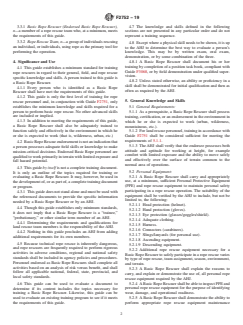
4.1 This guide establishes a minimum standard for training rope rescuers in regard to their general, field, and rope rescue specific knowledge and skills. A person trained to this guide is a Basic Rope Rescuer.
4.1.1 Every person who is identified as a Basic Rope Rescuer shall have met the requirements of this guide.
4.1.2 This guide is only the first level of training for rope rescue personnel and, in conjunction with Guide F2751, only establishes the minimum knowledge and skills required for a person to perform basic rope rescue. No other advanced skills are included or implied.
4.1.3 In addition to meeting the requirements of this guide, a Basic Rope Rescuer shall also be adequately trained to function safely and effectively in the environment in which he or she is expected to work (that is, wilderness, urban, etc.)
4.2 Basic Rope Rescue endorsement is not an indication that a person possesses adequate field skills or knowledge to make mission-critical decisions. Endorsed Basic Rope personnel are qualified to work primarily in terrain with limited exposure and fall hazard potential.
4.3 This guide by itself is not a complete training document. It is only an outline of the topics required for training or evaluating a Basic Rope Rescuer. It may, however, be used in the development of, or as part of, a complete training document or program.
4.3.1 This guide does not stand alone and must be used with the referenced documents to provide the specific information needed by a Basic Rope Rescuer or by an AHJ.
4.4 Though this guide establishes only minimum standards, it does not imply that a Basic Rope Rescuer is a “trainee,” “probationary,” or other similar term member of an AHJ.
4.4.1 Determining the requirements and qualifications for land rescue team members is the responsibility of the AHJ.
4.4.2 Nothing in this guide precludes an AHJ from adding additional requirements for its own members.
4.5 Because technical rope rescue is inherently ...
SCOPE
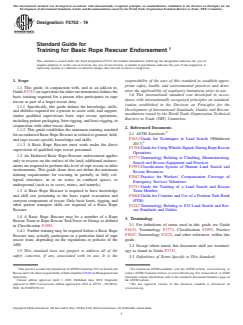
1.1 This guide, in conjunction with, and as an add-on to, Guide F2751 (or equivalent for other environments) defines the basic training required for a person who participates in rope rescue as part of a larger rescue duty.
1.1.1 Specifically, this guide defines the knowledge, skills, and abilities required for a person to assist with, and support, (under qualified supervision) basic rope rescue operations, including patient packaging, litter rigging, and basic rigging, in conjunction with other rescue duties.
1.1.2 This guide establishes the minimum training standard for an endorsed Basic Rope Rescuer as related to general, field, and rope rescue-specific knowledge and skills.
1.1.3 A Basic Rope Rescuer must work under the direct supervision of qualified rope rescue personnel.
1.2 An Endorsed Basic Rope Rescuer endorsement applies only to rescues on the surface of the land; additional endorsements are required to perform this level of rope rescue in other environments. This guide alone does not define the minimum training requirements for rescuing in partially or fully collapsed structures, in or on water, in confined spaces, or underground (such as in caves, mines, and tunnels).
1.3 A Basic Rope Rescuer is required to have knowledge and skill sets pertaining to the basic roped evacuation and carryout components of rescue. Only basic knots, rigging, and other patient transport skills are required of a Basic Rope Rescuer.
1.4 A Basic Rope Rescuer may be a member of a Rope Rescue Team or Rope Rescue Task Force or Group, as defined in Classification F1993.
1.4.1 Further training may be required before a Basic Rope Rescuer may actually participate in a particular kind of rope rescue team, depending on the regulations or policies of the AHJ.
1.5 This standard does not purport to address all of the safety concerns, if any, associated with its use. It is the responsibility of the user of this standard to...
- Status
- Published
- Publication Date
- 31-Mar-2019
- Technical Committee
- F32 - Search and Rescue
- Drafting Committee
- F32.02 - Management and Operations

Overview
ASTM F2752-19: Standard Guide for Training for Basic Rope Rescuer Endorsement establishes the minimum requirements for training personnel participating in basic rope rescue operations. Published by ASTM International, this guide outlines the essential knowledge, skills, and abilities needed for individuals seeking to be endorsed as a Basic Rope Rescuer. Its purpose is to ensure that rescue teams and personnel are prepared to safely support rope rescue duties, primarily on surface land environments, under the supervision of qualified rescue professionals.
Key Topics
The ASTM F2752-19 standard focuses on entry-level rope rescue knowledge and capabilities, and is used in conjunction with ASTM Guide F2751 for a complete training framework. Core subjects covered include:
General Knowledge and Skills
- Awareness of operational environments (urban, wilderness, mountainous)
- Understanding of safety, health, and regulatory requirements
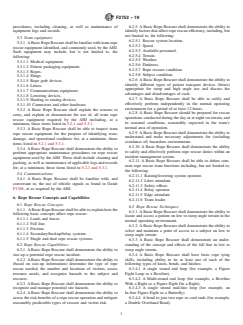
- Ability to use, inspect, and maintain personal protective equipment (PPE) and rescue equipment
Personal and Team Equipment
- Familiarity with items like harnesses, helmets, gloves, carabiners, and litters
- Maintenance and inspection of both personal and team rescue gear
Communications
- Proficiency in the use of verbal commands and whistle signals as defined in related ASTM guidance
Rope Rescue Concepts
- Fundamentals such as load and force management, friction, anchor systems, and patient transport
- Risk assessment and scene size-up
Technical Rope Skills
- Basic knot, bend, and hitch tying
- Introduction to rigging for raising, lowering, and belay systems
- Low-angle litter evacuation and participation in rope rescue team functions
Role within Rescue Teams
- Working under direct supervision
- Understanding of incident management systems
- Awareness of the team structure and functions
Applications
ASTM F2752-19 applies to all land-based rope rescue scenarios where personnel may be required to support complex rescue operations under supervision. Key application areas include:
Search and Rescue (SAR) Operations
For wilderness, urban, and mountainous terrain rescues involving low to moderate angle environments.Fire and Emergency Response Teams
Basic Rope Rescuer Endorsement is commonly required for fire departments, EMS, and emergency management agencies performing rope-assisted patient extrication.Volunteer Rescue Organizations
Ensures that volunteer team members possess a foundational skill set for safe participation in rope rescue assignments.Training and Assessment Programs
Acts as a reference for agencies when developing or evaluating basic rope rescue curriculum, skill books, and training protocols.
The endorsement does not qualify individuals for advanced rope rescue scenarios such as water, confined spaces, collapsed structures, or underground operations. Additional or specialized training is necessary for those environments.
Related Standards
ASTM F2752-19 is part of a suite of standards supporting land-based rescue and technical operations. Key related documents include:
- ASTM F2751 - Guide for Training of a Land Search and Rescue Team Member
- ASTM F1768 - Guide for Using Whistle Signals During Rope Rescue Operations
- ASTM F1993 - Classification System for Human Land Search and Rescue Resources
- ASTM F3068 - Guide for Use of Position Task Books in Search and Rescue
- ASTM F3222 - Terminology Relating to Land Search and Rescue Standards
These documents provide supporting definitions, procedures, and frameworks essential for a comprehensive approach to rope rescue training and team readiness.
Keywords: rope rescue training, Basic Rope Rescuer Endorsement, ASTM F2752-19, search and rescue standards, technical rescue, PPE, rescue equipment, land rescue, rope skills, rescue team training.
Relations
- Effective Date
- 01-Apr-2019
- Effective Date
- 01-Apr-2024
- Effective Date
- 01-Apr-2020
- Effective Date
- 01-Apr-2019
- Refers
ASTM F3222-16 - Standard Terminology Relating to F32 Land Search and Rescue Standards and Guides - Effective Date
- 01-Nov-2016
- Effective Date
- 01-Dec-2015
- Effective Date
- 01-Mar-2014
- Effective Date
- 01-May-2012
- Effective Date
- 01-Oct-2009
- Effective Date
- 01-Apr-2009
- Effective Date
- 01-Nov-2008
- Effective Date
- 01-Jun-2007
- Effective Date
- 01-Aug-2006
- Refers
ASTM F1993-99(2005) - Standard Classification of Human Search and Rescue Resources (Withdrawn 2014) - Effective Date
- 01-Apr-2005
- Effective Date
- 01-May-2004
Get Certified
Connect with accredited certification bodies for this standard

CIS Institut d.o.o.
Personal Protective Equipment (PPE) certification body. Notified Body NB-2890 for EU Regulation 2016/425 PPE.

Kiwa BDA Testing
Building and construction product certification.
Kmetijski inštitut Slovenije
Agricultural Institute of Slovenia. Soil testing, plant health, agricultural product analysis.
Sponsored listings
Frequently Asked Questions
ASTM F2752-19 is a guide published by ASTM International. Its full title is "Standard Guide for Training for Basic Rope Rescuer Endorsement". This standard covers: SIGNIFICANCE AND USE 4.1 This guide establishes a minimum standard for training rope rescuers in regard to their general, field, and rope rescue specific knowledge and skills. A person trained to this guide is a Basic Rope Rescuer. 4.1.1 Every person who is identified as a Basic Rope Rescuer shall have met the requirements of this guide. 4.1.2 This guide is only the first level of training for rope rescue personnel and, in conjunction with Guide F2751, only establishes the minimum knowledge and skills required for a person to perform basic rope rescue. No other advanced skills are included or implied. 4.1.3 In addition to meeting the requirements of this guide, a Basic Rope Rescuer shall also be adequately trained to function safely and effectively in the environment in which he or she is expected to work (that is, wilderness, urban, etc.) 4.2 Basic Rope Rescue endorsement is not an indication that a person possesses adequate field skills or knowledge to make mission-critical decisions. Endorsed Basic Rope personnel are qualified to work primarily in terrain with limited exposure and fall hazard potential. 4.3 This guide by itself is not a complete training document. It is only an outline of the topics required for training or evaluating a Basic Rope Rescuer. It may, however, be used in the development of, or as part of, a complete training document or program. 4.3.1 This guide does not stand alone and must be used with the referenced documents to provide the specific information needed by a Basic Rope Rescuer or by an AHJ. 4.4 Though this guide establishes only minimum standards, it does not imply that a Basic Rope Rescuer is a “trainee,” “probationary,” or other similar term member of an AHJ. 4.4.1 Determining the requirements and qualifications for land rescue team members is the responsibility of the AHJ. 4.4.2 Nothing in this guide precludes an AHJ from adding additional requirements for its own members. 4.5 Because technical rope rescue is inherently ... SCOPE 1.1 This guide, in conjunction with, and as an add-on to, Guide F2751 (or equivalent for other environments) defines the basic training required for a person who participates in rope rescue as part of a larger rescue duty. 1.1.1 Specifically, this guide defines the knowledge, skills, and abilities required for a person to assist with, and support, (under qualified supervision) basic rope rescue operations, including patient packaging, litter rigging, and basic rigging, in conjunction with other rescue duties. 1.1.2 This guide establishes the minimum training standard for an endorsed Basic Rope Rescuer as related to general, field, and rope rescue-specific knowledge and skills. 1.1.3 A Basic Rope Rescuer must work under the direct supervision of qualified rope rescue personnel. 1.2 An Endorsed Basic Rope Rescuer endorsement applies only to rescues on the surface of the land; additional endorsements are required to perform this level of rope rescue in other environments. This guide alone does not define the minimum training requirements for rescuing in partially or fully collapsed structures, in or on water, in confined spaces, or underground (such as in caves, mines, and tunnels). 1.3 A Basic Rope Rescuer is required to have knowledge and skill sets pertaining to the basic roped evacuation and carryout components of rescue. Only basic knots, rigging, and other patient transport skills are required of a Basic Rope Rescuer. 1.4 A Basic Rope Rescuer may be a member of a Rope Rescue Team or Rope Rescue Task Force or Group, as defined in Classification F1993. 1.4.1 Further training may be required before a Basic Rope Rescuer may actually participate in a particular kind of rope rescue team, depending on the regulations or policies of the AHJ. 1.5 This standard does not purport to address all of the safety concerns, if any, associated with its use. It is the responsibility of the user of this standard to...
SIGNIFICANCE AND USE 4.1 This guide establishes a minimum standard for training rope rescuers in regard to their general, field, and rope rescue specific knowledge and skills. A person trained to this guide is a Basic Rope Rescuer. 4.1.1 Every person who is identified as a Basic Rope Rescuer shall have met the requirements of this guide. 4.1.2 This guide is only the first level of training for rope rescue personnel and, in conjunction with Guide F2751, only establishes the minimum knowledge and skills required for a person to perform basic rope rescue. No other advanced skills are included or implied. 4.1.3 In addition to meeting the requirements of this guide, a Basic Rope Rescuer shall also be adequately trained to function safely and effectively in the environment in which he or she is expected to work (that is, wilderness, urban, etc.) 4.2 Basic Rope Rescue endorsement is not an indication that a person possesses adequate field skills or knowledge to make mission-critical decisions. Endorsed Basic Rope personnel are qualified to work primarily in terrain with limited exposure and fall hazard potential. 4.3 This guide by itself is not a complete training document. It is only an outline of the topics required for training or evaluating a Basic Rope Rescuer. It may, however, be used in the development of, or as part of, a complete training document or program. 4.3.1 This guide does not stand alone and must be used with the referenced documents to provide the specific information needed by a Basic Rope Rescuer or by an AHJ. 4.4 Though this guide establishes only minimum standards, it does not imply that a Basic Rope Rescuer is a “trainee,” “probationary,” or other similar term member of an AHJ. 4.4.1 Determining the requirements and qualifications for land rescue team members is the responsibility of the AHJ. 4.4.2 Nothing in this guide precludes an AHJ from adding additional requirements for its own members. 4.5 Because technical rope rescue is inherently ... SCOPE 1.1 This guide, in conjunction with, and as an add-on to, Guide F2751 (or equivalent for other environments) defines the basic training required for a person who participates in rope rescue as part of a larger rescue duty. 1.1.1 Specifically, this guide defines the knowledge, skills, and abilities required for a person to assist with, and support, (under qualified supervision) basic rope rescue operations, including patient packaging, litter rigging, and basic rigging, in conjunction with other rescue duties. 1.1.2 This guide establishes the minimum training standard for an endorsed Basic Rope Rescuer as related to general, field, and rope rescue-specific knowledge and skills. 1.1.3 A Basic Rope Rescuer must work under the direct supervision of qualified rope rescue personnel. 1.2 An Endorsed Basic Rope Rescuer endorsement applies only to rescues on the surface of the land; additional endorsements are required to perform this level of rope rescue in other environments. This guide alone does not define the minimum training requirements for rescuing in partially or fully collapsed structures, in or on water, in confined spaces, or underground (such as in caves, mines, and tunnels). 1.3 A Basic Rope Rescuer is required to have knowledge and skill sets pertaining to the basic roped evacuation and carryout components of rescue. Only basic knots, rigging, and other patient transport skills are required of a Basic Rope Rescuer. 1.4 A Basic Rope Rescuer may be a member of a Rope Rescue Team or Rope Rescue Task Force or Group, as defined in Classification F1993. 1.4.1 Further training may be required before a Basic Rope Rescuer may actually participate in a particular kind of rope rescue team, depending on the regulations or policies of the AHJ. 1.5 This standard does not purport to address all of the safety concerns, if any, associated with its use. It is the responsibility of the user of this standard to...
ASTM F2752-19 is classified under the following ICS (International Classification for Standards) categories: 13.200 - Accident and disaster control. The ICS classification helps identify the subject area and facilitates finding related standards.
ASTM F2752-19 has the following relationships with other standards: It is inter standard links to ASTM F2752-09(2014), ASTM F1993-24, ASTM F1768-97(2020), ASTM F2047-00(2019), ASTM F3222-16, ASTM F1773-09(2015), ASTM F1768-97(2014), ASTM F2047-00(2012), ASTM F1773-09, ASTM F2751-09, ASTM F1633-97(2008), ASTM F1768-97(2007), ASTM F2047-00(2006), ASTM F1993-99(2005), ASTM F1773-97(2004). Understanding these relationships helps ensure you are using the most current and applicable version of the standard.
ASTM F2752-19 is available in PDF format for immediate download after purchase. The document can be added to your cart and obtained through the secure checkout process. Digital delivery ensures instant access to the complete standard document.
Standards Content (Sample)
This international standard was developed in accordance with internationally recognized principles on standardization established in the Decision on Principles for the
Development of International Standards, Guides and Recommendations issued by the World Trade Organization Technical Barriers to Trade (TBT) Committee.
Designation: F2752 − 19
Standard Guide for
Training for Basic Rope Rescuer Endorsement
This standard is issued under the fixed designation F2752; the number immediately following the designation indicates the year of
original adoption or, in the case of revision, the year of last revision. A number in parentheses indicates the year of last reapproval. A
superscript epsilon (´) indicates an editorial change since the last revision or reapproval.
1. Scope responsibility of the user of this standard to establish appro-
priate safety, health, and environmental practices and deter-
1.1 This guide, in conjunction with, and as an add-on to,
mine the applicability of regulatory limitations prior to use.
GuideF2751(orequivalentforotherenvironments)definesthe
1.6 This international standard was developed in accor-
basic training required for a person who participates in rope
dance with internationally recognized principles on standard-
rescue as part of a larger rescue duty.
ization established in the Decision on Principles for the
1.1.1 Specifically, this guide defines the knowledge, skills,
Development of International Standards, Guides and Recom-
and abilities required for a person to assist with, and support,
mendations issued by the World Trade Organization Technical
(under qualified supervision) basic rope rescue operations,
Barriers to Trade (TBT) Committee.
including patient packaging, litter rigging, and basic rigging, in
conjunction with other rescue duties.
2. Referenced Documents
1.1.2 This guide establishes the minimum training standard
2.1 ASTM Standards:
for an endorsed Basic Rope Rescuer as related to general, field,
F1633 Guide for Techniques in Land Search (Withdrawn
and rope rescue-specific knowledge and skills.
2017)
1.1.3 A Basic Rope Rescuer must work under the direct
F1768 GuideforUsingWhistleSignalsDuringRopeRescue
supervision of qualified rope rescue personnel.
Operations
1.2 An Endorsed Basic Rope Rescuer endorsement applies
F1773 Terminology Relating to Climbing, Mountaineering,
only to rescues on the surface of the land; additional endorse-
Search and Rescue Equipment and Practices
ments are required to perform this level of rope rescue in other
F1993 Classification System of Human Land Search and
environments. This guide alone does not define the minimum
Rescue Resources
training requirements for rescuing in partially or fully col-
F2047 Practice for Workers’ Compensation Coverage of
lapsed structures, in or on water, in confined spaces, or
Emergency Services Volunteers
underground (such as in caves, mines, and tunnels).
F2751 Guide for Training of a Land Search and Rescue
1.3 A Basic Rope Rescuer is required to have knowledge
Team Member
and skill sets pertaining to the basic roped evacuation and
F3068 Guide for Contents and Use of a Position Task Book
carryout components of rescue. Only basic knots, rigging, and
(PTB)
other patient transport skills are required of a Basic Rope F3222 Terminology Relating to F32 Land Search and Res-
Rescuer.
cue Standards and Guides
1.4 A Basic Rope Rescuer may be a member of a Rope
3. Terminology
Rescue Team or Rope Rescue Task Force or Group, as defined
3.1 For definitions of terms used in this guide see Guide
in Classification F1993.
F1633, Terminology F1773, Classification F1993, Practice
1.4.1 Further training may be required before a Basic Rope
F2047, Terminology F3222, and other references within this
Rescuer may actually participate in a particular kind of rope
guide.
rescue team, depending on the regulations or policies of the
AHJ.
3.2 Except where noted, this document shall use terminol-
ogy as found in Guide F2751.
1.5 This standard does not purport to address all of the
safety concerns, if any, associated with its use. It is the
3.3 Definitions of Terms Specific to This Standard:
1 2
This practice is under the jurisdiction ofASTM Committee F32 on Search and For referenced ASTM standards, visit the ASTM website, www.astm.org, or
Rescue and is the direct responsibility of Subcommittee F32.02 on Management and contact ASTM Customer Service at service@astm.org. For Annual Book of ASTM
Operations. Standards volume information, refer to the standard’s Document Summary page on
Current edition approved April 1, 2019. Published June 2019. Originally the ASTM website.
approved in 2009. Last previous edition approved in 2014 as F2752 – 09 (2014). The last approved version of this historical standard is referenced on
DOI: 10.1520/F2752-19. www.astm.org.
Copyright © ASTM International, 100 Barr Harbor Drive, PO Box C700, West Conshohocken, PA 19428-2959. United States
F2752 − 19
3.3.1 Basic Rope Rescuer (Endorsed Basic Rope Rescuer), 4.7 The knowledge and skills defined in the following
n—a member of a rope rescue team who, at a minimum, meets sections are not presented in any particular order and do not
the requirements of this guide. represent a training sequence.
3.3.2 Rope Rescue Team, n—a group of individuals rescuing
4.8 Except where a physical skill needs to be shown, it is up
an individual, or individuals, using rope as the primary tool for
to the AHJ to determine the best way to evaluate a person’s
performing the operation.
knowledge. This may be by written exam, oral exam,
demonstration, or by some combination of the three.
4. Significance and Use 4.8.1 A Basic Rope Rescuer shall document his or her
training by completion of a position task book, compliant with
4.1 This guide establishes a minimum standard for training
Guide F3068, or by field demonstration under qualified super-
rope rescuers in regard to their general, field, and rope rescue
vision.
specific knowledge and skills.Aperson trained to this guide is
4.8.2 Unless stated otherwise, an ability or proficiency in a
a Basic Rope Rescuer.
skill shall be demonstrated for initial qualification and then as
4.1.1 Every person who is identified as a Basic Rope
often as required by the AHJ.
Rescuer shall have met the requirements of this guide.
4.1.2 This guide is only the first level of training for rope
5. General Knowledge and Skills
rescue personnel and, in conjunction with Guide F2751, only
establishes the minimum knowledge and skills required for a
5.1 General Requirements:
person to perform basic rope rescue. No other advanced skills
5.1.1 As a prerequisite, a Basic Rope Rescuer shall possess
are included or implied.
training, certification, or an endorsement in the environment in
4.1.3 In addition to meeting the requirements of this guide,
which he or she is expected to work (urban, wilderness,
a Basic Rope Rescuer shall also be adequately trained to
mountainous, etc.).
function safely and effectively in the environment in which he
5.1.2 For land rescue personnel, training in accordance with
or she is expected to work (that is, wilderness, urban, etc.)
Guide F2751 shall be considered sufficient for meeting the
requirements of 5.1.1.
4.2 BasicRopeRescueendorsementisnotanindicationthat
5.1.3 TheAHJ shall verify that the endorsee possesses both
a person possesses adequate field skills or knowledge to make
attitude and aptitude for working at height, for example
mission-critical decisions. Endorsed Basic Rope personnel are
comfort with limited exposure and the ability to move safely
qualifiedtoworkprimarilyinterrainwithlimitedexposureand
and effectively over the surface of terrain common to the
fall hazard potential.
normal area of operations.
4.3 This guide by itself is not a complete training document.
5.2 Personal Equipment:
It is only an outline of the topics required for training or
5.2.1 A Basic Rope Rescuer shall carry and appropriately
evaluating a Basic Rope Rescuer. It may, however, be used in
use, at a minimum, sufficient Personal Protective Equipment
thedevelopmentof,oraspartof,acompletetrainingdocument
(PPE) and rope rescue equipment to maintain personal safety
or program.
participating in a rope rescue operation. The suitability of the
4.3.1 This guide does not stand alone and must be used with
equipment shall be verified by the AHJ to include, but not be
the referenced documents to provide the specific information
limited to, the following:
needed by a Basic Rope Rescuer or by an AHJ.
5.2.1.1 Head protection (helmet).
4.4 Though this guide establishes only minimum standards,
5.2.1.2 Hand protection (gloves).
it does not imply that a Basic Rope Rescuer is a “trainee,”
5.2.1.3 Eye protection (glasses/goggles/shield).
“probationary,” or other similar term member of an AHJ.
5.2.1.4 Adequate clothing.
4.4.1 Determining the requirements and qualifications for
5.2.1.5 Harness.
land rescue team members is the responsibility of the AHJ.
5.2.1.6 Connectors (carabiners).
4.4.2 Nothing in this guide precludes an AHJ from adding
5.2.1.7 Slings/lanyards (for personal use).
additional requirements for its own members.
5.2.1.8 Ascending equipment.
4.5 Because technical rope rescue is inherently dangerous,
5.2.1.9 Descending equipment.
and rope rescuers are
...
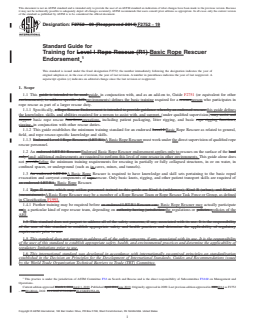
This document is not an ASTM standard and is intended only to provide the user of an ASTM standard an indication of what changes have been made to the previous version. Because
it may not be technically possible to adequately depict all changes accurately, ASTM recommends that users consult prior editions as appropriate. In all cases only the current version
of the standard as published by ASTM is to be considered the official document.
Designation: F2752 − 09 (Reapproved 2014) F2752 − 19
Standard Guide for
Training for Level I Rope Rescue (R1) Basic Rope Rescuer
Endorsement
This standard is issued under the fixed designation F2752; the number immediately following the designation indicates the year of
original adoption or, in the case of revision, the year of last revision. A number in parentheses indicates the year of last reapproval. A
superscript epsilon (´) indicates an editorial change since the last revision or reapproval.
1. Scope
1.1 This guide is intended to be used guide, in conjunction with, and as an add-on to, Guide F2751 (or equivalent for other
environments), to address specific skillsenvironments) defines the basic training required for a rescuerperson who participates in
rope rescue as part of a larger rescue duty.
1.1.1 Specifically, a Rope Rescue Endorsement is intended to provide guidance whereby an endorsed rescuer this guide defines
the knowledge, skills, and abilities required for a person to assist with, and support, (under qualified supervision) may assist and
support basic rope rescue functions,operations, including patient packaging, litter rigging, and basic rope rigging functions,
rigging, in conjunction with other rescue duties.
1.1.2 This guide establishes the minimum training standard for an endorsed Level I Basic Rope Rescuer as related to general,
field, and rope rescue-specific knowledge and skills.
1.1.3 Endorsed Level I Rope Rescuers (LRT-R1) A Basic Rope Rescuer must work under the direct supervision of qualified rope
rescue personnel.
1.2 An endorsed LRT-R1 Rescuer Endorsed Basic Rope Rescuer endorsement applies only to rescues on the surface of the land
only. land; additional endorsements are required to perform this level of rope rescue in other environments. This guide alone does
not providedefine the minimum training requirements for rescuing in partially or fully collapsed structures, in or on water, in
confined spaces, or underground (such as in caves, mines, and tunnels).
1.3 An endorsed LRT-R1A Basic Rope Rescuer is required to have knowledge and skill sets pertaining to the basic roped
evacuation and carryout components of rope rescue. Only basic knots, rigging, and other patient transport skills are required of
an endorsed LRT-R1a Basic Rope Rescuer.
1.4 Type II teams which may utilize personnel trained to this guide are Kind A (wilderness), Kind B (urban), and Kind C
(mountainous). A Basic Rope Rescuer may be a member of a Rope Rescue Team or Rope Rescue Task Force or Group, as defined
in Classification F1993.
1.4.1 Further training may be required before an endorsed LRT-R1 Rescuer cana Basic Rope Rescuer may actually participate
onin a particular kind of rope rescue team, depending on authority having jurisdiction the regulations or policies. policies of the
AHJ.
1.5 This standard does not purport to address all of the safety concerns, if any, associated with its use. It is the responsibility
of the user of this standard to establish appropriate safety and health practices and determine the applicability of regulatory
requirements prior to use.
1.5 This standard does not purport to address all of the safety concerns, if any, associated with its use. It is the responsibility
of the user of this standard to establish appropriate safety, health, and environmental practices and determine the applicability of
regulatory limitations prior to use.
1.6 This international standard was developed in accordance with internationally recognized principles on standardization
established in the Decision on Principles for the Development of International Standards, Guides and Recommendations issued
by the World Trade Organization Technical Barriers to Trade (TBT) Committee.
This practice is under the jurisdiction of ASTM Committee F32 on Search and Rescue and is the direct responsibility of Subcommittee F32.02 on Management and
Operations.
Current edition approved March 1, 2014April 1, 2019. Published April 2014June 2019. Originally approved in 2009. Last previous edition approved in 20092014 as F2752
– 09.09 (2014). DOI: 10.1520/F2752-09R14.10.1520/F2752-19.
Copyright © ASTM International, 100 Barr Harbor Drive, PO Box C700, West Conshohocken, PA 19428-2959. United States
F2752 − 19
2. Referenced Documents
2.1 ASTM Standards:
F1490 Terminology Relating to Search and Rescue (Withdrawn 2011)
F1633 Guide for Techniques in Land Search (Withdrawn 2017)
F1768 Guide for Using Whistle Signals During Rope Rescue Operations
F1773 Terminology Relating to Climbing, Mountaineering, Search and Rescue Equipment and Practices
F1993 Classification System of Human Land Search and Rescue Resources
F2047 Practice for Workers’ Compensation Coverage of Emergency Services Volunteers
F2209F2751 Guide for Training of a Land Search and Rescue Team Member
F2751F3068 Guide for Training of a Land Search and Rescue Team MemberContents and Use of a Position Task Book (PTB)
F3222 Terminology Relating to F32 Land Search and Rescue Standards and Guides
3. Terminology
3.1 For definitions of terms used in this guide,guide see TerminologyGuide F1490F1633, GuideTerminology F1633F1773,
Classification F1993, Practice F2047, Terminology F3222, and other references within this guide.
3.2 Except where noted, this document shall use terminology as found in Guide F2751.
3.3 Definitions of Terms Specific to This Standard:
3.3.1 Rope Rescue Team, n—a group of individuals performing high angle rescue on steep to vertical terrain using rope as a
primary adjunct to safety.
3.3.1 Rope Rescuer, Level I (LRT-R1Basic Rope Rescuer (Endorsed Basic Rope Rescuer), n—a member of a rope rescue team
who, asat a minimum, meets the requirements of this guide. These requirements define the basic, entry, awareness, or similar level
of land rope rescue knowledge and skills.
3.3.2 Rope Rescue Team, n—a group of individuals rescuing an individual, or individuals, using rope as the primary tool for
performing the operation.
4. Significance and Use
4.1 This guide establishes a minimum standard for training Rope Rescuers as it relates rope rescuers in regard to their general,
field, and rope rescue specific knowledge and skills. A person trained to this guide is an endorsed Level I Rope Rescuer (LRT-R1
Rescuer).a Basic Rope Rescuer.
4.1.1 Every person who is identified as an endorsed LRT-R1a Basic Rope Rescuer shall have met the requirements of this guide.
4.1.2 This guide is only the first level of training for rope rescue personnel and, in conjunction with Guide F2209F2751, only
establishes the minimum knowledge and skills required for a person to perform basic rope rescue of a subject. rescue. No other
advanced skills are included or implied.
4.1.3 In addition to meeting the requirements of this guide, an LRT-R1 a Basic Rope Rescuer shall also be adequately trained
to function safely and effectively in the environment in which he or she is expected to work (i.e., (that is, wilderness, urban, etc.)
4.1.4 Nothing in this guide precludes an AHJ from adding additional requirements for its own members.
4.2 Endorsement to Level I Basic Rope Rescue (LRT-R1 Rescuer) endorsement is not an indication that personnel possess a
person possesses adequate field skills or knowledge to make mission-critical decisions. These Endorsed Basic Rope personnel are
qualified to work primarily in terrain with limited exposure and fall hazard potential.
4.3 This guide by itself is not a complete training document. It is only an outline of the topics required for training or evaluating
an endorsed LRT-R1a Basic Rope Rescuer. It may, however, be used in the development of, or as part of, a complete training
document or program.
4.3.1 This guide does not stand alone and must be used with the referenced documents to provide the specific information
needed by an endorsed LRT-R1a Basic Rope Rescuer or by an AHJ.
4.4 Though this guide establishes only minimum standards, it does not imply that an endorsed LRT-R1a Basic Rope Rescuer
is a “trainee,” “probationary,” or other similar term member of an AHJ. It is up to the AHJ to determine the requirements and
qualifications for member ratings.
4.4.1 Determining the requirements and qualifications for land rescue team members is the responsibility of the AHJ.
4.4.2 Nothing in this guide precludes an AHJ from adding additional requirements for its own members.
4.5 Because technical rope rescue is inherently dangerous, and Rope Rescuersrope rescuers are frequently required to perform
rigorous activities in adverse conditions, regional,regional and national safety standards shall be included in agency policies and
For referenced ASTM standards, visit the ASTM website, www.astm.org, or contact ASTM Customer Service at service@astm.org. For Annual Book of ASTM Standards
volume information, refer to the standard’s Document Summary page on the ASTM website.
The last approved version of this historical standard is referenced on www.astm.org.
F2752 − 19
procedures. Personnel endorsed as Basic Rope Rescuers shall complete all activities in the safest possible manner based on an
analysis of risk versus benefit, and shall follow all applicable national, federal, state, provincial, and local safety standards as they
apply to the Rope Rescuer.standards.
4.6 This guide can be used to evaluate a document to determine if its content meetsincludes the necessary topics necessary for
training an endorsed LRT-R1a Basic Rope Rescuer. Likewise, thethis guide can be used to evaluate an existing training program
to see if it meets the requirements of this guide.
4.7 The knowledge and skills requirementsdefined in the following sections are not presented in any particular order and do not
represent a training sequence.
4.8 Except where a physical skill needs to be shown, it is up to the AHJ to determine the best way to evaluate a person’sperson’s
knowledge. This may be by written exam, oral exam, demonstration, or by some combination of the three.
4.8.1 A Basic Rope Rescuer shall document his or her training by completion of a position task book, compliant with Guide
F3068, or by field demonstration under qualified supervision.
4.8.2 Unless stated otherwise, an ability or proficiency in a skill shall be demonstrated for initial qualification and then as often
as required by the AHJ.
5. General Knowledge and Skills
5.1 General Requirements:
5.1.1 As a prerequisite, LRT-R1 a Basic Rope Rescuer shall possess some training, certification, or an endorsement in the
environment in which he or she is expected to work (urban, wilderness, mo
...