

ASTM C822-21
(Terminology)Standard Terminology Relating to Concrete Pipe and Related Products
General Information
- Abstract
- Status
- Published
- Publication Date
- 31-Aug-2021
- Technical Committee
- C13 - Concrete Pipe
- Drafting Committee
- C13.10 - Correlation and Editorial
Overview
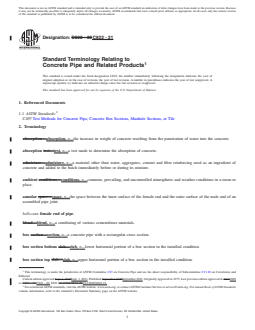
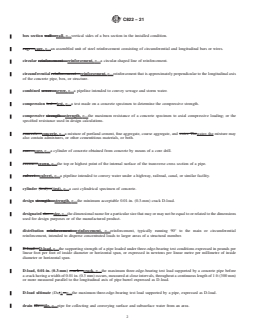
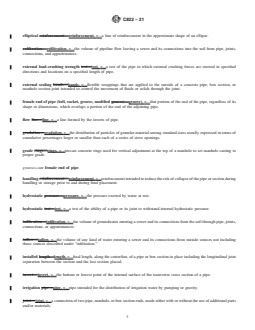
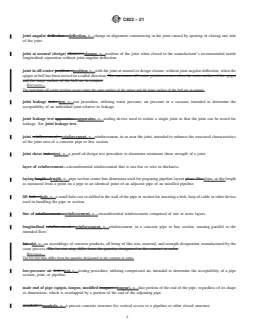
ASTM C822-21: Standard Terminology Relating to Concrete Pipe and Related Products establishes a comprehensive set of definitions and terminology used within the concrete pipe industry. Developed by ASTM Committee C13, this standard provides clarity and uniformity in the language used for concrete pipe, box sections, manholes, joint components, and the associated testing and design methods. Adherence to clear terminology is crucial for engineers, manufacturers, specifiers, and regulators for effective communication and compliance across all phases of design, production, testing, and installation of concrete pipe products.
Key Topics
ASTM C822-21 covers a wide range of terminology and concepts relevant to concrete pipe and related infrastructure components:
- Fundamental Terms
- Definitions for concrete pipe, box sections, manholes, and fittings.
- Terminology for structural aspects such as reinforcement, wall, top slab, and base.
- Testing and Performance Criteria
- Terms for key test methods including absorption test, compression test, hydrostatic test, permeability test, joint leakage test, and low-pressure air test.
- Definitions of minimum and ultimate strength, D-load, and other performance metrics.
- Manufacturing and Installation
- Vocabulary pertaining to manufacturing processes, such as admixture, batching, and production run.
- Installation-related terms including laying length, installed length, joint deflection, manhole base, and lift hole.
- Joint and Structure Components
- Detailed definitions for male/female pipe ends (spigot, bell, groove, tongue), sealing mechanisms, O-ring gaskets, joints, sealing bands, and resilient connectors.
- Hydraulic and Environmental Considerations
- Gradation, permeability, infiltration, exfiltration, and inflow.
- Definitions covering the use of concrete pipes in drainage, sewer, irrigation, and stormwater applications.
Recent revisions reflect updated definitions for critical industry terms such as "concrete", "owner", "laying length", "manufactured length", "reinforced concrete pipe", and "reinforcement", ensuring alignment with industry advances and best practices.
Applications
ASTM C822-21 supports practical use in a variety of civil engineering and infrastructure projects by:
- Facilitating Clear Communication
Ensuring that project teams, contractors, suppliers, and regulators have a common understanding of technical terms minimizes errors and misinterpretations during design, procurement, testing, and installation. - Supporting Specification and Compliance
The standard provides a reference point for contract documents, construction specifications, quality assurance protocols, and regulatory compliance, particularly for projects involving concrete sewers, culverts, storm drains, and manholes. - Guiding Product Testing and Quality Control
By standardizing terminology for test methods and structural requirements, ASTM C822-21 aids in consistent application and reporting of quality assurance tests such as compressive strength, absorption, hydrostatic, and leakage tests. - Regulating International and Domestic Trade
Uniform terminology facilitates the exchange of products and services across different regions and regulatory environments, supporting global trade and procurement.
Related Standards
ASTM C822-21 is frequently used in conjunction with related ASTM standards and industry references, including:
- ASTM C497 - Test Methods for Concrete Pipe, Concrete Box Sections, Manhole Sections, or Tile
- Standards developed by ASTM Committee C13 on Concrete Pipe
- American Association of State Highway and Transportation Officials (AASHTO) standards relating to concrete structures and pipelines
- Local and federal infrastructure specifications and sustainability guidelines
Utilizing these related standards alongside ASTM C822-21 ensures holistic coverage of specification, design, manufacture, testing, and installation of concrete pipe systems.
Keywords: ASTM C822-21, concrete pipe terminology, ASTM standards, concrete box section, manhole components, joint testing, concrete pipe installation, pipe reinforcement, infrastructure standards, civil engineering.
Relations
- Effective Date
- 01-Oct-2019
- Effective Date
- 01-Jan-2019
- Effective Date
- 01-Jun-2018
- Effective Date
- 01-May-2018
- Effective Date
- 01-Jan-2018
- Effective Date
- 01-Apr-2017
- Effective Date
- 01-Sep-2016
- Effective Date
- 01-Jun-2016
- Effective Date
- 01-Oct-2015
- Effective Date
- 01-Sep-2014
- Effective Date
- 01-Feb-2013
- Effective Date
- 01-Feb-2013
- Effective Date
- 01-Oct-2005
- Effective Date
- 01-Oct-2004
- Effective Date
- 01-Oct-2004
Get Certified
Connect with accredited certification bodies for this standard

Institut za varilstvo d.o.o. (Welding Institute)
Slovenia's leading welding institute since 1952. ISO 3834, EN 1090, pressure equipment certification, NDT personnel, welder qualification. Only IIW Au
Sponsored listings
Frequently Asked Questions
ASTM C822-21 is a standard published by ASTM International. Its full title is "Standard Terminology Relating to Concrete Pipe and Related Products". This standard covers: Standard Terminology Relating to Concrete Pipe and Related Products
Standard Terminology Relating to Concrete Pipe and Related Products
ASTM C822-21 is classified under the following ICS (International Classification for Standards) categories: 01.040.23 - Fluid systems and components for general use (Vocabularies); 23.040.50 - Pipes and fittings of other materials. The ICS classification helps identify the subject area and facilitates finding related standards.
ASTM C822-21 has the following relationships with other standards: It is inter standard links to ASTM C497-19a, ASTM C497-19, ASTM C497-18b, ASTM C497-18a, ASTM C497-18, ASTM C497-17, ASTM C497-16a, ASTM C497-16, ASTM C497-15, ASTM C497-14, ASTM C497-13, ASTM C497-13e1, ASTM C497-05, ASTM C497-04e1, ASTM C497-04. Understanding these relationships helps ensure you are using the most current and applicable version of the standard.
ASTM C822-21 is available in PDF format for immediate download after purchase. The document can be added to your cart and obtained through the secure checkout process. Digital delivery ensures instant access to the complete standard document.
Standards Content (Sample)
This international standard was developed in accordance with internationally recognized principles on standardization established in the Decision on Principles for the
Development of International Standards, Guides and Recommendations issued by the World Trade Organization Technical Barriers to Trade (TBT) Committee.
Designation: C822 − 21
Standard Terminology Relating to
Concrete Pipe and Related Products
This standard is issued under the fixed designation C822; the number immediately following the designation indicates the year of
original adoption or, in the case of revision, the year of last revision. A number in parentheses indicates the year of last reapproval. A
superscript epsilon (´) indicates an editorial change since the last revision or reapproval.
This standard has been approved for use by agencies of the U.S. Department of Defense.
1. Referenced Documents cage, n—an assembled unit of steel reinforcement consisting of
2 circumferential and longitudinal bars or wires.
1.1 ASTM Standards:
C497 Test Methods for Concrete Pipe, Concrete Box
circular reinforcement, n—acircular-shapedlineofreinforce-
Sections, Manhole Sections, or Tile
ment.
2. Terminology circumferential reinforcement, n—reinforcement that is ap-
proximately perpendicular to the longitudinal axis of the
absorption, n—the increase in weight of concrete resulting
concrete pipe, box, or structure.
from the penetration of water into the concrete.
combined sewer, n—a pipeline intended to convey sewage and
absorption test, n—a test made to determine the absorption of
storm water.
concrete.
compression test, n—a test made on a concrete specimen to
admixture, n—a material other than water, aggregates, cement
determine the compressive strength.
and fibre reinforcing used as an ingredient of concrete and
added to the batch immediately before or during its mixture.
compressive strength, n—the maximum resistance of a con-
crete specimen to axial compressive loading; or the specified
ambient conditions, n—common,prevailing,anduncontrolled
resistance used in design calculations.
atmospheric and weather conditions in a room or place.
concrete, n—a mixture of portland cement, fine aggregate,
annular space, n—the space between the inner surface of the
coarse aggregate, and water; the mixture may also contain
female end and the outer surface of the male end of an
admixtures, or other cementitious materials, or both.
assembled pipe joint.
core, n—a cylinder of concrete obtained from concrete by
bell—see female end of pipe.
means of a core drill.
blend, n—a combining of various cementitious materials.
crown, n—the top or highest point of the internal surface of the
box section, n—a concrete pipe with a rectangular cross
transverse cross section of a pipe.
section.
culvert, n—a pipeline intended to convey water under a
box section bottom slab, n—lower horizontal portion of a box
highway, railroad, canal, or similar facility.
section in the installed condition.
cylinder (test), n—a cast cylindrical specimen of concrete.
box section top slab, n—upper horizontal portion of a box
section in the installed condition.
design strength, n—the minimum acceptable 0.01-in. (0.3-
mm) crack D-load.
box section wall, n—vertical sides of a box section in the
installed condition.
designated size, n—the dimensional name for a particular size
that may or may not be equal to or related to the dimensions
used for design purposes or of the manufactured product.
This terminology is under the jurisdiction of ASTM Committee C13 on
Concrete Pipe and are the direct responsibility of Subcommittee C13.10 on
distribution reinforcement, n—reinforcement, typically run-
Correlation and Editorial.
Current edition approved Sept. 1, 2021. Published September 2021. Originally
ning 90° to the main or circumferential reinforcement,
approved in 1975. Last previous edition approved in 2020 as C822 – 20. DOI:
intended to disperse concentrated loads to larger areas of a
10.1520/C0822-21.
2 structural member.
For referenced ASTM standards, visit the ASTM website, www.astm.org, or
contact ASTM Customer Service at service@astm.org. For Annual Book of ASTM
D-load, n—the supporting strength of a pipe loaded under
Standards volume information, refer to the standard’s Document Summary page on
the ASTM website. three-edge-bearing test conditions expressed in pounds per
Copyright © ASTM International, 100 Barr Harbor Drive, PO Box C700, West Conshohocken, PA 19428-2959. United States
C822 − 21
linear foot per foot of inside diameter or horizontal span, or installed length, n—final length, along the centerline, of a pipe
expressed in newtons per linear metre per millimetre of or box section in place including the longitudinal joint
inside diameter or horizontal span. separation between the section and the last section placed.
D-load, 0.01-in. (0.3-mm) crack, n—the maximum three- invert, n—the bottom or lowest point of the internal surface of
the transverse cross section of a pipe.
edge-bearing test load supported by a concrete pipe before a
crack having a width of 0.01 in. (0.3 mm) occurs, measured
irrigation pipe, n—pipe intended for the distribution of
at close intervals, throughout a continuous length of 1 ft (300
irrigation water by pumping or gravity.
mm) or more measured parallel to the longitudinal axis of
pipe barrel expressed as D-load.
joint, n—a connection of two pipe, manhole, or box section
ends, made either with or without the use of additional parts
D-load ultimate (Du), n—the maximum three-edge-bearing
and/or materials.
test load supported by a pipe, expressed as D-load.
joint angular deflection, n—changeinalignmentcommencing
drain tile, n—pipe for collecting and conveying surface and
in the joint caused by opening or closing one side of the
subsurface water from an area.
joint.
elliptical reinforcement, n—a line of reinforcement in the
joint at normal (design) closure, n—position of the joint
approximate shape of an ellipse.
when closed to the manufacturer’s recommended inside
longitudinal separation without joint angular deflection.
exfiltration, n—the volume of pipeline flow leaving a sewer
and its connections into the soil from pipe, joints,
joint in off-center position, n—with the joint at normal or
connections, and appurtenances.
design closure, without joint angular deflection, when the
spigot or bell has been moved in a radial direction.
external load-crushing strength test, n—a test of the pipe in
DISCUSSION—The maximum off-center position occurs when the
which external crushing forces are exerted in specified
outer surface of the spigot and the inner surface of the bell are in
directions and locations on a specified length of pipe.
contact.
external sealing bands, n—flexible wrappings that are applied
joint leakage test, n—test procedure, utilizing water pressure,
to the outside of a concrete pipe, box section, or manhole
air pressure or a vacuum, intended to determine the accept-
section joint intended to control the movement of fluids or
ability of an individual joint relative to leakage.
solids through the joint.
joint leakage test apparatus, n—sealing device used to isolate
female end of pipe (bell, socket, groove, modified groove),
a single joint so that the joint can be tested for leakage. See
n—that portion of the end of the pipe, regardless of its shape
joint leakage test.
or dimensions, which overlaps a portion of the end of the
joint reinforcement, n—reinforcement, in or near the joint,
adjoining pipe.
intended to enhance the structural characteristics of the joint
flow line, n—a line formed by the inverts of pipe.
area of a concrete pipe or box section.
gradation, n—the distribution of particles of granular material
joint shear test, n—a proof-of-design test procedure to deter-
among standard sizes usually expressed in terms of cumu-
mine minimum shear strength of a joint.
lative percentages larger or smaller than each of a series of
layer of reinforcement—circumferential reinforcement that is
sieve openings.
one bar or wire in thickness.
grade rings, n—precast concrete rings used for vertical adjust-
laying length, n—pipe section center-line dimension used for
ment at the top of a manhole to set manhole casting to proper
preparing pipeline layout plans; or the length as measured
grade.
from a point on a pipe to an identical point of an adjacent
groove—see female end of pipe.
pipe of an installed pipeline.
handling reinforcement, n—reinforcement intended to reduce
lift hole, n—a small hole cast or drilled in the wall of the pipe
the risk of collapse of the pipe or section during handling or
or section for inserting a bolt, loop of cable or other device
storage prior to and during final placement.
used in handling the pipe or section.
hydrostatic pressure, n—the pressure exerted by water at rest.
line of reinforcement, n—circumferential reinforcement com-
hydrostatic test, n—a test of the ability of a pipe or its joint to
prised of one or more layers.
withstand internal hydrostatic pressure.
longitudinal reinf
...
This document is not an ASTM standard and is intended only to provide the user of an ASTM standard an indication of what changes have been made to the previous version. Because
it may not be technically possible to adequately depict all changes accurately, ASTM recommends that users consult prior editions as appropriate. In all cases only the current version
of the standard as published by ASTM is to be considered the official document.
Designation: C822 − 20 C822 − 21
Standard Terminology Relating to
Concrete Pipe and Related Products
This standard is issued under the fixed designation C822; the number immediately following the designation indicates the year of
original adoption or, in the case of revision, the year of last revision. A number in parentheses indicates the year of last reapproval. A
superscript epsilon (´) indicates an editorial change since the last revision or reapproval.
This standard has been approved for use by agencies of the U.S. Department of Defense.
1. Referenced Documents
1.1 ASTM Standards:
C497 Test Methods for Concrete Pipe, Concrete Box Sections, Manhole Sections, or Tile
2. Terminology
absorption—absorption, n—the increase in weight of concrete resulting from the penetration of water into the concrete.
absorption test—test, n—a test made to determine the absorption of concrete.
admixture—admixture, n—a material other than water, aggregates, cement and fibre reinforcing used as an ingredient of
concrete and added to the batch immediately before or during its mixture.
ambient conditions—conditions, n—common, prevailing, and uncontrolled atmospheric and weather conditions in a room or
place.
annular space—space, n—the space between the inner surface of the female end and the outer surface of the male end of an
assembled pipe joint.
bell—see female end of pipe.
blend—blend, n—a combining of various cementitious materials.
box section—section, n—a concrete pipe with a rectangular cross section.
box section bottom slab—slab, n—lower horizontal portion of a box section in the installed condition.
box section top slab—slab, n—upper horizontal portion of a box section in the installed condition.
This terminology is under the jurisdiction of ASTM Committee C13 on Concrete Pipe and are the direct responsibility of Subcommittee C13.10 on Correlation and
Editorial.
Current edition approved Sept. 1, 2020Sept. 1, 2021. Published September 2020September 2021. Originally approved in 1975. Last previous edition approved in 20192020
as C822 – 19.C822 – 20. DOI: 10.1520/C0822-20.10.1520/C0822-21.
For referenced ASTM standards, visit the ASTM website, www.astm.org, or contact ASTM Customer Service at service@astm.org. For Annual Book of ASTM Standards
volume information, refer to the standard’s Document Summary page on the ASTM website.
Copyright © ASTM International, 100 Barr Harbor Drive, PO Box C700, West Conshohocken, PA 19428-2959. United States
C822 − 21
box section wall—wall, n—vertical sides of a box section in the installed condition.
cage—cage, n—an assembled unit of steel reinforcement consisting of circumferential and longitudinal bars or wires.
circular reinforcement—reinforcement, n—a circular-shaped line of reinforcement.
circumferential reinforcement—reinforcement, n—reinforcement that is approximately perpendicular to the longitudinal axis
of the concrete pipe, box, or structure.
combined sewer—sewer, n—a pipeline intended to convey sewage and storm water.
compression test—test, n—a test made on a concrete specimen to determine the compressive strength.
compressive strength—strength, n—the maximum resistance of a concrete specimen to axial compressive loading; or the
specified resistance used in design calculations.
concrete—concrete, n—a mixture of portland cement, fine aggregate, coarse aggregate, and water. Thewater; the mixture may
also contain admixtures, or other cementitious materials, or both.
core—core, n—a cylinder of concrete obtained from concrete by means of a core drill.
crown—crown, n—the top or highest point of the internal surface of the transverse cross section of a pipe.
culvert—culvert, n—a pipeline intended to convey water under a highway, railroad, canal, or similar facility.
cylinder (test)—(test), n—a cast cylindrical specimen of concrete.
design strength—strength, n—the minimum acceptable 0.01-in. (0.3-mm) crack D-load.
designated size—size, n—the dimensional name for a particular size that may or may not be equal to or related to the dimensions
used for design purposes or of the manufactured product.
distribution reinforcement—reinforcement, n—reinforcement, typically running 90° to the main or circumferential
reinforcement, intended to disperse concentrated loads to larger areas of a structural member.
D-load—D-load, n—the supporting strength of a pipe loaded under three-edge-bearing test conditions expressed in pounds per
linear foot per foot of inside diameter or horizontal span, or expressed in newtons per linear metre per millimetre of inside
diameter or horizontal span.
D-load, 0.01-in. (0.3-mm) crack—crack, n—the maximum three-edge-bearing test load supported by a concrete pipe before
a crack having a width of 0.01 in. (0.3 mm) occurs, measured at close intervals, throughout a continuous length of 1 ft (300 mm)
or more measured parallel to the longitudinal axis of pipe barrel expressed as D-load.
D-load ultimate (Du)),—n—the maximum three-edge-bearing test load supported by a pipe, expressed as D-load.
drain tile—tile, n—pipe for collecting and conveying surface and subsurface water from an area.
C822 − 21
elliptical reinforcement—reinforcement, n—a line of reinforcement in the approximate shape of an ellipse.
exfiltration—exfiltration, n—the volume of pipeline flow leaving a sewer and its connections into the soil from pipe, joints,
connections, and appurtenances.
external load-crushing strength test—test, n—a test of the pipe in which external crushing forces are exerted in specified
directions and locations on a specified length of pipe.
external sealing bands—bands, n—flexible wrappings that are applied to the outside of a concrete pipe, box section, or
manhole section joint intended to control the movement of fluids or solids through the joint.
female end of pipe (bell, socket, groove, modified groove)—groove), n—that portion of the end of the pipe, regardless of its
shape or dimensions, which overlaps a portion of the end of the adjoining pipe.
flow line—line, n—a line formed by the inverts of pipe.
gradation—gradation, n—the distribution of particles of granular material among standard sizes usually expressed in terms of
cumulative percentages larger or smaller than each of a series of sieve openings.
grade rings—rings, n—precast concrete rings used for vertical adjustment at the top of a manhole to set manhole casting to
proper grade.
groove—see female end of pipe.
handling reinforcement—reinforcement, n—reinforcement intended to reduce the risk of collapse of the pipe or section during
handling or storage prior to and during final placement.
hydrostatic pressure—pressure, n—the pressure exerted by water at rest.
hydrostatic test—test, n—a test of the ability of a pipe or its joint to withstand internal hydrostatic pressure.
infiltration—infiltration, n—the volume of groundwater entering a sewer and its connections from the soil through pipe, joints,
connections, or appurtenances.
inflow—inflow, n—the volume of any kind of water entering a sewer and its connections from outside sources not including
those sources described under “infiltration.”
installed length—length, n—final length, along the centerline, of a pipe or box section in place including the longitudinal joint
separation between the section and the last section placed.
invert—invert, n—the bottom or lowest point of the internal surface of the transverse cross section of a pipe.
irrigation pipe—pipe, n—pipe intended for the distribution of irrigation water by pumping or gravity.
joint—joint, n—a connection of two pipe, manhole, or box section ends, made either with or without the use of additional parts
and/or materials.
C822 − 21
joint angular deflection—deflection, n—change in alignment commencing in the joint caused by opening or closing one side
of the joint.
joint at normal (design) closure—closure, n—position of the joint when closed to the manufacturer’s recommended inside
longitudinal separation without joint angular deflection.
joint in off-center position—position, n—with the joint at normal or design closure, without joint angular deflection, when the
spigot or bell has been moved in a radial direction. The maximum off-center position occurs when the outer surface of the spigot
and the inner surface of the bell are in contact.
DISCUSSION—
The maximum off-center position occurs when the outer surface of the spigot and the inner surface of the bell are in contact.
joint leakage test—test, n—test procedure, utilizing water pressure, air pressure or a vacuum, intended to determine the
acceptability of an individual joint relative to leakage.
joint leakage test apparatus—apparatus, n—sealing device used to isolate a single joint so that the joint can be tested for
leakage. See joint leakage test.
joint reinforcement—reinforcement, n—reinforcement, in or near the joint, intended to enhance the structural characteristics
of the joint area of a concrete pipe or box section.
joint shear test—test, n—a proof-of-design test procedure to determine minimum shear strength of a joint.
layer of reinforcement—circumferential reinforcement that is one bar or wire in thickness.
laying length—length, n—pipe section center-line dimension used for preparing pipeline layout plans. The plans; or the length
as measured from a point on a pipe to an identical point of an adjacent pipe of an installed pipeline.
lift hole—hole, n—a small hole cast or drilled in the wall of the pipe or section for inserting
...