

ASTM D580/D580M-24
(Practice)Standard Practice for Greige Woven Glass Tapes and Webbings
General Information
- Abstract
ABSTRACT
This specification primarily covers greige tapes and webbings woven from "E" electrical classification glass fiber yarns. This specification can also be applied to tapes and webbings made of other glass fiber grades upon agreement between the purchaser and the supplier. Greige glass fiber tapes and webbings are produced in two types: type A - medium texture, and type B - open texture. The fabric count, yarn number, filament diameter, strand construction, twist direction, twist level, weave type, length per unit mass, thickness, breaking force, width, length, ignition loss, and visual appearance shall be tested to meet the requirements prescribed.
SCOPE
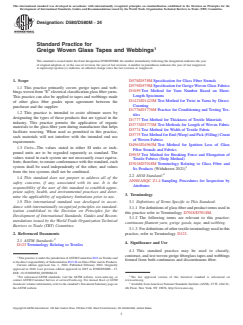
1.1 This practice primarily covers greige tapes and webbings woven from “E” electrical classification glass fiber yarns. This practice can also be applied to tapes and webbings made of other glass fiber grades upon agreement between the purchaser and the supplier.
1.2 This practice is intended to assist ultimate users by designating the types of these products that are typical in the industry. This practice permits the application of organic materials to the glass fiber yarn during manufacture that helps facilitate weaving. When used as permitted in this practice, such materials will not interfere with the intended end use requirements.
1.3 Units—The values stated in either SI units or inch-pound units are to be regarded separately as standard. The values stated in each system are not necessarily exact equivalents; therefore, to ensure conformance with the standard, each system shall be used independently of the other, and values from the two systems shall not be combined.
1.4 This standard does not purport to address all of the safety concerns, if any, associated with its use. It is the responsibility of the user of this standard to establish appropriate safety, health, and environmental practices and determine the applicability of regulatory limitations prior to use.
1.5 This international standard was developed in accordance with internationally recognized principles on standardization established in the Decision on Principles for the Development of International Standards, Guides and Recommendations issued by the World Trade Organization Technical Barriers to Trade (TBT) Committee.
- Status
- Published
- Publication Date
- 31-Dec-2023
- Technical Committee
- D13 - Textiles
- Drafting Committee
- D13.18 - Glass Fiber and its Products
Overview
ASTM D580/D580M-24 is the international standard practice developed by ASTM for greige woven glass tapes and webbings. This standard primarily addresses tapes and webbings fabricated from "E" (electrical classification) glass fiber yarns, but it is also applicable to products made from other glass fiber grades upon mutual agreement between purchaser and supplier. The standard outlines the classification, construction, and key physical characteristics for these textile products, as well as detailed methods for inspection, testing, packaging, and marking.
Whether used in insulation, electrical, or general industrial applications, manufacturers, suppliers, and end-users all benefit from the clear guidance in ASTM D580/D580M-24 on specifications and performance attributes for woven glass tapes and webbings.
Key Topics
ASTM D580/D580M-24 covers a range of important topics, including:
- Types of Greige Glass Tapes and Webbings: Defines two primary types:
- Type A: Medium texture
- Type B: Close (open) texture
- Material Composition: Focuses on "E" electrical grade glass fibers, with flexibility to use other grades as agreed.
- Physical and Mechanical Properties:
- Fabric count (warp and fill)
- Yarn number and filament diameter
- Strand construction and twist specifications
- Weave type (commonly plain weave)
- Length per unit mass, width, and thickness
- Breaking force and elongation
- Ignition loss (as a measure of organic content)
- Visual appearance and uniformity
- Dimensional Tolerances: Clarifies allowed variations for width, thickness, and length.
- Sampling and Testing Methods: References established ASTM methods for laboratory testing (e.g., D3775 for fabric count, D5035 for breaking force).
- Packaging and Marking: Specifies requirements for packaging rolls and marking for identification, compliance, and shipping.
Applications
Greige woven glass tapes and webbings standardized by ASTM D580/D580M-24 have wide utility in industries such as:
- Electrical Insulation: Used for binding, wrapping, and insulating electrical coils, cables, and conductors due to their dielectric properties.
- Thermal Insulation: As a base material in insulation wraps for piping, ducting, and equipment.
- Composite Reinforcement: Employed in manufacturing reinforced plastics and laminates where glass fiber strength and stability are required.
- Industrial Fabrication: Serve as substrates for adhesives, resins, or further finishing treatments.
- Automotive and Aerospace: Utilized where heat, chemical, or flame resistance is critical.
By following ASTM D580/D580M-24, producers and buyers ensure consistent product performance and safety, and facilitate compliance with broader quality and regulatory requirements.
Related Standards
Several other standards are referenced within ASTM D580/D580M-24 for terminology, test methods, and product specifications, including:
- ASTM D123 - Terminology Relating to Textiles
- ASTM D578/D578M - Specification for Glass Fiber Strands
- ASTM D579/D579M - Practice for Greige Woven Glass Fabrics
- ASTM D1059 - Test Method for Yarn Number
- ASTM D1423/D1423M - Test Method for Twist in Yarns
- ASTM D1777 - Test Method for Thickness of Textile Materials
- ASTM D3773/D3773M - Test Methods for Length of Woven Fabric
- ASTM D3774 - Test Method for Width of Textile Fabric
- ASTM D3775 - Test Method for End (Warp) and Pick (Filling) Count of Woven Fabrics
- ASTM D4963/D4963M - Test Method for Ignition Loss of Glass Fiber Strands and Fabrics
- ASTM D5035 - Test Method for Breaking Force and Elongation of Textile Fabrics
- ANSI/ASQC Z1.4 - Sampling Procedures for Inspection by Attributes
Summary
ASTM D580/D580M-24 provides an essential framework for the classification, testing, and acceptance of greige woven glass tapes and webbings. Adhering to this standard ensures high-quality electrical and thermal insulation materials, enhances safety and reliability, and supports consistent production in global supply chains involving industrial textiles.
Relations
- Effective Date
- 01-Jan-2024
- Effective Date
- 01-Jan-2024
- Effective Date
- 01-Feb-2015
- Effective Date
- 01-Jan-2024
Get Certified
Connect with accredited certification bodies for this standard

Control Union Certifications
Global certification for agriculture and sustainability.

Hohenstein Institut
Textile testing and certification.

Bureau Veritas Bangladesh
Bureau Veritas certification services in Bangladesh.
Sponsored listings
Frequently Asked Questions
ASTM D580/D580M-24 is a standard published by ASTM International. Its full title is "Standard Practice for Greige Woven Glass Tapes and Webbings". This standard covers: ABSTRACT This specification primarily covers greige tapes and webbings woven from "E" electrical classification glass fiber yarns. This specification can also be applied to tapes and webbings made of other glass fiber grades upon agreement between the purchaser and the supplier. Greige glass fiber tapes and webbings are produced in two types: type A - medium texture, and type B - open texture. The fabric count, yarn number, filament diameter, strand construction, twist direction, twist level, weave type, length per unit mass, thickness, breaking force, width, length, ignition loss, and visual appearance shall be tested to meet the requirements prescribed. SCOPE 1.1 This practice primarily covers greige tapes and webbings woven from “E” electrical classification glass fiber yarns. This practice can also be applied to tapes and webbings made of other glass fiber grades upon agreement between the purchaser and the supplier. 1.2 This practice is intended to assist ultimate users by designating the types of these products that are typical in the industry. This practice permits the application of organic materials to the glass fiber yarn during manufacture that helps facilitate weaving. When used as permitted in this practice, such materials will not interfere with the intended end use requirements. 1.3 Units—The values stated in either SI units or inch-pound units are to be regarded separately as standard. The values stated in each system are not necessarily exact equivalents; therefore, to ensure conformance with the standard, each system shall be used independently of the other, and values from the two systems shall not be combined. 1.4 This standard does not purport to address all of the safety concerns, if any, associated with its use. It is the responsibility of the user of this standard to establish appropriate safety, health, and environmental practices and determine the applicability of regulatory limitations prior to use. 1.5 This international standard was developed in accordance with internationally recognized principles on standardization established in the Decision on Principles for the Development of International Standards, Guides and Recommendations issued by the World Trade Organization Technical Barriers to Trade (TBT) Committee.
ABSTRACT This specification primarily covers greige tapes and webbings woven from "E" electrical classification glass fiber yarns. This specification can also be applied to tapes and webbings made of other glass fiber grades upon agreement between the purchaser and the supplier. Greige glass fiber tapes and webbings are produced in two types: type A - medium texture, and type B - open texture. The fabric count, yarn number, filament diameter, strand construction, twist direction, twist level, weave type, length per unit mass, thickness, breaking force, width, length, ignition loss, and visual appearance shall be tested to meet the requirements prescribed. SCOPE 1.1 This practice primarily covers greige tapes and webbings woven from “E” electrical classification glass fiber yarns. This practice can also be applied to tapes and webbings made of other glass fiber grades upon agreement between the purchaser and the supplier. 1.2 This practice is intended to assist ultimate users by designating the types of these products that are typical in the industry. This practice permits the application of organic materials to the glass fiber yarn during manufacture that helps facilitate weaving. When used as permitted in this practice, such materials will not interfere with the intended end use requirements. 1.3 Units—The values stated in either SI units or inch-pound units are to be regarded separately as standard. The values stated in each system are not necessarily exact equivalents; therefore, to ensure conformance with the standard, each system shall be used independently of the other, and values from the two systems shall not be combined. 1.4 This standard does not purport to address all of the safety concerns, if any, associated with its use. It is the responsibility of the user of this standard to establish appropriate safety, health, and environmental practices and determine the applicability of regulatory limitations prior to use. 1.5 This international standard was developed in accordance with internationally recognized principles on standardization established in the Decision on Principles for the Development of International Standards, Guides and Recommendations issued by the World Trade Organization Technical Barriers to Trade (TBT) Committee.
ASTM D580/D580M-24 is classified under the following ICS (International Classification for Standards) categories: 59.100.10 - Textile glass materials. The ICS classification helps identify the subject area and facilitates finding related standards.
ASTM D580/D580M-24 has the following relationships with other standards: It is inter standard links to ASTM D580/D580M-15, ASTM D579/D579M-24, ASTM D579/D579M-15, ASTM D1932-19. Understanding these relationships helps ensure you are using the most current and applicable version of the standard.
ASTM D580/D580M-24 is available in PDF format for immediate download after purchase. The document can be added to your cart and obtained through the secure checkout process. Digital delivery ensures instant access to the complete standard document.
Standards Content (Sample)
This international standard was developed in accordance with internationally recognized principles on standardization established in the Decision on Principles for the
Development of International Standards, Guides and Recommendations issued by the World Trade Organization Technical Barriers to Trade (TBT) Committee.
Designation: D580/D580M − 24
Standard Practice for
Greige Woven Glass Tapes and Webbings
This standard is issued under the fixed designation D580/D580M; the number immediately following the designation indicates the year
of original adoption or, in the case of revision, the year of last revision. A number in parentheses indicates the year of last reapproval.
A superscript epsilon (´) indicates an editorial change since the last revision or reapproval.
1. Scope D578/D578M Specification for Glass Fiber Strands
D579/D579M Specification for Greige Woven Glass Fabrics
1.1 This practice primarily covers greige tapes and web-
D1059 Test Method for Yarn Number Based on Short-
bings woven from “E” electrical classification glass fiber yarns.
Length Specimens
This practice can also be applied to tapes and webbings made
D1423/D1423M Test Method for Twist in Yarns by Direct-
of other glass fiber grades upon agreement between the
Counting
purchaser and the supplier.
D1776/D1776M Practice for Conditioning and Testing Tex-
1.2 This practice is intended to assist ultimate users by
tiles
designating the types of these products that are typical in the
D1777 Test Method for Thickness of Textile Materials
industry. This practice permits the application of organic
D3773/D3773M Test Methods for Length of Woven Fabric
materials to the glass fiber yarn during manufacture that helps
D3774 Test Method for Width of Textile Fabric
facilitate weaving. When used as permitted in this practice,
D3775 Test Method for End (Warp) and Pick (Filling) Count
such materials will not interfere with the intended end use
of Woven Fabrics
requirements.
D4963/D4963M Test Method for Ignition Loss of Glass
1.3 Units—The values stated in either SI units or inch-
Fiber Strands and Fabrics
pound units are to be regarded separately as standard. The
D5035 Test Method for Breaking Force and Elongation of
values stated in each system are not necessarily exact equiva-
Textile Fabrics (Strip Method)
lents; therefore, to ensure conformance with the standard, each
D7018/D7018M Terminology Relating to Glass Fiber and
system shall be used independently of the other, and values
Its Products (Withdrawn 2021)
from the two systems shall not be combined.
2.2 ANSI Standard:
1.4 This standard does not purport to address all of the
ANSI/ASQC Z1.4 Sampling Procedures for Inspection by
safety concerns, if any, associated with its use. It is the
Attributes
responsibility of the user of this standard to establish appro-
priate safety, health, and environmental practices and deter-
3. Terminology
mine the applicability of regulatory limitations prior to use.
1.5 This international standard was developed in accor-
3.1 Definitions of Terms Specific to This Standard:
dance with internationally recognized principles on standard-
3.1.1 For definitions of glass fiber and product terms used in
ization established in the Decision on Principles for the
this practice refer to Terminology D7018/D7018M.
Development of International Standards, Guides and Recom-
3.1.2 The following terms are relevant to this practice:
mendations issued by the World Trade Organization Technical
continuous filament yarn, greige goods, tape, and webbing.
Barriers to Trade (TBT) Committee.
3.1.3 For definitions of other textile terminology used in this
practice, refer to Terminology D123.
2. Referenced Documents
2.1 ASTM Standards:
4. Significance and Use
D123 Terminology Relating to Textiles
4.1 This standard practice may be used to classify,
construct, and test woven greige fiberglass tapes and webbings
This practice is under the jurisdiction of ASTM Committee D13 on Textiles and
formed from both continuous and discontinuous fiber.
is the direct responsibility of Subcommittee D13.18 on Glass Fiber and its Products.
Current edition approved Jan. 1, 2024. Published February 2024. Originally
approved in 1940. Last previous edition approved in 2015 as D580/D580M – 15.
DOI: 10.1520/D0580_D0580M-24
2 3
For referenced ASTM standards, visit the ASTM website, www.astm.org, or The last approved version of this historical standard is referenced on
contact ASTM Customer Service at service@astm.org. For Annual Book of ASTM www.astm.org.
Standards volume information, refer to the standard’s Document Summary page on Available from American National Standards Institute (ANSI), 25 W. 43rd St.,
the ASTM website. 4th Floor, New York, NY 10036, http://www.ansi.org.
Copyright © ASTM International, 100 Barr Harbor Drive, PO Box C700, West Conshohocken, PA 19428-2959. United States
D580/D580M − 24
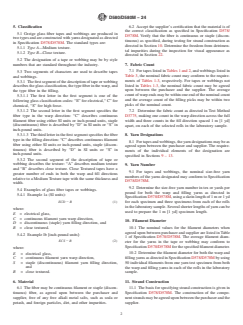
5. Classification 6.2 Accept the supplier’s certification that the material is of
the correct classification as specified in Specification D578/
5.1 Greige glass fiber tapes and webbings are produced in
D578M. Verify that the fiber is continuous or staple (discon-
two types and are constructed with yarns designated as directed
tinuous) as specified, during testing for strand construction as
in Specification D578/D578M. The standard types are:
directed in Section 10. Determine the freedom from detrimen-
5.1.1 Type A—Medium texture.
tal impurities during the inspection for visual appearance as
5.1.2 Type B—Close texture.
directed in Section 22.
5.2 The designation of a tape or webbing may be by style
numbers that are standard throughout the industry. 7. Fabric Count
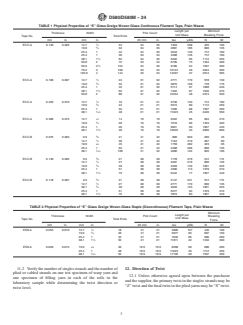
7.1 For tapes listed in Tables 1 and 2, and webbings listed in
5.3 Two segments of characters are used to describe tapes
Table 3, the nominal fabric count may conform to the require-
and webbings.
ments of Tables 1-3, respectively. For tapes or webbings not
5.3.1 The first segment of the description of tape or webbing
listed in Tables 1-3, the nominal fabric count may be agreed
describes the glass classification, the type fiber in the warp, and
upon between the purchaser and the supplier. The average
the type fiber in the filling.
count of warp ends may be within one end of the nominal count
5.3.1.1 The first letter in the first segment is one of the
and the average count of the filling picks may be within two
following glass classification codes: “E” for electrical,“ C” for
picks of the nominal count.
chemical, “S” for high force.
5.3.1.2 The second letter in the first segment specifies the 7.2 Determine the fabric count as directed in Test Method
fiber type in the warp direction: “C” describes continuous D3775, making one count in the warp direction across the full
filament fiber using either SI units or inch-pound units, staple width and three counts in the fill direction spaced 1 m [1 yd]
(discontinuous) fiber is described by “D” in SI units or “S” in
apart, on each of the selected rolls in the laboratory sample.
inch-pound units.
5.3.1.3 The third letter in the first segment specifies the fiber 8. Yarn Designations
type in the filling direction: “C” describes continuous filament
8.1 For tapes and webbings, the yarn designations may be as
fiber using either SI units or inch-pound units, staple (discon-
agreed upon between the purchaser and supplier. The require-
tinuous) fiber is described by “D” in SI units or “S” in
ments of the individual elements of the designation are
inch-pound units.
specified in Sections 9 – 13.
5.3.2 The second segment of the description of tape or
webbing describes the texture: “A” describes medium texture
9. Yarn Number
and “B” describes close texture. Close Textured tapes have a
9.1 For tapes and webbings, the nominal size-free yarn
greater number of ends in both the warp and fill directions
numbers of the yarns designated may conform to Specification
relative to a Medium Texture tape with the same thickness and
D578/D578M.
width.
9.2 Determine the size-free yarn number in tex or yards per
5.4 Examples of glass fiber tapes or webbings.
pound for both the warp and filling yarns as directed in
5.4.1 Example 1a (SI units):
Specification D578/D578M, using a skein length of 1 m or 1 yd
ECD 2 B (1)
for each specimen and three specimens from each of the rolls
in the laboratory sample. Several shorter lengths of yarn can be
where:
used to prepare the 1 m [1 yd] specimen length.
E = electrical glass,
C = continuous filament yarn warp direction,
10. Filament Diameter
D = discontinuous (staple) yarn filling direction, and
B = close textured. 10.1 The nominal values for the filament diameters when
agreed upon between purchaser and supplier are listed in Table
5.4.2 Example lb [inch-pound units]:
1 of Specification D578/D578M. The average filament diam-
ECS 2 B (2)
eter for the yarns in the tape or webbing may conform to
Specification D578/D578M for the specified filament diameter.
where:
10.2 Determine the filament diameter for both the warp and
E = electrical glass,
C = continuous filament yarn warp direction, filling yarns as directed in Specification D578/D578M by using
S = staple (discontinuous) filament yarn filling direction,
50 individual filaments from one yarn test specimen from both
and
the warp and filling yarns in each of the rolls in the laboratory
B = close textured.
sample.
6. Material
11. Strand Construction
6.1 The fiber may be continuous filament or staple (discon- 11.1 The basis for specifying strand construction is given in
tinuous) fiber, as agreed upon between the purchaser and Specification D578/D578M. The construction of the compo-
supplier, free of any free alkali metal salts, such as soda or nent strands may be agreed upon between the purchaser and the
potash, and foreign particles, dirt, and other impurities. supplier.
D580/D580M − 24
TABLE 1 Physical Properties of “E” Glass Greige Woven Glass Continuous Filament Tape, Plain Weave
Length per Minimum
Thickness Width Pick Count
Unit Mass Breaking Force
Tape No. Total Ends
mm in. mm in. 25 mm in. tex yd/lb N lbf
ECC-A 0.130 0.005 12.7 ⁄2 24 34 35 1923 258 445 100
19.0 ⁄4 32 34 35 2681 185 600 135
25.4 1 42 34 35 3543 140 712 160
25.4 1 36 33 34 3398 146 712 160
38.1 1 ⁄2 62 34 35 5222 95 1112 250
50.8 2 72 33 34 6795 73 1334 300
63.5 2 ⁄2 104 34 35 9186 54 1557 350
76.2 3 108 33 34 10124 49 2224 500
102.0 4 144 33 34 13407 37 2513 565
ECC-A 0.180 0.007 12.7 ⁄2 24 31 32 2771 179 578 130
19.0 ⁄4 32 31 32 3875 128 778 175
25.4 1 42 31 32 5114 97 1068 240
38.1 1 ⁄2 62 31 32 7404 67 1646 370
50.8 2 88 31 32 10334 48 2313 520
ECC-A 0.255 0.010 12.7 ⁄2 16 21 21 3730 133 712 160
19.0 ⁄4 24 21 21 5574 89 1112 250
25.4 1 32 21 21 7295 68 1557 350
38.1 1 ⁄2 48 21 21 11023 45 2446 550
ECC-A 0.380 0.015 12.7 ⁄2 14 16 16 5222 95 934 210
19.0 ⁄4 20 16 16 7516 66 1423 320
25.4 1 26 16 16 9921 50 1957 440
38.1 1 ⁄2 40 16 16 15032 33 2936 660
ECC-B 0.075 0.003 9.5 ⁄8 21 41 42 800 620 200 45
12.7 ⁄2 30 41 42 1184 419 267 60
19.0 ⁄4 45 41 42 1759 282 423 95
25.4 1 63 41 42 2408 206 600 135
38.1 1 ⁄2 108 41 42 4066 122 845 190
ECC-B 0.130 0.005 9.5 ⁄8 21 38 39 1778 279 512 115
12.7 ⁄2 27 38 39 2297 216 600 135
19.0 ⁄4 39 38 39 3329 149 1001 225
25.4 1 51 38 39 4390 113 1379 310
38.1 1 ⁄2 75 38 39 6442 77 1957 440
ECC-B 0.178 0.007 9.5 ⁄8 21 38 39 2147 231 512 115
12.7 ⁄2 27 38 39 2771 179 600 135
38.1 ⁄4 39 38 39 4033 123 1001 225
25.4 1 51 38 39 5277 94 1379 310
38.1 1 ⁄2 75 38 39 7874 63 1957 440
TABLE 2 Physical Properties of “E” Glass Greige Woven Glass Staple (Discontinuous) Filament Tape, Plain Weave
Minimum
Length per
Thickness Width Pick Count Breaking
Unit Mass
Tape No. Total Ends
Force
mm in. mm in. 25 mm in. tex yd/lb N lbf
ESS-A 0.255 0.010 12.7 ⁄2 18 21 21 3906 127 445 100
19.0 ⁄4 26 21 21 5977 83 667 150
25.4 1 34 21 21 7632 65 890 200
38.1 1 ⁄2 52 21 21 11811 42 1334 300
ESS-A 0.038 0.015 19.0 ⁄4 20 16.5 16.5 8268 60 890 200
25.4 1 28 16.5 16.5 11023 45 1112 250
38.1 1 ⁄2 52 16.5 16.5 17105 29 1557 350
11.2 Verify the number of singles strands and the number of 12. Direction of Twist
plied or cabled strands on one test specimen of warp yarn and
12.1 Unless otherwise agreed upon between the purchaser
one specimen of filling yarn in each of the rolls in the
and the supplier, the primary twist in the singles strands may be
laboratory sample while determining the twist direction or
“Z” twist and the final twist in the plied yarns may be “S” twist.
twist level.
D580/D580M − 24
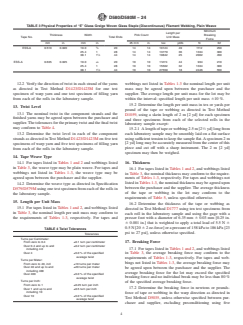
TABLE 3 Physical Properties of “E” Glass Greige Woven Glass Staple (Discontinuous) Filament Webbing, Plain Weave
Minimum
Length per
Thickness Width Pick Count Breaking
Unit Mass
Tape No. Total Ends
Force
mm in. mm in. 25 mm in. tex yd/lb N lbf
ESS-A 0.510 0.020 19.0 ⁄4 20 14 14 10124 49 1112 250
25.4 1 28 14 14 13779 36 1334 300
38.1 1 ⁄2 44 14 14 19842 25 2002 450
ESS-A 0.635 0.025 19.0 ⁄4 20 10 10 11274 44 934 210
25.4 1 28 10 10 15502 32 1334 300
38.1 1 ⁄2 44 10 10 27559 18 2446 550
12.2 Verify the direction of twist in each strand of the yarns webbings not listed in Tables 1-3 the nominal length per unit
as directed in Test Method D1423/D1423M for one test mass may be agreed upon between the purchaser and the
specimen of warp yarn and one test specimen of filling yarn supplier. The average length per unit mass for the lot may be
from each of the rolls in the laboratory sample. within the interval: specified length per unit mass 610 %.
15.2 Determine the length per unit mass in tex or yards per
13. Twist Level
pound of the tape or webbing as directed in Test Method
13.1 The nominal twist in the component strands and the
D1059, using a skein length of 2 m [2 yd] for each specimen
finished yarns may be agreed upon between the purchaser and
and three specimens from each of the selected rolls in the
supplier. The tolerances for the primary twist and the final twist
laboratory sample except:
may conform to Table 4.
15.2.1 A length of tape or webbing 2.5 m [2 ⁄2 yd] long from
each laboratory sample may be smoothly laid on a flat surface
13.2 Determine the twist level in each of the component
using sufficient tension to keep the sample flat. A specimen 2 m
strands as directed in Test Method D1423/D1423M on five test
[2 yd] long may be accurately measured from the center of this
specimens of warp yarn and five test specimens of fill
...
This document is not an ASTM standard and is intended only to provide the user of an ASTM standard an indication of what changes have been made to the previous version. Because
it may not be technically possible to adequately depict all changes accurately, ASTM recommends that users consult prior editions as appropriate. In all cases only the current version
of the standard as published by ASTM is to be considered the official document.
Designation: D580/D580M − 15 D580/D580M − 24
Standard SpecificationPractice for
Greige Woven Glass Tapes and Webbings
This standard is issued under the fixed designation D580/D580M; the number immediately following the designation indicates the year
of original adoption or, in the case of revision, the year of last revision. A number in parentheses indicates the year of last reapproval.
A superscript epsilon (´) indicates an editorial change since the last revision or reapproval.
1. Scope
1.1 This specificationpractice primarily covers greige tapes and webbings woven from “E” electrical classification glass fiber
yarns. This specificationpractice can also be applied to tapes and webbings made of other glass fiber grades upon agreement
between the purchaser and the supplier.
1.2 This specificationpractice is intended to assist ultimate users by designating the types of these products that are typical in the
industry. This specificationpractice permits the application of organic materials to the glass fiber yarn during manufacture that helps
facilitate weaving. When used as permitted in this specification,practice, such materials will not interfere with the intended end
use requirements.
1.3 Units—The values stated in either SI units or inch-pound units are to be regarded separately as standard. The values stated in
each system may not beare not necessarily exact equivalents; therefore, to ensure conformance with the standard, each system shall
be used independently of the other. Combiningother, and values from the two systems may result in nonconformance with the
standard.shall not be combined.
1.4 This standard does not purport to address all of the safety concerns, if any, associated with its use. It is the responsibility
of the user of this standard to establish appropriate safety and healthsafety, health, and environmental practices and determine
the applicability of regulatory limitations prior to use.
1.5 This international standard was developed in accordance with internationally recognized principles on standardization
established in the Decision on Principles for the Development of International Standards, Guides and Recommendations issued
by the World Trade Organization Technical Barriers to Trade (TBT) Committee.
2. Referenced Documents
2.1 ASTM Standards:
D123 Terminology Relating to Textiles
D578D578/D578M Specification for Glass Fiber Strands
D579D579/D579M Practice for Greige Woven Glass Fabrics
D1059 Test Method for Yarn Number Based on Short-Length Specimens
D1423D1423/D1423M Test Method for Twist in Yarns by Direct-Counting
D1776D1776/D1776M Practice for Conditioning and Testing Textiles
D1777 Test Method for Thickness of Textile Materials
D3773D3773/D3773M Test Methods for Length of Woven Fabric
This specificationpractice is under the jurisdiction of ASTM Committee D13 on Textiles and is the direct responsibility of Subcommittee D13.18 on Glass Fiber and its
Products.
Current edition approved Feb. 1, 2015Jan. 1, 2024. Published March 2015February 2024. Originally approved in 1940. Last previous edition approved in 20042015 as
D580/D580M – 10.D580/D580M – 15. DOI: 10.1520/D0580_D0580M-1510.1520/D0580_D0580M-24
For referenced ASTM standards, visit the ASTM website, www.astm.org, or contact ASTM Customer Service at service@astm.org. For Annual Book of ASTM Standards
volume information, refer to the standard’s Document Summary page on the ASTM website.
Copyright © ASTM International, 100 Barr Harbor Drive, PO Box C700, West Conshohocken, PA 19428-2959. United States
D580/D580M − 24
D3774 Test Method for Width of Textile Fabric
D3775 Test Method for End (Warp) and Pick (Filling) Count of Woven Fabrics
D4963D4963/D4963M Test Method for Ignition Loss of Glass Fiber Strands and Fabrics
D5035 Test Method for Breaking Force and Elongation of Textile Fabrics (Strip Method)
D7018D7018/D7018M Terminology Relating to Glass Fiber and Its Products (Withdrawn 2021)
2.2 ANSI Standard:
ANSI/ASQC Z1.4 Sampling Procedures for Inspection by Attributes
3. Terminology
3.1 Definitions of Terms Specific to This Standard:
3.1.1 For definitions of glass fiber and product terms used in this specificationpractice refer to Terminology D7018D7018/
D7018M.
3.1.2 The following terms are relevant to this standard:practice: continuous filament yarn, greige goods, tape, and webbing.
3.1.3 For definitions of other textile terminology used in this specification,practice, refer to Terminology D123.
4. Significance and Use
4.1 This standard practice may be used to classify, construct, and test woven greige fiberglass tapes and webbings formed from
both continuous and discontinuous fiber.
5. Classification
5.1 Greige glass fiber tapes and webbings are produced in two types and are constructed with yarns designated as directed in
Specification D578D578/D578M. The standard types are:
5.1.1 Type A—Medium texture.
5.1.2 Type B—OpenClose texture.
5.2 The designation of a tape or webbing shallmay be by style numbers that are standard throughout the industry.
5.3 Two segments of characters are used to describe tapes and webbings.
5.3.1 The first segment of the description of tape or webbing describes the glass classification, the type fiber in the warp, and the
type fiber in the filling.
5.3.1.1 The first letter in the first segment is one of the following glass classification codes: “E” for electrical,“ C” for chemical,
“S” for high force.
5.3.1.2 The second letter in the first segment specifies the fiber type in the warp direction: “C” describes continuous filament fiber
using either SI units or inch-pound units, staple (discontinuous) fiber is described by “D” in SI units or “S” in inch-pound units.
5.3.1.3 The third letter in the first segment specifies the fiber type in the filling direction: “C” describes continuous filament fiber
using either SI units or inch-pound units, staple (discontinuous) fiber is described by “D” in SI units or “S” in inch-pound units.
5.3.2 The second segment of the description of tape or webbing describes the texture: “A” describes medium texture and“ B”and
“B” describes close texture. Close Textured tapes have a greater number of ends in both the warp and fill directions relative to a
Medium Texture tape with the same thickness and width.
5.4 Examples of glass fiber tapes or webbings.
The last approved version of this historical standard is referenced on www.astm.org.
Available from American National Standards Institute, 11 W. 42nd St., 13thInstitute (ANSI), 25 W. 43rd St., 4th Floor, New York, NY 10036.10036, http://www.ansi.org.
D580/D580M − 24
5.4.1 Example 1a (SI units):
ECD 2 B (1)
where:
E = electrical glass,
C = continuous filament yarn warp direction,
D = discontinuous (staple) yarn filling direction, and
B = close textured.
5.4.2 Example 1blb [inch-pound units]:
ECS 2 B (2)
where:
E = electrical glass,
C = continuous filament yarn warp direction,
S = staple (discontinuous) filament yarn filling direction, and
B = close textured.
REQUIREMENTS
6. Material
6.1 The fiber shallmay be continuous filament or staple (discontinuous) fiber, as agreed upon between the purchaser and supplier,
free of any free alkali metal salts, such as soda or potash, and foreign particles, dirt, and other impurities.
6.2 Accept the supplier’s certification that the material is of the correct classification as specified in Specification D578/D578M.
Verify that the fiber is continuous or staple (discontinuous) as specified, during testing for strand construction as directed in Section
10. Determine the freedom from detrimental impurities during the inspection for visual appearance as directed in Section 22.
7. Fabric Count
7.1 For tapes listed in Tables 1 and 2, and webbings listed in Table 3, the nominal fabric count shallmay conform to the
requirements of Table 1Tables 1-3, Table 2, and Table 3, respectively. For tapes or webbings not listed in Table 1Tables 1-3, Table
2, and Table 3, the nominal fabric count shallmay be agreed upon between the purchaser and the supplier. The average count of
warp ends shallmay be within one end of the nominal count and the average count of the filling picks shallmay be within two picks
of the nominal count.
7.2 Determine the fabric count as directed in Test Method D3775, making one count in the warp direction across the full width
and three counts in the fill direction spaced 1 m [1 yd] apart, on each of the selected rolls in the laboratory sample.
8. Yarn Designations
8.1 For tapes and webbings, the yarn designations shallmay be as agreed upon between the purchaser and supplier. The
requirements of the individual elements of the designation are specified in Sections 89 – 1213.
9. Yarn Number
9.1 For tapes and webbings, the nominal size-free yarn numbers of the yarns designated shallmay conform to Specification
D578D578/D578M.
9.2 Determine the size-free yarn number in tex or yards per pound for both the warp and filling yarns as directed in Specification
D578/D578M, using a skein length of 1 m or 1 yd for each specimen and three specimens from each of the rolls in the laboratory
sample. Several shorter lengths of yarn can be used to prepare the 1 m [1 yd] specimen length.
D580/D580M − 24
TABLE 1 Physical Properties of Generally Available “E” Glass Greige Woven Glass Continuous Filament Tape, Plain Weave
Length per Minimum
Thickness Width Pick Count
Unit Mass Breaking Force
Tape No. Total Ends
mm in. mm in. 25 mm in. tex yd/lb N lbf
ECC-A 0.130 0.005 12.7 ⁄2 24 34 35 1923 258 445 100
19.0 ⁄4 32 34 35 2681 185 600 135
25.4 1 42 34 35 3543 140 712 160
25.4 1 36 33 34 3398 146 712 160
38.1 1 ⁄2 62 34 35 5222 95 1112 250
50.8 2 72 33 34 6795 73 1334 300
63.5 2 ⁄2 104 34 35 9186 54 1557 350
76.2 3 108 33 34 10124 49 2224 500
102.0 4 144 33 34 13407 37 2513 565
ECC-A 0.180 0.007 12.7 ⁄2 24 31 32 2771 179 578 130
19.0 ⁄4 32 31 32 3875 128 778 175
25.4 1 42 31 32 5114 97 1068 240
38.1 1 ⁄2 62 31 32 7404 67 1646 370
50.8 2 88 31 32 10334 48 2313 520
0.255 0.010 12.7 ⁄2 16 21 21 3730 133 712 160
ECC-A
19.0 ⁄4 24 21 21 5574 89 1112 250
25.4 1 32 21 21 7295 68 1557 350
38.1 1 ⁄2 48 21 21 11023 45 2446 550
ECC-A 0.380 0.015 12.7 ⁄2 14 16 16 5222 95 934 210
19.0 ⁄4 20 16 16 7516 66 1423 320
25.4 1 26 16 16 9921 50 1957 440
38.1 1 ⁄2 40 16 16 15032 33 2936 660
ECC-B 0.075 0.003 9.5 ⁄8 21 41 42 800 620 200 45
12.7 ⁄2 30 41 42 1184 419 267 60
19.0 ⁄4 45 41 42 1759 282 423 95
25.4 1 63 41 42 2408 206 600 135
38.1 1 ⁄2 108 41 42 4066 122 845 190
ECC-B 0.130 0.005 9.5 ⁄8 21 38 39 1778 279 512 115
12.7 ⁄2 27 38 39 2297 216 600 135
19.0 ⁄4 39 38 39 3329 149 1001 225
25.4 1 51 38 39 4390 113 1379 310
38.1 1 ⁄2 75 38 39 6442 77 1957 440
ECC-B 0.178 0.007 9.5 ⁄8 21 38 39 2147 231 512 115
12.7 ⁄2 27 38 39 2771 179 600 135
38.1 ⁄4 39 38 39 4033 123 1001 225
25.4 1 51 38 39 5277 94 1379 310
38.1 1 ⁄2 75 38 39 7874 63 1957 440
TABLE 2 Physical Properties of Generally Available “E” Glass Greige Woven Glass Staple (Discontinuous) Filament Tape, Plain Weave
Minimum
Length per
Thickness Width Pick Count Breaking
Unit Mass
Tape No. Total Ends
Force
mm in. mm in. 25 mm in. tex yd/lb N lbf
ESS-A 0.255 0.010 12.7 ⁄2 18 21 21 3906 127 445 100
19.0 ⁄4 26 21 21 5977 83 667 150
25.4 1 34 21 21 7632 65 890 200
38.1 1 ⁄2 52 21 21 11811 42 1334 300
ESS-A 0.038 0.015 19.0 ⁄4 20 16.5 16.5 8268 60 890 200
25.4 1 28 16.5 16.5 11023 45 1112 250
38.1 1 ⁄2 52 16.5 16.5 17105 29 1557 350
10. Filament Diameter
10.1 The nominal values for the filament diameters when agreed upon between purchaser and supplier are listed in Table 1 of
Specification D578D578/D578M. The average filament diameter for the yarns in the tape or webbing shallmay conform to
Specification D578D578/D578M for the specified filament diameter.
D580/D580M − 24
TABLE 3 Physical Properties of Generally Available “E” Glass Greige Woven Glass Staple (Discontinuous) Filament Webbing, Plain
Weave
Minimum
Length per
Thickness Width Pick Count Breaking
Unit Mass
Tape No. Total Ends
Force
mm in. mm in. 25 mm in. tex yd/lb N lbf
ESS-A 0.510 0.020 19.0 ⁄4 20 14 14 10124 49 1112 250
25.4 1 28 14 14 13779 36 1334 300
38.1 1 ⁄2 44 14 14 19842 25 2002 450
ESS-A 0.635 0.025 19.0 ⁄4 20 10 10 11274 44 934 210
25.4 1 28 10 10 15502 32 1334 300
38.1 1 ⁄2 44 10 10 27559 18 2446 550
10.2 Determine the filament diameter for both the warp and filling yarns as directed in Specification D578/D578M by using 50
individual filaments from one yarn test specimen from both the warp and filling yarns in each of the rolls in the laboratory sample.
11. Strand Construction
11.1 The basis for specifying strand construction is given in Specification D578D578/D578M. The construction of the component
strands shallmay be agreed upon between the purchaser and the supplier.
11.2 Verify the number of singles strands and the number of plied or cabled strands on one test specimen of warp yarn and one
specimen of filling yarn in each of the rolls in the laboratory sample while determining the twist direction or twist level.
12. Direction of Twist
12.1 Unless otherwise agreed upon between the purchaser and the supplier, the primary twist in the singles strands shallmay be
“Z” twist and the final twist in the plied yarns shallmay be “S” twist.
12.2 Verify the direction of twist in each strand of the yarns as directed in Test Method D1423/D1423M for one test specimen of
warp yarn and one test specimen of filling yarn from each of the rolls in the laboratory sample.
13. Twist Level
13.1 The nominal twist in the component strands and the finished yarns shallmay be agreed upon between the purchaser and
supplier. The tolerances for the primary twist and the final twist shallmay conform to Table 4.
TABLE 4 Twist Tolerances
Tolerances
Turns per Centimeter:
From zero to 0.4 ±0.1 turn per centimeter
Over 0.4 and up to and ±0.2 turn per centimeter
including 4.0
Over 4 ±5.0 % of the specified
average twist
Turns per Meter:
From zero to 40, incl ±10 turns per meter
Over 40 and up to and ±20 turns per meter
including 400
Over 400 ±5.0 % of the specified
av erage twist
Over 400 ±5.0 % of the specified
average twist
Turns per Inch:
From zero to 1 ±0.25 turn per inch
Over 1 and up to and ±0.5 turn per inch
including 10
Over 10 ±5.0 % of the specified
average twist
D580/D580M − 24
13.2 Determine the twist level in each of the component strands as directed in Test Method D1423/D1423M on five test specimens
of warp yarn and five test specimens of filling yarn from each of the rolls in the laboratory sample.
14. Tape Weave Type
14.1 For tapes listed in Tables 1 and 2 and webbings listed in Table 3, the weave type shallmay be plain weave. For tapes and
webbings not listed in Table 1Tables 1-3, Table 2, and Table 3, the weave type shallmay be agreed upon between the purchaser
and the supplier.
14.2 Determine the weave type as directed in Specification D579/D579M using one test specimen from each of the rolls in the
laboratory sample.
15. Length per Unit Mass
15.1 For tapes listed in Tables 1 and 2, and webbings listed in Table 3, the nominal length per unit mass shallmay conform to the
requirements of Table 1Tables 1-3, Table 2, and Table 3, respectively. For tapes and webbings not listed in Table 1Tables 1-3, Table
2, and Table 3, the nominal length per unit mass shallmay be agreed upon between the purchaser and the supplier. The average
length per unit mass for the lot shallmay be within the interval: specified length per unit mass 610 %.
15.2 Determine the length per unit mass in tex or yards per pound of the tape or webbing as directed in Test Method D1059, using
a skein length of 2 m [2 yd] for each specimen and three specimens from each of the selected rolls in the laboratory sample except:
15.2.1 A length of tape or webbing 2.5 m [2 ⁄2 yd] long from each laboratory sample may be smoothly laid on a flat surface using
sufficient tension to keep the sample flat. A specimen 2 m [2 yd] long may be accurately measured from the center of this piece
and cut off with a sharp instrument. The 2 m [2 yd] specimen may then be weighed.
16. Thickness
16.1 For tapes listed in Tables 1 and 2, and webbings listed in Table 3, the nominal thickness shallmay conform to the requirements
of Table 1Tables 1-3, Table 2, and Table 3, respectively. For tapes and webbings not listed in Table 1Tables 1-3, Table 2, and Table
3, the nominal thickness shallmay be agreed upon between the purchaser and the supplier. The average thickness of the tape or
webbing in the lot shallmay conform to the requirements of Table 5, unless specified otherwise.
TABLE 5 Tolerances—Thickness
Permissible Variations, Average
Nominal Thickness
Staple
Continuous
(discontinuous)
millimetres
millimeters
0.125 and under ±0.013 .
Over 0.125 to 0.250 ±0.025 ±0.050
Over 0.250 to 0.380 ±0.050 ±0.075
Over 0.380 to 0.025 . ±0.075
inches
0.0050 and under ±0.0005 .
Over 0.0050 to 0.0100 ±0.0010 ±0.0020
Over 0.0100 to 0.0150 ±0.0020 ±0.0030
Over 0.0150 to 0.0250 . ±0.0030
Permissible Variations, Individual
Staple
Continuous
(discontinuous)
millimetres
millimeters
0.125 and under ±0.025 .
Over 0.125 to 0.250 ±0.040 ±0.075
Over 0.250 to 0.380 ±0.060 ±0.090
Over 0.380 to 0.635 . ±0.090
inches
0.0050 and under ±0.0010 .
Over 0.0050 to 0.0100 ±0.0015 ±0.0030
Over 0.0100 to 0.0150 ±0.0025 ±0.0035
Over 0.0150 to 0.0250 . ±0.0035
D580/D580M − 24
...