

ASTM D4030/D4030M-23
(Specification)Standard Specification for Glass Fiber Cord and Sewing Thread
General Information
- Abstract
ABSTRACT
This specification covers the requirements for continuous glass filament sewing thread and untreated and neoprene treated, continuous filament cord; intended to assist ultimate users by designing the types of these products that are typical in the industry. The fiber shall be electrical grade, free of any free alkali metal oxides, such as soda or potash, and foreign particle, dirt, and other impurities. The glass fiber cord or sewing thread shall be wound on tubes, spools, or cones and shall conform to the following requirements: filament diameter; yarn number; strand construction; twist direction; twist level; breaking strength; yarn diameter; twist balance; and ignition loss. The cord and the sewing thread shall also undergo visual examination to check for defects such as cut, spot or stain, and embedded foreign matter.
SCOPE
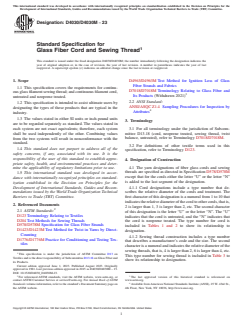
1.1 This specification covers the requirements for continuous glass filament sewing thread; and continuous filament cord, untreated and neoprene treated.
1.2 This specification is intended to assist ultimate users by designating the types of these products that are typical in the industry.
1.3 The values stated in either SI units or inch-pound units are to be regarded separately as standard. The values stated in each system are not exact equivalents; therefore, each system shall be used independently of the other. Combining values from the two systems will result in nonconformance with the standard.
1.4 This standard does not purport to address all of the safety concerns, if any, associated with its use. It is the responsibility of the user of this standard to establish appropriate safety, health, and environmental practices and determine the applicability of regulatory limitations prior to use.
1.5 This international standard was developed in accordance with internationally recognized principles on standardization established in the Decision on Principles for the Development of International Standards, Guides and Recommendations issued by the World Trade Organization Technical Barriers to Trade (TBT) Committee.
- Status
- Published
- Publication Date
- 31-May-2023
- Technical Committee
- D13 - Textiles
- Drafting Committee
- D13.18 - Glass Fiber and its Products
Buy Documents
ASTM D4030/D4030M-23 - Standard Specification for Glass Fiber Cord and Sewing Thread
REDLINE ASTM D4030/D4030M-23 - Standard Specification for Glass Fiber Cord and Sewing Thread
Overview
ASTM D4030/D4030M-23 - Standard Specification for Glass Fiber Cord and Sewing Thread establishes the requirements for continuous glass filament sewing thread and both untreated and neoprene-treated glass fiber cord. Developed by ASTM International, this standard assists users in identifying typical products and their types as prevalent in the textile and composite industries. The document outlines critical physical and material properties including filament diameter, yarn number, strand construction, twist level, breaking strength, yarn diameter, twist balance, and ignition loss, while ensuring the exclusion of impurities and defects.
Key Topics
- Material Requirements: Specifies that glass fibers must be electrical grade, free from alkali metal oxides such as soda or potash, and without foreign materials or contamination.
- Construction Designation:
- Cords and sewing threads are designated using a systematic code that reflects size, treatment type (untreated “U” or neoprene treated “N”), and other construction details for standardization across suppliers and industries.
- Physical and Mechanical Properties:
- Requirements for filament diameter, yarn number, breaking strength, and strand construction are clearly outlined.
- Twist direction and twist balance are specified, with tolerances detailed for different measurement units.
- Visual and Dimensional Examination:
- Threads and cords must be visually inspected and be free of cuts, stains, spots, and embedded foreign matter.
- Nominal yarn diameters and quality appearance standards are included to ensure uniformity.
- Ignition Loss and Organic Content:
- Limits on organic content are provided to control the amount of sizing or treatment, ensuring product consistency and performance.
- Packaging and Marking:
- Products must be wound on tubes, spools, or cones and packaged to prevent damage during shipment.
- Each package requires clear labeling with product specifications and batch information for traceability.
Applications
- Electrical Insulation and Cable Wrapping: Glass fiber cords and sewing threads meeting ASTM D4030/D4030M-23 are preferred for insulation purposes due to their electrical grade and resistance to impurities.
- Composite Reinforcement: Used in manufacturing processes where consistent fiber properties and mechanical strength are critical, such as in aerospace, automotive, and building materials.
- Industrial Sewing and Stitching: Glass fiber sewing thread offers durability for high-temperature or chemically aggressive environments, suitable for filtration products, conveyor belts, and other technical textiles.
- Protective Coverings: These products are utilized where fire resistance, thermal insulation, or structural strength is required.
Related Standards
- ASTM D578/D578M: Specification for Glass Fiber Strands, providing foundational material classification referenced throughout ASTM D4030/D4030M-23.
- ASTM D204: Test Methods for Sewing Threads, offering test procedures for properties like thread twist and diameter.
- ASTM D1423/D1423M: Test Method for Twist in Yarns, key for verifying strand construction and twist balance.
- ASTM D4963/D4963M: Method for Ignition Loss of Glass Fiber Strands and Fabrics, essential for determining organic content in fibers.
- ASTM D123: Terminology Relating to Textiles, ensuring consistent vocabulary across standards.
- ANSI/ASQC Z1.4: Sampling Procedures for Inspection by Attributes, guiding quality inspection and lot acceptance.
Keywords: glass fiber cord, glass sewing thread, ASTM D4030/D4030M-23, electrical grade fiber, neoprene-treated cord, physical properties, textile standards, composite reinforcement, yarn testing, textile inspection.
Relations
- Effective Date
- 01-Feb-2020
- Effective Date
- 01-Mar-2017
- Effective Date
- 01-Jan-2016
- Effective Date
- 15-Sep-2015
- Effective Date
- 01-Sep-2015
- Effective Date
- 01-Apr-2015
- Effective Date
- 01-Feb-2015
- Effective Date
- 15-Jun-2013
- Effective Date
- 15-Jun-2013
- Effective Date
- 15-May-2013
- Effective Date
- 01-Feb-2012
- Effective Date
- 01-Feb-2012
- Effective Date
- 01-Jul-2011
- Effective Date
- 01-Jan-2011
- Effective Date
- 01-Jun-2010
Buy Documents
ASTM D4030/D4030M-23 - Standard Specification for Glass Fiber Cord and Sewing Thread
REDLINE ASTM D4030/D4030M-23 - Standard Specification for Glass Fiber Cord and Sewing Thread
Get Certified
Connect with accredited certification bodies for this standard

Control Union Certifications
Global certification for agriculture and sustainability.

Hohenstein Institut
Textile testing and certification.

Bureau Veritas Bangladesh
Bureau Veritas certification services in Bangladesh.
Sponsored listings
Frequently Asked Questions
ASTM D4030/D4030M-23 is a technical specification published by ASTM International. Its full title is "Standard Specification for Glass Fiber Cord and Sewing Thread". This standard covers: ABSTRACT This specification covers the requirements for continuous glass filament sewing thread and untreated and neoprene treated, continuous filament cord; intended to assist ultimate users by designing the types of these products that are typical in the industry. The fiber shall be electrical grade, free of any free alkali metal oxides, such as soda or potash, and foreign particle, dirt, and other impurities. The glass fiber cord or sewing thread shall be wound on tubes, spools, or cones and shall conform to the following requirements: filament diameter; yarn number; strand construction; twist direction; twist level; breaking strength; yarn diameter; twist balance; and ignition loss. The cord and the sewing thread shall also undergo visual examination to check for defects such as cut, spot or stain, and embedded foreign matter. SCOPE 1.1 This specification covers the requirements for continuous glass filament sewing thread; and continuous filament cord, untreated and neoprene treated. 1.2 This specification is intended to assist ultimate users by designating the types of these products that are typical in the industry. 1.3 The values stated in either SI units or inch-pound units are to be regarded separately as standard. The values stated in each system are not exact equivalents; therefore, each system shall be used independently of the other. Combining values from the two systems will result in nonconformance with the standard. 1.4 This standard does not purport to address all of the safety concerns, if any, associated with its use. It is the responsibility of the user of this standard to establish appropriate safety, health, and environmental practices and determine the applicability of regulatory limitations prior to use. 1.5 This international standard was developed in accordance with internationally recognized principles on standardization established in the Decision on Principles for the Development of International Standards, Guides and Recommendations issued by the World Trade Organization Technical Barriers to Trade (TBT) Committee.
ABSTRACT This specification covers the requirements for continuous glass filament sewing thread and untreated and neoprene treated, continuous filament cord; intended to assist ultimate users by designing the types of these products that are typical in the industry. The fiber shall be electrical grade, free of any free alkali metal oxides, such as soda or potash, and foreign particle, dirt, and other impurities. The glass fiber cord or sewing thread shall be wound on tubes, spools, or cones and shall conform to the following requirements: filament diameter; yarn number; strand construction; twist direction; twist level; breaking strength; yarn diameter; twist balance; and ignition loss. The cord and the sewing thread shall also undergo visual examination to check for defects such as cut, spot or stain, and embedded foreign matter. SCOPE 1.1 This specification covers the requirements for continuous glass filament sewing thread; and continuous filament cord, untreated and neoprene treated. 1.2 This specification is intended to assist ultimate users by designating the types of these products that are typical in the industry. 1.3 The values stated in either SI units or inch-pound units are to be regarded separately as standard. The values stated in each system are not exact equivalents; therefore, each system shall be used independently of the other. Combining values from the two systems will result in nonconformance with the standard. 1.4 This standard does not purport to address all of the safety concerns, if any, associated with its use. It is the responsibility of the user of this standard to establish appropriate safety, health, and environmental practices and determine the applicability of regulatory limitations prior to use. 1.5 This international standard was developed in accordance with internationally recognized principles on standardization established in the Decision on Principles for the Development of International Standards, Guides and Recommendations issued by the World Trade Organization Technical Barriers to Trade (TBT) Committee.
ASTM D4030/D4030M-23 is classified under the following ICS (International Classification for Standards) categories: 59.100.10 - Textile glass materials. The ICS classification helps identify the subject area and facilitates finding related standards.
ASTM D4030/D4030M-23 has the following relationships with other standards: It is inter standard links to ASTM D1776/D1776M-20, ASTM D123-17, ASTM D1776/D1776M-16, ASTM D123-15b, ASTM D123-15a, ASTM D123-15, ASTM D1776/D1776M-15, ASTM D123-13ae1, ASTM D123-13a, ASTM D123-13, ASTM D123-12e1, ASTM D123-12, ASTM D578/D578M-05(2011)e1, ASTM D7018/D7018M-11, ASTM D204-02(2010)e1. Understanding these relationships helps ensure you are using the most current and applicable version of the standard.
ASTM D4030/D4030M-23 is available in PDF format for immediate download after purchase. The document can be added to your cart and obtained through the secure checkout process. Digital delivery ensures instant access to the complete standard document.
Standards Content (Sample)
This international standard was developed in accordance with internationally recognized principles on standardization established in the Decision on Principles for the
Development of International Standards, Guides and Recommendations issued by the World Trade Organization Technical Barriers to Trade (TBT) Committee.
Designation: D4030/D4030M − 23
Standard Specification for
Glass Fiber Cord and Sewing Thread
This standard is issued under the fixed designation D4030/D4030M; the number immediately following the designation indicates the
year of original adoption or, in the case of revision, the year of last revision. A number in parentheses indicates the year of last
reapproval. A superscript epsilon (´) indicates an editorial change since the last revision or reapproval.
1. Scope D4963/D4963M Test Method for Ignition Loss of Glass
Fiber Strands and Fabrics
1.1 This specification covers the requirements for continu-
D7018/D7018M Terminology Relating to Glass Fiber and
ous glass filament sewing thread; and continuous filament cord,
Its Products (Withdrawn 2021)
untreated and neoprene treated.
2.2 ANSI Standard:
1.2 This specification is intended to assist ultimate users by
ANSI/ASQC Z1.4 Sampling Procedures for Inspection by
designating the types of these products that are typical in the
Attributes
industry.
1.3 The values stated in either SI units or inch-pound units
3. Terminology
are to be regarded separately as standard. The values stated in
each system are not exact equivalents; therefore, each system 3.1 For all terminology under the jurisdiction of Subcom-
mittee D13.18 (cord, neoprene treated, sewing thread, twist
shall be used independently of the other. Combining values
from the two systems will result in nonconformance with the balance, untreated), refer to Terminology D7018/D7018M.
standard.
3.2 For definitions of other textile terms used in this
1.4 This standard does not purport to address all of the
specification, refer to Terminology D123.
safety concerns, if any, associated with its use. It is the
responsibility of the user of this standard to establish appro-
4. Designation of Construction
priate safety, health, and environmental practices and deter-
4.1 The yarn designations of fiber glass cords and sewing
mine the applicability of regulatory limitations prior to use.
threads are specified as directed in Specification D578/D578M
1.5 This international standard was developed in accor-
except that for the cords either the letter “U” or the letter “N”
dance with internationally recognized principles on standard-
is added to the last segment of the designation.
ization established in the Decision on Principles for the
Development of International Standards, Guides and Recom- 4.1.1 Cord designations include a type number that de-
mendations issued by the World Trade Organization Technical
scribes the relative diameter of the cords and treatment. The
Barriers to Trade (TBT) Committee. first character of this designation is a numeral from 1 to 10 that
indicates the relative diameter of the cord to other cords, that is,
2. Referenced Documents
2 is larger than 1, 3 is larger than 2, etc. The second character
2.1 ASTM Standards:
of this designation is the letter “U” or the letter “N”. The “U”
D123 Terminology Relating to Textiles
indicates that the cord is untreated, and the “N” indicates that
D204 Test Methods for Sewing Threads
the cord is neoprene treated. The type number for cord is
D578/D578M Specification for Glass Fiber Strands
included in Tables 1 and 2 to show its relationship to
D1423/D1423M Test Method for Twist in Yarns by Direct-
designation.
Counting
4.1.2 Sewing thread construction includes a type number
D1776/D1776M Practice for Conditioning and Testing Tex-
that describes a manufacturer’s code and the size. The second
tiles
character is a numeral and indicates the relative diameter of the
sewing threads, that is, 4 is larger than 2, 6 is larger than 4, etc.
This specification is under the jurisdiction of ASTM Committee D13 on
This type number for sewing thread is included in Table 3 to
Textiles and is the direct responsibility of Subcommittee D13.18 on Glass Fiber and
show its relationship to designation.
its Products.
Current edition approved June 1, 2023. Published August 2023. Originally
approved in 1981. Last previous edition approved in 2015 as D4030/D4030M – 15.
DOI: 10.1520/D4030_D4030M-23.
2 3
For referenced ASTM standards, visit the ASTM website, www.astm.org, or The last approved version of this historical standard is referenced on
contact ASTM Customer Service at service@astm.org. For Annual Book of ASTM www.astm.org.
Standards volume information, refer to the standard’s Document Summary page on Available from American National Standards Institute (ANSI), 25 W. 43rd St.,
the ASTM website. 4th Floor, New York, NY 10036, http://www.ansi.org.
Copyright © ASTM International, 100 Barr Harbor Drive, PO Box C700, West Conshohocken, PA 19428-2959. United States
D4030/D4030M − 23
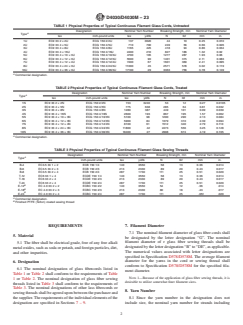
TABLE 1 Physical Properties of Typical Continuous Filament Glass Cords, Untreated
Designation Nominal Yarn Number Breaking Strength, min Nominal Yarn Diameter
A
Type
tex inch-pound units tex yd/lb N lbf mm in.
1U EC9 33 2 × 2U ECG 150 2/2U 137 3620 44 10 0.25 0.010
2U EC9 33 4 × 5U ECG 150 4/5U 710 700 249 56 0.66 0.026
3U EC9 33 4 × 8U ECG 150 4/8U 1165 425 418 94 0.86 0.034
4U EC9 33 4 × 16U ECG 150 4/16U 2400 210 827 186 1.32 0.02
5U EC9 33 4 × 10 × 3U ECG 150 4/10/3U 4700 105 1277 287 1.93 0.06
6U EC9 33 4 × 12 × 3U ECG 150 4/12/3U 5500 90 1401 315 2.11 0.083
7U EC9 33 4 × 12 × 4U ECG 150 4/12/4U 7400 67 1601 360 2.41 0.095
8U EC9 33 4 × 24 × 3U ECG 150 4/24/3U 11000 45 2571 578 3.02 0.119
10U EC9 33 4 × 36 × 3U ECG 150 4/36/3U 17100 29 3363 756 3.78 0.149
A
Commercial designation.
TABLE 2 Physical Properties of Typical Continuous Filament Glass Cords, Treated
Designation Nominal Yarn Number Breaking Strength, min Nominal Yarn Diameter
A
Type
tex inch-pound units tex yd/lb N lbf mm in.
1N EC9 33 2 × 2N ECG 150 2/2N 153 3240 53 12 0.27 0.0105
2N EC9 33 4 × 5N ECG 150 4/5N 775 638 285 64 0.81 0.032
3N EC9 33 4 × 8N ECG 150 4/8N 1280 387 449 101 0.99 0.039
4N EC9 33 4 × 16N ECG 150 4/16N 2600 193 867 195 1.57 0.062
5N EC9 33 4 × 10 × 3N ECG 150 4/10/3N 5100 98 1290 290 2.13 0.084
6N EC9 33 4 × 12 × 3N ECG 150 4/12/3N 5900 84 1379 310 2.39 0.094
7N EC9 33 4 × 12 × 4N ECG 150 4/12/4N 8100 61 1512 340 2.79 0.110
8N EC9 33 4 × 24 × 3N ECG 150 4/24/3N 11800 42 2473 556 3.25 0.128
10N EC9 33 4 × 36 × 3N ECG 150 4/36/3N 18400 27 2998 674 4.19 0.165
A
Commercial designation.
TABLE 3 Physical Properties of Typical Continuous Filament Glass Sewing Threads
Designation Nominal Yarn Number Breaking Strength, min Nominal Yarn Diameter
A
Type
tex inch-pound units tex yd/lb N lbf mm in.
B-4 EC3.5 33 1 × 2 ECB 150 1/4 140 3550 58 13 0.36 0.014
B-6 EC3.5 33 2 × 3 ECB 150 2/3 213 2330 89 20 0.43 0.017
B-8 EC3.5 33 2 × 4 ECB 150 2/4 287 1730 111 25 0.51 0.020
T-12 EC6 33 1 × 4 ECDE 150 1/4 140 3550 58 13 0.36 0.014
T-18 EC6 33 2 × 4 ECDE 150 2/3 213 2330 89 20 0.43 0.017
T-24 EC6 33 2 × 4 ECDE 150 2/4 287 1730 111 25 0.51 0.020
B
E-12 EC 4.0 33 2 × 2 ECBC 150 2/2 140 3550 54 12 .36 .014
B
E-18 EC 4.0 33 2 × 3 ECBC 150 2/3 213 2330 80 18 .43 .017
B
E-24 EC 4.0 33 2 × 4 ECBC 150 2/4 287 1730 111 25 .051 .020
A
Commercial designation.
B
Finished PTFE (Teflon) coated sewing thread
REQUIREMENTS 7. Filament Diameter
7.1 The nominal filament diameter of glass fiber cords shall
5. Material
be designated by the letter designation “G”. The nominal
filament diameter of r glass fiber sewing threads shall be
5.1 The fiber shall be electrical grade, free of any free alkali
designated by the letter designation “B” to “DE”, as applicable.
metal oxides, such as soda or potash, and foreign particles, dirt,
The numerical values associated with letter designations are
and other impurities.
specified in Specification D578/D578M. The average filament
diameter for the yarns in the cord or sewing thread shall
6. Designation
conform to Specification D578/D578M for the specified fila-
6.1 The nominal designation of glass fibercords listed in
ment diameter.
Table 1 or Table 2 shall conform to the requirements of Table
NOTE 1—Because of the application of glass fiber sewing threads, it is
1 or Table 2. The nominal designation of glass fiber sewing
desirable to utilize somewhat finer filament sizes.
threads listed in Table 3 shall conform to the requirements of
Table 3. The nominal designations of other lass fibercords or
8. Yarn Number
sewing threads shall be agreed upon between the purchaser and
the supplier. The requirements of the individual elements of the 8.1 Since the yarn number in the designation does not
designation are specified in Sections 7 – 9. include size, the nominal yarn number for strands including
D4030/D4030M − 23
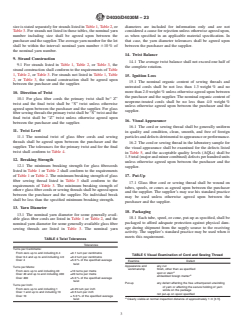
size is stated separately for strands listed in Table 1, Table 2, or diameters are included for information only and are not
Table 3. For strands not listed in those tables, the nominal yarn considered a cause for rejection unless otherwise agreed upon,
number including size shall be agreed upon between the as when specified in an applicable material specification. In
purchaser and the supplier. The average yarn number for the lot that case, the yarn diameter tolerances shall be agreed upon
shall be within the interval: nominal yarn number 610 % of between the purchaser and the supplier.
the nominal yarn number.
14. Twist Balance
9. Strand Construction
14.1 The average twist balance shall not exceed one half of
9.1 For strands listed in Table 1, Table 2, or Table 3, the
the complete rotation.
strand construction shall conform to the requirements of Table
1, Table 2, or Table 3. For strands not listed in Table 1, Table
15. Ignition Loss
2, or Table 3, the strand construction shall be agreed upon
15.1 The nominal organic content of sewing threads and
between the purchaser and the supplier.
untreated cords shall be not less than 1.3 weight % and no
more than 2.0 weight % unless otherwise agreed upon between
10. Direction of Twist
the purchaser and the supplier. The nominal organic content of
10.1 For glass fiber cords the primary twist shall be“ Z”
neoprene-treated cords shall be no less than 4.0 weight %
twist and the final twist shall be “S” twist unless otherwise
unless otherwise agreed upon between the purchaser and the
agreed upon between the purchaser and the supplier. For glass
supplier.
fiber sewing threads the primary twist shall be “S” twist and the
final twist shall be “Z” twist unless otherwise agreed upon
16. Visual Appearance
between the purchaser and the supplier.
16.1 The cord or sewing thread shall be generally uniform
11. Twist Level
in quality and condition, clean, smooth, and free of foreign
particles and defects detrimental to appearance or performance.
11.1 The nominal twist of glass fiber cords and sewing
threads shall be agreed upon between the purchaser and the
16.2 The cord or sewing thread in the laboratory sample for
supplier. The tolerances for the primary twist an
...
This document is not an ASTM standard and is intended only to provide the user of an ASTM standard an indication of what changes have been made to the previous version. Because
it may not be technically possible to adequately depict all changes accurately, ASTM recommends that users consult prior editions as appropriate. In all cases only the current version
of the standard as published by ASTM is to be considered the official document.
Designation: D4030/D4030M − 15 D4030/D4030M − 23
Standard Specification for
Glass Fiber Cord and Sewing Thread
This standard is issued under the fixed designation D4030/D4030M; the number immediately following the designation indicates the
year of original adoption or, in the case of revision, the year of last revision. A number in parentheses indicates the year of last
reapproval. A superscript epsilon (´) indicates an editorial change since the last revision or reapproval.
1. Scope
1.1 This specification covers the requirements for continuous glass filament sewing thread; and continuous filament cord,
untreated and neoprene treated.
1.2 This specification is intended to assist ultimate users by designating the types of these products that are typical in the industry.
1.3 The values stated in either SI units or inch-pound units are to be regarded separately as standard. The values stated in each
system mayare not be exact equivalents; therefore, each system shall be used independently of the other. Combining values from
the two systems maywill result in nonconformance with the standard.
1.4 This standard does not purport to address all of the safety concerns, if any, associated with its use. It is the responsibility
of the user of this standard to establish appropriate safety and healthsafety, health, and environmental practices and determine
the applicability of regulatory limitations prior to use.
1.5 This international standard was developed in accordance with internationally recognized principles on standardization
established in the Decision on Principles for the Development of International Standards, Guides and Recommendations issued
by the World Trade Organization Technical Barriers to Trade (TBT) Committee.
2. Referenced Documents
2.1 ASTM Standards:
D123 Terminology Relating to Textiles
D204 Test Methods for Sewing Threads
D578D578/D578M Specification for Glass Fiber Strands
D1423D1423/D1423M Test Method for Twist in Yarns by Direct-Counting
D1776D1776/D1776M Practice for Conditioning and Testing Textiles
D4963D4963/D4963M Test Method for Ignition Loss of Glass Fiber Strands and Fabrics
D7018D7018/D7018M Terminology Relating to Glass Fiber and Its Products (Withdrawn 2021)
2.2 ANSI Standard:
ANSI/ASQC Z1.4 Sampling Procedures for Inspection by Attributes
This specification is under the jurisdiction of ASTM Committee D13 on Textiles and is the direct responsibility of Subcommittee D13.18 on Glass Fiber and its Products.
Current edition approved Feb. 1, 2015June 1, 2023. Published April 2015August 2023. Originally approved in 1981. Last previous edition approved in 20092015 as
ε1
D4030 – 09D4030/D4030M – 15. . DOI: 10.1520/D4030_D4030M-15.10.1520/D4030_D4030M-23.
For referenced ASTM standards, visit the ASTM website, www.astm.org, or contact ASTM Customer Service at service@astm.org. For Annual Book of ASTM Standards
volume information, refer to the standard’s Document Summary page on the ASTM website.
The last approved version of this historical standard is referenced on www.astm.org.
Available from American National Standards Institute (ANSI), 25 W. 43rd St., 4th Floor, New York, NY 10036, http://www.ansi.org.
Copyright © ASTM International, 100 Barr Harbor Drive, PO Box C700, West Conshohocken, PA 19428-2959. United States
D4030/D4030M − 23
3. Terminology
3.1 For all terminology under the jurisdiction of Subcommittee D13.18 (cord, neoprene treated, sewing thread, twist balance,
untreated), refer to Terminology D7018D7018/D7018M.
3.2 For definitions of other textile terms used in this specification, refer to Terminology D123.
4. Designation of Construction
4.1 The yarn designations of fiber glass cords and sewing threads are specified as directed in Specification D578D578/D578M
except that for the cords either the letter “U” or the letter “N” is added to the last segment of the designation.
4.1.1 Cord designations may include a type number that describes the relative diameter of the cords and treatment. The first
character of this designation is a numeral from 1 to 10 that indicates the relative diameter of the cord to other cords, that is, 2 is
larger than 1, 3 is larger than 2, etc. The second character of this designation is the letter “U” or the letter “N”. The “U” indicates
that the cord is untreated, and the “N” indicates that the cord is neoprene treated. The type number for cord is included in Tables
1 and 2 to show its relationship to designation.
4.1.2 Sewing thread construction includes a type number that describes a manufacturer’s code and the size. The second character
is a numeral and indicates the relative diameter of the sewing threads, that is, 4 is larger than 2, 6 is larger than 4, etc. This type
number for sewing thread is included in Table 3 to show its relationship to designation.
REQUIREMENTS
5. Material
5.1 The fiber shall be electrical grade, free of any free alkali metal oxides, such as soda or potash, and foreign particles, dirt, and
other impurities.
6. Designation
6.1 The nominal designation of glass fibercords listed in Table 1 or Table 2 shall conform to the requirements of Table 1 or Table
2. The nominal designation of glass fiber sewing threads listed in Table 3 shall conform to the requirements of Table 3. The nominal
designations of other lass fibercords or sewing threads shall be agreed upon between the purchaser and the supplier. The
requirements of the individual elements of the designation are specified in Sections 7 – 9.
7. Filament Diameter
7.1 The nominal filament diameter of glass fiber cords shall be designated by the letter designation “G”. The nominal filament
diameter of r glass fiber sewing threads shall be designated by the letter designation “B” to “DE”, as applicable. The numerical
values associated with letter designations are specified in Specification D578D578/D578M. The average filament diameter for the
yarns in the cord or sewing thread shall conform to Specification D578D578/D578M for the specified filament diameter.
TABLE 1 Physical Properties of Typical Continuous Filament Glass Cords, Untreated
Designation Nominal Yarn Number Breaking Strength, min Nominal Yarn Diameter
A
Type
tex inch-pound units tex yd/lb N lbf mm in.
1U EC9 33 2 × 2U ECG 150 2/2U 137 3620 44 10 0.25 0.010
2U EC9 33 4 × 5U ECG 150 4/5U 710 700 249 56 0.66 0.026
3U EC9 33 4 × 8U ECG 150 4/8U 1165 425 418 94 0.86 0.034
4U EC9 33 4 × 16U ECG 150 4/16U 2400 210 827 186 1.32 0.02
5U EC9 33 4 × 10 × 3U ECG 150 4/10/3U 4700 105 1277 287 1.93 0.06
6U EC9 33 4 × 12 × 3U ECG 150 4/12/3U 5500 90 1401 315 2.11 0.083
7U EC9 33 4 × 12 × 4U ECG 150 4/12/4U 7400 67 1601 360 2.41 0.095
8U EC9 33 4 × 24 × 3U ECG 150 4/24/3U 11000 45 2571 578 3.02 0.119
10U EC9 33 4 × 36 × 3U ECG 150 4/36/3U 17100 29 3363 756 3.78 0.149
A
Commercial designation.
D4030/D4030M − 23
TABLE 2 Physical Properties of Typical Continuous Filament Glass Cords, Treated
Designation Nominal Yarn Number Breaking Strength, min Nominal Yarn Diameter
A
Type
tex inch-pound units tex yd/lb N lbf mm in.
1N EC9 33 2 × 2N ECG 150 2/2N 153 3240 53 12 0.27 0.0105
2N EC9 33 4 × 5N ECG 150 4/5N 775 638 285 64 0.81 0.032
3N EC9 33 4 × 8N ECG 150 4/8N 1280 387 449 101 0.99 0.039
4N EC9 33 4 × 16N ECG 150 4/16N 2600 193 867 195 1.57 0.062
5N EC9 33 4 × 10 × 3N ECG 150 4/10/3N 5100 98 1290 290 2.13 0.084
6N EC9 33 4 × 12 × 3N ECG 150 4/12/3N 5900 84 1379 310 2.39 0.094
7N EC9 33 4 × 12 × 4N ECG 150 4/12/4N 8100 61 1512 340 2.79 0.110
8N EC9 33 4 × 24 × 3N ECG 150 4/24/3N 11800 42 2473 556 3.25 0.128
10N EC9 33 4 × 36 × 3N ECG 150 4/36/3N 18400 27 2998 674 4.19 0.165
A
Commercial designation.
TABLE 3 Physical Properties of Typical Continuous Filament Glass Sewing Threads
Designation Nominal Yarn Number Breaking Strength, min Nominal Yarn Diameter
A
Type
tex inch-pound units tex yd/lb N lbf mm in.
B-4 EC3.5 33 1 × 2 ECB 150 1/4 140 3550 58 13 0.36 0.014
B-6 EC3.5 33 2 × 3 ECB 150 2/3 213 2330 89 20 0.43 0.017
B-8 EC3.5 33 2 × 4 ECB 150 2/4 287 1730 111 25 0.51 0.020
T-12 EC6 33 1 × 4 ECDE 150 1/4 140 3550 58 13 0.36 0.014
T-18 EC6 33 2 × 4 ECDE 150 2/3 213 2330 89 20 0.43 0.017
T-24 EC6 33 2 × 4 ECDE 150 2/4 287 1730 111 25 0.51 0.020
B
E-12 EC 4.0 33 2 × 2 ECBC 150 2/2 140 3550 54 12 .36 .014
B
E-18 EC 4.0 33 2 × 3 ECBC 150 2/3 213 2330 80 18 .43 .017
B
E-24 EC 4.0 33 2 × 4 ECBC 150 2/4 287 1730 111 25 .051 .020
A
Commercial designation.
B
Finished PTFE (Teflon) coated sewing thread
NOTE 1—Because of the application of glass fiber sewing threads, it is desirable to utilize somewhat finer filament sizes.
8. Yarn Number
8.1 Since the yarn number in the designation does not include size, the nominal yarn number for strands including size is stated
separately for strands listed in Table 1, Table 2, or Table 3. For strands not listed in those tables, the nominal yarn number including
size shall be agreed upon between the purchaser and the supplier. The average yarn number for the lot shall be within the interval:
nominal yarn number 610 % of the nominal yarn number.
9. Strand Construction
9.1 For strands listed in Table 1, Table 2, or Table 3, the strand construction shall conform to the requirements of Table 1, Table
2, or Table 3. For strands not listed in Table 1, Table 2, or Table 3, the strand construction shall be agreed upon between the
purchaser and the supplier.
10. Direction of Twist
10.1 For glass fiber cords the primary twist shall be“ Z” twist and the final twist shall be “S” twist unless otherwise agreed upon
between the purchaser and the supplier. For glass fiber sewing threads the primary twist shall be “S” twist and the final twist shall
be “Z” twist unless otherwise agreed upon between the purchaser and the supplier.
11. Twist Level
11.1 The nominal twist of glass fiber cords and sewing threads shall be agreed upon between the purchaser and the supplier. The
tolerances for the primary twist and for the final twist shall conform to Table 4.
12. Breaking Strength
12.1 The minimum breaking strength for glass fibercords listed in Table 1 or Table 2 shall conform to the requirements of Table
1 or Table 2. The minimum breaking strength of glass fiber sewing thread listed in Table 3 shall conform to the requirements of
Table 3. The minimum breaking strength of other r glass fiber cords or sewing threads shall be agreed upon between the purchaser
and the supplier. No individual break shall be less than the specified minimum breaking strength.
D4030/D4030M − 23
TABLE 4 Twist Tolerances
Tolerances
Turns per Centimetre:
From zero to 0.4, incl ±0.1 turn per centimetre
From zero up to and including 0.4 ±0.1 turn per centimetre
Over 0.4 and up to and including 4.0 ±0.2 turn per centimetre
Over 4 ±5.0 % of the specified average
twist
Turns per Metre:
From zero to 40, incl ±10 turns per metre
From zero up to and including 40 ±10 turns per metre
Over 40 and up to and including 400 ±20 turns per metre
Over 400 ±5.0 % of the specified average
twist
Turns per Inch:
From zero to 1, incl ±0.25 turn per inch
From zer
...