

ASTM D7255-22e1
(Test Method)Standard Test Method for Abrasion Resistance of Leather (Rotary Platform, Abraser Method)
General Information
- Abstract
SIGNIFICANCE AND USE
5.1 The resistance of leather to abrasion, as measured on a testing machine in the laboratory, is generally only one of several factors contributing to wear performance or durability as experienced in the actual use of the material. While “abrasion resistance” (often stated in terms of the number of abrasion cycles) and “durability” are frequently related, the relationship varies with different end uses and different factors may be necessary in any calculation of predicted durability from specific abrasion data. This test method provides a comparative ranking of material performance, which can be used as an indication of relative end-use performance.
5.2 The resistance of leather to abrasion may be affected by factors including test conditions; type of abradant; pressure between the specimen and abradant; mounting or tension of the specimen; and type, kind, or amount of finishing materials.
5.3 Abrasion tests utilizing the rotary platform abraser may be subject to variation due to changes in the abradant during specific tests. Depending on abradant type and test specimen, the abrasive wheel surface may change (that is, become clogged) due to the pick up of finishing or other materials from test specimens. To reduce this variation, the abrasive wheels must be resurfaced at regularly defined intervals.
5.4 The measurement of the relative amount of abrasion may be affected by the method of evaluation and influenced by the judgment of the operator.
SCOPE
1.1 This test method covers the determination of the abrasion resistance of leather using the rotary platform abraser.
Note 1: This test method is similar but not equivalent to ISO 17076-1, and results should not be directly compared between the two methods.
1.2 The values stated in SI units are to be regarded as standard. No other units of measurement are included in this standard.
1.3 This standard does not purport to address all of the safety concerns, if any, associated with its use. It is the responsibility of the user of this standard to establish appropriate safety, health, and environmental practices and determine the applicability of regulatory limitations prior to use.
1.4 This international standard was developed in accordance with internationally recognized principles on standardization established in the Decision on Principles for the Development of International Standards, Guides and Recommendations issued by the World Trade Organization Technical Barriers to Trade (TBT) Committee.
- Status
- Published
- Publication Date
- 31-Mar-2022
- Technical Committee
- D31 - Leather
- Drafting Committee
- D31.07 - Physical Properties
Overview
ASTM D7255-22e1 is the internationally recognized standard test method for evaluating the abrasion resistance of leather using the rotary platform, also known as the Taber abraser method. Developed by ASTM International, this standard provides a reliable framework for testing and comparing the wear resistance of leather across diverse products and applications. The method is essential for manufacturers, quality control laboratories, and material researchers seeking to assess the durability and performance of leather materials under controlled laboratory conditions.
Key Topics
- Abrasion Resistance: The standard defines abrasion resistance as the ability of leather to withstand surface wear caused by rubbing or friction. This property is often measured in terms of the number of abrasion cycles a material can withstand before surface failure or significant visual change.
- Test Apparatus: The rotary platform abraser device is central to this method. Specimens are subjected to controlled abrasion using abrasion wheels of specified types, such as resilient or vitrified, under defined loads and vacuum conditions.
- Sample Preparation: The test requires careful selection and preparation of leather specimens to ensure results reflect real-world performance. Sampling accounts for natural variations within hides and employs standardized specimen shapes and dimensions.
- Test Evaluation: Evaluation methods include visual inspection for damage, grading based on established scales, and/or measurement of mass loss. The number of cycles to surface failure or a fixed cycle count for visual grading are common endpoints.
- Factors Affecting Results: Test outcomes may vary with wheel type, specimen clamping, applied load, vacuum suction setting, specimen mounting method, and type or amount of leather finish. Consistency in test setup is critical for comparative results.
Applications
- Quality Control in Leather Manufacturing: The ASTM D7255 test is widely used by manufacturers of footwear, automotive interiors, furniture, and leather goods to ensure their materials meet specified durability standards before reaching the market.
- Comparative Material Ranking: This method supports benchmarking of different leather types, finishes, or formulations, assisting in material selection and product engineering.
- Product Development and R&D: Researchers and developers use this standard to assess how variations in tanning, finishing, and treatment affect the abrasion resistance and long-term performance of new leather materials.
- Specification and Compliance: The standard is referenced in purchasing specifications and supply chain agreements to demonstrate conformity to internationally accepted performance criteria.
- Performance Prediction: The test provides relative rankings useful as indicators of end-use performance, though it is important to recognize that real-world durability is influenced by additional factors not fully replicated in the laboratory.
Related Standards
- ISO 17076-1 - Leather-Determination of abrasion resistance: Taber method. While similar in intent, this ISO standard and ASTM D7255 prescribe different procedures, and results should not be directly equated.
- ASTM D1517 - Terminology Relating to Leather: Provides definitions of key terms used throughout D7255.
- ASTM D1610 - Practice for Conditioning Leather and Leather Products for Testing: Specifies environmental conditions for sample conditioning.
- ASTM D2813 - Practice for Sampling Leather for Physical and Chemical Tests: Guides representative sampling.
- ASTM G195 - Guide for Conducting Wear Tests Using a Rotary Platform Abraser: Offers general guidance for rotary abraser tests across materials.
By adhering to ASTM D7255-22e1, laboratories and manufacturers ensure consistent, reliable, and internationally recognized assessment of leather abrasion resistance, facilitating product quality, material innovation, and trade compliance. Using standardized methods supports both inter-company benchmarking and customer assurance of product performance.
Relations
- Effective Date
- 01-Dec-2015
- Effective Date
- 01-Nov-2013
- Effective Date
- 01-Jul-2013
- Refers
ASTM D1610-01(2013) - Standard Practice for Conditioning Leather and Leather Products for Testing - Effective Date
- 01-May-2013
- Effective Date
- 01-Oct-2010
- Effective Date
- 01-Sep-2008
- Refers
ASTM G195-08 - Standard Guide for Conducting Wear Tests Using a Rotary Platform, Double-Head Abraser - Effective Date
- 01-May-2008
- Refers
ASTM D1610-01(2007) - Standard Practice for Conditioning Leather and Leather Products for Testing - Effective Date
- 01-Apr-2007
- Effective Date
- 01-Oct-2006
- Effective Date
- 01-Sep-2004
- Effective Date
- 01-Sep-2004
- Effective Date
- 01-Apr-2004
- Effective Date
- 01-Oct-2003
- Effective Date
- 10-May-2001
- Effective Date
- 10-May-2001
Get Certified
Connect with accredited certification bodies for this standard

Control Union Certifications
Global certification for agriculture and sustainability.

Hohenstein Institut
Textile testing and certification.

Bureau Veritas Bangladesh
Bureau Veritas certification services in Bangladesh.
Sponsored listings
Frequently Asked Questions
ASTM D7255-22e1 is a standard published by ASTM International. Its full title is "Standard Test Method for Abrasion Resistance of Leather (Rotary Platform, Abraser Method)". This standard covers: SIGNIFICANCE AND USE 5.1 The resistance of leather to abrasion, as measured on a testing machine in the laboratory, is generally only one of several factors contributing to wear performance or durability as experienced in the actual use of the material. While “abrasion resistance” (often stated in terms of the number of abrasion cycles) and “durability” are frequently related, the relationship varies with different end uses and different factors may be necessary in any calculation of predicted durability from specific abrasion data. This test method provides a comparative ranking of material performance, which can be used as an indication of relative end-use performance. 5.2 The resistance of leather to abrasion may be affected by factors including test conditions; type of abradant; pressure between the specimen and abradant; mounting or tension of the specimen; and type, kind, or amount of finishing materials. 5.3 Abrasion tests utilizing the rotary platform abraser may be subject to variation due to changes in the abradant during specific tests. Depending on abradant type and test specimen, the abrasive wheel surface may change (that is, become clogged) due to the pick up of finishing or other materials from test specimens. To reduce this variation, the abrasive wheels must be resurfaced at regularly defined intervals. 5.4 The measurement of the relative amount of abrasion may be affected by the method of evaluation and influenced by the judgment of the operator. SCOPE 1.1 This test method covers the determination of the abrasion resistance of leather using the rotary platform abraser. Note 1: This test method is similar but not equivalent to ISO 17076-1, and results should not be directly compared between the two methods. 1.2 The values stated in SI units are to be regarded as standard. No other units of measurement are included in this standard. 1.3 This standard does not purport to address all of the safety concerns, if any, associated with its use. It is the responsibility of the user of this standard to establish appropriate safety, health, and environmental practices and determine the applicability of regulatory limitations prior to use. 1.4 This international standard was developed in accordance with internationally recognized principles on standardization established in the Decision on Principles for the Development of International Standards, Guides and Recommendations issued by the World Trade Organization Technical Barriers to Trade (TBT) Committee.
SIGNIFICANCE AND USE 5.1 The resistance of leather to abrasion, as measured on a testing machine in the laboratory, is generally only one of several factors contributing to wear performance or durability as experienced in the actual use of the material. While “abrasion resistance” (often stated in terms of the number of abrasion cycles) and “durability” are frequently related, the relationship varies with different end uses and different factors may be necessary in any calculation of predicted durability from specific abrasion data. This test method provides a comparative ranking of material performance, which can be used as an indication of relative end-use performance. 5.2 The resistance of leather to abrasion may be affected by factors including test conditions; type of abradant; pressure between the specimen and abradant; mounting or tension of the specimen; and type, kind, or amount of finishing materials. 5.3 Abrasion tests utilizing the rotary platform abraser may be subject to variation due to changes in the abradant during specific tests. Depending on abradant type and test specimen, the abrasive wheel surface may change (that is, become clogged) due to the pick up of finishing or other materials from test specimens. To reduce this variation, the abrasive wheels must be resurfaced at regularly defined intervals. 5.4 The measurement of the relative amount of abrasion may be affected by the method of evaluation and influenced by the judgment of the operator. SCOPE 1.1 This test method covers the determination of the abrasion resistance of leather using the rotary platform abraser. Note 1: This test method is similar but not equivalent to ISO 17076-1, and results should not be directly compared between the two methods. 1.2 The values stated in SI units are to be regarded as standard. No other units of measurement are included in this standard. 1.3 This standard does not purport to address all of the safety concerns, if any, associated with its use. It is the responsibility of the user of this standard to establish appropriate safety, health, and environmental practices and determine the applicability of regulatory limitations prior to use. 1.4 This international standard was developed in accordance with internationally recognized principles on standardization established in the Decision on Principles for the Development of International Standards, Guides and Recommendations issued by the World Trade Organization Technical Barriers to Trade (TBT) Committee.
ASTM D7255-22e1 is classified under the following ICS (International Classification for Standards) categories: 59.140.01 - Leather technology in general. The ICS classification helps identify the subject area and facilitates finding related standards.
ASTM D7255-22e1 has the following relationships with other standards: It is inter standard links to ASTM D1517-15, ASTM G195-13a, ASTM G195-13, ASTM D1610-01(2013), ASTM D1517-10, ASTM D2813-03(2008), ASTM G195-08, ASTM D1610-01(2007), ASTM D1517-06, ASTM D1517-04, ASTM D1517-04e1, ASTM D1517-99(2004), ASTM D2813-03, ASTM D1610-01, ASTM D1610-00. Understanding these relationships helps ensure you are using the most current and applicable version of the standard.
ASTM D7255-22e1 is available in PDF format for immediate download after purchase. The document can be added to your cart and obtained through the secure checkout process. Digital delivery ensures instant access to the complete standard document.
Standards Content (Sample)
This international standard was developed in accordance with internationally recognized principles on standardization established in the Decision on Principles for the
Development of International Standards, Guides and Recommendations issued by the World Trade Organization Technical Barriers to Trade (TBT) Committee.
´1
Designation: D7255 − 22
Standard Test Method for
Abrasion Resistance of Leather (Rotary Platform, Abraser
Method)
This standard is issued under the fixed designation D7255; the number immediately following the designation indicates the year of
original adoption or, in the case of revision, the year of last revision.Anumber in parentheses indicates the year of last reapproval.A
superscript epsilon (´) indicates an editorial change since the last revision or reapproval.
ε NOTE—Figure X2.1, Visual Grading Scale, was updated editorially to show better contrast in November 2022.
1. Scope* 2.2 Other Standards:
ISO 17076-1Leather-Determination of abrasion resistance
1.1 This test method covers the determination of the abra-
Part 1-Taber method
sion resistance of leather using the rotary platform abraser.
NOTE1—ThistestmethodissimilarbutnotequivalenttoISO17076-1,
3. Terminology
and results should not be directly compared between the two methods.
3.1 Definitions:
1.2 The values stated in SI units are to be regarded as
3.1.1 abraser—aweartestinginstrument,alsoreferredtoas
standard. No other units of measurement are included in this
a rotary platform tester or abrader.
standard.
3.1.2 abrasion—the wearing away of any part of a material
1.3 This standard does not purport to address all of the
by rubbing against another surface.
safety concerns, if any, associated with its use. It is the
3.1.3 abrasion cycle—in abrasion testing, one or more
responsibility of the user of this standard to establish appro-
movements of the abradant across a material surface, or the
priate safety, health, and environmental practices and deter-
materialsurfaceacrosstheabradant,thatpermitsareturntoits
mine the applicability of regulatory limitations prior to use.
startingposition.Inthecaseoftherotaryplatformtestmethod,
1.4 This international standard was developed in accor-
it consists of one complete rotation of the specimen.
dance with internationally recognized principles on standard-
3.1.4 durability—the ability to withstand deterioration or
ization established in the Decision on Principles for the
wear out in use, including the effects of abrasion.
Development of International Standards, Guides and Recom-
3.1.5 resurface—the preparation of an abrasive wheel on a
mendations issued by the World Trade Organization Technical
refacing disc or diamond tool wheel refacer, prior to use in
Barriers to Trade (TBT) Committee.
testing.
2. Referenced Documents 3.2 For definitions of other leather terms used in this test
method, refer to Terminology D1517.
2.1 ASTM Standards:
D1517Terminology Relating to Leather
4. Summary of Test Method
D1610Practice for Conditioning Leather and Leather Prod-
4.1 Aspecimenisabradedusingrotaryrubbingactionunder
ucts for Testing
controlled conditions of pressure and abrasive action. The test
D2813Practice for Sampling Leather for Physical and
specimen, mounted on a turntable platform, turns on a vertical
Chemical Tests
axis, against the sliding rotation of two abrading wheels. One
G195Guide for Conducting Wear Tests Using a Rotary
abrading wheel rubs the specimen outward toward the periph-
Platform Abraser
ery and the other, inward toward the center, while a vacuum
system removes wear debris generated during the test. The
resultingabrasionmarksformapatternofcrossedarcsoveran
1 2
ThistestmethodisunderthejurisdictionofASTMCommitteeD31onLeather
area of approximately 30 cm . Resistance to abrasion is
and is the direct responsibility of Subcommittee D31.07 on Physical Properties.
evaluated by visual inspection of damage to the specimen or
Current edition approved April 1, 2022. Published May 2022. Originally
change in mass, as described in Section 14.
approved in 2006. Last previous edition approved in 2020 as D7255–20. DOI:
10.1520/D7255-22E01.
For referenced ASTM standards, visit the ASTM website, www.astm.org, or
contact ASTM Customer Service at service@astm.org. For Annual Book of ASTM
Standards volume information, refer to the standard’s Document Summary page on Available fromAmerican National Standards Institute (ANSI), 25 W. 43rd St.,
the ASTM website. 4th Floor, New York, NY 10036, http://www.ansi.org.
*A Summary of Changes section appears at the end of this standard
Copyright © ASTM International, 100 Barr Harbor Drive, PO Box C700, West Conshohocken, PA 19428-2959. United States
´1
D7255 − 22
5. Significance and Use 6.1.1 A turntable platform, which is removable, that in-
cludesarubberpad,clampplateandcentrallylocatedthreaded
5.1 The resistance of leather to abrasion, as measured on a
post and nut. When testing flexible specimens, the turntable
testing machine in the laboratory, is generally only one of
platform will also include a clamping ring to secure the
several factors contributing to wear performance or durability
specimen to the turntable. The turntable shall be motor driven
as experienced in the actual use of the material. While
and mounted so as to produce a circular surface travel of an
“abrasion resistance” (often stated in terms of the number of
essentially flat specimen in the plane of its surface,
abrasion cycles) and “durability” are frequently related, the
6.1.2 Amotorcapableofrotatingtheturntableplatformata
relationship varies with different end uses and different factors
speed of either 72 6 2 r/min or 60 6 2 r/min,
may be necessary in any calculation of predicted durability
6.1.3 A pair of pivoted arms to which the abrasive wheels
from specific abrasion data. This test method provides a
and accessory weights or counterweights are attached,
comparative ranking of material performance, which can be
6.1.4 A vacuum suction system and vacuum pickup nozzle
used as an indication of relative end-use performance.
to remove debris and abrasive particles from the specimen
5.2 The resistance of leather to abrasion may be affected by
surfaceduringtesting.Theheightofthevacuumpickupnozzle
factors including test conditions; type of abradant; pressure
shall be adjustable, and will have two 8 mm openings. One
betweenthespecimenandabradant;mountingortensionofthe
opening shall be positioned between the two wheels and over
specimen; and type, kind, or amount of finishing materials.
the wear path and the other placed diametrically opposite. The
distance between the axes of the two openings shall be 76.0 6
5.3 Abrasion tests utilizing the rotary platform abraser may
be subject to variation due to changes in the abradant during 1.0 mm, and
6.1.5 A counter to record the number of abrasion cycles
specific tests. Depending on abradant type and test specimen,
the abrasive wheel surface may change (that is, become (revolutions) made by the turntable platform.
clogged)duetothepickupoffinishingorothermaterialsfrom
6.2 Abrasive Wheels, whichareattachedtothefreeendof
test specimens. To reduce this variation, the abrasive wheels
the pivoted arms, and are able to rotate freely about horizontal
must be resurfaced at regularly defined intervals.
spindles. The abrasive wheels are either resilient (such as type
5.4 The measurement of the relative amount of abrasion CS-10 or CS-17) or vitrified based (such as type H-18 or
H-22), with both types of wheels consisting of hard particles
maybeaffectedbythemethodofevaluationandinfluencedby
the judgment of the operator. embedded in a binder material and manufactured in different
gradesofabrasivequality.Othertypesofwheels,whichdonot
6. Apparatus
includehardparticlesembeddedinabindermaterial,mayalso
be used.
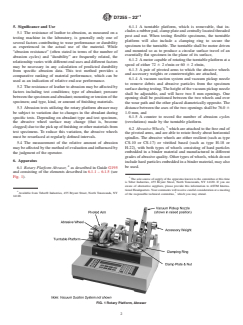
6.1 Rotary Platform Abraser, as described in Guide G195
and consisting of the elements described in 6.1.1 – 6.1.5 (see
Fig. 1).
The sole source of supply of the apparatus known to the committee at this time
is Taber Industries, 455 Bryant Street, North Tonawanda, NY 14120. If you are
aware of alternative suppliers, please provide this information to ASTM Interna-
tional Headquarters.Your comments will receive careful consideration at a meeting
Available from Taber® Industries, 455 Bryant Street, North Tonawanda, NY
of the responsible technical committee, which you may attend.
14120.
FIG. 1 Rotary Platform, Abraser
´1
D7255 − 22
spiral pitch angle, helical teeth cut into its periphery. This wheel does not
6.2.1 The abrasive wheels shall be cylindrically shaped;
include hard particles embedded in a binder material, and typically
12.7 6 0.3 mm thick; include an axial hole 16.0 6 0.1 mm to
produces severe cutting and abrasion.
allowthewheeltobemountedtothepivotedarm;andhavean
6.2.3 Prior to testing, ensure the expiration date has not
external diameter of 51.9 + 0.5 mm when new, and in no case
passed for resilient wheels. Follow the manufacturer’s recom-
less than 44.4 mm.
mended practice for breaking in new or resurfacing previously
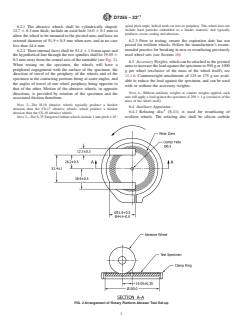
6.2.2 Their internal faces shall be 52.4 6 1.0 mm apart and
used wheel sets (see Section 10).
thehypotheticallinethroughthetwospindlesshallbe19.05 6
0.3mmawayfromthecentralaxisoftheturntable(seeFig.2).
6.3 Accessory Weights,whichcanbeattachedtothepivoted
When resting on the specimen, the wheels will have a
armstoincreasetheloadagainstthespecimento500gor1000
peripheral engagement with the surface of the specimen, the
g per wheel (exclusive of the mass of the wheel itself), see
direction of travel of the periphery of the wheels and of the
11.1.6. Counterweight attachments of 125 or 175 g are avail-
specimen at the contacting portions being at acute angles, and
able to reduce the load against the specimen, and can be used
the angles of travel of one wheel periphery being opposite to
with or without the accessory weights.
that of the other. Motion of the abrasive wheels, in opposite
NOTE 4—Without auxiliary weights or counter weights applied, each
directions, is provided by rotation of the specimen and the
arm will apply a load against the specimen of 250 6 1 g (exclusive of the
associated friction therefrom.
mass of the wheel itself).
NOTE 2—The H-18 abrasive wheels typically produce a harsher
6.4 Auxiliary Apparatus:
abrasion than the CS-17 abrasive wheels, which produce a harsher
6.4.1 Refacing disc (S-11), is used for resurfacing of
abrasion than the CS-10 abrasive wheels.
NOTE 3—The S-35Tungsten Carbide wheels include 1 mm pitch × 45° resilient wheels. The refacing disc shall be silicon carbide
FIG. 2 Arrangement of Rotary Platform Abraser Test Set-up
´1
D7255 − 22
coatedabrasivewithanaverageparticlesizeof92µm(150grit 9.4 Selection of Wheel Type—The CS-10 abrasive wheel
CAMI grade), 102 mm diameter with a 6.5 mm center hole. shouldbeused,unlessotherwiseagreeduponbytheinterested
parties.
6.4.2 Wheel refacer, with a diamond tool for resurfacing
vitrified wheels or correcting out of round wheels.
10. Standardization of Abrading Wheels
6.4.3 Asoftbristlebrush,toremovelooseparticlesfromthe
10.1 Preparation of Resilient Abrading Wheels—To ensure
surface of the specimen after testing.
that the abrading function of the wheels is maintained at a
6.4.4 Specimen mounting cards (S-36-1) or equivalent, a
constantlevel,preparetheresilientwheels(suchastypeCS-10
108 mm round mounting card with a 6.5 mm center hole and
or CS-17) following 10.1.1 – 10.1.4.
one side coated with pressure-sensitive adhesive used for
10.1.1 Mount the selected resilient wheels on their respec-
mounting specimens. Use of the mounting card is not required
tive flange holders, taking care not to handle them by their
when using a clamping ring.
abrasive surfaces.Adjust the load on each wheel to 1000 g or
the load agreed upon between the interested parties for testing.
7. Sampling
10.1.2 Mount the refacing disc (S-11) on the turntable
7.1 Take a lot sample as described in Practice D2813,oras
platform and secure using the clamp plate and nut, and
agreed upon by the interested parties. Because leather is a
clamping ring. Lower the pivoted arms carefully until the
naturalproduct,thephysicalpropertiesmayvarydependingon
wheels rest on the refacing disc. Place the vacuum pick-up
location on the hide, side or skin from which the test sample is
nozzleinpositionandadjustittoadistanceof7 61mmabove
taken. Random sampling of specimens from a predefined
the surface of the disc.
location and orientation minimizes test bias and variability.
10.1.3 Set the counter to ‘zero’ and adjust the vacuum
suction force to 100.
8. Number and Preparation of Test Specimens
10.1.4 If the vacuum system does not turn on automatically
at the start of the test, start the vacuum suction and then the
8.1 If the number of specimens to be tested is not specified
by agreement between the interested parties, test three speci- turntable. Resurface the wheels by running them for the
appropriate number of cycles against the resurfacing disc as
mens.
shown in Table 1. Each resurfacing disc is good for one 25 or
8.2 Using shears or an appropriate sample cutter, cut the
50 cycle resurfacing operation, after which it must be dis-
specimen to size. Punch or cut a 6.5 mm diameter hole in the
carded. Do not touch the surface of the wheels after they are
center of the specimen.
resurfaced.
8.2.1 When using a specimen mounting card, cut a circular
specimen 105 6 5 mm in diameter. Clean the back of the NOTE6—New Set of Wheels (break-in procedure)—Thecompositionof
resilient wheels can make them subject to slight changes of form. Before
specimen with a soft bristle brush to remove any loose debris.
placing in service a new set of resilient wheels they must be subjected to
Mount specimen to a round specimen mounting card (such as
two (2) resurfacings of 50 cycles to ensure perfect contact of the abrading
S-36-1), ensuring that the specimen is free of folds, creases, or
faces with the specimen surface. The resurfacing disc is used only once
wrinkles.
(maximum of 50 cycles), therefore this initial resurfacing of new wheels
will requir
...