

ASTM F2780-20
(Guide)Standard Guide for Design and Construction of Expanded Metal Security Fences and Barriers
General Information
- Abstract
SCOPE
1.1 This guide provides assistance for the site security designer to select the proper components required to design a site specific expanded metal physical security perimeter barrier.
1.2 This standard does not purport to address all of the physical protection security concerns, if any, associated with its use. It is the responsibility of the user of this standard to establish the appropriate design for the level of physical protection required and determine the applicability of regulatory requirements or limitations prior to use.
1.3 It is recommended that Specification F2548 be used in conjunction with this guide.
1.4 Units—The values stated in inch-pound units are to be regarded as standard.
1.5 This standard does not purport to address all of the safety concerns, if any, associated with its use. It is the responsibility of the user of this standard to establish appropriate safety, health, and environmental practices and determine the applicability of regulatory limitations prior to use.
1.6 This international standard was developed in accordance with internationally recognized principles on standardization established in the Decision on Principles for the Development of International Standards, Guides and Recommendations issued by the World Trade Organization Technical Barriers to Trade (TBT) Committee.
- Status
- Published
- Publication Date
- 31-Mar-2020
- Technical Committee
- F14 - Fences
- Drafting Committee
- F14.50 - High Security Fences and Perimeter Barriers
Buy Documents
ASTM F2780-20 - Standard Guide for Design and Construction of Expanded Metal Security Fences and Barriers
REDLINE ASTM F2780-20 - Standard Guide for Design and Construction of Expanded Metal Security Fences and Barriers
Overview
ASTM F2780-20: Standard Guide for Design and Construction of Expanded Metal Security Fences and Barriers provides guidance for security professionals and site designers in selecting and configuring the appropriate components for perimeter barriers using expanded metal fencing. Published by ASTM International, this standard supports the development of robust physical security perimeters tailored to specific site requirements. The guide focuses on best practices for material selection, installation, and integration of expanded metal security fences and barriers to help safeguard assets, personnel, and facilities against various threats.
Key Topics
- Material Selection: Offers guidance on selecting suitable expanded metal mesh panels, coatings (such as hot-dip galvanizing to ASTM A123/A123M), and fence framework materials.
- Design Criteria: Provides methods for determining fence system requirements based on risk assessment, level of protection, threat identification, and cost-effectiveness.
- Structural Considerations: Addresses calculation for post spacing, wind load criteria in compliance with ASCE/SEI 7, and recommended installation practices for enhanced durability and resilience.
- Barrier Types: Explains the difference between active and passive security barriers, including anti-ram and vehicle deterrent measures.
- Security Features: Details fittings, fasteners, and accessories that enhance security, such as barbed wire or tape, reinforced posts, and appropriate signage.
- Site Integration: Recommends integrating security fencing with access control systems, intrusion detection, lighting, and surveillance for comprehensive protection.
- Regulatory Compliance: Advises on alignment with related standards and established federal guidelines, including antiterrorism measures and setback requirements.
Applications
Expanded metal security fences and barriers designed in accordance with ASTM F2780-20 are widely used in:
- Critical Infrastructure Protection: Securing facilities such as utility substations, water treatment plants, and transportation hubs.
- Government and Military Sites: Protecting buildings that require compliance with federal anti-terrorism or DoD security guidelines.
- Commercial and Industrial Premises: Enhancing the perimeter security of warehouses, factories, and data centers.
- Correctional Facilities: Providing robust, climb-resistant barriers to prevent unauthorized access or escape.
- Event Security and Temporary Protection: Employing portable expanded metal barriers for crowd control or high-profile events.
Using this standard ensures that expanded metal security fences are configured for site-specific threats, maximum durability, and integration with other security systems.
Related Standards
ASTM F2780-20 references several important standards and guidelines to ensure comprehensive and compliant design:
- ASTM F2548: Specification for Expanded Metal Fence Systems for Security Purposes
- ASTM F1043 & ASTM F1083: Specifications for fence framework, strength, and protective coatings
- ASTM A123/A123M: Hot-dip galvanizing requirements for iron and steel products
- ASTM A121: Specification for metallic-coated carbon steel barbed wire
- ASTM F626: Specification for fence fittings
- ASTM F1910: Specification for long barbed tape obstacles
- ASTM F2656: Test method for crash testing of vehicle security barriers
- ASCE/SEI 7: Minimum design loads for buildings, particularly for wind load calculations
- Federal Guidelines: UFC 4-010-01 (DoD Minimum Antiterrorism Standards), SD-STD-02.01 (Vehicle crash gate testing), and GSA’s Site Security Design Guide
Practical Value
By following ASTM F2780-20, security and construction professionals can ensure that their expanded metal security fence systems are robust, adaptable, and meet the required level of protection for any given site. The standard enhances risk mitigation, supports compliance with national and international security regulations, and increases overall facility safety by reducing vulnerability to unauthorized access, sabotage, or intrusion.
Keywords: expanded metal fencing, security barriers, physical security standard, ASTM F2780, perimeter protection, security fences, metal security fence design, anti-ram barrier, ASTM standards for fencing.
Relations
- Effective Date
- 01-Apr-2020
- Effective Date
- 01-Apr-2020
- Refers
ASTM F2548-12(2018) - Standard Specification for Expanded Metal Fence Systems for Security Purposes - Effective Date
- 01-Mar-2018
- Effective Date
- 01-Jun-2017
- Effective Date
- 01-Feb-2017
- Effective Date
- 01-Jun-2016
- Effective Date
- 01-Feb-2016
- Effective Date
- 01-Jan-2016
- Effective Date
- 01-Oct-2014
- Effective Date
- 01-Apr-2014
- Effective Date
- 15-Nov-2013
- Effective Date
- 01-Nov-2013
- Effective Date
- 01-Mar-2013
- Effective Date
- 01-Mar-2013
- Effective Date
- 01-Dec-2012
Buy Documents
ASTM F2780-20 - Standard Guide for Design and Construction of Expanded Metal Security Fences and Barriers
REDLINE ASTM F2780-20 - Standard Guide for Design and Construction of Expanded Metal Security Fences and Barriers
Get Certified
Connect with accredited certification bodies for this standard

DIBt (Deutsches Institut für Bautechnik)
German Institute for Building Technology.
DIN CERTCO
DIN Group product certification.

Kiwa BDA Testing
Building and construction product certification.
Sponsored listings
Frequently Asked Questions
ASTM F2780-20 is a guide published by ASTM International. Its full title is "Standard Guide for Design and Construction of Expanded Metal Security Fences and Barriers". This standard covers: SCOPE 1.1 This guide provides assistance for the site security designer to select the proper components required to design a site specific expanded metal physical security perimeter barrier. 1.2 This standard does not purport to address all of the physical protection security concerns, if any, associated with its use. It is the responsibility of the user of this standard to establish the appropriate design for the level of physical protection required and determine the applicability of regulatory requirements or limitations prior to use. 1.3 It is recommended that Specification F2548 be used in conjunction with this guide. 1.4 Units—The values stated in inch-pound units are to be regarded as standard. 1.5 This standard does not purport to address all of the safety concerns, if any, associated with its use. It is the responsibility of the user of this standard to establish appropriate safety, health, and environmental practices and determine the applicability of regulatory limitations prior to use. 1.6 This international standard was developed in accordance with internationally recognized principles on standardization established in the Decision on Principles for the Development of International Standards, Guides and Recommendations issued by the World Trade Organization Technical Barriers to Trade (TBT) Committee.
SCOPE 1.1 This guide provides assistance for the site security designer to select the proper components required to design a site specific expanded metal physical security perimeter barrier. 1.2 This standard does not purport to address all of the physical protection security concerns, if any, associated with its use. It is the responsibility of the user of this standard to establish the appropriate design for the level of physical protection required and determine the applicability of regulatory requirements or limitations prior to use. 1.3 It is recommended that Specification F2548 be used in conjunction with this guide. 1.4 Units—The values stated in inch-pound units are to be regarded as standard. 1.5 This standard does not purport to address all of the safety concerns, if any, associated with its use. It is the responsibility of the user of this standard to establish appropriate safety, health, and environmental practices and determine the applicability of regulatory limitations prior to use. 1.6 This international standard was developed in accordance with internationally recognized principles on standardization established in the Decision on Principles for the Development of International Standards, Guides and Recommendations issued by the World Trade Organization Technical Barriers to Trade (TBT) Committee.
ASTM F2780-20 is classified under the following ICS (International Classification for Standards) categories: 13.310 - Protection against crime; 91.090 - External structures. The ICS classification helps identify the subject area and facilitates finding related standards.
ASTM F2780-20 has the following relationships with other standards: It is inter standard links to ASTM F2780-09(2014), ASTM F2548-20, ASTM F2548-12(2018), ASTM F1043-17a, ASTM F1043-17, ASTM F1043-16a, ASTM F1043-16, ASTM F1083-16, ASTM F1043-14, ASTM F626-14, ASTM F1083-13, ASTM F1043-13, ASTM F626-08(2013), ASTM F1910-98(2013), ASTM A307-12. Understanding these relationships helps ensure you are using the most current and applicable version of the standard.
ASTM F2780-20 is available in PDF format for immediate download after purchase. The document can be added to your cart and obtained through the secure checkout process. Digital delivery ensures instant access to the complete standard document.
Standards Content (Sample)
This international standard was developed in accordance with internationally recognized principles on standardization established in the Decision on Principles for the
Development of International Standards, Guides and Recommendations issued by the World Trade Organization Technical Barriers to Trade (TBT) Committee.
Designation: F2780 − 20
Standard Guide for
Design and Construction of Expanded Metal Security
Fences and Barriers
This standard is issued under the fixed designation F2780; the number immediately following the designation indicates the year of
original adoption or, in the case of revision, the year of last revision. A number in parentheses indicates the year of last reapproval. A
superscript epsilon (´) indicates an editorial change since the last revision or reapproval.
1. Scope A123/A123M Specification for Zinc (Hot-Dip Galvanized)
Coatings on Iron and Steel Products
1.1 This guide provides assistance for the site security
A307 Specification for Carbon Steel Bolts, Studs, and
designer to select the proper components required to design a
Threaded Rod 60 000 PSI Tensile Strength
site specific expanded metal physical security perimeter bar-
F626 Specification for Fence Fittings
rier.
F1043 Specification for Strength and Protective Coatings on
1.2 This standard does not purport to address all of the
Steel Industrial Fence Framework
physicalprotectionsecurityconcerns,ifany,associatedwithits
F1083 Specification for Pipe, Steel, Hot-Dipped Zinc-
use. It is the responsibility of the user of this standard to
Coated (Galvanized) Welded, for Fence Structures
establish the appropriate design for the level of physical
F1910 Specification for Long Barbed Tape Obstacles
protection required and determine the applicability of regula-
F2548 Specification for Expanded Metal Fence Systems for
tory requirements or limitations prior to use.
Security Purposes
1.3 It is recommended that Specification F2548 be used in F2656 Test Method for Crash Testing of Vehicle Security
Barriers
conjunction with this guide.
2.2 US Dept. of Defense Documents:
1.4 Units—The values stated in inch-pound units are to be
UFC 4-010-01 United Facilities Criteria, DoD Minimum
regarded as standard.
Antiterrorism Standards for Buildings
1.5 This standard does not purport to address all of the
UFC 4-020-01 United Facilities Criteria, DoD Security En-
safety concerns, if any, associated with its use. It is the
gineering Facilities Planning Manual
responsibility of the user of this standard to establish appro-
2.3 US Dept. of State Document:
priate safety, health, and environmental practices and deter-
SD-STD-02.01 Revision A, March 2003 Test Method for
mine the applicability of regulatory limitations prior to use.
Vehicle Crash Gate Testing of Perimeter Barriers and
1.6 This international standard was developed in accor-
Gates
dance with internationally recognized principles on standard-
ization established in the Decision on Principles for the
2.4 GSA Document:
Development of International Standards, Guides and Recom- The Site Security Design Guide, U.S. General Services
mendations issued by the World Trade Organization Technical
Administration (GSA)
Barriers to Trade (TBT) Committee.
2.5 ASCE Standard:
ASCE/SEI 7-16 Minimum Design Loads for Buildings and
2. Referenced Documents
OtherStructures(ManufacturerShallDemonstrateFrame-
2.1 ASTM Standards: work Design for Wind Load Criteria for the Selection of
A121 Specification for Metallic-Coated Carbon Steel Line Posts and Line Post Spacing)
Barbed Wire
3. Terminology
3.1 Definitions of Terms Specific to This Standard:
This guide is under the jurisdiction ofASTM Committee F14 on Fences and is
the direct responsibility of Subcommittee F14.50 on High Security Fences and
Perimeter Barriers.
Current edition approved April 1, 2020. Published May 2020. Originally Available from Whole Building Design Guide (WBDG), https://
approved in 2009. Last previous edition approved in 2014 as F2780 – 09(2014). www.wbdg.org.
DOI: 10.1520/F2780-20. Available from Cybersecurity & Infrastructure Security Agency (CISA),
For referenced ASTM standards, visit the ASTM website, www.astm.org, or https://www.cisa.gov.
contact ASTM Customer Service at service@astm.org. For Annual Book of ASTM Available from General Services Administration (GSA), https://www.gsa.gov.
Standards volume information, refer to the standard’s Document Summary page on Available from American Society of Civil Engineers (ASCE), 1801 Alexander
the ASTM website. Bell Dr., Reston, VA 20191, http://www.asce.org.
Copyright © ASTM International, 100 Barr Harbor Drive, PO Box C700, West Conshohocken, PA 19428-2959. United States
F2780 − 20
3.1.1 access control, n—for the purposes of these standards, movable object that can be moved in place to stop the
any combination of barriers, gates, electronic security movement of vehicles, or people, or both.
equipment, or guards, or a combination thereof, that can deny
3.1.13 risk acceptance, n—the degree of risk associated
entry to unauthorized personnel or vehicles.
with an asset or endeavor that a decision-maker perceives and
3.1.2 active barrier, n—a barrier that requires manual or will accept under a given set of circumstances and with
motorized action to operate; action barriers may be command associated costs.
or sensor activated to prevent or impede unauthorized passage.
3.1.14 standoff, n—the area between a protected structure
and the perimeter protecting the asset against potential attacks.
3.1.3 anti-ram vehicle barrier, n—a device or barrier that
3.1.14.1 Discussion—Sometimes referred to as setback.
prevents vehicle access to provide pedestrian protection or
building security, or both. Distancefromtheinsideedgeofabarriertothenearestsurface
of the building being protected.
3.1.3.1 Discussion—Anti-Ram vehicle barriers may be ei-
ther active or passive barriers. A rated anti-ram barrier is a
Department of State-approved perimeter barrier that does not 4. Summary of Guide
exceed the defined penetration level for a 15 000 lb gross
4.1 It is the responsibility of the design team to consider the
weightvehicletravelingperpendiculartothebarrieratnominal
design criteria, understand the design basis tactics, and levels
speeds of 50, 40, or 30 mph. Reference Test Method F2656 for
of protection that shaped them, and provide effective and
performance criteria.
balanced design solutions that respond to the threat.
3.1.4 asset, n—tangible or intangible items, personnel, or
4.2 Concernsforsecuritythroughoutthedesignprocesswill
outdoor gatherings (in whole or in part) which may be subject
identifytheneedforappropriatelevelsofprotectionaroundthe
to manmade or natural hazards.
site perimeter, site access, required standoff distances, parking,
3.1.5 barrier, n—an object used to separate or impede the and other specific assets. All of these areas may require some
movement of a vehicle or pedestrian.
form of physical security to equally balance the level of
security with an acceptable risk.
3.1.6 design basis tactics, n—identify the specific acts and
methods that the building and site’s countermeasures must
4.3 Perimeter barriers are used to define the limits of a
protect against and form the basis for the site security design.
perimeter, standoff, activity, or area, to define ingress and
(U.S. General Services Administration)
egress points, to form a psychological deterrent, and to
establish an acceptable level of protection. They delay unau-
3.1.7 design criteria, n—defines the design direction that
thorizedindividualstofacilitatetheirapprehensionbyresponse
emerges, based on inputs from the risk assessment, consider-
forces, direct traffic along designated routes of travel for
ation of the design basis tactics, and the required level of
enhanced surveillance and control, and can preclude visual
protection. (U.S. General Services Administration)
compromise by unauthorized individuals.
3.1.8 level of protection, n—the degree to which an asset
(for example, a person, a piece of equipment, or an object, etc.)
5. Design Criteria for Perimeter Fences and Barriers
is protected against injury or damage from an attack.
5.1 Cost Effectiveness—Budgetary allotments for security
3.1.9 passive vehicle barrier, n—stationary barriers creating
plans should be set after the performance requirements for
perimeter or edge protection, such as fixed bollards, concrete
fences and barriers have been determined.
walls, concrete jersey barriers, concrete planters, boulders,
5.2 Determine the threat and risk acceptance. This standard
excavations and ditches, vehicle restraint cable systems, king
guide should be used in conjunction with site-specific risk
tut blocks, bastion barriers, bin barriers, reinforced masonry
assessments as necessary to attain an appropriate level of
walls, berms, ponds/basins, existing trees, intrusion detection
protection from natural or manmade hazards, or both.
devices, and reinforced streetscape elements sculpture, etc.
3.1.9.1 Discussion—Passive vehicle barriers have no mov-
5.3 Determine the level of security for the fence system
ing parts. A passive vehicle barrier system consists of a
required based on acceptable risk. Part of this determination
permanent or portable structure positioned to slow, delay, or
would be the height of the fence. Fences used for the purpose
deny access to a protected site or restricted area.
of security shall be a minimum of 8 ft high.
3.1.10 perimeter barrier, n—a fence, gate, bollard, wall,
5.4 Determine the function for the fence or barrier based on
fence, planter, other structure, or natural topographic feature
the application icons listed in Fig. 1.
that provides protection against a vehicle gaining access to a
5.4.1 Expanded metal barriers may take different forms and
compound or facility.
provide perimeter security and access control to protect assets.
Expanded metal fencing can be mounted on moveable K Rated
3.1.11 physical security, n—the part of security concerned
concrete highway barriers creating active barriers that are also
with physical measures designed to safeguard personnel; to
portable barriers to meet changing or evolving levels of
prevent unauthorized access to equipment, installations,
security. Reference Fig. 2.
material, and documents; and to safeguard against espionage,
sabotage, damage, and theft. (U.S. Army)
6. Materials and Sizes
3.1.12 portable barrier, n—a passive or active barrier de-
signed to be removed and relocated as required; includes any 6.1 Expanded Metal Mesh Panels:
F2780 − 20
FIG. 1 Applications
FIG. 2 Expanded Metal on Concret
...
This document is not an ASTM standard and is intended only to provide the user of an ASTM standard an indication of what changes have been made to the previous version. Because
it may not be technically possible to adequately depict all changes accurately, ASTM recommends that users consult prior editions as appropriate. In all cases only the current version
of the standard as published by ASTM is to be considered the official document.
Designation: F2780 − 09 (Reapproved 2014) F2780 − 20
Standard Guide for
Design and Construction of Expanded Metal Security
Fences and Barriers
This standard is issued under the fixed designation F2780; the number immediately following the designation indicates the year of
original adoption or, in the case of revision, the year of last revision. A number in parentheses indicates the year of last reapproval. A
superscript epsilon (´) indicates an editorial change since the last revision or reapproval.
1. Scope
1.1 This guide provides assistance for the site security designer to select the proper components required to design a site specific
expanded metal physical security perimeter barrier.
1.2 This standard does not purport to address all of the physical protection security concerns, if any, associated with its use. It
is the responsibility of the user of this standard to establish the appropriate design for the level of physical protection required and
determine the applicability of regulatory requirements or limitations prior to use.
1.3 It is recommended that Specification F2548 to be used in conjunction with this guide.
1.4 Units—The values stated in inch-pound units are to be regarded as standard.
1.5 This standard does not purport to address all of the safety concerns, if any, associated with its use. It is the responsibility
of the user of this standard to establish appropriate safety, health, and environmental practices and determine the applicability of
regulatory limitations prior to use.
1.6 This international standard was developed in accordance with internationally recognized principles on standardization
established in the Decision on Principles for the Development of International Standards, Guides and Recommendations issued
by the World Trade Organization Technical Barriers to Trade (TBT) Committee.
2. Referenced Documents
2.1 ASTM Standards:
A121 Specification for Metallic-Coated Carbon Steel Barbed Wire
A123/A123M Specification for Zinc (Hot-Dip Galvanized) Coatings on Iron and Steel Products
A307 Specification for Carbon Steel Bolts, Studs, and Threaded Rod 60 000 PSI Tensile Strength
F626 Specification for Fence Fittings
F1043 Specification for Strength and Protective Coatings on Steel Industrial Fence Framework
F1083 Specification for Pipe, Steel, Hot-Dipped Zinc-Coated (Galvanized) Welded, for Fence Structures
F1910 Specification for Long Barbed Tape Obstacles
F2200 Specification for Automated Vehicular Gate Construction
F2548 Specification for Expanded Metal Fence Systems for Security Purposes
F2656 Test Method for Crash Testing of Vehicle Security Barriers
2.2 US Dept. of Defense:Defense Documents:
UFC 4-010-01 United Facilities Criteria, DoD Minimum Antiterrorism Standards for Buildings
UFC 4-020-01 United Facilities Criteria, DoD Security Engineering Facilities Planning Manual
2.3 US Dept. of State:State Document:
SD-STD-02.01 Revision A, March 2003 Test Method for Vehicle Crash Gate Testing of Perimeter Barriers and Gates
2.4 General Services Administration:GSA Document:
The Site Security Design Guide, U.S. General Services Administration (GSA)
This guide is under the jurisdiction of ASTM Committee F14 on Fences and is the direct responsibility of Subcommittee F14.50 on High Security Fences and Perimeter
Barriers.
Current edition approved May 1, 2014April 1, 2020. Published May 2014May 2020. Originally approved in 2009. Last previous edition approved in 20092014 as
F2780F2780 – 09– 09. (2014). DOI: 10.1520/F2780-09R14.10.1520/F2780-20.
For referenced ASTM standards, visit the ASTM website, www.astm.org, or contact ASTM Customer Service at service@astm.org. For Annual Book of ASTM Standards
volume information, refer to the standard’s Document Summary page on the ASTM website.
Available from Whole Building Design Guide (WBDG), https://www.wbdg.org.
Available from Cybersecurity & Infrastructure Security Agency (CISA), https://www.cisa.gov.
Available from General Services Administration (GSA), https://www.gsa.gov.
Copyright © ASTM International, 100 Barr Harbor Drive, PO Box C700, West Conshohocken, PA 19428-2959. United States
F2780 − 20
2.5 American Society of Civil Engineers (ASCE):ASCE Standard:
ASCE/SEI 7-057-16 Minimum Design Loads for Buildings and Other Structures (Manufacturer shall demonstrate framework
design for wind load criteria for the selection of line posts and line post spacing)Shall Demonstrate Framework Design for
Wind Load Criteria for the Selection of Line Posts and Line Post Spacing)
3. Terminology
3.1 Definitions of Terms Specific to This Standard:
3.1.1 access control—control, n—for the purposes of these standards, any combination of barriers, gates, electronic security
equipment, or guards, or a combination thereof, that can deny entry to unauthorized personnel or vehicles.
3.1.2 active barrier—barrier, n—abarrier a barrier that requires manual or motorized action to operate. Actionoperate; action
barriers may be command or sensor activated to prevent or impede unauthorized passage.
3.1.3 anti-ram vehicle barrier—barrier, n—a device or barrier that prevents vehicle access to provide pedestrian protection
and/or building security. Anti-Ram vehicle barriers may be either active or passive barriers. A rated anti-ram barrier is a
Department of State-approved perimeter barrier that does not exceed the defined penetration level for a 15,000-lb gross weight
vehicle traveling perpendicular to the barrier at nominal speeds of 50, 40, or 30 mph. Reference Test Method or building security,
or both.F2656 for performance criteria.
3.1.3.1 Discussion—
Anti-Ram vehicle barriers may be either active or passive barriers. A rated anti-ram barrier is a Department of State-approved
perimeter barrier that does not exceed the defined penetration level for a 15 000 lb gross weight vehicle traveling perpendicular
to the barrier at nominal speeds of 50, 40, or 30 mph. Reference Test Method F2656 for performance criteria.
3.1.4 asset—asset, n—tangible or intangible items, personnel, or outdoor gatherings,gatherings (in whole or in part),part) which
may be subject to manmade or natural hazards.
3.1.5 barrier—barrier, n—an object used to separate or impede the movement of a vehicle or pedestrian.
3.1.6 design basis tactics—tactics, n—identify the specific acts and methods that the building and site’s countermeasures must
protect against and form the basis for the site security design. (U.S. General Services Administration)
3.1.7 design criteria—criteria, n—defines the design direction that emerges, based on inputs from the risk assessment,
consideration of the design basis tactics, and the required level of protection. (U.S. General Services Administration)
3.1.8 level of protection—protection, n—the degree to which an asset (for example, a person, a piece of equipment, or an object,
etc.) is protected against injury or damage from an attack.
3.1.9 passive vehicle barrier—barrier, n—stationary barriers creating perimeter or edge protection, such as fixed bollards,
concrete walls, concrete jersey barriers, concrete planters, boulders, excavations and ditches, vehicle restraint cable systems, king
tut blocks, bastion barriers, bin barriers, reinforced masonry walls, berms, ponds/basins, existing trees, intrusion detection devices,
and reinforced streetscape elements sculpture etc. Passive vehicle barriers have no moving parts. A passive vehicle barrier system
consists of a permanent or portable structure positioned to slow, delay or deny access to a protected site or restricted area.sculpture,
etc.
3.1.9.1 Discussion—
Passive vehicle barriers have no moving parts. A passive vehicle barrier system consists of a permanent or portable structure
positioned to slow, delay, or deny access to a protected site or restricted area.
3.1.10 perimeter barrier—barrier, n—a fence, gate, bollard, wall, fence, planter, other structure, or natural topographic feature
that provides protection against a vehicle gaining access to a compound or facility.
3.1.11 physical security—security, n—the part of security concerned with physical measures designed to safeguard personnel;
to prevent unauthorized access to equipment, installations, material, and documents; and to safeguard against espionage, sabotage,
damage, and theft. (U.S. Army)
3.1.12 portable barrier—barrier, n—a passive or active barrier designed to be removed and relocated as required.
Includesrequired; includes any movable object that can be moved in place to stop the movement of vehicles and/or people.vehicles,
or people, or both.
3.1.13 risk acceptance—acceptance, n—the degree of risk associated with an asset or endeavor that a decision-maker perceives
and will accept under a given set of circumstances and with associated costs.
Available from American Society of Civil Engineers (ASCE), 1801 Alexander Bell Dr., Reston, VA 20191, http://www.asce.org.
F2780 − 20
3.1.14 standoff—standoff, n—the area between a protected structure and the perimeter protecting the asset against potential
attacks. Sometimes referred to as setback. Distance from the inside edge of a barrier to the nearest surface of the building being
protected.
3.1.14.1 Discussion—
Sometimes referred to as setback. Distance from the inside edge of a barrier to the nearest surface of the building being protected.
4. Summary of Guide
4.1 It is the responsibility of the design team to consider the design criteria, understand the design basis tactics, and levels of
protection that shaped them, and provide effective and balanced design solutions that respond to the threat.
4.2 Concerns for security throughout the design process will identify the need for appropriate levels of protection around the
site perimeter, site access, required standoff distances, parking, and other specific assets. All of these areas may require some form
of physical security to equally balance the level of security with an acceptable risk.
4.3 Perimeter barriers are used to define the limits of a perimeter, standoff, activity, or area, to define ingress and egress points,
to form a psychological deterrent, and to establish an acceptable level of protection. They delay unauthorized individuals to
facilitate their apprehension by response forces, direct traffic along designated routes of travel for enhanced surveillance and
control, and can preclude visual compromise by unauthorized individuals.
5. Design Criteria for Perimeter Fences and Barriers
5.1 Cost Effectiveness—Budgetary allotments for security plans should be set after the performance requirements for fences and
barriers have been determined.
5.2 Determine the threat and risk acceptance. This standard guide should be used in conjunction with site-specific risk
assessments as necessary to attain an appropriate level of protection from natural and or manmade hazards.hazards, or both.
5.3 Determine the level of security for the fence system required based on acceptable risk. Part of this determination would be
the height of the fence. Fences used for the purpose of security shall be a minimum of 8-ft8 ft high.
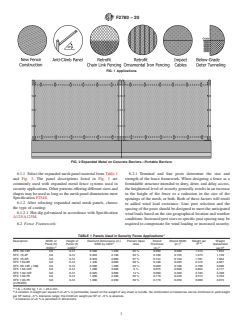
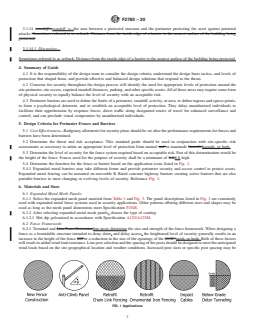
5.4 Determine the function for the fence or barrier based on the application icons listed in Fig. 1.
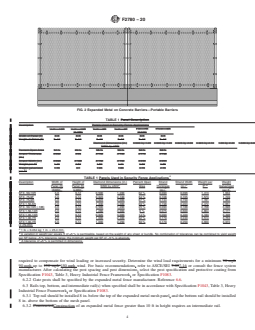
5.4.1 Expanded metal barriers may take different forms and provide perimeter security and access control to protect assets.
Expanded metal fencing can be mounted
...