

ASTM F3572-22
(Practice)Standard Practice for Additive Manufacturing – General Principles – Part Classifications for Additive Manufactured Parts Used in Aviation
General Information
- Abstract
SCOPE
1.1 This practice is intended to be used to assign part classifications across the aviation industries that use AM to produce parts.
1.2 This practice is applicable to all AM technologies defined in ISO/ASTM 52900 used in aviation.
1.3 This practice is intended to be used to establish a metric for AM parts in downstream documents.
1.4 This practice is not intended to establish criteria for any downstream processes, but rather to establish a metric that these processes can use.
1.5 The part classification metric could be utilized by the engineering, procurement, non-destructive inspection, testing, qualification, or certification processes used for AM aviation parts.
1.6 The classification scheme in this practice establishes a consistent methodology to define and communicate the consequence of failure associated with AM aviation parts.
1.7 This practice is not intended to supersede the requirements and definitions of the applicable regulations or policies, including but not limited to the ones listed in Annex A1.
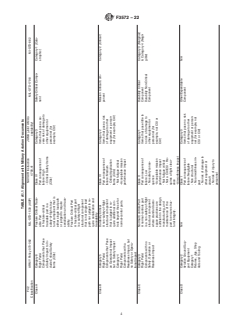
1.8 Tables A1.1-A1.3 align the existing regulations and guidance with the four part classes established herein. However, this alignment should not be construed as an alignment of the existing regulations to each other.
1.9 The material or process, or both, in general does not affect the consequence of failure of a part, therefore the classification scheme defined in this document may be used outside AM.
1.10 The user of this standard should not assume regulators’ endorsement of this standard as accepted mean of compliance.
1.11 This standard does not purport to address all of the safety concerns, if any, associated with its use. It is the responsibility of the user of this standard to establish appropriate safety, health, and environmental practices and determine the applicability of regulatory limitations prior to use.
1.12 This international standard was developed in accordance with internationally recognized principles on standardization established in the Decision on Principles for the Development of International Standards, Guides and Recommendations issued by the World Trade Organization Technical Barriers to Trade (TBT) Committee.
- Status
- Published
- Publication Date
- 30-Jun-2022
- Technical Committee
- F42 - Additive Manufacturing Technologies
- Drafting Committee
- F42.07 - Applications
Overview
ASTM F3572-22: Standard Practice for Additive Manufacturing – General Principles – Part Classifications for Additive Manufactured Parts Used in Aviation provides a systematic approach for assigning part classifications to aviation components manufactured using additive manufacturing (AM) technologies. Developed by ASTM International, this standard addresses the increasing adoption of AM within the aviation sector and the critical need to evaluate and communicate the risks associated with these parts based on the consequence of failure. The classification scheme outlined in this document enables consistent communication of part criticality and aligns with the requirements of various industry stakeholders, regulators, and downstream processes such as engineering, procurement, inspection, testing, and certification.
Key Topics
Part Classification System
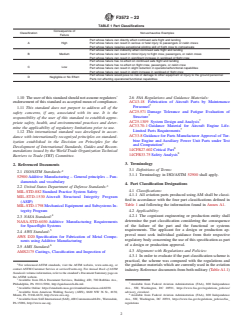
ASTM F3572-22 introduces a four-level classification system for AM parts used in aviation, based on the consequence of failure:- Class A (High Consequence): Failure can directly affect continued safe flight and landing, or cause serious or fatal injury to crew or passengers.
- Class B (Medium Consequence): Failure can indirectly impact safe flight or cause minor injuries/increased workload to crew.
- Class C (Low Consequence): Failure has no impact on safe flight but may slightly reduce operational or functional capabilities.
- Class D (Negligible): Failure has no effect on operational capabilities or safety, nor poses risk to equipment or ground personnel.
Consistency and Communication
This standard promotes a consistent methodology to define and communicate risk, supporting the integrity and comparability of AM part classification within the aviation industry.Scope of Applicability
ASTM F3572-22 applies to all AM technologies as defined by ISO/ASTM 52900 and is not limited to specific materials or processes, enabling broad utility across various aviation applications.Alignment with Regulations
The standard facilitates alignment with existing regulatory and guidance documents, but does not supersede them. It provides tables relating the classification scheme to military and civilian aviation regulations for easier cross-reference.
Applications
ASTM F3572-22 has practical value across the aviation sector by offering:
Risk-Based Part Management
The classification system supports effective risk management throughout the lifecycle of AM parts, from design and manufacturing to maintenance and inspection.Improved Regulatory Compliance
By establishing clear metrics for part consequence of failure, organizations can streamline the process of seeking regulatory approval for AM parts and ensure their documentation aligns with industry expectations.Downstream Process Integration
The classification metric can be referenced in downstream documents such as process specifications, inspection criteria, or qualification protocols, aiding in the selection of appropriate controls and process rigor matched to part criticality.Cross-Organizational Consistency
Use of a standardized classification enables consistent communication between manufacturers, suppliers, engineers, and regulatory bodies, reducing ambiguity and helping to prevent both over- and under-mitigation of risks.Extension Beyond AM
While designed for additive manufacturing, the classification principle is applicable to conventionally manufactured aviation parts, provided the focus is on consequence of failure.
Related Standards
ISO/ASTM 52900: Additive Manufacturing – General Principles – Fundamentals and Vocabulary
Provides terminology and foundational concepts used in AM, referenced directly in ASTM F3572-22.MIL-STD-1530 & MIL-STD-1798: Address structural integrity programs and equipment reliability for military aircraft.
NASA-STD-6030: NASA’s requirements for AM in spaceflight systems.
AWS D20: American Welding Society specification for fabrication of metal components using AM.
AMS2175: SAE International standard for classification and inspection of castings.
FAA Regulations and Guidance (e.g., AC25.571, AC25.1309, AC43-18, 14 CFR §33.75): Cover damage tolerance, system design, fabrication, and safety analysis relevant to aviation part approvals.
By leveraging ASTM F3572-22, organizations involved in aviation additive manufacturing can ensure consistent, risk-informed part classification, aiding safe integration of AM technologies into aerospace applications.
Get Certified
Connect with accredited certification bodies for this standard

BUREAU VERITAS Certification Germany
Bureau Veritas certification in Germany.

DVS-ZERT GmbH
German welding certification society.

Element Materials Technology
Materials testing and product certification.
Sponsored listings
Frequently Asked Questions
ASTM F3572-22 is a standard published by ASTM International. Its full title is "Standard Practice for Additive Manufacturing – General Principles – Part Classifications for Additive Manufactured Parts Used in Aviation". This standard covers: SCOPE 1.1 This practice is intended to be used to assign part classifications across the aviation industries that use AM to produce parts. 1.2 This practice is applicable to all AM technologies defined in ISO/ASTM 52900 used in aviation. 1.3 This practice is intended to be used to establish a metric for AM parts in downstream documents. 1.4 This practice is not intended to establish criteria for any downstream processes, but rather to establish a metric that these processes can use. 1.5 The part classification metric could be utilized by the engineering, procurement, non-destructive inspection, testing, qualification, or certification processes used for AM aviation parts. 1.6 The classification scheme in this practice establishes a consistent methodology to define and communicate the consequence of failure associated with AM aviation parts. 1.7 This practice is not intended to supersede the requirements and definitions of the applicable regulations or policies, including but not limited to the ones listed in Annex A1. 1.8 Tables A1.1-A1.3 align the existing regulations and guidance with the four part classes established herein. However, this alignment should not be construed as an alignment of the existing regulations to each other. 1.9 The material or process, or both, in general does not affect the consequence of failure of a part, therefore the classification scheme defined in this document may be used outside AM. 1.10 The user of this standard should not assume regulators’ endorsement of this standard as accepted mean of compliance. 1.11 This standard does not purport to address all of the safety concerns, if any, associated with its use. It is the responsibility of the user of this standard to establish appropriate safety, health, and environmental practices and determine the applicability of regulatory limitations prior to use. 1.12 This international standard was developed in accordance with internationally recognized principles on standardization established in the Decision on Principles for the Development of International Standards, Guides and Recommendations issued by the World Trade Organization Technical Barriers to Trade (TBT) Committee.
SCOPE 1.1 This practice is intended to be used to assign part classifications across the aviation industries that use AM to produce parts. 1.2 This practice is applicable to all AM technologies defined in ISO/ASTM 52900 used in aviation. 1.3 This practice is intended to be used to establish a metric for AM parts in downstream documents. 1.4 This practice is not intended to establish criteria for any downstream processes, but rather to establish a metric that these processes can use. 1.5 The part classification metric could be utilized by the engineering, procurement, non-destructive inspection, testing, qualification, or certification processes used for AM aviation parts. 1.6 The classification scheme in this practice establishes a consistent methodology to define and communicate the consequence of failure associated with AM aviation parts. 1.7 This practice is not intended to supersede the requirements and definitions of the applicable regulations or policies, including but not limited to the ones listed in Annex A1. 1.8 Tables A1.1-A1.3 align the existing regulations and guidance with the four part classes established herein. However, this alignment should not be construed as an alignment of the existing regulations to each other. 1.9 The material or process, or both, in general does not affect the consequence of failure of a part, therefore the classification scheme defined in this document may be used outside AM. 1.10 The user of this standard should not assume regulators’ endorsement of this standard as accepted mean of compliance. 1.11 This standard does not purport to address all of the safety concerns, if any, associated with its use. It is the responsibility of the user of this standard to establish appropriate safety, health, and environmental practices and determine the applicability of regulatory limitations prior to use. 1.12 This international standard was developed in accordance with internationally recognized principles on standardization established in the Decision on Principles for the Development of International Standards, Guides and Recommendations issued by the World Trade Organization Technical Barriers to Trade (TBT) Committee.
ASTM F3572-22 is classified under the following ICS (International Classification for Standards) categories: 25.030 - Additive manufacturing; 49.035 - Components for aerospace construction. The ICS classification helps identify the subject area and facilitates finding related standards.
ASTM F3572-22 is available in PDF format for immediate download after purchase. The document can be added to your cart and obtained through the secure checkout process. Digital delivery ensures instant access to the complete standard document.
Standards Content (Sample)
This international standard was developed in accordance with internationally recognized principles on standardization established in the Decision on Principles for the
Development of International Standards, Guides and Recommendations issued by the World Trade Organization Technical Barriers to Trade (TBT) Committee.
Designation: F3572 − 22
Standard Practice for
Additive Manufacturing – General Principles – Part
Classifications for Additive Manufactured Parts Used in
Aviation
This standard is issued under the fixed designation F3572; the number immediately following the designation indicates the year of
original adoption or, in the case of revision, the year of last revision. A number in parentheses indicates the year of last reapproval. A
superscript epsilon (´) indicates an editorial change since the last revision or reapproval.
INTRODUCTION
The use of additive manufacturing (AM) technology allows designs that may not be achieved with
traditionalmanufacturingmethods.ItisimportanttounderstandtheriskassociatedwiththeAMusage
by understanding the consequence of failure (including the loss of intended function) of the usage.
Such information can be beneficial in establishing consistent manufacturing, inspection, or qualifi-
cation processes relative to a defined risk scale, which can serve as supporting data when seeking
regulatory approval of an AM part. A part classification scheme based on a part’s consequence of
failure can provide a consistent risk metric. Without carefully defined part classes, the ability to
accurately gauge the consequence of failure associated with additively manufactured aviation parts
within and across programs, projects, and suppliers becomes exceedingly difficult, resulting in
mitigations that are either not commensurate or inconsistent. The part classification scheme
documented here does not affect a part’s functional requirements, but rather is used to group additive
manufacturingaviationpartsintocategorieswhichcanbeusedindownstreamstandards.Forexample,
this classification scheme can be used in material and process specifications to determine the
appropriate levels of process control, thermal post processing, qualification, and inspection to ensure
AM parts meet their application requirements. This classification scheme does not specify how the
classification is used in any downstream processes. The use of the classification shall be left to the
cognizant engineering or production entities, or downstream documents which reference this standard.
1. Scope 1.5 The part classification metric could be utilized by the
engineering, procurement, non-destructive inspection, testing,
1.1 This practice is intended to be used to assign part
qualification, or certification processes used for AM aviation
classifications across the aviation industries that use AM to
parts.
produce parts.
1.6 The classification scheme in this practice establishes a
1.2 This practice is applicable to all AM technologies
consistent methodology to define and communicate the conse-
defined in ISO/ASTM 52900 used in aviation.
quence of failure associated with AM aviation parts.
1.3 This practice is intended to be used to establish a metric
1.7 This practice is not intended to supersede the require-
for AM parts in downstream documents.
ments and definitions of the applicable regulations or policies,
including but not limited to the ones listed in Annex A1.
1.4 This practice is not intended to establish criteria for any
downstream processes, but rather to establish a metric that
1.8 Tables A1.1-A1.3 align the existing regulations and
these processes can use.
guidance with the four part classes established herein.
However, this alignment should not be construed as an align-
ment of the existing regulations to each other.
This specification is under the jurisdiction of ASTM Committee F42 on
1.9 The material or process, or both, in general does not
Additive Manufacturing Technologies and is the direct responsibility of Subcom-
affect the consequence of failure of a part, therefore the
mittee F42.07 on Applications.
classification scheme defined in this document may be used
Current edition approved July 1, 2022. Published August 2022. DOI: 10.1520/
F3572-22. outside AM.
Copyright © ASTM International, 100 Barr Harbor Drive, PO Box C700, West Conshohocken, PA 19428-2959. United States
F3572 − 22
TABLE 1 Part Classifications
Consequence of
Classification Non-exhaustive Examples
Failure
Part whose failure can directly affect continued safe flight and landing
A High Part whose failure can result in serious or fatal injury to passengers or cabin crews
Part whose failure requires exceptional piloting skill of flight crew to compensate
Part whose failure can indirectly affect continued safe flight and landing
B Medium Part whose failure can result in minor injury to flight crew, passengers, or cabin crews
Part whose failure can result in significant increase in workload of flight crew
Part whose failure has no effect on continued safe flight and landing
Part whose failure has no effect on flight crew, passengers, or cabin crew
C Low
Part whose failure can result in slight reduction in operational/functional capabilities
Part whose failure can result in slight increase in workload of flight crew
Part whose failure would pose no risk of damage to other equipment or injury to the ground personnel
D Negligible or No Effect
Parts not affecting operational/functional capabilities
1.10 The user of this standard should not assume regulators’ 2.6 FAA Regulations and Guidance Materials:
endorsement of this standard as accepted mean of compliance. AC43-18 Fabrication of Aircraft Parts by Maintenance
Personnel
1.11 This standard does not purport to address all of the
AC25.571 Damage Tolerance and Fatigue Evaluation of
safety concerns, if any, associated with its use. It is the
Structure
responsibility of the user of this standard to establish appro-
AC25.1309 System Design and Analysis
priate safety, health, and environmental practices and deter-
AC33.70-1 Guidance Material for Aircraft Engine Life-
mine the applicability of regulatory limitations prior to use.
Limited Parts Requirements
1.12 This international standard was developed in accor-
AC33-8 Guidance for Parts Manufacturer Approval of Tur-
dance with internationally recognized principles on standard-
bine Engine and Auxiliary Power Unit Parts under Test
ization established in the Decision on Principles for the
and Computation
Development of International Standards, Guides and Recom-
14CFR27.602 Critical Part
mendations issued by the World Trade Organization Technical
14CFR33.75 Safety Analysis
Barriers to Trade (TBT) Committee.
3. Terminology
2. Referenced Documents
2 3.1 Definitions of Terms:
2.1 ISO/ASTM Standards:
3.1.1 Terminology in ISO/ASTM 52900 shall apply.
52900 Additive Manufacturing – General principles – Fun-
damentals and vocabulary
4. Part Classification Designations
2.2 United States Department of Defense Standards:
4.1 Classifications:
MIL-STD-882 Standard Practice System Safety
4.1.1 All aviation parts produced using AM shall be classi-
MIL-STD-1530 Aircraft Structural Integrity Program
fied in accordance with the four part classifications defined in
(ASIP)
Table 1 and following the information found in Annex A1.
MIL-STD-1798 Mechanical Equipment and Subsystems In-
tegrity Program 4.2 Applicability:
4.2.1 The cognizant engineering or production entity shall
2.3 NASA Standard:
determine the part classification considering the consequence
NASA-STD-6030 Additive Manufacturing Requirements
of the failure of the part and the functional or systems
for Spaceflight Systems
requirements. The applicant for a design or production ap-
2.4 AWS Standard:
proval must seek individual guidance from their respective
AWS D20 Specification for Fabrication of Metal Compo-
regulatory body concerning the use of this specification as part
nents using Additive Manufacturing
of a design or production approval.
2.5 AMS Standard:
4.3 Alignment with Regulations and Policies:
AMS2175 Castings, Classification and Inspection of
4.3.1 In order to evaluate if the part classification scheme is
practical, the scheme was compared with the regulations and
For referenced ASTM standards, visit the ASTM website, www.astm.org, or the guidance materials which are currently used in the aviation
contact ASTM Customer Service at service@astm.org. For Annual Book of ASTM
industry. Reference documents from both military (TableA1.1)
Standards volume information, refer to the standard’s Document Summary page on
the ASTM website.
Available from DLA Document Services, Building 4/D, 700 Robbins Ave.,
Philadelphia, PA 19111-5094, http://quicksearch.dla.mil. Available from Federal Aviation Administration (FAA), 800 Independence
Available Online: https://standards.nasa.gov/standard/nasa/nasa-std-6030. Ave., SW, Washington, DC 20591, https://www.faa.gov/regulations_policies/
Available from American Welding Society (AWS), 8669 NW 36 St., #130, advisory_circulars/.
Miami, FL 33166-6672, http://www.aws.org. Available from Federal Aviation Administration (FAA), 800 Independence
Available from SAE International (SAE), 400 Commonwealth Dr.,Warrendale, Ave., SW, Washington, DC 20591, https://www.faa.gov/regulations_policies/faa_
PA 15096, http://www.sae.org. regulations
F3572 − 22
and civilian (TableA1.2) domains covering both structural and scheme works well with existing aviation regulatory docu-
non-structural aspects were reviewed. Other documents spe- ments. When establishing the specific methods of compliance,
cific to spaceflight and broader non-aviation applications were the user should refer to the original regulations (such as the
alsoreviewed(TableA1.3)asreference.Thefour-classification ones listed in Annex A1).
ANNEX
(Mandatory Information)
A1. SUPPORTING DOCUMENTS
A1.1 This annex is included to support the AM part classi- cific methods of compliance, the user should refer to the
fication designation in Section 4. When establishing the spe- original regulations.
F3572 − 22
TABLE A1.1 Alignment with Military Aviation Documents
F42 NAVAIR Instruction JAMA (Joint AM Ac-
ARMY Policy 070-062 MIL-STD-1530 (ASIP) MIL-STD-1798 MI-STD-882
Classification 4790.41 ceptability)
Class A Category 6 Fracture Critical Trace- Class IV Category 3 Safety Critical Compo- Category 1 (Cata-
Flight Parts/ able Part Part consequence of Items that pose a se- nent strophic)
Components that Pose A fracture-critical failure: High vere risk of damage to
a Safety Impact to In- traceable part is a – Critical Safety Items other equipment or
clude Critical Safety safety-of-flight struc- (CSIs) personnel (for
Items (CSIs) tural component that is example, CSI)
either single load path
or judged to require
serialization and trace-
ability.
Fracture Critical Part
A fracture-critical part
is a safe
...