

ASTM C1866/C1866M-22
(Specification)Standard Specification for Ground-Glass Pozzolan for Use in Concrete
General Information
- Abstract
SCOPE
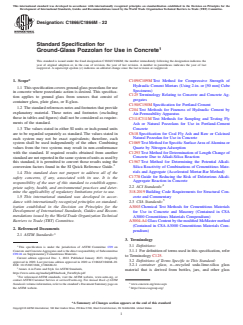
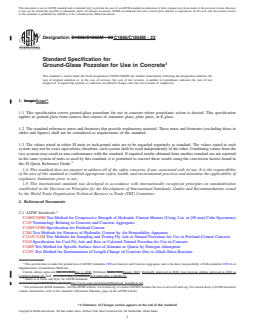
1.1 This specification covers ground-glass pozzolans for use in concrete where pozzolanic action is desired. This specification applies to ground glass from sources that consist of container glass, plate glass, or E-glass.
1.2 The standard references notes and footnotes that provide explanatory material. These notes and footnotes (excluding those in tables and figures) shall not be considered as requirements of the standard.
1.3 The values stated in either SI units or inch-pound units are to be regarded separately as standard. The values stated in each system may not be exact equivalents; therefore, each system shall be used independently of the other. Combining values from the two systems may result in non-conformance with the standard. If required results obtained from another standard are not reported in the same system of units as used by this standard, it is permitted to convert those results using the conversion factors found in the SI Quick Reference Guide.2
1.4 This standard does not purport to address all of the safety concerns, if any, associated with its use. It is the responsibility of the user of this standard to establish appropriate safety, health, and environmental practices and determine the applicability of regulatory limitations prior to use.
1.5 This international standard was developed in accordance with internationally recognized principles on standardization established in the Decision on Principles for the Development of International Standards, Guides and Recommendations issued by the World Trade Organization Technical Barriers to Trade (TBT) Committee.
- Status
- Published
- Publication Date
- 30-Nov-2022
- Technical Committee
- C09 - Concrete and Concrete Aggregates
- Drafting Committee
- C09.24 - Supplementary Cementitious Materials
Buy Documents
ASTM C1866/C1866M-22 - Standard Specification for Ground-Glass Pozzolan for Use in Concrete
REDLINE ASTM C1866/C1866M-22 - Standard Specification for Ground-Glass Pozzolan for Use in Concrete
Overview
ASTM C1866/C1866M-22: Standard Specification for Ground-Glass Pozzolan for Use in Concrete sets the requirements for ground-glass pozzolans used as supplementary cementitious materials in concrete mixes. Ground-glass pozzolans, derived from recycled container glass, plate glass, or E-glass, enhance concrete durability through pozzolanic activity. This international standard, published by ASTM, ensures the consistent quality, testing procedures, and reporting necessary for effective application in construction projects.
Key Topics
- Scope and Material Sources
The standard applies to ground-glass pozzolans manufactured from:- Container glass (e.g., bottles, jars)
- Plate glass (e.g., windows)
- E-glass (post-industrial glass fiber waste)
- Classification
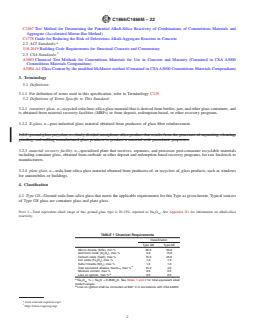
- Type GS: Ground soda-lime-silica glass (e.g., container and plate glass)
- Type GE: Ground E-glass (waste fibers from glass reinforcement production)
- Chemical and Physical Requirements
- Minimum and maximum content for silicon dioxide, aluminum oxide, calcium oxide, iron oxide, sulfur trioxide, and alkali levels
- Limits on moisture content and loss on ignition
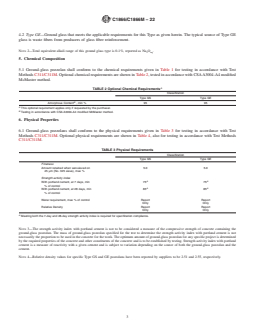
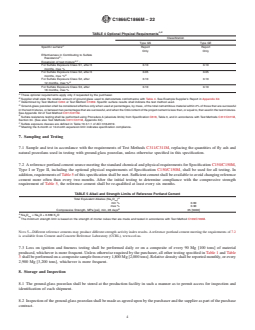
- Fineness index and strength activity indices at 7 and 28 days when mixed with portland cement
- Testing and Sampling
- Procedures for sampling, fineness testing, strength evaluation, and routine quality checks using referenced ASTM and CSA test methods
- Safety and Compliance
- User responsibilities for establishing safety, health, and environmental practices
- Reporting guidelines for supplier certification and product traceability
Applications
Ground-glass pozzolan is increasingly used in concrete applications aiming for enhanced sustainability, performance, and durability. Its pozzolanic reaction improves long-term strength development, reduces alkali-silica reactivity (ASR), and can contribute to resistance against sulfate attack. Key applications include:
- Ready-mixed and precast concrete: Incorporating ground-glass pozzolan as a partial cement replacement reduces the carbon footprint of concrete and recycles post-consumer and industrial waste.
- Infrastructure projects: Ideal for projects where longevity and resistance to chemical attack, such as bridges, wastewater treatment structures, and marine applications, are crucial.
- Sustainable construction: Ground-glass pozzolans are valued in green building initiatives for lowering cement usage and promoting the circular economy by utilizing recycled glass.
- Mitigation of Alkali-Silica Reaction (ASR): Especially using Type GE pozzolan, the risk of deleterious expansion from ASR is minimized, preserving the structural integrity of concrete over time.
Related Standards
Several international and regional standards are referenced by ASTM C1866/C1866M-22 to ensure the reliable assessment of ground-glass pozzolan properties:
- ASTM C109/C109M: Test Method for Compressive Strength of Hydraulic Cement Mortars
- ASTM C125: Terminology Relating to Concrete and Concrete Aggregates
- ASTM C150/C150M: Specification for Portland Cement
- ASTM C311/C311M: Test Methods for Sampling and Testing Fly Ash or Natural Pozzolans for Use in Portland-Cement Concrete
- ASTM C618: Specification for Coal Fly Ash and Raw or Calcined Natural Pozzolan for Use in Concrete
- ASTM C1293, C1567: Test Methods for determining alkali-silica reactivity
- ASTM C204, C1069: Methods for assessing particle fineness and surface area
- ACI 318: Building Code Requirements for Structural Concrete
- CSA A3003, A3004: Canadian standards for cementitious material testing and glass content
Practical Value
Compliance with ASTM C1866/C1866M-22 helps stakeholders in the concrete industry-producers, designers, and contractors-ensure reliable, high-performance, and sustainable concrete solutions leveraging recycled materials. Adherence to this standard supports environmental goals, facilitates quality assurance throughout the supply chain, and promotes the use of supplementary cementitious materials with proven performance in modern construction.
Relations
- Effective Date
- 01-Jan-2024
- Refers
ASTM C204-24 - Standard Test Methods for Fineness of Hydraulic Cement by Air-Permeability Apparatus - Effective Date
- 01-Jan-2024
- Effective Date
- 15-Dec-2023
- Effective Date
- 01-Dec-2023
- Effective Date
- 01-Jan-2020
- Effective Date
- 15-Dec-2019
- Effective Date
- 01-Dec-2019
- Effective Date
- 15-Jun-2019
- Effective Date
- 01-Jun-2019
- Effective Date
- 01-Apr-2019
- Effective Date
- 01-Jan-2019
- Effective Date
- 15-Dec-2018
- Effective Date
- 01-Oct-2018
- Effective Date
- 01-Jul-2018
- Effective Date
- 01-May-2018
Buy Documents
ASTM C1866/C1866M-22 - Standard Specification for Ground-Glass Pozzolan for Use in Concrete
REDLINE ASTM C1866/C1866M-22 - Standard Specification for Ground-Glass Pozzolan for Use in Concrete
Get Certified
Connect with accredited certification bodies for this standard

DIBt (Deutsches Institut für Bautechnik)
German Institute for Building Technology.
DIN CERTCO
DIN Group product certification.

Aboma Certification B.V.
Specialized in construction, metal, and transport sectors.
Sponsored listings
Frequently Asked Questions
ASTM C1866/C1866M-22 is a technical specification published by ASTM International. Its full title is "Standard Specification for Ground-Glass Pozzolan for Use in Concrete". This standard covers: SCOPE 1.1 This specification covers ground-glass pozzolans for use in concrete where pozzolanic action is desired. This specification applies to ground glass from sources that consist of container glass, plate glass, or E-glass. 1.2 The standard references notes and footnotes that provide explanatory material. These notes and footnotes (excluding those in tables and figures) shall not be considered as requirements of the standard. 1.3 The values stated in either SI units or inch-pound units are to be regarded separately as standard. The values stated in each system may not be exact equivalents; therefore, each system shall be used independently of the other. Combining values from the two systems may result in non-conformance with the standard. If required results obtained from another standard are not reported in the same system of units as used by this standard, it is permitted to convert those results using the conversion factors found in the SI Quick Reference Guide.2 1.4 This standard does not purport to address all of the safety concerns, if any, associated with its use. It is the responsibility of the user of this standard to establish appropriate safety, health, and environmental practices and determine the applicability of regulatory limitations prior to use. 1.5 This international standard was developed in accordance with internationally recognized principles on standardization established in the Decision on Principles for the Development of International Standards, Guides and Recommendations issued by the World Trade Organization Technical Barriers to Trade (TBT) Committee.
SCOPE 1.1 This specification covers ground-glass pozzolans for use in concrete where pozzolanic action is desired. This specification applies to ground glass from sources that consist of container glass, plate glass, or E-glass. 1.2 The standard references notes and footnotes that provide explanatory material. These notes and footnotes (excluding those in tables and figures) shall not be considered as requirements of the standard. 1.3 The values stated in either SI units or inch-pound units are to be regarded separately as standard. The values stated in each system may not be exact equivalents; therefore, each system shall be used independently of the other. Combining values from the two systems may result in non-conformance with the standard. If required results obtained from another standard are not reported in the same system of units as used by this standard, it is permitted to convert those results using the conversion factors found in the SI Quick Reference Guide.2 1.4 This standard does not purport to address all of the safety concerns, if any, associated with its use. It is the responsibility of the user of this standard to establish appropriate safety, health, and environmental practices and determine the applicability of regulatory limitations prior to use. 1.5 This international standard was developed in accordance with internationally recognized principles on standardization established in the Decision on Principles for the Development of International Standards, Guides and Recommendations issued by the World Trade Organization Technical Barriers to Trade (TBT) Committee.
ASTM C1866/C1866M-22 is classified under the following ICS (International Classification for Standards) categories: 91.100.15 - Mineral materials and products; 91.100.30 - Concrete and concrete products. The ICS classification helps identify the subject area and facilitates finding related standards.
ASTM C1866/C1866M-22 has the following relationships with other standards: It is inter standard links to ASTM C311/C311M-24, ASTM C204-24, ASTM C109/C109M-23, ASTM C1778-23, ASTM C1293-20, ASTM C125-19a, ASTM C1778-19b, ASTM C1778-19a, ASTM C1778-19, ASTM C150/C150M-19, ASTM C125-19, ASTM C1293-18a, ASTM C125-18b, ASTM C125-18a, ASTM C1293-18. Understanding these relationships helps ensure you are using the most current and applicable version of the standard.
ASTM C1866/C1866M-22 is available in PDF format for immediate download after purchase. The document can be added to your cart and obtained through the secure checkout process. Digital delivery ensures instant access to the complete standard document.
Standards Content (Sample)
This international standard was developed in accordance with internationally recognized principles on standardization established in the Decision on Principles for the
Development of International Standards, Guides and Recommendations issued by the World Trade Organization Technical Barriers to Trade (TBT) Committee.
Designation:C1866/C1866M −22
Standard Specification for
Ground-Glass Pozzolan for Use in Concrete
This standard is issued under the fixed designation C1866/C1866M; the number immediately following the designation indicates the
year of original adoption or, in the case of revision, the year of last revision. A number in parentheses indicates the year of last
reapproval. A superscript epsilon (´) indicates an editorial change since the last revision or reapproval.
1. Scope* C109/C109M Test Method for Compressive Strength of
Hydraulic Cement Mortars (Using 2-in. or [50 mm] Cube
1.1 Thisspecificationcoversground-glasspozzolansforuse
Specimens)
in concrete where pozzolanic action is desired. This specifica-
C125 Terminology Relating to Concrete and Concrete Ag-
tion applies to ground glass from sources that consist of
gregates
container glass, plate glass, or E-glass.
C150/C150M Specification for Portland Cement
1.2 Thestandardreferencesnotesandfootnotesthatprovide
C204 Test Methods for Fineness of Hydraulic Cement by
explanatory material. These notes and footnotes (excluding
Air-Permeability Apparatus
those in tables and figures) shall not be considered as require-
C311/C311M Test Methods for Sampling and Testing Fly
ments of the standard.
Ash or Natural Pozzolans for Use in Portland-Cement
1.3 The values stated in either SI units or inch-pound units Concrete
C618 Specification for Coal Fly Ash and Raw or Calcined
are to be regarded separately as standard. The values stated in
each system may not be exact equivalents; therefore, each Natural Pozzolan for Use in Concrete
C1069 Test Method for Specific SurfaceArea ofAlumina or
system shall be used independently of the other. Combining
values from the two systems may result in non-conformance Quartz by Nitrogen Adsorption
C1293 Test Method for Determination of Length Change of
with the standard. If required results obtained from another
standardarenotreportedinthesamesystemofunitsasusedby Concrete Due to Alkali-Silica Reaction
C1567 Test Method for Determining the Potential Alkali-
this standard, it is permitted to convert those results using the
conversion factors found in the SI Quick Reference Guide. Silica Reactivity of Combinations of Cementitious Mate-
rials and Aggregate (Accelerated Mortar-Bar Method)
1.4 This standard does not purport to address all of the
C1778 Guide for Reducing the Risk of Deleterious Alkali-
safety concerns, if any, associated with its use. It is the
Aggregate Reaction in Concrete
responsibility of the user of this standard to establish appro-
2.2 ACI Standards:
priate safety, health, and environmental practices and deter-
318-2019 Building Code Requirements for Structural Con-
mine the applicability of regulatory limitations prior to use.
crete and Commentary
1.5 This international standard was developed in accor-
dance with internationally recognized principles on standard-
2.3 CSA Standards:
ization established in the Decision on Principles for the
A3003 Chemical Test Methods for Cementitious Materials
Development of International Standards, Guides and Recom-
for Use in Concrete and Masonry (Contained in CSA
mendations issued by the World Trade Organization Technical
A3000 Cementitious Materials Compendium)
Barriers to Trade (TBT) Committee.
A3004-A4 Glass Content by the modified McMaster method
(Contained in CSA A3000 Cementitious Materials Com-
2. Referenced Documents
pendium)
2.1 ASTM Standards:
3. Terminology
3.1 Definitions:
This specification is under the jurisdiction of ASTM Committee C09 on
Concrete and ConcreteAggregates and is the direct responsibility of Subcommittee
3.1.1 For definition of terms used in this specification, refer
C09.24 on Supplementary Cementitious Materials.
to Terminology C125.
Current edition approved Dec. 1, 2022. Published January 2023. Originally
3.2 Definitions of Terms Specific to This Standard:
approved in 2020. Last previous edition approved in 2020 as C1866/C1866M–20.
DOI: 10.1520/C1866_C1866M-22. 3.2.1 container glass, n—recycled soda-lime-silica glass
Annex A in Form and Style for ASTM Standards,
material that is derived from bottles, jars, and other glass
https://www.astm.org/media/pdf/bluebook_FormStyle.pdf
For referenced ASTM standards, visit the ASTM website, www.astm.org, or
contact ASTM Customer Service at service@astm.org. For Annual Book of ASTM
Standards volume information, refer to the standard’s Document Summary page on www.concrete.org/store.aspx
the ASTM website. https://store.csagroup.org/
*A Summary of Changes section appears at the end of this standard
Copyright © ASTM International, 100 Barr Harbor Drive, PO Box C700, West Conshohocken, PA 19428-2959. United States
C1866/C1866M−22
TABLE 1 Chemical Requirements
Test Methods C311/C311M. Optional chemical requirements
Classification are shown in Table 2, tested in accordance with CSA
Type GS Type GE
A3004-A4 modified McMaster method.
A
Silicon dioxide (SiO ), min % 60.0 55.0
2 TABLE 2 Optional Chemical Requirements
Aluminum oxide (Al O ), max % 5.0 15.0
2 3
Classification
Calcium oxide (CaO), max % 15.0 25.0
Type GS Type GE
Iron oxide (Fe O ), max % 1.0 1.0
2 3
B
Sulfur trioxide (SO ), max % 1.0 1.0 Amorphous Content , min % 95 95
A
Total equivalent alkalies, Na O , max % 15.0 4.0
2 eq
A
This optional requirement applies only if requested by the purchaser.
Moisture content, max % 0.5 0.5
B
Testing in accordance with CSAA3004-A4 modified McMaster method.
B
Loss on ignition, max % 0.5 0.5
A
Na O %=Na O + 0.658K O. See Notes 1 and 2 for total equivalent alkali
2 eq 2 2
6. Physical Properties
content ranges.
B
Loss on ignition shall be conducted at 600° C in accordance with CSAA3003.
6.1 Ground-glass pozzolans shall conform to the physical
requirements given in Table 3 for testing in accordance with
containers, and is obtained from material recovery facilities
Test Methods C311/C311M. Optional physical requirements
(MRFs) or from deposit, redemption-based, or other recovery
are shown in Table 4, also for testing in accordance with Test
programs.
Methods C311/C311M.
TABLE 3 Physical Requirements
3.2.2 E-glass, n—post-industrial glass material obtained
Classification
from producers of glass fiber reinforcement.
Type GS Type GE
3.2.3 material recovery facility, n—specialized plant that
Fineness
receives, separates, and processes post-consumer recyclable
Amount retained when wet-sieved on 5.0 5.0
materials including container glass, obtained from curbside or
45 µm (No. 325 sieve), max %
other deposit and redemption-based recovery programs, for
Strength activity index
raw feedstock to manufacturers.
A A
With portland cement, at 7 days, min 75 75
% of control
3.2.4 plate glass, n—soda-lime-silica glass material ob-
A A
With portland cement, at 28 days, min 85 85
tained from producers of, or recyclers of, glass products, such
% of control
as windows for automobiles or buildings.
Water requirement, max % of control Report Report
4. Classification Only Only
Relative Density Report Report
4.1 Type GS—Ground soda-lime-silica glass that meets the
Only Only
applicable requirements for this Type as given herein. Typical
A
Meeting both the 7-day and 28-day strength activity index is required for
sources of Type GS glass are container glass and plate glass.
specification compliance.
NOTE 1—Total equivalent alkali range of this ground glass type is
NOTE 3—The strength activity index with portland cement is not to be
10-15%, reported as Na O . See Appendix X1 for information on
2 eq
considered a measure of the compressive strength of concrete containing
alkali-silica reactivity.
the ground-glass pozzolan. The mass of ground-glass pozzolan specified
for the test to determine the strength activity index with portland cement
4.2 Type GE—Ground glass that meets the applicable re-
is not necessarily the proportion to be used in the concrete for the work.
quirements for this Type as given herein. The typical source of
The optimum amount of ground-glass pozzolan for any specific project is
Type GE glass is waste fibers from producers of glass fiber
determined by the required properties of the concrete and other constitu-
reinforcement.
ents of the concrete and is to be established by testing. Strength activity
index with portland cement is a measure of reactivity with a given cement
NOTE2—Totalequivalentalkalirangeofthisgroundglasstypeis0-1%,
and is subject to variation depending on the source of both the ground-
reported as Na O .
2 eq
glass pozzolan and the cement.
5. Chemical Composition
NOTE 4—Relative density values for specific Type GS and GE
pozzolans have been reported by suppliers to be 2.51 and 2.55, respec-
5.1 Ground-glass pozzolan shall conform to the chemical
tively.
requirements given in Table 1 for testing in accordance with
C1866/C1866M−22
A,B
TABLE 4 Optional Physical Requirements activity index results. A reference portland cement meeting the require-
Classification mentsof7.2isavailablefromCementandConcreteReferenceLaboratory
(CCRL), www.ccrl.us.
Type GS Type GE
C
Specific surface Report Report
7.3 Loss on ignition and fineness testing shall be performed
Only Only
daily or on a composite of every 90 Mg [100 tons] of material
Effectiveness in Contributing to Sulfate
D
produced, wh
...
This document is not an ASTM standard and is intended only to provide the user of an ASTM standard an indication of what changes have been made to the previous version. Because
it may not be technically possible to adequately depict all changes accurately, ASTM recommends that users consult prior editions as appropriate. In all cases only the current version
of the standard as published by ASTM is to be considered the official document.
Designation: C1866/C1866M − 20 C1866/C1866M − 22
Standard Specification for
Ground-Glass Pozzolan for Use in Concrete
This standard is issued under the fixed designation C1866/C1866M; the number immediately following the designation indicates the
year of original adoption or, in the case of revision, the year of last revision. A number in parentheses indicates the year of last
reapproval. A superscript epsilon (´) indicates an editorial change since the last revision or reapproval.
1. Scope Scope*
1.1 This specification covers ground-glass pozzolans for use in concrete where pozzolanic action is desired. This specification
applies to ground glass from sources that consist of container glass, plate glass, or E-glass.
1.2 The standard references notes and footnotes that provide explanatory material. These notes and footnotes (excluding those in
tables and figures) shall not be considered as requirements of the standard.
1.3 The values stated in either SI units or inch-pound units are to be regarded separately as standard. The values stated in each
system may not be exact equivalents; therefore, each system shall be used independently of the other. Combining values from the
two systems may result in non-conformance with the standard. If required results obtained from another standard are not reported
in the same system of units as used by this standard, it is permitted to convert those results using the conversion factors found in
the SI Quick Reference Guide.
1.4 This standard does not purport to address all of the safety concerns, if any, associated with its use. It is the responsibility
of the user of this standard to establish appropriate safety, health, and environmental practices and determine the applicability of
regulatory limitations prior to use.
1.5 This international standard was developed in accordance with internationally recognized principles on standardization
established in the Decision on Principles for the Development of International Standards, Guides and Recommendations issued
by the World Trade Organization Technical Barriers to Trade (TBT) Committee.
2. Referenced Documents
2.1 ASTM Standards:
C109/C109M Test Method for Compressive Strength of Hydraulic Cement Mortars (Using 2-in. or [50 mm] Cube Specimens)
C125 Terminology Relating to Concrete and Concrete Aggregates
C150/C150M Specification for Portland Cement
C204 Test Methods for Fineness of Hydraulic Cement by Air-Permeability Apparatus
C311/C311M Test Methods for Sampling and Testing Fly Ash or Natural Pozzolans for Use in Portland-Cement Concrete
C618 Specification for Coal Fly Ash and Raw or Calcined Natural Pozzolan for Use in Concrete
C1069 Test Method for Specific Surface Area of Alumina or Quartz by Nitrogen Adsorption
C1293 Test Method for Determination of Length Change of Concrete Due to Alkali-Silica Reaction
This specification is under the jurisdiction of ASTM Committee C09 on Concrete and Concrete Aggregates and is the direct responsibility of Subcommittee C09.24 on
Supplementary Cementitious Materials.
Current edition approved Feb. 15, 2020Dec. 1, 2022. Published March 2020January 2023. Originally approved in 2020. Last previous edition approved in 2020 as
C1866/C1866M–20. DOI: 10.1520/C1866_C1866M-20.10.1520/C1866_C1866M-22.
Annex A in Form and Style for ASTM Standards,
www.astm.org/COMMIT/Blue_Book.pdfhttps://www.astm.org/media/pdf/bluebook_FormStyle.pdf
For referenced ASTM standards, visit the ASTM website, www.astm.org, or contact ASTM Customer Service at service@astm.org. For Annual Book of ASTM Standards
volume information, refer to the standard’s Document Summary page on the ASTM website.
*A Summary of Changes section appears at the end of this standard
Copyright © ASTM International, 100 Barr Harbor Drive, PO Box C700, West Conshohocken, PA 19428-2959. United States
C1866/C1866M − 22
C1567 Test Method for Determining the Potential Alkali-Silica Reactivity of Combinations of Cementitious Materials and
Aggregate (Accelerated Mortar-Bar Method)
C1778 Guide for Reducing the Risk of Deleterious Alkali-Aggregate Reaction in Concrete
2.2 ACI Standards:
318-2019 Building Code Requirements for Structural Concrete and Commentary
2.3 CSA Standards:
A3003 Chemical Test Methods for Cementitious Materials for Use in Concrete and Masonry (Contained in CSA A3000
Cementitious Materials Compendium)
A3004-A4 Glass Content by the modified McMaster method (Contained in CSA A3000 Cementitious Materials Compendium)
3. Terminology
3.1 Definitions:
3.1.1 For definition of terms used in this specification, refer to Terminology C125.
3.2 Definitions of Terms Specific to This Standard:
3.2.1 container glass, n—recycled soda-lime-silica glass material that is derived from bottles, jars, and other glass containers, and
is obtained from material recovery facilities (MRFs) or from deposit, redemption-based, or other recovery programs.
3.2.2 E-glass, n—post-industrial glass material obtained from producers of glass fiber reinforcement.
3.2.3 ground-glass pozzolan, n—finely divided amorphous silica product that results from the processes of separating, cleaning,
grinding, and milling manufactured glass products to produce a material with pozzolanic properties.
3.2.3 material recovery facility, n—specialized plant that receives, separates, and processes post-consumer recyclable materials
including container glass, obtained from curbside or other deposit and redemption-based recovery programs, for raw feedstock to
manufacturers.
3.2.4 plate glass, n—soda-lime-silica glass material obtained from producers of, or recyclers of, glass products, such as windows
for automobiles or buildings.
4. Classification
4.1 Type GS—Ground soda-lime-silica glass that meets the applicable requirements for this Type as given herein. Typical sources
of Type GS glass are container glass and plate glass.
NOTE 1—Total equivalent alkali range of this ground glass type is 10-15%, reported as Na O . See Appendix X1 for information on alkali-silica
2 eq
reactivity.
TABLE 1 Chemical Requirements
Classification
Type GS Type GE
Silicon dioxide (SiO ), min % 60.0 55.0
Aluminum oxide (Al O ), max % 5.0 15.0
2 3
Calcium oxide (CaO), max % 15.0 25.0
Iron oxide (Fe O ), max % 1.0 1.0
2 3
Sulfur trioxide (SO ), max % 1.0 1.0
A
Total equivalent alkalies, Na O , max % 15.0 4.0
2 eq
Moisture content, max % 0.5 0.5
B
Loss on ignition, max % 0.5 0.5
A
Na O % = Na O + 0.658K O. See Notes 1 and 2 for total equivalent alkali
2 eq 2 2
content ranges.
B
Loss on ignition shall be conducted at 600° C in accordance with CSA A3003.
www.concrete.org/store.aspx
https://store.csagroup.org/
C1866/C1866M − 22
4.2 Type GE—Ground glass that meets the applicable requirements for this Type as given herein. The typical source of Type GE
glass is waste fibers from producers of glass fiber reinforcement.
NOTE 2—Total equivalent alkali range of this ground glass type is 0-1%, reported as Na O .
2 eq
5. Chemical Composition
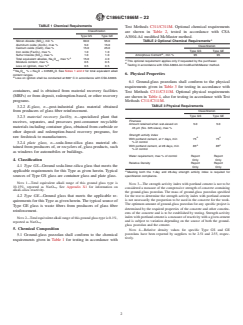
5.1 Ground-glass pozzolan shall conform to the chemical requirements given in Table 1 for testing in accordance with Test
Methods C311/C311M. Optional chemical requirements are shown in Table 2, tested in accordance with CSA A3004-A4 modified
McMaster method.
A
TABLE 2 Optional Chemical Requirements
Classification
Type GS Type GE
B
Amorphous Content , min % 95 95
A
This optional requirement applies only if requested by the purchaser.
B
Testing in accordance with CSA A3004-A4 modified McMaster method.
6. Physical Properties
6.1 Ground-glass pozzolans shall conform to the physical requirements given in Table 3 for testing in accordance with Test
Methods C311/C311M. Optional physical requirements are shown in Table 4, also for testing in accordance with Test Methods
C311/C311M.
TABLE 3 Physical Requirements
Classification
Type GS Type GE
Fineness
Amount retained when wet-sieved on 5.0 5.0
45 μm (No. 325 sieve), max %
Strength activity index
A A
With portland cement, at 7 days, min 75 75
% of control
A A
With portland cement, at 28 days, min 85 85
% of control
Water requirement, max % of control Report Report
Only Only
Relative Density Report Report
Only Only
A
Meeting both the 7-day and 28-day strength activity index is required for specification compliance.
NOTE 3—The strength activity index with portland cement is not to be considered a measure of the compressive strength of concrete containing the
ground-glass pozzolan. The mass of ground-glass pozzolan specified for the test to determine the strength activity index with portland cement is not
necessarily the proportion to be used in the concrete for the work. The optimum amount of ground-glass pozzolan for any specific project is determined
by the required properties of the concrete and other constituents of the concrete and is to be established by testing. Strength activity index with portland
cement is a measure of reactivity with a given cement and is subject to variation depending on the source of both the ground-glass pozzolan and the
cement.
NOTE 4—Relative density values for specific Type GS and GE pozzolans have been reported by suppliers to be 2.51 and 2.55, respectively.
C1866/C1866M − 22
A,B
TABLE 4 Optional Physical Requirements
Classification
Type GS Type GE
C
Specific surface Report Report
Only Only
Effectiveness in Contributing to Sulfate
D
Resistance :
E,F
Expansion of test mixture :
For Sulfate Exposure Class S1, after
...