

ASTM D2889-95(2019)
(Test Method)Standard Test Method for Calculation of True Vapor Pressures of Petroleum Distillate Fuels
General Information
- Abstract
SIGNIFICANCE AND USE
4.1 The true vapor pressure of a distillate fuel is a relative measurement, both of the tendency of the most volatile portion of the fuel to gasify, and of the restraining pressure required to prevent gasification of the most volatile portion. Thus the measurement is of importance when a fuel is to be utilized in applications where no gasification may be tolerated, and temperature-pressure conditions are expected to be near the true vapor pressure of the fuel.
SCOPE
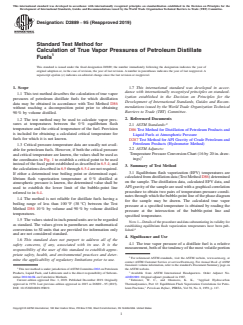
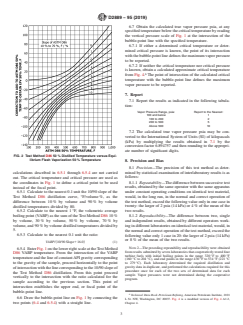
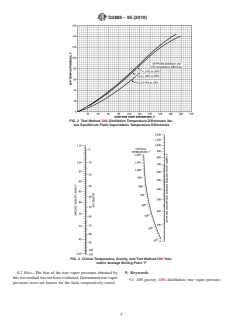
1.1 This test method describes the calculation of true vapor pressures of petroleum distillate fuels for which distillation data may be obtained in accordance with Test Method D86 without reaching a decomposition point prior to obtaining 90 % by volume distilled.
1.2 The test method may be used to calculate vapor pressures at temperatures between the 0 % equilibrium flash temperature and the critical temperature of the fuel. Provision is included for obtaining a calculated critical temperature for fuels for which it is not known.
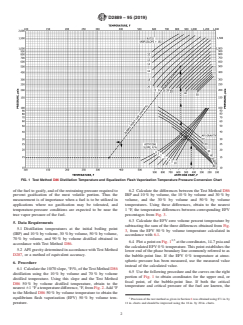
1.3 Critical pressure-temperature data are usually not available for petroleum fuels. However, if both the critical pressure and critical temperature are known, the values shall be used as the coordinates in Fig. 1 to establish a critical point to be used instead of the focal point established as described in 6.5.4; and the calculations described in 6.5 through 6.5.4 are not required. If either a determined true boiling point or determined equilibrium flash vaporization temperature at 0 % distilled at atmospheric pressure is known, the determined value shall be used to establish the lower limit of the bubble-point line referred to in 6.4.
FIG. 1 Test Method D86 Distillation Temperature and Equalization Flash Vaporization Temperature Pressure Conversion Chart
1.4 The method is not reliable for distillate fuels having a boiling range of less than 100 °F (38 °C) between the Test Method D86 10 % by volume and 90 % by volume distilled temperatures.
1.5 The values stated in inch-pound units are to be regarded as standard. The values given in parentheses are mathematical conversions to SI units that are provided for information only and are not considered standard.
1.6 This standard does not purport to address all of the safety concerns, if any, associated with its use. It is the responsibility of the user of this standard to establish appropriate safety, health, and environmental practices and determine the applicability of regulatory limitations prior to use.
1.7 This international standard was developed in accordance with internationally recognized principles on standardization established in the Decision on Principles for the Development of International Standards, Guides and Recommendations issued by the World Trade Organization Technical Barriers to Trade (TBT) Committee.
- Status
- Published
- Publication Date
- 30-Nov-2019
- Technical Committee
- D02 - Petroleum Products, Liquid Fuels, and Lubricants
- Drafting Committee
- D02.04.0K - Correlative Methods
Overview
ASTM D2889-95(2019), Standard Test Method for Calculation of True Vapor Pressures of Petroleum Distillate Fuels, is a widely recognized methodology developed by ASTM International. This standard describes a calculation procedure for determining the true vapor pressure (TVP) of petroleum distillate fuels using distillation data, specifically data obtained via ASTM D86. Accurate measurement of true vapor pressure is essential for ensuring the safe storage, handling, and use of petroleum fuels, as it reflects both the volatility of the most volatile fuel components and the pressure required to suppress their vaporization. This measurement is critical for applications where gasification of the fuel must be prevented under certain pressure-temperature conditions.
Key Topics
- True Vapor Pressure Determination: The standard outlines a graphical and calculation-based approach to estimate the true vapor pressure of petroleum distillate fuels across applicable temperature ranges.
- Distillation Data Usage: Utilizes ASTM D86 distillation results (initial boiling point, various percentage points by volume, and critical temperature if available) as the basis for pressure calculations.
- Vapor Pressure Range: Applies to fuels where a distillation range of at least 100°F (38°C) between 10% and 90% distilled is achieved.
- Phase Diagram and Bubble-Point Line: Establishes key points on the phase diagram, including calculation of equilibrium flash vaporization (EFV) temperatures and defining the bubble-point line for vapor pressure calculations.
- Critical Properties: Provides a pathway for using known or calculated critical temperature and pressure values, streamlining the pressure calculation if these data are available.
- Reporting and Units: Results are reported in psia and can be converted to kilopascals (kPa) using a specified conversion factor, supporting both inch-pound and SI units.
- Safety and Use: Users are responsible for ensuring that all relevant safety, health, and environmental protocols are met when applying this standard.
Applications
ASTM D2889-95(2019) is crucial in several sectors of petroleum production, distribution, and storage:
- Fuel Storage Design: Engineers and operators use true vapor pressure data to design storage facilities that minimize vapor losses and mitigate safety hazards.
- Compliance and Regulatory Reporting: TVP data informs compliance with environmental and transportation regulations, particularly those addressing volatile organic compounds (VOC) emissions and safe transport of flammable liquids.
- Process Engineering: Refineries and blending facilities rely on accurate vapor pressure measurements to select and blend components, ensuring fuels meet both specifications and performance requirements.
- Product Quality Control: Regular vapor pressure assessments allow fuel suppliers and quality control laboratories to maintain product consistency and performance integrity.
- Safety Assessment: Understanding the volatility characteristics of distillate fuels supports risk management decisions in handling, transporting, and using those fuels in various climatic and operational scenarios.
Related Standards
- ASTM D86: Test Method for Distillation of Petroleum Products and Liquid Fuels at Atmospheric Pressure - provides the essential distillation data necessary for the ASTM D2889 calculation method.
- ASTM D287: Test Method for API Gravity of Crude Petroleum and Petroleum Products - used for determining API gravity, an integral part of the true vapor pressure assessment.
- Temperature-Pressure Conversion Charts: ASTM provides adjunct materials and reference charts for conversion and graphical calculation steps as referenced in the standard.
Utilizing ASTM D2889 assures precise and standardized calculation of true vapor pressure in petroleum distillate fuels, supporting safety, regulatory compliance, and operational efficiency throughout the fuel supply chain.
Relations
- Effective Date
- 01-Dec-2019
- Effective Date
- 01-Dec-2023
- Effective Date
- 01-Dec-2023
- Effective Date
- 01-Jul-2016
- Effective Date
- 15-May-2012
- Effective Date
- 01-Apr-2012
- Refers
ASTM D86-11b - Standard Test Method for Distillation of Petroleum Products at Atmospheric Pressure - Effective Date
- 01-Dec-2011
- Refers
ASTM D86-09 - Standard Test Method for Distillation of Petroleum Products at Atmospheric Pressure - Effective Date
- 15-Apr-2009
- Refers
ASTM D86-08a - Standard Test Method for Distillation of Petroleum Products at Atmospheric Pressure - Effective Date
- 15-Dec-2008
- Refers
ASTM D86-08 - Standard Test Method for Distillation of Petroleum Products at Atmospheric Pressure - Effective Date
- 15-Nov-2008
- Refers
ASTM D86-07b - Standard Test Method for Distillation of Petroleum Products at Atmospheric Pressure - Effective Date
- 15-Nov-2007
- Refers
ASTM D86-07a - Standard Test Method for Distillation of Petroleum Products at Atmospheric Pressure - Effective Date
- 01-Apr-2007
- Refers
ASTM D86-07 - Standard Test Method for Distillation of Petroleum Products at Atmospheric Pressure - Effective Date
- 15-Jan-2007
- Effective Date
- 01-May-2006
- Refers
ASTM D86-05 - Standard Test Method for Distillation of Petroleum Products at Atmospheric Pressure - Effective Date
- 01-Jul-2005
Get Certified
Connect with accredited certification bodies for this standard

Element Materials Technology
Materials testing and product certification.

ABS Group Brazil
ABS Group certification services in Brazil.

ABS Quality Evaluations Inc.
American Bureau of Shipping quality certification.
Sponsored listings
Frequently Asked Questions
ASTM D2889-95(2019) is a standard published by ASTM International. Its full title is "Standard Test Method for Calculation of True Vapor Pressures of Petroleum Distillate Fuels". This standard covers: SIGNIFICANCE AND USE 4.1 The true vapor pressure of a distillate fuel is a relative measurement, both of the tendency of the most volatile portion of the fuel to gasify, and of the restraining pressure required to prevent gasification of the most volatile portion. Thus the measurement is of importance when a fuel is to be utilized in applications where no gasification may be tolerated, and temperature-pressure conditions are expected to be near the true vapor pressure of the fuel. SCOPE 1.1 This test method describes the calculation of true vapor pressures of petroleum distillate fuels for which distillation data may be obtained in accordance with Test Method D86 without reaching a decomposition point prior to obtaining 90 % by volume distilled. 1.2 The test method may be used to calculate vapor pressures at temperatures between the 0 % equilibrium flash temperature and the critical temperature of the fuel. Provision is included for obtaining a calculated critical temperature for fuels for which it is not known. 1.3 Critical pressure-temperature data are usually not available for petroleum fuels. However, if both the critical pressure and critical temperature are known, the values shall be used as the coordinates in Fig. 1 to establish a critical point to be used instead of the focal point established as described in 6.5.4; and the calculations described in 6.5 through 6.5.4 are not required. If either a determined true boiling point or determined equilibrium flash vaporization temperature at 0 % distilled at atmospheric pressure is known, the determined value shall be used to establish the lower limit of the bubble-point line referred to in 6.4. FIG. 1 Test Method D86 Distillation Temperature and Equalization Flash Vaporization Temperature Pressure Conversion Chart 1.4 The method is not reliable for distillate fuels having a boiling range of less than 100 °F (38 °C) between the Test Method D86 10 % by volume and 90 % by volume distilled temperatures. 1.5 The values stated in inch-pound units are to be regarded as standard. The values given in parentheses are mathematical conversions to SI units that are provided for information only and are not considered standard. 1.6 This standard does not purport to address all of the safety concerns, if any, associated with its use. It is the responsibility of the user of this standard to establish appropriate safety, health, and environmental practices and determine the applicability of regulatory limitations prior to use. 1.7 This international standard was developed in accordance with internationally recognized principles on standardization established in the Decision on Principles for the Development of International Standards, Guides and Recommendations issued by the World Trade Organization Technical Barriers to Trade (TBT) Committee.
SIGNIFICANCE AND USE 4.1 The true vapor pressure of a distillate fuel is a relative measurement, both of the tendency of the most volatile portion of the fuel to gasify, and of the restraining pressure required to prevent gasification of the most volatile portion. Thus the measurement is of importance when a fuel is to be utilized in applications where no gasification may be tolerated, and temperature-pressure conditions are expected to be near the true vapor pressure of the fuel. SCOPE 1.1 This test method describes the calculation of true vapor pressures of petroleum distillate fuels for which distillation data may be obtained in accordance with Test Method D86 without reaching a decomposition point prior to obtaining 90 % by volume distilled. 1.2 The test method may be used to calculate vapor pressures at temperatures between the 0 % equilibrium flash temperature and the critical temperature of the fuel. Provision is included for obtaining a calculated critical temperature for fuels for which it is not known. 1.3 Critical pressure-temperature data are usually not available for petroleum fuels. However, if both the critical pressure and critical temperature are known, the values shall be used as the coordinates in Fig. 1 to establish a critical point to be used instead of the focal point established as described in 6.5.4; and the calculations described in 6.5 through 6.5.4 are not required. If either a determined true boiling point or determined equilibrium flash vaporization temperature at 0 % distilled at atmospheric pressure is known, the determined value shall be used to establish the lower limit of the bubble-point line referred to in 6.4. FIG. 1 Test Method D86 Distillation Temperature and Equalization Flash Vaporization Temperature Pressure Conversion Chart 1.4 The method is not reliable for distillate fuels having a boiling range of less than 100 °F (38 °C) between the Test Method D86 10 % by volume and 90 % by volume distilled temperatures. 1.5 The values stated in inch-pound units are to be regarded as standard. The values given in parentheses are mathematical conversions to SI units that are provided for information only and are not considered standard. 1.6 This standard does not purport to address all of the safety concerns, if any, associated with its use. It is the responsibility of the user of this standard to establish appropriate safety, health, and environmental practices and determine the applicability of regulatory limitations prior to use. 1.7 This international standard was developed in accordance with internationally recognized principles on standardization established in the Decision on Principles for the Development of International Standards, Guides and Recommendations issued by the World Trade Organization Technical Barriers to Trade (TBT) Committee.
ASTM D2889-95(2019) is classified under the following ICS (International Classification for Standards) categories: 75.080 - Petroleum products in general; 75.160.20 - Liquid fuels. The ICS classification helps identify the subject area and facilitates finding related standards.
ASTM D2889-95(2019) has the following relationships with other standards: It is inter standard links to ASTM D2889-95(2015), ASTM D86-23ae1, ASTM D86-23a, ASTM D86-16, ASTM D287-12a, ASTM D287-12, ASTM D86-11b, ASTM D86-09, ASTM D86-08a, ASTM D86-08, ASTM D86-07b, ASTM D86-07a, ASTM D86-07, ASTM D287-92(2006), ASTM D86-05. Understanding these relationships helps ensure you are using the most current and applicable version of the standard.
ASTM D2889-95(2019) is available in PDF format for immediate download after purchase. The document can be added to your cart and obtained through the secure checkout process. Digital delivery ensures instant access to the complete standard document.
Standards Content (Sample)
This international standard was developed in accordance with internationally recognized principles on standardization established in the Decision on Principles for the
Development of International Standards, Guides and Recommendations issued by the World Trade Organization Technical Barriers to Trade (TBT) Committee.
Designation: D2889 − 95 (Reapproved 2019)
Standard Test Method for
Calculation of True Vapor Pressures of Petroleum Distillate
Fuels
This standard is issued under the fixed designation D2889; the number immediately following the designation indicates the year of
original adoption or, in the case of revision, the year of last revision.Anumber in parentheses indicates the year of last reapproval.A
superscript epsilon (´) indicates an editorial change since the last revision or reapproval.
1. Scope 1.7 This international standard was developed in accor-
dance with internationally recognized principles on standard-
1.1 This test method describes the calculation of true vapor
ization established in the Decision on Principles for the
pressures of petroleum distillate fuels for which distillation
Development of International Standards, Guides and Recom-
data may be obtained in accordance with Test Method D86
mendations issued by the World Trade Organization Technical
without reaching a decomposition point prior to obtaining
Barriers to Trade (TBT) Committee.
90% by volume distilled.
2. Referenced Documents
1.2 The test method may be used to calculate vapor pres-
sures at temperatures between the 0% equilibrium flash
2.1 ASTM Standards:
temperature and the critical temperature of the fuel. Provision
D86Test Method for Distillation of Petroleum Products and
is included for obtaining a calculated critical temperature for
Liquid Fuels at Atmospheric Pressure
fuels for which it is not known.
D287Test Method forAPI Gravity of Crude Petroleum and
Petroleum Products (Hydrometer Method)
1.3 Critical pressure-temperature data are usually not avail-
2.2 ASTM Adjuncts:
able for petroleum fuels. However, if both the critical pressure
TemperaturePressureConversionChart(16by20in.draw-
and critical temperature are known, the values shall be used as
ings)
the coordinates in Fig. 1 to establish a critical point to be used
instead of the focal point established as described in 6.5.4; and
3. Summary of Test Method
thecalculationsdescribedin6.5through6.5.4arenotrequired.
3.1 Equilibrium flash vaporization (EFV) temperatures are
If either a determined true boiling point or determined equi-
calculatedfromdistillationdata(TestMethodD86)determined
librium flash vaporization temperature at 0% distilled at
on the sample. The distillation data, calculated EFV data, and
atmospheric pressure is known, the determined value shall be
APIgravityofthesampleareusedwithagraphicalcorrelation
used to establish the lower limit of the bubble-point line
procedure to obtain two pairs of temperature-pressure coordi-
referred to in 6.4.
natesthroughwhichthebubble-pointlineofthephasediagram
1.4 The method is not reliable for distillate fuels having a
for the sample may be drawn. The calculated true vapor
boiling range of less than 100°F (38°C) between the Test
pressure at a specified temperature is obtained by reading the
Method D86 10% by volume and 90% by volume distilled
pressure at the intersection of the bubble-point line and
temperatures.
specified temperature.
1.5 The values stated in inch-pound units are to be regarded
NOTE1—Detailsoftheprocedureanddatasubstantiatingitsvalidityfor
as standard. The values given in parentheses are mathematical
establishing equilibrium flash vaporization temperatures have been pub-
conversions to SI units that are provided for information only
lished.
and are not considered standard.
4. Significance and Use
1.6 This standard does not purport to address all of the
4.1 The true vapor pressure of a distillate fuel is a relative
safety concerns, if any, associated with its use. It is the
measurement,bothofthetendencyofthemostvolatileportion
responsibility of the user of this standard to establish appro-
priate safety, health, and environmental practices and deter-
For referenced ASTM standards, visit the ASTM website, www.astm.org, or
mine the applicability of regulatory limitations prior to use.
contact ASTM Customer Service at service@astm.org. For Annual Book of ASTM
Standards volume information, refer to the standard’s Document Summary page on
This test method is under jurisdiction ofASTM Committee D02 on Petroleum the ASTM website.
Products, Liquid Fuels, and Lubricants and is the direct responsibility of Subcom- Available from ASTM International Headquarters. Order Adjunct No.
mittee D02.04.0K on Correlative Methods. ADJD2889. Original adjunct produced in 1987.
Current edition approved Dec. 1, 2019. Published December 2019. Originally Edmister, W. C., and Okamoto, K. K., “Applied Hydrocarbon
approved in 1970. Last previous edition approved in 2015 as D2889–95 (2015). Thermodynamics, Part 12: Equilibrium Flash Vaporization Correlations for Petro-
DOI: 10.1520/D2889-95R19. leum Fractions,” Petroleum Refiner, PEREA, Vol 38, No. 8, 1959, p. 117.
Copyright © ASTM International, 100 Barr Harbor Drive, PO Box C700, West Conshohocken, PA 19428-2959. United States
D2889 − 95 (2019)
FIG. 1 Test Method D86 Distillation Temperature and Equalization Flash Vaporization Temperature Pressure Conversion Chart
of the fuel to gasify, and of the restraining pressure required to 6.2 Calculate the differences between the Test Method D86
prevent gasification of the most volatile portion. Thus the IBP and 10% by volume, the 10% by volume and 30% by
measurement is of importance when a fuel is to be utilized in volume, and the 30% by volume and 50% by volume
applications where no gasification may be tolerated, and temperatures. Using these differences, obtain to the nearest
temperature-pressure conditions are expected to be near the 1°F, the temperature differences between corresponding EFV
true vapor pressure of the fuel. percentages from Fig. 3.
6.3 Calculate the EFV zero volume percent temperature by
5. Data Requirements
subtracting the sum of the three differences obtained from Fig.
5.1 Distillation temperatures at the initial boiling point
3, from the EFV 50% by volume temperature calculated in
(IBP)and10%byvolume,30%byvolume,50%byvolume,
accordance with 6.1.
70% by volume, and 90% by volume distilled obtained in
3,5
6.4 PlotapointonFig.1 atthecoordinates,14.7psiaand
accordance with Test Method D86.
thecalculatedEFV0%temperature.Thispointestablishesthe
5.2 APIgravitydeterminedinaccordancewithTestMethod
lower end of the phase boundary line commonly referred to as
D287, or a method of equivalent accuracy.
the bubble-point line. If the EFV 0% temperature at atmo-
spheric pressure has been measured, use the measured value
6. Procedure
instead of the calculated value.
6.1 Calculatethe10/70slope,°F/%,oftheTestMethodD86
6.5 Use the following procedure and the curves on the right
distillation using the 10% by volume and 70% by volume
portion of Fig. 1 to obtain coordinates for the upper end, or
distilled temperature. Using this slope and the Test Method
focal point, of the bubble-point line. If both the critical
D86 50% by volume distilled temperature, obtain to the
temperature and critical pressure of the fuel are known, the
nearest 61°Fatemperaturedifference,°F,fromFig.2.Add°F
to the Method D86 50% by volume temperature to obtain the
equilibrium flash vaporization (EFV) 50% by volume tem- 1
PrecisionofthetestmethodasgiveninSection6wasobtainedusing8 ⁄2in.by
perature. 11in. charts and should be improved using the 16in. by 20in. charts.
D2889 − 95 (2019)
6.7 Obtain the calculated true vapor pressure psia, at any
specifiedtemperaturebelowthecriticaltemperaturebyreading
the vertical pressure scale of Fig. 1
...