

ASTM D746-20
(Test Method)Standard Test Method for Brittleness Temperature of Plastics and Elastomers by Impact
General Information
- Abstract
SIGNIFICANCE AND USE
5.1 This test method establishes the temperature at which 50 % of the specimens tested would probably fail when subjected to the conditions specified herein. The test provides for the evaluation of long-time effects such as crystallization, or those effects that are introduced by low-temperature incompatibility of plasticizers in the material under test. Plastics and elastomers are used in many applications requiring low-temperature flexing with or without impact. Use data obtained by this method to predict the behavior of plastic and elastomeric materials at low temperatures only in applications in which the conditions of deformation are similar to those specified in this test method. This test method has been found useful for specification purposes, but does not necessarily measure the lowest temperature at which the material is suitable for use.
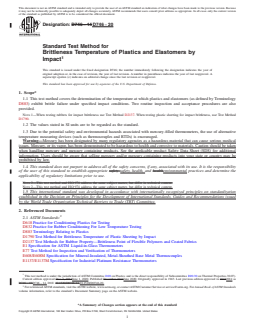
FIG. 1 Dimensional Requirements Between Specimen Clamp and Striking Edge (Type A)
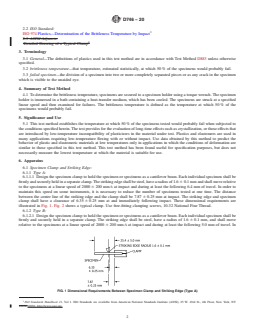
FIG. 2 Typical Clamp (Type A)
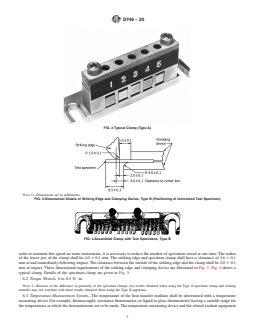
FIG. 3 Dimensional Details of Striking Edge and Clamping Device, Type B (Positioning of Unnotched Test Specimen)
Note 1: Dimensions are in millimetres.
FIG. 4 Assembled Clamp with Test Specimens, Type B
SCOPE
1.1 This test method covers the determination of the temperature at which plastics and elastomers (as defined by Terminology D883) exhibit brittle failure under specified impact conditions. Two routine inspection and acceptance procedures are also provided.
Note 1: When testing rubbers for impact brittleness use Test Method D2137. When testing plastic sheeting for impact brittleness, use Test Method D1790.
1.2 The values stated in SI units are to be regarded as the standard.
1.3 Due to the potential safety and environmental hazards associated with mercury-filled thermometers, the use of alternative temperature measuring devices (such as thermocouples and RTDs) is encouraged.
Warning—Mercury has been designated by many regulatory agencies as a hazardous material that can cause serious medical issues. Mercury, or its vapor, has been demonstrated to be hazardous to health and corrosive to materials. Caution should be taken when handling mercury and mercury containing products. See the applicable product Safety Data Sheet (SDS) for additional information. Users should be aware that selling mercury and/or mercury containing products into your state or country may be prohibited by law.
1.4 This standard does not purport to address all of the safety concerns, if any, associated with its use. It is the responsibility of the user of this standard to establish appropriate safety, health, and environmental practices and determine the applicability of regulatory limitations prior to use.
Note 2: This test method and ISO 974 address the same subject matter, but differ in technical content.
1.5 This international standard was developed in accordance with internationally recognized principles on standardization established in the Decision on Principles for the Development of International Standards, Guides and Recommendations issued by the World Trade Organization Technical Barriers to Trade (TBT) Committee.
- Status
- Published
- Publication Date
- 31-May-2020
- Technical Committee
- D20 - Plastics
- Drafting Committee
- D20.30 - Thermal Properties
Buy Documents
ASTM D746-20 - Standard Test Method for Brittleness Temperature of Plastics and Elastomers by Impact
REDLINE ASTM D746-20 - Standard Test Method for Brittleness Temperature of Plastics and Elastomers by Impact
Overview
ASTM D746-20 is the standard test method established by ASTM International for determining the brittleness temperature of plastics and elastomers by impact. This method identifies the temperature at which 50% of tested specimens are likely to fail when subjected to impact under specific, controlled conditions. Brittleness temperature testing is critical for materials used in environments where low-temperature impact resistance is essential, providing valuable data for material selection and quality control processes.
Key Topics
- Brittleness Temperature: The test identifies the point at which a plastic or elastomer exhibits brittle failure when impacted at low temperatures, a crucial property for many applications.
- Impact Resistance Assessment: It evaluates materials for their ability to withstand sudden impacts after exposure to cold, simulating real-world conditions faced by finished parts and products.
- Material Conditioning and Preparation: Specimens are conditioned and prepared according to specific size and form requirements to ensure test accuracy and repeatability.
- Standardized Procedures: The test method covers apparatus specifications, specimen geometry, preparation guidelines, and calculation methods to ensure consistency across laboratories and industries.
- Alternative Temperature Measurement: The standard encourages the use of modern temperature measuring devices, such as thermocouples and resistance thermometers, due to the safety and environmental hazards associated with mercury thermometers.
- Safety Considerations: Users are cautioned about mercury hazards and required to implement appropriate safety, health, and environmental practices.
Applications
ASTM D746-20 is widely used across industries that manufacture, specify, or utilize plastic or elastomeric materials expected to perform under low-temperature conditions or require reliable impact resistance. Typical applications include:
- Automotive Components: Ensuring that plastic and elastomer parts used in vehicles remain functional and safe in cold climates.
- Packaging Materials: Assessing the durability of films, containers, and other packaging that may face mechanical shock during transportation and storage at subzero temperatures.
- Construction and Building Products: Qualification of materials for pipes, seals, insulation, and exterior applications exposed to outdoor elements.
- Consumer Goods: Testing of polymer-based products, such as toys or sporting goods, that encounter low temperatures during use or storage.
- Quality Control and Procurement: Routine acceptance and inspection testing for raw materials and finished goods.
- Research and Development: Comparative evaluation of formulations, additives, and aging effects, including those caused by crystallization or incompatibility of plasticizers.
Performance data from this method provides manufacturers with confidence in product durability and helps comply with regulatory and customer requirements for low-temperature service environments.
Related Standards
For broader and specialized testing needs, ASTM D746-20 references several related standards:
- ASTM D883: Terminology Relating to Plastics
- ASTM D2137: Test Methods for Brittleness Point of Flexible Polymers and Coated Fabrics (for rubbers)
- ASTM D1790: Test Method for Brittleness Temperature of Plastic Sheeting by Impact
- ASTM E1: Specification for ASTM Liquid-in-Glass Thermometers
- ASTM E608/E608M: Specification for Mineral-Insulated, Metal-Sheathed Base Metal Thermocouples
- ASTM E1137/E1137M: Specification for Industrial Platinum Resistance Thermometers
- ISO 974: Plastics - Determination of the Brittleness Temperature by Impact
These standards collectively support comprehensive low-temperature testing of plastics, elastomers, and related materials, ensuring global alignment and reliability in test results.
Keywords: ASTM D746, brittleness temperature, plastics, elastomers, low-temperature impact, material testing, quality control, polymer impact resistance, standard test method.
Relations
- Effective Date
- 01-Feb-2024
- Effective Date
- 01-Nov-2023
- Effective Date
- 01-Jan-2020
- Effective Date
- 01-Aug-2019
- Effective Date
- 15-Apr-2019
- Effective Date
- 01-Feb-2019
- Effective Date
- 01-Dec-2018
- Effective Date
- 01-Nov-2018
- Effective Date
- 15-Aug-2017
- Effective Date
- 01-May-2014
- Effective Date
- 01-May-2013
- Effective Date
- 15-Nov-2012
- Effective Date
- 15-May-2011
- Effective Date
- 01-Nov-2008
- Effective Date
- 01-Nov-2008
Buy Documents
ASTM D746-20 - Standard Test Method for Brittleness Temperature of Plastics and Elastomers by Impact
REDLINE ASTM D746-20 - Standard Test Method for Brittleness Temperature of Plastics and Elastomers by Impact
Get Certified
Connect with accredited certification bodies for this standard

DIN CERTCO
DIN Group product certification.

Smithers Quality Assessments
US management systems and product certification.
Sponsored listings
Frequently Asked Questions
ASTM D746-20 is a standard published by ASTM International. Its full title is "Standard Test Method for Brittleness Temperature of Plastics and Elastomers by Impact". This standard covers: SIGNIFICANCE AND USE 5.1 This test method establishes the temperature at which 50 % of the specimens tested would probably fail when subjected to the conditions specified herein. The test provides for the evaluation of long-time effects such as crystallization, or those effects that are introduced by low-temperature incompatibility of plasticizers in the material under test. Plastics and elastomers are used in many applications requiring low-temperature flexing with or without impact. Use data obtained by this method to predict the behavior of plastic and elastomeric materials at low temperatures only in applications in which the conditions of deformation are similar to those specified in this test method. This test method has been found useful for specification purposes, but does not necessarily measure the lowest temperature at which the material is suitable for use. FIG. 1 Dimensional Requirements Between Specimen Clamp and Striking Edge (Type A) FIG. 2 Typical Clamp (Type A) FIG. 3 Dimensional Details of Striking Edge and Clamping Device, Type B (Positioning of Unnotched Test Specimen) Note 1: Dimensions are in millimetres. FIG. 4 Assembled Clamp with Test Specimens, Type B SCOPE 1.1 This test method covers the determination of the temperature at which plastics and elastomers (as defined by Terminology D883) exhibit brittle failure under specified impact conditions. Two routine inspection and acceptance procedures are also provided. Note 1: When testing rubbers for impact brittleness use Test Method D2137. When testing plastic sheeting for impact brittleness, use Test Method D1790. 1.2 The values stated in SI units are to be regarded as the standard. 1.3 Due to the potential safety and environmental hazards associated with mercury-filled thermometers, the use of alternative temperature measuring devices (such as thermocouples and RTDs) is encouraged. Warning—Mercury has been designated by many regulatory agencies as a hazardous material that can cause serious medical issues. Mercury, or its vapor, has been demonstrated to be hazardous to health and corrosive to materials. Caution should be taken when handling mercury and mercury containing products. See the applicable product Safety Data Sheet (SDS) for additional information. Users should be aware that selling mercury and/or mercury containing products into your state or country may be prohibited by law. 1.4 This standard does not purport to address all of the safety concerns, if any, associated with its use. It is the responsibility of the user of this standard to establish appropriate safety, health, and environmental practices and determine the applicability of regulatory limitations prior to use. Note 2: This test method and ISO 974 address the same subject matter, but differ in technical content. 1.5 This international standard was developed in accordance with internationally recognized principles on standardization established in the Decision on Principles for the Development of International Standards, Guides and Recommendations issued by the World Trade Organization Technical Barriers to Trade (TBT) Committee.
SIGNIFICANCE AND USE 5.1 This test method establishes the temperature at which 50 % of the specimens tested would probably fail when subjected to the conditions specified herein. The test provides for the evaluation of long-time effects such as crystallization, or those effects that are introduced by low-temperature incompatibility of plasticizers in the material under test. Plastics and elastomers are used in many applications requiring low-temperature flexing with or without impact. Use data obtained by this method to predict the behavior of plastic and elastomeric materials at low temperatures only in applications in which the conditions of deformation are similar to those specified in this test method. This test method has been found useful for specification purposes, but does not necessarily measure the lowest temperature at which the material is suitable for use. FIG. 1 Dimensional Requirements Between Specimen Clamp and Striking Edge (Type A) FIG. 2 Typical Clamp (Type A) FIG. 3 Dimensional Details of Striking Edge and Clamping Device, Type B (Positioning of Unnotched Test Specimen) Note 1: Dimensions are in millimetres. FIG. 4 Assembled Clamp with Test Specimens, Type B SCOPE 1.1 This test method covers the determination of the temperature at which plastics and elastomers (as defined by Terminology D883) exhibit brittle failure under specified impact conditions. Two routine inspection and acceptance procedures are also provided. Note 1: When testing rubbers for impact brittleness use Test Method D2137. When testing plastic sheeting for impact brittleness, use Test Method D1790. 1.2 The values stated in SI units are to be regarded as the standard. 1.3 Due to the potential safety and environmental hazards associated with mercury-filled thermometers, the use of alternative temperature measuring devices (such as thermocouples and RTDs) is encouraged. Warning—Mercury has been designated by many regulatory agencies as a hazardous material that can cause serious medical issues. Mercury, or its vapor, has been demonstrated to be hazardous to health and corrosive to materials. Caution should be taken when handling mercury and mercury containing products. See the applicable product Safety Data Sheet (SDS) for additional information. Users should be aware that selling mercury and/or mercury containing products into your state or country may be prohibited by law. 1.4 This standard does not purport to address all of the safety concerns, if any, associated with its use. It is the responsibility of the user of this standard to establish appropriate safety, health, and environmental practices and determine the applicability of regulatory limitations prior to use. Note 2: This test method and ISO 974 address the same subject matter, but differ in technical content. 1.5 This international standard was developed in accordance with internationally recognized principles on standardization established in the Decision on Principles for the Development of International Standards, Guides and Recommendations issued by the World Trade Organization Technical Barriers to Trade (TBT) Committee.
ASTM D746-20 is classified under the following ICS (International Classification for Standards) categories: 83.060 - Rubber; 83.080.01 - Plastics in general. The ICS classification helps identify the subject area and facilitates finding related standards.
ASTM D746-20 has the following relationships with other standards: It is inter standard links to ASTM D883-24, ASTM D883-23, ASTM D883-20, ASTM D883-19c, ASTM D883-19a, ASTM D883-19, ASTM D883-18a, ASTM D883-18, ASTM D883-17, ASTM E77-14, ASTM E1-13, ASTM D883-12e1, ASTM D883-11, ASTM E1137/E1137M-08, ASTM D618-08. Understanding these relationships helps ensure you are using the most current and applicable version of the standard.
ASTM D746-20 is available in PDF format for immediate download after purchase. The document can be added to your cart and obtained through the secure checkout process. Digital delivery ensures instant access to the complete standard document.
Standards Content (Sample)
This international standard was developed in accordance with internationally recognized principles on standardization established in the Decision on Principles for the
Development of International Standards, Guides and Recommendations issued by the World Trade Organization Technical Barriers to Trade (TBT) Committee.
Designation: D746 − 20
Standard Test Method for
Brittleness Temperature of Plastics and Elastomers by
Impact
This standard is issued under the fixed designation D746; the number immediately following the designation indicates the year of
original adoption or, in the case of revision, the year of last revision.Anumber in parentheses indicates the year of last reapproval.A
superscript epsilon (´) indicates an editorial change since the last revision or reapproval.
This standard has been approved for use by agencies of the U.S. Department of Defense.
1. Scope* ization established in the Decision on Principles for the
Development of International Standards, Guides and Recom-
1.1 This test method covers the determination of the tem-
mendations issued by the World Trade Organization Technical
perature at which plastics and elastomers (as defined by
Barriers to Trade (TBT) Committee.
Terminology D883) exhibit brittle failure under specified
impact conditions. Two routine inspection and acceptance
2. Referenced Documents
procedures are also provided.
2.1 ASTM Standards:
NOTE 1—When testing rubbers for impact brittleness use Test Method
D618Practice for Conditioning Plastics for Testing
D2137. When testing plastic sheeting for impact brittleness, use Test
D832Practice for Rubber Conditioning For Low Tempera-
Method D1790.
ture Testing
1.2 The values stated in SI units are to be regarded as the
D883Terminology Relating to Plastics
standard.
D1790Test Method for Brittleness Temperature of Plastic
1.3 Due to the potential safety and environmental hazards
Sheeting by Impact
associated with mercury-filled thermometers, the use of alter-
D2137TestMethodsforRubberProperty—BrittlenessPoint
native temperature measuring devices (such as thermocouples
of Flexible Polymers and Coated Fabrics
and RTDs) is encouraged.
E1Specification for ASTM Liquid-in-Glass Thermometers
Warning—Mercury has been designated by many regula-
E77Test Method for Inspection and Verification of Ther-
tory agencies as a hazardous material that can cause serious
mometers
medicalissues.Mercury,oritsvapor,hasbeendemonstratedto
E608/E608MSpecification for Mineral-Insulated, Metal-
be hazardous to health and corrosive to materials. Caution
Sheathed Base Metal Thermocouples
should be taken when handling mercury and mercury contain-
E1137/E1137MSpecification for Industrial Platinum Resis-
ing products. See the applicable product Safety Data Sheet
tance Thermometers
(SDS) for additional information. Users should be aware that
2.2 ISO Standard:
selling mercury and/or mercury containing products into your
ISO974Plastics—Determination of the Brittleness Tem-
state or country may be prohibited by law. 3
perature by Impact
1.4 This standard does not purport to address all of the
safety concerns, if any, associated with its use. It is the 3. Terminology
responsibility of the user of this standard to establish appro-
3.1 General—The definitions of plastics used in this test
priate safety, health, and environmental practices and deter-
method are in accordance with Test Method D883 unless
mine the applicability of regulatory limitations prior to use.
otherwise specified.
NOTE 2—This test method and ISO974 address the same subject
3.2 brittleness temperature—that temperature, estimated
matter, but differ in technical content.
statistically, at which 50% of the specimens would probably
1.5 This international standard was developed in accor-
fail.
dance with internationally recognized principles on standard-
For referenced ASTM standards, visit the ASTM website, www.astm.org, or
ThistestmethodisunderthejurisdictionofASTMCommitteeD20onPlastics contact ASTM Customer Service at service@astm.org. For Annual Book of ASTM
and is the direct responsibility of Subcommittee D20.30 on Thermal Proper- Standards volume information, refer to the standard’s Document Summary page on
ties.30.07). the ASTM website.
Current edition approved June 1, 2020. Published June 2020. Originally ISO Standards Handbook 21,Vol1.ISOStandardsareavailablefromAmerican
approved in 1943. Last previous edition approved in 2014 as D746–14. DOI: National Standards Institute (ANSI), 25 W. 43rd St., 4th Floor, New York, NY
10.1520/D0746-20. 10036, http://www.ansi.org.
*A Summary of Changes section appears at the end of this standard
Copyright © ASTM International, 100 Barr Harbor Drive, PO Box C700, West Conshohocken, PA 19428-2959. United States
D746 − 20
3.3 failed specimen—the division of a specimen into two or 6.35 60.25 mm at and immediately following impact. These
more completely separated pieces or as any crack in the dimensionalrequirementsareillustratedinFig.1.Fig.2shows
specimen which is visible to the unaided eye. a typical clamp. Use free-fitting clamping screws, 10-32
National Fine Thread.
4. Summary of Test Method
6.1.2 Type B:
4.1 To determine the brittleness temperature, specimens are
6.1.2.1 Design the specimen clamp to hold the specimen or
secured to a specimen holder using a torque wrench. The
specimens as a cantilever beam. Each individual specimen
specimen holder is immersed in a bath containing a heat-
shall be firmly and securely held in a separate clamp. The
transfer medium, which has been cooled. The specimens are
strikingedgeshallbesteel,havearadiusof1.6 60.1mm,and
struck at a specified linear speed and then examined for
shall move relative to the specimens at a linear speed of
failures. The brittleness temperature is defined as the tempera-
2000 6200 mm⁄s at impact and during at least the following
ture at which 50% of the specimens would probably fail.
5.0 mm of travel. In order to maintain this speed on some
instruments, it is necessary to reduce the number of specimens
5. Significance and Use
tested at one time. The radius of the lower jaw of the clamp
5.1 This test method establishes the temperature at which shall be 4.0 60.1 mm. The striking edge and specimen clamp
50% of the specimens tested would probably fail when shall have a clearance of 3.6 60.1 mm at and immediately
subjected to the conditions specified herein. The test provides following impact. The clearance between the outside of the
for the evaluation of long-time effects such as crystallization,
striking edge and the clamp shall be 2.0 60.1 mm at impact.
or those effects that are introduced by low-temperature incom- These dimensional requirements of the striking edge and
patibility of plasticizers in the material under test. Plastics and
clampingdeviceareillustratedinFig.3.Fig.4showsatypical
elastomers are used in many applications requiring low- clamp. Details of the specimen clamp are given in Fig. 5.
temperature flexing with or without impact. Use data obtained
6.2 Torque Wrench, 0 to 8.5 N·m.
by this method to predict the behavior of plastic and elasto-
meric materials at low temperatures only in applications in
NOTE 3—Because of the difference in geometry of the specimen
clamps, test results obtained when using the TypeAspecimen clamp and
which the conditions of deformation are similar to those
strikingmembermaynotcorrelatewiththoseresultsobtainedwhenusing
specified in this test method. This test method has been found
the Type B apparatus.
useful for specification purposes, but does not necessarily
measure the lowest temperature at which the material is 6.3 Temperature-Measurement System—The temperature of
suitable for use. the heat-transfer medium shall be determined with a tempera-
ture measuring device (for example, thermocouple, resistance
6. Apparatus
thermometer, or liquid-in-glass thermometer) having a suitable
range for the temperatures at which the determinations are to
6.1 Specimen Clamp and Striking Edge:
be made. The temperature-measuring device and the related
6.1.1 Type A:
readout equipment shall be accurate to at least 60.5°C. The
6.1.1.1 Design the specimen clamp to hold the specimen or
temperature-measuring device shall be located as close to the
specimens as a cantilever beam. Each individual specimen
specimens as possible. Thermocouples shall conform to the
shall be firmly and securely held in a separate clamp. The
requirements of Specification E608/E608M. Resistance tem-
striking edge shall be steel, have a radius of 1.6 60.1 mm and
perature devices shall comply with the requirements of Speci-
shall move relative to the specimens at a linear speed of
fication E1137/E1137M. Liquid-in-glass thermometers, are
2000 6200 mm⁄s at impact and during at least the following
describedinSpecificationE1.Usethethermometerappropriate
6.4 mm of travel. In order to maintain this speed on some
for the temperature range and accuracy required, and calibrate
instruments, it is necessary to reduce the number of specimens
it for the appropriate immersion depth in accordance with Test
tested at one time. The distance between the center line of the
Method E77.
strikingedgeandtheclampshallbe7.87 60.25mmatimpact.
Thestrikingedgeandspecimenclampshallhaveaclearanceof
6.4 Heat-Transfer Medium—Use any liquid heat transfer
medium that remains fluid at the test temperature and does not
appreciably affect the material being tested. Measurement of
selected physical properties prior to and after 15-min exposure
at the highest temperature used will provide an indication of
the inertness of a plastic to the heat transfer medium.
6.4.1 Where a flammable or toxic solvent is used as the
cooling medium, follow customary precautions when handling
such materials. Methanol is the recommended heat transfer
medium for rubber.
NOTE 4—The following materials have been found suitable for use at
the indicated temperatures. When silicone oil is used, moisture from the
air will condense on the surface of the oil, causing slush to form. If slush
FIG. 1 Dimensional Requirements Between Specimen Clamp and collects on the temperature-measuring device as ice, it will affect
Striking Edge (Type A) temperature measurement. When this occurs, remove the ice from the
D746 − 20
FIG. 2 Typical Clamp (Type A)
nitrogen are recommended for lowering the temperature, and
an electric immersion heater for raising the temperature.
6.6 Tank, insulated.
6.7 Stirrer, to provide thorough circulation of the heat
transfer medium.
NOTE 5—Suitable apparatus is commercially available from several
suppliers. The striking member may be motor-driven, solenoid-operated,
gravity-actuated, or spring-loaded. Equip the motor-driven tester with a
safety interlock to prevent striker arm motion when the cover is open.
7. Test Specimen
NOTE 1—Dimensions are in millimetres.
7.1 Type I (for Type A Apparatus):
FIG. 3 Dimensional Details of Striking Edge and Clamping
Device, Type B (Positioning of Unnotched Test Specimen)
7.1.1 Geometry—This type of specimen shall be
6.35 60.51 mm wide by 31.75 66.35 mm long as illustrated
in Fig. 6.
7.1.2 Preparation—Specimens shall be 1.91 6 0.13 mm
thick. Specimens shall be die-punched, cut by hand using a
razorbladeorothersharptool,orcutbyanautomaticmachine
from flat sheet, or prepared by injection molding.
7.2 Type II (for Type A Apparatus):
FIG. 4 Assembled Clamp with Test Specimens, Type B
7.2.1 Geometry (Modified T-50 Specimen)—This type of
specimenshallbeT-shaped,asillustratedinFig.6.Whenusing
temperature-measuring device.
this type of specimen, clamp it so that the entire tab is inside
the jaws for a minimum distance of 3.18 mm.
Material Temperature, °C
7.2.2 Preparation—Specimens shall be 1.91 6 0.13 mm
5-mm /s viscosity silicone oil −60
2-mm /s viscosity silicone oil −76
thick. Specimens shall be die-punched, cut by hand using a
Methyl alcohol −90
razorbladeorothersharptool,orcutbyanautomaticmachine
from flat sheet, or prepared by injection molding.
7.3 Type III (for Type B Apparatus):
6.5 Temperature Control—Suitable means (automatic or
7.3.1 Geometry—This type of specimen shall be
manual) shall be provided for controlling the temperature of
20.0 60.25 mm long by 2.5 60.05 mm wide and 1.6 60.1
the heat-transfer medium to within 60.5°C of the desired
value. Powdered solid carbon dioxide (dry ice) and liquid mm thick as illustrated in Fig. 6.
D746 − 20
NOTE 1—Dimensions are in millimetres.
FIG. 5 Details of One Form of Clamp Meeting the Requirements of 6.1.2
FIG. 6 Specimen Geometry
7.3.2 Preparation—Specimens shall be die-punched, cut by 7.4 Test results will vary according to molding conditions
hand using a razor blade or other sharp tool, or cut by an and methods of specimen preparation. It is essential that
automatic machine from flat sheet, or prepared by injection preparation methods produce uniform specimens. The pre-
molding. ferred method of preparation is to use an automatic cutting
...
This document is not an ASTM standard and is intended only to provide the user of an ASTM standard an indication of what changes have been made to the previous version. Because
it may not be technically possible to adequately depict all changes accurately, ASTM recommends that users consult prior editions as appropriate. In all cases only the current version
of the standard as published by ASTM is to be considered the official document.
Designation: D746 − 14 D746 − 20
Standard Test Method for
Brittleness Temperature of Plastics and Elastomers by
Impact
This standard is issued under the fixed designation D746; the number immediately following the designation indicates the year of
original adoption or, in the case of revision, the year of last revision. A number in parentheses indicates the year of last reapproval. A
superscript epsilon (´) indicates an editorial change since the last revision or reapproval.
This standard has been approved for use by agencies of the U.S. Department of Defense.
1. Scope*
1.1 This test method covers the determination of the temperature at which plastics and elastomers (as defined by Terminology
D883) exhibit brittle failure under specified impact conditions. Two routine inspection and acceptance procedures are also
provided.
NOTE 1—When testing rubbers for impact brittleness use Test Method D2137. When testing plastic sheeting for impact brittleness, use Test Method
D1790.
1.2 The values stated in SI units are to be regarded as the standard.
1.3 Due to the potential safety and environmental hazards associated with mercury-filled thermometers, the use of alternative
temperature measuring devices (such as thermocouples and RTDs) is encouraged.
Warning—Mercury has been designated by many regulatory agencies as a hazardous material that can cause serious medical
issues. Mercury, or its vapor, has been demonstrated to be hazardous to health and corrosive to materials. Caution should be taken
when handling mercury and mercury containing products. See the applicable product Safety Data Sheet (SDS) for additional
information. Users should be aware that selling mercury and/or mercury containing products into your state or country may be
prohibited by law.
1.4 This standard does not purport to address all of the safety concerns, if any, associated with its use. It is the responsibility
of the user of this standard to establish appropriate safety safety, health, and healthenvironmental practices and determine the
applicability of regulatory limitations prior to use.
NOTE 2—This test method and ISO 974 address the same subject matter, but differ in technical content.
NOTE 2—This test method and ISO 974 address the same subject matter, but differ in technical content.
1.5 This international standard was developed in accordance with internationally recognized principles on standardization
established in the Decision on Principles for the Development of International Standards, Guides and Recommendations issued
by the World Trade Organization Technical Barriers to Trade (TBT) Committee.
2. Referenced Documents
2.1 ASTM Standards:
D618 Practice for Conditioning Plastics for Testing
D832 Practice for Rubber Conditioning For Low Temperature Testing
D883 Terminology Relating to Plastics
D1790 Test Method for Brittleness Temperature of Plastic Sheeting by Impact
D2137 Test Methods for Rubber Property—Brittleness Point of Flexible Polymers and Coated Fabrics
E1 Specification for ASTM Liquid-in-Glass Thermometers
E77 Test Method for Inspection and Verification of Thermometers
E608/E608M Specification for Mineral-Insulated, Metal-Sheathed Base Metal Thermocouples
E1137/E1137M Specification for Industrial Platinum Resistance Thermometers
This test method is under the jurisdiction of ASTM Committee D20 on Plastics and is the direct responsibility of Subcommittee D20.30 on Thermal Properties.30.07).
Current edition approved Dec. 1, 2014June 1, 2020. Published December 2014June 2020. Originally approved in 1943. Last previous edition approved in 20132014 as
D746 – 13.D746 – 14. DOI: 10.1520/D0746-14.10.1520/D0746-20.
For referenced ASTM standards, visit the ASTM website, www.astm.org, or contact ASTM Customer Service at service@astm.org. For Annual Book of ASTM Standards
volume information, refer to the standard’s Document Summary page on the ASTM website.
*A Summary of Changes section appears at the end of this standard
Copyright © ASTM International, 100 Barr Harbor Drive, PO Box C700, West Conshohocken, PA 19428-2959. United States
D746 − 20
2.2 ISO Standard:
ISO 974 Plastics—Determination of the Brittleness Temperature by Impact
2.3 ASTM Adjuncts:
Detailed Drawing of a Typical Clamp
3. Terminology
3.1 General—The definitions of plastics used in this test method are in accordance with Test Method D883 unless otherwise
specified.
3.2 brittleness temperature—that temperature, estimated statistically, at which 50 % of the specimens would probably fail.
3.3 failed specimen—the division of a specimen into two or more completely separated pieces or as any crack in the specimen
which is visible to the unaided eye.
4. Summary of Test Method
4.1 To determine the brittleness temperature, specimens are secured to a specimen holder using a torque wrench. The specimen
holder is immersed in a bath containing a heat-transfer medium, which has been cooled. The specimens are struck at a specified
linear speed and then examined for failures. The brittleness temperature is defined as the temperature at which 50 % of the
specimens would probably fail.
5. Significance and Use
5.1 This test method establishes the temperature at which 50 % of the specimens tested would probably fail when subjected to
the conditions specified herein. The test provides for the evaluation of long-time effects such as crystallization, or those effects that
are introduced by low-temperature incompatibility of plasticizers in the material under test. Plastics and elastomers are used in
many applications requiring low-temperature flexing with or without impact. Use data obtained by this method to predict the
behavior of plastic and elastomeric materials at low temperatures only in applications in which the conditions of deformation are
similar to those specified in this test method. This test method has been found useful for specification purposes, but does not
necessarily measure the lowest temperature at which the material is suitable for use.
6. Apparatus
6.1 Specimen Clamp and Striking Edge:
6.1.1 Type A:
6.1.1.1 Design the specimen clamp to hold the specimen or specimens as a cantilever beam. Each individual specimen shall be
firmly and securely held in a separate clamp. The striking edge shall be steel, have a radius of 1.6 6 0.1 mm and shall move relative
to the specimens at a linear speed of 2000 6 200 mm ⁄s at impact and during at least the following 6.4 mm of travel. In order to
maintain this speed on some instruments, it is necessary to reduce the number of specimens tested at one time. The distance
between the center line of the striking edge and the clamp shall be 7.87 6 0.25 mm at impact. The striking edge and specimen
clamp shall have a clearance of 6.35 6 0.25 mm at and immediately following impact. These dimensional requirements are
illustrated in Fig. 1. Fig. 2 shows a typical clamp. Use free-fitting clamping screws, 10-32 National Fine Thread.
6.1.2 Type B:
6.1.2.1 Design the specimen clamp to hold the specimen or specimens as a cantilever beam. Each individual specimen shall be
firmly and securely held in a separate clamp. The striking edge shall be steel, have a radius of 1.6 6 0.1 mm, and shall move
relative to the specimens at a linear speed of 2000 6 200 mm ⁄s at impact and during at least the following 5.0 mm of travel. In
FIG. 1 Dimensional Requirements Between Specimen Clamp and Striking Edge (Type A)
ISO Standards Handbook 21, Vol 1. ISO Standards are available from American National Standards Institute (ANSI), 25 W. 43rd St., 4th Floor, New York, NY
10036.10036, http://www.ansi.org.
D746 − 20
FIG. 2 Typical Clamp (Type A)
NOTE 1—Dimensions are in millimetres.
FIG. 3 Dimensional Details of Striking Edge and Clamping Device, Type B (Positioning of Unnotched Test Specimen)
FIG. 4 Assembled Clamp with Test Specimens, Type B
order to maintain this speed on some instruments, it is necessary to reduce the number of specimens tested at one time. The radius
of the lower jaw of the clamp shall be 4.0 6 0.1 mm. The striking edge and specimen clamp shall have a clearance of 3.6 6 0.1
mm at and immediately following impact. The clearance between the outside of the striking edge and the clamp shall be 2.0 6 0.1
mm at impact. These dimensional requirements of the striking edge and clamping device are illustrated in Fig. 3. Fig. 4 shows a
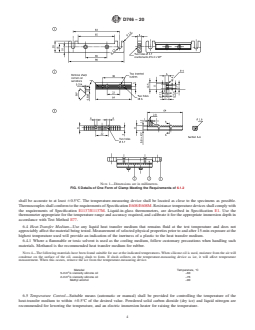
typical clamp. Details of the specimen clamp are given in Fig. 5.
6.2 Torque Wrench, 0 to 8.5 N · m.
NOTE 3—Because of the difference in geometry of the specimen clamps, test results obtained when using the Type A specimen clamp and striking
member may not correlate with those results obtained when using the Type B apparatus.
6.3 Temperature-Measurement System—The temperature of the heat-transfer medium shall be determined with a temperature
measuring device (for example, thermocouple, resistance thermometer, or liquid-in-glass thermometer) having a suitable range for
the temperatures at which the determinations are to be made. The temperature-measuring device and the related readout equipment
D746 − 20
NOTE 1—Dimensions are in millimetres.
FIG. 5 Details of One Form of Clamp Meeting the Requirements of 6.1.2
shall be accurate to at least 60.5°C. The temperature-measuring device shall be located as close to the specimens as possible.
Thermocouples shall conform to the requirements of Specification E608/E608M. Resistance temperature devices shall comply with
the requirements of Specification E1137/E1137M. Liquid-in-glass thermometers, are described in Specification E1. Use the
thermometer appropriate for the temperature range and accuracy required, and calibrate it for the appropriate immersion depth in
accordance with Test Method E77.
6.4 Heat-Transfer Medium—Use any liquid heat transfer medium that remains fluid at the test temperature and does not
appreciably affect the material being tested. Measurement of selected physical properties prior to and after 15-min exposure at the
highest temperature used will provide an indication of the inertness of a plastic to the heat transfer medium.
6.4.1 Where a flammable or toxic solvent is used as the cooling medium, follow customary precautions when handling such
materials. Methanol is the recommended heat transfer medium for rubber.
NOTE 4—The following materials have been found suitable for use at the indicated temperatures. When silicone oil is used, moisture from the air will
condense on the surface of the oil, causing slush to form. If slush collects on the temperature-measuring device as ice, it will affect temperature
measurement. When this occurs, remove the ice from the temperature-measuring device.
Material Temperature, °C
5-mm /s viscosity silicone oil −60
2-mm /s viscosity silicone oil −76
Methyl alcohol −90
6.5 Temperature Control—Suitable means (automatic or manual) shall be provided for controlling the temperature of the
heat-transfer medium to within 60.5°C of the desired value. Powdered solid carbon dioxide (dry ice) and liquid nitrogen are
recommended for lowering the temperature, and an electric immersion heater for raising the temperature.
D746 − 20
6.6 Tank, insulated.
6.7 Stirrer, to provide thorough circulation of the heat transfer medium.
NOTE 5—Suitable apparatus is commercially available from several suppliers. The striking member may be motor-driven, solenoid-operated,
gravity-actuated, or spring-loaded. Equip the motor-driven tester with a safety interlock to prevent striker arm motion when the cover is open.
7. Test Specimen
7.1 Type I (for Type A Apparatus):
7.1.1 Geometry—This type of specimen shall be 6.35 6 0.51 mm wide by 31.75 6 6.35 mm long as illustrated in Fig. 6.
7.1.2 Preparation—Specimens shall be 1.91 6 0.13 mm thick. Specimens shall be die-punched, cut by hand using a razor blade
or other sharp tool, or cut by an automatic machine from flat sheet, or prepared by injection molding.
7.2 Type II (for Type A Apparatus):
7.2.1 Geometry (Modified T-50 Specimen)—This type of specimen shall be T-shaped, as illustrated in Fig. 6. When using this
type of specimen, clamp it so that the entire tab is inside the jaws for a minimum distance of 3.18 mm.
7.2.2 Preparation—Specimens shall be 1.91 6 0.13 mm thick. Specimens shall be die-punched, cut by hand using a razor blade
or other sharp tool, or cut by an automatic machine from flat sheet, or prepared by injection molding.
7.3 Type III (for Type B Apparatus):
7.3.1 Geometry—This type of specimen shall be 20.0 6 0.25 mm long by 2.5 6 0.05 mm wide and 1.6 6 0.1 mm thick as
illustrated in Fig. 6.
7.3.2 Preparation—Specimens shall be die-punched, cut by hand using a razor blade or other sharp tool, or cut by an automatic
machine from flat sheet, or prepared by injection molding.
7.4 Test results will vary according to molding conditions and methods of specimen preparation. It is essential that preparation
methods produce uniform specimens. The preferred method of preparation is to use an automatic cutting machine, however
specimens that are punched using an arbor press or hydraulically operated press are also acceptable. No matter which preparation
method is employed, the specimen edges shall be free of all flash. Specimens that are damaged in any way shall be discarded. If
specimens are to be die punched, sharp dies must be used in the preparation of specimens for this test if reliable results are to be
achieved. Careful maintenance of die cutting edges is of extreme importance and is obtained by daily lightly honing and touching
up the cutting edges with jewelers’ hard Arkansas honing stones. The condition of the die is judged by investigating the rupture
point on any series of broken specimens. When broken specimens are removed from the clamps of the testing machine it is
advantageous to pile these specimens and note if there is any tendency
...