

ASTM E3148-18(2023)
(Guide)Standard Guide for Postmortem Facial Image Capture
General Information
- Abstract
SIGNIFICANCE AND USE
5.1 The protocols that exist for photographing a decedent’s face at autopsy for identification purposes (for example, NAME Forensic Autopsy Performance Standards) do not always result in the capture of facial images that can be used for automated FR searches or manual facial comparisons. It is not always feasible to collect fingerprints from decedents (for example, in disaster situations or when a decedent is in a state of advanced decomposition), and radiograph (medical or dental) comparison requires at least a presumptive identification of remains so appropriate comparative antemortem radiographs can be obtained to confirm the identification. If the decedent’s DNA or appropriate family reference DNA profiles are not already stored within a DNA repository (for example, the FBI’s CODIS), a DNA association will also require the presumptive identification of a decedent to ensure that appropriate samples are collected for comparison/association.
5.2 It is advisable to follow the guidelines presented in this guide even when not all facial components are present as even incomplete facial images can assist automated FR and manual facial comparison processes, especially through more accurate recording of minute facial details.
5.3 For the purpose of facial image capture, there are various perimortem or postmortem conditions or both that can degrade the usability of any facial images captured:
5.3.1 Presence of trauma (for example, entry/exit wounds, lacerations, bruising, missing components, etc.),
5.3.2 Obscuring matter (for example, blood, fluids, dirt, debris, hair, clothing accessories, and so forth), and
5.3.3 Decomposition and other postmortem changes (for example, bloating, mummification, skeletonization, evidence of insect or scavenger activity, etc.).
5.4 Before any attempt is made to clean or alter the decedent for facial image capture, nationally accepted standards or agency protocols or both should be followed so the alterations do not affect ...
SCOPE
1.1 The purpose of this document is to provide guidelines for capturing postmortem facial images of human remains in controlled (for example, morgue) and semi-controlled (for example, field) settings to facilitate automated facial recognition (FR) searches or manual facial comparisons that could contribute to forensic investigations.
1.2 The values stated in SI units are to be regarded as standard. The values given in parentheses are mathematical conversions to inch-pound units that are provided for information only and are not considered standard.
1.3 This standard does not purport to address all of the safety concerns, if any, associated with its use. It is the responsibility of the user of this standard to establish appropriate safety, health, and environmental practices and determine the applicability of regulatory limitations prior to use.
1.4 This international standard was developed in accordance with internationally recognized principles on standardization established in the Decision on Principles for the Development of International Standards, Guides and Recommendations issued by the World Trade Organization Technical Barriers to Trade (TBT) Committee.
- Status
- Published
- Publication Date
- 14-Jan-2023
- Technical Committee
- E30 - Forensic Sciences
- Drafting Committee
- E30.12 - Digital and Multimedia Evidence
Overview
ASTM E3148-18(2023) - Standard Guide for Postmortem Facial Image Capture provides comprehensive guidance for capturing facial images of human decedents in both controlled (such as a morgue) and semi-controlled (such as field disaster sites) environments. The standard is essential in forensic science, especially when traditional identification methods like fingerprinting or radiographic comparison are not possible. Its guidelines support automated facial recognition (FR) searches and manual comparisons, facilitating the accurate identification of unidentified remains and contributing to forensic investigations.
Key Topics
- Controlled vs. Semi-Controlled Environments:
- Defines best practices for morgue and field situations.
- Specifies ideal environmental, lighting, and positioning conditions for optimal image capture.
- Optimal Image Capture Techniques:
- Recommendations on camera position, distance, and angle to minimize distortion.
- Importance of neutral backgrounds and uniform lighting for clear facial image acquisition.
- Preparation of Decedent:
- Steps to ensure full visibility of facial features (removing obstructions like blood, dirt, hair, accessories).
- Specific positioning of the head and body for both frontal and profile images.
- Handling incomplete or compromised facial components to maximize usable data.
- Handling Postmortem Changes:
- Addresses trauma, decomposition, and other postmortem effects that may affect image usability.
- Guidance on photographic adjustments without compromising forensic integrity.
- Documentation of Identifying Features:
- Emphasizes recording scars, marks, tattoos (SMTs), and the use of prosthetics.
- Provides for the use of video imaging to supplement still photographs.
- Chain of Custody and Ethical Considerations:
- Adherence to recognized forensic standards and agency protocols before any cleaning or alteration.
- Encourages documentation before and after any interventions to maintain evidence integrity.
Applications
The ASTM E3148-18(2023) standard is applied by:
- Medical Examiners and Coroners: For capturing standardized postmortem facial photographs to support positive identification of unknown decedents.
- Forensic Investigators: Provides guidelines to maximize the value of facial imagery in cases where fingerprints, dental records, or DNA profiles are unavailable or insufficient.
- Disaster Victim Identification (DVI): Ensures consistent, high-quality imagery can be obtained even in challenging field conditions, crucial for large-scale disaster response.
- Law Enforcement and Government Agencies: Supports integration with facial recognition systems and biometric databases for cross-referencing unidentified remains.
- Digital Forensics and Biometrics Experts: Aligns image capture practices with technical requirements for automated FR systems and manual image comparisons.
By following these protocols, practitioners increase the chances that postmortem images can be successfully matched against antemortem records or biometric galleries, thereby improving identification rates and supporting justice efforts.
Related Standards
- ISO/IEC 19794-5: Biometric data interchange formats-Part 5: Face image data; aligns facial image capture criteria with global biometric data standards.
- ANSI/NIST-ITL-1-2011: Data format for the interchange of fingerprint, facial, and other biometric information; relevant for digital evidence management.
- ASTM E2916: Terminology for Digital and Multimedia Evidence Examination; provides consistent language for practitioners.
- NAME Forensic Autopsy Performance Standards: Complements accreditation and procedural guidelines for forensic autopsy settings.
- FISWG Capture and Equipment Assessment for Facial Recognition Systems: Offers specific equipment and capture environment recommendations for FR systems.
Keywords: postmortem facial image capture, ASTM E3148, forensic identification, facial recognition, disaster victim identification, medical examiner, coroner standards, forensic photography, biometrics
Relations
- Effective Date
- 01-Mar-2019
- Effective Date
- 01-Nov-2018
- Effective Date
- 01-Jun-2013
Get Certified
Connect with accredited certification bodies for this standard

BSI Group
BSI (British Standards Institution) is the business standards company that helps organizations make excellence a habit.

TÜV Rheinland
TÜV Rheinland is a leading international provider of technical services.

TÜV SÜD
TÜV SÜD is a trusted partner of choice for safety, security and sustainability solutions.
Sponsored listings
Frequently Asked Questions
ASTM E3148-18(2023) is a guide published by ASTM International. Its full title is "Standard Guide for Postmortem Facial Image Capture". This standard covers: SIGNIFICANCE AND USE 5.1 The protocols that exist for photographing a decedent’s face at autopsy for identification purposes (for example, NAME Forensic Autopsy Performance Standards) do not always result in the capture of facial images that can be used for automated FR searches or manual facial comparisons. It is not always feasible to collect fingerprints from decedents (for example, in disaster situations or when a decedent is in a state of advanced decomposition), and radiograph (medical or dental) comparison requires at least a presumptive identification of remains so appropriate comparative antemortem radiographs can be obtained to confirm the identification. If the decedent’s DNA or appropriate family reference DNA profiles are not already stored within a DNA repository (for example, the FBI’s CODIS), a DNA association will also require the presumptive identification of a decedent to ensure that appropriate samples are collected for comparison/association. 5.2 It is advisable to follow the guidelines presented in this guide even when not all facial components are present as even incomplete facial images can assist automated FR and manual facial comparison processes, especially through more accurate recording of minute facial details. 5.3 For the purpose of facial image capture, there are various perimortem or postmortem conditions or both that can degrade the usability of any facial images captured: 5.3.1 Presence of trauma (for example, entry/exit wounds, lacerations, bruising, missing components, etc.), 5.3.2 Obscuring matter (for example, blood, fluids, dirt, debris, hair, clothing accessories, and so forth), and 5.3.3 Decomposition and other postmortem changes (for example, bloating, mummification, skeletonization, evidence of insect or scavenger activity, etc.). 5.4 Before any attempt is made to clean or alter the decedent for facial image capture, nationally accepted standards or agency protocols or both should be followed so the alterations do not affect ... SCOPE 1.1 The purpose of this document is to provide guidelines for capturing postmortem facial images of human remains in controlled (for example, morgue) and semi-controlled (for example, field) settings to facilitate automated facial recognition (FR) searches or manual facial comparisons that could contribute to forensic investigations. 1.2 The values stated in SI units are to be regarded as standard. The values given in parentheses are mathematical conversions to inch-pound units that are provided for information only and are not considered standard. 1.3 This standard does not purport to address all of the safety concerns, if any, associated with its use. It is the responsibility of the user of this standard to establish appropriate safety, health, and environmental practices and determine the applicability of regulatory limitations prior to use. 1.4 This international standard was developed in accordance with internationally recognized principles on standardization established in the Decision on Principles for the Development of International Standards, Guides and Recommendations issued by the World Trade Organization Technical Barriers to Trade (TBT) Committee.
SIGNIFICANCE AND USE 5.1 The protocols that exist for photographing a decedent’s face at autopsy for identification purposes (for example, NAME Forensic Autopsy Performance Standards) do not always result in the capture of facial images that can be used for automated FR searches or manual facial comparisons. It is not always feasible to collect fingerprints from decedents (for example, in disaster situations or when a decedent is in a state of advanced decomposition), and radiograph (medical or dental) comparison requires at least a presumptive identification of remains so appropriate comparative antemortem radiographs can be obtained to confirm the identification. If the decedent’s DNA or appropriate family reference DNA profiles are not already stored within a DNA repository (for example, the FBI’s CODIS), a DNA association will also require the presumptive identification of a decedent to ensure that appropriate samples are collected for comparison/association. 5.2 It is advisable to follow the guidelines presented in this guide even when not all facial components are present as even incomplete facial images can assist automated FR and manual facial comparison processes, especially through more accurate recording of minute facial details. 5.3 For the purpose of facial image capture, there are various perimortem or postmortem conditions or both that can degrade the usability of any facial images captured: 5.3.1 Presence of trauma (for example, entry/exit wounds, lacerations, bruising, missing components, etc.), 5.3.2 Obscuring matter (for example, blood, fluids, dirt, debris, hair, clothing accessories, and so forth), and 5.3.3 Decomposition and other postmortem changes (for example, bloating, mummification, skeletonization, evidence of insect or scavenger activity, etc.). 5.4 Before any attempt is made to clean or alter the decedent for facial image capture, nationally accepted standards or agency protocols or both should be followed so the alterations do not affect ... SCOPE 1.1 The purpose of this document is to provide guidelines for capturing postmortem facial images of human remains in controlled (for example, morgue) and semi-controlled (for example, field) settings to facilitate automated facial recognition (FR) searches or manual facial comparisons that could contribute to forensic investigations. 1.2 The values stated in SI units are to be regarded as standard. The values given in parentheses are mathematical conversions to inch-pound units that are provided for information only and are not considered standard. 1.3 This standard does not purport to address all of the safety concerns, if any, associated with its use. It is the responsibility of the user of this standard to establish appropriate safety, health, and environmental practices and determine the applicability of regulatory limitations prior to use. 1.4 This international standard was developed in accordance with internationally recognized principles on standardization established in the Decision on Principles for the Development of International Standards, Guides and Recommendations issued by the World Trade Organization Technical Barriers to Trade (TBT) Committee.
ASTM E3148-18(2023) is classified under the following ICS (International Classification for Standards) categories: 11.100.01 - Laboratory medicine in general; 37.040.01 - Photography in general. The ICS classification helps identify the subject area and facilitates finding related standards.
ASTM E3148-18(2023) has the following relationships with other standards: It is inter standard links to ASTM E2916-19, ASTM E2916-18, ASTM E2916-13. Understanding these relationships helps ensure you are using the most current and applicable version of the standard.
ASTM E3148-18(2023) is available in PDF format for immediate download after purchase. The document can be added to your cart and obtained through the secure checkout process. Digital delivery ensures instant access to the complete standard document.
Standards Content (Sample)
This international standard was developed in accordance with internationally recognized principles on standardization established in the Decision on Principles for the
Development of International Standards, Guides and Recommendations issued by the World Trade Organization Technical Barriers to Trade (TBT) Committee.
Designation: E3148 − 18 (Reapproved 2023)
Standard Guide for
Postmortem Facial Image Capture
This standard is issued under the fixed designation E3148; the number immediately following the designation indicates the year of
original adoption or, in the case of revision, the year of last revision. A number in parentheses indicates the year of last reapproval. A
superscript epsilon (´) indicates an editorial change since the last revision or reapproval.
1. Scope FISWG “Capture and Equipment Assessment for Facial
Recognition Systems,” Revision 1.0 (2011.05.05)
1.1 The purpose of this document is to provide guidelines
ISO/IEC 19794-5 Biometric data interchange formats—Part
for capturing postmortem facial images of human remains in
5: Face image data
controlled (for example, morgue) and semi-controlled (for
NAME Forensic Autopsy Performance Standards
example, field) settings to facilitate automated facial recogni-
tion (FR) searches or manual facial comparisons that could
3. Terminology
contribute to forensic investigations.
3.1 Definitions:
1.2 The values stated in SI units are to be regarded as
3.1.1 For digital and multimedia evidence examination
standard. The values given in parentheses are mathematical
terms, see Terminology E2916.
conversions to inch-pound units that are provided for informa-
3.2 Definitions of Terms Specific to This Standard:
tion only and are not considered standard.
3.2.1 facial image capture, n—in facial identification, the
1.3 This standard does not purport to address all of the
process of collecting a biometric sample from an individual by
safety concerns, if any, associated with its use. It is the
means of a sensor.
responsibility of the user of this standard to establish appro-
3.3 Acronyms:
priate safety, health, and environmental practices and deter-
mine the applicability of regulatory limitations prior to use. 3.3.1 CODIS—Combined DNA Index System
1.4 This international standard was developed in accor-
3.3.2 DNA—Deoxyribonucleic acid
dance with internationally recognized principles on standard-
3.3.3 FBI—Federal Bureau of Investigation
ization established in the Decision on Principles for the
3.3.4 FR—Facial recognition
Development of International Standards, Guides and Recom-
3.3.5 ME/C—Medical examiner or coroner
mendations issued by the World Trade Organization Technical
Barriers to Trade (TBT) Committee.
3.3.6 SMT—Scars, marks, and tattoos
2. Referenced Documents
4. Summary of Guide
2.1 ASTM Standards:
4.1 FR searches can assist in generating potential candidates
E2916 Terminology for Digital and Multimedia Evidence
and investigative leads for the identification of unidentified
Examination
remains or connecting decedents to image galleries but, for the
2.2 Other Standards:
FR systems to operate properly, the images submitted must
ANSI/NIST-ITL-1-2011 Data Format for the Interchange of
meet certain criteria. This guide provides an overview of the
Fingerprint, Facial & Other Biometric Information
optimal processes and techniques for the capture of postmor-
tem facial images of human remains to maximize their utility
in automated FR searches and manual facial image compari-
sons.
This guide is under the jurisdiction of ASTM Committee E30 on Forensic
4.2 This guide is intended to supplement forensic autopsy
Sciences and is the direct responsibility of Subcommittee E30.12 on Digital and
performance standards that medical examiners and coroners
Multimedia Evidence.
Current edition approved Jan. 15, 2023. Published February 2023. Originally
approved in 2018. Last previous edition approved in 2018 as E3148 – 18. DOI:
10.1520/E3148-18R23. Available from Facial Identification Scientific Working Group, https://
For referenced ASTM standards, visit the ASTM website, www.astm.org, or fiswg.org.
contact ASTM Customer Service at service@astm.org. For Annual Book of ASTM Available from International Organization for Standardization (ISO), ISO
Standards volume information, refer to the standard’s Document Summary page on Central Secretariat, BIBC II, Chemin de Blandonnet 8, CP 401, 1214 Vernier,
the ASTM website. Geneva, Switzerland, http://www.iso.org.
3 6
Available from National Institute of Standards and Technology (NIST), 100 Available from National Association of Medical Examiners (NAME), 362
Bureau Dr., Stop 1070, Gaithersburg, MD 20899-1070, http://www.nist.gov. Bristol Road, Walnut Shade, MO 65771, http://www.thename.org.
Copyright © ASTM International, 100 Barr Harbor Drive, PO Box C700, West Conshohocken, PA 19428-2959. United States
E3148 − 18 (2023)
(ME/C) must meet for accreditation (for example, NAME 6.1.3 Recommendations are presented under the assumption
Forensic Autopsy Performance Standards or internal agency that all proper medicolegal investigation procedures have been
policies, or both) for proper postmortem examination proce- followed and the body can be prepared and repositioned as
dures in the United States. needed.
NOTE 1—Facial recognition systems are dependent on facial features
5. Significance and Use
including the eye area and pupils. Withdrawing vitreous fluid can alter the
5.1 The protocols that exist for photographing a decedent’s
eye shape. Therefore, the extraction of vitreous fluid can have a negative
face at autopsy for identification purposes (for example, effect on the usability of the facial imagery. If possible, the extraction of
vitreous fluid from the eyes should be delayed until after all facial imagery
NAME Forensic Autopsy Performance Standards) do not
is captured.
always result in the capture of facial images that can be used
for automated FR searches or manual facial comparisons. It is 6.1.4 More information can be found at:
not always feasible to collect fingerprints from decedents (for
6.1.4.1 For forensic image capture, please refer to Annex E
example, in disaster situations or when a decedent is in a state
of ANSI/NIST-ITL-1-2011, and
of advanced decomposition), and radiograph (medical or den-
6.1.4.2 For controlled image capture guidance, please refer
tal) comparison requires at least a presumptive identification of
to FISWG’s “Capture and Equipment Assessment for Facial
remains so appropriate comparative antemortem radiographs
Recognition Systems.”
can be obtained to confirm the identification. If the decedent’s
6.2 Controlled Acquisition:
DNA or appropriate family reference DNA profiles are not
6.2.1 This section outlines the optimal environmental con-
already stored within a DNA repository (for example, the FBI’s
ditions for capturing postmortem facial images.
CODIS), a DNA association will also require the presumptive
6.2.2 The imaging conditions listed in this section are in the
identification of a decedent to ensure that appropriate samples
context of an ideal controlled environment. While it’s not be
are collected for comparison/association.
possible in all ME/C offices to conform exactly to the specifi-
5.2 It is advisable to follow the guidelines presented in this
cations listed, especially with regard to the camera position, it
guide even when not all facial components are present as even
is recommended that all attempts be made to approximate these
incomplete facial images can assist automated FR and manual
conditions to the best of the photographer’s ability. The
facial comparison processes, especially through more accurate
photographer should be aware that with increasing discrepan-
recording of minute facial details.
cies between the ideal environment and the actual image
capture environment there will be a decrease in the usable
5.3 For the purpose of facial image capture, there are
quality of the facial image for FR searching and image
various perimortem or postmortem conditions or both that can
comparison.
degrade the usability of any facial images captured:
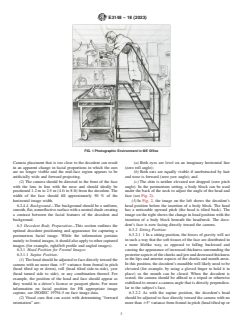
5.3.1 Presence of trauma (for example, entry/exit wounds, 6.2.3 Fig. 1 provides an example of the photographic
lacerations, bruising, missing components, etc.), environment in a ME/C office with positioning of the camera
5.3.2 Obscuring matter (for example, blood, fluids, dirt, directly over the decedent’s face and a camera-to-subject
debris, hair, clothing accessories, and so forth), and distance appropriate for minimizing distortion (for example,
5.3.3 Decomposition and other postmortem changes (for the “fishbowl effect” resulting from capturing a facial image
example, bloating, mummification, skeletonization, evidence too close to the face). When possible, it is recommended to use
of insect or scavenger activity, etc.). a fixed camera mount to provide stability and reduce the
potential for distortion. At a minimum, if a decedent is on a
5.4 Before any attempt is made to clean or alter the decedent
gurney, it is recommended to use a stepladder or other means
for facial image capture, nationally accepted standards or
for elevating the photographer to ensure proper camera-to-
agency protocols or both should be followed so the alterations
subject distance. Standing beside the gurney and reaching over
do not affect forensic evidence collection, documentation, or
the decedent’s face is not recommended.
chain of custody.
6.2.4 The following suggestions for the image capture
6. Image Capture
environment should be considered:
6.2.4.1 Decedent Position—The decedent should be posi-
6.1 Facial Image Capture in a Controlled Environment:
tioned and suitable equipment should be available to maximize
6.1.1 This section addresses the image capture process and
the quality of the imagery. Optimal position of the body for
techniques as they relate to a controlled environment, such as
facial image capture is to have the head in a vertical position
a morgue, where all or most variables and decisions can be
with the jaw closed to allow the face morphology to be as close
controlled by the photographer, including equipment, the
to the antemortem reference images with which it will be
photographic environment (for example, camera position,
compared. This will likely require the body to be positioned so
lighting, distance, background, and resolution), and the pose
that the decedent is seated or standing.
and positioning of the decedent.
6.2.4.2 Lighting—Lighting should uniformly illuminate the
6.1.2 ME/C and morgue personnel (for example,
decedent. Hot spots, reflections, and shadows on the face and
investigators, autopsy technicians, residents, volunteers, and so
in the background should be minimized.
forth) should take the following factors into consideration
when making decisions for the capture of postmortem facial 6.2.4.3 Camera Position:
images, especially when the images are intended to be used for (1) The camera-to-subject distance should be great enough
automated FR searches or manual facial comparisons or both. to minimize distortion of the face in the resulting image.
E3148 − 18 (2023)
FIG. 1 Photographic Environment in ME Office
Camera placement that is too close to the decedent can result (a) Both eyes are level on an imaginary horizontal line
in an apparent change in facial proportions in which the ears (zero roll angle);
are no longer visible and the mid-face region appears to be (b) Both ears are equally visible if unobstructed by hair
artificially wide and forward projecting. and nose is forward (zero yaw angle); and
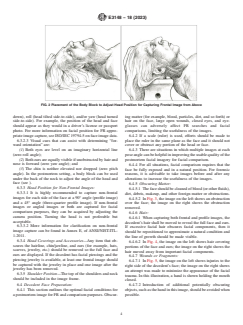
(2) The camera should be directed to the front of the face (c) The chin is neither elevated nor dropped (zero pitch
with the lens in line with the nose and should ideally be angle). In the postmortem setting, a body block can be used
positioned 1.2 m to 2.5 m (4 ft to 8 ft) from the decedent. The under the back of the neck to adjust the angle of the head and
width of the face should fill approximately 50 % of the face (see Fig. 2).
horizontal image width. (3) In Fig. 2, the image on the left shows the decedent’s
6.2.4.4 Background—The background should be a uniform, head position before the insertion of a body block. The head
smooth, flat, nonreflective surface with a neutral shade creating has a noticeable upward pitch (the head is tilted back). The
a contrast between the facial features of the decedent and image on the right shows the change in head position with the
background. insertion of a body block beneath the head/neck. The dec
...