

ASTM D5363-16
(Specification)Standard Specification for Anaerobic Single-Component Adhesives (AN)
General Information
- Abstract
ABSTRACT
This specification establishes the requirements for single-component anaerobic adhesives suitable for locking, sealing, and retaining threaded or cylindrical assemblies. It is intended to be a means of classifying the adhesives, and does not address engineering design purposes. The adhesives are cured to a solid state when confined between closely fitting active metal surfaces. Materials shall undergo test procedures and conform accordingly to the following requirements: ultraviolet fluorescence; color and workmanship; flash point; storage stability; toxicity; solvent resistance; hot strength; heat aging; cold strength; lubricity; fluid tightness; wicking; viscosity; speed of cure; prevailing torque strength (strength at standard conditions); and qualification of primers.
SCOPE
1.1 This specification covers single-component anaerobic adhesives suitable for locking, sealing, and retaining threaded or cylindrical assemblies. The adhesives are cured to a solid state when confined between closely fitting active metal surfaces.
1.2 This specification is intended to be a means of classifying anaerobic adhesives. It is not intended for engineering design purposes.
1.3 This specification is intended to replace Military Specifications MIL-S-22473, MIL-S-46163, and MIL-R-46082.
1.4 The values stated in SI units are to be regarded as the standard.
1.5 The following safety hazards caveat pertains only to the test methods portion, Section 7, of this specification. This standard does not purport to address all of the safety concerns, if any, associated with its use. It is the responsibility of the user of this standard to establish appropriate safety and health practices and determine the applicability of regulatory limitations prior to use.
- Status
- Published
- Publication Date
- 31-Mar-2016
- Technical Committee
- D14 - Adhesives
- Drafting Committee
- D14.60 - Adhesive Material Classification System
Buy Documents
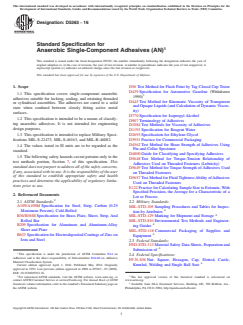
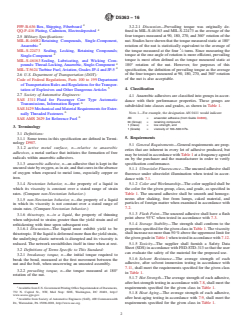
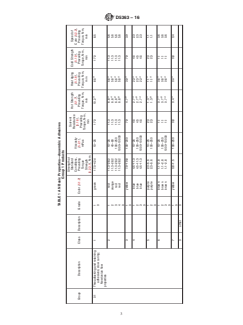
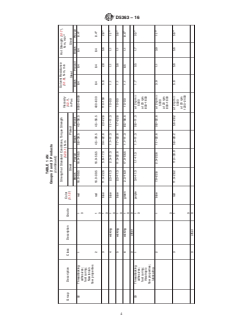
ASTM D5363-16 - Standard Specification for Anaerobic Single-Component Adhesives (AN)
REDLINE ASTM D5363-16 - Standard Specification for Anaerobic Single-Component Adhesives (AN)
Overview
ASTM D5363-16: Standard Specification for Anaerobic Single-Component Adhesives (AN) defines classification and quality requirements for single-component anaerobic adhesives used in locking, sealing, and retaining threaded or cylindrical assemblies. Issued by ASTM International, this standard provides a framework for evaluating such adhesives based on their performance properties, ensuring suitability for industrial, automotive, and military applications. Anaerobic adhesives under this standard cure to a solid state when confined between closely fitting active metal surfaces, making them ideal for threadlocking, shaft-retaining, and sealing tasks.
Key Topics
- Classification: Anaerobic adhesives are categorized into groups, classes, and grades according to their strength, viscosity, curing performance, and application type (threadlocking, retaining, wicking, etc.).
- Performance Requirements:
- Ultraviolet fluorescence
- Color and physical appearance
- Flash point
- Storage stability
- Toxicity
- Solvent resistance
- Hot and cold strength
- Heat aging
- Lubricity
- Fluid tightness
- Wicking ability
- Viscosity
- Speed of cure
- Prevailing and breakaway torque strength
- Testing: The standard specifies detailed test methods to ensure adhesives comply with the outlined requirements, such as torque strength measurements, viscosity checks, and environmental resistance tests.
- Packaging and Labeling: Guidelines for commercial and government packaging, including requirements for safe handling, marking, and container types.
- Safety Considerations: Users are responsible for following appropriate safety and health practices, including compliance with regulatory limitations.
Applications
Anaerobic single-component adhesives standardized by ASTM D5363-16 are widely used across multiple industries due to their ability to cure without air and provide strong bonds in metal assemblies. Main application areas include:
- Threadlocking: Securing bolts, screws, and nuts to prevent loosening caused by vibration or thermal expansion.
- Sealing: Preventing leakage of fluids or gases in piping, hydraulic, and pneumatic systems.
- Retaining: Fixing bearings, bushings, and cylindrical parts within housings or on shafts for reliable load transmission.
- Wicking: Delivering adhesive into preassembled fasteners to enhance strength and sealing without part disassembly.
- Military and Aerospace: Qualified for use as replacements to legacy military specifications (e.g., MIL-S-22473, MIL-S-46163, MIL-R-46082), meeting stringent requirements for reliability, fluid resistance, and environmental durability.
By providing a uniform specification, ASTM D5363-16 helps manufacturers, engineers, and procurement professionals select and qualify anaerobic adhesives, ensuring compatibility and consistent performance for critical mechanical assemblies.
Related Standards
Several standards are referenced within ASTM D5363-16 and are essential for full compliance and comprehensive quality assurance:
- ASTM D907: Terminology of Adhesives
- ASTM D1084, D445: Viscosity test methods for adhesives
- ASTM D4562, D5648, D5649: Methods for measuring strength and torque in adhesive-bonded fasteners
- ASTM D5657: Test method for fluid tightness
- ASTM D1193, D770, D2693: Specifications for test solvents and reagents
- MIL-STD-105, MIL-STD-810: Sampling procedures and environmental testing for military use
- SAE J311, J429: Requirements for fasteners and lubricants
- PPP-B-636, MIL-STD-129, MIL-STD-118: Guidelines for packaging, marking, and shipment
Keywords: ASTM D5363-16, anaerobic adhesives, single-component adhesive, threadlocker, adhesive standard, adhesive classification, adhesive testing, industrial adhesives, retaining compound, sealing adhesive, torque strength, fluid tightness, viscosity, adhesive packaging, military adhesive specification.
Relations
- Effective Date
- 01-Apr-2024
- Effective Date
- 01-Mar-2024
- Effective Date
- 01-Nov-2023
- Effective Date
- 01-Oct-2023
- Effective Date
- 01-Oct-2023
- Effective Date
- 01-Jun-2019
- Effective Date
- 01-Jun-2019
- Effective Date
- 01-Nov-2018
- Effective Date
- 01-Oct-2018
- Effective Date
- 01-May-2018
- Effective Date
- 15-Dec-2016
- Effective Date
- 01-Sep-2016
- Effective Date
- 01-Jun-2016
- Effective Date
- 01-Dec-2015
- Effective Date
- 01-Dec-2015
Buy Documents
ASTM D5363-16 - Standard Specification for Anaerobic Single-Component Adhesives (AN)
REDLINE ASTM D5363-16 - Standard Specification for Anaerobic Single-Component Adhesives (AN)
Get Certified
Connect with accredited certification bodies for this standard

DIN CERTCO
DIN Group product certification.

Smithers Quality Assessments
US management systems and product certification.
Sponsored listings
Frequently Asked Questions
ASTM D5363-16 is a technical specification published by ASTM International. Its full title is "Standard Specification for Anaerobic Single-Component Adhesives (AN)". This standard covers: ABSTRACT This specification establishes the requirements for single-component anaerobic adhesives suitable for locking, sealing, and retaining threaded or cylindrical assemblies. It is intended to be a means of classifying the adhesives, and does not address engineering design purposes. The adhesives are cured to a solid state when confined between closely fitting active metal surfaces. Materials shall undergo test procedures and conform accordingly to the following requirements: ultraviolet fluorescence; color and workmanship; flash point; storage stability; toxicity; solvent resistance; hot strength; heat aging; cold strength; lubricity; fluid tightness; wicking; viscosity; speed of cure; prevailing torque strength (strength at standard conditions); and qualification of primers. SCOPE 1.1 This specification covers single-component anaerobic adhesives suitable for locking, sealing, and retaining threaded or cylindrical assemblies. The adhesives are cured to a solid state when confined between closely fitting active metal surfaces. 1.2 This specification is intended to be a means of classifying anaerobic adhesives. It is not intended for engineering design purposes. 1.3 This specification is intended to replace Military Specifications MIL-S-22473, MIL-S-46163, and MIL-R-46082. 1.4 The values stated in SI units are to be regarded as the standard. 1.5 The following safety hazards caveat pertains only to the test methods portion, Section 7, of this specification. This standard does not purport to address all of the safety concerns, if any, associated with its use. It is the responsibility of the user of this standard to establish appropriate safety and health practices and determine the applicability of regulatory limitations prior to use.
ABSTRACT This specification establishes the requirements for single-component anaerobic adhesives suitable for locking, sealing, and retaining threaded or cylindrical assemblies. It is intended to be a means of classifying the adhesives, and does not address engineering design purposes. The adhesives are cured to a solid state when confined between closely fitting active metal surfaces. Materials shall undergo test procedures and conform accordingly to the following requirements: ultraviolet fluorescence; color and workmanship; flash point; storage stability; toxicity; solvent resistance; hot strength; heat aging; cold strength; lubricity; fluid tightness; wicking; viscosity; speed of cure; prevailing torque strength (strength at standard conditions); and qualification of primers. SCOPE 1.1 This specification covers single-component anaerobic adhesives suitable for locking, sealing, and retaining threaded or cylindrical assemblies. The adhesives are cured to a solid state when confined between closely fitting active metal surfaces. 1.2 This specification is intended to be a means of classifying anaerobic adhesives. It is not intended for engineering design purposes. 1.3 This specification is intended to replace Military Specifications MIL-S-22473, MIL-S-46163, and MIL-R-46082. 1.4 The values stated in SI units are to be regarded as the standard. 1.5 The following safety hazards caveat pertains only to the test methods portion, Section 7, of this specification. This standard does not purport to address all of the safety concerns, if any, associated with its use. It is the responsibility of the user of this standard to establish appropriate safety and health practices and determine the applicability of regulatory limitations prior to use.
ASTM D5363-16 is classified under the following ICS (International Classification for Standards) categories: 83.180 - Adhesives. The ICS classification helps identify the subject area and facilitates finding related standards.
ASTM D5363-16 has the following relationships with other standards: It is inter standard links to ASTM D445-24, ASTM A109/A109M-24, ASTM D445-23, ASTM B36/B36M-23, ASTM D3951-18(2023), ASTM D4562-01(2019), ASTM D5648-01(2019), ASTM A109/A109M-16(2018), ASTM B36/B36M-18, ASTM D3951-18, ASTM D445-16, ASTM A109/A109M-16, ASTM D56-16, ASTM B633-15, ASTM D3951-15. Understanding these relationships helps ensure you are using the most current and applicable version of the standard.
ASTM D5363-16 is available in PDF format for immediate download after purchase. The document can be added to your cart and obtained through the secure checkout process. Digital delivery ensures instant access to the complete standard document.
Standards Content (Sample)
This international standard was developed in accordance with internationally recognized principles on standardization established in the Decision on Principles for the
Development of International Standards, Guides and Recommendations issued by the World Trade Organization Technical Barriers to Trade (TBT) Committee.
Designation:D5363 −16
Standard Specification for
Anaerobic Single-Component Adhesives (AN)
This standard is issued under the fixed designation D5363; the number immediately following the designation indicates the year of
original adoption or, in the case of revision, the year of last revision.Anumber in parentheses indicates the year of last reapproval.A
superscript epsilon (´) indicates an editorial change since the last revision or reapproval.
This standard has been approved for use by agencies of the U.S. Department of Defense.
1. Scope D56Test Method for Flash Point by Tag Closed Cup Tester
D439Specification for Automotive Gasoline (Withdrawn
1.1 This specification covers single-component anaerobic
1990)
adhesives suitable for locking, sealing, and retaining threaded
D445Test Method for Kinematic Viscosity of Transparent
or cylindrical assemblies. The adhesives are cured to a solid
and Opaque Liquids (and Calculation of DynamicViscos-
state when confined between closely fitting active metal
ity)
surfaces.
D770Specification for Isopropyl Alcohol
1.2 This specification is intended to be a means of classify-
D907Terminology of Adhesives
ing anaerobic adhesives. It is not intended for engineering
D1084Test Methods for Viscosity of Adhesives
design purposes.
D1193Specification for Reagent Water
1.3 This specification is intended to replace Military Speci- D2693Specification for Ethylene Glycol
D3951Practice for Commercial Packaging
fications MIL-S-22473, MIL-S-46163, and MIL-R-46082.
D4562Test Method for Shear Strength of Adhesives Using
1.4 The values stated in SI units are to be regarded as the
Pin-and-Collar Specimen
standard.
D4800Guide for Classifying and Specifying Adhesives
1.5 The following safety hazards caveat pertains only to the
D5648Test Method for Torque-Tension Relationship of
test methods portion, Section 7, of this specification. This
Adhesives Used on Threaded Fasteners (Lubricity)
standard does not purport to address all of the safety concerns,
D5649Test Method for Torque Strength ofAdhesives Used
if any, associated with its use. It is the responsibility of the user
on Threaded Fasteners
of this standard to establish appropriate safety and health
D5657TestMethodforFluidTightnessAbilityofAdhesives
practices and determine the applicability of regulatory limita-
Used on Threaded Fasteners
tions prior to use.
E122PracticeforCalculatingSampleSizetoEstimate,With
Specified Precision, the Average for a Characteristic of a
2. Referenced Documents
Lot or Process
2.1 ASTM Standards:
2.2 Military Standards:
A109/A109MSpecification for Steel, Strip, Carbon (0.25
MIL-STD-105Sampling Procedures and Tables for Inspec-
Maximum Percent), Cold-Rolled
tion by Attributes
B36/B36MSpecification for Brass Plate, Sheet, Strip, And
MIL-STD-129Marking for Shipment and Storage
Rolled Bar
MIL-STD-810Environmental Test Methods and Engineer-
B209Specification for Aluminum and Aluminum-Alloy
ing Guides
Sheet and Plate
MIL-STD-118 Commercial Packaging of Supplies and
B633SpecificationforElectrodepositedCoatingsofZincon
Equipment
Iron and Steel
2.3 Federal Standards:
FED-STD-313Material Safety Data Sheets, Preparation and
Submission of
This specification is under the jurisdiction of ASTM Committee D14 on
2.4 Federal Specifications:
Adhesives and is the direct responsibility of Subcommittee D14.60 on Adhesive
FF-N-836 Nut: Square, Hexagon, Cap, Slotted, Castle,
Material Classification System.
Knurled, Welding and Single Ball Seat
Current edition approved April 1, 2016. Published May 2016. Originally
approved in 1993. Last previous edition approved in 2008 as D5363–03 (2008).
DOI: 10.1520/D5363-16.
2 3
For referenced ASTM standards, visit the ASTM website, www.astm.org, or The last approved version of this historical standard is referenced on
contact ASTM Customer Service at service@astm.org. For Annual Book of ASTM www.astm.org.
Standards volume information, refer to the standard’s Document Summary page on Available from DLA Document Services, Building 4/D, 700 Robbins Ave.,
the ASTM website. Philadelphia, PA 19111-5094, http://quicksearch.dla.mil.
Copyright © ASTM International, 100 Barr Harbor Drive, PO Box C700, West Conshohocken, PA 19428-2959. United States
D5363−16
PPP-B-636Box, Shipping, Fiberboard 3.2.2.1 Discussion—Prevailing torque was originally de-
QQ-P-416Plating, Cadmium, Electrodeposited fined in MIL-S-46163 and MIL-S-22473 as the average of the
fourtorquesmeasuredat90,180,270,and360°rotationofthe
2.5 Military Specifications:
nut.Studieshaveshownthatthetorquemeasuredstaticat180°
MIL-R-46082Retaining Compounds, Single-Component,
rotation of the nut is statistically equivalent to the average of
Anaerobic
the torque measured at the four ⁄4 turns. Since measuring the
MIL-S-22473 Sealing, Locking, Retaining Compounds;
torque at the one angle of rotation is more efficient, prevailing
Single-Component
torque is most often defined as the torque measured static at
MIL-S-46163 Sealing, Lubricating, and Wicking Com-
180° rotation of the nut. However, for purposes of this
pounds: Thread-Locking,Anaerobic, Single-Component
specification, the definition of prevailing torque as the average
MIL-T-5624Turbine Fuel,Aviation, Grades JP-4 and JP-5
ofthefourtorquesmeasuredat90,180,270,and360°rotation
2.6 U.S. Department of Transportation (DOT):
of the nut is also acceptable.
Code of Federal Regulations, Parts 100 to 199Department
ofTransportation Rules and Regulations for theTranspor-
4. Classification
tation of Explosives and Other Dangerous Articles
2.7 Society of Automotive Engineers:
4.1 Anaerobic adhesives are classified into groups in accor-
SAE J311 Fluid for Passenger Care Type Automatic
dance with their performance properties. These groups are
Transmissions, Information Report
subdivided into classes and grades, as shown in Table 1.
SAEJ429MechanicalandMaterialRequirementsforExter-
NOTE 1—For example, the designation AN 0411 would indicate:
nally Threaded Fasteners
AN = anaerobic adhesive (from Guide D4800),
SAE AMS 2629Jet Reference Fuel
04 (Group) = retaining compound,
1 (Class) = low strength, and
3. Terminology
1 (Grade) = viscosity of 100–500 mPa.
3.1 Definitions:
5. Requirements
3.1.1 Some terms in this specification are defined in Termi-
nology D907.
5.1 General Requirements—General requirements are prop-
3.1.2 active metal surface, n—relative to anaerobic
erties that are inherent in every lot of adhesive produced, but
adhesives, a metal surface that initiates the formation of free
maybetestedinaccordancewithTable1atafrequencyagreed
radicals within anaerobic adhesives.
on by the purchaser and the manufacturer in order to verify
3.1.3 anaerobic adhesive, n—an adhesive that is kept in the
specification conformance.
uncuredstatebyoxygen,asinair,andthatcuresintheabsence
5.1.1 Ultraviolet Fluorescence—Theuncuredadhesiveshall
of oxygen when exposed to metal ions, especially copper or
fluoresce under ultraviolet illumination when tested in accor-
iron.
dance with 7.1.
3.1.4 Newtonian behavior, n—the property of a liquid in
5.1.2 Color and Workmanship—The color supplied shall be
which its viscosity is constant over a stated range of strain
the color for the given group, class, and grade, as specified in
rates. (Compare non-Newtonian behavior.)
Table 1. The uncured adhesive shall be smooth and homoge-
neous after shaking, free from lumps, caked material, and
3.1.5 non-Newtonian behavior, n—the property of a liquid
particles of foreign matter when examined in accordance with
in which its viscosity is not constant over a stated range of
7.2.
strain rates. (Compare Newtonian behavior.)
5.1.3 Flash Point—The uncured adhesive shall have a flash
3.1.6 thixotropy, n—in a liquid, the property of thinning
point above 93°C when tested in accordance with 7.3.
when subjected to strains greater than the yield strain and of
5.1.4 Storage Stability—The strength shall conform to the
rethickening with time upon subsequent rest.
propertiesspecifiedforthegivenclassinTable1.Theviscosity
3.1.6.1 Discussion—The liquid must exhibit yield to be
shallincreasenomorethan50%abovetheuppermostlimitfor
thixotropic.Iftheliquidisdeformedmorethantheyieldstrain,
thegivengradeinTable1whentestedinaccordancewith7.12.
the underlying elastic network is disrupted and its viscosity is
reduced. The network reestablishes itself in time when at rest. 5.1.5 Toxicity—The supplier shall furnish a Safety Data
Sheet(SDS)inaccordancewithFED-STD-313sothattheuser
3.2 Definitions of Terms Specific to This Standard:
can evaluate the safety of the material for the proposed use.
3.2.1 breakaway torque, n—the initial torque required to
5.1.6 Solvent Resistance—The average strength of each
break the bond, measured at the first movement between the
adhesive, after solvent immersion testing in accordance with
nut and the bolt, when unscrewing an unseated assembly.
7.11, shall meet the requirements specified for the given class
3.2.2 prevailing torque, n—the torque measured at 180°
in Table 1.
rotation of the nut.
5.1.7 Hot Strength—The average strength of each adhesive,
afterhot-strengthtestinginaccordancewith7.8,shallmeetthe
AvailablefromU.S.GovernmentPrintingOfficeSuperintendentofDocuments, requirements specified for the given class in Table 1.
732 N. Capitol St., NW, Mail Stop: SDE, Washington, DC 20401, http://
5.1.8 Heat Aging—The average strength of each adhesive,
www.access.gpo.gov.
after heat-aging testing in accordance with 7.9, shall meet the
Available from Society of Automotive Engineers (SAE), 400 Commonwealth
Dr., Warrendale, PA 15096-0001, http://www.sae.org. requirements specified for the given class in Table 1.
D5363−16
TABLE 1 AN Basic Properties—Anaerobic Adhesives
Group 1 Products
Strength at
Solvent
Standard Hot Strength Heat Aging Cold Strength Speed of
Resistance
Conditions, Viscosity (5.1.7), (5.1.8), (5.1.9), Cure (5.2.2),
(5.1.6),
Group Description Class Description Grade Color (5.1.2) Prevailing (5.2.1), Prevailing Prevailing Prevailing Prevailing
Prevailing
Torque mPa·s Torque, N·m, Torque, N·m, Torque, N·m, Torque, N·m,
Torque, N·m,
Strength min min min min
min
(5.2.3.1), N·m
A A
01 Threadlocking and retaining11 green 17.0–42.4 10–25 17.0 10.2 8.5 17.0 8.5
adhesives; slow curing; 0
Newtonian flow
properties
A A
2 1 red 11.3–28.2 10–25 11.3 6.8 5.6 11.3 5.6
A A
2 orange 11.3–28.2 40–80 11.3 6.8 5.6 11.3 5.6
B A
3 red 11.3–28.2 100–250 11.3 6.8 5.6 11.3 5.6
B A
4 red 11.3–28.2 1000–10000 11.3 6.8 5.6 11.3 5.6
B A
3 1 yellow 7.9–19.8 100–200 7.9 4.7 3.9 7.9 3.9
A A
4 1 blue 4.5–11.3 10–25 4.5 2.7 2.3 4.5 2.3
B A
2 blue 4.5–11.3 100–250 4.5 2.7 2.3 4.5 2.3
A A
3 blue 4.5–11.3 1000–10000 4.5 2.7 2.3 4.5 2.3
A A
5 1 purple 2.3–5.6 10–25 2.3 1.3 1.1 2.3 1.1
B A
2 purple 2.3–5.6 100–250 2.3 1.3 1.1 2.3 1.1
A A
6 1 brown 1.1–2.8 10–25 1.1 0.7 0.6 1.1 0.6
B A
2 brown 1.1–2.8 100–250 1.1 0.7 0.6 1.1 0.6
A A
3 brown 1.1–2.8 1000–10000 1.1 0.7 0.6 1.1 0.6
A A
7 1 yellow 0.8–1.5 100–250 0.8 0.4 0.4 0.8 0.4
0 other 0
D5363−16
TABLE 1 AN
Groups 2 and 3 Products
(continued)
Solvent Resistance
Strength at Standard Conditions, Torque Strength Hot Strength (5.1.7),
A
Viscosity (5.1.6), N·m, min
N·m, min
(5.2.3.1), N·m
Color
Group Description Class Description Grade (5.2.1),
(5.1.2)
Steel Plated Steel
mPa·s Steel
Break Prevail Break Prevail Break Prevail Break Prevail
C
02 Threadlocking11 red 16.9–39.5 16.9–56.5 5.6–39.5 4.5–56.5 6000–8000 8.4 8.4 8.4 8.4
adhesives; 0
fast curing;
Newtonian
flow properties
A
2 1 red 16.9–39.5 16.9–56.5 4.5–39.5 4.5–56.5 400–600 8.4 8.4 8.4 8.4
C
3 1 blue 11.3–22.6 5.6–17.0 3.4–22.6 2.3–22.6 110–150 5.6 2.8 5.6 2.8
C
4 wicking 1 blue 2.3–11.3 2.3–11.3 1.1–11.3 1.1–11.3 10–30 1.1 1.1 1.1 1.1
C
5 wicking 1 blue 2.3–11.3 11.3–22.6 1.7–22.6 1.7–22.6 10–30 1.1 5.6 1.1 5.6
A
6 wicking 1 green 2.3–16.9 17.0–56.5 1.1–11.3 8.5–56.5 10–30 1.1 8.5 1.1 8.5
0 other 0
C
03 Threadlocking11 purple 3.4–11.3 1.1–11.3 1.1–11.3 0.6–11.3 at 2 rpm$ 1.7 0.5 1.7 0.5
adhesives; 0 5000
fast curing; at 20 rpm
thixotropic 800–1600
flow properties;
lubricating
B
2 1 blue 7.9–22.6 2.3–22.6 1.1–22.6 0.6–22.6 at 2 rpm$ 3.9 1.1 3.9 1.1
at 20 rpm
800–1600
A
3 1 red 11.3–28.2 11.3–33.9 5.6–28.2 5.6–28.2 at 2 rpm$ 5.6 5.6 5.6 5.6
at 20 rpm
1200–2400
0 other 0
D5363−16
TABLE 1 AN
Groups 2 and 3 Products
(continued)
Group Description Class Description Grade Color Heat Aging Cold Strength Speed of Cure
(5.1.2) (5.1.8), (5.1.9), (5.2.2),
A
N·m, min N·m, min N·m, min
Steel
Steel Steel
Break Prevail Break Prevail Break Prevail
C
02 Threadlocking11 red 8.4 8.4 8.4 8.4 8.4 8.4
adhesives; 0
fast curing;
Newtonian
flow properties
A
2 1 red 8.4 8.4 8.4 8.4 8.4 8.4
C
3 1 blue 5.6 2.8 5.6 2.8 5.6 2.8
C
4 wicking 1 blue 1.1 1.1 1.1 1.1 1.1 1.1
C
5 wicking 1 blue 1.1 5.6 1.1 5.6 1.1 5.6
A
6 wicking 1 green 1.1 8.5 1.1 8.5 1.1 8.5
0 other 0
C
03 Threadlocking11 purple 1.7 0.5 1.7 0.5 1.7 0.5
adhesives; 0
fast curing;
thixotropic
flow properties;
lubricating
B
2 1 blue 3.9 1.1 3.9 1.1 3.9 1.1
A
3 1 red 5.6 5.6 5.6 5.6 5.6 5.6
0 other 0
D5363−16
TABLE 1 AN
Group 4 Products (continued)
Strength at Standard
Solvent Resis- Hot Strength Heat Aging Cold Strength Speed of Cure
Conditions, Shear Strength Viscosity
Group Description Class Description Grade Color (5.1.2) tance (5.1.6), (5.1.7), MPa, (5.1.8), MPa, (5.1.9), MPa, (5.2.2), MPa,
(5.2.3.2), ASTM D4562 (5.2.1), mPa·s
MPa, min min min min min
MPa, min
A A
04 retaining adhesives 1 1 green 13.8 100–500 10.3 6.9 10.3 13.8
A A
2 green 13.8 400–800 10.3 10.3 12.4 13.8
A A
2 1 green 24.1 1500–2500 10.3 6.9 10.3 17.2
0 other 0
B,C
00 other 0 other 0
A
Test temperature = 150°C.
B
Test temperature = 93°C.
C
Test temperature = 121°C.
D5363−16
TABLE 2 Wicking Requirements for Group 02 Products,
5.2.3.2 Group 04 Products—The minimum strength of each
N·mmin
adhesive, when tested in accordance with 7.6, shall meet the
Pretorqued Non-Pretorqued
requirements specified for the given class in Table 1.
Steel Plated Steel Plated
Prevail Prevail Break Prevail Break Prevail
6. Other Requirements
Class 4 1.1 0.6 1.1 1.1 0.6 0.6
Class 5 5.6 0.8 1.1 5.6 0.8 0.8
6.1 Suffıxes—When requirements are needed that supersede
Class 6 8.5 4.2 1.1 8.5 0.6 4.2
or supplement Table 1, they shall be specified through the use
of suffixes.
TABLE 3 Cure Time for Speed-of-Cure Test 6.2 When using the callout for materials covered by this
specification, the suffixes that are found in Annex A1 may be
Group Class Time
used for the specific requirements for the material for the
01 all 6 h
02 1, 2, 3 90 min
application intended. In general, the suffix letter gives the
02 4, 5, 6 15 min
general requirement needed, the first digit following gives the
03 all 60 min
test condition, and the second digit gives the specific require-
ment.
TABLE 4 Primer Qualification Requirements % of Strength at
6.3 Additional suffixes will be added to this specification as
Standard Conditions
test methods and requirements are developed.Afurther list of
Grade N Grade T
suffixes can be found in Guide D4800 and may be used for
Plated Steel Plated
additional requirements as appropriate.
Cure Strength Cure Strength Cure Strength
NOTE 2—Using the information from Note 1, an example of the suffix
6h 50% 10min 50% 30min 50%
system follows. The designation AN 0411 H11 P15 would indicate:
24 h 100 % 40 min 100 % 2 h 100 %
AN 0411 = information from Note 1,
H = hot strength,
1 = to be tested in accordance with 7.8 at a test temperature
of 204°C,
1 = hot strength shall meet the requirement stated in Table 3,
P = package/container,
5.1.9 Cold Strength—The average strength of each
1 = bottle (plastic), and
adhesive, after cold-strength testing in accordance with 7.10, 5 = 250 mL.
shall meet the requirements specified for the given class in
6.4 QualificationofPrimers—PrimersGradeNandGradeT
Table 1.
shall be tested in accordance with 7.17 with adhesive specified
5.1.10 Lubricity—Group 03 products shall show lubricity
by the adhesive manufacturer, and shall meet the requirements
on the thread flanks to within 610% of an as-received
specified in Table 4.
phosphate and oil, ⁄8 in.-16 grade 5 bolt, when tested in
7. Test Methods
accordance with 7.14.
5.1.11 Fluid Tightness—Groups 01, 02, and 03 products
7.1 Ultraviolet Fluorescence—Place two to five drops of
shallbecapableofmakingleak-tightassemblieswhentestedin
adhesive to be examined on a microscope slide and expose to
accordance with 7.15.
long-wavelength blacklight at standard conditions. (Generally,
5.1.12 Wicking—The average breakaway and prevailing
awavelengthof365nmandanintensityof400to800µW/cm
torque strength f
...
This document is not an ASTM standard and is intended only to provide the user of an ASTM standard an indication of what changes have been made to the previous version. Because
it may not be technically possible to adequately depict all changes accurately, ASTM recommends that users consult prior editions as appropriate. In all cases only the current version
of the standard as published by ASTM is to be considered the official document.
Designation: D5363 − 03 (Reapproved 2008) D5363 − 16
Standard Specification for
Anaerobic Single-Component Adhesives (AN)
This standard is issued under the fixed designation D5363; the number immediately following the designation indicates the year of
original adoption or, in the case of revision, the year of last revision. A number in parentheses indicates the year of last reapproval. A
superscript epsilon (´) indicates an editorial change since the last revision or reapproval.
This standard has been approved for use by agencies of the U.S. Department of Defense.
1. Scope
1.1 This specification covers single-component anaerobic adhesives suitable for locking, sealing, and retaining threaded or
cylindrical assemblies. The adhesives are cured to a solid state when confined between closely fitting active metal surfaces.
1.2 This specification is intended to be a means of classifying anaerobic adhesives. It is not intended for engineering design
purposes.
1.3 This specification is intended to replace Military Specifications MIL-S-22473, MIL-S-46163, and MIL-R-46082.
1.4 The values stated in SI units are to be regarded as the standard.
1.5 The following safety hazards caveat pertains only to the test methods portion, Section 7, of this specification. This standard
does not purport to address all of the safety concerns, if any, associated with its use. It is the responsibility of the user of this
standard to establish appropriate safety and health practices and determine the applicability of regulatory limitations prior to use.
2. Referenced Documents
2.1 ASTM Standards:
A109/A109M Specification for Steel, Strip, Carbon (0.25 Maximum Percent), Cold-Rolled
B36/B36M Specification for Brass Plate, Sheet, Strip, And Rolled Bar
B209 Specification for Aluminum and Aluminum-Alloy Sheet and Plate
B633 Specification for Electrodeposited Coatings of Zinc on Iron and Steel
D56 Test Method for Flash Point by Tag Closed Cup Tester
D439 Specification for Automotive Gasoline (Withdrawn 1990)
D445 Test Method for Kinematic Viscosity of Transparent and Opaque Liquids (and Calculation of Dynamic Viscosity)
D770 Specification for Isopropyl Alcohol
D907 Terminology of Adhesives
D1084 Test Methods for Viscosity of Adhesives
D1193 Specification for Reagent Water
D2693 Specification for Ethylene Glycol
D3951 Practice for Commercial Packaging
D4562 Test Method for Shear Strength of Adhesives Using Pin-and-Collar Specimen
D4800 Guide for Classifying and Specifying Adhesives
D5648 Test Method for Torque-Tension Relationship of Adhesives Used on Threaded Fasteners (Lubricity)
D5649 Test Method for Torque Strength of Adhesives Used on Threaded Fasteners
D5657 Test Method for Fluid Tightness Ability of Adhesives Used on Threaded Fasteners
E122 Practice for Calculating Sample Size to Estimate, With Specified Precision, the Average for a Characteristic of a Lot or
Process
This specification is under the jurisdiction of ASTM Committee D14 on Adhesives and is the direct responsibility of Subcommittee D14.60 on Adhesive Material
Classification System.
Current edition approved Oct. 1, 2008April 1, 2016. Published October 2008May 2016. Originally approved in 1993. Last previous edition approved in 20032008 as
ε1
D5363 – 03 (2008). . DOI: 10.1520/D5363-03R08.10.1520/D5363-16.
For referenced ASTM standards, visit the ASTM website, www.astm.org, or contact ASTM Customer Service at service@astm.org. For Annual Book of ASTM Standards
volume information, refer to the standard’sstandard’s Document Summary page on the ASTM website.
The last approved version of this historical standard is referenced on www.astm.org.
Copyright © ASTM International, 100 Barr Harbor Drive, PO Box C700, West Conshohocken, PA 19428-2959. United States
D5363 − 16
2.2 Military Standards:
MIL-STD-105 Sampling Procedures and Tables for Inspection by Attributes
MIL-STD-129 Marking for Shipment and Storage
MIL-STD-810 Environmental Test Methods and Engineering Guides
MIL-STD-118 Commercial Packaging of Supplies and Equipment
2.3 Federal Standards:
FED-STD-313 Material Safety Data Sheets, Preparation and Submission of
2.4 Federal Specifications:
FF-N-836 Nut: Square, Hexagon, Cap, Slotted, Castle, Knurled, Welding and Single Ball Seat
PPP-B-636 Box, Shipping, Fiberboard
QQ-P-416 Plating, Cadmium, Electrodeposited
2.5 Military Specifications:
MIL-R-46082 Retaining Compounds, Single-Component, Anaerobic
MIL-S-22473 Sealing, Locking, Retaining Compounds; Single-Component
MIL-S-46163 Sealing, Lubricating, and Wicking Compounds: Thread-Locking, Anaerobic, Single-Component
MIL-T-5624 Turbine Fuel, Aviation, Grades JP-4 and JP-5
2.6 U.S. Department of Transportation (DOT):
Code of Federal Regulations, Parts 100 to 199 , Department of Transportation Rules and Regulations for the Transportation of
Explosives and Other Dangerous Articles
2.7 Society of Automotive Engineers:
SAE J311 Fluid for Passenger Care Type Automatic Transmissions, Information Report
SAE J429 Mechanical and Material Requirements for Externally Threaded Fasteners
SAE AMS 2629 Jet Reference Fuel
3. Terminology
3.1 Definitions:
3.1.1 Some terms in this specification are defined in Terminology D907.
3.1.2 active metal surface, n—relative to anaerobic adhesives, a metal surface that initiates the formation of free radicals within
anaerobic adhesives.
3.1.3 anaerobic adhesive, n—an adhesive that is kept in the uncured state by oxygen, as in air, and that cures in the absence
of oxygen when exposed to metal ions, especially copper or iron.
3.1.4 Newtonian behavior, n—the property of a liquid in which its viscosity is constant over a stated range of strain rates.
(Compare non-Newtonian behavior.)
3.1.5 non-Newtonian behavior, n—the property of a liquid in which its viscosity is not constant over a stated range of strain
rates. (Compare Newtonian behavior.)
3.1.6 thixotropy, n—in a liquid, the property of thinning when subjected to strains greater than the yield strain and of
rethickening with time upon subsequent rest.
Available from Standardization Documents Order Desk, DODSSP, Bldg. 4, Section D, DLA Document Services, Building 4/D, 700 Robbins Ave., Philadelphia, PA
19111-5098, http://www.dodssp.daps.mil.19111-5094, http://quicksearch.dla.mil.
Available from U.S. Government Printing Office Superintendent of Documents, 732 N. Capitol St., NW, Mail Stop: SDE, Washington, DC 20401, http://
www.access.gpo.gov.
Available from Society of Automotive Engineers (SAE), 400 Commonwealth Dr., Warrendale, PA 15096-0001, http://www.sae.org.
3.1.6.1 Discussion—
The liquid must exhibit yield to be thixotropic. If the liquid is deformed more than the yield strain, the underlying elastic network
is disrupted and its viscosity is reduced. The network reestablishes itself in time when at rest.
3.2 Definitions of Terms Specific to This Standard:
3.2.1 breakaway torque, n—the initial torque required to break the bond, measured at the first movement between the nut and
the bolt, when unscrewing an unseated assembly.
3.2.2 prevailing torque, n—the torque measured at 180° rotation of the nut.
3.2.2.1 Discussion—
Prevailing torque was originally defined in MIL-S-46163 and MIL-S-22473 as the average of the four torques measured at 90, 180,
270, and 360° rotation of the nut. Studies have shown that the torque measured static at 180° rotation of the nut is statistically
D5363 − 16
equivalent to the average of the torque measured at the four ⁄4 turns. Since measuring the torque at the one angle of rotation is
more efficient, prevailing torque is most often defined as the torque measured static at 180° rotation of the nut. However, for
purposes of this specification, the definition of prevailing torque as the average of the four torques measured at 90, 180, 270, and
360° rotation of the nut is also acceptable.
4. Classification
4.1 Anaerobic adhesives are classified into groups in accordance with their performance properties. These groups are subdivided
into classes and grades, as shown in Table 1.
NOTE 1—For example, the designation AN 0411 would indicate:
AN = anaerobic adhesive (from Guide D4800),
04 (Group) = retaining compound,
1 (Class) = low strength, and
1 (Grade) = viscosity of 100–500 mPa.
5. Requirements
5.1 General Requirements—General requirements are properties that are inherent in every lot of adhesive produced, but may
be tested in accordance with Table 1 at a frequency agreed on by the purchaser and the manufacturer in order to verify specification
conformance.
5.1.1 Ultraviolet Fluorescence—The uncured adhesive shall fluoresce under ultraviolet illumination when tested in accordance
with 7.1.
5.1.2 Color and Workmanship—The color supplied shall be the color for the given group, class, and grade, as specified in Table
1. The uncured adhesive shall be smooth and homogeneous after shaking, free from lumps, caked material, and particles of foreign
matter when examined in accordance with 7.2.
5.1.3 Flash Point—The uncured adhesive shall have a flash point above 93°C when tested in accordance with 7.3.
5.1.4 Storage Stability—The strength shall conform to the properties specified for the given class in Table 1. The viscosity shall
increase no more than 50 % above the uppermost limit for the given grade in Table 1 when tested in accordance with 7.12.
5.1.5 Toxicity—The supplier shall furnish a Material Safety Data Sheet (MSDS)(SDS) in accordance with FED-STD-313 so that
the user can evaluate the safety of the material for the proposed use.
5.1.6 Solvent Resistance—The average strength of each adhesive, after solvent immersion testing in accordance with 7.11, shall
meet the requirements specified for the given class in Table 1.
5.1.7 Hot Strength—The average strength of each adhesive, after hot-strength testing in accordance with 7.8, shall meet the
requirements specified for the given class in Table 1.
5.1.8 Heat Aging—The average strength of each adhesive, after heat-aging testing in accordance with 7.9, shall meet the
requirements specified for the given class in Table 1.
5.1.9 Cold Strength—The average strength of each adhesive, after cold-strength testing in accordance with 7.10, shall meet the
requirements specified for the given class in Table 1.
5.1.10 Lubricity—Group 03 products shall show lubricity on the thread flanks to within 610 % of an as-received phosphate and
oil, ⁄8 in.-16 grade 5 bolt, when tested in accordance with 7.14.
5.1.11 Fluid Tightness—Groups 01, 02, and 03 products shall be capable of making leak-tight assemblies when tested in
accordance with 7.15.
5.1.12 Wicking—The average breakaway and prevailing torque strength for Group 02, Class 4, 5, and 6 products, when tested
in accordance with 7.16, shall meet the requirements specified in Table 2.
5.2 Detail Requirements—Detail requirements are properties which are adjusted in each lot of adhesive produced to provide
different groups, classes, and grades, and are tested on every lot in accordance with Table 1 to verify specification conformance.
5.2.1 Viscosity—The uncured adhesive shall have a viscosity within the range given in Table 1 for the grade specified when
tested in accordance with 7.4.
5.2.2 Speed of Cure—The average strength of each adhesive, when tested in accordance with 7.7, shall meet the requirements
specified for the given class in Table 1.
5.2.3 Strength at Standard Conditions—Standard conditions are 21 to 25°C (69.8 to 77°F) and 45 to 55 % relative humidity.
5.2.3.1 Groups 01, 02, and 03 Products—The average strength of each adhesive, when tested in accordance with 7.5, shall meet
the requirements specified for the given class in Table 1.
5.2.3.2 Group 04 Products—The minimum strength of each adhesive, when tested in accordance with 7.6, shall meet the
requirements specified for the given class in Table 1.
6. Other Requirements
6.1 Suffıxes—When requirements are needed that supersede or supplement Table 1, they shall be specified through the use of
suffixes.
D5363 − 16
TABLE 1 AN Basic Properties—Anaerobic Adhesives
Group 1 Products
Strength at
Solvent
Standard Hot Strength Heat Aging Cold Strength Speed of
Resistance
Conditions, Viscosity (5.1.7), (5.1.8), (5.1.9), Cure (5.2.2),
(5.1.6),
Group Description Class Description Grade Color (5.1.2) Prevailing (5.2.1), Prevailing Prevailing Prevailing Prevailing
Prevailing
Torque mPa·s Torque, N·m, Torque, N·m, Torque, N·m, Torque, N·m,
Torque, N·m,
Strength min min min min
min
(5.2.3.1), N·m
A A
01 Threadlocking and retaining 1 1 green 17.0–42.4 10–25 17.0 10.2 8.5 17.0 8.5
adhesives; slow curing; 0
Newtonian flow
properties
A A
2 1 red 11.3–28.2 10–25 11.3 6.8 5.6 11.3 5.6
A A
2 orange 11.3–28.2 40–80 11.3 6.8 5.6 11.3 5.6
B A
3 red 11.3–28.2 100–250 11.3 6.8 5.6 11.3 5.6
B A
4 red 11.3–28.2 1000–10000 11.3 6.8 5.6 11.3 5.6
B A
3 1 yellow 7.9–19.8 100–200 7.9 4.7 3.9 7.9 3.9
A A
4 1 blue 4.5–11.3 10–25 4.5 2.7 2.3 4.5 2.3
B A
2 blue 4.5–11.3 100–250 4.5 2.7 2.3 4.5 2.3
A A
3 blue 4.5–11.3 1000–10000 4.5 2.7 2.3 4.5 2.3
A A
5 1 purple 2.3–5.6 10–25 2.3 1.3 1.1 2.3 1.1
B A
2 purple 2.3–5.6 100–250 2.3 1.3 1.1 2.3 1.1
A A
6 1 brown 1.1–2.8 10–25 1.1 0.7 0.6 1.1 0.6
B A
2 brown 1.1–2.8 100–250 1.1 0.7 0.6 1.1 0.6
A A
3 brown 1.1–2.8 1000–10000 1.1 0.7 0.6 1.1 0.6
A A
7 1 yellow 0.8–1.5 100–250 0.8 0.4 0.4 0.8 0.4
0 other 0
D5363 − 16
TABLE 1 AN
Groups 2 and 3 Products
(continued)
Solvent Resistance
Strength at Standard Conditions, Torque Strength Hot Strength (5.1.7),
A
Viscosity (5.1.6), N·m, min
N·m, min
(5.2.3.1), N·m
Color
Group Description Class Description Grade (5.2.1),
(5.1.2)
Steel Plated
Steel
mPa·s Steel
Break Prevail Break Prevail Break Prevail Break Prevail
C
02 Threadlocking 1 1 red 16.9–39.5 16.9–56.5 5.6–39.5 4.5–56.5 6000–8000 8.4 8.4 8.4 8.4
adhesives; 0
fast curing;
Newtonian
flow properties
A
2 1 red 16.9–39.5 16.9–56.5 4.5–39.5 4.5–56.5 400–600 8.4 8.4 8.4 8.4
C
3 1 blue 11.3–22.6 5.6–17.0 3.4–22.6 2.3–22.6 110–150 5.6 2.8 5.6 2.8
C
4 wicking 1 blue 2.3–11.3 2.3–11.3 1.1–11.3 1.1–11.3 10–30 1.1 1.1 1.1 1.1
C
5 wicking 1 blue 2.3–11.3 11.3–22.6 1.7–22.6 1.7–22.6 10–30 1.1 5.6 1.1 5.6
A
6 wicking 1 green 2.3–16.9 17.0–56.5 1.1–11.3 8.5–56.5 10–30 1.1 8.5 1.1 8.5
0 other 0
C
03 Threadlocking 1 1 purple 3.4–11.3 1.1–11.3 1.1–11.3 0.6–11.3 at 2 rpm $ 1.7 0.5 1.7 0.5
adhesives; 0 5000
fast curing; at 20 rpm
thixotropic 800–1600
flow properties;
lubricating
B
2 1 blue 7.9–22.6 2.3–22.6 1.1–22.6 0.6–22.6 at 2 rpm $ 3.9 1.1 3.9 1.1
at 20 rpm
800–1600
A
3 1 red 11.3–28.2 11.3–33.9 5.6–28.2 5.6–28.2 at 2 rpm $ 5.6 5.6 5.6 5.6
at 20 rpm
1200–2400
0 other 0
D5363 − 16
TABLE 1 AN
Groups 2 and 3 Products
(continued)
Group Description Class Description Grade Color Heat Aging Cold Strength Speed of Cure
(5.1.2) (5.1.8), (5.1.9), (5.2.2),
A
N·m, min N·m, min N·m, min
Steel
Steel Steel
Break Prevail Break Prevail Break Prevail
C
02 Threadlocking 1 1 red 8.4 8.4 8.4 8.4 8.4 8.4
adhesives; 0
fast curing;
Newtonian
flow properties
A
2 1 red 8.4 8.4 8.4 8.4 8.4 8.4
C
3 1 blue 5.6 2.8 5.6 2.8 5.6 2.8
C
4 wicking 1 blue 1.1 1.1 1.1 1.1 1.1 1.1
C
5 wicking 1 blue 1.1 5.6 1.1 5.6 1.1 5.6
A
6 wicking 1 green 1.1 8.5 1.1 8.5 1.1 8.5
0 other 0
C
03 Threadlocking 1 1 purple 1.7 0.5 1.7 0.5 1.7 0.5
adhesives; 0
fast curing;
thixotropic
flow properties;
lubricating
B
2 1 blue 3.9 1.1 3.9 1.1 3.9 1.1
A
3 1 red 5.6 5.6 5.6 5.6 5.6 5.6
0 other 0
D5363 − 16
TABLE 1 AN
Group 4 Products (continued)
Strength at Standard
Solvent Resis- Hot Strength Heat Aging Cold Strength Speed of Cure
Conditions, Shear Strength Viscosity
Group Description Class Description Grade Color (5.1.2) tance (5.1.6), (5.1.7), MPa, (5.1.8), MPa, (5.1.9), MPa, (5.2.2), MPa,
(5.2.3.2), ASTM D4562 (5.2.1), mPa·s
MPa, min min min min min
MPa, min
A A
04 retaining adhesives 1 1 green 13.8 100–500 10.3 6.9 10.3 13.8
A A
2 green 13.8 400–800 10.3 10.3 12.4 13.8
A A
2 1 green 24.1 1500–2500 10.3 6.9 10.3 17.2
0 other 0
B,C
00 other 0 other 0
A
Test temperature = 150°C.
B
Test temperature = 93°C.
C
Test temperature = 121°C.
D5363 − 16
TABLE 2 Wicking Requirements for Group 02 Products,
N · m min
Pretorqued Non-Pretorqued
Steel Plated Steel Plated
Prevail Prevail Break Prevail Break Prevail
Class 4 1.1 0.6 1.1 1.1 0.6 0.6
Class 5 5.6 0.8 1.1 5.6 0.8 0.8
Class 6 8.5 4.2 1.1 † 8.5 0.6 4.2
Class 6 8.5 4.2 1.1 8.5 0.6 4.2
† N·m value for Class 6 was corrected editorially.
TABLE 3 Cure Time for Speed-of-Cure Test
Group Class Time
01 all 6 h
02 1, 2, 3 90 min
02 4, 5, 6 15 min
03 all 60 min
TABLE 4 Primer Qualification Requirements % of Strength at
Standard Conditions
Grade N Grade T
Plated Steel Plated
Cure Strength Cure Strength Cure Strength
Grade N Grade T
Plated Steel Plated
Cure Strength Cure Strength Cure Strength
6 h 50 % 10 min 50 % 30 min 50 %
24 h 100 % 40 min 100 % 2 h 100 %
6.2 When using the callout for materials covered by this specification, the suffixes that are found in Annex A1 may be used for
the specific requirements for the material for the application intended. In general, the suffix letter gives the general requir
...