

ASTM E3416-23
(Practice)Standard Practice for Competency-based Workplace Learning Programs
General Information
- Abstract
SIGNIFICANCE AND USE
4.1 Today’s labor shortages demand competency-based workplace learning (CWL) programs that are validated by industry. A standard practice relative to CWL programs formalizes this important type of skill-based, workforce preparation by offering industry a framework for success. CWL programs that result in a credential increase the total number of individuals holding credentials, allowing for worker advancement (upskilling and reskilling), portability, and a talent pipeline of highly skilled workers for the employer.
4.2 This standard practice will have a positive impact on worker-learners from various populations, generally those who develop their skills while working on the job and will streamline the process for employers transitioning employees to in-demand, high-quality employment opportunities, allowing for more sustainable economic mobility.
4.3 CWL programs offer learning opportunities for individuals seeking skills that may not be attained in a traditional classroom. For workers, CWL programs are designed to provide new job skills, hands-on training experiences, and interaction with individuals with expertise in the occupation as facilitators in the learning and assessment processes. For employers, CWL programs are designed to provide a pipeline of skilled talent to meet specific industry needs.
4.4 While CWL programs have attributes in common with other credentialing programs, such as certification and certificate programs, they are a distinct credentialing program type. All three programs have a summative assessment component. Certificate programs and CWL programs have a learning component aligned with its assessment, while certification does not. Of these credentialing programs, only CWL programs have formative assessments as a specified assessment method and experiential learning as a specified learning method. Lastly, unique to CWL programs is that they must be implemented in a real or simulated workplace setting. These last three attributes are...
SCOPE
1.1 This standard practice provides instruction to entities for developing and administering competency-based workplace learning (CWL) programs.
1.2 This standard practice provides guidance to stakeholders in determining the quality of CWL programs.
1.3 This standard practice does not contain instructions or guidance pertaining to certification of persons, certificate programs, or education or training programs in general, including those that issue certificates of participation or certificates of attendance.
1.4 This standard does not purport to address all of the safety concerns, if any, associated with its use. It is the responsibility of the user of this standard to establish appropriate safety, health, and environmental practices and determine the applicability of regulatory limitations prior to use.
1.5 This international standard was developed in accordance with internationally recognized principles on standardization established in the Decision on Principles for the Development of International Standards, Guides and Recommendations issued by the World Trade Organization Technical Barriers to Trade (TBT) Committee.
- Status
- Published
- Publication Date
- 31-Oct-2023
- Technical Committee
- E36 - Accreditation & Certification
- Drafting Committee
- E36.30 - Personnel Credentialing
Overview
ASTM E3416-23: Standard Practice for Competency-based Workplace Learning Programs establishes a structured, industry-validated framework for designing, implementing, and evaluating workplace learning programs based on competencies. This international standard provides organizations with guidance to develop programs that equip individuals with job-specific skills and knowledge, assessed in real or simulated work environments. The standard emphasizes the importance of industry recognition, sustainable economic mobility, and the creation of talent pipelines to address modern labor shortages.
Competency-based workplace learning (CWL) programs offer a systematic approach to upskilling, reskilling, and credentialing employees or new workforce entrants, differentiating themselves from traditional certificate and certification programs by mandating practical, workplace-oriented experiences and formative assessments.
Key Topics
- Framework for CWL Programs: Outlines procedures for organizations to develop and administer learning experiences that build and assess workplace competencies.
- Credentialing and Assessment: Highlights the requirement for both formative (ongoing feedback) and summative (final judgment) assessments, ensuring participants master necessary skills before receiving credentials.
- Program Quality Assurance: Defines responsibilities for management systems, personnel qualifications, resource sufficiency, and continual improvement processes.
- Stakeholder Engagement: Involves key interest groups, including employers, employees, subject matter experts, and education providers, in the analysis and design of learning schemes.
- Documentation and Recordkeeping: Establishes rigorous controls for documenting objectives, policy, assessment criteria, program delivery, and participant progress.
- Ethics and Compliance: Requires transparent processes for handling complaints and appeals, ensuring fairness, confidentiality, and compliance with relevant regulations.
Applications
ASTM E3416-23 is particularly relevant for:
- Employers and Human Resource Professionals: Structuring competency-based training for current or potential employees, supporting workforce upskilling and reskilling aligned with strategic organizational goals.
- Program Providers: Universities, community colleges, industry training organizations, and apprenticeship sponsors seeking to implement validated learning programs that culminate in recognized credentials.
- Credentialing Bodies: Establishing rigorous, transparent processes for workplace learning credentials that reflect industry standards and regulatory requirements.
- Policy Makers and Economic Development Agencies: Promoting lifelong learning, economic mobility, and the development of a highly skilled talent pool ready to meet changing industry demands.
- Learners and Career Changers: Participating in structured programs that validate work-based competencies, supporting advancement and job portability in competitive job markets.
Common program types under this standard include apprenticeships, internships, clinical experiences, boot camps, fellowships, and on-the-job training schemes.
Related Standards
ASTM E3416-23 references and complements several important standards, including:
- ASTM E2659: Practice for Certificate Programs
- ASTM E2708: Terminology for Accreditation and Certification
- ANSI/ISO/IEC 17024: General Requirements for Bodies Operating Certification of Persons
- ANSI/ISO 9000: Quality Management Systems terminology
- ISO/IEC 17027: Terminology related to competence of persons for certification
Organizations implementing ASTM E3416-23 may also consider the IACET Guidelines for Competency Based Learning and documentation from credentialing authorities such as the Institute for Credentialing Excellence (ICE).
By adopting ASTM E3416-23, organizations can ensure their competency-based workplace learning programs deliver reliable, equitable, and measurable workforce outcomes, driving industry competitiveness and supporting the professional growth of individual workers.
Relations
- Effective Date
- 01-Nov-2023
- Effective Date
- 15-May-2021
Frequently Asked Questions
ASTM E3416-23 is a standard published by ASTM International. Its full title is "Standard Practice for Competency-based Workplace Learning Programs". This standard covers: SIGNIFICANCE AND USE 4.1 Today’s labor shortages demand competency-based workplace learning (CWL) programs that are validated by industry. A standard practice relative to CWL programs formalizes this important type of skill-based, workforce preparation by offering industry a framework for success. CWL programs that result in a credential increase the total number of individuals holding credentials, allowing for worker advancement (upskilling and reskilling), portability, and a talent pipeline of highly skilled workers for the employer. 4.2 This standard practice will have a positive impact on worker-learners from various populations, generally those who develop their skills while working on the job and will streamline the process for employers transitioning employees to in-demand, high-quality employment opportunities, allowing for more sustainable economic mobility. 4.3 CWL programs offer learning opportunities for individuals seeking skills that may not be attained in a traditional classroom. For workers, CWL programs are designed to provide new job skills, hands-on training experiences, and interaction with individuals with expertise in the occupation as facilitators in the learning and assessment processes. For employers, CWL programs are designed to provide a pipeline of skilled talent to meet specific industry needs. 4.4 While CWL programs have attributes in common with other credentialing programs, such as certification and certificate programs, they are a distinct credentialing program type. All three programs have a summative assessment component. Certificate programs and CWL programs have a learning component aligned with its assessment, while certification does not. Of these credentialing programs, only CWL programs have formative assessments as a specified assessment method and experiential learning as a specified learning method. Lastly, unique to CWL programs is that they must be implemented in a real or simulated workplace setting. These last three attributes are... SCOPE 1.1 This standard practice provides instruction to entities for developing and administering competency-based workplace learning (CWL) programs. 1.2 This standard practice provides guidance to stakeholders in determining the quality of CWL programs. 1.3 This standard practice does not contain instructions or guidance pertaining to certification of persons, certificate programs, or education or training programs in general, including those that issue certificates of participation or certificates of attendance. 1.4 This standard does not purport to address all of the safety concerns, if any, associated with its use. It is the responsibility of the user of this standard to establish appropriate safety, health, and environmental practices and determine the applicability of regulatory limitations prior to use. 1.5 This international standard was developed in accordance with internationally recognized principles on standardization established in the Decision on Principles for the Development of International Standards, Guides and Recommendations issued by the World Trade Organization Technical Barriers to Trade (TBT) Committee.
SIGNIFICANCE AND USE 4.1 Today’s labor shortages demand competency-based workplace learning (CWL) programs that are validated by industry. A standard practice relative to CWL programs formalizes this important type of skill-based, workforce preparation by offering industry a framework for success. CWL programs that result in a credential increase the total number of individuals holding credentials, allowing for worker advancement (upskilling and reskilling), portability, and a talent pipeline of highly skilled workers for the employer. 4.2 This standard practice will have a positive impact on worker-learners from various populations, generally those who develop their skills while working on the job and will streamline the process for employers transitioning employees to in-demand, high-quality employment opportunities, allowing for more sustainable economic mobility. 4.3 CWL programs offer learning opportunities for individuals seeking skills that may not be attained in a traditional classroom. For workers, CWL programs are designed to provide new job skills, hands-on training experiences, and interaction with individuals with expertise in the occupation as facilitators in the learning and assessment processes. For employers, CWL programs are designed to provide a pipeline of skilled talent to meet specific industry needs. 4.4 While CWL programs have attributes in common with other credentialing programs, such as certification and certificate programs, they are a distinct credentialing program type. All three programs have a summative assessment component. Certificate programs and CWL programs have a learning component aligned with its assessment, while certification does not. Of these credentialing programs, only CWL programs have formative assessments as a specified assessment method and experiential learning as a specified learning method. Lastly, unique to CWL programs is that they must be implemented in a real or simulated workplace setting. These last three attributes are... SCOPE 1.1 This standard practice provides instruction to entities for developing and administering competency-based workplace learning (CWL) programs. 1.2 This standard practice provides guidance to stakeholders in determining the quality of CWL programs. 1.3 This standard practice does not contain instructions or guidance pertaining to certification of persons, certificate programs, or education or training programs in general, including those that issue certificates of participation or certificates of attendance. 1.4 This standard does not purport to address all of the safety concerns, if any, associated with its use. It is the responsibility of the user of this standard to establish appropriate safety, health, and environmental practices and determine the applicability of regulatory limitations prior to use. 1.5 This international standard was developed in accordance with internationally recognized principles on standardization established in the Decision on Principles for the Development of International Standards, Guides and Recommendations issued by the World Trade Organization Technical Barriers to Trade (TBT) Committee.
ASTM E3416-23 has the following relationships with other standards: It is inter standard links to ASTM E2708-23, ASTM E2708-21a. Understanding these relationships helps ensure you are using the most current and applicable version of the standard.
ASTM E3416-23 is available in PDF format for immediate download after purchase. The document can be added to your cart and obtained through the secure checkout process. Digital delivery ensures instant access to the complete standard document.
Standards Content (Sample)
This international standard was developed in accordance with internationally recognized principles on standardization established in the Decision on Principles for the
Development of International Standards, Guides and Recommendations issued by the World Trade Organization Technical Barriers to Trade (TBT) Committee.
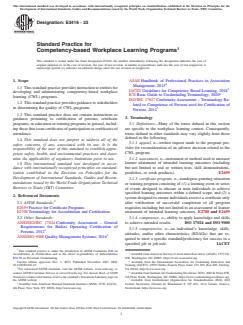
Designation: E3416 − 23
Standard Practice for
Competency-based Workplace Learning Programs
This standard is issued under the fixed designation E3416; the number immediately following the designation indicates the year of
original adoption or, in the case of revision, the year of last revision. A number in parentheses indicates the year of last reapproval. A
superscript epsilon (´) indicates an editorial change since the last revision or reapproval.
1. Scope ASAE Handbook of Professional Practices in Association
Management, 2015
1.1 This standard practice provides instruction to entities for
IACET Guidelines for Competency Based Learning, 2018
developing and administering competency-based workplace
ICE Basic Guide to Credentialing Terminology, 2020
learning (CWL) programs.
ISO/IEC 17027 Conformity Assessment – Terminology Re-
1.2 This standard practice provides guidance to stakeholders
lated to Competence of Persons used for Certification of
in determining the quality of CWL programs. 7
Persons, 2014
1.3 This standard practice does not contain instructions or
3. Terminology
guidance pertaining to certification of persons, certificate
3.1 Definitions—Many of the terms defined in this section
programs, or education or training programs in general, includ-
ing those that issue certificates of participation or certificates of are specific to the workplace learning context. Consequently,
terms defined in other standards may vary slightly from those
attendance.
defined in the following.
1.4 This standard does not purport to address all of the
3.1.1 appeal, n—written request made to the program pro-
safety concerns, if any, associated with its use. It is the
vider for reconsideration of an adverse decision related to the
responsibility of the user of this standard to establish appro-
CWL program.
priate safety, health, and environmental practices and deter-
mine the applicability of regulatory limitations prior to use. 3.1.2 assessment, n—instrument or method used to measure
learner attainment of intended learning outcomes (including
1.5 This international standard was developed in accor-
dance with internationally recognized principles on standard- but not limited to oral or written tests, skill demonstrations,
portfolios, or work products). E2659
ization established in the Decision on Principles for the
Development of International Standards, Guides and Recom-
3.1.3 certificate program, n—nondegree-granting education
mendations issued by the World Trade Organization Technical
or training program consisting of (1) a learning event or series
Barriers to Trade (TBT) Committee.
of events designed to educate or train individuals to achieve
specified learning outcomes within a defined scope, and (2) a
2. Referenced Documents
system designed to ensure individuals receive a certificate only
2.1 ASTM Standards: after verification of successful completion of all program
E2659 Practice for Certificate Programs requisites including but not limited to an assessment of learner
E2708 Terminology for Accreditation and Certification attainment of intended learning outcomes. E2708 and E2659
2.2 Other Standards:
3.1.4 competence, n—ability to apply knowledge and skills
ANSI/ISO/IEC 17024 Conformity Assessment – General
to achieve intended results. ISO 17024 and ISO 9000
Requirements for Bodies Operating Certification of
3.1.5 competencies, n—an individual’s knowledge, skills,
Persons, 2012
attitudes, and/or other characteristics (KSAOs) that are re-
ANSI/ISO 9000 Quality Management Systems, 2016
quired to meet a specific standard/proficiency for success in a
specified job or job role. IACET
This standard practice is under the jurisdiction of ASTM Committee E36 on
Accreditation & Certification and is the direct responsibility of Subcommittee Available from American Society of Association Executives (ASAE), 1575 I St.
E36.30 on Personnel Credentialing. NW, Washington, DC 20005, https://www.asaecenter.org.
Current edition approved Nov. 1, 2023. Published November 2023. DOI: Available from the International Accreditors for Continuing Education and
10.1520/E3416-23. Training (IACET), 45591 Dulles Eastern Plaza, Suite 132, P.O. Box 805, Sterling,
For referenced ASTM standards, visit the ASTM website, www.astm.org, or VA 20166, http://www.iacet.org.
contact ASTM Customer Service at service@astm.org. For Annual Book of ASTM Available from Institute for Credentialing Excellence (ICE), 2001 K Street NW,
Standards volume information, refer to the standard’s Document Summary page on 3rd Floor North, Washington, DC 20006, https://www.credentialingexcellence.org.
the ASTM website. Available from International Organization for Standardization (ISO), ISO
Available from American National Standards Institute (ANSI), 25 W. 43rd St., Central Secretariat, Chemin de Blandonnet 8, CP 401, 1214 Vernier, Geneva,
4th Floor, New York, NY 10036, http://www.ansi.org. Switzerland, https://www.iso.org.
Copyright © ASTM International, 100 Barr Harbor Drive, PO Box C700, West Conshohocken, PA 19428-2959. United States
E3416 − 23
3.1.6 competency-based learning, n—learning events with 3.1.17 policy, n—a written statement of defined expectations
the goal of mastering specific predetermined individual that guide, influence, and determine decisions or actions.
knowledge, skills, attitudes, and/or other characteristics re- IACET
quired to meet a specific standard/proficiency. IACET
3.1.18 primary stakeholders, n—persons, groups, or
3.1.7 competency-based workplace learning program,
organizations, or combination thereof, for which the CWL
n—program of structured learning experiences that builds and program is targeted, or for which intended outcomes are
assesses participant competencies in a real or simulated work- directed or both.
place setting resulting in the issuance of a credential when
3.1.19 prior learning assessment, n—assessment of an in-
pre-determined criteria are met.
dividual’s existing skill sets, knowledge and experience gained
3.1.7.1 Discussion—Examples of CWL programs include
prior to entering an education or credentialing program.
apprenticeships, boot camps, career accelerators, clerkships,
3.1.20 procedure, n—a specified way to carry out an activity
clinical experiences, cooperative education, externships,
or a process. E2708
fellowships, internships, on-the-job training programs, pre-
apprenticeship, residencies, reskilling programs, training-to-
3.1.21 professional or personnel certification, n—voluntary
placement programs, and upskilling programs.
process by which a nongovernmental agency grants a time-
limited recognition and use of a credential to individuals who
3.1.8 complaint, n—formal expression of dissatisfaction,
have demonstrated that they have met predetermined and
other than appeal, by any person or organization to a program
standardized criteria for required knowledge, skills, or
provider, relating to the program provider’s CWL program
competencies. ASAE
activities where a response is expected.
3.1.22 program completer, n—individual who has fulfilled
3.1.9 credential, n—recognition of qualification or compe-
the requirements of a CWL program.
tence issued to a person by an organization qualified to do so.
ISO 17027
3.1.23 program participant, n—individual who is working
to complete the CWL program.
3.1.10 credentialing, n—process by which an entity quali-
fied to do so, grants formal recognition to, or records the
3.1.24 program provider, n—entity responsible for imple-
recognition status of persons, organizations, institutions,
mentation of the CWL program scheme, oversight of the
programs, processes, services, or products that meet predeter-
program, and issuance of credentials to program completers.
mined and standardized criteria. E2708 and ASAE
3.1.25 scheme, n—the framework that defines the elements
3.1.11 cut score, n—specific score on an assessment where
and criteria necessary to fulfil the CWL program requirements
candidates who obtain that specific score or a higher score pass
and earn the credential.
the assessment, and candidates who obtain a lower score fail
3.1.26 scheme scope, n—description of the extent and
the assessment.
boundaries of a CWL program scheme.
3.1.11.1 Discussion—Also known as passing score, pass-
3.1.27 scheme owner, n—entity responsible for developing
fail standard, and pass mark.
and maintaining a CWL program scheme.
3.1.11.2 Discussion—A criterion-referenced cut score is
determined by evaluating an individual’s assessment score in
3.1.28 summative assessment, n—assessment that is primar-
relation to a pre-determined benchmark. A norm-referenced cut
ily intended to render a score or pass-fail judgment at the end
score is determined by comparing an individual’s assessment
of training or education. ICE
score to the scores of others taking the same assessment.
3.1.29 target population, n—the entire group of individuals
3.1.12 experiential learning, n—method of instruction in
considered eligible or suitable to participate in a CWL pro-
which learning occurs by performing skills or tasks and
gram.
reflecting on the performance.
3.1.30 theoretical learning, n—method of instruction that
3.1.12.1 Discussion—Also called on-the-job learning.
conveys knowledge and understanding of concepts, principles,
3.1.13 formative assessment, n—assessment intended to
and theories without necessarily having a practical application
promote learning rather than render a score or pass-fail
or direct experience.
judgment. ICE
3.1.30.1 Discussion—Also called didactic learning.
3.1.14 job analysis, n—method(s) used to identify the tasks
3.1.31 workplace learning, n—type of learning that takes
and the associated competence. ISO 17027
place in a real or simulated workplace setting.
3.1.14.1 Discussion—Also called practice analysis, job task
analysis, and role delineation.
4. Significance and Use
3.1.15 learning outcomes, n—statement(s) of what a person
4.1 Today’s labor shortages demand competency-based
is expected to know, understand, or be able to do at the end of
workplace learning (CWL) programs that are validated by
a training program, course, or module. ISO 17027
industry. A standard practice relative to CWL programs for-
3.1.16 needs assessment, n—method by which one deter- malizes this important type of skill-based, workforce prepara-
mines the requirements, needs, or expectations of learners and tion by offering industry a framework for success. CWL
other stakeholders to inform a program’s design. programs that result in a credential increase the total number of
E3416 − 23
individuals holding credentials, allowing for worker advance- 5.1.6 The program provider shall have designated personnel
ment (upskilling and reskilling), portability, and a talent responsible for establishing, implementing, and monitoring the
pipeline of highly skilled workers for the employer. CWL program activities.
4.2 This standard practice will have a positive impact on
5.2 Personnel:
worker-learners from various populations, generally those who
5.2.1 The program provider shall implement a procedure for
develop their skills while working on the job and will stream-
personnel management, covering, at a minimum, the require-
line the process for employers transitioning employees to
ments of this standard practice.
in-demand, high-quality employment opportunities, allowing
5.2.2 The program provider shall define and maintain the
for more sustainable economic mobility.
responsibilities, qualifications, and competence requirements
4.3 CWL programs offer learning opportunities for indi- for all positions involved in the CWL program.
viduals seeking skills that may not be attained in a traditional
5.2.3 The program provider shall have personnel with the
classroom. For workers, CWL programs are designed to
qualifications and competence to carry out roles assigned, both
provide new job skills, hands-on training experiences, and
initially and ongoing.
interaction with individuals with expertise in the occupation as
5.2.4 The program provider shall have sufficient personnel
facilitators in the learning and assessment processes. For
to carry out the CWL program activities.
employers, CWL programs are designed to provide a pipeline
5.2.5 The program provider shall provide sufficient training
of skilled talent to meet specific industry needs.
and resources to personnel to carry out the CWL program
4.4 While CWL programs have attributes in common with activities.
other credentialing programs, such as certification and certifi-
5.2.6 The program provider shall maintain up-to-date per-
cate programs, they are a distinct credentialing program type.
sonnel records.
All three programs have a summative assessment component.
5.2.7 The program provider shall require personnel to de-
Certificate programs and CWL programs have a learning
clare conflicts of interest with any participant and have a
component aligned with its assessment, while certification does
process for dealing with such conflicts.
not. Of these credentialing programs, only CWL programs
5.3 Financial and Other Resources:
have formative assessments as a specified assessment method
5.3.1 The program provider shall have sufficient funds to
and experiential learning as a specified learning method.
sustain the program and cover liabilities.
Lastly, unique to CWL programs is that they must be imple-
5.3.2 The program provider shall have sufficient resources
mented in a real or simulated workplace setting. These last
(facilities, equipment, etc.) to operate the program.
three attributes are allowable but optional in certificate pro-
grams.
5.4 Public Information and Communications:
4.5 While CWL programs are a distinct program type, both
5.4.1 The program provider shall make information about
certificate programs and certification programs can be (1) a
the CWL program scheme publicly available without request.
pre-requisite to admittance to a CWL program, (2) earned as
This shall include the program objectives and outcomes,
part of a CWL program, or (3) earned through an external
benefits to participants, and a general description of the CWL
entity while enrolled in a CWL program.
program scheme elements and criteria.
5.4.2 The program provider shall disseminate information,
4.6 This standard practice will provide the foundation for
including advertising, that is accurate and not misleading.
the self-attestation, recognition, or accreditation of a specific
entity to develop and administer a CWL program.
5.5 Information Security, Confidentiality, and Access:
5.5.1 The program provider shall maintain adequate records
5. Organization
to ensure accurate and up-to-date documentation of the CWL
5.1 Organizational Structure and Administration:
program.
5.1.1 The program provider shall be a legal entity or be part
5.5.2 The program provider shall maintain a records man-
of a legal entity.
agement system whereby stakeholders can confirm the status of
5.1.2 The scheme owner shall be an entity qualified to
any participant in the CWL program, and participants have
design the program scheme.
access to their program records.
5.5.3 The program provider shall implement policies and
NOTE 1—The scheme owner may be the program provider or a separate
entity. See 3.1.24 and 3.1.27.
procedures (1) for the maintenance and release of confidential
information and (2) to ensure security of assessment materials
5.1.3 The program provider shall be qualified to oversee and
throughout the CWL program.
implement the CWL program.
5.5.4 The program provider shall identify, manage, and
5.1.4 The program provider shall be responsible and retain
dispose of records in such a way to ensure the integrity of the
authority for decisions related to the CWL program, including
CWL program and the confidentiality of the information.
program acceptance, issuing the credential, and revoking the
credential.
5.5.5 The program provider shall require participants to sign
5.1.5 The program provider shall have designated manage- an agreement covering their commitment to comply with the
ment personnel responsible for establishing and monitoring the rules of the CWL program, including participant
CWL program management system and budget. responsibilities, confidentiality, and security terms.
E3416 − 23
5.5.6 The program provider shall require personnel to sign tenance and release of confidential information, (9) Security of
an agreement covering their commitments to comply with assessment materials, (10) Assessment administration, (11)
confidentiality and security terms. Outsourcing, (12) Complaints, (13) Appeals, (14) Scheme
design, review and validation, (15) Program design,
5.6 Outsourcing:
development, implementation, and evaluation, and (16) Cre-
5.6.1 The program provider shall implement a procedure for
dential issuance and use.
outsourcing consistent with the requirements of this standard
practice. NOTE 2—The implementation details for these procedures are included
throughout this standard practice.
5.6.2 When outsourcing occurs, the program provider shall
retain responsibility for assurance of quality and conformance
6.1.3 All policies and procedures shall be fair, equitable,
with this standard practice.
inclusive, and comply with all applicable regulatory and
5.6.3 The program provider shall have legal
...