

ASTM F1166-23
(Practice)Standard Practice for Human Engineering Design for Marine Systems, Equipment, and Facilities
General Information
- Abstract
SIGNIFICANCE AND USE
4.1 The objective of this practice is to provide ergonomic design criteria for maritime vessels and structures to ensure that maritime systems and equipment are designed in compliance with requirements for human performance, human workload, health and safety, survivability, and habitability.
4.2 Principles of Human Behavior:
4.2.1 There are basic principles of human behavior that control or influence how each person performs in their workplace. Some of these behaviors are culturally derived, while others are general and uniform across all cultures and geographical regions of the world. These behaviors influence a person’s physical, social, and psychological approach toward the work they do and how safely they do that work. Failure to satisfy these behavioral principles in the design of a ship or maritime structure can encourage, or even coerce, maritime personnel into taking unsafe risks in their everyday activities. It is, therefore, imperative that designers of ships and maritime equipment, systems, and facilities know these principles to provide a safe and efficient workplace for maritime personnel.
4.2.2 These principles include:
4.2.2.1 If the design of the ship or maritime facility is considered to be unsafe or inefficient by the crew, it will be modified by the users, often solving the initial problem but introducing others that may be as bad, or worse, than the original.
4.2.2.2 Equipment design shall be such that it encourages safe use, that is, does not provide hardware and software that can be used in an unsafe manner.
4.2.2.3 If the equipment or system is not designed to operate as the users’ cultural and stereotypical expectations lead them to think that it will operate, the chance for human error is significantly increased.
4.2.2.4 If equipment or systems are perceived by operators/maintainers to be too complex or require more effort to operate or maintain than they believe is necessary, they will always look for a “shortcut.” Further...
SCOPE
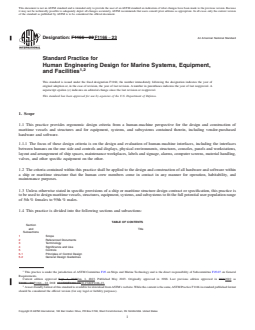
1.1 This practice provides ergonomic design criteria from a human-machine perspective for the design and construction of maritime vessels and structures and for equipment, systems, and subsystems contained therein, including vendor-purchased hardware and software.
1.1.1 The focus of these design criteria is on the design and evaluation of human-machine interfaces, including the interfaces between humans on the one side and controls and displays, physical environments, structures, consoles, panels and workstations, layout and arrangement of ship spaces, maintenance workplaces, labels and signage, alarms, computer screens, material handling, valves, and other specific equipment on the other.
1.2 The criteria contained within this practice shall be applied to the design and construction of all hardware and software within a ship or maritime structure that the human crew members come in contact in any manner for operation, habitability, and maintenance purposes.
1.3 Unless otherwise stated in specific provisions of a ship or maritime structure design contract or specification, this practice is to be used to design maritime vessels, structures, equipment, systems, and subsystems to fit the full potential user population range of 5th % females to 95th % males.
1.4 This practice is divided into the following sections and subsections:
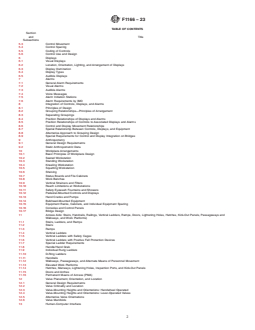
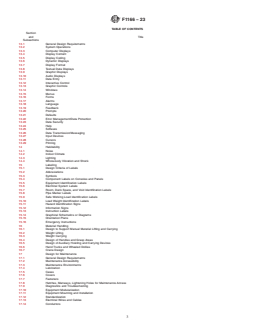
TABLE OF CONTENTS
Section
and
Subsections
Title
1
Scope
2
Referenced Documents
3
Terminology
4
Significance and Use
5
Controls
5.1
Principles of Control Design
5.2
General Design Guidelines
5.3
Control Movement
5.4
Control Spacing
5.5
Coding of Controls
5.6
Control Use and Design
6
Displays
6.1
Visual Displays
6.2
Location, Orientation, Lighting, and Arrangement of Displays
6.3
Display Illumination
6.4
Display Types
6.5
Audible Displays
7
Alarm...
- Status
- Published
- Publication Date
- 31-Dec-2022
- Technical Committee
- F25 - Ships and Marine Technology
- Drafting Committee
- F25.07 - General Requirements
Buy Documents
ASTM F1166-23 - Standard Practice for Human Engineering Design for Marine Systems, Equipment, and Facilities<rangeref></rangeref >
REDLINE ASTM F1166-23 - Standard Practice for Human Engineering Design for Marine Systems, Equipment, and Facilities<rangeref></rangeref >
Overview
ASTM F1166-23: Standard Practice for Human Engineering Design for Marine Systems, Equipment, and Facilities
ASTM F1166-23 is an essential international standard providing comprehensive ergonomic and human engineering design criteria for maritime vessels, systems, equipment, and facilities. Developed by ASTM International, this standard ensures that all aspects of ship and marine structure design prioritize human performance, health and safety, workload efficiency, survivability, and habitability. Its principles promote optimal human-machine interfaces, reduce the risk of human error, and support the well-being and operational effectiveness of maritime crews.
Key Topics
ASTM F1166-23 covers a wide range of critical human factors and ergonomic considerations, including:
- Controls and Displays: Guidelines for the design, movement, spacing, and coding of control devices and visual/audible displays to enhance safe and intuitive operation.
- Alarm Systems: Requirements for the integration, prioritization, and management of alarms for effective hazard detection and response.
- Human-Machine Interface: Criteria for controls, panels, workstations, labeling, signage, computer screens, and related equipment interfaces.
- Anthropometry: Design to accommodate a wide user population, specifically from the 5th percentile female to the 95th percentile male, addressing static and functional body dimensions.
- Workplace Arrangement: Recommendations for the layout of ship spaces, access points, maintenance workplaces, and special considerations for different working positions (seated, standing, kneeling, squatting).
- Access Aids: Design requirements for stairs, railings, ladders, ramps, doors, hatches, walkways, and platforms.
- Material Handling: Guidelines for the design of manual and assisted lifting/carrying, as well as hoisting and handling equipment.
- Maintenance and Safety: Provisions for maintenance accessibility, diagnostic features, hazard management, safety barriers, and emergency egress.
- Habitability: Standards for noise control, lighting, climate, and vibration to improve crew comfort and health.
- Labeling and Signage: Specifications for equipment identification, hazard warnings, and information signs.
Applications
ASTM F1166-23 provides practical value for a broad range of maritime design, construction, and operational activities:
- Ship Design and Construction: Applies ergonomic and human engineering criteria throughout the design and build process for all shipboard systems and facilities.
- Equipment Procurement: Ensures that vendor-supplied hardware and software meet human factors standards, supporting safe integration onboard.
- Human Factors Engineering: Guides system engineers and naval architects in designing intuitive and safe controls, displays, and automated systems.
- Workplace Safety and Efficiency: Helps ship operators, owners, and regulators enhance working conditions and reduce risks through evidence-based design.
- Retrofitting and Upgrades: Offers a reference for evaluating and improving existing vessels and marine structures to meet current ergonomic requirements.
- Compliance and Certification: Supports maritime organizations in meeting international requirements for crew safety, well-being, and operational performance.
Related Standards
For comprehensive coverage and best practices in maritime ergonomics and safety, consider the following related standards:
- ASTM F1646: Terminology Relating to Walkway Safety and Footwear
- ABS Guidance Notes for the Application of Ergonomics to Marine Systems
- MIL-STD-1472: Human Engineering Design Criteria Standard (U.S. Department of Defense)
- International Maritime Organization (IMO) Resolutions: Codes on Alarms and Indicators, and Noise Levels On Board Ships
- ANSI Z535 Series: Standards for Safety Signs, Symbols, and Labeling
- DNVGL-OS-A301: Offshore Standard for Human Comfort
- ISO 2631-1: Mechanical Vibration and Shock - Human Exposure Evaluations
By implementing AST F1166-23 alongside related standards, marine designers, engineers, and operators can significantly improve safety, usability, and habitability aboard vessels and offshore structures.
Relations
- Effective Date
- 01-Apr-2024
- Effective Date
- 01-Jul-2016
- Effective Date
- 01-Jul-2016
- Effective Date
- 15-May-2016
- Effective Date
- 01-May-2015
- Effective Date
- 01-Apr-2013
- Effective Date
- 01-Jan-2013
- Effective Date
- 01-Nov-2012
- Effective Date
- 15-Oct-2012
- Effective Date
- 01-Jul-2012
- Effective Date
- 15-Mar-2011
- Effective Date
- 01-Mar-2005
- Effective Date
- 01-Mar-2005
- Effective Date
- 10-Aug-2003
- Effective Date
- 10-Aug-2003
Buy Documents
ASTM F1166-23 - Standard Practice for Human Engineering Design for Marine Systems, Equipment, and Facilities<rangeref></rangeref >
REDLINE ASTM F1166-23 - Standard Practice for Human Engineering Design for Marine Systems, Equipment, and Facilities<rangeref></rangeref >
Get Certified
Connect with accredited certification bodies for this standard

DNV
DNV is an independent assurance and risk management provider.

Lloyd's Register
Lloyd's Register is a global professional services organisation specialising in engineering and technology.

FSC International
Forest Stewardship Council certification.
Sponsored listings
Frequently Asked Questions
ASTM F1166-23 is a standard published by ASTM International. Its full title is "Standard Practice for Human Engineering Design for Marine Systems, Equipment, and Facilities<rangeref></rangeref >". This standard covers: SIGNIFICANCE AND USE 4.1 The objective of this practice is to provide ergonomic design criteria for maritime vessels and structures to ensure that maritime systems and equipment are designed in compliance with requirements for human performance, human workload, health and safety, survivability, and habitability. 4.2 Principles of Human Behavior: 4.2.1 There are basic principles of human behavior that control or influence how each person performs in their workplace. Some of these behaviors are culturally derived, while others are general and uniform across all cultures and geographical regions of the world. These behaviors influence a person’s physical, social, and psychological approach toward the work they do and how safely they do that work. Failure to satisfy these behavioral principles in the design of a ship or maritime structure can encourage, or even coerce, maritime personnel into taking unsafe risks in their everyday activities. It is, therefore, imperative that designers of ships and maritime equipment, systems, and facilities know these principles to provide a safe and efficient workplace for maritime personnel. 4.2.2 These principles include: 4.2.2.1 If the design of the ship or maritime facility is considered to be unsafe or inefficient by the crew, it will be modified by the users, often solving the initial problem but introducing others that may be as bad, or worse, than the original. 4.2.2.2 Equipment design shall be such that it encourages safe use, that is, does not provide hardware and software that can be used in an unsafe manner. 4.2.2.3 If the equipment or system is not designed to operate as the users’ cultural and stereotypical expectations lead them to think that it will operate, the chance for human error is significantly increased. 4.2.2.4 If equipment or systems are perceived by operators/maintainers to be too complex or require more effort to operate or maintain than they believe is necessary, they will always look for a “shortcut.” Further... SCOPE 1.1 This practice provides ergonomic design criteria from a human-machine perspective for the design and construction of maritime vessels and structures and for equipment, systems, and subsystems contained therein, including vendor-purchased hardware and software. 1.1.1 The focus of these design criteria is on the design and evaluation of human-machine interfaces, including the interfaces between humans on the one side and controls and displays, physical environments, structures, consoles, panels and workstations, layout and arrangement of ship spaces, maintenance workplaces, labels and signage, alarms, computer screens, material handling, valves, and other specific equipment on the other. 1.2 The criteria contained within this practice shall be applied to the design and construction of all hardware and software within a ship or maritime structure that the human crew members come in contact in any manner for operation, habitability, and maintenance purposes. 1.3 Unless otherwise stated in specific provisions of a ship or maritime structure design contract or specification, this practice is to be used to design maritime vessels, structures, equipment, systems, and subsystems to fit the full potential user population range of 5th % females to 95th % males. 1.4 This practice is divided into the following sections and subsections: TABLE OF CONTENTS Section and Subsections Title 1 Scope 2 Referenced Documents 3 Terminology 4 Significance and Use 5 Controls 5.1 Principles of Control Design 5.2 General Design Guidelines 5.3 Control Movement 5.4 Control Spacing 5.5 Coding of Controls 5.6 Control Use and Design 6 Displays 6.1 Visual Displays 6.2 Location, Orientation, Lighting, and Arrangement of Displays 6.3 Display Illumination 6.4 Display Types 6.5 Audible Displays 7 Alarm...
SIGNIFICANCE AND USE 4.1 The objective of this practice is to provide ergonomic design criteria for maritime vessels and structures to ensure that maritime systems and equipment are designed in compliance with requirements for human performance, human workload, health and safety, survivability, and habitability. 4.2 Principles of Human Behavior: 4.2.1 There are basic principles of human behavior that control or influence how each person performs in their workplace. Some of these behaviors are culturally derived, while others are general and uniform across all cultures and geographical regions of the world. These behaviors influence a person’s physical, social, and psychological approach toward the work they do and how safely they do that work. Failure to satisfy these behavioral principles in the design of a ship or maritime structure can encourage, or even coerce, maritime personnel into taking unsafe risks in their everyday activities. It is, therefore, imperative that designers of ships and maritime equipment, systems, and facilities know these principles to provide a safe and efficient workplace for maritime personnel. 4.2.2 These principles include: 4.2.2.1 If the design of the ship or maritime facility is considered to be unsafe or inefficient by the crew, it will be modified by the users, often solving the initial problem but introducing others that may be as bad, or worse, than the original. 4.2.2.2 Equipment design shall be such that it encourages safe use, that is, does not provide hardware and software that can be used in an unsafe manner. 4.2.2.3 If the equipment or system is not designed to operate as the users’ cultural and stereotypical expectations lead them to think that it will operate, the chance for human error is significantly increased. 4.2.2.4 If equipment or systems are perceived by operators/maintainers to be too complex or require more effort to operate or maintain than they believe is necessary, they will always look for a “shortcut.” Further... SCOPE 1.1 This practice provides ergonomic design criteria from a human-machine perspective for the design and construction of maritime vessels and structures and for equipment, systems, and subsystems contained therein, including vendor-purchased hardware and software. 1.1.1 The focus of these design criteria is on the design and evaluation of human-machine interfaces, including the interfaces between humans on the one side and controls and displays, physical environments, structures, consoles, panels and workstations, layout and arrangement of ship spaces, maintenance workplaces, labels and signage, alarms, computer screens, material handling, valves, and other specific equipment on the other. 1.2 The criteria contained within this practice shall be applied to the design and construction of all hardware and software within a ship or maritime structure that the human crew members come in contact in any manner for operation, habitability, and maintenance purposes. 1.3 Unless otherwise stated in specific provisions of a ship or maritime structure design contract or specification, this practice is to be used to design maritime vessels, structures, equipment, systems, and subsystems to fit the full potential user population range of 5th % females to 95th % males. 1.4 This practice is divided into the following sections and subsections: TABLE OF CONTENTS Section and Subsections Title 1 Scope 2 Referenced Documents 3 Terminology 4 Significance and Use 5 Controls 5.1 Principles of Control Design 5.2 General Design Guidelines 5.3 Control Movement 5.4 Control Spacing 5.5 Coding of Controls 5.6 Control Use and Design 6 Displays 6.1 Visual Displays 6.2 Location, Orientation, Lighting, and Arrangement of Displays 6.3 Display Illumination 6.4 Display Types 6.5 Audible Displays 7 Alarm...
ASTM F1166-23 is classified under the following ICS (International Classification for Standards) categories: 47.020.01 - General standards related to shipbuilding and marine structures. The ICS classification helps identify the subject area and facilitates finding related standards.
ASTM F1166-23 has the following relationships with other standards: It is inter standard links to ASTM F3539-24, ASTM F2508-16, ASTM F2508-16e1, ASTM F1646-16, ASTM F2508-15, ASTM F2508-13, ASTM F1646-13, ASTM F2508-12a, ASTM F2508-12, ASTM F1646-12, ASTM F2508-11, ASTM F1646-05, ASTM F1646-05e1, ASTM F1646-03, ASTM F1646-03e1. Understanding these relationships helps ensure you are using the most current and applicable version of the standard.
ASTM F1166-23 is available in PDF format for immediate download after purchase. The document can be added to your cart and obtained through the secure checkout process. Digital delivery ensures instant access to the complete standard document.
Standards Content (Sample)
This international standard was developed in accordance with internationally recognized principles on standardization established in the Decision on Principles for the
Development of International Standards, Guides and Recommendations issued by the World Trade Organization Technical Barriers to Trade (TBT) Committee.
Designation: F1166 − 23 An American National Standard
Standard Practice for
Human Engineering Design for Marine Systems, Equipment,
1,2
and Facilities
This standard is issued under the fixed designation F1166; the number immediately following the designation indicates the year of
original adoption or, in the case of revision, the year of last revision. A number in parentheses indicates the year of last reapproval. A
superscript epsilon (´) indicates an editorial change since the last revision or reapproval.
This standard has been approved for use by agencies of the U.S. Department of Defense.
1. Scope
TABLE OF CONTENTS
Section
1.1 This practice provides ergonomic design criteria from a
and Title
human-machine perspective for the design and construction of Subsections
3 Terminology
maritime vessels and structures and for equipment, systems,
4 Significance and Use
and subsystems contained therein, including vendor-purchased
5 Controls
hardware and software. 5.1 Principles of Control Design
5.2 General Design Guidelines
1.1.1 The focus of these design criteria is on the design and
5.3 Control Movement
evaluation of human-machine interfaces, including the inter-
5.4 Control Spacing
5.5 Coding of Controls
faces between humans on the one side and controls and
5.6 Control Use and Design
displays, physical environments, structures, consoles, panels
6 Displays
and workstations, layout and arrangement of ship spaces,
6.1 Visual Displays
6.2 Location, Orientation, Lighting, and Arrangement of Displays
maintenance workplaces, labels and signage, alarms, computer
6.3 Display Illumination
screens, material handling, valves, and other specific equip-
6.4 Display Types
ment on the other.
6.5 Audible Displays
7 Alarms
1.2 The criteria contained within this practice shall be
7.1 General Alarm Requirements
applied to the design and construction of all hardware and
7.2 Visual Alarms
7.3 Audible Alarms
software within a ship or maritime structure that the human
7.4 Voice Messages
crew members come in contact in any manner for operation,
7.5 Alarm Initiation Stations
habitability, and maintenance purposes. 7.6 Alarm Requirements by IMO
8 Integration of Controls, Displays, and Alarms
1.3 Unless otherwise stated in specific provisions of a ship
8.1 Principles of Design
or maritime structure design contract or specification, this 8.2 Grouping Relationships—Principles of Arrangement
8.3 Separating Groupings
practice is to be used to design maritime vessels, structures,
8.4 Position Relationships of Displays and Alarms
equipment, systems, and subsystems to fit the full potential
8.5 Position Relationships of Controls to Associated Displays and
Alarms
user population range of 5th % females to 95th % males.
8.6 Control and Display Movement Relationships
1.4 This practice is divided into the following sections and
8.7 Spatial Relationship Between Controls, Displays, and Equipment
8.8 Alternative Approach to Grouping Design
subsections:
8.9 Special Requirements for Control and Display Integration on
TABLE OF CONTENTS
Bridges
Section
9 Anthropometry
and Title
9.1 General Design Requirements
Subsections
9.2 Static Anthropometric Data
1 Scope
10 Workplace Arrangements
2 Referenced Documents
10.1 Basic Principles of Workplace Design
10.2 Seated Workstation
10.3 Standing Workstation
10.4 Kneeling Workstation
10.5 Squatting Workstation
This practice is under the jurisdiction of ASTM Committee F25 on Ships and
10.6 Shelving
Marine Technology and is the direct responsibility of Subcommittee F25.07 on
10.7 Status Boards and File Cabinets
General Requirements.
10.8 Work Benches
Current edition approved Jan. 1, 2023. Published May 2023. Originally approved
10.9 Vertical Strainers and Filters
in 1988. Last previous edition approved in 2022 as F1166 – 22. DOI: 10.1520/
10.10 Reach Limitations at Workstations
F1166-23.
2 10.11 Safety Eyewash Fountains and Showers
A user-friendly format of this standard is available for download from ASTM’s
10.12 Pedestal-Mounted Controls and Displays
website. While the content is the same, ASTM Practice F1166 in standard published
10.13 Hand Cranks and Pumps
format should be considered the official version (for any legal or liability purposes).
Copyright © ASTM International, 100 Barr Harbor Drive, PO Box C700, West Conshohocken, PA 19428-2959. United States
F1166 − 23
TABLE OF CONTENTS TABLE OF CONTENTS
Section Section
and Title and Title
Subsections Subsections
10.14 Bulkhead-Mounted Equipment 15.7 Room, Deck Space, and Void Identification Labels
10.15 Equipment Racks, Cabinets, and Individual Equipment Spacing 15.8 Pipe Marker Labels
10.16 Consoles and Control Panels 15.9 Safe Working Load Identification Labels
10.17 Bridge Design 15.10 Load Weight Identification Labels
11 Access Aids: Stairs, Handrails, Railings, Vertical Ladders, Ramps, 15.11 Hazard Identification Signs
Doors, Lightening Holes, Hatches, Kick-Out Panels, Passageways 15.12 Information Signs
and Walkways, and Work Platforms) 15.13 Instruction Labels
11.1 Stairs, Ladders, and Ramps 15.14 Graphical Schematics or Diagrams
11.2 Stairs 15.15 Orientation Plans
11.3 Ramps 15.16 Emergency Instructions
11.4 Vertical Ladders 16 Material Handling
11.5 Vertical Ladders with Safety Cages
16.1 Design to Support Manual Material Lifting and Carrying
11.6 Vertical Ladders with Positive Fall Protection Devices 16.2 Weight Lifting
11.7 Special Ladder Requirements 16.3 Weight Carrying
11.8 Handle/Hand Grab 16.4 Design of Handles and Grasp Areas
11.9 Individual Rung Ladders 16.5 Design of Auxiliary Hoisting and Carrying Devices
11.10 D-Ring Ladders 16.6 Hand Trucks and Wheeled Dollies
11.11 Handrails 16.7 Crane Design
11.12 Walkways, Passageways, and Alternate Means of Personnel
17 Design for Maintenance
Movement 17.1 General Design Requirements
11.13 Elevated Work Platforms
17.2 Maintenance Accessibility
11.14 Hatches, Manways, Lightening Holes, Inspection Ports, and Kick- 17.3 Maintenance Environments
Out Panels
17.4 Lubrication
11.15 Doors and Arches 17.5 Cases
11.16 Permanent Means of Access (PMA) 17.6 Covers
12 Valve Placement, Orientation, and Location 17.7 Fasteners
12.1 General Design Requirements 17.8 Hatches, Manways, Lightening Holes for Maintenance Access
12.2 Valve Criticality and Location
17.9 Diagnostics and Troubleshooting
12.3 Valve-Mounting Heights and Orientations: Handwheel Operated 17.10 Equipment Modularization
12.4 Valve-Mounting Heights and Orientations: Lever-Operated Valves
17.11 Equipment Mounting and Installation
12.5 Alternative Valve Orientations 17.12 Standardization
12.6 Valve Manifolds
17.13 Electrical Wires and Cables
13 Human-Computer Interface 17.14 Conductors
13.1 General Design Requirements 17.15 Connectors
13.2 System Operations 17.16 Test Equipment
13.3 Computer Displays 17.17 Fuses and Circuit Breakers
13.4 Display Content
17.18 Hydraulic Systems
13.5 Display Coding 17.19 Stored Energy Devices
13.6 Dynamic Displays
17.20 Pipe Flanges, Spools, and Blinds
13.7 Display Format 17.21 Test and Sample Points
13.8 Textual Data Displays 18 Hazards and Safety
13.9 Graphic Displays 18.1 Hierarchy of Controls
13.10 Audio Displays 18.2 Safety Labels, Signs, and Excluded Area Markings
13.11 Data Entry
18.3 General Workplace Hazards
13.12 Interactive Control 18.4 General Equipment-Related Hazards
13.13 Graphic Controls
18.5 Electrical Hazards
13.14 Windows 18.6 Mechanical Hazards
13.15 Menus
18.7 Fluid Hazards
13.16 Forms 18.8 Safety Barriers
13.17 Alarms 18.9 Fall Protection
13.18 Language 18.10 Emergency Egress
13.19 Feedback 19 Communications
13.20 Prompts
19.1 Communication System Requirements
13.21 Defaults 19.2 Microphones
13.22 Error Management/Data Protection
19.3 Headsets
13.23 Data Security 19.4 Loudspeakers
13.24 Help
19.5 Telephone Systems
13.25 Software 20 Keywords
13.26 Data Transmission/Messaging 21 Acknowledgement
13.27 Input Devices Appendix Small Boat and High Speed Craft (HSC) Appendix
13.28 Cursors X1
13.29 Printing
Appendix Human Factors Engineering (HFE) Design Checklist
14 Habitability X2
14.1 Noise
Appendix Guidance for the Selection and Testing of Slip Resistant Walking
14.2 Indoor Climate X3 Surfaces
14.3 Lighting
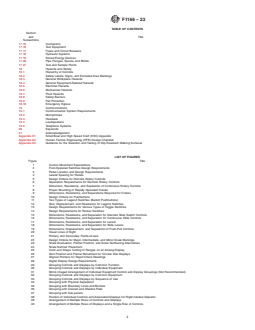
LIST OF FIGURES
14.4 Whole-body Vibration and Shock
Figure Title
15 Labeling
1 Control Movement Expectations
15.1 Design Criteria of Labels
2 Foot-Operated Switches Design Requirements
15.2 Abbreviations
3 Pedal Location and Design Requirements
15.3 Symbols
4 Lateral Spacing for Pedals
15.4 Component Labels on Consoles and Panels
5 Design Criteria for Discrete Rotary Controls
15.5 Equipment Identification Labels
6 Separation Requirements for Discrete Rotary Controls
15.6 Electrical System Labels
F1166 − 23
LIST OF FIGURES LIST OF FIGURES
Figure Title Figure Title
7 Dimension, Resistance, and Separation of Continuous Rotary 73 Workplace Dimensions for Shelves Located Above a Cabinet
Controls 74 Workplace Dimensions for Shelves Requiring Vision Over the Top
8 Proper Mounting of Rapidly Operated Cranks 75 Front Clearance Requirement for Lower Shelves
9 Dimensions, Resistance, and Separations Required for Cranks 76 Mounting Height of Status Boards
10 Design Criteria for Pushbuttons 77 Clearance in Front of Filing Cabinets
11 Two Types of Legend Switches (Backlit Pushbuttons) 78 Workbench Dimensions
12 Size, Displacement, and Resistance for Legend Switches 79 Safe Reach Distances Over an Obstacle or Barrier
13 Design Requirements for Various Types of Toggle Switches 80 Mounting Heights for Bulkhead-mounted Equipment in
14 Design Requirements for Rocker Switches Passageways
15 Dimensions, Resistance, and Separation for Discrete Slide Switch 81 Mounting Heights for Common Electrical Fixtures
Controls 82 Direct Spatial Relationships Between Controls and Equipment
16 Dimensions, Resistance, and Separation for Continuous Slide
83 Spatial Relationship of Fore and Aft Equipment to Controls and
Controls Displays on a Console Located Athwartship
17 Dimensions, Resistance, and Separation for Levers 84 Seated Single-operator Console Dimensions
18 Dimensions, Resistance, and Separation for Slide Levers 85 Wraparound Seated Console
19 Dimensions, Displacement, and Separation of Push-Pull Controls 86 Special Width Console
20 Visual Lines of Sight 87 Multi-tiered Standing Console
21 Primary and Secondary Fields-of-view 88 Multi-tiered Seated Console
22 Design Criteria for Major, Intermediate, and Minor Scale Markings 89 Dimensions for Desktop Standing Console
23 Scale Graduation, Pointer Position, and Scale Numbering 90 Cargo and Ballast Transfer Consoles
Alternatives
91 Stair Dimensions
24 Scale Number Placement 92 Straight Run Ramp Dimensions
25 Color and Shape Coding of Ranges on an Analog Display
93 Ramp with Turning Platform
26 Zero Position and Pointer Movement for Circular Dial Displays 94 Ramp with Switchback Turning Platform
27 Aligned Pointers for Rapid Check Readings 95 Vertical Ladder Dimensions
28 Digital Display Design Requirements 96 Dimensions for a Vertical Ladder Arrangement
29 Grouping Controls and Displays by Common Function 97 Platform/Landing Dimensions for Vertical Ladder Penetration
30 Grouping Controls and Displays by Individual Equipment 98 Caged Ladder Dimensions
31 Mirror-Imaged Arrangement of Individual Equipment Control and 99 Cage Shape and Size
Display Groupings (Not Recommended)
100 Ladder and Climber Safety Device Dimensions
32 Grouping Controls and Displays by Common Equipment 101 Extended Railing for Ladder Fall Protection (Front View)
33 Grouping Controls and Displays by Sequence of Use
102 Extended Railing for Ladder Fall Protection (Side View)
34 Grouping with Physical Separation 103 Extended Railing and Cage for Ladder Fall Protection (Front View)
35 Grouping with Boundary Lines and Borders 104 Extended Railing and Cage for Ladder Fall Protection (Side View)
36 Grouping with Colored and Shaded Pads 105 Handles or Hand Grabs for Use as Ladder Extensions
37 Grouping with Sub-panels 106 Handle for Transition from a Ladder to an Intermediate Platform
38 Position of Individual Controls and Associated Displays for Right- 107 Recommended Design Criteria for Individual Rung Ladders
handed Operator 108 Dimensions for D-Ring Ladders
39 Arrangement of Multiple Rows of Controls and Displays
109 Fixed Handrail Design
40 Arrangement of Multiple Rows of Displays and a Single Row of 110 Removable Handrail Dimensions
Controls
111 Special Handrail Design Dimensions
41 Positional Relationship between Alarm, Display, and Control 112 Transition Handrail Dimensions
42 Positional Relationship between Control Pointer and Status
113 Additional Personnel Movement-related Design Features
Indicator 114 Dimensions for Rectangular Access Openings Installed in a Vertical
43 Control and Display Movement Relationship
Orientation Requiring a Step to Reach the Opening
44 Spatial Relationship Between Controls, Displays, and Equipment 115 Dimensions for Rectangular, Square, and Round Hatches,
45 Spatial Relationships Between Equipment and Control Panels Manways, and Lightening Holes
46 Spatial Relationships for Redundant Controls and Displays 116 Dimensions for Lightening Holes
47 Panel Layout That Replicates Location of Equipment in Remote 117 Access to Vertical Escape Hatches
Space
118 Access to Overhead Hatch
48 Mimic of Physical Equipment Functional Layout 119 Access into a Cargo Hold Through a Raised Hatch
49 Mimic of Functional Groups Irrespective of Equipment Layout
120 Door Placement
50 Standing Body Dimensions 121 Desirable Upper Limits for Handwheel Torque
51 Seated Body Dimensions
122 Mounting Heights for Handwheel Valves With Vertical Stems
52 Depth and Breadth Dimensions 123 Mounting Heights for Handwheel Valves With Horizontal Stems
53 Hand and Foot Dimensions 124 Mounting Heights for Handwheel Valves With Angled Stems
54 Gloved Hand Dimensions
125 Mounting Heights for Lever-Operated Valves With Vertical Stems
55 Head Dimensions 126 Mounting Heights for Lever-Operated Valves With Horizontal Stems
56 Changes in Levels up to a Maximum of 6 mm ( ⁄4 in.)
127 Direction of Travel for Valve Levers Accessible From One Side Only
57 Seated Workspace Dimensions 128 Physical Reach from a Stooping or Squatting Position
58 Dimensions for a Computer Workstation
129 Mounting Position for Valve Levers and Handwheels Below
59 Dimensions for Single or Multiple Personnel at a Table or Other Standing Surface
Duty Station Not Requiring a Desk
130 Orientation and Reach from Ladder Parallel to Valves
60 Seating at CRT-Type Workstations 131 Orientation and Reach from Ladder Perpendicular to Valves
61 Clearance Behind a Seated Workstation 132 Operating Valves from a Ladder
62 Control Mounting Height for Seated Personnel 133 Valve Manifold for Tanks Located Athwartship
63 Display Mounting Height for Seated Personnel 134 Valve Manifold for Tanks Located Fore and Aft
64 Control Mounting Height for Standing Personnel
135 Valve Manifold for Fill, High-suction, and Low-suction Valves
65 Display Mounting Height for Standing Personnel 136 Default Push Button
66 Control Mounting Height for a Kneeling Person
137 Push Button States
67 Display Mounting Height for Kneeling Personnel 138 Radio Buttons
68 Required Dimensions for a Kneeling Worker
139 Check Boxes
69 Control Mounting Height for Squatting Personnel 140 Slider Control
70 Display Mounting Heights for Squatting Personnel 141 Message Window Design
71 Required Dimensions for a Squatting Worker
142 Finger-Operated Displacement Joystick Specifications
72 Workplace Dimensions for Shelves with Full Access
F1166 − 23
LIST OF FIGURES LIST OF TABLES
Figure Title Table Title
143 Trackball Dimensions, Resistance, and Clearance 42 Example Color-Coding Scheme for Vessel/structure Piping
144 Permissible Noise Exposure Limits 43 Chromaticity Coordinates for Color Coding
145 Large Enclosure Ventilation Requirements 44 Message Text Character Heights
146 Surface Reflectance Values 45 Design Weight Limits for Lifting
147 Health Guidance Zones for Limited Exposures 46 Design Weight Limits for Carrying
148 Independent Symbols 47 Limiting Factors
149 Guidelines for Labels on Consoles and Panels 48 Seated, Forward Reach (Both Arms)
150 Control and Control Setting Labels 49 Cross-Legged Seated, Forward Reach (Both Arms)
151 Control and Display Group Labels 50 Standing, Forward Reach (Both Arms)
51 Standing, Forward Reach (Preferred Arm)
152 Control Setting Labels for Multiple Controls
153 Equipment Label Format 52 Standing, Lateral Reach (Preferred Arm)
154 Sensor Label 53 Opening Dimensions for Single-hand Access with Tools
155 Pipe Marker Labels 54 Opening Dimensions for Single-hand Access without Tools
156 Pipe Marker Labels with Two Colors 55 Opening Dimensions for Arm Access without Tools
157 Hazard Signal Word Headers 56 Opening Dimensions for Two-hand Access
158 Examples of Text and Symbol on Signs 57 Thermal Temperature Limits
159 Example of Information Sign 58 Shock Current Intensities and Their Probable Consequences
160 Handle Dimensions 59 Minimum Speech Intelligibility Scores
161 Use of Hand Trucks X1.1 Visibility Standards for HSC and Small Boat Application
162 Use of Dollies X1.2 Forward Functional Reach Measurements for North American
163 Case Orientation Population
164 Access Opening Covers X2.1 Human Factors Checklist for Design
165 Example of Alignment Pins
1.5 This standard does not purport to address all of the
166 Cable Arrangements
safety concerns, if any, associated with its use. It is the
167 Suggested Cable Arrangement in a Junction Box
168 Fluid Line Connection Recommendations
responsibility of the user of this standard to establish appro-
169 Areas To Place Items on Bulkhead
priate safety, health, and environmental practices and deter-
170 Safety Barriers
mine the applicability of regulatory limitations prior to use.
X1.1 Primary and Secondary Fields of View
1.6 This international standard was developed in accor-
LIST OF TABLES
Table Title
dance with internationally recognized principles on standard-
1 Recommended Manual Controls
ization established in the Decision on Principles for the
2 Control Movement Expectations
Development of International Standards, Guides and Recom-
3 Minimum Spacing Between Two Controls
4 Comparison of Displacement and Isometric Controls
mendations issued by the World Trade Organization Technical
5 Typical Status Display and Alarm Color Codes for North American
Barriers to Trade (TBT) Committee.
Industry
6 Character Sizes for Digital Displays
2. Referenced Documents
7 Functional Evaluation of Types of Audio Signals
8 Guidelines for Color Coding of Visual Alarms 3
2.1 ASTM Standards:
9 General Recommendations for Sound Loudness and Frequency
F1646 Terminology Relating to Walkway Safety and Foot-
10 Guidelines for Selecting Audible Alarm Sounds
11 Clothing and Postural Effects
wear
12 International Geographical Regions for Which Anthropometric
F2508 Practice for Validation, Calibration, and Certification
Data Are Available
of Walkway Tribometers Using Reference Surfaces
13 Standing Height Dimensions—International Population
14 Seated Eye Height Dimensions—International Population
F2965 Guide for Selection of Walkway Surfaces and Treat-
15 Forward Reach Dimensions—International Population
ments When Considering Aggressive Contaminant Con-
16 Male Anthropometric Data from Four Regions of the World
ditions in Commercial and Industrial (Not Including
17 Female Anthropometric Data from Four Regions of the World
18 Weights for American Adult Females and Males
Construction) Environments (Withdrawn 2022)
19 Seated Workspace Dimensions
F3132 Practice for Selection of Walkway Surfaces When
20 Dimensions for a Seated Computer Workstation
Considering Pedestrian Safety
21 Selection of Access Type
22 Stair Dimensions
F3539 Practice for Creation of Walkway Tribometer Interla-
23 Stair Widths
boratory Study Reports and Test Procedures
24 Handrail Arrangements
2.2 Overall References:
25 Recommended Ramp Angle Inclinations
26 Walkway and Passageway Dimensions
ABS Guidance Notes for the Application of Ergonomics to
27 Dimensions for Additional Personnel Movement-related Features
Marine Systems, August 2013 (Updated August 2018)
28 Access Opening and Mounting Depth Dimensions for Levers and
MIL-STD-1472 Department of Defense Design Criteria
Handwheels Mounted Below the Standing Surface
29 System Response Time Limits
Standard: Human Engineering
30 Advantages and Disadvantages of Nonkeyboard Input Devices
2.3 Alarms:
31 Keyboard Push-button Characteristics
DOT/FAA/HF-STD-001B Ahlstrom, V. (2016). Human Fac-
32 Pointer Shapes and Associated Functions
33 Pointing Device Button Actions
tors Design Standard (HFDS) Atlantic City International
34 Limiting Dimensions for Mouse
35 Maximum Permissible Noise Levels
36 Noise Attenuation from Hearing Protectors
For referenced ASTM standards, visit the ASTM website, www.astm.org, or
37 Lighting Levels for Ships and Maritime Structures
contact ASTM Customer Service at service@astm.org. For Annual Book of ASTM
38 Maximum Brightness Ratios
Standards volume information, refer to the standard’s Document Summary page on
39 Operational Environment Types
the ASTM website.
40 Examples of Equipment Labels 4
The last approved version of this historical standard is referenced on
41 Pipe Label Format
www.astm.org.
F1166 − 23
Airport, NJ: Federal Aviation Administration William J. fractional-octave-band filters
Hughes Technical Center ISO 2041:1990 Vibration and shock — Vocabulary
Engineering Equipment and Materials User’s Association ISO 2531:2009 Ductile iron pipes, fittings, accessories and
(EEMUA) Publication # 191 Alarm Systems, a Guide to their joints for water applications
Design, Management and Procurement ISO 2631-1:1997 Mechanical vibration and shock — Evalu-
International Maritime Organization (IMO) Resolution ation of human exposure to whole-body vibration
A.1021(26) Code on Alarms and Indicators ISO 5805:1997 Mechanical vibration and shock — Human
exposure — Vocabulary
2.4 Integration of Controls, Displays, and Alarms:
ISO 8041:1990 Human response to vibration — Measuring
ABS Guidance Notes on Ergonomic Design of Navigation
instrumentation
Bridges October 2003 (Updated August 2018) Guidance
Notes on Ergonomic Design of Navigation Bridges
2.9 Labeling:
2.5 Anthropometry: ANSI Z535.2 Environmental and Facility Safety Sign Stan-
ADULTDATA: The Handbook of Adult Anthropometrics dard
and Strength Measurements—Data for Design Safety In- ANSI Z535.3 Criteria for Safety Symbols
Globally Harmonized System of Classification and Label-
stitute for Occupational Ergonomics, University of
Nottingham, UK, 1998 ling of Chemicals (GHS)
Peterson, R., Price, B., LaBrecque, J., Bass, D., and Ziemba,
International Labor Office (ILO) International Data on
Anthropometry, 1990 A., Development of Impact Injury Design Rule for High
Speed Craft, Naval Surface Warfare Center, Panama City,
McDowell, M. A., Fryar, C. D., Hirsch, R., and Ogden, C.
L. Anthropometric Reference Data for Children and FL, August 26, 2004
Adults: U.S. Population, 2003-2006, Advance Data from
2.10 Material Handling:
Vital and Health Statistics No. 361, U.S. Department of
Lifting: TLV Physical Agents, 7th edition, American Con-
Health and Human Services, Centers for Disease Control
ference of Governmental Industrial Hygienists, 2005
and Prevention, July 2005
DOT/FAA/HF-STD-001B Ahlstrom, V. (2016). Human Fac-
Anthropometric Survey of U.S. Army Personnel: Methods
tors Design Standard (HFDS). Atlantic City International
and Summary Statistics, Technical Report NATICK/TR-
Airport, NJ: Federal Aviation Administration William J.
15./007 U.S. Army NATICK Soldier RD&E Center, 2014
Hughes Technical Center
Woodson, W. Human Factors Design Handbook, 1981
Katrin Kroemer Elbert, Henrike Kroemer, Anne D. Kroemer
2.6 Access Aids:
Hoffman Ergonomics: How to Design for Ease and
ABS Guide for Means of Access to Tanks and Holds for
Efficiency, 3rd edition, 2018
Inspection, April 2016 (Updated March 2018)
2.11 Maintenance:
International Maritime Organization (IMO) Guidelines for
MIL-HDBK-454 General Guidelines for Electronic Equip-
Safe Access to Tanker Bows, IMO Resolution MSC.62
ment
(67) 1996 International Maritime Organization (IMO) In-
MIL-STD-130 Department of Defense Standard Practice for
ternational Convention on Loadlines, 1966
Identification Marking of U.S. Military Property
2.7 Human-Computer Interface:
2.12 Communications:
Defense Information Systems Agency (DISA) Common
DOT/FAA/HF-STD-001B Ahlstrom, V. (2016). Human Fac-
Operating Environment (COE) User Interface Specifica-
tors Design Standard (HFDS). Atlantic City International
tions (UIS) 2003
Airport, NJ: Federal Aviation Administration William J.
DOT/FAA/HF-STD-001B Ahlstrom, V. (2016) Human Fac-
Hughes Technical Center
tors Design Standard (HFDS). Atlantic City International
2.13 Hazards and Safety:
Airport, NJ: Federal Aviation Administration William J.
ANSI/ASSP Z590.3-2011 Prevention Through Design
Hughes Technical Center
Guidelines for Addressing Occupational Hazards and
ANSI/HFES Standard No. 100–2007 American National
Risks in Design and Redesign Processes
Standard for Human Factors Engineering of Computer
MIL-STD-882E Department of Defense Standard Practice,
Workstations, Human Factors and Ergonomics Society,
System Safety
Inc., Santa Monica, CA, 2007
2.8 Habitability: 2.14 Small Boat and High Speed Craft Appendix:
ABS Guide for Crew Habitability on Ships, February 2016 American Boat and Yacht Council (2014) Reboarding
Directive 2002/44/EC of the European Parliament and of the Means, Ladders, Handholds, Rails and Lifelines (ABYC
Council (25 June 2002) on the minimum health and safety H-41)
requirements regarding the exposure of workers to the American Boat and Yacht Council (2019) Field of Vision
risks arising from physical agents (vibration) from the Helm Position (ABYC H-1)
DNVGL-OS-A301, April 2016 DNV-GL Offshore Standard Dobbins, T., Rowley, I., and Campbell, L. (2008) High
for Human Comfort Speed Craft Human Factors Design Guide (Report Num-
International Maritime Organization (IMO) Resolution ber ABCD-TR-08-01 v1.0). UK MOD Defence Equip-
MSC.337(91) Code on Noise Levels on Board Ships ment and Support Agency (DE&S); Directorate of Sea
IEC 1260:1995 Electroacoustics — Octave-band and Systems supported by the ABCD Working Group
F1166 − 23
International Maritime Organization (2000) Adoption of the urgency of mitigating responses required of personnel, that is,
International Code of Safety for High-Speed Craft: 2000 the more severe the potential consequence, the higher the alarm
HSC Code (MSC.97(73)) priority.
International Maritime Organization (2000) Maritime Safety
3.1.6 alarm suppression, n—(1) technique in which when a
Committee Circular 982: Guidelines on Ergonomic Crite-
single-alarm event leads to subsequent alarm events (for
ria for Bridge Equipment and Layout (MSC.1-Circ. 982)
example, cascading alarms), the initiating alarm is presented
The International Organization for Standardization
but the subsequent events are not (that is, are suppressed); and
(2007) Ship’s bridge layout and associated equipment —
(2) technique by which alarm messages are not displayed but
Requirements and guidelines: Annex A (normative):
are available to the user upon request.
Bridge layout for high speed craft (ISO 8468, 3rd edition)
3.1.7 analog display, n—type of display that shows the
The International Organization for Standardization
complete range of a measured parameter on a continuous scale
(2016) Small craft – Principle data (ISO 8666, 2nd edi-
and by means of a pointer, or equivalent, indicating an
tion)
instantaneous value of the parameter on the scale.
The International Organization for Standardization
3.1.8 angle of inclination, n—angle that the stair rises
(2019) Small craft – Field of vision from the steering
measured from the deck or surface on which the stair is sitting
position (ISO 11591, 3rd edition)
to the underside of the stair stringers.
United States Coast Guard (2001) Navigation and Vessel
Inspection Circular Number 5-01
3.1.9 annunciator, n—(1) type of transilluminated display
Guidance for Enhancing the Operational Safety of Domestic
that provides written text, pictorial data, or both to a user to
High Speed Vessels (COMDTPUB P16700.4)
show status or condition of a system or equipment; and (2)
(also called a legend light) type of transilluminated display
2.15 Slip-resistant Walking Surfaces:
consisting of a light source located behind a cover that contains
ANSI A326.3 Test Method for Measuring Dynamic Coeffi-
a printed label (that is, legend).
cient of Friction of Hard Surface Materials
3.1.9.1 Discussion—The color of the light (usually red,
EN 16165 Determination of slip resistance of pedestrian
green, white, or blue), whether it is ON or OFF, and the printed
surfaces – Methods of evaluation
label all provide information to the operator about the status of
Vessel Sanitation Program 2018 Construction Guide-
a piece of equipment or system.
lines U.S. Department of Health and Human Services,
U.S. Public Health Service, CDC
3.1.10 anthropometrics, n—(1) study of the physical size,
SA HB 198:2014 Handbook: Guide to the specification and strength, and range of motion of the human body and the
testing of slip resistance of pedestrian surfaces, Standards
application of that data to the design of systems, equipment,
Australia workspaces, and tools to maximize human performance and
safety in a work setting; and (2) measurement of human
3. Terminology variability of body dimensions and strength as a function of
gender, race, and regional origin.
3.1 Definitions of Terms Specific to This Standard:
3.1.11 anti-two-block alarm, n—alarm used to warn a crane
3.1.1 accessible, adj—an item is considered accessible
operator of the impending collision of the traveling block and
when it can be operated, manipulated, inspected, serviced,
crane tip sheave.
removed, or replaced by the suitably clothed and equipped user
with applicable body dimensions conforming to the anthropo-
3.1.12 articulation index (AI), n—technique used to mea-
metric range and database specified by the procuring activity
sure how intelligible (that is, understandable) spoken words are
or, if not specified by the procuring activity, with applicable 5th
that are received over communication equipment and is ex-
to 95th percentile body dimensions as defined in Section 9.
pressed as a percentage of speech units that are understood by
3.1.1.1 Discussion—Applicable body dimensions are those
a listener when heard out of context.
dimensions that are design critical to the operation,
3.1.13 assembly, n—number of parts or subassemblies or
manipulation, inspection, service, removal, or replacement
any combination thereof joined together to perform a specific
task.
function and capable of disassembly.
3.1.2 advisory signal, n—signal that indicates a safe or
3.1.13.1 Discussion—The distinction between an assembly
normal configuration, condition of performance, or operation
and a subassembly is determined by the individual application.
of equipment or attracts attention and imparts information for
An assembly in one instance may be a subassembly in another
routine action purposes.
in which it forms a portion of an assembly.
3.1.3 alarm, n—visual or audible signal or both of a
3.1.14 assisted lifting devices, n—items such as cranes,
condition, or a predetermined out-of-tolerance condition, for
hoists, mobile A-frame and hydraulic jacking units, monorails,
machinery, equipment, components, or systems that require
trolleys, or padeyes used by individuals to lift or move
attention and response by a crewmember.
materials and equipment or both that is too heavy for direct
manual lifting or carrying.
3.1.4 alarm filtering, n—technique by which unnecessary
alarms are eliminated.
3.1.15 audible alarm, n—alarm comprised of tones, verbal
3.1.5 alarm priority, n—predicted assessment of the poten- messages, or verbal messages combined with tones and not all
tial consequence of a condition or situation and the resulting audible alarms are associated with visual alarms.
F1166 − 23
3.1.16 auditory display, n—device that provides readings, 3.1.30 cursor, n—marker on the display screen that indicates
status, or condition of machinery, equipment, or system- the position where the computer expects the next input or will
operating parameters through the use of sound signals or display the next output.
spoken messages. 3.1.30.1 Discussion—The cursor may be positioned by the
computer or by the user.
3.1.17 available friction, n—an inherent characteristic of a
walkway surface that would result in measurable friction upon 3.1.31 danger signal, n—signal that indicates the existence
the attempted or actual sliding of another object across that
of a hazardous condition requiring immediate action to prevent
surface; can only be measured using a method, apparatus and loss of life, major equipment damage or environmental
contaminant (if any) that have their own inherent influences on
contamination, or serious loss of mission capability.
the measurement value itself. F3132
3.1.32 dead-man switch, n—control that automatically stops
3.1.18 band pass, n—electronic filter designed to respond machinery or systems from operating once the control is
only to selected audio frequencies while blocking all other
released by the operator.
frequencies.
3.1.33 dependent symbol, n—symbols that alone do not
3.1.18.1 Discussion—Commonly used in telephones.
impart any specific information to the user but require the
3.1.19 binaural, n—sound coming to a headset from dual
existence of supporting data to provide useful information.
channels or signal paths with a different channel or signal path
3.1.34 detent control, n—(1) type of discrete control, char-
presented to each headset.
acterized by the control locking into each position setting until
3.1.20 case, n—part of an item of equipment that encloses
the operator exerts extra force to move the control out of the
and protects the equipment from its surroundings and protects
setting.
the surroundings—including personnel—from the equipment.
3.1.34.1 Discussion—These types of controls are preferable
for machinery equipment or system operation requiring control
3.1.21 caution signal, n—signal that indicates the existence
in discrete steps or different modes.
of a condition requiring attention but not immediate action.
(2) type of discrete control in which each control position
3.1.22 coaming, n—vertical steel plate extending up 50 to
setting is identified by an audible click and the control “locks”
76 mm (2 to 3 in.) from the deck and placed around equipment
into that position setting until the operator exerts extra force to
or other areas in which liquids (for example, oil, water, grey or
move the control out of that setting and into the next one.
black water, and oily water) could be spilled to contain the
3.1.35 digital display, n—type of display that uses numeric
liquids within a confined area.
characters to provide an instantaneous value of a parameter.
3.1.23 color pad, n—area on a console or panel face that is
3.1.36 directly accessible, adj—to be directly accessible, an
shaded a different color than the panel itself to highlight a set
object, space, component, or piece of equipment shall be in an
of controls, displays, or alarms, or combination thereof, that are
area reachable without having to use tools or disassemble an
related in some manner.
access opening; be clear of, or protected from, obstructions,
3.1.24 command, n—instructions that cause a device to
moving equipment, hot surfaces, or other obstructions that
perform some action.
would prevent safe contact by the user; allow the user to get as
3.1.25 command language, n—limited programming lan-
close as necessary (for example, arm’s reach) to perform the
guage used strictly for executing a series of commands (for
required tasks; be reachable by means of a permanent access;
example, Linux or any DOS shells).
and allow all of the above by a person wearing the required
3.1.26 console, n—group of controls and displays associated protective clothing and carrying tools, spare parts, and test
with one or more individual pieces of equipment or systems equipment as required.
mounted together on a structure dedicated to the control and
3.1.37 directly visible, adj—a directly visible object (for
monitoring of the individual equipment or systems.
example, control, display, hazard warning, and so forth) shall
3.1.26.1 Discussion—Consoles may be freestanding units
not be located behind a door or other closure cover and shall be
and include angled and vertical surfaces.
readable from the normal user position within the provided
ambient lighting and from a position that does not require the
3.1.27 continuous control, n—continuous control is an ac-
reader to stand on pipes, cable trays, structural members, or
tuator that operates at any point or value along a continuous
other surfaces not intended to be a regular working surface or
scale (for example, engine throttle).
assume awkward body postures.
3.1.28 contrast ratio, n—ratio of the differences in lumi-
3.1.38 discrete control, n—actuator that allows for the
nance between the item on a video display and the background.
selection between two or more mutually exclusive operating
3.1.29 control, n—(1) any switch, pushbutton, knob, lever,
functions or points along a scale (for example, switching a
keyboard, mouse, or other device manually manipulated by the
machine ON or OFF or selecting one of three pumps to run).
operator/maintainer to alter or maintain the status of a particu-
lar piece of equipment or system; and (2) a device an operator 3.1.39 displacement joystick, n—joystick that moves out of
the detent in the direction it is pushed.
or maintainer uses to input a signal, change the operating status
of equipment or systems, or to manipulate displayed data. 3.1.39.1 Discussion—Displacement joysticks are usually
Examples include switches, knobs, cranks, thumbwheels, spring-loaded so that they return to a neutral center (detent)
levers, keyboards, and foot pedals. position.
F1166 − 23
3.1.40 display, n—any gauge, light counter, printer, ramps, steps, platforms, and walkways to prevent a person
annunciator, sight glass, horn, siren, digital counter, cathode from falling from one elevation to another.
ray tube (CRT) screen, or any other device that provides visual
3.1.53 hazard identification sign, n—type of sign used to
or auditory information to the human operator/maintainer
identify and provide information about situations that may be
about the status of a piece of equipment or system.
hazardous to personnel, equipment, or the environment; there
3.1.41 dynamic display, n—display screen that is, or has are two types of hazards: “DANGER” and “CAUTION.”
portions within that are, updated on a regular basis, primarily
3.1.54 hazard label, n—type of label used to identify and
alphanumeric values.
provide information about situations that may be hazardous to
personnel, equipment, or the environment and only two types
3.1.42 emergency shutdown stations (ESDs), n—manual
of hazards should be allowed, that is, “DANGER” and
controls that are located throughout a ship or maritime struc-
“CAUTION,” based on the following criteria.
ture that shut down equipment, systems, or complete structures
and initiate an alarm at the same time.
3.1.54.1 DANGER—used where the hazard could result in
serious injury or death to a person, serious damage to vital
3.1.43 fixed ladder, n—ladder permanently attached to a
equipment, or a major environmental problem.
structure, building, or equipment.
3.1.54.2 CAUTION—used where the hazard could result in
3.1.44 foot candle (fc, lm/ft or ft-c), n—a non-SI measure of
a minor injury to a person, minor damage to the equipment, or
light intensity or illuminance, the amount of light striking a
a minor environmental problem.
surface, in lumens per square foot. One foot candle is equal to
approximately 10.76 lux (the corresponding SI unit).
3.1.55 hierarchical menus, n—large series of options or
menus that are organized as a multilevel, branching structure in
3.1.45 foot lambert (fl or ft-L), n—a non-SI measure of
which an option in a higher-level menu is the name of another
luminance, the amount of light reflected from a surface. A
menu at the next lower level and the options in the lowest-level
foot-lambert equals 1/π candela per square foot, or 3.426
menus are not the names of other menus.
candela per square metre (the corresponding SI unit).
3.1.56 human engineering (ergonomics), n—scientific disci-
3.1.46 flicker, n—perception of rapid fluctuations in lumi-
pline concerned with the understanding of interactions among
nance levels characterized by an impression of jerky move-
humans and other elements of a system and the profession that
ments.
applies theory, principles, data, and methods to design to
3.1.47 function keys, n—labeled keys that serve as keyboard
optimize human well-being and overall system performance.
shortcuts (for example, F1, F2, F3, or with the function name
3.1.57 human machine interface (HMI), n—means by which
such as Delete or Insert) by combining in one key the actions
humans and machines/computers communicate/work with
of a sequence of individual keys.
each other to control and operate systems.
3.1.48 general emergency alarms, n—alarm given in the
3.1.58 human systems integration (HSI), n—systems engi-
case of an emergency involving all persons on a vessel or other
neering discipline that is focused on human performance,
maritime facility and these alarms sound throughout a vessel or
human skills and training, manpower, personnel survivability,
maritime installation and are intended to be heard by all
health and safety, and quality of life at sea.
personnel.
3.1.59 hyperlinks, n—text that provides the capability to,
3.1.48.1 Discussion—General emergency alarms relate to
when selected using a pointing device or ENTER key, direct
conditions of a serious nature such as announcing a fire or
the user to another location within the window or another
flooding, demanding evacuation of an area, or demanding
window.
abandonment of a vessel or installation.
3.1.59.1 Discussion—Hyperlinks are generally indicated by
3.1.49 glare, n—luminance or amount of light-per-unit area
textual formats such as alternate text color or underlining or
emitted or reflected from a surface, within a specific area of
both.
personnel’s field of view, that is greater than the luminance to
3.1.60 icon, n—picture or drawing that represents an actual
which the eye is adjusted compared to the remainder of the
piece of equipment or system on the ship or maritime structure.
field of view.
3.1.61 identification label, n—type of label used to: (1)
3.1.50 graphic label, n—type of label used to present
identify, and be placed on, all individual equipment or
information through line schematics, diagrams, charts, tables,
components, for example, valves, gauges, junction boxes,
and pictures.
filters, pumps, sensor, consoles, transmitters, pressure vessels,
3.1.51 handle or handgrab, n—U-shaped bar attached di-
control panels, local motor controllers, fans, heaters, cabinets,
rectly to bulkheads or other structures used by a person to hold
lockers, and all other items used by the crew for operation,
onto where handholds are required such as when passing
maintenance, or habitability use; (2) identify spaces (for
through hatches or lightening holes or climbing vertically
example, rooms, compartments, open deck areas, buildings,
through deck openings.
tanks, voids, or any area in which the crew may enter); and (3)
3.1.52 handrail, n—vertical barrier consisting of two or identify individual controls, displays, alarms, or groups thereof
more horizontal rails connected to vertical stanchions that are as shown in Section 8 that appear on consoles, control panels,
erected along exposed edges of floor openings, wall openings, or are individually mounted.
F1166 − 23
3.1.62 independent symbol, n—pictorial representation that 3.1.76 luminance, n—total light emitted from a video dis-
alone provides information to personnel without requiring play calculated on the basis of the brightest portion
...
This document is not an ASTM standard and is intended only to provide the user of an ASTM standard an indication of what changes have been made to the previous version. Because
it may not be technically possible to adequately depict all changes accurately, ASTM recommends that users consult prior editions as appropriate. In all cases only the current version
of the standard as published by ASTM is to be considered the official document.
Designation: F1166 − 22 F1166 − 23 An American National Standard
Standard Practice for
Human Engineering Design for Marine Systems, Equipment,
1,2
and Facilities
This standard is issued under the fixed designation F1166; the number immediately following the designation indicates the year of
original adoption or, in the case of revision, the year of last revision. A number in parentheses indicates the year of last reapproval. A
superscript epsilon (´) indicates an editorial change since the last revision or reapproval.
This standard has been approved for use by agencies of the U.S. Department of Defense.
1. Scope
1.1 This practice provides ergonomic design criteria from a human-machine perspective for the design and construction of
maritime vessels and structures and for equipment, systems, and subsystems contained therein, including vendor-purchased
hardware and software.
1.1.1 The focus of these design criteria is on the design and evaluation of human-machine interfaces, including the interfaces
between humans on the one side and controls and displays, physical environments, structures, consoles, panels and workstations,
layout and arrangement of ship spaces, maintenance workplaces, labels and signage, alarms, computer screens, material handling,
valves, and other specific equipment on the other.
1.2 The criteria contained within this practice shall be applied to the design and construction of all hardware and software within
a ship or maritime structure that the human crew members come in contact in any manner for operation, habitability, and
maintenance purposes.
1.3 Unless otherwise stated in specific provisions of a ship or maritime structure design contract or specification, this practice is
to be used to design maritime vessels, structures, equipment, systems, and subsystems to fit the full potential user population range
of 5th % females to 95th % males.
1.4 This practice is divided into the following sections and subsections:
TABLE OF CONTENTS
Section
and Title
Subsections
1 Scope
2 Referenced Documents
3 Terminology
4 Significance and Use
5 Controls
5.1 Principles of Control Design
5.2 General Design Guidelines
This practice is under the jurisdiction of ASTM Committee F25 on Ships and Marine Technology and is the direct responsibility of Subcommittee F25.07 on General
Requirements.
Current edition approved Sept. 1, 2022Jan. 1, 2023. Published May 2023. Originally approved in 1988. Last previous edition approved in 20212022 as
F1166 – 21.F1166 – 22. DOI: 10.1520/F1166-22.10.1520/F1166-23.
A user-friendly format of this standard is available for download from ASTM’s website. While the content is the same, ASTM Practice F1166 in standard published format
should be considered the official version (for any legal or liability purposes).
Copyright © ASTM International, 100 Barr Harbor Drive, PO Box C700, West Conshohocken, PA 19428-2959. United States
F1166 − 23
TABLE OF CONTENTS
Section
and Title
Subsections
5.3 Control Movement
5.4 Control Spacing
5.5 Coding of Controls
5.6 Control Use and Design
6 Displays
6.1 Visual Displays
6.2 Location, Orientation, Lighting, and Arrangement of Displays
6.3 Display Illumination
6.4 Display Types
6.5 Audible Displays
7 Alarms
7.1 General Alarm Requirements
7.2 Visual Alarms
7.3 Audible Alarms
7.4 Voice Messages
7.5 Alarm Initiation Stations
7.6 Alarm Requirements by IMO
8 Integration of Controls, Displays, and Alarms
8.1 Principles of Design
8.2 Grouping Relationships—Principles of Arrangement
8.3 Separating Groupings
8.4 Position Relationships of Displays and Alarms
8.5 Position Relationships of Controls to Associated Displays and Alarms
8.6 Control and Display Movement Relationships
8.7 Spatial Relationship Between Controls, Displays, and Equipment
8.8 Alternative Approach to Grouping Design
8.9 Special Requirements for Control and Display Integration on Bridges
9 Anthropometry
9.1 General Design Requirements
9.2 Static Anthropometric Data
10 Workplace Arrangements
10.1 Basic Principles of Workplace Design
10.2 Seated Workstation
10.3 Standing Workstation
10.4 Kneeling Workstation
10.5 Squatting Workstation
10.6 Shelving
10.7 Status Boards and File Cabinets
10.8 Work Benches
10.9 Vertical Strainers and Filters
10.10 Reach Limitations at Workstations
10.11 Safety Eyewash Fountains and Showers
10.12 Pedestal-Mounted Controls and Displays
10.13 Hand Cranks and Pumps
10.14 Bulkhead-Mounted Equipment
10.15 Equipment Racks, Cabinets, and Individual Equipment Spacing
10.16 Consoles and Control Panels
10.17 Bridge Design
11 Access Aids: Stairs, Handrails, Railings, Vertical Ladders, Ramps, Doors, Lightening Holes, Hatches, Kick-Out Panels, Passageways and
Walkways, and Work Platforms)
11.1 Stairs, Ladders, and Ramps
11.2 Stairs
11.3 Ramps
11.4 Vertical Ladders
11.5 Vertical Ladders with Safety Cages
11.6 Vertical Ladders with Positive Fall Protection Devices
11.7 Special Ladder Requirements
11.8 Handle/Hand Grab
11.9 Individual Rung Ladders
11.10 D-Ring Ladders
11.11 Handrails
11.12 Walkways, Passageways, and Alternate Means of Personnel Movement
11.13 Elevated Work Platforms
11.14 Hatches, Manways, Lightening Holes, Inspection Ports, and Kick-Out Panels
11.15 Doors and Arches
11.16 Permanent Means of Access (PMA)
12 Valve Placement, Orientation, and Location
12.1 General Design Requirements
12.2 Valve Criticality and Location
12.3 Valve-Mounting Heights and Orientations: Handwheel Operated
12.4 Valve-Mounting Heights and Orientations: Lever-Operated Valves
12.5 Alternative Valve Orientations
12.6 Valve Manifolds
13 Human-Computer Interface
F1166 − 23
TABLE OF CONTENTS
Section
and Title
Subsections
13.1 General Design Requirements
13.2 System Operations
13.3 Computer Displays
13.4 Display Content
13.5 Display Coding
13.6 Dynamic Displays
13.7 Display Format
13.8 Textual Data Displays
13.9 Graphic Displays
13.10 Audio Displays
13.11 Data Entry
13.12 Interactive Control
13.13 Graphic Controls
13.14 Windows
13.15 Menus
13.16 Forms
13.17 Alarms
13.18 Language
13.19 Feedback
13.20 Prompts
13.21 Defaults
13.22 Error Management/Data Protection
13.23 Data Security
13.24 Help
13.25 Software
13.26 Data Transmission/Messaging
13.27 Input Devices
13.28 Cursors
13.29 Printing
14 Habitability
14.1 Noise
14.2 Indoor Climate
14.3 Lighting
14.4 Whole-body Vibration and Shock
15 Labeling
15.1 Design Criteria of Labels
15.2 Abbreviations
15.3 Symbols
15.4 Component Labels on Consoles and Panels
15.5 Equipment Identification Labels
15.6 Electrical System Labels
15.7 Room, Deck Space, and Void Identification Labels
15.8 Pipe Marker Labels
15.9 Safe Working Load Identification Labels
15.10 Load Weight Identification Labels
15.11 Hazard Identification Signs
15.12 Information Signs
15.13 Instruction Labels
15.14 Graphical Schematics or Diagrams
15.15 Orientation Plans
15.16 Emergency Instructions
16 Material Handling
16.1 Design to Support Manual Material Lifting and Carrying
16.2 Weight Lifting
16.3 Weight Carrying
16.4 Design of Handles and Grasp Areas
16.5 Design of Auxiliary Hoisting and Carrying Devices
16.6 Hand Trucks and Wheeled Dollies
16.7 Crane Design
17 Design for Maintenance
17.1 General Design Requirements
17.2 Maintenance Accessibility
17.3 Maintenance Environments
17.4 Lubrication
17.5 Cases
17.6 Covers
17.7 Fasteners
17.8 Hatches, Manways, Lightening Holes for Maintenance Access
17.9 Diagnostics and Troubleshooting
17.10 Equipment Modularization
17.11 Equipment Mounting and Installation
17.12 Standardization
17.13 Electrical Wires and Cables
17.14 Conductors
F1166 − 23
TABLE OF CONTENTS
Section
and Title
Subsections
17.15 Connectors
17.16 Test Equipment
17.17 Fuses and Circuit Breakers
17.18 Hydraulic Systems
17.19 Stored Energy Devices
17.20 Pipe Flanges, Spools, and Blinds
17.21 Test and Sample Points
18 Hazards and Safety
18.1 Hierarchy of Controls
18.2 Safety Labels, Signs, and Excluded Area Markings
18.3 General Workplace Hazards
18.4 General Equipment-Related Hazards
18.5 Electrical Hazards
18.6 Mechanical Hazards
18.7 Fluid Hazards
18.8 Safety Barriers
18.9 Fall Protection
18.10 Emergency Egress
19 Communications
19.1 Communication System Requirements
19.2 Microphones
19.3 Headsets
19.4 Loudspeakers
19.5 Telephone Systems
20 Keywords
21 Acknowledgement
Appendix X1 Small Boat and High Speed Craft (HSC) Appendix
Appendix X2 Human Factors Engineering (HFE) Design Checklist
Appendix X3 Guidance for the Selection and Testing of Slip Resistant Walking Surfaces
LIST OF FIGURES
Figure Title
1 Control Movement Expectations
2 Foot-Operated Switches Design Requirements
3 Pedal Location and Design Requirements
4 Lateral Spacing for Pedals
5 Design Criteria for Discrete Rotary Controls
6 Separation Requirements for Discrete Rotary Controls
7 Dimension, Resistance, and Separation of Continuous Rotary Controls
8 Proper Mounting of Rapidly Operated Cranks
9 Dimensions, Resistance, and Separations Required for Cranks
10 Design Criteria for Pushbuttons
11 Two Types of Legend Switches (Backlit Pushbuttons)
12 Size, Displacement, and Resistance for Legend Switches
13 Design Requirements for Various Types of Toggle Switches
14 Design Requirements for Rocker Switches
15 Dimensions, Resistance, and Separation for Discrete Slide Switch Controls
16 Dimensions, Resistance, and Separation for Continuous Slide Controls
17 Dimensions, Resistance, and Separation for Levers
18 Dimensions, Resistance, and Separation for Slide Levers
19 Dimensions, Displacement, and Separation of Push-Pull Controls
20 Visual Lines of Sight
21 Primary and Secondary Fields-of-view
22 Design Criteria for Major, Intermediate, and Minor Scale Markings
23 Scale Graduation, Pointer Position, and Scale Numbering Alternatives
24 Scale Number Placement
25 Color and Shape Coding of Ranges on an Analog Display
26 Zero Position and Pointer Movement for Circular Dial Displays
27 Aligned Pointers for Rapid Check Readings
28 Digital Display Design Requirements
29 Grouping Controls and Displays by Common Function
30 Grouping Controls and Displays by Individual Equipment
31 Mirror-Imaged Arrangement of Individual Equipment Control and Display Groupings (Not Recommended)
32 Grouping Controls and Displays by Common Equipment
33 Grouping Controls and Displays by Sequence of Use
34 Grouping with Physical Separation
35 Grouping with Boundary Lines and Borders
36 Grouping with Colored and Shaded Pads
37 Grouping with Sub-panels
38 Position of Individual Controls and Associated Displays for Right-handed Operator
39 Arrangement of Multiple Rows of Controls and Displays
40 Arrangement of Multiple Rows of Displays and a Single Row of Controls
F1166 − 23
LIST OF FIGURES
Figure Title
41 Positional Relationship between Alarm, Display, and Control
42 Positional Relationship between Control Pointer and Status Indicator
43 Control and Display Movement Relationship
44 Spatial Relationship Between Controls, Displays, and Equipment
45 Spatial Relationships Between Equipment and Control Panels
46 Spatial Relationships for Redundant Controls and Displays
47 Panel Layout That Replicates Location of Equipment in Remote Space
48 Mimic of Physical Equipment Functional Layout
49 Mimic of Functional Groups Irrespective of Equipment Layout
50 Standing Body Dimensions
51 Seated Body Dimensions
52 Depth and Breadth Dimensions
53 Hand and Foot Dimensions
54 Gloved Hand Dimensions
55 Head Dimensions
56 Changes in Levels up to a Maximum of 6 mm ( ⁄4 in.)
57 Seated Workspace Dimensions
58 Dimensions for a Computer Workstation
59 Dimensions for Single or Multiple Personnel at a Table or Other Duty Station Not Requiring a Desk
60 Seating at CRT-Type Workstations
61 Clearance Behind a Seated Workstation
62 Control Mounting Height for Seated Personnel
63 Display Mounting Height for Seated Personnel
64 Control Mounting Height for Standing Personnel
65 Display Mounting Height for Standing Personnel
66 Control Mounting Height for a Kneeling Person
67 Display Mounting Height for Kneeling Personnel
68 Required Dimensions for a Kneeling Worker
69 Control Mounting Height for Squatting Personnel
70 Display Mounting Heights for Squatting Personnel
71 Required Dimensions for a Squatting Worker
72 Workplace Dimensions for Shelves with Full Access
73 Workplace Dimensions for Shelves Located Above a Cabinet
74 Workplace Dimensions for Shelves Requiring Vision Over the Top
75 Front Clearance Requirement for Lower Shelves
76 Mounting Height of Status Boards
77 Clearance in Front of Filing Cabinets
78 Workbench Dimensions
79 Safe Reach Distances Over an Obstacle or Barrier
80 Mounting Heights for Bulkhead-mounted Equipment in Passageways
81 Mounting Heights for Common Electrical Fixtures
82 Direct Spatial Relationships Between Controls and Equipment
83 Spatial Relationship of Fore and Aft Equipment to Controls and Displays on a Console Located Athwartship
84 Seated Single-operator Console Dimensions
85 Wraparound Seated Console
86 Special Width Console
87 Multi-tiered Standing Console
88 Multi-tiered Seated Console
89 Dimensions for Desktop Standing Console
90 Cargo and Ballast Transfer Consoles
91 Stair Dimensions
92 Straight Run Ramp Dimensions
93 Ramp with Turning Platform
94 Ramp with Switchback Turning Platform
95 Vertical Ladder Dimensions
96 Dimensions for a Vertical Ladder Arrangement
97 Platform/Landing Dimensions for Vertical Ladder Penetration
98 Caged Ladder Dimensions
99 Cage Shape and Size
100 Ladder and Climber Safety Device Dimensions
101 Extended Railing for Ladder Fall Protection (Front View)
102 Extended Railing for Ladder Fall Protection (Side View)
103 Extended Railing and Cage for Ladder Fall Protection (Front View)
104 Extended Railing and Cage for Ladder Fall Protection (Side View)
105 Handles or Hand Grabs for Use as Ladder Extensions
106 Handle for Transition from a Ladder to an Intermediate Platform
107 Recommended Design Criteria for Individual Rung Ladders
108 Dimensions for D-Ring Ladders
109 Fixed Handrail Design
110 Removable Handrail Dimensions
111 Special Handrail Design Dimensions
112 Transition Handrail Dimensions
113 Additional Personnel Movement-related Design Features
114 Dimensions for Rectangular Access Openings Installed in a Vertical Orientation Requiring a Step to Reach the Opening
115 Dimensions for Rectangular, Square, and Round Hatches, Manways, and Lightening Holes
116 Dimensions for Lightening Holes
F1166 − 23
LIST OF FIGURES
Figure Title
117 Access to Vertical Escape Hatches
118 Access to Overhead Hatch
119 Access into a Cargo Hold Through a Raised Hatch
120 Door Placement
121 Desirable Upper Limits for Handwheel Torque
122 Mounting Heights for Handwheel Valves With Vertical Stems
123 Mounting Heights for Handwheel Valves With Horizontal Stems
124 Mounting Heights for Handwheel Valves With Angled Stems
125 Mounting Heights for Lever-Operated Valves With Vertical Stems
126 Mounting Heights for Lever-Operated Valves With Horizontal Stems
127 Direction of Travel for Valve Levers Accessible From One Side Only
128 Physical Reach from a Stooping or Squatting Position
129 Mounting Position for Valve Levers and Handwheels Below Standing Surface
130 Orientation and Reach from Ladder Parallel to Valves
131 Orientation and Reach from Ladder Perpendicular to Valves
132 Operating Valves from a Ladder
133 Valve Manifold for Tanks Located Athwartship
134 Valve Manifold for Tanks Located Fore and Aft
135 Valve Manifold for Fill, High-suction, and Low-suction Valves
136 Default Push Button
137 Push Button States
138 Radio Buttons
139 Check Boxes
140 Slider Control
141 Message Window Design
142 Finger-Operated Displacement Joystick Specifications
143 Trackball Dimensions, Resistance, and Clearance
144 Permissible Noise Exposure Limits
145 Large Enclosure Ventilation Requirements
146 Surface Reflectance Values
147 Health Guidance Zones for Limited Exposures
148 Independent Symbols
149 Guidelines for Labels on Consoles and Panels
150 Control and Control Setting Labels
151 Control and Display Group Labels
152 Control Setting Labels for Multiple Controls
153 Equipment Label Format
154 Sensor Label
155 Pipe Marker Labels
156 Pipe Marker Labels with Two Colors
157 Hazard Signal Word Headers
158 Examples of Text and Symbol on Signs
159 Example of Information Sign
160 Handle Dimensions
161 Use of Hand Trucks
162 Use of Dollies
163 Case Orientation
164 Access Opening Covers
165 Example of Alignment Pins
166 Cable Arrangements
167 Suggested Cable Arrangement in a Junction Box
168 Fluid Line Connection Recommendations
169 Areas To Place Items on Bulkhead
170 Safety Barriers
X1.1 Primary and Secondary Fields of View
LIST OF TABLES
Table Title
1 Recommended Manual Controls
2 Control Movement Expectations
3 Minimum Spacing Between Two Controls
4 Comparison of Displacement and Isometric Controls
5 Typical Status Display and Alarm Color Codes for North American Industry
6 Character Sizes for Digital Displays
7 Functional Evaluation of Types of Audio Signals
8 Guidelines for Color Coding of Visual Alarms
9 General Recommendations for Sound Loudness and Frequency
10 Guidelines for Selecting Audible Alarm Sounds
11 Clothing and Postural Effects
12 International Geographical Regions for Which Anthropometric Data Are Available
13 Standing Height Dimensions—International Population
14 Seated Eye Height Dimensions—International Population
15 Forward Functional Reach Dimensions—International Population
15 Forward Reach Dimensions—International Population
F1166 − 23
LIST OF TABLES
Table Title
16 Male Anthropometric Data from Four Regions of the World
17 Female Anthropometric Data from Four Regions of the World
18 Weights for American Adult Females and Males
19 Seated Workspace Dimensions
20 Dimensions for a Seated Computer Workstation
21 Maximum Overhead Extended and Gripping Reach
22 Selection of Access Type
21 Selection of Access Type
23 Stair Dimensions
22 Stair Dimensions
24 Stair Widths
23 Stair Widths
25 Handrail Arrangements
24 Handrail Arrangements
26 Recommended Ramp Angle Inclinations
25 Recommended Ramp Angle Inclinations
27 Walkway and Passageway Dimensions
26 Walkway and Passageway Dimensions
28 Dimensions for Additional Personnel Movement-related Features
27 Dimensions for Additional Personnel Movement-related Features
29 Access Opening and Mounting Depth Dimensions for Levers and Handwheels Mounted Below the Standing Surface
28 Access Opening and Mounting Depth Dimensions for Levers and Handwheels Mounted Below the Standing Surface
30 System Response Time Limits
29 System Response Time Limits
31 Advantages and Disadvantages of Nonkeyboard Input Devices
30 Advantages and Disadvantages of Nonkeyboard Input Devices
32 Keyboard Push-button Characteristics
31 Keyboard Push-button Characteristics
33 Pointer Shapes and Associated Functions
32 Pointer Shapes and Associated Functions
34 Pointing Device Button Actions
33 Pointing Device Button Actions
35 Limiting Dimensions for Mouse
34 Limiting Dimensions for Mouse
36 Maximum Permissible Noise Levels
35 Maximum Permissible Noise Levels
37 Noise Attenuation from Hearing Protectors
36 Noise Attenuation from Hearing Protectors
38 Lighting Levels for Ships and Maritime Structures
37 Lighting Levels for Ships and Maritime Structures
39 Maximum Brightness Ratios
38 Maximum Brightness Ratios
40 Operational Environment Types
39 Operational Environment Types
41 Examples of Equipment Labels
40 Examples of Equipment Labels
42 Pipe Label Format
41 Pipe Label Format
43 Example Color-Coding Scheme for Vessel/structure Piping
42 Example Color-Coding Scheme for Vessel/structure Piping
44 Chromaticity Coordinates for Color Coding
43 Chromaticity Coordinates for Color Coding
45 Message Text Character Heights
44 Message Text Character Heights
46 Design Weight Limits for Lifting
45 Design Weight Limits for Lifting
47 Design Weight Limits for Carrying
46 Design Weight Limits for Carrying
48 Limiting Factors
47 Limiting Factors
49 Seated, Forward Reach (Both Arms)
48 Seated, Forward Reach (Both Arms)
50 Cross-Legged Seated, Forward Reach (Both Arms)
49 Cross-Legged Seated, Forward Reach (Both Arms)
51 Standing, Forward Reach (Both Arms)
50 Standing, Forward Reach (Both Arms)
52 Standing, Forward Reach (Preferred Arm)
51 Standing, Forward Reach (Preferred Arm)
53 Standing, Lateral Reach (Preferred Arm)
52 Standing, Lateral Reach (Preferred Arm)
54 Opening Dimensions for Single-hand Access with Tools
53 Opening Dimensions for Single-hand Access with Tools
55 Opening Dimensions for Single-hand Access without Tools
54 Opening Dimensions for Single-hand Access without Tools
56 Opening Dimensions for Arm Access without Tools
55 Opening Dimensions for Arm Access without Tools
F1166 − 23
LIST OF TABLES
Table Title
57 Opening Dimensions for Two-hand Access
56 Opening Dimensions for Two-hand Access
58 Thermal Temperature Limits
57 Thermal Temperature Limits
59 Shock Current Intensities and Their Probable Consequences
58 Shock Current Intensities and Their Probable Consequences
60 Minimum Speech Intelligibility Scores
59 Minimum Speech Intelligibility Scores
X1.1 Visibility Standards for HSC and Small Boat Application
X1.2 Forward Functional Reach Measurements for North American Population
X2.1 Human Factors Checklist for Design
1.5 This standard does not purport to address all of the safety concerns, if any, associated with its use. It is the responsibility
of the user of this standard to establish appropriate safety, health, and environmental practices and determine the applicability of
regulatory limitations prior to use.
1.6 This international standard was developed in accordance with internationally recognized principles on standardization
established in the Decision on Principles for the Development of International Standards, Guides and Recommendations issued
by the World Trade Organization Technical Barriers to Trade (TBT) Committee.
2. Referenced Documents
2.1 ASTM Standards:
F1646 Terminology Relating to Walkway Safety and Footwear
F2508 Practice for Validation, Calibration, and Certification of Walkway Tribometers Using Reference Surfaces
F2965 Guide for Selection of Walkway Surfaces and Treatments When Considering Aggressive Contaminant Conditions in
Commercial and Industrial (Not Including Construction) Environments (Withdrawn 2022)
F3132 Practice for Selection of Walkway Surfaces When Considering Pedestrian Safety
F3539 Practice for Creation of Walkway Tribometer Interlaboratory Study Reports and Test Procedures
2.2 Overall References:
ABS Guidance Notes for the Application of Ergonomics to Marine Systems, August 2013 (Updated August 2018)
MIL-STD-1472 Department of Defense Design Criteria Standard: Human Engineering
2.3 Alarms:
DOT/FAA/HF-STD-001B Ahlstrom, V. (2016). Human Factors Design Standard (HFDS) Atlantic City International Airport, NJ:
Federal Aviation Administration William J. Hughes Technical Center
Engineering Equipment and Materials User’s Association (EEMUA) Publication # 191 Alarm Systems, a Guide to Design,
Management and Procurement
International Maritime Organization (IMO) Resolution A.830(19)A.1021(26) Code on Alarms and Indicators
2.4 Integration of Controls, Displays, and Alarms:
ABS (October 2003)Guidance Notes on Ergonomic Design of Navigation Bridges October 2003 (Updated August 2018) Guid-
ance Notes on Ergonomic Design of Navigation Bridges
2.5 Anthropometry:
ADULTDATA: The Handbook of Adult Anthropometrics and Strength Measurements—Data for Design Safety Institute for
Occupational Ergonomics, University of Nottingham, UK, 1998
International Labor Office (ILO) International Data on Anthropometry, 1990
McDowell, M. A., Fryar, C. D., Hirsch, R., and Ogden, C. L. Anthropometric Reference Data for Children and Adults: U.S.
Population, 2003-2006, Advance Data from Vital and Health Statistics No. 361, U.S. Department of Health and Human
Services, Centers for Disease Control and Prevention, July 2005
Anthropometric Survey of U.S. Army Personnel: Methods and Summary Statistics, Technical Report NATICK/TR-15./007 U.S.
Army NATICK Soldier RD&E Center, 2014
Woodson, W. Human Factors Design Handbook, 1981
2.6 Access Aids:
ABS Guide for Means of Access to Tanks and Holds for Inspection, April 2016 (Updated March 2018)
International Maritime Organization (IMO) Guidelines for Safe Access to Tanker Bows, IMO Resolution MSC.62 (67) 1996
International Maritime Organization (IMO) International Convention on Loadlines, 1966
For referenced ASTM standards, visit the ASTM website, www.astm.org, or contact ASTM Customer Service at service@astm.org. For Annual Book of ASTM Standards
volume information, refer to the standard’s Document Summary page on the ASTM website.
The last approved version of this historical standard is referenced on www.astm.org.
F1166 − 23
2.7 Human-Computer Interface:
Defense Information Systems Agency (DISA) Common Operating Environment (COE) User Interface Specifications
(UIS) 2003
DOT/FAA/HF-STD-001B Ahlstrom, V. (2016) Human Factors Design Standard (HFDS). Atlantic City International Airport, NJ:
Federal Aviation Administration William J. Hughes Technical Center
ANSI/HFES Standard No. 100–2007 American National Standard for Human Factors Engineering of Computer Workstations,
Human Factors and Ergonomics Society, Inc., Santa Monica, CA, 2007
2.8 Habitability:
ABS (February 2016) Guide for Crew Habitability on ShipsShips, February 2016
Directive 2002/44/EC of the European Parliament and of the Council (25 June 2002) on the minimum health and safety
requirements regarding the exposure of workers to the risks arising from physical agents (vibration)
DNVGL-OS-A301, April 2016 DNV-GL Offshore Standard for Human Comfort
International Maritime Organization (IMO) Resolution MSC.337(91) Code on Noise Levels on Board Ships
IEC 1260:1995 Electroacoustics — Octave-band and fractional-octave-band filters
ISO 2041:1990 Vibration and shock — Vocabulary
ISO 2531:2009 Ductile iron pipes, fittings, accessories and their joints for water applications
ISO 2631-1:1997 Mechanical vibration and shock — Evaluation of human exposure to whole-body vibration
ISO 5805:1997 Mechanical vibration and shock — Human exposure — Vocabulary
ISO 8041:1990 Human response to vibration — Measuring instrumentation
2.9 Labeling:
ANSI Z535.2 Environmental and Facility Safety Sign Standard
ANSI Z535.3 Criteria for Safety Symbols
Globally Harmonized System of Classification and Labelling of Chemicals (GHS)
Peterson, R., Price, B., LaBrecque, J., Bass, D., and Ziemba, A., Development of Impact Injury Design Rule for High Speed
Craft, Naval Surface Warfare Center, Panama City, FL, August 26, 2004
2.10 Material Handling:
Lifting: TLV Physical Agents, 7th edition, American Conference of Governmental Industrial Hygienists, 2005
DOT/FAA/HF-STD-001B Ahlstrom, V. (2016). Human Factors Design Standard (HFDS). Atlantic City International Airport,
NJ: Federal Aviation Administration William J. Hughes Technical Center
Katrin Kroemer Elbert, Henrike Kroemer, Anne D. Kroemer Hoffman Ergonomics: How to Design for Ease and Efficiency, 3rd
edition, 2018
2.11 Maintenance:
MIL-HDBK-454 General Guidelines for Electronic Equipment
MIL-STD-130 Department of Defense Standard Practice for Identification Marking of U.S. Military Property
2.12 Communications:
DOT/FAA/HF-STD-001B Ahlstrom, V. (2016). Human Factors Design Standard (HFDS). Atlantic City International Airport,
NJ: Federal Aviation Administration William J. Hughes Technical Center
2.13 Hazards and Safety:
ANSI/ASSP Z590.3-2011 Prevention Through Design Guidelines for Addressing Occupational Hazards and Risks in Design and
Redesign Processes
MIL-STD-882E Department of Defense Standard Practice, System Safety
2.14 Small Boat and High Speed Craft Appendix:
American Boat and Yacht Council (2014) Reboarding Means, Ladders, Handholds, Rails and Lifelines (ABYC H-41)
American Boat and Yacht Council (2019) Field of Vision from the Helm Position (ABYC H-1)
Dobbins, T., Rowley, I., and Campbell, L. (2008) High Speed Craft Human Factors Design Guide (Report Number
ABCD-TR-08-01 v1.0). UK MOD Defence Equipment and Support Agency (DE&S); Directorate of Sea Systems supported
by the ABCD Working Group
International Maritime Organization (2000) Adoption of the International Code of Safety for High-Speed Craft: 2000 HSC Code
(MSC.97(73))
International Maritime Organization (2000) Maritime Safety Committee Circular 982: Guidelines on Ergonomic Criteria for
Bridge Equipment and Layout (MSC.1-Circ. 982)
The International Organization for Standardization (2007) Ship’s bridge layout and associated equipment — Requirements and
guidelines: Annex A (normative): Bridge layout for high speed craft (ISO 8468, 3rd edition)
The International Organization for Standardization (2016) Small craft – Principle data (ISO 8666, 2nd edition)
The International Organization for Standardization (2019) Small craft – Field of vision from the steering position (ISO 11591,
3rd edition)
United States Coast Guard (2001) Navigation and Vessel Inspection Circular Number 5-01
Guidance for Enhancing the Operational Safety of Domestic High Speed Vessels (COMDTPUB P16700.4)
F1166 − 23
2.15 Slip-resistant Walking Surfaces:
ANSI A326.3 Test Method for Measuring Dynamic Coefficient of Friction of Hard Surface Materials
EN 16165 Determination of slip resistance of pedestrian surfaces – Methods of evaluation
Vessel Sanitation Program 2018 Construction Guidelines U.S. Department of Health and Human Services, U.S. Public Health
Service, CDC
SA HB 198:2014 Handbook: Guide to the specification and testing of slip resistance of pedestrian surfaces, Standards Australia
3. Terminology
3.1 Definitions of Terms Specific to This Standard:
3.1.1 accessible, adj—an item is considered accessible when it can be operated, manipulated, inspected, serviced, removed, or
replaced by the suitably clothed and equipped user with applicable body dimensions conforming to the anthropometric range and
database specified by the procuring activity or, if not specified by the procuring activity, with applicable 5th to 95th percentile body
dimensions as defined in Section 9.
3.1.1.1 Discussion—
Applicable body dimensions are those dimensions that are design critical to the operation, manipulation, inspection, service,
removal, or replacement task.
3.1.2 advisory signal, n—signal that indicates a safe or normal configuration, condition of performance, or operation of equipment
or attracts attention and imparts information for routine action purposes.
3.1.3 alarm, n—visual or audible signal or both of a condition, or a predetermined out-of-tolerance condition, for machinery,
equipment, components, or systems that require attention and response by a crewmember.
3.1.4 alarm filtering, n—technique by which unnecessary alarms are eliminated.
3.1.5 alarm priority, n—predicted assessment of the potential consequence of a condition or situation and the resulting urgency
of mitigating responses required of personnel, that is, the more severe the potential consequence, the higher the alarm priority.
3.1.6 alarm suppression, n—(1) technique in which when a single-alarm event leads to subsequent alarm events (for example,
cascading alarms), the initiating alarm is presented but the subsequent events are not (that is, are suppressed); and (2) technique
by which alarm messages are not displayed but are available to the user upon request.
3.1.7 analog display, n—type of display that shows the complete range of a measured parameter on a continuous scale and by
means of a pointer, or equivalent, indicating an instantaneous value of the parameter on the scale.
3.1.8 angle of inclination, n—angle that the stair rises measured from the deck or surface on which the stair is sitting to the
underside of the stair stringers.
3.1.9 annunciator, n—(1) type of transilluminated display that provides written text, pictorial data, or both to a user to show status
or condition of a system or equipment; and (2) (also called a legend light) type of transilluminated display consisting of a light
source located behind a cover that contains a printed label (that is, legend).
3.1.9.1 Discussion—
The color of the light (usually red, green, white, or blue), whether it is ON or OFF, and the printed label all provide information
to the operator about the status of a piece of equipment or system.
3.1.10 anthropometrics, n—(1) study of the physical size, strength, and range of motion of the human body and the application
of that data to the design of systems, equipment, workspaces, and tools to maximize human performance and safety in a work
setting; and (2) measurement of human variability of body dimensions and strength as a function of gender, race, and regional
origin.
3.1.11 anti-two-block alarm, n—alarm used to warn a crane operator of the impending collision of the traveling block and crane
tip sheave.
F1166 − 23
3.1.12 articulation index (AI), n—technique used to measure how intelligible (that is, understandable) spoken words are that are
received over communication equipment and is expressed as a percentage of speech units that are understood by a listener when
heard out of context.
3.1.13 assembly, n—number of parts or subassemblies or any combination thereof joined together to perform a specific function
and capable of disassembly.
3.1.13.1 Discussion—
The distinction between an assembly and a subassembly is determined by the individual application. An assembly in one instance
may be a subassembly in another in which it forms a portion of an assembly.
3.1.14 assisted lifting devices, n—items such as cranes, hoists, mobile A-frame and hydraulic jacking units, monorails, trolleys,
or padeyes used by individuals to lift or move materials and equipment or both that is too heavy for direct manual lifting or
carrying.
3.1.15 audible alarm, n—alarm comprised of tones, verbal messages, or verbal messages combined with tones and not all audible
alarms are associated with visual alarms.
3.1.16 auditory display, n—device that provides readings, status, or condition of machinery, equipment, or system-operating
parameters through the use of sound signals or spoken messages.
3.1.17 available friction, n—an inherent characteristic of a walkway surface that would result in measurable friction upon the
attempted or actual sliding of another object across that surface; can only be measured using a method, apparatus and contaminant
(if any) that have their own inherent influences on the measurement value itself. F3132
3.1.18 band pass, n—electronic filter designed to respond only to selected audio frequencies while blocking all other frequencies.
3.1.18.1 Discussion—
Commonly used in telephones.
3.1.19 binaural, n—sound coming to a headset from dual channels or signal paths with a different channel or signal path presented
to each headset.
3.1.20 case, n—part of an item of equipment that encloses and protects the equipment from its surroundings and protects the
surroundings—including personnel—from the equipment.
3.1.21 caution signal, n—signal that indicates the existence of a condition requiring attention but not immediate action.
3.1.22 coaming, n—vertical steel plate extending up 50 to 76 mm (2 to 3 in.) from the deck and placed around equipment or other
areas in which liquids (for example, oil, water, grey or black water, and oily water) could be spilled to contain the liquids within
a confined area.
3.1.23 color pad, n—area on a console or panel face that is shaded a different color than the panel itself to highlight a set of
controls, displays, or alarms, or combination thereof, that are related in some manner.
3.1.24 command, n—instructions that cause a device to perform some action.
3.1.25 command language, n—limited programming language used strictly for executing a series of commands (for example,
Linux or any DOS shells).
3.1.26 console, n—group of controls and displays associated with one or more individual pieces of equipment or systems mounted
together on a structure dedicated to the control and monitoring of the individual equipment or systems.
3.1.26.1 Discussion—
Consoles may be freestanding units and include angled and vertical surfaces.
F1166 − 23
3.1.27 continuous control, n—continuous control is an actuator that operates at any point or value along a continuous scale (for
example, engine throttle).
3.1.28 contrast ratio, n—ratio of the differences in luminance between the item on a video display and the background.
3.1.29 control, n—(1) any switch, pushbutton, knob, lever, keyboard, mouse, or other device manually manipulated by the
operator/maintainer to alter or maintain the status of a particular piece of equipment or system; and (2) a device an operator or
maintainer uses to input a signal, change the operating status of equipment or systems, or to manipulate displayed data. Examples
include switches, knobs, cranks, thumbwheels, levers, keyboards, and foot pedals.
3.1.30 cursor, n—marker on the display screen that indicates the position where the computer expects the next input or will display
the next output.
3.1.30.1 Discussion—
The cursor may be positioned by the computer or by the user.
3.1.31 danger signal, n—signal that indicates the existence of a hazardous condition requiring immediate action to prevent loss
of life, major equipment damage or environmental contamination, or serious loss of mission capability.
3.1.32 dead-man switch, n—control that automatically stops machinery or systems from operating once the control is released by
the operator.
3.1.33 dependent symbol, n—symbols that alone do not impart any specific information to the user but require the existence of
supporting data to provide useful information.
3.1.34 detent control, n—(1) type of discrete control, characterized by the control locking into each position setting until the
operator exerts extra force to move the control out of the setting.
3.1.34.1 Discussion—
These types of controls are preferable for machinery equipment or system operation requiring control in discrete steps or different
modes.
(2) type of discrete control in which each control position setting is identified by aan audible click and the control “locks” into
that position setting until the operator exerts extra force to move the control out of that setting and into the next one.
3.1.35 digital display, n—type of display that uses numeric characters to provide an instantaneous value of a parameter.
3.1.36 directly accessible, adj—to be directly accessible, an object, space, component, or piece of equipment shall be in an area
reachable without having to use tools or disassemble an access opening; be clear of, or protected from, obstructions, moving
equipment, hot surfaces, or other obstructions that would prevent safe contact by the user; allow the user to get as close as
necessary (for example, arm’s reach) to perform the required tasks; be reachable by means of a permanent access; and allow all
of the above by a person wearing the required protective clothing and carrying tools, spare parts, and test equipment as required.
3.1.37 directly visible, adj—a directly visible object (for example, control, display, hazard warning, and so forth) shall not be
located behind a door or other closure cover and shall be readable from the normal user position within the provided ambient
lighting and from a position that does not require the reader to stand on pipes, cable trays, structural members, or other surfaces
not intended to be a regular working surface or assume awkward body postures.
3.1.38 discrete control, n—actuator that allows for the selection between two or more mutually exclusive operating functions or
points along a scale (for example, switching a machine ON or OFF or selecting one of three pumps to run).
3.1.39 displacement joystick, n—joystick that moves out of the detent in the direction it is pushed.
3.1.39.1 Discussion—
Displacement joysticks are usually spring-loaded so that they return to a neutral center (detent) position.
F1166 − 23
3.1.40 display, n—any gauge, light counter, printer, annunciator, sight glass, horn, siren, digital counter, cathode ray tube (CRT)
screen, or any other device that provides visual or auditory information to the human operator/maintainer about the status of a piece
of equipment or system.
3.1.41 dynamic display, n—display screen that is, or has portions within that are, updated on a regular basis, primarily
alphanumeric values.
3.1.42 emergency shutdown stations (ESDs), n—manual controls that are located throughout a ship or maritime structure that shut
down equipment, systems, or complete structures and initiate an alarm at the same time.
3.1.43 fixed ladder, n—ladder permanently attached to a structure, building, or equipment.
3.1.44 foot candle (fc, lm/ft or ft-c), n—a non-SI measure of light intensity or illuminance, the amount of light striking a surface,
in lumens per square foot. One foot candle is equal to approximately 10.76 lux (the corresponding SI unit).
3.1.45 foot lambert (fl or ft-L), n—a non-SI measure of luminance, the amount of light reflected from a surface. A foot-lambert
equals 1/π candela per square foot, or 3.426 candela per square metre (the corresponding SI unit).
3.1.46 flicker, n—perception of rapid fluctuations in luminance levels characterized by an impression of jerky movements.
3.1.47 function keys, n—labeled keys that serve as keyboard shortcuts (for example, F1, F2, F3, or with the function name such
as Delete or Insert) by combining in one key the actions of a sequence of individual keys.
3.1.48 general emergency alarms, n—alarm given in the case of an emergency involving all persons on a vessel or other maritime
facility and these alarms sound throughout a vessel or maritime installation and are intended to be heard by all personnel.
3.1.48.1 Discussion—
General emergency alarms relate to conditions of a serious nature such as announcing a fire or flooding, demanding evacuation
of an area, or demanding abandonment of a vessel or installation.
3.1.49 glare, n—luminance or amount of light-per-unit area emitted or reflected from a surface, within a specific area of
personnel’s field of view, that is greater than the luminance to which the eye is adjusted compared to the remainder of the field
of view.
3.1.50 graphic label, n—type of label used to present information through line schematics, diagrams, charts, tables, and pictures.
3.1.51 handle or handgrab, n—U-shaped bar attached directly to bulkheads or other structures used by a person to hold onto where
handholds are required such as when passing through hatches or lightening holes or climbing vertically through deck openings.
3.1.52 handrail, n—vertical barrier consisting of two or more horizontal rails connected to vertical stanchions that are erected
along exposed edges of floor openings, wall openings, ramps, steps, platforms, and walkways to prevent a person from falling from
one elevation to another.
3.1.53 hazard identification sign, n—type of sign used to identify and provide information about situations that may be hazardous
to personnel, equipment, or the environment; there are two types of hazards: “DANGER” and “CAUTION.”
3.1.54 hazard label, n—type of label used to identify and provide information about situations that may be hazardous to personnel,
equipment, or the environment and only two types of hazards should be allowed, that is, “DANGER” and “CAUTION,” based on
the following criteria.
3.1.54.1 DANGER—used where the hazard could result in serious injury or death to a person, serious damage to vital equipment,
or a major environmental problem.
3.1.54.2 CAUTION—used where the hazard could result in a minor injury to a person, minor damage to the equipment, or a
minor environmental problem.
F1166 − 23
3.1.55 hierarchical menus, n—large series of options or menus that are organized as a multil
...