

ASTM F1321-21
(Guide)Standard Guide for Conducting a Stability Test (Lightweight Survey and Inclining Experiment) to Determine the Light Ship Displacement and Centers of Gravity of a Vessel
General Information
- Abstract
SIGNIFICANCE AND USE
4.1 From the light ship characteristics one is able to calculate the stability characteristics of the vessel for all conditions of loading and thereby determine whether the vessel satisfies the applicable stability criteria. Accurate results from a stability test may in some cases determine the future survival of the vessel and its crew, so the accuracy with which the test is conducted cannot be overemphasized. The condition of the vessel and the environment during the test is rarely ideal and consequently, the stability test is infrequently conducted exactly as planned. If the vessel is not 100 % complete and the weather is not perfect, there ends up being water or shipyard trash in a tank that was supposed to be clean and dry and so forth, then the person in charge must make immediate decisions as to the acceptability of variances from the plan. A complete understanding of the principles behind the stability test and a knowledge of the factors that affect the results is necessary.
SCOPE
1.1 This guide covers the determination of a vessel’s light ship characteristics. In this standard, a vessel is a traditional hull-formed vessel. The stability test can be considered to be two separate tasks; the lightweight survey and the inclining experiment. The stability test is required for most vessels upon their completion and after major conversions. It is normally conducted inshore in calm weather conditions and usually requires the vessel be taken out of service to prepare for and conduct the stability test. The three light ship characteristics determined from the stability test for conventional (symmetrical) ships are displacement (“displ”), longitudinal center of gravity (“LCG”), and the vertical center of gravity (“KG”). The transverse center of gravity (“TCG”) may also be determined for mobile offshore drilling units (MODUs) and other vessels which are asymmetrical about the centerline or whose internal arrangement or outfitting is such that an inherent list may develop from off-center weight. Because of their nature, other special considerations not specifically addressed in this guide may be necessary for some MODUs. This standard is not applicable to vessels such as a tension-leg platforms, semi-submersibles, rigid hull inflatable boats, and so on.
1.2 The limitations of 1 % trim or 4 % heel and so on apply if one is using the traditional pre-defined hydrostatic characteristics. This is due to the drastic change of waterplane area. If one is calculating hydrostatic characteristics at each move, such as utilizing a computer program, then the limitations are not applicable.
1.3 The values stated in inch-pound units are to be regarded as standard. No other units of measurement are included in this standard.
1.3.1 Exceptions—Other units may be used for the stability test, but the test results should be reported in the same units and coordinate system as the vessel’s draft marks and Trim and Stability Book or similar stability information provided.
1.4 This standard does not purport to address all of the safety concerns, if any, associated with its use. It is the responsibility of the user of this standard to establish appropriate safety, health, and environmental practices and determine the applicability of regulatory limitations prior to use.
1.5 This international standard was developed in accordance with internationally recognized principles on standardization established in the Decision on Principles for the Development of International Standards, Guides and Recommendations issued by the World Trade Organization Technical Barriers to Trade (TBT) Committee.
- Status
- Published
- Publication Date
- 30-Apr-2021
- Technical Committee
- F25 - Ships and Marine Technology
- Drafting Committee
- F25.01 - Structures
Buy Documents
ASTM F1321-21 - Standard Guide for Conducting a Stability Test (Lightweight Survey and Inclining Experiment) to Determine the Light Ship Displacement and Centers of Gravity of a Vessel
REDLINE ASTM F1321-21 - Standard Guide for Conducting a Stability Test (Lightweight Survey and Inclining Experiment) to Determine the Light Ship Displacement and Centers of Gravity of a Vessel
Overview
ASTM F1321-21 is the recognized industry standard for determining a vessel’s light ship displacement and centers of gravity through a systematic stability test. Developed and maintained by ASTM International, this standard outlines procedures for conducting both a lightweight survey and an inclining experiment. These tests are essential for assessing the stability characteristics of traditional hull-formed vessels, ensuring they meet critical safety criteria for all loading conditions.
By accurately determining a vessel's displacement and centers of gravity, shipbuilders, operators, and regulatory authorities can evaluate if the vessel satisfies required stability parameters. This guide is integral to marine safety, especially during vessel completion, after major modifications, or following significant conversions.
Key Topics
Light Ship Characteristics
- Determining the vessel’s displacement, longitudinal center of gravity (LCG), and vertical center of gravity (KG)
- In certain cases, the transverse center of gravity (TCG) for vessels like mobile offshore drilling units (MODUs)
Lightweight Survey and Inclining Experiment
- Performing an audit of onboard items to accurately reflect the vessel’s lightweight condition
- Moving weights transversely on the vessel and measuring heel angles to calculate the vertical center of gravity
Test Conditions and Requirements
- The vessel should be as complete as possible with minimal temporary materials, trash, or liquids on board
- The recommended conditions include calm, inshore waters and vessels out of service for testing
Environmental and Operational Variability
- Test results may be affected by less-than-ideal environmental conditions or incomplete vessel construction
- Decision-making regarding variances from the plan is crucial; understanding principles of the stability test is necessary for accurate results
Units and Reporting
- The standard uses inch-pound units, though alternative units may be utilized if results report consistently with vessel documentation
Safety Precautions
- Users must establish safety, health, and environmental protections when conducting tests, with attention to regulatory compliance
Applications
ASTM F1321-21 is applied in the following scenarios:
- New Vessel Construction: Essential for establishing baseline stability characteristics before a vessel enters service.
- Major Vessel Modification: Required after conversions or significant refitting to reassess stability.
- Regulatory Compliance: Used by marine authorities to verify that vessels meet international and national stability criteria.
- Operational Safety: Guides shipyards, naval architects, and marine surveyors in carrying out reliable and accurate stability assessments.
By following ASTM F1321-21, owners and shipyards ensure vessels meet established safety standards, optimizing crew survivability and asset preservation in various operational environments.
Related Standards
ASTM E100 - Specification for ASTM Hydrometers
Referenced for measuring relative density of water or liquids during the stability test.IMO (International Maritime Organization) Stability Criteria
International regulations often require compliance with procedures similar to those described in ASTM F1321-21.U.S. Coast Guard and Military Vessel Requirements
Additional annexes in ASTM F1321-21 address special requirements for U.S. Navy and Coast Guard vessels.Other ASTM Ship and Marine Technology Standards
ASTM F25 Committee maintains related standards addressing marine structures and vessel integrity.
Practical Value
Utilizing ASTM F1321-21 for stability testing protects marine investments, enhances safety, and supports regulatory approval processes. Whether constructing, converting, or maintaining traditional vessels, adherence to this guide results in:
- Increased Operational Safety: Thorough stability data ensures vessels withstand loading and environmental challenges.
- Regulatory Assurance: Consistent documentation and reporting streamline compliance with international and local maritime laws.
- Data Accuracy: Structured testing procedures minimize errors and prevent costly miscalculations in vessel weight and balance.
For marine professionals seeking a trusted, practical standard for vessel stability testing, ASTM F1321-21 provides a clear, comprehensive framework to achieve reliable results.
Keywords: ASTM F1321-21, vessel stability test, lightweight survey, inclining experiment, ship displacement, centers of gravity, marine safety, ship stability standard, marine testing procedures.
Relations
- Effective Date
- 01-May-2019
- Effective Date
- 01-Dec-2015
- Effective Date
- 01-Aug-2015
- Effective Date
- 01-May-2014
- Effective Date
- 01-Nov-2010
- Effective Date
- 01-May-2005
- Effective Date
- 01-Nov-2003
- Effective Date
- 15-Feb-1995
Buy Documents
ASTM F1321-21 - Standard Guide for Conducting a Stability Test (Lightweight Survey and Inclining Experiment) to Determine the Light Ship Displacement and Centers of Gravity of a Vessel
REDLINE ASTM F1321-21 - Standard Guide for Conducting a Stability Test (Lightweight Survey and Inclining Experiment) to Determine the Light Ship Displacement and Centers of Gravity of a Vessel
Get Certified
Connect with accredited certification bodies for this standard

DNV
DNV is an independent assurance and risk management provider.

Lloyd's Register
Lloyd's Register is a global professional services organisation specialising in engineering and technology.

FSC International
Forest Stewardship Council certification.
Sponsored listings
Frequently Asked Questions
ASTM F1321-21 is a guide published by ASTM International. Its full title is "Standard Guide for Conducting a Stability Test (Lightweight Survey and Inclining Experiment) to Determine the Light Ship Displacement and Centers of Gravity of a Vessel". This standard covers: SIGNIFICANCE AND USE 4.1 From the light ship characteristics one is able to calculate the stability characteristics of the vessel for all conditions of loading and thereby determine whether the vessel satisfies the applicable stability criteria. Accurate results from a stability test may in some cases determine the future survival of the vessel and its crew, so the accuracy with which the test is conducted cannot be overemphasized. The condition of the vessel and the environment during the test is rarely ideal and consequently, the stability test is infrequently conducted exactly as planned. If the vessel is not 100 % complete and the weather is not perfect, there ends up being water or shipyard trash in a tank that was supposed to be clean and dry and so forth, then the person in charge must make immediate decisions as to the acceptability of variances from the plan. A complete understanding of the principles behind the stability test and a knowledge of the factors that affect the results is necessary. SCOPE 1.1 This guide covers the determination of a vessel’s light ship characteristics. In this standard, a vessel is a traditional hull-formed vessel. The stability test can be considered to be two separate tasks; the lightweight survey and the inclining experiment. The stability test is required for most vessels upon their completion and after major conversions. It is normally conducted inshore in calm weather conditions and usually requires the vessel be taken out of service to prepare for and conduct the stability test. The three light ship characteristics determined from the stability test for conventional (symmetrical) ships are displacement (“displ”), longitudinal center of gravity (“LCG”), and the vertical center of gravity (“KG”). The transverse center of gravity (“TCG”) may also be determined for mobile offshore drilling units (MODUs) and other vessels which are asymmetrical about the centerline or whose internal arrangement or outfitting is such that an inherent list may develop from off-center weight. Because of their nature, other special considerations not specifically addressed in this guide may be necessary for some MODUs. This standard is not applicable to vessels such as a tension-leg platforms, semi-submersibles, rigid hull inflatable boats, and so on. 1.2 The limitations of 1 % trim or 4 % heel and so on apply if one is using the traditional pre-defined hydrostatic characteristics. This is due to the drastic change of waterplane area. If one is calculating hydrostatic characteristics at each move, such as utilizing a computer program, then the limitations are not applicable. 1.3 The values stated in inch-pound units are to be regarded as standard. No other units of measurement are included in this standard. 1.3.1 Exceptions—Other units may be used for the stability test, but the test results should be reported in the same units and coordinate system as the vessel’s draft marks and Trim and Stability Book or similar stability information provided. 1.4 This standard does not purport to address all of the safety concerns, if any, associated with its use. It is the responsibility of the user of this standard to establish appropriate safety, health, and environmental practices and determine the applicability of regulatory limitations prior to use. 1.5 This international standard was developed in accordance with internationally recognized principles on standardization established in the Decision on Principles for the Development of International Standards, Guides and Recommendations issued by the World Trade Organization Technical Barriers to Trade (TBT) Committee.
SIGNIFICANCE AND USE 4.1 From the light ship characteristics one is able to calculate the stability characteristics of the vessel for all conditions of loading and thereby determine whether the vessel satisfies the applicable stability criteria. Accurate results from a stability test may in some cases determine the future survival of the vessel and its crew, so the accuracy with which the test is conducted cannot be overemphasized. The condition of the vessel and the environment during the test is rarely ideal and consequently, the stability test is infrequently conducted exactly as planned. If the vessel is not 100 % complete and the weather is not perfect, there ends up being water or shipyard trash in a tank that was supposed to be clean and dry and so forth, then the person in charge must make immediate decisions as to the acceptability of variances from the plan. A complete understanding of the principles behind the stability test and a knowledge of the factors that affect the results is necessary. SCOPE 1.1 This guide covers the determination of a vessel’s light ship characteristics. In this standard, a vessel is a traditional hull-formed vessel. The stability test can be considered to be two separate tasks; the lightweight survey and the inclining experiment. The stability test is required for most vessels upon their completion and after major conversions. It is normally conducted inshore in calm weather conditions and usually requires the vessel be taken out of service to prepare for and conduct the stability test. The three light ship characteristics determined from the stability test for conventional (symmetrical) ships are displacement (“displ”), longitudinal center of gravity (“LCG”), and the vertical center of gravity (“KG”). The transverse center of gravity (“TCG”) may also be determined for mobile offshore drilling units (MODUs) and other vessels which are asymmetrical about the centerline or whose internal arrangement or outfitting is such that an inherent list may develop from off-center weight. Because of their nature, other special considerations not specifically addressed in this guide may be necessary for some MODUs. This standard is not applicable to vessels such as a tension-leg platforms, semi-submersibles, rigid hull inflatable boats, and so on. 1.2 The limitations of 1 % trim or 4 % heel and so on apply if one is using the traditional pre-defined hydrostatic characteristics. This is due to the drastic change of waterplane area. If one is calculating hydrostatic characteristics at each move, such as utilizing a computer program, then the limitations are not applicable. 1.3 The values stated in inch-pound units are to be regarded as standard. No other units of measurement are included in this standard. 1.3.1 Exceptions—Other units may be used for the stability test, but the test results should be reported in the same units and coordinate system as the vessel’s draft marks and Trim and Stability Book or similar stability information provided. 1.4 This standard does not purport to address all of the safety concerns, if any, associated with its use. It is the responsibility of the user of this standard to establish appropriate safety, health, and environmental practices and determine the applicability of regulatory limitations prior to use. 1.5 This international standard was developed in accordance with internationally recognized principles on standardization established in the Decision on Principles for the Development of International Standards, Guides and Recommendations issued by the World Trade Organization Technical Barriers to Trade (TBT) Committee.
ASTM F1321-21 is classified under the following ICS (International Classification for Standards) categories: 47.020.01 - General standards related to shipbuilding and marine structures. The ICS classification helps identify the subject area and facilitates finding related standards.
ASTM F1321-21 has the following relationships with other standards: It is inter standard links to ASTM E100-19, ASTM E100-15a, ASTM E100-15, ASTM E100-14, ASTM E100-10, ASTM E100-05, ASTM E100-03, ASTM E100-95. Understanding these relationships helps ensure you are using the most current and applicable version of the standard.
ASTM F1321-21 is available in PDF format for immediate download after purchase. The document can be added to your cart and obtained through the secure checkout process. Digital delivery ensures instant access to the complete standard document.
Standards Content (Sample)
This international standard was developed in accordance with internationally recognized principles on standardization established in the Decision on Principles for the
Development of International Standards, Guides and Recommendations issued by the World Trade Organization Technical Barriers to Trade (TBT) Committee.
Designation: F1321 − 21 An American National Standard
Standard Guide for
Conducting a Stability Test (Lightweight Survey and
Inclining Experiment) to Determine the Light Ship
Displacement and Centers of Gravity of a Vessel
This standard is issued under the fixed designation F1321; the number immediately following the designation indicates the year of
original adoption or, in the case of revision, the year of last revision.Anumber in parentheses indicates the year of last reapproval.A
superscript epsilon (´) indicates an editorial change since the last revision or reapproval.
This standard has been approved for use by agencies of the U.S. Department of Defense.
INTRODUCTION
This guide provides the marine industry with a basic understanding of the various aspects of a
stability test. It contains procedures for conducting a stability test to ensure that valid results are
obtained with maximum precision at a minimal cost to owners, shipyards, and the government. This
guide is not intended to instruct a person in the actual calculation of the light ship displacement and
centersofgravity,butrathertobeaguidetothenecessaryprocedurestobefollowedtogatheraccurate
dataforuseinthecalculationofthelightshipcharacteristics.Acompleteunderstandingofthecorrect
procedures used to perform a stability test is imperative to ensure that the test is conducted properly
and so that results can be examined for accuracy as the inclining experiment is conducted. It is
recommended that these procedures be used on all vessels and marine craft.
1. Scope applicable to vessels such as a tension-leg platforms, semi-
submersibles, rigid hull inflatable boats, and so on.
1.1 This guide covers the determination of a vessel’s light
ship characteristics. In this standard, a vessel is a traditional 1.2 The limitations of 1 % trim or 4 % heel and so on apply
hull-formed vessel. The stability test can be considered to be if one is using the traditional pre-defined hydrostatic charac-
two separate tasks; the lightweight survey and the inclining teristics.Thisisduetothedrasticchangeofwaterplanearea.If
experiment.The stability test is required for most vessels upon one is calculating hydrostatic characteristics at each move,
their completion and after major conversions. It is normally such as utilizing a computer program, then the limitations are
conducted inshore in calm weather conditions and usually not applicable.
requires the vessel be taken out of service to prepare for and
1.3 The values stated in inch-pound units are to be regarded
conduct the stability test. The three light ship characteristics
asstandard.Nootherunitsofmeasurementareincludedinthis
determined from the stability test for conventional (symmetri-
standard.
cal) ships are displacement (“displ”), longitudinal center of
1.3.1 Exceptions—Other units may be used for the stability
gravity(“LCG”),andtheverticalcenterofgravity(“KG”).The
test,butthetestresultsshouldbereportedinthesameunitsand
transverse center of gravity (“TCG”) may also be determined
coordinate system as the vessel’s draft marks and Trim and
for mobile offshore drilling units (MODUs) and other vessels
Stability Book or similar stability information provided.
which are asymmetrical about the centerline or whose internal
1.4 This standard does not purport to address all of the
arrangement or outfitting is such that an inherent list may
safety concerns, if any, associated with its use. It is the
develop from off-center weight. Because of their nature, other
responsibility of the user of this standard to establish appro-
special considerations not specifically addressed in this guide
priate safety, health, and environmental practices and deter-
may be necessary for some MODUs. This standard is not
mine the applicability of regulatory limitations prior to use.
1.5 This international standard was developed in accor-
dance with internationally recognized principles on standard-
This guide is under the jurisdiction of ASTM Committee F25 on Ships and
Marine Technology and is the direct responsibility of Subcommittee F25.01 on
ization established in the Decision on Principles for the
Structures.
Development of International Standards, Guides and Recom-
Current edition approved May 1, 2021. Published May 2021. Originally
mendations issued by the World Trade Organization Technical
approved in 1990. Last previous edition approved in 2021 as F1321–14 (2021).
DOI: 10.1520/F1321-21. Barriers to Trade (TBT) Committee.
Copyright © ASTM International, 100 Barr Harbor Drive, PO Box C700, West Conshohocken, PA 19428-2959. United States
F1321 − 21
2. Referenced Documents forth, then the person in charge must make immediate deci-
2 sions as to the acceptability of variances from the plan. A
2.1 ASTM Standards:
complete understanding of the principles behind the stability
E100Specification for ASTM Hydrometers
test and a knowledge of the factors that affect the results is
necessary.
3. Terminology
3.1 Definitions:
5. Theory
3.1.1 inclining experiment, n—involves moving a series of
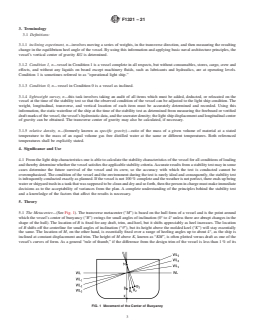
5.1 The Metacenter—(See Fig. 1). The transverse metacen-
weights, in the transverse direction, and then measuring the
ter (“M”) is based on the hull form of a vessel and is the point
resultingchangeintheequilibriumheelangleofthevessel.By
around which the vessel’s center of buoyancy (“B”) swings for
using this information and applying basic naval architecture
small angles of inclination (0° to 4° unless there are abrupt
principles, the vessel’s vertical center of gravity KG is deter-
changes in the shape of the hull).The location of B is fixed for
mined.
any draft, trim, and heel, but it shifts appreciably as heel
3.1.2 Condition 1, n—vessel in Condition 1 is a vessel
increases. The location of B shifts off the centerline for small
complete in all respects, but without consumables, stores,
anglesofinclination(“θ”),butitsheightabovethemoldedkeel
cargo, crew and effects, and without any liquids on board
(“K”) will stay essentially the same. The location of M, on the
except machinery fluids, such as lubricants and hydraulics, are
other hand, is essentially fixed over a range of heeling angles
at operating levels. Condition 1 is sometimes referred to as
up to about 4°, as the ship is inclined at constant displacement
“operational light ship.”
and trim. The height of M above K, known as “KM”, is often
3.1.3 Condition 0, n—vessel in Condition 0 is a vessel as
plotted versus draft as one of the vessel’s curves of form.As a
inclined.
general “rule of thumb,” if the difference from the design trim
ofthevesselislessthan1%ofitslength,the KMcanbetaken
3.1.4 lightweight survey, n—this task involves taking an
directly from either the vessel’s curves of form or hydrostatic
audit of all items which must be added, deducted, or relocated
tables. Because KM varies with trim, the KM must be com-
onthevesselatthetimeofthestabilitytestsothattheobserved
puted using the trim of the ship at the time of the stability test
condition of the vessel can be adjusted to the light ship
whenthedifferencefromthedesigntrimofthevesselisgreater
condition. The weight, longitudinal, transverse, and vertical
than 1% of its length. Caution should be exercised when
location of each item must be accurately determined and
applying the “rule of thumb” to ensure that excessive error, as
recorded. Using this information, the static waterline of the
would result from a significant change in the waterplane area
ship at the time of the stability test as determined from
during heeling, is not introduced into the stability calculations.
measuring the freeboard or verified draft marks of the vessel,
thevessel’shydrostaticdata,andtheseawaterdensity;thelight
5.2 Metacentric Height—The vertical distance between the
ship displacement and longitudinal center of gravity can be
center of gravity (“G”) and M is called the metacentric height
obtained. The transverse center of gravity may also be
(“GM”). At small angles of heel, GM is equal to the initial
calculated, if necessary.
slope of the righting arm (“GZ”) curve and is calculated using
3.1.5 relative density, n—(formerly known as specific the relationship, GZ = GM sin θ. GM is a measure of vessel
gravity)—ratio of the mass of a given volume of material at a
stability that can be calculated during an inclining experiment.
stated temperature to the mass of an equal volume gas free As shown in Fig. 1 and Fig. 2, moving a weight (“W”) across
distilled water at the same or different temperatures. Both
the deck a distance (“x”) will cause a shift in the overall center
referenced temperatures shall be explicitly stated. of gravity (G–G') of the vessel equal to (W)(x)/displ and
parallel to the movement of W. The vessel will heel over to a
4. Significance and Use
new equilibrium heel angle where the new center of buoyancy,
B', will once again be directly under the new center of gravity
4.1 From the light ship characteristics one is able to calcu-
(G'). Because the angle of inclination during the inclining
late the stability characteristics of the vessel for all conditions
experiment is small, the shift in G can be approximated by
of loading and thereby determine whether the vessel satisfies
theapplicablestabilitycriteria.Accurateresultsfromastability
test may in some cases determine the future survival of the
vessel and its crew, so the accuracy with which the test is
conducted cannot be overemphasized. The condition of the
vessel and the environment during the test is rarely ideal and
consequently, the stability test is infrequently conducted ex-
actly as planned. If the vessel is not 100% complete and the
weather is not perfect, there ends up being water or shipyard
trash in a tank that was supposed to be clean and dry and so
For referenced ASTM standards, visit the ASTM website, www.astm.org, or
contact ASTM Customer Service at service@astm.org. For Annual Book of ASTM
Standards volume information, refer to the standard’s Document Summary page on
the ASTM website. FIG. 1 Movement of the Center of Buoyancy
F1321 − 21
5.3 Calculating the Height of the Center of Gravity Above
the Keel—KM is known for the draft and trim of the vessel
during the stability test. The metacentric height, GM,as
calculated above, is determined from the inclining experiment.
The difference between the height KM and the distance GM is
the height of the center of gravity above the keel, KG. See Fig.
4.
5.4 Measuring the Angle of Inclination—(See Fig. 5.) Each
time an inclining weight, W, is shifted a distance, x, the vessel
will settle to some equilibrium heel angle, θ. To measure this
angle, θ, accurately, pendulums or other precise instruments
areusedonthevessel.Whenpendulumsareused,thetwosides
of the triangle defined by the pendulum are measured. (“Y”) is
FIG. 2 Metacentric Height
the length of the pendulum wire from the pivot point to the
batten and (“Z”) is the distance the wire deflects from the
reference position at the point along the pendulum length
where transverse deflections are measured. Tangent θ is then
calculated:
tan θ 5 Z/Y (2)
After each weight movement, plotting all of the readings for
each of the pendulums during the inclining experiment aids in
the discovery of bad readings. Since (W)(x)/tan θ should be
constant, the plotted line should be straight. Deviations from a
straight line are an indication that there were other moments
acting on the vessel during the inclining.These other moments
must be identified, the cause corrected, and the weight move-
ments repeated until a straight line is achieved. Figs. 6-9
illustrate examples of how to detect some of these other
moments during the inclining and a recommended solution for
each case. For simplicity, only the average of the readings is
shown on the inclining plots.
5.5 Free Surface—During the stability test, the inclining of
thevesselshouldresultsolelyfromthemovingoftheinclining
weights. It should not be inhibited or exaggerated by unknown
moments or the shifting of liquids on board. However, some
liquids will be aboard the vessel in slack tanks so a discussion
of “free surface” is appropriate.
5.5.1 Standing Water on Deck—Decks should be free of
FIG. 3 A Typical Incline Plot
water.Watertrappedondeckmayshiftandpocketinafashion
similar to liquids in a tank.
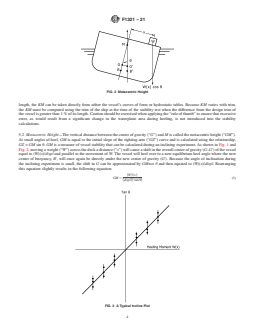
GMtan θ and then equated to (W)(x)/displ. Rearranging this
equation slightly results in the following equation:
~W!~x!
GM 5 (1)
displ tan θ
~ !~ !
Since GMand displremainconstantthroughouttheinclining
experiment the ratio (W)(x)/tan θ will be a constant. By
carefully planning a series of weight movements, a plot of
tangents is made at the corresponding moments. The ratio is
measured as the slope of the best represented straight line
drawn through the plotted points as shown in Fig. 3, where
three angle indicating devices have been used. This line does
not necessarily pass through the origin or any other particular
point, for no single point is more significant than any other
point. A linear regression analysis is often used to fit the
straight line. FIG. 4 Relationship betweenGM,KM, andKG
F1321 − 21
FIG. 5 Measuring the Angle of Inclination
NOTE 1—Take water soundings and check lines; redo Weight Move-
ments 2 and 3.
FIG. 7 Vessel Touching Bottom or Restrained by Mooring Lines
NOTE 1—Recheck all tanks and voids and pump out as necessary; redo
all weight movements and recheck freeboard and draft readings.
FIG. 6 Excessive Free Liquids
5.5.2 Tankage During the Inclining—If there are liquids on
board the vessel when it is inclined, whether in the bilges or in
the tanks, it will shift to the low side when the vessel heels.
This shift of liquids will exaggerate the heel of the vessel.
Unless the exact weight and distance of liquid shifted can be
precisely calculated, the GM from Eq 1 will be in error. Free
surfaceshouldbeminimizedbyemptyingthetankscompletely
FIG. 8 Steady Wind From Port Side Came Up After Initial Zero
Point Taken (Plot Acceptable)
and making sure all bilges are dry or by completely filling the
tanks so that no shift of liquid is possible.The latter method is
not the optimum because air pockets are difficult to remove
frombetweenstructuralmembersofatank,andtheweightand rectangular, trapezoidal, and so forth) when viewed from
centeroftheliquidinafulltankmustbeaccuratelydetermined above, so that the free surface moment of the liquid can be
toadjustthelightshipvaluesaccordingly.Whentanksmustbe accurately determined. The free surface moment of the liquid
left slack, it is desirable that the sides of the tanks be parallel in a tank with parallel vertical sides can be readily calculated
vertical planes and the tanks be regular in shape (that is, by the equation:
F1321 − 21
Equipmentthatmayshiftduringtheinclining,suchasZ-drives
or cargo gear, must be securely locked in place.
6.2 Tankage—Include the anticipated liquid loading for the
test in the planning for the test. Preferably, all tanks should be
empty and clean or completely full. Keep the number of slack
tankstoaminimum.Theviscosityofthefluidandtheshapeof
the tank should be such that the free surface effect can be
accurately determined.All cross-connects between tanks must
be closed. When conducting a lightweight survey only, strict
adherence to the following sub-paragraphs may not be
required, so long as all tankage is static, measureable and
quantified at the time of the stability test. When an inclining
experiment is part of the stability test, the tankage during the
lightweight survey must remain the same as during the
inclining to the greatest extent possible.
6.2.1 Slack Tanks:
6.2.1.1 The number of slack tanks should normally be
limitedtoonepairofportandstarboardtanksoronecenterline
tank of the following:
(1)Freshwater reserve feed tanks,
(2)Fuel/diesel oil storage tanks,
NOTE 1—Redo Weight Movements 1 and 5.
(3)Fuel/diesel oil day tanks,
FIG. 9 Gusty Wind From Port Side
(4)Lube oil tanks,
(5)Sanitary tanks, or
M 5 lb /12Q (3)
fs
(6)Potable water tanks.
where:
6.2.1.2 To avoid pocketing, slack tanks should normally be
of regular (that is, rectangular, trapezoidal, and so forth) cross
M = free surface moment, ft-Ltons
fs
l = length of tank, ft, section and be 20 to 80% full if they are deep tanks and 40 to
b = breadth of tank, ft, 60% full if they are double-bottom tanks. These levels ensure
Q = specific volume of liquid in tank (ft /ton), and
that the rate of shifting of liquid remains constant throughout
(See AnnexA3 for liquid conversions or measure Q
the heel angles of the stability test. If the trim changes as the
directly with a hydrometer.)
vessel is inclined, then consideration must also be given to
Lton = long ton of 2240 lbs.
longitudinal pocketing. Slack tanks containing liquids of suf-
ficientviscositytopreventfreemovementoftheliquids,asthe
Free surface correction is independent of the height of the
vessel is inclined (such as Bunker C at low temperature),
tank in the ship, location of the tank, and direction of heel.
should be avoided since the free surface cannot be calculated
5.5.3 As the width of the tank increases, the value of free
accurately.Afree surface correction for such tanks should not
surface moment increases by the third power. The distance
be used unless the tanks are heated to reduce viscosity.
available for the liquid to shift is the predominant factor. This
Communicationbetweentanksshouldneverbeallowed.Cross
is why even the smallest amount of liquid in the bottom of a
connections, including those via manifolds, should be closed.
wide tank or bilge is normally unacceptable and should be
Equal liquid levels in slack tank pairs can be a warning sign of
removed before the inclining experiment. Insignificant
open cross connections. A bilge, ballast, and fuel oil piping
amounts of liquids in V-shaped tanks or voids (for example, a
plan can be referred to, when checking for cross-connection
chainlockerinthebow),wherethepotentialshiftisnegligible,
closures.
mayremainifremovaloftheliquidwouldbedifficultorwould
cause extensive delays. 6.2.2 Pressed Up Tanks—Pressed up means completely full
with no voids caused by trim or inadequate venting.Anything
6. Preparations for the Stability Test
less than 100% full, for example, the 98% condition regarded
as full for operational purposes, is not acceptable. The vessel
6.1 General Condition of the Vessel—Avessel should be as
may be rolled from side to side to eliminate entrapped air
complete as possible at the time of the stability test. Schedule
before taking the final sounding. Special care should be taken
the test to minimize the disruption in the vessel’s delivery date
whenpressingfueloiltankstopreventaccidentalpollution.An
or its operational commitments. The amount and type of work
exampleofatankthatwouldappear“pressedup,”butactually
left to be completed (weights to be added) affects the accuracy
contained entrapped air is shown in Fig. 10.
of the light ship characteristics, so good judgment must be
used. If the weight or center of gravity of an item to be added 6.2.3 Empty Tanks—It is generally not sufficient simply to
cannot be determined with confidence, it is best to conduct the pump tanks until suction is lost. Enter the tank after pumping
stability test after the item is added. Temporary material, tool to determine if final stripping with portable pumps or by hand
boxes,staging,trash,sand,debris,andsoforthonboardshould is necessary. The exceptions are very narrow tanks or tanks
be reduced to absolute minimum during the stability test. where there is a sharp deadrise, since free surface would be
F1321 − 21
FIG. 11 The Preferred Mooring Arrangement
FIG. 10 Tank Containing Entrapped Air
negligible. Since all empty tanks must be inspected, all
manholes must be open and the tanks well ventilated and
certified as safe for entry. A safe testing device should be on
hand to test for sufficient oxygen and minimum toxic levels.
6.3 Mooring Arrangements—Theimportanceofgoodmoor-
FIG. 12 An Acceptable Alternate Mooring Arrangement
ing arrangements cannot be overemphasized.The arrangement
selection will be dependent upon many factors. Among the
most important are depth of water, wind, and current effects.
Whenever possible, the vessel should be moored in a quiet, practicable. Provide cylindrical camels between the vessel and
sheltered area free of extraneous forces such as propeller wash the dock.All lines should be slack, with the vessel free of the
from passing tugs or sudden discharges from shoreside pumps. pier and camels, when taking readings.
Thedepthofwaterunderthehullshouldbesufficienttoensure 6.3.2.1 If the vessel is held off the pier by the combined
thatthehullwillbeentirelyfreeofthebottomatthemaximum effect of the wind and current, and the bow and stern lines are
inclinationangle.Thetideconditionsandthetrimofthevessel secured at centerline near the waterline, they can be taut. This
duringthetestmustbeconsidered.Beforethetest,measurethe is essentially the same as the preferred arrangement described
depth of water and record in as many locations as necessary to in 6.3.1.Asin 6.3.1, varying wind or current, or both, will
ensure the vessel will not contact the bottom. If marginal, cause some distortion of the plot.
conduct the test during high tide or move the vessel to deeper 6.3.2.2 Ifthevesselispressedagainstthecamelsbywindor
water. current, or both, all lines should be slack. The cylindrical
6.3.1 The vessel should be held by lines at the bow and the camels will prevent binding, but again there will be an
stern, attached to temporary pad eyes installed as close as unavoidable superimposed heeling moment as a result of the
possibletothecenterlineofthevesselandasnearthewaterline ship bearing against the camels. This condition should be
as practical. If temporary pad eyes are not feasible, then lines avoided but when used, give consideration to positioning the
can be secured to bollards or cleats, or both, on the deck. This ship free of the dock and camels, and letting the ship drift as
arrangement requires that the lines be slackened when the ship readingsaretaken.Thevesselmaybeheldawayfromthedock
is heeled away from the dock. The preferred arrangement is by tugs, or pushed off the dock from shoreside by hand or by
withthevessellyinginaslipwhereitcanbemooredasshown using equipment such as forklifts with pusher knees.
in Fig. 11. In this case, the lines can be kept taut to hold the 6.3.2.3 Another acceptable arrangement is where the com-
vessel in place, yet allowing unrestricted heeling. Note, binedwindandcurrentaresuchthattheshipmaybecontrolled
however, that wind or current, or both, may cause a superim- by only one line at either the bow or the stern. In this case the
posed heeling moment to act on the vessel throughout the test. control line need not be attached near the waterline, but it
For steady conditions, this will not affect the results. Gusty should be led from on or near the center line of the ship. With
wind or uniformly varying wind or current, or both, will cause all lines but one slack, the ship is free to veer with the wind or
these superimposed heeling moments to change, which may current, or both, as readings are taken. This can sometimes be
requireadditionaltestpointstoobtainavalidtest.Theneedfor troublesome because varying wind or current, or both, can
additional test points can be determined by plotting test points cause distortion of the plot.
as they are obtained. 6.3.3 If a floating crane is used for handling inclining
6.3.2 Where the vessel can be moored to one side only, it is weights it should not be moored to the ship.
good practice to supplement the bow and stern lines with two 6.3.4 Remove the access ramps and gangways. Shore
springlinestomaintainpositivecontrolofthevessel,asshown connections, hoses, and so forth connected to shore should be
in Fig. 12. The leads of the spring lines should be as long as at a minimum and kept slack at all times.
F1321 − 21
6.4 List and Trim—To simplify calculations the vessel 6.5.1.4 Estimatethetotalweight, W,requiredbythefollow-
should be as close as possible to even list and design trim and ing equation:
have sufficient draft so that any abrupt changes in the water-
GM tan θ displ
~ !
W 5 (5)
plane will be avoided as the ship is inclined from side to side.
x
If the vessel has a bow appendage, such as a bulbous bow or
whereθisthedesiredangleofinclinationbetween1°and4°.
sonar dome, hard chine, or transom stern at the waterline, then
6.5.1.5 It would be prudent to have additional weights
give consideration to changing the draft or trim to ensure there
readily available to compensate for any inaccurate estimates.
is a minimum change in the waterplane area as the vessel is
heeled from side to side. Trim different from design of up to 6.5.2 Test weights should be compact and of such a con-
figuration that the vertical center of gravity of the weights can
1% of length between perpendiculars (“LBP”) is normally
acceptable when using hydrostatic data calculated at design be accurately determined. Weights, such as porous concrete,
thatcanabsorbsignificantamountsofmoisture,shouldonlybe
trim. Exercise caution when applying the “1% rule of thumb”
toensurethatexcessiveerror,aswouldresultfromasignificant used if they were weighed just before the stability test or if
recentweightcertificatesarepresented.Markeachweightwith
changeinthewaterplaneareaduringheeling,isnotintroduced
into the stability calculations. With inclining weights in the an identification number and weight. For small vessels, drums
initialposition,upto ⁄2°oflistisacceptable.Ifthelistexceeds completely filled with water may be used. Drums should
this, use leveling weights to put the vessel in an acceptable normally be full and capped to allow accurate weight control.
condition. In accordance with 1.2, if generating hydrostatic
6.5.2.1 Certify test weights using a certificated scale. Per-
calculations onboard for each condition, these limitations are form the weighing close enough in time to the stability test to
not applicable.
ensure the measured weight is accurate. The time since
weighing depends on the construction of the weight.
6.5 Test Weights—Test weight positions and movements
6.5.3 Acraneofsufficientcapacityandreach,orsomeother
should be preplanned and provided to test personnel and
means, must be available during the stability test to shift
responsible members of the ship’s force participating in the
weights on the deck in an expeditious and safe manner.
experiment well prior to loading weights for experiment. Note
6.5.4 Take precautions to ensure that the decks are not
alsothatthemovementpathshouldbecheckedtominimizethe
overloaded during weight movements. If deck strength is
possibility of damage due to striking ship structure or fittings
questionable, then perform a structural analysis to determine if
with a weight or crane fall.
existing framing can support the weight.
6.5.1 Thetotalweightusedshouldbesufficienttoprovidea
6.5.5 The test weights should be on board and in place
minimum inclination of 1° and a maximum of 4° of heel. One
before the scheduled time of the stability test.
approach that can be taken to estimate how much weight is
6.5.6 The standard test uses eight weight moves, three on
needed follows:
each side and stopping at the starting point as the weights are
6.5.1.1 Measurethemaximumathwartshipsdistance, x,that
being moved to the other side and upon completion.
is available on deck to shift the weights as shown in Fig. 13.
6.5.1.2 Estimate the draft the vessel will be at for the
6.6 Pendulums:
stability test and find the corresponding displacement from the
6.6.1 Use a minimum of three pendulums to allow identifi-
vessel’s hydrostatic data.
cation of bad readings at any one pendulum station. They
6.5.1.3 Estimate the GM of the vessel by estimating its
should each be located in an area protected from the wind. If
center of gravity, KG, and subtracting that value from KM,
this is not possible, then erect a screen around the exposed
obtained from the hydrostatic data for the appropriate draft;
portions of the pendulums. Pendulums should be located
GM 5 KM 2 KG (4) forward, midship, and aft. Preferred locations for pendulums
are ladder trunks, elevator shafts, hatchways, or any access
way passing through decks.
6.6.2 The pendulums should be long enough to give a
measured deflection, to each side of upright, of at least 6 in.
Usually, the longer the pendulum the greater the accuracy of
the test; however, if excessively long pendulums are used on a
tender ship, the pendulums may not settle down and the
accuracy of the pendulums would then be questionable. On
smaller vessels, where there is insufficient headroom to hang
long pendulums, obtain the 6-in. deflection by increasing the
test weight so as to increase the list. The typical inclination is
between2°and3°butinnocaseshouldthemaximumangleof
list be greater than 4°. As shown in Fig. 14, the pendulums
must be at least 87 in. long to get at least 6 in. of deflection
without exceeding the 4° maximum heel.
6.6.3 The pendulums should be of different lengths to avoid
the natural frequencies and, the possibility of collusion be-
FIG. 13 Movement of the Test Weights tween station recorders. The pendulum wire should be piano
F1321 − 21
FIG. 15 Typical Satisfactory Pendulum Arrangement
of the ship. Like the pendulum, the greater the span between
the vertical ends of the water tube apparatus, the higher the
tan θ =Z/Y
tan 4° = 6 in./Y
deflection readings when shifting the weight.Water tubes shall
Y = 6 in./tan 4°
be arranged to give equivalent measurement precision as a
Y = 6 in./0.0699
pendulum. Water tubes should be located forward, midship,
Y = 87 in.
tan 3° = 6 in./Y and aft.
Y = 6 in./tan 3°
6.7.3 The flexible water tubes should be long enough to lay
Y = 6 in./0.0524
freely athwartships on the ship and extend vertically on the
Y=114in.
tan 2° = 6 in./Y ends of an apparatus.
Y = 6 in./tan 2°
6.7.4 Make sure the water tube is free of any air bubbles.
Y = 6 in./0.0349
Trapped air bubbles will cause an error in the deflection
Y = 172 in.
readings. Generally, when using three water tubes in parallel
FIG. 14 Angle of Inclination Versus Pendulum Length
with one another, different colored dye is added to each water
tube to allow personnel recording the deflections to do so
wireorothermonofilamentmaterial.Thetopconnectionofthe without discrepancy. This also ensures that the port and
pendulumshouldaffordunrestrictedrotationofthepivotpoint. starboard legs of the tube are correctly matched. Note that a
An example is that of a washer with the pendulum wire stopcockoneachendofeachtubeallowsthemtobemovedor
attached suspended from a nail. otherwise inclined without loss of the fluid, but verify that the
6.6.4 Aweightedwingedpendulumbob(suchastwoangles stopcocks are fully open during each measurement.
connected at their heels) shall be immersed in a trough filled 6.7.5 Rulersorbattensshouldbefixedtotheverticalendsof
with a liquid to dampen oscillations after each weight move- the water tube apparatus to easily read the deflection in the
ment. Liquid detergent generally works well. The trough water tube.
should be deep enough to prevent the pendulum bob from 6.7.6 The water tube apparatus is usually located in an
touching the bottom. unobstructed section of the boat deck where it can pass freely
6.6.5 The battens should be smooth, light-colored wood, ⁄2 fromsidetoside.Notethatthetubeconnectingthewaterlevels
to ⁄4 in. thick, and should be securely fixed in position so that may run freely vertically and fore and aft, etc. as convenient
an inadvertent contact will not cause them to shift. The batten provided that no point on the tube is higher than the measure-
shouldbealignedclosetothependulumwirebutnotincontact ment area and that no air pockets are formed.
with it.
6.8 Digital Inclinometers:
6.6.6 The pendulums should be in place before the sched-
6.8.1 Calibrated digital inclinometers with an ability to
uled time of the stability test.
display at least hundredths (0.01) of a degree and an accuracy
6.6.7 AtypicalsatisfactoryarrangementisshowninFig.15.
of 6five-hundredths (0.05) of a degree may be substituted for
The pendulums may be placed in any location on the vessel,
pendulums. However, at least one pendulum must be used for
longitudinally and transversely.
the test.
6.7 Water Tubes: 6.8.2 Inclinometers should be located with the active axis
6.7.1 Water tubes may be substituted for pendulums. athwartships and in an unobstructed area easily viewed by
However, at least one pendulum must be used for the test. personneltorecord.Ifthereadingdoesnotstabilizeatasingle
6.7.2 At a minimum, three (3) water tubes should be number,anaverageofatleastfivemaximum-minimumswings
arranged to allow personnel to read and record deflections (therefore, ten readings) should be recorded for each weight
causedbytheweightshiftduringthestabilitytestoneitherside movement.
F1321 − 21
6.9 No other angle measuring device should be excluded 7.2.5 A sufficiently long sounding tape for sounding tanks
from use during an inclining experiment if it can be shown to and taking freeboard readings,
be equivalent in precision and accuracy as a pendulum.
7.2.6 One or more relative density hydrometers as pre-
Substitution of such devices for pendulums would be at the
scribed in Specification E100 for general use with range
discretion of the approving authority.
sufficient to cover 0.999 to 1.030, to measure the relative
density of the water in which the vessel is floating,
6.10 Communications Arrangements:
7.2.7 Other hydrometers as necessary to measure the rela-
6.10.1 One person at a central control station should have
tive density of any liquids on board,
complete control over all personnel involved in the test.
7.2.8 As a backup to computer plotting, graph paper to plot
6.10.2 There should be efficient two-way communications
inclining moments versus tangents,
between central control and the weight handlers and between
7.2.9 Astraight edge to draw the measured waterline on the
central control and each pendulum station.
lines drawing,
6.10.3 Shelter the central control station from the elements,
7.2.10 A pad of paper to record data,
and have adequate lighting so that a plot of tangents versus
7.2.11 An explosion proof testing device to check for
heeling moments can be made during the test. It is desirable
that the weight handlers be directly observed from the control sufficientoxygenandabsenceoflethalgasesintanksandother
closed spaces such as voids and cofferdams,
station.
7.2.12 A thermometer, and
6.11 Additional Requirements:
7.2.13 A calculator,
6.11.1 AnnexA1containsadditionalrequirementsthatmust
7.2.14 A digital camera, and
be met, if U.S. Coast Guard approval of the stability test is
7.2.15 Draft tubes (if necessary).
needed.
6.11.2 AnnexA2containsadditionalrequirementsthatmust
7.3 Substitutes—Substitution of such other devices for the
be met for stability tests on U.S. Navy vessels.
equipment above, such as refractometers for hydrometers,
6.11.3 Inclining procedures should be presented to the
would be at the discretion of the approving authority.
approving authority prior to conducting the stability test.
8. Procedure
7. Plans and Equipment Required
8.1 The inclining experiment, the freeboard/draft readings,
7.1 Plans—The person in charge of the inclining should
andthesurvey,maybeconductedinanyorderandstillachieve
have available a copy of the following at the time of the
the same results. If the person conducting the stability test is
stability test:
confident that the survey will show that the vessel is in an
7.1.1 Lines plan,
acceptable condition and there is the possibility of the weather
7.1.2 Curves of form (hydrostatic curves) or hydrostatic
becomingunfavorable,thenitissuggestedthattheincliningbe
data, performedfirstandthesurveylast.Ifthepersonconductingthe
7.1.3 General arrangement plan of decks, holds, inner test is doubtful that the vessel is complete enough for the test,
bottoms, and so forth, it is recommended that the survey be performed first since this
7.1.4 Outboard profile, could invalidate the entire test, regardless of the weather
conditions. It is very important that all weights, the number of
7.1.5 Inboard profile,
people on board, and so forth, remain constant throughout the
7.1.6 Midship section,
test.AppendixX1containsastabilitytestchecklistthatcanbe
7.1.7 Capacity plan showing capacities and vertical and
used to make a quick check that the procedure is correctly
longitudinal centers of gravity of cargo spaces, tanks, and so
followed.
forth,
8.1.1 Initial Walk Through and Survey—The person respon-
7.1.8 Tank sounding tables,
sibleforconductingthestabilitytestshouldarriveonboardthe
7.1.9 Draft mark locations, and
vessel well in advance of the scheduled time of the test to
7.1.10 Docking drawing with keel profile and draft mark
ensure that the vessel is properly prepared for the test. If the
corrections (if available).
ship to be inclined is large, a preliminary walk-through may
7.2 Equipment—Besides the physical equipment necessary
needtobedonethedayprecedingtheactualincline.Toensure
such as the inclining weights, pendulums, small boat, and so
the safety of personnel conducting the walk-through, and to
forth,thefollowingarenecessaryandshouldbeprovidedbyor
improve the documentation of surveyed weights and
made available to the person in charge of the inclining:
deficiencies, at least two persons should make the initial
7.2.1 Three engineering scales for measuring pendulum
walk-through. Things to check include: all compartments are
deflections(rulesshouldbesubdividedintoatleasttenthsofan
open, clean, and dry, tanks are well ventilated and gas free;
inch),
movable or suspended items are secured and their position
7.2.2 Threesharppencilsformarkingpendulumdeflections,
documented;pendulumsareinplace;weightsareonboardand
7.2.3 Chalk for marking the various positions of the inclin-
in place; a crane or other method for moving weights is
ing weights,
available;andthenecessaryplansandequipmentareavailable.
7.2.4 A sufficiently long measuring tape for measuring the Before beginning the stability test, the person conducting the
movementoftheweightsandlocatingdifferentitemsonboard, test should:
F1321 − 21
8.1.1.1 Consider the weather conditions. The combined during the incline and survey or the person reviewing the
adverse effect of wind, current, and sea may result in difficul- stabilitytest,orboth,maynothavebeenpresentduringthetest
ties or even an invalid test due to the following: and must be able to determine the exact location of the items
(1)Inability to record freeboards and drafts accurately, from the data recorded and the vessel’s drawings. Any tanks
(2)Excessive or irregular oscillations of the pendulums, containing liquids must be accurately sounded and the sound-
and ings recorded. Table 1 is an example of just a few typical
(3)Variations in unavoidable superimposed heeling mo- entries from a survey.
ments. (1)Itisrecognizedthattheweightofsomeitemsonboard,
In some instances, unless conditions can be sufficiently or that are to be added, may have to be estimated. If this is
improved by moving the vessel to a better location, it may be necessary, it is in the best interest of safety to be on the safe
necessary to delay or postpone the test. Any significant side when estimating, so the following rules of thumb should
quantities of rain, snow, or ice must be removed from the be followed:
vessel before the test. (a)When estimating weights to be added:
8.1.1.2 Make a quick overall survey of the vessel to make – estimate high for items to be added high in the vessel, and
sure the vessel is complete enough to conduct the test and to – estimate low for items to be added low in the vessel.
ensure that all equipment is in place. (b)When estimating weights to be removed:
8.1.1.3 Enter all empty tanks after it is determined that they – estimate low for items to be removed from high in the
are well ventilated and gas free to ensure that they are dry and vessel, and
free of debris. Ensure that any pressed up tanks are indeed full – estimate high for items to be removed from low in the
and free of air pockets. vessel.
8.1.1.4 Survey the entire vessel to identify all items that (c)When estimating weights to be relocated:
need to be added to the vessel, removed from the vessel, or – estimate high for items to be relocated to a higher point in
relocated on the vessel to bring the vessel to the light ship the vessel,
condition. Each item must be clearly identified by weight and – estimate low for items to be relocated to a lower point in
vertical and longitudinal location. If necessary, record also the the vessel.
transverse location.The inclining weights, the pendulums, any 8.1.2 Freeboard/Draft Readings:
temporary equipment and dunnage, and the people on board 8.1.2.1 Take freeboard/draft readings to establish the posi-
during the stability test are all among the weights to be tion of the waterline to determine the displacement of the
removed to obtain the light ship condition. The person calcu- vessel at the time of the stability test. At least five freeboard
lating the light ship characteristics from the data gathered readings, approximately equally spaced along the length of the
TABLE 1 Typical Survey Entries
Items To Be Removed
Item Weight, lb Vertical Center Longitudinal Center
Inclining Weight No. 1 2400 3 ft above main deck 4.5 ft aft frame 50
Inclining Weight No. 2 2640 3 ft above main deck frame 50
Inclining Weight No. 3 2500 3 ft above main deck 4.5 ft forward frame 50
Inclining Weight No. 4 2350 3 ft above main deck frame 51
Two men 370 3 ft above main deck frame 63
Two men 370 3 ft above main deck frame 90
Pendulum No. 1 (total setup and 240 2.8 ft above bottom at centerline 3 ft forward of aft engine room bulkhead
one man)
AA A
Fuel oil tank No. 3P 8 ft 8 in.
sounding
AA A
Potable water tk No. 1C 9 ft 3 in.
sounding
Items To Be Added
Item Weight, lb Vertical Center Longitudinal Center
Radio 200 5 ft above pilot deck 2 ft aft forward pilot house bulkhead
Antenna 85 15 ft above top of pilot house frame 20
Towing cable 800 2.5 ft above main deck 8 ft forward frame 85
Rescue boat 120 4 ft above main deck frame 60
Items To Be Relocated
Item Weight, lb From To
Vertical Longitudinal Vertical Longitudinal
Liferaft 300 main deck frame 50 01 deck frame 65
Fire pump 220 main deck frame 65 2 ft above shell frame 40
A
Can be determined later by the naval architect from drawings or sounding tables, or both.
F1321 − 21
vessel with the foremost and aftermost readings positioned as 8.1.2.8 Calculate the mean draft (average of port and
close as possible to the forward and aft perpendicular, should starboard reading) for each of the locations where freeboard/
draft readings are taken and plotted on the vessel’s lines
be taken on each side of the vessel to determine the waterline
at the time of the inclining. Only on ships where the vertical drawing or outboard profile to ensure that all readings are
consistent and together define the correct waterline. The
location of the draft marks (forward, midship, and aft on both
resulting plot should yield either a straight line or a waterline
sides) have been confirmed to accurately determine the water-
which is either hogged or sagged. If inconsistent readings are
line should draft readings be used in lieu of freeboards. The
obtained, retake the freeboards/drafts.
locations for each freeboard reading should be clearly marked.
8.1.3 The Inclining Experiment:
The longitudinal location along the vessel must be accurately
8.1.3.1 Beforeanyweightmovements,checkthefollowing:
determinedandrecordedsincethe(molded)depthateachpoint
(1)Check the mooring arrangement to ensure that the
will be obtained from the vessel’s lines. All freeboard mea-
vesselisfloatingfreely.(Dothisjustbeforeeachreadingofthe
surements should include a reference note clarifying the
pendulums.)
inclusion of the coaming in the measurement and the coaming
(2)Measure the pendulums and record their lengths. The
height.
pendulumsshouldbealignedsothatwhenthevesselheels,the
8.1.2.2 Read draft and freeboa
...
This document is not an ASTM standard and is intended only to provide the user of an ASTM standard an indication of what changes have been made to the previous version. Because
it may not be technically possible to adequately depict all changes accurately, ASTM recommends that users consult prior editions as appropriate. In all cases only the current version
of the standard as published by ASTM is to be considered the official document.
Designation: F1321 − 14 (Reapproved 2021) F1321 − 21 An American National Standard
Standard Guide for
Conducting a Stability Test (Lightweight Survey and
Inclining Experiment) to Determine the Light Ship
Displacement and Centers of Gravity of a Vessel
This standard is issued under the fixed designation F1321; the number immediately following the designation indicates the year of
original adoption or, in the case of revision, the year of last revision. A number in parentheses indicates the year of last reapproval. A
superscript epsilon (´) indicates an editorial change since the last revision or reapproval.
This standard has been approved for use by agencies of the U.S. Department of Defense.
INTRODUCTION
This guide provides the marine industry with a basic understanding of the various aspects of a
stability test. It contains procedures for conducting a stability test to ensure that valid results are
obtained with maximum precision at a minimal cost to owners, shipyards, and the government. This
guide is not intended to instruct a person in the actual calculation of the light ship displacement and
centers of gravity, but rather to be a guide to the necessary procedures to be followed to gather accurate
data for use in the calculation of the light ship characteristics. A complete understanding of the correct
procedures used to perform a stability test is imperative to ensure that the test is conducted properly
and so that results can be examined for accuracy as the inclining experiment is conducted. It is
recommended that these procedures be used on all vessels and marine craft.
1. Scope
1.1 This guide covers the determination of a vessel’s light ship characteristics. In this standard, a vessel is a traditional hull-formed
vessel. The stability test can be considered to be two separate tasks; the lightweight survey and the inclining experiment. The
stability test is required for most vessels upon their completion and after major conversions. It is normally conducted inshore in
calm weather conditions and usually requires the vessel be taken out of service to prepare for and conduct the stability test. The
three light ship characteristics determined from the stability test for conventional (symmetrical) ships are displacement (“displ”),
longitudinal center of gravity (“LCG”), and the vertical center of gravity (“KG”). The transverse center of gravity (“TCG”) may
also be determined for mobile offshore drilling units (MODUs) and other vessels which are asymmetrical about the centerline or
whose internal arrangement or outfitting is such that an inherent list may develop from off-center weight. Because of their nature,
other special considerations not specifically addressed in this guide may be necessary for some MODUs. This standard is not
applicable to vessels such as a tension-leg platforms, semi-submersibles, rigid hull inflatable boats, and so on.
1.2 The limitations of 1 % trim or 4 % heel and so on apply if one is using the traditional pre-defined hydrostatic characteristics.
This is due to the drastic change of waterplane area. If one is calculating hydrostatic characteristics at each move, such as utilizing
a computer program, then the limitations are not applicable.
1.3 The values stated in inch-pound units are to be regarded as standard. No other units of measurement are included in this
standard.
This guide is under the jurisdiction of ASTM Committee F25 on Ships and Marine Technology and is the direct responsibility of Subcommittee F25.01 on Structures.
Current edition approved Jan. 15, 2021May 1, 2021. Published February 2021May 2021. Originally approved in 1990. Last previous edition approved in 20142021 as
F1321 – 14.F1321 – 14 (2021). DOI: 10.1520/F1321-14R21.10.1520/F1321-21.
Copyright © ASTM International, 100 Barr Harbor Drive, PO Box C700, West Conshohocken, PA 19428-2959. United States
F1321 − 21
1.3.1 Exceptions—Other units may be used for the stability test, but the test results should be reported in the same units and
coordinate system as the vessel’s draft marks and Trim and Stability Book or similar stability information provided.
1.4 This standard does not purport to address all of the safety concerns, if any, associated with its use. It is the responsibility
of the user of this standard to establish appropriate safety, health, and environmental practices and determine the applicability of
regulatory limitations prior to use.
1.5 This international standard was developed in accordance with internationally recognized principles on standardization
established in the Decision on Principles for the Development of International Standards, Guides and Recommendations issued
by the World Trade Organization Technical Barriers to Trade (TBT) Committee.
2. Referenced Documents
2.1 ASTM Standards:
E100 Specification for ASTM Hydrometers
For referenced ASTM standards, visit the ASTM website, www.astm.org, or contact ASTM Customer Service at service@astm.org. For Annual Book of ASTM Standards
volume information, refer to the standard’s Document Summary page on the ASTM website.
F1321 − 21
3. Terminology
3.1 Definitions:
3.1.1 inclining experiment, n—involves moving a series of weights, in the transverse direction, and then measuring the resulting
change in the equilibrium heel angle of the vessel. By using this information and applying basic naval architecture principles, the
vessel’s vertical center of gravity KG is determined.
3.1.2 Condition 1, n—vessel in Condition 1 is a vessel complete in all respects, but without consumables, stores, cargo, crew and
effects, and without any liquids on board except machinery fluids, such as lubricants and hydraulics, are at operating levels.
Condition 1 is sometimes referred to as “operational light ship.”
3.1.3 Condition 0, n—vessel in Condition 0 is a vessel as inclined.
3.1.4 lightweight survey, n—this task involves taking an audit of all items which must be added, deducted, or relocated on the
vessel at the time of the stability test so that the observed condition of the vessel can be adjusted to the light ship condition. The
weight, longitudinal, transverse, and vertical location of each item must be accurately determined and recorded. Using this
information, the static waterline of the ship at the time of the stability test as determined from measuring the freeboard or verified
draft marks of the vessel, the vessel’s hydrostatic data, and the seawater density; the light ship displacement and longitudinal center
of gravity can be obtained. The transverse center of gravity may also be calculated, if necessary.
3.1.5 relative density, n—(formerly known as specific gravity)—ratio of the mass of a given volume of material at a stated
temperature to the mass of an equal volume gas free distilled water at the same or different temperatures. Both referenced
temperatures shall be explicitly stated.
4. Significance and Use
4.1 From the light ship characteristics one is able to calculate the stability characteristics of the vessel for all conditions of loading
and thereby determine whether the vessel satisfies the applicable stability criteria. Accurate results from a stability test may in some
cases determine the future survival of the vessel and its crew, so the accuracy with which the test is conducted cannot be
overemphasized. The condition of the vessel and the environment during the test is rarely ideal and consequently, the stability test
is infrequently conducted exactly as planned. If the vessel is not 100 % complete and the weather is not perfect, there ends up being
water or shipyard trash in a tank that was supposed to be clean and dry and so forth, then the person in charge must make immediate
decisions as to the acceptability of variances from the plan. A complete understanding of the principles behind the stability test
and a knowledge of the factors that affect the results is necessary.
5. Theory
5.1 The Metacenter—(See Fig. 1). The transverse metacenter (“M”) is based on the hull form of a vessel and is the point around
which the vessel’s center of buoyancy (“B”) swings for small angles of inclination (0° to 4° unless there are abrupt changes in the
shape of the hull). The location of B is fixed for any draft, trim, and heel, but it shifts appreciably as heel increases. The location
of B shifts off the centerline for small angles of inclination (“θ”), but its height above the molded keel (“K”) will stay essentially
the same. The location of M, on the other hand, is essentially fixed over a range of heeling angles up to about 4°, as the ship is
inclined at constant displacement and trim. The height of M above K, known as “KM”, is often plotted versus draft as one of the
vessel’s curves of form. As a general “rule of thumb,” if the difference from the design trim of the vessel is less than 1 % of its
FIG. 1 Movement of the Center of Buoyancy
F1321 − 21
FIG. 2 Metacentric Height
length, the KM can be taken directly from either the vessel’s curves of form or hydrostatic tables. Because KM varies with trim,
the KM must be computed using the trim of the ship at the time of the stability test when the difference from the design trim of
the vessel is greater than 1 % of its length. Caution should be exercised when applying the “rule of thumb” to ensure that excessive
error, as would result from a significant change in the waterplane area during heeling, is not introduced into the stability
calculations.
5.2 Metacentric Height—The vertical distance between the center of gravity (“G”) and M is called the metacentric height (“GM”).
At small angles of heel, GM is equal to the initial slope of the righting arm (“GZ”) curve and is calculated using the relationship,
GZ = GM sin θ. GM is a measure of vessel stability that can be calculated during an inclining experiment. As shown in Fig. 1 and
Fig. 2, moving a weight (“W”) across the deck a distance (“x”) will cause a shift in the overall center of gravity (G–G') of the vessel
equal to (W)(x)/displ and parallel to the movement of W. The vessel will heel over to a new equilibrium heel angle where the new
center of buoyancy, B', will once again be directly under the new center of gravity (G'). Because the angle of inclination during
the inclining experiment is small, the shift in G can be approximated by GMtan θ and then equated to (W)(x)/displ. Rearranging
this equation slightly results in the following equation:
W x
~ !~ !
GM 5 (1)
~displ!~ tan θ!
FIG. 3 A Typical Incline Plot
F1321 − 21
Since GM and displ remain constant throughout the inclining experiment the ratio (W)(x)/tan θ will be a constant. By carefully
planning a series of weight movements, a plot of tangents is made at the corresponding moments. The ratio is measured as the slope
of the best represented straight line drawn through the plotted points as shown in Fig. 3, where three angle indicating devices have
been used. This line does not necessarily pass through the origin or any other particular point, for no single point is more significant
than any other point. A linear regression analysis is often used to fit the straight line.
5.3 Calculating the Height of the Center of Gravity Above the Keel—KM is known for the draft and trim of the vessel during the
stability test. The metacentric height, GM, as calculated above, is determined from the inclining experiment. The difference
between the height KM and the distance GM is the height of the center of gravity above the keel, KG. See Fig. 4.
5.4 Measuring the Angle of Inclination—(See Fig. 5.) Each time an inclining weight, W, is shifted a distance, x, the vessel will
settle to some equilibrium heel angle, θ. To measure this angle, θ, accurately, pendulums or other precise instruments are used on
the vessel. When pendulums are used, the two sides of the triangle defined by the pendulum are measured. (“Y”) is the length of
the pendulum wire from the pivot point to the batten and (“Z”) is the distance the wire deflects from the reference position at the
point along the pendulum length where transverse deflections are measured. Tangent θ is then calculated:
tan θ5 Z/Y (2)
After each weight movement, plotting all of the readings for each of the pendulums during the inclining experiment aids in the
discovery of bad readings. Since (W)(x)/tan θ should be constant, the plotted line should be straight. Deviations from a straight
line are an indication that there were other moments acting on the vessel during the inclining. These other moments must be
identified, the cause corrected, and the weight movements repeated until a straight line is achieved. Figs. 6-9 illustrate examples
of how to detect some of these other moments during the inclining and a recommended solution for each case. For simplicity, only
the average of the readings is shown on the inclining plots.
5.5 Free Surface—During the stability test, the inclining of the vessel should result solely from the moving of the inclining
weights. It should not be inhibited or exaggerated by unknown moments or the shifting of liquids on board. However, some liquids
will be aboard the vessel in slack tanks so a discussion of “free surface” is appropriate.
5.5.1 Standing Water on Deck—Decks should be free of water. Water trapped on deck may shift and pocket in a fashion similar
to liquids in a tank.
5.5.2 Tankage During the Inclining—If there are liquids on board the vessel when it is inclined, whether in the bilges or in the
tanks, it will shift to the low side when the vessel heels. This shift of liquids will exaggerate the heel of the vessel. Unless the exact
weight and distance of liquid shifted can be precisely calculated, the GM from Eq 1 will be in error. Free surface should be
minimized by emptying the tanks completely and making sure all bilges are dry or by completely filling the tanks so that no shift
of liquid is possible. The latter method is not the optimum because air pockets are difficult to remove from between structural
members of a tank, and the weight and center of the liquid in a full tank must be accurately determined to adjust the light ship
values accordingly. When tanks must be left slack, it is desirable that the sides of the tanks be parallel vertical planes and the tanks
be regular in shape (that is, rectangular, trapezoidal, and so forth) when viewed from above, so that the free surface moment of
the liquid can be accurately determined. The free surface moment of the liquid in a tank with parallel vertical sides can be readily
calculated by the equation:
FIG. 4 Relationship between GM,KM, and KG
F1321 − 21
FIG. 5 Measuring the Angle of Inclination
NOTE 1—Recheck all tanks and voids and pump out as necessary; redo all weight movements and recheck freeboard and draft readings.
FIG. 6 Excessive Free Liquids
M 5 lb /12Q (3)
fs
where:
M = free surface moment, ft-Ltons
fs
l = length of tank, ft,
b = breadth of tank, ft,
Q = specific volume of liquid in tank (ft /ton), and
(See Annex A3 for liquid conversions or measure Q directly with a hydrometer.)
Lton = long ton of 2240 lbs.
Free surface correction is independent of the height of the tank in the ship, location of the tank, and direction of heel.
5.5.3 As the width of the tank increases, the value of free surface moment increases by the third power. The distance available
for the liquid to shift is the predominant factor. This is why even the smallest amount of liquid in the bottom of a wide tank or
bilge is normally unacceptable and should be removed before the inclining experiment. Insignificant amounts of liquids in
V-shaped tanks or voids (for example, a chain locker in the bow), where the potential shift is negligible, may remain if removal
of the liquid would be difficult or would cause extensive delays.
F1321 − 21
NOTE 1—Take water soundings and check lines; redo Weight Movements 2 and 3.
FIG. 7 Vessel Touching Bottom or Restrained by Mooring Lines
FIG. 8 Steady Wind From Port Side Came Up After Initial Zero Point Taken (Plot Acceptable)
6. Preparations for the Stability Test
6.1 General Condition of the Vessel—A vessel should be as complete as possible at the time of the stability test. Schedule the test
to minimize the disruption in the vessel’s delivery date or its operational commitments. The amount and type of work left to be
completed (weights to be added) affects the accuracy of the light ship characteristics, so good judgment must be used. If the weight
or center of gravity of an item to be added cannot be determined with confidence, it is best to conduct the stability test after the
item is added. Temporary material, tool boxes, staging, trash, sand, debris, and so forth on board should be reduced to absolute
minimum during the stability test. Equipment that may shift during the inclining, such as Z-drives or cargo gear, must be securely
locked in place.
F1321 − 21
NOTE 1—Redo Weight Movements 1 and 5.
FIG. 9 Gusty Wind From Port Side
6.2 Tankage—Include the anticipated liquid loading for the test in the planning for the test. Preferably, all tanks should be empty
and clean or completely full. Keep the number of slack tanks to a minimum. The viscosity of the fluid and the shape of the tank
should be such that the free surface effect can be accurately determined. All cross-connects between tanks must be closed. When
conducting a lightweight survey only, strict adherence to the following sub-paragraphs may not be required, so long as all tankage
is static, measureable and quantified at the time of the stability test. When an inclining experiment is part of the stability test, the
tankage during the lightweight survey must remain the same as during the inclining to the greatest extent possible.
6.2.1 Slack Tanks:
6.2.1.1 The number of slack tanks should normally be limited to one pair of port and starboard tanks or one centerline tank of the
following:
(1) Freshwater reserve feed tanks,
(2) Fuel/diesel oil storage tanks,
(3) Fuel/diesel oil day tanks,
(4) Lube oil tanks,
(5) Sanitary tanks, or
(6) Potable water tanks.
6.2.1.2 To avoid pocketing, slack tanks should normally be of regular (that is, rectangular, trapezoidal, and so forth) cross section
and be 20 to 80 % full if they are deep tanks and 40 to 60 % full if they are double-bottom tanks. These levels ensure that the rate
of shifting of liquid remains constant throughout the heel angles of the stability test. If the trim changes as the vessel is inclined,
then consideration must also be given to longitudinal pocketing. Slack tanks containing liquids of sufficient viscosity to prevent
free movement of the liquids, as the vessel is inclined (such as Bunker C at low temperature), should be avoided since the free
surface cannot be calculated accurately. A free surface correction for such tanks should not be used unless the tanks are heated to
reduce viscosity. Communication between tanks should never be allowed. Cross connections, including those via manifolds, should
be closed. Equal liquid levels in slack tank pairs can be a warning sign of open cross connections. A bilge, ballast, and fuel oil
piping plan can be referred to, when checking for cross-connection closures.
6.2.2 Pressed Up Tanks—Pressed up means completely full with no voids caused by trim or inadequate venting. Anything less than
100 % full, for example, the 98 % condition regarded as full for operational purposes, is not acceptable. The vessel may be rolled
from side to side to eliminate entrapped air before taking the final sounding. Special care should be taken when pressing fuel oil
tanks to prevent accidental pollution. An example of a tank that would appear “pressed up,” but actually contained entrapped air
is shown in Fig. 10.
F1321 − 21
FIG. 10 Tank Containing Entrapped Air
6.2.3 Empty Tanks—It is generally not sufficient simply to pump tanks until suction is lost. Enter the tank after pumping to
determine if final stripping with portable pumps or by hand is necessary. The exceptions are very narrow tanks or tanks where there
is a sharp deadrise, since free surface would be negligible. Since all empty tanks must be inspected, all manholes must be open
and the tanks well ventilated and certified as safe for entry. A safe testing device should be on hand to test for sufficient oxygen
and minimum toxic levels.
6.3 Mooring Arrangements—The importance of good mooring arrangements cannot be overemphasized. The arrangement
selection will be dependent upon many factors. Among the most important are depth of water, wind, and current effects. Whenever
possible, the vessel should be moored in a quiet, sheltered area free of extraneous forces such as propeller wash from passing tugs
or sudden discharges from shoreside pumps. The depth of water under the hull should be sufficient to ensure that the hull will be
entirely free of the bottom at the maximum inclination angle. The tide conditions and the trim of the vessel during the test must
be considered. Before the test, measure the depth of water and record in as many locations as necessary to ensure the vessel will
not contact the bottom. If marginal, conduct the test during high tide or move the vessel to deeper water.
6.3.1 The vessel should be held by lines at the bow and the stern, attached to temporary pad eyes installed as close as possible
to the centerline of the vessel and as near the waterline as practical. If temporary pad eyes are not feasible, then lines can be secured
to bollards or cleats, or both, on the deck. This arrangement requires that the lines be slackened when the ship is heeled away from
the dock. The preferred arrangement is with the vessel lying in a slip where it can be moored as shown in Fig. 11. In this case,
the lines can be kept taut to hold the vessel in place, yet allowing unrestricted heeling. Note, however, that wind or current, or both,
may cause a superimposed heeling moment to act on the vessel throughout the test. For steady conditions, this will not affect the
results. Gusty wind or uniformly varying wind or current, or both, will cause these superimposed heeling moments to change,
which may require additional test points to obtain a valid test. The need for additional test points can be determined by plotting
test points as they are obtained.
FIG. 11 The Preferred Mooring Arrangement
F1321 − 21
6.3.2 Where the vessel can be moored to one side only, it is good practice to supplement the bow and stern lines with two spring
lines to maintain positive control of the vessel, as shown in Fig. 12. The leads of the spring lines should be as long as practicable.
Provide cylindrical camels between the vessel and the dock. All lines should be slack, with the vessel free of the pier and camels,
when taking readings.
6.3.2.1 If the vessel is held off the pier by the combined effect of the wind and current, and the bow and stern lines are secured
at centerline near the waterline, they can be taut. This is essentially the same as the preferred arrangement described in 6.3.1. As
in 6.3.1, varying wind or current, or both, will cause some distortion of the plot.
6.3.2.2 If the vessel is pressed against the camels by wind or current, or both, all lines should be slack. The cylindrical camels
will prevent binding, but again there will be an unavoidable superimposed heeling moment as a result of the ship bearing against
the camels. This condition should be avoided but when used, give consideration to positioning the ship free of the dock and camels,
and letting the ship drift as readings are taken. The vessel may be held away from the dock by tugs, or pushed off the dock from
shoreside by hand or by using equipment such as forklifts with pusher knees.
6.3.2.3 Another acceptable arrangement is where the combined wind and current are such that the ship may be controlled by only
one line at either the bow or the stern. In this case the control line need not be attached near the waterline, but it should be led
from on or near the center line of the ship. With all lines but one slack, the ship is free to veer with the wind or current, or both,
as readings are taken. This can sometimes be troublesome because varying wind or current, or both, can cause distortion of the
plot.
6.3.3 If a floating crane is used for handling inclining weights it should not be moored to the ship.
6.3.4 Remove the access ramps and gangways. Shore connections, hoses, and so forth connected to shore should be at a minimum
and kept slack at all times.
6.4 List and Trim—To simplify calculations the vessel should be as close as possible to even list and design trim and have sufficient
draft so that any abrupt changes in the waterplane will be avoided as the ship is inclined from side to side. If the vessel has a bow
appendage, such as a bulbous bow or sonar dome, hard chine, or transom stern at the waterline, then give consideration to changing
the draft or trim to ensure there is a minimum change in the waterplane area as the vessel is heeled from side to side. Trim different
from design of up to 1 % of length between perpendiculars (“LBP”) is normally acceptable when using hydrostatic data calculated
at design trim. Exercise caution when applying the “1 % rule of thumb” to ensure that excessive error, as would result from a
significant change in the waterplane area during heeling, is not introduced into the stability calculations. With inclining weights
in the initial position, up to ⁄2 ° of list is acceptable. If the list exceeds this, use leveling weights to put the vessel in an acceptable
condition. In accordance with 1.2, if generating hydrostatic calculations onboard for each condition, these limitations are not
applicable.
6.5 Test Weights—Test weight positions and movements should be preplanned and provided to test personnel and responsible
members of the ship’s force participating in the experiment well prior to loading weights for experiment. Note also that the
movement path should be checked to minimize the possibility of damage due to striking ship structure or fittings with a weight
or crane fall.
6.5.1 The total weight used should be sufficient to provide a minimum inclination of 1° and a maximum of 4° of heel. One
approach that can be taken to estimate how much weight is needed follows:
6.5.1.1 Measure the maximum athwartships distance, x, that is available on deck to shift the weights as shown in Fig. 13.
6.5.1.2 Estimate the draft the vessel will be at for the stability test and find the corresponding displacement from the vessel’s
hydrostatic data.
FIG. 12 An Acceptable Alternate Mooring Arrangement
F1321 − 21
FIG. 13 Movement of the Test Weights
6.5.1.3 Estimate the GM of the vessel by estimating its center of gravity, KG, and subtracting that value from KM, obtained from
the hydrostatic data for the appropriate draft;
GM 5 KM 2 KG (4)
6.5.1.4 Estimate the total weight, W, required by the following equation:
GM ~ tan θ! displ
W 5 (5)
x
where θ is the desired angle of inclination between 1° and 4°.
6.5.1.5 It would be prudent to have additional weights readily available to compensate for any inaccurate estimates.
6.5.2 Test weights should be compact and of such a configuration that the vertical center of gravity of the weights can be accurately
determined. Weights, such as porous concrete, that can absorb significant amounts of moisture, should only be used if they were
weighed just before the stability test or if recent weight certificates are presented. Mark each weight with an identification number
and weight. For small vessels, drums completely filled with water may be used. Drums should normally be full and capped to allow
accurate weight control.
6.5.2.1 Certify test weights using a certificated scale. Perform the weighing close enough in time to the stability test to ensure the
measured weight is accurate. The time since weighing depends on the construction of the weight.
6.5.3 A crane of sufficient capacity and reach, or some other means, must be available during the stability test to shift weights on
the deck in an expeditious and safe manner.
6.5.4 Take precautions to ensure that the decks are not overloaded during weight movements. If deck strength is questionable, then
perform a structural analysis to determine if existing framing can support the weight.
6.5.5 The test weights should be on board and in place before the scheduled time of the stability test.
6.5.6 The standard test uses eight weight moves, three on each side and stopping at the starting point as the weights are being
moved to the other side and upon completion.
6.6 Pendulums:
6.6.1 Use a minimum of three pendulums to allow identification of bad readings at any one pendulum station. They should each
be located in an area protected from the wind. If this is not possible, then erect a screen around the exposed portions of the
pendulums. Pendulums should be located forward, midship, and aft. Preferred locations for pendulums are ladder trunks, elevator
shafts, hatchways, or any access way passing through decks.
F1321 − 21
6.6.2 The pendulums should be long enough to give a measured deflection, to each side of upright, of at least 6 in. Usually, the
longer the pendulum the greater the accuracy of the test; however, if excessively long pendulums are used on a tender ship, the
pendulums may not settle down and the accuracy of the pendulums would then be questionable. On smaller vessels, where there
is insufficient headroom to hang long pendulums, obtain the 6-in. deflection by increasing the test weight so as to increase the list.
The typical inclination is between 2° and 3° but in no case should the maximum angle of list be greater than 4°. As shown in Fig.
14, the pendulums must be at least 87 in. long to get at least 6 in. of deflection without exceeding the 4° maximum heel.
6.6.3 The pendulums should be of different lengths to avoid the natural frequencies and, the possibility of collusion between
station recorders. The pendulum wire should be piano wire or other monofilament material. The top connection of the pendulum
should afford unrestricted rotation of the pivot point. An example is that of a washer with the pendulum wire attached suspended
from a nail.
6.6.4 A weighted winged pendulum bob (such as two angles connected at their heels) shall be immersed in a trough filled with
a liquid to dampen oscillations after each weight movement. Liquid detergent generally works well. The trough should be deep
enough to prevent the pendulum bob from touching the bottom.
1 3
6.6.5 The battens should be smooth, light-colored wood, ⁄2 to ⁄4 in. thick, and should be securely fixed in position so that an
inadvertent contact will not cause them to shift. The batten should be aligned close to the pendulum wire but not in contact with
it.
6.6.6 The pendulums should be in place before the scheduled time of the stability test.
6.6.7 A typical satisfactory arrangement is shown in Fig. 15. The pendulums may be placed in any location on the vessel,
longitudinally and transversely.
tan θ = Z/Y
tan 4° = 6 in./Y
Y = 6 in./tan 4°
Y = 6 in./0.0699
Y = 87 in.
tan 3° = 6 in./Y
Y = 6 in./tan 3°
Y = 6 in./0.0524
Y = 114 in.
tan 2° = 6 in./Y
Y = 6 in./tan 2°
Y = 6 in./0.0349
Y = 172 in.
FIG. 14 Angle of Inclination Versus Pendulum Length
F1321 − 21
FIG. 15 Typical Satisfactory Pendulum Arrangement
6.7 Water Tubes:
6.7.1 Water tubes may be substituted for pendulums. However, at least one pendulum must be used for the test.
6.7.2 At a minimum, three (3) water tubes should be arranged to allow personnel to read and record deflections caused by the
weight shift during the stability test on either side of the ship. Like the pendulum, the greater the span between the vertical ends
of the water tube apparatus, the higher the deflection readings when shifting the weight. Water tubes shall be arranged to give
equivalent measurement precision as a pendulum. Water tubes should be located forward, midship, and aft.
6.7.3 The flexible water tubes should be long enough to lay freely athwartships on the ship and extend vertically on the ends of
an apparatus.
6.7.4 Make sure the water tube is free of any air bubbles. Trapped air bubbles will cause an error in the deflection readings.
Generally, when using three water tubes in parallel with one another, different colored dye is added to each water tube to allow
personnel recording the deflections to do so without discrepancy. This also ensures that the port and starboard legs of the tube are
correctly matched. Note that a stopcock on each end of each tube allows them to be moved or otherwise inclined without loss of
the fluid, but verify that the stopcocks are fully open during each measurement.
6.7.5 Rulers or battens should be fixed to the vertical ends of the water tube apparatus to easily read the deflection in the water
tube.
6.7.6 The water tube apparatus is usually located in an unobstructed section of the boat deck where it can pass freely from side
to side. Note that the tube connecting the water levels may run freely vertically and fore and aft, etc. as convenient provided that
no point on the tube is higher than the measurement area and that no air pockets are formed.
6.8 Digital Inclinometers:
6.8.1 Calibrated digital inclinometers with an ability to display at least hundredths (0.01) of a degree and an accuracy of
6five-hundredths (0.05) of a degree may be substituted for pendulums. However, at least one pendulum must be used for the test.
6.8.2 Inclinometers should be located with the active axis athwartships and in an unobstructed area easily viewed by personnel
to record. If the reading does not stabilize at a single number, an average of at least five maximum-minimum swings (therefore,
ten readings) should be recorded for each weight movement.
6.9 No other angle measuring device should be excluded from use during an inclining experiment if it can be shown to be
equivalent in precision and accuracy as a pendulum. Substitution of such devices for pendulums would be at the discretion of the
approving authority.
F1321 − 21
6.10 Communications Arrangements:
6.10.1 One person at a central control station should have complete control over all personnel involved in the test.
6.10.2 There should be efficient two-way communications between central control and the weight handlers and between central
control and each pendulum station.
6.10.3 Shelter the central control station from the elements, and have adequate lighting so that a plot of tangents versus heeling
moments can be made during the test. It is desirable that the weight handlers be directly observed from the control station.
F1321 − 21
6.11 Additional Requirements:
6.11.1 Annex A1 contains additional requirements that must be met, if U.S. Coast Guard approval of the stability test is needed.
6.11.2 Annex A2 contains additional requirements that must be met for stability tests on U.S. Navy vessels.
6.11.3 Inclining procedures should be presented to the approving authority prior to conducting the stability test.
7. Plans and Equipment Required
7.1 Plans—The person in charge of the inclining should have available a copy of the following at the time of the stability test:
7.1.1 Lines plan,
7.1.2 Curves of form (hydrostatic curves) or hydrostatic data,
7.1.3 General arrangement plan of decks, holds, inner bottoms, and so forth,
7.1.4 Outboard profile,
7.1.5 Inboard profile,
7.1.6 Midship section,
7.1.7 Capacity plan showing capacities and vertical and longitudinal centers of gravity of cargo spaces, tanks, and so forth,
7.1.8 Tank sounding tables,
7.1.9 Draft mark locations, and
7.1.10 Docking drawing with keel profile and draft mark corrections (if available).
7.2 Equipment—Besides the physical equipment necessary such as the inclining weights, pendulums, small boat, and so forth, the
following are necessary and should be provided by or made available to the person in charge of the inclining:
7.2.1 Three engineering scales for measuring pendulum deflections (rules should be subdivided into at least tenths of an inch),
7.2.2 Three sharp pencils for marking pendulum deflections,
7.2.3 Chalk for marking the various positions of the inclining weights,
7.2.4 A sufficiently long measuring tape for measuring the movement of the weights and locating different items on board,
7.2.5 A sufficiently long sounding tape for sounding tanks and taking freeboard readings,
7.2.6 One or more relative density hydrometers as prescribed in Specification E100 for general purpose,use with range sufficient
to cover 0.999 to 1.030, to measure the relative density of the water in which the vessel is floating,
7.2.7 Other hydrometers as necessary to measure the relative density of any liquids on board,
7.2.8 As a backup to computer plotting, graph paper to plot inclining moments versus tangents,
7.2.9 A straight edge to draw the measured waterline on the lines drawing,
7.2.10 A pad of paper to record data,
F1321 − 21
7.2.11 An explosion proof testing device to check for sufficient oxygen and absence of lethal gases in tanks and other closed spaces
such as voids and cofferdams,
7.2.12 A thermometer, and
7.2.13 A calculator,
7.2.14 A digital camera, and
7.2.15 Draft tubes (if necessary).
7.3 Substitutes—Substitution of such other devices for the equipment above, such as refractometers for hydrometers, would be at
the discretion of the approving authority.
8. Procedure
8.1 The inclining experiment, the freeboard/draft readings, and the survey, may be conducted in any order and still achieve the
same results. If the person conducting the stability test is confident that the survey will show that the vessel is in an acceptable
condition and there is the possibility of the weather becoming unfavorable, then it is suggested that the inclining be performed first
and the survey last. If the person conducting the test is doubtful that the vessel is complete enough for the test, it is recommended
that the survey be performed first since this could invalidate the entire test, regardless of the weather conditions. It is very important
that all weights, the number of people on board, and so forth, remain constant throughout the test. Appendix X1 contains a stability
test check list that can be used to make a quick check that the procedure is correctly followed.
8.1.1 Initial Walk Through and Survey—The person responsible for conducting the stability test should arrive on board the vessel
well in advance of the scheduled time of the test to ensure that the vessel is properly prepared for the test. If the ship to be inclined
is large, a preliminary walk-through may need to be done the day preceding the actual incline. To ensure the safety of personnel
conducting the walk-through, and to improve the documentation of surveyed weights and deficiencies, at least two persons should
make the initial walk-through. Things to check include: all compartments are open, clean, and dry, tanks are well ventilated and
gas free; movable or suspended items are secured and their position documented; pendulums are in place; weights are on board
and in place; a crane or other method for moving weights is available; and the necessary plans and equipment are available. Before
beginning the stability test, the person conducting the test should:
8.1.1.1 Consider the weather conditions. The combined adverse effect of wind, current, and sea may result in difficulties or even
an invalid test due to the following:
(1) Inability to record freeboards and drafts accurately,
(2) Excessive or irregular oscillations of the pendulums, and
(3) Variations in unavoidable superimposed heeling moments.
In some instances, unless conditions can be sufficiently improved by moving the vessel to a better location, it may be necessary
to delay or postpone the test. Any significant quantities of rain, snow, or ice must be removed from the vessel before the test.
8.1.1.2 Make a quick overall survey of the vessel to make sure the vessel is complete enough to conduct the test and to ensure
that all equipment is in place.
8.1.1.3 Enter all empty tanks after it is determined that they are well ventilated and gas free to ensure that they are dry and free
of debris. Ensure that any pressed up tanks are indeed full and free of air pockets.
8.1.1.4 Survey the entire vessel to identify all items that need to be added to the vessel, removed from the vessel, or relocated on
the vessel to bring the vessel to the light ship condition. Each item must be clearly identified by weight and vertical and longitudinal
location. If necessary, record also the transverse location. The inclining weights, the pendulums, any temporary equipment and
dunnage, and the people on board during the stability test are all among the weights to be removed to obtain the light ship
condition. The person calculating the light ship characteristics from the data gathered during the incline and survey or the person
reviewing the stability test, or both, may not have been present during the test and must be able to determine the exact location
of the items from the data recorded and the vessel’s drawings. Any tanks containing liquids must be accurately sounded and the
soundings recorded. Table 1 is an example of just a few typical entries from a survey.
F1321 − 21
TABLE 1 Typical Survey Entries
Items To Be Removed
Item Weight, lb Vertical Center Longitudinal Center
Inclining Weight No. 1 2400 3 ft above main deck 4.5 ft aft frame 50
Inclining Weight No. 2 2640 3 ft above main deck frame 50
Inclining Weight No. 3 2500 3 ft above main deck 4.5 ft forward frame 50
Inclining Weight No. 4 2350 3 ft above main deck frame 51
Two men 370 3 ft above main deck frame 63
Two men 370 3 ft above main deck frame 90
Pendulum No. 1 (total setup and 240 2.8 ft above bottom at centerline 3 ft forward of aft engine room bulkhead
one man)
A A A
Fuel oil tank No. 3P 8 ft 8 in.
sounding
A A A
Potable water tk No. 1C 9 ft 3 in.
sounding
Items To Be Added
Item Weight, lb Vertical Center Longitudinal Center
Radio 200 5 ft above pilot deck 2 ft aft forward pilot house bulkhead
Antenna 85 15 ft above top of pilot house frame 20
Towing cable 800 2.5 ft above main deck 8 ft forward frame 85
Rescue boat 120 4 ft above main deck frame 60
Items To Be Relocated
Item Weight, lb From To
Vertical Longitudinal Vertical Longitudinal
Liferaft 300 main deck frame 50 01 deck frame 65
Fire pump 220 main deck frame 65 2 ft above shell frame 40
A
Can be determined later by the naval architect from drawings or sounding tables, or both.
(1) It is recognized that the weight of some items on board, or that are to be added, may have to be estimated. If this is
necessary, it is in the best interest of safety to be on the safe side when estimating, so the following rules of thumb should be
followed:
(a) When estimating weights to be added:
– estimate high for items to be added high in the vessel, and
– estimate low for items to be added low in the vessel.
(b) When estimating weights to be removed:
– estimate low for items to be removed from high in the vessel, and
– estimate high for items to be removed from low in the vessel.
(c) When estimating weights to be relocated:
– estimate high for items to be relocated to a higher point in the vessel,
– estimate low for items to be relocated to a lower point in the vessel.
8.1.2 Freeboard/Draft Readings:
8.1.2.1 Take freeboard/draft readings to establish the position of the waterline to determine the displacement of the vessel at the
time of the stability test. At least five freeboard readings, approximately equally spaced along the length of the vessel, vessel with
the foremost and aftermost readings positioned as close as possible to the forward and aft perpendicular, should be taken
...