

ASTM D6824-23
(Test Method)Standard Test Method for Determining Filterability of Aviation Turbine Fuel
General Information
- Abstract
SIGNIFICANCE AND USE
5.1 This test method is intended for use in the laboratory or field in evaluating aviation turbine fuel cleanliness.
5.2 A change in filtration performance after storage, pretreatment, or commingling can be indicative of changes in fuel condition.
5.3 Relative filterability of fuels may vary, depending on filter porosity and structure, and may not always correlate with results from this test method.
5.4 Causes of poor filterability in industrial/refinery filters include fuel degradation products, contaminants picked up during storage or transfer, incompatibility of commingled fuels, or interaction of the fuel with the filter media. Any of these could correlate with orifice or filter system plugging, or both.
SCOPE
1.1 This test method covers a procedure for determining the filterability of aviation turbine fuels (for other middle distillate fuels, see Test Method D6426).
Note 1: ASTM specification fuels falling within the scope of this test method are Specifications D1655 and D6615 and the military fuels covered in the military specifications listed in 2.2.
1.2 This test method is not applicable to fuels that contain undissolved water.
1.3 The values stated in SI units are to be regarded as standard. The values given in parentheses after SI units are provided for information only and are not considered standard.
1.4 This standard does not purport to address all of the safety concerns, if any, associated with its use. It is the responsibility of the user of this standard to establish appropriate safety, health, and environmental practices and determine the applicability of regulatory limitations prior to use.
1.5 This international standard was developed in accordance with internationally recognized principles on standardization established in the Decision on Principles for the Development of International Standards, Guides and Recommendations issued by the World Trade Organization Technical Barriers to Trade (TBT) Committee.
- Status
- Published
- Publication Date
- 28-Feb-2023
- Technical Committee
- D02 - Petroleum Products, Liquid Fuels, and Lubricants
- Drafting Committee
- D02.J0.01 - Jet Fuel Specifications
Overview
ASTM D6824-23: Standard Test Method for Determining Filterability of Aviation Turbine Fuel provides procedures to evaluate the filterability of aviation turbine fuels. Filterability measures a fuel’s ability to pass through a specific filter medium without plugging, which is essential for ensuring fuel cleanliness and operational reliability in both laboratory and field settings. This standard addresses the identification of changes in filtration performance due to fuel degradation, contamination, or commingling, which can directly affect aircraft engine safety and performance.
Maintaining aviation turbine fuel filterability is critical to avoid blockages, reduce maintenance risks, and support safe fuel handling from storage to consumption. ASTM D6824-23 applies to aviation turbine fuels covered by ASTM Specifications D1655 and D6615 and various military specifications, but it is not suitable for fuels containing visible undissolved water.
Key Topics
- Test Method Scope:
- Designed for laboratory and field use to determine aviation turbine fuel filterability.
- Not applicable where undissolved water is present in the fuel.
- Results stated in SI units; values in parentheses are for informational purposes only.
- Significance and Use:
- Highlights fuel cleanliness, with poor filterability often indicating contamination, degradation, or incompatibility.
- Used to track filter performance changes after storage, fuel treatment, or commingling.
- Relative filterability can depend on filter characteristics and may not always match real-world filtration outcomes.
- Causes of Poor Filterability:
- Introduction of particulates during storage or transfer, fuel degradation, incompatibility when blending different fuels, or interactions between fuel and filter media.
- These issues can result in system orifice or filter blockages.
- Testing Apparatus and Procedure:
- Utilization of a micro-filter analyzer and disposable filter units.
- Measurement of metrics such as filterability-quality factor (F-QF), final pressure, and final filtered volume.
- Physical cleanliness is assessed by monitoring pressure drop as fuel is passed through a controlled porosity filter.
- Precision & Reporting:
- Well-defined repeatability and reproducibility requirements facilitate reliable comparisons.
- Mandatory reporting of sample source, storage conditions, F-QF values, and any signs of undissolved water.
Applications
- Quality Control for Jet Fuel Producers and Suppliers:
Use ASTM D6824-23 to verify that turbine fuel meets regulatory and operational cleanliness standards before distribution. - Routine Maintenance in Aviation Operations:
Field and laboratory personnel monitor filterability as part of ongoing fuel quality assurance programs, ensuring engine protection. - Fuel Specifiers and Compliance Auditing:
Regulatory bodies and stakeholders reference ASTM D6824-23 in audits and certifications for aviation turbine fuel supplies. - Detection of Contamination Events:
The test method serves as an early warning for contamination introduced during transportation, bulk storage, or due to incompatibilities in blended fuels.
Related Standards
- ASTM D1655 - Specification for Aviation Turbine Fuels
- ASTM D6615 - Specification for Jet B Wide-Cut Aviation Turbine Fuel
- ASTM D4057 - Practice for Manual Sampling of Petroleum and Petroleum Products
- ASTM D4175 - Terminology Relating to Petroleum Products, Liquid Fuels, and Lubricants
- ASTM D4176 - Test Method for Free Water and Particulate Contamination in Distillate Fuels
- ASTM D4860 - Test Method for Free Water and Particulate Contamination in Middle Distillate Fuels
- ASTM D5452 - Test Method for Particulate Contamination in Aviation Fuels by Laboratory Filtration
- ASTM D6426 - Test Method for Determining Filterability of Middle Distillate Fuel Oils
Keywords: aviation turbine fuel, filterability test, jet fuel cleanliness, fuel contamination, fuel quality control, ASTM D6824-23, aviation fuel filtration standards, fuel specification compliance, jet engine reliability.
Relations
- Effective Date
- 15-Mar-2024
- Effective Date
- 01-Mar-2024
- Refers
ASTM D4175-23a - Standard Terminology Relating to Petroleum Products, Liquid Fuels, and Lubricants - Effective Date
- 15-Dec-2023
- Effective Date
- 01-Dec-2023
- Effective Date
- 01-Oct-2023
- Refers
ASTM D4175-23e1 - Standard Terminology Relating to Petroleum Products, Liquid Fuels, and Lubricants - Effective Date
- 01-Jul-2023
- Effective Date
- 01-Dec-2019
- Effective Date
- 01-Jan-2018
- Effective Date
- 01-Dec-2017
- Effective Date
- 01-Dec-2016
- Effective Date
- 01-Sep-2016
- Effective Date
- 01-Jun-2016
- Effective Date
- 01-Apr-2016
- Effective Date
- 01-Oct-2015
- Effective Date
- 01-Sep-2015
Get Certified
Connect with accredited certification bodies for this standard

Element Materials Technology
Materials testing and product certification.

ABS Group Brazil
ABS Group certification services in Brazil.

ABS Quality Evaluations Inc.
American Bureau of Shipping quality certification.
Sponsored listings
Frequently Asked Questions
ASTM D6824-23 is a standard published by ASTM International. Its full title is "Standard Test Method for Determining Filterability of Aviation Turbine Fuel". This standard covers: SIGNIFICANCE AND USE 5.1 This test method is intended for use in the laboratory or field in evaluating aviation turbine fuel cleanliness. 5.2 A change in filtration performance after storage, pretreatment, or commingling can be indicative of changes in fuel condition. 5.3 Relative filterability of fuels may vary, depending on filter porosity and structure, and may not always correlate with results from this test method. 5.4 Causes of poor filterability in industrial/refinery filters include fuel degradation products, contaminants picked up during storage or transfer, incompatibility of commingled fuels, or interaction of the fuel with the filter media. Any of these could correlate with orifice or filter system plugging, or both. SCOPE 1.1 This test method covers a procedure for determining the filterability of aviation turbine fuels (for other middle distillate fuels, see Test Method D6426). Note 1: ASTM specification fuels falling within the scope of this test method are Specifications D1655 and D6615 and the military fuels covered in the military specifications listed in 2.2. 1.2 This test method is not applicable to fuels that contain undissolved water. 1.3 The values stated in SI units are to be regarded as standard. The values given in parentheses after SI units are provided for information only and are not considered standard. 1.4 This standard does not purport to address all of the safety concerns, if any, associated with its use. It is the responsibility of the user of this standard to establish appropriate safety, health, and environmental practices and determine the applicability of regulatory limitations prior to use. 1.5 This international standard was developed in accordance with internationally recognized principles on standardization established in the Decision on Principles for the Development of International Standards, Guides and Recommendations issued by the World Trade Organization Technical Barriers to Trade (TBT) Committee.
SIGNIFICANCE AND USE 5.1 This test method is intended for use in the laboratory or field in evaluating aviation turbine fuel cleanliness. 5.2 A change in filtration performance after storage, pretreatment, or commingling can be indicative of changes in fuel condition. 5.3 Relative filterability of fuels may vary, depending on filter porosity and structure, and may not always correlate with results from this test method. 5.4 Causes of poor filterability in industrial/refinery filters include fuel degradation products, contaminants picked up during storage or transfer, incompatibility of commingled fuels, or interaction of the fuel with the filter media. Any of these could correlate with orifice or filter system plugging, or both. SCOPE 1.1 This test method covers a procedure for determining the filterability of aviation turbine fuels (for other middle distillate fuels, see Test Method D6426). Note 1: ASTM specification fuels falling within the scope of this test method are Specifications D1655 and D6615 and the military fuels covered in the military specifications listed in 2.2. 1.2 This test method is not applicable to fuels that contain undissolved water. 1.3 The values stated in SI units are to be regarded as standard. The values given in parentheses after SI units are provided for information only and are not considered standard. 1.4 This standard does not purport to address all of the safety concerns, if any, associated with its use. It is the responsibility of the user of this standard to establish appropriate safety, health, and environmental practices and determine the applicability of regulatory limitations prior to use. 1.5 This international standard was developed in accordance with internationally recognized principles on standardization established in the Decision on Principles for the Development of International Standards, Guides and Recommendations issued by the World Trade Organization Technical Barriers to Trade (TBT) Committee.
ASTM D6824-23 is classified under the following ICS (International Classification for Standards) categories: 75.160.01 - Fuels in general. The ICS classification helps identify the subject area and facilitates finding related standards.
ASTM D6824-23 has the following relationships with other standards: It is inter standard links to ASTM D1655-24, ASTM D6300-24, ASTM D4175-23a, ASTM D6300-23a, ASTM D1655-23a, ASTM D4175-23e1, ASTM D6300-19a, ASTM D1655-18, ASTM D1655-17a, ASTM D1655-16c, ASTM D1655-16b, ASTM D1655-16, ASTM D6300-16, ASTM D1655-15d, ASTM D6615-15a. Understanding these relationships helps ensure you are using the most current and applicable version of the standard.
ASTM D6824-23 is available in PDF format for immediate download after purchase. The document can be added to your cart and obtained through the secure checkout process. Digital delivery ensures instant access to the complete standard document.
Standards Content (Sample)
This international standard was developed in accordance with internationally recognized principles on standardization established in the Decision on Principles for the
Development of International Standards, Guides and Recommendations issued by the World Trade Organization Technical Barriers to Trade (TBT) Committee.
Designation: D6824 − 23
Standard Test Method for
Determining Filterability of Aviation Turbine Fuel
This standard is issued under the fixed designation D6824; the number immediately following the designation indicates the year of
original adoption or, in the case of revision, the year of last revision. A number in parentheses indicates the year of last reapproval. A
superscript epsilon (´) indicates an editorial change since the last revision or reapproval.
1. Scope* D4177 Practice for Automatic Sampling of Petroleum and
Petroleum Products
1.1 This test method covers a procedure for determining the
D4860 Test Method for Free Water and Particulate Contami-
filterability of aviation turbine fuels (for other middle distillate
nation in Middle Distillate Fuels (Clear and Bright Nu-
fuels, see Test Method D6426).
merical Rating)
NOTE 1—ASTM specification fuels falling within the scope of this test
D5452 Test Method for Particulate Contamination in Avia-
method are Specifications D1655 and D6615 and the military fuels
covered in the military specifications listed in 2.2.
tion Fuels by Laboratory Filtration
D6300 Practice for Determination of Precision and Bias
1.2 This test method is not applicable to fuels that contain
Data for Use in Test Methods for Petroleum Products,
undissolved water.
Liquid Fuels, and Lubricants
1.3 The values stated in SI units are to be regarded as
D6426 Test Method for Determining Filterability of Middle
standard. The values given in parentheses after SI units are
Distillate Fuel Oils
provided for information only and are not considered standard.
D6615 Specification for Jet B Wide-Cut Aviation Turbine
1.4 This standard does not purport to address all of the
Fuel
safety concerns, if any, associated with its use. It is the
2.2 Military Standards:
responsibility of the user of this standard to establish appro-
MIL-DTL-5624 Turbine Fuel, Aviation, Grades JP-4, JP-5,
priate safety, health, and environmental practices and deter-
and JP-5/JP-8 ST
mine the applicability of regulatory limitations prior to use.
MIL-DTL-25524 Turbine Fuel, Aviation, Thermally Stable
1.5 This international standard was developed in accor-
MIL-DTL-38219 Turbine Fuels, Low Volatility, JP-7
dance with internationally recognized principles on standard-
MIL-DTL-83133 Turbine Fuels, Aviation, Kerosine Types,
ization established in the Decision on Principles for the
NATO F-34 (JP-8), NATO F-35, and JP-8+100
Development of International Standards, Guides and Recom-
mendations issued by the World Trade Organization Technical
3. Terminology
Barriers to Trade (TBT) Committee.
3.1 Definitions:
2. Referenced Documents
3.1.1 For definitions of terms used in this test method, refer
to Terminology D4175.
2.1 ASTM Standards:
3.2 Definitions of Terms Specific to This Standard:
D1655 Specification for Aviation Turbine Fuels
3.2.1 filterability, n—a measure of the rapidity with which a
D4057 Practice for Manual Sampling of Petroleum and
standard filter medium is plugged by insoluble matter in fuel
Petroleum Products
and may be described as a function of pressure or volume:
D4175 Terminology Relating to Petroleum Products, Liquid
Fuels, and Lubricants
3.2.1.1 filterability (by pressure), n—the pressure drop
D4176 Test Method for Free Water and Particulate Contami-
across a filter medium when 300 mL of fuel is passed at a rate
nation in Distillate Fuels (Visual Inspection Procedures)
of 20 mL ⁄min.
3.2.1.2 filterability (by volume), n—the volume of fuel
passed when a pressure of 104 kPa (15 psig) is reached.
This test method is under the jurisdiction of ASTM Committee D02 on
Petroleum Products, Liquid Fuels, and Lubricants and is the direct responsibility of
3.2.1.3 Discussion—Filterability by volume is used when
Subcommittee D02.J0.01 on Jet Fuel Specifications.
less than 300 mL passes the filter at a pressure up to 104 kPa
Current edition approved March 1, 2023. Published March 2023. Originally
(15 psig).
approved in 2002. Last previous edition approved in 2018 as D6824 – 13 (2018).
DOI: 10.1520/D6824-23.
For referenced ASTM standards, visit the ASTM website, www.astm.org, or
contact ASTM Customer Service at service@astm.org. For Annual Book of ASTM
Standards volume information, refer to the standard’s Document Summary page on Available from Standardization Documents Order Desk, DODSSP, Bldg. 4,
the ASTM website. Section D, 700 Robbins Ave., Philadelphia, PA 19111-5098.
*A Summary of Changes section appears at the end of this standard
Copyright © ASTM International, 100 Barr Harbor Drive, PO Box C700, West Conshohocken, PA 19428-2959. United States
D6824 − 23
NOTE 1—Fuel flow from reservoir through pump to container.
FIG. 1 Schematic Diagram of Filterability Apparatus
3.2.1.4 filterability quality factor (F-QF), n—a value that fuels, or interaction of the fuel with the filter media. Any of
defines the filter plugging tendency of a fuel caused by these could correlate with orifice or filter system plugging, or
particulates. both.
3.2.1.5 Discussion—The F-QF value is calculated using the
6. Apparatus
volume and pressure attained at the end of the test cycle,
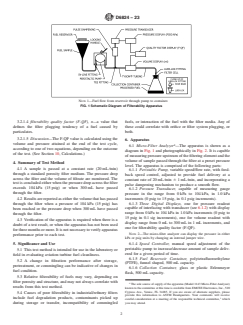
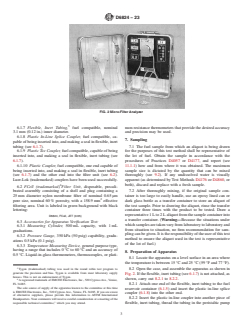
6.1 Micro-Filter Analyzer —The apparatus is shown as a
according to one of two equations, depending on the outcome
diagram in Fig. 1 and photographically in Fig. 2. It is capable
of the test. (See Section 10, Calculations.)
of measuring pressure upstream of the filtering element and the
volume of sample passed through the filter at a preset pressure
4. Summary of Test Method
level. The apparatus is comprised of the following parts:
4.1 A sample is passed at a constant rate (20 mL ⁄min)
6.1.1 Peristaltic Pump, variable speed/flow rate, with feed-
through a standard porosity filter medium. The pressure drop
back speed control, adjusted to provide fuel delivery at a
across the filter and the volume of filtrate are monitored. The
constant rate of 20 mL ⁄min 6 1 mL ⁄min, and incorporating a
test is concluded either when the pressure drop across the filter
pulse dampening mechanism to produce a smooth flow.
exceeds 104 kPa (15 psig) or when 300 mL have passed
6.1.2 Pressure Transducer, capable of measuring gauge
through the filter.
pressure in the range from 0 kPa to 104 kPa, in 1.0 kPa
increments (0 psig to 15 psig, in 0.1 psig increments).
4.2 Results are reported as either the volume that has passed
6.1.3 Three Digital Displays, one for pressure readout
through the filter when a pressure of 104 kPa (15 psig) has
capable of interfacing with transducer (see 6.1.2) with display
been reached or the pressure drop when 300 mL have passed
range from 0 kPa to 104 kPa in 1.0 kPa increments (0 psig to
through the filter.
15 psig in 0.1 sig increments), one for volume readout with
4.3 Verification of the apparatus is required when there is a
display range from 0 mL to 300 mL in 1 mL increments, and
doubt of a test result, or when the apparatus has not been used
one for filterability quality factor (F-QF).
for three months or more. It is not necessary to verify apparatus
performance prior to each test. NOTE 2—The micro-filter analyzer can display the pressure in either
kPa or psig units by changing an internal jumper wire.
5. Significance and Use
6.1.4 Speed Controller, manual speed adjustment of the
peristaltic pump to increase/decrease amount of sample deliv-
5.1 This test method is intended for use in the laboratory or
ered for a given period of time.
field in evaluating aviation turbine fuel cleanliness.
6.1.5 Fuel Reservoir Container, polytetrafluoroethylene
5.2 A change in filtration performance after storage,
(PTFE), funnel shaped, 500 mL capacity.
pretreatment, or commingling can be indicative of changes in
6.1.6 Collection Container, glass or plastic Erlenmeyer
fuel condition.
flask, 500 mL capacity.
5.3 Relative filterability of fuels may vary, depending on
filter porosity and structure, and may not always correlate with
The sole source of supply of the apparatus (Model 1143 Micro-Filter Analyzer)
results from this test method.
known to the committee at this time is available from EMCEE Electronics, Inc., 520
Cypress Ave., Venice, FL 34285. If you are aware of alternate suppliers, please
5.4 Causes of poor filterability in industrial/refinery filters
provide this information to ASTM Headquarters. Your comments will receive
include fuel degradation products, contaminants picked up
careful consideration at a meeting of the responsible technical committee, which
during storage or transfer, incompatibility of commingled you may attend.
D6824 − 23
FIG. 2 Micro-Filter Analyzer
6.1.7 Flexible, Inert Tubing, fuel compatible, nominal num resistance thermometers that provide the desired accuracy
3.1 mm (0.12 in.) inner diameter. and precision may be used.
6.1.8 Plastic In-Line Splice Coupler, fuel compatible, ca-
7. Sampling
pable of being inserted into, and making a seal in flexible, inert
tubing (see 6.1.7). 7.1 The fuel sample from which an aliquot is being drawn
6.1.9 Plastic Tee Coupler, fuel compatible, capable of being for the purposes of this test method shall be representative of
inserted into, and making a seal in flexible, inert tubing (see the lot of fuel. Obtain the sample in accordance with the
6.1.7). procedures of Practices D4057 or D4177, and report (see
6.1.10 Plastic Coupler, fuel compatible, one end capable of 11.1.1) how and from where it was obtained. The maximum
being inserted into, and making a seal in flexible, inert tubing sample size is dictated by the quantity that can be mixed
(see 6.1.7) and the other end into the filter unit (see 6.2). thoroughly (see 9.2). If any undissolved water is visually
Luer-Lok (trademarked) couplers have been used successfully. apparent (as determined by Test Methods D4176 or D4860, or
both), discard and replace with a fresh sample.
6.2 FCell (trademarked) Filter Unit, disposable, precali-
brated assembly consisting of a shell and plug containing a 7.2 After thoroughly mixing, if the original sample con-
25 mm diameter nylon membrane filter of nominal 0.65 μm
tainer is too large to easily handle, use an epoxy lined can or
pore size, nominal 60 % porosity, with a 158.9 mm effective dark glass bottle as a transfer container to store an aliquot of
filtering area. Unit is labeled in green background with black
the test sample. Prior to drawing the aliquot, rinse the transfer
lettering: container three times with the product to be tested. Draw a
representative 1 L to 2 L aliquot from the sample container into
D6824, FCell, JET (0.65)
a transfer container. (Warning—Because the situations under
6.3 Accessories for Apparatus Verification Test:
which samples are taken vary from laboratory to laboratory and
6.3.1 Measuring Cylinder, 500 mL capacity, with 1 mL
from situation to situation, no firm recommendation for sam-
graduations.
pling can be given. It is the responsibility of the user of this test
6.3.2 Pressure Gauge, 350 kPa (50 psig) capability, gradu-
method to ensure the aliquot used in the test is representative
ations 0.5 kPa (0.1 psig).
of the lot of fuel.)
6.3.3 Temperature Measuring Device, general purpose type,
having a range that includes 0 °C to 60 °C and an accuracy of
8. Preparation of Apparatus
0.5 °C. Liquid-in-glass thermometers, thermocouples, or plati-
8.1 Locate the apparatus on a level surface in an area where
the temperature is between 15 °C and 25 °C (59 °F and 77 °F).
Tygon (trademarked) tubing was used in the round robin test program to
8.2 Open the case, and assemble the apparatus as shown in
generate the precision and bias. Tygon is available from most laboratory supply
Fig. 2. If the flexible, inert tubing (see 6.1.7) is not attached, as
houses. This is not an endorsement of Tygon.
6 shown, carry out 8.2.1 to 8.2.2.
A registered trademark of EMCEE Electronics, Inc., 520 Cypress Ave., Venice,
8.2.1 Attach one end of the flexible, inert tubing to the fuel
FL 34285.
The sole source of supply of the apparatus known to the committee at this time
reservoir container (6.1.5) and insert the plastic in-line splice
is EMCEE Electronics, Inc., 520 Cypress Ave., Venice, FL 34285. If you are aware
coupler (6.1.8) into the other end.
of alternative suppliers, please provide this information to ASTM International
8.2.2 Insert the plastic in-line coupler into another piece of
Headquarters. Your comments will receive careful consideration at a meeting of the
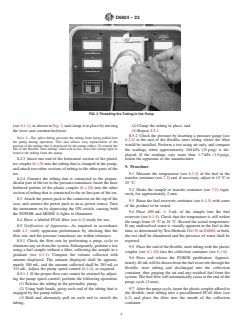
responsible technical committee, which you may attend. flexible, inert tubing, thread the tubing in the peristaltic pump
D6824 − 23
FIG. 3 Threading the Tubing in the Pump
(see 6.1.1), as shown in Fig. 3, and clamp it in place by moving (4) Clamp the tubing in place, and
the lever arm counterclockwise. (5) Repeat 8.5.1.
8.5.2 Check the pressure by inse
...
This document is not an ASTM standard and is intended only to provide the user of an ASTM standard an indication of what changes have been made to the previous version. Because
it may not be technically possible to adequately depict all changes accurately, ASTM recommends that users consult prior editions as appropriate. In all cases only the current version
of the standard as published by ASTM is to be considered the official document.
Designation: D6824 − 13 (Reapproved 2018) D6824 − 23
Standard Test Method for
Determining Filterability of Aviation Turbine Fuel
This standard is issued under the fixed designation D6824; the number immediately following the designation indicates the year of
original adoption or, in the case of revision, the year of last revision. A number in parentheses indicates the year of last reapproval. A
superscript epsilon (´) indicates an editorial change since the last revision or reapproval.
1. Scope Scope*
1.1 This test method covers a procedure for determining the filterability of aviation turbine fuels (for other middle distillate fuels,
see Test Method D6426).
NOTE 1—ASTM specification fuels falling within the scope of this test method are Specifications D1655 and D6615 and the military fuels covered in the
military specifications listed in 2.2.
1.2 This test method is not applicable to fuels that contain undissolved water.
1.3 The values stated in SI units are to be regarded as standard. The values given in parentheses after SI units are provided for
information only and are not considered standard.
1.4 This standard does not purport to address all of the safety concerns, if any, associated with its use. It is the responsibility
of the user of this standard to establish appropriate safety, health, and environmental practices and determine the applicability of
regulatory limitations prior to use.
1.5 This international standard was developed in accordance with internationally recognized principles on standardization
established in the Decision on Principles for the Development of International Standards, Guides and Recommendations issued
by the World Trade Organization Technical Barriers to Trade (TBT) Committee.
2. Referenced Documents
2.1 ASTM Standards:
D1655 Specification for Aviation Turbine Fuels
D4057 Practice for Manual Sampling of Petroleum and Petroleum Products
D4175 Terminology Relating to Petroleum Products, Liquid Fuels, and Lubricants
D4176 Test Method for Free Water and Particulate Contamination in Distillate Fuels (Visual Inspection Procedures)
D4177 Practice for Automatic Sampling of Petroleum and Petroleum Products
D4860 Test Method for Free Water and Particulate Contamination in Middle Distillate Fuels (Clear and Bright Numerical
Rating)
D5452 Test Method for Particulate Contamination in Aviation Fuels by Laboratory Filtration
D6300 Practice for Determination of Precision and Bias Data for Use in Test Methods for Petroleum Products, Liquid Fuels, and
Lubricants
D6426 Test Method for Determining Filterability of Middle Distillate Fuel Oils
This test method is under the jurisdiction of ASTM Committee D02 on Petroleum Products, Liquid Fuels, and Lubricants and is the direct responsibility of Subcommittee
D02.J0.01 on Jet Fuel Specifications.
Current edition approved Oct. 1, 2018March 1, 2023. Published November 2018March 2023. Originally approved in 2002. Last previous edition approved in 20132018
ɛ1
as D6824 – 13 (2018). . DOI: 10.1520/D6824-13R18.10.1520/D6824-23.
For referenced ASTM standards, visit the ASTM website, www.astm.org, or contact ASTM Customer Service at service@astm.org. For Annual Book of ASTM Standards
volume information, refer to the standard’s Document Summary page on the ASTM website.
*A Summary of Changes section appears at the end of this standard
Copyright © ASTM International, 100 Barr Harbor Drive, PO Box C700, West Conshohocken, PA 19428-2959. United States
D6824 − 23
D6615 Specification for Jet B Wide-Cut Aviation Turbine Fuel
2.2 Military Standards:
MIL-DTL-5624 Turbine Fuel, Aviation, Grades JP-4, JP-5, and JP-5/JP-8 ST
MIL-DTL-25524 Turbine Fuel, Aviation, Thermally Stable
MIL-DTL-38219 Turbine Fuels, Low Volatility, JP-7
MIL-DTL-83133 Turbine Fuels, Aviation, Kerosine Types, NATO F-34 (JP-8), NATO F-35, and JP-8+100
3. Terminology
3.1 Definitions:
3.1.1 For definitions of terms used in this test method, refer to Terminology D4175.
3.2 Definitions of Terms Specific to This Standard:
3.2.1 filterability, n—a measure of the rapidity with which a standard filter medium is plugged by insoluble matter in fuel and may
be described as a function of pressure or volume:
3.2.1.1 filterability (by pressure), n—the pressure drop across a filter medium when 300 mL of fuel is passed at a rate of
20 mL ⁄min.
3.2.1.2 filterability (by volume), n—the volume of fuel passed when a pressure of 104 kPa (15 psig) is reached.
3.2.1.3 Discussion—
Filterability by volume is used when less than 300 mL passes the filter at a pressure up to 104 kPa (15 psig).
3.2.1.4 filterability quality factor (F-QF), n—a value that defines the filter plugging tendency of a fuel caused by particulates.
3.2.1.5 Discussion—
The F-QF value is calculated using the volume and pressure attained at the end of the test cycle, according to one of two equations,
depending on the outcome of the test. (See Section 10, Calculations.)
4. Summary of Test Method
4.1 A sample is passed at a constant rate (20 mL ⁄min) through a standard porosity filter medium. The pressure drop across the filter
and the volume of filtrate are monitored. The test is concluded either when the pressure drop across the filter exceeds 104 kPa
(15 psig) or when 300 mL have passed through the filter.
4.2 Results are reported as either the volume that has passed through the filter when a pressure of 104 kPa (15 psig) has been
reached or the pressure drop when 300 mL have passed through the filter.
4.3 Verification of the apparatus is required when there is a doubt of a test result, or when the apparatus has not been used for three
months or more. It is not necessary to verify apparatus performance prior to each test.
5. Significance and Use
5.1 This test method is intended for use in the laboratory or field in evaluating aviation turbine fuel cleanliness.
5.2 A change in filtration performance after storage, pretreatment, or commingling can be indicative of changes in fuel condition.
5.3 Relative filterability of fuels may vary, depending on filter porosity and structure, and may not always correlate with results
from this test method.
5.4 Causes of poor filterability in industrial/refinery filters include fuel degradation products, contaminants picked up during
storage or transfer, incompatibility of commingled fuels, or interaction of the fuel with the filter media. Any of these could correlate
with orifice or filter system plugging, or both.
Available from Standardization Documents Order Desk, DODSSP, Bldg. 4, Section D, 700 Robbins Ave., Philadelphia, PA 19111-5098.
D6824 − 23
NOTE 1—Fuel flow from reservoir through pump to container.
FIG. 1 Schematic Diagram of Filterability Apparatus
6. Apparatus
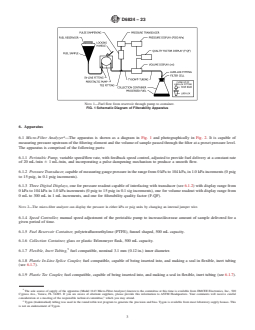
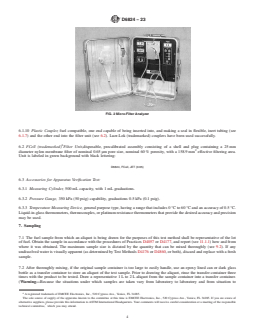
6.1 Micro-Filter Analyzer —The apparatus is shown as a diagram in Fig. 1 and photographically in Fig. 2. It is capable of
measuring pressure upstream of the filtering element and the volume of sample passed through the filter at a preset pressure level.
The apparatus is comprised of the following parts:
6.1.1 Peristaltic Pump, variable speed/flow rate, with feedback speed control, adjusted to provide fuel delivery at a constant rate
of 20 mL ⁄min 6 1 mL ⁄min, and incorporating a pulse dampening mechanism to produce a smooth flow.
6.1.2 Pressure Transducer, capable of measuring gauge pressure in the range from 0 kPa to 104 kPa, in 1.0 kPa increments (0 psig
to 15 psig, in 0.1 psig increments).
6.1.3 Three Digital Displays, one for pressure readout capable of interfacing with transducer (see 6.1.2) with display range from
0 kPa to 104 kPa in 1.0 kPa increments (0 psig to 15 psig in 0.1 sig increments), one for volume readout with display range from
0 mL to 300 mL in 1 mL increments, and one for filterability quality factor (F-QF).
NOTE 2—The micro-filter analyzer can display the pressure in either kPa or psig units by changing an internal jumper wire.
6.1.4 Speed Controller, manual speed adjustment of the peristaltic pump to increase/decrease amount of sample delivered for a
given period of time.
6.1.5 Fuel Reservoir Container, polytetrafluoroethylene (PTFE), funnel shaped, 500 mL capacity.
6.1.6 Collection Container, glass or plastic Erlenmeyer flask, 500 mL capacity.
6.1.7 Flexible, Inert Tubing, fuel compatible, nominal 3.1 mm (0.12 in.) inner diameter.
6.1.8 Plastic In-Line Splice Coupler, fuel compatible, capable of being inserted into, and making a seal in flexible, inert tubing
(see 6.1.7).
6.1.9 Plastic Tee Coupler, fuel compatible, capable of being inserted into, and making a seal in flexible, inert tubing (see 6.1.7).
The sole source of supply of the apparatus (Model 1143 Micro-Filter Analyzer) known to the committee at this time is available from EMCEE Electronics, Inc., 520
Cypress Ave., Venice, FL 34285. If you are aware of alternate suppliers, please provide this information to ASTM Headquarters. Your comments will receive careful
consideration at a meeting of the responsible technical committee, which you may attend.
Tygon (trademarked) tubing was used in the round robin test program to generate the precision and bias. Tygon is available from most laboratory supply houses. This
is not an endorsement of Tygon.
D6824 − 23
FIG. 2 Micro-Filter Analyzer
6.1.10 Plastic Coupler, fuel compatible, one end capable of being inserted into, and making a seal in flexible, inert tubing (see
6.1.7) and the other end into the filter unit (see 6.2). Luer-Lok (trademarked) couplers have been used successfully.
6.2 FCell (trademarked) Filter Unit,disposable, precalibrated assembly consisting of a shell and plug containing a 25 mm
diameter nylon membrane filter of nominal 0.65 μm pore size, nominal 60 % porosity, with a 158.9 mm effective filtering area.
Unit is labeled in green background with black lettering:
D6824, FCell, JET (0.65)
6.3 Accessories for Apparatus Verification Test:
6.3.1 Measuring Cylinder, 500 mL capacity, with 1 mL graduations.
6.3.2 Pressure Gauge, 350 kPa (50 psig) capability, graduations 0.5 kPa (0.1 psig).
6.3.3 Temperature Measuring Device, general purpose type, having a range that includes 0 °C to 60 °C and an accuracy of 0.5 °C.
Liquid-in-glass thermometers, thermocouples, or platinum resistance thermometers that provide the desired accuracy and precision
may be used.
7. Sampling
7.1 The fuel sample from which an aliquot is being drawn for the purposes of this test method shall be representative of the lot
of fuel. Obtain the sample in accordance with the procedures of Practices D4057 or D4177, and report (see 11.1.1) how and from
where it was obtained. The maximum sample size is dictated by the quantity that can be mixed thoroughly (see 9.2). If any
undissolved water is visually apparent (as determined by Test Methods D4176 or D4860, or both), discard and replace with a fresh
sample.
7.2 After thoroughly mixing, if the original sample container is too large to easily handle, use an epoxy lined can or dark glass
bottle as a transfer container to store an aliquot of the test sample. Prior to drawing the aliquot, rinse the transfer container three
times with the product to be tested. Draw a representative 1 L to 2 L aliquot from the sample container into a transfer container.
(Warning—Because the situations under which samples are taken vary from laboratory to laboratory and from situation to
A registered trademark of EMCEE Electronics, Inc., 520 Cypress Ave., Venice, FL 34285.
The sole source of supply of the apparatus known to the committee at this time is EMCEE Electronics, Inc., 520 Cypress Ave., Venice, FL 34285. If you are aware of
alternative suppliers, please provide this information to ASTM International Headquarters. Your comments will receive careful consideration at a meeting of the responsible
technical committee, which you may attend.
D6824 − 23
FIG. 3 Threading the Tubing in the Pump
situation, no firm recommendation for sampling can be given. It is the responsibility of the user of this test method to ensure the
aliquot used in the test is representative of the lot of fuel.)
8. Preparation of Apparatus
8.1 Locate the apparatus on a level surface in an area where the temperature is between 15 °C and 25 °C (59 °F and 77 °F).
8.2 Open the case, and assemble the apparatus as shown in Fig. 2. If the flexible, inert tubing (see 6.1.7) is not attached, as shown,
carry out 8.2.1 to 8.2.2.
8.2.1 Attach one end of the flexible, inert tubing to the fuel reservoir container (6.1.5) and insert the plastic in-line splice coupler
(6.1.8) into the other end.
8.2.2 Insert the plastic in-line coupler into another piece of flexible, inert tubing, thread the tubing in the peristaltic pump (see
6.1.1), as shown in Fig. 3, and clamp it in place by moving the lever arm c
...