

ASTM D8322-20
(Test Method)Standard Test Method for Determination of Elements in Residual Fuels and Crude Oils by Microwave Plasma Atomic Emission Spectroscopy (MP-AES)
General Information
- Abstract
SIGNIFICANCE AND USE
5.1 This test method covers the determination of V, Ni, Ca, Na, Al, Si, Zn, P, and S for residual fuels and Fe, V, Ni,Ca, Na, K, and S for crude oils. This test method complements and extends the capabilities of Test Methods D1548 and D5708, which only apply to the determination of Ni, V, and Fe in crude oils and residual fuels.
5.2 The metals and other elements tested for in this method may occur naturally or may be added as a result of production (that is, catalyst fines).
SCOPE
1.1 This test method covers the determination of metals and other elements in residual fuel and crude oil by microwave plasma atomic emission spectroscopy (MP-AES). The specific elements within the scope of this method are V, Ni, Ca, Na, Al, Si, Zn, P, and S for residual fuel oil and Fe, V, Ni, Ca, Na, K, and S for crude oils.
1.2 Method working range:
high expected concentration limit = highest ILS sample mean
low expected concentration limit = lowest ILS sample mean if:
(1) lowest ILS sample mean − Rlowest ILS sample mean > 0; otherwise it is determined by solving for X using the following equation:
(2) X − RX= coarsest resolution, determined by
0.5*σr lowest ILS sample mean
Crude Oil:
Element
Method Working Range
(expected mg/kg)
Iron
0.70 to 161.02
Vanadium
2.88 to 417.50
Nickel
0.36 to 107.66
Calcium
5.41 to 96.78
Sodium
1.18 to 97.13
Potassium
7.01 to 63.83
Sulfur
1059 to 35194
Residual Fuel Oil:
Element
Method Working Range
(expected mg/kg)
Vanadium
3.88 to 370.09
Nickel
1.47 to 96.68
Calcium
4.41 to 102.01
Sodium
2.80 to 112.67
Aluminum
4.13 to 154.12
Silicon
5.99 to 237.56
Zinc
2.75 to 102.46
Sulfur
1314 to 30134
1.3 This test method uses soluble metals in organic solvents for calibration and does not purport to quantitatively determine insoluble particulates. Analytical results are particle size dependent, and particles larger than a few micrometers may cause results to appear low
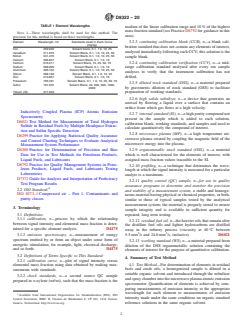
1.4 Elements present at mass fractions above the upper limit of the calibration curves can be determined with additional appropriate dilutions. Elements shall be measured at the wavelengths presented in Table 1.
1.5 The values stated in SI units are to be regarded as standard. No other units of measurement are included in this standard.
1.6 This standard does not purport to address all of the safety concerns, if any, associated with its use. It is the responsibility of the user of this standard to establish appropriate safety, health, and environmental practices and determine the applicability of regulatory limitations prior to use.
1.7 This international standard was developed in accordance with internationally recognized principles on standardization established in the Decision on Principles for the Development of International Standards, Guides and Recommendations issued by the World Trade Organization Technical Barriers to Trade (TBT) Committee.
- Status
- Published
- Publication Date
- 31-May-2020
- Technical Committee
- D02 - Petroleum Products, Liquid Fuels, and Lubricants
- Drafting Committee
- D02.03 - Elemental Analysis
Overview
ASTM D8322-20 is the internationally recognized standard test method for the determination of elements in residual fuels and crude oils by Microwave Plasma Atomic Emission Spectroscopy (MP-AES). Developed by ASTM International, this method enables precise analysis of specific elements-such as vanadium, nickel, calcium, sodium, aluminum, silicon, zinc, phosphorus, and sulfur in residual fuel oil, and iron, vanadium, nickel, calcium, sodium, potassium, and sulfur in crude oil. The adoption of MP-AES extends the capabilities of earlier standards, offering improved detection for a wider range of elements and enhanced flexibility for quality assurance in the petroleum industry.
Key Topics
- Scope of Elements:
- For residual fuels: V (vanadium), Ni (nickel), Ca (calcium), Na (sodium), Al (aluminum), Si (silicon), Zn (zinc), P (phosphorus), S (sulfur).
- For crude oils: Fe (iron), V, Ni, Ca, Na, K (potassium), S.
- Analytical Range:
- Defined limits for each element ensure reliable results within specific mg/kg ranges.
- MP-AES Technique:
- Utilizes microwave-induced plasma to excite atoms and measure characteristic emission spectra for each element.
- Employs soluble metal calibration in organic solvents.
- Quality Control:
- Built-in procedures for calibration verification, background correction, and control of spectral interferences.
- Use of internal standards and quality control samples ensures data reliability.
- Limitations:
- Method is optimized for soluble metals; larger particles may not be quantitatively determined.
- Results are expressed strictly in SI units.
- Safety, regulatory, and environmental practices must be observed by users.
Applications
- Quality Assurance in Petroleum Refining:
MP-AES as outlined in ASTM D8322-20 provides comprehensive elemental analysis for both raw crude oils and residual fuel oils. This is crucial for:- Monitoring trace metals and contaminants that affect refining processes and equipment longevity.
- Compliance testing for international trade, ensuring fuels meet regulatory limits for metallic elements and sulfur content.
- Detecting catalyst fines and other impurities introduced during production or processing.
- Process Optimization:
Accurate elemental profiling allows refineries to optimize blending strategies and select appropriate downstream treatments, reducing operational risk. - Environmental and Regulatory Reporting:
By quantifying elements like sulfur and metals, this method supports facilities in meeting strict emissions and environmental discharge standards. - Supporting Research and Development:
Provides laboratories with a standardized, reproducible methodology for elemental characterization needed in new fuel formulations or technology development.
Related Standards
- ASTM D1548: Test Method for Vanadium in Heavy Fuel Oil.
- ASTM D5708: Test Methods for Determination of Nickel, Vanadium, and Iron in Crude Oils and Residual Fuels.
- ASTM D4052/D1298: Methods for determining API gravity and density.
- ASTM D6021: Measurement of total hydrogen sulfide in residual fuels.
- ISO 8573-1: Air quality standards relevant for gas supplies in analytical procedures.
- ASTM D6792, D6299, D6300, D7372: Covering quality management, statistical assurance, and proficiency testing in petroleum laboratories.
ASTM D8322-20 is a critical standard for elemental analysis in the petroleum sector, enhancing process control, product quality, and compliance through advanced MP-AES technology. Its broad applicability and rigorous methodology support regulatory adherence and optimized fuel production, making it an essential reference for laboratories, refineries, and environmental professionals.
Relations
- Effective Date
- 01-Mar-2024
- Refers
ASTM D4175-23a - Standard Terminology Relating to Petroleum Products, Liquid Fuels, and Lubricants - Effective Date
- 15-Dec-2023
- Effective Date
- 01-Dec-2023
- Effective Date
- 01-Dec-2023
- Effective Date
- 01-Nov-2023
- Effective Date
- 01-Oct-2023
- Refers
ASTM D4175-23e1 - Standard Terminology Relating to Petroleum Products, Liquid Fuels, and Lubricants - Effective Date
- 01-Jul-2023
- Effective Date
- 01-Dec-2019
- Effective Date
- 15-Dec-2017
- Effective Date
- 15-Nov-2017
- Effective Date
- 01-Jan-2017
- Effective Date
- 01-Apr-2016
- Effective Date
- 01-Jun-2015
- Effective Date
- 01-Jun-2014
- Effective Date
- 01-Jun-2014
Get Certified
Connect with accredited certification bodies for this standard

Element Materials Technology
Materials testing and product certification.

ABS Group Brazil
ABS Group certification services in Brazil.

ABS Quality Evaluations Inc.
American Bureau of Shipping quality certification.
Sponsored listings
Frequently Asked Questions
ASTM D8322-20 is a standard published by ASTM International. Its full title is "Standard Test Method for Determination of Elements in Residual Fuels and Crude Oils by Microwave Plasma Atomic Emission Spectroscopy (MP-AES)". This standard covers: SIGNIFICANCE AND USE 5.1 This test method covers the determination of V, Ni, Ca, Na, Al, Si, Zn, P, and S for residual fuels and Fe, V, Ni,Ca, Na, K, and S for crude oils. This test method complements and extends the capabilities of Test Methods D1548 and D5708, which only apply to the determination of Ni, V, and Fe in crude oils and residual fuels. 5.2 The metals and other elements tested for in this method may occur naturally or may be added as a result of production (that is, catalyst fines). SCOPE 1.1 This test method covers the determination of metals and other elements in residual fuel and crude oil by microwave plasma atomic emission spectroscopy (MP-AES). The specific elements within the scope of this method are V, Ni, Ca, Na, Al, Si, Zn, P, and S for residual fuel oil and Fe, V, Ni, Ca, Na, K, and S for crude oils. 1.2 Method working range: high expected concentration limit = highest ILS sample mean low expected concentration limit = lowest ILS sample mean if: (1) lowest ILS sample mean − Rlowest ILS sample mean > 0; otherwise it is determined by solving for X using the following equation: (2) X − RX= coarsest resolution, determined by 0.5*σr lowest ILS sample mean Crude Oil: Element Method Working Range (expected mg/kg) Iron 0.70 to 161.02 Vanadium 2.88 to 417.50 Nickel 0.36 to 107.66 Calcium 5.41 to 96.78 Sodium 1.18 to 97.13 Potassium 7.01 to 63.83 Sulfur 1059 to 35194 Residual Fuel Oil: Element Method Working Range (expected mg/kg) Vanadium 3.88 to 370.09 Nickel 1.47 to 96.68 Calcium 4.41 to 102.01 Sodium 2.80 to 112.67 Aluminum 4.13 to 154.12 Silicon 5.99 to 237.56 Zinc 2.75 to 102.46 Sulfur 1314 to 30134 1.3 This test method uses soluble metals in organic solvents for calibration and does not purport to quantitatively determine insoluble particulates. Analytical results are particle size dependent, and particles larger than a few micrometers may cause results to appear low 1.4 Elements present at mass fractions above the upper limit of the calibration curves can be determined with additional appropriate dilutions. Elements shall be measured at the wavelengths presented in Table 1. 1.5 The values stated in SI units are to be regarded as standard. No other units of measurement are included in this standard. 1.6 This standard does not purport to address all of the safety concerns, if any, associated with its use. It is the responsibility of the user of this standard to establish appropriate safety, health, and environmental practices and determine the applicability of regulatory limitations prior to use. 1.7 This international standard was developed in accordance with internationally recognized principles on standardization established in the Decision on Principles for the Development of International Standards, Guides and Recommendations issued by the World Trade Organization Technical Barriers to Trade (TBT) Committee.
SIGNIFICANCE AND USE 5.1 This test method covers the determination of V, Ni, Ca, Na, Al, Si, Zn, P, and S for residual fuels and Fe, V, Ni,Ca, Na, K, and S for crude oils. This test method complements and extends the capabilities of Test Methods D1548 and D5708, which only apply to the determination of Ni, V, and Fe in crude oils and residual fuels. 5.2 The metals and other elements tested for in this method may occur naturally or may be added as a result of production (that is, catalyst fines). SCOPE 1.1 This test method covers the determination of metals and other elements in residual fuel and crude oil by microwave plasma atomic emission spectroscopy (MP-AES). The specific elements within the scope of this method are V, Ni, Ca, Na, Al, Si, Zn, P, and S for residual fuel oil and Fe, V, Ni, Ca, Na, K, and S for crude oils. 1.2 Method working range: high expected concentration limit = highest ILS sample mean low expected concentration limit = lowest ILS sample mean if: (1) lowest ILS sample mean − Rlowest ILS sample mean > 0; otherwise it is determined by solving for X using the following equation: (2) X − RX= coarsest resolution, determined by 0.5*σr lowest ILS sample mean Crude Oil: Element Method Working Range (expected mg/kg) Iron 0.70 to 161.02 Vanadium 2.88 to 417.50 Nickel 0.36 to 107.66 Calcium 5.41 to 96.78 Sodium 1.18 to 97.13 Potassium 7.01 to 63.83 Sulfur 1059 to 35194 Residual Fuel Oil: Element Method Working Range (expected mg/kg) Vanadium 3.88 to 370.09 Nickel 1.47 to 96.68 Calcium 4.41 to 102.01 Sodium 2.80 to 112.67 Aluminum 4.13 to 154.12 Silicon 5.99 to 237.56 Zinc 2.75 to 102.46 Sulfur 1314 to 30134 1.3 This test method uses soluble metals in organic solvents for calibration and does not purport to quantitatively determine insoluble particulates. Analytical results are particle size dependent, and particles larger than a few micrometers may cause results to appear low 1.4 Elements present at mass fractions above the upper limit of the calibration curves can be determined with additional appropriate dilutions. Elements shall be measured at the wavelengths presented in Table 1. 1.5 The values stated in SI units are to be regarded as standard. No other units of measurement are included in this standard. 1.6 This standard does not purport to address all of the safety concerns, if any, associated with its use. It is the responsibility of the user of this standard to establish appropriate safety, health, and environmental practices and determine the applicability of regulatory limitations prior to use. 1.7 This international standard was developed in accordance with internationally recognized principles on standardization established in the Decision on Principles for the Development of International Standards, Guides and Recommendations issued by the World Trade Organization Technical Barriers to Trade (TBT) Committee.
ASTM D8322-20 is classified under the following ICS (International Classification for Standards) categories: 75.160.01 - Fuels in general. The ICS classification helps identify the subject area and facilitates finding related standards.
ASTM D8322-20 has the following relationships with other standards: It is inter standard links to ASTM D6300-24, ASTM D4175-23a, ASTM D6300-23a, ASTM D6299-23a, ASTM D6792-23c, ASTM D6792-23b, ASTM D4175-23e1, ASTM D6300-19a, ASTM D6299-17b, ASTM D6299-17a, ASTM D6299-17, ASTM D6300-16, ASTM D6300-15, ASTM D6300-14ae1, ASTM D6300-14a. Understanding these relationships helps ensure you are using the most current and applicable version of the standard.
ASTM D8322-20 is available in PDF format for immediate download after purchase. The document can be added to your cart and obtained through the secure checkout process. Digital delivery ensures instant access to the complete standard document.
Standards Content (Sample)
This international standard was developed in accordance with internationally recognized principles on standardization established in the Decision on Principles for the
Development of International Standards, Guides and Recommendations issued by the World Trade Organization Technical Barriers to Trade (TBT) Committee.
Designation: D8322 − 20
Standard Test Method for
Determination of Elements in Residual Fuels and Crude Oils
by Microwave Plasma Atomic Emission Spectroscopy (MP-
AES)
This standard is issued under the fixed designation D8322; the number immediately following the designation indicates the year of
original adoption or, in the case of revision, the year of last revision.Anumber in parentheses indicates the year of last reapproval.A
superscript epsilon (´) indicates an editorial change since the last revision or reapproval.
1. Scope dependent, and particles larger than a few micrometers may
cause results to appear low
1.1 Thistestmethodcoversthedeterminationofmetalsand
other elements in residual fuel and crude oil by microwave 1.4 Elementspresentatmassfractionsabovetheupperlimit
plasma atomic emission spectroscopy (MP-AES). The specific of the calibration curves can be determined with additional
elementswithinthescopeofthismethodareV,Ni,Ca,Na,Al, appropriate dilutions. Elements shall be measured at the
Si, Zn, P, and S for residual fuel oil and Fe, V, Ni, Ca, Na, K, wavelengths presented in Table 1.
and S for crude oils.
1.5 The values stated in SI units are to be regarded as
1.2 Method working range: standard. No other units of measurement are included in this
high expected concentration limit = highest ILS sample mean standard.
lowexpectedconcentrationlimit=lowestILSsamplemeanif:
1.6 This standard does not purport to address all of the
(1)lowest ILS sample mean − R >0;
lowest ILS sample mean
safety concerns, if any, associated with its use. It is the
otherwiseitisdeterminedbysolvingfor Xusingthefollowing
responsibility of the user of this standard to establish appro-
equation:
priate safety, health, and environmental practices and deter-
(2) X−R = coarsest resolution, determined by
X
mine the applicability of regulatory limitations prior to use.
0.5*σ
r lowest ILS sample mean
1.7 This international standard was developed in accor-
Crude Oil:
dance with internationally recognized principles on standard-
Method Working Range
Element ization established in the Decision on Principles for the
(expected mg/kg)
Development of International Standards, Guides and Recom-
Iron 0.70 to 161.02
Vanadium 2.88 to 417.50
mendations issued by the World Trade Organization Technical
Nickel 0.36 to 107.66
Barriers to Trade (TBT) Committee.
Calcium 5.41 to 96.78
Sodium 1.18 to 97.13
2. Referenced Documents
Potassium 7.01 to 63.83
Sulfur 1059 to 35194
2.1 ASTM Standards:
Residual Fuel Oil:
D1298Test Method for Density, Relative Density, or API
Method Working Range
Element
(expected mg/kg) Gravity of Crude Petroleum and Liquid Petroleum Prod-
Vanadium 3.88 to 370.09
ucts by Hydrometer Method
Nickel 1.47 to 96.68
D1548Test Method for Vanadium in Heavy Fuel Oil
Calcium 4.41 to 102.01
Sodium 2.80 to 112.67 (Withdrawn 1997)
Aluminum 4.13 to 154.12
D4052Test Method for Density, Relative Density, and API
Silicon 5.99 to 237.56
Gravity of Liquids by Digital Density Meter
Zinc 2.75 to 102.46
Sulfur 1314 to 30134 D4175Terminology Relating to Petroleum Products, Liquid
Fuels, and Lubricants
1.3 Thistestmethodusessolublemetalsinorganicsolvents
D5708 Test Methods for Determination of Nickel,
forcalibrationanddoesnotpurporttoquantitativelydetermine
Vanadium, and Iron in Crude Oils and Residual Fuels by
insoluble particulates. Analytical results are particle size
For referenced ASTM standards, visit the ASTM website, www.astm.org, or
This test method is under the jurisdiction of ASTM Committee D02 on contact ASTM Customer Service at service@astm.org. For Annual Book of ASTM
Petroleum Products, Liquid Fuels, and Lubricants and is the direct responsibility of Standards volume information, refer to the standard’s Document Summary page on
Subcommittee D02.03 on Elemental Analysis. the ASTM website.
Current edition approved June 1, 2020. Published July 2020. DOI: 10.1520/ The last approved version of this historical standard is referenced on
D8322-20. www.astm.org.
Copyright © ASTM International, 100 Barr Harbor Drive, PO Box C700, West Conshohocken, PA 19428-2959. United States
D8322 − 20
TABLE 1 Element Wavelengths
median of the linear calibration range and 10% of the highest
massfractionstandard(seePracticeD6792forguidanceinthis
NOTE 1—These wavelengths shall be used for this method. The
area).
precision for this method is based on these wavelengths.
Element Wavelength, nm Standards Used in Each Curve
3.2.3 continuing calibration blank (CCB), n—a blank cali-
(mg/kg)
bration standard that does not contain any elements of interest,
Iron 259.940 Solvent blank, 0.1, 1.0, 10, 25
analyzed immediately following each CCV; this solution is the
Vanadium 311.070 Solvent Blank, 0.1, 1.0, 10, 25, 50
Nickel 341.476 Solvent Blank, 0.1, 1.0, 10, 25, 50
sample blank.
Calcium 396.847 Solvent Blank, 0.1, 1.0, 10
3.2.4 continuing calibration verification (CCV), n—a mid-
Calcium 616.217 Solvent Blank, 10, 25, 50, 70
Sodium 588.995 Solvent Blank, 0.1, 1.0, 10
range calibration standard analyzed after every ten sample
Aluminum 396.152 Solvent Blank, 0.1, 1.0, 10, 25, 50
analyses to verify that the instrument calibration has not
Silicon 288.158 Solvent Blank, 0.1, 1.0, 10, 25
drifted.
Zinc 213.857 Solvent Blank, 0.1, 1.0, 10
Potassium 766.491 Solvent Blank, 0.1, 1.0, 10, 25, 50, 70
3.2.5 diluted stock standard (DSS), n—a material prepared
Sulfur 181.972 Solvent Blank, 40, 200, 500, 1000,
by gravimetric dilution of stock standard (OSS) to facilitate
Yttrium (IS) 371.029
preparation of working standards.
3.2.6 high solids nebulizer, n—a device that generates an
aerosol by flowing a liquid over a surface that contains an
orifice from which gas flows at a high velocity.
Inductively Coupled Plasma (ICP) Atomic Emission
3.2.7 internal standard (IS), n—ahighpuritycompoundnot
Spectrometry
present in the sample which is added to each solution,
D6021Test Method for Measurement of Total Hydrogen
calibration blank, working standards, and samples and used to
Sulfide in Residual Fuels by Multiple Headspace Extrac-
calculate quantitatively the compound of interest.
tion and Sulfur Specific Detection
3.2.8 microwave plasma (MP), n—a high temperature mi-
D6299Practice for Applying Statistical Quality Assurance
crowave plasma created by coupling the magnetic field of the
and Control Charting Techniques to Evaluate Analytical
microwave energy into the plasma.
Measurement System Performance
D6300Practice for Determination of Precision and Bias 3.2.9 organometallic stock standard (OSS), n—a material
which is well characterized for the elements of interest, with
Data for Use in Test Methods for Petroleum Products,
Liquid Fuels, and Lubricants assigned mass fraction values traceable to the SI.
D6792Practice for Quality Management Systems in Petro-
3.2.10 profiling, n—a technique that determines the wave-
leum Products, Liquid Fuels, and Lubricants Testing
lengthatwhichthesignalintensityismeasuredforaparticular
Laboratories
analyte is a maximum.
D7372Guide for Analysis and Interpretation of Proficiency
3.2.11 quality control (QC) sample, n—for use in quality
Test Program Results
assurance programs to determine and monitor the precision
2.2 ISO Standard:
and stability of a measurement system, a stable and homoge-
ISO 8573–1Compressed air – Part 1: Contaminants and
neousmaterialhavingphysicalorchemicalproperties,orboth,
purity classes
similar to those of typical samples tested by the analytical
measurement system; the material is properly stored to ensure
3. Terminology
sample integrity and is available in sufficient quantity for
3.1 Definitions: repeated, long term testing.
3.1.1 calibration, n—process by which the relationship
3.2.12 residual fuel oil, n—theheavieroilsthatremainafter
between signal intensity and elemental mass fraction is deter-
the distillate fuel oils and lighter hydrocarbons are distilled
mined for a specific element analysis. D4175
away in the refinery process (viscosity at 40°C between
2 2
3.1.2 emission spectroscopy, n—measurement of energy 5.5mm /s and 24.0mm /s, inclusive). D6021
spectrum emitted by or from an object under some form of
3.2.13 working standard (WS), n—a material prepared from
energetic stimulation; for example, light, electrical discharge,
dilution of the DSS organometallic solution containing the
and so forth. D4175
elements of interest for the purpose of quantitative calibration.
3.2 Definitions of Terms Specific to This Standard:
4. Summary of Test Method
3.2.1 calibration curve, n—plot of signal intensity versus
4.1 Test Method—For determination of elements in residual
elemental mass fraction using data obtained by making mea-
fuels and crude oils, a homogenized sample is diluted in a
surements with standards.
suitable organic solvent and introduced through the nebulizer
3.2.2 check standards, n—a second source QC sample
andspraychamberintothemicrowaveplasmaatomicemission
prepared in o-xylene (wt/wt), such that the mass fraction is the
spectrometer. Quantification of elements is achieved by com-
paring measurements of emission intensity at the appropriate
wavelength for each element to measurements of emission
Available from International Organization for Standardization (ISO), ISO
intensity made under the same conditions on organic standard
Central Secretariat, BIBC II, Chemin de Blandonnet 8, CP 401, 1214 Vernier,
Geneva, Switzerland, http://www.iso.org. reference solutions in the same organic solvent.
D8322 − 20
5. Significance and Use 7.2.3 Instrument Control Software for Background
Correction—Spectrum correction software which allows for
5.1 This test method covers the determination of V, Ni, Ca,
manual or automated background correction. Software opti-
Na,Al,Si,Zn,P,andSforresidualfuelsandFe,V,Ni,Ca,Na,
mizes nebulizer flow at each wavelength. Introduction condi-
K, and S for crude oils. This test method complements and
tions and settings are presented in Table 2. Instrument operat-
extends the capabilities of Test Methods D1548 and D5708,
ing conditions for elemental determination in residual fuel and
whichonlyapplytothedeterminationofNi,V,andFeincrude
crude oil samples are presented in Table 3.
oils and residual fuels.
7.3 Peristaltic Pump—Using a peristaltic pump is required
5.2 The metals and other elements tested for in this method
foraconstantflowofsolution.Thepumpraterecommendedis
may occur naturally or may be added as a result of production
5rpm to 10rpm.
(that is, catalyst fines).
NOTE 1—The precision was determined using 5rpm.
6. Interferences
7.4 Peristaltic Pump Tubing (Viton)—The pump tubing
6.1 Spectral—Check all spectral interferences expected
must be able to withstand at least 6 h exposure to the dilution
from the elements listed in Table 1 using manufacturer’s solvent. Use Viton tubing for testing hydrocarbon solvents.
operating guide to develop and apply correction factors to
Inspect the peristaltic pump tubing daily and replace deterio-
compensate for the interferences. To apply interference rating tubing.
corrections, all mass fractions must be within the linear
7.5 Test Specimen Solution Containers, of appropriate size,
response range of each element listed in Table 1.
glass or Teflon vials or bottles, with screw caps.
6.2 Spectral interferences can usually be avoided by using
7.6 Filters, 0.45 µm, 0.8 µm, or 1.0 µm (nylon, TFE-
the specified wavelengths in Table 1.
fluorocarbon, cellulose acetate/cellulose nitrate, or other com-
6.3 Particulates—Particulates can clog the nebulizer
patible material).
therebycausinglowresults.Nebulizerandsampleintroduction
7.7 Dispensing Vessel, provides a consistent means for
requirements are defined in Section 7. Use of nebulizers or
dispensing of solutions more easily for gravimetric measure-
sample introduction devices, or both, that do not meet these
ments.
requirements shall not be used.
7.8 Internal Standard Peristaltic Tee Assembly—Any tee-
type fitting composed of solvent resistant material used to
7. Apparatus
facilitatethesimultaneousadditionoftheinternalstandardand
7.1 Balance, top loading or analytical, with automatic tare,
sample directly into the nebulizer.
that measures to at least 0.0001g and with sufficient capacity
to weigh prepared solutions.
8. Reagents and Materials
7.2 Microwave Plasma Atomic Emission Spectrometer
8.1 Purity of Reagents—Reagent grade chemicals shall be
(MP-AES)—A sequential, emission based multi-element ana-
used in all tests. Unless otherwise indicated, it is intended that
lytical technique that uses a microwave-induced plasma for
all reagents conform to the specifications of the Committee on
sample excitation. The operating software provides pro-
Analytical Reagents of theAmerican Chemical Society, where
grammed sequential sample operation and quantitative data
such specifications are available.
processing.Atorch and microwave generator are used to form
8.2 Organometallic Reference Materials in Organic
a sustained plasma that can be used for making measurements
Matrix—An appropriate SI-traceable certified reference mate-
at the specified wavelengths.
rialmaybeavailableforV,Ni,Na,andSfromNISToranother
7.2.1 SampleIntroduction—Thesampleintroductionsystem
shall be composed of solvent-resistant tubing, a double-pass
cyclonic chamber, and an inert high solids nebulizer. The
nebulizer must provide a homogeneous aerosol, comprised of
small droplets with a narrow distribution of droplet sizes, to
ACS Reagent Chemicals, Specifications and Procedures for Reagents and
increase nebulization efficiency and improve sensitivity.
Standard-Grade Reference Materials, American Chemical Society, Washington,
7.2.2 Gas Control System—Allgasflowsshallbecontrolled DC. For suggestions on the testing of reagents not listed by theAmerican Chemical
Society, see Analar Standards for Laboratory Chemicals, BDH Ltd., Poole, Dorset,
byautomatedflowsystem.Thepurgecontrolsystemfacilitates
U.K., and the United States Pharmacopeia and National Formulary, U.S. Pharma-
nitrogen purging of the monochromator for optimal sulfur
copeial Convention, Inc. (USPC), Rockville, MD.
determination.
TABLE 2 Sample Introduction Conditions for Elemental
Determination in Residual Fuel and Crude Oil Samples
The sole source of supply of the Microwave Plasma Atomic Emission
Instrument
Operating Condition
equipment, OneNeb Series 2 and instrumentation, known to the committee at this
Parameter
time is Agilent Technologies, Inc., 5301 Stevens Creek Blvd., Santa Clara, CA
Nebulizer Inert High Solids nebulizer (such as the OneNeb Series 2)
95051.Agilent Technologies also has authorized sales and service organizations in
Spray Chamber Cyclonic double-pass
selectedgeographicalareas.Ifyouareawareofalternativesuppliers,pleaseprovide
Sample Tubing Viton Orange/Green. Internal standard if teeing is Viton
this information toASTM International Headquarters. Your comments will receive
orange/green (0.38 mm ID)
careful consideration at a meeting of the responsible technical committee, which Waste Tubing Blue/blue Viton 1.65 mm ID
you may attend.
D8322 − 20
TABLE 3 Instrument Operating Conditions for Elemental
9.2 Sample Handling During Analysis:
Determination in Residual Fuel and Crude Oil Samples
9.2.1 When analyzing samples using the MP-AES, the
Instrument Conditions MP-AES
sampletemperaturemustbewithintherangeof20°Cto25°C.
Pump Rate 5 rpm
9.2.2 After analysis, if the sample is to be retained, reseal
Read Time 3 s – 10 s
the container before storing.
Number of Replicates 3
Sample Uptake Delay Approximately 60 s (depends on lab set-up)
9.3 If particulates are visually observed in the diluted
Stabilization Delay Approximately 30 s (depends on lab set-up)
Background Correction Auto sample, filter through a 1.0µm (nylon, TFE-fluorocarbon,
Air Injection Required Yes
cellulose acetate/cellulose nitrate, or other compatible mate-
rial) membrane filter into a container and retain the filtrate for
analysis. Follow the same procedure for the blank solution
national metrology institute. Commercial reference material used for the analysis of these samples.
producers may also be able to provide SI traceable reference
NOTE 2—It is unlikely that solids are visible in the actual crude oil
materials.
sample, especially if it is thick. Once diluted it is fluid enough that the
particles are either visibly suspended in o-xylene or settle to bottom.
8.3 Blank Mineral Oil—U.S.P. white oil or equivalent.
Material should be free of elements being measured.
10. Preparation of Apparatus
8.4 Nitrogen—High purity compressed gas cylinder or from
10.1 Instrument—The optics need to be purged for 30min
a nitrogen generator. Working pressure is 450kPa to 600kPa
with the plasma turned on prior to acquiring test data.Astable
(65psi to 87psi).
laboratory temperature between 20°C and 25°C shall be
8.4.1 Plasma Support Gas—99.5%puritynitrogencontain-
maintained during the entire warm-up and testing process. For
ing<0.5%oxygenand<4ppmwatervapor,supplyat0L⁄min
best sulfur sensitivity, the optics need to be purged for at least
to 25L⁄min.
3h. This only needs to be done once if leaving the purge
8.4.2 Monochromator Purge Gas—99.95% purity nitrogen
continuously running. If the instrument loses power or is shut
containing <0.5% oxygen and <4ppm water vapor, supply at
down for more than 1h, the 3h optics purge shall be repeated
0L⁄min to 10L⁄min.
before attempting sulfur testing.
8.5 Air—Air supply used for nitrogen generator supply, as
10.2 PeristalticPump—Inspectthepumptubingandreplace
follows:
it, if necessary, before starting each day. Verify the solution
8.5.1 Plasma Support Nitrogen Generator—ISO 8573-
uptake rate and adjust it to the desired rate.
1:2010 CLASS 1.4.3, supply at 115L⁄min.
8.5.2 Plasma Support Nitrogen Generator—ISO 8573-
10.3 Nitrogen Purge—Ensure that the gas lines are ad-
1:2010 CLASS 1.4.3, supply at 0L⁄min to 25L⁄min. equately purged with nitrogen before attempting to ignite the
plasmafollowingthemanufacturer’srecommendedprocedure.
8.6 Argon—99.999 % purity, supply at 0 L⁄min to
1.5L⁄min. 10.4 MP Excitation Source—Light the plasma source ac-
cording to manufacturer’s instructions at least 30 min before
8.7 Viton Tubing—Orange/green (0.38mm ID), Blue/blue
performing analysis. Purge sampling system and nebulizer
Viton 1.65mm ID.
during the warm up period using dilution solvent. Inspect the
8.8 Organic Solvents—0-xylenefreeofelementsofinterest.
torch for carbon buildup during the warm up period. If carbon
The solvent is considered acceptable for use under the condi-
buildup occurs, replace the torch immediately and consult the
tionwherethesolventelemental(elementsofinterest)intensity
MP-AESEasyFitTorchmanufacturer’smaintenanceguidefor
responseisequaltoorlessthan25%comparedtotheintensity
corrective action instructions.
response of the lowest calibration point.
10.5 Wavelength Calibration—Prepare the instrument for
8.9 Organometallic Internal Standards in Organic Matrix—
analysis by performing a wavelength calibration, dark current
Commercially available Internal standard solutions containing
scan and torch alignment scan in accordance with manufactur-
oil soluble Yttrium (Y) at known certified concentrations with
er’s instructions when the method is first run on the MP-AES.
expanded uncertainty not exceeding 10% relative uncertainty
Subsequent wavelength calibration, torch alignment and dark
of the certified mass fraction.
current is typically only necessary once a month or following
instrument maintenance.
9. Sampling
10.6 Operating Parameters—Assign the appropriate oper-
9.1 General Requirements:
ating parameters as shown in Table 4, so that the desired
9.1.1 Prior to weighing, homogenize the sample in the
elements can be determined. Parameters to be included are
original container by stirring the sample or shake the sample
element, wavelength, background correction points.
container. Vortex mixers can help in making the samples
uniform and homogenous. If the sample does not readily flow
11. Calibration
at room temperature, heat the sample in an oven, hot block, or
dry bath at 60°C. The estimated time required to sufficiently 11.1 The linear range must be established once for the
heat each sample varies and is dependent on sample density particular instrument being used. This is accomplished by
and sample volume; the sample should flow when removed running a blank and standards. To prepare a blank, dilute the
from heating device. mineral oil ten-fold by mass with o-xylene. Prepare serial
D8322 − 20
TABLE 4 Analyte Nebulizer Flow Rate
source of error or contamination and make corrections before
Element Wavelength, Viewing Nebulizer Air Background proceeding with testing
A
nm Position Flow Injection Correction
(L/min) Flow Rate
11.4 Analyze the Quality Control (QC), Continuing Cali-
Iron 259.940 0 0.5 Medium Auto
bration Blank (CCB), and Continuing Calibration Verification
Vanadium 311.070 0 0.5 High Auto
(CCV) standards and unknown samples in the same manner as
Nickel 341.476 0 0.5 High Auto
Calcium 396.847 0 0.5 High Auto
thecalibrationstandards(thatis,sameintegrationtime,plasma
Calcium 616.217 0 0.5 High Auto
conditions, and so forth). Calculate mass fractions by multi-
Sodium 588.995 0 0.5 High Auto
Aluminum 396.152 0 0
...