


ASTM D1655-23a
(Specification)Standard Specification for Aviation Turbine Fuels
Standard Specification for Aviation Turbine Fuels
ABSTRACT
This specification covers purchases of aviation turbine fuel under contract and is intended primarily for use by purchasing agencies. This specification does not include all fuels satisfactory for reciprocating aviation turbine engines, but rather, defines the following specific types of aviation fuel for civil use: Jet A; and Jet A-1. The fuels shall be sampled and tested appropriately to examine their conformance to detailed requirements as to composition, volatility, fluidity, combustion, corrosion, thermal stability, contaminants, and additives.
SCOPE
1.1 This specification covers the use of purchasing agencies in formulating specifications for purchases of aviation turbine fuel under contract.
1.2 This specification defines the minimum property requirements for Jet A and Jet A-1 aviation turbine fuel and lists acceptable additives for use in civil and military operated engines and aircraft. Specification D1655 was developed initially for civil applications, but has also been adopted for military aircraft. Guidance information regarding the use of Jet A and Jet A-1 in specialized applications is available in the appendix.
1.3 This specification can be used as a standard in describing the quality of aviation turbine fuel from production to the aircraft. However, this specification does not define the quality assurance testing and procedures necessary to ensure that fuel in the distribution system continues to comply with this specification after batch certification. Such procedures are defined elsewhere, for example in ICAO 9977, EI/JIG Standard 1530, JIG 1, JIG 2, API 1543, API 1595, and ATA-103.
1.4 This specification does not include all fuels satisfactory for aviation turbine engines. Certain equipment or conditions of use may permit a wider, or require a narrower, range of characteristics than is shown by this specification.
1.5 Aviation turbine fuels defined by this specification may be used in other than turbine engines that are specifically designed and certified for this fuel.
1.6 This specification no longer includes wide-cut aviation turbine fuel (Jet B). FAA has issued a Special Airworthiness Information Bulletin which now approves the use of Specification D6615 to replace Specification D1655 as the specification for Jet B and refers users to this standard for reference.
1.7 The values stated in SI units are to be regarded as standard. However, other units of measurement are included in this standard.
1.8 This standard does not purport to address all of the safety concerns, if any, associated with its use. It is the responsibility of the user of this standard to establish appropriate safety, health, and environmental practices and determine the applicability of regulatory limitations prior to use.
1.9 This international standard was developed in accordance with internationally recognized principles on standardization established in the Decision on Principles for the Development of International Standards, Guides and Recommendations issued by the World Trade Organization Technical Barriers to Trade (TBT) Committee.
General Information
- Status
- Historical
- Publication Date
- 30-Sep-2023
- Technical Committee
- D02 - Petroleum Products, Liquid Fuels, and Lubricants
- Drafting Committee
- D02.J0.01 - Jet Fuel Specifications
- Current Stage
Relations
- Effective Date
- 01-Oct-2023
- Effective Date
- 15-Mar-2024
- Effective Date
- 01-Mar-2024
- Refers
ASTM D3241-24 - Standard Test Method for Thermal Oxidation Stability of Aviation Turbine Fuels - Effective Date
- 01-Mar-2024
- Effective Date
- 01-Mar-2024
- Effective Date
- 01-Mar-2024
- Effective Date
- 01-Feb-2024
- Effective Date
- 01-Feb-2024
- Refers
ASTM D4175-23a - Standard Terminology Relating to Petroleum Products, Liquid Fuels, and Lubricants - Effective Date
- 15-Dec-2023
- Effective Date
- 01-Dec-2023
- Effective Date
- 01-Dec-2023
- Effective Date
- 01-Dec-2023
- Effective Date
- 01-Dec-2023
- Effective Date
- 01-Nov-2023
- Effective Date
- 01-Nov-2023


ASTM D1655-23a - Standard Specification for Aviation Turbine Fuels


REDLINE ASTM D1655-23a - Standard Specification for Aviation Turbine Fuels


ASTM D1655-23a - Standard Specification for Aviation Turbine Fuels
Frequently Asked Questions
ASTM D1655-23a is a technical specification published by ASTM International. Its full title is "Standard Specification for Aviation Turbine Fuels". This standard covers: ABSTRACT This specification covers purchases of aviation turbine fuel under contract and is intended primarily for use by purchasing agencies. This specification does not include all fuels satisfactory for reciprocating aviation turbine engines, but rather, defines the following specific types of aviation fuel for civil use: Jet A; and Jet A-1. The fuels shall be sampled and tested appropriately to examine their conformance to detailed requirements as to composition, volatility, fluidity, combustion, corrosion, thermal stability, contaminants, and additives. SCOPE 1.1 This specification covers the use of purchasing agencies in formulating specifications for purchases of aviation turbine fuel under contract. 1.2 This specification defines the minimum property requirements for Jet A and Jet A-1 aviation turbine fuel and lists acceptable additives for use in civil and military operated engines and aircraft. Specification D1655 was developed initially for civil applications, but has also been adopted for military aircraft. Guidance information regarding the use of Jet A and Jet A-1 in specialized applications is available in the appendix. 1.3 This specification can be used as a standard in describing the quality of aviation turbine fuel from production to the aircraft. However, this specification does not define the quality assurance testing and procedures necessary to ensure that fuel in the distribution system continues to comply with this specification after batch certification. Such procedures are defined elsewhere, for example in ICAO 9977, EI/JIG Standard 1530, JIG 1, JIG 2, API 1543, API 1595, and ATA-103. 1.4 This specification does not include all fuels satisfactory for aviation turbine engines. Certain equipment or conditions of use may permit a wider, or require a narrower, range of characteristics than is shown by this specification. 1.5 Aviation turbine fuels defined by this specification may be used in other than turbine engines that are specifically designed and certified for this fuel. 1.6 This specification no longer includes wide-cut aviation turbine fuel (Jet B). FAA has issued a Special Airworthiness Information Bulletin which now approves the use of Specification D6615 to replace Specification D1655 as the specification for Jet B and refers users to this standard for reference. 1.7 The values stated in SI units are to be regarded as standard. However, other units of measurement are included in this standard. 1.8 This standard does not purport to address all of the safety concerns, if any, associated with its use. It is the responsibility of the user of this standard to establish appropriate safety, health, and environmental practices and determine the applicability of regulatory limitations prior to use. 1.9 This international standard was developed in accordance with internationally recognized principles on standardization established in the Decision on Principles for the Development of International Standards, Guides and Recommendations issued by the World Trade Organization Technical Barriers to Trade (TBT) Committee.
ABSTRACT This specification covers purchases of aviation turbine fuel under contract and is intended primarily for use by purchasing agencies. This specification does not include all fuels satisfactory for reciprocating aviation turbine engines, but rather, defines the following specific types of aviation fuel for civil use: Jet A; and Jet A-1. The fuels shall be sampled and tested appropriately to examine their conformance to detailed requirements as to composition, volatility, fluidity, combustion, corrosion, thermal stability, contaminants, and additives. SCOPE 1.1 This specification covers the use of purchasing agencies in formulating specifications for purchases of aviation turbine fuel under contract. 1.2 This specification defines the minimum property requirements for Jet A and Jet A-1 aviation turbine fuel and lists acceptable additives for use in civil and military operated engines and aircraft. Specification D1655 was developed initially for civil applications, but has also been adopted for military aircraft. Guidance information regarding the use of Jet A and Jet A-1 in specialized applications is available in the appendix. 1.3 This specification can be used as a standard in describing the quality of aviation turbine fuel from production to the aircraft. However, this specification does not define the quality assurance testing and procedures necessary to ensure that fuel in the distribution system continues to comply with this specification after batch certification. Such procedures are defined elsewhere, for example in ICAO 9977, EI/JIG Standard 1530, JIG 1, JIG 2, API 1543, API 1595, and ATA-103. 1.4 This specification does not include all fuels satisfactory for aviation turbine engines. Certain equipment or conditions of use may permit a wider, or require a narrower, range of characteristics than is shown by this specification. 1.5 Aviation turbine fuels defined by this specification may be used in other than turbine engines that are specifically designed and certified for this fuel. 1.6 This specification no longer includes wide-cut aviation turbine fuel (Jet B). FAA has issued a Special Airworthiness Information Bulletin which now approves the use of Specification D6615 to replace Specification D1655 as the specification for Jet B and refers users to this standard for reference. 1.7 The values stated in SI units are to be regarded as standard. However, other units of measurement are included in this standard. 1.8 This standard does not purport to address all of the safety concerns, if any, associated with its use. It is the responsibility of the user of this standard to establish appropriate safety, health, and environmental practices and determine the applicability of regulatory limitations prior to use. 1.9 This international standard was developed in accordance with internationally recognized principles on standardization established in the Decision on Principles for the Development of International Standards, Guides and Recommendations issued by the World Trade Organization Technical Barriers to Trade (TBT) Committee.
ASTM D1655-23a is classified under the following ICS (International Classification for Standards) categories: 75.160.20 - Liquid fuels. The ICS classification helps identify the subject area and facilitates finding related standards.
ASTM D1655-23a has the following relationships with other standards: It is inter standard links to ASTM D1655-23, ASTM D1655-24, ASTM D3227-24, ASTM D3241-24, ASTM D7959-24, ASTM D1322-24, ASTM D6866-24, ASTM D613-24, ASTM D4175-23a, ASTM D7345-23, ASTM D1322-23, ASTM D86-23a, ASTM D86-23ae1, ASTM D445-23, ASTM D2892-23. Understanding these relationships helps ensure you are using the most current and applicable version of the standard.
ASTM D1655-23a is available in PDF format for immediate download after purchase. The document can be added to your cart and obtained through the secure checkout process. Digital delivery ensures instant access to the complete standard document.
Standards Content (Sample)
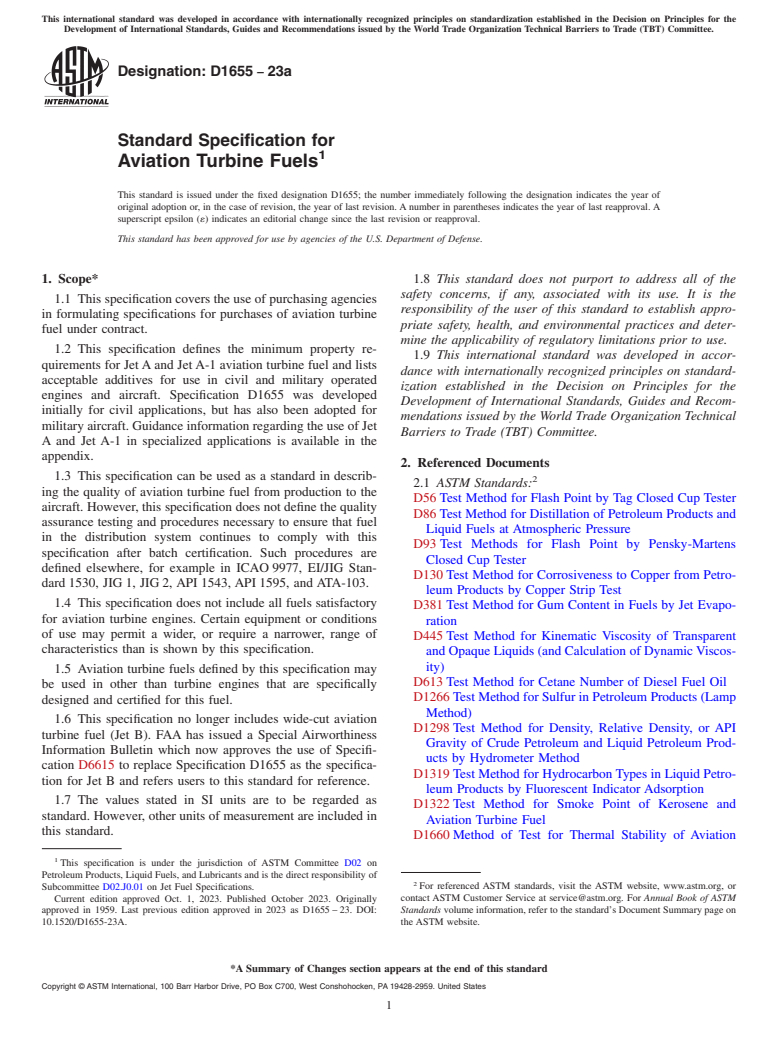
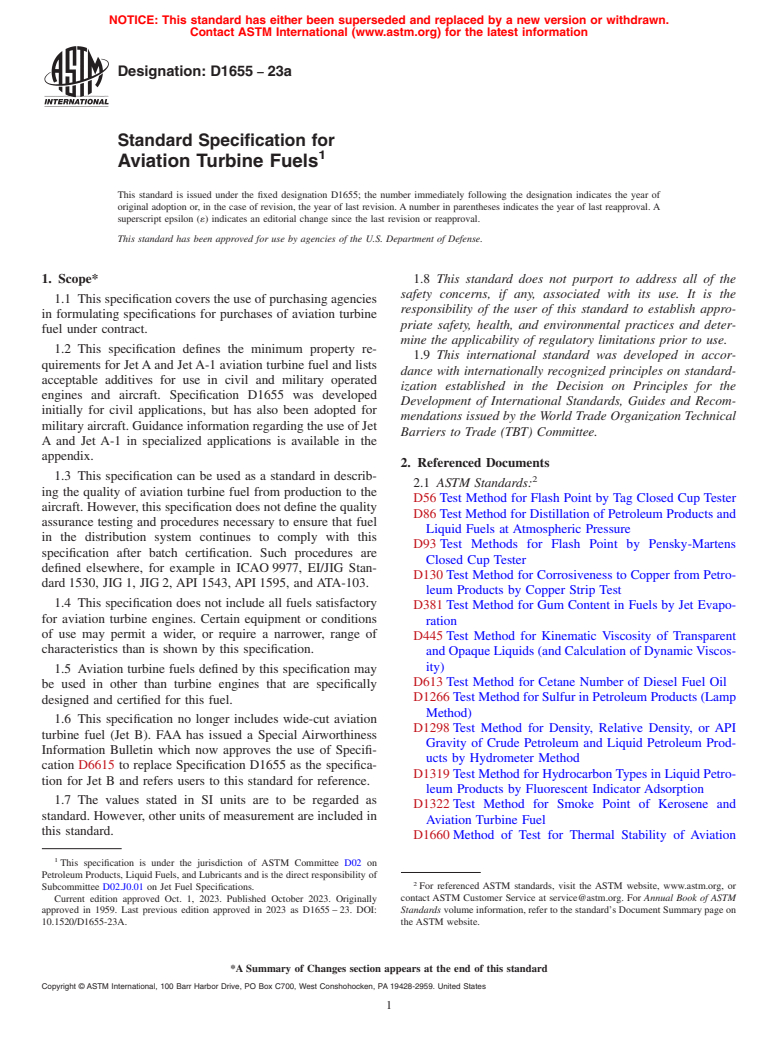
This international standard was developed in accordance with internationally recognized principles on standardization established in the Decision on Principles for the
Development of International Standards, Guides and Recommendations issued by the World Trade Organization Technical Barriers to Trade (TBT) Committee.
Designation: D1655 − 23a
Standard Specification for
Aviation Turbine Fuels
This standard is issued under the fixed designation D1655; the number immediately following the designation indicates the year of
original adoption or, in the case of revision, the year of last revision. A number in parentheses indicates the year of last reapproval. A
superscript epsilon (´) indicates an editorial change since the last revision or reapproval.
This standard has been approved for use by agencies of the U.S. Department of Defense.
1. Scope* 1.8 This standard does not purport to address all of the
safety concerns, if any, associated with its use. It is the
1.1 This specification covers the use of purchasing agencies
responsibility of the user of this standard to establish appro-
in formulating specifications for purchases of aviation turbine
priate safety, health, and environmental practices and deter-
fuel under contract.
mine the applicability of regulatory limitations prior to use.
1.2 This specification defines the minimum property re-
1.9 This international standard was developed in accor-
quirements for Jet A and Jet A-1 aviation turbine fuel and lists
dance with internationally recognized principles on standard-
acceptable additives for use in civil and military operated
ization established in the Decision on Principles for the
engines and aircraft. Specification D1655 was developed
Development of International Standards, Guides and Recom-
initially for civil applications, but has also been adopted for
mendations issued by the World Trade Organization Technical
military aircraft. Guidance information regarding the use of Jet
Barriers to Trade (TBT) Committee.
A and Jet A-1 in specialized applications is available in the
appendix.
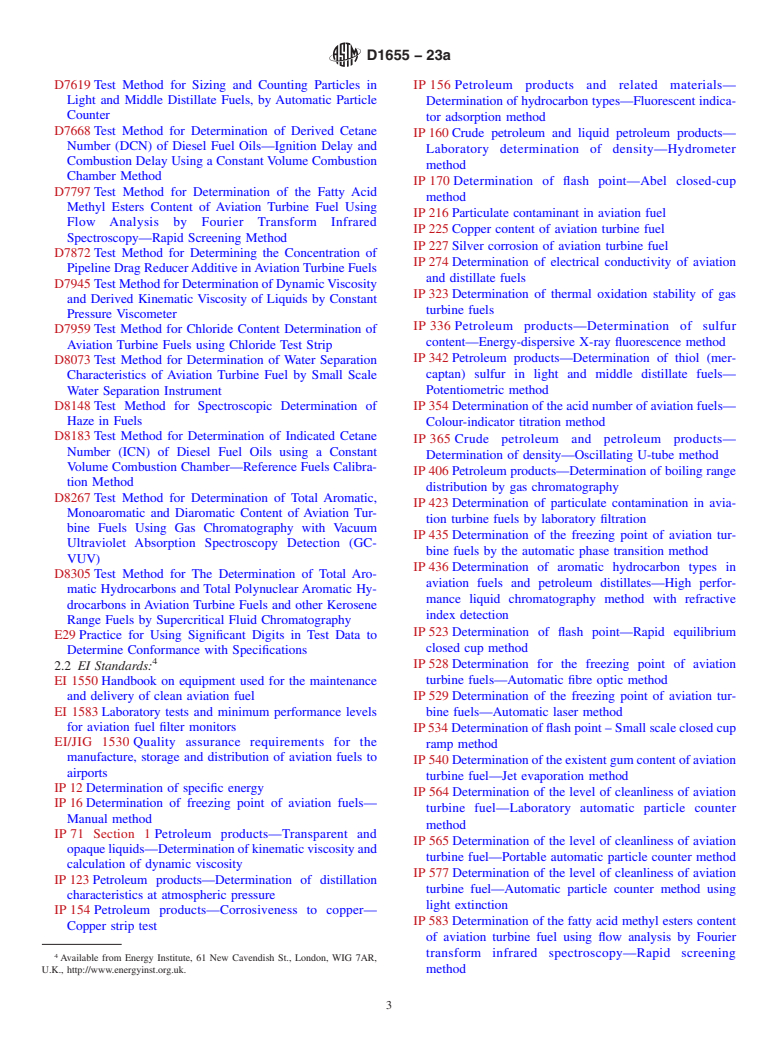
2. Referenced Documents
1.3 This specification can be used as a standard in describ-
2.1 ASTM Standards:
ing the quality of aviation turbine fuel from production to the
D56 Test Method for Flash Point by Tag Closed Cup Tester
aircraft. However, this specification does not define the quality
D86 Test Method for Distillation of Petroleum Products and
assurance testing and procedures necessary to ensure that fuel
Liquid Fuels at Atmospheric Pressure
in the distribution system continues to comply with this
D93 Test Methods for Flash Point by Pensky-Martens
specification after batch certification. Such procedures are
Closed Cup Tester
defined elsewhere, for example in ICAO 9977, EI/JIG Stan-
D130 Test Method for Corrosiveness to Copper from Petro-
dard 1530, JIG 1, JIG 2, API 1543, API 1595, and ATA-103.
leum Products by Copper Strip Test
1.4 This specification does not include all fuels satisfactory
D381 Test Method for Gum Content in Fuels by Jet Evapo-
for aviation turbine engines. Certain equipment or conditions
ration
of use may permit a wider, or require a narrower, range of
D445 Test Method for Kinematic Viscosity of Transparent
characteristics than is shown by this specification.
and Opaque Liquids (and Calculation of Dynamic Viscos-
ity)
1.5 Aviation turbine fuels defined by this specification may
D613 Test Method for Cetane Number of Diesel Fuel Oil
be used in other than turbine engines that are specifically
D1266 Test Method for Sulfur in Petroleum Products (Lamp
designed and certified for this fuel.
Method)
1.6 This specification no longer includes wide-cut aviation
D1298 Test Method for Density, Relative Density, or API
turbine fuel (Jet B). FAA has issued a Special Airworthiness
Gravity of Crude Petroleum and Liquid Petroleum Prod-
Information Bulletin which now approves the use of Specifi-
ucts by Hydrometer Method
cation D6615 to replace Specification D1655 as the specifica-
D1319 Test Method for Hydrocarbon Types in Liquid Petro-
tion for Jet B and refers users to this standard for reference.
leum Products by Fluorescent Indicator Adsorption
1.7 The values stated in SI units are to be regarded as
D1322 Test Method for Smoke Point of Kerosene and
standard. However, other units of measurement are included in
Aviation Turbine Fuel
this standard.
D1660 Method of Test for Thermal Stability of Aviation
This specification is under the jurisdiction of ASTM Committee D02 on
Petroleum Products, Liquid Fuels, and Lubricants and is the direct responsibility of
Subcommittee D02.J0.01 on Jet Fuel Specifications. For referenced ASTM standards, visit the ASTM website, www.astm.org, or
Current edition approved Oct. 1, 2023. Published October 2023. Originally contact ASTM Customer Service at service@astm.org. For Annual Book of ASTM
approved in 1959. Last previous edition approved in 2023 as D1655 – 23. DOI: Standards volume information, refer to the standard’s Document Summary page on
10.1520/D1655-23A. the ASTM website.
*A Summary of Changes section appears at the end of this standard
Copyright © ASTM International, 100 Barr Harbor Drive, PO Box C700, West Conshohocken, PA 19428-2959. United States
D1655 − 23a
Turbine Fuels (Withdrawn 1992) tricity in Petroleum Fuel Systems
D1840 Test Method for Naphthalene Hydrocarbons in Avia- D4952 Test Method for Qualitative Analysis for Active
tion Turbine Fuels by Ultraviolet Spectrophotometry
Sulfur Species in Fuels and Solvents (Doctor Test)
D2276 Test Method for Particulate Contaminant in Aviation D5001 Test Method for Measurement of Lubricity of Avia-
Fuel by Line Sampling
tion Turbine Fuels by the Ball-on-Cylinder Lubricity
D2386 Test Method for Freezing Point of Aviation Fuels
Evaluator (BOCLE)
D2622 Test Method for Sulfur in Petroleum Products by
D5006 Test Method for Measurement of Fuel System Icing
Wavelength Dispersive X-ray Fluorescence Spectrometry
Inhibitors (Ether Type) in Aviation Fuels
D2624 Test Methods for Electrical Conductivity of Aviation
D5452 Test Method for Particulate Contamination in Avia-
and Distillate Fuels
tion Fuels by Laboratory Filtration
D2887 Test Method for Boiling Range Distribution of Pe-
D5453 Test Method for Determination of Total Sulfur in
troleum Fractions by Gas Chromatography
Light Hydrocarbons, Spark Ignition Engine Fuel, Diesel
D2892 Test Method for Distillation of Crude Petroleum
Engine Fuel, and Engine Oil by Ultraviolet Fluorescence
(15-Theoretical Plate Column)
D5972 Test Method for Freezing Point of Aviation Fuels
D3227 Test Method for (Thiol Mercaptan) Sulfur in
(Automatic Phase Transition Method)
Gasoline, Kerosine, Aviation Turbine, and Distillate Fuels
D6379 Test Method for Determination of Aromatic Hydro-
(Potentiometric Method)
carbon Types in Aviation Fuels and Petroleum
D3240 Test Method for Undissolved Water In Aviation
Distillates—High Performance Liquid Chromatography
Turbine Fuels
Method with Refractive Index Detection
D3241 Test Method for Thermal Oxidation Stability of
D6469 Guide for Microbial Contamination in Fuels and Fuel
Aviation Turbine Fuels
Systems
D3242 Test Method for Acidity in Aviation Turbine Fuel
D6615 Specification for Jet B Wide-Cut Aviation Turbine
D3338 Test Method for Estimation of Net Heat of Combus-
Fuel
tion of Aviation Fuels
D6751 Specification for Biodiesel Fuel Blendstock (B100)
D3828 Test Methods for Flash Point by Small Scale Closed
for Middle Distillate Fuels
Cup Tester
D6866 Test Methods for Determining the Biobased Content
D3948 Test Method for Determining Water Separation Char-
of Solid, Liquid, and Gaseous Samples Using Radiocar-
acteristics of Aviation Turbine Fuels by Portable Separom-
bon Analysis
eter
D6890 Test Method for Determination of Ignition Delay and
D4052 Test Method for Density, Relative Density, and API
Derived Cetane Number (DCN) of Diesel Fuel Oils by
Gravity of Liquids by Digital Density Meter
Combustion in a Constant Volume Chamber
D4054 Practice for Evaluation of New Aviation Turbine
D7042 Test Method for Dynamic Viscosity and Density of
Fuels and Fuel Additives
Liquids by Stabinger Viscometer (and the Calculation of
D4057 Practice for Manual Sampling of Petroleum and
Kinematic Viscosity)
Petroleum Products
D7153 Test Method for Freezing Point of Aviation Fuels
D4171 Specification for Fuel System Icing Inhibitors
(Automatic Laser Method)
D4175 Terminology Relating to Petroleum Products, Liquid
D7154 Test Method for Freezing Point of Aviation Fuels
Fuels, and Lubricants
(Automatic Fiber Optical Method)
D4176 Test Method for Free Water and Particulate Contami-
D7170 Test Method for Determination of Derived Cetane
nation in Distillate Fuels (Visual Inspection Procedures)
Number (DCN) of Diesel Fuel Oils—Fixed Range Injec-
D4294 Test Method for Sulfur in Petroleum and Petroleum
tion Period, Constant Volume Combustion Chamber
Products by Energy Dispersive X-ray Fluorescence Spec-
Method (Withdrawn 2019)
trometry
D7224 Test Method for Determining Water Separation Char-
D4306 Practice for Aviation Fuel Sample Containers for
acteristics of Kerosine-Type Aviation Turbine Fuels Con-
Tests Affected by Trace Contamination
taining Additives by Portable Separometer
D4529 Test Method for Estimation of Net Heat of Combus-
D7236 Test Method for Flash Point by Small Scale Closed
tion of Aviation Fuels
Cup Tester (Ramp Method)
D4625 Test Method for Middle Distillate Fuel Storage
D7344 Test Method for Distillation of Petroleum Products
Stability at 43 °C (110 °F)
and Liquid Fuels at Atmospheric Pressure (Mini Method)
D4737 Test Method for Calculated Cetane Index by Four
D7345 Test Method for Distillation of Petroleum Products
Variable Equation
and Liquid Fuels at Atmospheric Pressure (Micro Distil-
D4809 Test Method for Heat of Combustion of Liquid
lation Method)
Hydrocarbon Fuels by Bomb Calorimeter (Precision
D7524 Test Method for Determination of Static Dissipater
Method)
Additives (SDA) in Aviation Turbine Fuel and Middle
D4865 Guide for Generation and Dissipation of Static Elec-
Distillate Fuels—High Performance Liquid Chromato-
graph (HPLC) Method
D7566 Specification for Aviation Turbine Fuel Containing
The last approved version of this historical standard is referenced on
www.astm.org. Synthesized Hydrocarbons
D1655 − 23a
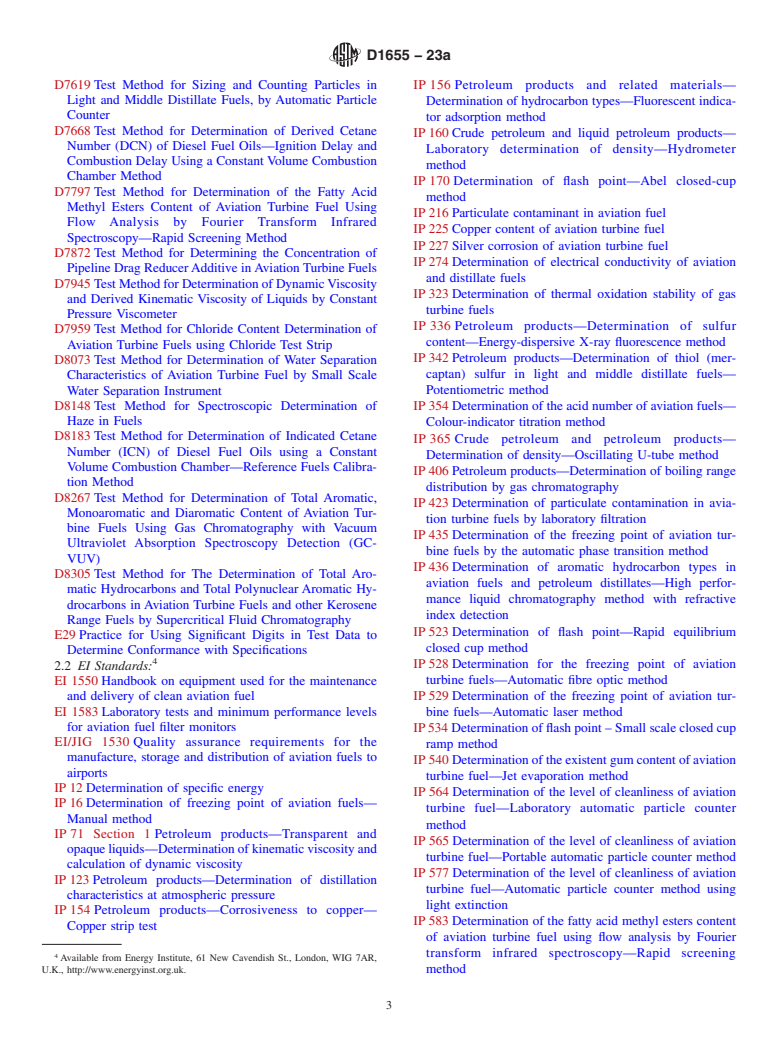
D7619 Test Method for Sizing and Counting Particles in IP 156 Petroleum products and related materials—
Light and Middle Distillate Fuels, by Automatic Particle Determination of hydrocarbon types—Fluorescent indica-
Counter
tor adsorption method
D7668 Test Method for Determination of Derived Cetane
IP 160 Crude petroleum and liquid petroleum products—
Number (DCN) of Diesel Fuel Oils—Ignition Delay and
Laboratory determination of density—Hydrometer
Combustion Delay Using a Constant Volume Combustion
method
Chamber Method
IP 170 Determination of flash point—Abel closed-cup
D7797 Test Method for Determination of the Fatty Acid
method
Methyl Esters Content of Aviation Turbine Fuel Using
IP 216 Particulate contaminant in aviation fuel
Flow Analysis by Fourier Transform Infrared
IP 225 Copper content of aviation turbine fuel
Spectroscopy—Rapid Screening Method
IP 227 Silver corrosion of aviation turbine fuel
D7872 Test Method for Determining the Concentration of
IP 274 Determination of electrical conductivity of aviation
Pipeline Drag Reducer Additive in Aviation Turbine Fuels
and distillate fuels
D7945 Test Method for Determination of Dynamic Viscosity
IP 323 Determination of thermal oxidation stability of gas
and Derived Kinematic Viscosity of Liquids by Constant
turbine fuels
Pressure Viscometer
IP 336 Petroleum products—Determination of sulfur
D7959 Test Method for Chloride Content Determination of
content—Energy-dispersive X-ray fluorescence method
Aviation Turbine Fuels using Chloride Test Strip
IP 342 Petroleum products—Determination of thiol (mer-
D8073 Test Method for Determination of Water Separation
Characteristics of Aviation Turbine Fuel by Small Scale captan) sulfur in light and middle distillate fuels—
Water Separation Instrument Potentiometric method
D8148 Test Method for Spectroscopic Determination of
IP 354 Determination of the acid number of aviation fuels—
Haze in Fuels
Colour-indicator titration method
D8183 Test Method for Determination of Indicated Cetane
IP 365 Crude petroleum and petroleum products—
Number (ICN) of Diesel Fuel Oils using a Constant
Determination of density—Oscillating U-tube method
Volume Combustion Chamber—Reference Fuels Calibra-
IP 406 Petroleum products—Determination of boiling range
tion Method
distribution by gas chromatography
D8267 Test Method for Determination of Total Aromatic,
IP 423 Determination of particulate contamination in avia-
Monoaromatic and Diaromatic Content of Aviation Tur-
tion turbine fuels by laboratory filtration
bine Fuels Using Gas Chromatography with Vacuum
IP 435 Determination of the freezing point of aviation tur-
Ultraviolet Absorption Spectroscopy Detection (GC-
bine fuels by the automatic phase transition method
VUV)
IP 436 Determination of aromatic hydrocarbon types in
D8305 Test Method for The Determination of Total Aro-
aviation fuels and petroleum distillates—High perfor-
matic Hydrocarbons and Total Polynuclear Aromatic Hy-
mance liquid chromatography method with refractive
drocarbons in Aviation Turbine Fuels and other Kerosene
index detection
Range Fuels by Supercritical Fluid Chromatography
IP 523 Determination of flash point—Rapid equilibrium
E29 Practice for Using Significant Digits in Test Data to
closed cup method
Determine Conformance with Specifications
IP 528 Determination for the freezing point of aviation
2.2 EI Standards:
turbine fuels—Automatic fibre optic method
EI 1550 Handbook on equipment used for the maintenance
and delivery of clean aviation fuel IP 529 Determination of the freezing point of aviation tur-
EI 1583 Laboratory tests and minimum performance levels bine fuels—Automatic laser method
for aviation fuel filter monitors
IP 534 Determination of flash point – Small scale closed cup
EI/JIG 1530 Quality assurance requirements for the
ramp method
manufacture, storage and distribution of aviation fuels to
IP 540 Determination of the existent gum content of aviation
airports
turbine fuel—Jet evaporation method
IP 12 Determination of specific energy
IP 564 Determination of the level of cleanliness of aviation
IP 16 Determination of freezing point of aviation fuels—
turbine fuel—Laboratory automatic particle counter
Manual method
method
IP 71 Section 1 Petroleum products—Transparent and
IP 565 Determination of the level of cleanliness of aviation
opaque liquids—Determination of kinematic viscosity and
turbine fuel—Portable automatic particle counter method
calculation of dynamic viscosity
IP 577 Determination of the level of cleanliness of aviation
IP 123 Petroleum products—Determination of distillation
turbine fuel—Automatic particle counter method using
characteristics at atmospheric pressure
light extinction
IP 154 Petroleum products—Corrosiveness to copper—
IP 583 Determination of the fatty acid methyl esters content
Copper strip test
of aviation turbine fuel using flow analysis by Fourier
4 transform infrared spectroscopy—Rapid screening
Available from Energy Institute, 61 New Cavendish St., London, WIG 7AR,
U.K., http://www.energyinst.org.uk. method
D1655 − 23a
IP 585 Determination of fatty acid methyl esters (FAME), JP-8 that will Provide Adequate Icing Inhibition and
derived from bio-diesel fuel, in aviation turbine fuel— Biostatic Protection for Air Force Aircraft
GC-MS with selective ion monitoring/scan detection
3. Terminology
method
IP 590 Determination of fatty acid methyl esters (FAME) in
3.1 For definitions of terms used in this specification, refer
aviation fuel—HPLC evaporative light scattering detector
to Terminology D4175.
method
3.2 Definitions of Terms Specific to This Standard:
IP 598 Petroleum products—Determination of the smoke
3.2.1 Certificate of Analysis (COA), n—the quality docu-
point of kerosine, manual and automated method
ment issued by independent inspectors and/or laboratories that
IP 599 Determination of fatty acid methyl esters (FAME) in
contains the results of measurements made of Table 1 proper-
aviation turbine fuel by gas chromatography using heart-
ties but does not necessarily contain or provide information
cut and refocusing
regarding those identified as being required at point of manu-
2.3 API Standards:
facture.
API 1543 Documentation, Monitoring and Laboratory Test-
3.2.1.1 Discussion—Typically, COAs are produced down-
ing of Aviation Fuel During Shipment from Refinery to
stream of refineries in intermediate supply terminals or inter-
Airport
mediate storage locations. A Certificate of Analysis is not
API 1595 Design, Construction, Operation, Maintenance,
considered equivalent to a Certificate of Quality.
and Inspection of Aviation Pre-Airfield Storage Terminals
3.2.2 Certificate of Quality (COQ) (including Refinery Cer-
2.4 Joint Inspection Group Standards:
tificate of Quality, RCQ), n—the quality document that is the
JIG 1 Aviation Fuel Quality Control & Operating Standards
definitive original document describing the quality of aviation
for Into-Plane Fuelling Services
fuel at the point of manufacture.
JIG 2 Aviation Fuel Quality Control & Operating Standards
3.2.2.1 Discussion—A COQ contains the results of
for Airport Depots & Hydrants
measurements, usually made by the product originator’s
2.5 ANSI Standard: laboratory, of all the properties listed in Table 1, the additive
ANSI 863 Report of Test Results information as per Table 2, as well as those additional testing
requirements detailed in Annex A1 for fuels containing syn-
2.6 Other Standards:
thesized components and confirms conformance to the speci-
Defence Standard (Def Stan) 91-091 Turbine Fuel, Aviation
8 fication.
Kerosine Type, Jet A-1
3.2.3 co-hydroprocessed esters and fatty acids, n—synthetic
IATA Guidance Material on Microbiological Contamination
hydrocarbons derived from the hydroprocessing of bio-derived
in Aircraft Fuel Tanks Ref. No: 9680
mono-, di-, and triglycerides, free fatty acids, and fatty acid
IATA Guidelines for Sodium Chloride Contamination
esters with conventional hydrocarbons in accordance with the
Troubleshooting and Decontamination of Airframe and
requirements of A1.2.2.1.
Engine Fuel Systems, 2nd Ed., February 1998
EN14214 Automotive Fuels—Fatty Acid Methyl Esters
3.2.4 co-hydroprocessed Fischer-Tropsch hydrocarbons,
(FAME) for Diesel Engines—Requirements and Test
n—synthetic hydrocarbons derived from the hydroprocessing
Methods
of hydrocarbons derived from Fischer-Tropsch synthesis to
Bulletin Number 65 MSEP Protocol
paraffinic syncrude with conventional hydrocarbons in accor-
ATA-103 Standard for Jet Fuel Quality Control at Airports
dance with the requirements of A1.2.2.2.
ICAO 9977 Manual on Civil Aviation Jet Fuel Supply
3.2.5 co-hydroprocessed synthesized kerosene,
AFRL-RQ-WP-TR-2013-0271 Determination of the Mini-
n—hydrocarbons in the kerosene boiling range derived from
mum Use Level of Fuel System Icing Inhibitor (FSII) in
non-petroleum sources such as coal, natural gas, biomass, fatty
acid esters and fatty acids by processes such as gasification,
Fischer-Tropsch synthesis, and hydroprocessing, that have
Available from American Petroleum Institute (API), 1220 L. St., NW,
been processed simultaneously with hydrocarbons from con-
Washington, DC 20005-4070, http://www.api.org.
ventional sources.
Available from Joint Inspection Group (JIG), http://www.jigonline.com.
Available from American National Standards Institute (ANSI), 25 W. 43rd St.,
3.2.6 identified incidental materials, n—chemicals and com-
4th Floor, New York, NY 10036.
positions that have defined upper content limits in an aviation
Available from Procurement Executive DFS (Air), Ministry of Defence, St.
fuel specification but are not approved additives.
Giles Court 1, St. Giles High St., London WC2H 8LD.
Available from International Air Transport Association (IATA), (Head Office)
3.2.7 metrological method, n—heater tube deposit rating
800 Place Victoria, PO Box 113, Montreal, H4Z 1M1, Quebec, Canada. www.i-
methods employing an optically-based deposit thickness mea-
ata.org
10 surement and mapping technique described in the Test Method
Available from European Committee for Standardization (CEN), 36 rue de
Stassart, B-1050, Brussels, Belgium, http://www.cenorm.be.
D3241 annexes.
Available from Joint Inspection Group (JIG), http://www.jigonline.com.
Available from Air Transport Association of America, Inc. (ATA) d/b/a
Airlines for America, 1275 Pennsylvania Ave. NW, Suite 1300, Washington, D.C.
20004, http://www.airlines.org. Available from Defense Technical Information Center (DTIC), 8725 John J.
Available from International Civil Aviation Organization (ICAO), 999 Uni- Kingman Rd., Ft. Belvoir, VA 22060-6218, http://www.dtic.mil/dtic, accession
versity St., Montreal, Quebec H3C 5H7, Canada, http://www.icao.int. number ADA595127.
D1655 − 23a
NOTE 1—Conventionally refined jet fuel contains trace levels of
4. General
materials that are not hydrocarbons, including oxygenates, organosulfur,
4.1 This specification, unless otherwise provided, prescribes
and nitrogenous compounds.
the required properties of aviation turbine fuel at the time and
6.1.2 Fuels used in certified engines and aircraft are ulti-
place of delivery.
mately approved by the certifying authority subsequent to
5. Classification
formal submission of evidence to the authority as part of the
5.1 Two types of aviation turbine fuels are provided, as type certification program for that aircraft and engine model.
follows: Additives to be used as supplements to an approved fuel must
5.1.1 Jet A and Jet A-1—Relatively high flash point distil-
also be similarly approved on an individual basis (see X1.2.4
lates of the kerosene type. and X1.15.1).
5.2 Jet A and Jet A-1 represent two grades of kerosene fuel
6.2 Additives—Additives are used to improve the perfor-
that differ in freezing point. Other grades would be suitably
mance of the fuel or for fuel handling and maintenance
identified.
purposes.
5.3 This specification previously cited the requirements for
6.2.1 Only additives approved by the aviation industry
Jet B. Requirements for Jet B fuel now appear in Specification
(including the aircraft certifying authority) are permitted in the
D6615.
fuel on which an aircraft is operated. Practice D4054 guides the
practice used to evaluate additives intended for incorporation
6. Materials and Manufacture
into Specification D1655. The additives included in Specifica-
6.1 Aviation turbine fuel is a complex mixture predomi-
tion D1655 jet fuel are shown in Table 2 and may be used
nantly composed of hydrocarbons and varies depending on
within the concentration limits shown in the table subject to
crude source and manufacturing process. Consequently, it is
any restrictions described in the table footnotes.
impossible to define the exact composition of Jet A/A-1. This
6.2.2 Where it is necessary to dilute an additive for handling
specification has therefore evolved primarily as a performance
purposes, a refined hydrocarbon stream from a refinery, pro-
specification rather than a compositional specification. It is
duced in accordance with Materials and Manufacture require-
acknowledged that this largely relies on accumulated experi-
ments of Specification D1655, or a reagent grade (or better)
ence; therefore the specification limits aviation turbine fuels to
hydrocarbon or hydrocarbon mixture (excluding non-
those made from conventional sources or by specifically
hydrocarbons) from a chemical supplier shall be used. Since
approved processes.
not all additives and diluents are compatible (for example, an
6.1.1 Aviation turbine fuel, except as otherwise specified in
additive may drop-out if diluted with alkylate versus
this specification, shall consist predominantly of refined hydro-
carbons (see Note 1) derived from conventional sources reformate), the additive manufacturer should be consulted
regarding the preferred diluent. Reporting does not change
including crude oil, natural gas liquid condensates, heavy oil,
shale oil, and oil sands. The use of jet fuel blends containing when dilution is used; additive package content as received or
components from other sources is permitted only in accordance active ingredient content as described in Table 2 is the
with Annex A1. concentration to be reported.
A
TABLE 1 Detailed Requirements of Aviation Turbine Fuels
B
Test Methods
Property Jet A or Jet A-1
Referee Alternative
COMPOSITION
Acidity, total mg KOH/g max 0.10 D3242/IP 354
Aromatics
C D
(1) percent by volume, or max 25 D1319 IP 156 or D8267 or D8305
(2) percent by volume max 26.5 D6379/IP 436
E
Sulfur, mercaptan, percent by mass max 0.003 D3227/IP 342
Sulfur, total percent by mass max 0.30 D1266, D2622, D4294, D5453,
or IP 336
VOLATILITY
G H, I
Distillation temperature, °C: D2887 or IP 406, D7344,
F
D86
H F
D7345, IP 123
10 % recovered, temperature max 205
50 % recovered, temperature report
90 % recovered, temperature report
Final boiling point, temperature max 300
Distillation residue, % max 1.5
Distillation loss, % max 1.5
J K K K K
Flash point, °C min 38 D93, D3828, D7236, IP 170,
D56
K K
IP 523, or IP 534
Density at 15 °C, kg/m 775 to 840 D1298 or IP 160 or D4052 or IP 365
L
FLUIDITY
M,N
Freezing point, °C max −40 Jet A D5972/IP 435, D7153/IP 529, or
D2386/IP 16
D7154 or IP 528
M,N
−47 Jet A-1
2 O P
Viscosity −20 °C, mm /s max 8.0 D445 or IP 71, Section 1 D7042 or D7945
D1655 − 23a
TABLE 1 Continued
B
Test Methods
Property Jet A or Jet A-1
Referee Alternative
COMBUSTION
Q
Net heat of combustion, MJ/kg min 42.8 D4809 D4529, D3338, or IP 12
One of the following requirements shall be
met:
(1) Smoke point, mm, or min 25.0 D1322/IP 598
(2) Smoke point, mm, and min 18.0 D1322/IP 598
R
Naphthalenes, percent by volume max 3.0 D1840 D8305
CORROSION
Copper strip, 2 h at 100 °C max No. 1 D130 or IP 154
L
THERMAL STABILITY
(2.5 h at control temperature of 260 °C min)
S S
Filter pressure drop, mm Hg max 25 D3241 /IP 323
Tube rating: One of the following require-
T
ments shall be met:
(1) Annex A1 VTR, VTR Color Code Less 3 (no peacock or ab-
than normal color deposits)
(2) Annex A2 ITR or Annex A3 ETR, max 85
nm average over area of 2.5 mm
CONTAMINANTS
Existent gum, mg/100 mL max 7 D381 IP 540
U
Microseparometer, Rating D3948
Without electrical conductivity additive min 85
With electrical conductivity additive min 70
ADDITIVES See 6.2
V
Electrical conductivity, pS/m D2624/IP 274
A
For compliance of test results against the requirements of Table 1, see 7.2.
B
The test methods indicated in this table are referred to in Section 11. Where applicable, the referee test methods are identified in Table 1.
C
In analyzing Aviation Turbine Fuel by Test Method D1319 or IP 156, users shall not report results obtained using any of the following lot numbers of Fluorescent Indicator
Dyed Gel: 3000000975, 3000000976, 3000000977, 3000000978, 3000000979, and 3000000980.
D
Results from Test Method D8305 shall be bias-corrected using the bias-correction equation for total aromatics in Section 13 (Precision and Bias) of Test Method D8305.
The bias-corrected aromatics result shall also be used in Test Method D3338.
E
The mercaptan sulfur determination may be waived if the fuel is considered sweet by the doctor test described in Test Method D4952.
F
D86 and IP 123 distillation of jet fuel is run at Group 4 conditions, except Group 3 condenser temperature is used.
G
D2887 or IP 406 results shall be converted to estimated D86 or IP 123 results by application of the correlation in Appendix X4 on Correlation for Jet and Diesel Fuel
in Test Method D2887 or Annex G of IP 406. Distillation residue and loss limits provide control of the distillation process during the use of Test Method D86, and they do
not apply to Test Method D2887 or IP 406. Distillation residue and loss shall be reported as “not applicable” (N/A) when reporting D2887 results.
H
Results from Test Method D7344 and D7345 shall be corrected for relative bias as described in each of the test methods.
I
Data supporting inclusion of the Test Method D7344 methodology is on file at ASTM International Headquarters and can be obtained by requesting Research Reports
RR:D02-1621 and RR:D02-1855. Contact ASTM Customer Service at service@astm.org.
J
A higher minimum flash point specification can be agreed upon between purchaser and supplier.
K
Relative to D56, results obtained by Test Method: D93 can be up to 1.5 °C higher; IP 170, IP 534, and D7236 can be up to 0.5 °C higher; D3828 (IP 523) can be up to
0.5 °C lower (a research report is pending being filed at ASTM and is available at the Energy Institute as ILS2019_MMS_1).
L
For Annex A1.2.2 co-processing the more stringent limits and test methods listed in Table A1.1 shall be applied at point of manufacture. Downstream from manufacture
standard Table 1 limits and test methods apply.
M
Other freezing points can be agreed upon between supplier and purchaser.
N
During downstream distribution if the freezing point of the fuel is very low and cannot be determined within the ASTM D2386/IP 16 lowest achievable temperature of minus
65 °C, if no crystals appear during cooling of the fuel and when the thermometer indicates a temperature of minus 65 °C, the freezing point shall be recorded as below
minus 65 °C. This limit does not apply if the freezing point is measured by D5972/IP 435, D7153/IP 529, or D7154 or IP 528.
O 2
1 mm /s = 1 cSt.
P
Test Method D7042 results shall be converted to bias-corrected kinematic viscosity results by the application of the correction described in Test Method D7042 for jet
fuel at –20 °C (currently subsection 15.4.4).
Q
For all grades use either Eq 1 or Table 1 in Test Method D4529 or Eq 2 in Test Method D3338. Calculate and report the net heat of combustion corrected for the sulfur
content when using Test Method D4529 and D3338 empirical test methods. Test Method D4809 may be used as an alternative.
R
Results from Test Method D8305 shall be bias-corrected using the bias-correction equation for total polynuclear aromatics in Section 13 (Precision and Bias) of Test
Method D8305.
S
D3241/IP 323 Thermal Stability is a critical aviation fuel test, the results of which are used to assess the suitability of jet fuel for aviation operational safety and regulatory
compliance. The integrity of D3241/IP 323 testing requires that heater tubes (test coupons) meet the requirements of D3241 Table 2 and give equivalent D3241 results
to the heater tubes supplied by the original equipment manufacturer (OEM). A test protocol to demonstrate equivalence of heater tubes from other suppliers is on file at
ASTM International Headquarters and can be obtained by requesting Research Report RR:D02-1550. Heater tubes and filter kits, manufactured by the OEM (PAC, 8824
Fallbrook Drive, Houston, TX 77064) were used in the development of the D3241/IP 323 test method. Heater tube and filter kits, manufactured by Falex (Falex Corporation,
1020 Airpark Dr., Sugar Grove, IL, 60554-9585) were demonstrated to give equivalent results (see D3241 for research report references). These historical facts should
not be construed as an endorsement or certification by ASTM International.
T
Tube deposit ratings shall be measured by D3241 Annex A2 ITR or Annex A3 ETR, when available. If the Annex A2 ITR device reports “N/A” for a tube’s volume
measurement, the test shall be a failure and the value reported as >85 nm. Visual rating of the heater tube by the method in D3241 Annex A1 is not required when Annex
A2 ITR or Annex A3 ETR deposit thickness measurements are reported. In case of dispute between results from visual and metrological methods, the referee shall be
considered the Annex A3 ETR method if available, otherwise Annex A2 ITR.
U
At point of manufacture. See X1.13 for guidance concerning the application of microseparometer results in fuel distribution.
V
If electrical conductivity additive is used, the conductivity shall not exceed 600 pS/m at the point of use of the fuel. When electrical conductivity additive is specified by
the purchaser, the conductivity shall be 50 to 600 pS/m under the conditions at point of delivery.
212 21 21
1 pS/m 5 1 × 10 Ω m
D1655 − 23a
TABLE 2 Detailed Information for Additives for Aviation Turbine Fuels
Additive Dosage
Fuel Performance Enhancing Additives
A, B C
Antioxidants 24.0 mg/L max
One of the following:
2,6 ditertiary-butyl phenol
2,6 ditertiary-butyl-4-methyl phenol
2,4 dimethyl-6-tertiary-butyl-phenol
75 % minimum, 2,6 ditertiary-butyl phenol plus
25 % maximum mixed tertiary and tritertiary butyl-phenols
55 % minimum 2,4 dimethyl-6-tertiary-butyl phenol plus
15 % minimum 2,6 ditertiary-butyl-4-methyl phenol,
remainder as monomethyl and dimethyl tertiary-butyl phenols
72 % minimum 2,4 dimethyl-6-tertiary-butyl phenol plus
28 % maximum monomethyl and dimethyl-tertiary-butyl-phenols
A
Metal Deactivator (MDA)
N,N-disalicylidene-1,2-propane diamine
C, D
On initial blending 2.0 mg/L max
After field reblending cumulative concentration 5.7 mg/L max
E, F, G, H I
Fuel System Icing Inhibitor 0.07 % by volume, min
Diethylene Glycol Monomethyl Ether (see Specification D4171 Type III) 0.15 % by volume, max
Fuel Handling and Maintenance Additives
J
Electrical Conductivity Improver
One of the following:
K, L
AvGuard SDA
On initial blending 3 mg/L max
After field reblending, cumulative concentration 5 mg/L max
L, M
Stadis 450
On initial blending 3 mg/L max
After field reblending, cumulative concentration 5 mg/L max
If the additive concentrations are unknown at time of retreatment, additional
concentration is restricted to 2 mg/L max
Leak Detection Additive 1 mg/kg max
N
Tracer A (LDTA-A)
E, O, P
Biocidal Additives
Q
Biobor JF
R
Corrosion Inhibitor/Lubricity Improvers
One of the following:
S
Innospec DCI-4A 23 mg/L max
Nalco 5403 23 mg/L max
Into-Plane Water Management
T
Kerojet Aquarius PRD 30568468 250 ppmv, max
A
The active ingredient of the additive must meet the composition specified.
B
Supporting data have been filed at ASTM International Headquarters and may be obtained by requesting Research Report RR:D02-1125. Contact ASTM Customer
Service at service@astm.org.
C
Active ingredient (not including weight of solvent).
D
At the point of manufacture, Metal Deactivator Additive (MDA) may be added to improve thermal oxidative stability subject to the following limitations:
(1) No more than 5 % of the jet fuel batches produced in a 12 month period may be treated with MDA to meet Table 1 thermal oxidative stability requirements (260 °C
test temperature).
(2) The batch of fuel shall pass Table 1 thermal oxidative stability requirements at a test temperature of 245 °C prior to any MDA addition.
(3) The fuel batch after MDA addition (2.0 mg/L maximum MDA) shall pass Table 1 thermal oxidative stability requirements at a test temperature of 275 °C.
(4) The thermal oxidative stability test result at 245 °C prior to MDA addition, the original test result at 260 °C and the test result at 275 °C (post MDA addition) and the
concentration of MDA added shall be reported on the Refinery Certificate of Quality.
Initial addition of more than 2.0 mg/L MDA to jet fuel that meets Table 1 thermal oxidative stability requirements (260 °C test temperature) prior to MDA addition is
permitted when fuel will be transported in supply chains where copper contamination can occur: the maximum cumulative addition in this table still applies.
MDA may be added to jet fuel in the distribution system to recover thermal oxidative stability performance lost during distribution (after refinery release). The Certificate
of Quality shall show the initial thermal oxidative stability test result, the result after the addition of the MDA and the concentration of MDA added.
E
The quantity shall be declared by the fuel supplier and agreed to by the purchaser.
F
The lower FSII concentration limit allowable in Jet Fuel is based on research by the U.S. Air Force as documented in report AFRL-RQ-WP-TR-2013-0271. Some engines
and aircraft as certified require higher minimum concentrations of icing inhibitor than the lower limit in this jet fuel specification. When fueling an aircraft, the fuel should
be additized to the concentration levels specified in the appropriate engine and aircraft manual.
G
DiEGME content can by analyzed by Test Method D5006.
H
DiEGME is not suitable for use in systems that will later use EI 1583 filter monitors, which are commonly used at the point of aircraft fueling. Additional guidance is
provided in EI 1550 Chapter 9.
I
Some aircraft require higher levels than 0.07 % by volume.
J
If electrical conductivity improver is used, the conductivity shall not exceed 600 pS/m at the point of use of the fuel. When electrical conductivity additive is specified by
212 21 21
the purchaser, the conductivity shall be 50 pS ⁄m to 600 pS/m under the conditions at point of delivery. 1 pS/m51×10 Ω m
D1655 − 23a
K
AvGuard is a trademark of Afton Chemical Corporation, 500 Spring Street Richmond, VA 23219. Supporting documentation for this additive is found in RR:D02-1861.
L
Electrical conductivity improver content can be analyzed by Test Method D7524.
M
Stadis 450 is a registered trademark marketed by Innospec Inc., Innospec Manufacturing Park, Oil Sites Road, Ellesmere Port, Cheshire, CH65 4EY, UK.
N
Tracer A (LDTA-A) is a registered trademark of Praxair Services, Inc., Tucson, AZ 85705.
O
Biocidal additives are available for controlled usage. Where such an additive is used in the fuel, the approval status of the additive and associated conditions must be
checked for the specific aircraft and engines to be operated.
P
Refer to the Aircraft Maintenance Manual (AMM) to determine if the following biocide is approved for use and for the appropriate use and dosage.
Q
Biobor JF is a registered trademark of Hammonds Fuel Additives, Inc. 6951 W. Little York, Houston, TX 77040.
R
More information concerning minimum treat rates of corrosion inhibitor/lubricity improver additives is contained in X1.10.2.
S
Innospec DCI-4A is available from Innospec Inc., Innospec Manufacturing Park, Oil Sites Road, Ellesmere Port, Cheshire, CH65 4EY, UK.
T
Kerojet Aquarius is available from BASF SE, Carl-Bosch-Strasse 38, D-67056 Ludwigshafen am Rhein, Germany. Any process or formulation change to Kerojet Aquarius
Product Number (PRD) 30568468 that invalidates the data submitted in ASTM Research Report RR:D02-2001 will require a new and unique PRD. Note that given the
unique function of Kerojet Aquarius and the need for careful management of use, the additive should only be used in compliance with the following controls: (1) Refer to
the Aircraft Documentation (e.g., approved additives listed in the Type Certificate Data Sheet (TCDS), Aircraft Flight Manual (AFM), Aircraft Maintenance Manual (AMM),
Consumable Materials List (CML), or other relevant documentation) for approved usage and dosage for the specific aircraft/engine/APU combination. (2) Additive to be
injected after final filtration at the skin of the aircraft. For possible defueling of aircraft, do not allow additive to pass through EI 1581 and EI 1583 filters. (3) Dose only in
compliance with Aircraft Documentation and recommended practice detailed in this specification. (4) Handling, usage, and injection equipment information is contained
in the Kerojet Aquarius User Manual and RR:D02-2001.
6.3 Identified Incidental Materials—Table 3 lists specific result may be rounded to the same number of significant figures
materials that have an agreed limit, known as Identified as in Table 1 using Practice E29. Where multiple determina-
Incidental Materials. Specification D1655 does not require that tions are made, the average result, rounded in accordance with
each batch of fuel be analyzed for identified incidental mate- Practice E29, shall be used.
rials where there is essentially no risk of contamination
8. Workmanship, Finish, and Appearance
exceeding Table 3 limits. Where a supplier risk assessment
suggests that identified incidental materials could exceed Table
8.1 The aviation turbine fuel specified in this specification
3 limits, jet fuel should be confirmed to comply with Table 3
shall be visually free of undissolved water, sediment, and
limits prior to airport supply because airports generally are not
suspended matter. The odor of the fuel shall not be nauseating
equipped to mitigate identified incidental material content that
or irritating. If the fuel has an odor similar to that of “rotten
exceeds specification limits. Further guidance concerning these
egg,” please refer to X1.12.5 for further discussion. No
materials is presented in X1.16.
substance of known dangerous toxicity under usual conditions
of handling and use shall be present, except as permitted in this
6.4 Guidance material is presented in Appendix X2 con-
specification.
cerning the need to control processing additives in jet fuel
production.
9. Sampling
7. Detailed Requirements
9.1 Because of the importance of proper sampling proce-
7.1 The aviation turbine fuel shall conform to the require- dures in establishing fuel quality, use the appropriate proce-
dures in Practice D4057 to obtain a representative sample from
ments prescribed in Table 1.
the batch of fuel for specification compliance testing. This
7.2 Test results shall not exceed the maximum or be less
requirement is met by producing fuel as a discrete batch then
than the minimum values specified in Table 1. No allowance
testing it for specification compliance. This requirement is not
shall be made for the precision of the test methods. To
satisfied by averaging online analysis results.
determine conformance to the specification requirement, a test
9.2 A number of jet fuel properties, including thermal
stability, water separation, electrical conductivity, and others,
TABLE 3 Identified Incidental Materials
are very sensitive to trace contamination, which can originate
A
Material Permitted Level Test Methods
from sample containers. For recommended sample containers,
Referee Alternative
refer to Practice D4306.
C,D
Fatty Acid Methyl Ester 50 mg/kg IP 585 D7797/IP 583,
B
(FAME), max IP 590,
IP 599 10. Report
F
10.1 The type and number of reports to ensure conformance
Pipeline Drag Reducing Additive 72 μg ⁄L D7872
E
(DRA), max
with the requirements of this specification shall be mutually
A
Where applicable, the referee test methods are identified in Table 3. agreed upon by the seller and the purchaser of the aviation
B
For the purpose of meeting this requirement FAME is defined as material
turbine fuel.
meeting the limits of EN14214 or Specification D6751. Fatty acid methyl esters
that fail to meet the biodiesel quality standards are not permitted in aviation turbine
10.2 When Table 1 test results and Table 2 additive addi-
fuel.
tions are reported at the point of batch origination or at full
C
On an emergency basis, up to 100 mg/kg FAME is permitted in jet fuel when
certification in a form commonly known as a “Certificate of
authorized by the airframe and engine manufacturers and managed in compliance
with airframe and engine manufacturer requirements.
Quality” or “Certificate of Analysis,” at least the following
D
Subcommittee J intends to evaluate field experience in December 2016 to
should be included:
determine if a ballot to increase the FAME content limit to 100 mg/kg is supported
by the absence of significant FAME-related problems. 10.2.1 The designation of each test method used,
E
Active polymer ingredient.
10.2.2 The limits from Table 1, Table 2, and specific Annex
F
DRA is not approved as an additive for jet fuel. This level is accepted by approval
Table, for each item reported with units converted as appro-
authorities as the functional definition of “nil addition.”
priate to those measured and reported, and
D1655 − 23a
10.2.3 The designation of the quality system used by the point results outside specification limits by automated methods
reporting test laboratory. If no quality system is used then this should be investigated, but such results do not disqualify the
shall be reported as “None.” fuel from aviation use if the results from the referee method are
within the specification limit.
10.3 For examples on reporting, see Appendix X3 “Forms
11.1.5 Viscosity—Test Method D445 or IP 71 Section 1,
for Reporting Inspection Data on Aviation Turbine Fuels.”
D7042, or D7945. Results from Test Method D7042 shall be
reported as
...
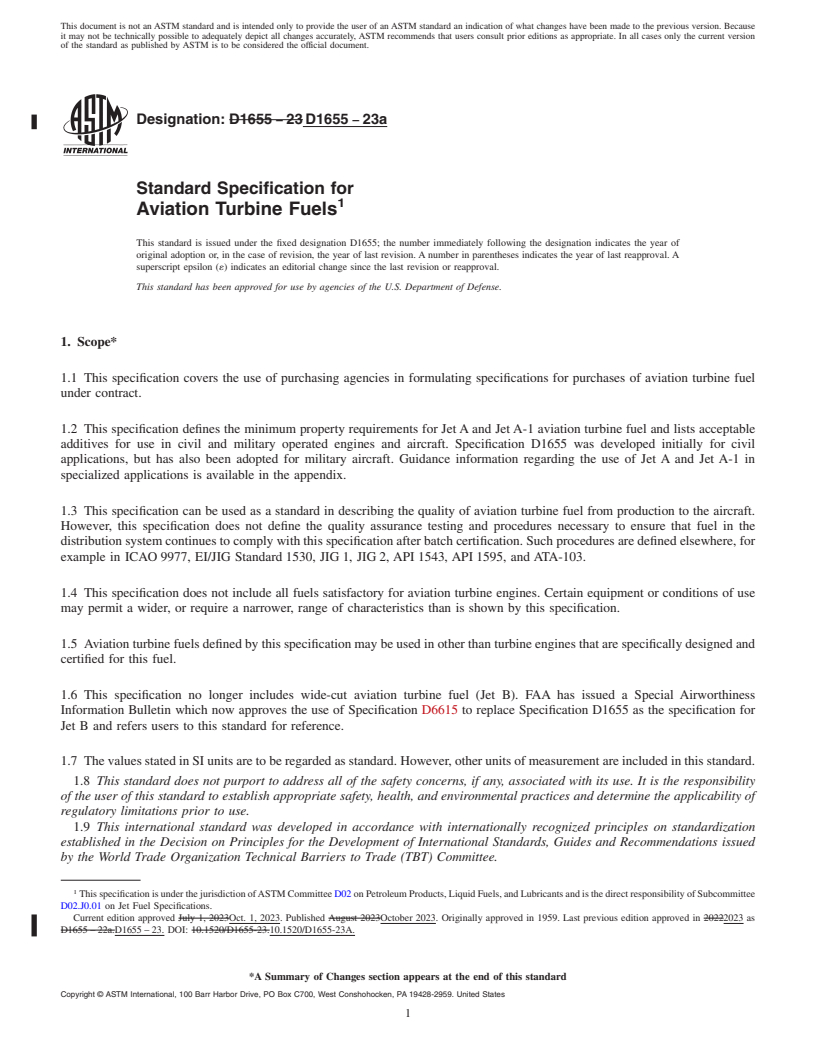
This document is not an ASTM standard and is intended only to provide the user of an ASTM standard an indication of what changes have been made to the previous version. Because
it may not be technically possible to adequately depict all changes accurately, ASTM recommends that users consult prior editions as appropriate. In all cases only the current version
of the standard as published by ASTM is to be considered the official document.
Designation: D1655 − 23 D1655 − 23a
Standard Specification for
Aviation Turbine Fuels
This standard is issued under the fixed designation D1655; the number immediately following the designation indicates the year of
original adoption or, in the case of revision, the year of last revision. A number in parentheses indicates the year of last reapproval. A
superscript epsilon (´) indicates an editorial change since the last revision or reapproval.
This standard has been approved for use by agencies of the U.S. Department of Defense.
1. Scope*
1.1 This specification covers the use of purchasing agencies in formulating specifications for purchases of aviation turbine fuel
under contract.
1.2 This specification defines the minimum property requirements for Jet A and Jet A-1 aviation turbine fuel and lists acceptable
additives for use in civil and military operated engines and aircraft. Specification D1655 was developed initially for civil
applications, but has also been adopted for military aircraft. Guidance information regarding the use of Jet A and Jet A-1 in
specialized applications is available in the appendix.
1.3 This specification can be used as a standard in describing the quality of aviation turbine fuel from production to the aircraft.
However, this specification does not define the quality assurance testing and procedures necessary to ensure that fuel in the
distribution system continues to comply with this specification after batch certification. Such procedures are defined elsewhere, for
example in ICAO 9977, EI/JIG Standard 1530, JIG 1, JIG 2, API 1543, API 1595, and ATA-103.
1.4 This specification does not include all fuels satisfactory for aviation turbine engines. Certain equipment or conditions of use
may permit a wider, or require a narrower, range of characteristics than is shown by this specification.
1.5 Aviation turbine fuels defined by this specification may be used in other than turbine engines that are specifically designed and
certified for this fuel.
1.6 This specification no longer includes wide-cut aviation turbine fuel (Jet B). FAA has issued a Special Airworthiness
Information Bulletin which now approves the use of Specification D6615 to replace Specification D1655 as the specification for
Jet B and refers users to this standard for reference.
1.7 The values stated in SI units are to be regarded as standard. However, other units of measurement are included in this standard.
1.8 This standard does not purport to address all of the safety concerns, if any, associated with its use. It is the responsibility
of the user of this standard to establish appropriate safety, health, and environmental practices and determine the applicability of
regulatory limitations prior to use.
1.9 This international standard was developed in accordance with internationally recognized principles on standardization
established in the Decision on Principles for the Development of International Standards, Guides and Recommendations issued
by the World Trade Organization Technical Barriers to Trade (TBT) Committee.
This specification is under the jurisdiction of ASTM Committee D02 on Petroleum Products, Liquid Fuels, and Lubricants and is the direct responsibility of Subcommittee
D02.J0.01 on Jet Fuel Specifications.
Current edition approved July 1, 2023Oct. 1, 2023. Published August 2023October 2023. Originally approved in 1959. Last previous edition approved in 20222023 as
D1655 – 22a.D1655 – 23. DOI: 10.1520/D1655-23.10.1520/D1655-23A.
*A Summary of Changes section appears at the end of this standard
Copyright © ASTM International, 100 Barr Harbor Drive, PO Box C700, West Conshohocken, PA 19428-2959. United States
D1655 − 23a
2. Referenced Documents
2.1 ASTM Standards:
D56 Test Method for Flash Point by Tag Closed Cup Tester
D86 Test Method for Distillation of Petroleum Products and Liquid Fuels at Atmospheric Pressure
D93 Test Methods for Flash Point by Pensky-Martens Closed Cup Tester
D130 Test Method for Corrosiveness to Copper from Petroleum Products by Copper Strip Test
D381 Test Method for Gum Content in Fuels by Jet Evaporation
D445 Test Method for Kinematic Viscosity of Transparent and Opaque Liquids (and Calculation of Dynamic Viscosity)
D613 Test Method for Cetane Number of Diesel Fuel Oil
D1266 Test Method for Sulfur in Petroleum Products (Lamp Method)
D1298 Test Method for Density, Relative Density, or API Gravity of Crude Petroleum and Liquid Petroleum Products by
Hydrometer Method
D1319 Test Method for Hydrocarbon Types in Liquid Petroleum Products by Fluorescent Indicator Adsorption
D1322 Test Method for Smoke Point of Kerosene and Aviation Turbine Fuel
D1660 Method of Test for Thermal Stability of Aviation Turbine Fuels (Withdrawn 1992)
D1840 Test Method for Naphthalene Hydrocarbons in Aviation Turbine Fuels by Ultraviolet Spectrophotometry
D2276 Test Method for Particulate Contaminant in Aviation Fuel by Line Sampling
D2386 Test Method for Freezing Point of Aviation Fuels
D2622 Test Method for Sulfur in Petroleum Products by Wavelength Dispersive X-ray Fluorescence Spectrometry
D2624 Test Methods for Electrical Conductivity of Aviation and Distillate Fuels
D2887 Test Method for Boiling Range Distribution of Petroleum Fractions by Gas Chromatography
D2892 Test Method for Distillation of Crude Petroleum (15-Theoretical Plate Column)
D3227 Test Method for (Thiol Mercaptan) Sulfur in Gasoline, Kerosine, Aviation Turbine, and Distillate Fuels (Potentiometric
Method)
D3240 Test Method for Undissolved Water In Aviation Turbine Fuels
D3241 Test Method for Thermal Oxidation Stability of Aviation Turbine Fuels
D3242 Test Method for Acidity in Aviation Turbine Fuel
D3338 Test Method for Estimation of Net Heat of Combustion of Aviation Fuels
D3828 Test Methods for Flash Point by Small Scale Closed Cup Tester
D3948 Test Method for Determining Water Separation Characteristics of Aviation Turbine Fuels by Portable Separometer
D4052 Test Method for Density, Relative Density, and API Gravity of Liquids by Digital Density Meter
D4054 Practice for Evaluation of New Aviation Turbine Fuels and Fuel Additives
D4057 Practice for Manual Sampling of Petroleum and Petroleum Products
D4171 Specification for Fuel System Icing Inhibitors
D4175 Terminology Relating to Petroleum Products, Liquid Fuels, and Lubricants
D4176 Test Method for Free Water and Particulate Contamination in Distillate Fuels (Visual Inspection Procedures)
D4294 Test Method for Sulfur in Petroleum and Petroleum Products by Energy Dispersive X-ray Fluorescence Spectrometry
D4306 Practice for Aviation Fuel Sample Containers for Tests Affected by Trace Contamination
D4529 Test Method for Estimation of Net Heat of Combustion of Aviation Fuels
D4625 Test Method for Middle Distillate Fuel Storage Stability at 43 °C (110 °F)
D4737 Test Method for Calculated Cetane Index by Four Variable Equation
D4809 Test Method for Heat of Combustion of Liquid Hydrocarbon Fuels by Bomb Calorimeter (Precision Method)
D4865 Guide for Generation and Dissipation of Static Electricity in Petroleum Fuel Systems
D4952 Test Method for Qualitative Analysis for Active Sulfur Species in Fuels and Solvents (Doctor Test)
D5001 Test Method for Measurement of Lubricity of Aviation Turbine Fuels by the Ball-on-Cylinder Lubricity Evaluator
(BOCLE)
D5006 Test Method for Measurement of Fuel System Icing Inhibitors (Ether Type) in Aviation Fuels
D5452 Test Method for Particulate Contamination in Aviation Fuels by Laboratory Filtration
D5453 Test Method for Determination of Total Sulfur in Light Hydrocarbons, Spark Ignition Engine Fuel, Diesel Engine Fuel,
and Engine Oil by Ultraviolet Fluorescence
D5972 Test Method for Freezing Point of Aviation Fuels (Automatic Phase Transition Method)
D6379 Test Method for Determination of Aromatic Hydrocarbon Types in Aviation Fuels and Petroleum Distillates—High
Performance Liquid Chromatography Method with Refractive Index Detection
For referenced ASTM standards, visit the ASTM website, www.astm.org, or contact ASTM Customer Service at service@astm.org. For Annual Book of ASTM Standards
volume information, refer to the standard’s Document Summary page on the ASTM website.
The last approved version of this historical standard is referenced on www.astm.org.
D1655 − 23a
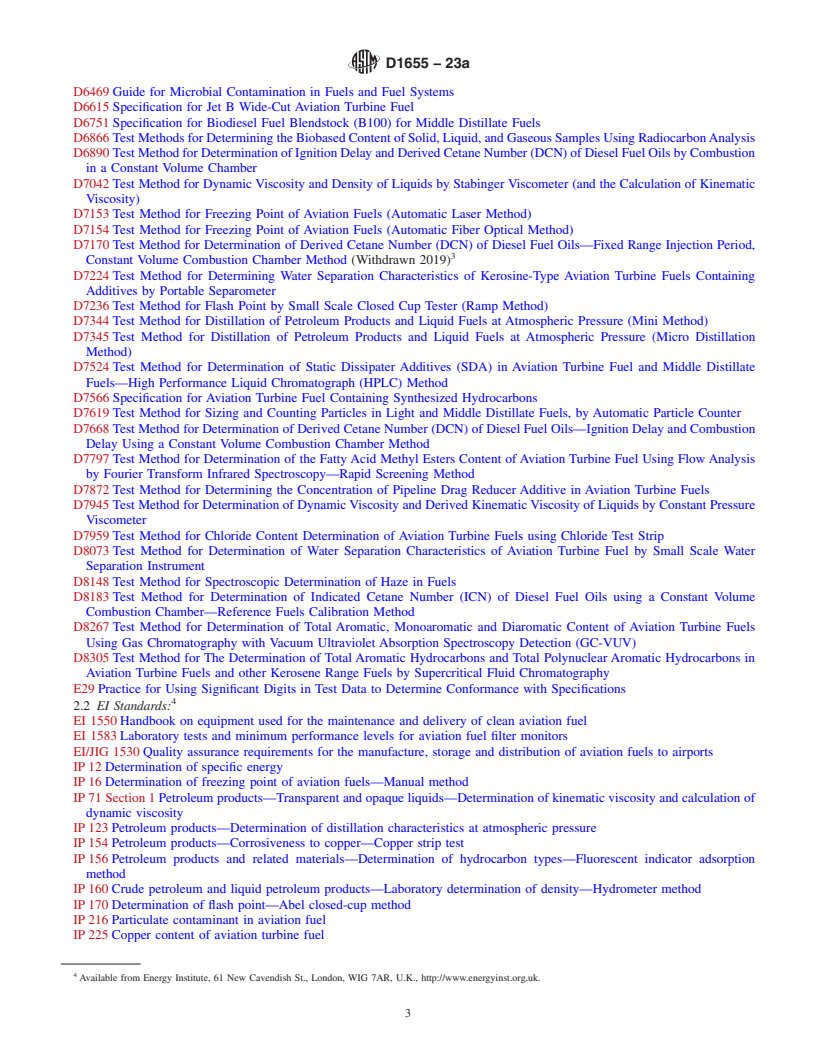
D6469 Guide for Microbial Contamination in Fuels and Fuel Systems
D6615 Specification for Jet B Wide-Cut Aviation Turbine Fuel
D6751 Specification for Biodiesel Fuel Blendstock (B100) for Middle Distillate Fuels
D6866 Test Methods for Determining the Biobased Content of Solid, Liquid, and Gaseous Samples Using Radiocarbon Analysis
D6890 Test Method for Determination of Ignition Delay and Derived Cetane Number (DCN) of Diesel Fuel Oils by Combustion
in a Constant Volume Chamber
D7042 Test Method for Dynamic Viscosity and Density of Liquids by Stabinger Viscometer (and the Calculation of Kinematic
Viscosity)
D7153 Test Method for Freezing Point of Aviation Fuels (Automatic Laser Method)
D7154 Test Method for Freezing Point of Aviation Fuels (Automatic Fiber Optical Method)
D7170 Test Method for Determination of Derived Cetane Number (DCN) of Diesel Fuel Oils—Fixed Range Injection Period,
Constant Volume Combustion Chamber Method (Withdrawn 2019)
D7224 Test Method for Determining Water Separation Characteristics of Kerosine-Type Aviation Turbine Fuels Containing
Additives by Portable Separometer
D7236 Test Method for Flash Point by Small Scale Closed Cup Tester (Ramp Method)
D7344 Test Method for Distillation of Petroleum Products and Liquid Fuels at Atmospheric Pressure (Mini Method)
D7345 Test Method for Distillation of Petroleum Products and Liquid Fuels at Atmospheric Pressure (Micro Distillation
Method)
D7524 Test Method for Determination of Static Dissipater Additives (SDA) in Aviation Turbine Fuel and Middle Distillate
Fuels—High Performance Liquid Chromatograph (HPLC) Method
D7566 Specification for Aviation Turbine Fuel Containing Synthesized Hydrocarbons
D7619 Test Method for Sizing and Counting Particles in Light and Middle Distillate Fuels, by Automatic Particle Counter
D7668 Test Method for Determination of Derived Cetane Number (DCN) of Diesel Fuel Oils—Ignition Delay and Combustion
Delay Using a Constant Volume Combustion Chamber Method
D7797 Test Method for Determination of the Fatty Acid Methyl Esters Content of Aviation Turbine Fuel Using Flow Analysis
by Fourier Transform Infrared Spectroscopy—Rapid Screening Method
D7872 Test Method for Determining the Concentration of Pipeline Drag Reducer Additive in Aviation Turbine Fuels
D7945 Test Method for Determination of Dynamic Viscosity and Derived Kinematic Viscosity of Liquids by Constant Pressure
Viscometer
D7959 Test Method for Chloride Content Determination of Aviation Turbine Fuels using Chloride Test Strip
D8073 Test Method for Determination of Water Separation Characteristics of Aviation Turbine Fuel by Small Scale Water
Separation Instrument
D8148 Test Method for Spectroscopic Determination of Haze in Fuels
D8183 Test Method for Determination of Indicated Cetane Number (ICN) of Diesel Fuel Oils using a Constant Volume
Combustion Chamber—Reference Fuels Calibration Method
D8267 Test Method for Determination of Total Aromatic, Monoaromatic and Diaromatic Content of Aviation Turbine Fuels
Using Gas Chromatography with Vacuum Ultraviolet Absorption Spectroscopy Detection (GC-VUV)
D8305 Test Method for The Determination of Total Aromatic Hydrocarbons and Total Polynuclear Aromatic Hydrocarbons in
Aviation Turbine Fuels and other Kerosene Range Fuels by Supercritical Fluid Chromatography
E29 Practice for Using Significant Digits in Test Data to Determine Conformance with Specifications
2.2 EI Standards:
EI 1550 Handbook on equipment used for the maintenance and delivery of clean aviation fuel
EI 1583 Laboratory tests and minimum performance levels for aviation fuel filter monitors
EI/JIG 1530 Quality assurance requirements for the manufacture, storage and distribution of aviation fuels to airports
IP 12 Determination of specific energy
IP 16 Determination of freezing point of aviation fuels—Manual method
IP 71 Section 1 Petroleum products—Transparent and opaque liquids—Determination of kinematic viscosity and calculation of
dynamic viscosity
IP 123 Petroleum products—Determination of distillation characteristics at atmospheric pressure
IP 154 Petroleum products—Corrosiveness to copper—Copper strip test
IP 156 Petroleum products and related materials—Determination of hydrocarbon types—Fluorescent indicator adsorption
method
IP 160 Crude petroleum and liquid petroleum products—Laboratory determination of density—Hydrometer method
IP 170 Determination of flash point—Abel closed-cup method
IP 216 Particulate contaminant in aviation fuel
IP 225 Copper content of aviation turbine fuel
Available from Energy Institute, 61 New Cavendish St., London, WIG 7AR, U.K., http://www.energyinst.org.uk.
D1655 − 23a
IP 227 Silver corrosion of aviation turbine fuel
IP 274 Determination of electrical conductivity of aviation and distillate fuels
IP 323 Determination of thermal oxidation stability of gas turbine fuels
IP 336 Petroleum products—Determination of sulfur content—Energy-dispersive X-ray fluorescence method
IP 342 Petroleum products—Determination of thiol (mercaptan) sulfur in light and middle distillate fuels—Potentiometric
method
IP 354 Determination of the acid number of aviation fuels—Colour-indicator titration method
IP 365 Crude petroleum and petroleum products—Determination of density—Oscillating U-tube method
IP 406 Petroleum products—Determination of boiling range distribution by gas chromatography
IP 423 Determination of particulate contamination in aviation turbine fuels by laboratory filtration
IP 435 Determination of the freezing point of aviation turbine fuels by the automatic phase transition method
IP 436 Determination of aromatic hydrocarbon types in aviation fuels and petroleum distillates—High performance liquid
chromatography method with refractive index detection
IP 523 Determination of flash point—Rapid equilibrium closed cup method
IP 528 Determination for the freezing point of aviation turbine fuels—Automatic fibre optic method
IP 529 Determination of the freezing point of aviation turbine fuels—Automatic laser method
IP 534 Determination of flash point – Small scale closed cup ramp method
IP 540 Determination of the existent gum content of aviation turbine fuel—Jet evaporation method
IP 564 Determination of the level of cleanliness of aviation turbine fuel—Laboratory automatic particle counter method
IP 565 Determination of the level of cleanliness of aviation turbine fuel—Portable automatic particle counter method
IP 577 Determination of the level of cleanliness of aviation turbine fuel—Automatic particle counter method using light
extinction
IP 583 Determination of the fatty acid methyl esters content of aviation turbine fuel using flow analysis by Fourier transform
infrared spectroscopy—Rapid screening method
IP 585 Determination of fatty acid methyl esters (FAME), derived from bio-diesel fuel, in aviation turbine fuel—GC-MS with
selective ion monitoring/scan detection method
IP 590 Determination of fatty acid methyl esters (FAME) in aviation fuel—HPLC evaporative light scattering detector method
IP 598 Petroleum products—Determination of the smoke point of kerosine, manual and automated method
IP 599 Determination of fatty acid methyl esters (FAME) in aviation turbine fuel by gas chromatography using heart-cut and
refocusing
2.3 API Standards:
API 1543 Documentation, Monitoring and Laboratory Testing of Aviation Fuel During Shipment from Refinery to Airport
API 1595 Design, Construction, Operation, Maintenance, and Inspection of Aviation Pre-Airfield Storage Terminals
2.4 Joint Inspection Group Standards:
JIG 1 Aviation Fuel Quality Control & Operating Standards for Into-Plane Fuelling Services
JIG 2 Aviation Fuel Quality Control & Operating Standards for Airport Depots & Hydrants
2.5 ANSI Standard:
ANSI 863 Report of Test Results
2.6 Other Standards:
Defence Standard (Def Stan) 91-091 Turbine Fuel, Aviation Kerosine Type, Jet A-1
IATA Guidance Material on Microbiological Contamination in Aircraft Fuel Tanks Ref. No: 9680
IATA Guidelines for Sodium Chloride Contamination Troubleshooting and Decontamination of Airframe and Engine Fuel
Systems, 2nd Ed., February 1998
EN14214 Automotive Fuels—Fatty Acid Methyl Esters (FAME) for Diesel Engines—Requirements and Test Methods
Bulletin Number 65 MSEP Protocol
ATA-103 Standard for Jet Fuel Quality Control at Airports
ICAO 9977 Manual on Civil Aviation Jet Fuel Supply
AFRL-RQ-WP-TR-2013-0271 Determination of the Minimum Use Level of Fuel System Icing Inhibitor (FSII) in JP-8 that will
Available from American Petroleum Institute (API), 1220 L. St., NW, Washington, DC 20005-4070, http://www.api.org.
Available from Joint Inspection Group (JIG), http://www.jigonline.com.
Available from American National Standards Institute (ANSI), 25 W. 43rd St., 4th Floor, New York, NY 10036.
Available from Procurement Executive DFS (Air), Ministry of Defence, St. Giles Court 1, St. Giles High St., London WC2H 8LD.
Available from International Air Transport Association (IATA), (Head Office) 800 Place Victoria, PO Box 113, Montreal, H4Z 1M1, Quebec, Canada. www.iata.org
Available from European Committee for Standardization (CEN), 36 rue de Stassart, B-1050, Brussels, Belgium, http://www.cenorm.be.
Available from Joint Inspection Group (JIG), http://www.jigonline.com.
Available from Air Transport Association of America, Inc. (ATA) d/b/a Airlines for America, 1275 Pennsylvania Ave. NW, Suite 1300, Washington, D.C. 20004,
http://www.airlines.org.
Available from International Civil Aviation Organization (ICAO), 999 University St., Montreal, Quebec H3C 5H7, Canada, http://www.icao.int.
D1655 − 23a
Provide Adequate Icing Inhibition and Biostatic Protection for Air Force Aircraft
3. Terminology
3.1 For definitions of terms used in this specification, refer to Terminology D4175.
3.2 Definitions of Terms Specific to This Standard:
3.2.1 Certificate of Analysis (COA), n—the quality document issued by independent inspectors and/or laboratories that contains
the results of measurements made of Table 1 properties but does not necessarily contain or provide information regarding those
identified as being required at point of manufacture.
3.2.1.1 Discussion—
Typically, COAs are produced downstream of refineries in intermediate supply terminals or intermediate storage locations. A
Certificate of Analysis is not considered equivalent to a Certificate of Quality.
3.2.2 Certificate of Quality (COQ) (including Refinery Certificate of Quality, RCQ), n—the quality document that is the definitive
original document describing the quality of aviation fuel at the point of manufacture.
3.2.2.1 Discussion—
A COQ contains the results of measurements, usually made by the product originator’s laboratory, of all the properties listed in
Table 1, the additive information as per Table 2, as well as those additional testing requirements detailed in Annex A1 for fuels
containing synthesized components and confirms conformance to the specification.
3.2.3 co-hydroprocessed esters and fatty acids, n—synthetic hydrocarbons derived from the hydroprocessing of bio-derived
mono-, di-, and triglycerides, free fatty acids, and fatty acid esters with conventional hydrocarbons in accordance with the
requirements of A1.2.2.1.
3.2.4 co-hydroprocessed Fischer-Tropsch hydrocarbons, n—synthetic hydrocarbons derived from the hydroprocessing of
hydrocarbons derived from Fischer-Tropsch synthesis to paraffinic syncrude with conventional hydrocarbons in accordance with
the requirements of A1.2.2.2.
3.2.5 co-hydroprocessed synthesized kerosene, n—hydrocarbons in the kerosene boiling range derived from non-petroleum
sources such as coal, natural gas, biomass, fatty acid esters and fatty acids by processes such as gasification, Fischer-Tropsch
synthesis, and hydroprocessing, that have been processed simultaneously with hydrocarbons from conventional sources.
3.2.6 identified incidental materials, n—chemicals and compositions that have defined upper content limits in an aviation fuel
specification but are not approved additives.
3.2.7 metrological method, n—heater tube deposit rating methods employing an optically-based deposit thickness measurement
and mapping technique described in the Test Method D3241 annexes.
4. General
4.1 This specification, unless otherwise provided, prescribes the required properties of aviation turbine fuel at the time and place
of delivery.
5. Classification
5.1 Two types of aviation turbine fuels are provided, as follows:
5.1.1 Jet A and Jet A-1—Relatively high flash point distillates of the kerosene type.
5.2 Jet A and Jet A-1 represent two grades of kerosene fuel that differ in freezing point. Other grades would be suitably identified.
5.3 This specification previously cited the requirements for Jet B. Requirements for Jet B fuel now appear in Specification D6615.
Available from Defense Technical Information Center (DTIC), 8725 John J. Kingman Rd., Ft. Belvoir, VA 22060-6218, http://www.dtic.mil/dtic, accession number
ADA595127.
D1655 − 23a
6. Materials and Manufacture
6.1 Aviation turbine fuel is a complex mixture predominantly composed of hydrocarbons and varies depending on crude source
and manufacturing process. Consequently, it is impossible to define the exact composition of Jet A/A-1. This specification has
therefore evolved primarily as a performance specification rather than a compositional specification. It is acknowledged that this
largely relies on accumulated experience; therefore the specification limits aviation turbine fuels to those made from conventional
sources or by specifically approved processes.
6.1.1 Aviation turbine fuel, except as otherwise specified in this specification, shall consist predominantly of refined hydrocarbons
(see Note 1) derived from conventional sources including crude oil, natural gas liquid condensates, heavy oil, shale oil, and oil
sands. The use of jet fuel blends containing components from other sources is permitted only in accordance with Annex A1.
NOTE 1—Conventionally refined jet fuel contains trace levels of materials that are not hydrocarbons, including oxygenates, organosulfur, and nitrogenous
compounds.
6.1.2 Fuels used in certified engines and aircraft are ultimately approved by the certifying authority subsequent to formal
submission of evidence to the authority as part of the type certification program for that aircraft and engine model. Additives to
be used as supplements to an approved fuel must also be similarly approved on an individual basis (see X1.2.4 and X1.15.1).
6.2 Additives—Additives are used to improve the performance of the fuel or for fuel handling and maintenance purposes.
6.2.1 Only additives approved by the aviation industry (including the aircraft certifying authority) are permitted in the fuel on
which an aircraft is operated. Practice D4054 guides the practice used to evaluate additives intended for incorporation into
Specification D1655. The additives included in Specification D1655 jet fuel are shown in Table 2 and may be used within the
concentration limits shown in the table subject to any restrictions described in the table footnotes.
6.2.2 Where it is necessary to dilute an additive for handling purposes, a refined hydrocarbon stream from a refinery, produced
in accordance with Materials and Manufacture requirements of Specification D1655, or a reagent grade (or better) hydrocarbon
or hydrocarbon mixture (excluding non-hydrocarbons) from a chemical supplier shall be used. Since not all additives and diluents
are compatible (for example, an additive may drop-out if diluted with alkylate versus reformate), the additive manufacturer should
be consulted regarding the preferred diluent. Reporting does not change when dilution is used; additive package content as received
or active ingredient content as described in Table 2 is the concentration to be reported.
A
TABLE 1 Detailed Requirements of Aviation Turbine Fuels
B
Test Methods
Property Jet A or Jet A-1
Referee Alternative
COMPOSITION
Acidity, total mg KOH/g max 0.10 D3242/IP 354
Aromatics
C D
(1) percent by volume, or max 25 D1319 IP 156 or D8267 or D8305
(2) percent by volume max 26.5 D6379/IP 436
E
Sulfur, mercaptan, percent by mass max 0.003 D3227/IP 342
Sulfur, total percent by mass max 0.30 D1266, D2622, D4294, D5453,
or IP 336
VOLATILITY
G H, I
Distillation temperature, °C: D2887 or IP 406, D7344,
F
D86
H F
D7345, IP 123
10 % recovered, temperature max 205
50 % recovered, temperature report
90 % recovered, temperature report
Final boiling point, temperature max 300
Distillation residue, % max 1.5
Distillation loss, % max 1.5
J K K K K
Flash point, °C min 38 D93, D3828, D7236, IP 170,
D56
K K
IP 523, or IP 534
Density at 15 °C, kg/m 775 to 840 D1298 or IP 160 or D4052 or IP 365
L
FLUIDITY
M,N
Freezing point, °C max −40 Jet A D5972/IP 435, D7153/IP 529, or
D2386/IP 16
D7154 or IP 528
M,N
−47 Jet A-1
2 O P
Viscosity −20 °C, mm /s max 8.0 D445 or IP 71, Section 1 D7042 or D7945
COMBUSTION
D1655 − 23a
TABLE 1 Continued
B
Test Methods
Property Jet A or Jet A-1
Referee Alternative
Q
Net heat of combustion, MJ/kg min 42.8 D4809 D4529, D3338, or IP 12
One of the following requirements shall be
met:
(1) Smoke point, mm, or min 25.0 D1322/IP 598
(2) Smoke point, mm, and min 18.0 D1322/IP 598
R
Naphthalenes, percent by volume max 3.0 D1840 D8305
CORROSION
Copper strip, 2 h at 100 °C max No. 1 D130 or IP 154
L
THERMAL STABILITY
(2.5 h at control temperature of 260 °C min)
S S
Filter pressure drop, mm Hg max 25 D3241 /IP 323
Tube rating: One of the following require-
T
ments shall be met:
(1) Annex A1 VTR, VTR Color Code Less 3 (no peacock or ab-
than normal color deposits)
(2) Annex A2 ITR or Annex A3 ETR, max 85
nm average over area of 2.5 mm
CONTAMINANTS
Existent gum, mg/100 mL max 7 D381 IP 540
U
Microseparometer, Rating D3948
Without electrical conductivity additive min 85
With electrical conductivity additive min 70
ADDITIVES See 6.2
V
Electrical conductivity, pS/m D2624/IP 274
A
For compliance of test results against the requirements of Table 1, see 7.2.
B
The test methods indicated in this table are referred to in Section 11. Where applicable, the referee test methods are identified in Table 1.
C
In analyzing Aviation Turbine Fuel by Test Method D1319 or IP 156, users shall not report results obtained using any of the following lot numbers of Fluorescent Indicator
Dyed Gel: 3000000975, 3000000976, 3000000977, 3000000978, 3000000979, and 3000000980.
D
Results from Test Method D8305 shall be bias-corrected using the bias-correction equation for total aromatics in Section 13 (Precision and Bias) of Test Method D8305.
The bias-corrected aromatics result shall also be used in Test Method D3338.
E
The mercaptan sulfur determination may be waived if the fuel is considered sweet by the doctor test described in Test Method D4952.
F
D86 and IP 123 distillation of jet fuel is run at Group 4 conditions, except Group 3 condenser temperature is used.
G
D2887 or IP 406 results shall be converted to estimated D86 or IP 123 results by application of the correlation in Appendix X4 on Correlation for Jet and Diesel Fuel
in Test Method D2887 or Annex G of IP 406. Distillation residue and loss limits provide control of the distillation process during the use of Test Method D86, and they do
not apply to Test Method D2887 or IP 406. Distillation residue and loss shall be reported as “not applicable” (N/A) when reporting D2887 results.
H
Results from Test Method D7344 and D7345 shall be corrected for relative bias as described in each of the test methods.
I
Data supporting inclusion of the Test Method D7344 methodology is on file at ASTM International Headquarters and can be obtained by requesting Research Reports
RR:D02-1621 and RR:D02-1855. Contact ASTM Customer Service at service@astm.org.
J
A higher minimum flash point specification can be agreed upon between purchaser and supplier.
K
Relative to D56, results obtained by Test Method: D93 can be up to 1.5 °C higher; IP 170, IP 534, and D7236 can be up to 0.5 °C higher; D3828 (IP 523) can be up to
0.5 °C lower (a research report is pending being filed at ASTM and is available at the Energy Institute as ILS2019_MMS_1).
L
For Annex A1.2.2 co-processing the more stringent limits and test methods listed in Table A1.1 shall be applied at point of manufacture. Downstream from manufacture
standard Table 1 limits and test methods apply.
M
Other freezing points can be agreed upon between supplier and purchaser.
N
During downstream distribution if the freezing point of the fuel is very low and cannot be determined within the ASTM D2386/IP 16 lowest achievable temperature of minus
65 °C, if no crystals appear during cooling of the fuel and when the thermometer indicates a temperature of minus 65 °C, the freezing point shall be recorded as below
minus 65 °C. This limit does not apply if the freezing point is measured by D5972/IP 435, D7153/IP 529, or D7154 or IP 528.
O 2
1 mm /s = 1 cSt.
P
Test Method D7042 results shall be converted to bias-corrected kinematic viscosity results by the application of the correction described in Test Method D7042 for jet
fuel at –20 °C (currently subsection 15.4.4).
Q
For all grades use either Eq 1 or Table 1 in Test Method D4529 or Eq 2 in Test Method D3338. Calculate and report the net heat of combustion corrected for the sulfur
content when using Test Method D4529 and D3338 empirical test methods. Test Method D4809 may be used as an alternative.
R
Results from Test Method D8305 shall be bias-corrected using the bias-correction equation for total polynuclear aromatics in Section 13 (Precision and Bias) of Test
Method D8305.
S
D3241/IP 323 Thermal Stability is a critical aviation fuel test, the results of which are used to assess the suitability of jet fuel for aviation operational safety and regulatory
compliance. The integrity of D3241/IP 323 testing requires that heater tubes (test coupons) meet the requirements of D3241 Table 2 and give equivalent D3241 results
to the heater tubes supplied by the original equipment manufacturer (OEM). A test protocol to demonstrate equivalence of heater tubes from other suppliers is on file at
ASTM International Headquarters and can be obtained by requesting Research Report RR:D02-1550. Heater tubes and filter kits, manufactured by the OEM (PAC, 8824
Fallbrook Drive, Houston, TX 77064) were used in the development of the D3241/IP 323 test method. Heater tube and filter kits, manufactured by Falex (Falex Corporation,
1020 Airpark Dr., Sugar Grove, IL, 60554-9585) were demonstrated to give equivalent results (see D3241 for research report references). These historical facts should
not be construed as an endorsement or certification by ASTM International.
T
Tube deposit ratings shall be measured by D3241 Annex A2 ITR or Annex A3 ETR, when available. If the Annex A2 ITR device reports “N/A” for a tube’s volume
measurement, the test shall be a failure and the value reported as >85 nm. Visual rating of the heater tube by the method in D3241 Annex A1 is not required when Annex
A2 ITR or Annex A3 ETR deposit thickness measurements are reported. In case of dispute between results from visual and metrological methods, the referee shall be
considered the Annex A3 ETR method if available, otherwise Annex A2 ITR.
U
At point of manufacture. See X1.13 for guidance concerning the application of microseparometer results in fuel distribution.
V
If electrical conductivity additive is used, the conductivity shall not exceed 600 pS/m at the point of use of the fuel. When electrical conductivity additive is specified by
the purchaser, the conductivity shall be 50 to 600 pS/m under the conditions at point of delivery.
212 21 21
1 pS/m51×10 Ω m
D1655 − 23a
TABLE 2 Detailed Information for Additives for Aviation Turbine Fuels
Additive Dosage
Fuel Performance Enhancing Additives
A, B C
Antioxidants 24.0 mg/L max
One of the following:
2,6 ditertiary-butyl phenol
2,6 ditertiary-butyl-4-methyl phenol
2,4 dimethyl-6-tertiary-butyl-phenol
75 % minimum, 2,6 ditertiary-butyl phenol plus
25 % maximum mixed tertiary and tritertiary butyl-phenols
55 % minimum 2,4 dimethyl-6-tertiary-butyl phenol plus
15 % minimum 2,6 ditertiary-butyl-4-methyl phenol,
remainder as monomethyl and dimethyl tertiary-butyl phenols
72 % minimum 2,4 dimethyl-6-tertiary-butyl phenol plus
28 % maximum monomethyl and dimethyl-tertiary-butyl-phenols
A
Metal Deactivator (MDA)
N,N-disalicylidene-1,2-propane diamine
C, D
On initial blending 2.0 mg/L max
After field reblending cumulative concentration 5.7 mg/L max
E, F, G, H I
Fuel System Icing Inhibitor 0.07 % by volume, min
Diethylene Glycol Monomethyl Ether (see Specification D4171 Type III) 0.15 % by volume, max
Fuel Handling and Maintenance Additives
J
Electrical Conductivity Improver
One of the following:
K, L
AvGuard SDA
On initial blending 3 mg/L max
After field reblending, cumulative concentration 5 mg/L max
L, M
Stadis 450
On initial blending 3 mg/L max
After field reblending, cumulative concentration 5 mg/L max
If the additive concentrations are unknown at time of retreatment, additional
concentration is restricted to 2 mg/L max
Leak Detection Additive 1 mg/kg max
N
Tracer A (LDTA-A)
E, O, P
Biocidal Additives
Q
Biobor JF
R
Kathon FP1.5
S
Corrosion Inhibitor/Lubricity Improvers
R
Corrosion Inhibitor/Lubricity Improvers
One of the following:
T
HiTEC 580 23 mg/L max
U
Innospec DCI-4A 23 mg/L max
S
Innospec DCI-4A 23 mg/L max
Nalco 5403 23 mg/L max
Into-Plane Water Management
V
Kerojet Aquarius PRD 30568468 250 ppmv, max
T
Kerojet Aquarius PRD 30568468 250 ppmv, max
A
The active ingredient of the additive must meet the composition specified.
B
Supporting data have been filed at ASTM International Headquarters and may be obtained by requesting Research Report RR:D02-1125. Contact ASTM Customer
Service at service@astm.org.
C
Active ingredient (not including weight of solvent).
D
At the point of manufacture, Metal Deactivator Additive (MDA) may be added to improve thermal oxidative stability subject to the following limitations:
(1) No more than 5 % of the jet fuel batches produced in a 12 month period may be treated with MDA to meet Table 1 thermal oxidative stability requirements (260 °C
test temperature).
(2) The batch of fuel shall pass Table 1 thermal oxidative stability requirements at a test temperature of 245 °C prior to any MDA addition.
(3) The fuel batch after MDA addition (2.0 mg/L maximum MDA) shall pass Table 1 thermal oxidative stability requirements at a test temperature of 275 °C.
(4) The thermal oxidative stability test result at 245 °C prior to MDA addition, the original test result at 260 °C and the test result at 275 °C (post MDA addition) and the
concentration of MDA added shall be reported on the Refinery Certificate of Quality.
Initial addition of more than 2.0 mg/L MDA to jet fuel that meets Table 1 thermal oxidative stability requirements (260 °C test temperature) prior to MDA addition is
permitted when fuel will be transported in supply chains where copper contamination can occur: the maximum cumulative addition in this table still applies.
MDA may be added to jet fuel in the distribution system to recover thermal oxidative stability performance lost during distribution (after refinery release). The Certificate
of Quality shall show the initial thermal oxidative stability test result, the result after the addition of the MDA and the concentration of MDA added.
E
The quantity shall be declared by the fuel supplier and agreed to by the purchaser.
F
The lower FSII concentration limit allowable in Jet Fuel is based on research by the U.S. Air Force as documented in report AFRL-RQ-WP-TR-2013-0271. Some engines
and aircraft as certified require higher minimum concentrations of icing inhibitor than the lower limit in this jet fuel specification. When fueling an aircraft, the fuel should
be additized to the concentration levels specified in the appropriate engine and aircraft manual.
D1655 − 23a
G
DiEGME content can by analyzed by Test Method D5006.
H
DiEGME is not suitable for use in systems that will later use EI 1583 filter monitors, which are commonly used at the point of aircraft fueling. Additional guidance is
provided in EI 1550 Chapter 9.
I
Some aircraft require higher levels than 0.07 % by volume.
J
If electrical conductivity improver is used, the conductivity shall not exceed 600 pS/m at the point of use of the fuel. When electrical conductivity additive is specified by
212 21 21
the purchaser, the conductivity shall be 50 pS ⁄m to 600 pS/m under the conditions at point of delivery. 1 pS/m51×10 Ω m
K
AvGuard is a trademark of Afton Chemical Corporation, 500 Spring Street Richmond, VA 23219. Supporting documentation for this additive is found in RR:D02-1861.
L
Electrical conductivity improver content can be analyzed by Test Method D7524.
M
Stadis 450 is a registered trademark marketed by Innospec Inc., Innospec Manufacturing Park, Oil Sites Road, Ellesmere Port, Cheshire, CH65 4EY, UK.
N
Tracer A (LDTA-A) is a registered trademark of Praxair Services, Inc., Tucson, AZ 85705.
O
Biocidal additives are available for controlled usage. Where such an additive is used in the fuel, the approval status of the additive and associated conditions must be
checked for the specific aircraft and engines to be operated.
P
Refer to the Aircraft Maintenance Manual (AMM) to determined if either determine if the following biocide is approved for use and for theirthe appropriate use and dosage.
Q
Biobor JF is a registered trademark of Hammonds Fuel Additives, Inc. 6951 W. Little York, Houston, TX 77040.
R
KATHON is a trademark of The Dow Chemical Company (“Dow”) or an affiliated company of Dow, 2030 Dow Center, Midland, MI 48674.
R
More information concerning minimum treat rates of corrosion inhibitor/lubricity improver additives is contained in X1.10.2.
T
HiTEC 580 is a trademark of Afton Chemical Corp., 500 Spring St., Richmond, VA 23219.
S
Innospec DCI-4A is available from Innospec Inc., Innospec Manufacturing Park, Oil Sites Road, Ellesmere Port, Cheshire, CH65 4EY, UK.
T
Kerojet Aquarius is available from BASF SE, Carl-Bosch-Strasse 38, D-67056 Ludwigshafen am Rhein, Germany. Any process or formulation change to Kerojet Aquarius
Product Number (PRD) 30568468 that invalidates the data submitted in ASTM Research Report RR:D02-2001 will require a new and unique PRD. Note that given the
unique function of Kerojet Aquarius and the need for careful management of use, the additive should only be used in compliance with the following controls: (1) Refer to
the Aircraft Documentation (e.g., approved additives listed in the Type Certificate Data Sheet (TCDS), Aircraft Flight Manual (AFM), Aircraft Maintenance Manual (AMM),
Consumable Materials List (CML), or other relevant documentation) for approved usage and dosage for the specific aircraft/engine/APU combination. (2) Additive to be
injected after final filtration at the skin of the aircraft. For possible defueling of aircraft, do not allow additive to pass through EI 1581 and EI 1583 filters. (3) Dose only in
compliance with Aircraft Documentation and recommended practice detailed in this specification. (4) Handling, usage, and injection equipment information is contained
in the Kerojet Aquarius User Manual and RR:D02-2001.
6.3 Identified Incidental Materials—Table 3 lists specific materials that have an agreed limit, known as Identified Incidental
Materials. Specification D1655 does not require that each batch of fuel be analyzed for identified incidental materials where there
is essentially no risk of contamination exceeding Table 3 limits. Where a supplier risk assessment suggests that identified incidental
materials could exceed Table 3 limits, jet fuel should be confirmed to comply with Table 3 limits prior to airport supply because
airports generally are not equipped to mitigate identified incidental material content that exceeds specification limits. Further
guidance concerning these materials is presented in X1.16.
6.4 Guidance material is presented in Appendix X2 concerning the need to control processing additives in jet fuel production.
7. Detailed Requirements
7.1 The aviation turbine fuel shall conform to the requirements prescribed in Table 1.
7.2 Test results shall not exceed the maximum or be less than the minimum values specified in Table 1. No allowance shall be
made for the precision of the test methods. To determine conformance to the specification requirement, a test result may be rounded
to the same number of significant figures as in Table 1 using Practice E29. Where multiple determinations are made, the average
result, rounded in accordance with Practice E29, shall be used.
TABLE 3 Identified Incidental Materials
A
Material Permitted Level Test Methods
Referee Alternative
C,D
Fatty Acid Methyl Ester 50 mg/kg IP 585 D7797/IP 583,
B
(FAME), max IP 590,
IP 599
F
Pipeline Drag Reducing Additive 72 μg ⁄L D7872
E
(DRA), max
A
Where applicable, the referee test methods are identified in Table 3.
B
For the purpose of meeting this requirement FAME is defined as material
meeting the limits of EN14214 or Specification D6751. Fatty acid methyl esters
that fail to meet the biodiesel quality standards are not permitted in aviation turbine
fuel.
C
On an emergency basis, up to 100 mg/kg FAME is permitted in jet fuel when
authorized by the airframe and engine manufacturers and managed in compliance
with airframe and engine manufacturer requirements.
D
Subcommittee J intends to evaluate field experience in December 2016 to
determine if a ballot to increase the FAME content limit to 100 mg/kg is supported
by the absence of significant FAME-related problems.
E
Active polymer ingredient.
F
DRA is not approved as an additive for jet fuel. This level is accepted by approval
authorities as the functional definition of “nil addition.”
D1655 − 23a
8. Workmanship, Finish, and Appearance
8.1 The aviation turbine fuel specified in this specification shall be visually free of undissolved water, sediment, and suspended
matter. The odor of the fuel shall not be nauseating or irritating. If the fuel has an odor similar to that of “rotten egg,” please refer
to X1.12.5 for further discussion. No substance of known dangerous toxicity under usual conditions of handling and use shall be
present, except as permitted in this specification.
9. Sampling
9.1 Because of the importance of proper sampling procedures in establishing fuel quality, use the appropriate procedures in
Practice D4057 to obtain a representative sample from the batch of fuel for specification compliance testing. This requirement is
met by producing fuel as a discrete batch then testing it for specification compliance. This requirement is not satisfied by averaging
online analysis results.
9.2 A number of jet fuel properties, including thermal stability, water separation, electrical conductivity, and others, are very
sensitive to trace contamination, which can originate from sample containers. For recommended sample containers, refer to
Practice D4306.
10. Report
10.1 The type and number of reports to ensure conformance with the requirements of this specification shall be mutually agreed
upon by the seller and the purchaser of the aviation turbine fuel.
10.2 When Table 1 test results and Table 2 additive additions are reported at the point of batch origination or at full certification
in a form commonly known as a “Certificate of Quality” or “Certificate of Analysis,” at least the following should be included:
10.2.1 The designation of each test method used,
10.2.2 The limits from Table 1, Table 2, and specific Annex Table, for each item reported with units converted as appropriate to
those measured and reported, and
10.2.3 The designation of the quality system used by the reporting test laboratory. If no quality system is used t
...
NOTICE: This standard has either been superseded and replaced by a new version or withdrawn.
Contact ASTM International (www.astm.org) for the latest information
Designation: D1655 − 23a
Standard Specification for
Aviation Turbine Fuels
This standard is issued under the fixed designation D1655; the number immediately following the designation indicates the year of
original adoption or, in the case of revision, the year of last revision. A number in parentheses indicates the year of last reapproval. A
superscript epsilon (´) indicates an editorial change since the last revision or reapproval.
This standard has been approved for use by agencies of the U.S. Department of Defense.
1. Scope* 1.8 This standard does not purport to address all of the
safety concerns, if any, associated with its use. It is the
1.1 This specification covers the use of purchasing agencies
responsibility of the user of this standard to establish appro-
in formulating specifications for purchases of aviation turbine
priate safety, health, and environmental practices and deter-
fuel under contract.
mine the applicability of regulatory limitations prior to use.
1.2 This specification defines the minimum property re-
1.9 This international standard was developed in accor-
quirements for Jet A and Jet A-1 aviation turbine fuel and lists
dance with internationally recognized principles on standard-
acceptable additives for use in civil and military operated
ization established in the Decision on Principles for the
engines and aircraft. Specification D1655 was developed
Development of International Standards, Guides and Recom-
initially for civil applications, but has also been adopted for
mendations issued by the World Trade Organization Technical
military aircraft. Guidance information regarding the use of Jet
Barriers to Trade (TBT) Committee.
A and Jet A-1 in specialized applications is available in the
appendix.
2. Referenced Documents
1.3 This specification can be used as a standard in describ-
2.1 ASTM Standards:
ing the quality of aviation turbine fuel from production to the
D56 Test Method for Flash Point by Tag Closed Cup Tester
aircraft. However, this specification does not define the quality
D86 Test Method for Distillation of Petroleum Products and
assurance testing and procedures necessary to ensure that fuel
Liquid Fuels at Atmospheric Pressure
in the distribution system continues to comply with this
D93 Test Methods for Flash Point by Pensky-Martens
specification after batch certification. Such procedures are
Closed Cup Tester
defined elsewhere, for example in ICAO 9977, EI/JIG Stan-
D130 Test Method for Corrosiveness to Copper from Petro-
dard 1530, JIG 1, JIG 2, API 1543, API 1595, and ATA-103.
leum Products by Copper Strip Test
1.4 This specification does not include all fuels satisfactory
D381 Test Method for Gum Content in Fuels by Jet Evapo-
for aviation turbine engines. Certain equipment or conditions
ration
of use may permit a wider, or require a narrower, range of
D445 Test Method for Kinematic Viscosity of Transparent
characteristics than is shown by this specification.
and Opaque Liquids (and Calculation of Dynamic Viscos-
ity)
1.5 Aviation turbine fuels defined by this specification may
D613 Test Method for Cetane Number of Diesel Fuel Oil
be used in other than turbine engines that are specifically
D1266 Test Method for Sulfur in Petroleum Products (Lamp
designed and certified for this fuel.
Method)
1.6 This specification no longer includes wide-cut aviation
D1298 Test Method for Density, Relative Density, or API
turbine fuel (Jet B). FAA has issued a Special Airworthiness
Gravity of Crude Petroleum and Liquid Petroleum Prod-
Information Bulletin which now approves the use of Specifi-
ucts by Hydrometer Method
cation D6615 to replace Specification D1655 as the specifica-
D1319 Test Method for Hydrocarbon Types in Liquid Petro-
tion for Jet B and refers users to this standard for reference.
leum Products by Fluorescent Indicator Adsorption
1.7 The values stated in SI units are to be regarded as
D1322 Test Method for Smoke Point of Kerosene and
standard. However, other units of measurement are included in
Aviation Turbine Fuel
this standard.
D1660 Method of Test for Thermal Stability of Aviation
This specification is under the jurisdiction of ASTM Committee D02 on
Petroleum Products, Liquid Fuels, and Lubricants and is the direct responsibility of
Subcommittee D02.J0.01 on Jet Fuel Specifications. For referenced ASTM standards, visit the ASTM website, www.astm.org, or
Current edition approved Oct. 1, 2023. Published October 2023. Originally contact ASTM Customer Service at service@astm.org. For Annual Book of ASTM
approved in 1959. Last previous edition approved in 2023 as D1655 – 23. DOI: Standards volume information, refer to the standard’s Document Summary page on
10.1520/D1655-23A. the ASTM website.
*A Summary of Changes section appears at the end of this standard
Copyright © ASTM International, 100 Barr Harbor Drive, PO Box C700, West Conshohocken, PA 19428-2959. United States
D1655 − 23a
Turbine Fuels (Withdrawn 1992) tricity in Petroleum Fuel Systems
D1840 Test Method for Naphthalene Hydrocarbons in Avia-
D4952 Test Method for Qualitative Analysis for Active
tion Turbine Fuels by Ultraviolet Spectrophotometry Sulfur Species in Fuels and Solvents (Doctor Test)
D2276 Test Method for Particulate Contaminant in Aviation
D5001 Test Method for Measurement of Lubricity of Avia-
Fuel by Line Sampling
tion Turbine Fuels by the Ball-on-Cylinder Lubricity
D2386 Test Method for Freezing Point of Aviation Fuels
Evaluator (BOCLE)
D2622 Test Method for Sulfur in Petroleum Products by
D5006 Test Method for Measurement of Fuel System Icing
Wavelength Dispersive X-ray Fluorescence Spectrometry
Inhibitors (Ether Type) in Aviation Fuels
D2624 Test Methods for Electrical Conductivity of Aviation
D5452 Test Method for Particulate Contamination in Avia-
and Distillate Fuels
tion Fuels by Laboratory Filtration
D2887 Test Method for Boiling Range Distribution of Pe-
D5453 Test Method for Determination of Total Sulfur in
troleum Fractions by Gas Chromatography
Light Hydrocarbons, Spark Ignition Engine Fuel, Diesel
D2892 Test Method for Distillation of Crude Petroleum
Engine Fuel, and Engine Oil by Ultraviolet Fluorescence
(15-Theoretical Plate Column)
D5972 Test Method for Freezing Point of Aviation Fuels
D3227 Test Method for (Thiol Mercaptan) Sulfur in
(Automatic Phase Transition Method)
Gasoline, Kerosine, Aviation Turbine, and Distillate Fuels
D6379 Test Method for Determination of Aromatic Hydro-
(Potentiometric Method)
carbon Types in Aviation Fuels and Petroleum
D3240 Test Method for Undissolved Water In Aviation
Distillates—High Performance Liquid Chromatography
Turbine Fuels
Method with Refractive Index Detection
D3241 Test Method for Thermal Oxidation Stability of
D6469 Guide for Microbial Contamination in Fuels and Fuel
Aviation Turbine Fuels
Systems
D3242 Test Method for Acidity in Aviation Turbine Fuel
D6615 Specification for Jet B Wide-Cut Aviation Turbine
D3338 Test Method for Estimation of Net Heat of Combus-
Fuel
tion of Aviation Fuels
D6751 Specification for Biodiesel Fuel Blendstock (B100)
D3828 Test Methods for Flash Point by Small Scale Closed
for Middle Distillate Fuels
Cup Tester
D6866 Test Methods for Determining the Biobased Content
D3948 Test Method for Determining Water Separation Char-
of Solid, Liquid, and Gaseous Samples Using Radiocar-
acteristics of Aviation Turbine Fuels by Portable Separom-
bon Analysis
eter
D6890 Test Method for Determination of Ignition Delay and
D4052 Test Method for Density, Relative Density, and API
Derived Cetane Number (DCN) of Diesel Fuel Oils by
Gravity of Liquids by Digital Density Meter
Combustion in a Constant Volume Chamber
D4054 Practice for Evaluation of New Aviation Turbine
D7042 Test Method for Dynamic Viscosity and Density of
Fuels and Fuel Additives
Liquids by Stabinger Viscometer (and the Calculation of
D4057 Practice for Manual Sampling of Petroleum and
Kinematic Viscosity)
Petroleum Products
D7153 Test Method for Freezing Point of Aviation Fuels
D4171 Specification for Fuel System Icing Inhibitors
(Automatic Laser Method)
D4175 Terminology Relating to Petroleum Products, Liquid
D7154 Test Method for Freezing Point of Aviation Fuels
Fuels, and Lubricants
(Automatic Fiber Optical Method)
D4176 Test Method for Free Water and Particulate Contami-
D7170 Test Method for Determination of Derived Cetane
nation in Distillate Fuels (Visual Inspection Procedures)
Number (DCN) of Diesel Fuel Oils—Fixed Range Injec-
D4294 Test Method for Sulfur in Petroleum and Petroleum
tion Period, Constant Volume Combustion Chamber
Products by Energy Dispersive X-ray Fluorescence Spec-
Method (Withdrawn 2019)
trometry
D7224 Test Method for Determining Water Separation Char-
D4306 Practice for Aviation Fuel Sample Containers for
acteristics of Kerosine-Type Aviation Turbine Fuels Con-
Tests Affected by Trace Contamination
taining Additives by Portable Separometer
D4529 Test Method for Estimation of Net Heat of Combus-
D7236 Test Method for Flash Point by Small Scale Closed
tion of Aviation Fuels
Cup Tester (Ramp Method)
D4625 Test Method for Middle Distillate Fuel Storage
D7344 Test Method for Distillation of Petroleum Products
Stability at 43 °C (110 °F)
and Liquid Fuels at Atmospheric Pressure (Mini Method)
D4737 Test Method for Calculated Cetane Index by Four
D7345 Test Method for Distillation of Petroleum Products
Variable Equation
and Liquid Fuels at Atmospheric Pressure (Micro Distil-
D4809 Test Method for Heat of Combustion of Liquid
lation Method)
Hydrocarbon Fuels by Bomb Calorimeter (Precision
D7524 Test Method for Determination of Static Dissipater
Method)
Additives (SDA) in Aviation Turbine Fuel and Middle
D4865 Guide for Generation and Dissipation of Static Elec-
Distillate Fuels—High Performance Liquid Chromato-
graph (HPLC) Method
3 D7566 Specification for Aviation Turbine Fuel Containing
The last approved version of this historical standard is referenced on
www.astm.org. Synthesized Hydrocarbons
D1655 − 23a
D7619 Test Method for Sizing and Counting Particles in IP 156 Petroleum products and related materials—
Light and Middle Distillate Fuels, by Automatic Particle
Determination of hydrocarbon types—Fluorescent indica-
Counter
tor adsorption method
D7668 Test Method for Determination of Derived Cetane
IP 160 Crude petroleum and liquid petroleum products—
Number (DCN) of Diesel Fuel Oils—Ignition Delay and
Laboratory determination of density—Hydrometer
Combustion Delay Using a Constant Volume Combustion
method
Chamber Method
IP 170 Determination of flash point—Abel closed-cup
D7797 Test Method for Determination of the Fatty Acid
method
Methyl Esters Content of Aviation Turbine Fuel Using
IP 216 Particulate contaminant in aviation fuel
Flow Analysis by Fourier Transform Infrared
IP 225 Copper content of aviation turbine fuel
Spectroscopy—Rapid Screening Method
IP 227 Silver corrosion of aviation turbine fuel
D7872 Test Method for Determining the Concentration of
IP 274 Determination of electrical conductivity of aviation
Pipeline Drag Reducer Additive in Aviation Turbine Fuels
and distillate fuels
D7945 Test Method for Determination of Dynamic Viscosity
IP 323 Determination of thermal oxidation stability of gas
and Derived Kinematic Viscosity of Liquids by Constant
turbine fuels
Pressure Viscometer
IP 336 Petroleum products—Determination of sulfur
D7959 Test Method for Chloride Content Determination of
content—Energy-dispersive X-ray fluorescence method
Aviation Turbine Fuels using Chloride Test Strip
IP 342 Petroleum products—Determination of thiol (mer-
D8073 Test Method for Determination of Water Separation
captan) sulfur in light and middle distillate fuels—
Characteristics of Aviation Turbine Fuel by Small Scale
Water Separation Instrument Potentiometric method
D8148 Test Method for Spectroscopic Determination of IP 354 Determination of the acid number of aviation fuels—
Haze in Fuels
Colour-indicator titration method
D8183 Test Method for Determination of Indicated Cetane
IP 365 Crude petroleum and petroleum products—
Number (ICN) of Diesel Fuel Oils using a Constant
Determination of density—Oscillating U-tube method
Volume Combustion Chamber—Reference Fuels Calibra-
IP 406 Petroleum products—Determination of boiling range
tion Method
distribution by gas chromatography
D8267 Test Method for Determination of Total Aromatic,
IP 423 Determination of particulate contamination in avia-
Monoaromatic and Diaromatic Content of Aviation Tur-
tion turbine fuels by laboratory filtration
bine Fuels Using Gas Chromatography with Vacuum
IP 435 Determination of the freezing point of aviation tur-
Ultraviolet Absorption Spectroscopy Detection (GC-
bine fuels by the automatic phase transition method
VUV)
IP 436 Determination of aromatic hydrocarbon types in
D8305 Test Method for The Determination of Total Aro-
aviation fuels and petroleum distillates—High perfor-
matic Hydrocarbons and Total Polynuclear Aromatic Hy-
mance liquid chromatography method with refractive
drocarbons in Aviation Turbine Fuels and other Kerosene
index detection
Range Fuels by Supercritical Fluid Chromatography
IP 523 Determination of flash point—Rapid equilibrium
E29 Practice for Using Significant Digits in Test Data to
closed cup method
Determine Conformance with Specifications
IP 528 Determination for the freezing point of aviation
2.2 EI Standards:
turbine fuels—Automatic fibre optic method
EI 1550 Handbook on equipment used for the maintenance
IP 529 Determination of the freezing point of aviation tur-
and delivery of clean aviation fuel
EI 1583 Laboratory tests and minimum performance levels
bine fuels—Automatic laser method
for aviation fuel filter monitors
IP 534 Determination of flash point – Small scale closed cup
EI/JIG 1530 Quality assurance requirements for the
ramp method
manufacture, storage and distribution of aviation fuels to
IP 540 Determination of the existent gum content of aviation
airports
turbine fuel—Jet evaporation method
IP 12 Determination of specific energy
IP 564 Determination of the level of cleanliness of aviation
IP 16 Determination of freezing point of aviation fuels—
turbine fuel—Laboratory automatic particle counter
Manual method
method
IP 71 Section 1 Petroleum products—Transparent and
IP 565 Determination of the level of cleanliness of aviation
opaque liquids—Determination of kinematic viscosity and
turbine fuel—Portable automatic particle counter method
calculation of dynamic viscosity
IP 577 Determination of the level of cleanliness of aviation
IP 123 Petroleum products—Determination of distillation
turbine fuel—Automatic particle counter method using
characteristics at atmospheric pressure
light extinction
IP 154 Petroleum products—Corrosiveness to copper—
IP 583 Determination of the fatty acid methyl esters content
Copper strip test
of aviation turbine fuel using flow analysis by Fourier
4 transform infrared spectroscopy—Rapid screening
Available from Energy Institute, 61 New Cavendish St., London, WIG 7AR,
U.K., http://www.energyinst.org.uk. method
D1655 − 23a
IP 585 Determination of fatty acid methyl esters (FAME), JP-8 that will Provide Adequate Icing Inhibition and
derived from bio-diesel fuel, in aviation turbine fuel— Biostatic Protection for Air Force Aircraft
GC-MS with selective ion monitoring/scan detection
method 3. Terminology
IP 590 Determination of fatty acid methyl esters (FAME) in
3.1 For definitions of terms used in this specification, refer
aviation fuel—HPLC evaporative light scattering detector
to Terminology D4175.
method
3.2 Definitions of Terms Specific to This Standard:
IP 598 Petroleum products—Determination of the smoke
3.2.1 Certificate of Analysis (COA), n—the quality docu-
point of kerosine, manual and automated method
ment issued by independent inspectors and/or laboratories that
IP 599 Determination of fatty acid methyl esters (FAME) in
contains the results of measurements made of Table 1 proper-
aviation turbine fuel by gas chromatography using heart-
ties but does not necessarily contain or provide information
cut and refocusing
regarding those identified as being required at point of manu-
2.3 API Standards:
facture.
API 1543 Documentation, Monitoring and Laboratory Test-
3.2.1.1 Discussion—Typically, COAs are produced down-
ing of Aviation Fuel During Shipment from Refinery to
stream of refineries in intermediate supply terminals or inter-
Airport
mediate storage locations. A Certificate of Analysis is not
API 1595 Design, Construction, Operation, Maintenance,
considered equivalent to a Certificate of Quality.
and Inspection of Aviation Pre-Airfield Storage Terminals
3.2.2 Certificate of Quality (COQ) (including Refinery Cer-
2.4 Joint Inspection Group Standards:
tificate of Quality, RCQ), n—the quality document that is the
JIG 1 Aviation Fuel Quality Control & Operating Standards
definitive original document describing the quality of aviation
for Into-Plane Fuelling Services
fuel at the point of manufacture.
JIG 2 Aviation Fuel Quality Control & Operating Standards
3.2.2.1 Discussion—A COQ contains the results of
for Airport Depots & Hydrants
measurements, usually made by the product originator’s
2.5 ANSI Standard: laboratory, of all the properties listed in Table 1, the additive
information as per Table 2, as well as those additional testing
ANSI 863 Report of Test Results
requirements detailed in Annex A1 for fuels containing syn-
2.6 Other Standards:
thesized components and confirms conformance to the speci-
Defence Standard (Def Stan) 91-091 Turbine Fuel, Aviation
8 fication.
Kerosine Type, Jet A-1
3.2.3 co-hydroprocessed esters and fatty acids, n—synthetic
IATA Guidance Material on Microbiological Contamination
hydrocarbons derived from the hydroprocessing of bio-derived
in Aircraft Fuel Tanks Ref. No: 9680
mono-, di-, and triglycerides, free fatty acids, and fatty acid
IATA Guidelines for Sodium Chloride Contamination
esters with conventional hydrocarbons in accordance with the
Troubleshooting and Decontamination of Airframe and
requirements of A1.2.2.1.
Engine Fuel Systems, 2nd Ed., February 1998
EN14214 Automotive Fuels—Fatty Acid Methyl Esters
3.2.4 co-hydroprocessed Fischer-Tropsch hydrocarbons,
(FAME) for Diesel Engines—Requirements and Test
n—synthetic hydrocarbons derived from the hydroprocessing
Methods
of hydrocarbons derived from Fischer-Tropsch synthesis to
Bulletin Number 65 MSEP Protocol
paraffinic syncrude with conventional hydrocarbons in accor-
ATA-103 Standard for Jet Fuel Quality Control at Airports
dance with the requirements of A1.2.2.2.
ICAO 9977 Manual on Civil Aviation Jet Fuel Supply
3.2.5 co-hydroprocessed synthesized kerosene,
AFRL-RQ-WP-TR-2013-0271 Determination of the Mini-
n—hydrocarbons in the kerosene boiling range derived from
mum Use Level of Fuel System Icing Inhibitor (FSII) in
non-petroleum sources such as coal, natural gas, biomass, fatty
acid esters and fatty acids by processes such as gasification,
Fischer-Tropsch synthesis, and hydroprocessing, that have
Available from American Petroleum Institute (API), 1220 L. St., NW,
been processed simultaneously with hydrocarbons from con-
Washington, DC 20005-4070, http://www.api.org.
ventional sources.
Available from Joint Inspection Group (JIG), http://www.jigonline.com.
Available from American National Standards Institute (ANSI), 25 W. 43rd St., 3.2.6 identified incidental materials, n—chemicals and com-
4th Floor, New York, NY 10036.
positions that have defined upper content limits in an aviation
Available from Procurement Executive DFS (Air), Ministry of Defence, St.
fuel specification but are not approved additives.
Giles Court 1, St. Giles High St., London WC2H 8LD.
Available from International Air Transport Association (IATA), (Head Office)
3.2.7 metrological method, n—heater tube deposit rating
800 Place Victoria, PO Box 113, Montreal, H4Z 1M1, Quebec, Canada. www.i-
methods employing an optically-based deposit thickness mea-
ata.org
surement and mapping technique described in the Test Method
Available from European Committee for Standardization (CEN), 36 rue de
Stassart, B-1050, Brussels, Belgium, http://www.cenorm.be. D3241 annexes.
Available from Joint Inspection Group (JIG), http://www.jigonline.com.
Available from Air Transport Association of America, Inc. (ATA) d/b/a
Airlines for America, 1275 Pennsylvania Ave. NW, Suite 1300, Washington, D.C.
20004, http://www.airlines.org. Available from Defense Technical Information Center (DTIC), 8725 John J.
Available from International Civil Aviation Organization (ICAO), 999 Uni- Kingman Rd., Ft. Belvoir, VA 22060-6218, http://www.dtic.mil/dtic, accession
versity St., Montreal, Quebec H3C 5H7, Canada, http://www.icao.int. number ADA595127.
D1655 − 23a
NOTE 1—Conventionally refined jet fuel contains trace levels of
4. General
materials that are not hydrocarbons, including oxygenates, organosulfur,
4.1 This specification, unless otherwise provided, prescribes
and nitrogenous compounds.
the required properties of aviation turbine fuel at the time and
6.1.2 Fuels used in certified engines and aircraft are ulti-
place of delivery.
mately approved by the certifying authority subsequent to
5. Classification
formal submission of evidence to the authority as part of the
5.1 Two types of aviation turbine fuels are provided, as type certification program for that aircraft and engine model.
follows:
Additives to be used as supplements to an approved fuel must
5.1.1 Jet A and Jet A-1—Relatively high flash point distil- also be similarly approved on an individual basis (see X1.2.4
lates of the kerosene type.
and X1.15.1).
5.2 Jet A and Jet A-1 represent two grades of kerosene fuel
6.2 Additives—Additives are used to improve the perfor-
that differ in freezing point. Other grades would be suitably
mance of the fuel or for fuel handling and maintenance
identified.
purposes.
5.3 This specification previously cited the requirements for
6.2.1 Only additives approved by the aviation industry
Jet B. Requirements for Jet B fuel now appear in Specification
(including the aircraft certifying authority) are permitted in the
D6615.
fuel on which an aircraft is operated. Practice D4054 guides the
practice used to evaluate additives intended for incorporation
6. Materials and Manufacture
into Specification D1655. The additives included in Specifica-
6.1 Aviation turbine fuel is a complex mixture predomi-
tion D1655 jet fuel are shown in Table 2 and may be used
nantly composed of hydrocarbons and varies depending on
within the concentration limits shown in the table subject to
crude source and manufacturing process. Consequently, it is
any restrictions described in the table footnotes.
impossible to define the exact composition of Jet A/A-1. This
6.2.2 Where it is necessary to dilute an additive for handling
specification has therefore evolved primarily as a performance
purposes, a refined hydrocarbon stream from a refinery, pro-
specification rather than a compositional specification. It is
duced in accordance with Materials and Manufacture require-
acknowledged that this largely relies on accumulated experi-
ments of Specification D1655, or a reagent grade (or better)
ence; therefore the specification limits aviation turbine fuels to
hydrocarbon or hydrocarbon mixture (excluding non-
those made from conventional sources or by specifically
hydrocarbons) from a chemical supplier shall be used. Since
approved processes.
not all additives and diluents are compatible (for example, an
6.1.1 Aviation turbine fuel, except as otherwise specified in
this specification, shall consist predominantly of refined hydro- additive may drop-out if diluted with alkylate versus
reformate), the additive manufacturer should be consulted
carbons (see Note 1) derived from conventional sources
including crude oil, natural gas liquid condensates, heavy oil, regarding the preferred diluent. Reporting does not change
shale oil, and oil sands. The use of jet fuel blends containing when dilution is used; additive package content as received or
components from other sources is permitted only in accordance active ingredient content as described in Table 2 is the
with Annex A1. concentration to be reported.
A
TABLE 1 Detailed Requirements of Aviation Turbine Fuels
B
Test Methods
Property Jet A or Jet A-1
Referee Alternative
COMPOSITION
Acidity, total mg KOH/g max 0.10 D3242/IP 354
Aromatics
C D
(1) percent by volume, or max 25 D1319 IP 156 or D8267 or D8305
(2) percent by volume max 26.5 D6379/IP 436
E
Sulfur, mercaptan, percent by mass max 0.003 D3227/IP 342
Sulfur, total percent by mass max 0.30 D1266, D2622, D4294, D5453,
or IP 336
VOLATILITY
G H, I
Distillation temperature, °C: D2887 or IP 406, D7344,
F
D86
H F
D7345, IP 123
10 % recovered, temperature max 205
50 % recovered, temperature report
90 % recovered, temperature report
Final boiling point, temperature max 300
Distillation residue, % max 1.5
Distillation loss, % max 1.5
J K K K K
Flash point, °C min 38 D93, D3828, D7236, IP 170,
D56
K K
IP 523, or IP 534
Density at 15 °C, kg/m 775 to 840 D1298 or IP 160 or D4052 or IP 365
L
FLUIDITY
M,N
Freezing point, °C max −40 Jet A D5972/IP 435, D7153/IP 529, or
D2386/IP 16
D7154 or IP 528
M,N
−47 Jet A-1
2 O P
Viscosity −20 °C, mm /s max 8.0 D445 or IP 71, Section 1 D7042 or D7945
D1655 − 23a
TABLE 1 Continued
B
Test Methods
Property Jet A or Jet A-1
Referee Alternative
COMBUSTION
Q
Net heat of combustion, MJ/kg min 42.8 D4809 D4529, D3338, or IP 12
One of the following requirements shall be
met:
(1) Smoke point, mm, or min 25.0 D1322/IP 598
(2) Smoke point, mm, and min 18.0 D1322/IP 598
R
Naphthalenes, percent by volume max 3.0 D1840 D8305
CORROSION
Copper strip, 2 h at 100 °C max No. 1 D130 or IP 154
L
THERMAL STABILITY
(2.5 h at control temperature of 260 °C min)
S S
Filter pressure drop, mm Hg max 25 D3241 /IP 323
Tube rating: One of the following require-
T
ments shall be met:
(1) Annex A1 VTR, VTR Color Code Less 3 (no peacock or ab-
than normal color deposits)
(2) Annex A2 ITR or Annex A3 ETR, max 85
nm average over area of 2.5 mm
CONTAMINANTS
Existent gum, mg/100 mL max 7 D381 IP 540
U
Microseparometer, Rating D3948
Without electrical conductivity additive min 85
With electrical conductivity additive min 70
ADDITIVES See 6.2
V
Electrical conductivity, pS/m D2624/IP 274
A
For compliance of test results against the requirements of Table 1, see 7.2.
B
The test methods indicated in this table are referred to in Section 11. Where applicable, the referee test methods are identified in Table 1.
C
In analyzing Aviation Turbine Fuel by Test Method D1319 or IP 156, users shall not report results obtained using any of the following lot numbers of Fluorescent Indicator
Dyed Gel: 3000000975, 3000000976, 3000000977, 3000000978, 3000000979, and 3000000980.
D
Results from Test Method D8305 shall be bias-corrected using the bias-correction equation for total aromatics in Section 13 (Precision and Bias) of Test Method D8305.
The bias-corrected aromatics result shall also be used in Test Method D3338.
E
The mercaptan sulfur determination may be waived if the fuel is considered sweet by the doctor test described in Test Method D4952.
F
D86 and IP 123 distillation of jet fuel is run at Group 4 conditions, except Group 3 condenser temperature is used.
G
D2887 or IP 406 results shall be converted to estimated D86 or IP 123 results by application of the correlation in Appendix X4 on Correlation for Jet and Diesel Fuel
in Test Method D2887 or Annex G of IP 406. Distillation residue and loss limits provide control of the distillation process during the use of Test Method D86, and they do
not apply to Test Method D2887 or IP 406. Distillation residue and loss shall be reported as “not applicable” (N/A) when reporting D2887 results.
H
Results from Test Method D7344 and D7345 shall be corrected for relative bias as described in each of the test methods.
I
Data supporting inclusion of the Test Method D7344 methodology is on file at ASTM International Headquarters and can be obtained by requesting Research Reports
RR:D02-1621 and RR:D02-1855. Contact ASTM Customer Service at service@astm.org.
J
A higher minimum flash point specification can be agreed upon between purchaser and supplier.
K
Relative to D56, results obtained by Test Method: D93 can be up to 1.5 °C higher; IP 170, IP 534, and D7236 can be up to 0.5 °C higher; D3828 (IP 523) can be up to
0.5 °C lower (a research report is pending being filed at ASTM and is available at the Energy Institute as ILS2019_MMS_1).
L
For Annex A1.2.2 co-processing the more stringent limits and test methods listed in Table A1.1 shall be applied at point of manufacture. Downstream from manufacture
standard Table 1 limits and test methods apply.
M
Other freezing points can be agreed upon between supplier and purchaser.
N
During downstream distribution if the freezing point of the fuel is very low and cannot be determined within the ASTM D2386/IP 16 lowest achievable temperature of minus
65 °C, if no crystals appear during cooling of the fuel and when the thermometer indicates a temperature of minus 65 °C, the freezing point shall be recorded as below
minus 65 °C. This limit does not apply if the freezing point is measured by D5972/IP 435, D7153/IP 529, or D7154 or IP 528.
O 2
1 mm /s = 1 cSt.
P
Test Method D7042 results shall be converted to bias-corrected kinematic viscosity results by the application of the correction described in Test Method D7042 for jet
fuel at –20 °C (currently subsection 15.4.4).
Q
For all grades use either Eq 1 or Table 1 in Test Method D4529 or Eq 2 in Test Method D3338. Calculate and report the net heat of combustion corrected for the sulfur
content when using Test Method D4529 and D3338 empirical test methods. Test Method D4809 may be used as an alternative.
R
Results from Test Method D8305 shall be bias-corrected using the bias-correction equation for total polynuclear aromatics in Section 13 (Precision and Bias) of Test
Method D8305.
S
D3241/IP 323 Thermal Stability is a critical aviation fuel test, the results of which are used to assess the suitability of jet fuel for aviation operational safety and regulatory
compliance. The integrity of D3241/IP 323 testing requires that heater tubes (test coupons) meet the requirements of D3241 Table 2 and give equivalent D3241 results
to the heater tubes supplied by the original equipment manufacturer (OEM). A test protocol to demonstrate equivalence of heater tubes from other suppliers is on file at
ASTM International Headquarters and can be obtained by requesting Research Report RR:D02-1550. Heater tubes and filter kits, manufactured by the OEM (PAC, 8824
Fallbrook Drive, Houston, TX 77064) were used in the development of the D3241/IP 323 test method. Heater tube and filter kits, manufactured by Falex (Falex Corporation,
1020 Airpark Dr., Sugar Grove, IL, 60554-9585) were demonstrated to give equivalent results (see D3241 for research report references). These historical facts should
not be construed as an endorsement or certification by ASTM International.
T
Tube deposit ratings shall be measured by D3241 Annex A2 ITR or Annex A3 ETR, when available. If the Annex A2 ITR device reports “N/A” for a tube’s volume
measurement, the test shall be a failure and the value reported as >85 nm. Visual rating of the heater tube by the method in D3241 Annex A1 is not required when Annex
A2 ITR or Annex A3 ETR deposit thickness measurements are reported. In case of dispute between results from visual and metrological methods, the referee shall be
considered the Annex A3 ETR method if available, otherwise Annex A2 ITR.
U
At point of manufacture. See X1.13 for guidance concerning the application of microseparometer results in fuel distribution.
V
If electrical conductivity additive is used, the conductivity shall not exceed 600 pS/m at the point of use of the fuel. When electrical conductivity additive is specified by
the purchaser, the conductivity shall be 50 to 600 pS/m under the conditions at point of delivery.
212 21 21
1 pS/m 5 1 × 10 Ω m
D1655 − 23a
TABLE 2 Detailed Information for Additives for Aviation Turbine Fuels
Additive Dosage
Fuel Performance Enhancing Additives
A, B C
Antioxidants 24.0 mg/L max
One of the following:
2,6 ditertiary-butyl phenol
2,6 ditertiary-butyl-4-methyl phenol
2,4 dimethyl-6-tertiary-butyl-phenol
75 % minimum, 2,6 ditertiary-butyl phenol plus
25 % maximum mixed tertiary and tritertiary butyl-phenols
55 % minimum 2,4 dimethyl-6-tertiary-butyl phenol plus
15 % minimum 2,6 ditertiary-butyl-4-methyl phenol,
remainder as monomethyl and dimethyl tertiary-butyl phenols
72 % minimum 2,4 dimethyl-6-tertiary-butyl phenol plus
28 % maximum monomethyl and dimethyl-tertiary-butyl-phenols
A
Metal Deactivator (MDA)
N,N-disalicylidene-1,2-propane diamine
C, D
On initial blending 2.0 mg/L max
After field reblending cumulative concentration 5.7 mg/L max
E, F, G, H I
Fuel System Icing Inhibitor 0.07 % by volume, min
Diethylene Glycol Monomethyl Ether (see Specification D4171 Type III) 0.15 % by volume, max
Fuel Handling and Maintenance Additives
J
Electrical Conductivity Improver
One of the following:
K, L
AvGuard SDA
On initial blending 3 mg/L max
After field reblending, cumulative concentration 5 mg/L max
L, M
Stadis 450
On initial blending 3 mg/L max
After field reblending, cumulative concentration 5 mg/L max
If the additive concentrations are unknown at time of retreatment, additional
concentration is restricted to 2 mg/L max
Leak Detection Additive 1 mg/kg max
N
Tracer A (LDTA-A)
E, O, P
Biocidal Additives
Q
Biobor JF
R
Corrosion Inhibitor/Lubricity Improvers
One of the following:
S
Innospec DCI-4A 23 mg/L max
Nalco 5403 23 mg/L max
Into-Plane Water Management
T
Kerojet Aquarius PRD 30568468 250 ppmv, max
A
The active ingredient of the additive must meet the composition specified.
B
Supporting data have been filed at ASTM International Headquarters and may be obtained by requesting Research Report RR:D02-1125. Contact ASTM Customer
Service at service@astm.org.
C
Active ingredient (not including weight of solvent).
D
At the point of manufacture, Metal Deactivator Additive (MDA) may be added to improve thermal oxidative stability subject to the following limitations:
(1) No more than 5 % of the jet fuel batches produced in a 12 month period may be treated with MDA to meet Table 1 thermal oxidative stability requirements (260 °C
test temperature).
(2) The batch of fuel shall pass Table 1 thermal oxidative stability requirements at a test temperature of 245 °C prior to any MDA addition.
(3) The fuel batch after MDA addition (2.0 mg/L maximum MDA) shall pass Table 1 thermal oxidative stability requirements at a test temperature of 275 °C.
(4) The thermal oxidative stability test result at 245 °C prior to MDA addition, the original test result at 260 °C and the test result at 275 °C (post MDA addition) and the
concentration of MDA added shall be reported on the Refinery Certificate of Quality.
Initial addition of more than 2.0 mg/L MDA to jet fuel that meets Table 1 thermal oxidative stability requirements (260 °C test temperature) prior to MDA addition is
permitted when fuel will be transported in supply chains where copper contamination can occur: the maximum cumulative addition in this table still applies.
MDA may be added to jet fuel in the distribution system to recover thermal oxidative stability performance lost during distribution (after refinery release). The Certificate
of Quality shall show the initial thermal oxidative stability test result, the result after the addition of the MDA and the concentration of MDA added.
E
The quantity shall be declared by the fuel supplier and agreed to by the purchaser.
F
The lower FSII concentration limit allowable in Jet Fuel is based on research by the U.S. Air Force as documented in report AFRL-RQ-WP-TR-2013-0271. Some engines
and aircraft as certified require higher minimum concentrations of icing inhibitor than the lower limit in this jet fuel specification. When fueling an aircraft, the fuel should
be additized to the concentration levels specified in the appropriate engine and aircraft manual.
G
DiEGME content can by analyzed by Test Method D5006.
H
DiEGME is not suitable for use in systems that will later use EI 1583 filter monitors, which are commonly used at the point of aircraft fueling. Additional guidance is
provided in EI 1550 Chapter 9.
I
Some aircraft require higher levels than 0.07 % by volume.
J
If electrical conductivity improver is used, the conductivity shall not exceed 600 pS/m at the point of use of the fuel. When electrical conductivity additive is specified by
212 21 21
the purchaser, the conductivity shall be 50 pS ⁄m to 600 pS/m under the conditions at point of delivery. 1 pS/m51×10 Ω m
D1655 − 23a
K
AvGuard is a trademark of Afton Chemical Corporation, 500 Spring Street Richmond, VA 23219. Supporting documentation for this additive is found in RR:D02-1861.
L
Electrical conductivity improver content can be analyzed by Test Method D7524.
M
Stadis 450 is a registered trademark marketed by Innospec Inc., Innospec Manufacturing Park, Oil Sites Road, Ellesmere Port, Cheshire, CH65 4EY, UK.
N
Tracer A (LDTA-A) is a registered trademark of Praxair Services, Inc., Tucson, AZ 85705.
O
Biocidal additives are available for controlled usage. Where such an additive is used in the fuel, the approval status of the additive and associated conditions must be
checked for the specific aircraft and engines to be operated.
P
Refer to the Aircraft Maintenance Manual (AMM) to determine if the following biocide is approved for use and for the appropriate use and dosage.
Q
Biobor JF is a registered trademark of Hammonds Fuel Additives, Inc. 6951 W. Little York, Houston, TX 77040.
R
More information concerning minimum treat rates of corrosion inhibitor/lubricity improver additives is contained in X1.10.2.
S
Innospec DCI-4A is available from Innospec Inc., Innospec Manufacturing Park, Oil Sites Road, Ellesmere Port, Cheshire, CH65 4EY, UK.
T
Kerojet Aquarius is available from BASF SE, Carl-Bosch-Strasse 38, D-67056 Ludwigshafen am Rhein, Germany. Any process or formulation change to Kerojet Aquarius
Product Number (PRD) 30568468 that invalidates the data submitted in ASTM Research Report RR:D02-2001 will require a new and unique PRD. Note that given the
unique function of Kerojet Aquarius and the need for careful management of use, the additive should only be used in compliance with the following controls: (1) Refer to
the Aircraft Documentation (e.g., approved additives listed in the Type Certificate Data Sheet (TCDS), Aircraft Flight Manual (AFM), Aircraft Maintenance Manual (AMM),
Consumable Materials List (CML), or other relevant documentation) for approved usage and dosage for the specific aircraft/engine/APU combination. (2) Additive to be
injected after final filtration at the skin of the aircraft. For possible defueling of aircraft, do not allow additive to pass through EI 1581 and EI 1583 filters. (3) Dose only in
compliance with Aircraft Documentation and recommended practice detailed in this specification. (4) Handling, usage, and injection equipment information is contained
in the Kerojet Aquarius User Manual and RR:D02-2001.
6.3 Identified Incidental Materials—Table 3 lists specific result may be rounded to the same number of significant figures
materials that have an agreed limit, known as Identified as in Table 1 using Practice E29. Where multiple determina-
Incidental Materials. Specification D1655 does not require that tions are made, the average result, rounded in accordance with
each batch of fuel be analyzed for identified incidental mate- Practice E29, shall be used.
rials where there is essentially no risk of contamination
8. Workmanship, Finish, and Appearance
exceeding Table 3 limits. Where a supplier risk assessment
suggests that identified incidental materials could exceed Table
8.1 The aviation turbine fuel specified in this specification
3 limits, jet fuel should be confirmed to comply with Table 3
shall be visually free of undissolved water, sediment, and
limits prior to airport supply because airports generally are not
suspended matter. The odor of the fuel shall not be nauseating
equipped to mitigate identified incidental material content that
or irritating. If the fuel has an odor similar to that of “rotten
exceeds specification limits. Further guidance concerning these
egg,” please refer to X1.12.5 for further discussion. No
materials is presented in X1.16.
substance of known dangerous toxicity under usual conditions
of handling and use shall be present, except as permitted in this
6.4 Guidance material is presented in Appendix X2 con-
specification.
cerning the need to control processing additives in jet fuel
production.
9. Sampling
7. Detailed Requirements
9.1 Because of the importance of proper sampling proce-
dures in establishing fuel quality, use the appropriate proce-
7.1 The aviation turbine fuel shall conform to the require-
ments prescribed in Table 1. dures in Practice D4057 to obtain a representative sample from
the batch of fuel for specification compliance testing. This
7.2 Test results shall not exceed the maximum or be less
requirement is met by producing fuel as a discrete batch then
than the minimum values specified in Table 1. No allowance
testing it for specification compliance. This requirement is not
shall be made for the precision of the test methods. To
satisfied by averaging online analysis results.
determine conformance to the specification requirement, a test
9.2 A number of jet fuel properties, including thermal
stability, water separation, electrical conductivity, and others,
TABLE 3 Identified Incidental Materials
are very sensitive to trace contamination, which can originate
A
Material Permitted Level Test Methods
from sample containers. For recommended sample containers,
Referee Alternative
refer to Practice D4306.
C,D
Fatty Acid Methyl Ester 50 mg/kg IP 585 D7797/IP 583,
B
(FAME), max IP 590,
10. Report
IP 599
F
10.1 The type and number of reports to ensure conformance
Pipeline Drag Reducing Additive 72 µg ⁄L D7872
E
(DRA), max
with the requirements of this specification shall be mutually
A
Where applicable, the referee test methods are identified in Table 3. agreed upon by the seller and the purchaser of the aviation
B
For the purpose of meeting this requirement FAME is defined as material
turbine fuel.
meeting the limits of EN14214 or Specification D6751. Fatty acid methyl esters
that fail to meet the biodiesel quality standards are not permitted in aviation turbine
10.2 When Table 1 test results and Table 2 additive addi-
fuel.
tions are reported at the point of batch origination or at full
C
On an emergency basis, up to 100 mg/kg FAME is permitted in jet fuel when
certification in a form commonly known as a “Certificate of
authorized by the airframe and engine manufacturers and managed in compliance
with airframe and engine manufacturer requirements.
Quality” or “Certificate of Analysis,” at least the following
D
Subcommittee J intends to evaluate field experience in December 2016 to
should be included:
determine if a ballot to increase the FAME content limit to 100 mg/kg is supported
10.2.1 The designation of each test method used,
by the absence of significant FAME-related problems.
E
Active polymer ingredient.
10.2.2 The limits from Table 1, Table 2, and specific Annex
F
DRA is not approved as an additive for jet fuel. This level is accepted by approval
Table, for each item reported with units converted as appro-
authorities as the functional definition of “nil addition.”
priate to those measured and reported, and
D1655 − 23a
10.2.3 The designation of the quality system used by the point results outside specification limits by automated methods
reporting test laboratory. If no quality system is used then this should be investigated, but such results do not disqualify the
shall be reported as “None.” fuel from aviation use if the results from the referee method are
within the specification limit.
10.3 For examples on reporting, see Appendix X3 “Forms
11.1.5 Viscosity—Test Method D445 or IP 71 Section 1,
for Reporting Inspection Data on Aviation Turbine Fuels.”
D7042, or D7945. Results from Test Method D7042 shall be
11. Test Methods re
...
Questions, Comments and Discussion
Ask us and Technical Secretary will try to provide an answer. You can facilitate discussion about the standard in here.
Loading comments...