

ASTM D6280-98(2020)
(Specification)Standard Specification for Zinc Phosphate Pigments
General Information
- Abstract
ABSTRACT
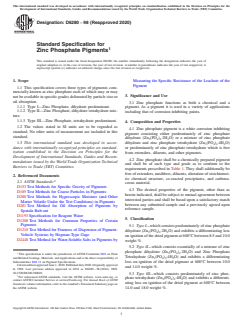
This specification covers three types of pigments commercially known as zinc phosphate each of which may or may not be available in specific grades delineated by particle size or oil absorption. The following types of pigments are: Type I which is zinc phosphate, dihydrate predominant, Type II which is zinc phosphate, dihydrate tetrahydrate mixture, and Type III which is zinc phosphate, tetrahydrate predominant. Zinc phosphate functions as both a chemical and a pigment. As a pigment it is used in a variety of applications including that of corrosion inhibiting paints. The pigments shall be subjected to the following tests: specific gravity test, oil absorption test, Hegman grind test, coarse particles test, pH test, specific resistance test, moisture test, and loss on ignition test.
SCOPE
1.1 This specification covers three types of pigments commercially known as zinc phosphate each of which may or may not be available in specific grades delineated by particle size or oil absorption.
1.1.1 Type I—Zinc Phosphate, dihydrate predominant.
1.1.2 Type II—Zinc Phosphate, dihydrate tetrahydrate mixture.
1.1.3 Type III—Zinc Phosphate, tetrahydrate predominant.
1.2 The values stated in SI units are to be regarded as standard. No other units of measurement are included in this standard.
1.3 This international standard was developed in accordance with internationally recognized principles on standardization established in the Decision on Principles for the Development of International Standards, Guides and Recommendations issued by the World Trade Organization Technical Barriers to Trade (TBT) Committee.
- Status
- Published
- Publication Date
- 31-May-2020
- Technical Committee
- D01 - Paint and Related Coatings, Materials, and Applications
- Drafting Committee
- D01.31 - Pigment Specifications
Overview
ASTM D6280-98(2020) is a comprehensive standard specification from ASTM International that defines the requirements for three types of zinc phosphate pigments. These pigments are highly valued for their function as white corrosion inhibitors and are integral to applications in paints and coatings. The standard delineates the distinct chemical compositions and physical properties of zinc phosphate pigments and establishes widely recognized testing methods for evaluating product quality.
By specifying detailed criteria for zinc phosphate pigment types and grades, ASTM D6280-98(2020) supports consistency, performance, and regulatory compliance in industries reliant on corrosion-inhibiting pigment technologies. The specification is developed in alignment with international standardization principles and is referenced globally for quality assurance.
Key Topics
Pigment Classification:
- Type I: Zinc phosphate, dihydrate predominant
- Type II: Zinc phosphate, dihydrate-tetrahydrate mixture
- Type III: Zinc phosphate, tetrahydrate predominant
Physical and Chemical Properties:
- Specific gravity
- Oil absorption
- Particle size (mean particle size grades)
- Specific electrical resistance
- pH value in aqueous suspension
- Moisture content and matter volatile at 105–110°C
- Loss on ignition (used to differentiate between types)
Purity Requirements:
- Free of extenders, diluents, co-reacted precipitates, modifiers, and carbonaceous materials
Testing Methods:
- Specific gravity test
- Oil absorption test
- Hegman grind test (dispersion/fineness)
- Coarse particles test
- pH test
- Specific resistance (water-soluble salts)
- Moisture test
- Chemical analysis for zinc and phosphate content
- Loss on ignition test
Applications
Zinc phosphate pigments specified by ASTM D6280-98(2020) are primarily utilized as effective white pigments with exceptional corrosion inhibiting properties. Their main applications include:
- Corrosion-Inhibiting Paints:
Used in protective and industrial coatings to prevent metal substrate corrosion, particularly in steel structures, bridges, ships, and automotive components. - Coatings for Construction:
Incorporated into primers and paints for buildings, pipelines, and other civil infrastructure exposed to harsh environments. - General Industrial Coatings:
Suitable for use in coatings systems where long-term protection from rust and corrosion is a priority. - Custom Pigment Formulations:
Employed as a base pigment in formulations tailored to specific performance needs, thanks to the specification’s detailed classification by type and particle size grade.
This standard ensures that customers and manufacturers can reliably specify and verify pigment quality, leading to improved product performance and longevity in a range of demanding applications.
Related Standards
To support thorough product assessment and compliance, ASTM D6280-98(2020) references several related ASTM standards related to pigment and coating evaluation. Notable referenced standards include:
- ASTM D153: Test Methods for Specific Gravity of Pigments
- ASTM D185: Test Methods for Coarse Particles in Pigments
- ASTM D280: Test Methods for Hygroscopic Moisture in Pigments
- ASTM D281: Test Method for Oil Absorption of Pigments
- ASTM D1193: Specification for Reagent Water
- ASTM D1210: Test Method for Fineness of Dispersion of Pigment-Vehicle Systems
- ASTM D2448: Test Method for Water-Soluble Salts in Pigments
Adherence to these standards ensures rigorous and consistent testing, enhancing the practical value of zinc phosphate pigments across industries. For detailed testing protocols or to verify compliance, consulting the full text of ASTM D6280-98(2020) and its related standards is recommended.
Relations
- Effective Date
- 01-Jun-2020
- Effective Date
- 01-Jun-2020
- Effective Date
- 01-Oct-2019
- Effective Date
- 01-Jun-2019
- Effective Date
- 01-Dec-2014
- Effective Date
- 01-Nov-2012
- Effective Date
- 01-Nov-2012
- Effective Date
- 01-Nov-2012
- Effective Date
- 15-Apr-2012
- Effective Date
- 01-Feb-2010
- Effective Date
- 01-Feb-2008
- Effective Date
- 01-Jul-2007
- Effective Date
- 01-Jul-2007
- Effective Date
- 01-Jun-2007
- Effective Date
- 01-Jun-2007
Get Certified
Connect with accredited certification bodies for this standard

DIN CERTCO
DIN Group product certification.

Smithers Quality Assessments
US management systems and product certification.
Sponsored listings
Frequently Asked Questions
ASTM D6280-98(2020) is a technical specification published by ASTM International. Its full title is "Standard Specification for Zinc Phosphate Pigments". This standard covers: ABSTRACT This specification covers three types of pigments commercially known as zinc phosphate each of which may or may not be available in specific grades delineated by particle size or oil absorption. The following types of pigments are: Type I which is zinc phosphate, dihydrate predominant, Type II which is zinc phosphate, dihydrate tetrahydrate mixture, and Type III which is zinc phosphate, tetrahydrate predominant. Zinc phosphate functions as both a chemical and a pigment. As a pigment it is used in a variety of applications including that of corrosion inhibiting paints. The pigments shall be subjected to the following tests: specific gravity test, oil absorption test, Hegman grind test, coarse particles test, pH test, specific resistance test, moisture test, and loss on ignition test. SCOPE 1.1 This specification covers three types of pigments commercially known as zinc phosphate each of which may or may not be available in specific grades delineated by particle size or oil absorption. 1.1.1 Type I—Zinc Phosphate, dihydrate predominant. 1.1.2 Type II—Zinc Phosphate, dihydrate tetrahydrate mixture. 1.1.3 Type III—Zinc Phosphate, tetrahydrate predominant. 1.2 The values stated in SI units are to be regarded as standard. No other units of measurement are included in this standard. 1.3 This international standard was developed in accordance with internationally recognized principles on standardization established in the Decision on Principles for the Development of International Standards, Guides and Recommendations issued by the World Trade Organization Technical Barriers to Trade (TBT) Committee.
ABSTRACT This specification covers three types of pigments commercially known as zinc phosphate each of which may or may not be available in specific grades delineated by particle size or oil absorption. The following types of pigments are: Type I which is zinc phosphate, dihydrate predominant, Type II which is zinc phosphate, dihydrate tetrahydrate mixture, and Type III which is zinc phosphate, tetrahydrate predominant. Zinc phosphate functions as both a chemical and a pigment. As a pigment it is used in a variety of applications including that of corrosion inhibiting paints. The pigments shall be subjected to the following tests: specific gravity test, oil absorption test, Hegman grind test, coarse particles test, pH test, specific resistance test, moisture test, and loss on ignition test. SCOPE 1.1 This specification covers three types of pigments commercially known as zinc phosphate each of which may or may not be available in specific grades delineated by particle size or oil absorption. 1.1.1 Type I—Zinc Phosphate, dihydrate predominant. 1.1.2 Type II—Zinc Phosphate, dihydrate tetrahydrate mixture. 1.1.3 Type III—Zinc Phosphate, tetrahydrate predominant. 1.2 The values stated in SI units are to be regarded as standard. No other units of measurement are included in this standard. 1.3 This international standard was developed in accordance with internationally recognized principles on standardization established in the Decision on Principles for the Development of International Standards, Guides and Recommendations issued by the World Trade Organization Technical Barriers to Trade (TBT) Committee.
ASTM D6280-98(2020) is classified under the following ICS (International Classification for Standards) categories: 83.040.30 - Auxiliary materials and additives for plastics; 87.060.10 - Pigments and extenders. The ICS classification helps identify the subject area and facilitates finding related standards.
ASTM D6280-98(2020) has the following relationships with other standards: It is inter standard links to ASTM D6280-98(2014), ASTM D153-84(2020), ASTM D2448-85(2019), ASTM D1208-96(2019), ASTM D153-84(2014), ASTM D1208-96(2012), ASTM D280-01(2012), ASTM D2448-85(2012), ASTM D281-12, ASTM D1210-05(2010), ASTM D153-84(2008), ASTM D281-95(2007), ASTM D185-07, ASTM D2448-85(2007), ASTM D1208-96(2007). Understanding these relationships helps ensure you are using the most current and applicable version of the standard.
ASTM D6280-98(2020) is available in PDF format for immediate download after purchase. The document can be added to your cart and obtained through the secure checkout process. Digital delivery ensures instant access to the complete standard document.
Standards Content (Sample)
This international standard was developed in accordance with internationally recognized principles on standardization established in the Decision on Principles for the
Development of International Standards, Guides and Recommendations issued by the World Trade Organization Technical Barriers to Trade (TBT) Committee.
Designation:D6280 −98 (Reapproved 2020)
Standard Specification for
Zinc Phosphate Pigments
This standard is issued under the fixed designation D6280; the number immediately following the designation indicates the year of
original adoption or, in the case of revision, the year of last revision. A number in parentheses indicates the year of last reapproval. A
superscript epsilon (´) indicates an editorial change since the last revision or reapproval.
1. Scope Measuring the Specific Resistance of the Leachate of the
Pigment
1.1 This specification covers three types of pigments com-
mercially known as zinc phosphate each of which may or may
3. Significance and Use
not be available in specific grades delineated by particle size or
oil absorption.
3.1 Zinc phosphate functions as both a chemical and a
1.1.1 Type I—Zinc Phosphate, dihydrate predominant.
pigment. As a pigment it is used in a variety of applications
1.1.2 Type II—Zinc Phosphate, dihydrate tetrahydrate mix-
including that of corrosion inhibiting paints.
ture.
1.1.3 Type III—Zinc Phosphate, tetrahydrate predominant.
4. Composition and Properties
1.2 The values stated in SI units are to be regarded as
4.1 Zinc phosphate pigment is a white corrosion inhibiting
standard. No other units of measurement are included in this
pigment consisting either predominately of zinc phosphate
standard.
dihydrate (Zn (PO ) ·2H O) or a mixture of zinc phosphate
3 4 2 2
1.3 This international standard was developed in accor- dihydrate and zinc phosphate tetrahydrate (Zn (PO ) ·4H O)
3 4 2 2
dance with internationally recognized principles on standard-
or predominately of zinc phosphate tetrahydrate which is free
ization established in the Decision on Principles for the from extenders, diluents, and other pigments.
Development of International Standards, Guides and Recom-
4.2 Zinc phosphate shall be a chemically prepared pigment
mendations issued by the World Trade Organization Technical
and shall be of such type and grade as to conform to the
Barriers to Trade (TBT) Committee.
requirements prescribed in Table 1. They shall additionally be
free of extenders, modifiers, diluents, alteration of stoichiomet-
2. Referenced Documents
ric chemical structure, co-reacted precipitates, and carbona-
2.1 ASTM Standards:
ceous material.
D153 Test Methods for Specific Gravity of Pigments
4.3 The desired properties of the pigment, other than as
D185 Test Methods for Coarse Particles in Pigments
herein indicated, shall be subject to mutual agreement between
D280 Test Methods for Hygroscopic Moisture (and Other
interested parties and shall be based upon a satisfactory match
Matter Volatile Under the Test Conditions) in Pigments
between any submitted sample and a previously agreed upon
D281 Test Method for Oil Absorption of Pigments by
reference sample.
Spatula Rub-out
D1193 Specification for Reagent Water
5. Classification
D1208 Test Methods for Common Properties of Certain
Pigments
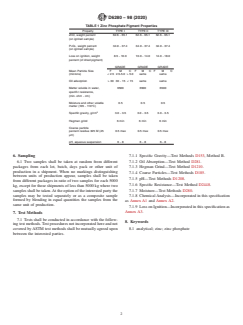
5.1 Type I—which consists predominately of zinc phosphate
D1210 Test Method for Fineness of Dispersion of Pigment-
dihydrate (Zn (PO ) ·2H O) and exhibits a differentiating loss
3 4 2 2
Vehicle Systems by Hegman-Type Gage
on ignition of the dried pigment at 600°C between 8.5 and 10.0
D2448 Test Method for Water-Soluble Salts in Pigments by
weight %.
5.2 Type II—which consists essentially of a mixture of zinc
phosphate dihydrate (Zn (PO ) ·2H O) and Zinc Phosphate
1 3 4 2 2
This specification is under the jurisdiction of ASTM Committee D01 on Paint
Tetrahydrate (Zn (PO ) ·4H O) and exhibits a differentiating
and Related Coatings, Materials, andApplications and is the direct responsibility of 3 4 2 2
Subcommittee D01.31 on Pigment Specifications. loss on ignition of the dried pigment at 600°C between 10.0
CurrenteditionapprovedJune1,2020.PublishedJuly2020.Originallyapproved
and 14.0 weight %.
in 1998. Last previous edition approved in 2014 as D6280 – 98 (2014). DOI:
10.1520/D6280-98R20.
5.3 Type III—which consists predominately of zinc phos-
For referenced ASTM standards, visit the ASTM website, www.astm.org, or
phate tetrahydrate (Zn (PO ) ·4H O) and exhibits a differenti-
3 4 2 2
contact ASTM Customer Service at service@astm.org. For Annual Book of ASTM
ating loss on ignition of the dried pigment at 600°C between
Standards volume information, refer to the standard’s Document Summary page on
the ASTM website. 14.0 and 18.0 weight %.
Copyright © ASTM International, 100 Barr Harbor Drive, PO Box C700, West Conshohocken, PA 19428-2959. United States
D6280−98 (2020)
TABLE 1 Zinc Phosphate Pigment Properties
Property TYPE I TYPE II TYPE III
ZnO, weight percent 62.6 - 65.1 62.6 - 65.1 62.6 - 65.1
(on ignited sample)
P O , weight percent 34.9 - 37.4 34.9 - 37.4 34.9 - 37.4
2 5
(on ignited sample)
Loss on ignition, weight 8.5 - 10.0 10.0 - 14.0 14.0 - 18.0
percent (of dried pigment)
GRADE GRADE GRADE
Mean Particle Size F M C F M C F M C
(microns) < 2.5 2.5-5.0 > 5.0 same same
Oil adsorption > 30 30 - 15 < 15 same same
Matter soluble in water, 6500 6500 6500
specific resistance,
(min. ohm - cm)
Moisture and other volatile 0.5 0.5 0.5
matter (105 - 110°C)
Specific gravity, g/cm 3.0 - 3.5 3.0 - 3.5 3.0 - 3.5
Hegman grind 6 min 6 min 6 min
Coarse particle
percent residue 325 M (45 0.5 max 0.5 max 0.5 max
µm)
pH, aqueous suspension 6 - 8 6 - 8 6 - 8
6. Sampling 7.1.1 Specific Gravity—Test Methods D153, Method B.
7.1.2 Oil Absorption—Test Method D281.
6.1 Two samples shall be taken at random from different
packages from each lot, batch, days pack or other unit of
7.1.3 Hegman Grind—Test Method D1210.
production in a shipment. When no markings distinguishing
7.1.4 Coarse Particles—Test Methods D185.
between units of production appear, samples shall be taken
7.1.5 pH—Test Methods D1208.
from different packages in ratio of two samples for each 5000
7.1.6 Specific Resistance—Test Method D2448.
kg, except for those shipments of less than 5000 kg where two
7.1.7 Moisture—Test Methods D280.
samples shall be taken.At the option of the interested party the
samples may be tested separately or as a composite sample
7.1.8 ChemicalAnalysis—Incorporated in this specification
formed by blending in equal quantities the samples from the
as Annex A1 and Annex A2.
same unit of production.
7.1.9 Loss on Ignition—Incorporated in this specification as
Annex A3.
7. Test Methods
7.1 Tests shall be conducted in accordance with the follow-
8. Keywords
ingtestmethods.Testproceduresnotincorporatedhereandnot
8.1 analytical; zinc; zinc phosphate
covered byASTM test methods shall be mutually agreed upon
between the interested parties.
D6280−98 (2020)
ANNEXES
(Mandatory Information)
A1. TEST METHOD FOR DETERMINATION OF ZINC CONTENT FOR ZINC PHOSPHATE TYPE PIGMENTS
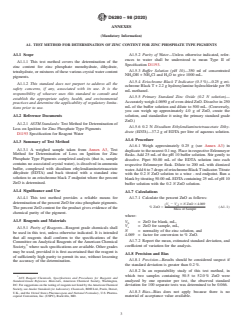
A1.1 Scope A1.5.2 Purity of Water—Unless otherwise indicated, refer-
ences to water shall be understood to mean Type II of
A1.1.1 This test method covers the determination of the
Specification D1193.
zinc content for zinc phosphate monohydrate, dihydrate,
A1.5.3 Buffer Solution (pH 10)—350 ml of concentrated
tetrahydrate, or mixtures of these various crystal water content
NHOH+NH Cl and H O to give 1000 mL.
4 4 2
pigments.
A1.5.4 Eriochrome Black T Indicator (0.5 %)—0.25 g eri-
A1.1.2 This standard does not purport to address all the
ochrome Black T + 2.2 g hydroxylamine hydrochloride per 50
safety concerns, if any, associated with its use. It is the
mL methanol.
responsibility of whoever uses this standard to consult and
A1.5.5 Primary Standard Zinc Oxide (0.2 N solution)—
establish the appropriate safety, health, and environmental
Accurately weigh 4.0690 g of oven dried ZnO. Dissolve in 250
practices and determine the applicability of regulatory limita-
mL of the buffer solution and dilute to 500 mL. (Conversely,
tions prior to use.
you can weigh up approximately 4.0 g of ZnO, create the
solution, and standardize it using the primary standard grade
A1.2 Reference Documents
ZnO.)
A1.2.1 ASTM Standards: Test Method for Determination of
A1.5.6 0.2 N Disodium Ethylendiaminetetraacetate Dihy-
Loss on Ignition for Zinc Phosphate Type Pigments
drate (EDTA)—37.2 g of EDTA per litre of aqueous solution.
D1193 Specification for Reagent Water
A1.6 Procedure
A1.3 Summary of Test Method
A1.6.1 Weigh approximately 0.25 g (see Annex A3)in
A1.3.1 A weighed sample taken from Annex A3, Test
duplicate to the nearest 0.1 mg. Place in respective Erlenmeyer
Method for Determination of Loss on Ignition for Zinc
flasks. Add 25 mL of the pH 10 buffer solution. Stir gently to
Phosphate Type Pigments completed analysis (that is, sample
dissolve. Pipet 50.00 mL of the EDTA solution into each
contains no associated crystal water), is dissolved in ammonia
respective Erlenmeyer flask. Dilute to 200 mL with dionized
buffer, complexed with disodium ethylendiaminetetraacetate
water.Add6to7dropsoferiochromeBlackTindicator.Titrate
dihydrate (EDTA) and back titrated with a standard zinc
with the 0.2 N ZnO solution to a wine - red endpoint. Run a
solution to an eriochrome black T endpoint where the percent
blank by titrating 50.00 mL EDTAcontaining 25 mL of pH 10
ZnO is determined.
buffer solution with the 0.2 N ZnO solution.
A1.4 Significance and Use
A1.7 Calculations
A1.7.1 Calculate the percent ZnO as follows:
A1.4.1 This test method provides a reliable means for
determination of the percent Z
...