

ASTM F2504-05(2022)
(Practice)Standard Practice for Describing System Output of Implantable Middle Ear Hearing Devices
General Information
- Abstract
SIGNIFICANCE AND USE
5.1 IMEHDs are alternatives to air conduction hearing aids. They are similar to air conduction hearing aids in that they process incoming sound by applying frequency shaping and compression to create an analog, vibratory audio frequency output. IMEHDs differ from hearing aids in that they do not create an airborne acoustical output signal with an electroacoustical output transducer in the external ear canal, but rather a mechanical stimulation that results in the vibration of the cochlear fluid. Therefore, the IMEHD output signal is not readily accessible after implantation in the way hearing aid output is accessible with real-ear probe microphone measurements. Different devices will use different methods of coupling to the ossicular chain or cochlea. This makes it difficult to design a uniform model of the middle ear in the way the 2-cm3 coupler is used as a model of the external ear canal with conventional hearing aids.
5.2 This practice provides uniformity of data collection practices, thus allowing IMEHD in vitro performances to be evaluated and readily compared. Once clinical data are available, the performance specifications can be augmented with corresponding transfer functions or results from measurements in patients.
5.3 The temporal bone is a well-accepted model that relates closely to the biomechanics of the living middle ear, which is readily relatable to hearing level. Laser Doppler vibrometry provides accurate velocity measurements in the ranges required for human hearing.
SCOPE
1.1 This practice defines means for describing system performance (ex vivo) and, in particular, system output of an implantable middle ear hearing device (IMEHD) by measuring a physical quantity that is relevant to the insertion gain and output level of the IMEHD when implanted in the patient.
1.2 This practice is similar to headphone calibration on an artificial ear in which the sound pressure level (in decibel sound pressure level (SPL)) measured in the artificial ear can be converted to patient hearing level (in decibel hearing level (HL)) using a known transfer function, as defined by ANSI 3.7. These measurements can then be used to predict system parameters relevant for patient benefit such as functional gain, maximum output, and variability. Measurements defined in this practice should be useful for patients, clinicians, manufacturers, investigators, and regulatory agencies in making comparative evaluations of IMEHDs.
1.3 The values given in SI units are to be considered the standard.
1.4 This standard does not purport to address all of the safety concerns, if any, associated with its use. It is the responsibility of the user of this standard to establish appropriate safety, health, and environmental practices and determine the applicability of regulatory limitations prior to use.
1.5 This international standard was developed in accordance with internationally recognized principles on standardization established in the Decision on Principles for the Development of International Standards, Guides and Recommendations issued by the World Trade Organization Technical Barriers to Trade (TBT) Committee.
- Status
- Published
- Publication Date
- 30-Sep-2022
- Technical Committee
- F04 - Medical and Surgical Materials and Devices
- Drafting Committee
- F04.37 - Implantable Hearing Devices (IHDs)
Overview
ASTM F2504-05(2022), titled Standard Practice for Describing System Output of Implantable Middle Ear Hearing Devices (IMEHDs), is a key international standard developed by ASTM International. This standard establishes detailed guidelines for describing and measuring the system output and performance characteristics of implantable middle ear hearing devices in ex vivo (laboratory) settings. By providing a uniform approach to the evaluation of system output, ASTM F2504 enables comparable and consistent characterization of these advanced hearing implants, supporting both industry development and clinical adoption.
Implantable Middle Ear Hearing Devices offer an alternative to conventional air conduction hearing aids by delivering mechanical vibration directly to middle ear structures, thereby stimulating the cochlea without producing airborne sound in the ear canal. This distinct mechanism of action requires different measurement techniques for system performance compared to traditional hearing aids. ASTM F2504 addresses the unique challenges of evaluating IMEHDs, including appropriate test setups, measurement quantities, and reporting practices.
Key Topics
- System Output Measurement: Defines methodologies for quantifying the vibratory audio frequency output of IMEHDs using temporal bone preparations and laser Doppler vibrometry, focusing on physical quantities such as stapes velocity and equivalent sound pressure.
- Comparability and Uniformity: Ensures data consistency across different devices and studies by standardizing measurement parameters (e.g., equivalent sound pressure transfer function, insertion gain, system frequency range).
- Test Models and Procedures: Details the use of human temporal bones as models for ex vivo testing, including criteria for selection and preparation to ensure test relevance.
- Performance Metrics: Outlines key measures including functional gain, maximum output, insertion gain (both sound field and velocity), harmonic distortion, and frequency response, relevant for both manufacturers and clinicians.
- Reporting and Documentation: Establishes requirements for reporting test results, including the number of temporal bones studied, variability as a function of frequency, test frequency range, and electrical input parameters.
- Relevance to Real-World Use: Provides mechanisms to augment laboratory data with clinical measurements as these become available.
Applications
ASTM F2504 is invaluable to a wide range of stakeholders in the hearing health sector:
- Manufacturers: Supports product development, performance verification, and regulatory submissions for IMEHDs by providing recognized measurement and reporting practices.
- Clinicians and Audiologists: Facilitates comparative evaluation of different implantable middle ear devices, aiding in treatment planning and patient counseling.
- Researchers: Enables reproducible, standardized assessment of device performance in laboratory settings, thereby advancing innovation in hearing implant technology.
- Regulatory Bodies: Offers a harmonized framework for the assessment and approval of new IMEHD products, aligning with international principles of standardization.
- Patients: Indirectly supports informed decision-making by ensuring that clinical performance data is based on comparable and validated methodologies.
The standard’s emphasis on use of SI units, attention to variability and measurement accuracy, and consideration of relevant transfer functions ensures that the practice is applicable worldwide and remains adaptable as clinical data emerges.
Related Standards
The following standards are referenced within ASTM F2504 and provide critical support for its application:
- ANSI S3.6: Specification for Audiometers – defines audiometric performance benchmarks.
- ANSI S3.7: Method for Coupler Calibration of Earphones – addresses artificial ear calibration, conceptually similar to the test couplers in IMEHD evaluation.
- ANSI S3.22: Specification of Hearing Aid Characteristics – covers test methods and reporting for conventional hearing aids, forming a conceptual basis for comparison with IMEHD test parameters.
Additional related standards may include ISO and IEC specifications addressing auditory devices, measurement instrumentation, and clinical performance evaluation.
Keywords: implantable middle ear hearing device, IMEHD, system output, performance measurement, transfer function, temporal bone, laser Doppler vibrometry, hearing implant, vibratory implant, acoustic measurement, audiology standards, ASTM F2504
Get Certified
Connect with accredited certification bodies for this standard

BSI Group
BSI (British Standards Institution) is the business standards company that helps organizations make excellence a habit.

TÜV Rheinland
TÜV Rheinland is a leading international provider of technical services.

TÜV SÜD
TÜV SÜD is a trusted partner of choice for safety, security and sustainability solutions.
Sponsored listings
Frequently Asked Questions
ASTM F2504-05(2022) is a standard published by ASTM International. Its full title is "Standard Practice for Describing System Output of Implantable Middle Ear Hearing Devices". This standard covers: SIGNIFICANCE AND USE 5.1 IMEHDs are alternatives to air conduction hearing aids. They are similar to air conduction hearing aids in that they process incoming sound by applying frequency shaping and compression to create an analog, vibratory audio frequency output. IMEHDs differ from hearing aids in that they do not create an airborne acoustical output signal with an electroacoustical output transducer in the external ear canal, but rather a mechanical stimulation that results in the vibration of the cochlear fluid. Therefore, the IMEHD output signal is not readily accessible after implantation in the way hearing aid output is accessible with real-ear probe microphone measurements. Different devices will use different methods of coupling to the ossicular chain or cochlea. This makes it difficult to design a uniform model of the middle ear in the way the 2-cm3 coupler is used as a model of the external ear canal with conventional hearing aids. 5.2 This practice provides uniformity of data collection practices, thus allowing IMEHD in vitro performances to be evaluated and readily compared. Once clinical data are available, the performance specifications can be augmented with corresponding transfer functions or results from measurements in patients. 5.3 The temporal bone is a well-accepted model that relates closely to the biomechanics of the living middle ear, which is readily relatable to hearing level. Laser Doppler vibrometry provides accurate velocity measurements in the ranges required for human hearing. SCOPE 1.1 This practice defines means for describing system performance (ex vivo) and, in particular, system output of an implantable middle ear hearing device (IMEHD) by measuring a physical quantity that is relevant to the insertion gain and output level of the IMEHD when implanted in the patient. 1.2 This practice is similar to headphone calibration on an artificial ear in which the sound pressure level (in decibel sound pressure level (SPL)) measured in the artificial ear can be converted to patient hearing level (in decibel hearing level (HL)) using a known transfer function, as defined by ANSI 3.7. These measurements can then be used to predict system parameters relevant for patient benefit such as functional gain, maximum output, and variability. Measurements defined in this practice should be useful for patients, clinicians, manufacturers, investigators, and regulatory agencies in making comparative evaluations of IMEHDs. 1.3 The values given in SI units are to be considered the standard. 1.4 This standard does not purport to address all of the safety concerns, if any, associated with its use. It is the responsibility of the user of this standard to establish appropriate safety, health, and environmental practices and determine the applicability of regulatory limitations prior to use. 1.5 This international standard was developed in accordance with internationally recognized principles on standardization established in the Decision on Principles for the Development of International Standards, Guides and Recommendations issued by the World Trade Organization Technical Barriers to Trade (TBT) Committee.
SIGNIFICANCE AND USE 5.1 IMEHDs are alternatives to air conduction hearing aids. They are similar to air conduction hearing aids in that they process incoming sound by applying frequency shaping and compression to create an analog, vibratory audio frequency output. IMEHDs differ from hearing aids in that they do not create an airborne acoustical output signal with an electroacoustical output transducer in the external ear canal, but rather a mechanical stimulation that results in the vibration of the cochlear fluid. Therefore, the IMEHD output signal is not readily accessible after implantation in the way hearing aid output is accessible with real-ear probe microphone measurements. Different devices will use different methods of coupling to the ossicular chain or cochlea. This makes it difficult to design a uniform model of the middle ear in the way the 2-cm3 coupler is used as a model of the external ear canal with conventional hearing aids. 5.2 This practice provides uniformity of data collection practices, thus allowing IMEHD in vitro performances to be evaluated and readily compared. Once clinical data are available, the performance specifications can be augmented with corresponding transfer functions or results from measurements in patients. 5.3 The temporal bone is a well-accepted model that relates closely to the biomechanics of the living middle ear, which is readily relatable to hearing level. Laser Doppler vibrometry provides accurate velocity measurements in the ranges required for human hearing. SCOPE 1.1 This practice defines means for describing system performance (ex vivo) and, in particular, system output of an implantable middle ear hearing device (IMEHD) by measuring a physical quantity that is relevant to the insertion gain and output level of the IMEHD when implanted in the patient. 1.2 This practice is similar to headphone calibration on an artificial ear in which the sound pressure level (in decibel sound pressure level (SPL)) measured in the artificial ear can be converted to patient hearing level (in decibel hearing level (HL)) using a known transfer function, as defined by ANSI 3.7. These measurements can then be used to predict system parameters relevant for patient benefit such as functional gain, maximum output, and variability. Measurements defined in this practice should be useful for patients, clinicians, manufacturers, investigators, and regulatory agencies in making comparative evaluations of IMEHDs. 1.3 The values given in SI units are to be considered the standard. 1.4 This standard does not purport to address all of the safety concerns, if any, associated with its use. It is the responsibility of the user of this standard to establish appropriate safety, health, and environmental practices and determine the applicability of regulatory limitations prior to use. 1.5 This international standard was developed in accordance with internationally recognized principles on standardization established in the Decision on Principles for the Development of International Standards, Guides and Recommendations issued by the World Trade Organization Technical Barriers to Trade (TBT) Committee.
ASTM F2504-05(2022) is classified under the following ICS (International Classification for Standards) categories: 11.180.15 - Aids for deaf and hearing impaired people. The ICS classification helps identify the subject area and facilitates finding related standards.
ASTM F2504-05(2022) is available in PDF format for immediate download after purchase. The document can be added to your cart and obtained through the secure checkout process. Digital delivery ensures instant access to the complete standard document.
Standards Content (Sample)
This international standard was developed in accordance with internationally recognized principles on standardization established in the Decision on Principles for the
Development of International Standards, Guides and Recommendations issued by the World Trade Organization Technical Barriers to Trade (TBT) Committee.
Designation: F2504 − 05 (Reapproved 2022)
Standard Practice for
Describing System Output of Implantable Middle Ear
Hearing Devices
This standard is issued under the fixed designation F2504; the number immediately following the designation indicates the year of
original adoption or, in the case of revision, the year of last revision.Anumber in parentheses indicates the year of last reapproval.A
superscript epsilon (´) indicates an editorial change since the last revision or reapproval.
1. Scope 2. Referenced Documents
1.1 This practice defines means for describing system per- 2.1 ANSI Standards:
formance (ex vivo) and, in particular, system output of an ANSI 3.6Specification for Audiometers
implantablemiddleearhearingdevice(IMEHD)bymeasuring ANSI 3.7Method for Coupler Calibration of Earphones
a physical quantity that is relevant to the insertion gain and ANSI 3.22Specification of Hearing Aid Characteristics
output level of the IMEHD when implanted in the patient.
3. Terminology
1.2 This practice is similar to headphone calibration on an
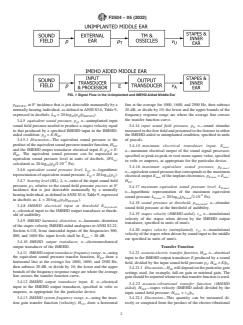
3.1 RefertotheblockdiagramofFig.1foraclarificationof
artificial ear in which the sound pressure level (in decibel
the mathematical notations used in this section.
sound pressure level (SPL)) measured in the artificial ear can
be converted to patient hearing level (in decibel hearing level
3.2 In the following definitions, these symbols are used for
(HL))usingaknowntransferfunction,asdefinedbyANSI3.7. physical quantities:
These measurements can then be used to predict system
3.2.1 E=electrical drive signal (voltage or current)
parameters relevant for patient benefit such as functional gain, 3.2.2 p=sound pressure
maximumoutput,andvariability.Measurementsdefinedinthis
3.2.3 v=vibration velocity
practice should be useful for patients, clinicians,
3.3 Alltransferfunctionsaredenotedbythesymbol H,with
manufacturers, investigators, and regulatory agencies in mak-
the following subscripts indicative of the type of transfer
ing comparative evaluations of IMEHDs.
function:
1.3 The values given in SI units are to be considered the
3.3.1 A=IMEHD-aided
standard.
3.3.2 E=electrical
3.3.3 H=hearing level
1.4 This standard does not purport to address all of the
3.3.4 S=sound field sound pressure
safety concerns, if any, associated with its use. It is the
3.3.5 T=tympanic membrane (ear drum) sound pressure
responsibility of the user of this standard to establish appro-
3.3.6 U=unimplanted
priate safety, health, and environmental practices and deter-
3.3.7 V=vibration of stapes
mine the applicability of regulatory limitations prior to use.
1.5 This international standard was developed in accor-
3.4 Definitions:
dance with internationally recognized principles on standard-
3.4.1 coupling, n—points and methods of attachment.
ization established in the Decision on Principles for the
3.4.2 displacement, n—integral of velocity measured in
Development of International Standards, Guides and Recom-
nanometres.
mendations issued by the World Trade Organization Technical
3.4.3 ear-canal sound pressure, p ,n—sound pressure pro-
T
Barriers to Trade (TBT) Committee.
duced in the ear canal, at the tympanic membrane, by a sound
field stimulus, specified in units of pascals.
1 3.4.4 equivalent hearing level, L ,n—ratio of an equivalent
H
ThispracticeisunderthejurisdictionofASTMCommitteeF04onMedicaland
Surgical Materials and Devices and is the direct responsibility of Subcommittee sound pressure, p , relative to the sound field pressure,
Q
F04.37 on Implantable Hearing Devices (IHDs).
Current edition approved Oct. 1, 2022. Published October 2022. Originally
approved in 2005. Last previous edition approved in 2014 as F2504 – 05 (2014). Available fromAmerican National Standards Institute (ANSI), 25 W. 43rd St.,
DOI: 10.1520/F2504-05R22. 4th Floor, New York, NY 10036, http://www.ansi.org.
Copyright © ASTM International, 100 Barr Harbor Drive, PO Box C700, West Conshohocken, PA 19428-2959. United States
F2504 − 05 (2022)
FIG. 1 Signal Flow in the Unimplanted and IMEHD-Aided Middle Ear
p , at 0° incidence that is just detectable monaurally by a line at the average for 1000, 1600, and 2500 Hz, then subtract
RETSPL
normally hearing individual, as defined inANSIS3.6, Table9, 20 dB, or divide by 10; the lower and the upper bounds of the
expressed in decibels: L = 20·log (p /p ). frequency response range are where the average line crosses
H 10 Q RETSPL
the transfer function curve.
3.4.5 equivalent sound pressure, p ,n—unimplanted input
Q
sound field pressure needed to produce a stapes velocity equal
3.4.14 input sound field pressure, p,n—sound stimulus
S
to that produced by a specified IMEHD input in the IMEHD- measuredinthefreefieldandpresentedtothelistenerineither
aided condition: p = E·H .
the IMEHD-aided or unimplanted condition, specified in units
Q ES
3.4.5.1 Discussion—The equivalent sound pressure is the of pascals.
productoftheequivalentsoundpressuretransferfunction,H ,
ES
3.4.15 maximum electrical transducer input, E ,
max
and the IMEHD output transducer electrical input E: p = E·
Q
n—maximum electrical output of the sound signal processor,
H . The equivalent sound pressure can be expressed as
ES
specified as peak-to-peak or root mean square value, specified
equivalent sound pressure level in units of decibels, SPL ,
eq
in volts or amperes, as appropriate for the particular device.
–5
calculated as 20·log (p /2·10 Pa).
10 Q
3.4.16 maximum equivalent sound pressure, p ,
E,max
3.4.6 equivalent sound pressure level, L ,n—logarithmic
Q
n—equivalentsoundpressurethatcorrespondstothemaximum
representationofequivalentsoundpressure, L =20·log (p ).
Q 10 Q
electrical output E of the implant electronics, p = E ·
max E,max max
3.4.7 hearing level (HL), L, n—ratiooftheinputsoundfield
H .
ES
pressure, p , relative to the sound field pressure p at 0°
S RETSPL
3.4.17 maximum equivalent sound pressure level, L ,
E,max
incidence that is just detectable monaurally by a normally
n—logarithmic representation of the maximum equivalent
hearingindividual,asdefinedinANSIS3.6,Table9,expressed –5
sound pressure L = 20·log (p /2·10 Pa).
E,max 10 E,max
in decibels as: L = 20·log (p /p ).
10 S RETSPL
3.4.18 sound pressure at threshold, p ,n—stimulus
threshold
3.4.8 IMEHD electrical input at threshold E ,
threshold
sound field pressure at the threshold of audibility.
n—electrical input to the IMEHD output transducer at thresh-
3.4.19 stapes velocity (IMEHD-aided), v ,n—translational
A
old of audibility.
velocity of the stapes when driven by the IMEHD output
3.4.9 IMEHD harmonic distortion, n—harmonic distortion
transducer, specified in units of mm/s.
ofthestapesvelocityIMEHD-aidedanalogoustoANSIS3.22,
3.4.20 stapes velocity (unimplanted), v ,n—translational
U
Section 6.11S, from sinusoidal inputs of the frequencies 500,
velocityofthestapeswhendrivenbysoundinputtothemiddle
800, and 1600 Hz; input levels shall be E −20dB.
max
ear specified in units of mm/s.
3.4.10 IMEHD output transducer, n—electromechanical
output transducer of the IMEHD.
Transfer Function
3.4.11 IMEHDoutputtransducerfrequencyrange,n—using
3.4.21 acousto-electric transfer function, H ,n—electrical
SE
the equivalent sound pressure transfer function, H , draw a
ES input to the IMEHD output transducer E produced by a sound
horizontal line at the average for 1000, 1600, and 2500 Hz,
field, divided by the input sound field pressure p : H = E/p .
S SE S
then subtract 20 dB, or divide by 10; the lower and the upper
3.4.21.1 Discussion—H willdependontheparticulargain
SE
bounds of the frequency response range are where the average
settings used, for example, full-on gain or minimal gain. The
line crosses the transfer function curve.
gainshouldbereportedwheneverthattransferfunctionisused.
3.4.12 IMEHD output transducer input, E, n—electrical
3.4.22 acousto-vibrational transfer function (IMEHD
input to the IMEHD output transducer, specified in volts or
aided), H —stapes velocity (IMEHD aided) divided by the
SVA
amperes, as appropriate for the particular device.
input sound field pressure: H =v /p .
SVA A S
3.4.13 IMEHD system frequency range, n—using the inser- 3.4.22.1 Discussion—This quantity can be measured di-
tion gain transfer function (velocity), H , draw a horizontal rectly or computed from the product of the electro-vibrational
VV
F2504 − 05 (2022)
transfer function, H , and the acousto-electric transfer cal output, the insertion gain (sound field), H , will equal the
EV SS
function, H , measured in the IMEHD-aided condition: H insertion gain transfer function (velocity), H .
SE SVA VV
= v /p .
A S
3.4.29 maximum insertion gain transfer function (sound
3.4.23 acousto-vibrational transfer function (unimplanted), field), H ,n—maximum insertion gain transfer function
SS,max
H ,n—stapes velocity (unimplanted) when driven by the
(sound field) that can be achieved with the implant electronics.
SVU
input sound field, divided by the input sound field pressure:
3.4.30 middle-eartransferfunction,H ,n—stapesvelocity
TV
H = v /p .
SVU U S
(unimplanted) produced by an ear-canal sound pressure, di-
3.4.23.1 Discussion—This quantity can be measured di-
vided by the ear-canal sound pressure, in units of mm/s/Pa:
rectly or computed from the product of the middle-ear transfer
H = v /p .
TV U T
function, H , and the ear-canal transfer function, H , mea-
TV ST
3.5 Acronyms:
sured in the unimplanted condition: H = v /p = H ·H .
SVU U S ST TV
3.5.1 IHD—implantable hearing device
3.4.24 ear-canal pressure transfer function, H ,n—ear
ST
3.5.2 IMEHD—implantable middle-ear hearing device
canal sound pressure, p , produced by the input sound field
T
pressure, p , in the unimplanted case, divided by that input
3.5.3 LDV—laser Doppler vibrometry
S
sound field pressure: H = p /p ; this quantity is unitless (1,
ST T S
3.5.4 SPL—sound pressure level
2).
3.4.25 electro-vibrational transfer function, H ,n—stapes
EV
4. Summary of Practice
velocity (IMEHD-aided) when driven by the IMEHD output
4.1 This practice involves the use of human temporal bones
transducer, divided by the transducer input: H = v /E.
EV A
and laser Doppler interferometry measurements of middle ear
3.4.26 equivalent sound pressure transfer function, H ,
ES
structures velocities, to test for the ex-vivo performances of
n—unimplanted sound field pressure needed to produce a
IMEHD. Once a procedure for measuring system output has
stapes velocity equivalent to that produced by an electrical
been defined, several characteristics of the IMEHD can be
IMEHD input in the IMEHD-aided condition, divided by the
specified. Detailed instructions for measuring and reporting
IMEHD input.
these characteristics are given below. The important character-
3.4.26.1 Discussion—If the electrical IMEHD input pro-
istics are:
duces a linear change in stapes velocity with a change in input
4.1.1 For Transducers:
electrical stimulus, the equivalent sound pressure transfer
4.1.1.1 Equivalent sound pressure transfer function,
function, H , can be computed as the quotient between the
ES
4.1.1.2 IMEHD output transducer frequency range, and
vibro-electric transfer function (IMEHD-aided), H , and the
EV
4.1.1.3 IMEHD harmonic distortion.
vibro-acoustic transfer function (unimplanted), H : H =
SVU ES
4.1.2 For the System:
(v/E)/(v/p)= H /H .
S EV SVU
4.1.2.1 Maximum insertion gain transfer function (sound
3.4.27 insertion gain transfer function (sound field), H ,
SS
field) (see full-on gain in ANSI S3.22, paragraph 3.7),
n—ratio of the equivalent sound pressure produced in the
4.1.2.2 Maximum equivalent sound pressure level (see
IMEHD-aidedcasewithagivenelectricalinputtotheIMEHD
OSPL90 in ANSI S3.22, paragraph 3.5), and
output transducer and the input sound field pressure used as
4.1.2.3 IMEHD system frequency range.
input in the IMEHD-aided case required to produce the same
IMEHD output transducer electrical input: H = p /p ; this
SS E S
5. Significance and Use
ratio is unitless.
3.4.27.1 Discussion—With a linear sound signal processor,
5.1 IMEHDs are alternatives to air conduction hearing aids.
the insertion gain (sound field) can be computed from the
They are similar to air conduction hearing aids in that they
productoftheequivalentsoundpressuretransferfunction,H ,
process incoming sound by applying frequency shaping and
ES
and the electro-acoustic transfer function, H : H = p /p =
compression to create an analog, vibratory audio frequency
SE SS E S
H ·H . H will depend on the particular gain settings used,
SE ES SS output. IMEHDs differ from hearing aids in that they do not
for example, full-on gain or minimal gain. The gain should be
create an airborne acoustical output signal with an electroa-
reported whenever that transfer function is used.
coustical output transducer in the external ear canal, but rather
a mechanical stimulation that results in the vibration of the
3.4.28 insertion gain transfer function (velocity), H ,
Vv
cochlear fluid. Therefore, the IMEHD output signal is not
n—ratio of the stapes velocity (IMEHD-aided) and the stapes
readily accessible after implantation in the way hearing aid
velocity (unimplanted) produced by a given input sound field:
output is accessible with real-ear probe microphone measure-
H = v /v ; t
...