

ASTM D7305-08a(2020)
(Test Method)Standard Test Method for Reflection Density of Printed Matter
General Information
- Abstract
SIGNIFICANCE AND USE
6.1 One of the key properties for printing in the lab or on production equipment is the intensity of the color, color balance and uniformity. This test can be used to ensure that the proper amount of ink is transferred to the substrate by obtaining a target density value, in addition to determining whether the print is uniform by measuring the reflection density over a wide print area. This then allows the use of the print for controlled testing of other appearance properties, such as gloss and color, and performance properties, such as resistance to abrasion and chemicals.
6.2 This test can be used to help achieve consistent color reproduction of printed color on flat surfaces.
6.3 Transfer of density readings from one set of inks to another, or from one substrate to another, carries a high risk of producing a color or tone shift. It is not in the scope of this test method to use density readings as digital proof of target points for printing process control.
SCOPE
1.1 This test method describes a procedure for measuring reflection density of printed matter using a reflection densitometer or spectrodensitometer.
1.2 This test method is intended primarily for process colors (yellow, magenta and cyan) and black. With appropriate instrumentation, it may also be used for other colors.
1.3 This test method applies to prints made by any printing process on a flat surface, with reflection density values ranging from just above zero, on the unprinted substrate, through to around 2.5 for very dense prints.
1.4 This test method can be used for prints on paper, film or board but not for those on metal or foil. It can be conducted in the pressroom or laboratory.
1.5 The values stated in SI units are to be regarded as standard. No other units of measurement are included in this standard.
1.6 This standard does not purport to address all of the safety concerns, if any, associated with its use. It is the responsibility of the user of this standard to establish appropriate safety, health, and environmental practices and determine the applicability of regulatory limitations prior to use.
1.7 This international standard was developed in accordance with internationally recognized principles on standardization established in the Decision on Principles for the Development of International Standards, Guides and Recommendations issued by the World Trade Organization Technical Barriers to Trade (TBT) Committee.
- Status
- Published
- Publication Date
- 31-May-2020
- Technical Committee
- D01 - Paint and Related Coatings, Materials, and Applications
- Drafting Committee
- D01.56 - Printing Inks

Overview
ASTM D7305-08a(2020) - Standard Test Method for Reflection Density of Printed Matter is a widely recognized standard developed by ASTM International. This document specifies a reliable method for measuring the reflection density of printed materials by using a reflection densitometer or spectrodensitometer. Reflection density measures how much light a print absorbs, providing insights into ink coverage, color intensity, and uniformity. This standard is crucial for evaluating the visual appearance and consistency of printed matter produced in the laboratory or on production equipment.
Key Topics
- Reflection Density Measurement: The method outlines how to determine the reflection density of prints, which is the logarithm of the reciprocal of the reflectance factor. This measurement reveals how much ink is present and how uniform the print is across the surface.
- Applicable Print Types: Primarily designed for process colors (yellow, magenta, cyan) and black, but extendable to other colors with suitable instrumentation.
- Suitable Materials: Applies to prints on flat surfaces such as paper, film, or board. It is not recommended for prints on metal or foil.
- Instrument Calibration: The standard emphasizes proper calibration using manufacturer-supplied reference standards, ensuring accuracy and repeatability in reflection density readings.
- Test Procedure: Involves taking multiple measurements at specified locations on the print, calculating the average density, and documenting instrument details and test conditions.
- Quality Assurance: Outlines criteria for repeatability and reproducibility between operators and laboratories to ensure test precision.
Applications
The ASTM D7305-08a(2020) test method is valuable across a broad range of printing quality control and research contexts:
- Printing Process Optimization: By measuring the intensity and uniformity of color, print professionals can confirm that the proper amount of ink is transferred to substrates, supporting consistent production quality.
- Color Reproduction Consistency: The method helps achieve uniform color reproduction in different print batches, ensuring products meet required visual standards.
- Ink and Substrate Evaluation: Enables assessment of how well inks perform on various substrates under different printing conditions.
- Performance Testing: Accurate reflection density measurement allows for controlled testing of related appearance properties (e.g., gloss, color) and performance properties (e.g., abrasion, chemical resistance).
- Laboratory and Pressroom Uses: Suitable for both lab-based research and routine pressroom quality control, facilitating actions to correct or fine-tune the printing process.
Related Standards
Professionals using ASTM D7305-08a(2020) may also reference these relevant standards for a comprehensive approach to print appearance and quality control:
- ASTM E284 - Terminology of Appearance
- ASTM E691 - Practice for Conducting an Interlaboratory Study to Determine the Precision of a Test Method
- ANSI CGATS.4-1993 - Graphic Technology: Reflection Densitometry Measurements - Terminology, Equations, Image Elements, and Procedures
- ANSI CGATS.6 - Specifications for Graphic Arts Printing
- ANSI CGATS.11-1999 - Certified Reference Materials for Reflection and Transmission Metrology
- ISO 15790 - Certified Reference Materials for Reflection and Transmission Metrology
- DIN 16536-2:1986 - Colour Density Measurements on Prints in Graphic Technology
These related standards support enhanced accuracy, repeatability, and comparability in measuring and reporting the reflection density and other key qualities of printed products.
Keywords: ASTM D7305, reflection density, printed matter, densitometer, spectrodensitometer, print quality, color consistency, process color, print measurement, printing standards.
Relations
- Effective Date
- 01-Nov-2013
- Effective Date
- 01-Jun-2013
- Effective Date
- 01-May-2013
- Effective Date
- 01-Jan-2013
- Effective Date
- 01-Jul-2012
- Effective Date
- 01-Nov-2011
- Effective Date
- 01-Jun-2009
- Effective Date
- 01-Jan-2009
- Effective Date
- 01-Oct-2008
- Effective Date
- 01-Aug-2008
- Effective Date
- 15-Jul-2007
- Effective Date
- 01-Dec-2006
- Effective Date
- 15-Jul-2006
- Effective Date
- 15-Feb-2006
- Effective Date
- 01-Nov-2005
Frequently Asked Questions
ASTM D7305-08a(2020) is a standard published by ASTM International. Its full title is "Standard Test Method for Reflection Density of Printed Matter". This standard covers: SIGNIFICANCE AND USE 6.1 One of the key properties for printing in the lab or on production equipment is the intensity of the color, color balance and uniformity. This test can be used to ensure that the proper amount of ink is transferred to the substrate by obtaining a target density value, in addition to determining whether the print is uniform by measuring the reflection density over a wide print area. This then allows the use of the print for controlled testing of other appearance properties, such as gloss and color, and performance properties, such as resistance to abrasion and chemicals. 6.2 This test can be used to help achieve consistent color reproduction of printed color on flat surfaces. 6.3 Transfer of density readings from one set of inks to another, or from one substrate to another, carries a high risk of producing a color or tone shift. It is not in the scope of this test method to use density readings as digital proof of target points for printing process control. SCOPE 1.1 This test method describes a procedure for measuring reflection density of printed matter using a reflection densitometer or spectrodensitometer. 1.2 This test method is intended primarily for process colors (yellow, magenta and cyan) and black. With appropriate instrumentation, it may also be used for other colors. 1.3 This test method applies to prints made by any printing process on a flat surface, with reflection density values ranging from just above zero, on the unprinted substrate, through to around 2.5 for very dense prints. 1.4 This test method can be used for prints on paper, film or board but not for those on metal or foil. It can be conducted in the pressroom or laboratory. 1.5 The values stated in SI units are to be regarded as standard. No other units of measurement are included in this standard. 1.6 This standard does not purport to address all of the safety concerns, if any, associated with its use. It is the responsibility of the user of this standard to establish appropriate safety, health, and environmental practices and determine the applicability of regulatory limitations prior to use. 1.7 This international standard was developed in accordance with internationally recognized principles on standardization established in the Decision on Principles for the Development of International Standards, Guides and Recommendations issued by the World Trade Organization Technical Barriers to Trade (TBT) Committee.
SIGNIFICANCE AND USE 6.1 One of the key properties for printing in the lab or on production equipment is the intensity of the color, color balance and uniformity. This test can be used to ensure that the proper amount of ink is transferred to the substrate by obtaining a target density value, in addition to determining whether the print is uniform by measuring the reflection density over a wide print area. This then allows the use of the print for controlled testing of other appearance properties, such as gloss and color, and performance properties, such as resistance to abrasion and chemicals. 6.2 This test can be used to help achieve consistent color reproduction of printed color on flat surfaces. 6.3 Transfer of density readings from one set of inks to another, or from one substrate to another, carries a high risk of producing a color or tone shift. It is not in the scope of this test method to use density readings as digital proof of target points for printing process control. SCOPE 1.1 This test method describes a procedure for measuring reflection density of printed matter using a reflection densitometer or spectrodensitometer. 1.2 This test method is intended primarily for process colors (yellow, magenta and cyan) and black. With appropriate instrumentation, it may also be used for other colors. 1.3 This test method applies to prints made by any printing process on a flat surface, with reflection density values ranging from just above zero, on the unprinted substrate, through to around 2.5 for very dense prints. 1.4 This test method can be used for prints on paper, film or board but not for those on metal or foil. It can be conducted in the pressroom or laboratory. 1.5 The values stated in SI units are to be regarded as standard. No other units of measurement are included in this standard. 1.6 This standard does not purport to address all of the safety concerns, if any, associated with its use. It is the responsibility of the user of this standard to establish appropriate safety, health, and environmental practices and determine the applicability of regulatory limitations prior to use. 1.7 This international standard was developed in accordance with internationally recognized principles on standardization established in the Decision on Principles for the Development of International Standards, Guides and Recommendations issued by the World Trade Organization Technical Barriers to Trade (TBT) Committee.
ASTM D7305-08a(2020) is classified under the following ICS (International Classification for Standards) categories: 37.100.01 - Graphic technology in general. The ICS classification helps identify the subject area and facilitates finding related standards.
ASTM D7305-08a(2020) has the following relationships with other standards: It is inter standard links to ASTM E284-13b, ASTM E284-13a, ASTM E691-13, ASTM E284-13, ASTM E284-12, ASTM E691-11, ASTM E284-09a, ASTM E284-09, ASTM E691-08, ASTM E284-08, ASTM E284-07, ASTM E284-06b, ASTM E284-06a, ASTM E284-06, ASTM E691-05. Understanding these relationships helps ensure you are using the most current and applicable version of the standard.
ASTM D7305-08a(2020) is available in PDF format for immediate download after purchase. The document can be added to your cart and obtained through the secure checkout process. Digital delivery ensures instant access to the complete standard document.
Standards Content (Sample)
This international standard was developed in accordance with internationally recognized principles on standardization established in the Decision on Principles for the
Development of International Standards, Guides and Recommendations issued by the World Trade Organization Technical Barriers to Trade (TBT) Committee.
Designation: D7305 −08a (Reapproved 2020)
Standard Test Method for
Reflection Density of Printed Matter
This standard is issued under the fixed designation D7305; the number immediately following the designation indicates the year of
original adoption or, in the case of revision, the year of last revision.Anumber in parentheses indicates the year of last reapproval.A
superscript epsilon (´) indicates an editorial change since the last revision or reapproval.
1. Scope E691Practice for Conducting an Interlaboratory Study to
Determine the Precision of a Test Method
1.1 This test method describes a procedure for measuring
2.2 ANSI Standards:
reflectiondensityofprintedmatterusingareflectiondensitom-
CGATS.4-1993Graphic Technology – GraphicArts Reflec-
eter or spectrodensitometer.
tion Densitometry Measurements — Terminology,
1.2 Thistestmethodisintendedprimarilyforprocesscolors
Equations, Image Elements and Procedures
(yellow, magenta and cyan) and black. With appropriate
CGATS.6GraphicTechnology—SpecificationsforGraphic
instrumentation, it may also be used for other colors.
Arts Printing
1.3 This test method applies to prints made by any printing
CGATS.11-1999Graphic Technology — Certified Refer-
processonaflatsurface,withreflectiondensityvaluesranging
enceMaterialsforReflectionandTransmissionMetrology
from just above zero, on the unprinted substrate, through to
– Documentation Requirements and Recommended Pro-
around 2.5 for very dense prints.
cedures
PH 2.17Geometric Conditions for Reflection Density
1.4 Thistestmethodcanbeusedforprintsonpaper,filmor
PH2.18SpectralConditionsfortheMeasurementofOptical
board but not for those on metal or foil. It can be conducted in
Density
the pressroom or laboratory.
2.3 ISO Standard:
1.5 The values stated in SI units are to be regarded as
ISO 15790Graphic technology and photography — Certi-
standard. No other units of measurement are included in this
fied reference materials for reflection and transmission
standard.
metrology — Documentation and procedures for use,
1.6 This standard does not purport to address all of the
including determination of combined standard uncertainty
safety concerns, if any, associated with its use. It is the
2.4 Other Standard:
responsibility of the user of this standard to establish appro-
DIN 16536-2:1986Testing of prints and printing inks in
priate safety, health, and environmental practices and deter-
graphic technology — Colour density measurements on
mine the applicability of regulatory limitations prior to use.
on-press or off-press prints
1.7 This international standard was developed in accor-
dance with internationally recognized principles on standard-
3. Terminology
ization established in the Decision on Principles for the
3.1 Definitions related to appearance are in Terminology
Development of International Standards, Guides and Recom-
E284.
mendations issued by the World Trade Organization Technical
Barriers to Trade (TBT) Committee.
3.2 Definitions of Terms Specific to This Standard:
3.2.1 reflection density, n—the light-absorbing property of a
2. Referenced Documents
material, expressed as the logarithm of the reciprocal of the
reflectance factor (i.e. higher density indicates more light is
2.1 ASTM Standards:
absorbed). [D = log (1/R) = -log (R)]
E284Terminology of Appearance 10 10
3.2.2 reflection densitometry, n—the practice of characteriz-
ing the amount of light absorption of materials by measuring
This test method is under the jurisdiction of ASTM Committee D01 on Paint
reflectance and calculating and reporting reflection density.
and Related Coatings, Materials, andApplications and is the direct responsibility of
3.2.3 spectrodensitometer, n—a spectrophotometer with ap-
Subcommittee D01.56 on Printing Inks.
CurrenteditionapprovedJune1,2020.PublishedJuly2020.Originallyapproved propriate software to convert the measured reflectance values
in 2008. Last previous edition approved in 2013 as D7305–08a (2013). DOI:
to reflection density.
10.1520/D7305-08AR20.
For referenced ASTM standards, visit the ASTM website, www.astm.org, or
contact ASTM Customer Service at service@astm.org. For Annual Book of ASTM
Standards volume information, refer to the standard’s Document Summary page on Available fromAmerican National Standards Institute (ANSI), 25 W. 43rd St.,
the ASTM website. 4th Floor, New York, NY 10036, http://www.ansi.org.
Copyright © ASTM International, 100 Barr Harbor Drive, PO Box C700, West Conshohocken, PA 19428-2959. United States
D7305 − 08a (2020)
chromatic inks at typical printing densities.
3.2.4 process color, n—a color having the main attribute of
absorbing approximately one-third (1/3) the visible spectrum
4. Symbols
and transmitting the other two-thirds (2/3).
4.1 Symbols—The following symbols are defined or re-
3.2.5 dry back, n—the reduction in density that occurs over
ferred to in this standard.
time after printing on paper and other absorbent substrates due
D reflection density
to ink penetration into the substrate.
R reflectance factor
3.2.6 status T, n—an ISO Reflection Status Density.
5. Summary of Test Method
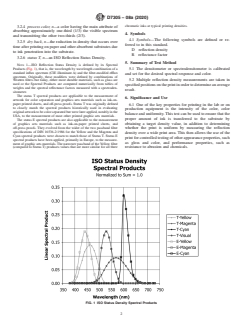
NOTE 1—ISO Reflection Status Density is defined by its Spectral
Products (Fig. 1), that is, the wavelength by wavelength combination of a
5.1 The densitometer or spectrodensitometer is calibrated
standard influx spectrum (CIE illuminantA) and the filter-modifed efflux
and set for the desired spectral response and color.
spectrum. Originally, these modifiers were defined by combinations of
Wratten filters but today, either more durable materials, such as glass are 5.2 Multiple reflection density measurements are taken in
used or the Spectral Products are computed numerically from tables of
specifiedpositionsontheprintinordertodetermineanaverage
weights and the spectral reflectance factors measured with a spectroden-
result.
sitometer.
The status T spectral products are applicable to the measurement of
6. Significance and Use
artwork for color separation and graphics arts materials such as ink-on-
paper printed sheets, and off-press proofs. StatusTwas originally defined
6.1 One of the key properties for printing in the lab or on
to closely match the spectral products historically used in evaluating
production equipment is the intensity of the color, color
originalartworktobecolorseparatedbutwerelaterapplied,notablyinthe
balanceanduniformity.Thistestcanbeusedtoensurethatthe
USA, to the measurement of most other printed graphic arts materials.
proper amount of ink is transferred to the substrate by
The status E spectral products are also applicable to the measurement
obtaining a target density value, in addition to determining
of graphics arts materials such as ink-on-paper printed sheets, and
off-press proofs. They evolved from the wider of the two passband filter
whether the print is uniform by measuring the reflection
specifications of DIN 16536-2:1986 for the Yellow and the Magenta and
density over a wide print area. This then allows the use of the
Cyan spectral products were chosen to match those of Status T. Status E
printforcontrolledtestingofotherappearanceproperties,such
spectral products have been applied, primarily in Europe, to the measure-
as gloss and color, and performance properties, such as
ment of graphic arts materials.The narrower passband of theYellow filter
(compared to Status T) produces values that are more similar for all three resistance to abrasion and chemicals.
FIG. 1 ISO Status Density Spectral Products
D7305 − 08a (2020)
6.2 This test can be used to help achieve consistent color T-Ref standard. Readings that differ from the labelled value on
reproduction of printed color on flat surfaces. thecertifiedreferencematerialbymorethanthegreaterof0.02
density units or 2% should be discussed with the densitometer
6.3 Transfer of density readings from one set of inks to
manufacturer in order to determine whether the particul
...