

ASTM C1057-22
(Practice)Standard Practice for Determination of Skin Contact Temperature from Heated Surfaces Using a Mathematical Model and Thermesthesiometer
General Information
- Abstract
SIGNIFICANCE AND USE
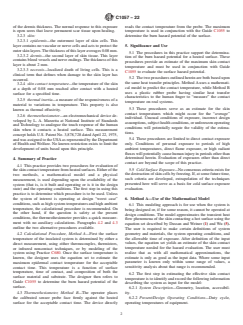
5.1 The procedures in this practice support the determination of the burn hazard potential for a heated surface. These procedures provide an estimate of the maximum skin contact temperature and must be used in conjunction with Guide C1055 to evaluate the surface hazard potential.
5.2 The two procedures outlined herein are both based upon the same heat transfer principles. Method A uses a mathematical model to predict the contact temperature, while Method B uses a plastic rubber probe having similar heat transfer characteristics to the human finger to “measure” the contact temperature on real systems.
5.3 These procedures serve as an estimate for the skin contact temperatures which might occur for the “average” individual. Unusual conditions of exposure, incorrect design assumptions, subject health conditions, or unforeseen operating conditions will potentially negate the validity of the estimations.
5.4 These procedures are limited to direct contact exposure only. Conditions of personal exposure to periods of high ambient temperatures, direct flame exposure, or high radiant fluxes will potentially cause human injury in periods other than determined herein. Evaluation of exposures other than direct contact are beyond the scope of this practice.
5.5 Cold Surface Exposure—No consensus criteria exists for the destruction of skin cells by freezing. If, at some future time, such criteria are developed, extrapolation of the techniques presented here will serve as a basis for cold surface exposure evaluation.
SCOPE
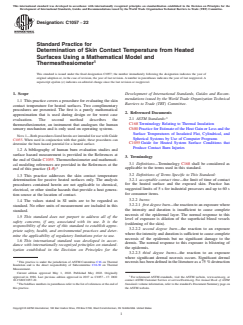
1.1 This practice covers a procedure for evaluating the skin contact temperature for heated surfaces. Two complimentary procedures are presented. The first is a purely mathematical approximation that is used during design or for worst case evaluation. The second method describes the thermesthesiometer, an instrument that analogues the human sensory mechanism and is only used on operating systems.
Note 1: Both procedures listed herein are intended for use with Guide C1055. When used in conjunction with that guide, these procedures can determine the burn hazard potential for a heated surface.
1.2 A bibliography of human burn evaluation studies and surface hazard measurement is provided in the References at the end of Guide C1055. Thermesthesiometer and mathematical modeling references are provided in the References at the end of this practice (1-5).2
1.3 This practice addresses the skin contact temperature determination for passive heated surfaces only. The analysis procedures contained herein are not applicable to chemical, electrical, or other similar hazards that provide a heat generation source at the location of contact.
1.4 The values stated in SI units are to be regarded as standard. No other units of measurement are included in this standard.
1.5 This standard does not purport to address all of the safety concerns, if any, associated with its use. It is the responsibility of the user of this standard to establish appropriate safety, health, and environmental practices and determine the applicability of regulatory limitations prior to use.
1.6 This international standard was developed in accordance with internationally recognized principles on standardization established in the Decision on Principles for the Development of International Standards, Guides and Recommendations issued by the World Trade Organization Technical Barriers to Trade (TBT) Committee.
- Status
- Published
- Publication Date
- 30-Apr-2022
- Technical Committee
- C16 - Thermal Insulation
- Drafting Committee
- C16.30 - Thermal Measurement
Buy Documents
ASTM C1057-22 - Standard Practice for Determination of Skin Contact Temperature from Heated Surfaces Using a Mathematical Model and Thermesthesiometer
REDLINE ASTM C1057-22 - Standard Practice for Determination of Skin Contact Temperature from Heated Surfaces Using a Mathematical Model and Thermesthesiometer
Overview
ASTM C1057-22: Standard Practice for Determination of Skin Contact Temperature from Heated Surfaces Using a Mathematical Model and Thermesthesiometer provides standardized procedures for evaluating the burn hazard potential of heated surfaces. Developed by ASTM International, this practice outlines two complementary approaches for estimating maximum skin contact temperature-one using a mathematical model during design, and the other utilizing a thermesthesiometer to simulate human touch on operating systems. These procedures are intended to be used in conjunction with ASTM Guide C1055 to comprehensively assess surface hazard potential for human skin exposure.
This standard is essential for industries where personnel may come into direct contact with heated surfaces, providing guidance on how to predict and measure contact temperatures to minimize the risk of contact burn injuries.
Key Topics
- Skin Contact Temperature: Defines the concept as the temperature experienced by skin at a depth of 0.08 mm after contacting a heated surface for a specific time period.
- Burn Hazard Assessment: Offers methodologies for estimating whether a heated surface poses a risk of first, second, or third-degree burns.
- Method A - Mathematical Model: Provides calculation methods for use in the design phase, based on inputs such as surface temperature, material properties, operating conditions, and acceptable contact time.
- Method B - Thermesthesiometer: Describes the use of a calibrated probe designed to mimic the human finger’s thermal response, allowing direct measurement of skin contact temperature on operating systems.
- Applicability: Focuses exclusively on direct contacts with passive heat sources, excluding chemical, electrical, or radiant exposures.
- Material Properties: Includes tables with typical properties (density, conductivity, specific heat) for common metals, insulations, plastics, and human tissue for use in calculations.
Applications
ASTM C1057-22 is widely applicable in fields where occupational or consumer exposure to hot surfaces is a concern. Primary use cases include:
- Industrial Facilities: Evaluating the risk of contact burns from equipment such as pipes, vessels, or process machinery in manufacturing plants.
- Thermal Insulation Assessment: Informing the selection and design of insulation and jacketing materials to control surface temperatures and minimize injury risk.
- Product Safety Evaluation: Guiding appliance and consumer product manufacturers in designing safe surface conditions to avoid user injury.
- Facility Safety Audits: Assisting safety professionals in identifying hazardous hot surfaces and verifying compliance with health, safety, and regulatory requirements.
- Regulatory Compliance: Supporting documentation and validation for compliance with workplace safety standards and technical regulations on thermal hazards.
- Design Optimization: Enabling engineers to perform hazard analyses during project planning and to validate that operating conditions align with safety thresholds for human contact.
Related Standards
- ASTM C1055 – Guide for Heated System Surface Conditions that Produce Contact Burn Injuries: Essential companion for evaluating burn hazard potential using the results from ASTM C1057-22 procedures.
- ASTM C680 – Practice for Estimate of the Heat Gain or Loss and the Surface Temperatures of Insulated Flat, Cylindrical, and Spherical Systems by Use of Computer Programs: Provides methods for profiling surface temperatures, which act as input for contact temperature modeling.
- ASTM C168 – Terminology Relating to Thermal Insulation: Offers definitions for material properties referenced in ASTM C1057-22.
Implementing ASTM C1057-22 helps organizations prevent skin burns, improve safety protocols, and optimize material choices for thermal insulation, ultimately fostering safer working and consumer environments. For further details or updates, refer to the official ASTM documentation.
Relations
- Effective Date
- 15-Apr-2024
- Effective Date
- 01-Nov-2023
- Effective Date
- 01-Apr-2020
- Effective Date
- 15-Apr-2018
- Effective Date
- 01-Jun-2017
- Effective Date
- 15-Oct-2015
- Effective Date
- 01-Jun-2015
- Effective Date
- 01-Sep-2014
- Effective Date
- 01-Feb-2014
- Effective Date
- 01-Apr-2013
- Effective Date
- 01-Nov-2010
- Effective Date
- 01-Jan-2010
- Effective Date
- 01-Sep-2009
- Effective Date
- 15-Dec-2008
- Effective Date
- 01-Sep-2008
Buy Documents
ASTM C1057-22 - Standard Practice for Determination of Skin Contact Temperature from Heated Surfaces Using a Mathematical Model and Thermesthesiometer
REDLINE ASTM C1057-22 - Standard Practice for Determination of Skin Contact Temperature from Heated Surfaces Using a Mathematical Model and Thermesthesiometer
Get Certified
Connect with accredited certification bodies for this standard

BSI Group
BSI (British Standards Institution) is the business standards company that helps organizations make excellence a habit.

Bureau Veritas
Bureau Veritas is a world leader in laboratory testing, inspection and certification services.

DNV
DNV is an independent assurance and risk management provider.
Sponsored listings
Frequently Asked Questions
ASTM C1057-22 is a standard published by ASTM International. Its full title is "Standard Practice for Determination of Skin Contact Temperature from Heated Surfaces Using a Mathematical Model and Thermesthesiometer". This standard covers: SIGNIFICANCE AND USE 5.1 The procedures in this practice support the determination of the burn hazard potential for a heated surface. These procedures provide an estimate of the maximum skin contact temperature and must be used in conjunction with Guide C1055 to evaluate the surface hazard potential. 5.2 The two procedures outlined herein are both based upon the same heat transfer principles. Method A uses a mathematical model to predict the contact temperature, while Method B uses a plastic rubber probe having similar heat transfer characteristics to the human finger to “measure” the contact temperature on real systems. 5.3 These procedures serve as an estimate for the skin contact temperatures which might occur for the “average” individual. Unusual conditions of exposure, incorrect design assumptions, subject health conditions, or unforeseen operating conditions will potentially negate the validity of the estimations. 5.4 These procedures are limited to direct contact exposure only. Conditions of personal exposure to periods of high ambient temperatures, direct flame exposure, or high radiant fluxes will potentially cause human injury in periods other than determined herein. Evaluation of exposures other than direct contact are beyond the scope of this practice. 5.5 Cold Surface Exposure—No consensus criteria exists for the destruction of skin cells by freezing. If, at some future time, such criteria are developed, extrapolation of the techniques presented here will serve as a basis for cold surface exposure evaluation. SCOPE 1.1 This practice covers a procedure for evaluating the skin contact temperature for heated surfaces. Two complimentary procedures are presented. The first is a purely mathematical approximation that is used during design or for worst case evaluation. The second method describes the thermesthesiometer, an instrument that analogues the human sensory mechanism and is only used on operating systems. Note 1: Both procedures listed herein are intended for use with Guide C1055. When used in conjunction with that guide, these procedures can determine the burn hazard potential for a heated surface. 1.2 A bibliography of human burn evaluation studies and surface hazard measurement is provided in the References at the end of Guide C1055. Thermesthesiometer and mathematical modeling references are provided in the References at the end of this practice (1-5).2 1.3 This practice addresses the skin contact temperature determination for passive heated surfaces only. The analysis procedures contained herein are not applicable to chemical, electrical, or other similar hazards that provide a heat generation source at the location of contact. 1.4 The values stated in SI units are to be regarded as standard. No other units of measurement are included in this standard. 1.5 This standard does not purport to address all of the safety concerns, if any, associated with its use. It is the responsibility of the user of this standard to establish appropriate safety, health, and environmental practices and determine the applicability of regulatory limitations prior to use. 1.6 This international standard was developed in accordance with internationally recognized principles on standardization established in the Decision on Principles for the Development of International Standards, Guides and Recommendations issued by the World Trade Organization Technical Barriers to Trade (TBT) Committee.
SIGNIFICANCE AND USE 5.1 The procedures in this practice support the determination of the burn hazard potential for a heated surface. These procedures provide an estimate of the maximum skin contact temperature and must be used in conjunction with Guide C1055 to evaluate the surface hazard potential. 5.2 The two procedures outlined herein are both based upon the same heat transfer principles. Method A uses a mathematical model to predict the contact temperature, while Method B uses a plastic rubber probe having similar heat transfer characteristics to the human finger to “measure” the contact temperature on real systems. 5.3 These procedures serve as an estimate for the skin contact temperatures which might occur for the “average” individual. Unusual conditions of exposure, incorrect design assumptions, subject health conditions, or unforeseen operating conditions will potentially negate the validity of the estimations. 5.4 These procedures are limited to direct contact exposure only. Conditions of personal exposure to periods of high ambient temperatures, direct flame exposure, or high radiant fluxes will potentially cause human injury in periods other than determined herein. Evaluation of exposures other than direct contact are beyond the scope of this practice. 5.5 Cold Surface Exposure—No consensus criteria exists for the destruction of skin cells by freezing. If, at some future time, such criteria are developed, extrapolation of the techniques presented here will serve as a basis for cold surface exposure evaluation. SCOPE 1.1 This practice covers a procedure for evaluating the skin contact temperature for heated surfaces. Two complimentary procedures are presented. The first is a purely mathematical approximation that is used during design or for worst case evaluation. The second method describes the thermesthesiometer, an instrument that analogues the human sensory mechanism and is only used on operating systems. Note 1: Both procedures listed herein are intended for use with Guide C1055. When used in conjunction with that guide, these procedures can determine the burn hazard potential for a heated surface. 1.2 A bibliography of human burn evaluation studies and surface hazard measurement is provided in the References at the end of Guide C1055. Thermesthesiometer and mathematical modeling references are provided in the References at the end of this practice (1-5).2 1.3 This practice addresses the skin contact temperature determination for passive heated surfaces only. The analysis procedures contained herein are not applicable to chemical, electrical, or other similar hazards that provide a heat generation source at the location of contact. 1.4 The values stated in SI units are to be regarded as standard. No other units of measurement are included in this standard. 1.5 This standard does not purport to address all of the safety concerns, if any, associated with its use. It is the responsibility of the user of this standard to establish appropriate safety, health, and environmental practices and determine the applicability of regulatory limitations prior to use. 1.6 This international standard was developed in accordance with internationally recognized principles on standardization established in the Decision on Principles for the Development of International Standards, Guides and Recommendations issued by the World Trade Organization Technical Barriers to Trade (TBT) Committee.
ASTM C1057-22 is classified under the following ICS (International Classification for Standards) categories: 13.100 - Occupational safety. Industrial hygiene. The ICS classification helps identify the subject area and facilitates finding related standards.
ASTM C1057-22 has the following relationships with other standards: It is inter standard links to ASTM C168-24, ASTM C680-23a, ASTM C1055-20, ASTM C168-18, ASTM C168-17, ASTM C168-15a, ASTM C168-15, ASTM C680-14, ASTM C1055-03(2014), ASTM C168-13, ASTM C680-10, ASTM C168-10, ASTM C1055-03(2009), ASTM C168-08b, ASTM C168-08a. Understanding these relationships helps ensure you are using the most current and applicable version of the standard.
ASTM C1057-22 is available in PDF format for immediate download after purchase. The document can be added to your cart and obtained through the secure checkout process. Digital delivery ensures instant access to the complete standard document.
Standards Content (Sample)
This international standard was developed in accordance with internationally recognized principles on standardization established in the Decision on Principles for the
Development of International Standards, Guides and Recommendations issued by the World Trade Organization Technical Barriers to Trade (TBT) Committee.
Designation: C1057 − 22
Standard Practice for
Determination of Skin Contact Temperature from Heated
Surfaces Using a Mathematical Model and
Thermesthesiometer
This standard is issued under the fixed designation C1057; the number immediately following the designation indicates the year of
original adoption or, in the case of revision, the year of last revision.Anumber in parentheses indicates the year of last reapproval.A
superscript epsilon (´) indicates an editorial change since the last revision or reapproval.
1. Scope Development of International Standards, Guides and Recom-
mendations issued by the World Trade Organization Technical
1.1 This practice covers a procedure for evaluating the skin
Barriers to Trade (TBT) Committee.
contact temperature for heated surfaces. Two complimentary
procedures are presented. The first is a purely mathematical
2. Referenced Documents
approximation that is used during design or for worst case
2.1 ASTM Standards:
evaluation. The second method describes the
C168Terminology Relating to Thermal Insulation
thermesthesiometer, an instrument that analogues the human
C680Practice for Estimate of the Heat Gain or Loss and the
sensory mechanism and is only used on operating systems.
Surface Temperatures of Insulated Flat, Cylindrical, and
NOTE 1—Both procedures listed herein are intended for use with Guide
Spherical Systems by Use of Computer Programs
C1055. When used in conjunction with that guide, these procedures can
C1055Guide for Heated System Surface Conditions that
determine the burn hazard potential for a heated surface.
Produce Contact Burn Injuries
1.2 A bibliography of human burn evaluation studies and
surface hazard measurement is provided in the References at
3. Terminology
the end of Guide C1055. Thermesthesiometer and mathemati-
3.1 Definitions—Terminology C168 shall be considered as
cal modeling references are provided in the References at the
applicable to the terms used in this standard.
end of this practice (1-5).
3.2 Definitions of Terms Specific to This Standard:
1.3 This practice addresses the skin contact temperature
3.2.1 acceptable contact time—the limit of time of contact
determination for passive heated surfaces only. The analysis
for the heated surface and the exposed skin. Practice has
procedures contained herein are not applicable to chemical,
suggested limits of 5 s for industrial processes and up to 60 s
electrical, or other similar hazards that provide a heat genera-
for consumer items.
tion source at the location of contact.
3.2.2 burns:
1.4 The values stated in SI units are to be regarded as
3.2.2.1 first degree burn—thereactiontoanexposurewhere
standard. No other units of measurement are included in this
the intensity and duration is insufficient to cause complete
standard.
necrosis of the epidermal layer. The normal response to this
1.5 This standard does not purport to address all of the
level of exposure is dilation of the superficial blood vessels
safety concerns, if any, associated with its use. It is the
(reddening of the skin).
responsibility of the user of this standard to establish appro-
3.2.2.2 second degree burn—the reaction to an exposure
priate safety, health, and environmental practices and deter-
where the intensity and duration is sufficient to cause complete
mine the applicability of regulatory limitations prior to use.
necrosis of the epidermis but no significant damage to the
1.6 This international standard was developed in accor-
dermis. The normal response to this exposure is blistering of
dance with internationally recognized principles on standard-
the epidermis.
ization established in the Decision on Principles for the
3.2.2.3 third degree burns—the reaction to an exposure
where significant dermal necrosis occurs. Significant dermal
This practice is under the jurisdiction of ASTM Committee C16 on Thermal
necrosishasbeendefinedintheliteratureasa75%destruction
Insulation and is the direct responsibility of Subcommittee C16.30 on Thermal
Measurement.
Current edition approved May 1, 2022. Published May 2022. Originally
approved in 1986. Last previous edition approved in 2017 as C1057–17. DOI: For referenced ASTM standards, visit the ASTM website, www.astm.org, or
10.1520/C1057-22. contact ASTM Customer Service at service@astm.org. For Annual Book of ASTM
Theboldfacenumbersinparenthesesrefertothelistofreferencesattheendof Standards volume information, refer to the standard’s Document Summary page on
this practice. the ASTM website.
Copyright © ASTM International, 100 Barr Harbor Drive, PO Box C700, West Conshohocken, PA 19428-2959. United States
C1057 − 22
of the dermis thickness. The normal response to this exposure reads the contact temperature from the probe. The maximum
is open sores that leave permanent scar tissue upon healing. temperature is used in conjunction with the Guide C1055 to
3.2.3 skin: determine the burn hazard potential of the surface.
3.2.3.1 epidermis—the outermost layer of skin cells. This
layer contains no vascular or nerve cells and acts to protect the 5. Significance and Use
outerskinlayers.Thethicknessofthislayeraverages0.08mm.
5.1 The procedures in this practice support the determina-
3.2.3.2 dermis—the second layer of skin tissue. This layer
tion of the burn hazard potential for a heated surface. These
containsbloodvesselsandnerveendings.Thethicknessofthis
procedures provide an estimate of the maximum skin contact
layer is about 2 mm.
temperature and must be used in conjunction with Guide
3.2.3.3 necrosis—localized death of living cells. This is a
C1055 to evaluate the surface hazard potential.
clinical term that defines when damage to the skin layer has
5.2 Thetwoproceduresoutlinedhereinarebothbasedupon
occurred.
the same heat transfer principles. MethodAuses a mathemati-
3.2.4 skin contact temperature—the temperature of the skin
cal model to predict the contact temperature, while Method B
at a depth of 0.08 mm reached after contact with a heated
uses a plastic rubber probe having similar heat transfer
surface for a specified time.
characteristics to the human finger to “measure” the contact
3.2.5 thermal inertia—a measure of the responsiveness of a
temperature on real systems.
material to variations in temperature. This property is also
5.3 These procedures serve as an estimate for the skin
known as thermal effusivity.
contact temperatures which might occur for the “average”
3.2.6 thermesthesiometer—an electromechanical device de-
individual. Unusual conditions of exposure, incorrect design
veloped by L. A. Marzetta at National Institute of Standards
assumptions,subjecthealthconditions,orunforeseenoperating
and Technology to analogue the touch response of the human
conditions will potentially negate the validity of the estima-
skin when it contacts a heated surface. This measurement
tions.
concept holds U.S. Patent No. 3,878,728 datedApril 22, 1975,
5.4 These procedures are limited to direct contact exposure
andwasassignedtotheUSAasrepresentedbytheDepartment
only. Conditions of personal exposure to periods of high
of Health andWelfare. No known restriction exists to limit the
ambient temperatures, direct flame exposure, or high radiant
development of units based upon this principle.
fluxeswillpotentiallycausehumaninjuryinperiodsotherthan
determined herein. Evaluation of exposures other than direct
4. Summary of Practice
contact are beyond the scope of this practice.
4.1 This practice provides two procedures for evaluation of
5.5 ColdSurfaceExposure—Noconsensuscriteriaexistsfor
theskincontacttemperaturefromheatedsurfaces.Eitherofthe
thedestructionofskincellsbyfreezing.If,atsomefuturetime,
two methods, a mathematical model and a physical
such criteria are developed, extrapolation of the techniques
measurement, is used depending upon the availability of the
presented here will serve as a basis for cold surface exposure
system (that is, is it built and operating or is it in the design
evaluation.
state) and the operating conditions. The first step in using this
practice is to determine which procedure is to be used. Unless
6. Method A—Use of the Mathematical Model
the system of interest is operating at design “worst case”
conditions,suchashighsystemtemperaturesandhighambient
6.1 This modeling approach is for use when the system is
temperature, the calculational procedure is recommended. On
being designed or, if for some reason, it cannot be operated at
the other hand, if the question is safety at the present
design conditions. The model approximates the transient heat
conditions, the thermesthesiometer provides a quick measure-
flow phenomena of the skin contacting a hot surface using the
ment with no auxiliary calculations. Paragraphs 4.2 and 4.3
equation set described by Dussan and Weiner (1) and Wu (5).
outline the two alternative procedures available.
The user is required to make certain definitions of system
geometry and materials, the system operating conditions, and
4.2 Calculational Procedure, Method A—First the surface
the allowable time of exposure. After definition of the input
temperature of the insulated system is determined by either a
values, the equation set yields an estimate of the skin contact
direct measurement, using either thermocouples, thermistors,
temperature needed for the hazard evaluation. The user must
or infrared noncontact techniques, or by modeling of the
realize that as with all mathematical approximations, the
system using Practice C680. Once the surface temperature is
estimate is only as good as the input data. Where some input
known, the designer uses the equation set to estimate the
parameter is known only within some range of values, a
maximum epidermal contact temperature for the acceptable
sensitivity analysis about that range is recommended.
contact time. This temperature is a function of surface
temperature, time of contact, and composition of both the
6.2 The first step in estimating the effective skin contact
surface material and substrate. The designer then refers to
temperatureistoidentifyandrecordthefollowinginformation
Guide C1055 to determine the burn hazard potential of the
describing the system as input for the model:
surface.
6.2.1 System Description—Geometry, location, accessibil-
4.3 Thermesthesiometer, Method B—The operator places ity.
the calibrated sensor probe face firmly against the heated 6.2.2 Present/Design Operating Conditions—Duty cycle,
surface for the acceptable contact time. The device directly operating temperatures of equipment.
C1057 − 22
6.2.3 System/Surface Data (as appropriate)—Substrate (in- and:
sulation) type and thickness, jacket type and thickness, surface
X /=α 12·N·l/=α
1 1 2
properties, such as emissivity and condition, shiny, painted,
θ 5 (2)
N
2=t
dirty, corroded.
6.2.4 Ambient Conditions, including dry bulb temperature
X /=α 12· N11 ·l/=α
~ !
1 1 2
and local wind velocity.
θ' 5 (3)
N
2=t
NOTE 2—The design temperatures should be at the worst case (gener-
~P 2 P !·~P 2 P !
ally high operating and high ambient) conditions. Care should be used in 2 3 2 1
I 5 (4)
the selection of design conditions since the hazard design conditions are P 1P · P 1P
~ ! ~ !
2 3 2 1
different from the heat loss design conditions.
T 2 T ·P
~ !
i 0 2
A 5 (5)
6.3 Using Practice C680 or a compatible program and the
P 1P
2 1
information gathered in 6.2, calculate the maximum operating
~T 2 T !·~P 2 P !·P
i 0 3 2 2
surface temperature. This temperature is an input to the model
B 5 (6)
P 1P · P 1P
~ ! ~ !
2 3 2 1
for the contact temperature.
1/2
P 5 ρ ·C ·K (7)
~ !
6.3.1 Where the system is operating at design conditions, 1 1 1 1
1/2
perform a direct measurement to determine the surface tem-
P 5 ρ ·C ·K (8)
~ !
2 2 2 2
perature. Thermocouples, resistance thermometers, or other
1/2
P 5 ~ρ ·C ·K ! (9)
3 3 3 3
means are options; however, proper application techniques are
α 5 K /ρ ·C (10)
1 1 1 1
required for accurate results. Caution must be observed since
high surface temperatures are present and the surface is a α 5 K /ρ ·C (11)
2 2 2 2
potential burn hazard.
where:
6.4 Calculate the expected skin contact temperature versus
T = initial tissue temperature, °C,
time history using the procedure below based upon the hot
N = integral constant, 1 > ∞,
−5
surface temperature, time of contact, and system properties.
X = depth of tissue of interest, normally 8.0×10 m,
The development of the equations below is taken from Dussan
α = thermal diffusivity of layer i,m /s,
i
and Weiner (1).Amore detailed derivation of the equation set
l = layer thickness of jacket material, m,
P = layer thermal inertia;
used is included in the papers by Dussan and Weiner (1) and
Wu (5). See Fig. 1.
22 21
W·m ·K ·=s,
6.4.1 Calculate the initial parameter constants, using Eq
4-11.
t = time of contact, s,
6.4.2 The contact temperature for the skin is determined
T = initial hot surface temperature, °C,
i
using Eq 1, Eq 2, and Eq 3 together for the system in question.
T = contact skin temperature at depth X and at time (t)
c
Note that the s
...
This document is not an ASTM standard and is intended only to provide the user of an ASTM standard an indication of what changes have been made to the previous version. Because
it may not be technically possible to adequately depict all changes accurately, ASTM recommends that users consult prior editions as appropriate. In all cases only the current version
of the standard as published by ASTM is to be considered the official document.
Designation: C1057 − 17 C1057 − 22
Standard Practice for
Determination of Skin Contact Temperature from Heated
Surfaces Using a Mathematical Model and
Thermesthesiometer
This standard is issued under the fixed designation C1057; the number immediately following the designation indicates the year of
original adoption or, in the case of revision, the year of last revision. A number in parentheses indicates the year of last reapproval. A
superscript epsilon (´) indicates an editorial change since the last revision or reapproval.
1. Scope
1.1 This practice covers a procedure for evaluating the skin contact temperature for heated surfaces. Two complimentary
procedures are presented. The first is a purely mathematical approximation that can be is used during design or for worst case
evaluation. The second method describes the thermesthesiometer, an instrument that analogues the human sensory mechanism and
can beis only used only on operating systems.
NOTE 1—Both procedures listed herein are intended for use with Guide C1055. When used in conjunction with that guide, these procedures can determine
the burn hazard potential for a heated surface.
1.2 A bibliography of human burn evaluation studies and surface hazard measurement is provided in the References at the end
of Guide C1055. Thermesthesiometer and mathematical modeling references are provided in the References at the end of this
practice (1-5).
1.3 This practice addresses the skin contact temperature determination for passive heated surfaces only. The analysis procedures
contained herein are not applicable to chemical, electrical, or other similar hazards that provide a heat generation source at the
location of contact.
1.4 The values stated in SI units are to be regarded as standard. No other units of measurement are included in this standard.
1.5 This standard does not purport to address all of the safety concerns, if any, associated with its use. It is the responsibility
of the user of this standard to establish appropriate safety safety, health, and healthenvironmental practices and determine the
applicability of regulatory limitations prior to use.
1.6 This international standard was developed in accordance with internationally recognized principles on standardization
established in the Decision on Principles for the Development of International Standards, Guides and Recommendations issued
by the World Trade Organization Technical Barriers to Trade (TBT) Committee.
2. Referenced Documents
2.1 ASTM Standards:
This practice is under the jurisdiction of ASTM Committee C16 on Thermal Insulation and is the direct responsibility of Subcommittee C16.30 on Thermal Measurement.
Current edition approved May 1, 2017May 1, 2022. Published June 2017May 2022. Originally approved in 1986. Last previous edition approved in 20122017 as
C1057 – 12.C1057 – 17. DOI: 10.1520/C1057-17.10.1520/C1057-22.
The boldface numbers in parentheses refer to the list of references at the end of this practice.
For referenced ASTM standards, visit the ASTM website, www.astm.org, or contact ASTM Customer Service at service@astm.org. For Annual Book of ASTM Standards
volume information, refer to the standard’s Document Summary page on the ASTM website.
Copyright © ASTM International, 100 Barr Harbor Drive, PO Box C700, West Conshohocken, PA 19428-2959. United States
C1057 − 22
C168 Terminology Relating to Thermal Insulation
C680 Practice for Estimate of the Heat Gain or Loss and the Surface Temperatures of Insulated Flat, Cylindrical, and Spherical
Systems by Use of Computer Programs
C1055 Guide for Heated System Surface Conditions that Produce Contact Burn Injuries
3. Terminology
3.1 Definitions—Terminology C168 shall be considered as applicable to the terms used in this standard.
3.2 Definitions of Terms Specific to This Standard:
3.2.1 acceptable contact time—the limit of time of contact for the heated surface and the exposed skin. Practice has suggested
limits of 5 s for industrial processes and up to 60 s for consumer items.
3.2.2 burns:
3.2.2.1 first degree burn—the reaction to an exposure where the intensity and duration is insufficient to cause complete necrosis
of the epidermal layer. The normal response to this level of exposure is dilation of the superficial blood vessels (reddening of the
skin).
3.2.2.2 second degree burn—the reaction to an exposure where the intensity and duration is sufficient to cause complete necrosis
of the epidermis but no significant damage to the dermis. The normal response to this exposure is blistering of the epidermis.
3.2.2.3 third degree burns—the reaction to an exposure where significant dermal necrosis occurs. Significant dermal necrosis has
been defined in the literature as a 75 % destruction of the dermis thickness. The normal response to this exposure is open sores
that leave permanent scar tissue upon healing.
3.2.3 skin:
3.2.3.1 epidermis—the outermost layer of skin cells. This layer contains no vascular or nerve cells and acts to protect the outer
skin layers. The thickness of this layer averages 0.08 mm.
3.2.3.2 dermis—the second layer of skin tissue. This layer contains blood vessels and nerve endings. The thickness of this layer
is about 2 mm.
3.2.3.3 necrosis—localized death of living cells. This is a clinical term that defines when damage to the skin layer has occurred.
3.2.4 skin contact temperature—the temperature of the skin at a depth of 0.08 mm reached after contact with a heated surface for
a specified time.
3.2.5 thermal inertia—a measure of the responsiveness of a material to variations in temperature. This property is also known as
thermal effusivity.
3.2.6 thermesthesiometer—an electromechanical device developed by L. A. Marzetta at National Institute of Standards and
Technology to analogue the touch response of the human skin when it contacts a heated surface. This measurement concept holds
U.S. Patent No. 3,878,728 dated April 22, 1975, and was assigned to the USA as represented by the Department of Health and
Welfare. No known restriction exists to limit the development of units based upon this principle.
4. Summary of Practice
4.1 This practice provides two procedures for evaluation of the skin contact temperature from heated surfaces. Either of the two
methods, a mathematical model and a physical measurement, can be is used depending upon the availability of the system (that
is, is it built and operating or is it in the design state) and the operating conditions. The first step in using this practice is to
determine which procedure is to be used. Unless the system of interest is operating at design “worst case” conditions, such as high
system temperatures and high ambient temperature, the calculational procedure is recommended. On the other hand, if the question
is safety at the present conditions, the thermesthesiometer provides a quick measurement with no auxiliary calculations. Paragraphs
4.2 and 4.3 outline the two alternative procedures available.
C1057 − 22
4.2 Calculational Procedure, Method A—First the surface temperature of the insulated system is determined by either a direct
measurement, using either thermocouples, thermistors, or infrared noncontact techniques, or by modeling of the system using
Practice C680. Once the surface temperature is known, the designer uses the equation set to estimate the maximum epidermal
contact temperature for the acceptable contact time. This temperature is a function of surface temperature, time of contact, and
composition of both the surface material and substrate. The designer then refers to Guide C1055 to determine the burn hazard
potential of the surface.
4.3 Thermesthesiometer, Method B—The operator places the calibrated sensor probe face firmly against the heated surface for the
acceptable contact time. The device directly reads the contact temperature from the probe. The maximum temperature is used in
conjunction with the Guide C1055 to determine the burn hazard potential of the surface.
5. Significance and Use
5.1 The procedures in this practice support the determination of the burn hazard potential for a heated surface. These procedures
provide an estimate of the maximum skin contact temperature and must be used in conjunction with Guide C1055 to evaluate the
surface hazard potential.
5.2 The two procedures outlined herein are both based upon the same heat transfer principles. Method A uses a mathematical
model to predict the contact temperature, while Method B uses a plastic rubber probe having similar heat transfer characteristics
to the human finger to “measure” the contact temperature on real systems.
5.3 These procedures serve as an estimate for the skin contact temperatures which might occur for the “average” individual.
Unusual conditions of exposure, incorrect design assumptions, subject health conditions, or unforeseen operating conditions may
will potentially negate the validity of the estimations.
5.4 These procedures are limited to direct contact exposure only. Conditions of personal exposure to periods of high ambient
temperatures, direct flame exposure, or high radiant fluxes may will potentially cause human injury in periods other than
determined herein. Evaluation of exposures other than direct contact are beyond the scope of this practice.
5.5 Cold Surface Exposure—No consensus criteria exists for the destruction of skin cells by freezing. If, at some future time, such
criteria are developed, extrapolation of the techniques presented here will serve as a basis for cold surface exposure evaluation.
6. Method A—Use of the Mathematical Model
6.1 This modeling approach is for use when the system is being designed or, if for some reason, it cannot be operated at design
conditions. The model approximates the transient heat flow phenomena of the skin contacting a hot surface using the equation set
described by Dussan and Weiner (1) and Wu (5). The user is required to make certain definitions of system geometry and materials,
the system operating conditions, and the allowable time of exposure. After definition of the input values, the equation set yields
an estimate of the skin contact temperature needed for the hazard evaluation. The user must realize that as with all mathematical
approximations, the estimate is only as good as the input data. Where some input parameter is known only within some range of
values, a sensitivity analysis about that range is recommended.
6.2 The first step in estimating the effective skin contact temperature is to identify and record the following information describing
the system as input for the model:
6.2.1 System Description—Geometry, location, accessibility.
6.2.2 Present/Design Operating Conditions—Duty cycle, operating temperatures of equipment.
6.2.3 System/Surface Data (as appropriate)—Substrate (insulation) type and thickness, jacket type and thickness, surface
properties, such as emissivity and condition, shiny, painted, dirty, corroded.
6.2.4 Ambient Conditions, including dry bulb temperature and local wind velocity.
NOTE 2—The design temperatures should be at the worst case (generally high operating and high ambient) conditions. Care should be used in the selection
C1057 − 22
of design conditions since the hazard design conditions are different from the heat loss design conditions.
6.3 Using Practice C680 or a compatible program and the information gathered in 6.2, calculate the maximum operating surface
temperature. This temperature is an input to the model for the contact temperature.
6.3.1 Where the system is operating at design conditions, perform a direct measurement can be used to determine the surface
temperature. Thermocouples, resistance thermometers, or other means can be used; are options; however, proper application
techniques are required for accurate results. Caution must be observed since the surface temperature may be high high surface
temperatures are present and the surface could constitute is a potential burn hazard.
6.4 Calculate the expected skin contact temperature versus time history using the procedure below based upon the hot surface
temperature, time of contact, and system properties. The development of the equations below is taken from Dussan and Weiner
(1). A more detailed derivation of the equation set used is included in the papers by Dussan and Weiner (1) and Wu (5). See Fig.
1.
6.4.1 Calculate the initial parameter constants, using Eq 4-11.
6.4.2 The contact temperature for the skin can now be is determined using Eq 1, Eq 2, and Eq 3 together for the system in question.
Note that the solution to this equation is a sum of an infinite series. The solution, however, converges quickly (five or six terms)
and can be is easily handled manually or by a small computer.
` `
N N
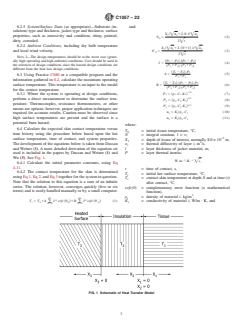
T 5 T 1A I erfc ~θ !1B I erfc ~θ' ! (1)
c 0 ( N ( N
N50 N50
and:
= =
X / α 12·N·l/ α
1 1 2
θ 5 (2)
N
=
2 t
= =
X / α 12·~N11!·l/ α
1 1 2
θ' 5 (3)
N
2=t
P 2 P · P 2 P
~ ! ~ !
2 3 2 1
I 5 (4)
~P 1P !·~P 1P !
2 3 2 1
~T 2 T !·P
i 0 2
A 5 (5)
P 1P
2 1
T 2 T · P 2 P ·P
~ ! ~ !
i 0 3 2 2
B 5 (6)
~P 1P !·~P 1P !
2 3 2 1
1/2
P 5 ρ ·C ·K (7)
~ !
1 1 1 1
1/2
P 5 ρ ·C ·K (8)
~ !
2 2 2 2
FIG. 1 Schematic of Heat Transfer Model
C1057 − 22
1/2
P 5 ρ ·C ·K (9)
~ !
3 3 3 3
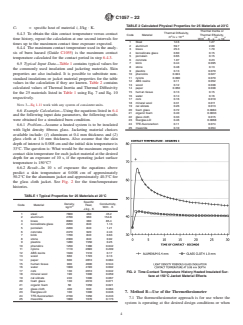
α 5 K /ρ ·C (10)
1 1 1 1
α 5 K /ρ ·C (11)
2 2 2 2
where:
T = initial tissue temperature, °C,
N = integral constant, 1 > ∞,
−5
X = depth of tissue of interest, normally 8.0 × 10 m,
α = thermal diffusivity of layer i, m /s,
i
l = la
...