

ASTM E848-94(2022)
(Guide)Standard Guide for Safety and Health Requirements Relating to Occupational Exposure to Water-Insoluble Chromates
General Information
- Abstract
SIGNIFICANCE AND USE
4.1 This guide includes chromates that are not readily soluble in water and that have water solubilities (Chromate ION) within the range of the more soluble calcium chromate and the much less soluble lead chromate. The major occupations involving potential exposure to insoluble chromates are in roasting of chromite ore, the manufacture of chromate pigments, the manufacture of coatings containing chromate pigments, and spray painting with these coatings. There is insufficient evidence to conclude that trivalent chromium compounds are carcinogenic.
SCOPE
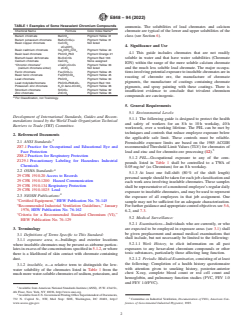
1.1 This guide covers control procedures for the safe production, storage, transportation, and handling of only the hexavalent chromium compounds found in Table 1 and their various hydrates, and mixtures of coprecipitates of the same regardless of crystalline form.
1.2 This guide is not intended to cover (a) such “soluble” chromates as chromates of sodium, potassium, magnesium, or ammonium; (b) soluble bichromates; (c) chromic acid; (d) volatile chromyl compounds; (e) any trivalent chromium compound; or (f) elemental chromium. Omission of said compounds or classes of compounds should not be construed to mean that they may be handled without due regard to their particular physical, chemical, and toxicological hazards (9, 10, 11).
1.3 The chromate ion, CrO4−2, depending upon the acidity, complexes to form di-, tri-, and higher polychromates; hence, the chromates listed in Table 1 may contain mixtures of polychromates, depending on the method of isolation and end use.
1.4 This standard does not purport to address all of the safety concerns, if any, associated with its use. It is the responsibility of the user of this standard to establish appropriate safety, health, and environmental practices and determine the applicability of regulatory limitations prior to use. (For more specific precautionary information see Section 5.)
1.5 This international standard was developed in accordance with internationally recognized principles on standardization established in the Decision on Principles for the Development of International Standards, Guides and Recommendations issued by the World Trade Organization Technical Barriers to Trade (TBT) Committee.
- Status
- Published
- Publication Date
- 30-Nov-2022
- Technical Committee
- D01 - Paint and Related Coatings, Materials, and Applications
- Drafting Committee
- D01.21 - Chemical Analysis of Paints and Paint Materials
Overview
ASTM E848-94(2022): Standard Guide for Safety and Health Requirements Relating to Occupational Exposure to Water-Insoluble Chromates is an international standard developed by ASTM International. This guide provides essential control procedures for the safe production, storage, transportation, and handling of hexavalent chromium compounds that are water-insoluble. It applies to compounds such as calcium chromate and lead chromate, which are prevalent in various industrial settings.
Water-insoluble chromates, while less readily dissolved in water compared to their soluble counterparts, still represent significant occupational health risks. This standard focuses on preventing hazardous exposure, ensuring proper worker protection, and promoting safe industrial hygiene practices.
Key Topics
- Scope of Application: Covers only hexavalent chromium (Cr(VI)) compounds with limited water solubility, as found in certain pigments and coatings. Excludes highly soluble chromates, bichromates, chromic acid, and trivalent chromium compounds.
- Occupational Exposure Controls: Provides recommendations on engineering controls, personal protective equipment (PPE), labeling, and hygiene to maintain employee exposures below established permissible exposure limits (PELs).
- Medical Surveillance: Emphasizes routine and periodic medical examinations, biological monitoring (especially for lead chromate exposure), and rapid response to potential health complaints or symptoms.
- Worker Training & Communication: Requires documented training on potential hazards, control methods, precautionary labeling, and emergency procedures.
- Environmental and Safety Considerations: Addresses appropriate housekeeping, waste disposal, maintenance, and recordkeeping to prevent environmental contamination and promote workplace safety.
Applications
ASTM E848-94(2022) is particularly valuable for industries where occupational exposure to water-insoluble chromates is likely, including:
- Roasting of Chromite Ore: Workers may encounter airborne dust containing chromates.
- Manufacture of Chromate Pigments and Coatings: Production and application of paints, pigments, and coatings that use insoluble chromates-such as barium chromate, zinc chromate, and lead chromate-benefit from the guide’s exposure control and labeling requirements.
- Spray Painting Operations: The guide helps prevent inhalation and minimize skin contact during spray application of chromate-containing coatings.
- Storage and Transportation: Ensures that containers of chromate materials are properly labeled and managed to reduce accidental exposure or environmental release.
Proper implementation supports compliance with national and international regulations as well as internal health and safety protocols.
Related Standards
Organizations involved in the handling of water-insoluble chromates should also reference these standards for a comprehensive approach to occupational safety:
- ANSI Z87.1: Practice for Occupational and Educational Eye and Face Protection
- ANSI Z88.2: Practices for Respiratory Protection
- OSHA 29 CFR 1910.1200: Hazard Communication
- OSHA 29 CFR 1910.134: Respiratory Protection
- NIOSH Recommended Industrial Ventilation Guidelines
- ACGIH TLVs: Threshold Limit Values for Chemical Substances and Physical Agents
Utilizing ASTM E848-94(2022) in conjunction with these related regulations and best practices supports a robust safety management system, reducing risks linked with hexavalent chromium exposure and ensuring regulatory compliance.
Keywords: ASTM E848, insoluble chromates, hexavalent chromium, occupational safety, exposure control, industrial hygiene, chromate pigments, water-insoluble chromates, medical surveillance, personal protective equipment, environmental health.
Get Certified
Connect with accredited certification bodies for this standard

BSI Group
BSI (British Standards Institution) is the business standards company that helps organizations make excellence a habit.

Bureau Veritas
Bureau Veritas is a world leader in laboratory testing, inspection and certification services.

DNV
DNV is an independent assurance and risk management provider.
Sponsored listings
Frequently Asked Questions
ASTM E848-94(2022) is a guide published by ASTM International. Its full title is "Standard Guide for Safety and Health Requirements Relating to Occupational Exposure to Water-Insoluble Chromates". This standard covers: SIGNIFICANCE AND USE 4.1 This guide includes chromates that are not readily soluble in water and that have water solubilities (Chromate ION) within the range of the more soluble calcium chromate and the much less soluble lead chromate. The major occupations involving potential exposure to insoluble chromates are in roasting of chromite ore, the manufacture of chromate pigments, the manufacture of coatings containing chromate pigments, and spray painting with these coatings. There is insufficient evidence to conclude that trivalent chromium compounds are carcinogenic. SCOPE 1.1 This guide covers control procedures for the safe production, storage, transportation, and handling of only the hexavalent chromium compounds found in Table 1 and their various hydrates, and mixtures of coprecipitates of the same regardless of crystalline form. 1.2 This guide is not intended to cover (a) such “soluble” chromates as chromates of sodium, potassium, magnesium, or ammonium; (b) soluble bichromates; (c) chromic acid; (d) volatile chromyl compounds; (e) any trivalent chromium compound; or (f) elemental chromium. Omission of said compounds or classes of compounds should not be construed to mean that they may be handled without due regard to their particular physical, chemical, and toxicological hazards (9, 10, 11). 1.3 The chromate ion, CrO4−2, depending upon the acidity, complexes to form di-, tri-, and higher polychromates; hence, the chromates listed in Table 1 may contain mixtures of polychromates, depending on the method of isolation and end use. 1.4 This standard does not purport to address all of the safety concerns, if any, associated with its use. It is the responsibility of the user of this standard to establish appropriate safety, health, and environmental practices and determine the applicability of regulatory limitations prior to use. (For more specific precautionary information see Section 5.) 1.5 This international standard was developed in accordance with internationally recognized principles on standardization established in the Decision on Principles for the Development of International Standards, Guides and Recommendations issued by the World Trade Organization Technical Barriers to Trade (TBT) Committee.
SIGNIFICANCE AND USE 4.1 This guide includes chromates that are not readily soluble in water and that have water solubilities (Chromate ION) within the range of the more soluble calcium chromate and the much less soluble lead chromate. The major occupations involving potential exposure to insoluble chromates are in roasting of chromite ore, the manufacture of chromate pigments, the manufacture of coatings containing chromate pigments, and spray painting with these coatings. There is insufficient evidence to conclude that trivalent chromium compounds are carcinogenic. SCOPE 1.1 This guide covers control procedures for the safe production, storage, transportation, and handling of only the hexavalent chromium compounds found in Table 1 and their various hydrates, and mixtures of coprecipitates of the same regardless of crystalline form. 1.2 This guide is not intended to cover (a) such “soluble” chromates as chromates of sodium, potassium, magnesium, or ammonium; (b) soluble bichromates; (c) chromic acid; (d) volatile chromyl compounds; (e) any trivalent chromium compound; or (f) elemental chromium. Omission of said compounds or classes of compounds should not be construed to mean that they may be handled without due regard to their particular physical, chemical, and toxicological hazards (9, 10, 11). 1.3 The chromate ion, CrO4−2, depending upon the acidity, complexes to form di-, tri-, and higher polychromates; hence, the chromates listed in Table 1 may contain mixtures of polychromates, depending on the method of isolation and end use. 1.4 This standard does not purport to address all of the safety concerns, if any, associated with its use. It is the responsibility of the user of this standard to establish appropriate safety, health, and environmental practices and determine the applicability of regulatory limitations prior to use. (For more specific precautionary information see Section 5.) 1.5 This international standard was developed in accordance with internationally recognized principles on standardization established in the Decision on Principles for the Development of International Standards, Guides and Recommendations issued by the World Trade Organization Technical Barriers to Trade (TBT) Committee.
ASTM E848-94(2022) is classified under the following ICS (International Classification for Standards) categories: 13.100 - Occupational safety. Industrial hygiene. The ICS classification helps identify the subject area and facilitates finding related standards.
ASTM E848-94(2022) is available in PDF format for immediate download after purchase. The document can be added to your cart and obtained through the secure checkout process. Digital delivery ensures instant access to the complete standard document.
Standards Content (Sample)
This international standard was developed in accordance with internationally recognized principles on standardization established in the Decision on Principles for the
Development of International Standards, Guides and Recommendations issued by the World Trade Organization Technical Barriers to Trade (TBT) Committee.
Designation: E848 − 94 (Reapproved 2022)
Standard Guide for
Safety and Health Requirements Relating to Occupational
Exposure to Water-Insoluble Chromates
This standard is issued under the fixed designation E848; the number immediately following the designation indicates the year of
original adoption or, in the case of revision, the year of last revision.Anumber in parentheses indicates the year of last reapproval.A
superscript epsilon (´) indicates an editorial change since the last revision or reapproval.
INTRODUCTION
Thisguideisintendedtoprovideguidanceinthesafehandlingofcertainchromatecompoundsthat
are suspected to be carcinogenic in man (1-8). Precautions contained herein are believed to protect
against possible carcinogenicity, and will also be sufficient to obviate any acute health hazards except
where skin hypersensitivity is a factor. Other hazards are considered and discussed.
The time-weighted average (TWA) permissible exposure limit (PEL) specified in this guide are
based on studies evaluated by the American Conference of Government Industrial Hygienists
(ACGIH) (9). Epidemiological studies of the chromate producing industry have indicated that
observed adverse health effects were associated with environmental levels and hygiene procedures
considerably less exacting than those recommended here (see Appendix X1).
Hygiene controls and medical surveillance measures have been chosen to protect workers,
recognizingthatthepotentialforexposurewillvarywidelyfromindustrytoindustryandbetweenone
location and another, depending on the compounds handled, scale of operations, kind of process, and
physical conditions.
The key to maintaining chromate levels below the PELis through implementation of cost effective
engineering controls augmented as necessary by personal protective equipment, or work practice
controls, or both. The choice of methods should depend upon the factors involved in each specific
situation.
Biological monitoring is also recommended for lead chromate (see 7.4).
All applicable federal, state, county and local regulations must be complied with when this guide
is used.
1. Scope compoundsorclassesofcompoundsshouldnotbeconstruedto
mean that they may be handled without due regard to their
1.1 This guide covers control procedures for the safe
particular physical, chemical, and toxicological hazards (9, 10,
production, storage, transportation, and handling of only the
11).
hexavalent chromium compounds found in Table 1 and their
various hydrates, and mixtures of coprecipitates of the same −2
1.3 The chromate ion, CrO , depending upon the acidity,
regardless of crystalline form.
complexes to form di-, tri-, and higher polychromates; hence,
1.2 This guide is not intended to cover (a) such “soluble”
the chromates listed in Table 1 may contain mixtures of
chromates as chromates of sodium, potassium, magnesium, or
polychromates, depending on the method of isolation and end
ammonium; (b) soluble bichromates; (c) chromic acid; (d)
use.
volatile chromyl compounds; (e) any trivalent chromium
1.4 This standard does not purport to address all of the
compound; or (f) elemental chromium. Omission of said
safety concerns, if any, associated with its use. It is the
responsibility of the user of this standard to establish appro-
This guide is under the jurisdiction of ASTM Committee D01 on Paint and
priate safety, health, and environmental practices and deter-
Related Coatings, Materials, and Applications and is the direct responsibility of
mine the applicability of regulatory limitations prior to use.
Subcommittee D01.21 on Chemical Analysis of Paints and Paint Materials.
(For more specific precautionary information see Section 5.)
Current edition approved Dec. 1, 2022. Published December 2022. Originally
approved in 1982. Last previous edition approved in 2016 as E848–94(2016).
1.5 This international standard was developed in accor-
DOI: 10.1520/E0848-94R22.
2 dance with internationally recognized principles on standard-
The boldface numbers in parentheses refer to the references at the end of this
guide. ization established in the Decision on Principles for the
Copyright © ASTM International, 100 Barr Harbor Drive, PO Box C700, West Conshohocken, PA 19428-2959. United States
E848 − 94 (2022)
TABLE 1 Examples of Some Hexavalent Chromium Compounds
ammonia. The solubilities of lead chromates and calcium
A
Chemical Name Formula Color Index Name chromate are typical of the lower and upper solubilities of the
Barium chromate BaCrO Pigment Yellow 31 class (see Section 6).
Barium potassium chromate BaK (CrO ) Pigment Yellow 31
3 4 2
Basic copper chromate CuCrO Not listed
4. Significance and Use
xCu(OH)
Basic cadmium chromate Cd (OH) CrO Pigment Yellow 44
2 2 4
4.1 This guide includes chromates that are not readily
Basic lead chromate PbCrO PbO Pigment Orange 21
Bismuth basic dichromate Bi O CrO Pigment Red 103
2 3 3 soluble in water and that have water solubilities (Chromate
Calcium chromate CaCrO None assigned
ION) within the range of the more soluble calcium chromate
“Chromic chromate” xCaO yCr O Pigment Yellow 33
2 3
and the much less soluble lead chromate. The major occupa-
(calcium chromate sinter) zCrO Not listed
Ferric chromate Fe (CrO ) Pigment Yellow 45
2 4 3 tionsinvolvingpotentialexposuretoinsolublechromatesarein
Basic ferric chromate Fe(OH)CrO Pigment Yellow 45
roasting of chromite ore, the manufacture of chromate
Lead chromate PbCrO Pigment Yellow 34
pigments, the manufacture of coatings containing chromate
Lead molybdochromate PbCrO PbMoO Pigment Red 104
4 4
Potassium zinc chromate K O 4ano·4Cr4O Pigment Yellow 36
pigments, and spray painting with these coatings. There is
2 3
Strontium chromate SrCrO Pigment Yellow 32
insufficient evidence to conclude that trivalent chromium
Zinc chromate ZnCrO Pigment Yellow 36
compounds are carcinogenic.
A
For Classification, not Toxicology.
5. General Requirements
5.1 Environmental Levels:
Development of International Standards, Guides and Recom-
5.1.1 The following guide is designed to protect the health
mendations issued by the World Trade Organization Technical
and safety of workers for an 8h to 10h workday, 40h
Barriers to Trade (TBT) Committee.
workweek, over a working lifetime. The PEL can be met by
techniques and controls that reduce employee exposure below
2. Referenced Documents
the applicable safe limit. These controls must be reliable.
2.1 ANSI Standards:
Permissible exposure limits are based on the 1985 ACGIH
Z87.1Practice for Occupational and Educational Eye and
recommended Threshold Limit Values (TLV) for chromates of
Face Protection
lead and zinc and for chromite-ore processing (12).
Z88.2Practices for Respiratory Protection
5.1.2 PEL—Occupational exposure to any of the com-
Z129.1Precautionary Labeling for Hazardous Industrial
pounds listed in Table 1 shall be controlled to a TWA of
Chemicals
0.05mg⁄m (as Chromium) for an 8h workday.
2.2 OSHA Standards:
5.1.3 At least one full-shift (80% of the shift length)
29 CFR 1910.20Access to Records
personalsampleshouldbetakenforeachjobclassificationand
29 CFR 1910.1200 Hazard Communication
each work area involving insoluble chromates. These samples
29 CFR 1910.134Respiratory Protection
shallberepresentativeofamonitoredemployee’sregulardaily
29 CFR 1910.1025 Lead
exposure to insoluble chromates, and may be used to represent
2.3 NIOSH Publications:
the exposure of all employees in that job assignment. One
“Certified Equipment,”HEW Publication No. 76-145
sample may not be sufficient for an adequate characterization.
“Recommended Industrial Ventilation Guidelines,” January
Forfurtherguidanceandappropriatecontrolobjectivessee5.6,
1976,HEW Publication No. 76-162
6.2, and 7.3.
“Criteria for a Recommended Standard Chromium (VI),”
5.2 Medical Surveillance:
HEW Publication No. 76-129
5.2.1 Examinations—Individuals who are currently, or who
3. Terminology are expected to be employed in exposure areas (see 3.1) shall
be given preplacement and annual medical examinations that
3.1 Definitions of Terms Specific to This Standard:
shall include, but not necessarily be limited to the following:
3.1.1 exposure area, n—buildings and exterior locations
5.2.1.1 Work History, to elicit information on all past
where insoluble chromates may be present as airborne particu-
exposures to any hexavalent chromium compounds or other
latesinexcessoftheconcentrationsspecifiedin5.1.2,orwhere
toxic substances, particularly those affecting lung function.
there is a likelihood of skin contact with chromate containing
dust. 5.2.1.2 Periodic Medical Examination,consistingofatleast
the following: Completion of a health history questionnaire
3.1.2 insoluble, n—a relative term to distinguish the low-
with attention given to smoking history, posterior-anterior
water solubility of the chromates listed in Table 1 from the
chest X-ray, complete blood count or red cell count and
muchmorewater-solublechromatesofsodium,potassium,and
hemoglobin, and pulmonary function studies (FVC, FEV 1.0
and FEV 1.0/FVC).
Available fromAmerican National Standards Institute (ANSI), 25 W. 43rd St.,
4th Floor, New York, NY 10036, http://www.ansi.org.
AvailablefromU.S.GovernmentPrintingOfficeSuperintendentofDocuments,
732 N. Capitol St., NW, Mail Stop: SDE, Washington, DC 20401, http:// Committee on Industrial Ventilation, Documentation of TLVs, American Con-
www.access.gpo.gov. ference of Governmental Industrial Hygienist, 1985.
E848 − 94 (2022)
5.2.2 Medical examinations shall be made available to with the recommendations of ANSI Z129.1. Any applicable
workers with symptoms of skin or upper respiratory tract governmental regulation must be followed.
irritation at the time the symptoms are first observed or
5.4 Personal Protective Equipment:
reported.
5.4.1 Respiratory Protection—Each employee’s personal
5.2.3 Management—Proper medical management shall be
work environment shall be maintained at a safe exposure level
provided promptly for workers adversely affected by exposure
through implementation of cost effective engineering controls,
to insoluble chromates. The cause of any excessive exposure
augmented as necessary by personal protective equipment or
shallbesoughtwithoutdelay,andcorrectiveactioninitiated.A
work practice controls, or both. The choice of method should
physician shall determine if sensitized individuals should be
depend on the factors involved in each specific situation. Two
excluded from jobs with a risk of exposure.
criteria should be used to guide the choice of the control
5.2.4 First Aid:
measures. The measure chosen must reduce employee expo-
5.2.4.1 Ingestion—Induce vomiting promptly and obtain
sure below the applicable safe limit and the control method
prompt medical attention. “Advice to physicians: Administer
must be reliable (14, 15). With these two factors met, other
500mg to 1000 mg ascorbic acid IV as promptly as possible,
factors such as logistics, product quality, economics, morale,
followed by oral Vitamin C, 5g⁄day to 10 g/day until risk of
housekeeping, and efficiency can then be incorporated into the
kidney failure has ceased,” (13).
decision logic for choosing appropriate control measures.
5.2.4.2 Chromium Contamination of Open Wounds—Flush
Respirators are also required for emergencies and for the
thoroughly for 15 min with water and seek medical attention.
performance of nonroutine tests and duties that have the
5.2.4.3 EyeIrritation—Flushthoroughlywithcopiousquan-
likelihoodofexceedingthePEL.Brushorrollerapplicationof
tities of water for 15 min and seek medical attention. paints does not normally require respiratory protective equip-
ment for protection from airborne chromates.
5.3 Labeling and Posting:
5.4.2 The Respiratory Protection Program must meet the
5.3.1 Warning Signs—In areas where insoluble chromate
general requirements outlined in OSHA29 CFR 1910.134 and
concentrations in the atmosphere are likely to exceed the
inANSI Z88.2-1980, see Ref (16). This program shall include
standard, appropriate warning signs, barricades, or work prac-
instructions on the proper selection and use, including fit
tices should be used to restrict access to unauthorized persons.
testing, cleaning and maintenance of respirators and air supply
The sign must alert anyone entering the area as to what action
devices. The fit test should be performed annually on all
should be taken.
negative pressure respirators. Either a quantitative or qualita-
5.3.2 Container Labels—All containers (bag, barrel, box,
tive test is satisfactory (14, 15).The type of respirator required
can, drum, reaction vessel, storage tanks, but not pipe or pipe
for protection against known or expected concentration of
lines) should be labeled, tagged, or marked with the following
airborne chromate to be encountered is outlined in Table 2.
information:
5.4.3 Foot Protection—Industrial type leather shoes with
5.3.2.1 The Identity of the Material(s)—Identity means any
synthetic soles will provide ample protection under normal
chemical or common name(s), code name or number, or brand
operating and good housekeeping conditions. For wet opera-
name, that is indicated on the material safety data sheet for the
tions during cleanup of spills or when conducting decontami-
chemical.
nation procedures, rubber or synthetic booties or pullover shoe
5.3.2.2 Batch process sheets, batch tickets, operating
protection shall be worn, and thoroughly rinsed and dried
procedures, or other such written materials are acceptable
before reuse. Shoes that are torn or show evidence of inside
alternatives to individual labels as long as the appropriate
contamination with chromate shall be disposed of properly.
identity is readily accessible to employees.
5.4.4 Clothing—Any employee exposed to airborne levels
5.3.2.3 Portable containers for immediate use need not be
of chromium above the PELor when the possibility of skin or
labeled.
eye irritation exists, should be supplied with appropriate
5.3.3 Safety Data Sheet (SDS)—The SDS or equivalent is
protective work clothing such as coveralls or similar full-body
the primary source of the safety and health information. The
work clothes. See for example, ANSI Z87.1 for eye and face
chemical identification and SDS for all insoluble chromates
protection guidelines. Clean work clothing should be supplied
used in the workplace must be made readily accessible to all
at least weekly to employees in these cases. All protective
employees. The SDS in conjunction with the identity on the
clothingmustberemovedatthecompletionofeachworkshift
label and employee training will convey the hazard(s) (both
in the change room provided for this purpose. Employees
physical and health) determination for the chromate com-
exposed to chromium above the PELshould shower at the end
pounds. Information on the SDS must include:
of the work shift. Employees must not wear or take any of the
5.3.3.1 The OSHA PEL and the ACGIH TLV.
protective equipment off the work site. Care must be taken to
5.3.3.2 A statement to that effect if the chromate has been prevent any cross contamination of street clothes.
identified as a suspect carcinogen by the National Toxicology
5.4.5 Hand Protection—Suitable gloves to minimize skin
Program (NTP), the International Agency for Research on
contact shall be worn during operations where chromates are
Cancer (IARC), OSHA, or the employer.
handled and may contact skin. Hands should be cleaned after
5.3.4 Finished Product Labels, are the responsibility of the removal of gloves. Gloves showing evidence of internal
manufacturer based on his knowledge of the end use of his contamination shall be disposed of or thoroughly cleaned
unique products. However, the label should be in agreement before reuse.
E848 − 94 (2022)
TABLE 2 Protection Factors for Particulate Filter Respirators
5.5.1.4 Site and government standards,
5.5.1.5 Potential health effects from both acute and chronic
NOTE 1—This table is based on Refs (17, 18, 19) and ANSI Z88.2.
exposures,
Concentrations in
Face-
5.5.1.6 Relevance of medical exams,
Multiples of
Piece Permissible Respirators
Permissible
5.5.1.7 Protective control measures used and new relevant
Pressure
A
Exposure Limits
information,
5× − Single-use dust
5.5.1.8 Exposure monitoring programs,
− Quarter-mask dust
B
10× − Half-mask dust 5.5.1.9 Employee responsibility for following procedures
− Half of quarter mask, fume
and using protective equipment, and
− Half or quarter mask, high
5.5.1.10 Emergency procedures.
efficiency
5.5.1.11 This information may be communicated and train-
− Half mask, supplied air de-
mand mode
ing achieved by any combination of oral or written individual
50× − Full-face piece, high effi-
or group methods which achieve understanding. Training
ciency or dust, fume, mist
− Full-face piece, supplied air should be repeated annually.
C
demand mode
5.5.2 Exposure Records—Employees have the right to their
− Self-contained breathing ap-
exposure records and medical records under OSHA 29 CFR
paratus (SCBA) demand
mode 1910.20.
1000× + Powered, high-efficiency, all
D
5.6 Work Practices and Engineering Controls:
enclosures
+ Half mask, supplied air,
5.6.1 Housekeeping—Spillsshallbecleaneduppromptlyby
pressure-demand mode or
vacuuming,orwetmethods,orbyabsorptionmethodsthatwill
continuous flow
prevent airborne contamination. No dry sweeping shall be
2000× + Full-face piece, hood, helmet,
or suit; supplied air;
performed. Floors, equipment, stains, and other contactable
pressure-demand mode or
surfacesthatmayaccumulatechromateparticulatefalloutshall
continuous flow
bemaintainedfreeofdustthatmaybecomeairborne.Contain-
10 000× + Full-face piece, SCBA
pressure-demand mode
ers provided for chromate solid waste shall be labeled and
+ Full-face piece supplied air
covered in accordance with 5.3.2.
pressure-demand mode or
continuous flow with auxiliary 5.6.2 Control of Hazards:
self-contained air supply
5.6.2.1 Engineering Design and Construction—In the plan-
Emergency entry into + Full-face piece, SCBA
ning and erection of new or modified manufacturing or
unknown pressure demand mode
concentrations or handling facilities, the principles of industrial hygiene and
firefighting
safety should be systematically applied.
E
Escape only + Any SCBA
5.6.2.2 Ventilation—Alloperationsthatreleasedust,suchas
− Any self rescuer
opening packages, sampling, taking aliquots, charging vessels,
A
Other chemicals, for example, lead may be the controlling factor rather than
drying,sizing,mixing,discharging(packout),orcleanoutshall
chromate concentration.
B
Half-mask and quarter-mask respirators should not be used if the particulate
be provided with appropriately designated local ventilation in
matter causes eye irritation at the use concentration.
accordance with ACGIH recommendations and applicable
C
Full-face piece, supplied-air respirators should not be used in any atmosphere
governmental regulations. Ventilation systems shall be subject
that is immediately dangerous to life or health unless it is equipped with an
auxiliary self-contained air supply that can be operated in the positive-pressure
to a preventive maintenance inspection program to ensure that
mode.
D hoods,ducts,fans,absorbers,draftcontrols,filters,alarms,and
Recent work by NIOSH would indicate a protection factor of 1000 may not be
obtained. Consult your supplier. other components are structurally sound and in good working
E
In an atmosphere that is immediately dangerous to life or health.
order.Periodictestsofductpressuresorflows,orboth,shallbe
made to ensure that the ventilation is adequate (20).
5.6.3 Solid Waste Disposal—Solid waste containing in-
soluble chromates that have the potential for becoming air-
borne shall be stored in labeled and covered containers until
5.4.6 Inspection—All personal protective devices shall be
disposal in accordance with applicable governmental agency
inspected regularly and shall be maintained in clean and
regulations.
satisfactory working condition.
5.6.4 Maintenance—Equipment and instruments shall be
kept in good repair. Pumps, vessels, and lines handling
5.5 Appraisal of Employees of Hazards (Communications):
5.5.1 Education and Training—All employees who are insoluble chromates shall be drained and washed out before
repairs are made except where repairs can be made without
employedinanexposureareashallbeadvisedofthefollowing
according to OSHA 29 CFR 1910.1200: exceeding the PEL.
5.5.1.1 Chemical names,
5.5.1.2 Label identification system,
5.5.1.3 Work procedures, 7
NIOSH Manual of Analytical Methods, 3rd ed., U.S. Department of Health and
Human Services, Public Health Service, Centers for Disease Control. National
Institute for Occupational Safety and Health, Division of Physical Sciences and
Engineering; Cincinnati, Ohio, 1990. Available from the Superintendent of
These items should also be included on the Safety Data Sheets (SDS). Documents, U.S. Government Printing Office, Washington, DC 20402.
E848 − 94 (2022)
TABLE 3 Physical and Chemical Properties of Insoluble Chromates
Solubility Solubility
Solubility
Particle Melting
A
Chromate Molecular Weight Product, in Dilute
in Water,
Density Point 3
2 2
g/100 cm
mol /L Acid
Barium potassium 563.52 4.50 (15 °C)
−10
Barium 253.37 4.50 (15 °C) 0.00034 (16 °C) 1.6 × 10 (18 °C) soluble
0.004 (37 °C)
Basic cadmium 374.81
Basic ferric 188.85
Basic copper variable compositions
Basic lead 546.2
Bismuth basic 665.95
dichromate
Calcium 156.07 0.75 (37 °C)
+6
Chromic (sinter) variable compositions 0.13 (37 °C) as Cr soluble
Ferric 459.67
−6 −14
Lead 323.10 6.12 (15 °C) 844 5.8 × 10 (25 °C) 1.77 × 10 (18 °C)
soluble
Lead molybdochromate variable compositions
Potassium zinc 819.68
Strontium 203.63 3.90 (15 °C) 0.09 (37 °C) soluble
Zinc 181.37 3.40 (15 °C) 0.21 (37 °C) soluble
A
Solubilities in water at 37 °C were calculated on the basis of data given in Heuper, W. C., and Conway, W. D., Chemical Carcinogenesis and Cancers, C. C Thomas,
Springfield, IL 1964, p. 397.
5.6.5 Sanitation—Washing facilities, emergency showers, 5.6.8.2 Explosion—None of the chromates covered by this
eye-flushing fountains, or appropriate washing facilities shall practice are explosive even at elevated temperatures. Mixtures
be provided and be easily accessible in areas where there is of insoluble chromates with readily oxidizable materials may
potential for skin or eye contact with insoluble hexavalent be explosive.
chromium dust or liquids. This equipment shall be frequently
5.7 Recordkeeping:
inspected, and maintained in good working condition. Con-
5.7.1 All test results shall be recorded showing location,
taminatedclothingshallbeheldincontainersuntilremovedfor
time and date of sample, and identity of employee in the case
decontamination or disposal. Arrangements for laundering or
of personal or biological sampling. This information shall be
otherwise decontaminating work clothing shall ensure the
retained for at least 30 years, and in the case of personal or
protection of individuals involved in this work.
biologicalsampling,resultsshallbekeptfor40yearsoratleast
5.6.6 Statistical Control—Data resulting from air and bio-
30 years after the termination of employment, whichever is
logical monitoring can be subject to various errors such as
longer.
random sampling device errors, or random analytical errors, or
5.7.2 Pertinent medical records, including results of clinical
both.Theseerrorscanbequantifiedandtheireffectsminimized
examinations, biological and biochemical analysis,
by the application of statistically based quality control pro-
roentgenograms,anddatesoftreatmentorhospitalization,shall
grams. Each analytical method should be consulted for appro-
be maintained in a secure and confidential manner for at least
priate details.
30 years after termination of employment.
5.6.6.1 Another potential source of large error is due to the
randominterdayandintradayfluctuationsinairbornecontami-
6. Physical and Chemical Properties
nant levels. These fluctuations are generally considered to be
6.1 Selected physical and chemical properties of insoluble
log-normal, and may result in erroneous conclusions unless
chromates are given in Table 3.
properly considered.
5.6.6.2 An appropriate objective is to control each employ-
7. Monitoring Airborne and Biological Chromates
ee’s exposure so that the maximum probability of exposure
abovetheexposurelimitis5%.Anumberofreferencescanbe
7.1 Personnel Monitoring—Breathing zone samples repre-
used for guidance since this detail is beyond the scope of this sent the most accurate measurement of employee exposure to
practice (21, 22, 23). airborne chromates. The sample is taken within a foot of the
employee’s face, and represents air inhaled by the employee.
5.6.7 Containers—All shipping, storage, or in-plant trans-
Thesamplemaybeobtainedusingapersonalsamplerattached
port containers of insoluble chromates shall be labeled to
to an individual or by a sampling device held within a foot of
identify the material.
the face. An analytical method should be consulted for the
5.6.8 Safety (Fire and Explosion):
necessary details such as collection device, flow rate, and the
5.6.8.1 Fire—The chromates covered by this practice are
like.
nonflammable, but under favorable conditions some may have
sufficient solubility in the presence of combustible materials to 7.2 Area Sampling—This is also known as fixed location
initiate combustion by local exothermic oxidation. sampling and is normally used to determine the maximum
E848 − 94 (2022)
potential exposure, or to make a preliminary study of work- isnotedthatbloodleadlevelsinexcessof50µg/100gofblood
place conditions. An example is a continuous monitor. require worker removal from the area under the OSHA
standard.
7.3 Frequency—In applying this practice, preliminary in-
vestigation of all work operations should be made by an
8. Analytical Test Methods
industrial hygienist or other qualified professional for the
8.1 National Institute for Occupational Safety and Health,
purposes of designating both frequency and location of air 7
(NIOSH)publishedthefollowingmethods: 7024;7200;7300;
sampling devices and appropriate job assignments to be
7600; 7604; 8005; and 8310. These methods should be
monitored.
consulted for advantages and disadvantages. (Such as separat-
ing CR III from CR VI).
7.4 Biological Monitoring—Bloodandurinalysisforcertain
components have long been used for monitoring the effective-
8.2 Anyanalyticalprocedurethathasbeenshowntopossess
nessofprogramsdesignedtocontrolworkerexposure.Airand
equivalent or better sensitivity, reproducibility, and accuracy
bloodleadlevelsshouldbemonitoredasrequiredinOSHA29
may be used to determine whether environmental levels are
CFR 1910.1025. Currently, when lead chromate is used or
within the recommended standards.
handled in any manner such that airborne lead levels exceed
9. Keywords
30µg⁄m , it is essential that a blood-lead monitoring program
be undertaken. Monitoring for other biochemical indicators 9.1 chromium; chromium based pigments; chromium com-
may be useful in certain situations but until better correlation
pounds; exposure; health; hexavalent chromium; insoluble
withbloodleadlevelsisestablished,nonearerecommended.It chromium; safety
APPENDIX
(Nonmandatory Information)
X1. EPIDEMIOLOGY AND TOXICOLOGY
X1.1 General studies: by Heuper in 1958 and 1959, Baetjer in 1959, and
Payne in 1960 (32, 33, 34, 35, 36).
X1.1.1 This appendix is restricted to discussion of the
epidemiologyandtoxicologyofinsolublechromatesasdefined
X1.3 Oral Toxicity and Metabolism
in Section 1. For a more thorough understanding, the original
articles should be consulted. X1.3.1 Insoluble chromates, at rates dependent on their
solubility, are either eliminated unchanged in the feces or
X1.2 Early Studies reduced to trivalent chromium that is bound to protein (37).
Ratesofthelaterhavethreecomponentswithhalf-livesof0.5,
X1.2.1 Although chrome dermatitis, skin ulcers, and nasal
5.9, and 83.4 days.
septumperforationswerereportedasearlyas1827inScotland
and in 1933 in the United States, indications that chromates of X1.3.2 Obviously,theoraltoxicityofinsolublechromatesis
some kind were a possible cause of bronchogenic carcinomas dependentonthenatureofthecation,especiallyinthecasesof
observed in chromate-producing plants first appeared in the lead chromate.Alethal dose, in man, of lead chromate as low
German literature during the 1930s (1, 2, 24, 25, 26, 27). as 50 mg/kg was reported by Gleason, but Harrold found this
Following evidence in 1945, that a similar situation might be compound was poorly absorbed by paint workers (29, 38).
developing in the United States, the chromates industry spon- Gross found that rats and mice tolerate 1% zinc chromate in
sored literature and case studies that culminated in reports by their feed (39). Kennedy summarized the toxicity of lead
Machle and Gregorius, by Baetjer, and by the U.S. Public chromates (40).Thesizeofthedoserequiredtoproduceeffects
Health Service (28, 29, 30, 31).These reports were in substan- varies considerably between pigments. The most adverse
tial agreement that the causative agents were associated with effects result from the availability of the lead cation.
thelime-roastingphaseoftheproductionprocess.Bythistime,
X1.3.3 In most studies the compounds were administered
it was clear that most of the dermatitis, sensitization, and
by intravenous injection, a procedure considered irrelevant for
ulceration effects were due to exposures to chromic acid and
the purpose at hand. At least for the more soluble of the
the soluble chromates and causative agents. It is noted, lead
chromate pigments, it is expected that excessive oral ingestion
chromate compounds have not been associated with sensitiza-
will result, as with the injected soluble chromates, in acute or
tion or ulceration.
chronic renal damage or failure, or both. Hunder found, for
X1.2.2 The carcinogenicity of calcium chromate and sin- example, that 0.02 g/kg of potassium dichromate (as 2%
tered and roasted ore (containing calcium chromato chromite, solution) was fatal to a monkey, producing acute renal lesions
misnamed “chromic chromate”) was confirmed by animal (41). Tandon reported elevated chromium levels in the urines
E848 − 94 (2022)
of pigment handlers in Indian paint factories (42). Toxicity by X1.5.2.4 A thorough review of the chromate-producing
the oral route has not been reported to be an occupational industryintheUnitedStateswasundertakenbytheU.S.Public
hazard.
HealthServicein1948andwaspublishedin1953 (2, 51).This
report concluded: “Some factor, not present in the comparison
X1.4 Skin and Eye Irritation
group, is responsible for the greater prevalence and earlier
X1.4.1 The dermal irritancy and skin-sensitizing properties production of bronchogenic carcinoma in chromate workers.”
ofthesolublechromatesarewellknownandfullydocumented
X1.5.2.5 In 1951, Bidstrup reported on her study of the
(43, 44). Less is known about the action of the insoluble
British chromate-producing industry where the lime process
chromates in these regards. However, since several of the
wasused (52).Herresultswerelimitedinsignificancebecause
chromate pigments have some limited solubility in moisture
she found only one case of lung cancer in 724 workers. In
and therefore in perspiration, allergic skin reactions can occur
1956, Bidstrup and Case demonstrated that from 1949 to 1955
in sensitized individuals. Walsh is of the opinion that once
in three bi-chromate producing factories in Great Britain there
chromate sensitivity becomes established, there is apparently
existed a statistically significant increase in mortality due to
no “hardening” or increased tolerance to further exposures
carcinoma of the lung (53).
(45). Both Fisher and Engle have observed dermatitis in
X1.5.2.6 Alderson,Rappan,andBidstrupin1981showedin
workers exposed to pain containing zinc chromate (46, 47).
afollow-upstudyof2715menwhohadworkedforatleastone
Calnan made a study of so called “cement dermatitis” and
year at the three chromate-producing factories in Britain
concluded that the presence of chromates was a possible cause
between1948and1977,thattherelativeriskoflungcancerfor
(47). It seems likely, that any chromate present in cement
those men employed at the one factory still in operation, had
would be largely in the form of calcium salt. Similarly, as
decreased from over three before plant modification to about
reported by Fregert and Shelly, the chromium alleged to be a
1.8, in those who had worked only since plant modification
possiblecausativeagentindermatitisfromweldingfumesmay
(this included the elimination of lime in 1961) (54).
beinthehexavalentform (48, 49).Inanyevent,thereisreason
X1.5.2.7 In 1966, Taylor reported on a study of 1212
to believe that the more soluble chromate pigments may be
workers representing three plants and 70% of the U.S.
causative agents for contact dermatitis, particularly among
chromate-producing capacity (55). These plants used the lime
sensitized or allergic individuals.
process. He found a nine-fold increase in deaths from lung
X1.4.2 Insoluble chromates should be regarded as possible
cancer.
eyeirritants,duetotheirirritancyasparticulates.Noreportsof
X1.5.2.8 Enterline, in 1974, reanalyzed the data from Tay-
special studies of the effects of insoluble chromates on the eye
lor’s study for 1941 to 1960 and found, again, the nine-fold
have been found. Although skin ulcers and nasal-septum
increase in deaths from lung cancer (56). In addition, he also
perforations are unusually associated with excessive exposure
found a slight excess in deaths from cancer of the digestive
to soluble chromates, dichromates, and chromic acid, some
system.
chromatepigmentsaresufficientlysolubletomakeitunwiseto
X1.5.2.9 In1979,HillandFergusoninvestigatedtheimpact
rule them out as causative agents.
ofchangesinproductiontechnologyataBaltimoreplantusing
X1.5 Respiratory Tract Irritation
“probability window analysis” (57). These authors found that
the successive decline in bronchiogenic carcinomas among the
X1.5.1 It has been shown that inhalation of soluble chro-
successivecohortsofthosepersonsenteringriskinthetenyear
mates can cause a variety of adverse respiratory reactions such
periods, 1932 to 1941, 1942 to 1951, 1952 to 1961, and 1962
as bronchitis, laryngitis, bronchogenic asthma, rhinorrhea
to 1971 was highly significant. No further cases occurred in a
tracheitis, pharyngitis, and emphysema (1, 44). No reports
subsequent period 1972 to 1977 and there have been no
establishing airborne insoluble chromates as the cause of these
observed cases of bronchogenic carcinoma among workers
effects have been found.
entering risk during the twenty year period 1958 to 1977. The
X1.5.2 Epidemiologic Studies:
results suggest that the risk of lung cancer in chromate-
X1.5.2.1 Machle and Gregorius made the first epidemio-
production workers has been reduced by improvements in the
logic study of the U.S. chromate industry (28).They examined
process and by consequent reduction of exposure to chromium
theincidenceratesoflungcancerinsevenchromateproducing
materials.
plants and found consistently high mortality ratios in six of
X1.5.2.10 Although the number of cases is sometimes too
these plants.
low to permit valid conclusions and most exposures have been
X1.5.2.2 Baetjer,limitingherstudytotwoproductionplants
mixed, there is accumulating epidemiological evidence that
in Baltimore, found a similar elevation in mortality ratio (29,
calcium chromate and sintered lime roast containing calcium
30). Both Machle and Baetjer studied plants that used a
chromato-chromite are lung cancer causative or promoting
lime-roasting process. One plant examined by Machle did not
(genotoxic or epigenetic) agents in chromate-producing plants
usealkalineoxidationofchromiteandhadnodeathsfromlung
using the lime process (57).
cancer in 1853 man-years of exposure.
X1.5.2.11 The earliest epidemiological study of a chromate
X1.5.2.3 Mancuso and Heuper investigated an Ohio
chromate-producing plant using the lime-roasting process and pigment-producing plant was reported by Gross in 1943 (26).
InaGermanfactory,thereweresevendeathsfromlungcancer
found a marked increase in lung cancer cases beyond that
found in control groups (50). in fewer than 50 workers. Lead, zinc, potassium, and barium
E848 − 94 (2022)
chromates were among the pigments produced. Potassium chromateandtheauthorconcludedthat“althoughthenumbers
dichromate was used as a raw material. are small, this updated follow-up supports the hypothesis that
zinc chromate increases the risk of lung cancer.” However, the
X1.5.2.12 In 1975, Langaard and Norseth reported an in-
number of lung cancer deaths among persons exposed only to
crease in bronchogenic cancer in a Scandinavian chromate
pigment-producingplant (3).Unfortunately,thesubgroupstud- lead chromate was too small to draw definitive conclusions.
iedissmall.Only24menworkedmorethanthreeyearsandof
X1.5.2.17 A study done by Frentzel-Beyme, and others, of
these, three had bronchogenic cancer and two of these were
fivefactoriesintheNetherlandsandWestGermanywithatotal
smokers. In 1983, Langaard and Vigander reported the results
of 1921 employees all producing zinc and lead chromate
of a follow-up study on the same group of workers (21).Three
showed a moderate but consistent increased risk of lung and
more cases of lung cancer were found. The observed/expected
respiratory tract cancer at four of the five factories. A multi-
ratioof44wasthesameasin1972.Fiveofthesixlungcancer
centric European epidemiological study investigated the lung
patients smoked and all had been exposed to zinc chromate.
cancer mortality of workers employed in chromate pigment
X1.5.2.13 Davies compared the incidence of lung cancer
factories (63).Otherstudiesoftheoccurrenceoflungcancerin
mortality among English workers at two manufacturing sites
workers producing chromium pigments were reported by
whowereexposedtobothzincandleadchromatewithanother
Langard in 1983 (64) and a publication by Satoh in 1981
site that only manufactured lead chromate (8, 58). There was
described an epidemiological study of workers engaged in the
no excess lung cancer mortality among workers with chromate
manufacturer of chromium compounds (65).
exposuresratedas“low”noramongthoseexposedonlytolead
X1.5.2.18 TheAmerican Conference of Government Indus-
chromates at all exposure levels. Workers with mixed expo-
trialHygienists(ACGIH)hasdesignatedchromatesofleadand
sures in the “medium to high” category to both lead and zinc
zinc as industrial substances suspect of carcinogenic potential
chromate had a marked excess of lung cancer deaths. In the
for men with a TLV of 0.05 mg/M .
author’s opinion, the results suggest that the manufacturer of
X1.5.2.19 TheInternationalAgencyforResearchonCancer
zinc chromate may involve a lung cancer hazard.
(IARC) has prepared a review on chromium and chromium
X1.5.2.14 In 1981, Hagauenor, and others performed a
compounds as part of its monograph on the evaluation of
prospective study of mortality in a chrome-pigment manufac-
carcinogenicriskofchemicalsonhumans (66).Theconclusion
turingplantinFrance (59).Theystudied251workerswhohad
beenexposedforatleastsixmonthsduring1958and1977and is as follows: “There is sufficient evidence of respiratory
had been involved in the manufacture of both lead and zinc carcinogenicity in men occupationally exposed during chro-
chromate. The relative standardized risk of bronchogenic
mate production. Data on lung cancer risk in other chromium
cancer was 6.41. Also, it was noted that 10 of the 11 cases of
associated occupations and for cancer at other sites are
bronchogeniccarcinomaweresmokersandfivehadpreviously
insufficient. The epidemiological data do not allow an evalua-
had a history of lead poisoning.
tion of relative contributions to carcinogenic risk of metallic
X1.5.2.15 In 1982, Sheffet, and others performed an epide- chromium, chromium (III), chromium (IV), or soluble versus
miologicalstudyofmortalityinapigmentplantinNewark,NJ insoluble chromium compounds.”
that utilized both lead and zinc pigments (60). The study
X1.5.2.20 Arecentreviewoftheknowntoxiceffectsoflead
population comprised two cohorts, one containing 1296 white
chromate by J. Morgan concluded that “In past reviews, toxic
and the second 650 non-white male employees who worked at
propertiesthatarecharacteristicofcertainleadcompoundsand
theplantbetweenJanuary1940andDecember1969forlonger
certain hexavalent lead chromate compounds and of processes
than one month. A statistically significant, relative risk of 1.6
in which they occur, have been erroneously attributed to lead
for lung cancer among white male employees was found. A
chromate pigments and the processes in which they have been
relative risk of 1.9 was noted for individuals employed for at
manufactured and used,” (40). Past reviews did not recognize
least two years who were “moderately” exposed to chromates.
the dissimilar physical, chemical, and toxic properties of lead
An increased incidence of lung cancer among non-whites and
chromate pigments as compared to the general classes of lead
stomach and pancreatic cancers among the total cohorts was
compounds and hexavalent chromium compounds.
also evident but these are not statistically significant.
X1.5.2.21 Lung cancer has been unequivocally associated
X1.5.2.16 In 1976, Equitable Environmental Health, Inc.
withtheprocessofproducingsolublechromatesfromchromite
completed a study of mortality of employees in three U.S.
ore. This observation was made in a period of time when dust
chromate-pigment manufacturing plants (61). Analysis of the
concentrations were exceedingly high compared to the present
deaths gave inconclusive results, but the data did suggest that
OSHA standard for chromic acid and chromates. In the
prolonged excess inhalation of chromate pigment could cause
manufacture of lead chromate pigments, the dust composition
lung cancer. In 1983, a five year follow-up study was com-
is different from that in chromite or processing. Even during
pleted (62).The follow-up showed that in the one plant having
past decades when dust concentrations were high, the lung
exposure only to lead chromate pigment, there was no statis-
cancer incidents have failed to reveal a clear-cut relationship
tically significant excess of lung cancer deaths. The author
between exposure and disease. J. Morgan concluded that
concluded that “the study, therefore, did not produce evidence
compliance with the current OSHA chromate standard in past
supporting any association between lead chromate and lung
decades of pigment manufacture and use would have been
cancer.” There was a statistically significant increase in lung
cancer deaths in the plants producing both lead and zinc adequate to protect the health of exposed workers.
E848 − 94 (2022)
X1.5.2.22 A retrospective mortality study of 4215 male X1.6.1.2 Steffee and Baetjer were unsuccessful in produc-
employees at 10 automobile factories, with special consider- ing significant tumors in rabbits, guinea pigs, rats, or mice by
ation to spray painters, was reported by Chiazzi (67).He
intratrachealinjectionsoflimeroast,zincpotassiumchromate,
reported a proportionate mortality ratio (PMR) of 1.3 for 278 lead chromates, or leached lime roast (73).
combined cancers of the upper respiratory tract and lungs
X1.6.1.3 Using arachis oil as the vehicle, Roe obtained
among all white male workers. The number of such cases was
significant numbers of local sarcomas in rats with calcium
not significantly higher than the expected number. The stan-
chromate (74).
dardized mortality ratio (SMR) for spray painters was 1.26
X1.6.1.4 In 1966, Heuper reported on the formation of a
versus 1.34 for employees with no spray paint exposure. No
high percentage of injection site cancers in rats from injection
information was given as to the exposure level or smoking
of “chromic chromate,” sintered calcium chromate, calcium
habits of the cohorts under study.
chromate, strontium chromate, and zinc yellow (75). A low
X1.5.2.23 A proportionate mortality study of aircraft spray
yield was obtained with barium and lead chromates. La
...