


ASTM F1284-24
(Test Method)Standard Test Method for Evaluating Carpet Embedded Dirt Removal Effectiveness of Residential Central Vacuum Cleaning Systems
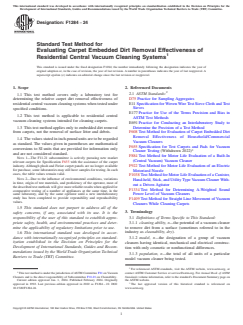
Standard Test Method for Evaluating Carpet Embedded Dirt Removal Effectiveness of Residential Central Vacuum Cleaning Systems
SIGNIFICANCE AND USE
4.1 This test method provides a laboratory test for determining the relative carpet dirt removal effectiveness of residential central vacuum cleaning systems when tested under standard conditions and on representative types of carpets.
4.2 This laboratory test method may not give a representation of carpet embedded dirt cleaning effectiveness in the home.
4.3 In order to provide a uniform basis for measuring performance as described in 1.2, standardized test carpets and standardized test dirt are employed in this procedure.
4.4 The results reflect a non-loaded cleaning capability and may not be representative of cleaning capabilities under dirt loading conditions.
SCOPE
1.1 This test method covers only a laboratory test for determining the relative carpet dirt removal effectiveness of residential central vacuum cleaning systems when tested under specified conditions.
1.2 This test method is applicable to residential central vacuum cleaning systems intended for cleaning carpets.
1.3 This test method applies only to embedded dirt removal from carpets, not the removal of surface litter and debris.
1.4 The values stated in inch-pound units are to be regarded as standard. The values given in parentheses are mathematical conversions to SI units that are provided for information only and are not considered standard.
Note 1: The F11.21 subcommittee is actively pursuing new market relevant carpets for Specification F655 with the assistance of the carpet industry. Although plush and Freize carpet panels are no longer available for purchase, some laboratories may still have samples for testing. In such cases, the table values remain valid.
Note 2: Due to the influence of environmental conditions, variations in time, origin of test materials, and proficiency of the operator, most of the described test methods will give more reliable results when applied for comparative testing of a number of appliances at the same time, in the same laboratory, and by the same operator until a new interlaboratory study has been completed to provide repeatability and reproducibility values.
1.5 This standard does not purport to address all of the safety concerns, if any, associated with its use. It is the responsibility of the user of this standard to establish appropriate safety, health, and environmental practices and determine the applicability of regulatory limitations prior to use.
1.6 This international standard was developed in accordance with internationally recognized principles on standardization established in the Decision on Principles for the Development of International Standards, Guides and Recommendations issued by the World Trade Organization Technical Barriers to Trade (TBT) Committee.
General Information
- Status
- Published
- Publication Date
- 31-Dec-2023
- Technical Committee
- F11 - Vacuum Cleaners
- Drafting Committee
- F11.21 - Cleanability
Relations
- Effective Date
- 01-Jan-2024
- Refers
ASTM F1334-24 - Standard Test Method for Determining A-Weighted Sound Power Level of Vacuum Cleaners - Effective Date
- 01-Jan-2024
- Effective Date
- 01-Jan-2024
- Effective Date
- 01-Nov-2022
- Refers
ASTM F1334-18 - Standard Test Method for Determining A-Weighted Sound Power Level of Vacuum Cleaners - Effective Date
- 01-Oct-2018
Overview
ASTM F1284-24 is a standard test method developed by ASTM International for evaluating the carpet embedded dirt removal effectiveness of residential central vacuum cleaning systems. The standard describes a laboratory-based procedure for determining the relative ability of central vacuum systems to remove embedded dirt from carpets under controlled, reproducible conditions. By utilizing standardized test carpets and dirt mixtures, this method ensures that the testing of vacuum cleaners is comparable across different models and laboratories.
Central vacuum systems are increasingly popular in modern homes for their deep cleaning efficiency and convenience. ASTM F1284-24 plays a crucial role in confirming that these systems provide measurable and consistent performance when it comes to removing dirt that penetrates below the carpet surface, contributing to improved indoor air quality and carpet longevity.
Key Topics
- Purpose of Testing: Establishes a consistent laboratory test for comparing the embedded dirt removal effectiveness of various central vacuum cleaning systems for residential use.
- Scope Limitations:
- Focuses strictly on laboratory conditions, not real-world in-home cleaning.
- Applies only to the removal of embedded carpet dirt, not surface debris or litter.
- Results reflect non-loaded (clean initial state) conditions.
- Specified for residential central vacuum systems designed for carpet cleaning.
- Standardization: Utilizes uniform test carpets and precisely defined dirt mixtures (silica sand and talc) to ensure repeatable and accurate performance assessments.
- Measurement Units: Inch-pound (imperial) units are the standard, with SI conversions provided for informational purposes.
- Sampling & Repeatability:
- Minimum sample sizes and rigorous statistical methods ensure valid population mean effectiveness estimates.
- Tests require multiple runs, specific cleaning patterns, and repeatability limits to ensure data reliability.
- Environmental Controls: Testing occurs in controlled temperature and humidity environments for consistency.
Applications
ASTM F1284-24 is especially useful for:
- Product Development: Manufacturers can evaluate and improve the embedded dirt removal capability of central vacuum systems during design and prototyping.
- Quality Assurance: Guarantees that production units meet specified performance levels for deep carpet cleaning.
- Comparative Performance: Retailers, certification bodies, and labs can use the standard to fairly compare different central vacuum cleaning systems.
- Consumer Assurance: Provides an independently verified benchmark that assures homeowners they are purchasing systems that effectively address embedded dirt and dust in residential carpets.
- Regulatory and Environmental Compliance: Supports initiatives to improve indoor air quality and prolong carpet life through effective dirt removal.
Related Standards
Several ASTM standards and test methods complement or are referenced within ASTM F1284-24, reinforcing standardized vacuum cleaner testing:
- ASTM F608 - Evaluation of Carpet Embedded Dirt Removal Effectiveness of Household/Commercial Vacuum Cleaners.
- ASTM F655 - Specification for Test Carpets and Pads for Vacuum Cleaner Testing (Withdrawn, but referenced for legacy purposes).
- ASTM F884, F922, F1038 - Test methods for motor life evaluation for various vacuum cleaner types.
- ASTM F1334 - Determining the A-Weighted Sound Power Level of Vacuum Cleaners.
- ASTM F1409 - Test Method for Straight Line Movement of Vacuum Cleaners While Cleaning Carpets.
- ASTM D75, ASTM E11, ASTM E177, ASTM E691 - Standards for sampling, test sieving, terminology, and interlaboratory study precision, supporting test consistency.
By adhering to ASTM F1284-24, stakeholders ensure reliable, transparent product comparison and help drive improvements in central vacuum cleaning systems, ultimately benefiting manufacturers, retailers, and consumers. For further details and to access the full standard, visit the ASTM International website.
Buy Documents
ASTM F1284-24 - Standard Test Method for Evaluating Carpet Embedded Dirt Removal Effectiveness of Residential Central Vacuum Cleaning Systems
REDLINE ASTM F1284-24 - Standard Test Method for Evaluating Carpet Embedded Dirt Removal Effectiveness of Residential Central Vacuum Cleaning Systems
Get Certified
Connect with accredited certification bodies for this standard

ICC Evaluation Service
Building products evaluation and certification.

QAI Laboratories
Building and construction product testing and certification.

Aboma Certification B.V.
Specialized in construction, metal, and transport sectors.
Sponsored listings
Frequently Asked Questions
ASTM F1284-24 is a standard published by ASTM International. Its full title is "Standard Test Method for Evaluating Carpet Embedded Dirt Removal Effectiveness of Residential Central Vacuum Cleaning Systems". This standard covers: SIGNIFICANCE AND USE 4.1 This test method provides a laboratory test for determining the relative carpet dirt removal effectiveness of residential central vacuum cleaning systems when tested under standard conditions and on representative types of carpets. 4.2 This laboratory test method may not give a representation of carpet embedded dirt cleaning effectiveness in the home. 4.3 In order to provide a uniform basis for measuring performance as described in 1.2, standardized test carpets and standardized test dirt are employed in this procedure. 4.4 The results reflect a non-loaded cleaning capability and may not be representative of cleaning capabilities under dirt loading conditions. SCOPE 1.1 This test method covers only a laboratory test for determining the relative carpet dirt removal effectiveness of residential central vacuum cleaning systems when tested under specified conditions. 1.2 This test method is applicable to residential central vacuum cleaning systems intended for cleaning carpets. 1.3 This test method applies only to embedded dirt removal from carpets, not the removal of surface litter and debris. 1.4 The values stated in inch-pound units are to be regarded as standard. The values given in parentheses are mathematical conversions to SI units that are provided for information only and are not considered standard. Note 1: The F11.21 subcommittee is actively pursuing new market relevant carpets for Specification F655 with the assistance of the carpet industry. Although plush and Freize carpet panels are no longer available for purchase, some laboratories may still have samples for testing. In such cases, the table values remain valid. Note 2: Due to the influence of environmental conditions, variations in time, origin of test materials, and proficiency of the operator, most of the described test methods will give more reliable results when applied for comparative testing of a number of appliances at the same time, in the same laboratory, and by the same operator until a new interlaboratory study has been completed to provide repeatability and reproducibility values. 1.5 This standard does not purport to address all of the safety concerns, if any, associated with its use. It is the responsibility of the user of this standard to establish appropriate safety, health, and environmental practices and determine the applicability of regulatory limitations prior to use. 1.6 This international standard was developed in accordance with internationally recognized principles on standardization established in the Decision on Principles for the Development of International Standards, Guides and Recommendations issued by the World Trade Organization Technical Barriers to Trade (TBT) Committee.
SIGNIFICANCE AND USE 4.1 This test method provides a laboratory test for determining the relative carpet dirt removal effectiveness of residential central vacuum cleaning systems when tested under standard conditions and on representative types of carpets. 4.2 This laboratory test method may not give a representation of carpet embedded dirt cleaning effectiveness in the home. 4.3 In order to provide a uniform basis for measuring performance as described in 1.2, standardized test carpets and standardized test dirt are employed in this procedure. 4.4 The results reflect a non-loaded cleaning capability and may not be representative of cleaning capabilities under dirt loading conditions. SCOPE 1.1 This test method covers only a laboratory test for determining the relative carpet dirt removal effectiveness of residential central vacuum cleaning systems when tested under specified conditions. 1.2 This test method is applicable to residential central vacuum cleaning systems intended for cleaning carpets. 1.3 This test method applies only to embedded dirt removal from carpets, not the removal of surface litter and debris. 1.4 The values stated in inch-pound units are to be regarded as standard. The values given in parentheses are mathematical conversions to SI units that are provided for information only and are not considered standard. Note 1: The F11.21 subcommittee is actively pursuing new market relevant carpets for Specification F655 with the assistance of the carpet industry. Although plush and Freize carpet panels are no longer available for purchase, some laboratories may still have samples for testing. In such cases, the table values remain valid. Note 2: Due to the influence of environmental conditions, variations in time, origin of test materials, and proficiency of the operator, most of the described test methods will give more reliable results when applied for comparative testing of a number of appliances at the same time, in the same laboratory, and by the same operator until a new interlaboratory study has been completed to provide repeatability and reproducibility values. 1.5 This standard does not purport to address all of the safety concerns, if any, associated with its use. It is the responsibility of the user of this standard to establish appropriate safety, health, and environmental practices and determine the applicability of regulatory limitations prior to use. 1.6 This international standard was developed in accordance with internationally recognized principles on standardization established in the Decision on Principles for the Development of International Standards, Guides and Recommendations issued by the World Trade Organization Technical Barriers to Trade (TBT) Committee.
ASTM F1284-24 is classified under the following ICS (International Classification for Standards) categories: 91.140.99 - Other installations in buildings. The ICS classification helps identify the subject area and facilitates finding related standards.
ASTM F1284-24 has the following relationships with other standards: It is inter standard links to ASTM F1284-22, ASTM F1334-24, ASTM F608-24, ASTM F608-22, ASTM F1334-18. Understanding these relationships helps ensure you are using the most current and applicable version of the standard.
ASTM F1284-24 is available in PDF format for immediate download after purchase. The document can be added to your cart and obtained through the secure checkout process. Digital delivery ensures instant access to the complete standard document.
Standards Content (Sample)
This international standard was developed in accordance with internationally recognized principles on standardization established in the Decision on Principles for the
Development of International Standards, Guides and Recommendations issued by the World Trade Organization Technical Barriers to Trade (TBT) Committee.
Designation: F1284 − 24
Standard Test Method for
Evaluating Carpet Embedded Dirt Removal Effectiveness of
Residential Central Vacuum Cleaning Systems
This standard is issued under the fixed designation F1284; the number immediately following the designation indicates the year of
original adoption or, in the case of revision, the year of last revision. A number in parentheses indicates the year of last reapproval. A
superscript epsilon (´) indicates an editorial change since the last revision or reapproval.
1. Scope 2. Referenced Documents
2.1 ASTM Standards:
1.1 This test method covers only a laboratory test for
D75 Practice for Sampling Aggregates
determining the relative carpet dirt removal effectiveness of
E11 Specification for Woven Wire Test Sieve Cloth and Test
residential central vacuum cleaning systems when tested under
Sieves
specified conditions.
E177 Practice for Use of the Terms Precision and Bias in
1.2 This test method is applicable to residential central
ASTM Test Methods
vacuum cleaning systems intended for cleaning carpets.
E691 Practice for Conducting an Interlaboratory Study to
1.3 This test method applies only to embedded dirt removal Determine the Precision of a Test Method
from carpets, not the removal of surface litter and debris. F608 Test Method for Evaluation of Carpet Embedded Dirt
Removal Effectiveness of Household/Commercial
1.4 The values stated in inch-pound units are to be regarded
Vacuum Cleaners
as standard. The values given in parentheses are mathematical
F655 Specification for Test Carpets and Pads for Vacuum
conversions to SI units that are provided for information only
Cleaner Testing (Withdrawn 2022)
and are not considered standard.
F884 Test Method for Motor Life Evaluation of a Built-In
NOTE 1—The F11.21 subcommittee is actively pursuing new market
(Central Vacuum) Vacuum Cleaner
relevant carpets for Specification F655 with the assistance of the carpet
F922 Test Method for Motor Life Evaluation of an Electric
industry. Although plush and Freize carpet panels are no longer available
for purchase, some laboratories may still have samples for testing. In such Motorized Nozzle
cases, the table values remain valid.
F1038 Test Method for Motor Life Evaluation of a Canister,
NOTE 2—Due to the influence of environmental conditions, variations
Hand-held, Stick, and Utility Type Vacuum Cleaner With-
in time, origin of test materials, and proficiency of the operator, most of
out a Driven Agitator
the described test methods will give more reliable results when applied for
F1334 Test Method for Determining A-Weighted Sound
comparative testing of a number of appliances at the same time, in the
Power Level of Vacuum Cleaners
same laboratory, and by the same operator until a new interlaboratory
study has been completed to provide repeatability and reproducibility
F1409 Test Method for Straight Line Movement of Vacuum
values.
Cleaners While Cleaning Carpets
1.5 This standard does not purport to address all of the
3. Terminology
safety concerns, if any, associated with its use. It is the
responsibility of the user of this standard to establish appro- 3.1 Definitions of Terms Specific to This Standard:
priate safety, health, and environmental practices and deter- 3.1.1 cleaning ability, n—the potential of a vacuum cleaner
mine the applicability of regulatory limitations prior to use. to remove dirt from a surface (sometimes referred to in the
industry as cleanability, dry).
1.6 This international standard was developed in accor-
dance with internationally recognized principles on standard-
3.1.2 model, n—the designation of a group of vacuum
ization established in the Decision on Principles for the
cleaners having identical, mechanical and electrical construc-
Development of International Standards, Guides and Recom-
tion with only cosmetic or nonfunctional differences.
mendations issued by the World Trade Organization Technical
3.1.3 population, n—the total of all units of a particular
Barriers to Trade (TBT) Committee.
model vacuum cleaner being tested.
For referenced ASTM standards, visit the ASTM website, www.astm.org, or
This test method is under the jurisdiction of ASTM Committee F11 on Vacuum contact ASTM Customer Service at service@astm.org. For Annual Book of ASTM
Cleaners and is the direct responsibility of Subcommittee F11.21 on Cleanability. Standards volume information, refer to the standard’s Document Summary page on
Current edition approved Jan. 1, 2024. Published February 2024. Originally the ASTM website.
approved in 1992. Last previous edition approved in 2022 as F1284 – 22. DOI: The last approved version of this historical standard is referenced on
10.1520/F1284-24. www.astm.org.
Copyright © ASTM International, 100 Barr Harbor Drive, PO Box C700, West Conshohocken, PA 19428-2959. United States
F1284 − 24
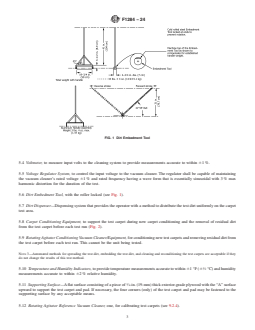
FIG. 1 Dirt Embedment Tool
3.1.4 sample, n—a group of vacuum cleaners taken from a 5.2 Weighing Scale (for weighing test dirt and non-
large collection of vacuum cleaners of one particular model, disposable dirt receptacles; see 9.2.1.2 and 9.4.12)—The scale
which serves to provide information that may be used as a basis must be accurate to 0.0035 oz (0.10 g) and have a weighing
for making a decision concerning the larger collection. capacity of at least 1.1 lb (500 g).
3.1.5 test run, n—the definitive procedure that produces a
5.3 Stopwatch with a second hand, or other type of equip-
singular measured result.
ment capable of establishing the specified rate of movement
and total cycle time.
3.1.6 test unit, n—a single vacuum cleaner of the model
being tested.
5.4 Voltmeter, to measure input volts to the cleaning system
to provide measurements accurate to within 61 %.
4. Significance and Use
5.5 Voltage Regulator System, to control the input voltage to
4.1 This test method provides a laboratory test for determin-
the vacuum cleaner. The regulator shall be capable of main-
ing the relative carpet dirt removal effectiveness of residential
taining the vacuum cleaner’s rated voltage 61 % and rated
central vacuum cleaning systems when tested under standard
frequency having a wave form that is essentially sinusoidal
conditions and on representative types of carpets.
with 3 % max harmonic distortion for the duration of the test.
4.2 This laboratory test method may not give a representa-
5.6 Dirt Embedment Tool, with the roller locked (see Fig. 1).
tion of carpet embedded dirt cleaning effectiveness in the
5.7 Dirt Dispenser—Dispensing system that provides the
home.
operator with a method to distribute the test dirt uniformly on
4.3 In order to provide a uniform basis for measuring
the carpet test area.
performance as described in 1.2, standardized test carpets and
5.8 Carpet Conditioning Equipment, to support the test
standardized test dirt are employed in this procedure.
carpet during new carpet conditioning and the removal of
4.4 The results reflect a non-loaded cleaning capability and
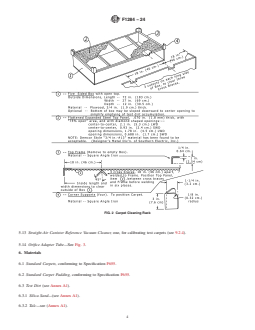
residual dirt from the test carpet before each test run (Fig. 2).
may not be representative of cleaning capabilities under dirt
5.9 Rotating Agitator Conditioning Vacuum Cleaner/
loading conditions.
Equipment, for conditioning new test carpets and removing
5. Apparatus
residual dirt from the test carpet before each test run. This
cannot be the unit being tested.
5.1 Weighing Scale (for weighing carpets; see 9.1.1.5 and
9.4.5)—The scale must be accurate to 0.035 oz (1 g) and have
NOTE 3—Automated methods for spreading the test dirt, embedding the
a weighing capacity of at least 15 lb (6.82 kg).
The Mettler-Toledo Model PM 2000, available from Mettler-Toledo, Inc., Box
The OHAUS Models GT-8000, LB30-CO and 1119D, all available from 71, Highstown, NJ, 08520. The OHAUS Model-GT-8000 available from OHAUS,
OHAUS, Inc. Florham Park, NJ, or the equivalent, have been found suitable for this Inc., Florham Park, NJ, or equivalent, have been found suitable for this purpose. It
purpose. It is recommended that the scale read directly in grams. is recommended that the seal read directly in grams.
F1284 − 24
FIG. 2 Carpet Cleaning Rack
test dirt, and cleaning and reconditioning the test carpets are acceptable if
5.14 Orifice Adapter Tube—See Fig. 3.
they do not change the results of this test method.
6. Materials
5.10 Temperature and Humidity Indicators, to provide tem-
perature measurements accurate to within 61 °F (6 ⁄2 °C) and
6.1 Standard Carpets, conforming to Specification F655.
humidity measurements accurate to within 62 % relative
6.2 Standard Carpet Padding, conforming to Specification
humidity.
F655.
5.11 Supporting Surface—A flat surface consisting of a
6.3 Test Dirt (see Annex A1).
piece of ⁄4-in. (19-mm) thick exterior-grade plywood with the
6.3.1 Silica Sand—(see Annex A1).
“A” surface upward to support the test carpet and pad. If
6.3.2 Talc—see (Annex A1).
necessary, the four corners (only) of the test carpet and pad
may be fastened to the supporting surface by any acceptable
7. Sampling
means.
7.1 A minimum of three units of the same model vacuum
5.12 Rotating Agitator Reference Vacuum Cleaner, one, for
cleaner selected at random in accordance with good statistical
calibrating test carpets (see 9.2.4).
practice shall constitute the population sample.
5.13 Straight-Air Canister Reference Vacuum Cleaner, one, 7.1.1 To determine the best estimate of the cleaning ability
for calibrating test carpets (see 9.2.4). effectiveness for the population of the vacuum cleaner model
F1284 − 24
FIG. 3 Orifice Adapter Tube
being tested, the arithmetic mean of the cleaning ability rating 9.1.1.3 Mark the test area on each carpet as indicated in Fig.
of the sample from the population shall be established by 5.
testing it to a 90 % confidence level within 65 % of the mean
9.1.1.4 Precondition New Test Carpet Samples:
value of the cleaning ability rating.
(1) Precondition the entire area of the carpet by cleaning
7.1.2 Annex A3 provides a procedural example for deter-
with the rotating agitator conditioning vacuum cleaner. Con-
mining the 90 % confidence level and when the sample size
tinue the operation until less than 0.07 oz (2 g) of carpet fiber
shall be increased.
is picked up in 5 min.
(2) Run ten carpet-embedded dirt removal effectiveness
NOTE 4—See Annex A3 for method of determining 90 % confidence
test runs in accordance with Sections 9.4.6 – 9.4.19.
level.
NOTE 5—Recondition the new test carpet following each precondition-
8. Conditioning
ing test run. It is not necessary, however, to meet the requirements set forth
in 9.1.2.1 with respect to the preconditioned weight.
8.1 Test Room—Maintain the test room in which all condi-
tioning and vacuum cleaner testing is done at 70 °F 6 5 °F
9.1.1.5 Weigh and record the preconditioned weight of the
(21 °C 6 3 °C) and 45 % to 55 % relative humidity.
carpet.
8.2 All components involved in the test must remain and be 9.1.1.6 Run a test carpet calibration in accordance with
Section 9.3.
exposed in the controlled environment for at least 16 h prior to
the start of the test.
9.1.2 Reconditioning Used Test Carpet Samples:
9.1.2.1 Initial Daily Reconditioned Weight: At the begin-
9. Procedure
ning of each day, it is necessary to remove any dirt that may
have settled on the carpet surface and stabilize the moisture
9.1 Test Carpet Preparation (see Fig. 4):
content of the carpet. Clean the carpet with a rotating agitator
9.1.1 Preconditioning New Test Carpet Samples:
conditioning vacuum cleaner until its weight does not exceed
9.1.1.1 New Test Carpets shall conform to Specification
the initial reconditioned weight from the previous day of
F655.
testing by more than 0.07 oz (2 g) or less than 0.035 oz (1 g)
9.1.1.2 Cut a sample of each test carpet to a size of 27 in. by
is picked up by the conditioning vacuum cleaner using the
72 in. (690 mm by 1830 mm) minimum. If the warp direction
procedure in 9.1.2.3.
or “lay” of the carpet can be determined, it shall be in the 72
in. direction as indicated in Fig. 5. Carpets shall be bound on 9.1.2.2 Following each test run, it is necessary to remove the
all sides. residual dirt and stabilize the moisture content of the carpet.
F1284 − 24
FIG. 4 Carpet Conditioning/Calibration Procedure
NOTE 1—Cleaning test area should be positioned as shown. First forward stroke of rotating agitator or carpet is in direction with lay of carpet.
FIG. 5 Test Carpet
Clean the carpet with a rotating agitator conditioning vacuum cleaner until its weight does not exceed the initial daily
F1284 − 24
FIG. 6 Vacuum Cleaner Conditioning Procedure
reconditioned weight requirement of 9.1.2.1 by more than 0.07 (4) Keep alternating 9.1.2.3(1) and 9.1.2.3(2), always end-
oz (2 g) or less than 0.035 oz (1 g) is picked up by the
ing with the pile side up, until the carpet weight meets the
conditioning vacuum cleaner using the following procedure.
requirement of 9.1.2.1 or 9.1.2.2.
9.1.2.3 Procedure:
(5) Change the disposable primary filter after a maximum
(1) Place the carpet on the carpet cleaning rack (Fig. 2)
of every 4 runs on the conditioning vacuum cleaner or more
with the pile side down. Run the rotating agitator conditioning
often if required.
vacuum cleaner over the carpet for 2 min concentrating on the
(6) Reconditioning equipment that uses nondisposable fil-
test area at 1.8 ft/s (0.55 m/s); then run the rotating agitator
ters should have the filter or filters cleaned after every four
conditioning vacuum cleaner thoroughly over the entire carpet
carpet reconditioning runs or more often, if required.
area at least one time.
(2) Place the carpet (pile side up) on the pad, on the NOTE 6—A high-cleaning performance rotating agitator vacuum cleaner
is recommended for reducing the time to recondition the carpet.
plywood supporting surface, and clean it with the rotating
agitator conditioning vacuum cleaner for 2 min, concentrating
9.1.3 Reconditioning Used Carpet Padding:
on the test area; then run the rotating agitator vacuum cleaner
9.1.3.1 Clean the carpet padding by shaking weekly or more
thoroughly over the entire area at least one time.
often, if necessary, to remove any collected dirt.
(3) Weigh the carpet.
F1284 − 24
9.1.3.2 Replace the carpet padding when it has holes, tears, 9.2.4.1 Use the reference vacuum cleaners or systems only
or other signs of wear. for determining the reference rating of carpets and for the
verification of carpet acceptability (see 9.3).
9.2 Preparation of Test Systems and Cleaning Tools (see
9.2.4.2 Maintain the performance of the reference vacuum
Fig. 6):
cleaners or systems throughout the acceptable life of the carpet
9.2.1 New Test Systems and Cleaning Tools:
(that is, nozzle suction, bristle extension, motor and agitator
9.2.1.1 Run the system in at rated voltage 61 % and rated
speeds, etc…).
frequency with filters in place.
(1) If a rotating agitator type cleaning tool is included with 9.3 Test Carpet Calibration:
the system operate it for 1 h with agitator bristles not engaged
9.3.1 The purpose of calibration is to determine when the
on any surface.
test carpet needs to be replaced by establishing a reference
9.2.1.2 For vacuum cleaners with non-disposable dirt
rating for each new preconditioned test carpet and to check this
receptacles, weigh and record the receptacle’s original weight
rating 50 or fewer test runs.
to the nearest 0.0035 oz (0.10 g). This may not be possible with
9.3.2 The reference ratings are determined for each test
some systems in which the nondisposable filter cannot be
carpet by the percent pickup using the reference rotating
removed.
agitator vacuum cleaner or system and the reference straight-
9.2.2 Used Test Vacuum Cleaners:
air vacuum cleaner or system.
9.2.2.1 Recondition a used test vacuum cleaner, prior to
9.3.3 The percent pickup is determined by performing a
each test run, as follows:
carpet-embedded dirt removal effectiveness test (see 9.4).
(1) Thoroughly remove excess dirt from the test system.
9.3.4 When the embedded dirt rating for either reference
Without using tools for disassembly, clean the entire outer
cleaner varies by 0.14 oz (4 g) from the original reference
surface, brushes, nozzle chamber, ductwork, inside of the
rating for the carpet, replace the carpet.
chamber surrounding the primary filter, and inside hose and
wands. Check the condition of all mechanisms for signs of NOTE 8—Carpet pick up changes over time as the test carpet panel is
used due to normal carpet wear. General laboratory practice is to track and
wear or damage. (See Note 7.)
record the number of test runs on each carpet panel. It is recommended to
(2) For systems using disposable filters as the primary
estimate, as closely as possible, the number of required test runs on all
filters, use a new disposable primary filter from the manufac-
carpet panels intended to be used prior to starting any test program in
turer for each test run. Weigh the filter to the nearest 0.0035 oz
order to establish that the selected carpet panels have a sufficient number
of test runs left to complete the test program. All products being tested in
(0.10 g) and install it as recommended by the vacuum cleaner
a comparison test must be tested on the same calibrated carpet panel
manufacturer. Thoroughly clean the inside of the chamber
throughout the test program. If a particular carpet panel is found to no
surrounding the primary filter each time the filter is replaced.
longer be acceptable for testing due to the 0.14 oz (4 g) limit being
(3) For systems using cloth filter bags or other types of
exceeded during a calibration check, all products tested on that particular
nondisposable dirt receptacles, empty according to manufac-
carpet panel during the test program must be retested on the new carpet
panel to ensure proper comparison.
turer’s instructions after each test run, and clean the cloth filter
bag or nondisposable dirt receptacle until its weight is within
9.4 Carpet Embedded Dirt Removal Effectiveness Test:
0.07 oz (2 g) of its original weight. Thoroughly clean the inside
9.4.1 Set up the system as shown in Fig. 7. On the intake
of the chamber surrounding the primary filter. Weigh the
side, use an orifice tube adapter terminating with a wall inlet
receptacle to the nearest 0.0035 oz (0.10 g) and install it as
valve. Insert into the wall valve a flexible cleaning hose as
recommended by the vacuum cleaner manufacturer.
provided with the system. The hose, wands, and nozzle should
be those normally offered with the particular unit being tested.
NOTE 7—It is recommended that a replaceable brush drive belt for
cleaning tool agitators be changed after each four test runs, if considered
If more than one hose, wand, or nozzle type is offered with the
applicable, using manufacturer’s instructions. Any other maintenance
unit, the manufacturer’s part, catalog or model number of the
task, such as cleaning the brush belt with distilled water, should only be
ductwork, fittings, hose, wands, and nozzle used in the test
done in accordance with manufacturer’s recommendations.
must be recorded and presented as part of the cleaning
9.2.3 Test System and Tool Settings:
effectiveness rating.
9.2.3.1 If various settings are provided, set the motor speed
9.4.2 For those systems which include exhaust tubing and
setting, suction regulator, nozzle height, or combination thereof
muffler, their use will be mandatory for testing.
using the manufacturer’s specifications as provided in the
NOTE 9—If necessary, the power unit may be positioned outside the test
instruction manual for each type of carpet. Contact the manu-
laboratory environment.
facturer if no instructions are given, or if the instructions are
unclear or inadequate.
9.4.3 Prepare test carpets in accordance with 9.1.1 for new
carpets or 9.1.2 for used carpets.
9.2.3.2 All straight line movement (see Test Method
F1409), sound power (see Test Method F1334), and motor life
9.4.4 If preconditioning or reconditioning has been done
evaluation (see Specification F655 and Test Methods F884,
more than 1 h before a test run, weigh the carpet. If the weight
F922, and F1038) tests shall be conducted using the same
of the carpet exceeds the preconditioned or reconditioned
settings (nozzle, motor speed, suction regulator, etc.) for each
weight by more than 0.07 oz (2 g), clean the carpet with a
specific carpet.
rotating agitator conditioning vacuum cleaner until these cri-
9.2.4 Reference Vacuum Cleaners or Systems (Calibration): teria are met.
F1284 − 24
NOTE 1—Due to the height required for the tubing assembly, the assembly (in a plane) can be at any angle from vertical to parallel with the floor.
NOTE 2— If flexible tubing is used for pipe sections, then flexible tubing must be supported in a straight line.
NOTE 3—Hose is to be laid out in a straight line so as to minimize kinks or bends.
FIG. 7 Vacuum Cleaning System Test Set-Up
9.4.5 Carefully weigh the test carpet immediately before “stroke.”) Use a uniform movement to provide a “stroke” time
placing it on the test platform. Record the weight to the nearest of 2.5 s (a rate of 1.8 ft/s (0.55 m/s)). The first forward stroke
0.035 oz (1.0 g). shall be in the direction of the carpet lay.
9.4.6 Position the test carpet on the padding (with “scrim”
NOTE 10—An acceptable laboratory practice shall be used to ensure that
side of the padding up) on the supporting surface (see 5.11).
the embedment tool shall not fall short of reaching the end boundaries of
9.4.7 The test cleaners and dirt receptacles should be
the test area, and the tool shall cover both side boundaries of the test area
prepared in accordance with Section 9.2. at all times.
9.4.8 Weigh the prepared dirt receptacle (that is, dust bag or
9.4.14 Clean the embedding tool as needed.
other primary filter device) prior to conducting the measure-
9.4.15 If the system or cleaning tool has not been energized
ment test run. Record the weight to the nearest 0.0035 oz (0.10
for more than 60 min, energize the system or cleaning tool for
g).
2 min at nameplate rated voltage (61 %) and frequency (61
9.4.9 Install the primary filter as explained below.
Hz) immediately preceding the test sequence of 9.4.12. For
9.4.9.1 For vacuum cleaners using disposable or non-
systems and cleaning tools with dual nameplate voltage
disposable primary filters, install the primary filter from the
ratings, conduct testing at the highest voltage.
manufacturer per their instructions.
9.4.15.1 For a rotating agitator-type cleaning tools, place it
9.4.10 Ensure that the vacuum cleaner settings have been
such that the bristles clear the supporting surface and no loose
made in accordance with 9.2.3.
dirt is picked up.
9.4.11 Test Dirt Preparation—Weigh and mix 3.17 oz 6
9.4.15.2 For a straight-air system or cleaning tool, operate
0.0035 oz (90 g 6 0.1 g) of silica sand and 0.35 oz 6 0.0035
with the rug tool unrestricted, positioned such that no loose dirt
oz (10 g 6 0.1 g) of commercial grade talcum, both conform-
is picked up from the supporting surface.
ing to the specifications found in Annex A1.
9.4.16 Immediately following the 2-min “run-in” of 9.4.11,
9.4.11.1 Silica Sand shall be sieved to assure conformance
de-energize the vacuum cleaner and place the vacuum cleaner
to the specification of A1.2. Sieving shall be performed in
nozzle on the test carpet so that the front edge of the vacuum
accordance with Test Method D75.
cleaner coincides with the line defining the beginning of the
9.4.11.2 Bulk mixing and storage of sieved constituents of
test area and the right side of the boundary of the 18-in. test
silica sand is acceptable if assay analysis meets the specifica-
width (see Fig. 8). The forward stroke of the nozzle shall be in
tion of A1.2.
the direction of the carpet lay (see Fig. 5).
9.4.11.3 Bulk storage of test dirt mixture (sand plus talc) is
9.4.16.1 Reasonable efforts shall be made to maintain the
not allowed.
handle height at 31.5 in. (0.8 m) during each test run for
9.4.12 Distribute 3.52 oz (100 g) of the test dirt uniformly
cleaning tools with a pivoting handle.
on the cleaning test area (see Fig. 5), using any convenient
9.4.16.2 Reasonable efforts shall be made to maintain the
spreading method.
cleaning tool’s nozzle parallel to the test carpet surface during
9.4.13 Embed the test dirt into the carpet using the dirt
each test run for vacuum cleaners with non-pivoting handles.
embedment tool shown in Fig. 1. Perform the embedding
9.4.17 Tilt or lift the nozzle off the carpet, energize the
process by using a dragging motion in both directions with the
system, and adjust the voltage to rated voltage 61 %. Allow
handle held at the angle shown. Drag the dirt embedment tool
the system to run and expand the filter bag, if one is present.
over the test area exactly 30 strokes, alternating directions
forward and back. (A movement in one direction is one 9.4.18 Test Cleaning Pattern:
F1284 − 24
NOTE 11—If after the first three tests on a new central vacuum cleaning
system sample, the repeatability limits are not met due to the results of the
first test run, the first test run may be discarded and replaced with an
additional test run.
9.4.21 The percent carpet-embedded dirt removal effective-
ness for each individual test vacuum cleaner from the popula-
tion sample for a given carpet is the ave
...
This document is not an ASTM standard and is intended only to provide the user of an ASTM standard an indication of what changes have been made to the previous version. Because
it may not be technically possible to adequately depict all changes accurately, ASTM recommends that users consult prior editions as appropriate. In all cases only the current version
of the standard as published by ASTM is to be considered the official document.
Designation: F1284 − 22 F1284 − 24
Standard Test Method for
Evaluating Carpet Embedded Dirt Removal Effectiveness of
Residential Central Vacuum Cleaning Systems
This standard is issued under the fixed designation F1284; the number immediately following the designation indicates the year of
original adoption or, in the case of revision, the year of last revision. A number in parentheses indicates the year of last reapproval. A
superscript epsilon (´) indicates an editorial change since the last revision or reapproval.
1. Scope
1.1 This test method covers only a laboratory test for determining the relative carpet dirt removal effectiveness of residential
central vacuum cleaning systems when tested under specified conditions.
1.2 This test method is applicable to residential central vacuum cleaning systems intended for cleaning carpets.
1.3 This test method applies only to embedded dirt removal from carpets, not the removal of surface litter and debris.
1.4 The values stated in inch-pound units are to be regarded as standard. The values given in parentheses are mathematical
conversions to SI units that are provided for information only and are not considered standard.
NOTE 1—The F11.21 subcommittee is actively pursuing new market relevant carpets for Specification F655 with the assistance of the carpet industry.
Although plush and Freize carpet panels are no longer available for purchase, some laboratories may still have samples for testing. In such cases, the table
values remain valid.
NOTE 2—Due to the influence of environmental conditions, variations in time, origin of test materials, and proficiency of the operator, most of the
described test methods will give more reliable results when applied for comparative testing of a number of appliances at the same time, in the same
laboratory, and by the same operator until a new interlaboratory study has been completed to provide repeatability and reproducibility values.
1.5 This standard does not purport to address all of the safety concerns, if any, associated with its use. It is the responsibility
of the user of this standard to establish appropriate safety, health, and environmental practices and determine the applicability of
regulatory limitations prior to use.
1.6 This international standard was developed in accordance with internationally recognized principles on standardization
established in the Decision on Principles for the Development of International Standards, Guides and Recommendations issued
by the World Trade Organization Technical Barriers to Trade (TBT) Committee.
2. Referenced Documents
2.1 ASTM Standards:
D75 Practice for Sampling Aggregates
E11 Specification for Woven Wire Test Sieve Cloth and Test Sieves
E177 Practice for Use of the Terms Precision and Bias in ASTM Test Methods
E691 Practice for Conducting an Interlaboratory Study to Determine the Precision of a Test Method
This test method is under the jurisdiction of ASTM Committee F11 on Vacuum Cleaners and is the direct responsibility of Subcommittee F11.21 on Cleanability.
Current edition approved Nov. 1, 2022Jan. 1, 2024. Published August 2023February 2024. Originally approved in 1992. Last previous edition approved in 20162022 as
F1284 – 09 (2016).F1284 – 22. DOI: 10.1520/F1284-22.10.1520/F1284-24.
For referenced ASTM standards, visit the ASTM website, www.astm.org, or contact ASTM Customer Service at service@astm.org. For Annual Book of ASTM Standards
volume information, refer to the standard’s Document Summary page on the ASTM website.
Copyright © ASTM International, 100 Barr Harbor Drive, PO Box C700, West Conshohocken, PA 19428-2959. United States
F1284 − 24
F608 Test Method for Evaluation of Carpet Embedded Dirt Removal Effectiveness of Household/Commercial Vacuum Cleaners
F655 Specification for Test Carpets and Pads for Vacuum Cleaner Testing (Withdrawn 2022)
F884 Test Method for Motor Life Evaluation of a Built-In (Central Vacuum) Vacuum Cleaner
F922 Test Method for Motor Life Evaluation of an Electric Motorized Nozzle
F1038 Test Method for Motor Life Evaluation of a Canister, Hand-held, Stick, and Utility Type Vacuum Cleaner Without a
Driven Agitator
F1334 Test Method for Determining A-Weighted Sound Power Level of Vacuum Cleaners
F1409 Test Method for Straight Line Movement of Vacuum Cleaners While Cleaning Carpets
3. Terminology
3.1 Definitions of Terms Specific to This Standard:
3.1.1 cleaning ability, n—the potential of a vacuum cleaner to remove dirt from a surface (sometimes referred to in the industry
as cleanability, dry).
3.1.2 model, n—the designation of a group of vacuum cleaners having identical, mechanical and electrical construction with only
cosmetic or nonfunctional differences.
3.1.3 population, n—the total of all units of a particular model vacuum cleaner being tested.
3.1.4 sample, n—a group of vacuum cleaners taken from a large collection of vacuum cleaners of one particular model, which
serves to provide information that may be used as a basis for making a decision concerning the larger collection.
3.1.5 test run, n—the definitive procedure that produces a singular measured result.
3.1.6 test unit, n—a single vacuum cleaner of the model being tested.
4. Significance and Use
4.1 This test method provides a laboratory test for determining the relative carpet dirt removal effectiveness of residential central
vacuum cleaning systems when tested under standard conditions and on representative types of carpets.
4.2 This laboratory test method may not give a representation of carpet embedded dirt cleaning effectiveness in the home.
4.3 In order to provide a uniform basis for measuring performance as described in 1.2, standardized test carpets and standardized
test dirt are employed in this procedure.
4.4 The results reflect a non-loaded cleaning capability and may not be representative of cleaning capabilities under dirt loading
conditions.
5. Apparatus
5.1 Weighing Scale (for weighing carpets; see 9.1.1.5 and 9.4.5)—The scale must be accurate to 0.035 oz (1 g) and have a
weighing capacity of at least 15 lb (6.82 kg).
5.2 Weighing Scale (for weighing test dirt and non-disposable dirt receptacles; see 9.2.1.2 and 9.4.12)—The scale must be
accurate to 0.0035 oz (0.10 g) and have a weighing capacity of at least 1.1 lb (500 g).
5.3 Stopwatch with a second hand, or other type of equipment capable of establishing the specified rate of movement and total
cycle time.
The last approved version of this historical standard is referenced on www.astm.org.
The OHAUS Models GT-8000, LB30-CO and 1119D, all available from OHAUS, Inc. Florham Park, NJ, or the equivalent, have been found suitable for this purpose.
It is recommended that the scale read directly in grams.
The Mettler-Toledo Model PM 2000, available from Mettler-Toledo, Inc., Box 71, Highstown, NJ, 08520. The OHAUS Model-GT-8000 available from OHAUS, Inc.,
Florham Park, NJ, or equivalent, have been found suitable for this purpose. It is recommended that the seal read directly in grams.
F1284 − 24
FIG. 1 Dirt Embedment Tool
5.4 Voltmeter, to measure input volts to the cleaning system to provide measurements accurate to within 61 %.
5.5 Voltage Regulator System, to control the input voltage to the vacuum cleaner. The regulator shall be capable of maintaining
the vacuum cleaner’s rated voltage 61 % and rated frequency having a wave form that is essentially sinusoidal with 3 % max
harmonic distortion for the duration of the test.
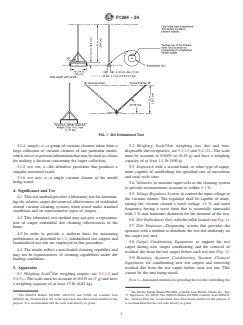
5.6 Dirt Embedment Tool, with the roller locked (see Fig. 1).
5.7 Dirt Dispenser—Dispensing system that provides the operator with a method to distribute the test dirt uniformly on the carpet
test area.
5.8 Carpet Conditioning Equipment, to support the test carpet during new carpet conditioning and the removal of residual dirt
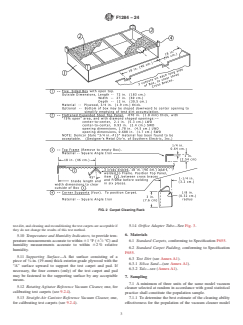
from the test carpet before each test run (Fig. 2).
5.9 Rotating Agitator Conditioning Vacuum Cleaner/Equipment, for conditioning new test carpets and removing residual dirt from
the test carpet before each test run. This cannot be the unit being tested.
NOTE 3—Automated methods for spreading the test dirt, embedding the test dirt, and cleaning and reconditioning the test carpets are acceptable if they
do not change the results of this test method.
5.10 Temperature and Humidity Indicators, to provide temperature measurements accurate to within 61 °F (6 ⁄2 °C) and humidity
measurements accurate to within 62 % relative humidity.
5.11 Supporting Surface—A flat surface consisting of a piece of ⁄4-in. (19-mm) thick exterior-grade plywood with the “A” surface
upward to support the test carpet and pad. If necessary, the four corners (only) of the test carpet and pad may be fastened to the
supporting surface by any acceptable means.
5.12 Rotating Agitator Reference Vacuum Cleaner, one, for calibrating test carpets (see 9.2.4).
F1284 − 24
FIG. 2 Carpet Cleaning Rack
5.13 Straight-Air Canister Reference Vacuum Cleaner, one, for calibrating test carpets (see 9.2.4).
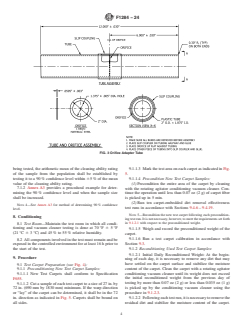
5.14 Orifice Adapter Tube—See Fig. 3.
6. Materials
6.1 Standard Carpets, conforming to Specification F655.
6.2 Standard Carpet Padding, conforming to Specification F655.
6.3 Test Dirt (see Annex A1).
6.3.1 Silica Sand—(see Annex A1).
6.3.2 Talc—see (Annex A1).
F1284 − 24
FIG. 3 Orifice Adapter Tube
7. Sampling
7.1 A minimum of three units of the same model vacuum cleaner selected at random in accordance with good statistical practice
shall constitute the population sample.
7.1.1 To determine the best estimate of the cleaning ability effectiveness for the population of the vacuum cleaner model being
tested, the arithmetic mean of the cleaning ability rating of the sample from the population shall be established by testing it to a
90 % confidence level within 65 % of the mean value of the cleaning ability rating.
7.1.2 Annex A3 provides a procedural example for determining the 90 % confidence level and when the sample size shall be
increased.
NOTE 4—See Annex A3 for method of determining 90 % confidence level.
8. Conditioning
8.1 Test Room—Maintain the test room in which all conditioning and vacuum cleaner testing is done at 70 °F 6 5 °F (21 °C 6
3 °C) and 45 % to 55 % relative humidity.
8.2 All components involved in the test must remain and be exposed in the controlled environment for at least 16 h prior to the
start of the test.
9. Procedure
9.1 Test Carpet Preparation (see Fig. 4):
9.1.1 Preconditioning New Test Carpet Samples:
9.1.1.1 New Test Carpets shall conform to Specification F655.
F1284 − 24
FIG. 4 Carpet Conditioning/Calibration Procedure
9.1.1.2 Cut a sample of each test carpet to a size of 27 in. by 72 in. (690 mm by 1830 mm) minimum. If the warp direction or
“lay” of the carpet can be determined, it shall be in the 72 in. direction as indicated in Fig. 5. Carpets shall be bound on all sides.
9.1.1.3 Mark the test area on each carpet as indicated in Fig. 5.
9.1.1.4 Precondition New Test Carpet Samples:
(1) Precondition the entire area of the carpet by cleaning with the rotating agitator conditioning vacuum cleaner. Continue the
operation until less than 0.07 oz (2 g) of carpet fiber is picked up in 5 min.
(2) Run ten carpet-embedded dirt removal effectiveness test runs in accordance with Sections 9.4.6 – 9.4.19.
NOTE 5—Recondition the new test carpet following each preconditioning test run. It is not necessary, however, to meet the requirements set forth in 9.1.2.1
with respect to the preconditioned weight.
F1284 − 24
NOTE 1—Cleaning test area should be positioned as shown. First forward stroke of rotating agitator or carpet is in direction with lay of carpet.
FIG. 5 Test Carpet
9.1.1.5 Weigh and record the preconditioned weight of the carpet.
9.1.1.6 Run a test carpet calibration in accordance with Section 9.3.
9.1.2 Reconditioning Used Test Carpet Samples:
9.1.2.1 Initial Daily Reconditioned Weight: At the beginning of each day, it is necessary to remove any dirt that may have settled
on the carpet surface and stabilize the moisture content of the carpet. Clean the carpet with a rotating agitator conditioning vacuum
cleaner until its weight does not exceed the initial reconditioned weight from the previous day of testing by more than 0.07 oz (2
g) or less than 0.035 oz (1 g) is picked up by the conditioning vacuum cleaner using the procedure in 9.1.2.3.
9.1.2.2 Following each test run, it is necessary to remove the residual dirt and stabilize the moisture content of the carpet. Clean
the carpet with a rotating agitator conditioning vacuum cleaner until its weight does not exceed the initial daily reconditioned
weight requirement of 9.1.2.1 by more than 0.07 oz (2 g) or less than 0.035 oz (1 g) is picked up by the conditioning vacuum
cleaner using the following procedure.
9.1.2.3 Procedure:
(1) Place the carpet on the carpet cleaning rack (Fig. 2) with the pile side down. Run the rotating agitator conditioning vacuum
cleaner over the carpet for 2 min concentrating on the test area at 1.8 ft/s (0.55 m/s); then run the rotating agitator conditioning
vacuum cleaner thoroughly over the entire carpet area at least one time.
(2) Place the carpet (pile side up) on the pad, on the plywood supporting surface, and clean it with the rotating agitator
conditioning vacuum cleaner for 2 min, concentrating on the test area; then run the rotating agitator vacuum cleaner thoroughly
over the entire area at least one time.
(3) Weigh the carpet.
(4) Keep alternating 9.1.2.3(1) and 9.1.2.3(2), always ending with the pile side up, until the carpet weight meets the
requirement of 9.1.2.1 or 9.1.2.2.
(5) Change the disposable primary filter after a maximum of every 4 runs on the conditioning vacuum cleaner or more often
if required.
(6) Reconditioning equipment that uses nondisposable filters should have the filter or filters cleaned after every four carpet
reconditioning runs or more often, if required.
NOTE 6—A high-cleaning performance rotating agitator vacuum cleaner is recommended for reducing the time to recondition the carpet.
9.1.3 Reconditioning Used Carpet Padding:
9.1.3.1 Clean the carpet padding by shaking weekly or more often, if necessary, to remove any collected dirt.
9.1.3.2 Replace the carpet padding when it has holes, tears, or other signs of wear.
9.2 Preparation of Test Systems and Cleaning Tools (see Fig. 6):
9.2.1 New Test Systems and Cleaning Tools:
F1284 − 24
FIG. 6 Vacuum Cleaner Conditioning Procedure
9.2.1.1 Run the system in at rated voltage 61 % and rated frequency with filters in place.
(1) If a rotating agitator type cleaning tool is included with the system operate it for 1 h with agitator bristles not engaged on
any surface.
9.2.1.2 For vacuum cleaners with non-disposable dirt receptacles, weigh and record the receptacle’s original weight to the nearest
0.0035 oz (0.10 g). This may not be possible with some systems in which the nondisposable filter cannot be removed.
9.2.2 Used Test Vacuum Cleaners:
9.2.2.1 Recondition a used test vacuum cleaner, prior to each test run, as follows:
(1) Thoroughly remove excess dirt from the test system. Without using tools for disassembly, clean the entire outer surface,
brushes, nozzle chamber, ductwork, inside of the chamber surrounding the primary filter, and inside hose and wands. Check the
condition of all mechanisms for signs of wear or damage. (See Note 57.)
(2) For systems using disposable filters as the primary filters, use a new disposable primary filter from the manufacturer for
each test run. Weigh the filter to the nearest 0.0035 oz (0.10 g) and install it as recommended by the vacuum cleaner manufacturer.
Thoroughly clean the inside of the chamber surrounding the primary filter each time the filter is replaced.
F1284 − 24
(3) For systems using cloth filter bags or other types of nondisposable dirt receptacles, empty according to manufacturer’s
instructions after each test run, and clean the cloth filter bag or nondisposable dirt receptacle until its weight is within 0.07 oz (2
g) of its original weight. Thoroughly clean the inside of the chamber surrounding the primary filter. Weigh the receptacle to the
nearest 0.0035 oz (0.10 g) and install it as recommended by the vacuum cleaner manufacturer.
NOTE 7—It is recommended that a replaceable brush drive belt for cleaning tool agitators be changed after each four test runs, if considered applicable,
using manufacturer’s instructions. Any other maintenance task, such as cleaning the brush belt with distilled water, should only be done in accordance
with manufacturer’s recommendations.
9.2.3 Test System and Tool Settings:
9.2.3.1 If various settings are provided, set the motor speed setting, suction regulator, nozzle height, or combination thereof using
the manufacturer’s specifications as provided in the instruction manual for each type of carpet. Contact the manufacturer if no
instructions are given, or if the instructions are unclear or inadequate.
9.2.3.2 All straight line movement (see Test Method F1409), sound power (see Test Method F1334), and motor life evaluation (see
Specification F655 and Test Methods F884, F922, and F1038) tests shall be conducted using the same settings (nozzle, motor
speed, suction regulator, etc.) for each specific carpet.
9.2.4 Reference Vacuum Cleaners or Systems (Calibration):
9.2.4.1 Use the reference vacuum cleaners or systems only for determining the reference rating of carpets and for the verification
of carpet acceptability (see 9.3).
9.2.4.2 Maintain the performance of the reference vacuum cleaners or systems throughout the acceptable life of the carpet (that
is, nozzle suction, bristle extension, motor and agitator speeds, etc…).
9.3 Test Carpet Calibration:
9.3.1 The purpose of calibration is to determine when the test carpet needs to be replaced by establishing a reference rating for
each new preconditioned test carpet and to check this rating 50 or fewer test runs.
9.3.2 The reference ratings are determined for each test carpet by the percent pickup using the reference rotating agitator vacuum
cleaner or system and the reference straight-air vacuum cleaner or system.
9.3.3 The percent pickup is determined by performing a carpet-embedded dirt removal effectiveness test (see 9.4).
9.3.4 When the embedded dirt rating for either reference cleaner varies by 0.14 oz (4 g) from the original reference rating for the
carpet, replace the carpet.
NOTE 8—Carpet pick up changes over time as the test carpet panel is used due to normal carpet wear. General laboratory practice is to track and record
the number of test runs on each carpet panel. It is recommended to estimate, as closely as possible, the number of required test runs on all carpet panels
intended to be used prior to starting any test program in order to establish that the selected carpet panels have a sufficient number of test runs left to
complete the test program. All products being tested in a comparison test must be tested on the same calibrated carpet panel throughout the test program.
If a particular carpet panel is found to no longer be acceptable for testing due to the 0.14 oz (4 g) limit being exceeded during a calibration check, all
products tested on that particular carpet panel during the test program must be retested on the new carpet panel to ensure proper comparison.
9.4 Carpet Embedded Dirt Removal Effectiveness Test:
9.4.1 Set up the system as shown in Fig. 7. On the intake side, use an orifice tube adapter terminating with a wall inlet valve. Insert
into the wall valve a flexible cleaning hose as provided with the system. The hose, wands, and nozzle should be those normally
offered with the particular unit being tested. If more than one hose, wand, or nozzle type is offered with the unit, the manufacturer’s
part, catalog or model number of the ductwork, fittings, hose, wands, and nozzle used in the test must be recorded and presented
as part of the cleaning effectiveness rating.
9.4.2 For those systems which include exhaust tubing and muffler, their use will be mandatory for testing.
NOTE 9—If necessary, the power unit may be positioned outside the test laboratory environment.
F1284 − 24
NOTE 1—Due to the height required for the tubing assembly, the assembly (in a plane) can be at any angle from vertical to parallel with the floor.
NOTE 2— If flexible tubing is used for pipe sections, then flexible tubing must be supported in a straight line.
NOTE 3—Hose is to be laid out in a straight line so as to minimize kinks or bends.
FIG. 7 Vacuum Cleaning System Test Set-Up
9.4.3 Prepare test carpets in accordance with 9.1.1 for new carpets or 9.1.2 for used carpets.
9.4.4 If preconditioning or reconditioning has been done more than 1 h before a test run, weigh the carpet. If the weight of the
carpet exceeds the preconditioned or reconditioned weight by more than 0.07 oz (2 g), clean the carpet with a rotating agitator
conditioning vacuum cleaner until these criteria are met.
9.4.5 Carefully weigh the test carpet immediately before placing it on the test platform. Record the weight to the nearest 0.035
oz (1.0 g).
9.4.6 Position the test carpet on the padding (with “scrim” side of the padding up) on the supporting surface (see 5.11).
9.4.7 The test cleaners and dirt receptacles should be prepared in accordance with Section 9.2.
9.4.8 Weigh the prepared dirt receptacle (that is, dust bag or other primary filter device) prior to conducting the measurement test
run. Record the weight to the nearest 0.0035 oz (0.10 g).
9.4.9 Install the primary filter as explained below.
9.4.9.1 For vacuum cleaners using disposable or non-disposable primary filters, install the primary filter from the manufacturer
per their instructions.
9.4.10 Ensure that the vacuum cleaner settings have been made in accordance with 9.2.3.
9.4.11 Test Dirt Preparation—Weigh and mix 3.17 oz 6 0.0035 oz (90 g 6 0.1 g) of silica sand and 0.35 oz 6 0.0035 oz (10 g
6 0.1 g) of commercial grade talcum, both conforming to the specifications found in Annex A1.
9.4.11.1 Silica Sand shall be sieved to assure conformance to the specification of A1.2. Sieving shall be performed in accordance
with Test Method D75.
9.4.11.2 Bulk mixing and storage of sieved constituents of silica sand is acceptable if assay analysis meets the specification of
A1.2.
9.4.11.3 Bulk storage of test dirt mixture (sand plus talc) is not allowed.
9.4.12 Distribute 3.52 oz (100 g) of the test dirt uniformly on the cleaning test area (see Fig. 5), using any convenient spreading
method.
F1284 − 24
NOTE 1—Shown are the nozzle positions for the cleaning pattern when N = 2 (refer to Annex A2).
FIG. 8 Cleaning Nozzle Position at Start and Finish of Test Cleaning Strokes
9.4.13 Embed the test dirt into the carpet using the dirt embedment tool shown in Fig. 1. Perform the embedding process by using
a dragging motion in both directions with the handle held at the angle shown. Drag the dirt embedment tool over the test area
exactly 30 strokes, alternating directions forward and back. (A movement in one direction is one “stroke.”) Use a uniform
movement to provide a “stroke” time of 2.5 s (a rate of 1.8 ft/s (0.55 m/s)). The first forward stroke shall be in the direction of
the carpet lay.
NOTE 10—An acceptable laboratory practice shall be used to ensure that the embedment tool shall not fall short of reaching the end boundaries of the
test area, and the tool shall cover both side boundaries of the test area at all times.
9.4.14 Clean the embedding tool as needed.
9.4.15 If the system or cleaning tool has not been energized for more than 60 min, energize the system or cleaning tool for 2 min
at nameplate rated voltage (61 %) and frequency (61 Hz) immediately preceding the test sequence of 9.4.12. For systems and
cleaning tools with dual nameplate voltage ratings, conduct testing at the highest voltage.
9.4.15.1 For a rotating agitator-type cleaning tools, place it such that the bristles clear the supporting surface and no loose dirt is
picked up.
9.4.15.2 For a straight-air system or cleaning tool, operate with the rug tool unrestricted, positioned such that no loose dirt is
picked up from the supporting surface.
9.4.16 Immediately following the 2-min “run-in” of 9.4.11, de-energize the vacuum cleaner and place the vacuum cleaner nozzle
on the test carpet so that the front edge of the vacuum cleaner coincides with the line defining the beginning of the test area and
the right side of the boundary of the 18-in. test width (see Fig. 8). The forward stroke of the nozzle shall be in the direction of
the carpet lay (see Fig. 5).
9.4.16.1 Reasonable efforts shall be made to maintain the handle height at 31.5 in. (0.8 m) during each test run for cleaning tools
with a pivoting handle.
9.4.16.2 Reasonable efforts shall be made to maintain the cleaning tool’s nozzle parallel to the test carpet surface during each test
run for vacuum cleaners with non-pivoting handles.
9.4.17 Tilt or lift the nozzle off the carpet, energize the system, and adjust the voltage to rated voltage 61 %. Allow the system
to run and expand the filter bag, if one is present.
9.4.18 Test Cleaning Pattern:
9.4.18.1 For a rotating agitator-type cleaning tool, lower the nozzle onto the carpet before the test area. Again, adjust the voltage
to rated voltage 61 %; then move the nozzle at a rate of 1.8 ft/s (0.55 m/s) in the test cleaning pattern and motion as specified
in Annex A2 during the cleaning cycle. Maintain the
...
Questions, Comments and Discussion
Ask us and Technical Secretary will try to provide an answer. You can facilitate discussion about the standard in here.
Loading comments...