

ASTM D5785/D5785M-20
(Practice)Standard Practice for (Analytical Procedure) for Determining Transmissivity of Confined Nonleaky Aquifers by Underdamped Well Response to Instantaneous Change in Head (Slug Test)
General Information
- Abstract
SIGNIFICANCE AND USE
6.1 The assumptions of the physical system are given as follows:
6.1.1 The aquifer is of uniform thickness and confined by impermeable beds above and below.
6.1.2 The aquifer is of constant homogeneous porosity and matrix compressibility and of homogeneous and isotropic hydraulic conductivity.
6.1.3 The origin of the cylindrical coordinate system is taken to be on the well-bore axis at the top of the aquifer.
6.1.4 The aquifer is fully screened.
6.2 The assumptions made in defining the momentum balance are as follows:
6.2.1 The average water velocity in the well is approximately constant over the well-bore section.
6.2.2 Flow is laminar and frictional head losses from flow across the well screen are negligible.
6.2.3 Flow through the well screen is uniformly distributed over the entire aquifer thickness.
6.2.4 Change in momentum from the water velocity changing from radial flow through the screen to vertical flow in the well are negligible.
6.2.5 The system response is an exponentially decaying sinusoidal function.
Note 3: The quality of the result produced by this standard is dependent on the competence of the personnel performing it, and the suitability of the equipment and facilities used. Agencies that meet the criteria of Practice D3740 are generally considered capable of competent and objective testing/sampling/inspection/etc. Users of this standard are cautioned that compliance with Practice D3740 does not in itself assure reliable results. Reliable results depend on many factors; Practice D3740 provides a means of evaluating some of those factors.
SCOPE
1.1 This practice covers determination of transmissivity from the measurement of the damped oscillation about the equilibrium water level of a well-aquifer system to a sudden change of water level in a well. Underdamped response of water level in a well to a sudden change in water level is characterized by oscillatory fluctuation about the static water level with a decrease in the magnitude of fluctuation and recovery to initial water level. Underdamped response may occur in wells tapping highly transmissive confined aquifers and in deep wells having long water columns.
1.2 This analytical procedure is used in conjunction with the field procedure Test Method D4044/D4044M for collection of test data.
1.3 Limitations—Slug tests are considered to provide an estimate of transmissivity of a confined aquifer. This test method requires that the storage coefficient be known. Assumptions of this practice prescribe a fully penetrating well (a well open through the full thickness of the aquifer), but the slug test method is commonly conducted using a partially penetrating well. Such a practice may be acceptable for application under conditions in which the aquifer is stratified and horizontal hydraulic conductivity is much greater than vertical hydraulic conductivity. In such a case the test would be considered to be representative of the average hydraulic conductivity of the portion of the aquifer adjacent to the open interval of the well. The method assumes laminar flow and is applicable for a slug test in which the initial water-level displacement is less than 0.1 or 0.2 of the length of the static water column.
1.4 This practice for analysis presented here is derived by van der Kamp (1)2 based on an approximation of the underdamped response to that of an exponentially damped sinusoid. A more rigorous analysis of the response of wells to a sudden change in water level by Kipp (2) indicates that the method presented by van der Kamp (1) matches the solution of Kipp (2) when the damping parameter values are less than about 0.2 and time greater than that of the first peak of the oscillation (2).
1.5 Units—The values stated in either SI units or inch-pound units are to be regarded separately as standard. The values in each system may not be exact equivalents; therefore each system shall be used independe...
- Status
- Published
- Publication Date
- 14-May-2020
- Technical Committee
- D18 - Soil and Rock
- Drafting Committee
- D18.21 - Groundwater and Vadose Zone Investigations
Buy Documents
ASTM D5785/D5785M-20 - Standard Practice for (Analytical Procedure) for Determining Transmissivity of Confined Nonleaky Aquifers by Underdamped Well Response to Instantaneous Change in Head (Slug Test)
REDLINE ASTM D5785/D5785M-20 - Standard Practice for (Analytical Procedure) for Determining Transmissivity of Confined Nonleaky Aquifers by Underdamped Well Response to Instantaneous Change in Head (Slug Test)
Overview
ASTM D5785/D5785M-20, titled Standard Practice for (Analytical Procedure) for Determining Transmissivity of Confined Nonleaky Aquifers by Underdamped Well Response to Instantaneous Change in Head (Slug Test), provides a practice for analyzing transmissivity in confined, nonleaky aquifers using data from underdamped slug tests. This practice enables hydrogeologists and environmental engineers to estimate the ability of an aquifer to transmit water, which is essential for groundwater resource evaluation, well field management, and site remediation activities.
By analyzing the oscillatory (underdamped) response of the water level in a well to a sudden change in head, this standard offers a systematic and validated approach for interpreting field slug test data, provided assumptions about aquifer properties and test setup are met.
Key Topics
- Transmissivity Determination: The standard covers analytical procedures for calculating transmissivity (the rate at which groundwater moves through aquifer materials) based on the observed, exponentially damped sinusoidal water level response following a slug test.
- Underdamped Response: It specifically applies to situations where the water level exhibits oscillatory, underdamped behavior-common in wells installed in highly transmissive, confined aquifers.
- Physical System Assumptions: The practice's validity relies on assumptions, including:
- The aquifer is of uniform thickness and confined by impermeable layers above and below.
- Homogeneous porosity, matrix compressibility, and hydraulic conductivity.
- The well is ideally fully screened across the aquifer.
- The water flow is laminar and uniformly distributed across the well screen.
- Momentum Balance: The standard assumes negligible frictional head loss and minimal changes in water momentum as flow enters the well, justifying use of the exponentially decaying sinusoidal analytical solution.
- Data Analysis: Procedures for calculating key parameters such as angular frequency and damping constant from water-level data are outlined, leading to transmissivity estimation.
- Limitations: The slug test method requires a known storage coefficient and may be affected by partial well penetration or stratified aquifer conditions, with results representing average hydraulic conductivity near the open well section.
Applications
ASTM D5785/D5785M-20 is widely used in:
- Groundwater Resource Assessment: Determining aquifer transmissivity supports sustainable water supply development.
- Well Field Management: Used to optimize well performance and predict drawdown behavior.
- Contaminant Hydrogeology: Understanding aquifer properties is crucial for modeling contaminant transport and designing remediation systems.
- Site Characterization: The practice is valuable for geotechnical investigations, supporting regulatory compliance in construction and land development projects.
- Long-term Monitoring Wells: Especially useful where conventional pumping tests are impractical due to logistical or environmental constraints.
The slug test analyzed under this standard is frequently employed both in new well installation and the ongoing assessment of existing wells, due to its speed and limited water disposal requirements.
Related Standards
Several ASTM standards complement or support applications of ASTM D5785/D5785M-20:
- ASTM D653 – Terminology Relating to Soil, Rock, and Contained Fluids
- ASTM D3740 – Practice for Minimum Requirements for Agencies Engaged in Testing and/or Inspection of Soil and Rock
- ASTM D4043 – Guide for Selection of Aquifer Test Method in Determining Hydraulic Properties by Well Techniques
- ASTM D4044/D4044M – Test Method for Field Procedure for Instantaneous Change in Head (Slug) Tests for Determining Hydraulic Properties of Aquifers
- ASTM D6026 – Practice for Using Significant Digits in Geotechnical Data
These standards together provide a comprehensive framework for aquifer testing, groundwater hydrology, and geotechnical data reliability.
Keywords: aquifer transmissivity, underdamped well response, slug test, confined aquifer, groundwater testing, ASTM D5785, hydraulic conductivity, aquifer properties, field data analysis
Relations
- Effective Date
- 01-Nov-2023
- Effective Date
- 01-Oct-2019
- Effective Date
- 01-Jan-2017
- Effective Date
- 01-Sep-2015
- Effective Date
- 01-Aug-2014
- Effective Date
- 01-May-2012
- Effective Date
- 01-Mar-2012
- Effective Date
- 01-Sep-2011
- Effective Date
- 01-Sep-2011
- Effective Date
- 01-Aug-2010
- Effective Date
- 01-Mar-2010
- Effective Date
- 01-Jan-2009
- Effective Date
- 01-Dec-2008
- Effective Date
- 01-Nov-2008
- Effective Date
- 01-Mar-2008
Buy Documents
ASTM D5785/D5785M-20 - Standard Practice for (Analytical Procedure) for Determining Transmissivity of Confined Nonleaky Aquifers by Underdamped Well Response to Instantaneous Change in Head (Slug Test)
REDLINE ASTM D5785/D5785M-20 - Standard Practice for (Analytical Procedure) for Determining Transmissivity of Confined Nonleaky Aquifers by Underdamped Well Response to Instantaneous Change in Head (Slug Test)
Get Certified
Connect with accredited certification bodies for this standard

Zavod za gradbeništvo Slovenije (ZAG) - Inšpekcija
ZAG inspection body for construction products, structures, and materials.
Sponsored listings
Frequently Asked Questions
ASTM D5785/D5785M-20 is a standard published by ASTM International. Its full title is "Standard Practice for (Analytical Procedure) for Determining Transmissivity of Confined Nonleaky Aquifers by Underdamped Well Response to Instantaneous Change in Head (Slug Test)". This standard covers: SIGNIFICANCE AND USE 6.1 The assumptions of the physical system are given as follows: 6.1.1 The aquifer is of uniform thickness and confined by impermeable beds above and below. 6.1.2 The aquifer is of constant homogeneous porosity and matrix compressibility and of homogeneous and isotropic hydraulic conductivity. 6.1.3 The origin of the cylindrical coordinate system is taken to be on the well-bore axis at the top of the aquifer. 6.1.4 The aquifer is fully screened. 6.2 The assumptions made in defining the momentum balance are as follows: 6.2.1 The average water velocity in the well is approximately constant over the well-bore section. 6.2.2 Flow is laminar and frictional head losses from flow across the well screen are negligible. 6.2.3 Flow through the well screen is uniformly distributed over the entire aquifer thickness. 6.2.4 Change in momentum from the water velocity changing from radial flow through the screen to vertical flow in the well are negligible. 6.2.5 The system response is an exponentially decaying sinusoidal function. Note 3: The quality of the result produced by this standard is dependent on the competence of the personnel performing it, and the suitability of the equipment and facilities used. Agencies that meet the criteria of Practice D3740 are generally considered capable of competent and objective testing/sampling/inspection/etc. Users of this standard are cautioned that compliance with Practice D3740 does not in itself assure reliable results. Reliable results depend on many factors; Practice D3740 provides a means of evaluating some of those factors. SCOPE 1.1 This practice covers determination of transmissivity from the measurement of the damped oscillation about the equilibrium water level of a well-aquifer system to a sudden change of water level in a well. Underdamped response of water level in a well to a sudden change in water level is characterized by oscillatory fluctuation about the static water level with a decrease in the magnitude of fluctuation and recovery to initial water level. Underdamped response may occur in wells tapping highly transmissive confined aquifers and in deep wells having long water columns. 1.2 This analytical procedure is used in conjunction with the field procedure Test Method D4044/D4044M for collection of test data. 1.3 Limitations—Slug tests are considered to provide an estimate of transmissivity of a confined aquifer. This test method requires that the storage coefficient be known. Assumptions of this practice prescribe a fully penetrating well (a well open through the full thickness of the aquifer), but the slug test method is commonly conducted using a partially penetrating well. Such a practice may be acceptable for application under conditions in which the aquifer is stratified and horizontal hydraulic conductivity is much greater than vertical hydraulic conductivity. In such a case the test would be considered to be representative of the average hydraulic conductivity of the portion of the aquifer adjacent to the open interval of the well. The method assumes laminar flow and is applicable for a slug test in which the initial water-level displacement is less than 0.1 or 0.2 of the length of the static water column. 1.4 This practice for analysis presented here is derived by van der Kamp (1)2 based on an approximation of the underdamped response to that of an exponentially damped sinusoid. A more rigorous analysis of the response of wells to a sudden change in water level by Kipp (2) indicates that the method presented by van der Kamp (1) matches the solution of Kipp (2) when the damping parameter values are less than about 0.2 and time greater than that of the first peak of the oscillation (2). 1.5 Units—The values stated in either SI units or inch-pound units are to be regarded separately as standard. The values in each system may not be exact equivalents; therefore each system shall be used independe...
SIGNIFICANCE AND USE 6.1 The assumptions of the physical system are given as follows: 6.1.1 The aquifer is of uniform thickness and confined by impermeable beds above and below. 6.1.2 The aquifer is of constant homogeneous porosity and matrix compressibility and of homogeneous and isotropic hydraulic conductivity. 6.1.3 The origin of the cylindrical coordinate system is taken to be on the well-bore axis at the top of the aquifer. 6.1.4 The aquifer is fully screened. 6.2 The assumptions made in defining the momentum balance are as follows: 6.2.1 The average water velocity in the well is approximately constant over the well-bore section. 6.2.2 Flow is laminar and frictional head losses from flow across the well screen are negligible. 6.2.3 Flow through the well screen is uniformly distributed over the entire aquifer thickness. 6.2.4 Change in momentum from the water velocity changing from radial flow through the screen to vertical flow in the well are negligible. 6.2.5 The system response is an exponentially decaying sinusoidal function. Note 3: The quality of the result produced by this standard is dependent on the competence of the personnel performing it, and the suitability of the equipment and facilities used. Agencies that meet the criteria of Practice D3740 are generally considered capable of competent and objective testing/sampling/inspection/etc. Users of this standard are cautioned that compliance with Practice D3740 does not in itself assure reliable results. Reliable results depend on many factors; Practice D3740 provides a means of evaluating some of those factors. SCOPE 1.1 This practice covers determination of transmissivity from the measurement of the damped oscillation about the equilibrium water level of a well-aquifer system to a sudden change of water level in a well. Underdamped response of water level in a well to a sudden change in water level is characterized by oscillatory fluctuation about the static water level with a decrease in the magnitude of fluctuation and recovery to initial water level. Underdamped response may occur in wells tapping highly transmissive confined aquifers and in deep wells having long water columns. 1.2 This analytical procedure is used in conjunction with the field procedure Test Method D4044/D4044M for collection of test data. 1.3 Limitations—Slug tests are considered to provide an estimate of transmissivity of a confined aquifer. This test method requires that the storage coefficient be known. Assumptions of this practice prescribe a fully penetrating well (a well open through the full thickness of the aquifer), but the slug test method is commonly conducted using a partially penetrating well. Such a practice may be acceptable for application under conditions in which the aquifer is stratified and horizontal hydraulic conductivity is much greater than vertical hydraulic conductivity. In such a case the test would be considered to be representative of the average hydraulic conductivity of the portion of the aquifer adjacent to the open interval of the well. The method assumes laminar flow and is applicable for a slug test in which the initial water-level displacement is less than 0.1 or 0.2 of the length of the static water column. 1.4 This practice for analysis presented here is derived by van der Kamp (1)2 based on an approximation of the underdamped response to that of an exponentially damped sinusoid. A more rigorous analysis of the response of wells to a sudden change in water level by Kipp (2) indicates that the method presented by van der Kamp (1) matches the solution of Kipp (2) when the damping parameter values are less than about 0.2 and time greater than that of the first peak of the oscillation (2). 1.5 Units—The values stated in either SI units or inch-pound units are to be regarded separately as standard. The values in each system may not be exact equivalents; therefore each system shall be used independe...
ASTM D5785/D5785M-20 is classified under the following ICS (International Classification for Standards) categories: 93.160 - Hydraulic construction. The ICS classification helps identify the subject area and facilitates finding related standards.
ASTM D5785/D5785M-20 has the following relationships with other standards: It is inter standard links to ASTM D3740-23, ASTM D3740-19, ASTM D4043-17, ASTM D4044/D4044M-15, ASTM D653-14, ASTM D3740-12a, ASTM D3740-12, ASTM D653-11, ASTM D3740-11, ASTM D4043-96(2010)e1, ASTM D3740-10, ASTM D653-09, ASTM D653-08a, ASTM D653-08, ASTM D3740-08. Understanding these relationships helps ensure you are using the most current and applicable version of the standard.
ASTM D5785/D5785M-20 is available in PDF format for immediate download after purchase. The document can be added to your cart and obtained through the secure checkout process. Digital delivery ensures instant access to the complete standard document.
Standards Content (Sample)
This international standard was developed in accordance with internationally recognized principles on standardization established in the Decision on Principles for the
Development of International Standards, Guides and Recommendations issued by the World Trade Organization Technical Barriers to Trade (TBT) Committee.
Designation:D5785/D5785M −20
Standard Practice for
(Analytical Procedure) for Determining Transmissivity of
Confined Nonleaky Aquifers by Underdamped Well
Response to Instantaneous Change in Head (Slug Test)
This standard is issued under the fixed designation D5785/D5785M; the number immediately following the designation indicates the
year of original adoption or, in the case of revision, the year of last revision. A number in parentheses indicates the year of last
reapproval. A superscript epsilon (´) indicates an editorial change since the last revision or reapproval.
1. Scope* Amore rigorous analysis of the response of wells to a sudden
change in water level by Kipp (2) indicates that the method
1.1 This practice covers determination of transmissivity
presented by van der Kamp (1) matches the solution of Kipp
from the measurement of the damped oscillation about the
(2) when the damping parameter values are less than about 0.2
equilibrium water level of a well-aquifer system to a sudden
andtimegreaterthanthatofthefirstpeakoftheoscillation (2).
change of water level in a well. Underdamped response of
water level in a well to a sudden change in water level is
1.5 Units—The values stated in either SI units or inch-
characterized by oscillatory fluctuation about the static water
pound units are to be regarded separately as standard. The
level with a decrease in the magnitude of fluctuation and
values in each system may not be exact equivalents; therefore
recovery to initial water level. Underdamped response may
each system shall be used independently of the other. Combin-
occur in wells tapping highly transmissive confined aquifers
ing values from the two systems may result in non-
and in deep wells having long water columns.
conformance with the standard. Reporting of test results in
1.2 Thisanalyticalprocedureisusedinconjunctionwiththe
units other than SI shall not be regarded as nonconformance
field procedure Test Method D4044/D4044M for collection of
with this practice.
test data.
1.6 All observed and calculated values shall conform to the
1.3 Limitations—Slug tests are considered to provide an
guidelines for significant digits and rounding established in
estimate of transmissivity of a confined aquifer. This test
Practice D6026.
method requires that the storage coefficient be known. As-
sumptions of this practice prescribe a fully penetrating well (a
1.7 This practice offers a set of instructions for performing
wellopenthroughthefullthicknessoftheaquifer),buttheslug
one or more specific operations. This document cannot replace
test method is commonly conducted using a partially penetrat-
education or experience and should be used in conjunction
ing well. Such a practice may be acceptable for application
with professional judgment. Not all aspects of the practice may
under conditions in which the aquifer is stratified and horizon-
be applicable in all circumstances. This ASTM standard is not
talhydraulicconductivityismuchgreaterthanverticalhydrau-
intended to represent or replace the standard of care by which
lic conductivity. In such a case the test would be considered to
the adequacy of a given professional service must be judged,
be representative of the average hydraulic conductivity of the
nor should this document be applied without the consideration
portion of the aquifer adjacent to the open interval of the well.
of a project’s many unique aspects. The word “Standard” in
The method assumes laminar flow and is applicable for a slug
the title of this document means only that the document has
test in which the initial water-level displacement is less than
been approved through the ASTM consensus process.
0.1 or 0.2 of the length of the static water column.
1.8 This standard does not purport to address all of the
1.4 This practice for analysis presented here is derived by
2 safety concerns, if any, associated with its use. It is the
van der Kamp (1) based on an approximation of the under-
responsibility of the user of this standard to establish appro-
damped response to that of an exponentially damped sinusoid.
priate safety, health, and environmental practices and deter-
mine the applicability of regulatory limitations prior to use.
This practice is under the jurisdiction of ASTM Committee D18 on Soil and
1.9 This international standard was developed in accor-
Rock and is the direct responsibility of Subcommittee D18.21 on Groundwater and
dance with internationally recognized principles on standard-
Vadose Zone Investigations.
Current edition approved May 15, 2020. Published May 2020. Originally ization established in the Decision on Principles for the
approved in 1995. Last previous edition approved in 2015 as D5785–15. DOI:
Development of International Standards, Guides and Recom-
10.1520/D5785_D5785M-20.
2 mendations issued by the World Trade Organization Technical
The boldface numbers given in parentheses refer to a list of references at the
end of the text. Barriers to Trade (TBT) Committee.
*A Summary of Changes section appears at the end of this standard
Copyright © ASTM International, 100 Barr Harbor Drive, PO Box C700, West Conshohocken, PA 19428-2959. United States
D5785/D5785M−20
2. Referenced Documents 3.2.16 τ—wavelength [T].
−1
3 3.2.17 ω—angular frequency [T ].
2.1 ASTM Standards:
3.2.18 m—aquifer thickness, [L].
D653Terminology Relating to Soil, Rock, and Contained
Fluids
4. Summary of Practice
D3740Practice for Minimum Requirements for Agencies
4.1 This practice describes the analytical procedure for
Engaged in Testing and/or Inspection of Soil and Rock as
analyzing data collected during an instantaneous head (slug)
Used in Engineering Design and Construction
test using a well in which the response is underdamped. The
D4043Guide for Selection of Aquifer Test Method in
field procedures in conducting a slug test are given in Test
Determining Hydraulic Properties by Well Techniques
Method D4044/D4044M. The analytical procedure consists of
D4044/D4044MTest Method for (Field Procedure) for In-
analyzing the response of water level in the well following the
stantaneous Change in Head (Slug) Tests for Determining
change in water level induced in the well.
Hydraulic Properties of Aquifers
4.2 Theory—The equations that govern the response of well
D6026Practice for Using Significant Digits in Geotechnical
to an instantaneous change in head are treated at length by
Data
Kipp (2). The flow in the aquifer is governed by the following
equation for cylindrical flow:
3. Terminology
S dh 1 d dh
3.1 Definitions—For definitions of common technical terms
5 r (1)
S D
T dt r dr dr
used in this practice, refer to Terminology D653.
3.1.1 observation well—a well open to all or part of an
where:
aquifer.
h = hydraulic head,
3.1.2 storage coeffıcient—the volume of water an aquifer
T = aquifer transmissivity, and
releases from or takes into storage per unit surface area of the
S = storage coefficient.
aquifer per unit change in head. For a confined aquifer, the
4.2.1 The initial condition is at t=0 and h = h and the
o
storage coefficient is equal to the product of specific storage
outer boundary condition is as r→∞ and h → h .
o
and aquifer thickness. For an unconfined aquifer, the storage
4.3 The flow rate balance on the well bore relates the
coefficient is approximately equal to the specific yield.
displacementofthewaterlevelinthewell-risertotheflowinto
3.1.3 transmissivity—the volume of water at the existing
the well:
kinematic viscosity that will move in a unit time under a unit
dw ] h
hydraulic gradient through a unit width of the aquifer.
Uπr 52πr T U (2)
c s
dt ]r
r5r
s
3.2 Symbols and Dimensions:
2 −1
3.2.1 T—transmissivity [L T ].
where:
3.2.2 S—storage coefficient [nd].
r = radius of the well casing, and
c
3.2.3 L—effective length of water column, equal to L +
c w = displacement of the water level in the well from its
2 2
(r /r ) (m/2).
c s
initial position.
3.2.3.1 Discussion—This expression for the effective length
4.3.1 The third equation describing the system, relating h
s
is given by Kipp (2).The expression for the effective length of
and w, comes from a momentum balance of Bird et al. (4) as
the water column from Cooper et al. (3) is given as L +3⁄8L
c s
referenced in Kipp (2).
andassumesthatthewellscreenandwellcasinghavethesame
d 0
diameter.
2 2 2
πr pv z 5 2pv 1p 2 p 2 pgm πr (3)
* @ #
s d 2 1 2 s
2m
dt
3.2.4 L —length of water column within casing [L].
c
3.2.5 L —length of water column within well screen [L].
s
where:
−2
3.2.6 g—acceleration of gravity [LT ].
v = velocity in the well screen interval,
3.2.7 h—hydraulic head in the aquifer [L].
m = aquifer thickness,
3.2.8 h —initial hydraulic head in the aquifer [L].
o
p = pressure,
3.2.9 h —hydraulic head in the well screen [L].
s
ρ = fluid density,
3.2.10 r —radius of well casing [L].
c
g = gravitational acceleration, and
3.2.11 r —radius of well screen [L].
s
r = well screen radius. Well and aquifer geometry are
s
3.2.12 t—time [T].
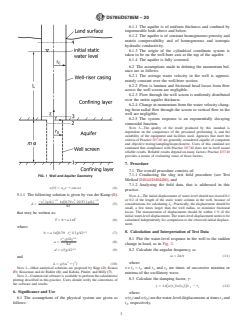
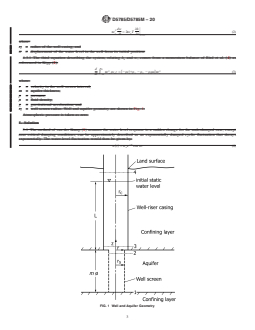
shown in Fig. 1.
3.2.13 w—water level displacement from the initial static
Atmospheric pressure is taken as zero.
level [L].
3.2.14 w —initial water level displacement [L]. 5. Solution
o
−1
3.2.15 γ—damping constant [T ].
5.1 The method of van der Kamp (1) assumes the water
level response to a sudden change for the underdamped case,
except near critical damping conditions, can be approximately
For referenced ASTM standards, visit the ASTM website, www.astm.org, or
described as an exponentially damped cyclic fluctuation that
contact ASTM Customer Service at service@astm.org. For Annual Book of ASTM
decays exponentially. The water-level fluctuation would then
Standards volume information, refer to the standard’s Document Summary page on
the ASTM website. be given by:
D5785/D5785M−20
6.1.1 The aquifer is of uniform thickness and confined by
impermeable beds above and below.
6.1.2 The aquifer is of constant homogeneous porosity and
matrix compressibility and of homogeneous and isotropic
hydraulic conductivity.
6.1.3 The origin of the cylindrical coordinate system is
taken to be on the well-bore axis at the top of the aquifer.
6.1.4 The aquifer is fully screened.
6.2 The assumptions made in defining the momentum bal-
ance are as follows:
6.2.1 The average water velocity in the well is approxi-
mately constant over the well-bore section.
6.2.2 Flow is laminar and frictional head losses from flow
across the well screen are negligible.
6.2.3 Flow through the well screen is uniformly distrib
...
This document is not an ASTM standard and is intended only to provide the user of an ASTM standard an indication of what changes have been made to the previous version. Because
it may not be technically possible to adequately depict all changes accurately, ASTM recommends that users consult prior editions as appropriate. In all cases only the current version
of the standard as published by ASTM is to be considered the official document.
Designation: D5785/D5785M − 15 D5785/D5785M − 20
Standard Test Method Practice for
(Analytical Procedure) for Determining Transmissivity of
Confined Nonleaky Aquifers by Underdamped Well
Response to Instantaneous Change in Head (Slug Test)
This standard is issued under the fixed designation D5785/D5785M; the number immediately following the designation indicates the
year of original adoption or, in the case of revision, the year of last revision. A number in parentheses indicates the year of last
reapproval. A superscript epsilon (´) indicates an editorial change since the last revision or reapproval.
1. Scope*
1.1 This test method covers determination of transmissivity from the measurement of the damped oscillation about the
equilibrium water level of a well-aquifer system to a sudden change of water level in a well. Underdamped response of water level
in a well to a sudden change in water level is characterized by oscillatory fluctuation about the static water level with a decrease
in the magnitude of fluctuation and recovery to initial water level. Underdamped response may occur in wells tapping highly
transmissive confined aquifers and in deep wells having long water columns.
1.2 This analytical procedure is used in conjunction with the field procedure Test Method D4044 for collection of test data.
1.3 Limitations—Slug tests are considered to provide an estimate of transmissivity of a confined aquifer. This test method
requires that the storage coefficient be known. Assumptions of this test method prescribe a fully penetrating well (a well open
through the full thickness of the aquifer), but the slug test method is commonly conducted using a partially penetrating well. Such
a practice may be acceptable for application under conditions in which the aquifer is stratified and horizontal hydraulic
conductivity is much greater than vertical hydraulic conductivity. In such a case the test would be considered to be representative
of the average hydraulic conductivity of the portion of the aquifer adjacent to the open interval of the well. The method assumes
laminar flow and is applicable for a slug test in which the initial water-level displacement is less than 0.1 or 0.2 of the length of
the static water column.
1.4 This test method of analysis presented here is derived by van der Kamp (1) based on an approximation of the underdamped
response to that of an exponentially damped sinusoid. A more rigorous analysis of the response of wells to a sudden change in water
level by Kipp (2) indicates that the method presented by van der Kamp (1) matches the solution of Kipp (2) when the damping
parameter values are less than about 0.2 and time greater than that of the first peak of the oscillation (2).
1.5 Units—The values stated in either SI units or inch-pound units are to be regarded separately as standard. The values in each
system may not be exact equivalents; therefore each system shall be used independently of the other. Combining values from the
two systems may result in non-conformance with the standard. Reporting of test results in units other than SI shall not be regarded
as nonconformance with this test method.
1.6 All observed and calculated values shall conform to the guidelines for significant digits and rounding established in Practice
D6026.
1.7 This standard does not purport to address all of the safety concerns, if any, associated with its use. It is the responsibility
of the user of this standard to establish appropriate safety and health practices and determine the applicability of regulatory
limitations prior to use.
2. Referenced Documents
2.1 ASTM Standards:
D653 Terminology Relating to Soil, Rock, and Contained Fluids
This test method practice is under the jurisdiction of ASTM Committee D18 on Soil and Rock and is the direct responsibility of Subcommittee D18.21 on Groundwater
and Vadose Zone Investigations.
Current edition approved Nov. 1, 2015May 15, 2020. Published November 2015May 2020. Originally approved in 1995. Last previous edition approved in 20132015 as
D5785 – 95 (2013).D5785 – 15. DOI: 10.1520/D5785_D5785M-15.10.1520/D5785_D5785M-20.
The boldface numbers given in parentheses refer to a list of references at the end of the text.
For referenced ASTM standards, visit the ASTM website, www.astm.org, or contact ASTM Customer Service at service@astm.org. For Annual Book of ASTM Standards
volume information, refer to the standard’s Document Summary page on the ASTM website.
*A Summary of Changes section appears at the end of this standard
Copyright © ASTM International, 100 Barr Harbor Drive, PO Box C700, West Conshohocken, PA 19428-2959. United States
D5785/D5785M − 20
D3740 Practice for Minimum Requirements for Agencies Engaged in Testing and/or Inspection of Soil and Rock as Used in
Engineering Design and Construction
D4043 Guide for Selection of Aquifer Test Method in Determining Hydraulic Properties by Well Techniques
D4044 Test Method for (Field Procedure) for Instantaneous Change in Head (Slug) Tests for Determining Hydraulic Properties
of Aquifers
D6026 Practice for Using Significant Digits in Geotechnical Data
3. Terminology
3.1 Definitions—For definitions of other terms used in this test method, see Terminology D653.
3.1.1 observation well—a well open to all or part of an aquifer.
3.1.2 storage coeffıcient—the volume of water an aquifer releases from or takes into storage per unit surface area of the aquifer
per unit change in head. For a confined aquifer, the storage coefficient is equal to the product of specific storage and aquifer
thickness. For an unconfined aquifer, the storage coefficient is approximately equal to the specific yield.
3.1.3 transmissivity—the volume of water at the existing kinematic viscosity that will move in a unit time under a unit hydraulic
gradient through a unit width of the aquifer.
3.2 Symbols and Dimensions:
2 −1
3.2.1 T—transmissivity [L T ].
3.2.2 S—storage coefficient [nd].
3.2.3 L—effective length of water column, equal to L +
c
2 2
(r /r ) (m/2).
c s
3.2.3.1 Discussion—This expression for the effective length is given by Kipp (2). The expression for the effective length of the
water column from Cooper et al. (3) is given as L + 3 ⁄8L and assumes that the well screen and well casing have the same
c s
diameter.
3.2.4 L —length of water column within casing [L].
c
3.2.5 L —length of water column within well screen [L].
s
−2
3.2.6 g—acceleration of gravity [LT ].
3.2.7 h—hydraulic head in the aquifer [L].
3.2.8 h —initial hydraulic head in the aquifer [L].
o
3.2.9 h —hydraulic head in the well screen [L].
s
3.2.10 r —radius of well casing [L].
c
3.2.11 r —radius of well screen [L].
s
3.2.12 t—time [T].
3.2.13 w—water level displacement from the initial static level [L].
3.2.14 w —initial water level displacement [L].
o
−1
3.2.15 γ—damping constant [T ].
3.2.16 τ—wavelength [T].
−1
3.2.17 ω—angular frequency [T ].
3.2.18 m—aquifer thickness, [L].
4. Summary of Test Method
4.1 This test method describes the analytical procedure for analyzing data collected during an instantaneous head (slug) test
using a well in which the response is underdamped. The field procedures in conducting a slug test are given in Test Method D4044.
The analytical procedure consists of analyzing the response of water level in the well following the change in water level induced
in the well.
4.2 Theory—The equations that govern the response of well to an instantaneous change in head are treated at length by Kipp
(2). The flow in the aquifer is governed by the following equation for cylindrical flow:
S dh 1 d dh
5 r (1)
S D
T dt r dr dr
where:
h = hydraulic head,
T = aquifer transmissivity, and
S = storage coefficient.
4.2.1 The initial condition is at t = 0 and h = h and the outer boundary condition is as r → ∞ and h → h .
o o
4.3 The flow rate balance on the well bore relates the displacement of the water level in the well-riser to the flow into the well:
D5785/D5785M − 20
dw ]h
πr 5 2πr T (2)
U U
c s
dt ]r
r5r
s
where:
r = radius of the well casing, and
c
w = displacement of the water level in the well from its initial position.
4.3.1 The third equation describing the system, relating h and w, comes from a momentum balance of Bird et al. (4) as
s
referenced in Kipp (2).
d 0
2 2 2
πr pv z 5 @2pv 1p 2 p 2 pgm#πr (3)
*
s d 2 1 2 s
2m
dt
where:
v = velocity in the well screen interval,
m = aquifer thickness,
p = pressure,
ρ = fluid density,
g = gravitational acceleration, and
r = well screen radius. Well and aquifer geometry are shown in Fig. 1.
s
Atmospheric pressure is taken as zero.
5. Solution
5.1 The method of van der Kamp (1) assumes the water level response to a sudden change for the underdamped case, except
near critical damping conditions, can be approximately described as an exponentially damped cyclic fluctuation that decays
exponentially. The water-level fluctuation would then be given by:
2γt
w~t! 5 w e cos wt (4)
o
FIG. 1 Well and Aquifer Geometry
D5785/D5785M − 20
5.1.1 The following solution is given by van der Kamp (1).
2 1/2 2 1/2
2r ~g/L! 1n@0.79 r ~S/T! ~g/L!
c s
d 5 (5)
8T
that may be written as:
T 5 b1a 1nT (6)
where:
2 1/2
b 5 a 1n@0.79 r S ~g/L! (7)
s
2 1/2
r g/L
~ !
c
a 5 (8)
8d
1/2
d 5 γ/~g/L! (9)
and
2 2
L 5 g/ ω 1γ (10)
~ !
NOTE 1—Other analytical solutions are proposed by Kipp (2); Krauss (5); Kruseman and de Ridder (6); and Kabala, Pinder, and Milly (7).
6. Significance and Use
NOTE 2—The quality of the result produced by this standard is dependent on the competence of the personnel performing it, and the suitability of the
equipment and facilities used. Agencies that meet the criteria of Practice D3740 are generally considered capable of competent and objective
testing/sampling/inspection/etc. Users of this standard are cautioned that compliance with Practice D3740 does not in itself assure reliable results. Reliable
results depend on many factors; Practice D3740 provides a means of evaluating some of those factors.
6.1 The assumptions of the physical system are given as follows:
6.1.1 The aquifer is of uniform thickness and confined by impermeable beds above and below.
6.1.2 The aquifer is of constant homogeneous porosity and matrix compressibility and of homogeneous and isotropic hydraulic
conductivity.
6.1.3 The origin of the cylindrical coordinate system is taken to be on the well-bore axis at the top of the aquifer.
6.1.4 The aquifer is fully screened.
6.2 The assumptions made in defining the momentum balance are as follows:
6.2.1 The average water velocity in the well is approximately constant over the well-bore section.
6.2.2 Flow is laminar and frictional head losses from flow across the well screen are negligible.
6.2.3 Flow through the well screen is uniformly distributed over the entire aquifer thickness.
6.2.4 Change in momentum from the water velocity changing from radial flow through the screen to vertical flow in the well
are negligible.
6.2.5 The system response is an exponentially decaying sinusoidal function.
7. Procedure
7.1 The overall procedure consists of:
7.1.1 Conducting the slug test field procedure (see Test Method D4044), and
7.1.2 Analyzing the field data, that is addressed in this test method.
NOTE 3—The initial displacement of water level should not exceed 0.1 or 0.2 of the length of the static water column in the well, because of
considerations for calculating L . Practically, the displacement should be small, a few times larger than the well radius, to minimize frictional losses. The
c
measurement of displacement should be within 1 % of the initial water-level displacement. The water-level displacement needs to be calculated
independently for comparison to the observed initial displacement.
8. Calculation and Interpretation of Test Data
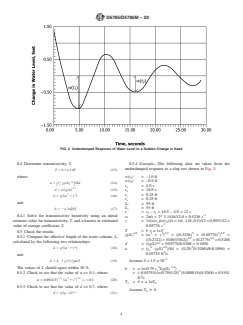
8.1 Plot the water-level response in the well to the sudden change in head, as in Fig. 2.
8.2 Calculate the angular frequency, ω:
ω5 2π/τ (11)
where:
τ = t − t , and t and t are times of successive maxima or minima of the oscillatory wave.
1 2 1 2
8.3 Calculate the damping factor, γ:
γ51n w t /w t /t 2 t (12)
@ ~ ! ~ !#
1 2 2 1
where:
w(t ) and w(t ) are the water-level displacements at times t and t , respectively.
1 2 1 2
8.4 Determine transmissivity, T,
D5785/D5785M − 20
FIG. 2 Underdamped Response of Water Level to a Sudden Change in Head
T 5 b1a 1nT (13)
where:
2 1/2
a 5 @r ~g/L! #/8d (14)
c
1/2
d 5 γ/~g/L! (15)
2 2
L 5 g/ ω 1γ (16)
~ !
and:
b 52a 1n@0# (17)
8.4.1 Solve for transmissivity iteratively using an initial estimate value for transmissivity, T, and a known or estimated value
of storage coefficient, S.
8.5 Check the results.
8.5.1 Compare the effective length of the water column, L, calculated by the following two relationships:
2 2
L 5 g/ ω 1γ (18)
~ !
and:
2 2
L 5 L 1 r /r m/2 (19)
~ !
c c s
The values of L should agree within 20 %.
8.5.2 Check to see that the value of α << 0.1, where:
1/2 2 2 1/4
α5 0.89 S/T ω 1γ r ,0.1 (20)
~ ! ~ !
s
8.5.3 Check to see that the value of d << 0.7, where:
1⁄2
d 5 γ⁄ g ⁄ L (21)
~ !
8.5.4 Example—The following data are taken from the underdamped response to a slug test shown in Fig. 2:
w(t ) = –1.0 ft
w(t ) = –0.5 ft
t = 4.9 s
D5785/D5785M − 20
t = 16.9 s
r = 0.25 ft
c
r = 0.25 ft
s
L = 95 ft
c
L = 55 ft
s
τ = t – t = 16.9 – 4.9 = 12 s
2 1
–1
ω = 2π/τ = 2* 3.1416/12.0 = 0.5236 s
–1
γ = 1n(w(t )/w(t ))/τ = 1n(–1.0/–0.5)/12 = 0.6931/12 = 0.05776 s
1 2
T = b + a 1nT
1/2 2 2 1/2 2 2 1/2 1/2 1/2
(g/L) = (ω + γ ) = ((0.5236) + (0.05776) ) = ((0.2742) + (0.0033362)) = (0.2775) = 0.5268
1/2
d = γ(g/L) = 0.05776/0.5268 = 0.1096
2 1/2 2 2
a = (r (g/L) )/8d = (0.25) (0.5268)/8(0.1096) = 0.03755 ft /s
c
−5
Assume S = 1.5 × 10
2 1/2
b = a 1n(0.79 r S(g/L) )
s
2 2
= (–0.03755)1n(0.79(0.25) (0.000015)(0.5268) = 0.5541 ft /s
T = b + a 1nT
1 0
Assume T > b,
T = 0.5541 + (0.03755)1n(0.5541) = 0.5319 ft /s
T = 0.5541 + (0.03755)1n(0.5319) = 0.5304 ft /s
2 2
T = 0.5304 ft /s * 86 400 s/day = 45 826 ft /day
Check the results:
2 2
L = g/(ω + γ ) = 32/(0.2775) = 115.3 ft
2 2
L = L + (r /r )m/2 = 95 + 27.5 = 122.5
c c s
122.5 – 115.3 = 7.2, 7.2/115.3 = 6.2 < 20 %
1/2 2 2 1/4
α = 0.89(S/T) (ω + γ ) r < 0.1
s
= 0.89 (0.005318)(0.7258) 0.25 = 0.000859 < 0.1
d = 0.1096 < 0.7
9. Report
9.1 Report the following information described as follows. The final report of the analytical procedure will include information
from the report on test method selection, Guide D4043, and the field testing procedure, Test Method D4044.
9.1.1 Introduction—The introductory section is intended to present the scope and purpose of the slug test method for
determining transmissivity and storativity. Summarize the field hydrogeologic conditions, the field equipment and instrumentation
including the construction of the control well, the method of measurement of head, and the method of effecting the change in head.
Discuss the rationale for selecting this test method.
9.1.2 Hydrogeologic Setting—Review information available on the hydrogeology of the site; interpret and describe the
hydrogeology of the site as it pertains to the method selected for conducting and analyzing an aquifer test. Compare hydrogeologic
characteristics of the site as it conforms and differs from assumptions made in the solution to the aquifer test method.
9.1.3 Equipment—Report the field installation and equipment for the aquifer test. Include in the report, well construction
information, diameter, depth, and open interval to the aquifer, and location of control well and pumping equipment. The
construction, diameter, depth, and open interval of observation wells should be recorded.
9.1.3.1 Report the techniques used for observing water levels, and other environmental conditions pertinent to the test. Include
a list of measuring devices used during the test; the manufacturer’s name, model number, and basic specifications for each major
item; and the name and date of the last calibration, if applicable.
9.1.4 Testing Procedures—Report the steps taken in conducting the pretest and test phases. Include the frequency of head
measurements made in the control well, and other environmental data recorded before and during the testing procedure.
9.1.5 Presentation and Interpretation of Test Results:
9.1.5.1 Data—Present tables of data collected during the test.
9.1.5.2 Data Plots—Present data plots used in analysis of the data.
9.1.5.3 Show calculation of transmissivity and coefficient of storage.
9.1.5.4 Evaluate the overall quality of the test on the basis of the adequacy of instrumentation and observations of stress and
response and the conformance of the hydrogeologic conditions and the performance of the test to the assumptions (see 5.1).
10. Precision and Bias
10.1 Precision—Test data on precision is not presented due to the nature of this test method. It is either not feasible or too costly
at this time to have ten or more agencies participate in an in situ testing program at a given site.
D5785/D5785M − 20
10.2 Bias—There is no accepted reference value for this test method, therefore, bias cannot be determined.
11. Keywords
11.1 aquifers; aquifer tests; control wells; groundwater; hydraulic conductivity; slug test; storage coefficient; transmissivity
REFERENCES
(1) van der Kamp, Garth, “Determining Aquifer Transmissivity by Means of Well Response Tests: The Underdamped Case,” Water Resources Research,
Vol 12, No. 1, 1976, pp. 71–77.
(2) Kipp, K. L., Jr., “Type Curve Analysis of Inertial Effects in the Response of a Well to a Slug Test,” Water Resources Research, Vol 21, No. 9, 1985,
pp. 1397–1408.
(3) Cooper, H. H., Jr., Bredehoeft, J. D., and Papadopulos, I. S., “Response of a Finite-Diameter Well to an Instantaneous Charge of Water,” Water
Resources Research, Vol 3, No. 1, 1967, pp. 263–269.
(4) Bird, R. B., Stewart, W. E., and Lightfoot, E. N., Transport Phenomena, John Wiley, New York, 1960.
(5) Krauss, I., “Determination of the Transmissibility from the Free Water Level Oscillation in Well-Aquifer Systems,” Surface and Subsurface
Hydrology, Proceedings of the Third International Hydrology Symposium, Colorado State University, 1977, pp. 179–268.
(6) Kruseman and de Ridder, “Analysis and Evaluation of Pumping Test Data,” Publication 47, International Institute for Land and Reclamation and
Improvement, Wageningen, The Netherlands, 1991.
(7) Kabala, Z. J., Pinder, G. F., and Milly, P. C. D., “Analysis of Well-Aquifer Response to a Slug Test,” Water Resources Research, Vol 21, No. 9, 1985,
pp. 1433–1436.
SUMMARY OF CHANGES
Committee D18 has identified the location of selected changes to this standard since the last issue (D5785 – 95
(2013)) that may impact the use of this standard. (November 1, 2015)
(1) Added D3740 to Referenced Documents section.
(2) Added Note 2 to Section 6 regarding the use of Practice D3740.
ASTM International takes no position respecting the validity of any patent rights asserted in connection with any item mentioned
in this standard. Users of this standard are expressly advised that determination of the validity of any such patent rights, and the risk
of infringement of such rights, are entirely their own responsibility.
This standard is subject to revision at any time by the responsible technical committee and must be reviewed every five years and
if not revised, either reapproved or withdrawn. Your comments are invited either for revision of this standard or for additional standards
and should be addressed to ASTM International Headquarters. Your comments will receive careful consideration at a meeting of the
responsible technical committee, which you may attend. If you feel that your comments have not received a fair hearing you should
make your views known to the ASTM Committee on Standards, at the address shown below.
This standard is copyrighted by ASTM International, 100 Barr Harbor Drive, PO Box C700, West Conshohocken, PA 19428-2959,
Unite
...