

ASTM D4106-20
(Practice)Standard Practice for (Analytical Procedure) for Determining Transmissivity and Storage Coefficient of Nonleaky Confined Aquifers by the Theis Nonequilibrium Method
General Information
- Abstract
SIGNIFICANCE AND USE
5.1 Assumptions:
5.1.1 Well discharges at a constant rate, Q.
5.1.2 Well is of infinitesimal diameter and fully penetrates the aquifer.
5.1.3 The nonleaky aquifer is homogeneous, isotropic, and aerially extensive. A nonleaky aquifer receives insignificant contribution of water from confining beds.
5.1.4 Discharge from the well is derived exclusively from storage in the aquifer.
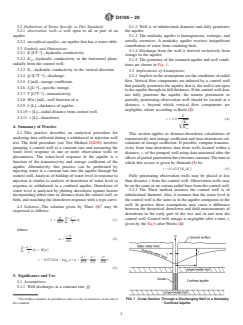
5.1.5 The geometry of the assumed aquifer and well conditions are shown in Fig. 1.
5.2.3 Application of Theis Method to Unconfined Aquifers:
5.2.3.1 Although the assumptions are applicable to artesian or confined conditions, the Theis solution may be applied to unconfined aquifers if drawdown is small compared with the saturated thickness of the aquifer or if the drawdown is corrected for reduction in thickness of the aquifer, and the effects of delayed gravity yield are small.
5.2.3.2 Reduction in Aquifer Thickness—In an unconfined aquifer dewatering occurs when the water levels decline in the vicinity of a pumping well. Corrections in drawdown need to be made when the drawdown is a significant fraction of the aquifer thickness as shown by Jacob (5). The drawdown, s, needs to be replaced by s′, the drawdown that would occur in an equivalent confined aquifer, where:
5.2.3.3 Gravity Yield Effects—In unconfined aquifers, delayed gravity yield effects may invalidate measurements of drawdown during the early part of the test for application to the Theis method. Effects of delayed gravity yield are negligible in partially penetrating observation wells at and beyond a distance, r, from the control well, where:
After the time, t, as given in Eq 9 from Neuman (6).
where:
Sy = the specific yield. For fully penetrating observation wells, the effects of delayed yield are negligible at the distance, r, in Eq 8 after one tenth of the time given in the Eq 9.
Note 1: The quality of the result produced by this standard is dependent on the co...
SCOPE
1.1 This practice covers an analytical procedure for determining the transmissivity and storage coefficient of a nonleaky confined aquifer. It is used to analyze data on water-level response collected during radial flow to or from a well of constant discharge or injection.
1.2 This analytical procedure, along with others, is used in conjunction with the field procedure given in Test Method D4050.
1.3 Limitations—The limitations of this practice for determination of hydraulic properties of aquifers are primarily related to the correspondence between the field situation and the simplifying assumptions of this practice (see 5.1).
1.4 All observed and calculated values shall conform to the guidelines for significant digits and rounding established in Practice D6026.
1.4.1 The procedures used to specify how data are collected/recorded or calculated, in this standard are regarded as the industry standard. In addition, they are representative of the significant digits that generally should be retained. The procedures used do not consider material variation, purpose for obtaining the data, special purpose studies, or any considerations for the user’s objectives; and it is common practice to increase or reduce significant digits of reported data to be commensurate with these considerations. It is beyond the scope of this standard to consider significant digits used in analytical methods for engineering design.
1.5 This practice offers a set of instructions for performing one or more specific operations. This document cannot replace education or experience and should be used in conjunction with professional judgment. Not all aspects of the practice may be applicable in all circumstances. This ASTM standard is not intended to represent or replace the standard of care by which the adequacy of a given professional service must be judged, nor should this document be applied without the consideration of a project’s many ...
- Status
- Published
- Publication Date
- 31-May-2020
- Technical Committee
- D18 - Soil and Rock
- Drafting Committee
- D18.21 - Groundwater and Vadose Zone Investigations
Buy Documents
ASTM D4106-20 - Standard Practice for (Analytical Procedure) for Determining Transmissivity and Storage Coefficient of Nonleaky Confined Aquifers by the Theis Nonequilibrium Method
REDLINE ASTM D4106-20 - Standard Practice for (Analytical Procedure) for Determining Transmissivity and Storage Coefficient of Nonleaky Confined Aquifers by the Theis Nonequilibrium Method
Overview
ASTM D4106-20: Standard Practice for Determining Transmissivity and Storage Coefficient of Nonleaky Confined Aquifers by the Theis Nonequilibrium Method provides a recognized analytical procedure for evaluating the hydraulic properties of confined aquifers. Developed by ASTM International, this standard practice is critical for groundwater professionals tasked with assessing aquifer performance, water resource sustainability, and planning groundwater extraction. The Theis nonequilibrium method is widely adopted in hydrogeology for interpreting water-level data collected during aquifer tests involving constant discharge or injection rates.
Key Topics
- Transmissivity and Storage Coefficient Determination: The practice outlines procedures for calculating key hydraulic properties-transmissivity and storage coefficient-using the Theis solution.
- Test Assumptions: The method assumes the aquifer is nonleaky, homogeneous, isotropic, of significant areal extent, and that the production or injection well is of infinitesimal diameter and fully penetrates the aquifer.
- Analytical and Graphical Analysis: Field drawdown or recovery data from observation wells are analyzed using graphical methods, often involving the overlay of data plots with type curves to match calculated values.
- Application to Confined and Unconfined Aquifers: While designed primarily for confined aquifer conditions, the standard includes guidance on applying the Theis method to unconfined aquifers with appropriate corrections for saturated thickness reduction and delayed gravity yield.
- Reporting and Data Quality: Emphasis is placed on standardized data collection, significant digits, and comprehensive reporting to ensure accuracy and clarity.
- Limitations: Users must verify that field conditions correspond to the standard's simplifying assumptions. The method may not be valid if significant deviations from these exist.
Applications
ASTM D4106-20 is essential for:
- Aquifer Characterization: Hydrogeologists and water resource managers use the practice to quantify aquifer properties necessary for groundwater modeling, sustainable yield calculations, and managing well fields.
- Well Testing: The practice is applied to constant-rate pumping or injection tests, helping professionals analyze drawdown or recovery data.
- Environmental and Engineering Assessments: Accurate transmissivity and storage coefficient values inform the design of water supply systems, contamination remediation projects, and impact assessments for construction near groundwater resources.
- Educational and Regulatory Uses: The standard offers a foundation for training and supports regulatory compliance in groundwater investigations.
- Data Quality and Consistency: By adhering to uniform procedures for data analysis and reporting, organizations ensure comparability and reliability across hydrogeologic studies.
Related Standards
For comprehensive assessment and integration with fieldwork, ASTM D4106-20 is often used alongside:
- ASTM D4050: Field procedures for withdrawal and injection well testing
- ASTM D6026: Guidance for significant digits in geotechnical data reporting
- ASTM D4043: Guide for selecting aquifer test methods in determining hydraulic properties by well techniques
- ASTM D653: Terminology relating to soil, rock, and contained fluids
- ASTM D3740: Practice for minimum requirements for agencies engaged in testing and/or inspection of soil and rock as used in engineering design and construction
Keywords: ASTM D4106-20, Theis method, aquifer transmissivity, storage coefficient, confined aquifer, nonleaky aquifer, groundwater, well testing, aquifer test analysis, hydrogeology standards.
By applying ASTM D4106-20, professionals ensure reliable determination of aquifer hydraulic properties, foundational to groundwater management and engineering projects.
Relations
- Effective Date
- 01-Nov-2023
- Effective Date
- 01-Jan-2020
- Effective Date
- 01-Oct-2019
- Effective Date
- 01-Jan-2017
- Effective Date
- 01-Aug-2014
- Effective Date
- 01-Jun-2014
- Effective Date
- 01-May-2012
- Effective Date
- 01-Mar-2012
- Effective Date
- 01-Sep-2011
- Effective Date
- 01-Sep-2011
- Effective Date
- 01-Aug-2010
- Effective Date
- 01-Mar-2010
- Effective Date
- 01-Jan-2009
- Effective Date
- 01-Dec-2008
- Effective Date
- 01-Nov-2008
Buy Documents
ASTM D4106-20 - Standard Practice for (Analytical Procedure) for Determining Transmissivity and Storage Coefficient of Nonleaky Confined Aquifers by the Theis Nonequilibrium Method
REDLINE ASTM D4106-20 - Standard Practice for (Analytical Procedure) for Determining Transmissivity and Storage Coefficient of Nonleaky Confined Aquifers by the Theis Nonequilibrium Method
Get Certified
Connect with accredited certification bodies for this standard

Zavod za gradbeništvo Slovenije (ZAG) - Inšpekcija
ZAG inspection body for construction products, structures, and materials.
Sponsored listings
Frequently Asked Questions
ASTM D4106-20 is a standard published by ASTM International. Its full title is "Standard Practice for (Analytical Procedure) for Determining Transmissivity and Storage Coefficient of Nonleaky Confined Aquifers by the Theis Nonequilibrium Method". This standard covers: SIGNIFICANCE AND USE 5.1 Assumptions: 5.1.1 Well discharges at a constant rate, Q. 5.1.2 Well is of infinitesimal diameter and fully penetrates the aquifer. 5.1.3 The nonleaky aquifer is homogeneous, isotropic, and aerially extensive. A nonleaky aquifer receives insignificant contribution of water from confining beds. 5.1.4 Discharge from the well is derived exclusively from storage in the aquifer. 5.1.5 The geometry of the assumed aquifer and well conditions are shown in Fig. 1. 5.2.3 Application of Theis Method to Unconfined Aquifers: 5.2.3.1 Although the assumptions are applicable to artesian or confined conditions, the Theis solution may be applied to unconfined aquifers if drawdown is small compared with the saturated thickness of the aquifer or if the drawdown is corrected for reduction in thickness of the aquifer, and the effects of delayed gravity yield are small. 5.2.3.2 Reduction in Aquifer Thickness—In an unconfined aquifer dewatering occurs when the water levels decline in the vicinity of a pumping well. Corrections in drawdown need to be made when the drawdown is a significant fraction of the aquifer thickness as shown by Jacob (5). The drawdown, s, needs to be replaced by s′, the drawdown that would occur in an equivalent confined aquifer, where: 5.2.3.3 Gravity Yield Effects—In unconfined aquifers, delayed gravity yield effects may invalidate measurements of drawdown during the early part of the test for application to the Theis method. Effects of delayed gravity yield are negligible in partially penetrating observation wells at and beyond a distance, r, from the control well, where: After the time, t, as given in Eq 9 from Neuman (6). where: Sy = the specific yield. For fully penetrating observation wells, the effects of delayed yield are negligible at the distance, r, in Eq 8 after one tenth of the time given in the Eq 9. Note 1: The quality of the result produced by this standard is dependent on the co... SCOPE 1.1 This practice covers an analytical procedure for determining the transmissivity and storage coefficient of a nonleaky confined aquifer. It is used to analyze data on water-level response collected during radial flow to or from a well of constant discharge or injection. 1.2 This analytical procedure, along with others, is used in conjunction with the field procedure given in Test Method D4050. 1.3 Limitations—The limitations of this practice for determination of hydraulic properties of aquifers are primarily related to the correspondence between the field situation and the simplifying assumptions of this practice (see 5.1). 1.4 All observed and calculated values shall conform to the guidelines for significant digits and rounding established in Practice D6026. 1.4.1 The procedures used to specify how data are collected/recorded or calculated, in this standard are regarded as the industry standard. In addition, they are representative of the significant digits that generally should be retained. The procedures used do not consider material variation, purpose for obtaining the data, special purpose studies, or any considerations for the user’s objectives; and it is common practice to increase or reduce significant digits of reported data to be commensurate with these considerations. It is beyond the scope of this standard to consider significant digits used in analytical methods for engineering design. 1.5 This practice offers a set of instructions for performing one or more specific operations. This document cannot replace education or experience and should be used in conjunction with professional judgment. Not all aspects of the practice may be applicable in all circumstances. This ASTM standard is not intended to represent or replace the standard of care by which the adequacy of a given professional service must be judged, nor should this document be applied without the consideration of a project’s many ...
SIGNIFICANCE AND USE 5.1 Assumptions: 5.1.1 Well discharges at a constant rate, Q. 5.1.2 Well is of infinitesimal diameter and fully penetrates the aquifer. 5.1.3 The nonleaky aquifer is homogeneous, isotropic, and aerially extensive. A nonleaky aquifer receives insignificant contribution of water from confining beds. 5.1.4 Discharge from the well is derived exclusively from storage in the aquifer. 5.1.5 The geometry of the assumed aquifer and well conditions are shown in Fig. 1. 5.2.3 Application of Theis Method to Unconfined Aquifers: 5.2.3.1 Although the assumptions are applicable to artesian or confined conditions, the Theis solution may be applied to unconfined aquifers if drawdown is small compared with the saturated thickness of the aquifer or if the drawdown is corrected for reduction in thickness of the aquifer, and the effects of delayed gravity yield are small. 5.2.3.2 Reduction in Aquifer Thickness—In an unconfined aquifer dewatering occurs when the water levels decline in the vicinity of a pumping well. Corrections in drawdown need to be made when the drawdown is a significant fraction of the aquifer thickness as shown by Jacob (5). The drawdown, s, needs to be replaced by s′, the drawdown that would occur in an equivalent confined aquifer, where: 5.2.3.3 Gravity Yield Effects—In unconfined aquifers, delayed gravity yield effects may invalidate measurements of drawdown during the early part of the test for application to the Theis method. Effects of delayed gravity yield are negligible in partially penetrating observation wells at and beyond a distance, r, from the control well, where: After the time, t, as given in Eq 9 from Neuman (6). where: Sy = the specific yield. For fully penetrating observation wells, the effects of delayed yield are negligible at the distance, r, in Eq 8 after one tenth of the time given in the Eq 9. Note 1: The quality of the result produced by this standard is dependent on the co... SCOPE 1.1 This practice covers an analytical procedure for determining the transmissivity and storage coefficient of a nonleaky confined aquifer. It is used to analyze data on water-level response collected during radial flow to or from a well of constant discharge or injection. 1.2 This analytical procedure, along with others, is used in conjunction with the field procedure given in Test Method D4050. 1.3 Limitations—The limitations of this practice for determination of hydraulic properties of aquifers are primarily related to the correspondence between the field situation and the simplifying assumptions of this practice (see 5.1). 1.4 All observed and calculated values shall conform to the guidelines for significant digits and rounding established in Practice D6026. 1.4.1 The procedures used to specify how data are collected/recorded or calculated, in this standard are regarded as the industry standard. In addition, they are representative of the significant digits that generally should be retained. The procedures used do not consider material variation, purpose for obtaining the data, special purpose studies, or any considerations for the user’s objectives; and it is common practice to increase or reduce significant digits of reported data to be commensurate with these considerations. It is beyond the scope of this standard to consider significant digits used in analytical methods for engineering design. 1.5 This practice offers a set of instructions for performing one or more specific operations. This document cannot replace education or experience and should be used in conjunction with professional judgment. Not all aspects of the practice may be applicable in all circumstances. This ASTM standard is not intended to represent or replace the standard of care by which the adequacy of a given professional service must be judged, nor should this document be applied without the consideration of a project’s many ...
ASTM D4106-20 is classified under the following ICS (International Classification for Standards) categories: 93.160 - Hydraulic construction. The ICS classification helps identify the subject area and facilitates finding related standards.
ASTM D4106-20 has the following relationships with other standards: It is inter standard links to ASTM D3740-23, ASTM D4050-20, ASTM D3740-19, ASTM D4043-17, ASTM D653-14, ASTM D4050-14, ASTM D3740-12a, ASTM D3740-12, ASTM D3740-11, ASTM D653-11, ASTM D4043-96(2010)e1, ASTM D3740-10, ASTM D653-09, ASTM D653-08a, ASTM D653-08. Understanding these relationships helps ensure you are using the most current and applicable version of the standard.
ASTM D4106-20 is available in PDF format for immediate download after purchase. The document can be added to your cart and obtained through the secure checkout process. Digital delivery ensures instant access to the complete standard document.
Standards Content (Sample)
This international standard was developed in accordance with internationally recognized principles on standardization established in the Decision on Principles for the
Development of International Standards, Guides and Recommendations issued by the World Trade Organization Technical Barriers to Trade (TBT) Committee.
Designation:D4106 −20
Standard Practice for
(Analytical Procedure) for Determining Transmissivity and
Storage Coefficient of Nonleaky Confined Aquifers by the
Theis Nonequilibrium Method
This standard is issued under the fixed designation D4106; the number immediately following the designation indicates the year of
original adoption or, in the case of revision, the year of last revision.Anumber in parentheses indicates the year of last reapproval.A
superscript epsilon (´) indicates an editorial change since the last revision or reapproval.
1. Scope* the adequacy of a given professional service must be judged,
nor should this document be applied without the consideration
1.1 This practice covers an analytical procedure for deter-
of a project’s many unique aspects. The word “Standard” in
mining the transmissivity and storage coefficient of a nonleaky
the title of this document means only that the document has
confined aquifer. It is used to analyze data on water-level
been approved through the ASTM consensus process.
response collected during radial flow to or from a well of
1.6 This standard does not purport to address all of the
constant discharge or injection.
safety concerns, if any, associated with its use. It is the
1.2 This analytical procedure, along with others, is used in
responsibility of the user of this standard to establish appro-
conjunction with the field procedure given in Test Method
priate safety, health, and environmental practices and deter-
D4050.
mine the applicability of regulatory limitations prior to use.
1.3 Limitations—The limitations of this practice for deter-
1.7 This international standard was developed in accor-
mination of hydraulic properties of aquifers are primarily
dance with internationally recognized principles on standard-
related to the correspondence between the field situation and
ization established in the Decision on Principles for the
the simplifying assumptions of this practice (see 5.1).
Development of International Standards, Guides and Recom-
mendations issued by the World Trade Organization Technical
1.4 All observed and calculated values shall conform to the
Barriers to Trade (TBT) Committee.
guidelines for significant digits and rounding established in
Practice D6026.
2. Referenced Documents
1.4.1 Theproceduresusedtospecifyhowdataarecollected/
recorded or calculated, in this standard are regarded as the 2.1 ASTM Standards:
industry standard. In addition, they are representative of the
D653Terminology Relating to Soil, Rock, and Contained
significant digits that generally should be retained. The proce- Fluids
dures used do not consider material variation, purpose for
D3740Practice for Minimum Requirements for Agencies
obtaining the data, special purpose studies, or any consider- Engaged in Testing and/or Inspection of Soil and Rock as
ations for the user’s objectives; and it is common practice to Used in Engineering Design and Construction
increase or reduce significant digits of reported data to be D4043Guide for Selection of Aquifer Test Method in
commensuratewiththeseconsiderations.Itisbeyondthescope Determining Hydraulic Properties by Well Techniques
of this standard to consider significant digits used in analytical D4050Test Method for (Field Procedure) for Withdrawal
methods for engineering design. and Injection Well Testing for Determining Hydraulic
Properties of Aquifer Systems
1.5 This practice offers a set of instructions for performing
D6026Practice for Using Significant Digits in Geotechnical
one or more specific operations. This document cannot replace
Data
education or experience and should be used in conjunction
with professional judgment. Not all aspects of the practice may
3. Terminology
be applicable in all circumstances. This ASTM standard is not
3.1 Definitions:
intended to represent or replace the standard of care by which
3.1.1 Fordefinitionsofcommontechnicaltermsusedinthis
practice, refer to Terminology D653.
This practice is under the jurisdiction of ASTM Committee D18 on Soil and
Rock and is the direct responsibility of Subcommittee D18.21 on Groundwater and
Vadose Zone Investigations. For referenced ASTM standards, visit the ASTM website, www.astm.org, or
Current edition approved June 1, 2020. Published June 2020. Originally contact ASTM Customer Service at service@astm.org. For Annual Book of ASTM
approved in 1991. Last previous edition approved in 2015 as D4106–15. DOI: Standards volume information, refer to the standard’s Document Summary page on
10.1520/D4106-20. the ASTM website.
*A Summary of Changes section appears at the end of this standard
Copyright © ASTM International, 100 Barr Harbor Drive, PO Box C700, West Conshohocken, PA 19428-2959. United States
D4106−20
3.2 Definitions of Terms Specific to This Standard: 5.1.2 Well is of infinitesimal diameter and fully penetrates
3.2.1 observation well—a well open to all or part of an the aquifer.
aquifer. 5.1.3 The nonleaky aquifer is homogeneous, isotropic, and
aerially extensive. A nonleaky aquifer receives insignificant
3.2.2 unconfined aquifer—an aquifer that has a water table.
contribution of water from confining beds.
3.3 Symbols and Dimensions:
5.1.4 Discharge from the well is derived exclusively from
−1
3.3.1 K [LT ]—hydraulic conductivity.
storage in the aquifer.
3.3.2 K —hydraulic conductivity in the horizontal plane,
xy 5.1.5 The geometry of the assumed aquifer and well condi-
radially from the control well.
tions are shown in Fig. 1.
3.3.3 K —hydraulic conductivity in the vertical direction.
z
5.2 Implications of Assumptions:
3 −1
5.2.1 Implicitintheassumptionsaretheconditionsofradial
3.3.4 Q [L T ]—discharge.
flow. Vertical flow components are induced by a control well
3.3.5 S [nd]—storage coefficient.
thatpartiallypenetratestheaquifer,thatis,thewell is not open
−1
3.3.6 S [L ]—specific storage.
s
totheaquiferthroughitsfullthickness.Ifthecontrolwelldoes
2 −1
3.3.7 T [L T ]—transmissivity.
not fully penetrate the aquifer, the nearest piezometer or
partially penetrating observation well should be located at a
3.3.8 W(u) [nd]—well function of u.
distance, r, beyond which vertical flow components are
3.3.9 b [L]—thickness of aquifer.
negligible, where according to Reed (2):
3.3.10 r [L]—radial distance from control well.
b
3.3.11 s [L]—drawdown. r 5 1.5 (4)
K
z
Œ
4. Summary of Practice K
xy
4.1 This practice describes an analytical procedure for
This section applies to distance-drawdown calculations of
analyzing data collected during a withdrawal or injection well
transmissivity and storage coefficient and time-drawdown cal-
test. The field procedure (see Test Method D4050) involves
culations of storage coefficient. If possible, compute transmis-
pumping a control well at a constant rate and measuring the
sivity from time-drawdown data from wells located within a
water level response in one or more observation wells or
distance, r, of the pumped well using data measured after the
piezometers. The water-level response in the aquifer is a
effectsofpartialpenetrationhavebecomeconstant.Thetimeat
function of the transmissivity and storage coefficient of the
which this occurs is given by Hantush (3) by:
aquifer. Alternatively, this practice can be performed by
t 5 b s/2T K /K (5)
~ !
z r
injecting water at a constant rate into the aquifer through the
Fully penetrating observation wells may be placed at less
control well.Analysis of buildup of water level in response to
injection is similar to analysis of drawdown of water level in than distance r from the control well. Observation wells may
be on the same or on various radial lines from the control well.
response to withdrawal in a confined aquifer. Drawdown of
water level is analyzed by plotting drawdown against factors 5.2.2 The Theis method assumes the control well is of
infinitesimal diameter. Also, it assumes that the water level in
incorporating either time or distance from the control well, or
both, and matching the drawdown response with a type curve. the control well is the same as in the aquifer contiguous to the
3 well. In practice these assumptions may cause a difference
4.2 Solution—The solution given by Theis (1) may be
between the theoretical drawdown and field measurements of
expressed as follows:
drawdown in the early part of the test and in and near the
2y
Q ` e
control well. Control well storage is negligible after a time, t,
s 5 dy (1)
*
u
4πT y
given by the Eq 6 after Weeks (4).
where:
r S
u 5 (2)
4Tt
2y
` e
dy 5 W u
* ~ !
u
y
2 3 4
u u u
520.577216 2 log u1u 2 1 2 1…
e
2!2 3!3 4!4
(3)
5. Significance and Use
5.1 Assumptions:
5.1.1 Well discharges at a constant rate, Q.
The boldface numbers in parentheses refer to a list of references at the end of FIG. 1 Cross Section Through a Discharging Well in a Nonleaky
this standard. Confined Aquifer
D4106−20
r penetrates the aquifer, take special precaution in the placement
c
t 5 25 3 (6)
T and design of observation wells (see 5.2.1).
6.3 Construction of Observation Wells—Construct one or
where:
more observation wells at a distance from the control well.
r = theradiusofthecontrolwellintheintervalinwhichthe
c
Observation wells may be partially open or open throughout
water level changes.
the thickness of the aquifer.
5.2.3 Application of Theis Method to Unconfined Aquifers:
6.4 Location of Observation Wells—Locate observation
5.2.3.1 Although the assumptions are applicable to artesian
wells at various distances from the control well within the area
or confined conditions, the Theis solution may be applied to
ofinfluenceofpumping.However,ifverticalflowcomponents
unconfined aquifers if drawdown is small compared with the
aresignificantandifpartiallypenetratingobservationwellsare
saturated thickness of the aquifer or if the drawdown is
used, locate them at a distance beyond the effect of vertical
corrected for reduction in thickness of the aquifer, and the
flow components (see 5.2.1). If the aquifer is unconfined,
effects of delayed gravity yield are small.
constraints are imposed on the distance to partially penetrating
5.2.3.2 Reduction in Aquifer Thickness—In an unconfined
observation wells and the validity of early time measurements
aquifer dewatering occurs when the water levels decline in the
(see 5.2.3).
vicinity of a pumping well. Corrections in drawdown need to
be made when the drawdown is a significant fraction of the
7. Procedure
aquifer thickness as shown by Jacob (5). The drawdown, s,
needs to be replaced by s', the drawdown that would occur in
7.1 The overall procedure consists of conducting the field
an equivalent confined aquifer, where: procedure for withdrawal or injection well tests (described in
2 Test Method D4050) and analysis of the field data that is
s
s' 5 s 2 (7)
S D
addressed in this practice.
2b
7.2 The integral expression in Eq 1 and Eq 2 cannot be
5.2.3.3 Gravity Yield Effects—In unconfined aquifers, de-
evaluated analytically. A graphical procedure is used to solve
layed gravity yield effects may invalidate measurements of
for the two unknown parameters transmissivity and storage
drawdownduringtheearlypartofthetestforapplicationtothe
coefficient where:
Theismethod.Effectsofdelayedgravityyieldarenegligiblein
Q
partially penetrating observation wells at and beyond a
s 5 W~u! (10)
4πT
distance, r, from the control well, where:
b
and:
r 5 (8)
...
This document is not an ASTM standard and is intended only to provide the user of an ASTM standard an indication of what changes have been made to the previous version. Because
it may not be technically possible to adequately depict all changes accurately, ASTM recommends that users consult prior editions as appropriate. In all cases only the current version
of the standard as published by ASTM is to be considered the official document.
Designation: D4106 − 15 D4106 − 20
Standard Test Method Practice for
(Analytical Procedure) for Determining Transmissivity and
Storage Coefficient of Nonleaky Confined Aquifers by the
Theis Nonequilibrium Method
This standard is issued under the fixed designation D4106; the number immediately following the designation indicates the year of
original adoption or, in the case of revision, the year of last revision. A number in parentheses indicates the year of last reapproval. A
superscript epsilon (´) indicates an editorial change since the last revision or reapproval.
1. Scope*
1.1 This test method covers an analytical procedure for determining the transmissivity and storage coefficient of a nonleaky
confined aquifer. It is used to analyze data on water-level response collected during radial flow to or from a well of constant
discharge or injection.
1.2 This analytical procedure, along with others, is used in conjunction with the field procedure given in Test Method D4050.
1.3 Limitations—The limitations of this test method for determination of hydraulic properties of aquifers are primarily related
to the correspondence between the field situation and the simplifying assumptions of this test method (see 5.1).
1.4 All observed and calculated values shall conform to the guidelines for significant digits and rounding established in Practice
D6026.
1.4.1 The procedures used to specify how data are collected/recorded or calculated, in this standard are regarded as the industry
standard. In addition, they are representative of the significant digits that generally should be retained. The procedures used do not
consider material variation, purpose for obtaining the data, special purpose studies, or any considerations for the user’s objectives;
and it is common practice to increase or reduce significant digits of reported data to be commensurate with these considerations.
It is beyond the scope of this standard to consider significant digits used in analytical methods for engineering design.
1.5 This standard does not purport to address all of the safety concerns, if any, associated with its use. It is the responsibility
of the user of this standard to establish appropriate safety and health practices and determine the applicability of regulatory
limitations prior to use.
2. Referenced Documents
2.1 ASTM Standards:
D653 Terminology Relating to Soil, Rock, and Contained Fluids
D3740 Practice for Minimum Requirements for Agencies Engaged in Testing and/or Inspection of Soil and Rock as Used in
Engineering Design and Construction
D4043 Guide for Selection of Aquifer Test Method in Determining Hydraulic Properties by Well Techniques
D4050 Test Method for (Field Procedure) for Withdrawal and Injection Well Testing for Determining Hydraulic Properties of
Aquifer Systems
D6026 Practice for Using Significant Digits in Geotechnical Data
3. Terminology
3.1 Definitions:
3.1.1 For definitions of other terms used in this test method, see Terminology D653.
3.2 Definitions of Terms Specific to This Standard:
3.2.1 observation well—a well open to all or part of an aquifer.
This test method practice is under the jurisdiction of ASTM Committee D18 on Soil and Rock and is the direct responsibility of Subcommittee D18.21 on Groundwater
and Vadose Zone Investigations.
Current edition approved April 15, 2015June 1, 2020. Published June 2015June 2020. Originally approved in 1991. Last previous edition approved in 20082015 as
D4106 – 96 (2008).D4106 – 15. DOI: 10.1520/D4106-15.10.1520/D4106-20.
For referenced ASTM standards, visit the ASTM website, www.astm.org, or contact ASTM Customer Service at service@astm.org. For Annual Book of ASTM Standards
volume information, refer to the standard’s Document Summary page on the ASTM website.
*A Summary of Changes section appears at the end of this standard
Copyright © ASTM International, 100 Barr Harbor Drive, PO Box C700, West Conshohocken, PA 19428-2959. United States
D4106 − 20
3.2.2 unconfined aquifer—an aquifer that has a water table.
3.3 Symbols and Dimensions:
−1
3.3.1 K [LT ]—hydraulic conductivity.
3.3.2 K —hydraulic conductivity in the horizontal plane, radially from the control well.
xy
3.3.3 K —hydraulic conductivity in the vertical direction.
z
3 −1
3.3.4 Q [L T ]—discharge.
3.3.5 S [nd]—storage coefficient.
−1
3.3.6 S [L ]—specific storage.
s
2 −1
3.3.7 T [L T ]—transmissivity.
3.3.8 W(u) [nd]—well function of u.
3.3.9 b [L]—thickness of aquifer.
3.3.10 r [L]—radial distance from control well.
3.3.11 s [L]—drawdown.
4. Summary of Test Method
4.1 This test method describes an analytical procedure for analyzing data collected during a withdrawal or injection well test.
The field procedure (see Test Method D4050) involves pumping a control well at a constant rate and measuring the water level
response in one or more observation wells or piezometers. The water-level response in the aquifer is a function of the transmissivity
and storage coefficient of the aquifer. Alternatively, this test method can be performed by injecting water at a constant rate into
the aquifer through the control well. Analysis of buildup of water level in response to injection is similar to analysis of drawdown
of water level in response to withdrawal in a confined aquifer. Drawdown of water level is analyzed by plotting drawdown against
factors incorporating either time or distance from the control well, or both, and matching the drawdown response with a type curve.
4.2 Solution—The solution given by Theis (1) may be expressed as follows:
2y
Q ` e
s 5 * dy (1)
4πT u y
where:
r S
u 5 (2)
4Tt
2y
` e
* dy 5 W~u!
u
y
2 3 4
u u u
520.5772162log u1u 2 1 2 1… (3)
e
2!2 3!3 4!4
5. Significance and Use
5.1 Assumptions:
5.1.1 Well discharges at a constant rate, Q.
5.1.2 Well is of infinitesimal diameter and fully penetrates the aquifer.
5.1.3 The nonleaky aquifer is homogeneous, isotropic, and aerially extensive. A nonleaky aquifer receives insignificant
contribution of water from confining beds.
5.1.4 Discharge from the well is derived exclusively from storage in the aquifer.
5.1.5 The geometry of the assumed aquifer and well conditions are shown in Fig. 1.
5.2 Implications of Assumptions:
5.2.1 Implicit in the assumptions are the conditions of radial flow. Vertical flow components are induced by a control well that
partially penetrates the aquifer, that is, the well is not open to the aquifer through its full thickness. If the control well does not
fully penetrate the aquifer, the nearest piezometer or partially penetrating observation well should be located at a distance, r,
beyond which vertical flow components are negligible, where according to Reed (2):
b
r 5 1.5 (4)
K
z
Œ
K
xy
The boldface numbers in parentheses refer to a list of references at the end of this standard.
D4106 − 20
FIG. 1 Cross Section Through a Discharging Well in a Nonleaky Confined Aquifer
This section applies to distance-drawdown calculations of transmissivity and storage coefficient and time-drawdown calculations
of storage coefficient. If possible, compute transmissivity from time-drawdown data from wells located within a distance, r, of the
pumped well using data measured after the effects of partial penetration have become constant. The time at which this occurs is
given by Hantush (3) by:
t 5 b s/2T ~K /K ! (5)
z r
Fully penetrating observation wells may be placed at less than distance r from the control well. Observation wells may be on
the same or on various radial lines from the control well.
5.2.2 The Theis method assumes the control well is of infinitesimal diameter. Also, it assumes that the water level in the control
well is the same as in the aquifer contiguous to the well. In practice these assumptions may cause a difference between the
theoretical drawdown and field measurements of drawdown in the early part of the test and in and near the control well. Control
well storage is negligible after a time, t, given by the Eq 6 after Weeks (4).
r
c
t 5 25 3 (6)
T
where:
r = the radius of the control well in the interval in which the water level changes.
c
5.2.3 Application of Theis Method to Unconfined Aquifers:
5.2.3.1 Although the assumptions are applicable to artesian or confined conditions, the Theis solution may be applied to
unconfined aquifers if drawdown is small compared with the saturated thickness of the aquifer or if the drawdown is corrected for
reduction in thickness of the aquifer, and the effects of delayed gravity yield are small.
5.2.3.2 Reduction in Aquifer Thickness—In an unconfined aquifer dewatering occurs when the water levels decline in the
vicinity of a pumping well. Corrections in drawdown need to be made when the drawdown is a significant fraction of the aquifer
thickness as shown by Jacob (5). The drawdown, s, needs to be replaced by s', the drawdown that would occur in an equivalent
confined aquifer, where:
s
s'5 s 2 (7)
S D
2b
5.2.3.3 Gravity Yield Effects—In unconfined aquifers, delayed gravity yield effects may invalidate measurements of drawdown
during the early part of the test for application to the Theis method. Effects of delayed gravity yield are negligible in partially
penetrating observation wells at and beyond a distance, r, from the control well, where:
b
r 5 (8)
K
z
Œ
K
xy
After the time, t, as given in Eq 9 from Neuman (6).
t 5 10 3S r /T (9)
~ !
y
where:
S = the specific yield. For fully penetrating observation wells, the effects of delayed yield are negligible at the distance, r, in
y
Eq 8 after one tenth of the time given in the Eq 9.
NOTE 1—The quality of the result produced by this standard is dependent on the competence of the personnel performing it, and the suitability of the
equipment and facilities used. Agencies that meet the criteria of Practice D3740 are generally considered capable of competent and objective
D4106 − 20
testing/sampling/inspection/etc. Users of this standard are cautioned that compliance with Practice D3740 does not in itself ensure reliable results.
Reliable results depend on many factors; Practice D3740 provides a means of evaluating some of those factors.
6. Apparatus
6.1 Analysis of data from the field procedure (see Test Method D4050) by the method specified in this test method requires that
the control well and observation wells meet the specifications in the following paragraphs.
6.2 Construction of Control Well—Screen the control well in the aquifer to be tested and equip with a pump capable of
discharging water from the well at a constant rate for the duration of the test. Preferably, screen the control well throughout the
full thickness of the aquifer. If the control well partially penetrates the aquifer, take special precaution in the placement and design
of observation wells (see 5.2.1).
6.3 Construction of Observation Wells—Construct one or more observation wells at a distance from the control well.
Observation wells may be partially open or open throughout the thickness of the aquifer.
6.4 Location of Observation Wells—Locate observation wells at various distances from the control well within the area of
influence of pumping. However, if vertical flow components are significant and if partially penetrating observation wells are used,
locate them at a distance beyond the effect of vertical flow components (see 5.2.1). If the aquifer is unconfined, constraints are
imposed on the distance to partially penetrating observation wells and the validity of early time measurements (see 5.2.3).
7. Procedure
7.1 The overall procedure consists of conducting the field procedure for withdrawal or injection well tests (described in Test
Method D4050) and analysis of the field data that is addressed in this test method.
7.2 The integral expression in Eq 1 and Eq 2 can not be evaluated analytically. A graphical procedure is used to solve for the
two unknown parameters transmissivity and storage coefficient where:
Q
s 5 W~u! (10)
4πT
and:
r S
u 5 (11)
4Tt
8. Calculation
8.1 The graphical procedure used to calculate test results is based on the functional relations between W(u) and s and between
u and t or t/r .
8.1.1 Plot values of W(u) versus 1/u on logarithmic-scale paper (see Table 1). This plot is referred to as the type curve plot.
8.1.2 On logarithmic tracing paper of the same scale and size as the W(u) versus 1/u type curve, plot values of drawdown, s,
on the vertical coordinate versus either time on the horizontal coordinate if one observation well is used or versus t/r on the
horizontal coordinate if more than one observation well is used.
8.1.3 Overlay the data plot on the type curve plot and, while the coordinate axes of the two plots are held parallel, shift the plot
to align with the type curve (see Fig. 2).
8.1.4 Select and record the values of W(u), 1/u, s, and t at an arbitrary point, referred to as the match point (see Fig. 2), anywhere
on the overlapping part of the plots. For convenience the point may be selected where W(u) and 1/ u are integer values.
NOTE 2—Alternatively, the type curve can be constructed by plotting W(u) against u, then plotting the data as s versus r /t.
NOTE 3—Commercially available software is available from several sources that can perform the calculation and plotting.
8.1.5 Using the coordinates of the point, determine the transmissivity and storage coefficient from Eq 12 and Eq 13:
QW u
~ !
T 5 (12)
4πs
t
S 5 4Tu (13)
r
8.1.6 To apply the Theis nonequilibrium method to thin unconfined aquifers where the drawdown is a significant fraction of the
initial saturated thickness, apply a correction to the drawdown in solving for transmissivity and coefficient of storage (see 5.2.3.2).
9. Report/Record
9.1 Prepare a report including the minimum information described in this section. The report of the analytical procedure will
include information from the report on test method selection (see Guide D4043) and the field testing procedure (see Test Method
D4050).
9.1.1 Introduction—The introductory section is intended to present the scope and purpose of the constant discharge method for
determining transmissivity and storativity in a confined nonleaky aquifer under constant flux. Summarize the field hydrogeologic
D4106 − 20
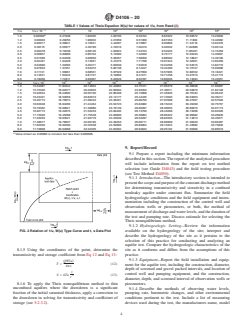
TABLE 1 Values of Theis Equation W(u) for values of 1/u, from Reed (2)
−1 2 3 4 5 6
1/u 1/u × 10 1 10 10 10 10 10 10
A
1.0 0.00000 0.21938 1.82292 4.03793 6.33154 8.63322 10.93572 13.23830
1.2 0.00003 0.29255 1.98932 4.21859 6.51369 8.81553 11.11804 13.42062
1.5 0.00017 0.39841 2.19641 4.44007 6.73667 9.03866 11.34118 13.64376
2.0 0.00115 0.55977 2.46790 4.72610 7.02419 9.32632 11.62886 13.93144
2.5 0.00378 0.70238 2.68126 4.94824 7.24723 9.54945 11.85201 14.15459
3.0 0.00857 0.82889 2.85704 5.12990 7.42949 9.73177 12.03433 14.33691
3.5 0.01566 0.94208 3.00650 5.28357 7.58359 9.88592 12.18847 14.49106
4.0 0.02491 1.04428 3.13651 5.41675 7.71708 10.01944 12.32201 14.62459
5.0 0.04890 1.22265 3.35471 5.63939 7.94018 10.24258 12.54515 14.84773
6.0 0.07833 1.37451 3.53372 5.82138 8.12247 10.42490 12.72747 15.03006
7.0 0.11131 1.50661 3.68551 5.97529 8.27659 10.57905 12.88162 15.18421
8.0 0.14641 1.62342 3.81727 6.10865 8.41011 10.71258 13.01515 15.31774
9.0 0.18266 1.72811 3.93367 6.22629 8.52787 10.83036 13.13294 15.43551
7 8 9 10 11 12 13 14
1/u 1/u × 10 10 10 10 10 10 10 10
1.0 15.54087 17.84344 20.14604 22.44862 24.75121 27.05379 29.36638 31.65897
1.2 15.72320 18.02577 20.32835 22.63094 24.93353 27.23611 29.53870 31.84128
1.5 15.94634 18.24892 20.55150 22.85408 25.15668 27.45926 29.76184 32.06442
2.0 16.23401 18.53659 20.83919 23.14177 25.44435 27.74693 30.04953 32.35211
2.5 16.45715 18.76974 21.06233 23.36491 25.66750 27.97008 30.27267 32.57526
3.0 16.63948 18.94206 21.24464 23.54723 25.84982 28.15240 30.45499 32.75757
3.5 16.79362 19.09621 21.39880 23.70139 26.00397 28.30655 30.60915 32.91173
4.0 16.92715 19.22975 21.53233 23.83492 26.13750 28.44008 30.74268 33.04526
5.0 17.15030 19.45288 21.75548 24.05806 26.36064 28.66322 30.96582 33.26840
6.0 17.33263 19.63521 21.93779 24.24039 26.54297 28.84555 31.14813 33.45071
7.0 17.48677 19.78937 22.09195 24.39453 26.69711 28.99969 31.30229 33.60487
8.0 17.62030 19.92290 22.22548 24.52806 26.83064 29.13324 31.43582 33.73840
9.0 17.73808 20.04068 22.34326 24.64584 26.94843 29.25102 31.55360 33.85619
A
Value shown as 0.00000 is nonzero but less than 0.000005.
FIG. 2 Relation of 1/u, W(u) Type Curve and t, s Data Plot
conditions and the field equipment and instrumentation including the construction of the control well and observation wells or
piezometers, or both, the method of measurement of discharge and water levels, and the duration of the test and pumping rate.
Discuss rationale for selecting the Theis nonequilibrium method.
9.1.2 Hydrogeologic Setting—Review the information available on the hydrogeology of the site; interpret and describe the
hydrogeology of the site as it pertains to the selection of this test method for conducting and analyzing an aquifer test. Compare
the hydrogeologic characteristics of the site as it conforms and differs from the assumptions of this test method.
9.1.3 Equipment—Report the field installation and equipment for the aquifer test, including the construction, diameter, depth of
screened and gravel packed intervals, and location of control well and pumping equipment, and the construction, diameter, depth,
and screened interval of observation wells or piezometers.
9.1.4 Describe the methods of observing water levels, pumping rate, barometric changes, and other environmental conditions
pertinent to the test. Include a list of measuring devices used during the test, the manufacturers name, model number, and basic
specifications for each major item, and the name and date and method of the last calibration, if applicable.
D4106 − 20
9.1.5 Testing Procedures—State the steps taken in conducting pre-test, drawdown, and recovery phases of the test. Include the
date, clock time, and time since pumping started or stopped for measurements of discharge rate, water levels, and other
environmental data recorded during the testing procedure.
9.2 Presentation and Interpretation of Test Results:
9.2.1 Data—Present tables of data collected during the test. Show methods of adjusting water levels for background water-level
and barometric changes and calculation of drawdown and residual drawdown.
9.2.2 Data Plots—Present data plots used in analysis of the data. Show overlays of data plots and type curve with match points
and corresponding values of parameters at match points.
9.2.3 Show calculation of transmissivity and storage coefficient.
9.2.4 Evaluate qualitatively the test on the basis of the adequacy of instrumentation, observations of stress and response, the
conformance of the hydrogeologic conditions, and the performance of the test to the assumptions of this test method.
10. Precision and Bias
10.1 Precision—Test data on precision is not presented due to the nature of the material (groundwater) tested by this test
method. It is either not feasible or too costly at this time to have ten or more laboratories participated in a round-robin testing
program. It is not practicable to specify the precision of this test method because the response of aquifer systems during aquifer
tests is dependent upon ambient system stresses.
10.2 Bias—There is no accepted reference value for this test method, therefore bias cannot be determined. No statement can be
made about bias because no true reference values exist.
11. Keywords
11.1 aquifer tests; aquifers; control wells; groundwater; hydraulic conductivity; observation wells; storage coefficient;
transmissivity
REFERENCES
(1) Theis, C. V., “The Relation Between the Lowering of the Piezometric Surface and the Rate and Duration of Discharge of a Well Using Ground-Water
Storage,” American Geophysical Union Transactions, Vol 16, Part 2, 1935, pp. 519–524.
(2) Reed, J. E., “Type Curves for Selected Problems of Flow to Wells in Confined Aquifers,” U.S. Geological Survey Techniques of Water-Resources
Investigations, Book 3, Chapter B3, 1980.
(3) Hantush, M. S., and Jacob, C. E., “Non-Steady Radial Flow in an Infinite Leaky Aquifer,” American Geophysical Union Transactions, Vol 36, No.
1, 1955, pp. 95–100.
(4) Weeks, E. P., “Aquifer Tests—The State of the Art in Hydrology” in Proceedings of the International Well-Testing Symposium, October 19–21, 1977,
Berkeley, California, LBL, 7027, Lawrence Berkeley Laboratory, pp 14–26.
(5) Jacob, C. C., “Determining the Permeability of Water-Table Aquifers,” in Bentall, Ray, compiler, “Methods of Determining Permeability,
Transmissibility, and Drawdown,” U.S. Geological Survey Water-Supply Paper 1536-I, 1963, pp. 245–271.
(6) Neuman, S. P., “Effect of Partial Penetration on Flow in Unconfined Aquifers Considering Delayed Gravity Response,” Water Resources Research
, Vol 10, No. 2, 1974, pp. 303–312.
(7) Wenzel, L. K., “Methods for Determining Permeability of Water-Bearing Materials, with Special Reference to Discharging Well Methods,” U.S.
Geological Survey Water Supply Paper 887, 1942.
D4106 − 20
SUMMARY OF CHANGES
In accordance wit
...