

ASTM E2479-16(2021)
(Practice)Standard Practice for Measuring the Ultrasonic Velocity in Polyethylene Tank Walls Using Lateral Longitudinal (LCR) Waves
General Information
- Abstract
ABSTRACT
This practice covers a procedure for measuring the ultrasonic velocities in the outer wall of polyethylene storage tanks. The practice is intended for application to the outer surfaces of the wall of polyethylene tanks. An angle beam lateral longitudinal (LCR) wave is excited with wedges along a circumferential chord of the tank wall. A digital ultrasonic flaw detector is used with sending-receiving search units in through transmission mode. The observed velocity is temperature corrected and compared to the expected velocity for a new, unexposed sample of material, which is the same as the material being evaluated. The difference between the observed and temperature corrected velocities determines the degree of UV exposure of the tank.
SIGNIFICANCE AND USE
5.1 Measuring the velocity of ultrasound in materials is a unique method for determining nondestructively the physical properties, which can vary due to both manufacturing processes and environmental attack. Velocity is directly related to the elastic moduli, which can vary based on environmental exposure and manufacturing process, The LCR method described herein is able to measure the velocity between two adjacent points on a surface and therefore is independent of the conditions on the opposite wall. Applications of the method beyond polymer tanks will undoubtedly be developed and examination may occur in the production line as well as in the in-service mode.
SCOPE
1.1 This practice covers a procedure for measuring the ultrasonic velocities in the outer wall of polyethylene storage tanks. An angle beam lateral longitudinal (LCR) wave is excited with wedges along a circumferential chord of the tank wall. A digital ultrasonic flaw detector is used with sending-receiving search units in through transmission mode. The observed velocity is temperature corrected and compared to the expected velocity for a new, unexposed sample of material which is the same as the material being evaluated. The difference between the observed and temperature corrected velocities determines the degree of UV exposure of the tank.
1.2 The practice is intended for application to the outer surfaces of the wall of polyethylene tanks. Degradation typically occurs in an outer layer approximately 3.2 mm (0.125 in.) thick. Since the technique does not interrogate the inside wall of the tank, wall thickness is not a consideration other than to be aware of possible guided (Lamb) wave effects or reflections off of the inner tank wall. No special surface preparation is necessary beyond wiping the area with a clean rag. Inside wall properties are not important since the longitudinal wave does not strike this surface. The excitation of Lamb waves must be avoided by choosing an excitation frequency such that the ratio of wavelength to wall thickness is one fifth or less.
1.3 UV degradation on the outer surface causes a stiffening of the material and an increase in Young's modulus and the longitudinal wave velocity.
1.4 The values stated in SI units are to be regarded as standard. The values given in parentheses are mathematical conversions to inch-pound units that are provided for information only and are not considered standard.
1.5 This standard does not purport to address all of the safety concerns, if any, associated with its use. It is the responsibility of the user of this standard to establish appropriate safety, health, and environmental practices and determine the applicability of regulatory limitations prior to use.
1.6 This international standard was developed in accordance with internationally recognized principles on standardization established in the Decision on Principles for the Development of International Standards, Guides and Recommendations issued by the World Trade Organization Technical Barriers to Trade (TBT) Committee.
- Status
- Published
- Publication Date
- 31-May-2021
- Technical Committee
- E07 - Nondestructive Testing
- Drafting Committee
- E07.06 - Ultrasonic Method
Overview
ASTM E2479-16(2021), published by ASTM International, specifies a standard practice for measuring ultrasonic velocity in the outer wall of polyethylene storage tanks using lateral longitudinal (LCR) waves. This nondestructive testing method is designed to assess the physical properties of polyethylene tank walls, particularly to determine the degree of ultraviolet (UV) exposure and material degradation. The procedure involves using an angle beam LCR wave, ultrasonic flaw detector, and a through-transmission setup to accurately measure ultrasonic wave velocity. Temperature corrections are applied to the observed velocities, and these values are compared to those of new, unexposed reference materials.
Key Topics
- Ultrasonic Velocity Measurement: The standard outlines procedures for exciting and receiving LCR waves with wedges along the tank wall’s circumferential chord, enabling accurate assessment of velocity independent of opposite wall conditions.
- Assessment of Material Degradation: The measured ultrasonic velocity, once corrected for temperature, is compared with that of new material to determine changes in the shell due to UV exposure. Increased velocity is typically associated with increased material stiffness and higher Young’s modulus, both indicators of degradation.
- Nondestructive Evaluation (NDE): The method enables in-service inspection of polyethylene tank walls, providing a nondestructive alternative for monitoring the effects of manufacturing or environmental factors such as UV exposure without needing invasive procedures.
- Equipment and Setup: Utilizes digital ultrasonic flaw detectors with dedicated angle beam search units, suitable reference standard blocks, and compatible couplants to ensure reliable measurements.
- Data Consistency and Standardization: Emphasizes standardization of measurement apparatus and procedures, repeated measurements at prescribed locations, and temperature correction for robust, repeatable data.
Applications
- Polyethylene Storage Tank Monitoring: The standard is primarily applied for routine maintenance, quality assurance, and service life evaluation of polyethylene storage tanks used in various industrial sectors, including chemical storage, water treatment, and agriculture.
- UV Exposure Assessment: By identifying increases in ultrasonic velocity, facility managers and inspectors can evaluate the degree of outer wall degradation from prolonged UV exposure and take timely action to extend tank life or plan replacements.
- Manufacturing Process Control: The practice can be adopted in production environments to ensure wall integrity and detect process-induced variations, supporting both acceptance testing and in-service inspection.
- Broader Nonmetallic Tank Evaluation: Though designed for polyethylene, the methodology outlines principles that may be adapted or further developed for use with other nonmetallic tanks or similar polymer structures, enhancing asset management programs.
Related Standards
ASTM E2479-16(2021) references several important standards to support comprehensive nondestructive testing programs:
- ASTM E494: Practice for Measuring Ultrasonic Velocity in Materials by Comparative Pulse-Echo Method
- ASTM E543: Specification for Agencies Performing Nondestructive Testing
- ASTM E1316: Terminology for Nondestructive Examinations
- ASTM E2373: Practice for Use of the Ultrasonic Time of Flight Diffraction (TOFD) Technique
- ASNT SNT-TC-1A / ANSI/ASNT CP-189: Qualification and Certification of Nondestructive Testing Personnel
- AIA/NAS-410: Nondestructive Testing Personnel Certification and Qualification
- ISO 9712: Non-Destructive Testing - Qualification and Certification of NDT Personnel
Practical Value
Implementing ASTM E2479-16(2021) provides measurable benefits for organizations needing reliable, nondestructive evaluation techniques in the field of ultrasonic testing, especially for polyethylene tank integrity. By following this standard, users can achieve:
- Improved safety and environmental compliance through regular wall integrity assessments
- Early detection of material degradation, reducing the risk of costly failures
- Consistent, standardized reporting and qualification of testing personnel
- The capability to refine asset management and maintenance strategies using accurate, temperature-corrected data
By naturally integrating these practical applications and supporting standards, facilities can maintain high standards for safety, performance, and lifecycle management of polymer-based containers and infrastructure.
Relations
- Effective Date
- 01-Feb-2024
- Effective Date
- 01-Dec-2019
- Effective Date
- 01-Mar-2019
- Effective Date
- 01-Jan-2018
- Effective Date
- 15-Jun-2017
- Effective Date
- 01-Feb-2017
- Effective Date
- 01-Aug-2016
- Effective Date
- 01-Feb-2016
- Effective Date
- 01-Dec-2015
- Effective Date
- 01-Sep-2015
- Effective Date
- 01-Jun-2014
- Effective Date
- 01-Jun-2014
- Effective Date
- 01-Dec-2013
- Effective Date
- 15-Jun-2013
- Effective Date
- 01-Jun-2013
Get Certified
Connect with accredited certification bodies for this standard

DIN CERTCO
DIN Group product certification.
Institut za varilstvo d.o.o. (Welding Institute)
Slovenia's leading welding institute since 1952. ISO 3834, EN 1090, pressure equipment certification, NDT personnel, welder qualification. Only IIW Au

Smithers Quality Assessments
US management systems and product certification.
Sponsored listings
Frequently Asked Questions
ASTM E2479-16(2021) is a standard published by ASTM International. Its full title is "Standard Practice for Measuring the Ultrasonic Velocity in Polyethylene Tank Walls Using Lateral Longitudinal (L<inf>CR</inf>) Waves". This standard covers: ABSTRACT This practice covers a procedure for measuring the ultrasonic velocities in the outer wall of polyethylene storage tanks. The practice is intended for application to the outer surfaces of the wall of polyethylene tanks. An angle beam lateral longitudinal (LCR) wave is excited with wedges along a circumferential chord of the tank wall. A digital ultrasonic flaw detector is used with sending-receiving search units in through transmission mode. The observed velocity is temperature corrected and compared to the expected velocity for a new, unexposed sample of material, which is the same as the material being evaluated. The difference between the observed and temperature corrected velocities determines the degree of UV exposure of the tank. SIGNIFICANCE AND USE 5.1 Measuring the velocity of ultrasound in materials is a unique method for determining nondestructively the physical properties, which can vary due to both manufacturing processes and environmental attack. Velocity is directly related to the elastic moduli, which can vary based on environmental exposure and manufacturing process, The LCR method described herein is able to measure the velocity between two adjacent points on a surface and therefore is independent of the conditions on the opposite wall. Applications of the method beyond polymer tanks will undoubtedly be developed and examination may occur in the production line as well as in the in-service mode. SCOPE 1.1 This practice covers a procedure for measuring the ultrasonic velocities in the outer wall of polyethylene storage tanks. An angle beam lateral longitudinal (LCR) wave is excited with wedges along a circumferential chord of the tank wall. A digital ultrasonic flaw detector is used with sending-receiving search units in through transmission mode. The observed velocity is temperature corrected and compared to the expected velocity for a new, unexposed sample of material which is the same as the material being evaluated. The difference between the observed and temperature corrected velocities determines the degree of UV exposure of the tank. 1.2 The practice is intended for application to the outer surfaces of the wall of polyethylene tanks. Degradation typically occurs in an outer layer approximately 3.2 mm (0.125 in.) thick. Since the technique does not interrogate the inside wall of the tank, wall thickness is not a consideration other than to be aware of possible guided (Lamb) wave effects or reflections off of the inner tank wall. No special surface preparation is necessary beyond wiping the area with a clean rag. Inside wall properties are not important since the longitudinal wave does not strike this surface. The excitation of Lamb waves must be avoided by choosing an excitation frequency such that the ratio of wavelength to wall thickness is one fifth or less. 1.3 UV degradation on the outer surface causes a stiffening of the material and an increase in Young's modulus and the longitudinal wave velocity. 1.4 The values stated in SI units are to be regarded as standard. The values given in parentheses are mathematical conversions to inch-pound units that are provided for information only and are not considered standard. 1.5 This standard does not purport to address all of the safety concerns, if any, associated with its use. It is the responsibility of the user of this standard to establish appropriate safety, health, and environmental practices and determine the applicability of regulatory limitations prior to use. 1.6 This international standard was developed in accordance with internationally recognized principles on standardization established in the Decision on Principles for the Development of International Standards, Guides and Recommendations issued by the World Trade Organization Technical Barriers to Trade (TBT) Committee.
ABSTRACT This practice covers a procedure for measuring the ultrasonic velocities in the outer wall of polyethylene storage tanks. The practice is intended for application to the outer surfaces of the wall of polyethylene tanks. An angle beam lateral longitudinal (LCR) wave is excited with wedges along a circumferential chord of the tank wall. A digital ultrasonic flaw detector is used with sending-receiving search units in through transmission mode. The observed velocity is temperature corrected and compared to the expected velocity for a new, unexposed sample of material, which is the same as the material being evaluated. The difference between the observed and temperature corrected velocities determines the degree of UV exposure of the tank. SIGNIFICANCE AND USE 5.1 Measuring the velocity of ultrasound in materials is a unique method for determining nondestructively the physical properties, which can vary due to both manufacturing processes and environmental attack. Velocity is directly related to the elastic moduli, which can vary based on environmental exposure and manufacturing process, The LCR method described herein is able to measure the velocity between two adjacent points on a surface and therefore is independent of the conditions on the opposite wall. Applications of the method beyond polymer tanks will undoubtedly be developed and examination may occur in the production line as well as in the in-service mode. SCOPE 1.1 This practice covers a procedure for measuring the ultrasonic velocities in the outer wall of polyethylene storage tanks. An angle beam lateral longitudinal (LCR) wave is excited with wedges along a circumferential chord of the tank wall. A digital ultrasonic flaw detector is used with sending-receiving search units in through transmission mode. The observed velocity is temperature corrected and compared to the expected velocity for a new, unexposed sample of material which is the same as the material being evaluated. The difference between the observed and temperature corrected velocities determines the degree of UV exposure of the tank. 1.2 The practice is intended for application to the outer surfaces of the wall of polyethylene tanks. Degradation typically occurs in an outer layer approximately 3.2 mm (0.125 in.) thick. Since the technique does not interrogate the inside wall of the tank, wall thickness is not a consideration other than to be aware of possible guided (Lamb) wave effects or reflections off of the inner tank wall. No special surface preparation is necessary beyond wiping the area with a clean rag. Inside wall properties are not important since the longitudinal wave does not strike this surface. The excitation of Lamb waves must be avoided by choosing an excitation frequency such that the ratio of wavelength to wall thickness is one fifth or less. 1.3 UV degradation on the outer surface causes a stiffening of the material and an increase in Young's modulus and the longitudinal wave velocity. 1.4 The values stated in SI units are to be regarded as standard. The values given in parentheses are mathematical conversions to inch-pound units that are provided for information only and are not considered standard. 1.5 This standard does not purport to address all of the safety concerns, if any, associated with its use. It is the responsibility of the user of this standard to establish appropriate safety, health, and environmental practices and determine the applicability of regulatory limitations prior to use. 1.6 This international standard was developed in accordance with internationally recognized principles on standardization established in the Decision on Principles for the Development of International Standards, Guides and Recommendations issued by the World Trade Organization Technical Barriers to Trade (TBT) Committee.
ASTM E2479-16(2021) is classified under the following ICS (International Classification for Standards) categories: 23.020.10 - Stationary containers and tanks; 83.080.01 - Plastics in general. The ICS classification helps identify the subject area and facilitates finding related standards.
ASTM E2479-16(2021) has the following relationships with other standards: It is inter standard links to ASTM E1316-24, ASTM E1316-19b, ASTM E1316-19, ASTM E1316-18, ASTM E1316-17a, ASTM E1316-17, ASTM E1316-16a, ASTM E1316-16, ASTM E1316-15a, ASTM E1316-15, ASTM E1316-14, ASTM E1316-14e1, ASTM E1316-13d, ASTM E1316-13c, ASTM E1316-13b. Understanding these relationships helps ensure you are using the most current and applicable version of the standard.
ASTM E2479-16(2021) is available in PDF format for immediate download after purchase. The document can be added to your cart and obtained through the secure checkout process. Digital delivery ensures instant access to the complete standard document.
Standards Content (Sample)
This international standard was developed in accordance with internationally recognized principles on standardization established in the Decision on Principles for the
Development of International Standards, Guides and Recommendations issued by the World Trade Organization Technical Barriers to Trade (TBT) Committee.
Designation: E2479 − 16 (Reapproved 2021)
Standard Practice for
Measuring the Ultrasonic Velocity in Polyethylene Tank
Walls Using Lateral Longitudinal (L ) Waves
CR
This standard is issued under the fixed designation E2479; the number immediately following the designation indicates the year of
original adoption or, in the case of revision, the year of last revision. A number in parentheses indicates the year of last reapproval. A
superscript epsilon (´) indicates an editorial change since the last revision or reapproval.
1. Scope* priate safety, health, and environmental practices and deter-
mine the applicability of regulatory limitations prior to use.
1.1 This practice covers a procedure for measuring the
1.6 This international standard was developed in accor-
ultrasonic velocities in the outer wall of polyethylene storage
dance with internationally recognized principles on standard-
tanks.Ananglebeamlaterallongitudinal(L )waveisexcited
CR
ization established in the Decision on Principles for the
with wedges along a circumferential chord of the tank wall. A
Development of International Standards, Guides and Recom-
digital ultrasonic flaw detector is used with sending-receiving
mendations issued by the World Trade Organization Technical
search units in through transmission mode. The observed
Barriers to Trade (TBT) Committee.
velocityistemperaturecorrectedandcomparedtotheexpected
velocity for a new, unexposed sample of material which is the
2. Referenced Documents
same as the material being evaluated. The difference between
2.1 ASTM Standards:
the observed and temperature corrected velocities determines
E494 Practice for Measuring Ultrasonic Velocity in Materi-
the degree of UV exposure of the tank.
als by Comparative Pulse-Echo Method
1.2 The practice is intended for application to the outer
E543 Specification forAgencies Performing Nondestructive
surfaces of the wall of polyethylene tanks. Degradation typi-
Testing
callyoccursinanouterlayerapproximately3.2mm(0.125in.)
E1316 Terminology for Nondestructive Examinations
thick. Since the technique does not interrogate the inside wall
E2373 Practice for Use of the Ultrasonic Time of Flight
of the tank, wall thickness is not a consideration other than to
Diffraction (TOFD) Technique
be aware of possible guided (Lamb) wave effects or reflections
2.2 ASNT Documents:
off of the inner tank wall. No special surface preparation is
SNT-TC-1A Recommended Practice for Nondestructive
necessary beyond wiping the area with a clean rag. Inside wall
Testing Personnel Qualification and Certification
properties are not important since the longitudinal wave does
ANSI/ASNT CP-189 ASNT Standard for Qualification and
not strike this surface. The excitation of Lamb waves must be
Certification of Nondestructive Testing Personnel
avoidedbychoosinganexcitationfrequencysuchthattheratio
2.3 AIA Document:
of wavelength to wall thickness is one fifth or less.
AIA/NAS-410 Nondestructive Testing Personnel Certifica-
tion and Qualification
1.3 UV degradation on the outer surface causes a stiffening
2.4 ISO Standard
of the material and an increase in Young’s modulus and the
ISO 9712 Non-Destructive Testing—Qualification and Cer-
longitudinal wave velocity.
tification of NDT Personnel
1.4 The values stated in SI units are to be regarded as
standard. The values given in parentheses are mathematical
3. Terminology
conversions to inch-pound units that are provided for informa-
3.1 Definitions—For definitions of terms used in this
tion only and are not considered standard.
practice, see Terminology E1316.
1.5 This standard does not purport to address all of the
safety concerns, if any, associated with its use. It is the
For referenced ASTM standards, visit the ASTM website, www.astm.org, or
responsibility of the user of this standard to establish appro-
contact ASTM Customer Service at service@astm.org. For Annual Book of ASTM
Standards volume information, refer to the standard’s Document Summary page on
the ASTM website.
AvailablefromAmericanSocietyforNondestructiveTesting(ASNT),P.O.Box
This practice is under the jurisdiction of ASTM Committee E07 on Nonde- 28518, 1711 Arlingate Ln., Columbus, OH 43228-0518, http://www.asnt.org.
structive Testing and is the direct responsibility of Subcommittee E07.06 on Available fromAerospace IndustriesAssociation ofAmerica, Inc. (AIA), 1000
Ultrasonic Method. WilsonBlvd.,Suite1700,Arlington,VA22209-3928,http://www.aia-aerospace.org.
Current edition approved June 1, 2021. Published June 2021. Originally Available from International Organization for Standardization (ISO), ISO
approved in 2006. Last previous edition approved in 2016 as E2479 – 16. DOI: Central Secretariat, BIBC II, Chemin de Blandonnet 8, CP 401, 1214 Vernier,
10.1520/E2479-16R21. Geneva, Switzerland, http://www.iso.org.
*A Summary of Changes section appears at the end of this standard
Copyright © ASTM International, 100 Barr Harbor Drive, PO Box C700, West Conshohocken, PA 19428-2959. United States
E2479 − 16 (2021)
4. Summary of Practice standard used and its applicable revision shall be identified in
the contractual agreement between the using parties.
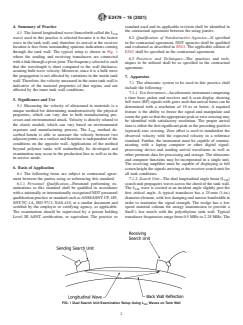
4.1 Thelaterallongitudinalwave(henceforthcalledtheL
CR
wave) used in this practice is selected because it is the fastest 6.2 Qualification of Nondestructive Agencies—If specified
wave in the tank wall, and, therefore its arrival at the receiver in the contractual agreement, NDT agencies shall be qualified
location is free from surrounding spurious indications coming and evaluated as described in E543. The applicable edition of
through the tank wall. The typical setup is shown in Fig. 1 E543 shall be specified in the contractual agreement.
where the sending and receiving transducers are connected
6.3 Practices and Techniques—The practices and tech-
withalinkthroughapivotjoint.Thefrequencyselectedissuch
niques to be utilized shall be as specified in the contractual
that the wavelength is short compared to the wall thickness,
agreement.
assuring bulk wave velocity. Moreover, since it is a bulk wave
the propagation is not affected by variations in the inside tank
7. Apparatus
wall. Therefore, the velocity measured in the outer tank wall is
7.1 The ultrasonic system to be used in this practice shall
indicative of the material properties of that region, and not
include the following:
affected by the inner tank wall conditions.
7.1.1 Test Instrument—An ultrasonic instrument comprising
a time base, pulser and receiver and A-scan display showing
5. Significance and Use
full wave (RF) signals with gates such that arrival times can be
5.1 Measuring the velocity of ultrasound in materials is a
determined with a resolution of 10 ns or better. A required
unique method for determining nondestructively the physical
feature is the ability to freeze the signal and manipulate and
properties, which can vary due to both manufacturing pro-
zoomthegatesothattheappropriatepeakorzerocrossingmay
cesses and environmental attack. Velocity is directly related to
be identified with satisfactory resolution. The proper arrival
the elastic moduli, which can vary based on environmental
time is either the first significant peak or the preceding positive
exposure and manufacturing process, The L method de-
CR
(upward) zero crossing. Zero offset is used to standardize the
scribed herein is able to measure the velocity between two
observed velocity with the expected velocity in a reference
adjacent points on a surface and therefore is independent of the
standard. Further, the instrument must be capable of commu-
conditions on the opposite wall. Applications of the method
nicating with a laptop computer or other digital signal-
beyond polymer tanks will undoubtedly be developed and
processing device and sending arrival waveforms as well as
examination may occur in the production line as well as in the
other pertinent data for processing and storage. The ultrasonic
in-service mode.
and computer functions may be incorporated in a single unit.
The receiving amplifier must be capable of displaying at full
6. Basis of Application
screen height the signals arriving at the receiver search unit for
6.1 The following items are subject to contractual agree- all tank conditions.
ment between the parties using or referencing this standard. 7.1.2 Search Unit—The dual longitudinal angle beam (L )
CR
6.1.1 Personnel Qualification—Personnel performing ex- search unit propagates waves across the chord of the tank wall.
aminations to this standard shall be qualified in accordance The L wave is excited at an incident angle slightly past the
CR
with a nationally or internationally recognized NDT personnel first critical angle. A typical transducer has a 25-mm (1-in.)
qualification practice or standard such asANSI/ASNTCP-189, diameter element, with low damping and narrow bandwidth in
SNT-TC-1A, ISO 9712, NAS-410, or a similar document and order to maximize the signal strength. The wedge has a low
certified by the employer or certifying agency, as applicable. speed material column for energy transmission to provide a
The examination should be supervised by a person holding Snell’s law match with the polyethylene tank wall. Typical
Level III ASNT certification, or equivalent. The practice or transducer frequencies range from 0.5 MHz to 2.25 MHz, The
FIG. 1 Dual Search Unit Examination Setup Using L Waves on Tank Wall
CR
E2479 − 16 (2021)
frequency must be high enough to assure that no Lamb waves is required since there is some initial priming of the surface
are excited in the tank wall. Search unit separation must be needed for full transmission into the material. Place the search
greater than the near field estimated experimentally using the unit on the area of the tank to be examined. When looking at
standardization block and must be such that the longitudinal the dual search unit, the two search units should be in a
wave travels across the chord of the tank wall and does not circumferential arrangement. The dual search unit assembly is
strike the inside wall. A typical distance is 47 mm (1.85 in.), spring loaded. Manipulate the search unit assembly until a
but may be adjusted to other spacing to accommodate exami- good signal is visible on the screen. Repeat couplant applica-
nation in moderate and low loss polymers and different tank tion if needed for additional surface priming. Once a good
wall thicknesses. signal has been found, the signal should be frozen with the
7.1.3 Couplant—Standard ultrasonic gel type couplants are ultrasonic unit for further analysis. The gate may be moved to
the appropriate point on the wave as discussed above.The tank
preferred. The couplant must adhere to the sidewall of the tank
and not run off, yet it must be easily wiped off when the wall velocity may then be calculated.
examinations are completed, leaving no significant residue. It
8.1.3 Formaximumconfidence,thepracticeoffullremoval,
must be fully compatible with the polyethylene tank material.
wiping and reapplication of the couplant should be repeated
7.1.4 Computer—The computer supporting this examina- several times at each search unit position. Since there will
tionshouldbeabletostorefullsiteandtankdetailinformation. always be some scatter in the data, a minimum of three values
Further, it should be able to calculate the true travel path based should be obtained at each location of interest.
on probe separation and tank curvature. It should be able to
8.1.4 The L wave traversing the chord of the tank wall
CR
calculate expected velocity at the wall temperature during the
should appear as the first arriving signal on the flaw detector
test. The difference between the expected speed for new
screen after the initial pulse. A short gate (time less than one
material at the test temperature and the observed speed is the
wavelength) is used to identify the arrival time of the L
CR
parameter used to evaluate tank wall condition. Manual data
wave. Fig. 2 sho
...