

ASTM F2227-13(2021)
(Test Method)Standard Test Method for Non-Destructive Detection of Leaks in Non-sealed and Empty Packaging Trays by CO2 Tracer Gas Method
General Information
- Abstract
SIGNIFICANCE AND USE
5.1 Harmful biological or particulate contaminants may enter the package through imperfections such as pinholes or cracks in trays.
5.2 After initial instrument set-up and calibration, the operations of individual tests and test results do not need operator interpretation.
5.3 Leak test results that exceed the permissible threshold setting are indicated by audible or visual signal responses, or both, or by other means.
5.4 This non-destructive test method may be performed in either laboratory or production environments and may be undertaken on either a 100 % or a statistical sampling basis. This test method, in single instrument use and current implementation, may not be fast enough to work on a production packaging line, but is well suited for statistical testing as well as package developmental design work.
SCOPE
1.1 This non-destructive test method detects pinhole leaks in trays, as small as 50 μm (0.002 in.) in diameter, or equivalently sized cracks, subject to trace gas concentration in the tray, tray design and manufacturing tolerances.
1.2 The values stated in SI units are to be regarded as standard. The values given in parentheses after SI units are provided for information only and are not considered standard.
1.3 This standard does not purport to address all of the safety concerns, if any, associated with its use. It is the responsibility of the user of this standard to establish appropriate safety, health, and environmental practices and determine the applicability of regulatory limitations prior to use.
1.4 This international standard was developed in accordance with internationally recognized principles on standardization established in the Decision on Principles for the Development of International Standards, Guides and Recommendations issued by the World Trade Organization Technical Barriers to Trade (TBT) Committee.
- Status
- Published
- Publication Date
- 14-Jan-2021
- Technical Committee
- F02 - Primary Barrier Packaging
- Drafting Committee
- F02.40 - Package Integrity

Overview
ASTM F2227-13(2021) is the internationally recognized standard test method for the non-destructive detection of leaks in non-sealed and empty packaging trays utilizing the carbon dioxide (CO₂) tracer gas method. Developed under the jurisdiction of ASTM Committee F02 on Primary Barrier Packaging, this standard ensures the integrity of packaging-particularly in medical and sensitive product applications-by providing a reliable method to detect pinhole leaks or cracks that could compromise sterility or product quality.
This non-destructive method can identify leaks as small as 50 micrometers (0.002 inches) in diameter, making it highly sensitive and effective for assessing package integrity either in laboratory settings or production environments.
Key Topics
- CO₂ Tracer Gas Leak Detection: Uses carbon dioxide as a trace gas to detect and quantify leaks in packaging trays.
- Non-Destructive Testing: Enables verification of package integrity without damaging the packaging, preserving product usability.
- Automation and Signal Response: After the initial instrument setup and calibration, the test yields objective pass/fail results via audible or visual signals, reducing the need for operator interpretation.
- Sensitivity and Precision: Detects minute imperfections such as pinholes or cracks, providing high levels of accuracy essential for critical packaging.
- Test Environments: Applicable in both laboratory and production settings, suitable for 100% or statistical sampling of packaging trays.
- Documentation and Traceability: Requires thorough reporting and record-keeping, including instrument calibration and individual or batch details of tested trays.
Applications
ASTM F2227-13(2021) finds strong practical use in sectors where package integrity is crucial to product safety and sterility, such as:
- Medical Packaging: Ensures that packaging trays used for medical devices or pharmaceutical products are free from leaks, protecting contents from biological and particulate contamination.
- Food and Sensitive Goods: Assures integrity in packaging for food or electronics, where exposure to external contaminants could impact safety or function.
- Quality Control & Product Development: An invaluable tool for package design validation and ongoing quality assurance; the method is ideal for statistical sampling or developmental testing, rather than fast-paced production lines.
- Regulatory Compliance: Supports organizations in maintaining compliance with global packaging standards and regulatory expectations related to product safety.
Related Standards
Users of ASTM F2227-13(2021) may also benefit from familiarity with related packaging standards and terminology, including:
- ASTM D996: Terminology of Packaging and Distribution Environments
- ASTM F1327: Terminology Relating to Barrier Materials for Medical Packaging (Withdrawn 2007, but references remain relevant)
- ISO and EN Packaging Standards: For harmonizing global practices and compliance, especially when shipping products internationally.
Summary of Benefits
Implementing the ASTM F2227-13(2021) standard in your quality assurance processes facilitates:
- Enhanced detection of micro-leaks in packaging trays, thereby reducing contamination risks.
- Consistent and objective test results through a validated and automated process.
- Support for international market access with a test method aligned with World Trade Organization’s recognized standardization principles.
By incorporating this non-destructive CO₂ tracer gas test method, manufacturers and quality professionals fortify their packaging integrity monitoring, ensuring products reach end-users securely and safely.
For further details and official documentation, refer to the ASTM International website and consult the full text of the standard.
Relations
- Effective Date
- 01-Dec-2010
- Effective Date
- 01-Apr-2005
- Effective Date
- 01-Apr-2004
- Effective Date
- 10-Apr-2002
- Effective Date
- 10-Apr-2002
- Effective Date
- 10-Apr-1998
Get Certified
Connect with accredited certification bodies for this standard

BSI Group
BSI (British Standards Institution) is the business standards company that helps organizations make excellence a habit.

TÜV Rheinland
TÜV Rheinland is a leading international provider of technical services.

TÜV SÜD
TÜV SÜD is a trusted partner of choice for safety, security and sustainability solutions.
Sponsored listings
Frequently Asked Questions
ASTM F2227-13(2021) is a standard published by ASTM International. Its full title is "Standard Test Method for Non-Destructive Detection of Leaks in Non-sealed and Empty Packaging Trays by CO<inf>2</inf> Tracer Gas Method". This standard covers: SIGNIFICANCE AND USE 5.1 Harmful biological or particulate contaminants may enter the package through imperfections such as pinholes or cracks in trays. 5.2 After initial instrument set-up and calibration, the operations of individual tests and test results do not need operator interpretation. 5.3 Leak test results that exceed the permissible threshold setting are indicated by audible or visual signal responses, or both, or by other means. 5.4 This non-destructive test method may be performed in either laboratory or production environments and may be undertaken on either a 100 % or a statistical sampling basis. This test method, in single instrument use and current implementation, may not be fast enough to work on a production packaging line, but is well suited for statistical testing as well as package developmental design work. SCOPE 1.1 This non-destructive test method detects pinhole leaks in trays, as small as 50 μm (0.002 in.) in diameter, or equivalently sized cracks, subject to trace gas concentration in the tray, tray design and manufacturing tolerances. 1.2 The values stated in SI units are to be regarded as standard. The values given in parentheses after SI units are provided for information only and are not considered standard. 1.3 This standard does not purport to address all of the safety concerns, if any, associated with its use. It is the responsibility of the user of this standard to establish appropriate safety, health, and environmental practices and determine the applicability of regulatory limitations prior to use. 1.4 This international standard was developed in accordance with internationally recognized principles on standardization established in the Decision on Principles for the Development of International Standards, Guides and Recommendations issued by the World Trade Organization Technical Barriers to Trade (TBT) Committee.
SIGNIFICANCE AND USE 5.1 Harmful biological or particulate contaminants may enter the package through imperfections such as pinholes or cracks in trays. 5.2 After initial instrument set-up and calibration, the operations of individual tests and test results do not need operator interpretation. 5.3 Leak test results that exceed the permissible threshold setting are indicated by audible or visual signal responses, or both, or by other means. 5.4 This non-destructive test method may be performed in either laboratory or production environments and may be undertaken on either a 100 % or a statistical sampling basis. This test method, in single instrument use and current implementation, may not be fast enough to work on a production packaging line, but is well suited for statistical testing as well as package developmental design work. SCOPE 1.1 This non-destructive test method detects pinhole leaks in trays, as small as 50 μm (0.002 in.) in diameter, or equivalently sized cracks, subject to trace gas concentration in the tray, tray design and manufacturing tolerances. 1.2 The values stated in SI units are to be regarded as standard. The values given in parentheses after SI units are provided for information only and are not considered standard. 1.3 This standard does not purport to address all of the safety concerns, if any, associated with its use. It is the responsibility of the user of this standard to establish appropriate safety, health, and environmental practices and determine the applicability of regulatory limitations prior to use. 1.4 This international standard was developed in accordance with internationally recognized principles on standardization established in the Decision on Principles for the Development of International Standards, Guides and Recommendations issued by the World Trade Organization Technical Barriers to Trade (TBT) Committee.
ASTM F2227-13(2021) is classified under the following ICS (International Classification for Standards) categories: 11.020 - Medical sciences and health care facilities in general; 19.100 - Non-destructive testing. The ICS classification helps identify the subject area and facilitates finding related standards.
ASTM F2227-13(2021) has the following relationships with other standards: It is inter standard links to ASTM D996-10a, ASTM F1327-05, ASTM D996-04, ASTM D996-02, ASTM D996-99, ASTM F1327-98. Understanding these relationships helps ensure you are using the most current and applicable version of the standard.
ASTM F2227-13(2021) is available in PDF format for immediate download after purchase. The document can be added to your cart and obtained through the secure checkout process. Digital delivery ensures instant access to the complete standard document.
Standards Content (Sample)
This international standard was developed in accordance with internationally recognized principles on standardization established in the Decision on Principles for the
Development of International Standards, Guides and Recommendations issued by the World Trade Organization Technical Barriers to Trade (TBT) Committee.
Designation: F2227 − 13 (Reapproved 2021)
Standard Test Method for
Non-Destructive Detection of Leaks in Non-sealed and
Empty Packaging Trays by CO Tracer Gas Method
This standard is issued under the fixed designation F2227; the number immediately following the designation indicates the year of
original adoption or, in the case of revision, the year of last revision. A number in parentheses indicates the year of last reapproval. A
superscript epsilon (´) indicates an editorial change since the last revision or reapproval.
1. Scope 3.2 Definitions of Terms Specific to This Standard:
3.2.1 trace gas, n—a compound selected solely for use to
1.1 This non-destructive test method detects pinhole leaks
identify leakage flow.
in trays, as small as 50 µm (0.002 in.) in diameter, or
equivalently sized cracks, subject to trace gas concentration in
4. Summary of Test Method
the tray, tray design and manufacturing tolerances.
4.1 This test method utilizes CO sensing techniques in the
1.2 The values stated in SI units are to be regarded as
detection of a CO trace gas to quantify leaks in medical
standard. The values given in parentheses after SI units are
packaging trays. The test method provides a qualitative
provided for information only and are not considered standard.
(accept/reject) inspection method to evaluate trays for pinholes
1.3 This standard does not purport to address all of the
and cracks. Further information on the “Leak Test Theory”
safety concerns, if any, associated with its use. It is the
may be found in Annex A1.
responsibility of the user of this standard to establish appro-
priate safety, health, and environmental practices and deter-
5. Significance and Use
mine the applicability of regulatory limitations prior to use.
5.1 Harmful biological or particulate contaminants may
1.4 This international standard was developed in accor-
enter the package through imperfections such as pinholes or
dance with internationally recognized principles on standard-
cracks in trays.
ization established in the Decision on Principles for the
Development of International Standards, Guides and Recom-
5.2 After initial instrument set-up and calibration, the op-
mendations issued by the World Trade Organization Technical
erations of individual tests and test results do not need operator
Barriers to Trade (TBT) Committee.
interpretation.
5.3 Leak test results that exceed the permissible threshold
2. Referenced Documents
setting are indicated by audible or visual signal responses, or
2.1 ASTM Standards:
both, or by other means.
D996 Terminology of Packaging and Distribution Environ-
5.4 This non-destructive test method may be performed in
ments
either laboratory or production environments and may be
F1327 Terminology Relating to Barrier Materials for Medi-
3 undertaken on either a 100 % or a statistical sampling basis.
cal Packaging (Withdrawn 2007)
This test method, in single instrument use and current
implementation, may not be fast enough to work on a produc-
3. Terminology
tion packaging line, but is well suited for statistical testing as
3.1 General Term Definitions—For definitions used in this
well as package developmental design work.
test method, see Terminologies D996 and F1327, Sections 3.
6. Apparatus
6.1 Non-destructive Trace Gas Leak Detection Apparatus—
This test method is under the jurisdiction ofASTM Committee F02 on Primary
Barrier Packaging and is the direct responsibility of Subcommittee F02.40 on
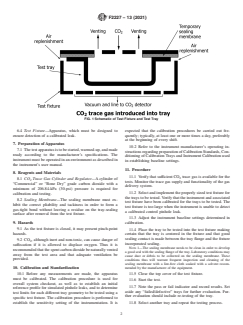
The apparatus’test fixture consists of three major elements and
Package Integrity.
is shown in Fig. 1.
Current edition approved Jan. 15, 2021. Published February 2021. Originally
approved in 2002. Last previous edition approved in 2013 as F2227 – 13. DOI:
6.2 Sealing Membrane—The purpose of the membrane is to
10.1520/F2227-13R21.
seal off the tracer gas transmission out of the top of the open
For referenced ASTM standards, visit the ASTM website, www.astm.org, or
tray.
contact ASTM Customer Service at service@astm.org. For Annual Book of ASTM
Standards volume information, refer to the standard’s Document Summary page on
6.3 Control Trays—Calibrated pinholes, or leaks, con-
the ASTM website.
structedincontroltraysforinstrumentcalibrationaswellasfor
The last approved version of this historical standard is referenced on
www.astm.org. test procedure verification.
Copyright © ASTM International, 100 Barr Harbor Drive, PO Box C700, West Conshohocken, PA 19428-2959. United States
F2227 − 13 (2021)
FIG. 1 Schematic of Test Fixture and Test Tray
6.4 Test Fixture—Apparatus, which must be designed to expected that the calibration procedures be carried out fre-
ensure detection of a calibrated leak. quently; typically, at least one or more times a day, preferably
at the beginning of every shift.
7. Preparation of Apparatus
10.2 Refer to the instrument manufacturer’s operating in-
7.1 Thetestapparatusistobestarted,warmed-up,andmade
structionsregardingpreparationofCalibrationStandards,Con-
ready according to the manufacturer’s specifications. The
ditioning of Calibration Trays and Instrument Calibration used
instrument must be operated in an environment as described in
in establishing baseline settings.
the instrument’s user manual.
11. Procedure
8. Reagents and Materials
11.1 Verify that sufficient CO trace gas is available for the
8.1 CO Trace Gas Cylinder and Regulator—A cylinder of
tests. Monitor the trace gas supply and functionality of the gas
“Commercial” or “Bone Dry” grade carbon dioxide with a
delivery system.
minimum of 206.84-kPa (30-psi) pressure is required for
11.2 Select and implement the properly sized test fixture for
calibration and testing.
the trays to be tested. Verify that the instrument and associated
8.2 Sealing Membrane—The sealing membrane must ex-
test fixture have been calibrated for the trays to be tested. The
hibit the correct pliability and tackiness in order to form a
test fixture is too large when the instrument is unable to detect
gas-tight bond without leaving a residue on the tray-sealing
a calibrated control pinhole leak.
surface after removal from the test fixture.
11.3 Adjust the instrument baseline settings determined in
9. Hazards calibration.
9.1 As the test fixture is closed, it may present pinch-point
11.4 Place the tray to be tested into the test fixture making
hazards. certain that the tray is centered in the fixture and that good
sealing contact is made between the tray flange and the fixture
9.2 CO , although inert and non-toxic, can cause danger of
incorporated sealing.
suffocation if it is allowed to displace oxygen. Thus it is
NOTE 1—The sealing membrane needs to be clean in order to develop
recommendedthatthespentcarbondioxidebenaturallyvented
a good seal with the sealing flange of the tray. Laboratory conditions may
away from the test area and that adequate ventilation be
cause dust or debris to be collected on the sealing membrane. These
provided.
conditions thus will warrant frequent inspection and cleaning of the
sealing membrane with a lint-free cloth soaked with a solvent recom-
10. Calibration and Standardization mended by the manufacturer of the equipment.
10.1 Before any measurements are made, the apparatus 11.5 Close the top cover of the test fixture.
must be calibrated. The calibration procedure is used for
11.6 Start the test.
overall system checkout, as well as to establish an initial
11.7 Note the pass or fail indicator and record results. Set
reference profile for simulated pinhole leaks, and to determine
aside any “failed/defective” trays for further evaluation. Fur-
test limits for each different tray geometry to be tested using a
ther evaluation should include re-testing of the tray.
specific test fixture. The calibration procedure is perfo
...