

ASTM G189-07(2021)e1
(Guide)Standard Guide for Laboratory Simulation of Corrosion Under Insulation
General Information
- Abstract
SIGNIFICANCE AND USE
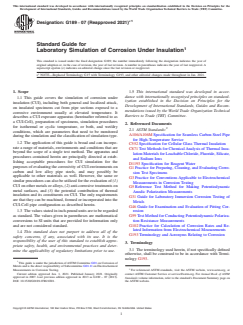
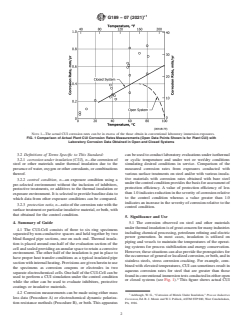
5.1 The corrosion observed on steel and other materials under thermal insulation is of great concern for many industries including chemical processing, petroleum refining and electric power generation. In most cases, insulation is utilized on piping and vessels to maintain the temperatures of the operating systems for process stabilization and energy conservation. However, these situations can also provide the prerequisites for the occurrence of general or localized corrosion, or both, and in stainless steels, stress corrosion cracking. For example, combined with elevated temperatures, CUI can sometimes result in aqueous corrosion rates for steel that are greater than those found in conventional immersion tests conducted in either open or closed systems (see Fig. 1).3 This figure shows actual CUI data determined in the field compared with the corrosion data from fully immersed corrosion coupons tests.
FIG. 1 Comparison of Actual Plant CUI Corrosion Rates Measurements (Open Data Points Shown is for Plant CUI) with Laboratory Corrosion Data Obtained in Open and Closed Systems
Note 1: The actual CUI corrosion rates can be in excess of the those obtain in conventional laboratory immersion exposures.
5.2 This guide provides a technical basis for laboratory simulation of many of the manifestations of CUI. This is an area where there has been a need for better simulation techniques, but until recently, has eluded many investigators. Much of the available experimental data is based on field and in-plant measurements of remaining wall thickness. Laboratory studies have generally been limited to simple immersion tests for the corrosivity of leachants from thermal insulation on corrosion coupons using techniques similar to those given in Guide G31. The field and inplant tests give an indication of corrosion after the fact and can not be easily utilized for experimental purposes. The use of coupons in laboratory immersion tests can give a general indication of corrosio...
SCOPE
1.1 This guide covers the simulation of corrosion under insulation (CUI), including both general and localized attack, on insulated specimens cut from pipe sections exposed to a corrosive environment usually at elevated temperature. It describes a CUI exposure apparatus (hereinafter referred to as a CUI-Cell), preparation of specimens, simulation procedures for isothermal or cyclic temperature, or both, and wet/dry conditions, which are parameters that need to be monitored during the simulation and the classification of simulation type.
1.2 The application of this guide is broad and can incorporate a range of materials, environments and conditions that are beyond the scope of a single test method. The apparatus and procedures contained herein are principally directed at establishing acceptable procedures for CUI simulation for the purposes of evaluating the corrosivity of CUI environments on carbon and low alloy pipe steels, and may possibly be applicable to other materials as well. However, the same or similar procedures can also be utilized for the evaluation of (1) CUI on other metals or alloys, (2) anti-corrosive treatments on metal surfaces, and (3) the potential contribution of thermal insulation and its constituents on CUI. The only requirements are that they can be machined, formed or incorporated into the CUI-Cell pipe configuration as described herein.
1.3 The values stated in inch-pound units are to be regarded as standard. The values given in parentheses are mathematical conversions to SI units that are provided for information only and are not considered standard.
1.4 This standard does not purport to address all of the safety concerns, if any, associated with its use. It is the responsibility of the user of this standard to establish appropriate safety, health, and environmental practices and determine the applicability of regulatory limitations prior to use.
1.5 This international standard was ...
- Status
- Published
- Publication Date
- 31-Dec-2020
- Technical Committee
- G01 - Corrosion of Metals
- Drafting Committee
- G01.11 - Electrochemical Measurements in Corrosion Testing
Overview
ASTM G189-07(2021)e1 is the standard guide developed by ASTM International for the laboratory simulation of corrosion under insulation (CUI). CUI is a significant concern for industries that utilize thermal insulation on piping and vessels, such as chemical processing, petroleum refining, and electric power generation. The standard provides procedures for simulating CUI on insulated specimens, typically using pipe sections exposed to corrosive environments at elevated temperatures. Its guidance is intended to facilitate more accurate, laboratory-based measurement and evaluation of general and localized corrosion-including stress corrosion cracking for stainless steels-that occurs beneath insulation.
Key Topics
- Corrosion Under Insulation (CUI): Simulates general and localized corrosion affecting steel and other materials under thermal insulation, caused by moisture, oxygen, or contaminants.
- Simulation Apparatus and Methods: Describes the design and use of a CUI-Cell-a laboratory exposure device-outlining specimen preparation, operational procedures, and environmental controls for simulating both isothermal and cyclic temperature conditions, as well as wet/dry cycles.
- Test Parameters: Addresses the importance of monitoring conditions such as temperature, solution chemistry, exposure geometry, and wet/dry cycles to reflect real-world service environments.
- Evaluation Techniques: Includes both mass loss (weight change) and electrochemical measurement methods (e.g., polarization resistance) to assess the severity and rate of corrosion.
- Applicability: Procedures can be adapted for carbon steel, low alloy pipe steels, other metals and alloys, evaluation of anti-corrosive treatments, and assessment of insulation materials.
Applications
ASTM G189 serves a wide range of practical uses within industries reliant on insulated process piping and vessels:
- Material and Insulation Selection: Enables testing and comparison of different pipe materials and insulation types for CUI resistance before field application.
- Protective Treatment Testing: Assesses the effectiveness of coatings or inhibitors applied to metal surfaces in mitigating CUI.
- Product Development: Supports manufacturers in developing and qualifying new insulation materials and corrosion-resistant coatings by providing standardized test procedures.
- Research and Development: Facilitates academic and industrial research to understand CUI mechanisms and the impact of various environmental factors under controlled laboratory conditions.
- Failure Analysis and Maintenance Planning: Helps in developing maintenance strategies by providing data on corrosion behavior in simulated service environments.
These applications contribute to improved asset integrity, reduced maintenance costs, and enhanced safety in critical infrastructure.
Related Standards
ASTM G189 references and aligns with several other ASTM standards relevant to corrosion testing and insulation materials, including:
- ASTM G1 - Preparing, Cleaning, and Evaluating Corrosion Test Specimens
- ASTM G31 - Laboratory Immersion Corrosion Testing of Metals
- ASTM G46 - Examination and Evaluation of Pitting Corrosion
- ASTM G59 - Conducting Potentiodynamic Polarization Resistance Measurements
- ASTM G193 - Terminology and Acronyms Relating to Corrosion
- ASTM D1193 - Specification for Reagent Water
- ASTM C552 - Specification for Cellular Glass Thermal Insulation
- ASTM C871 - Test Methods for Chemical Analysis of Thermal Insulation Materials for Leachable Chloride, Fluoride, Silicate, and Sodium Ions
These standards collectively provide a comprehensive framework for conducting credible, repeatable corrosion under insulation tests and for interpreting results in line with industry best practices.
Keywords: corrosion under insulation, CUI, laboratory simulation, thermal insulation, ASTM G189, mass loss, polarization resistance, test methods, piping corrosion, insulation materials, asset integrity.
Relations
- Effective Date
- 01-Nov-2019
- Effective Date
- 01-May-2019
- Effective Date
- 01-Oct-2017
- Effective Date
- 01-Sep-2016
- Effective Date
- 01-Mar-2016
- Effective Date
- 01-May-2015
- Effective Date
- 15-Dec-2014
- Effective Date
- 01-Nov-2014
- Effective Date
- 01-Sep-2014
- Effective Date
- 01-Jun-2014
- Effective Date
- 01-Dec-2013
- Effective Date
- 01-Oct-2013
- Effective Date
- 01-Sep-2013
- Effective Date
- 01-May-2013
- Effective Date
- 01-Feb-2013
Get Certified
Connect with accredited certification bodies for this standard

Institut za varilstvo d.o.o. (Welding Institute)
Slovenia's leading welding institute since 1952. ISO 3834, EN 1090, pressure equipment certification, NDT personnel, welder qualification. Only IIW Au
Sponsored listings
Frequently Asked Questions
ASTM G189-07(2021)e1 is a guide published by ASTM International. Its full title is "Standard Guide for Laboratory Simulation of Corrosion Under Insulation". This standard covers: SIGNIFICANCE AND USE 5.1 The corrosion observed on steel and other materials under thermal insulation is of great concern for many industries including chemical processing, petroleum refining and electric power generation. In most cases, insulation is utilized on piping and vessels to maintain the temperatures of the operating systems for process stabilization and energy conservation. However, these situations can also provide the prerequisites for the occurrence of general or localized corrosion, or both, and in stainless steels, stress corrosion cracking. For example, combined with elevated temperatures, CUI can sometimes result in aqueous corrosion rates for steel that are greater than those found in conventional immersion tests conducted in either open or closed systems (see Fig. 1).3 This figure shows actual CUI data determined in the field compared with the corrosion data from fully immersed corrosion coupons tests. FIG. 1 Comparison of Actual Plant CUI Corrosion Rates Measurements (Open Data Points Shown is for Plant CUI) with Laboratory Corrosion Data Obtained in Open and Closed Systems Note 1: The actual CUI corrosion rates can be in excess of the those obtain in conventional laboratory immersion exposures. 5.2 This guide provides a technical basis for laboratory simulation of many of the manifestations of CUI. This is an area where there has been a need for better simulation techniques, but until recently, has eluded many investigators. Much of the available experimental data is based on field and in-plant measurements of remaining wall thickness. Laboratory studies have generally been limited to simple immersion tests for the corrosivity of leachants from thermal insulation on corrosion coupons using techniques similar to those given in Guide G31. The field and inplant tests give an indication of corrosion after the fact and can not be easily utilized for experimental purposes. The use of coupons in laboratory immersion tests can give a general indication of corrosio... SCOPE 1.1 This guide covers the simulation of corrosion under insulation (CUI), including both general and localized attack, on insulated specimens cut from pipe sections exposed to a corrosive environment usually at elevated temperature. It describes a CUI exposure apparatus (hereinafter referred to as a CUI-Cell), preparation of specimens, simulation procedures for isothermal or cyclic temperature, or both, and wet/dry conditions, which are parameters that need to be monitored during the simulation and the classification of simulation type. 1.2 The application of this guide is broad and can incorporate a range of materials, environments and conditions that are beyond the scope of a single test method. The apparatus and procedures contained herein are principally directed at establishing acceptable procedures for CUI simulation for the purposes of evaluating the corrosivity of CUI environments on carbon and low alloy pipe steels, and may possibly be applicable to other materials as well. However, the same or similar procedures can also be utilized for the evaluation of (1) CUI on other metals or alloys, (2) anti-corrosive treatments on metal surfaces, and (3) the potential contribution of thermal insulation and its constituents on CUI. The only requirements are that they can be machined, formed or incorporated into the CUI-Cell pipe configuration as described herein. 1.3 The values stated in inch-pound units are to be regarded as standard. The values given in parentheses are mathematical conversions to SI units that are provided for information only and are not considered standard. 1.4 This standard does not purport to address all of the safety concerns, if any, associated with its use. It is the responsibility of the user of this standard to establish appropriate safety, health, and environmental practices and determine the applicability of regulatory limitations prior to use. 1.5 This international standard was ...
SIGNIFICANCE AND USE 5.1 The corrosion observed on steel and other materials under thermal insulation is of great concern for many industries including chemical processing, petroleum refining and electric power generation. In most cases, insulation is utilized on piping and vessels to maintain the temperatures of the operating systems for process stabilization and energy conservation. However, these situations can also provide the prerequisites for the occurrence of general or localized corrosion, or both, and in stainless steels, stress corrosion cracking. For example, combined with elevated temperatures, CUI can sometimes result in aqueous corrosion rates for steel that are greater than those found in conventional immersion tests conducted in either open or closed systems (see Fig. 1).3 This figure shows actual CUI data determined in the field compared with the corrosion data from fully immersed corrosion coupons tests. FIG. 1 Comparison of Actual Plant CUI Corrosion Rates Measurements (Open Data Points Shown is for Plant CUI) with Laboratory Corrosion Data Obtained in Open and Closed Systems Note 1: The actual CUI corrosion rates can be in excess of the those obtain in conventional laboratory immersion exposures. 5.2 This guide provides a technical basis for laboratory simulation of many of the manifestations of CUI. This is an area where there has been a need for better simulation techniques, but until recently, has eluded many investigators. Much of the available experimental data is based on field and in-plant measurements of remaining wall thickness. Laboratory studies have generally been limited to simple immersion tests for the corrosivity of leachants from thermal insulation on corrosion coupons using techniques similar to those given in Guide G31. The field and inplant tests give an indication of corrosion after the fact and can not be easily utilized for experimental purposes. The use of coupons in laboratory immersion tests can give a general indication of corrosio... SCOPE 1.1 This guide covers the simulation of corrosion under insulation (CUI), including both general and localized attack, on insulated specimens cut from pipe sections exposed to a corrosive environment usually at elevated temperature. It describes a CUI exposure apparatus (hereinafter referred to as a CUI-Cell), preparation of specimens, simulation procedures for isothermal or cyclic temperature, or both, and wet/dry conditions, which are parameters that need to be monitored during the simulation and the classification of simulation type. 1.2 The application of this guide is broad and can incorporate a range of materials, environments and conditions that are beyond the scope of a single test method. The apparatus and procedures contained herein are principally directed at establishing acceptable procedures for CUI simulation for the purposes of evaluating the corrosivity of CUI environments on carbon and low alloy pipe steels, and may possibly be applicable to other materials as well. However, the same or similar procedures can also be utilized for the evaluation of (1) CUI on other metals or alloys, (2) anti-corrosive treatments on metal surfaces, and (3) the potential contribution of thermal insulation and its constituents on CUI. The only requirements are that they can be machined, formed or incorporated into the CUI-Cell pipe configuration as described herein. 1.3 The values stated in inch-pound units are to be regarded as standard. The values given in parentheses are mathematical conversions to SI units that are provided for information only and are not considered standard. 1.4 This standard does not purport to address all of the safety concerns, if any, associated with its use. It is the responsibility of the user of this standard to establish appropriate safety, health, and environmental practices and determine the applicability of regulatory limitations prior to use. 1.5 This international standard was ...
ASTM G189-07(2021)e1 is classified under the following ICS (International Classification for Standards) categories: 23.040.99 - Other pipeline components. The ICS classification helps identify the subject area and facilitates finding related standards.
ASTM G189-07(2021)e1 has the following relationships with other standards: It is inter standard links to ASTM A106/A106M-19a, ASTM G3-14(2019), ASTM C552-17, ASTM C552-16a, ASTM C552-16, ASTM C552-15, ASTM G3-14, ASTM G5-14, ASTM C552-14, ASTM A106/A106M-14, ASTM G3-13, ASTM A106/A106M-13, ASTM C552-13, ASTM G46-94(2013), ASTM G5-13. Understanding these relationships helps ensure you are using the most current and applicable version of the standard.
ASTM G189-07(2021)e1 is available in PDF format for immediate download after purchase. The document can be added to your cart and obtained through the secure checkout process. Digital delivery ensures instant access to the complete standard document.
Standards Content (Sample)
This international standard was developed in accordance with internationally recognized principles on standardization established in the Decision on Principles for the
Development of International Standards, Guides and Recommendations issued by the World Trade Organization Technical Barriers to Trade (TBT) Committee.
´1
Designation: G189 − 07 (Reapproved 2021)
Standard Guide for
Laboratory Simulation of Corrosion Under Insulation
This standard is issued under the fixed designation G189; the number immediately following the designation indicates the year of
original adoption or, in the case of revision, the year of last revision.Anumber in parentheses indicates the year of last reapproval.A
superscript epsilon (´) indicates an editorial change since the last revision or reapproval.
ε NOTE—Replaced Terminology G15 with Terminology G193, and other editorial changes made throughout in Jan. 2021.
1. Scope 1.5 This international standard was developed in accor-
dance with internationally recognized principles on standard-
1.1 This guide covers the simulation of corrosion under
ization established in the Decision on Principles for the
insulation (CUI), including both general and localized attack,
Development of International Standards, Guides and Recom-
on insulated specimens cut from pipe sections exposed to a
mendations issued by the World Trade Organization Technical
corrosive environment usually at elevated temperature. It
Barriers to Trade (TBT) Committee.
describes a CUI exposure apparatus (hereinafter referred to as
a CUI-Cell), preparation of specimens, simulation procedures
2. Referenced Documents
for isothermal or cyclic temperature, or both, and wet/dry
2.1 ASTM Standards:
conditions, which are parameters that need to be monitored
A106/A106MSpecification for Seamless Carbon Steel Pipe
during the simulation and the classification of simulation type.
for High-Temperature Service
1.2 The application of this guide is broad and can incorpo-
C552Specification for Cellular Glass Thermal Insulation
rate a range of materials, environments and conditions that are
C871Test Methods for ChemicalAnalysis of Thermal Insu-
beyond the scope of a single test method. The apparatus and
lationMaterialsforLeachableChloride,Fluoride,Silicate,
procedures contained herein are principally directed at estab-
and Sodium Ions
lishing acceptable procedures for CUI simulation for the
D1193Specification for Reagent Water
purposes of evaluating the corrosivity of CUI environments on
G1Practice for Preparing, Cleaning, and Evaluating Corro-
carbon and low alloy pipe steels, and may possibly be
sion Test Specimens
applicable to other materials as well. However, the same or
G3Practice for Conventions Applicable to Electrochemical
similarprocedurescanalsobeutilizedfortheevaluationof (1)
Measurements in Corrosion Testing
CUI on other metals or alloys, (2) anti-corrosive treatments on
G5Reference Test Method for Making Potentiodynamic
metal surfaces, and (3) the potential contribution of thermal
Anodic Polarization Measurements
insulation and its constituents on CUI. The only requirements
G31Guide for Laboratory Immersion Corrosion Testing of
are that they can be machined, formed or incorporated into the
Metals
CUI-Cell pipe configuration as described herein.
G46Guide for Examination and Evaluation of Pitting Cor-
1.3 The values stated in inch-pound units are to be regarded rosion
as standard. The values given in parentheses are mathematical G59Test Method for Conducting Potentiodynamic Polariza-
conversions to SI units that are provided for information only tion Resistance Measurements
G102Practice for Calculation of Corrosion Rates and Re-
and are not considered standard.
lated Information from Electrochemical Measurements
1.4 This standard does not purport to address all of the
G193Terminology and Acronyms Relating to Corrosion
safety concerns, if any, associated with its use. It is the
responsibility of the user of this standard to establish appro-
3. Terminology
priate safety, health, and environmental practices and deter-
3.1 The terminology used herein, if not specifically defined
mine the applicability of regulatory limitations prior to use.
otherwise, shall be construed to be in accordance with Termi-
nology G193.
This guide is under the jurisdiction ofASTM Committee G01 on Corrosion of
Metals and is the direct responsibility of Subcommittee G01.11 on Electrochemical
Measurements in Corrosion Testing. For referenced ASTM standards, visit the ASTM website, www.astm.org, or
Current edition approved Jan. 1, 2021. Published January 2021. Originally contact ASTM Customer Service at service@astm.org. For Annual Book of ASTM
approved in 2007. Last previous edition approved in 2013 as G189 – 07 (2013). Standards volume information, refer to the standard’s Document Summary page on
DOI: 10.1520/G0189-07R21E01. the ASTM website.
Copyright © ASTM International, 100 Barr Harbor Drive, PO Box C700, West Conshohocken, PA 19428-2959. United States
´1
G189 − 07 (2021)
NOTE 1—The actual CUI corrosion rates can be in excess of the those obtain in conventional laboratory immersion exposures.
FIG. 1 Comparison of Actual Plant CUI Corrosion Rates Measurements (Open Data Points Shown is for Plant CUI) with
Laboratory Corrosion Data Obtained in Open and Closed Systems
3.2 Definitions of Terms Specific to This Standard: canbeusedtoconductlaboratoryevaluationsunderisothermal
3.2.1 corrosion under insulation (CUI), n—the corrosion of or cyclic temperature and under wet or wet/dry conditions
steel or other materials under thermal insulation due to the simulating desired conditions in service. Comparison of the
presenceofwater,oxygenorothercorrodants,orcombinations measured corrosion rates from exposures conducted with
thereof. various surface treatments on steel and/or with various insula-
tive materials with corrosion rates obtained with bare steel
3.2.2 control condition, n—an exposure condition using a
underthecontrolconditionprovidesthebasisforassessmentof
pre-selected environment without the inclusion of inhibitors,
protection efficiency. A value of protection efficiency of less
protective treatments, or additives to the thermal insulation or
than1.0indicatesreductionintheseverityofcorrosionrelative
exposureenvironment.Itisselectedtoprovidebaselinedatato
to the control condition whereas a value greater than 1.0
which data from other exposure conditions can be compared.
indicates an increase in the severity of corrosion relative to the
3.2.3 protection ratio, n—ratioofthecorrosionratewiththe
control condition.
surfacetreatmentorparticularinsulativematerial,orboth,with
that obtained for the control condition.
5. Significance and Use
4. Summary of Guide 5.1 The corrosion observed on steel and other materials
underthermalinsulationisofgreatconcernformanyindustries
4.1 The CUI-Cell consists of three to six ring specimens
including chemical processing, petroleum refining and electric
separated by non-conductive spacers and held together by two
power generation. In most cases, insulation is utilized on
blind flanged pipe sections, one on each end. Thermal insula-
piping and vessels to maintain the temperatures of the operat-
tion is placed around one-half of the evaluation section of the
ing systems for process stabilization and energy conservation.
cellandsealedprovidinganannularspacetoretainacorrosive
However,thesesituationscanalsoprovidetheprerequisitesfor
environment. The other half of the insulation is put in place to
theoccurrenceofgeneralorlocalizedcorrosion,orboth,andin
have proper heat transfer conditions as a typical insulated pipe
stainless steels, stress corrosion cracking. For example, com-
sectionwithinternalheating.Provisionsaregivenhereintouse
bined with elevated temperatures, CUI can sometimes result in
the specimens as corrosion coupons or electrodes in two
aqueous corrosion rates for steel that are greater than those
separateelectrochemicalcells.OnehalfoftheCUI-Cellcanbe
foundinconventionalimmersiontestsconductedineitheropen
used to perform a CUI simulation under the control condition
or closed systems (see Fig. 1). This figure shows actual CUI
while the other can be used to evaluate inhibitors, protective
coatings or insulative materials.
4.2 Corrosion measurements can be made using either mass
Ashbaugh, W. G., “Corrosion of Metals Under Insulation,” Process Industries
loss data (Procedure A) or electrochemical dynamic polariza-
Corrosion, Ed. B. J. Moniz andW. I. Pollock,ASTM STP880,West Conshohoken,
tion resistance methods (Procedure B), or both. This apparatus PA, 1986.
´1
G189 − 07 (2021)
data determined in the field compared with the corrosion data 6. Apparatus
from fully immersed corrosion coupons tests. 4
6.1 TheCUI-Cell cansimulatetheseverityandmodalityof
corrosion that has been described to occur under thermal
5.2 This guide provides a technical basis for laboratory
3,5
insulation. Initiallythiscellwasdevelopedfortheevaluation
simulation of many of the manifestations of CUI. This is an
of various surface treatments to be applied on the external
area where there has been a need for better simulation
surface of pipe to remediate CUI problems. However,
techniques, but until recently, has eluded many investigators.
subsequently, this same apparatus has been used successfully
Much of the available experimental data is based on field and
to evaluate the influence of various types of thermal insulation
in-plantmeasurementsofremainingwallthickness.Laboratory
on CUI. In the cell, corrosion is intended to occur on the outer
studies have generally been limited to simple immersion tests
surface of ring specimens machined from a selected material.
for the corrosivity of leachants from thermal insulation on
Fig. 2 shows a schematic representation of the CUI-Cell. The
corrosion coupons using techniques similar to those given in
components of the cell include the following:
Guide G31. The field and inplant tests give an indication of
6.1.1 Blind Flange Sections—TheCUI-Cellconsistsoftwo,
corrosion after the fact and can not be easily utilized for
nominal two-inch diameter pipe sections [that is, two-inch
experimental purposes. The use of coupons in laboratory
nominal diameter pipe material with a thickness of 0.187 in.
immersion tests can give a general indication of corrosion
(4.75 mm) as shown in Specification A106/A106M, Grade B,
tendencies. However, in some cases, these procedures are
or alternative material to match that being evaluated by this
useful in ranking insulative materials in terms of their tenden-
simulation]; one for each end of the cell. Each end includes a
cies to leach corrosive species. However, this immersion
bolted flange pair consisting of a weldneck, threaded or lap
techniquedoesnotalwayspresentanaccuraterepresentationof
joint flange and a blind flange and attached pipe section. Pipe
the actual CUI tendencies experienced in the service due to
clampsorothersuitabledevicescanbeusedtoholdtheflanged
differences in exposure geometry, temperature, cyclic
endsandtheringspecimenstogether.Anydeviceisacceptable
temperatures, or wet/dry conditions in the plant and field
that provides adequate sealing force between the various
environments.
sections of the CUI-Cell.
6.1.2 Ring Specimens—The CUI-Cell consists of six ring
5.3 One of the special aspects of the apparatus and meth-
specimens that are separated by nonporous, nonconductive
odologies contained herein are their capabilities to accommo-
spacers (see Section 7 for more detailed information). The
dateseveralaspectscriticaltosuccessfulsimulationoftheCUI
evaluation portion, which includes alternate ring specimens of
exposure condition. These are: (1) an idealized annular geom-
theintendedmaterialandnonconductiverings,isheldtogether
etry between piping and surrounding thermal insulation, (2)
by two blind flanged pipe sections on both ends. The two sets
internal heating to produce a hot-wall surface on which CUI
of three ring specimens and spacers should be separated by an
can be quantified, (3) introduction of ionic solutions into the
extra thick, nonconductive ring spacer (dam) at the center of
annular cavity between the piping and thermal insulation, (4)
the CUI-cell. This allows for separate corrosion measurements
control of the temperature to produce either isothermal or
to be made on each set of specimens. For electrochemical
cyclictemperatureconditions,and(5)controlofthedeliveryof
measurements, each ring specimen should contain an attach-
the control or solution to produce wet or wet-dry conditions.
mentscrewforconnectionofelectricalleadstothepotentiostat
Other simpler methods can be used to run corrosion evalua-
(Fig. 2). The connections should be made outside of the area
tions on specimens immersed in various solutions and
exposed to the corrosive environment. The nonconductive
leachants from thermal insulation. In some cases, these proce-
spacers should be made from a machinable, temperature
dures may be acceptable for evaluation of the contribution of
resistant, non-conductive material. Machinable polytetrafluo-
various factors on corrosion. However, they do not provide
roethylene (PTFE) resins with high melting points are suitable
accommodation of the above mentioned factors that may be
in most cases for use up to about 400°F to 450°F (200°C to
needed for CUI simulation.
230°C).
5.4 With the CUI-Cell, the pipe material, insulation and
6.1.3 Internal Heater and Temperature Controller—The
environmentcanbeselectedforthedesiredsimulationneeded. temperature on the outer surface of the ring specimens is
Therefore, no single standard exposure condition can be
achieved via an immersion heater (nominally 0.625 in.
defined. The guide is designed to assist in the laboratory (1.6cm)indiameter)having400Wlocatedontheinsideofthe
simulation of (1) the influence of different insulation materials
pipe section mounted through the center of one of the blind
onCUIthat,insomecases,maycontainmaterialsoradditives,
or both, that can accelerate corrosion, (2) the effect of applied
Abayarathna, D.,Ashbaugh, W. G., Kane, R. D., McGowan, N., and Heimann,
or otherwise incorporated inhibitors or protective coatings on
B., “Measurement of Corrosion Under Insulation and Effectiveness of Protective
Coatings,” Corrosion/97, Paper No. 266, NACE International, Houston, Texas,
reducing the extent and severity of CUI. This guide provides
March 1997.
information on CUI in a relatively short time (approximately
Ullrich, O.A., MTI Technical Report No. 7, “Investigation of anApproach for
72 h) as well as providing a means of assessing variation of
Detection of Corrosion Under Insulation,” MTI Project 12, Phase II, Materials
corrosion rate with time and environmental conditions. Technology Institute of the Chemical Process Industries, March 1982.
´1
G189 − 07 (2021)
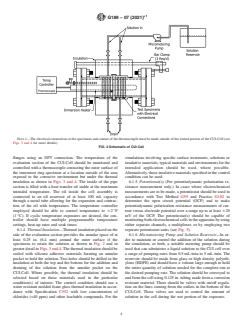
NOTE1—TheelectricalconnectionstothespecimensandcontactofthethermocouplemustbemadeoutsideofthewettedportionoftheCUI-Cell(see
Figs. 3 and 4 for more details).
FIG. 2 Schematic of CUI-Cell
flanges using an NPT connection. The temperature of the simulations involving specific surface treatments, solutions or
evaluation section of the CUI-Cell should be monitored and insulativematerials,typicalmaterialsandenvironmentsforthe
controlled with a thermocouple contacting the outer surface of intended application should be used, where possible.
the innermost ring specimen at a location outside of the area Alternatively,thoseinsulativematerialsspecifiedinthecontrol
exposed to the corrosive environment but under the thermal condition can be used.
insulation as shown in Figs. 3 and 4. The inside of the pipe 6.1.5 Potentiostat(s) (For potentiodynamic polarization re-
section is filled with a heat transfer oil stable at the maximum sistance measurement only.) In cases where electrochemical
intended temperature. The oil inside the cell assembly is measurements are to be made, a potentiostat should be used in
connected to an oil reservoir of at least 100 mL capacity accordance with Test Method G59 and Practice G102 to
through a metal tube allowing for the expansion and contrac- determine the open circuit potential (OCP) and to make
tion of the oil with temperature. The temperature controller potentiodynamic polarization resistance measurements of cur-
employed should be able to control temperature to 62°F rent versus electrode potential over a range up to at least 620
(1°C). If cyclic temperature exposures are desired, the con- mV of the OCP. The potentiostat(s) should be capable of
troller should have multiple programmable temperature monitoringbothelectrochemicalcellsintheapparatusbyusing
settings, heat-up rates and soak times. either separate channels, a multiplexer, or by employing two
6.1.4 Thermal Insulation—Thermalinsulationplacedonthe separate potentiostat units (see Fig. 5).
side of the evaluation section provides the annular space of at 6.1.6 Micrometering Pump and Solution Reservoir—In or-
least 0.25 in. (6.4 mm) around the outer surface if the der to maintain or control the addition of the solution during
specimens to retain the solution as shown in Fig. 2 and in the simulation, or both, a suitable metering pump should be
greaterdetailinFigs.3and4.Thethermalinsulationshouldbe used that can administer a liquid solution to the CUI cell over
sealed with silicone adhesive materials forming an annular a range of pumping rates from 0.5mL⁄min to 5mL⁄min. The
pocket to hold the solution. Two holes should be drilled in the reservoir should be made from glass or high density polyeth-
insulation at both the top and the bottom for the addition and ylene (HDPE) and should have a volume large enough to hold
draining of the solution from the annular pocket on the the entire quantity of solution needed for the complete run at
CUI-Cell. Where possible, the thermal insulation should be the desired pumping rate. The solution should be conveyed to
selected based on those materials used in the particular and from the cell using 0.125 in. tubing made from a corrosion
condition(s) of interest. The control condition should use a resistant material. There should be valves with on/off regula-
water resistant molded foam glass thermal insulation in accor- tion on the lines coming from the outlets in the bottom of the
dance with Specification C552 with low concentration of CUI-Cell. These valves are used to control the amount of
chlorides (<40 ppm) and other leachable compounds. For the solution in the cell during the wet portion of the exposure.
´1
G189 − 07 (2021)
NOTE 1—Opposite half of thermal is added after seals has been made and thermocouple has been inserted into the proper position (see Fig. 2).
FIG. 3 Cross-section of CUI-Cell Showing Orientation of Thermal Insulation
FIG. 4 Dimensions of Thermal Insulation for CUI Simulation
´1
G189 − 07 (2021)
Top—Set-up with two separate potentiostats.
Bottom—Set-up with one potentiostat and multiplexer.
NOTE 1—Electrical connects to CUI-Cell specimens to be made outside wetted area of cell.
FIG. 5 Schematic of Wiring of Potentiostat to CUI-Cell Ring Specimens for Procedure B
´1
G189 − 07 (2021)
Top Left—Configuration of the ring specimen.
...