

ASTM G8-24
(Test Method)Standard Test Methods for Cathodic Disbonding of Coated Steel
General Information
- Abstract
SIGNIFICANCE AND USE
4.1 Breaks or holidays in a coating applied over steel exposes the substrate to a potential corrosion cell. When the steel is subjected to cathodic protection by the polarization of the steel via sacrificial anodes or impressed current, the exposed steel at the holiday becomes the cathode in the corrosion cell. When the electrolyte is neutral or slightly alkaline, hydroxyl ions form from the reduction of oxygen and, when paired with a suitable cation from the electrolyte, form an alkaline solution. Depending on the strength of this alkaline solution and the concentration of the alkaline compound, this alkalinity may disrupt the adhesion between the coating and the steel, disbonding the coating from the steel.
4.2 Current density of the cathodic cell also can affect the degree of cathodic disbondment. The greater the current density generated by the concentration of electrons at the anode, the greater the number of hydroxyl ions formed, thus increasing the alkalinity available for disrupting the adhesion between the coating and the steel substrate. Likewise, the concentration of oxygen in the electrolyte will affect the concentration of hydroxyl ions formed at the cathode.
4.3 For these reasons it is often useful to measure pH, oxygen, and current density when conducting a cathodic disbondment test.
SCOPE
1.1 These test methods apply to procedures for determining the degree of disbondment of a coating from a steel substrate when placed in contact with an electrolyte and a potential is applied to the steel. Specimens may include coated steel pipe or coated flat or curved steel plate. The coating applied to the steel substrate shall be non-metallic and shall not show flow characteristics at the test temperature.
1.2 These test methods apply to specimens that are immersed in an electrolyte bath or specimens with an attached electrolyte cell at ambient room temperature, 21 °C to 25 °C (70 °F to 77 °F), conditions. If higher temperatures are required, use Test Method G42.
1.3 These test methods apply to methods of polarization including sacrificial anodes or impressed current applied to the steel by a rectifier.
1.4 The values stated in SI units are to be regarded as the standard. The values given in parentheses are for information only.
1.5 This standard does not purport to address all of the safety concerns, if any, associated with its use. It is the responsibility of the user of this standard to establish appropriate safety, health, and environmental practices and determine the applicability of regulatory limitations prior to use.
1.6 This international standard was developed in accordance with internationally recognized principles on standardization established in the Decision on Principles for the Development of International Standards, Guides and Recommendations issued by the World Trade Organization Technical Barriers to Trade (TBT) Committee.
- Status
- Published
- Publication Date
- 31-Jan-2024
- Technical Committee
- D01 - Paint and Related Coatings, Materials, and Applications
- Drafting Committee
- D01.48 - Durability of Pipeline Coating and Linings
Overview
ASTM G8-24, Standard Test Methods for Cathodic Disbonding of Coated Steel, provides a well-established methodology for evaluating the resistance of non-metallic coatings on steel (such as those on pipes, plates, and structural steel) to cathodic disbondment. Cathodic disbonding is a key indicator for the effectiveness and durability of protective coatings used in corrosion protection systems, especially in underground or submerged environments.
This standard outlines procedures for artificially inducing defects (“holidays”) in a coating, subjecting the coated steel specimen to electrolytic environments, and applying cathodic protection using either sacrificial anodes or impressed current systems. The degree of coating disbondment serves as a comparative measure of coating performance under simulated field conditions.
Key Topics
- Cathodic Disbondment: Evaluation of the separation of a non-metallic coating from a steel substrate when exposed to electrolytes and a cathodic protection current.
- Testing Methods: Three primary test setups, varying by type of electrolyte exposure and current application:
- Method A: Immersion bath with a magnesium anode and no electrical monitoring.
- Method B: Immersion with either a magnesium anode or impressed current, including current and voltage monitoring.
- Method C: Attached electrolyte cell over the test area, with impressed current and continuous monitoring.
- Control of Test Variables: Measurement of pH, oxygen concentration, and current density is encouraged due to their direct influence on disbondment rates.
- Holiday Creation: Procedures for artificially inducing holidays in the coating to simulate real-world damage.
- Physical and Electrical Evaluation: Post-exposure assessment based on visual, mechanical, and electrical data.
Applications
ASTM G8-24 is vital in the following practical applications:
- Pipeline Industry: Used to qualify and compare external coating systems for steel pipes intended for underground or underwater service, ensuring effective long-term corrosion mitigation.
- Protective Coating Development: Allows manufacturers to benchmark new coatings against established ones based on their performance under cathodic protection.
- Quality Assurance: Provides repeatable, standardized methods for end-users, asset owners, and coating applicators to validate the integrity and adhesiveness of applied coatings.
- Failure Analysis: Essential tool in investigating coating failures in service by replicating environmental and electrochemical stresses in the lab.
- Regulatory Compliance: Helps meet safety and performance requirements for steel structures exposed to corrosive environments.
Related Standards
Professionals relying on ASTM G8-24 often reference the following related standards to ensure comprehensive evaluation and validation of pipeline coating systems and corrosion protection strategies:
- ASTM D1141: Practice for Preparation of Substitute Ocean Water
- ASTM D5162: Practice for Discontinuity (Holiday) Testing of Nonconductive Protective Coatings on Metallic Substrates
- ASTM G12 (Withdrawn): Practice for Nondestructive Measurement of Dry Film Thickness of Pipeline Coatings on Steel
- ASTM G42: Test Method for Cathodic Disbonding of Pipeline Coatings Subjected to Elevated Temperatures
- ASTM G95: Test Method for Cathodic Disbondment Test of Pipeline Coatings (Attached Cell Method)
- ASTM A36: Specification for Carbon Structural Steel
Practical Value
- Assures coating suitability for cathodically protected environments
- Enables side-by-side comparison of different coating formulations
- Reduces the risk of unplanned maintenance and corrosion-related failures
- Supports data-driven coating selection and specification for new projects
Implementing ASTM G8-24 promotes long-term asset integrity by systematically identifying coatings most resistant to cathodic disbondment, protecting both infrastructure and investment.
Relations
- Effective Date
- 26-Feb-2024
- Effective Date
- 01-Feb-2024
- Effective Date
- 01-Feb-2024
- Referred By
ASTM A934/A934M-22 - Standard Specification for Epoxy-Coated Prefabricated Steel Reinforcing Bars - Effective Date
- 01-Feb-2024
- Referred By
ASTM A972/A972M-00(2021) - Standard Specification for Fusion Bonded Epoxy-Coated Pipe Piles - Effective Date
- 01-Feb-2024
- Referred By
ASTM A1124/A1124M-23 - Standard Specification for Textured Epoxy-Coated Steel Reinforcing Bars - Effective Date
- 01-Feb-2024
- Effective Date
- 01-Feb-2024
- Effective Date
- 01-Feb-2024
- Effective Date
- 01-Feb-2024
- Effective Date
- 01-Feb-2024
- Effective Date
- 01-Feb-2024
Get Certified
Connect with accredited certification bodies for this standard

Institut za varilstvo d.o.o. (Welding Institute)
Slovenia's leading welding institute since 1952. ISO 3834, EN 1090, pressure equipment certification, NDT personnel, welder qualification. Only IIW Au
Sponsored listings
Frequently Asked Questions
ASTM G8-24 is a standard published by ASTM International. Its full title is "Standard Test Methods for Cathodic Disbonding of Coated Steel". This standard covers: SIGNIFICANCE AND USE 4.1 Breaks or holidays in a coating applied over steel exposes the substrate to a potential corrosion cell. When the steel is subjected to cathodic protection by the polarization of the steel via sacrificial anodes or impressed current, the exposed steel at the holiday becomes the cathode in the corrosion cell. When the electrolyte is neutral or slightly alkaline, hydroxyl ions form from the reduction of oxygen and, when paired with a suitable cation from the electrolyte, form an alkaline solution. Depending on the strength of this alkaline solution and the concentration of the alkaline compound, this alkalinity may disrupt the adhesion between the coating and the steel, disbonding the coating from the steel. 4.2 Current density of the cathodic cell also can affect the degree of cathodic disbondment. The greater the current density generated by the concentration of electrons at the anode, the greater the number of hydroxyl ions formed, thus increasing the alkalinity available for disrupting the adhesion between the coating and the steel substrate. Likewise, the concentration of oxygen in the electrolyte will affect the concentration of hydroxyl ions formed at the cathode. 4.3 For these reasons it is often useful to measure pH, oxygen, and current density when conducting a cathodic disbondment test. SCOPE 1.1 These test methods apply to procedures for determining the degree of disbondment of a coating from a steel substrate when placed in contact with an electrolyte and a potential is applied to the steel. Specimens may include coated steel pipe or coated flat or curved steel plate. The coating applied to the steel substrate shall be non-metallic and shall not show flow characteristics at the test temperature. 1.2 These test methods apply to specimens that are immersed in an electrolyte bath or specimens with an attached electrolyte cell at ambient room temperature, 21 °C to 25 °C (70 °F to 77 °F), conditions. If higher temperatures are required, use Test Method G42. 1.3 These test methods apply to methods of polarization including sacrificial anodes or impressed current applied to the steel by a rectifier. 1.4 The values stated in SI units are to be regarded as the standard. The values given in parentheses are for information only. 1.5 This standard does not purport to address all of the safety concerns, if any, associated with its use. It is the responsibility of the user of this standard to establish appropriate safety, health, and environmental practices and determine the applicability of regulatory limitations prior to use. 1.6 This international standard was developed in accordance with internationally recognized principles on standardization established in the Decision on Principles for the Development of International Standards, Guides and Recommendations issued by the World Trade Organization Technical Barriers to Trade (TBT) Committee.
SIGNIFICANCE AND USE 4.1 Breaks or holidays in a coating applied over steel exposes the substrate to a potential corrosion cell. When the steel is subjected to cathodic protection by the polarization of the steel via sacrificial anodes or impressed current, the exposed steel at the holiday becomes the cathode in the corrosion cell. When the electrolyte is neutral or slightly alkaline, hydroxyl ions form from the reduction of oxygen and, when paired with a suitable cation from the electrolyte, form an alkaline solution. Depending on the strength of this alkaline solution and the concentration of the alkaline compound, this alkalinity may disrupt the adhesion between the coating and the steel, disbonding the coating from the steel. 4.2 Current density of the cathodic cell also can affect the degree of cathodic disbondment. The greater the current density generated by the concentration of electrons at the anode, the greater the number of hydroxyl ions formed, thus increasing the alkalinity available for disrupting the adhesion between the coating and the steel substrate. Likewise, the concentration of oxygen in the electrolyte will affect the concentration of hydroxyl ions formed at the cathode. 4.3 For these reasons it is often useful to measure pH, oxygen, and current density when conducting a cathodic disbondment test. SCOPE 1.1 These test methods apply to procedures for determining the degree of disbondment of a coating from a steel substrate when placed in contact with an electrolyte and a potential is applied to the steel. Specimens may include coated steel pipe or coated flat or curved steel plate. The coating applied to the steel substrate shall be non-metallic and shall not show flow characteristics at the test temperature. 1.2 These test methods apply to specimens that are immersed in an electrolyte bath or specimens with an attached electrolyte cell at ambient room temperature, 21 °C to 25 °C (70 °F to 77 °F), conditions. If higher temperatures are required, use Test Method G42. 1.3 These test methods apply to methods of polarization including sacrificial anodes or impressed current applied to the steel by a rectifier. 1.4 The values stated in SI units are to be regarded as the standard. The values given in parentheses are for information only. 1.5 This standard does not purport to address all of the safety concerns, if any, associated with its use. It is the responsibility of the user of this standard to establish appropriate safety, health, and environmental practices and determine the applicability of regulatory limitations prior to use. 1.6 This international standard was developed in accordance with internationally recognized principles on standardization established in the Decision on Principles for the Development of International Standards, Guides and Recommendations issued by the World Trade Organization Technical Barriers to Trade (TBT) Committee.
ASTM G8-24 is classified under the following ICS (International Classification for Standards) categories: 23.040.99 - Other pipeline components. The ICS classification helps identify the subject area and facilitates finding related standards.
ASTM G8-24 has the following relationships with other standards: It is inter standard links to ASTM G95-07(2021), ASTM G8-96(2019), ASTM G11-19, ASTM A934/A934M-22, ASTM A972/A972M-00(2021), ASTM A1124/A1124M-23, ASTM A775/A775M-22, ASTM A950/A950M-11(2023), ASTM D6577-15(2019), ASTM G20-10(2019), ASTM G42-11(2019)e1. Understanding these relationships helps ensure you are using the most current and applicable version of the standard.
ASTM G8-24 is available in PDF format for immediate download after purchase. The document can be added to your cart and obtained through the secure checkout process. Digital delivery ensures instant access to the complete standard document.
Standards Content (Sample)
This international standard was developed in accordance with internationally recognized principles on standardization established in the Decision on Principles for the
Development of International Standards, Guides and Recommendations issued by the World Trade Organization Technical Barriers to Trade (TBT) Committee.
Designation: G8 − 24
Standard Test Methods for
Cathodic Disbonding of Coated Steel
This standard is issued under the fixed designation G8; the number immediately following the designation indicates the year of original
adoption or, in the case of revision, the year of last revision. A number in parentheses indicates the year of last reapproval. A superscript
epsilon (´) indicates an editorial change since the last revision or reapproval.
1. Scope 2. Referenced Documents
2.1 ASTM Standards:
1.1 These test methods apply to procedures for determining
A36 Specification for Carbon Structural Steel
the degree of disbondment of a coating from a steel substrate
D1141 Practice for Preparation of Substitute Ocean Water
when placed in contact with an electrolyte and a potential is
D5162 Practice for Discontinuity (Holiday) Testing of Non-
applied to the steel. Specimens may include coated steel pipe
conductive Protective Coating on Metallic Substrates
or coated flat or curved steel plate. The coating applied to the
D7091 Practice for Nondestructive Measurement of Dry
steel substrate shall be non-metallic and shall not show flow
Film Thickness of Nonmagnetic Coatings Applied to
characteristics at the test temperature.
Ferrous Metals and Nonmagnetic, Nonconductive Coat-
1.2 These test methods apply to specimens that are im-
ings Applied to Non-Ferrous Metals
mersed in an electrolyte bath or specimens with an attached
G42 Test Method for Cathodic Disbonding of Pipeline
electrolyte cell at ambient room temperature, 21 °C to 25 °C
Coatings Subjected to Elevated Temperatures
(70 °F to 77 °F), conditions. If higher temperatures are
G95 Test Method for Cathodic Disbondment Test of Pipeline
required, use Test Method G42.
Coatings (Attached Cell Method)
1.3 These test methods apply to methods of polarization
3. Summary of Test Method
including sacrificial anodes or impressed current applied to the
3.1 Three test methods are described in this standard. In
steel by a rectifier.
each method, an artificial holiday or defect is applied to the
1.4 The values stated in SI units are to be regarded as the specimen’s coating film through to the steel substrate. The
standard. The values given in parentheses are for information specimen is immersed in a defined electrolyte with the steel
only. polarized to a defined voltage.
3.1.1 Method A—The specimens are immersed in an elec-
1.5 This standard does not purport to address all of the
trolyte immersion bath. A specified metallic anode is used to
safety concerns, if any, associated with its use. It is the
polarize the specimen with no electrical monitoring during the
responsibility of the user of this standard to establish appro-
test period.
priate safety, health, and environmental practices and deter-
3.1.2 Method B—The specimens are immersed in an elec-
mine the applicability of regulatory limitations prior to use.
trolyte immersion bath. Polarization of the specimen is con-
1.6 This international standard was developed in accor-
ducted using an impressed current potentiostat at a specified
dance with internationally recognized principles on standard-
DC voltage with electrical monitoring during the test period.
ization established in the Decision on Principles for the
3.1.3 Method C—The specimens shall have a cell contain-
Development of International Standards, Guides and Recom-
ing the electrolyte attached to the surface of the specimen.
mendations issued by the World Trade Organization Technical
Polarization of the specimen is conducted using an impressed
Barriers to Trade (TBT) Committee.
current potentiostat at a specified DC voltage with electrical
monitoring during the test period.
3.2 Upon completion of immersion exposure, a physical
These test methods are under the jurisdiction of ASTM Committee D01 on
examination is conducted by comparing the extent of loosened
Paint and Related Coatings, Materials, and Applications and are the direct
responsibility of Subcommittee D01.48 on Durability of Pipeline Coating and
Linings. For referenced ASTM standards, visit the ASTM website, www.astm.org, or
Current edition approved Feb. 1, 2024. Published February 2024. Originally contact ASTM Customer Service at service@astm.org. For Annual Book of ASTM
approved in 1969. Last previous edition approved in 2019 as G8 – 96 (2019). DOI: Standards volume information, refer to the standard’s Document Summary page on
10.1520/G0008-24. the ASTM website.
Copyright © ASTM International, 100 Barr Harbor Drive, PO Box C700, West Conshohocken, PA 19428-2959. United States
G8 − 24
or disbonded coating at the holiday in the immersed area with electrolyte solution (for example, 3 % NaCl solution). The
extent of loosened or disbonded coating at a new holiday in the voltage differential shall be within 5 mV. If over 5 mV, the
coating made in an area that was not immersed. Test specimens subject Ag/AgCl reference electrode shall be discarded.
are also examined for any other visible defect. 5.1.5 Thickness Gauge, for measuring coating thickness in
accordance with Practice D7091.
4. Significance and Use
5.1.6 Holiday Detector, for locating holidays in the coating
4.1 Breaks or holidays in a coating applied over steel of the test specimen in accordance with Practice D5162, Test
exposes the substrate to a potential corrosion cell. When the Method A – Low Voltage Wet Sponge Testing.
steel is subjected to cathodic protection by the polarization of 5.1.7 Thermometer, for measuring electrolyte temperature,
the steel via sacrificial anodes or impressed current, the general lab type, 1° subdivisions, 76.2 mm (3 in.) immersion.
exposed steel at the holiday becomes the cathode in the 5.1.8 High-Resistance Voltmeter, for direct current, having
corrosion cell. When the electrolyte is neutral or slightly an internal resistance of not less than 10 MΩ and capable of
alkaline, hydroxyl ions form from the reduction of oxygen and, measuring as low as 10 μV potential drop across a shunt in the
when paired with a suitable cation from the electrolyte, form an test cell circuit.
alkaline solution. Depending on the strength of this alkaline
5.2 Additional Apparatus for Methods, Method A and
solution and the concentration of the alkaline compound, this
Method B:
alkalinity may disrupt the adhesion between the coating and the
5.2.1 Test Vessel—A nonconducting material shall be used
steel, disbonding the coating from the steel.
for the vessel or as a lining in a metallic vessel. Dimensions of
4.2 Current density of the cathodic cell also can affect the the vessel shall permit the following requirements:
degree of cathodic disbondment. The greater the current 5.2.1.1 Test specimens shall be suspended vertically in the
density generated by the concentration of electrons at the vessel with at least 25.4 mm (1.0 in.) clearance from the
anode, the greater the number of hydroxyl ions formed, thus bottom.
increasing the alkalinity available for disrupting the adhesion 5.2.1.2 Each test specimen shall be separated from the other
between the coating and the steel substrate. Likewise, the specimens, from the anodes and from the walls of the test
concentration of oxygen in the electrolyte will affect the vessel by at least 38.1 mm (1.5 in.).
concentration of hydroxyl ions formed at the cathode. 5.2.1.3 The depth of electrolyte shall permit the test length
of the specimen to be immersed such that a minimum of
4.3 For these reasons it is often useful to measure pH,
2 2
23 227 mm (36 in. ) shall be immersed in the electrolyte.
oxygen, and current density when conducting a cathodic
5.2.1.4 Plywood or plastic material has been found suitable
disbondment test.
for the construction of test vessel covers and for the support
5. Apparatus
through apertures of test specimens and electrodes. Wood
dowels introduced through holes in the top ends of test
5.1 Apparatus for All Three Methods—Method A, Method B,
specimens have been found suitable for suspending test speci-
and Method C:
mens from the vessel cover.
5.1.1 Connectors—Wiring from anode to test specimen
shall be 4107 cmil (14 gauge AWG), minimum, insulated 5.3 Additional Apparatus for Method A:
copper. Attachment to the test specimen shall be by soldering, 5.3.1 Sacrificial Anodes—Anodes shall be made as specified
brazing, or bolting to the non-immersed end, and the place of in Table 1. It shall have a surface area not less than one third
attachment shall be coated with an insulating material. A that of the total specimen area exposed to electrolyte (for flat
junction in the connecting wire is permitted, provided that it is panels, the area containing the artificial holiday only and for
made by means of a bolted pair of terminal lugs soldered or pipe outside area exposed only). The anode shall be provided
mechanically crimped to clean wire ends. with a factory-sealed, 4107 cmil (14 gauge AWG), minimum,
5.1.2 Holiday Tools—Holidays shall be made with conven- insulated copper wire for connecting to the test specimen.
tional drills of the required diameter. For use in preparing Anodes without a factory seal may be used if the alloy extends
small-diameter pipe specimens, the use of a flat end mill has above the cover or if the connection of the wire to the anode is
been found effective in preventing perforation of the metal wall coated with an insulating material. Anodes, alternatively, may
of the pipe. be directly bolted to the test specimen ensuring that there is
5.1.3 Disbondment Evaluation Tools—A sharp-pointed thin positive electrical contact between the anode and the test
blade knife with a safe handle is required for use in removing specimen. If pre-used anodes are to be used, the anodes shall be
disbonded coating from the specimen. cleaned by wire brushing or by immersion in dilute acid to
5.1.4 Reference Electrode—A reference electrode Ag/AgCl
remove corrosion products to ensure they are active.
in saturated KCl with double junction, or a saturated Cu/
CuSO reference electrode shall be used. The accuracy of the
TABLE 1
Ag/AgCl reference electrode shall be checked before starting
Metal Alloy Potential (Ag/AgCl Potential (Cu/CuSO
the test. The Ag/AgCl reference electrode can be checked reference electrode) reference electrode)
Magnesium –1.33 to –1.43 V –1.45 to –1.55 V
against another Ag/AgCl reference electrode which is only
Zinc –0.88 to –0.98 V –1.00 to –1.10 V
used for accuracy checkup only without routine usage. The two
User specified alloy User specified User specified
Ag/AgCl reference electrodes can be inserted into the same
G8 − 24
5.4 Additional Apparatus for Method B: 5.4.6.2 Impressed-Current Anode—The anode shall be of
5.4.1 Precision Wire-Wound Resistor, 1 Ω 6 1 %, 1 W corrosion-resistant metal wire 0.51 mm (0.020 in. – 24 gauge
(minimum), shall be used in the test cell circuit as a shunt for
AWG) diameter. A titanium wire coated with mixed metal
current.
oxide IrO /Ta O or a platinum coated wire has been used with
2 2 5
5.4.2 Metallic Electrode, used temporarily with the high-
good results.
resistance voltmeter to determine apparent initial holiday status
5.4.7 Voltage Divider, 100 Ω, 25 W rheostat, to be used if
of the test specimen.
more than one specimen is to be tested as shown in Fig. 6.
5.4.3 Additional connecting wires shall be 4107 cmil
(14 gauge AWG), minimum, insulated copper. 5.5 Additional Apparatus for Method C:
5.4.4 Brass Studs, used at a terminal board, together with
5.5.1 Test Vessel—The test vessel shall be a transparent
alligator clips or knife switches, for making and breaking
plastic or glass tube that is centered over the intentional holiday
circuits may be used. Alligator clips shall not be used to
and sealed to the test sample surface with a waterproof sealing
connect to electrodes or specimens at the top location of test
material. The cylinder shall be 101.6 mm (4.0 in.) nominal
cells.
diameter and of sufficient height to contain 127.0 mm (5.0 in.)
5.4.5 Direct-Current Rectifier or Power Supply, capable of
of electrolyte. Size of vessel shall remain unchanged. Sealing
supplying constant voltage at a voltage of up to 5.0 V 6
procedure must be altered to accommodate specimen having a
0.05 V, as measured between the test specimen and reference
diameter less than 101.60 mm (4 in.).
electrode.
5.5.2 Impressed-Current Anode Assembly (Fig. 1):
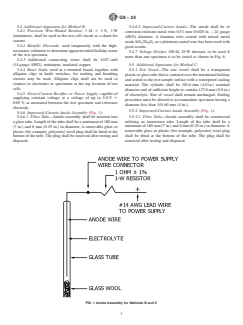
5.4.6 Impressed-Current Anode Assembly (Fig. 1):
5.5.2.1 Filter Tube—Anode assembly shall be constructed
5.4.6.1 Filter Tube—Anode assembly shall be inserted into
utilizing an immersion tube. Length of the tube shall be a
a glass tube. Length of the tube shall be a minimum of 180 mm
minimum of 180 mm (7 in.) and 6 mm (0.25 in.) in diameter. A
(7 in.) and 6 mm (0.25 in.) in diameter. A removable glass or
removable glass or plastic (for example, polyester) wool plug
plastic (for example, polyester) wool plug shall be fitted at the
bottom of the tube. The plug shall be removed after testing and shall be fitted at the bottom of the tube. The plug shall be
disposed. removed after testing and disposed.
FIG. 1 Anode Assembly for Methods B and C
G8 − 24
5.5.2.2 Impressed-Current Anode—The anode shall be of 8. Test Specimen Preparation
corrosion-resistant metal wire 0.51 mm (0.020 in. – 24 gauge
8.1 Three single holiday specimens or one, three holiday
AWG) diameter. A titanium wire coated with mixed metal
pipe specimen shall be tested for each coating/test condition
oxide IrO /Ta O or a platinum coated wire has been used with
2 2 5
unless otherwise specified.
good results.
8.2 Preparation of Artificial Holiday:
5.5.3 High-Impedance Multimeter—For making direct-
8.2.1 Prior to making the artificial holiday, the continuity of
current and voltage measurements, the multimeter must have
the coating shall be verified by using a low-voltage wet-sponge
an internal resistance of not less than 10 M Ω and be capable
holiday detector (Practice D5162) with sufficient water on the
of measuring current as low as 1 mA, and voltage up to 10 V.
sponge to ensure electrical connection in case a holiday is
5.5.4 Direct-Current Rectifier or Power Supply, capable of
encountered. Specimens with holidays shall be removed and
supplying constant voltage at a voltage of up to 3.00 V 6 0.05
not tested and replaced with holiday free specimens.
V, as measured between the test specimen and reference
8.2.2 For flat panels, curved panels, and large diameter pipe
electrode.
specimens, one intentional holiday shall be made in each
5.5.5 Precision Wire-Wound Resistor, 1 Ω 6 1 %, 1 W
specimen to be tested at the center of the immersion area. The
(minimum), shall be used in the test cell circuit as a shunt for
holiday shall be drilled so that the angular cone point of the
current (Fig. 1).
drill will fully enter the steel where the cylindrical portion of
the drill meets the steel surface. The specimen shall not be
6. Reagent and Materials
perforated by the drill. The drill shall be for Methods A and B,
6.4 mm (0.25 in.) in diameter and for Method C, 3.2 mm
6.1 The electrolyte employed shall be one of those found in
(0.125 in.) in diameter, unless otherwise specified.
Table 2:
8.2.3 For 50.8 mm (2.0 in.) pipe specimens, three holidays
TABLE 2
with diameters of 6.4 mm (0.25 in.) shall be drilled with a flat
Electrolyte Ionic Composition Preparation
Designation
end mill or a regular drill bit and the angular cone point of the
I Aqueous solution of 1 % Using technical grade salts,
drill will fully enter the steel where the cylindrical portion of
sodium chloride, 1 % sodium add to distilled or deionized
the drill meets the steel surface. The specimen shall not be
sulfate, 1 % sodium carbonate water, and mix until
dissolved.
perforated by the drill. One holiday shall be drilled in the
II Aqueous solution of 3% sodium Using technical grade sodium
center of the immersion area of the pipe. One holiday shall be
chloride chloride, add to distilled or
deionized water, and mix until drilled halfway above the center holiday to the upper immer-
dissolved.
sion level on the pipe, offset 120° to the right the center
III Synthetic seawater Practice D1141 (without
holiday. One holiday shall be drilled halfway below the center
heavy metals)
holiday to the bottom on the pipe, offset 120° to the left the
IV Specified by the user Specified by the user
center holiday.
6.1.1 Use freshly prepared solution for each test.
8.3 Measure and record the dry film thickness of the coating
6.2 Materials for sealing edges of coated panels or the ends
in accordance with Practice D7091, and the dry film thickness
of coated pipe specimens shall consist of non-conducting
immediately adjacent to where each holiday is made.
protective materials.
8.4 For Methods A and B, the end of the specimen which
will protrude above the immersion line shall be provided with
7. Test Specimen
suitable supporting means and a separate wire connection for
7.1 Test specimens shall be of the following types, unless
electrical purposes, soldered, brazed, or bolted to the specimen.
otherwise specified by the end user:
The protruding end, including hanger and wire connections,
7.1.1 Applicable for Methods A, B, and C—Coated flat
shall be protected and sealed with an insulating coating
panels or coupons shall have minimum dimensions of 150 mm material. The specimen test area shall consist of the area
× 300 mm (6 in. × 12 in.) with a minimum thickness 3.2 mm
betw
...
This document is not an ASTM standard and is intended only to provide the user of an ASTM standard an indication of what changes have been made to the previous version. Because
it may not be technically possible to adequately depict all changes accurately, ASTM recommends that users consult prior editions as appropriate. In all cases only the current version
of the standard as published by ASTM is to be considered the official document.
Designation: G8 − 96 (Reapproved 2019) G8 − 24
Standard Test Methods for
Cathodic Disbonding of Pipeline CoatingsCoated Steel
This standard is issued under the fixed designation G8; the number immediately following the designation indicates the year of original
adoption or, in the case of revision, the year of last revision. A number in parentheses indicates the year of last reapproval. A superscript
epsilon (´) indicates an editorial change since the last revision or reapproval.
1. Scope
1.1 These test methods cover acceleratedapply to procedures for simultaneously determining comparative characteristics of
insulating coating systems applied to steel pipe exterior for the purpose of preventing or mitigating corrosion that may occur in
underground service where the pipe will be determining the degree of disbondment of a coating from a steel substrate when placed
in contact with inland soils and may or may not receive cathodic protection. They are intended for use with samples of coated pipe
taken from commercial production and are applicable to such samples when the coating is characterized by function as an electrical
barrier.an electrolyte and a potential is applied to the steel. Specimens may include coated steel pipe or coated flat or curved steel
plate. The coating applied to the steel substrate shall be non-metallic and shall not show flow characteristics at the test temperature.
1.2 This test method is intended for testing coatings submerged or immersed in the test solution at room temperature. When it is
impractical to submerge or immerse the test specimen, Test Method These test methods apply to specimens that are immersed in
an electrolyte bath or specimens with an attached electrolyte G95 may be considered where the test cell is cemented to the surface
of the coated pipe specimen. cell at ambient room temperature, 21 °C to 25 °C (70 °F to 77 °F), conditions. If higher temperatures
are required, seeuse Test Method G42. If a specific test method is required with no options, see Test Method G80.
1.3 These test methods apply to methods of polarization including sacrificial anodes or impressed current applied to the steel by
a rectifier.
1.4 The values stated in SI units to 3 significant decimals are to be regarded as the standard. The values given in parentheses are
for information only.
1.5 This standard does not purport to address all of the safety concerns, if any, associated with its use. It is the responsibility
of the user of this standard to establish appropriate safety, health, and environmental practices and determine the applicability of
regulatory limitations prior to use.
1.6 This international standard was developed in accordance with internationally recognized principles on standardization
established in the Decision on Principles for the Development of International Standards, Guides and Recommendations issued
by the World Trade Organization Technical Barriers to Trade (TBT) Committee.
2. Referenced Documents
2.1 ASTM Standards:
A36 Specification for Carbon Structural Steel
These test methods are under the jurisdiction of ASTM Committee D01 on Paint and Related Coatings, Materials, and Applications and are the direct responsibility of
Subcommittee D01.48 on Durability of Pipeline Coating and Linings.
Current edition approved June 1, 2019Feb. 1, 2024. Published June 2019February 2024. Originally approved in 1969. Last previous edition approved in 20102019 as
G8 – 96 (2010).(2019). DOI: 10.1520/G0008-96R19.10.1520/G0008-24.
For referenced ASTM standards, visit the ASTM website, www.astm.org, or contact ASTM Customer Service at service@astm.org. For Annual Book of ASTM Standards
volume information, refer to the standard’s Document Summary page on the ASTM website.
Copyright © ASTM International, 100 Barr Harbor Drive, PO Box C700, West Conshohocken, PA 19428-2959. United States
G8 − 24
D1141 Practice for Preparation of Substitute Ocean Water
D5162 Practice for Discontinuity (Holiday) Testing of Nonconductive Protective Coating on Metallic Substrates
G12D7091 Test Method Practice for Nondestructive Measurement of Dry Film Thickness of Pipeline Coatings on SteelNon-
magnetic Coatings Applied to Ferrous Metals and Nonmagnetic, Nonconductive Coatings Applied to Non-Ferrous Metals
(Withdrawn 2013)
G42 Test Method for Cathodic Disbonding of Pipeline Coatings Subjected to Elevated Temperatures
G80 Test Method for Specific Cathodic Disbonding of Pipeline Coatings (Withdrawn 2013)
G95 Test Method for Cathodic Disbondment Test of Pipeline Coatings (Attached Cell Method)
3. Summary of Test Method
3.1 Three test methods are described in this standard. In each method, an artificial holiday or defect is applied to the specimen’s
coating film through to the steel substrate. The specimen is immersed in a defined electrolyte with the steel polarized to a defined
voltage.
3.1.1 Method A—The specimens are immersed in an electrolyte immersion bath. A specified metallic anode is used to polarize the
specimen with no electrical monitoring during the test period.
3.1.2 Method B—The specimens are immersed in an electrolyte immersion bath. Polarization of the specimen is conducted using
an impressed current potentiostat at a specified DC voltage with electrical monitoring during the test period.
3.1.3 Method C—The specimens shall have a cell containing the electrolyte attached to the surface of the specimen. Polarization
of the specimen is conducted using an impressed current potentiostat at a specified DC voltage with electrical monitoring during
the test period.
3.2 Both of the two test methods described subject the coating on the test specimen to electrical stress in a highly conductive,
alkaline electrolyte. Electrical stress is obtained either by means of a sacrificial magnesium anode or from an impressed current
system. The coating is perforated before starting the test.Upon completion of immersion exposure, a physical examination is
conducted by comparing the extent of loosened or disbonded coating at the holiday in the immersed area with extent of loosened
or disbonded coating at a new holiday in the coating made in an area that was not immersed. Test specimens are also examined
for any other visible defect.
3.1.1 In Method A, a magnesium anode is used with no electrical monitoring during the test period. The results are determined
by physical examination after the test period is concluded.
3.1.2 In Method B, either a magnesium anode or an impressed current system may be used. Electrical instrumentation is provided
for measuring the current in the cell circuit. The electrical potential is also measured, and upon conclusion of the test period, the
test specimen is physically examined.
3.1.3 In both test methods physical examination is conducted by comparing the extent of loosened or disbonded coating at the
perforations in the immersed area with extent of loosened or disbonded coating at a new test hole in the coating made in an area
that was not immersed.
4. Significance and Use
4.1 Breaks or holidays in pipe coatings may expose the pipe to possible corrosion, since after a pipe has been installed
underground, the surrounding earth will be more or less moisture-bearing and it constitutes an effective electrolyte. Damage to pipe
coating is almost unavoidable during transportation and construction. Normal soil potentials as well as applied cathodic protection
potentials may cause loosening of the coating, beginning at holiday edges, in some cases increasing the apparent size of the holiday.
Holidays may also be caused by such potentials. While apparently loosened coating and cathodic holidays may not result in
corrosion, this test provides accelerated conditions for loosening to occur and therefore gives a measure of resistance of coatings
to this type of action.
4.1 The effects of the test may be evaluated by either physical examination or monitoring the current drawn by the test specimen
and both of these two. Usually there is no correlation between the two methods of evaluation but both methods are significant.
Physical examination consists of assessing the effective contact of the coating with the metal surface in terms of observed
differences in the relative adhesive bond. It is usually found that the electrically stressed area propagates from the holiday to a
boundary where the loosened coating leaves off for the more effective contact or bond attributed to an original condition throughout
G8 − 24
the specimen before electrical stressing was applied. Assumptions associated with test results include the following:Breaks or
holidays in a coating applied over steel exposes the substrate to a potential corrosion cell. When the steel is subjected to cathodic
protection by the polarization of the steel via sacrificial anodes or impressed current, the exposed steel at the holiday becomes the
cathode in the corrosion cell. When the electrolyte is neutral or slightly alkaline, hydroxyl ions form from the reduction of oxygen
and, when paired with a suitable cation from the electrolyte, form an alkaline solution. Depending on the strength of this alkaline
solution and the concentration of the alkaline compound, this alkalinity may disrupt the adhesion between the coating and the steel,
disbonding the coating from the steel.
4.2.1 Attempting to loosen or disbond the coating at a new test hole made in the coating in an area that was not immersed
represents maximum adhesion or bond as measured by the lifting technique used, and that the same lifting technique can be used
at a test hole that was immersed thereby providing a means of comparing relative resistance to lifting.
4.2.2 Any relatively lesser bonded area at the immersed test holes in the coating was caused by electrical stressing and was not
attributable to an anomaly in the application process. Ability to resist disbondment is a desired quality on a comparative basis, but
disbondment per se in this test is not necessarily an adverse indication. The virtue of this test is that all dielectric type coatings
now in common use will disbond to some degree thus providing a means of comparing one coating with another. Bond strength
is more important for proper functioning of some coatings than others and the same measured disbondment for two different
coating systems may not represent equivalent loss of corrosion protection.
4.2.3 The amount of current in the test cell is a relative indicator of the extent of areas requiring protection against corrosion;
however, the current density appearing in this test is much greater than that usually required for cathodic protection in natural,
inland soil environments.
4.2 Current density of the cathodic cell also can affect the degree of cathodic disbondment. The greater the current density
generated by the concentration of electrons at the anode, the greater the number of hydroxyl ions formed, thus increasing the
alkalinity available for disrupting the adhesion between the coating and the steel substrate. Likewise, the concentration of oxygen
in the electrolyte will affect the concentration of hydroxyl ions formed at the cathode.
4.3 For these reasons it is often useful to measure pH, oxygen, and current density when conducting a cathodic disbondment test.
5. Apparatus
5.1 Apparatus for Both Methods: All Three Methods—Method A, Method B, and Method C:
5.1.1 Test Vessel—A nonconducting material shall be used for the vessel or as a lining in a metallic vessel. Dimensions of the
vessel shall permit the following requirements:
5.1.1.1 Test specimens shall be suspended vertically in the vessel with at least 25.4-mm (1-in.) clearance from the bottom.
5.1.1.2 Each test specimen shall be separated from the other specimens, from the anodes and from the walls of the test vessel by
at least 38.1 mm (1.500 in.).
5.1.1.3 Depth of electrolyte shall permit the test length of the specimen to be immersed as required in 7.4.
5.1.1.4 If electrical monitoring is to be performed as required in Method B, the reference electrode may be placed anywhere in
the vessel, provided it is separated from the specimen and from the anode by not less than 38.1 mm (1.500 in.).
5.1.2 Magnesium Anode—The anode shall be made of a magnesium alloy having a solution potential of −1.45 to −1.55 V with
respect to a CuCuSO reference electrode in the electrolyte given in 6.1. It shall have a surface area not less than one third that
of the total specimen area exposed to electrolyte (outside area exposed only). The anode shall be provided with a factory-sealed,
4107-cmil (14-gage Awg), minimum, insulated copper wire. Anodes without a factory seal may be used if the magnesium extends
above the cover.
5.1.1 Connectors—Wiring from anode to test specimen shall be 4107-cmil (14-gage Awg),4107 cmil (14 gauge AWG), minimum,
insulated copper. Attachment to the test specimen shall be by soldering, brazing, or bolting to the nonimmersednon-immersed end,
and the place of attachment shall be coated with an insulating material. A junction in the connecting wire is permitted, provided
that it is made by means of a bolted pair of terminal lugs soldered or mechanically crimped to clean wire ends.
G8 − 24
5.1.2 Holiday Tools—Holidays shall be made with conventional drills of the required diameter. For use in preparing
small-diameter pipe specimens such as 19.05 mm (0.750 in.) nominal diameter pipe, specimens, the use of a drill modified by
substantially grinding away the sharp cone point flat end mill has been found effective in preventing perforation of the metal wall
of the pipe. A sharp-pointed knife with a safe handle is required for use in making physical examinations.
5.1.3 High-Resistance Voltmeter, Disbondment Evaluation Tools—for direct current, having an internal resistance of not less than
10 MΩ and having a range from 0.01 to 5 V for measuring potential to the reference electrode.A sharp-pointed thin blade knife
with a safe handle is required for use in removing disbonded coating from the specimen.
5.1.4 Reference Electrode, Electrode—saturated CuCuSOA reference of conventional glass or plastic tube with porous plug
construction, preferably notelectrode Ag/AgCl in saturated KCl with double junction, or a saturated Cu/CuSO over 19.05 mm
(0.750 in.) in diameter, having a potential of −0.316 V with respect to the standard hydrogen electrode. A calomel electrode may
be used, but measurements made with it shall be converted to the CuCuSOreference electrode shall be used. The accuracy of the
Ag/AgCl reference electrode shall be checked before starting the test. The Ag/AgCl reference electrode can be checked against
another Ag/AgCl reference electrode which is only used reference for reporting by adding −0.072 V to the observed reading.for
accuracy checkup only without routine usage. The two Ag/AgCl reference electrodes can be inserted into the same electrolyte
solution (for example, 3 % NaCl solution). The voltage differential shall be within 5 mV. If over 5 mV, the subject Ag/AgCl
reference electrode shall be discarded.
5.1.5 Thickness Gage,Gauge, for measuring coating thickness in accordance with Test Method Practice G12D7091.
5.1.6 Holiday Detector, for locating holidays in the coating of the test specimen in accordance with Practice D5162, Test Method
A – Low Voltage Wet Sponge Testing.
5.1.7 Thermometer, for measuring electrolyte temperature, general lab type, 1° subdivisions, 76.2 mm (3 in.) immersion.
5.1.8 High-Resistance Voltmeter, for direct current, having an internal resistance of not less than 10 MΩ and capable of measuring
as low as 10 μV potential drop across a shunt in the test cell circuit.
5.2 Additional Apparatus for Methods, Method A and Method B:
5.2.1 Test Vessel—A nonconducting material shall be used for the vessel or as a lining in a metallic vessel. Dimensions of the
vessel shall permit the following requirements:
5.2.1.1 Test specimens shall be suspended vertically in the vessel with at least 25.4 mm (1.0 in.) clearance from the bottom.
5.2.1.2 Each test specimen shall be separated from the other specimens, from the anodes and from the walls of the test vessel by
at least 38.1 mm (1.5 in.).
5.2.1.3 The depth of electrolyte shall permit the test length of the specimen to be immersed such that a minimum of 23 227 mm
(36 in. ) shall be immersed in the electrolyte.
5.2.1.4 Plywood or plastic material has been found suitable for the construction of test vessel covers and for the support through
apertures of test specimens and electrodes. Wood dowels introduced through holes in the top ends of test specimens have been
found suitable for suspending test specimens from the vessel cover.
5.3 Additional Apparatus for Method A:
5.3.1 Sacrificial Anodes—Anodes shall be made as specified in Table 1. It shall have a surface area not less than one third that
of the total specimen area exposed to electrolyte (for flat panels, the area containing the artificial holiday only and for pipe outside
TABLE 1
Metal Alloy Potential (Ag/AgCl Potential (Cu/CuSO
reference electrode) reference electrode)
Magnesium –1.33 to –1.43 V –1.45 to –1.55 V
Zinc –0.88 to –0.98 V –1.00 to –1.10 V
User specified alloy User specified User specified
G8 − 24
area exposed only). The anode shall be provided with a factory-sealed, 4107 cmil (14 gauge AWG), minimum, insulated copper
wire for connecting to the test specimen. Anodes without a factory seal may be used if the alloy extends above the cover or if the
connection of the wire to the anode is coated with an insulating material. Anodes, alternatively, may be directly bolted to the test
specimen ensuring that there is positive electrical contact between the anode and the test specimen. If pre-used anodes are to be
used, the anodes shall be cleaned by wire brushing or by immersion in dilute acid to remove corrosion products to ensure they are
active.
G8 − 24
5.4 Additional Apparatus for Method B:
5.2.1 High-Resistance Voltmeter, for direct current, having an internal resistance of not less than 10 MΩ and capable of measuring
as low as 10 μV potential drop across a shunt in the test cell circuit.
5.4.1 Precision Wire-Wound Resistor, 1-Ω1 Ω 6 1 %, 1-W (minimum), to1 W (minimum), shall be used in the test cell circuit as
a shunt for current.
5.2.3 Volt-Ohm-Meter, for initial testing of apparent coating resistance.
5.4.2 Metallic Electrode, used temporarily with the volt-ohm-meter high-resistance voltmeter to determine apparent initial holiday
status of the test specimen.
5.4.3 Additional Connecting Wires, 4107-cmil (14-gage Awg), Additional connecting wires shall be 4107 cmil (14 gauge AWG),
minimum, insulated copper.
5.4.4 Brass Studs, used at a terminal board, together with alligator clips or knife switches, for making and breaking circuits.
circuits may be used. Alligator clips shall not be used to connect to electrodes or specimens at the top location of test cells.
5.2.7 Zero-Resistance Ammeter, capable of measuring direct current as low as 10 μA may be used in the alternative method given
in 9.1.3 and substituted for the apparatus described in 5.2.1 and 5.2.2.
5.4.5 Direct-Current Rectifier, Rectifier or Power Supply, capable of supplying constant voltage at a voltage of 1.50 6 0.01 V, up
to 5.0 V 6 0.05 V, as measured between the test specimen and reference electrode.
5.4.6 Impressed Current Anode, Impressed-Current Anode Assembly (Fig. 1): shall be of the nonconsumable type provided with
a factory sealed, insulated copper wire.
5.4.6.1 Filter Tube—Anode assembly shall be inserted into a glass tube. Length of the tube shall be a minimum of 180 mm (7
in.) and 6 mm (0.25 in.) in diameter. A removable glass or plastic (for example, polyester) wool plug shall be fitted at the bottom
of the tube. The plug shall be removed after testing and disposed.
5.4.6.2 Impressed-Current Anode—The anode shall be of corrosion-resistant metal wire 0.51 mm (0.020 in. – 24 gauge AWG)
diameter. A titanium wire coated with mixed metal oxide IrO /Ta O or a platinum coated wire has been used with good results.
2 2 5
5.4.7 Voltage Divider, 100-Ω, 25-W100 Ω, 25 W rheostat, to be used if more than one specimen is to be tested as shown in Fig.
1.Fig. 6.
5.5 Additional Apparatus for Method C:
5.5.1 Test Vessel—The test vessel shall be a transparent plastic or glass tube that is centered over the intentional holiday and sealed
to the test sample surface with a waterproof sealing material. The cylinder shall be 101.6 mm (4.0 in.) nominal diameter and of
sufficient height to contain 127.0 mm (5.0 in.) of electrolyte. Size of vessel shall remain unchanged. Sealing procedure must be
altered to accommodate specimen having a diameter less than 101.60 mm (4 in.).
5.5.2 Impressed-Current Anode Assembly (Fig. 1):
FIG. 4 Removal of Disbonded Coating
G8 − 24
NOTE 1—Test hole made in non-immersed area after testing not shown (see Fig. 2).
FIG. 1 Anode Assembly for Methods B and C
5.5.2.1 Filter Tube—Anode assembly shall be constructed utilizing an immersion tube. Length of the tube shall be a minimum of
180 mm (7 in.) and 6 mm (0.25 in.) in diameter. A removable glass or plastic (for example, polyester) wool plug shall be fitted at
the bottom of the tube. The plug shall be removed after testing and disposed.
5.5.2.2 Impressed-Current Anode—The anode shall be of corrosion-resistant metal wire 0.51 mm (0.020 in. – 24 gauge AWG)
diameter. A titanium wire coated with mixed metal oxide IrO /Ta O or a platinum coated wire has been used with good results.
2 2 5
5.5.3 High-Impedance Multimeter—For making direct-current and voltage measurements, the multimeter must have an internal
resistance of not less than 10 M Ω and be capable of measuring current as low as 1 mA, and voltage up to 10 V.
5.5.4 Direct-Current Rectifier or Power Supply, capable of supplying constant voltage at a voltage of up to 3.00 V 6 0.05 V, as
measured between the test specimen and reference electrode.
5.5.5 Precision Wire-Wound Resistor, 1 Ω 6 1 %, 1 W (minimum), shall be used in the test cell circuit as a shunt for current (Fig.
1).
6. Reagent and Materials
6.1 The electrolyte shall consist of potable tap water with the addition of 1 mass % ofemployed shall be one of those found in
Table 2each of the following technical-grade salts, calculated on an anhydrous basis: sodium chloride, sodium sulfate, and sodium
carbonate. Use freshly prepared solution for each test.:
G8 − 24
TABLE 2
Electrolyte Designation Ionic Composition Preparation
I Aqueous solution of 1 % sodium chloride, 1 % sodium sulfate, 1 % Using technical grade salts, add to distilled or deionized water,
sodium carbonate and mix until dissolved.
II Aqueous solution of 3% sodium chloride Using technical grade sodium chloride, add to distilled or
deionized water, and mix until dissolved.
III Synthetic seawater Practice D1141 (without heavy metals)
IV Specified by the user Specified by the user
6.1.1 Use freshly prepared solution for each test.
6.2 Materials for sealing edges of coated panels or the ends of coated pipe specimens may consist of bituminous products, wax,
epoxy, or other materials, including molded elastomeric or plastic end caps.shall consist of non-conducting protective materials.
6.3 Plywood or plastic material has been found suitable for the construction of test vessel covers and for the support through
apertures of test specimens and electrodes. Wood dowels introduced through holes in the top ends of test specimens have been
found suitable for suspending test specimens from the vessel cover.
7. Test Specimen
7.1 The test specimen shall be a representative piece of production-coated pipe. One end shall be plugged or capped, and
sealed.Test specimens shall be of the following types, unless otherwise specified by the end user:
7.1.1 Applicable for Methods A, B, and C—Coated flat panels or coupons shall have minimum dimensions of 150 mm × 300 mm
(6 in. × 12 in.) with a minimum thickness 3.2 mm ( ⁄8 in.). Unless otherwise specified, the grade of steel shall be Specification
A36 or equivalent. Uncoated edges shall have a protective edging applied to the panels when used with Method A and Method B.
7.1.2 Applicable for Methods A and B—Coated pipe shall have an outside diameter of 50.8 mm (2 in.) with a wall thickness of
6.4 mm (0.25 in.) and a minimum length of 300 mm (12 in.). The end of the pipe to be immersed shall be plugged or capped, and
sealed.
7.1.3 Applicable for Method C—Coated pipe or curved plate of a diameter that the test vessel can be fitted and sealed to the
surface. The recommended wall thickness of the test specimen shall be 6.4 mm (0.25 in.) or greater.
7.2 One or three holidays shall be made in each specimen. Three holidays are recommended. Recommended dimensions are given
in Fig. 2. A specimen with one holiday shall have it drilled in the middle of the immersed length. If three holidays are used, they
shall be drilled 120° apart with one in the center and the other two at locations one fourth the distance from top and bottom of
the immersed test length. Each holiday shall be drilled so that the angular cone point of the drill will fully enter the steel where
the cylindrical portion of the drill meets the steel surface. The drill diameter shall be not less than three times the coating thickness,
but it shall never be smaller than 6.35 mm (0.250 in.) in diameter. The steel wall of the pipe shall not be perforated. With
small-diameter pipes, where there is danger of perforating the pipe, the holiday shall be started with a standard 60° cone point and
finished with a drill that has had a substantial portion of the cone point ground away.
NOTE 1—Before making the holiday, see 8.1.
7.3 The end of the pipe which will protrude above the immersion line shall be provided with suitable supporting means and a
separate wire connection for electrical purposes, soldered, brazed, or bolted to the pipe. The protruding end, including hanger and
wire connections, shall be protected and sealed with an insulating coating material.
7.4 The specimen test area shall consist of the area between the edge of the bottom end seal and the immersion line. The bottom
end seal area shall not be considered part of the area tested. Any suitable diameter and specimen length of pipe may be used, but
2 2 2 2
the immersed area shall be not less than 23 227 mm (36 in. ). An area of 92 900 mm (1 ft ) has been found preferable when
convenient.
8. Test Specimen Preparation
8.1 Three single holiday specimens or one, three holiday pipe specimen shall be tested for each coating/test condition unless
otherwise specified.
G8 − 24
FIG. 5 Test Assembly for Method B Using an Impressed Current
with One Specimen
8.2 Before making artificial holidays, verify the continuity of the coating and the effectiveness of the end-cap seal as
follows:Preparation of Artificial Holiday:
8.2.1 Prior to making the artificial holiday, the continuity of the coating shall be verified by using a low-voltage wet-sponge
holiday detector (Practice D5162) with sufficient water on the sponge to ensure electrical connection in case a holiday is
encountered. Specimens with holidays shall be removed and not tested and replaced with holiday free specimens.
8.2.2 Immerse the test specimen and a metallic electrode in the electrolyte. Connect one terminal of the multimeter to the test
specimen and the other terminal to the metallic electrode. Measure the apparent resistance in ohms, making two determinations:
one with the specimen connected to the positive terminal of the multimeter; and one with the specimen connected to the negative
terminal.For flat panels, curved panels, and large diameter pipe specimens, one intentional holiday shall be made in each specimen
to be tested at the center of the immersion area. The holiday shall be drilled so that the angular cone point of the drill will fully
enter the steel where the cylindrical portion of the drill meets the steel surface. The specimen shall not be perforated by the drill.
The drill shall be for Methods A and B, 6.4 mm (0.25 in.) in diameter and for Method C, 3.2 mm (0.125 in.) in diameter, unless
otherwise specified.
8.1.2 Disconnect the specimen from the multimeter but leave i
...