

ASTM E2775-16(2023)
(Practice)Standard Practice for Guided Wave Testing of Above Ground Steel Pipework Using Piezoelectric Effect Transduction
General Information
- Abstract
SIGNIFICANCE AND USE
5.1 The purpose of this practice is to outline a procedure for using GWT to locate areas in metal pipes in which wall loss has occurred due to corrosion or erosion.
5.2 GWT does not provide a direct measurement of wall thickness, but is sensitive to a combination of the CSC and circumferential extent and axial extent of any metal loss. Based on this information, a classification of the severity can be assigned.
5.3 The GWT method provides a screening tool to quickly identify any discontinuity along the pipe. Where a possible defect is found, follow-up inspection of suspected areas with ultrasonic testing or other NDT methods is normally required to obtain detailed thickness information, nature, and extent of damage.
5.4 GWT also provides some information on the axial length of a discontinuity, provided that the axial length is longer than roughly a quarter of the wavelength of the excitation signal.
5.5 The identification and severity assessment of any possible defects is qualitative only. An interpretation process to differentiate between relevant and non-relevant signals is necessary.
5.6 This practice only covers the application specified in the scope. The GWT method has the capability and can be used for applications where the pipe is insulated, buried, in road crossings, and where access is limited.
5.7 GWT shall be performed by qualified and certified personnel, as specified in the contract or purchase order. Qualifications shall include training specific to the use of the equipment employed, interpretation of the test results and guided wave technology.
5.8 A documented program that includes training, examination and experience for the GWT personnel certification shall be maintained by the supplying party.
SCOPE
1.1 This practice provides a procedure for the use of guided wave testing (GWT), also previously known as long range ultrasonic testing (LRUT) or guided wave ultrasonic testing (GWUT).
1.2 GWT utilizes ultrasonic guided waves, sent in the axial direction of the pipe, to non-destructively test pipes for defects or other features by detecting changes in the cross-section or stiffness of the pipe, or both.
1.3 GWT is a screening tool. The method does not provide a direct measurement of wall thickness or the exact dimensions of defects/defected area; an estimate of the defect severity however can be provided.
1.4 This practice is intended for use with tubular carbon steel or low-alloy steel products having Nominal Pipe size (NPS) 2 to 48 corresponding to 60.3 mm to 1219.2 mm (2.375 in. to 48 in.) outer diameter, and wall thickness between 3.81 mm and 25.4 mm (0.15 in. and 1 in.).
1.5 This practice covers GWT using piezoelectric transduction technology.
1.6 This practice only applies to GWT of basic pipe configuration. This includes pipes that are straight, constructed of a single pipe size and schedules, fully accessible at the test location, jointed by girth welds, supported by simple contact supports and free of internal, or external coatings, or both; the pipe may be insulated or painted.
1.7 This practice provides a general procedure for performing the examination and identifying various aspects of particular importance to ensure valid results, but actual interpretation of the data is excluded.
1.8 This practice does not establish an acceptance criterion. Specific acceptance criteria shall be specified in the contractual agreement by the responsible system user or engineering entity.
1.9 Units—The values stated in SI units are to be regarded as standard. The values given in parentheses are mathematical conversions to SI units that are provided for information only and are not considered standard.
1.10 This standard does not purport to address all of the safety concerns, if any, associated with its use. It is the responsibility of the user of this standard to establish appropriate safety, health, and environmental practices and de...
- Status
- Published
- Publication Date
- 30-Nov-2023
- Technical Committee
- E07 - Nondestructive Testing
- Drafting Committee
- E07.10 - Specialized NDT Methods
Overview
ASTM E2775-16(2023): Standard Practice for Guided Wave Testing of Above Ground Steel Pipework Using Piezoelectric Effect Transduction provides a comprehensive procedure for the application of guided wave testing (GWT) - also known as long range ultrasonic testing (LRUT) or guided wave ultrasonic testing (GWUT). Developed by ASTM International, this standard focuses on non-destructive screening for detecting corrosion, erosion, and other forms of wall loss in carbon steel and low-alloy steel pipework, utilizing piezoelectric transduction.
Guided wave testing is valued for its ability to rapidly screen long lengths of straight pipe, especially where access is limited, insulation is present, or the pipe configuration makes other inspection methods challenging. While GWT does not provide direct measurement of wall thickness or exact defect dimensions, it allows for the detection of areas where metal loss or discontinuities may exist, supporting effective maintenance planning and risk assessment.
Key Topics
Purpose and Scope:
- Outlines a method for applying GWT to above-ground steel pipework using piezoelectric technology.
- Covers pipe sizes from NPS 2 to 48 (60.3 mm to 1219.2 mm OD) and wall thicknesses from 3.81 mm to 25.4 mm.
- Applies to straight, basic pipe configurations that are accessible at the test location.
Capabilities and Limitations:
- GWT identifies areas with potential wall thinning; severity classification is qualitative.
- Sensitive to cross-sectional and axial/circumferential extent of metal loss.
- Does not provide direct thickness measurement – follow-up with ultrasonic testing or other NDT methods is needed where defects are detected.
Personnel Requirements:
- Testing must be conducted by qualified and certified personnel with documented training and experience in GWT and data interpretation.
- Certification programs and training documentation are essential and must be maintained by the service provider.
Data and Results:
- Results guide prioritization for further analysis or repairs.
- The process involves identifying relevant, non-relevant, and false signals, with classification of possible defects based on signal evaluation.
Pipe Features and Noise:
- The standard addresses handling of reflections from features such as welds, supports, and attachments.
- Differentiates between real discontinuities and noise signals (coherent/incoherent noise).
Applications
Pipeline Integrity Management:
Used for rapid screening of straight, above-ground, insulated, and difficult-access piping for corrosion and erosion, supporting maintenance planning, regulatory compliance, and risk reduction.Industrial Sectors:
- Oil and gas pipelines
- Chemical processing plants
- Power generation facilities
- Water treatment infrastructure
Pipe Safety and Reliability: Enables early detection of potentially hazardous wall loss, helping prevent leaks, failures, and environmental incidents.
Screening Tool in Multi-Stage Inspection:
Guided wave testing is often the first stage of inspection. Locations with possible defects are further examined using higher-resolution methods such as conventional ultrasonic testing.
Related Standards
- ASTM E543: Specification for Agencies Performing Nondestructive Testing - establishes quality requirements for service providers.
- ASTM E1065: Practice for Evaluating Characteristics of Ultrasonic Search Units - guidance on ultrasonic equipment.
- ASTM E1316: Terminology for Nondestructive Examinations - standardizes NDT terminology.
- ASTM E1324: Guide for Measuring Electronic Characteristics of Ultrasonic Testing Instruments.
Practical Value
By referencing ASTM E2775-16(2023), organizations ensure that guided wave testing of above-ground steel pipework is performed consistently, reliably, and by qualified personnel. This leads to more efficient asset protection, minimized maintenance costs, and optimized safety performance.
Keywords: ASTM E2775-16(2023), guided wave testing, GWT, long range ultrasonic testing, piezoelectric effect, pipe screening, steel pipework inspection, NDT, wall loss detection, corrosion, erosion, pipeline integrity, ultrasonic testing standards.
Relations
- Effective Date
- 01-Dec-2023
- Effective Date
- 01-Feb-2024
- Effective Date
- 01-Sep-2023
Get Certified
Connect with accredited certification bodies for this standard

Institut za varilstvo d.o.o. (Welding Institute)
Slovenia's leading welding institute since 1952. ISO 3834, EN 1090, pressure equipment certification, NDT personnel, welder qualification. Only IIW Au
Sponsored listings
Frequently Asked Questions
ASTM E2775-16(2023) is a standard published by ASTM International. Its full title is "Standard Practice for Guided Wave Testing of Above Ground Steel Pipework Using Piezoelectric Effect Transduction". This standard covers: SIGNIFICANCE AND USE 5.1 The purpose of this practice is to outline a procedure for using GWT to locate areas in metal pipes in which wall loss has occurred due to corrosion or erosion. 5.2 GWT does not provide a direct measurement of wall thickness, but is sensitive to a combination of the CSC and circumferential extent and axial extent of any metal loss. Based on this information, a classification of the severity can be assigned. 5.3 The GWT method provides a screening tool to quickly identify any discontinuity along the pipe. Where a possible defect is found, follow-up inspection of suspected areas with ultrasonic testing or other NDT methods is normally required to obtain detailed thickness information, nature, and extent of damage. 5.4 GWT also provides some information on the axial length of a discontinuity, provided that the axial length is longer than roughly a quarter of the wavelength of the excitation signal. 5.5 The identification and severity assessment of any possible defects is qualitative only. An interpretation process to differentiate between relevant and non-relevant signals is necessary. 5.6 This practice only covers the application specified in the scope. The GWT method has the capability and can be used for applications where the pipe is insulated, buried, in road crossings, and where access is limited. 5.7 GWT shall be performed by qualified and certified personnel, as specified in the contract or purchase order. Qualifications shall include training specific to the use of the equipment employed, interpretation of the test results and guided wave technology. 5.8 A documented program that includes training, examination and experience for the GWT personnel certification shall be maintained by the supplying party. SCOPE 1.1 This practice provides a procedure for the use of guided wave testing (GWT), also previously known as long range ultrasonic testing (LRUT) or guided wave ultrasonic testing (GWUT). 1.2 GWT utilizes ultrasonic guided waves, sent in the axial direction of the pipe, to non-destructively test pipes for defects or other features by detecting changes in the cross-section or stiffness of the pipe, or both. 1.3 GWT is a screening tool. The method does not provide a direct measurement of wall thickness or the exact dimensions of defects/defected area; an estimate of the defect severity however can be provided. 1.4 This practice is intended for use with tubular carbon steel or low-alloy steel products having Nominal Pipe size (NPS) 2 to 48 corresponding to 60.3 mm to 1219.2 mm (2.375 in. to 48 in.) outer diameter, and wall thickness between 3.81 mm and 25.4 mm (0.15 in. and 1 in.). 1.5 This practice covers GWT using piezoelectric transduction technology. 1.6 This practice only applies to GWT of basic pipe configuration. This includes pipes that are straight, constructed of a single pipe size and schedules, fully accessible at the test location, jointed by girth welds, supported by simple contact supports and free of internal, or external coatings, or both; the pipe may be insulated or painted. 1.7 This practice provides a general procedure for performing the examination and identifying various aspects of particular importance to ensure valid results, but actual interpretation of the data is excluded. 1.8 This practice does not establish an acceptance criterion. Specific acceptance criteria shall be specified in the contractual agreement by the responsible system user or engineering entity. 1.9 Units—The values stated in SI units are to be regarded as standard. The values given in parentheses are mathematical conversions to SI units that are provided for information only and are not considered standard. 1.10 This standard does not purport to address all of the safety concerns, if any, associated with its use. It is the responsibility of the user of this standard to establish appropriate safety, health, and environmental practices and de...
SIGNIFICANCE AND USE 5.1 The purpose of this practice is to outline a procedure for using GWT to locate areas in metal pipes in which wall loss has occurred due to corrosion or erosion. 5.2 GWT does not provide a direct measurement of wall thickness, but is sensitive to a combination of the CSC and circumferential extent and axial extent of any metal loss. Based on this information, a classification of the severity can be assigned. 5.3 The GWT method provides a screening tool to quickly identify any discontinuity along the pipe. Where a possible defect is found, follow-up inspection of suspected areas with ultrasonic testing or other NDT methods is normally required to obtain detailed thickness information, nature, and extent of damage. 5.4 GWT also provides some information on the axial length of a discontinuity, provided that the axial length is longer than roughly a quarter of the wavelength of the excitation signal. 5.5 The identification and severity assessment of any possible defects is qualitative only. An interpretation process to differentiate between relevant and non-relevant signals is necessary. 5.6 This practice only covers the application specified in the scope. The GWT method has the capability and can be used for applications where the pipe is insulated, buried, in road crossings, and where access is limited. 5.7 GWT shall be performed by qualified and certified personnel, as specified in the contract or purchase order. Qualifications shall include training specific to the use of the equipment employed, interpretation of the test results and guided wave technology. 5.8 A documented program that includes training, examination and experience for the GWT personnel certification shall be maintained by the supplying party. SCOPE 1.1 This practice provides a procedure for the use of guided wave testing (GWT), also previously known as long range ultrasonic testing (LRUT) or guided wave ultrasonic testing (GWUT). 1.2 GWT utilizes ultrasonic guided waves, sent in the axial direction of the pipe, to non-destructively test pipes for defects or other features by detecting changes in the cross-section or stiffness of the pipe, or both. 1.3 GWT is a screening tool. The method does not provide a direct measurement of wall thickness or the exact dimensions of defects/defected area; an estimate of the defect severity however can be provided. 1.4 This practice is intended for use with tubular carbon steel or low-alloy steel products having Nominal Pipe size (NPS) 2 to 48 corresponding to 60.3 mm to 1219.2 mm (2.375 in. to 48 in.) outer diameter, and wall thickness between 3.81 mm and 25.4 mm (0.15 in. and 1 in.). 1.5 This practice covers GWT using piezoelectric transduction technology. 1.6 This practice only applies to GWT of basic pipe configuration. This includes pipes that are straight, constructed of a single pipe size and schedules, fully accessible at the test location, jointed by girth welds, supported by simple contact supports and free of internal, or external coatings, or both; the pipe may be insulated or painted. 1.7 This practice provides a general procedure for performing the examination and identifying various aspects of particular importance to ensure valid results, but actual interpretation of the data is excluded. 1.8 This practice does not establish an acceptance criterion. Specific acceptance criteria shall be specified in the contractual agreement by the responsible system user or engineering entity. 1.9 Units—The values stated in SI units are to be regarded as standard. The values given in parentheses are mathematical conversions to SI units that are provided for information only and are not considered standard. 1.10 This standard does not purport to address all of the safety concerns, if any, associated with its use. It is the responsibility of the user of this standard to establish appropriate safety, health, and environmental practices and de...
ASTM E2775-16(2023) is classified under the following ICS (International Classification for Standards) categories: 23.040.99 - Other pipeline components. The ICS classification helps identify the subject area and facilitates finding related standards.
ASTM E2775-16(2023) has the following relationships with other standards: It is inter standard links to ASTM E2775-16, ASTM E1316-24, ASTM E1316-23b. Understanding these relationships helps ensure you are using the most current and applicable version of the standard.
ASTM E2775-16(2023) is available in PDF format for immediate download after purchase. The document can be added to your cart and obtained through the secure checkout process. Digital delivery ensures instant access to the complete standard document.
Standards Content (Sample)
This international standard was developed in accordance with internationally recognized principles on standardization established in the Decision on Principles for the
Development of International Standards, Guides and Recommendations issued by the World Trade Organization Technical Barriers to Trade (TBT) Committee.
Designation: E2775 − 16 (Reapproved 2023)
Standard Practice for
Guided Wave Testing of Above Ground Steel Pipework
Using Piezoelectric Effect Transduction
This standard is issued under the fixed designation E2775; the number immediately following the designation indicates the year of
original adoption or, in the case of revision, the year of last revision. A number in parentheses indicates the year of last reapproval. A
superscript epsilon (´) indicates an editorial change since the last revision or reapproval.
1. Scope 1.9 Units—The values stated in SI units are to be regarded
as standard. The values given in parentheses are mathematical
1.1 This practice provides a procedure for the use of guided
conversions to SI units that are provided for information only
wave testing (GWT), also previously known as long range
and are not considered standard.
ultrasonic testing (LRUT) or guided wave ultrasonic testing
1.10 This standard does not purport to address all of the
(GWUT).
safety concerns, if any, associated with its use. It is the
1.2 GWT utilizes ultrasonic guided waves, sent in the axial
responsibility of the user of this standard to establish appro-
direction of the pipe, to non-destructively test pipes for defects
priate safety, health, and environmental practices and deter-
or other features by detecting changes in the cross-section or
mine the applicability of regulatory limitations prior to use.
stiffness of the pipe, or both.
1.11 This international standard was developed in accor-
1.3 GWT is a screening tool. The method does not provide
dance with internationally recognized principles on standard-
a direct measurement of wall thickness or the exact dimensions
ization established in the Decision on Principles for the
of defects/defected area; an estimate of the defect severity
Development of International Standards, Guides and Recom-
however can be provided.
mendations issued by the World Trade Organization Technical
Barriers to Trade (TBT) Committee.
1.4 This practice is intended for use with tubular carbon
steel or low-alloy steel products having Nominal Pipe size
2. Referenced Documents
(NPS) 2 to 48 corresponding to 60.3 mm to 1219.2 mm
2.1 ASTM Standards:
(2.375 in. to 48 in.) outer diameter, and wall thickness between
3.81 mm and 25.4 mm (0.15 in. and 1 in.). E543 Specification for Agencies Performing Nondestructive
Testing
1.5 This practice covers GWT using piezoelectric transduc-
E1065 Practice for Evaluating Characteristics of Ultrasonic
tion technology.
Search Units
1.6 This practice only applies to GWT of basic pipe
E1316 Terminology for Nondestructive Examinations
configuration. This includes pipes that are straight, constructed
E1324 Guide for Measuring Some Electronic Characteristics
of a single pipe size and schedules, fully accessible at the test
of Ultrasonic Testing Instruments
location, jointed by girth welds, supported by simple contact
2.2 Equipment Manufacturer’s User’s Manual
supports and free of internal, or external coatings, or both; the
pipe may be insulated or painted. 3. Terminology
1.7 This practice provides a general procedure for perform-
3.1 Definitions of Terms Specific to This Standard:
ing the examination and identifying various aspects of particu- 3.1.1 circumferential extent—the length of a pipe feature in
lar importance to ensure valid results, but actual interpretation
the circumferential direction, usually given as a percentage of
of the data is excluded. the pipe circumference.
1.8 This practice does not establish an acceptance criterion. 3.1.2 coherent noise—indications caused by real disconti-
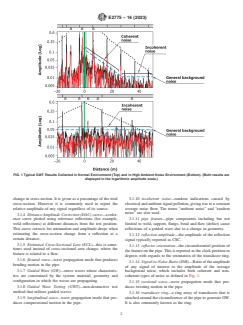
nuities causing a background noise, which exponentially de-
Specific acceptance criteria shall be specified in the contractual
agreement by the responsible system user or engineering entity. cays with distance.
3.1.3 Cross-Sectional Area Change (CSC)—the CSC is
calculated assuming that a reflection is purely caused by a
This practice is under the jurisdiction of ASTM Committee E07 on Nonde-
structive Testing and is the direct responsibility of Subcommittee E07.10 on
Specialized NDT Methods. For referenced ASTM standards, visit the ASTM website, www.astm.org, or
Current edition approved Dec. 1, 2023. Published January 2024. Originally contact ASTM Customer Service at service@astm.org. For Annual Book of ASTM
approved in 2011. last previous edition approved in 2016 as E2775 – 16. Standards volume information, refer to the standard’s Document Summary page on
DOI:10.1520/E2775-16R23. the ASTM website.
Copyright © ASTM International, 100 Barr Harbor Drive, PO Box C700, West Conshohocken, PA 19428-2959. United States
E2775 − 16 (2023)
FIG. 1 Typical GWT Results Collected in Normal Environment (Top) and in High Ambient Noise Environment (Bottom). (Both results are
displayed in the logarithmic amplitude scale.)
change in cross-section. It is given as a percentage of the total 3.1.10 incoherent noise—random indications caused by
cross-section. However it is commonly used to report the electrical and ambient signal pollution, giving rise to a constant
relative amplitude of any signal regardless of its source. average noise floor. The terms “ambient noise” and “random
noise” are also used.
3.1.4 Distance Amplitude Correction (DAC) curve—a refer-
ence curve plotted using reference reflections (for example, 3.1.11 pipe feature—pipe components including but not
weld reflections) at different distances from the test position. limited to weld, support, flange, bend and flaw (defect) cause
This curve corrects for attenuation and amplitude drops when reflections of a guided wave due to a change in geometry.
estimating the cross-section change from a reflection at a
3.1.12 reflection amplitude—the amplitude of the reflection
certain distance.
signal typically reported as CSC.
3.1.5 Estimated Cross-Sectional Loss (ECL)—this is some-
3.1.13 reflector orientation—the circumferential position of
times used instead of cross-sectional area change, where the
the feature on the pipe. This is reported as the clock position or
feature is related to a flaw.
degrees with regards to the orientation of the transducer ring.
3.1.6 flexural wave—wave propagation mode that produces
3.1.14 Signal-to-Noise-Ratio (SNR)—Ratio of the amplitude
bending motion in the pipe.
of any signal of interest to the amplitude of the average
3.1.7 Guided Wave (GW)—stress waves whose characteris- background noise, which includes both coherent and non-
tics are constrained by the system material, geometry and coherent types of noise as defined in Fig. 1.
configuration in which the waves are propagating.
3.1.15 torsional wave—wave propagation mode that pro-
3.1.8 Guided Wave Testing (GWT)—non-destructive test duces twisting motion in the pipe.
method that utilizes guided waves.
3.1.16 transducer ring—a ring array of transducers that is
3.1.9 longitudinal wave—wave propagation mode that pro- attached around the circumference of the pipe to generate GW.
duces compressional motion in the pipe. It is also commonly known as the ring.
E2775 − 16 (2023)
3.1.17 wave mode—a particular form of propagating wave defect is found, follow-up inspection of suspected areas with
motion generated into a pipe, such as flexural, torsional, or ultrasonic testing or other NDT methods is normally required
longitudinal. to obtain detailed thickness information, nature, and extent of
damage.
4. Summary of Practice
5.4 GWT also provides some information on the axial
4.1 GWT evaluates the condition of metal pipes to primarily
length of a discontinuity, provided that the axial length is
establish the severity classification of defects by applying GW
longer than roughly a quarter of the wavelength of the
at a typical test frequency of up to 150 kHz, which travels
excitation signal.
along the pipe. Reflections are generated by the change in
5.5 The identification and severity assessment of any pos-
cross-sectional area or stiffness of the pipe, or both.
sible defects is qualitative only. An interpretation process to
4.2 A transducer ring attached around the pipe screens the
differentiate between relevant and non-relevant signals is
pipe in both directions simultaneously. It can evaluate long
necessary.
lengths of pipe, and is especially useful when access to the pipe
5.6 This practice only covers the application specified in the
is limited.
scope. The GWT method has the capability and can be used for
4.3 This examination locates areas of thickness reduction(s)
applications where the pipe is insulated, buried, in road
and provides a severity classification as to the extent of that
crossings, and where access is limited.
damage. The results are used to assess the condition of the
5.7 GWT shall be performed by qualified and certified
pipe, to determine where damaged areas are located and their
personnel, as specified in the contract or purchase order.
circumferential position on the pipe. The information can be
Qualifications shall include training specific to the use of the
used to program and prioritize additional inspection work and
equipment employed, interpretation of the test results and
repairs.
guided wave technology.
4.4 Reflections produced by pipe features that are not
5.8 A documented program that includes training, examina-
associated with areas containing possible defects are consid-
tion and experience for the GWT personnel certification shall
ered as relevant signals. These features can be used for setting
be maintained by the supplying party.
GW system DAC levels and identifying the relative position
and distance of discontinuities and areas containing possible
6. Basis of Application
defects. Examples of these features are: circumferential welds,
elbows, welded supports, vents, drainage, insulation lugs, and
6.1 The following items are subject to contractual agree-
other welded attachments.
ment between the parties using or referencing this standard.
4.5 Other sources of reflection may include changes in
6.2 Personnel Qualifications—Unless otherwise specified in
surface impedance of the pipe. These reflections are normally
the contractual agreement, personnel performing examinations
not relevant, but should be analyzed and classified in an
to this practice shall be qualified in accordance with one of the
interpretation process. Examples of these changes are the
following:
presence of pipe supports and clamps. In the advanced
6.2.1 Personnel performing examinations to this standard
applications, which are not covered by this standard, these
shall be qualified in accordance with SNT-TC-1A and certified
changes may also include various types of external/internal
by the employer or certifying agency, as applicable. Other
coatings or entrance of the pipe to ground or concrete wall.
equivalent qualification documents may be used when speci-
fied in the contract or purchase order. The applicable revision
4.6 Inspection of the pipe section immediately connecting to
shall be the latest unless otherwise specified in the contractual
branch connections, bends or flanges are considered advance
agreement between parties.
applications which are not covered by this standard.
6.2.2 Personnel qualification accredited by the GWT manu-
4.7 False echoes are produced by phenomena such as
facturers.
reverberations, incomplete control of direction, distortion at
6.3 The practice or standard used and its applicable revision
elbows and others. These signals should be analyzed and
classified as false echoes in the interpretation process. shall be identified in the contractual agreement between the
using parties.
5. Significance and Use
6.4 Qualifications of Non-destructive Testing Agencies—
5.1 The purpose of this practice is to outline a procedure for
Unless otherwise specified in the contractual agreement, NDT
using GWT to locate areas in metal pipes in which wall loss
agencies shall be qualified and evaluated as described in
has occurred due to corrosion or erosion.
Specification E543, the applicable edition of Specification
5.2 GWT does not provide a direct measurement of wall E543 shall be specified in the contractual agreement.
thickness, but is sensitive to a combination of the CSC and
6.5 Procedure and Techniques—The procedures and tech-
circumferential extent and axial extent of any metal loss. Based
niques to be utilized shall be specified in the contractual
on this information, a classification of the severity can be
agreement. It should include the scope of the inspection, that is,
assigned.
the overall NDT examination intended to identify and estimate
5.3 The GWT method provides a screening tool to quickly the size of any indications detected by the examination, or
identify any discontinuity along the pipe. Where a possible simply locate and provide a relative severity classification.
E2775 − 16 (2023)
6.6 Surface Preparation—The pre-examination site prepa- 8. Examination Procedure
ration criteria shall be in accordance with 8.3 unless otherwise
8.1 It is important to ensure that the proposed inspection
specified.
falls within the capabilities of the technology and equipment
6.7 Required Interval of Examination—The required inter- and that the using party or parties understand the capabilities
val or the system time in service of the examination shall be and limitations as it applies to their inspection.
specified in the contractual agreement.
8.2 Pre-examination Preparation:
6.8 Extent of the Examination—The extent of the examina-
8.2.1 All test equipment shall have current and valid cali-
tion shall be in accordance with 6.5 above unless otherwise
bration certificates.
specified. The extent should include but is not limited to:
8.2.2 Follow the equipment manufacturer’s recommenda-
6.8.1 The sizes and length(s) of pipes to be inspected.
tions with regard to equipment pre-test verification and check
6.8.2 Limitations of the method in the areas of application.
list. As a minimum this check list should include but is not
limited to:
6.8.3 Drawings of pipe circuits, pipe nomenclature, and
identification of examination locations.
8.2.2.1 Electronics fully operational.
6.8.4 Pipe access method(s).
8.2.2.2 Proper charging of batteries.
6.8.5 Safety requirements.
8.2.2.3 Verification that interconnection cables are in good
condition and functioning correctly.
6.9 Reporting Criteria—The test results of the examination
8.2.2.4 Correct transducer ring size for the intended pipes.
shall be documented in accordance with the contractual agree-
ment. This may include requirements for permanent records of 8.2.2.5 Sufficient transducer modules (including spares) are
available to test the largest diameter pipe in the work scope.
the collected data and test reports. The report documentation
should include:
8.2.2.6 The transducer ring, modules, and transducers are
6.9.1 Equipment inspector and test results reviewed by (if functioning correctly.
applicable).
8.2.2.7 Any computer used with the system is functioning
correctly and has sufficient storage capacity for the intended
6.9.2 Date and time of the examination performed.
work scope.
6.9.3 Equipment used.
8.2.2.8 Supplementary equipment, such as an ultrasonic
6.9.4 Test procedure/specification used.
flaw detector or specialized pit gauges, are available and
6.9.5 Acceptance criteria.
functioning correctly.
6.9.6 Inspection location.
8.2.2.9 All necessary accessories, such as tape-measure
6.9.7 Identification of areas inspected.
markers, are available.
6.9.8 Identification of the inspection range.
8.2.3 Ensure all site safety requirements and procedures are
6.9.9 Any other information deemed necessary to reproduce
reviewed and understood prior to starting any field work.
or duplicate test results.
8.2.4 The test equipment shall be calibrated in accordance to
6.10 Re-examination of Repairs/Rework Items—
the equipment manufacturer’s procedure at regular intervals.
Examination of repaired/reworked items is not addressed in
8.3 Examination Site Preparation:
this standard and if required shall be specified in the contrac-
8.3.1 Pipe Surface Condition—To obtain best coupling
tual agreement.
condition, any loose material such as mud, flaking paint and
loose corrosion must be removed from the surface of the pipe
7. Apparatus
where the transducer ring is attached. However, well-bonded
7.1 The GWT apparatus shall include the following:
paint layers of up to 1 mm (0.04 in.) can stay in place. Wire
7.1.1 Transducer Ring Transmitter—A transduction system
brushing or sanding, or both, are usually sufficient to prepare
using piezoelectric effect for the generation of guided wave
the surface if it is safe and permitted to do so.
modes with axial propagation on cylindrical pipes.
8.3.2 Insulation—If the pipe is insulated, carefully remove
7.1.2 Transducer Ring Receiver—A system for the detection
an approximately 1 m (3 ft) band of insulation for attaching the
of the signal reflected by the geometric features on the pipe,
transducer ring. Prior to removing the insulating material
which can be the same as the transmitter or an analogous
ensure it is safe and permissible to do so.
transduction system.
8.3.3 GWT is most effective for testing long lengths of pipe.
7.1.3 Instrumentation—The GWT instrumentation shall be
However, tight radius elbows distort GWT signals, making
capable of generating, receiving, and amplifying electrical
interpretation of signal beyond them difficult. Where possible,
pulses within the frequency range used by GWT. Additionally,
it is good practice to exclude from evaluation sections of pipe
it shall be capable of communicating with a computer so that
immediately after elbows. In any case, no signals after two
collected data can be processed and recorded.
elbows should be analyzed. It is sometimes better to take
7.1.4 Processing System—This is a software interface for additional data at different locations than to interpret a signal
processing and analyzing the signal, capable of distinguishing beyond multiple features or those with complicated geom-
at least one guided wave mode for the specific detection etries. Consider taking a second reading 1 m (3 ft) apart for
system. confirmation of features and false echo identification.
E2775 − 16 (2023)
8.3.4 Visual Inspection—Visually inspect the pipe where orientation is reported, the transducer ring should be attached
possible for potential damage areas or corrosion, such as the with the correct ring attachment configurations.
support areas if possible defect indications are found in the
8.9 Reproducibility—The examination pipe should be
GWT result.
marked with a paint marker indicating the transducer ring
8.3.5 Surface Temperature—Verify that the surface tempera-
position, direction, and date of examination. This can assist in
ture of the pipe to be tested is within the manufacturer’s
the future, should it be necessary to reproduce the examination.
specifications for the equipment. Testing at elevated tempera-
This information should also be included in the examination
tures does not in general affect the performance of the GWT,
documentation.
however caution must be exercised to avoid injuries to person-
8.10 Test Location Information—As the data collections of
nel. When testing low temperature pipes, ensure that no ice
most GWT equipments are fully recorded electronically, a
forms between the sensor face and the surface of the pipe.
minimum amount of information about the test location is
8.3.6 Thickness Check—Before mounting the transducer
needed in the processing software to ensure the exact location
ring, verify that there is no degradation in the pipe wall
can be identified. This information shall include the following:
thickness at the test location. As a minimum requirement,
thickness measurements at no less than four equally spaced
8.10.1 Site Name—The name of the site, which may include
positions around the pipe should be made using an appropriate the plant name, plant unit number, approximate mile marker or
thickness measuring instrument and procedure. Some agencies
any relevant reference if available.
also require thickness measurement of the entire dead zone and
8.10.2 Pipe—The pipe identification if available; if not, the
near field. It is important to note that attaching the transducer
pipe diameter should be recorded.
ring at locations with very severe corrosion may cause further
8.10.3 Datum—The reference feature from which the test
damage to the pipe.
location is measured. Typical reference features used are welds
and flanges.
8.4 Transducer Ring—The type of ring, the transducer
orientation and their spacing can vary depending on the type of
8.10.4 Distance—The distance between the datum and the
collection protocol. Refer to 8.13 when selecting the transducer center of the transducer ring shall be recorded. It is also
ring assembly for the type of examination to be performed.
important to include both positive and negative signs in front of
the distance value for positive and negative direction of the
8.5 Couplant—Couplant is generally not required for this
ring respectively.
method. GWT utilizes relatively low frequency compared to
those used in conventional UT, typically in the regions of tens
8.11 Coupling Check—It is important that all transducers
of kilohertz (kHz) as opposed to megahertz (MHz). At these
are well coupled to the pipe. Prior to collecting any test data,
frequencies, good coupling is obtained by simply applying
perform a coupling test in accordance with the manufacturer’s
sufficient mechanical force on the transducer ring.
guidelines. As a minimum, this shall include a way of
simulating “signals” on the pipe and verifying that all trans-
8.6 Choosing Test Location—After completing the exami-
ducers detect it with a similar magnitude and sensitivity.
nation site preparation outlined in 8.3, attach the transducer
ring to the pipe. The test location should be chosen so as to
8.12 Examination Precautions—There are several precau-
minimize false echoes. Avoid placing the ring near a feature as
tions that need to be addressed when analyzing the collected
the corresponding signal may appear within the near field or
data. These include:
the dead zone. In the dead zone, no echoes are received, and in
8.12.1 Dead Zone—This is an area that can be up to 1 m
the near field, the amplitude of the echoes is typically lower
(3 ft) long on either side of the transducer ring that is not
than normal. As a practice, a minimum of 1.5 m (5 ft) should
inspected during the testing. The area of the dead zone is a
be used to the first area of inspection. Features such as welds,
function of the excitation frequency and the number of cycles
which are used for the DAC curves fitting, should be outside
transmitted. The area is inversely related to frequency and
the near field to ensure valid amplitude. Additionally, trans-
directly related to the number of cycles. In order to get a 100 %
ducer rings should not be positioned equidistant between two
coverage of the pipe there are two options:
features to avoid masking of the mirror echoes if any.
8.12.1.1 Inspect the dead zone with an alternative NDT
8.7 Attaching the Transducer Ring—When attaching the
method such as ultrasonic testing.
transducer ring it is important to ensure that all transducers are
8.12.1.2 Locate the next shot so that there is overlap of the
in good contact with the pipe and that the ring is mounted
previous transducer ring position. Some agencies require a
parallel to the circumference of the pipe. Apply the appropriate
20 % overlap on all shots where possible.
air pressure or clamp torque settings as specified in the
8.12.2 Near Field—This is an area that could extend to as
manufacturer’s operating manual for proper installation of the
far as 3 m (10 ft) on either side of the transducer ring. In this
transducer ring. Any pressure gauge or torque meter used shall
area, the amplitudes are artificially lower than normal, and
be checked regularly for correct functionality.
mirrors (see 8.20.4.1) can appear, making analysis of reflec-
8.8 Directionality and Orientation—The reported direction- tions in this area difficult. While this area is inspectable,
ality and orientation of the features depend on the way the extreme care must be taken when
...