

ASTM D3166-99(2020)
(Test Method)Standard Test Method for Fatigue Properties of Adhesives in Shear by Tension Loading (Metal/Metal)
General Information
- Abstract
SIGNIFICANCE AND USE
4.1 While this test method is intended for use in metal-to-metal applications it may be used for measuring the fatigue properties of adhesives using plastic adherends, provided consideration is given to the thickness of the plastic adherends. Doublers may be required for plastic adherends to prevent bearing failure in the adherends.
4.2 A variation in the thickness of the adherends can influence the test results. For this reason, the thickness of the sheets used to make the test specimens should be specified in the material specification. When no thickness is specified, metal adherends 1.63 mm (0.064 in.) thick are recommended.
SCOPE
1.1 This test method covers the measurement of fatigue strength in shear by tension loading of adhesives on a standard specimen and under specified conditions of preparation, loading, and testing.
1.2 The values stated in SI units are to be regarded as the standard. The values given in parentheses are for information only.
1.3 This standard does not purport to address all of the safety concerns, if any, associated with its use. It is the responsibility of the user of this standard to establish appropriate safety, health, and environmental practices and determine the applicability of regulatory limitations prior to use.
1.4 This international standard was developed in accordance with internationally recognized principles on standardization established in the Decision on Principles for the Development of International Standards, Guides and Recommendations issued by the World Trade Organization Technical Barriers to Trade (TBT) Committee.
- Status
- Published
- Publication Date
- 31-Dec-2019
- Technical Committee
- D14 - Adhesives
- Drafting Committee
- D14.80 - Metal Bonding Adhesives


Overview
ASTM D3166-99(2020), titled Standard Test Method for Fatigue Properties of Adhesives in Shear by Tension Loading (Metal/Metal), is a globally recognized standard developed by ASTM International. It provides a uniform methodology for assessing the fatigue strength of adhesives used primarily in metal-to-metal bonded assemblies. The method examines how adhesives perform under repeated shear loads applied through tension, making it essential for evaluating adhesive durability and reliability in structural applications. While its focus is on metal adherends, the standard offers guidance for evaluating adhesives bonded to plastics with appropriate considerations for material thickness and reinforcement.
Key Topics
- Fatigue Testing of Adhesives: The standard details how to measure adhesive fatigue properties under cyclic tension loading, offering quantifiable data about adhesive performance over millions of cycles.
- Specimen Preparation: Guidance on the specimen configuration, recommended dimensions, and surface preparation ensures uniformity and reproducibility.
- Test Conditions: Prescribes environmental conditions (humidity, temperature) and test parameters (cyclic load rates, load levels).
- Reporting: Specifies key data points to record, such as bond dimensions, number of cycles to failure, failure modes, and environmental conditions.
- Material Considerations: Stresses the importance of specifying substrate thickness, recommending 1.63 mm (0.064 in.) for metal adherends unless otherwise noted, to maintain consistency and validity of results.
- Adaptability for Plastics: Includes provisions for using plastic adherends, factoring in thickness and the need for doublers to avoid substrate failures.
Applications
ASTM D3166-99(2020) is vital for industries where metal-to-metal adhesive bonding is subjected to repeated mechanical loading. Key applications include:
- Aerospace Engineering: Ensures adhesive joints in aircraft structures withstand cyclic stress without premature failure.
- Automotive Manufacturing: Supports the qualification and comparison of adhesives for vehicle body and chassis bonding under repetitive use conditions.
- Industrial Equipment: Validates adhesive systems in machinery components that face vibrational or oscillatory loads.
- Product Development and Quality Control: Serves manufacturers, engineers, and R&D teams in verifying new adhesive products or comparing products from different suppliers.
- Plastic Bonding: When adapted with appropriate specimen configurations, offers insight into adhesive fatigue in plastic-to-plastic or plastic-to-metal joints, given proper attention to material specification and reinforcement.
Related Standards
- ASTM D907: Terminology of Adhesives - provides definitions used throughout D3166 and related adhesive testing protocols.
- ASTM D1002: Standard Test Method for Apparent Shear Strength of Single-Lap-Joint Adhesively Bonded Metal Specimens by Tension Loading - complements D3166 by covering basic shear strength rather than fatigue.
- ISO and EN Adhesive Standards: While ASTM D3166 is widely used, international standards from ISO and regional bodies provide additional methods and comparative data for adhesive joint fatigue performance.
Practical Value
- Reliability Assessment: Organizations can benchmark adhesive performance, predict service life, and make informed selection decisions.
- Safety and Compliance: Satisfies requirements from government and defense agencies concerning adhesive joint integrity.
- Global Acceptance: As an ASTM International standard aligned with WTO principles, D3166 test results are widely recognized and accepted in international markets.
Keywords: ASTM D3166, adhesive fatigue, shear by tension loading, metal-to-metal bonding, adhesive test method, fatigue properties of adhesives, adhesive reliability, industrial adhesives, adhesive joint testing, cyclic loading, single-lap joint.
Relations
- Effective Date
- 01-Jan-2020
- Effective Date
- 01-Apr-2019
- Effective Date
- 01-Jul-2012
- Effective Date
- 01-May-2012
- Effective Date
- 01-Dec-2011
- Effective Date
- 01-Jan-2011
- Effective Date
- 01-Oct-2008
- Effective Date
- 15-Aug-2008
- Effective Date
- 01-Mar-2008
- Effective Date
- 01-Dec-2006
- Effective Date
- 01-Oct-2005
- Effective Date
- 01-Apr-2005
- Effective Date
- 01-Apr-2005
- Effective Date
- 01-Dec-2004
- Effective Date
- 01-Apr-2004
Get Certified
Connect with accredited certification bodies for this standard

DIN CERTCO
DIN Group product certification.

Smithers Quality Assessments
US management systems and product certification.
Sponsored listings
Frequently Asked Questions
ASTM D3166-99(2020) is a standard published by ASTM International. Its full title is "Standard Test Method for Fatigue Properties of Adhesives in Shear by Tension Loading (Metal/Metal)". This standard covers: SIGNIFICANCE AND USE 4.1 While this test method is intended for use in metal-to-metal applications it may be used for measuring the fatigue properties of adhesives using plastic adherends, provided consideration is given to the thickness of the plastic adherends. Doublers may be required for plastic adherends to prevent bearing failure in the adherends. 4.2 A variation in the thickness of the adherends can influence the test results. For this reason, the thickness of the sheets used to make the test specimens should be specified in the material specification. When no thickness is specified, metal adherends 1.63 mm (0.064 in.) thick are recommended. SCOPE 1.1 This test method covers the measurement of fatigue strength in shear by tension loading of adhesives on a standard specimen and under specified conditions of preparation, loading, and testing. 1.2 The values stated in SI units are to be regarded as the standard. The values given in parentheses are for information only. 1.3 This standard does not purport to address all of the safety concerns, if any, associated with its use. It is the responsibility of the user of this standard to establish appropriate safety, health, and environmental practices and determine the applicability of regulatory limitations prior to use. 1.4 This international standard was developed in accordance with internationally recognized principles on standardization established in the Decision on Principles for the Development of International Standards, Guides and Recommendations issued by the World Trade Organization Technical Barriers to Trade (TBT) Committee.
SIGNIFICANCE AND USE 4.1 While this test method is intended for use in metal-to-metal applications it may be used for measuring the fatigue properties of adhesives using plastic adherends, provided consideration is given to the thickness of the plastic adherends. Doublers may be required for plastic adherends to prevent bearing failure in the adherends. 4.2 A variation in the thickness of the adherends can influence the test results. For this reason, the thickness of the sheets used to make the test specimens should be specified in the material specification. When no thickness is specified, metal adherends 1.63 mm (0.064 in.) thick are recommended. SCOPE 1.1 This test method covers the measurement of fatigue strength in shear by tension loading of adhesives on a standard specimen and under specified conditions of preparation, loading, and testing. 1.2 The values stated in SI units are to be regarded as the standard. The values given in parentheses are for information only. 1.3 This standard does not purport to address all of the safety concerns, if any, associated with its use. It is the responsibility of the user of this standard to establish appropriate safety, health, and environmental practices and determine the applicability of regulatory limitations prior to use. 1.4 This international standard was developed in accordance with internationally recognized principles on standardization established in the Decision on Principles for the Development of International Standards, Guides and Recommendations issued by the World Trade Organization Technical Barriers to Trade (TBT) Committee.
ASTM D3166-99(2020) is classified under the following ICS (International Classification for Standards) categories: 83.180 - Adhesives. The ICS classification helps identify the subject area and facilitates finding related standards.
ASTM D3166-99(2020) has the following relationships with other standards: It is inter standard links to ASTM D3166-99(2012), ASTM D1002-10(2019), ASTM D907-12a, ASTM D907-12, ASTM D907-11a, ASTM D907-11, ASTM D907-08b, ASTM D907-08a, ASTM D907-08, ASTM D907-06, ASTM D1002-05, ASTM D907-05e1, ASTM D907-05, ASTM D907-04a, ASTM D907-04. Understanding these relationships helps ensure you are using the most current and applicable version of the standard.
ASTM D3166-99(2020) is available in PDF format for immediate download after purchase. The document can be added to your cart and obtained through the secure checkout process. Digital delivery ensures instant access to the complete standard document.
Standards Content (Sample)
This international standard was developed in accordance with internationally recognized principles on standardization established in the Decision on Principles for the
Development of International Standards, Guides and Recommendations issued by the World Trade Organization Technical Barriers to Trade (TBT) Committee.
Designation: D3166 − 99 (Reapproved 2020)
Standard Test Method for
Fatigue Properties of Adhesives in Shear by Tension
Loading (Metal/Metal)
This standard is issued under the fixed designation D3166; the number immediately following the designation indicates the year of
original adoption or, in the case of revision, the year of last revision. A number in parentheses indicates the year of last reapproval. A
superscript epsilon (´) indicates an editorial change since the last revision or reapproval.
This standard has been approved for use by agencies of the U.S. Department of Defense.
1. Scope 4. Significance and Use
1.1 This test method covers the measurement of fatigue
4.1 While this test method is intended for use in metal-to-
strength in shear by tension loading of adhesives on a standard
metal applications it may be used for measuring the fatigue
specimen and under specified conditions of preparation,
properties of adhesives using plastic adherends, provided
loading, and testing.
consideration is given to the thickness of the plastic adherends.
1.2 The values stated in SI units are to be regarded as the
Doublers may be required for plastic adherends to prevent
standard. The values given in parentheses are for information
bearing failure in the adherends.
only.
4.2 A variation in the thickness of the adherends can
1.3 This standard does not purport to address all of the
influence the test results. For this reason, the thickness of the
safety concerns, if any, associated with its use. It is the
sheets used to make the test specimens should be specified in
responsibility of the user of this standard to establish appro-
the material specification. When no thickness is specified,
priate safety, health, and environmental practices and deter-
metal adherends 1.63 mm (0.064 in.) thick are recommended.
mine the applicability of regulatory limitations prior to use.
1.4 This international standard was developed in accor-
5. Apparatus
dance with internationally recognized principles on standard-
ization established in the Decision on Principles for the
5.1 Testing Machine,capableofapplyingasinusoidalcyclic
Development of International Standards, Guides and Recom-
axialload.Thecyclicrateandtypeofequipment(constantload
mendations issued by the World Trade Organization Technical
or constant displacement) can influence test results. For this
Barriers to Trade (TBT) Committee.
reason, the cyclic rate and equipment should be specified in the
material specification. When no cyclic rate is specified 1800
2. Referenced Documents
cycles/minisrecommended.Employsuitablegripsandjawsso
2.1 ASTM Standards:
that the specimen can be gripped tightly and held in alignment
D907 Terminology of Adhesives
as the load, accurate within 62 %, is applied.
D1002 Test Method for Apparent Shear Strength of Single-
Lap-Joint Adhesively Bonded Metal Specimens by Ten-
6. Test Specimens
sion Loading (Metal-to-Metal)
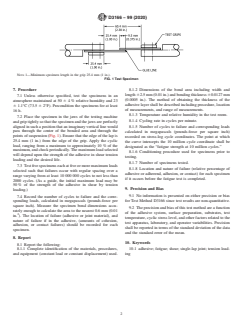
6.1 Use test specimens conforming to the shape and dimen-
3. Terminology sions shown in Fig. 1, having grip ends suitable for use in the
particular testing machine. These specimens are similar to the
3.1 Definitions—Many terms in this test method are defined
tension lap-shear specimens described in Test Method D1002.
in Terminology D907.
6.2 At least 25 specimens shall be tested, representing at
least 4 different panels.
This test method is under the jurisdiction of ASTM Committee D14 on
Adhesives and is the direct responsibility of Subcommittee D14.80 on Metal
6.3 Prepare, cut, finish, and condition the specimens in the
Bonding Adhesives.
same manner as forTest Method D1002. Employ an overlap of
Current edition approved Jan. 1, 2020. Published January 2020. Originally
9.5 mm (0.38 in.) for 1.63-mm (0.064-in.) aluminum alloys.
approved in 1973. Last previous edition approved in 2012 as D3166 – 99 (2012).
DOI: 10.1520/D3166-99R20.
Ensure that the dimensions of other materials are such that
For referenced ASTM standards, visit the ASTM website, www.astm.org, or
failures occur in the bond. (An overlap of 12.7 mm (0.50 in.)
contact ASTM Customer Service at service@astm.org. For Annual Book of ASTM
for 6.4-mm (0.25-in.) thick nonmetals should be used if
Standards volume information, refer to the standard’s Document Summary page on
the ASTM website. possible.)
Copyright © ASTM International, 100 Barr Harbor Drive, PO Box C700, West Conshohocken, PA 19428-2959. United States
D3166 − 99 (2020)
NOTE 1—Minimum specimen length in the grip 2
...