

ASTM F2170-19a
(Test Method)Standard Test Method for Determining Relative Humidity in Concrete Floor Slabs Using in situ Probes
General Information
- Abstract
SIGNIFICANCE AND USE
5.1 Excessive moisture in floor slabs after floor covering has been installed can cause floor covering system failures such as debonding, peaking and deterioration of finish flooring and coatings and microbial growth.
5.2 Manufacturers of such systems generally require moisture testing to be performed before installation on concrete. Internal relative humidity testing is one such method.
5.3 Moisture test results indicate the moisture condition of the slab only at the time of the test and in the specific locations tested.
SCOPE
1.1 This test method covers the quantitative determination of percent relative humidity in concrete slabs for field or laboratory tests.
1.2 The values stated in inch-pound units are to be regarded as standard. The values given in parentheses are mathematical conversions to SI units that are provided for information only and are not considered standard.
1.3 This standard does not purport to address all of the safety concerns, if any, associated with its use. It is the responsibility of the user of this standard to establish appropriate safety, health, and environmental practices and determine the applicability of regulatory limitations prior to use.
Specific warnings are given in Section 7, 10.3.2, and 10.4.4.
1.4 This international standard was developed in accordance with internationally recognized principles on standardization established in the Decision on Principles for the Development of International Standards, Guides and Recommendations issued by the World Trade Organization Technical Barriers to Trade (TBT) Committee.
- Status
- Published
- Publication Date
- 30-Nov-2019
- Technical Committee
- F06 - Resilient Floor Coverings
- Drafting Committee
- F06.40 - Practices
Buy Documents
ASTM F2170-19a - Standard Test Method for Determining Relative Humidity in Concrete Floor Slabs Using in situ Probes
REDLINE ASTM F2170-19a - Standard Test Method for Determining Relative Humidity in Concrete Floor Slabs Using in situ Probes
Overview
ASTM F2170-19a: Standard Test Method for Determining Relative Humidity in Concrete Floor Slabs Using in situ Probes defines a reliable, quantitative procedure for measuring the internal relative humidity (RH) of concrete slabs. Excessive moisture within floor slabs can cause significant issues with floor coverings and coatings, making accurate RH testing essential before installation. The standard provides a widely recognized approach that ensures consistent, actionable results for both field and laboratory settings, enhancing the quality and longevity of built environments.
Key Topics
Purpose and Importance
- Identifies moisture-related failures in floor covering systems, such as debonding, peaking, and finish deterioration.
- Helps prevent microbial growth resulting from excessive slab humidity.
- Meets manufacturer and industry moisture testing requirements before floor covering installation.
Test Method Scope
- Covers in situ RH measurement within hardened or fresh concrete slabs using probe technology.
- Specifies apparatus, depth calculations based on slab conditions, and detailed steps for probe installation and measurement.
- Emphasizes that results reflect only the tested location and time.
Procedure Highlights
- Details requirements for drilled holes, liners, and probes to ensure accurate humidity readings at specified depths.
- Requires recording temperature data alongside RH measurements for each tested location.
- Mandates appropriate calibration practices and annual probe recalibration to maintain reliable data.
Health & Safety Considerations
- Includes warnings related to silica and asbestos exposure during drilling or preparation.
- Addresses lead safety for older painted surfaces and protective measures for handling wet concrete.
Applications
Construction and Flooring Installation
- Essential for contractors, flooring installers, and building inspectors to assess moisture conditions prior to applying resilient, textile, or other floor coverings.
- Supports compliance with flooring manufacturer requirements for moisture content, reducing risk of floor failures and warranty disputes.
Facility Management and Building Maintenance
- Useful for ongoing diagnostics in existing facilities facing flooring issues due to moisture infiltration.
- Enables targeted moisture mitigation strategies, such as improved ventilation or the application of moisture barriers.
Research and Quality Control
- Applied in laboratory research on concrete curing and drying behavior.
- Provides baseline data for quality control during new construction or renovations involving concrete substrates.
Related Standards
ASTM Standards
- ASTM F710 - Standard Practice for Preparing Concrete Floors to Receive Resilient Flooring
- ASTM E104 - Standard Practice for Maintaining Constant Relative Humidity by Means of Aqueous Solutions
- ASTM E177 - Practice for Use of the Terms Precision and Bias in ASTM Test Methods
Industry Best Practices & International Documents
- Nordtest NT BUILD 439 - Concrete Hardened: Relative Humidity Measured in Drilled Holes
- BS 5325 and BS 8203 - Codes of practice for installation of textile and resilient floor coverings (UK)
- Additional research and practices from Swedish and New Zealand authorities on concrete flooring and moisture measurement.
Summary
The ASTM F2170-19a standard is a critical reference for professionals needing accurate, actionable data on the moisture condition of concrete floor slabs. By following its validated test methods, users can ensure successful floor covering installations, prevent costly failures, and comply with industry requirements. Its targeted procedures, safety guidance, and compatibility with other industry standards make it an invaluable resource in construction, facility management, and building research. For effective moisture testing and reliable RH measurement in concrete, ASTM F2170-19a is the industry benchmark.
Relations
- Effective Date
- 01-Dec-2019
- Effective Date
- 01-Feb-2019
- Effective Date
- 01-Sep-2017
- Effective Date
- 01-May-2014
- Effective Date
- 01-May-2013
- Effective Date
- 01-Apr-2012
- Effective Date
- 15-May-2011
- Effective Date
- 01-Oct-2010
- Effective Date
- 01-Oct-2008
- Effective Date
- 01-Jan-2008
- Effective Date
- 01-Oct-2007
- Refers
ASTM E177-06b - Standard Practice for Use of the Terms Precision and Bias in ASTM Test Methods - Effective Date
- 15-Nov-2006
- Refers
ASTM E177-06a - Standard Practice for Use of the Terms Precision and Bias in ASTM Test Methods - Effective Date
- 01-Nov-2006
- Effective Date
- 01-Feb-2005
- Effective Date
- 01-Nov-2004
Buy Documents
ASTM F2170-19a - Standard Test Method for Determining Relative Humidity in Concrete Floor Slabs Using in situ Probes
REDLINE ASTM F2170-19a - Standard Test Method for Determining Relative Humidity in Concrete Floor Slabs Using in situ Probes
Get Certified
Connect with accredited certification bodies for this standard

DIBt (Deutsches Institut für Bautechnik)
German Institute for Building Technology.
DIN CERTCO
DIN Group product certification.

Aboma Certification B.V.
Specialized in construction, metal, and transport sectors.
Sponsored listings
Frequently Asked Questions
ASTM F2170-19a is a standard published by ASTM International. Its full title is "Standard Test Method for Determining Relative Humidity in Concrete Floor Slabs Using in situ Probes". This standard covers: SIGNIFICANCE AND USE 5.1 Excessive moisture in floor slabs after floor covering has been installed can cause floor covering system failures such as debonding, peaking and deterioration of finish flooring and coatings and microbial growth. 5.2 Manufacturers of such systems generally require moisture testing to be performed before installation on concrete. Internal relative humidity testing is one such method. 5.3 Moisture test results indicate the moisture condition of the slab only at the time of the test and in the specific locations tested. SCOPE 1.1 This test method covers the quantitative determination of percent relative humidity in concrete slabs for field or laboratory tests. 1.2 The values stated in inch-pound units are to be regarded as standard. The values given in parentheses are mathematical conversions to SI units that are provided for information only and are not considered standard. 1.3 This standard does not purport to address all of the safety concerns, if any, associated with its use. It is the responsibility of the user of this standard to establish appropriate safety, health, and environmental practices and determine the applicability of regulatory limitations prior to use. Specific warnings are given in Section 7, 10.3.2, and 10.4.4. 1.4 This international standard was developed in accordance with internationally recognized principles on standardization established in the Decision on Principles for the Development of International Standards, Guides and Recommendations issued by the World Trade Organization Technical Barriers to Trade (TBT) Committee.
SIGNIFICANCE AND USE 5.1 Excessive moisture in floor slabs after floor covering has been installed can cause floor covering system failures such as debonding, peaking and deterioration of finish flooring and coatings and microbial growth. 5.2 Manufacturers of such systems generally require moisture testing to be performed before installation on concrete. Internal relative humidity testing is one such method. 5.3 Moisture test results indicate the moisture condition of the slab only at the time of the test and in the specific locations tested. SCOPE 1.1 This test method covers the quantitative determination of percent relative humidity in concrete slabs for field or laboratory tests. 1.2 The values stated in inch-pound units are to be regarded as standard. The values given in parentheses are mathematical conversions to SI units that are provided for information only and are not considered standard. 1.3 This standard does not purport to address all of the safety concerns, if any, associated with its use. It is the responsibility of the user of this standard to establish appropriate safety, health, and environmental practices and determine the applicability of regulatory limitations prior to use. Specific warnings are given in Section 7, 10.3.2, and 10.4.4. 1.4 This international standard was developed in accordance with internationally recognized principles on standardization established in the Decision on Principles for the Development of International Standards, Guides and Recommendations issued by the World Trade Organization Technical Barriers to Trade (TBT) Committee.
ASTM F2170-19a is classified under the following ICS (International Classification for Standards) categories: 91.080.40 - Concrete structures. The ICS classification helps identify the subject area and facilitates finding related standards.
ASTM F2170-19a has the following relationships with other standards: It is inter standard links to ASTM F2170-19, ASTM F710-19, ASTM F710-17, ASTM E177-14, ASTM E177-13, ASTM E104-02(2012), ASTM F710-11, ASTM E177-10, ASTM E177-08, ASTM F710-08, ASTM E104-02(2007), ASTM E177-06b, ASTM E177-06a, ASTM F710-05, ASTM E177-06. Understanding these relationships helps ensure you are using the most current and applicable version of the standard.
ASTM F2170-19a is available in PDF format for immediate download after purchase. The document can be added to your cart and obtained through the secure checkout process. Digital delivery ensures instant access to the complete standard document.
Standards Content (Sample)
This international standard was developed in accordance with internationally recognized principles on standardization established in the Decision on Principles for the
Development of International Standards, Guides and Recommendations issued by the World Trade Organization Technical Barriers to Trade (TBT) Committee.
Designation: F2170 − 19a
Standard Test Method for
Determining Relative Humidity in Concrete Floor Slabs
Using in situ Probes
This standard is issued under the fixed designation F2170; the number immediately following the designation indicates the year of
original adoption or, in the case of revision, the year of last revision. A number in parentheses indicates the year of last reapproval. A
superscript epsilon (´) indicates an editorial change since the last revision or reapproval.
1. Scope 3. Terminology
1.1 This test method covers the quantitative determination 3.1 Definitions:
of percent relative humidity in concrete slabs for field or 3.1.1 relative humidity, n—ratio of the amount of water
laboratory tests. vaporactuallyintheaircomparedtotheamountofwatervapor
required for saturation at that particular temperature and
1.2 The values stated in inch-pound units are to be regarded
pressure, expressed as a percentage.
as standard. The values given in parentheses are mathematical
3.1.2 service temperature and relative humidity, n—average
conversions to SI units that are provided for information only
ambient air temperature and relative humidity that typically
and are not considered standard.
will be found in a building’s occupied spaces during normal
1.3 This standard does not purport to address all of the
use.
safety concerns, if any, associated with its use. It is the
responsibility of the user of this standard to establish appro-
4. Summary of Test Method
priate safety, health, and environmental practices and deter-
4.1 This test method comprises two procedures for forming
mine the applicability of regulatory limitations prior to use.
holes in concrete into which a relative humidity probe is
Specific warnings are given in Section 7, 10.3.2, and 10.4.4.
placed. Procedure A for hardened concrete involves drilling a
1.4 This international standard was developed in accor-
cylindrical hole in concrete with a rotary hammerdrill, then
dance with internationally recognized principles on standard-
placing a hollow sleeve to line the hole. Procedure B is an
ization established in the Decision on Principles for the
alternative procedure for fresh concrete, which involves form-
Development of International Standards, Guides and Recom-
ing a cylindrical hole in concrete by placing a hollow cylin-
mendations issued by the World Trade Organization Technical
drical tube in the formwork, then placing and consolidating
Barriers to Trade (TBT) Committee.
concrete around the tube. The liner or tube permits measure-
ment of RH at a specific, well-defined depth in the concrete.
2. Referenced Documents
4.2 Methods of probe calibration and factors affecting
2.1 ASTM Standards:
equilibration are described in Section 8.
E104 Practice for Maintaining Constant Relative Humidity
by Means of Aqueous Solutions
5. Significance and Use
E177 Practice for Use of the Terms Precision and Bias in
5.1 Excessivemoistureinfloorslabsafterfloorcoveringhas
ASTM Test Methods
been installed can cause floor covering system failures such as
F710 Practice for Preparing Concrete Floors to Receive
debonding, peaking and deterioration of finish flooring and
Resilient Flooring
coatings and microbial growth.
2.2 OSHA Standard:
5.2 Manufacturers of such systems generally require mois-
§1926.1153 Respirable crystalline silica
ture testing to be performed before installation on concrete.
Internal relative humidity testing is one such method.
ThistestmethodisunderthejurisdictionofASTMCommitteeF06onResilient
Floor Coverings and is the direct responsibility of Subcommittee F06.40 on 5.3 Moisture test results indicate the moisture condition of
Practices.
the slab only at the time of the test and in the specific locations
Current edition approved Dec. 1, 2019. Published January 2020. Originally
tested.
approved in 2002. Last previous edition approved in 2019 as F2170-19. DOI:
10.1520/F2170-19A.
6. Apparatus
For referenced ASTM standards, visit the ASTM website, www.astm.org, or
contact ASTM Customer Service at service@astm.org. For Annual Book of ASTM
6.1 Hole Liner, made of plastic or non-corroding metal. The
Standards volume information, refer to the standard’s Document Summary page on
liner shall have the shape of a hollow right circular cylinder
the ASTM website.
3 and shall be between 0.37 to 0.75-in. (10 to 20 mm) outside
Available from Occupational Safety and Health Administration (OSHA), 200
Constitution Ave., NW, Washington, DC 20210, http://www.osha.gov. diameter.
Copyright © ASTM International, 100 Barr Harbor Drive, PO Box C700, West Conshohocken, PA 19428-2959. United States
F2170 − 19a
6.1.1 The liner shall have a solid sidewall that is open only als exposed to asbestos fibers greatly increases the risk of
at the bottom and at the top. Slots, holes, or other penetrations serious bodily harm. Unless positively certain that the product
in the sidewall of the liner are not permitted. Two or more is a nonasbestos-containing material, presume that it contain
deformable circumferential fins located around the exterior asbestos. Regulations may require that the material be tested to
circumference near the bottom of the liner shall be provided to determine asbestos content. The Resilient Floor Covering
create a positive seal against the concrete. The liner shall be of Institute’s (RFCI) recommended work practices for removal of
sufficientlengthtoextendfromthebottomdiameterofthehole existing resilient floor coverings should be consulted for a
to the surface of the concrete. See Fig. 1. defined set of instructions addressed to the task of removing all
NOTE 1—The purpose of the liner is to isolate the probe from the
resilient floor covering structures.
sidewall of the hole so that moisture only enters into the sensor from a
7.2 Lead Warning—Certain paints may contain lead. Expo-
specific depth at the bottom of the hole. The specified diameter range will
suretoexcessiveamountsofleaddustpresentsahealthhazard.
usually permit the hole to intersect a sufficient volume of cement paste to
provide adequate moisture interaction with the sensor for accurate
Refer to applicable federal, state, and local laws and guidelines
measurement. Smaller diameter holes may intersect only a single aggre-
for hazard identification and abatement of lead-based paint
gate particle at the bottom of the hole and therefore produce inaccurate
published by the U.S. Department of Housing and Urban
results. If the user observes that the bottom of the hole is occupied by a
Development regarding appropriate methods for identifying
single aggregate particle, do not use that hole.
lead-based paint and removing such paint, and any licensing,
6.2 Humidity Probe and Digital Meter—Relative humidity
certification, and training requirements for persons performing
and temperature sensors in cylindrical probe, designed such
lead abatement work.
that when the probe is installed to its full depth within the hole
7.3 Wet Concrete Warning—Contact with wet (unhardened)
liner, the following geometrical considerations shall be met:
concrete, mortar, cement, or cement mixtures can cause skin
6.2.1 The sensing elements of the probe shall be located
irritation, severe chemical burns, or serious eye damage. Wear
within0.625 60.125in.(15.9 63mm)ofthebaseoftheliner
waterproof gloves, a long-sleeved shirt, full-length trousers,
andtheprobesealedorgasketedwithinitselfandthelinersuch
and proper eye protection when working with these materials.
that the volume of air being measured cannot escape upward
If you have to stand in wet concrete, use waterproof boots that
beyond 0.625 6 0.125 in. (15.9 6 3 mm) within the probe
arehighenoughtokeepconcretefromflowingintothem.Wash
itself or the liner. See Fig. 2.
wet concrete, mortar, cement, or cement mixtures from your
6.2.2 Obtain probes from a manufacturer with NIST trace-
skin immediately after contact. Indirect contact through cloth-
able calibration equal to or better than 62 % relative humidity
ing can be as serious as direct contact, so promptly rinse out
at 50 % relative humidity and 62 % relative humidity at 90 %
wet concrete, mortar, cement, or cement mixtures from cloth-
relative humidity.
NOTE 2—Calibration by end-users using saturated salt solutions in ing. Seek immediate medical attention if you have persistent or
accordance with Practice E104 is not recommended due to the technical
severe discomfort.
difficulties of maintaining sufficiently accurate reference standards.
Checking with salt solutions is an acceptable method of assessing probe
8. Calibration
performance.
8.1 Recalibrate probes at least annually or more frequently
7. Hazards
ifexposedtoenvironmentalconditionsthataffectmeasurement
accuracy.
7.1 Silica and Asbestos Warning—Do not sand, dry sweep,
dry scrape, drill, saw, beadblast, or mechanically chip or
8.2 Check probe calibration within 30 days before use by
pulverize existing resilient flooring, backing, lining felt, paint,
the following procedure:
asphalticcutbackadhesives,orotheradhesives.Theseproducts
may contain asbestos fibers or crystalline silica. (See OSHA
§1926.1153 for latest OSHA requirements). Avoid creating
Recommended Work Practices for Removal of Resilient Floor Coverings,
dust. Use of dust collection equipment and appropriate per-
Resilient Floor Covering Institute, 115 Broad St., Suite 201, La Grange, GA30240,
rfci.com.
sonal protective equipment such as an approved respirator may
Lead-Based Paint: Interim Guidelines for Hazard Identification and Abatement
be required to control worker exposure to respirable crystalline
in Public and Indian Housing, U.S. Department of Housing and Urban
silica produced from drilling concrete. Inhalation of such dust
Development, NTIS Order Number PB91-144311.Available online from www.fed-
is a cancer and respiratory tract hazard. Smoking by individu- world.gov.
FIG. 1 Example Hole with Liner
F2170 − 19a
FIG. 2 Example % RH - Probe Element Position
8.2.1 Calibration Check Procedure, Saturated Salt 10.2 Determine the appropriate depth for probe holes from
Solutions—Prepare saturated salt solutions in accordance with the following table:
Practice E104. Follow probe manufacturer’s recommended
Drying Conditions Drill-to Depth from Top of Slab
procedure for exposing probes. Check probes at relative
Slab drying from top only 40 %
humidity (RH) equal to or greater than 75 % RH. Record the
(Example: slab on ground with (Example: 1.6 in. (41 mm) deep in
as-found relative humidity of the probe and the nominal
vapor retarder below, or slab 4-in. (102-mm) thick slab)
on metal deck)
relative humidity of the salt solutions. If the as-found relative
humidity differs from the nominal relative humidity by more
Slab drying from top and 20 %
than 2 % RH (below 90 % relative humidity) or by more than
bottom (Example: 0.8 in. (20 mm) deep in
(Example: elevated structural 4-in. (102-mm) thick slab)
3 % RH (from 90 to 100 % relative humidity), recalibrate the
slab not in metal deck)
probe before use or discard.
Fluted Metal Deck 40 % of maximum slab thickness
(Composite) (Example: 2.4 in. (61 mm) deep in
9. Conditioning
a 3-6 in. (76-152 mm) thick fluted
9.1 Concrete floor slabs shall be at service temperature and
deck slab)
the occupied air space above the floor slab shall be at service
NOTE 3—Testing at these depths will indicate the potential equilibrium
temperature and service relative humidity for at least 48 h
relative humidity that will be established within the concrete slab after a
before making relative humidity measurements in the concrete
low-permeability floor covering is applied.
slab.
10.2.1 Drilled hole depth shall be calculated using the
established concrete slab thickness of the concrete slab.
10. Procedure
10.3 Procedure A—Drilled Holes:
10.1 Number of Tests and Locations:
2 2
10.3.1 Use a rotary hammerdrill with a carbide-tipped drill
10.1.1 Perform three tests for the first 1000 ft (100 m ) and
bit to drill holes to r
...
This document is not an ASTM standard and is intended only to provide the user of an ASTM standard an indication of what changes have been made to the previous version. Because
it may not be technically possible to adequately depict all changes accurately, ASTM recommends that users consult prior editions as appropriate. In all cases only the current version
of the standard as published by ASTM is to be considered the official document.
Designation: F2170 − 19 F2170 − 19a
Standard Test Method for
Determining Relative Humidity in Concrete Floor Slabs
Using in situ Probes
This standard is issued under the fixed designation F2170; the number immediately following the designation indicates the year of
original adoption or, in the case of revision, the year of last revision. A number in parentheses indicates the year of last reapproval. A
superscript epsilon (´) indicates an editorial change since the last revision or reapproval.
1. Scope
1.1 This test method covers the quantitative determination of percent relative humidity in concrete slabs for field or laboratory
tests.
1.2 The values stated in inch-pound units are to be regarded as standard. The values given in parentheses are mathematical
conversions to SI units that are provided for information only and are not considered standard.
1.3 This standard does not purport to address all of the safety concerns, if any, associated with its use. It is the responsibility
of the user of this standard to establish appropriate safety, health, and environmental practices and determine the applicability of
regulatory limitations prior to use.
Specific warnings are given in Section 7, 10.3.2, and 10.4.4.
1.4 This international standard was developed in accordance with internationally recognized principles on standardization
established in the Decision on Principles for the Development of International Standards, Guides and Recommendations issued
by the World Trade Organization Technical Barriers to Trade (TBT) Committee.
2. Referenced Documents
2.1 ASTM Standards:
E104 Practice for Maintaining Constant Relative Humidity by Means of Aqueous Solutions
E177 Practice for Use of the Terms Precision and Bias in ASTM Test Methods
F710 Practice for Preparing Concrete Floors to Receive Resilient Flooring
2.2 OSHA Standard:
§1926.1153 Respirable crystalline silica
3. Terminology
3.1 Definitions:
3.1.1 relative humidity, n—ratio of the amount of water vapor actually in the air compared to the amount of water vapor required
for saturation at that particular temperature and pressure, expressed as a percentage.
3.1.2 service temperature and relative humidity, n—average ambient air temperature and relative humidity that typically will be
found in a building’s occupied spaces during normal use.
4. Summary of Test Method
4.1 This test method comprises two procedures for forming holes in concrete into which a relative humidity probe is placed.
Procedure A for hardened concrete involves drilling a cylindrical hole in concrete with a rotary hammerdrill, then placing a hollow
sleeve to line the hole. Procedure B is an alternative procedure for fresh concrete, which involves forming a cylindrical hole in
concrete by placing a hollow cylindrical tube in the formwork, then placing and consolidating concrete around the tube. The liner
or tube permits measurement of RH at a specific, well-defined depth in the concrete.
4.2 Methods of probe calibration and factors affecting equilibration are described in Section 8.
This test method is under the jurisdiction of ASTM Committee F06 on Resilient Floor Coverings and is the direct responsibility of Subcommittee F06.40 on Practices.
Current edition approved March 1, 2019Dec. 1, 2019. Published April 2019January 2020. Originally approved in 2002. Last previous edition approved in 20182019 as
F2170-18.-19. DOI: 10.1520/F2170-19.10.1520/F2170-19A.
For referenced ASTM standards, visit the ASTM website, www.astm.org, or contact ASTM Customer Service at service@astm.org. For Annual Book of ASTM Standards
volume information, refer to the standard’s Document Summary page on the ASTM website.
Available from Occupational Safety and Health Administration (OSHA), 200 Constitution Ave., NW, Washington, DC 20210, http://www.osha.gov.
Copyright © ASTM International, 100 Barr Harbor Drive, PO Box C700, West Conshohocken, PA 19428-2959. United States
F2170 − 19a
5. Significance and Use
5.1 Excessive moisture in floor slabs after floor covering has been installed can cause floor covering system failures such as
debonding, peaking and deterioration of finish flooring and coatings and microbial growth.
5.2 Manufacturers of such systems generally require moisture testing to be performed before installation on concrete. Internal
relative humidity testing is one such method.
5.3 Moisture test results indicate the moisture condition of the slab only at the time of the test and in the specific locations tested.
6. Apparatus
6.1 Hole Liner, made of plastic or non-corroding metal. The liner shall have the shape of a hollow right circular cylinder and
shall be between 0.37 to 0.75-in. (10 to 20 mm) outside diameter.
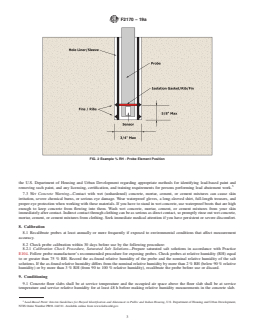
6.1.1 The liner shall have a solid sidewall that is open only at the bottom and at the top. Slots, holes, or other penetrations in
the sidewall of the liner are not permitted. Two or more deformable circumferential fins located around the exterior circumference
near the bottom of the liner shall be provided to create a positive seal against the concrete. The liner shall be of sufficient length
to extend from the bottom diameter of the hole to the surface of the concrete. See Fig. 1.
NOTE 1—The purpose of the liner is to isolate the probe from the sidewall of the hole so that moisture only enters into the sensor from a specific depth
at the bottom of the hole. The specified diameter range will usually permit the hole to intersect a sufficient volume of cement paste to provide adequate
moisture interaction with the sensor for accurate measurement. Smaller diameter holes may intersect only a single aggregate particle at the bottom of the
hole and therefore produce inaccurate results. If the user observes that the bottom of the hole is occupied by a single aggregate particle, do not use that
hole.
6.2 Humidity Probe and Digital Meter—Relative humidity and temperature sensors in cylindrical probe, designed such that
when the probe is installed to its full depth within the hole liner, the following geometrical considerations shall be met:
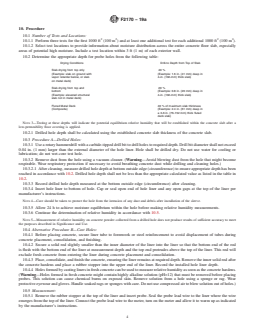
6.2.1 The sensing elements of the probe shall be located within 0.625 6 0.125 in. (15.9 6 3 mm) of the base of the liner and
the probe sealed or gasketed within itself and the liner such that the volume of air being measured cannot escape upward beyond
0.625 6 0.125 in. (15.9 6 3 mm) within the probe itself or the liner. See Fig. 2.
6.2.2 Obtain probes from a manufacturer with NIST traceable calibration equal to or better than 62 % relative humidity at 50
% relative humidity and 62 % relative humidity at 90 % relative humidity.
NOTE 2—Calibration by end-users using saturated salt solutions in accordance with Practice E104 is not recommended due to the technical difficulties
of maintaining sufficiently accurate reference standards. Checking with salt solutions is an acceptable method of assessing probe performance.
7. Hazards
7.1 Silica and Asbestos Warning—Do not sand, dry sweep, dry scrape, drill, saw, beadblast, or mechanically chip or pulverize
existing resilient flooring, backing, lining felt, paint, asphaltic cutback adhesives, or other adhesives. These products may contain
asbestos fibers or crystalline silica. (See OSHA §1926.1153 for latest OSHA requirements). Avoid creating dust. Use of dust
collection equipment and appropriate personal protective equipment such as an approved respirator may be required to control
worker exposure to respirable crystalline silica produced from drilling concrete. Inhalation of such dust is a cancer and respiratory
tract hazard. Smoking by individuals exposed to asbestos fibers greatly increases the risk of serious bodily harm. Unless positively
certain that the product is a nonasbestos-containing material, presume that it contain asbestos. Regulations may require that the
material be tested to determine asbestos content. The Resilient Floor Covering Institute’s (RFCI) recommended work practices for
removal of existing resilient floor coverings should be consulted for a defined set of instructions addressed to the task of removing
all resilient floor covering structures.
7.2 Lead Warning—Certain paints may contain lead. Exposure to excessive amounts of lead dust presents a health hazard. Refer
to applicable federal, state, and local laws and guidelines for hazard identification and abatement of lead-based paint published by
FIG. 1 Example Hole with Liner
Recommended Work Practices for Removal of Resilient Floor Coverings, Resilient Floor Covering Institute, 115 Broad St., Suite 201, La Grange, GA 30240, rfci.com.
F2170 − 19a
FIG. 2 Example % RH - Probe Element Position
the U.S. Department of Housing and Urban Development regarding appropriate methods for identifying lead-based paint and
removing such paint, and any licensing, certification, and training requirements for persons performing lead abatement work.
7.3 Wet Concrete Warning—Contact with wet (unhardened) concrete, mortar, cement, or cement mixtures can cause skin
irritation, severe chemical burns, or serious eye damage. Wear waterproof gloves, a long-sleeved shirt, full-length trousers, and
proper eye protection when working with these materials. If you have to stand in wet concrete, use waterproof boots that are high
enough to keep concrete from flowing into them. Wash wet concrete, mortar, cement, or cement mixtures from your skin
immediately after contact. Indirect contact through clothing can be as serious as direct contact, so promptly rinse out wet concrete,
mortar, cement, or cement mixtures from clothing. Seek immediate medical attention if you have persistent or severe discomfort.
8. Calibration
8.1 Recalibrate probes at least annually or more frequently if exposed to environmental conditions that affect measurement
accuracy.
8.2 Check probe calibration within 30 days before use by the following procedure:
8.2.1 Calibration Check Procedure, Saturated Salt Solutions—Prepare saturated salt solutions in accordance with Practice
E104. Follow probe manufacturer’s recommended procedure for exposing probes. Check probes at relative humidity (RH) equal
to or greater than 75 % RH. Record the as-found relative humidity of the probe and the nominal relative humidity of the salt
solutions. If the as-found relative humidity differs from the nominal relative humidity by more than 2 % RH (below 90 % relative
humidity) or by more than 3 % RH (from 90 to 100 % relative humidity), recalibrate the probe before use or discard.
9. Conditioning
9.1 Concrete floor slabs shall be at service temperature and the occupied air space above the floor slab shall be at service
temperature and service relative humidity for at least 48 h before making relative humidity measurements in the concrete slab.
Lead-Based Paint: Interim Guidelines for Hazard Identification and Abatement in Public and Indian Housing, U.S. Department of Housing and Urban Development,
NTIS Order Number PB91-144311. Available online from www.fedworld.gov.
F2170 − 19a
10. Procedure
10.1 Number of Tests and Locations:
2 2 2 2
10.1.1 Perform three tests for the first 1000 ft (100 m ) and at least one additional test for each additional 1000 ft (100 m ).
10.1.2 Select test locations to provide information about moisture distribution across the entire concrete floor slab, especially
areas of potential high moisture. Include a test location within 3 ft (1 m) of each exterior wall.
10.2 Determine the appropriate depth for probe holes from the following table:
Drying Conditions Drill-to Depth from Top of Slab
Slab drying from top only 40 %
(Example: slab on ground with (Example: 1.6 in. (41 mm) deep in
vapor retarder below, or slab 4-in. (102-mm) thick slab)
on metal deck)
Slab drying from top and 20 %
bottom (Example: 0.8 in. (20 mm) deep in
(Example: elevated structural 4-in. (102-mm) thick slab)
slab not in metal deck)
Fluted Metal Deck 40 % of maximum slab thickness
(Composite) (Example: 2.4 in. (61 mm) deep in
a 3-6 in.
...