

ASTM D6701-21
(Test Method)Standard Test Method for Determining Water Vapor Transmission Rates Through Nonwoven and Plastic Barriers
General Information
- Abstract
SIGNIFICANCE AND USE
5.1 The purpose of this test method is to obtain values for the WVTR of barrier materials.
5.2 WVTR is an important property of materials and can be related to shelf life; product stability, breath-ability, and wearing comfort.
5.3 Data from this test method is suitable as a referee method of testing, provided that the purchaser and seller have agreed on sampling procedures, test conditions, and acceptance criteria.
SCOPE
1.1 This test method covers a procedure for determining the rate of water vapor transmission ranging between 500 to 100 000 g/(m2·day) through nonwoven and plastic barrier materials. The method is applicable to films, barriers consisting of single or multilayer synthetic or natural polymers, nonwoven fabric, and nonwoven fabrics coated with films up to 3 mm (0.1 in.) in thickness.
1.2 This test method provides for the determination of (1) water vapor transmission rate (WVTR), and (2) the permeance to water vapor.
1.3 The values stated in SI units are to be regarded as standard. The values given in parentheses after SI units are provided for information only and are not considered standard. The acceptable units for WVTR are usually g/(m2·day).
1.4 This standard does not purport to address all of the safety concerns, if any, associated with its use. It is the responsibility of the user of this standard to establish appropriate safety, health, and environmental practices and determine the applicability of regulatory limitations prior to use.
1.5 This international standard was developed in accordance with internationally recognized principles on standardization established in the Decision on Principles for the Development of International Standards, Guides and Recommendations issued by the World Trade Organization Technical Barriers to Trade (TBT) Committee.
- Status
- Published
- Publication Date
- 31-Jan-2021
- Technical Committee
- F02 - Primary Barrier Packaging
- Drafting Committee
- F02.10 - Permeation
Buy Documents
ASTM D6701-21 - Standard Test Method for Determining Water Vapor Transmission Rates Through Nonwoven and Plastic Barriers
REDLINE ASTM D6701-21 - Standard Test Method for Determining Water Vapor Transmission Rates Through Nonwoven and Plastic Barriers
Overview
ASTM D6701-21 is the Standard Test Method for Determining Water Vapor Transmission Rates Through Nonwoven and Plastic Barriers, published by ASTM International. This standard specifies a method for measuring the water vapor transmission rate (WVTR) of various materials, including nonwovens, plastic films, multilayer polymer barriers, and nonwoven fabrics coated with films up to 3 mm thick. The WVTR is a critical property that affects product shelf life, stability, breathability, and end-use comfort. This method is widely used as a referee test when agreement has been made on sampling procedures, test conditions, and acceptance criteria between parties.
Key Topics
Water Vapor Transmission Rate (WVTR)
WVTR quantifies the amount of water vapor that passes through a material per unit area within a specific time (expressed as g/(m²·day)). Accurately determining WVTR is essential for materials utilized in packaging, textiles, and protective barriers.Scope of Materials
The method applies to:- Nonwoven fabrics (including coated nonwovens)
- Plastic barriers and films
- Single or multilayer synthetic or natural polymers
Test Range and Conditions
- The procedure is designed for WVTR ranging from 500 to 100,000 g/(m²·day).
- The test is performed under controlled temperature and humidity conditions, with SI units used as the reference.
Reportable Results
- WVTR values
- Water vapor permeance
Precision and Agreement
- The method provides repeatability and reproducibility metrics for comparing results obtained within or between laboratories.
Applications
Implementing ASTM D6701-21 for water vapor transmission testing has numerous practical benefits across different industries:
Pharmaceutical and Food Packaging
- Ensures packaging materials maintain product integrity by limiting moisture ingress, thereby extending shelf life and preserving effectiveness.
Medical and Protective Textiles
- Assesses the breathability and comfort of nonwoven fabrics used in gowns, masks, and drapes, where moisture permeability is a key performance indicator.
Industrial Materials
- Evaluates the efficacy of vapor barriers in construction or insulation, ensuring that materials provide adequate moisture protection.
Material Development and Quality Control
- Supports R&D and quality assurance by providing a standardized approach to compare the WVTR of barrier materials under consistent conditions.
Regulatory Compliance
- ASTM D6701-21 test data can be used in specifications, procurement, and certification to demonstrate compliance with moisture barrier requirements.
Related Standards
- ASTM F1249 - Test Method for Water Vapor Transmission Rate Through Plastic Film and Sheeting Using a Modulated Infrared Sensor
- ASTM D123 - Terminology Relating to Textiles
- ASTM D1898 (Withdrawn) - Practice for Sampling of Plastics
- ASTM D5729 (Withdrawn) - Test Method for Thickness of Nonwoven Fabrics
- ASTM D4204 - Practice for Preparing Plastic Film Specimens
- ASTM E177 - Practice for Use of the Terms Precision and Bias in ASTM Test Methods
- ASTM E691 - Practice for Conducting an Interlaboratory Study to Determine the Precision of a Test Method
These related ASTM standards provide additional terminology, sampling practices, and test methods that complement the evaluation of flexible barrier materials for water vapor transmission rates.
By utilizing this internationally recognized test standard, manufacturers and researchers gain reliable data on the moisture barrier performance of nonwoven and plastic materials, supporting informed decisions in product design, compliance, and quality assurance.
Relations
- Refers
ASTM D4204-16(2023) - Standard Practice for Preparing Plastic Film Specimens for a Round-Robin Study - Effective Date
- 01-Nov-2023
- Effective Date
- 29-Sep-2023
- Effective Date
- 01-Jun-2020
- Effective Date
- 01-Mar-2017
- Refers
ASTM D4204-16 - Standard Practice for Preparing Plastic Film Specimens for a Round-Robin Study - Effective Date
- 01-Nov-2016
- Effective Date
- 15-Sep-2015
- Effective Date
- 01-Sep-2015
- Effective Date
- 01-Apr-2015
- Effective Date
- 01-May-2014
- Effective Date
- 15-Jun-2013
- Effective Date
- 15-Jun-2013
- Effective Date
- 15-May-2013
- Effective Date
- 01-May-2013
- Effective Date
- 01-May-2013
- Refers
ASTM D4204-12 - Standard Practice for Preparing Plastic Film Specimens for a Round-Robin Study - Effective Date
- 01-Aug-2012
Buy Documents
ASTM D6701-21 - Standard Test Method for Determining Water Vapor Transmission Rates Through Nonwoven and Plastic Barriers
REDLINE ASTM D6701-21 - Standard Test Method for Determining Water Vapor Transmission Rates Through Nonwoven and Plastic Barriers
Get Certified
Connect with accredited certification bodies for this standard

Control Union Certifications
Global certification for agriculture and sustainability.

DIN CERTCO
DIN Group product certification.
Hohenstein Institut
Textile testing and certification.
Sponsored listings
Frequently Asked Questions
ASTM D6701-21 is a standard published by ASTM International. Its full title is "Standard Test Method for Determining Water Vapor Transmission Rates Through Nonwoven and Plastic Barriers". This standard covers: SIGNIFICANCE AND USE 5.1 The purpose of this test method is to obtain values for the WVTR of barrier materials. 5.2 WVTR is an important property of materials and can be related to shelf life; product stability, breath-ability, and wearing comfort. 5.3 Data from this test method is suitable as a referee method of testing, provided that the purchaser and seller have agreed on sampling procedures, test conditions, and acceptance criteria. SCOPE 1.1 This test method covers a procedure for determining the rate of water vapor transmission ranging between 500 to 100 000 g/(m2·day) through nonwoven and plastic barrier materials. The method is applicable to films, barriers consisting of single or multilayer synthetic or natural polymers, nonwoven fabric, and nonwoven fabrics coated with films up to 3 mm (0.1 in.) in thickness. 1.2 This test method provides for the determination of (1) water vapor transmission rate (WVTR), and (2) the permeance to water vapor. 1.3 The values stated in SI units are to be regarded as standard. The values given in parentheses after SI units are provided for information only and are not considered standard. The acceptable units for WVTR are usually g/(m2·day). 1.4 This standard does not purport to address all of the safety concerns, if any, associated with its use. It is the responsibility of the user of this standard to establish appropriate safety, health, and environmental practices and determine the applicability of regulatory limitations prior to use. 1.5 This international standard was developed in accordance with internationally recognized principles on standardization established in the Decision on Principles for the Development of International Standards, Guides and Recommendations issued by the World Trade Organization Technical Barriers to Trade (TBT) Committee.
SIGNIFICANCE AND USE 5.1 The purpose of this test method is to obtain values for the WVTR of barrier materials. 5.2 WVTR is an important property of materials and can be related to shelf life; product stability, breath-ability, and wearing comfort. 5.3 Data from this test method is suitable as a referee method of testing, provided that the purchaser and seller have agreed on sampling procedures, test conditions, and acceptance criteria. SCOPE 1.1 This test method covers a procedure for determining the rate of water vapor transmission ranging between 500 to 100 000 g/(m2·day) through nonwoven and plastic barrier materials. The method is applicable to films, barriers consisting of single or multilayer synthetic or natural polymers, nonwoven fabric, and nonwoven fabrics coated with films up to 3 mm (0.1 in.) in thickness. 1.2 This test method provides for the determination of (1) water vapor transmission rate (WVTR), and (2) the permeance to water vapor. 1.3 The values stated in SI units are to be regarded as standard. The values given in parentheses after SI units are provided for information only and are not considered standard. The acceptable units for WVTR are usually g/(m2·day). 1.4 This standard does not purport to address all of the safety concerns, if any, associated with its use. It is the responsibility of the user of this standard to establish appropriate safety, health, and environmental practices and determine the applicability of regulatory limitations prior to use. 1.5 This international standard was developed in accordance with internationally recognized principles on standardization established in the Decision on Principles for the Development of International Standards, Guides and Recommendations issued by the World Trade Organization Technical Barriers to Trade (TBT) Committee.
ASTM D6701-21 is classified under the following ICS (International Classification for Standards) categories: 59.080.30 - Textile fabrics; 83.080.01 - Plastics in general. The ICS classification helps identify the subject area and facilitates finding related standards.
ASTM D6701-21 has the following relationships with other standards: It is inter standard links to ASTM D4204-16(2023), ASTM D1898-68(1989), ASTM F1249-20, ASTM D123-17, ASTM D4204-16, ASTM D123-15b, ASTM D123-15a, ASTM D123-15, ASTM E177-14, ASTM D123-13ae1, ASTM D123-13a, ASTM D123-13, ASTM E691-13, ASTM E177-13, ASTM D4204-12. Understanding these relationships helps ensure you are using the most current and applicable version of the standard.
ASTM D6701-21 is available in PDF format for immediate download after purchase. The document can be added to your cart and obtained through the secure checkout process. Digital delivery ensures instant access to the complete standard document.
Standards Content (Sample)
This international standard was developed in accordance with internationally recognized principles on standardization established in the Decision on Principles for the
Development of International Standards, Guides and Recommendations issued by the World Trade Organization Technical Barriers to Trade (TBT) Committee.
Designation: D6701 − 21
Standard Test Method for
Determining Water Vapor Transmission Rates Through
Nonwoven and Plastic Barriers
This standard is issued under the fixed designation D6701; the number immediately following the designation indicates the year of
original adoption or, in the case of revision, the year of last revision. A number in parentheses indicates the year of last reapproval. A
superscript epsilon (´) indicates an editorial change since the last revision or reapproval.
1. Scope D1898 Practice for Sampling of Plastics (Withdrawn 1998)
D4204 Practice for Preparing Plastic Film Specimens for a
1.1 This test method covers a procedure for determining the
Round-Robin Study
rate of water vapor transmission ranging between 500 to
D5729 Test Method for Thickness of Nonwoven Fabrics
100 000 g⁄(m ·day) through nonwoven and plastic barrier
(Withdrawn 2008)
materials.Themethodisapplicabletofilms,barriersconsisting
E177 Practice for Use of the Terms Precision and Bias in
of single or multilayer synthetic or natural polymers, nonwo-
ASTM Test Methods
venfabric,andnonwovenfabricscoatedwithfilmsupto3 mm
E691 Practice for Conducting an Interlaboratory Study to
(0.1 in.) in thickness.
Determine the Precision of a Test Method
1.2 This test method provides for the determination of (1) F1249 Test Method for Water Vapor Transmission Rate
water vapor transmission rate (WVTR), and (2) the permeance
Through Plastic Film and Sheeting Using a Modulated
to water vapor. Infrared Sensor
1.3 The values stated in SI units are to be regarded as
3. Terminology
standard. The values given in parentheses after SI units are
3.1 Definitions:
provided for information only and are not considered standard.
2 3.1.1 water vapor permeability coeffıcient, n—the ratio of
The acceptable units for WVTR are usually g/(m ·day).
the permeance and the thickness.
1.4 This standard does not purport to address all of the
3.1.1.1 Discussion—This quantity should not be used unless
safety concerns, if any, associated with its use. It is the
the relationship between thickness and permeance has been
responsibility of the user of this standard to establish appro-
verified in tests using several thickness’ of the material. The
priate safety, health, and environmental practices and deter-
water vapor permeability is meaningful only for homogeneous
mine the applicability of regulatory limitations prior to use.
materials, in which case it is a property characteristic of bulk
1.5 This international standard was developed in accor-
material. An accepted unit of water vapor permeability is the
dance with internationally recognized principles on standard-
metric perm centimeter, or 1 g per m per day per mm Hg-cm
ization established in the Decision on Principles for the
of thickness. The SI unit is the mol/(m -s-Pa-mm).
Development of International Standards, Guides and Recom-
3.1.2 water vapor permeance, n—the ratio of a barrier’s
mendations issued by the World Trade Organization Technical
water vapor transmission rate to the vapor pressure difference
Barriers to Trade (TBT) Committee.
between the two surfaces.
3.1.2.1 Discussion—An accepted unit of water vapor per-
2. Referenced Documents 2
meance is the metric perm, or 1 g/m per day per mm Hg. The
SI unit is the mol/(m -s-Pa). Since the water vapor permeance
2.1 ASTM Standards:
of a specimen is generally a function of relative humidity and
D123 Terminology Relating to Textiles
temperature, therefore those conditions must be stated.
3.1.3 water vapor transmission rate (WVTR), n—thesteady-
state time rate of water vapor flow through unit area of a
This test method is under the jurisdiction ofASTM Committee F02 on Primary
Barrier Packaging and is the direct responsibility of Subcommittee F02.10 on specimen, normal to the surfaces under specific conditions of
Permeation.
temperature and humidity at each surface.
Current edition approved Feb. 1, 2021. Published February 2021. Originally
3.1.3.1 Discussion—A common practice accepted unit of
approved in 2001. Last previous edition approved in 2016 as D6701 – 16. DOI:
water vapor transmission rate is metric g/m per day. The test
10.1520/D6701-21.
For referenced ASTM standards, visit the ASTM website, www.astm.org, or
contact ASTM Customer Service at service@astm.org. For Annual Book of ASTM
Standards volume information, refer to the standard’s Document Summary page on The last approved version of this historical standard is referenced on
the ASTM website. www.astm.org.
Copyright © ASTM International, 100 Barr Harbor Drive, PO Box C700, West Conshohocken, PA 19428-2959. United States
D6701 − 21
conditions of relative humidity and temperature where the 5.3 Data from this test method is suitable as a referee
driving force is the difference in relative humidity across the method of testing, provided that the purchaser and seller have
specimen must be stated. agreedonsamplingprocedures,testconditions,andacceptance
criteria.
4. Summary of Test Method
6. Apparatus
4.1 Adry chamber, guard film, and a wet chamber make up
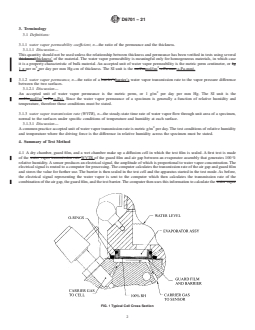
6.1 This method utilizes water vapor transmission appara-
a diffusion cell in which the test film is sealed. A first test is
tus comprised of the following:
made of the WVTR of the guard film and air gap between an
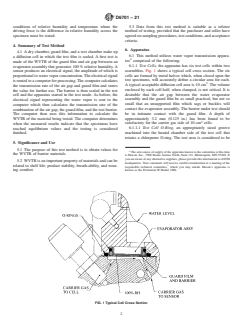
6.1.1 Test Cells, the apparatus has six test cells within two
evaporator assembly that generates 100 % relative humidity.A
assemblies. Fig. 1 shows a typical cell cross section. The six
sensor produces an electrical signal, the amplitude of which is
cells are formed by metal halves which, when closed upon the
proportional to water vapor concentration.The electrical signal
test specimens, will accurately define a circular area for each.
isroutedtoacomputerforprocessing.Thecomputercalculates
Atypical acceptable diffusion cell area is 10 cm . The volume
the transmission rate of the air gap and guard film and stores
enclosed by each cell half, when clamped, is not critical. It is
the value for further use. The barrier is then sealed in the test
desirable that the air gap between the water evaporator
cell and the apparatus started in the test mode. As before, the
assembly and the guard film be as small practical, but not so
electrical signal representing the water vapor is sent to the
small that an unsupported film which sags or buckles will
computer which then calculates the transmission rate of the
contact the evaporator assembly. The barrier under test should
combination of the air gap, the guard film, and the test barrier.
be in intimate contact with the guard film. A depth of
The computer then uses this information to calculate the
approximately 3.2 mm (0.125 in.) has been found to be
WVTR of the material being tested. The computer determines
satisfactory for the carrier gas side of 10-cm cells.
when the measured results indicate that the specimens have
6.1.1.1 Test Cell O-Ring, an appropriately sized groove
reached equilibrium values and the testing is considered
machined into the humid chamber side of the test cell that
finished.
retains a chlorprene O-ring. The test area is considered to be
5. Significance and Use
5.1 The purpose of this test method is to obtain values for
The sole source of supply of the apparatus known to the committee at this time
the WVTR of barrier materials.
is Mocon, Inc., 7500 Boone Avenue North, Suite 111, Minneapolis, MN 55428. If
you are aware of any alternative suppliers, please provide this information toASTM
5.2 WVTR is an important property of materials and can be
headquarters. Your comments will receive careful consideration at a meeting of the
related to shelf life; product stability, breath-ability, and wear- 1
responsible technical committee, which you may attend. Mocon’s apparatus is
ing comfort. known as the Permatran-W Model 100k.
FIG. 1 Typical Cell Cross Section
D6701 − 21
the area established by the inside contact diameter of the 8. Sampling and Test Specimens
compressed O-ring when the test cell is clamped shut against
8.1 Select material for testing in accordance with standard
the test specimen.
methods of sampling applicable to the material under test.
6.1.1.2 Test Cell Sealing Surface, a flat rim around the dry
Sampling may be done in accordance with Practice D1898 or
side of the diffusion cell. This is a critical sealing surface
by 8.2 below.
against which the test specimen is pressed; it shall be smooth
8.2 Selection samples considered representative of the ma-
and without radial scratches.
terial to be tested.
6.1.1.3 Test Cell Air Passages, two holes in the dry half of
8.2.1 Primary Sampling Unit—Consider rolls, bolts, or
the diffusion cell that pass carrier gas and water vapor to either
pieces of the flexible barrier material or nonwoven fabric to be
exhaust ports or the sensor assembly. One cell at a time can be
the primary sampling unit, as applicable.
connected to the sensor assembly by solenoid valves.
8.2.2 Laboratory Sampling Unit—As a laboratory sampling
6.1.1.4 Test Cell Guard Film, a flat film that covers the
unit, take from the primary sampling unit at least a one
humid side of each cell. The film is a barrier that stills the air
full-width piece that is1m(1yd)in length along the (machine
in the gap between the water evaporator and the mounting
direction, after first removinga1m(1yd) length.
planeofthespecimen.Theguardfilmisaveryhightransmitter
8.2.2.1 For primary sampling units less than1m(1yd)in
of water vapor. Its transmission rate as well as that of the air
length, use a sufficient number of pieces to prepare the six
gap is accounted for in the apparatus’ measurements.
specimens to the size described in 8.2.3.
6.1.1.5 Water Vapor Sensor, a water vapor detector capable
8.2.3 Test Specimen Size—From each laboratory-sampling
of sensing 0 to 100 % relative humidity with sufficient accu-
unit, cut at least six test specimens using the template supplied
racy so the apparatus can determine transmission rates down to
with the apparatus or a similar die cutter. The truncated pie
500 g/m per day.
shaped template will produce proper size specimens that cover
the sample cell.
6.1.1.6 Post Sensor Dryer, a no-maintenance dryer that
removes water vapor from the measurement gas stream after it 8.2.4 Test Specimen Selection—Select test specimens as
passes through the water vapor sensor. follows:
8.2.4.1 Cut specimens representing a broad distribution
6.1.1.7 Mass Flowmeter, a means for regulating the flow of
diagonally across the width of the laboratory-sampling unit.
dry air within an operating range of 0 to 200 cc/min.
8.2.4.2 For fabric widths 125 mm (5 in.) or more take no
6.1.1.8 Flow-Metering Valves, fine-metering valves capable
specimen closer than 25 mm (1 in.) from the selvage edge.
of controlling the dry-air flow rate to each test.
8.2.4.3 For fabric widths less than 125 mm (5 in.), use the
6.1.2 Computer System, a computer provides the main
entire width for specimens.
control, calculating, and data storage device for the system.
8.2.4.4 Ensure specimens are free of folds, creases, or
6.1.3 Temperature Control, Temperature of the test speci-
wrinkles. Avoid getting oil, water, grease, etc., on the speci-
men is thermostatically controlled by a thermo-electric device
mens when handling.
(TED) attached to the apparatus that ensures good thermal
contact. A thermistor sensor and an appropriate control circuit
9. Conditioning
willservetoregulatethetemperaturefrom20to50°Ctowithin
0.1°C. 9.1 No pre-conditioning is necessary before starting a test.
6.1.4 Barometric Pressure Sensor, a sensor that measures
9.2 Any conditioning of the specimens to the water vapor
the ambient barometric pressure so that variations are auto-
driving force (differential relative humidity) and temperature is
matically corrected in the calculations.
carried out during the test within the test apparatus. In general,
these materials are high transmitters and the specimens do not
7. Reagents and Materials
require a significant conditioning period; they reach equilib-
5 rium in just a few examination periods. (Experience has shown
7.1 Desiccant, for drying air stream.
that individual test periods range from 2 to 10 minutes.) The
7.2 High Purity Level Chromatograph Grade Distilled Wa-
time required for sample conditioning varies as a function of
ter (HPLC), for producing 100 % relative humidity. many factors such as barrier composition, thickness, test
temperature, etc.
7.3 Sealing Grease, a high-viscosity, silicone stopcock
grease or other suitable silicone high-vacuum grease is re-
10. Preparation of Test Apparatus and Calibration Pre-
...
This document is not an ASTM standard and is intended only to provide the user of an ASTM standard an indication of what changes have been made to the previous version. Because
it may not be technically possible to adequately depict all changes accurately, ASTM recommends that users consult prior editions as appropriate. In all cases only the current version
of the standard as published by ASTM is to be considered the official document.
Designation: D6701 − 16 D6701 − 21
Standard Test Method for
Determining Water Vapor Transmission Rates Through
Nonwoven and Plastic Barriers
This standard is issued under the fixed designation D6701; the number immediately following the designation indicates the year of
original adoption or, in the case of revision, the year of last revision. A number in parentheses indicates the year of last reapproval. A
superscript epsilon (´) indicates an editorial change since the last revision or reapproval.
1. Scope
1.1 This test method covers a procedure for determining the rate of water vapor transmission ranging between 500 to 100,000
100 000 g g/m⁄(m day·day) through nonwoven and plastic barrier materials. The method is applicable to films, barriers consisting
of single or multilayer synthetic or natural polymers, nonwoven fabric, and nonwoven fabrics coated with films up to 3 mm (0.1
in.) 3 mm (0.1 in.) in thickness.
1.2 This test method provides for the determination of (1) water vapor transmission rate (WVTR), and (2) the permeance to water
vapor.
1.3 The values stated in metricSI units are to be regarded as the standard. The standard. The values given in parentheses after SI
units are provided for information only and are not considered standard. The acceptable units for water vapor transmission rate
WVTR are usually g/mg/(m day.·day).
1.4 This standard does not purport to address all of the safety concerns, if any, associated with its use. It is the responsibility
of the user of this standard to establish appropriate safety safety, health, and healthenvironmental practices and determine the
applicability of regulatory limitations prior to use.
1.5 This international standard was developed in accordance with internationally recognized principles on standardization
established in the Decision on Principles for the Development of International Standards, Guides and Recommendations issued
by the World Trade Organization Technical Barriers to Trade (TBT) Committee.
2. Referenced Documents
2.1 ASTM Standards:
D123 Terminology Relating to Textiles
D1898 Practice for Sampling of Plastics (Withdrawn 1998)
D4204 Practice for Preparing Plastic Film Specimens for a Round-Robin Study
D5729 Test Method for Thickness of Nonwoven Fabrics (Withdrawn 2008)
E177 Practice for Use of the Terms Precision and Bias in ASTM Test Methods
E691 Practice for Conducting an Interlaboratory Study to Determine the Precision of a Test Method
F1249 Test Method for Water Vapor Transmission Rate Through Plastic Film and Sheeting Using a Modulated Infrared Sensor
This test method is under the jurisdiction of ASTM Committee F02 on FlexiblePrimary Barrier Packaging and is the direct responsibility of Subcommittee F02.10 on
Permeation.
Current edition approved Aug. 1, 2016Feb. 1, 2021. Published September 2016February 2021. Originally approved in 2001. Last previous edition approved in 20012016
as D6701–01, which was withdrawn in October 2008 and reinstated in August 2016. – 16. DOI: 10.1520/D6701-21.
For referenced ASTM standards, visit the ASTM website, www.astm.org, or contact ASTM Customer Service at service@astm.org. For Annual Book of ASTM Standards
volume information, refer to the standard’sstandard’s Document Summary page on the ASTM website.
The last approved version of this historical standard is referenced on www.astm.org.
Copyright © ASTM International, 100 Barr Harbor Drive, PO Box C700, West Conshohocken, PA 19428-2959. United States
D6701 − 21
3. Terminology
3.1 Definitions:
3.1.1 water vapor permeability coeffıcient, n—the ratio of the permeance and the thickness.
3.1.1.1 Discussion—
This quantity should not be used unless the relationship between thickness and permeance has been verified in tests using several
thickness’thickness’ of the material. The water vapor permeability is meaningful only for homogeneous materials, in which case
it is a property characteristic of bulk material. An accepted unit of water vapor permeability is the metric perm centimeter, or 1g
2 2
1 g per m per day per mm Hg-cm of thickness. The SI unit is the mol/mmol/(m -s-Pa-mm.-s-Pa-mm).
3.1.2 water vapor permeance, n—the ratio of a barrier’sbarrier’s water vapor transmission rate to the vapor pressure difference
between the two surfaces.
3.1.2.1 Discussion—
An accepted unit of water vapor permeance is the metric perm, or 1 g/m per day per mm Hg. The SI unit is the
mol/mmol/(m -s-Pa.-s-Pa). Since the water vapor permeance of a specimen is generally a function of relative humidity and
temperature, therefore those conditions must be stated.
3.1.3 water vapor transmission rate (WVTR), n—the steady-state time rate of water vapor flow through unit area of a specimen,
normal to the surfaces under specific conditions of temperature and humidity at each surface.
3.1.3.1 Discussion—
A common practice accepted unit of water vapor transmission rate is metric g/m per day. The test conditions of relative humidity
and temperature where the driving force is the difference in relative humidity across the specimen must be stated.
4. Summary of Test Method
4.1 A dry chamber, guard film, and a wet chamber make up a diffusion cell in which the test film is sealed. A first test is made
of the water vapor transmission rate WVTR of the guard film and air gap between an evaporator assembly that generates 100 %
relative humidity. A sensor produces an electrical signal, the amplitude of which is proportional to water vapor concentration. The
electrical signal is routed to a computer for processing. The computer calculates the transmission rate of the air gap and guard film
and stores the value for further use. The barrier is then sealed in the test cell and the apparatus started in the test mode. As before,
the electrical signal representing the water vapor is sent to the computer which then calculates the transmission rate of the
combination of the air gap, the guard film, and the test barrier. The computer then uses this information to calculate the water vapor
FIG. 1 Typical Cell Cross Section
D6701 − 21
transmission rate WVTR of the material being tested. The computer determines when the measured results indicate that the
specimens have reached equilibrium values and the testing is considered finished.
5. Significance and Use
5.1 The purpose of this test method is to obtain values for the water vapor transmission rate WVTR of barrier materials.
5.2 Water vapor transmission rate WVTR is an important property of materials and can be related to shelf life; product stability,
breath-ability, and wearing comfort.
5.3 Data from this test method is suitable as a referee method of testing, provided that the purchaser and seller have agreed on
sampling procedures, test conditions, and acceptance criteria.
6. Apparatus
6.1 This method utilizes water vapor transmission apparatus comprised of the following:
6.1.1 Test Cells, the apparatus has six test cells within two assemblies. Fig. 1 shows a typical cell cross section. The six cells are
formed by metal halves which, when closed upon the test specimens, will accurately define a circular area for each. A typical
acceptable diffusion cell area is 10 cm . The volume enclosed by each cell half, when clamped, is not critical. It is desirable that
the air gap between the water evaporator assembly and the guard film be as small practical, but not so small that an unsupported
film which sags or buckles will contact the evaporator assembly. The barrier under test should be in intimate contact with the guard
film. A depth of approximately 3.2 mm (0.125 in.) has been found to be satisfactory for the carrier gas side of 10-cm cells.
6.1.1.1 Test Cell O-ring,O-Ring, an appropriately sized groove machined into the humid chamber side of the test cell that retains
a chlorprene O-ring. The test area is considered to be the area established by the inside contact diameter of the compressed O-ring
when the test cell is clamped shut against the test specimen.
6.1.1.2 Test Cell Sealing Surface, a flat rim around the dry side of the diffusion cell. This is a critical sealing surface against which
the test specimen is pressed; it shall be smooth and without radial scratches.
6.1.1.3 Test Cell Air Passages, two holes in the dry half of the diffusion cell that pass carrier gas and water vapor to either exhaust
ports or the sensor assembly. One cell at a time can be connected to the sensor assembly by solenoid valves.
6.1.1.4 Test Cell Guard Film, a flat film that covers the humid side of each cell. The film is a barrier that stills the air in the gap
between the water evaporator and the mounting plane of the specimen. The guard film is a very high transmitter of water vapor.
Its transmission rate as well as that of the air gap is accounted for in the apparatus’apparatus’ measurements.
6.1.1.5 Water Vapor Sensor, a water vapor detector capable of sensing 0 to 100 % relative humidity with sufficient accuracy so
the apparatus can determine transmission rates down to 500 g/m per day.
6.1.1.6 Post Sensor Dryer, a no-maintenance dryer that removes water vapor from the measurement gas stream after it passes
through the water vapor sensor.
6.1.1.7 Mass Flowmeter, a means for regulating the flow of dry air within an operating range of 0 to 200 cc/min.
6.1.1.8 Flow-Metering Valves, fine-metering valves capable of controlling the dry-air flow rate to each test.
6.1.2 Computer System, a computer provides the main control, calculating, and data storage device for the system.
6.1.3 Temperature Control, Temperature of the test specimen is thermostatically controlled by a Thermo-Electric Devicethermo-
electric device (TED) attached to the apparatus that ensures good thermal contact. A thermistor sensor and an appropriate control
circuit will serve to regulate the temperature from 20 to 50°C to within 0.1°C.
The sole source of supply of the apparatus known to the committee at this time is Mocon, Inc., 7500 Boone Avenue North, Suite 111, Minneapolis, MN 55428. If you
are aware of any alternative suppliers, please provide this information to ASTM headquarters. Your comments will receive careful consideration at a meeting of the responsible
technical committee, which you may attend. Mocon’sMocon’s apparatus is known as the Permatran-W modelModel 100k.
D6701 − 21
6.1.4 Barometric Pressure Sensor, a sensor that measures the ambient barometric pressure so that variations are automatically
corrected in the calculations.
7. Reagents and Materials
5 5
7.1 Desiccant, —Desiccant, for drying air stream.
7.2 High Purity Level Chromatograph Grade Distilled Water (HPLC), for producing 100 % relative humidity.
7.3 Sealing Grease, a high-viscosity, silicone stopcock grease or other suitable silicone high-vacuum grease is required for
lubrication of O-rings.
7.4 Sample Holder, a cardboard or metal sample holder is supplied with the apparatus to facilitate loading of specimens.
8. Sampling and Test Specimens
8.1 Select material for testing in accordance with standard methods of sampling applicable to the material under test. Sampling
may be done in accordance with Practice D1898 or by 8.2 below.
8.2 Selection samples considered representative of the material to be tested.
8.2.1 Primary Sampling Unit—Consider rolls, bolts, or pieces of the flexible barrier material or nonwoven fabric to be the primary
sampling unit, as applicable.
8.2.2 Laboratory Sampling Unit—As a laboratory sampling unit, take from the primary sampling unit at least a one full-width
piece that is 1 m (1yd) (1 yd) in length along the (machine direction, after first removing a 1 m (1 yd) length.
8.2.2.1 For primary sampling units less than 1 m (1 yd) in length, use a sufficient number of pieces to prepare the six specimens
to the size described in 8.2.3.
8.2.3 Test Specimen Size—From each laboratory-sampling unit, cut at least six test specimens using the template supplied with the
apparatus or a similar die cutter. The truncated pie shaped template will produce proper size specimens that cover the sample cell.
8.2.4 Test Specimen Selection—Select test specimens as follows:
8.2.4.1 Cut specimens representing a broad distribution diagonally across the width of the laboratory-sampling unit.
8.2.4.2 For fabric widths 125 mm (5 in.) or more take no specimen closer than 25 mm (1 in.) from the selvage edge.
8.2.4.3 For fabric widths less than 125 mm (5 in.), use the entire width for specimens.
8.2.4.4 Ensure specimens are free of folds, creases, or wrinkles. Avoid getting oil, water, grease, etc.etc., on the specimens when
handling.
9. Conditioning
9.1 No pre-conditioning is necessary before starting a test.
9.2 Any conditioning of the specimens to the water vapor driving force (differential relative humidity) and temperature is carried
out during the test within the test apparatus. In general, these materials are high transmitters and the specimens do not require a
significant conditioning period; they reach equilibrium in just a few examination periods. (Experience has shown that individual
test periods range from 2 to 10 minutes).minutes.) The time required for sample conditioning varies as a function of many factors
such as barrier composition, thickness, test temperature, etc.
Linde Molecular Sieve, Type 4A or Type 5A, in the form of 1/8 in. pellets as may be obtained from the Union Carbide Co., Linde Division, Danbury, CT 06817-0001.
D6701 − 21
10. Preparation of Test Apparatus and Calibration Pre-Test Sample Considerations
10.1 Preparation of Apparatus (Fig. 1).):
10.1.1 If preceding tests have exposed the apparatus to high moisture levels, outgas the system to desorb residual moisture. Purge
the system with dry air for a period of 3 to 4 hours.
10.2 Calibrating the System—Determine the transmission rate of the system including the air gap and th
...