

ASTM D3498-19a
(Specification)Standard Specification for Adhesives for Field-Gluing Wood Structural Panels (Plywood or Oriented Strand Board) to Wood Based Floor System Framing
General Information
- Abstract
ABSTRACT
This specification covers minimum performance standards and test requirements for gap-filling construction adhesives for field-gluing plywood to lumber framing for floor systems. The adhesive shall conform to the strength and durability properties prescribed. The different methods for specimen's preparation are presented in details. The shear strength, gap-filling effect on strength, and durability shall be tested to meet the requirements prescribed.
SCOPE
1.1 This specification covers minimum performance standards and test requirements for gap-filling construction adhesives for bonding wood structural panels consisting of plywood or oriented strand board (OSB) to wood based floor system framing, particularly dimension lumber or wood I-joists, at the construction site.
1.2 This specification provides a basis for ensuring the quality of the adhesives and is not intended as an application specification.
1.3 The values stated in inch-pound units are to be regarded as standard. The values given in parentheses are mathematical conversions to SI units that are provided for information only and are not considered standard.
1.4 The following precautionary caveat pertains only to the test method portion, Section 11, of this specification: This standard does not purport to address all of the safety concerns, if any, associated with its use. It is the responsibility of the user of this standard to establish appropriate safety, health, and environmental practices and determine the applicability of regulatory limitations prior to use.
1.5 This international standard was developed in accordance with internationally recognized principles on standardization established in the Decision on Principles for the Development of International Standards, Guides and Recommendations issued by the World Trade Organization Technical Barriers to Trade (TBT) Committee.
- Status
- Published
- Publication Date
- 31-May-2019
- Technical Committee
- D14 - Adhesives
- Drafting Committee
- D14.70 - Construction Adhesives
Buy Documents
ASTM D3498-19a - Standard Specification for Adhesives for Field-Gluing Wood Structural Panels (Plywood or Oriented Strand Board) to Wood Based Floor System Framing
REDLINE ASTM D3498-19a - Standard Specification for Adhesives for Field-Gluing Wood Structural Panels (Plywood or Oriented Strand Board) to Wood Based Floor System Framing
Overview
ASTM D3498-19a is the internationally recognized standard specification developed by ASTM for adhesives used in field-gluing wood structural panels, specifically plywood or oriented strand board (OSB), to wood-based floor system framing, including dimension lumber and wood I-joists. This standard establishes minimum performance and testing requirements for gap-filling construction adhesives, ensuring they meet rigorous strength and durability criteria necessary for on-site floor system assembly.
By adhering to ASTM D3498-19a, manufacturers, contractors, and testing laboratories can be confident that adhesives used for subfloor installation deliver reliable bonding performance, even under variable site conditions such as moisture, temperature, and substrate variability.
Key Topics
- Performance Standards: The standard defines minimum shear strength and durability criteria for adhesives bonding plywood or OSB panels to wood framing. Adhesives must demonstrate specified performance on both wet, frozen, and dry lumber.
- Testing Requirements: Comprehensive test methods are outlined, including specimen preparation and conditioning, to simulate real-world conditions such as moisture and temperature extremes. Key tests include shear strength, gap-filling capability, moisture resistance, and oxidation resistance.
- Adhesive Classification:
- Panel Type: Adhesives are qualified for plywood (P), OSB (O), or both (P/O).
- Gap Class: Classification is based on performance with gap sizes of 1/16 in. or 1/8 in., supporting use in typical field conditions where close-fitting is not guaranteed.
- Quality Assurance: Provides a consistent framework for producers and quality control programs to certify adhesives, enabling traceable manufacturing, batch identification, and test documentation.
- Packaging and Marking: Specifies labeling requirements, including manufacturer, product code, lot number, manufacture date, and application information, to ensure correct use and traceability.
Applications
ASTM D3498-19a adhesives are vital in the construction industry, particularly for:
- Subfloor Installation: Ensuring robust bonding of plywood or OSB to wood framing, essential for the longevity, performance, and noise reduction of floor assemblies.
- Residential and Commercial Building: Applicable to new construction and renovations where wood-based flooring systems are installed over framing.
- Field Assembly: Designed to verify adhesive performance under variable site conditions, supporting reliable outcomes in real-world application rather than just laboratory settings.
- Product Certification & Quality Control: Used by adhesive manufacturers to qualify and regularly monitor product consistency according to recognized industry benchmarks.
The standard’s requirements help prevent common flooring issues such as squeaks, gaps, and loosening under load or moisture exposure, improving the durability and satisfaction of floor installations.
Related Standards
ASTM D3498-19a references and complements several other standards, including:
- ASTM D905: Strength Properties of Adhesive Bonds in Shear by Compression Loading
- ASTM D907: Terminology of Adhesives
- ASTM D4300 and D4783: Resistance to Fungi and Microorganisms
- ASTM D4442/D4444: Wood Moisture Content Measurement
- ASTM PS1 & PS2: Performance standards for plywood and wood-based panels
- ASTM E4, E177: Testing machine verification and statistical accuracy
Keywords: field-gluing adhesives, wood structural panels, plywood, OSB, floor system framing, gap-filling construction adhesive, shear strength, durability, subfloor adhesive standard, ASTM D3498-19a.
Relations
- Effective Date
- 01-Jun-2019
- Effective Date
- 01-Mar-2020
- Effective Date
- 15-Nov-2016
- Effective Date
- 01-Jun-2015
- Effective Date
- 01-Jun-2014
- Effective Date
- 01-May-2014
- Effective Date
- 01-May-2013
- Effective Date
- 01-Jul-2012
- Effective Date
- 01-May-2012
- Effective Date
- 01-Dec-2011
- Effective Date
- 01-Jan-2011
- Effective Date
- 01-Oct-2010
- Effective Date
- 01-Jun-2010
- Effective Date
- 01-Nov-2009
- Effective Date
- 01-Apr-2009
Buy Documents
ASTM D3498-19a - Standard Specification for Adhesives for Field-Gluing Wood Structural Panels (Plywood or Oriented Strand Board) to Wood Based Floor System Framing
REDLINE ASTM D3498-19a - Standard Specification for Adhesives for Field-Gluing Wood Structural Panels (Plywood or Oriented Strand Board) to Wood Based Floor System Framing
Get Certified
Connect with accredited certification bodies for this standard

DIN CERTCO
DIN Group product certification.

Smithers Quality Assessments
US management systems and product certification.
Sponsored listings
Frequently Asked Questions
ASTM D3498-19a is a technical specification published by ASTM International. Its full title is "Standard Specification for Adhesives for Field-Gluing Wood Structural Panels (Plywood or Oriented Strand Board) to Wood Based Floor System Framing". This standard covers: ABSTRACT This specification covers minimum performance standards and test requirements for gap-filling construction adhesives for field-gluing plywood to lumber framing for floor systems. The adhesive shall conform to the strength and durability properties prescribed. The different methods for specimen's preparation are presented in details. The shear strength, gap-filling effect on strength, and durability shall be tested to meet the requirements prescribed. SCOPE 1.1 This specification covers minimum performance standards and test requirements for gap-filling construction adhesives for bonding wood structural panels consisting of plywood or oriented strand board (OSB) to wood based floor system framing, particularly dimension lumber or wood I-joists, at the construction site. 1.2 This specification provides a basis for ensuring the quality of the adhesives and is not intended as an application specification. 1.3 The values stated in inch-pound units are to be regarded as standard. The values given in parentheses are mathematical conversions to SI units that are provided for information only and are not considered standard. 1.4 The following precautionary caveat pertains only to the test method portion, Section 11, of this specification: This standard does not purport to address all of the safety concerns, if any, associated with its use. It is the responsibility of the user of this standard to establish appropriate safety, health, and environmental practices and determine the applicability of regulatory limitations prior to use. 1.5 This international standard was developed in accordance with internationally recognized principles on standardization established in the Decision on Principles for the Development of International Standards, Guides and Recommendations issued by the World Trade Organization Technical Barriers to Trade (TBT) Committee.
ABSTRACT This specification covers minimum performance standards and test requirements for gap-filling construction adhesives for field-gluing plywood to lumber framing for floor systems. The adhesive shall conform to the strength and durability properties prescribed. The different methods for specimen's preparation are presented in details. The shear strength, gap-filling effect on strength, and durability shall be tested to meet the requirements prescribed. SCOPE 1.1 This specification covers minimum performance standards and test requirements for gap-filling construction adhesives for bonding wood structural panels consisting of plywood or oriented strand board (OSB) to wood based floor system framing, particularly dimension lumber or wood I-joists, at the construction site. 1.2 This specification provides a basis for ensuring the quality of the adhesives and is not intended as an application specification. 1.3 The values stated in inch-pound units are to be regarded as standard. The values given in parentheses are mathematical conversions to SI units that are provided for information only and are not considered standard. 1.4 The following precautionary caveat pertains only to the test method portion, Section 11, of this specification: This standard does not purport to address all of the safety concerns, if any, associated with its use. It is the responsibility of the user of this standard to establish appropriate safety, health, and environmental practices and determine the applicability of regulatory limitations prior to use. 1.5 This international standard was developed in accordance with internationally recognized principles on standardization established in the Decision on Principles for the Development of International Standards, Guides and Recommendations issued by the World Trade Organization Technical Barriers to Trade (TBT) Committee.
ASTM D3498-19a is classified under the following ICS (International Classification for Standards) categories: 83.180 - Adhesives. The ICS classification helps identify the subject area and facilitates finding related standards.
ASTM D3498-19a has the following relationships with other standards: It is inter standard links to ASTM D3498-19, ASTM D4442-20, ASTM D4442-16, ASTM D4442-15, ASTM E4-14, ASTM E177-14, ASTM E177-13, ASTM D907-12a, ASTM D907-12, ASTM D907-11a, ASTM D907-11, ASTM E177-10, ASTM E4-10, ASTM E4-09a, ASTM E4-09. Understanding these relationships helps ensure you are using the most current and applicable version of the standard.
ASTM D3498-19a is available in PDF format for immediate download after purchase. The document can be added to your cart and obtained through the secure checkout process. Digital delivery ensures instant access to the complete standard document.
Standards Content (Sample)
This international standard was developed in accordance with internationally recognized principles on standardization established in the Decision on Principles for the
Development of International Standards, Guides and Recommendations issued by the World Trade Organization Technical Barriers to Trade (TBT) Committee.
Designation:D3498 −19a
Standard Specification for
Adhesives for Field-Gluing Wood Structural Panels
(Plywood or Oriented Strand Board) to Wood Based Floor
System Framing
This standard is issued under the fixed designation D3498; the number immediately following the designation indicates the year of
original adoption or, in the case of revision, the year of last revision.Anumber in parentheses indicates the year of last reapproval.A
superscript epsilon (´) indicates an editorial change since the last revision or reapproval.
1. Scope D572Test Method for Rubber—Deterioration by Heat and
Oxygen
1.1 This specification covers minimum performance stan-
D905Test Method for Strength Properties of Adhesive
dards and test requirements for gap-filling construction adhe-
Bonds in Shear by Compression Loading
sivesforbondingwoodstructuralpanelsconsistingofplywood
D907Terminology of Adhesives
or oriented strand board (OSB) to wood based floor system
D4300Test Methods for Ability of Adhesive Films to
framing, particularly dimension lumber or wood I-joists, at the
Support or Resist the Growth of Fungi
construction site.
D4442Test Methods for Direct Moisture Content Measure-
1.2 This specification provides a basis for ensuring the
ment of Wood and Wood-Based Materials
quality of the adhesives and is not intended as an application
D4783Test Methods for Resistance of Adhesive Prepara-
specification.
tions in Container toAttack by Bacteria,Yeast, and Fungi
E4Practices for Force Verification of Testing Machines
1.3 The values stated in inch-pound units are to be regarded
as standard. The values given in parentheses are mathematical E177Practice for Use of the Terms Precision and Bias in
ASTM Test Methods
conversions to SI units that are provided for information only
and are not considered standard.
2.2 Voluntary Product Standards:
PS1Structural Plywood
1.4 The following precautionary caveat pertains only to the
PS2Performance Standard for Wood-Based Structural-Use
test method portion, Section 11, of this specification: This
Panels
standard does not purport to address all of the safety concerns,
if any, associated with its use. It is the responsibility of the user
3. Terminology
of this standard to establish appropriate safety, health, and
environmental practices and determine the applicability of
3.1 Definitions:
regulatory limitations prior to use.
3.1.1 Many terms in this specification are defined in Termi-
1.5 This international standard was developed in accor-
nology D907.
dance with internationally recognized principles on standard-
3.1.2 gap class, n—a classification used to indicate whether
ization established in the Decision on Principles for the
a product has been qualified using a ⁄8in. (1.59 mm) gap
Development of International Standards, Guides and Recom-
condition.
mendations issued by the World Trade Organization Technical
3.1.3 gap-filling adhesive, n—an adhesive capable of form-
Barriers to Trade (TBT) Committee.
ing and maintaining a bond between surfaces that are not
close-fitting.
2. Referenced Documents
3.1.3.1 Discussion—Close-fitting is relative to a given ma-
2.1 ASTM Standards:
terial and industry; for example, standards in construction
differ from standards in electronics. Some adhesives will bond
bybridgingwithoutcompletelyfillingthegap;othersbyfilling
This specification is under the jurisdiction of ASTM Committee D14 on
the gap completely.
Adhesives and is the direct responsibility of Subcommittee D14.70 on Construction
3.1.4 open assembly time, n—the time interval between
Adhesives.
Current edition approved June 1, 2019. Published June 2019. Originally
applying adhesive on the substrates and closing them together
approved in 1976. Last previous edition approved in 2019 as D3498–19. DOI:
before bonding.
10.1520/D3498-19a.
For referenced ASTM standards, visit the ASTM website, www.astm.org, or
contact ASTM Customer Service at service@astm.org. For Annual Book of ASTM
Standards volume information, refer to the standard’s Document Summary page on Available from National Institute of Standards and Technology (NIST), 100
the ASTM website. Bureau Dr., Stop 1070, Gaithersburg, MD 20899-1070, http://www.nist.gov.
Copyright © ASTM International, 100 Barr Harbor Drive, PO Box C700, West Conshohocken, PA 19428-2959. United States
D3498−19a
3.1.5 oriented strand board (OSB), n—a mat formed panel 6. Materials
product with oriented layers resulting in directional properties.
6.1 The adhesive shall be a gap-filling construction adhe-
3.1.6 panel type, n—aclassificationusedtoindicatewhether
sive.
aproducthasbeenqualifiedusingOSBand/orplywoodpanels.
6.2 Theadhesiveshallnotsupportmoldorbacterialgrowth.
3.1.7 plywood, n—a conventional all-veneer panel with
If amylaceous or protein fillers and extenders are used in the
alternatelayersofveneerwhichareorientatedperpendicularto
adhesive formulation, the adhesive must not only pass the
each other.
performancerequirementsofthisspecification,butinaddition,
3.1.8 wood-I joist, n—a structural member manufactured possesssufficientanti-fungalpropertiestoinhibitthegrowthof
using sawn or structural composite lumber flanges and struc- selected fungal species when tested in accordance with Test
tural panel webs, bonded together with exterior exposure Methods D4300 and selected bacterial species in accordance
adhesives, forming an “I” cross-sectional shape. with Test Methods D4783. The adhesive manufacturer shall
notify in writing the agency responsible for testing, certifying,
4. Significance and Use and compliance labeling of the adhesive whether any such
materials are present in the adhesive.
4.1 This specification establishes test methods and perfor-
mancerequirementsforadhesivesbondingplywoodorOSBto 6.3 The adhesive, when completely set, shall form a resil-
wood framing members.
ient bond that shall be durable when protected from direct
exposure to the weather, as defined by the requirements of this
4.2 This specification provides a basis for ensuring the
specification.
quality of the adhesives.
6.4 The adhesive shall be a uniform mixture suitable for
4.3 The tests provide shear strength performance data when
extrusion by a caulking gun or other pressurized application
the substrates are conditioned to simulate various conditions
equipment.
that may occur during sub-floor adhesive application and
curing.
6.5 The adhesive shall permit an open assembly time of not
less than 10 min when applied to the lumber framing in
4.4 The tests are suitable for product performance certifica-
accordance with the manufacturer’s instructions. It shall be
tion and quality control programs, and can be useful to the
functional, as defined in this specification, when applied to
generalpublic,adhesivemanufacturers,distributors,specifiers,
surfaces having a temperature range from 0 to 100°F (−17.8 to
architects,contractors,testinglaboratoriesandotherbusinesses
37.8°C). Open assembly times less than 10 min, may be used
and professionals.
if agreed upon between the manufacturer and user, provided
4.5 Theresultsdonotincludeallpossibleconditions,which
the adhesive meets the requirements of Table 1.
may occur during final assembly, but indicate a set of perfor-
6.6 Theadhesiveshallbefunctionalwhenappliedtolumber
mance characteristics for laboratory controlled bonding vari-
framing free of standing water, ice, or snow.
ables.
4.6 Successful testing compliance with plywood or OSB
7. Requirements
does not qualify the same adhesive formulation with the other.
7.1 The adhesive shall conform to the strength and durabil-
5. Ordering Information ity properties shown in Table 1.
5.1 The adhesive may be furnished by the manufacturer in 7.2 Performance of the adhesive for bonding plywood and
any suitable form agreeable to the purchaser. OSB shall be evaluated separately.
TABLE 1 Adhesive Strength and Durability Requirements
Number of
Test Property Requirement Section Reference
Specimens
Test A (wet lumber)
Douglas-fir shear strength 24 150 psi (1.035 MPa), min avg 11.2
Southern pine shear strength 24 150 psi (1.035 MPa), min avg 11.2
Test B (frozen lumber)
Douglas-fir shear strength 24 100 psi (0.689 MPa), min avg 11.2
Southern pine shear strength 24 100 psi (0.689 MPa), min avg 11.2
Test C (dry lumber)
Douglas-fir shear strength 24 150 psi (1.035 MPa), min avg 11.2
GAP-filling
Douglas-fir shear strength 24 100 psi (0.689 MPa), min avg 11.3
Durability (moisture resistance)
Douglas-fir delamination 24 a minimum of 22 of 24 specimens shall show no 11.4
delamination.
shear strength 24 150 psi (1.035 MPa), min avg 11.4
Durability (oxidation resistance) flexibility 3 no fracture of free film on mandrel bend or visible 11.5
signs of melting after exposure
D3498−19a
7.3 Adhesive bonding performance with both plywood and application for 1 ⁄2in. wide floor system framing. See the
OSB shall meet the requirements specified in this standard product marking requirement in 15.2.5.
prior to certification in accordance with Section 14.
10.2 Number of Test Assemblies—Prepare three wood-
adhesivecompositetestassembliesasshowninFig.1foreach
8. Sampling
condition specified.
8.1 Arepresentative sample totaling not less than 1 qt (946
10.3 Conditioning of Materials:
cm ) of the adhesive shall be taken from each lot to be tested.
10.3.1 Cut lumber and plywood or OSB to the required size
8.2 For the purpose of sampling, a lot shall consist of as shown in Fig. 1. If the lumber must be reduced in height,
retain at least one mill-finished surface as the surface to be
material from the same batch or blending operation subject to
the same processing operations and conditions. bonded. If the lumber must be reduced in width to achieve a
maximum 1 ⁄2in. (38mm) dimension, plane both sides in
equal amounts.
9. Number of Tests
10.3.2 Predrill the plywood or OSB and lumber with a No.
9.1 The number of test specimens shall be as specified in
37 (diameter 0.104 in. (2.64 mm)) to receive nails as shown in
each test method designated in Section 11 and Table 1. The
Fig. 1. Predrill the lumber to a depth of 1 in. (25 mm).
average result for the specimens tested shall conform to the
10.3.3 Condition the adhesive at 70 6 5°F (21.1 6 2.8°C)
requirements prescribed in this specification.
for a period of 48 h prior to use.
10.3.4 Condition the lumber and plywood or OSB in accor-
10. Specimen Preparation
dance with the schedules shown in Table 2, and the following
10.1 Materials—Use the following materials for the tests
procedures:
outlined:
5 19
10.1.1 Plywood— ⁄8in. or ⁄32in. (15.1mm) thick, U.S.
Product Standard PS-1 grade marked stamped, commercial
plywood, Group 1 Species, exterior glue, or sanded exterior-
grade plywood, underlayment type with A grade face ply for
the adhesion surface. The plywood must be flat within ⁄16 in.
(2 mm); that is, the maximum permissible bow for a 16in.
(406mm) length of plywood shall be ⁄16 in. (2 mm). Make the
measurement across the top surface of the plywood. Use
bowed plywood only if it meets the limitation above and if the
convexity occurs on the bottom surface that will contact the
lumber. The plywood must be free of patches, core voids, and
knot holes in the glueline area.
5 19
10.1.2 Oriented Strand Board (OSB)— ⁄8in. or ⁄32in.
(15.1mm) thick, U.S. Product Standard PS-2-grade marked
stamped. The OSB must be flat within ⁄16in. (2 mm); that is,
the maximum permissible bow for a 16in. (406mm) length of
OSBshallbe ⁄16in.(2mm).Makethemeasurementacrossthe
top surface of the OSB. Use bowed OSB only if it meets the
limitation above and if the convexity occurs on the bottom
surface that will contact the lumber. The OSB must be free of
any defect that could interfere with bonding to lumber sub-
strate. Unless the OSB’s grade stamp requires otherwise, the
panel surface with the grade stamp shall be used for adhesion.
No further surface modification or preparation is permitted.
10.1.3 Lumber—2in. (51mm) (nominal) Douglas-fir and
southern pine; (Note 1) clear dry lumber (moisture content of
Table of Dimensions
8to15%)(Note 2). The surface shall be free of bark, knots,
in. mm
splits, and pitch.
Dimension Tolerance Dimension Tolerance
NOTE 1—Only the sapwood of loblolly, slash, longleaf, and shortleaf 3 1
A 15 ⁄4 ⁄8 400 3
pine may be used.
B 5 ⁄2 . 140 .
NOTE 2—Test Method D4442 shall be used to determine moisture C 16 . 406 .
D 15 ⁄8 381 3
content.
E 13 ⁄8 330 3
10.1.4 Adhesive—applied as per the quantity and method 1
F 1 ⁄8 25 3
1 1
G 1 ⁄2 min ⁄16 38 min 2
recommended by the adhesive manufacturer to ensure full
3 1
H 1 ⁄8 ⁄16 33 2
coverage of a 1 ⁄2in. wide lumber surface.The dispensed bead
1 1
I 1 ⁄2 max ⁄16 38 max 2
diameter used for test specimen preparation shall be stated in
the manufacturer’s application instructions as the minimum FIG. 1Test Assembly
D3498−19a
TABLE 2 Conditioning of Materials before Fabrication of Test Assemblies
Lumber
Test Plywood or OSB
Douglas-fir Southern Pine
Test A (wet lumber) 48 h soak in water at 70 ± 5°F 2 h soak in water at 70 ± 5°F (21.1 48hat100±5°F(37.8±
(21.1 ± 2.8°C), ± 2.8°C), 2.8°C) and 90 ± 5 % RH
then then
48hat100±5°F(37.8±2.8°C) 48 h at 100 ± 5°F (37.8 ± 2.8°C)
and 90 ± 5 % RH, and 90 ± 5 % RH,
then then
15 min soak in water at 70 ± 5°F 15 min soak in water at 70 ± 5°F
(21.1 ± 8°C) (21.1 ± 2.8°C)
Test B (frozen lumber) 48 h soak in water at 70 ± 5°F 2 h soak in water at 70 ± 5°F (21.1 48 h at 0 ± 5°F (−17.8 ± 2.8°C),
(21.1 ± 2.8°C), ± 2.8°C), with RH uncontrolled
then then
48 h at 0 ± 5°F (−17.8 ± 2.8°C), 48 h at 0 ± 5°F (−17.8 ± 2.8°C),
with RH uncontrolled with RH uncontrolled
Test C (dry lumber) 48 h at 100 ± 5°F (37.8 ± 2.8°C) . same as lumber
and RH max of 40 %
Gap-filling 48 h at 70 ± 5°F (21.1 ± 2.8°C) . same as lumber
and 50 ± 10 % RH
Durability (moisture resistance) 48 h at 70 ± 5°F (21.1 ± 2.8°C) . same as lumber
and 50 ± 10 % RH
TABLE 3 Open Assembly Time Conditions
10.3.4.1 Run Test A (wet lumber) and Test B (frozen
Test Temperature Humidity
lumber) with both Douglas-fir and southern pine lumber.
10.3.4.2 Before fabricating samples with wet lumber sur- Test A (wet lumber) 70 ± 5°F (21.1 ± 2.8°C) 50 ± 10 % RH
Test B (frozen lumber) 0 ± 5°F (−17.8 ± 2.8°C) RH uncontrolled
faces (Test A), seal both ends of the lumber sections with
Test C (dry lumber) 100 ± 5°F (37.8 ± 2.8°C) 40 % RH max
paraffin.Completelysubmergethelumberinwaterat70 65°F
Gap-filling 70 ± 5°F (21.1 ± 2.8°C) 50 ± 10 % RH
(21.1 62.8°C)for48hforDouglasfir,andfor2hforsouthern Durability (moisture 70±5°F(21.1±2.8°C) 50±10%RH
resistance)
pine. After submersion, wipe off visible surface water and
expose the lumber for 48 h at 100 6 5°F (37.8 6 2.8°C), and
90 6 5% relative humidity.At the completion of the humidity
outboard side of each nail, as shown in Fig. 2. Before the
cycle, submerge the lumber in water at 70 6 5°F
spacer is inserted at the midpoint, scrape away a 1in. (25mm)
(21.1+2.8°C) for 15 min. Wipe off visible surface water with
segment of the adhesive bead at the midpoint. Do not permit
a clean, dry cloth and immediately begin the fabrication
adhesive between the spacer and substrate.
procedure as outlined in 10.4.1.
10.3.4.3 Seal lumber for test assemblies with frozen lumber
NOTE 4—Aluminum embossing tape is suggested for use as spacers.
surfaces (Test B) at both ends with paraffin and submerge in
water as described in Table 2. After submersion, wipe off
visible surface water with a clean, dry cloth and store imme-
diately at 0 6 5°F (−17.8 6 2.8°C) for 48 h.
NOTE 3—For safety, conditioning chambers should have no ignition
sources within the vapor space.
10.4 Preparation of Shear Strength Specimens:
10.4.1 Apply an adhesive bead along the center line of a
mill-finished surface of the lumber, such that the bead extends
from one predrilled hole to the other, but not beyond. Apply
sufficient adhesive to give 100% coverage of the lumber
surface, as evidenced by a “squeeze-out.” If it is necessary to
applytheadhesiveoutsideofthelumberconditioningchamber,
remove only one piece of lumbe
...
This document is not an ASTM standard and is intended only to provide the user of an ASTM standard an indication of what changes have been made to the previous version. Because
it may not be technically possible to adequately depict all changes accurately, ASTM recommends that users consult prior editions as appropriate. In all cases only the current version
of the standard as published by ASTM is to be considered the official document.
Designation: D3498 − 19 D3498 − 19a
Standard Specification for
Adhesives for Field-Gluing Wood Structural Panels
(Plywood or Oriented Strand Board) to Wood Based Floor
System Framing
This standard is issued under the fixed designation D3498; the number immediately following the designation indicates the year of
original adoption or, in the case of revision, the year of last revision. A number in parentheses indicates the year of last reapproval. A
superscript epsilon (´) indicates an editorial change since the last revision or reapproval.
1. Scope
1.1 This specification covers minimum performance standards and test requirements for gap-filling construction adhesives for
bonding wood structural panels consisting of plywood or oriented strand board (OSB) to wood based floor system framing,
particularly dimension lumber or wood I-joists, at the construction site.
1.2 This specification provides a basis for ensuring the quality of the adhesives and is not intended as an application
specification.
1.3 The values stated in inch-pound units are to be regarded as standard. The values given in parentheses are mathematical
conversions to SI units that are provided for information only and are not considered standard.
1.4 The following precautionary caveat pertains only to the test method portion, Section 11, of this specification: This standard
does not purport to address all of the safety concerns, if any, associated with its use. It is the responsibility of the user of this
standard to establish appropriate safety, health, and environmental practices and determine the applicability of regulatory
limitations prior to use.
1.5 This international standard was developed in accordance with internationally recognized principles on standardization
established in the Decision on Principles for the Development of International Standards, Guides and Recommendations issued
by the World Trade Organization Technical Barriers to Trade (TBT) Committee.
2. Referenced Documents
2.1 ASTM Standards:
D572 Test Method for Rubber—Deterioration by Heat and Oxygen
D905 Test Method for Strength Properties of Adhesive Bonds in Shear by Compression Loading
D907 Terminology of Adhesives
D4300 Test Methods for Ability of Adhesive Films to Support or Resist the Growth of Fungi
D4442 Test Methods for Direct Moisture Content Measurement of Wood and Wood-Based Materials
D4444 Test Method for Laboratory Standardization and Calibration of Hand-Held Moisture Meters
D4783 Test Methods for Resistance of Adhesive Preparations in Container to Attack by Bacteria, Yeast, and Fungi
E4 Practices for Force Verification of Testing Machines
E177 Practice for Use of the Terms Precision and Bias in ASTM Test Methods
2.2 Voluntary Product Standards:
PS1 Structural Plywood
PS2 Performance Standard for Wood-Based Structural-Use Panels
3. Terminology
3.1 Definitions:
3.1.1 Many terms in this specification are defined in Terminology D907.
This specification is under the jurisdiction of ASTM Committee D14 on Adhesives and is the direct responsibility of Subcommittee D14.70 on Construction Adhesives.
Current edition approved March 1, 2019June 1, 2019. Published March 2019June 2019. Originally approved in 1976. Last previous edition approved in 20182019 as
D3498 – 18a.D3498 – 19. DOI: 10.1520/D3498-19.10.1520/D3498-19a.
For referenced ASTM standards, visit the ASTM website, www.astm.org, or contact ASTM Customer Service at service@astm.org. For Annual Book of ASTM Standards
volume information, refer to the standard’s Document Summary page on the ASTM website.
Available from National Institute of Standards and Technology (NIST), 100 Bureau Dr., Stop 1070, Gaithersburg, MD 20899-1070, http://www.nist.gov.
Copyright © ASTM International, 100 Barr Harbor Drive, PO Box C700, West Conshohocken, PA 19428-2959. United States
D3498 − 19a
3.1.2 gap class, n—a classification used to indicate whether a product has been qualified using a ⁄8 in. (1.59 mm) gap condition.
3.1.3 gap-filling adhesive, n—an adhesive capable of forming and maintaining a bond between surfaces that are not close-fitting.
3.1.3.1 Discussion—
Close-fitting is relative to a given material and industry; for example, standards in construction differ from standards in electronics.
Some adhesives will bond by bridging without completely filling the gap; others by filling the gap completely.
3.1.4 open assembly time, n—the time interval between applying adhesive on the substrates and closing them together before
bonding.
3.1.5 oriented strand board (OSB), n—a mat formed panel product with oriented layers resulting in directional properties.
3.1.6 panel type, n—a classification used to indicate whether a product has been qualified using OSB and/or plywood panels.
3.1.7 plywood, n—a conventional all-veneer panel with alternate layers of veneer which are orientated perpendicular to each
other.
3.1.8 wood-I joist, n—a structural member manufactured using sawn or structural composite lumber flanges and structural panel
webs, bonded together with exterior exposure adhesives, forming an “I” cross-sectional shape.
4. Significance and Use
4.1 This specification establishes test methods and performance requirements for adhesives bonding plywood or OSB to wood
framing members.
4.2 This specification provides a basis for ensuring the quality of the adhesives.
4.3 The tests provide shear strength performance data when the substrates are conditioned to simulate various conditions that
may occur during sub-floor adhesive application and curing.
4.4 The tests are suitable for product performance certification and quality control programs, and can be useful to the general
public, adhesive manufacturers, distributors, specifiers, architects, contractors, testing laboratories and other businesses and
professionals.
4.5 The results do not include all possible conditions, which may occur during final assembly, but indicate a set of performance
characteristics for laboratory controlled bonding variables.
4.6 Successful testing compliance with plywood or OSB does not qualify the same adhesive formulation with the other.
5. Ordering Information
5.1 The adhesive may be furnished by the manufacturer in any suitable form agreeable to the purchaser.
6. Materials
6.1 The adhesive shall be a gap-filling construction adhesive.
6.2 The adhesive shall not support mold or bacterial growth. If amylaceous or protein fillers and extenders are used in the
adhesive formulation, the adhesive must not only pass the performance requirements of this specification, but in addition, possess
sufficient anti-fungal properties to inhibit the growth of selected fungal species when tested in accordance with Test Methods
D4300 and selected bacterial species in accordance with Test Methods D4783. The adhesive manufacturer shall notify in writing
the agency responsible for testing, certifying, and compliance labeling of the adhesive whether any such materials are present in
the adhesive.
6.3 The adhesive, when completely set, shall form a resilient bond that shall be durable when protected from direct exposure
to the weather, as defined by the requirements of this specification.
6.4 The adhesive shall be a uniform mixture suitable for extrusion by a caulking gun or other pressurized application equipment.
6.5 The adhesive shall permit an open assembly time of not less than 10 min when applied to the lumber framing in accordance
with the manufacturer’s instructions. It shall be functional, as defined in this specification, when applied to surfaces having a
temperature range from 0 to 100°F (−17.8 to 37.8°C). Open assembly times less than 10 min, may be used if agreed upon between
the manufacturer and user, provided the adhesive meets the requirements of Table 1.
6.6 The adhesive shall be functional when applied to lumber framing free of standing water, ice, or snow.
7. Requirements
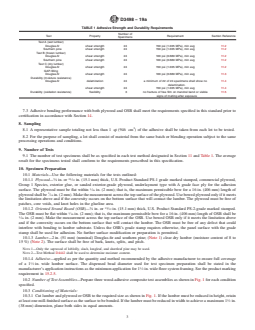
7.1 The adhesive shall conform to the strength and durability properties shown in Table 1.
7.2 Performance of the adhesive for bonding plywood and OSB shall be evaluated separately.
D3498 − 19a
TABLE 1 Adhesive Strength and Durability Requirements
Number of
Test Property Requirement Section Reference
Specimens
Test A (wet lumber)
Douglas-fir shear strength 24 150 psi (1.035 MPa), min avg 11.2
Southern pine shear strength 24 150 psi (1.035 MPa), min avg 11.2
Test B (frozen lumber)
Douglas-fir shear strength 24 100 psi (0.689 MPa), min avg 11.2
Southern pine shear strength 24 100 psi (0.689 MPa), min avg 11.2
Test C (dry lumber)
Douglas-fir shear strength 24 150 psi (1.035 MPa), min avg 11.2
GAP-filling
Douglas-fir shear strength 24 100 psi (0.689 MPa), min avg 11.3
Durability (moisture resistance)
Douglas-fir delamination 24 a minimum of 22 of 24 specimens shall show no 11.4
delamination.
shear strength 24 150 psi (1.035 MPa), min avg 11.4
Durability (oxidation resistance) flexibility 3 no fracture of free film on mandrel bend or visible 11.5
signs of melting after exposure
7.3 Adhesive bonding performance with both plywood and OSB shall meet the requirements specified in this standard prior to
certification in accordance with Section 14.
8. Sampling
8.1 A representative sample totaling not less than 1 qt (946 cm ) of the adhesive shall be taken from each lot to be tested.
8.2 For the purpose of sampling, a lot shall consist of material from the same batch or blending operation subject to the same
processing operations and conditions.
9. Number of Tests
9.1 The number of test specimens shall be as specified in each test method designated in Section 11 and Table 1. The average
result for the specimens tested shall conform to the requirements prescribed in this specification.
10. Specimen Preparation
10.1 Materials—Use the following materials for the tests outlined:
5 19
10.1.1 Plywood— ⁄8 in. or ⁄32 in. (15.1 mm) thick, U.S. Product Standard PS-1 grade marked stamped, commercial plywood,
Group 1 Species, exterior glue, or sanded exterior-grade plywood, underlayment type with A grade face ply for the adhesion
surface. The plywood must be flat within ⁄16 in. (2 mm); that is, the maximum permissible bow for a 16 in. (406 mm) length of
plywood shall be ⁄16 in. (2 mm). Make the measurement across the top surface of the plywood. Use bowed plywood only if it meets
the limitation above and if the convexity occurs on the bottom surface that will contact the lumber. The plywood must be free of
patches, core voids, and knot holes in the glueline area.
5 19
10.1.2 Oriented Strand Board (OSB)— ⁄8 in. or ⁄32 in. (15.1 mm) thick, U.S. Product Standard PS-2-grade marked stamped.
The OSB must be flat within ⁄16 in. (2 mm); that is, the maximum permissible bow for a 16 in. (406 mm) length of OSB shall be
⁄16 in. (2 mm). Make the measurement across the top surface of the OSB. Use bowed OSB only if it meets the limitation above
and if the convexity occurs on the bottom surface that will contact the lumber. The OSB must be free of any defect that could
interfere with bonding to lumber substrate. Unless the OSB’s grade stamp requires otherwise, the panel surface with the grade
stamp shall be used for adhesion. No further surface modification or preparation is permitted.
10.1.3 Lumber—2 in. (51 mm) (nominal) Douglas-fir and southern pine; (Note 1) clear dry lumber (moisture content of 8 to
15 %) (Note 2). The surface shall be free of bark, knots, splits, and pitch.
NOTE 1—Only the sapwood of loblolly, slash, longleaf, and shortleaf pine may be used.
NOTE 2—Test Method D4442 shall be used to determine moisture content.
10.1.4 Adhesive—applied as per the quantity and method recommended by the adhesive manufacturer to ensure full coverage
of a 1 ⁄2 in. wide lumber surface. The dispensed bead diameter used for test specimen preparation shall be stated in the
manufacturer’s application instructions as the minimum application for 1 ⁄2 in. wide floor system framing. See the product marking
requirement in 15.2.5.
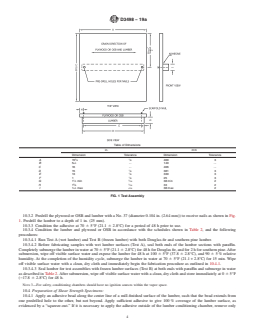
10.2 Number of Test Assemblies—Prepare three wood-adhesive composite test assemblies as shown in Fig. 1 for each condition
specified.
10.3 Conditioning of Materials:
10.3.1 Cut lumber and plywood or OSB to the required size as shown in Fig. 1. If the lumber must be reduced in height, retain
at least one mill-finished surface as the surface to be bonded. If the lumber must be reduced in width to achieve a maximum 1 ⁄2 in.
(38 mm) dimension, plane both sides in equal amounts.
D3498 − 19a
Table of Dimensions
in. mm
Dimension Tolerance Dimension Tolerance
3 1
A 15 ⁄4 ⁄8 400 3
B 5 ⁄2 . 140 .
C 16 . 406 .
D 15 ⁄8 381 3
E 13 ⁄8 330 3
F 1 ⁄8 25 3
1 1
G 1 ⁄2 min ⁄16 38 min 2
3 1
H 1 ⁄8 ⁄16 33 2
1 1
I 1 ⁄2 max ⁄16 38 max 2
FIG. 1 Test Assembly
10.3.2 Predrill the plywood or OSB and lumber with a No. 37 (diameter 0.104 in. (2.64 mm)) to receive nails as shown in Fig.
1. Predrill the lumber to a depth of 1 in. (25 mm).
10.3.3 Condition the adhesive at 70 6 5°F (21.1 6 2.8°C) for a period of 48 h prior to use.
10.3.4 Condition the lumber and plywood or OSB in accordance with the schedules shown in Table 2, and the following
procedures:
10.3.4.1 Run Test A (wet lumber) and Test B (frozen lumber) with both Douglas-fir and southern pine lumber.
10.3.4.2 Before fabricating samples with wet lumber surfaces (Test A), seal both ends of the lumber sections with paraffin.
Completely submerge the lumber in water at 70 6 5°F (21.1 6 2.8°C) for 48 h for Douglas fir, and for 2 h for southern pine. After
submersion, wipe off visible surface water and expose the lumber for 48 h at 100 6 5°F (37.8 6 2.8°C), and 90 6 5 % relative
humidity. At the completion of the humidity cycle, submerge the lumber in water at 70 6 5°F (21.1 + 2.8°C) for 15 min. Wipe
off visible surface water with a clean, dry cloth and immediately begin the fabrication procedure as outlined in 10.4.1.
10.3.4.3 Seal lumber for test assemblies with frozen lumber surfaces (Test B) at both ends with paraffin and submerge in water
as described in Table 2. After submersion, wipe off visible surface water with a clean, dry cloth and store immediately at 0 6 5°F
(−17.8 6 2.8°C) for 48 h.
NOTE 3—For safety, conditioning chambers should have no ignition sources within the vapor space.
10.4 Preparation of Shear Strength Specimens:
10.4.1 Apply an adhesive bead along the center line of a mill-finished surface of the lumber, such that the bead extends from
one predrilled hole to the other, but not beyond. Apply sufficient adhesive to give 100 % coverage of the lumber surface, as
evidenced by a “squeeze-out.” If it is necessary to apply the adhesive outside of the lumber conditioning chamber, remove only
D3498 − 19a
TABLE 2 Conditioning of Materials before Fabrication of Test Assemblies
Lumber
Test Plywood or OSB
Douglas-fir Southern Pine
Test A (wet lumber) 48 h soak in water at 70 ± 5°F 2 h soak in water at 70 ± 5°F (21.1 48 h at 100 ± 5°F (37.8 ±
(21.1 ± 2.8°C), ± 2.8°C), 2.8°C) and 90 ± 5 % RH
then then
48 h at 100 ± 5°F (37.8 ± 2.8°C) 48 h at 100 ± 5°F (37.8 ± 2.8°C)
and 90 ± 5 % RH, and 90 ± 5 % RH,
then then
15 min soak in water at 70 ± 5°F 15 min soak in water at 70 ± 5°F
(21.1 ± 8°C) (21.1 ± 2.8°C)
Test B (frozen lumber) 48 h soak in water at 70 ± 5°F 2 h soak in water at 70 ± 5°F (21.1 48 h at 0 ± 5°F (−17.8 ± 2.8°C),
(21.1 ± 2.8°C), ± 2.8°C), with RH uncontrolled
then then
48 h at 0 ± 5°F (−17.8 ± 2.8°C), 48 h at 0 ± 5°F (−17.8 ± 2.8°C),
with RH uncontrolled with RH uncontrolled
Test C (dry lumber) 48 h at 100 ± 5°F (37.8 ± 2.8°C) . same as lumber
and RH max of 40 %
Gap-filling 48 h at 70 ± 5°F (21.1 ± 2.8°C) . same as lumber
and 50 ± 10 % RH
Durability (moisture resistance) 48 h at 70 ± 5°F (21.1 ± 2.8°C) . same as lumber
and 50 ± 10 % RH
one piece of lumber at a time, apply the adhesive bead as quickly as possible and return the lumber to the conditioning chamber
within a 2 min time period, then condition the lumber with adhesive applied for a minimum of 10 min and a maximum of 12 min
in accordance with Table 3.
10.4.2 Remove lumber and panels from the conditioning chamber one piece at a time to complete the assembly, complete the
pressure application and then place the finished assemblies in the setting chamber in less than 3 min. Before placing the plywood
or OSB on the adhesive-covered surface, insert spacers, ⁄4 in. wide by 0.006 in. thick by 4 in. long (6 by 0.15 by 102 mm), at
the midpoint of the lumber and at the outboard side of each nail, as shown in Fig. 2. Before the spacer is inserted at the
...