

ASTM F997-18
(Specification)Standard Specification for Polycarbonate Resin for Medical Applications
General Information
- Abstract
ABSTRACT
This specification covers the general, physical property, and biocompatibility requirements, and the associated test methods for establishing a reasonable level of confidence concerning the performance of unfilled thermoplastic polycarbonate resin for use in the manufacture of medical devices or the components thereof.
SCOPE
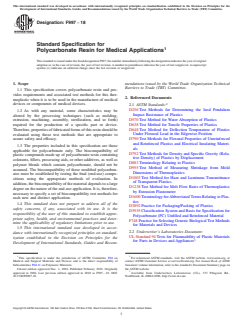
1.1 This specification covers polycarbonate resin and provides requirements and associated test methods for this thermoplastic when it is to be used in the manufacture of medical devices or components of medical devices.
1.2 As with any material, some characteristics may be altered by the processing techniques (such as molding, extrusion, machining, assembly, sterilization, and so forth) required for the production of a specific part or device. Therefore, properties of fabricated forms of this resin should be evaluated using those test methods that are appropriate to assure safety and efficacy.
1.3 The properties included in this specification are those applicable for polycarbonate only. The biocompatibility of plastic compounds made up of polycarbonate resin containing colorants, fillers, processing aids, or other additives, as well as polymer blends which contain polycarbonate, should not be assumed. The biocompatibility of these modified polycarbonates must be established by testing the final (end-use) compositions using the appropriate methods of evaluation. In addition, the biocompatibility of the material depends to a large degree on the nature of the end-use application. It is, therefore, necessary to specify a set of biocompatibility test methods for each new and distinct application.
1.4 This standard does not purport to address all of the safety concerns, if any, associated with its use. It is the responsibility of the user of this standard to establish appropriate safety, health, and environmental practices and determine the applicability of regulatory limitations prior to use.
1.5 This international standard was developed in accordance with internationally recognized principles on standardization established in the Decision on Principles for the Development of International Standards, Guides and Recommendations issued by the World Trade Organization Technical Barriers to Trade (TBT) Committee.
- Status
- Published
- Publication Date
- 30-Nov-2018
- Technical Committee
- F04 - Medical and Surgical Materials and Devices
- Drafting Committee
- F04.11 - Polymeric Materials
Buy Documents


ASTM F997-18 - Standard Specification for Polycarbonate Resin for Medical Applications


REDLINE ASTM F997-18 - Standard Specification for Polycarbonate Resin for Medical Applications
Overview
ASTM F997-18 Standard Specification for Polycarbonate Resin for Medical Applications provides comprehensive requirements and test methods to establish the physical performance and biocompatibility of unfilled thermoplastic polycarbonate resin used in the manufacture of medical devices and components. Maintained by ASTM International, this standard ensures that polycarbonate materials used in healthcare applications are evaluated for both chemical and biological suitability, addressing safety and performance concerns associated with medical device manufacturing.
Key Topics
- Material Scope: This standard specifically addresses unfilled polycarbonate resins intended for medical device applications. It covers requirements for raw resin before processing as well as the necessity for evaluation of fabricated forms.
- Processing Considerations: Recognizes that properties may change due to manufacturing techniques such as molding, extrusion, machining, assembly, or sterilization. Finished parts must be evaluated to ensure continued compliance.
- Physical Properties: Specifies that polycarbonate resin properties are determined using various ASTM test methods, including tensile strength, impact resistance, water absorption, deflection temperature, flexural properties, density, and more, referencing standards like ASTM D256, D570, D638, and others.
- Biocompatibility Requirements: Establishes that only the base unfilled polycarbonate is covered by this standard. For polycarbonate compounds with additives (colorants, fillers, processing aids), or blends, biocompatibility must be proven for each specific, end-use composition using appropriate biological evaluation methods such as ISO 10993-1 or ASTM Practice F748.
- Sterilization Impact: Addresses the impact of sterilization processes (steam, ethylene oxide, irradiation) on material performance, noting that repeated cycles can weaken polycarbonate components and must be tested for safe limits.
- Safety and Regulatory Compliance: Reminds users that overall safety, health, and regulatory practices are the responsibility of the manufacturer, particularly regarding the potential release of substances such as Bisphenol A (BPA).
Applications
ASTM F997-18 serves as a vital reference for:
- Medical Device Manufacturers: Ensures the selection and testing of polycarbonate resin for surgical devices, diagnostic equipment, fluid delivery systems, housings, and other critical healthcare components.
- Quality Assurance Teams: Aids in setting acceptance criteria for incoming polycarbonate resin and finished medical device components.
- Research & Development: Supports material selection and design for new or improved medical products by outlining necessary physical and biocompatibility property evaluations.
- Regulatory Compliance: Helps organizations meet US FDA, EU MDR, and other global regulatory requirements concerning material safety for patient contact devices.
The standard supports the safe use of polycarbonate in both direct and indirect patient contact, provided end-use biocompatibility is confirmed.
Related Standards
Several referenced and related standards are essential for full compliance with ASTM F997-18:
- ASTM D256 - Determining Izod impact resistance of plastics
- ASTM D570 - Water absorption testing for plastics
- ASTM D638 - Tensile properties of plastics
- ASTM D648 - Deflection temperature under load
- ASTM D790 - Flexural properties of plastics
- ASTM D792 - Density and specific gravity testing
- ASTM D955 - Measurement of shrinkage from molded thermoplastics
- ASTM F748 - Practice for selecting biological test methods
- ISO 10993-1 - Biological evaluation of medical devices
- 21 CFR 177.1580 - US FDA regulation for polycarbonate resins in food and medical applications
- UL Standard 94 - Flammability testing of plastic materials
Practical Value
By conforming to ASTM F997-18, manufacturers demonstrate due diligence in selecting polycarbonate materials suitable for safe, high-performance use in medical devices. The standard guides the rigorous assessment of both material properties and biocompatibility, supporting compliance with global regulatory expectations and promoting patient safety.
Keywords: ASTM F997-18, polycarbonate resin, medical device materials, biocompatibility, medical plastics, physical property testing, healthcare compliance, polymer standards, medical applications, resin selection.
Relations
- Effective Date
- 01-Dec-2018
- Effective Date
- 01-Feb-2024
- Refers
ASTM D1238-23a - Standard Test Method for Melt Flow Rates of Thermoplastics by Extrusion Plastometer - Effective Date
- 15-Nov-2023
- Effective Date
- 01-Nov-2023
- Effective Date
- 01-Jan-2020
- Effective Date
- 01-Aug-2019
- Effective Date
- 15-Apr-2019
- Effective Date
- 01-Feb-2019
- Effective Date
- 01-Dec-2018
- Effective Date
- 01-Nov-2018
- Effective Date
- 01-Apr-2018
- Refers
ASTM D1600-18 - Standard Terminology for Abbreviated Terms Relating to Plastics (Withdrawn 2024) - Effective Date
- 01-Jan-2018
- Effective Date
- 15-Aug-2017
- Effective Date
- 01-Jul-2017
- Effective Date
- 01-Apr-2016
Buy Documents
ASTM F997-18 - Standard Specification for Polycarbonate Resin for Medical Applications
REDLINE ASTM F997-18 - Standard Specification for Polycarbonate Resin for Medical Applications
Get Certified
Connect with accredited certification bodies for this standard

BSI Group
BSI (British Standards Institution) is the business standards company that helps organizations make excellence a habit.

TÜV Rheinland
TÜV Rheinland is a leading international provider of technical services.

TÜV SÜD
TÜV SÜD is a trusted partner of choice for safety, security and sustainability solutions.
Sponsored listings
Frequently Asked Questions
ASTM F997-18 is a technical specification published by ASTM International. Its full title is "Standard Specification for Polycarbonate Resin for Medical Applications". This standard covers: ABSTRACT This specification covers the general, physical property, and biocompatibility requirements, and the associated test methods for establishing a reasonable level of confidence concerning the performance of unfilled thermoplastic polycarbonate resin for use in the manufacture of medical devices or the components thereof. SCOPE 1.1 This specification covers polycarbonate resin and provides requirements and associated test methods for this thermoplastic when it is to be used in the manufacture of medical devices or components of medical devices. 1.2 As with any material, some characteristics may be altered by the processing techniques (such as molding, extrusion, machining, assembly, sterilization, and so forth) required for the production of a specific part or device. Therefore, properties of fabricated forms of this resin should be evaluated using those test methods that are appropriate to assure safety and efficacy. 1.3 The properties included in this specification are those applicable for polycarbonate only. The biocompatibility of plastic compounds made up of polycarbonate resin containing colorants, fillers, processing aids, or other additives, as well as polymer blends which contain polycarbonate, should not be assumed. The biocompatibility of these modified polycarbonates must be established by testing the final (end-use) compositions using the appropriate methods of evaluation. In addition, the biocompatibility of the material depends to a large degree on the nature of the end-use application. It is, therefore, necessary to specify a set of biocompatibility test methods for each new and distinct application. 1.4 This standard does not purport to address all of the safety concerns, if any, associated with its use. It is the responsibility of the user of this standard to establish appropriate safety, health, and environmental practices and determine the applicability of regulatory limitations prior to use. 1.5 This international standard was developed in accordance with internationally recognized principles on standardization established in the Decision on Principles for the Development of International Standards, Guides and Recommendations issued by the World Trade Organization Technical Barriers to Trade (TBT) Committee.
ABSTRACT This specification covers the general, physical property, and biocompatibility requirements, and the associated test methods for establishing a reasonable level of confidence concerning the performance of unfilled thermoplastic polycarbonate resin for use in the manufacture of medical devices or the components thereof. SCOPE 1.1 This specification covers polycarbonate resin and provides requirements and associated test methods for this thermoplastic when it is to be used in the manufacture of medical devices or components of medical devices. 1.2 As with any material, some characteristics may be altered by the processing techniques (such as molding, extrusion, machining, assembly, sterilization, and so forth) required for the production of a specific part or device. Therefore, properties of fabricated forms of this resin should be evaluated using those test methods that are appropriate to assure safety and efficacy. 1.3 The properties included in this specification are those applicable for polycarbonate only. The biocompatibility of plastic compounds made up of polycarbonate resin containing colorants, fillers, processing aids, or other additives, as well as polymer blends which contain polycarbonate, should not be assumed. The biocompatibility of these modified polycarbonates must be established by testing the final (end-use) compositions using the appropriate methods of evaluation. In addition, the biocompatibility of the material depends to a large degree on the nature of the end-use application. It is, therefore, necessary to specify a set of biocompatibility test methods for each new and distinct application. 1.4 This standard does not purport to address all of the safety concerns, if any, associated with its use. It is the responsibility of the user of this standard to establish appropriate safety, health, and environmental practices and determine the applicability of regulatory limitations prior to use. 1.5 This international standard was developed in accordance with internationally recognized principles on standardization established in the Decision on Principles for the Development of International Standards, Guides and Recommendations issued by the World Trade Organization Technical Barriers to Trade (TBT) Committee.
ASTM F997-18 is classified under the following ICS (International Classification for Standards) categories: 11.100.99 - Other standards related to laboratory medicine; 83.080.20 - Thermoplastic materials. The ICS classification helps identify the subject area and facilitates finding related standards.
ASTM F997-18 has the following relationships with other standards: It is inter standard links to ASTM F997-10, ASTM D883-24, ASTM D1238-23a, ASTM D883-23, ASTM D883-20, ASTM D883-19c, ASTM D883-19a, ASTM D883-19, ASTM D883-18a, ASTM D883-18, ASTM D648-18, ASTM D1600-18, ASTM D883-17, ASTM D790-17, ASTM F748-16. Understanding these relationships helps ensure you are using the most current and applicable version of the standard.
ASTM F997-18 is available in PDF format for immediate download after purchase. The document can be added to your cart and obtained through the secure checkout process. Digital delivery ensures instant access to the complete standard document.
Standards Content (Sample)
This international standard was developed in accordance with internationally recognized principles on standardization established in the Decision on Principles for the
Development of International Standards, Guides and Recommendations issued by the World Trade Organization Technical Barriers to Trade (TBT) Committee.
Designation: F997 −18
Standard Specification for
Polycarbonate Resin for Medical Applications
ThisstandardisissuedunderthefixeddesignationF997;thenumberimmediatelyfollowingthedesignationindicatestheyearoforiginal
adoption or, in the case of revision, the year of last revision.Anumber in parentheses indicates the year of last reapproval.Asuperscript
epsilon (´) indicates an editorial change since the last revision or reapproval.
1. Scope mendations issued by the World Trade Organization Technical
Barriers to Trade (TBT) Committee.
1.1 This specification covers polycarbonate resin and pro-
vides requirements and associated test methods for this ther-
2. Referenced Documents
moplastic when it is to be used in the manufacture of medical
devices or components of medical devices.
2.1 ASTM Standards:
D256 Test Methods for Determining the Izod Pendulum
1.2 As with any material, some characteristics may be
Impact Resistance of Plastics
altered by the processing techniques (such as molding,
D570 Test Method for Water Absorption of Plastics
extrusion, machining, assembly, sterilization, and so forth)
D638 Test Method for Tensile Properties of Plastics
required for the production of a specific part or device.
Therefore,propertiesoffabricatedformsofthisresinshouldbe D648 Test Method for Deflection Temperature of Plastics
Under Flexural Load in the Edgewise Position
evaluated using those test methods that are appropriate to
assure safety and efficacy. D790 Test Methods for Flexural Properties of Unreinforced
and Reinforced Plastics and Electrical Insulating Materi-
1.3 The properties included in this specification are those
als
applicable for polycarbonate only. The biocompatibility of
D792 Test Methods for Density and Specific Gravity (Rela-
plastic compounds made up of polycarbonate resin containing
tive Density) of Plastics by Displacement
colorants, fillers, processing aids, or other additives, as well as
D883 Terminology Relating to Plastics
polymer blends which contain polycarbonate, should not be
D955 Test Method of Measuring Shrinkage from Mold
assumed. The biocompatibility of these modified polycarbon-
Dimensions of Thermoplastics
ates must be established by testing the final (end-use) compo-
D1003 Test Method for Haze and Luminous Transmittance
sitions using the appropriate methods of evaluation. In
of Transparent Plastics
addition,thebiocompatibilityofthematerialdependstoalarge
D1238 Test Method for Melt Flow Rates of Thermoplastics
degree on the nature of the end-use application. It is, therefore,
by Extrusion Plastometer
necessary to specify a set of biocompatibility test methods for
D1600 Terminology forAbbreviatedTerms Relating to Plas-
each new and distinct application.
tics
1.4 This standard does not purport to address all of the
D3892 Practice for Packaging/Packing of Plastics
safety concerns, if any, associated with its use. It is the
D3935 Classification System and Basis for Specification for
responsibility of the user of this standard to establish appro-
Polycarbonate (PC) Unfilled and Reinforced Material
priate safety, health, and environmental practices and deter-
F748 PracticeforSelectingGenericBiologicalTestMethods
mine the applicability of regulatory limitations prior to use.
for Materials and Devices
1.5 This international standard was developed in accor-
2.2 Underwriter’s Laboratories Document:
dance with internationally recognized principles on standard-
UL Standard 94 Tests for Flammability of Plastic Materials
ization established in the Decision on Principles for the
for Parts in Devices and Appliances
Development of International Standards, Guides and Recom-
1 2
This specification is under the jurisdiction of ASTM Committee F04 on For referenced ASTM standards, visit the ASTM website, www.astm.org, or
Medical and Surgical Materials and Devices and is the direct responsibility of contact ASTM Customer Service at service@astm.org. For Annual Book of ASTM
Subcommittee F04.11 on Polymeric Materials. Standards volume information, refer to the standard’s Document Summary page on
Current edition approved Dec. 1, 2018. Published February 2019. Originally the ASTM website.
approved in 1986. Last previous edition approved in 2010 as F997 – 10. DOI: Available from Underwriters Laboratories (UL), 333 Pfingsten Rd.,
10.1520/F0997-18. Northbrook, IL 60062-2096, http://www.ul.com.
Copyright © ASTM International, 100 Barr Harbor Drive, PO Box C700, West Conshohocken, PA 19428-2959. United States
F997 − 18
2.3 Code of Federal Regulations: 6. Physical Properties
Title 21 CFR Subpart 177.1580 Polycarbonate Resins
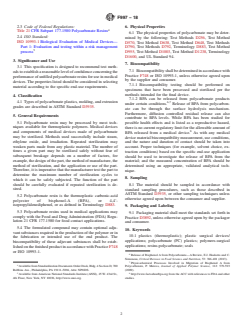
6.1 The physical properties of polycarbonate may be deter-
2.4 ISO Standard:
mined by the following: Test Methods D256, Test Method
ISO 10993-1 Biological Evaluation of Medical Devices—
D570, Test Method D638, Test Method D648, Test Methods
Part 1: Evaluation and testing within a risk management
D790, Test Methods D792, Terminology D883, Test Method
process
D955, Test Method D1003, Test Method D1238, Terminology
D1600, and UL Standard 94.
3. Significance and Use
7. Biocompatibility
3.1 This specification is designed to recommend test meth-
7.1 Biocompatibilityshallbedeterminedinaccordancewith
odstoestablishareasonablelevelofconfidenceconcerningthe
Practice F748 or ISO 10993-1, unless otherwise agreed upon
performanceofunfilledpolycarbonateresinsforuseinmedical
by the supplier and consumer.
devices.The properties listed should be considered in selecting
7.1.1 Biocompatibility testing should be performed on
material according to the specific end-use requirements.
specimens that have been processed and sterilized per the
methods intended for the final device.
4. Classification
7.1.2 BPA can be released from polycarbonate products
4.1 Types of polycarbonate plastics, molding, and extrusion
...
This document is not an ASTM standard and is intended only to provide the user of an ASTM standard an indication of what changes have been made to the previous version. Because
it may not be technically possible to adequately depict all changes accurately, ASTM recommends that users consult prior editions as appropriate. In all cases only the current version
of the standard as published by ASTM is to be considered the official document.
Designation: F997 − 10 F997 − 18
Standard Specification for
Polycarbonate Resin for Medical Applications
This standard is issued under the fixed designation F997; the number immediately following the designation indicates the year of original
adoption or, in the case of revision, the year of last revision. A number in parentheses indicates the year of last reapproval. A superscript
epsilon (´) indicates an editorial change since the last revision or reapproval.
1. Scope
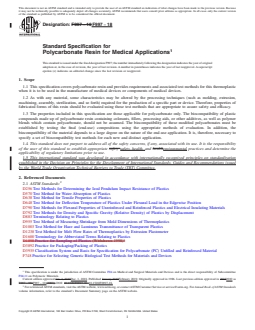
1.1 This specification covers polycarbonate resin and provides requirements and associated test methods for this thermoplastic
when it is to be used in the manufacture of medical devices or components of medical devices.
1.2 As with any material, some characteristics may be altered by the processing techniques (such as molding, extrusion,
machining, assembly, sterilization, and so forth) required for the production of a specific part or device. Therefore, properties of
fabricated forms of this resin should be evaluated using those test methods that are appropriate to assure safety and efficacy.
1.3 The properties included in this specification are those applicable for polycarbonate only. The biocompatibility of plastic
compounds made up of polycarbonate resin containing colorants, fillers, processing aids, or other additives, as well as polymer
blends which contain polycarbonate, should not be assumed. The biocompatibility of these modified polycarbonates must be
established by testing the final (end-use) compositions using the appropriate methods of evaluation. In addition, the
biocompatibility of the material depends to a large degree on the nature of the end-use application. It is, therefore, necessary to
specify a set of biocompatibility test methods for each new and distinct application.
1.4 This standard does not purport to address all of the safety concerns, if any, associated with its use. It is the responsibility
of the user of this standard to establish appropriate safety safety, health, and healthenvironmental practices and determine the
applicability of regulatory limitations prior to use.
1.5 This international standard was developed in accordance with internationally recognized principles on standardization
established in the Decision on Principles for the Development of International Standards, Guides and Recommendations issued
by the World Trade Organization Technical Barriers to Trade (TBT) Committee.
2. Referenced Documents
2.1 ASTM Standards:
D256 Test Methods for Determining the Izod Pendulum Impact Resistance of Plastics
D570 Test Method for Water Absorption of Plastics
D638 Test Method for Tensile Properties of Plastics
D648 Test Method for Deflection Temperature of Plastics Under Flexural Load in the Edgewise Position
D790 Test Methods for Flexural Properties of Unreinforced and Reinforced Plastics and Electrical Insulating Materials
D792 Test Methods for Density and Specific Gravity (Relative Density) of Plastics by Displacement
D883 Terminology Relating to Plastics
D955 Test Method of Measuring Shrinkage from Mold Dimensions of Thermoplastics
D1003 Test Method for Haze and Luminous Transmittance of Transparent Plastics
D1238 Test Method for Melt Flow Rates of Thermoplastics by Extrusion Plastometer
D1600 Terminology for Abbreviated Terms Relating to Plastics
D1898 Practice for Sampling of Plastics (Withdrawn 1998)
D3892 Practice for Packaging/Packing of Plastics
D3935 Classification System and Basis for Specification for Polycarbonate (PC) Unfilled and Reinforced Material
F748 Practice for Selecting Generic Biological Test Methods for Materials and Devices
This specification is under the jurisdiction of ASTM Committee F04 on Medical and Surgical Materials and Devices and is the direct responsibility of Subcommittee
F04.11 on Polymeric Materials.
Current edition approved Jan. 1, 2010Dec. 1, 2018. Published January 2010February 2019. Originally approved in 1986. Last previous edition approved in 20032010 as
F997 – 98aF997 – 10.(2003). DOI: 10.1520/F0997-10. 10.1520/F0997-18.
For referenced ASTM standards, visit the ASTM website, www.astm.org, or contact ASTM Customer Service at service@astm.org. For Annual Book of ASTM Standards
volume information, refer to the standard’s Document Summary page on the ASTM website.
Copyright © ASTM International, 100 Barr Harbor Drive, PO Box C700, West Conshohocken, PA 19428-2959. United States
F997 − 18
2.2 Underwriter’s Laboratories Document:
UL Standard 94 Tests andfor Flammability of Plastic Materials for Parts in Devices and Appliances
2.3 Code of Federal Regulations:
Title 21 CFR Subpart 177.1580 Polycarbonate Resins
2.4 ISO Standard:
ISO 1099310993-1 Biological Evaluation of Medical DevicesDevices—Part 1: Evaluation and testing within a risk management
process
3. Significance and Use
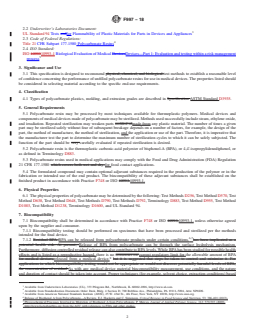
3.1 This specification is designed to recommend physical, chemical, and biological test methods to establish a reasonable level
of confidence concerning the performance of unfilled polycarbonate resins for use in medical devices. The properties listed should
be considered in selecting material according to the specific end-use requirements.
4. Classification
4.1 Types of polycarbonate plastics, molding, and extrusion grades are described in Specification ASTM Standard D3935.
5. General Requirements
5.1 Polycarbonate resin may be processed by most techniques available for thermoplastic polymers. Medical devices and
components of medical devices made of polycarbonate may be sterilized. Methods used successfully include steam, ethylene oxide,
and irradiation. Repeated sterilization may weaken parts molded ofmade from any plastic material. The number of times a given
part may be sterilized safely without fear of subsequent breakage depends on a number of factors, for example, the design of the
part, the method of manufacture, the method of sterilization, and the application or use of the part. Therefore, it is imperative that
the manufacturer test the part to determine the maximum number of sterilization cycles to which it can be safely subjected. The
function of the part should be very carefully evaluated if repeated sterilization
...