

ASTM B447-12a(2021)
(Specification)Standard Specification for Welded Copper Tube
General Information
- Abstract
ABSTRACT
This specification establishes the requirements for welded copper tube with a longitudinal seam free of filler metal produced from sheet or strip of one of the Copper UNS Nos. C10100, C10200, C10300, C10800, C11000, C12000, C12200, and C14200. Copper C11000 welded tube shall not be used in applications where hydrogen embrittlement during heating is a concern. Tempers of the welded tube types are as follows: as-welded: WM50, WM02, or WM04, welded and annealed: W060 and W050, welded and cold drawn: WH00, WH02, and WH04, and fully finished: O60, O50, H55, H58, and H80. The product shall be manufactured by forming the material into a tubular shape on a suitable forming mill and welding shall be accomplished by any process that produces forge or fusion welds. The external flash of forge welded tube shall be removed by scarfing and the internal flash shall be treated by IFI (to remain in the as-welded condition), IFR (scarfing) or IFD (rolling or drawing) technique. The material shall conform to the chemical composition requirements prescribed for copper, phosphorus, and arsenic, as determined by chemical analysis. The welded tubes shall meet the requirements specified for grain size, electrical mass resistivity, mechanical properties such as tensile strength and Rockwell hardness, dimensions, and mass. Performance requirements includes microscopical examination, hydrogen embrittlement susceptibility test, and expansion test. Requirements for tensile, electromagnetic (eddy-current), hydrostatic, and pneumatic tests are detailed.
SIGNIFICANCE AND USE
20.1 For purposes of determining compliance with the specified limits for requirements of the properties listed in the following table and for dimensional tolerances, an observed value or a calculated value shall be rounded as indicated in accordance with the rounding method of Practice E29:
Property
Rounded Unit for Observed or
Calculated Value
Chemical composition
Nearest unit in the last right-hand
Hardness
Significant
Electrical Resistivity
Digit used in expression the limiting value
Grain size up to 0.055 mm, incl
nearest multiple of 0.005 mm
Tensile strength
nearest ksi (5 MPa)
Expansion
Nearest 1%
SCOPE
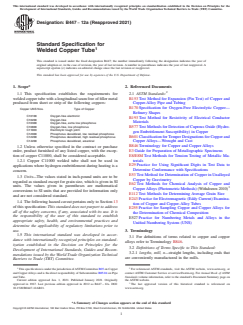
1.1 This specification establishes the requirements for welded copper tube with a longitudinal seam free of filler metal produced from sheet or strip of the following coppers:
Copper UNS Nos.
Type of Copper
C10100
Oxygen-free electronic
C10200
Oxygen-free
C10300
Oxygen-free, extra low phosphorus
C10800
Oxygen-free, low phosphorus
C11000
Electrolytic tough pitch
C12000
Phosphorus deoxidized, low residual phosphorus
C12200
Phosphorus deoxidized, high residual phosphorus
C14200
Phosphorus deoxidized, arsenical
1.2 Unless otherwise specified in the contract or purchase order, product furnished of any listed copper, with the exception of copper C11000, shall be considered acceptable.
1.2.1 Copper C11000 welded tube shall not be used in applications where hydrogen embrittlement during heating is a concern.
1.3 Units—The values stated in inch-pound units are to be regarded as standard except for grain size, which is given in SI units. The values given in parentheses are mathematical conversions to SI units that are provided for information only and are not considered standard.
1.4 The following hazard caveat pertains only to Section 13 of this specification: This standard does not purport to address all of the safety concerns, if any, associated with its use. It is the responsibility of the user of this standard to establish appropriate safety, health, and environmental practices and determine the applicability of regulatory limitations prior to use.
1.5 This international standard was developed in accordance with internationally recognized principles on standardization established in the Decision on Principles...
- Status
- Published
- Publication Date
- 31-Dec-2020
- Technical Committee
- B05 - Copper and Copper Alloys
- Drafting Committee
- B05.04 - Pipe and Tube
Overview
ASTM B447-12a(2021): Standard Specification for Welded Copper Tube establishes comprehensive requirements for welded copper tubing manufactured with a longitudinal seam that is free of filler metal. This specification applies to tubes made from sheet or strip copper, using specific Copper UNS designations, to ensure the material's quality and suitability for various applications. Developed by ASTM International, the standard defines chemical, mechanical, and physical property requirements and is recognized for supporting quality assurance and regulatory compliance in manufacturing and engineering environments.
Key Topics
- Materials Covered: The specification includes copper alloys with the following UNS Nos.: C10100, C10200, C10300, C10800, C11000, C12000, C12200, and C14200.
- Tube Classification: Four primary types of welded copper tubes are recognized:
- As-welded
- Welded and annealed
- Welded and cold drawn
- Fully finished
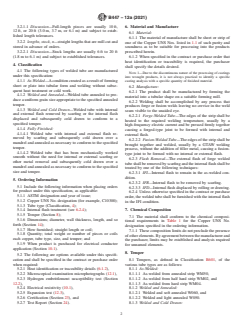
- Tempers: Various tempers specified (e.g., WM50, WM02, WM04, W060, WH02, H58, O60) determine the mechanical properties and intended use of the tubes.
- Manufacturing Process: Tubes are formed and welded from copper sheet or strip, using methods that achieve a seamless internal structure and address flash removal, as required.
- Chemical Composition: Strict limits for copper, phosphorus, arsenic, and other elements ensure material consistency and performance.
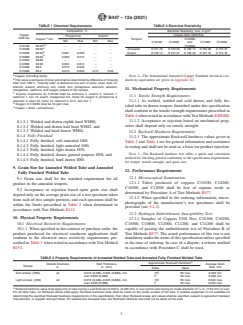
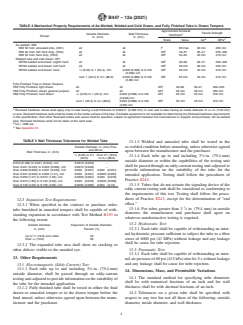
- Mechanical and Physical Properties: Requirements include tensile strength, Rockwell hardness, grain size, dimensional tolerances, and electrical resistivity for conductor applications.
- Testing: Tubes must pass various tests such as:
- Microscopic examinations
- Hydrogen embrittlement susceptibility (critical for some alloys)
- Expansion (pin test)
- Electromagnetic (eddy-current) test
- Hydrostatic and pneumatic pressure tests
- Ordering Information: Users must specify copper grade, tube type, temper, dimensions, internal flash treatment, and testing requirements in purchase orders.
Applications
ASTM B447-12a(2021) is widely referenced in industries where welded copper tubing performance and integrity are critical, such as:
- HVAC systems: Used for refrigerant and water lines due to copper's excellent thermal conductivity and corrosion resistance.
- Plumbing installations: Popular for potable water supply systems, as-welded tubes are often chosen for their reliability and ease of joining.
- Electrical applications: Tubes meet electrical resistivity specifications where conductivity is paramount, such as protective sheathing for cabling.
- Heat exchangers: The high thermal conductivity and customizable dimensions make these tubes suitable for industrial heat exchangers.
- Manufacturing and fabrication: Copper tubes serve in mechanical systems requiring precise tolerances, consistent strength, and resistance to corrosion.
- Regulatory and procurement standards: Compliance with ASTM B447 ensures product acceptance in regulated markets and governmental contracts.
Related Standards
Several other ASTM documents complement or interrelate with ASTM B447-12a(2021):
- ASTM B153: Expansion (pin) test method for copper and copper-alloy pipes and tubing.
- ASTM B170: Specification for oxygen-free electrolytic copper - refinery shapes.
- ASTM B193: Test method for electrical resistivity of electrical conductor materials.
- ASTM B577: Methods for detection of cuprous oxide (hydrogen embrittlement susceptibility) in copper.
- ASTM B601: Classification for temper designations of copper and copper alloys.
- ASTM E3, E8/E8M, E29, E112, E243, E255: Methods for sample preparation, tension testing, rounding practices, grain size determination, electromagnetic (eddy-current) examination, and sampling for chemical analysis.
By adhering to ASTM B447-12a(2021), manufacturers ensure that their welded copper tubes display predictable performance, meet industry benchmarks, and are suitable for a wide range of demanding applications. Using this ASTM standard safeguards quality, assists in regulatory compliance, and supports the successful execution of projects across construction, manufacturing, and technology sectors.
Relations
- Effective Date
- 01-Jan-2024
- Effective Date
- 01-Aug-2019
- Effective Date
- 01-Apr-2019
- Effective Date
- 01-Jan-2019
- Effective Date
- 01-Oct-2018
- Effective Date
- 01-Jun-2018
- Effective Date
- 01-Mar-2018
- Effective Date
- 01-Oct-2016
- Effective Date
- 15-Jul-2016
- Effective Date
- 01-Apr-2016
- Effective Date
- 01-Apr-2016
- Effective Date
- 15-Oct-2015
- Effective Date
- 01-Feb-2015
- Effective Date
- 01-Apr-2014
- Effective Date
- 01-Dec-2013
Get Certified
Connect with accredited certification bodies for this standard

Element Materials Technology
Materials testing and product certification.

Inštitut za kovinske materiale in tehnologije
Institute of Metals and Technology. Materials testing, metallurgical analysis, NDT.
Institut za varilstvo d.o.o. (Welding Institute)
Slovenia's leading welding institute since 1952. ISO 3834, EN 1090, pressure equipment certification, NDT personnel, welder qualification. Only IIW Au
Sponsored listings
Frequently Asked Questions
ASTM B447-12a(2021) is a technical specification published by ASTM International. Its full title is "Standard Specification for Welded Copper Tube". This standard covers: ABSTRACT This specification establishes the requirements for welded copper tube with a longitudinal seam free of filler metal produced from sheet or strip of one of the Copper UNS Nos. C10100, C10200, C10300, C10800, C11000, C12000, C12200, and C14200. Copper C11000 welded tube shall not be used in applications where hydrogen embrittlement during heating is a concern. Tempers of the welded tube types are as follows: as-welded: WM50, WM02, or WM04, welded and annealed: W060 and W050, welded and cold drawn: WH00, WH02, and WH04, and fully finished: O60, O50, H55, H58, and H80. The product shall be manufactured by forming the material into a tubular shape on a suitable forming mill and welding shall be accomplished by any process that produces forge or fusion welds. The external flash of forge welded tube shall be removed by scarfing and the internal flash shall be treated by IFI (to remain in the as-welded condition), IFR (scarfing) or IFD (rolling or drawing) technique. The material shall conform to the chemical composition requirements prescribed for copper, phosphorus, and arsenic, as determined by chemical analysis. The welded tubes shall meet the requirements specified for grain size, electrical mass resistivity, mechanical properties such as tensile strength and Rockwell hardness, dimensions, and mass. Performance requirements includes microscopical examination, hydrogen embrittlement susceptibility test, and expansion test. Requirements for tensile, electromagnetic (eddy-current), hydrostatic, and pneumatic tests are detailed. SIGNIFICANCE AND USE 20.1 For purposes of determining compliance with the specified limits for requirements of the properties listed in the following table and for dimensional tolerances, an observed value or a calculated value shall be rounded as indicated in accordance with the rounding method of Practice E29: Property Rounded Unit for Observed or Calculated Value Chemical composition Nearest unit in the last right-hand Hardness Significant Electrical Resistivity Digit used in expression the limiting value Grain size up to 0.055 mm, incl nearest multiple of 0.005 mm Tensile strength nearest ksi (5 MPa) Expansion Nearest 1% SCOPE 1.1 This specification establishes the requirements for welded copper tube with a longitudinal seam free of filler metal produced from sheet or strip of the following coppers: Copper UNS Nos. Type of Copper C10100 Oxygen-free electronic C10200 Oxygen-free C10300 Oxygen-free, extra low phosphorus C10800 Oxygen-free, low phosphorus C11000 Electrolytic tough pitch C12000 Phosphorus deoxidized, low residual phosphorus C12200 Phosphorus deoxidized, high residual phosphorus C14200 Phosphorus deoxidized, arsenical 1.2 Unless otherwise specified in the contract or purchase order, product furnished of any listed copper, with the exception of copper C11000, shall be considered acceptable. 1.2.1 Copper C11000 welded tube shall not be used in applications where hydrogen embrittlement during heating is a concern. 1.3 Units—The values stated in inch-pound units are to be regarded as standard except for grain size, which is given in SI units. The values given in parentheses are mathematical conversions to SI units that are provided for information only and are not considered standard. 1.4 The following hazard caveat pertains only to Section 13 of this specification: This standard does not purport to address all of the safety concerns, if any, associated with its use. It is the responsibility of the user of this standard to establish appropriate safety, health, and environmental practices and determine the applicability of regulatory limitations prior to use. 1.5 This international standard was developed in accordance with internationally recognized principles on standardization established in the Decision on Principles...
ABSTRACT This specification establishes the requirements for welded copper tube with a longitudinal seam free of filler metal produced from sheet or strip of one of the Copper UNS Nos. C10100, C10200, C10300, C10800, C11000, C12000, C12200, and C14200. Copper C11000 welded tube shall not be used in applications where hydrogen embrittlement during heating is a concern. Tempers of the welded tube types are as follows: as-welded: WM50, WM02, or WM04, welded and annealed: W060 and W050, welded and cold drawn: WH00, WH02, and WH04, and fully finished: O60, O50, H55, H58, and H80. The product shall be manufactured by forming the material into a tubular shape on a suitable forming mill and welding shall be accomplished by any process that produces forge or fusion welds. The external flash of forge welded tube shall be removed by scarfing and the internal flash shall be treated by IFI (to remain in the as-welded condition), IFR (scarfing) or IFD (rolling or drawing) technique. The material shall conform to the chemical composition requirements prescribed for copper, phosphorus, and arsenic, as determined by chemical analysis. The welded tubes shall meet the requirements specified for grain size, electrical mass resistivity, mechanical properties such as tensile strength and Rockwell hardness, dimensions, and mass. Performance requirements includes microscopical examination, hydrogen embrittlement susceptibility test, and expansion test. Requirements for tensile, electromagnetic (eddy-current), hydrostatic, and pneumatic tests are detailed. SIGNIFICANCE AND USE 20.1 For purposes of determining compliance with the specified limits for requirements of the properties listed in the following table and for dimensional tolerances, an observed value or a calculated value shall be rounded as indicated in accordance with the rounding method of Practice E29: Property Rounded Unit for Observed or Calculated Value Chemical composition Nearest unit in the last right-hand Hardness Significant Electrical Resistivity Digit used in expression the limiting value Grain size up to 0.055 mm, incl nearest multiple of 0.005 mm Tensile strength nearest ksi (5 MPa) Expansion Nearest 1% SCOPE 1.1 This specification establishes the requirements for welded copper tube with a longitudinal seam free of filler metal produced from sheet or strip of the following coppers: Copper UNS Nos. Type of Copper C10100 Oxygen-free electronic C10200 Oxygen-free C10300 Oxygen-free, extra low phosphorus C10800 Oxygen-free, low phosphorus C11000 Electrolytic tough pitch C12000 Phosphorus deoxidized, low residual phosphorus C12200 Phosphorus deoxidized, high residual phosphorus C14200 Phosphorus deoxidized, arsenical 1.2 Unless otherwise specified in the contract or purchase order, product furnished of any listed copper, with the exception of copper C11000, shall be considered acceptable. 1.2.1 Copper C11000 welded tube shall not be used in applications where hydrogen embrittlement during heating is a concern. 1.3 Units—The values stated in inch-pound units are to be regarded as standard except for grain size, which is given in SI units. The values given in parentheses are mathematical conversions to SI units that are provided for information only and are not considered standard. 1.4 The following hazard caveat pertains only to Section 13 of this specification: This standard does not purport to address all of the safety concerns, if any, associated with its use. It is the responsibility of the user of this standard to establish appropriate safety, health, and environmental practices and determine the applicability of regulatory limitations prior to use. 1.5 This international standard was developed in accordance with internationally recognized principles on standardization established in the Decision on Principles...
ASTM B447-12a(2021) is classified under the following ICS (International Classification for Standards) categories: 23.040.15 - Non-ferrous metal pipes; 77.150.30 - Copper products. The ICS classification helps identify the subject area and facilitates finding related standards.
ASTM B447-12a(2021) has the following relationships with other standards: It is inter standard links to ASTM E8/E8M-24, ASTM B846-19a, ASTM B577-19, ASTM B846-19, ASTM B601-18a, ASTM E243-18, ASTM B601-18, ASTM B601-16, ASTM E8/E8M-16, ASTM B193-16, ASTM B577-16, ASTM B170-99(2015), ASTM E8/E8M-15, ASTM B193-02(2014), ASTM E243-13. Understanding these relationships helps ensure you are using the most current and applicable version of the standard.
ASTM B447-12a(2021) is available in PDF format for immediate download after purchase. The document can be added to your cart and obtained through the secure checkout process. Digital delivery ensures instant access to the complete standard document.
Standards Content (Sample)
This international standard was developed in accordance with internationally recognized principles on standardization established in the Decision on Principles for the
Development of International Standards, Guides and Recommendations issued by the World Trade Organization Technical Barriers to Trade (TBT) Committee.
Designation:B447 −12a (Reapproved 2021)
Standard Specification for
Welded Copper Tube
This standard is issued under the fixed designation B447; the number immediately following the designation indicates the year of
original adoption or, in the case of revision, the year of last revision.Anumber in parentheses indicates the year of last reapproval.A
superscript epsilon (´) indicates an editorial change since the last revision or reapproval.
This standard has been approved for use by agencies of the U.S. Department of Defense.
1. Scope* 2. Referenced Documents
1.1 This specification establishes the requirements for 2.1 ASTM Standards:
weldedcoppertubewithalongitudinalseamfreeoffillermetal B153Test Method for Expansion (Pin Test) of Copper and
produced from sheet or strip of the following coppers: Copper-Alloy Pipe and Tubing
B170Specification for Oxygen-Free Electrolytic Copper—
Copper UNS Nos. Type of Copper
Refinery Shapes
C10100 Oxygen-free electronic
B193Test Method for Resistivity of Electrical Conductor
C10200 Oxygen-free
Materials
C10300 Oxygen-free, extra low phosphorus
C10800 Oxygen-free, low phosphorus
B577TestMethodsforDetectionofCuprousOxide(Hydro-
C11000 Electrolytic tough pitch
gen Embrittlement Susceptibility) in Copper
C12000 Phosphorus deoxidized, low residual phosphorus
B601ClassificationforTemperDesignationsforCopperand
C12200 Phosphorus deoxidized, high residual phosphorus
C14200 Phosphorus deoxidized, arsenical
Copper Alloys—Wrought and Cast
B846Terminology for Copper and Copper Alloys
1.2 Unless otherwise specified in the contract or purchase
E3Guide for Preparation of Metallographic Specimens
order, product furnished of any listed copper, with the excep-
E8/E8MTest Methods for Tension Testing of Metallic Ma-
tion of copper C11000, shall be considered acceptable.
terials
1.2.1 Copper C11000 welded tube shall not be used in
E29Practice for Using Significant Digits in Test Data to
applications where hydrogen embrittlement during heating is a
Determine Conformance with Specifications
concern.
E53Test Method for Determination of Copper in Unalloyed
1.3 Units—The values stated in inch-pound units are to be
Copper by Gravimetry
regardedasstandardexceptforgrainsize,whichisgiveninSI
E62Test Methods for Chemical Analysis of Copper and
units. The values given in parentheses are mathematical
CopperAlloys(PhotometricMethods)(Withdrawn2010)
conversions to SI units that are provided for information only
E112Test Methods for Determining Average Grain Size
and are not considered standard.
E243PracticeforElectromagnetic(EddyCurrent)Examina-
1.4 The following hazard caveat pertains only to Section 13
tion of Copper and Copper-Alloy Tubes
of this specification: This standard does not purport to address
E255Practice for Sampling Copper and Copper Alloys for
all of the safety concerns, if any, associated with its use. It is
the Determination of Chemical Composition
the responsibility of the user of this standard to establish
E527Practice for Numbering Metals and Alloys in the
appropriate safety, health, and environmental practices and
Unified Numbering System (UNS)
determine the applicability of regulatory limitations prior to
use. 3. Terminology
1.5 This international standard was developed in accor-
3.1 For definitions of terms related to copper and copper
dance with internationally recognized principles on standard-
alloys refer to Terminology B846.
ization established in the Decision on Principles for the
3.2 Definitions of Terms Specific to This Standard:
Development of International Standards, Guides and Recom-
3.2.1 lengths, mill, n—straight lengths, including ends that
mendations issued by the World Trade Organization Technical
are conveniently manufactured in the mills.
Barriers to Trade (TBT) Committee.
1 2
ThisspecificationisunderthejurisdictionofASTMCommitteeB05onCopper For referenced ASTM standards, visit the ASTM website, www.astm.org, or
and CopperAlloys and is the direct responsibility of Subcommittee B05.04 on Pipe contact ASTM Customer Service at service@astm.org. For Annual Book of ASTM
and Tube. Standards volume information, refer to the standard’s Document Summary page on
Current edition approved Jan. 1, 2021. Published January 2021. Originally the ASTM website.
approved in 1967. Last previous edition approved in 2012 as B447–12a. DOI: The last approved version of this historical standard is referenced on
10.1520/B0447-12AR21. www.astm.org.
*A Summary of Changes section appears at the end of this standard
Copyright © ASTM International, 100 Barr Harbor Drive, PO Box C700, West Conshohocken, PA 19428-2959. United States
B447−12a (2021)
3.2.1.1 Discussion—Full-length pieces are usually 10ft, 6. Material and Manufacture
12ft, or 20ft (3.0m, 3.7m, or 6.1m) and subject to estab-
6.1 Material:
lished length tolerances.
6.1.1 The material of manufacture shall be sheet or strip of
3.2.2 lengths, stock, n—straightlengthsthataremillcutand
one of the Copper UNS Nos. listed in 1.1 of such purity and
stored in advance of orders.
soundness as to be suitable for processing into the products
3.2.2.1 Discussion—Stock lengths are usually 6ft to 20 ft
prescribed herein.
(1.8m to 6.1 m) and subject to established tolerances.
6.1.2 When specified in the contract or purchase order that
heat identification or traceability is required, the purchaser
4. Classification
shall specify the details desired.
4.1 The following types of welded tube are manufactured
NOTE 1—Due to the discontinuous nature of the processing of castings
under this specification:
into wrought products, it is not always practical to identify a specific
4.1.1 As-Welded—Aconditioncreatedasaresultofforming
casting analysis with a specific quantity of finished material.
sheet or plate into tubular form and welding without subse-
6.2 Manufacture:
quent heat treatment or cold work.
6.2.1 The product shall be manufactured by forming the
4.1.2 Welded and Annealed—Welded tube annealed to pro-
material into a tubular shape on a suitable forming mill.
duce a uniform grain size appropriate to the specified annealed
6.2.2 Welding shall be accomplished by any process that
temper.
produces forge or fusion welds leaving no crevice in the weld
4.1.3 Welded and Cold Drawn—Welded tube with internal
seam visible to the unaided eye.
and external flash removed by scarfing or the internal flash
6.2.2.1 Forge-Welded Tube—The edges of the strip shall be
displaced and subsequently cold drawn to conform to a
heated to the required welding temperature, usually by a
specified temper.
high-frequency electric current and be pressed firmly together
4.1.4 Fully Finished:
causing a forged-type joint to be formed with internal and
4.1.4.1 Welded tube with internal and external flash re-
external flash.
moved by scarfing and subsequently cold drawn over a
6.2.2.2 Fusion-Welded Tube—Theedgesofthestripshallbe
mandrel and annealed as necessary to conform to the specified
brought together and welded, usually by a GTAW welding
temper.
process, without the addition of filler metal, causing a fusion-
4.1.4.2 Welded tube that has been mechanically worked
type joint to be formed with no internal or external flash.
smooth without the need for internal or external scarfing or
6.2.3 Flash Removal—The external flash of forge welded
other metal removal and subsequently cold drawn over a
tubeshallberemovedbyscarfingandtheinternalflashshallbe
mandrel and annealed as necessary to conform to the specified
treated by one of the following techniques:
size and temper.
6.2.3.1 IFI—Internal flash to remain in the as-welded con-
dition.
5. Ordering Information
6.2.3.2 IFR—Internal flash to be removed by scarfing.
5.1 Include the following information when placing orders
6.2.3.3 IFD—Internal flash displaced by rolling or drawing.
for product under this specification, as applicable:
6.2.4 Unless otherwise specified in the contract or purchase
5.1.1 ASTM designation and year of issue;
order,theweldedtubeshallbefurnishedwiththeinternalflash
5.1.2 Copper UNS No. designation (for example, C10300);
in the IFI condition.
5.1.3 Tube type (Classification, 4);
7. Chemical Composition
5.1.4 Internal flash treatment (see 6.2.4);
5.1.5 Temper (Section 8);
7.1 The material shall conform to the chemical composi-
5.1.6 Dimensions; diameter, wall thickness, length, and so
tional requirements in Table 1 for the Copper UNS No.
forth (Section 14);
designation specified in the ordering information.
5.1.7 How furnished; straight length or coil;
7.1.1 Thesecompositionlimitsdonotprecludethepresence
5.1.8 Quantity; total weight or number of pieces or coils
ofotherelements.Byagreementbetweenthemanufacturerand
each copper, tube type, size, and temper; and
the purchaser, limits may be established and analysis required
5.1.9 When product is purchased for electrical conductor
for unnamed elements.
application (Section 10.1).
8. Temper
5.2 The following are options available under this specifi-
cation and shall be specified in the contract or purchase order 8.1 Tempers, as defined in Classification B601,ofthe
when required: various tube types are as follows:
5.2.1 Heat identification or traceability details (6.1.2), 8.1.1 As-Welded:
5.2.2 Microscopical examination microphotographs (12.1), 8.1.1.1 As-welded from annealed strip WM50,
5.2.3 Hydrogen embrittlement susceptibility test (Section 8.1.1.2 As-welded from half hard strip WM02, and
12.2), 8.1.1.3 As-welded from hard strip WM04.
5.2.4 Electrical resistivity (10.1), 8.1.2 Welded and Annealed:
5.2.5 Expansion test (12.3), 8.1.2.1 Welded and soft annealed W060, and
5.2.6 Certification (Section 23), and 8.1.2.2 Welded and light annealed W050.
5.2.7 Test Report (Section 24). 8.1.3 Welded and Cold Drawn:
B447−12a (2021)
TABLE 1 Chemical Requirements TABLE 3 Electrical Resistivity
Composition, % Electrical Resistivity, max,Ω·g/m
Copper
Copper Alloy UNS Nos.
Phosphorus Arsenic
A
UNS No.
Copper, min Tempers C10300
Min Max Min Max
C10100 C10200 and C11000 C12000
B,C
C10100 99.99 . . . . C12000
D
Annealed 0.151 76 0.153 28 0.156 14 0.153 28 0.170 31
C10200 99.95 . . . .
E
Drawn 0.156 14 0.157 37 0.159 40 0.157 75 0.174 18
C10300 99.95 0.001 0.005 . .
E
C10800 99.95 0.005 0.012 . .
C11000 99.90 . . . .
C12000 99.90 0.004 0.012 . .
C12200 99.9 0.015 0.040 . .
C14200 99.4 0.015 0.040 0.15 0.50
A
Copper (including silver). NOTE 2—The International Annealed Copper Standard electrical con-
B
This value is exclusive of silver and shall be determined by difference of “impurity
ductivity equivalents are given in Appendix X2.
total” from 100 %. “Impurity total” is defined as the sum of sulfur, silver, lead, tin,
bismuth, arsenic, antimony, iron, nickel, zinc, phosphorus, selenium, tellurium,
11. Mechanical Property Requirements
manganese, cadmium, and oxygen present in the sample.
C
Impurity maximums for C10100 shall be antimony 4, arsenic 5, bismuth 1,
11.1 Tensile Strength Requirements:
cadmium 1, iron 10, lead 5, manganese 0.5, nickel 10, oxygen 5, phosphorus 3,
selenium 3, silver 25, sulfur 15, tellurium 2, tin 2, and zinc 1.
11.1.1 As welded, welded and cold drawn, and fully fin-
D
Oxygen in C10200 shall be 10 ppm max.
ished tube in drawn tempers furnished under this specification
E
Copper + silver + phosphorus.
shallconformtothetensilestrengthrequirementsprescribedin
Table4whentestedinaccordancewithTestMethodsE8/E8M.
11.1.2 Acceptance or rejection based on mechanical prop-
8.1.3.1 Welded and drawn eighth hard WH00,
erties shall depend only on tensile strength.
8.1.3.2 Welded and drawn half hard WH02, and
8.1.3.3 Welded and hard drawn WH04.
11.2 Rockwell Hardness Requirements:
8.1.4 Fully Finished:
11.2.1 The approximate Rockwell hardness values given in
8.1.4.1 Fully finished, soft annealed O60;
Table 2 and Table 4 are for general information and assistance
8.1.4.2 Fully finished, light annealed O50;
in testing and shall not be used as a basis for product rejection.
8.1.4.3 Fully finished, light drawn H55;
NOTE 3—The Rockwell hardness test offers a quick and convenient
8.1.4.4 Fully finished, drawn general purpose H58; and
method for checking general conformity to the specification requirements
8.1.4.5 Fully finished, hard drawn H80.
for temper, tensile strength, and grain size.
9. Grain Size for Annealed Welded Tube and Annealed
12. Performance Requirements
Fully Finished Welded Tube
12.1 Microscopical Examination:
9.1 Grain size shall be the standard requirement for all
12.1.1 Tubes produced of coppers C10100, C10200,
product in the annealed tempers.
C10300, and C12000 shall be free of cuprous oxide as
9.2 Acceptance or rejection based upon grain size shall
determined by Procedure A of Test Methods B577.
depend only on the average grain size of a test specimen taken
12.1.2 When specified in the ordering information, micro-
from each of two sample portions, and each specimen shall be
photographs of the manufacturer’s test specimens shall be
within the limits prescribed in Table 2 when determined in
provided (see 5.2.2).
accordance with Test Methods E112.
12.2 Hydrogen Embrittlement Susceptibility Test:
10. Physical Property Requirements
12.2.1 Samples of Coppers UNS Nos. C10100, C10200,
10.1 Electrical Resistivity Requirements: C10300, C10800, C12000, C12200, and C14200 shall be
10.1.1 When specified in the contract or purchase order, the capable of passing the embrittlement test of Procedure B of
product purchased for electrical conductor applications shall Test Methods B577. The actual performance of this test is not
conform to the electrical mass resistivity requirements pre- mandatoryunderthetermsofthisspecificationunlessspecified
scribedinTable3whentestedinaccordancewithTestMethod at the time of ordering. In case of a dispute, a referee method
B193. in accordance with Procedure C shall be used.
TABLE 2 Property Requirements of Annealed Welded Tube and Annealed Fully Finished Welded Tube
A
Approximate Rockwell Hardness
Outside Diameter, Wall Thickness, Average Grain
Temper
in. in. (mm) Size, mm
Scale Value
Soft anneal, (O60) all 0.016 (0.406)–0.035 (0.889), incl. 15T 60 max 0.040 min
over 0.035 (0.889) F 50 max 0.040 min
Light anneal, (O50) all 0.016 (0.406)–0.035 (0.889), incl. 15T 65 max 0.040 max
over 0.035 (0.889) F 55 max 0.040 max
A
Rockwell hardness value shall apply only to tube having a wall thickness 0.016 in. (0.406 mm) or over and to tube having an inside diameter of ⁄16 in. (7.94 mm) or over.
For all other tube, no Rockwell values shall apply. Rockwell hardness tests shall be made on the inside surface of the tube. If suitable equipment is not available for
determining the specified Rockwell hardness requirements in this specification, then other Rockwell scales and values shall be specified, subject to agreement between
manufacturer, or supplier and purchaser. On welded and annealed tube, the Rockwell hardness test shall not be taken at the weld.
B447−12a (2021)
TABLE 4 Mechanical Property Requirements of As-Welded, Welded and Cold Drawn, and Fully Finished Tube in Drawn Tempers
Approximate Rockwell
Tensile Strength
Outside Diameter, Wall Thickness, A
Hardness
Temper
in. (mm) in. (mm)
B C
Scale Value ksi MPa
As-welded: WM
WM 50 from annealed strip, (O61) all all F 65 max 30 min 205 min
WM 02 from half hard strip, (HO2) all all 30T 43–57 36–47 250–325
WM 04 from hard strip, (HO4) all all 30T 54–62 45 min 310 min
Welded tube and cold drawn, WH
WH00 welded and drawn: eighth hard all all 30T 30–60 36–47 250–325
WH02 welded and drawn: half hard all all 30T 30 min 36 min 250 min
WH04 welded and drawn: hard ⁄4 (6.35) to 1 (25.4), incl. 0.020 (0.508) to 0.120 30T 55 min 45 min 310 min
(3.048) incl
over 1 (25.4) to 3 ⁄2 (88.9) 0.035 (0.889) to 0.156 30T 55 min 45 min 310 min
(3.96) incl
Fully Finished Tube in Drawn Tempers
H55 Fully Finished, light drawn all all 30T 30–60 36–47 250–325
H58 Fully Finished, drawn general purpose all all 30T 30 min 36 min 250 min
H80 Fully Finished, hard drawn ⁄4 (6.25) to 1 (25.4), incl. 0.020 (0.508) to 0.120 30T 55 min 45 min 310 min
(3.048) incl
over 1 (25.4) to 3 ⁄2 (88.9) 0.035 (0.889) to 0.156 30T 55 min 45 min 310 min
(3.96) incl
A 5
Rockwell hardness values shall apply only to tube having a wall thickness of 0.020 in. (0.508 mm) or over and to tube having an inside diameter of ⁄16 in. (7.94 mm)
or over. Rockwell hardness tests shall be made on the inside surface of the tube. If suitable equipment is not available for determining the Rockwell hardness requirements
in this specification, then other Rockwell scales and values shall be specified, subject to agreement between the manufacturer or supplier and purchaser. On as-welded
tube, Rockwell Hardness shall not be taken at the weld area.
B
ksi = 1000 psi.
C
See Appendix X1.
TABLE 5 Wall Thickness Tolerances for Welded Tube
13.1.3 Welded and annealed tube shall be tested in the
Outside Diameter, in. (mm) Plus as-welded condition before annealing, unless otherwise agreed
and Minus
upon between the manufacturer and the purchaser.
Wall Thickness, in. (mm)
1 1 1
⁄4 (6.35) to 2 ⁄2 Over 2 ⁄2 (63.5)
13.1.4 Each tube up to and including 3 ⁄8in. (79.4mm)
(63.5) to 3 ⁄2 (88.9)
outside diameter or within the capabilities of the testing unit
0.016 (0.406) to 0.021 (0.533), incl 0.0013 (0.033) .
shallbepassedthroughaneddy-currenttestingunitadjustedto
Over 0.021 (0.533) to 0.026 (0.660), incl 0.0015 (0.038) .
Over 0.026 (0.660) to 0.037 (0.940), incl 0.002 (0.051) 0.002 (0.051) provide information on the suitability of the tube for the
Over 0.037 (0.940) to 0.050 (1.27), incl 0.002 (0.051) 0.0025 (0.064)
intended application. Testing shall follow the procedures of
Over 0.050 (1.27) to 0.073 (1.85), incl 0.0025 (0.064) 0.003 (0.076)
Practice E243.
Over 0.073 (1.85) to 0.130 (3.30), incl 0.003 (0.076) 0.0035 (0.089)
Over 0.130 (3.30) to 0.156 (3.96), incl 0.0035 (0.089) 0.004 (0.10) 13.1.5 Tubes that do not actuate the signaling device of the
eddy current testing unit shall be considered as conforming to
the requirements of this test. Testing shall follow the proce-
dures of Practice E243, except for the determination of “end
12.3 Expansion Test Requirements:
effect.”
12.3.1 When specified in the contract or purchase order,
13.1.6 For tubes greater than 3 ⁄8in. (79.4 mm) in outside
tube furnished in annealed tempers shall be capable of with-
diameter, the manufacturer and purchaser shall agree on
standing expansion in accordance with Test Method B153 to
whatever nondestructive testing is required.
the following extent:
13.2 Hydrostatic Test:
Outside Diameter Expansion of Outside Diameter,
in. (mm) Percent (%)
13.2.1 Each tube shall be capable of withstanding an inter-
nal hydrostatic pressure sufficient to subject the tube to a fiber
Up to ⁄4 (19.0) and under 40
3 stress of 6000 psi (41 MPa) without leakage and any leakage
Over ⁄4 (19.0) 30
shall be cause for tube rejection.
12.3.2 The expanded tube area shall show no cracking or
13.3 Pneumatic Test:
other defects visible to the unaided eye.
13.3.1 Each tube shall be capable of withstanding an inter-
13. Other Requirements
nalairpressureof60psi(415kPa)minfor5swithoutleakage
and any leakage shall be cause for tube rejection.
13.1 Electromagnetic (Eddy-Current) Test:
13.1.1 Each tube up to and including 3 ⁄8in. (79.4mm)
14. Dimensions, Mass, and Permissible Variations
outside diameter, shall be passed through an eddy-current
14.1 The standard method for specifying tube diameters
testingunitadjustedtoprovideinformationonthesuitabilityof
shall be with numerical fractions of an inch and for wall
the tube for the intended application.
thickness shall be with decimal fractions of an inch.
13.1.2 Fully finished tube shall be tested in either the final
drawn or annealed temper or in the drawn temper before the 14.2 Tolerances on a given tube shall be specified with
final anneal, unless otherwise agreed upon between the manu- respect to any two but not all three of the following: outside
facturer and the purchaser. diameter, inside diameter, and wall thickness.
B447−12a (2021)
TABLE 7 Length Tolerances for Welded Tube in Straight Lengths
14.3 For purposes of determining conformance with the
dimensional requirements prescribed in this specification, any
NOTE1—Tolerancesareallplus,ifallminustolerancesaredesired,use
measured value outside the specified limiting values for any
thesamevalues,iftolerancesplusandminusaredesired,halvethevalues
given.
dimension shall be cause for rejection.
Tolerances, in. (mm) (Applicable
NOTE 4—Blank spaces in the tolerance tables indicate either that the
Only to Full-Length Pieces)
material is not generally available or that no tolerances have been
For Major Out-
established.
For Major Out- side Dimen-
Length
side Dimen- sions Over 1
14.4 Wall Thickness Tolerances—Wall thickness of the tube
sions up to 1 in. (25.4 mm)
shall conform to the tolerances listed in Table 5.
in. (25.4 mm) to 3 ⁄2 in.
14.4.1 The wall thickness tolerances of tube furnished IFI
(88.9 mm)
listed in Table 5 shall not apply to that portion of the tube wall
Specific lengths: ⁄32 (0.79)
Up to 6 in. (152 mm) incl ⁄16 (1.6)
that contains the interior flash and weld upset.
1 3
Over 6 in. (152 mm) to 2 ft (0.610 m) incl ⁄16 (1.6) ⁄32 (2.4)
14.4.2 The tolerances of Table 5 shall be increased by
3 1
Over 2 ft (0.610 m) to 6 ft (1.83 m) incl ⁄32 (2.4) ⁄8 (3.2)
1 1
100% for tube furnished IFR and IFD for the portion of the Over 6 ft (1.83 m) to 14 ft (4.27 m) incl ⁄4 (6.4) ⁄4 (6.4)
1 1
Over 14 ft (4.27 m) ⁄2 (12.7) ⁄2 (12.7)
tube wall that contains the weld zone.
Specific lengths with ends 1 (25) 1 (25)
A A
14.5 Diameter Tolerances: Stock lengths with or without ends 1 (25) 1 (25)
A
14.5.1 Diameter tolerances for round tubes only shall be in
As stock lengths are cut and placed in stock in advance of orders, departure from
this tolerance is not practicable.
accordance with Table 6. For tube furnished in coils, no
tolerances ar
...