

ASTM B587-19
(Specification)Standard Specification for Welded Brass Tube
General Information
- Abstract
ABSTRACT
This specification establishes the requirements for round, rectangular, and square copper alloy welded tube for general engineering applications. The tubes are classified into four types: Type I tubes which are finished by passing through sizing and straightening rolls at ambient temperature; Type II tubes which are finished by sizing, straightening, and annealing; Type III tubes which are finished by cold reducing or cold drawing over a plug or mandrel; and Type IV tubes which are finished by cold drawing over a plug or mandrel and annealing, and redrawing and annealing when necessary to conform to a specified size and temper. Tubes shall be welded by any process which produces forged or fusion welds. Forged-welded tube shall be scarfed to remove both internal and external flash. Forged-welded tube to be drawn over a mandrel to produce Types III and IV may have the internal flash completely removed. Fusion-welded tube shall be mechanically worked to produce a smooth external and internal surface without the application of scarfing or other removal of the weld metal bead. Grain size and mechanical properties such as tensile strength and Rockwell hardness shall be determined. The tubes shall be subjected to mercury nitrate, expansion, flattening, and reverse bend tests for performance evaluation. Non-destructive tests such as eddy-current test, hydrostatic test, and pneumatic tests shall be done as well.
SIGNIFICANCE AND USE
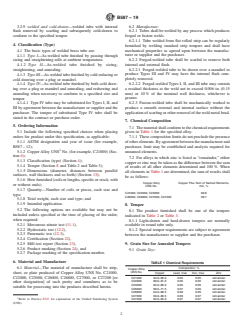
19.1 For the purpose of determining compliance with the specified limits for requirements of the properties listed in the following table, an observed value or a calculated value shall be rounded as indicated in accordance with the rounding method of Practice E29:
Property
Rounded Unit for Observed or Calculated Value
Chemical composition
Hardness
nearest unit in the last right-hand place of figures of
the specified limit
Tensile strength
nearest ksi
Grain size up to 0.060
mm, incl
nearest multiple of 0.005 mm
SCOPE
1.1 This specification establishes the requirements for round, rectangular, and square copper alloy welded tube for general engineering applications.
1.2 Units—The values stated in inch-pound units are to be regarded as standard. The values given in parentheses are mathematical conversions to SI units that are provided for information only and are not considered standard.
1.3 The following safety hazard caveat pertains only to the test method(s) described in this specification:
1.3.1 This standard does not purport to address all of the safety concerns, if any, associated with its use. It is the responsibility of the user of this standard to establish appropriate safety, health, and environmental practices and to determine the applicability of regulatory limitations prior to use.
1.4 This international standard was developed in accordance with internationally recognized principles on standardization established in the Decision on Principles for the Development of International Standards, Guides and Recommendations issued by the World Trade Organization Technical Barriers to Trade (TBT) Committee.
- Status
- Published
- Publication Date
- 31-Mar-2019
- Technical Committee
- B05 - Copper and Copper Alloys
- Drafting Committee
- B05.04 - Pipe and Tube
Overview
ASTM B587-19: Standard Specification for Welded Brass Tube establishes comprehensive requirements for round, rectangular, and square copper alloy welded tubes used in general engineering applications. Developed by ASTM International, this standard provides guidelines for the manufacturing, classification, chemical composition, temper, mechanical properties, permissible variations, and testing of welded brass tubes. Compliance with ASTM B587-19 helps ensure high product quality, consistent performance, and safety across a wide range of industrial uses.
Key Topics
1. Tube Types and Manufacturing:
- ASTM B587 specifies four types of welded brass tubes, differing in finishing and processing methods:
- Type I: Finished by sizing and straightening rolls at ambient temperature.
- Type II: Finished by sizing, straightening, and annealing.
- Type III: Cold reduced or cold drawn over a plug or mandrel.
- Type IV: Cold drawn over a plug or mandrel, with required annealing and redrawing if necessary.
- Tubes may be welded by any process yielding forged or fusion welds.
- Flash (excess weld material) requirements and removal methods are specified for varying tube types and finishing processes.
2. Material Specifications:
- Covers copper alloys such as C21000, C22000, C23000, C26000, C26800, C27000, and C27200.
- Chemical composition limits are mandatory for copper, lead, iron, and zinc; other elements may be included by agreement.
3. Mechanical and Physical Properties:
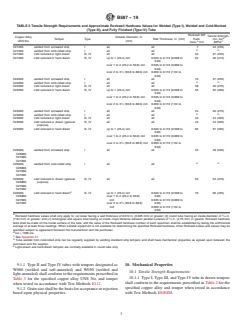
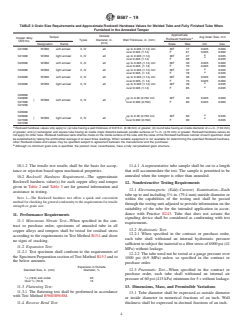
- Requirements for tensile strength, Rockwell hardness, and grain size are detailed based on tube type, alloy, and temper.
- The standard also includes tolerances for dimensions, roundness, straightness, and squareness of cut.
4. Performance and Quality Testing:
- Tubes must undergo destructive and non-destructive tests, including:
- Expansion (pin) test
- Mercurous nitrate test
- Flattening and reverse bend tests
- Eddy-current, hydrostatic, and pneumatic tests
- Sampling and retesting procedures are defined to ensure ongoing compliance.
5. Ordering and Identification:
- Purchasers should specify alloy UNS number, tube type, temper, dimensions, quantity, intended application, and any additional test or certification requirements.
Applications
Welded brass tubes manufactured under ASTM B587-19 are suitable for a variety of general engineering applications where a combination of strength, corrosion resistance, and precise dimensional tolerances are required. Common uses include:
- Heat exchangers and condenser tubes
- Automotive components
- Architectural applications, such as decorative railing and framing
- Plumbing and HVAC systems
- Precision tubing in instrumentation and other industrial assemblies
Adhering to the ASTM B587 standard ensures that products meet strict quality and safety criteria, facilitating their acceptance in both domestic and international projects and markets.
Related Standards
To ensure comprehensive product evaluation and manufacturing consistency, ASTM B587-19 is often used alongside several related ASTM standards:
- ASTM B153: Method for Expansion (Pin Test) of Copper and Copper-Alloy Pipe and Tubing
- ASTM B154: Mercurous Nitrate Test for Copper Alloys
- ASTM B428: Angle of Twist in Rectangular and Square Copper Alloy Tube
- ASTM B846: Terminology for Copper and Copper Alloys
- ASTM B968/B968M: Flattening of Copper and Copper-Alloy Pipe and Tube
- ASTM E3: Guide for Preparation of Metallographic Specimens
- ASTM E8/E8M: Test Methods for Tension Testing of Metallic Materials
- ASTM E18: Test Methods for Rockwell Hardness of Metallic Materials
- ASTM E243: Electromagnetic (Eddy Current) Examination of Copper and Copper-Alloy Tubes
- ASTM E478: Chemical Analysis of Copper Alloys
Compliance with ASTM B587-19 ensures welded brass tubes fit seamlessly into broader production standards and global supply chains, supporting engineering reliability and safety.
Keywords: ASTM B587-19, welded brass tube, copper alloy tube specification, mechanical properties, tube testing requirements, general engineering tubes, ASTM standards for brass, copper alloy chemistry, dimensional tolerances for tubes, international material compliance
Relations
- Effective Date
- 01-Apr-2019
- Effective Date
- 01-Jan-2024
- Effective Date
- 01-Aug-2019
- Effective Date
- 01-Jan-2019
- Effective Date
- 01-Jun-2018
- Effective Date
- 01-Mar-2018
- Effective Date
- 15-Jul-2016
- Effective Date
- 01-Feb-2015
- Effective Date
- 01-Dec-2013
- Effective Date
- 01-Oct-2013
- Effective Date
- 01-Jun-2013
- Effective Date
- 15-Nov-2012
- Effective Date
- 01-Oct-2012
- Effective Date
- 01-Oct-2012
- Effective Date
- 01-Dec-2011
Get Certified
Connect with accredited certification bodies for this standard

Element Materials Technology
Materials testing and product certification.

Inštitut za kovinske materiale in tehnologije
Institute of Metals and Technology. Materials testing, metallurgical analysis, NDT.
Institut za varilstvo d.o.o. (Welding Institute)
Slovenia's leading welding institute since 1952. ISO 3834, EN 1090, pressure equipment certification, NDT personnel, welder qualification. Only IIW Au
Sponsored listings
Frequently Asked Questions
ASTM B587-19 is a technical specification published by ASTM International. Its full title is "Standard Specification for Welded Brass Tube". This standard covers: ABSTRACT This specification establishes the requirements for round, rectangular, and square copper alloy welded tube for general engineering applications. The tubes are classified into four types: Type I tubes which are finished by passing through sizing and straightening rolls at ambient temperature; Type II tubes which are finished by sizing, straightening, and annealing; Type III tubes which are finished by cold reducing or cold drawing over a plug or mandrel; and Type IV tubes which are finished by cold drawing over a plug or mandrel and annealing, and redrawing and annealing when necessary to conform to a specified size and temper. Tubes shall be welded by any process which produces forged or fusion welds. Forged-welded tube shall be scarfed to remove both internal and external flash. Forged-welded tube to be drawn over a mandrel to produce Types III and IV may have the internal flash completely removed. Fusion-welded tube shall be mechanically worked to produce a smooth external and internal surface without the application of scarfing or other removal of the weld metal bead. Grain size and mechanical properties such as tensile strength and Rockwell hardness shall be determined. The tubes shall be subjected to mercury nitrate, expansion, flattening, and reverse bend tests for performance evaluation. Non-destructive tests such as eddy-current test, hydrostatic test, and pneumatic tests shall be done as well. SIGNIFICANCE AND USE 19.1 For the purpose of determining compliance with the specified limits for requirements of the properties listed in the following table, an observed value or a calculated value shall be rounded as indicated in accordance with the rounding method of Practice E29: Property Rounded Unit for Observed or Calculated Value Chemical composition Hardness nearest unit in the last right-hand place of figures of the specified limit Tensile strength nearest ksi Grain size up to 0.060 mm, incl nearest multiple of 0.005 mm SCOPE 1.1 This specification establishes the requirements for round, rectangular, and square copper alloy welded tube for general engineering applications. 1.2 Units—The values stated in inch-pound units are to be regarded as standard. The values given in parentheses are mathematical conversions to SI units that are provided for information only and are not considered standard. 1.3 The following safety hazard caveat pertains only to the test method(s) described in this specification: 1.3.1 This standard does not purport to address all of the safety concerns, if any, associated with its use. It is the responsibility of the user of this standard to establish appropriate safety, health, and environmental practices and to determine the applicability of regulatory limitations prior to use. 1.4 This international standard was developed in accordance with internationally recognized principles on standardization established in the Decision on Principles for the Development of International Standards, Guides and Recommendations issued by the World Trade Organization Technical Barriers to Trade (TBT) Committee.
ABSTRACT This specification establishes the requirements for round, rectangular, and square copper alloy welded tube for general engineering applications. The tubes are classified into four types: Type I tubes which are finished by passing through sizing and straightening rolls at ambient temperature; Type II tubes which are finished by sizing, straightening, and annealing; Type III tubes which are finished by cold reducing or cold drawing over a plug or mandrel; and Type IV tubes which are finished by cold drawing over a plug or mandrel and annealing, and redrawing and annealing when necessary to conform to a specified size and temper. Tubes shall be welded by any process which produces forged or fusion welds. Forged-welded tube shall be scarfed to remove both internal and external flash. Forged-welded tube to be drawn over a mandrel to produce Types III and IV may have the internal flash completely removed. Fusion-welded tube shall be mechanically worked to produce a smooth external and internal surface without the application of scarfing or other removal of the weld metal bead. Grain size and mechanical properties such as tensile strength and Rockwell hardness shall be determined. The tubes shall be subjected to mercury nitrate, expansion, flattening, and reverse bend tests for performance evaluation. Non-destructive tests such as eddy-current test, hydrostatic test, and pneumatic tests shall be done as well. SIGNIFICANCE AND USE 19.1 For the purpose of determining compliance with the specified limits for requirements of the properties listed in the following table, an observed value or a calculated value shall be rounded as indicated in accordance with the rounding method of Practice E29: Property Rounded Unit for Observed or Calculated Value Chemical composition Hardness nearest unit in the last right-hand place of figures of the specified limit Tensile strength nearest ksi Grain size up to 0.060 mm, incl nearest multiple of 0.005 mm SCOPE 1.1 This specification establishes the requirements for round, rectangular, and square copper alloy welded tube for general engineering applications. 1.2 Units—The values stated in inch-pound units are to be regarded as standard. The values given in parentheses are mathematical conversions to SI units that are provided for information only and are not considered standard. 1.3 The following safety hazard caveat pertains only to the test method(s) described in this specification: 1.3.1 This standard does not purport to address all of the safety concerns, if any, associated with its use. It is the responsibility of the user of this standard to establish appropriate safety, health, and environmental practices and to determine the applicability of regulatory limitations prior to use. 1.4 This international standard was developed in accordance with internationally recognized principles on standardization established in the Decision on Principles for the Development of International Standards, Guides and Recommendations issued by the World Trade Organization Technical Barriers to Trade (TBT) Committee.
ASTM B587-19 is classified under the following ICS (International Classification for Standards) categories: 23.040.15 - Non-ferrous metal pipes; 77.150.30 - Copper products. The ICS classification helps identify the subject area and facilitates finding related standards.
ASTM B587-19 has the following relationships with other standards: It is inter standard links to ASTM B587-12, ASTM E8/E8M-24, ASTM B846-19a, ASTM B846-19, ASTM E243-18, ASTM B428-09(2018), ASTM E8/E8M-16, ASTM E8/E8M-15, ASTM E243-13, ASTM B428-09(2013), ASTM E8/E8M-13, ASTM E112-12, ASTM B154-12, ASTM B154-12e1, ASTM E8/E8M-11. Understanding these relationships helps ensure you are using the most current and applicable version of the standard.
ASTM B587-19 is available in PDF format for immediate download after purchase. The document can be added to your cart and obtained through the secure checkout process. Digital delivery ensures instant access to the complete standard document.
Standards Content (Sample)
This international standard was developed in accordance with internationally recognized principles on standardization established in the Decision on Principles for the
Development of International Standards, Guides and Recommendations issued by the World Trade Organization Technical Barriers to Trade (TBT) Committee.
Designation:B587 −19
Standard Specification for
Welded Brass Tube
This standard is issued under the fixed designation B587; the number immediately following the designation indicates the year of
original adoption or, in the case of revision, the year of last revision. A number in parentheses indicates the year of last reapproval. A
superscript epsilon (´) indicates an editorial change since the last revision or reapproval.
1. Scope* Copper-Alloy Pipe and Tube
E3 Guide for Preparation of Metallographic Specimens
1.1 This specification establishes the requirements for
E8/E8M Test Methods for Tension Testing of Metallic Ma-
round, rectangular, and square copper alloy welded tube for
terials
general engineering applications.
E29 Practice for Using Significant Digits in Test Data to
1.2 Units—The values stated in inch-pound units are to be
Determine Conformance with Specifications
regarded as standard. The values given in parentheses are
E112 Test Methods for Determining Average Grain Size
mathematical conversions to SI units that are provided for
E243 Practice for Electromagnetic (Eddy Current) Examina-
information only and are not considered standard.
tion of Copper and Copper-Alloy Tubes
1.3 The following safety hazard caveat pertains only to the E255 Practice for Sampling Copper and Copper Alloys for
test method(s) described in this specification:
the Determination of Chemical Composition
1.3.1 This standard does not purport to address all of the E478 Test Methods for ChemicalAnalysis of CopperAlloys
safety concerns, if any, associated with its use. It is the
E527 Practice for Numbering Metals and Alloys in the
responsibility of the user of this standard to establish appro-
Unified Numbering System (UNS)
priate safety, health, and environmental practices and to
determine the applicability of regulatory limitations prior to
3. Terminology
use.
3.1 For definitions of terms related to copper and copper
1.4 This international standard was developed in accor-
alloys, refer to Terminology B846.
dance with internationally recognized principles on standard-
3.2 Definitions of Terms Specific to This Standard:
ization established in the Decision on Principles for the
3.2.1 as-welded—a condition created as a result of shaping
Development of International Standards, Guides and Recom-
sheet, strip, or plate into a tubular form and welding without
mendations issued by the World Trade Organization Technical
subsequent heat treatment or cold work, or both.
Barriers to Trade (TBT) Committee.
3.2.2 ends—straight pieces, shorter than the nominal length,
2. Referenced Documents
left over after cutting the product into mill lengths, stock
2.1 ASTM Standards:
lengths, or specified lengths. They are subject to minimum
B153 Test Method for Expansion (Pin Test) of Copper and
length and maximum weight requirements.
Copper-Alloy Pipe and Tubing
3.2.3 fully finished—welded tube with internal and pro-
B154 Test Method for Mercurous Nitrate Test for Copper
cessed to conform to the specified temper.
Alloys
B428 Test Method for Angle of Twist in Rectangular and
3.2.4 mill length—lengths that can be conveniently manu-
Square Copper and Copper Alloy Tube
factured in the mills.
B846 Terminology for Copper and Copper Alloys
3.2.5 mill lengths with ends—lengths, including ends, that
B968/B968M Test Method for Flattening of Copper and
can be conveniently manufactured in the mills.
3.2.6 specific—straight lengths that are uniform in length, as
ThisspecificationisunderthejurisdictionofASTMCommitteeB05onCopper
specified, and subject to established tolerances.
and CopperAlloys and is the direct responsibility of Subcommittee B05.04 on Pipe
and Tube.
3.2.7 stock—straight lengths that are mill cut and stored in
Current edition approved April 1, 2019. Published May 2019. Originally
advance of orders. They are usually subject to established
approved in 1973. Last previous edition approved in 2012 as B587–12. DOI:
tolerances.
10.1520/B0587–19.
For referenced ASTM standards, visit the ASTM website, www.astm.org, or
3.2.8 welded and annealed—welded tube that has been
contact ASTM Customer Service at service@astm.org. For Annual Book of ASTM
annealed to produce a uniformed grain size appropriate to the
Standards volume information, refer to the standard’s Document Summary page on
the ASTM website. specified annealed temper.
*A Summary of Changes section appears at the end of this standard
Copyright © ASTM International, 100 Barr Harbor Drive, PO Box C700, West Conshohocken, PA 19428-2959. United States
B587−19
3.2.9 welded and cold-drawn—welded tube with internal 6.2 Manufacture:
flash removed by scarfing and subsequently cold-drawn to 6.2.1 Tubes shall be welded by any process which produces
conform to the specified temper. forged or fusion welds.
6.2.1.1 Tube welded from flat rolled strip can be regularly
4. Classification (Type)
furnished by welding standard strip tempers and shall have
mechanical properties as agreed upon between the manufac-
4.1 The basic types of welded brass tube are:
turer or supplier and the purchaser.
4.1.1 Type I—As-welded tube finished by passing through
6.2.2 Forged-welded tube shall be scarfed to remove both
sizing and straightening rolls at ambient temperature.
internal and external flash.
4.1.2 Type II—As-welded tube finished by sizing,
6.2.2.1 Forged-welded tube to be drawn over a mandrel to
straightening, and annealing.
produce Types III and IV may have the internal flash com-
4.1.3 Type III—As-welded tube finished by cold reducing or
cold drawing over a plug or mandrel. pletely removed.
6.2.2.2 Forged-welded Types I, II, and III tube may contain
4.1.4 Type IV—As-welded tube finished by both cold draw-
ing over a plug or mandrel and annealing, and redrawing and a residual thickness at the weld not to exceed 0.006 in. (0.15
mm) or 10 % of the nominal wall thickness, whichever is
annealing when necessary to conform to a specified size and
greater.
temper.
6.2.3 Fusion-welded tube shall be mechanically worked to
4.1.4.1 Type IV tube may be substituted for Types I, II, and
produce a smooth external and internal surface without the
III by agreement between the manufacturer or supplier and the
applicationofscarfingorotherremovaloftheweldmetalbead.
purchaser. The temper of substituted Type IV tube shall be
stated in the contract or purchase order.
7. Chemical Composition
5. Ordering Information
7.1 Thematerialshallconformtothechemicalrequirements
given in Table 1 for the specified alloy.
5.1 Include the following specified choices when placing
orders for product under this specification, as applicable: 7.1.1 These composition limits do not preclude the presence
ofotherelements.Byagreementbetweenthemanufacturerand
5.1.1 ASTM designation and year of issue (for example,
B587 – 12); purchaser, limit may be established and analysis required for
5.1.2 CopperAlloy UNS No. (for example, C21000) (Sec- unnamed elements.
tion 6);
7.2 For alloys in which zinc is listed as “remainder,” either
5.1.3 Classification (type) (Section 4);
copper or zinc may be taken as the difference between the sum
5.1.4 Temper (Section 8 and Table 2 and Table 3);
of results of all other elements determined and 100 %. When
5.1.5 Dimensions (diameter, distances between parallel
all elements in Table 1 are determined, the sum of results shall
surfaces, wall thickness and so forth) (Section 13);
be as follows:
5.1.6 Howfurnished(coilsorlengths,specificorstock,with
Copper Alloy Copper Plus Sum of Named Elements,
or without ends);
UNS No. min, %
5.1.7 Quantity—Number of coils or pieces, each size and
C21000, C22000, C23000 99.8
type;
C26000, C26800, C27000, C27200 99.7
5.1.8 Total weight, each size and type; and
5.1.9 Intended application.
8. Temper
5.2 The following options are available but may not be
8.1 The product furnished shall be one of the tempers
included unless specified at the time of placing of the order,
indicated in Table 2 or Table 3.
when required:
8.1.1 Light-drawn and hard-drawn tempers are normally
5.2.1 Mercurous nitrate test (11.1),
available in round tube only.
5.2.2 Hydrostatic test (12.2),
8.1.2 Special temper requirements are subject to agreement
5.2.3 Pneumatic test (12.3),
between the manufacturer or supplier and the purchaser.
5.2.4 Certification (Section 22),
5.2.5 Mill test report (Section 23), 9. Grain Size for Annealed Tempers
5.2.6 Product marking (Section 24), and
9.1 Grain Size:
5.2.7 Package marking of the specification number.
6. Material and Manufacture
TABLE 1 Chemical Requirements
6.1 Material—The material of manufacture shall be strip, Composition, %
Copper Alloy
UNS No.
sheet, or plate produced of Copper Alloy UNS No. C21000, Copper Lead, max Iron, max Zinc
C22000, C23000, C26000, C26800, C27000, or C27200 [or C21000 94.0–96.0 0.05 0.05 remainder
C22000 89.0–91.0 0.05 0.05 remainder
other designation] of such purity and soundness as to be
C23000 84.0–86.0 0.05 0.05 remainder
suitable for processing into the products described herein.
C26000 68.5–71.5 0.07 0.05 remainder
C26800 64.0–68.5 0.09 0.05 remainder
C27000 63.0–68.5 0.09 0.07 remainder
Refer to Practice E527 for explanation of the Unified Numbering System C27200 62.0–65.0 0.07 0.07 remainder
(UNS).
B587−19
TABLE 2 Tensile Strength Requirements and Approximate Rockwell Hardness Values for Welded (Type I), Welded and Cold-Worked
(Type III), and Fully Finished (Type IV) Tube
Rockwell 30T
Tensile Strength,
Copper Alloy Outside Diameter, in.
B
Temper Type Wall Thickness, in. (mm) Hard-
min, ksi
UNS No. (mm)
C
A
ness, min (MPa)
C21000 welded from annealed strip I all all 7 34 (235)
DD
C21000 welded from cold-rolled strip I all all
C21000 cold reduced or light drawn III, IV all all 34 37 (255)
C21000 cold reduced or hard drawn III, IV up to 1 (25.4) incl 0.020 to 0.119 (0.508 to 52 46 (315)
3.02)
over 1 to 2 (25.4 to 50.8) incl 0.035 to 0.119 (0.889 to
3.02)
over 2 to 3 ⁄2 (50.8 to 88.9) incl 0.060 to 0.119 (1.52 to
3.02)
C22000 welded from annealed strip I all all 10 37 (255)
DD
C22000 welded from cold-rolled strip I all all
C22000 cold reduced or light drawn III, IV all all 38 40 (275)
C22000 cold reduced or hard drawn III, IV up to 1 (25.4) incl 0.020 to 0.119 (0.508 to 55 52 (360)
3.02)
over 1 to 2 (25.4 to 50.8) incl 0.035 to 0.119 (0.889 to
3.02)
over 2 to 3 ⁄2 (50.8 to 88.9) incl 0.060 to 0.119 (1.52 to
3.02)
C23000 welded from annealed strip I all all 24 40 (275)
DD
C23000 welded from cold-rolled strip I all all
C23000 cold reduced or light drawn III, IV all all 43 44 (305)
C23000 cold reduced or drawn (general III, IV all all 43 44 (305)
purpose)
C23000 cold reduced or hard drawn III, IV up to 1 (25.4) incl 0.020 to 0.119 (0.508 to 65 57 (395)
3.02)
over 1 to 2 (25.4 to 50.8) incl 0.035 to 0.119 (0.889 to
3.02)
over 2 to 3 ⁄2 (50.8 to 88.9) incl 0.060 to 0.119 (1.52 to
3.02)
C26000, welded from annealed strip I all all 25 48 (330)
C26800,
C27000,
C27200
DD
C26000, welded from cold-rolled strip I all all
C26800,
C27000,
C27200
C26000, cold reduced or drawn (general III, IV all all 53 54 (370)
C26800, purpose)
C27000,
C27200
E
C26000, cold reduced or hard drawn III, IV up to 1 (25.4) incl 0.020 to 0.119 (0.508 to 70 66 (455)
C26800, over 1 to 2 (25.4 to 50.8) 3.02)
C27000, incl 0.035 to 0.119 (0.889 to
C27200 over 2 to 3 ⁄2 (50.8 to 88.9) 3.02)
incl 0.060 to 0.119 (1.52 to
3.02)
A
Rockwell hardness values shall only apply to: (a) tubes having a wall thickness of 0.012 in. (0.305 mm) or greater; (b) round tube having an inside diameter of ⁄16 in.
(7.94 mm) or greater; and (c) rectangular and square tube having an inside major distance between parallel surfaces of ⁄4 in. (4.76 mm) or greater. Rockwell hardness
tests shall be made on the inside surface of the tube, and the value of the Rockwell hardness number of each specimen shall be established by taking the arithmetical
average of at least three readings. When suitable equipment is not available for determining the specified Rockwell hardness, other Rockwell scales and values may be
specified subject to agreement between the manufacturer and the purchaser.
B
ksi = 1000 psi.
C
See Appendix X1.
D
Tube welded from cold-rolled strip can be regularly supplied by welding standard strip tempers and shall have mechanical properties as agreed upon between the
purchaser and the supplier.
E
Light-drawn and hard-drawn tempers are normally available in round tube only.
9.1.1 Type II and Type IV tubes with tempers designated as 10. Mechanical Properties
W060 (welded and soft-annealed) and W050 (welded and
10.1 Tensile Strength Requirements:
light-annealed) shall conform to the requirements prescribed in
10.1.1 Type I, Type III, and Type IV tube in drawn tempers
Table 3 for the specified copper alloy UNS No. and temper
shall conform to the requirements prescribed in Table 2 for the
when tested in accordance with Test Methods E112.
specified copper alloy and temper when tested in accordance
9.1.2 Grainsizeshallbethebasisforacceptanceorrejection
with Test Methods E8/E8M.
based upon physical properties.
B587−19
TABLE 3 Grain Size Requirements and Approximate Rockwell Hardness Values for Welded Tube and Fully Finished Tube When
Furnished in the Annealed Temper
Approximate
Outside
Temper Avg Grain Size, mm
Copper Alloy A
Rockwell Hardness
Types Diameter, in. Wall Thickness, in. (mm)
UNS No.
(mm)
Designation Name Scale Max min max
C21000 WO60 soft anneal II, IV all up to 0.045 (1.14) incl 30T 17 0.025 0.060
over 0.045 (1.14) F 61 0.025 0.060
B
C21000 WO50 light anneal II, IV all up to 0.045 (1.14) 30T 27 0.035
B
over 0.045 (1.14) F 68 0.035
C22000 WO60 soft anneal II, IV all up to 0.045 (1.14) incl 30T 30 0.025 0.060
over 0.045, (1.14) F 70 0.025 0.060
B
C22000 WO50 light anneal II, IV all up to 0.045 (1.14) incl 30T 37 0.035
B
over 0.045, (1.14) F 78 0.035
C23000 WO60 soft anneal II, IV all up to 0.045 (1.14) incl 30T 36 0.025 0.060
over 0.045, (1.14) F 75 0.025 0.060
B
C23000 WO50 light anneal II, IV all up to 0.045 (1.14) incl 30T 39 0.035
B
over 0.045 (1.14) F 85 0.035
C26000
C26800 up to 0.30 (0.762 incl 30T 40 0.025 0.060
} WO60 soft anneal II, IV all {
C27000 over 0.030 (0.762) F 80 0.025 0.060
C27200
C26000
B
C26800 up to 0.30 (0.762 incl 30T 60 0.035
} WO50 light anneal II, IV all {
B
C27000 over 0.030 (0.762) F 90 0.035
C27200
A
Rockwell hardness values only apply to: (a) tube having a wall thickness of 0.015 in. (0.38 mm) or greater; (b) round tube having an inside diameter of ⁄16 in. (7.94 mm)
or greater; and (c) rectangular and square tube having an inside major distance between parallel surfaces of ⁄16 in. (4.76 mm) or greater. Rockwell hardness values do
not apply for other tube. Rockwell hardness tests shall be made on the inside surface of the tube and the value of the Rockwell hardness number of each specimen shall
be established by taking the arithmetical average of at least three readings. When suitable equipment is not available for determining the specified Rockwell hardness,
other Rockwell scales and values may be specified subject to agreement between the manufacturer and the purchaser.
B
Although no minimum grain size is specified, the product must, nevertheless, have a fully recrystallized grain structure.
10.1.2 The tensile test results shall be the basis for accep- 11.4.1 A representative tube sample shall be cut to a length
tance or rejection based upon mechanical properties. that will accommodate the test. The sample is permitted to be
annealed when the temper is other than annealed.
10.2 Rockwell Hardness Requirement—The approximate
Rockwell hardness value(s) for each copper alloy and temper
12. Nondestructive Testing Requirements
given in Table 2 and Table 3 are for general information and
12.1 Electromagnetic (Eddy-Current) Examination—Each
assistance in testing.
tube up to and including 3 ⁄8 in. (79.4 mm) outside diameter or
NOTE 1—The Rockwell hardness test offers a quick and convenient
within the capabilities of the testing unit shall be passed
methodforcheckingforgeneralconformitytotherequirementsfortensile
through the testing unit adjusted to provide information on the
strength or grain size.
suitability of the tube for the intended application in accor-
dance with Practice E243. Tube that does not actuate the
11. Performance Requirements
signaling device shall be considered as conforming with test
11.1 Mercurous Nitrate Test—When specified in the con-
requirements.
tract or purchase order, specimens of annealed tube in all
12.2 Hydrostatic Test:
copper alloys and tempers shall be tested for residual stress
12.2.1 When specified in the contract or purchase order,
according to the requirements in Test Method B154 and show
each tube shall withstand an internal hydrostatic pressure
no signs of cracking.
sufficienttosubjectthematerialtoafiberstressof6000psi(41
11.2 Expansion Test:
MPa) without leakage.
11.2.1 Test specimen shall conform to the requirements of
12.2.2 The tube need not be tested at a gauge pressure over
the Specimen Preparation section of Test Method B153 and to
1000 psi (6.9 MPa) unless so specified in the contract or
the below amounts.
purchase order.
Expansion in Outside
12.3 Pneumatic Test—When specified in the contract or
Standard Size, in. (mm) Diameter, %
purchase order, each tube shall withstand an internal air
⁄4 (19.0) and under 20
pressure of 60 psi (415 kPa) minimum for 5 s without leakage.
Over ⁄4 (19.0) 15
11.3 Flattening Test: 13. Dimensions, Mass, and Permissible Variations
11.3.1 The flattening test shall be performed in accordance
13.1 Tube diameter shall be expressed as outside diameter
with Test Method B968/B968M.
or inside diameter in numerical fractions of an inch. Wall
11.4 Reverse Bend Test: thickness shall be expressed in decimal fractions of an inch.
B587−19
13.2 Tolerances on a given tube may be specified with tube furnished in coils, or tube whose wall thickness is under
respect to any two, but not all three, of the following: outside 0.016 in. (0.406 mm).
diameter, inside diameter, and wall thickness.
13.9 Squareness-of-Cut—For tube in straight lengths, the
13.3 For purposes of determining conformance with the
departure from squareness at the end of any tube shall not
dimensional requirements prescribed in this specification, any
exceed the following:
measured value outside the specified limiting values for any
13.9.1 Round Tubes:
dimension shall be cause for rejection.
Specified Outside Diameter, Tolerance
in. (mm)
13.4 Wall Thickness Tolerances—Wall thickness tolerances
for round tube shall conform to the tolerances listed in Table 4.
Up to ⁄8 (15.9), incl 0.010 in. (0.25 mm)
Wall thickness tolerances for rectangular including square tube Over ⁄8 (15.9) 0.016 in./in. (0.016 mm/mm) of diameter
shall be in accordance with Table 5.
13.9.2 Rectangular and Square Tube:
13.5 Diameter tolerances for round tubes furnished in
Specified Distance Between Major Tolerance
Outside Parallel Surfaces, in.
straight lengths only shall be in accordance with Table 6.
(mm)
Tolerances have not been established for tube furnished in
coils.
Up to ⁄8 (15.9), incl 0.016 in. (0.41 mm)
Over ⁄8 (15.9) 0.025 in./in. (0.025 mm/mm) of distance
13.6 Tolerances on distance between parallel surfaces for
between outside parallel surfaces
rectangular (including square) tube shall be in accordance with
13.10 Straightness Tolerances:
Table 7.
13.10.1 Round Tubes—For round tubes of any drawn tem-
13.7 Lengths and Tolerances:
1 1
per or round tubes as welded from cold-rolled strip, ⁄4 to 3 ⁄2
13.7.1 Tube in straight lengths shall be furnished in stock
in. (6.35 to 88.9 mm) in outside diameter, inclusive, the
lengths with ends unless the order requires specific lengths or
straightness tolerances shall be in accordance with Table 14.
specific lengths with ends.
Straightness tolerances have not been established for redraw
13.7.2 The tolerances on the length for tubes furnished in
tube, tube as welded from annealed strip, or any annealed tube.
straight lengths shall be in accordance with Table 8.
13.10.2 Rectangular and Square Tubes—For rectangular
13.7.3 The schedule of ends for tubes furnished in specific
and square tubes of any drawn temper or rectangular or square
or stock lengths with ends shall be in accordance with Table 9.
tubes as welded from cold-rolled strip, the straightness toler-
13.7.4 The tolerances for tubes furnished in coils shall be in
ance shall be ⁄2 in. (12.7 mm) maximum curvature (depth of
accordance with Table 10, Table 11, and Table 12.
arc) in any 6 ft (1.83 m) portion of the total length. (Not
13.8 Roundness:
applicable to redraw tube, tube as welded from annealed strip,
13.8.1 For as-welded from cold-worked strip, and redrawn
or any annealed tube.)
unannealed tube in straight lengths, the roundness tolerances
13.11 Corner Radius, Rectangular and Square Tubes—The
shall be in accordance with Table 13.
permissible radii for commercially square corners applicable to
13.8.2 Compliance with the roundness tolerance shall be
welded rectangular and square tubes shall be in accordance
determined by taking measurements on the outside diameter
with Table 15.
only, irrespective of the manner in which the tube dimensions
are specified. The deviation from roundness is measured as the 13.12 Twist Tolerances, Rectangular and Square Tubes—
differencebetweenmajorandminordiametersasdeterminedat The maximum twist about the longitudinal axis of drawn
any one cross section of the tube. temperandasweldedfromcold-rolledstriptemperrectangular
13.8.3 Tolerances have not been established for redrawn and square tubes shall not exceed 1°/ft (0.305 m) length,
tube, annealed tube, tube as welded from annealed strip, any measured to the nearest degree, and the total angle of twist
A
TABLE 4 Wall Thickness Tolerances for Welded Brass Tube
NOTE 1—Maximum Deviation at any Point—The following tolerances are plus and minus. If tolerances all plus or all minus are desired, double the
values given.
C
Outside Diameters, in. (mm)
B
Wall Thickness, in. (mm) 1 5 5 1
Over ⁄8 (3.18) to ⁄8 Over ⁄8 (15.9) to 1 Over 1 (25.4) to 2 Over 2 (50.8) to 3 ⁄2
1 1
⁄32 (0.794) to ⁄8 (3.18), incl
(15.9), incl (25.4), incl (50.8), incl (88.9), incl
Up to 0.017 (0.432), incl 0.002 (0.051) 0.001 (0.025) 0.0015 (0.038) 0.002 (0.051) .
Over 0.017 (0.432) to 0.024 (0.610), incl 0.003 (0.076) 0.002 (0.051) 0.002 (0.051) 0.0025 (0.064) .
Over 0.024 (0.610) to 0.034 (0.864), incl 0.003 (0.076) 0.0025 (0.064) 0.0025 (0.064) 0.003 (0.076) 0.004 (0.10)
Over 0.034 (0.864) to 0.057 (1.48), incl 0.003 (0.076) 0.003 (0.076) 0.0035 (0.089) 0.0035 (0.089) 0.005 (0.13)
Over 0.057 (1.48) to 0.082 (2.08), incl . 0.0035 (0.089) 0.004 (0.10) 0.004 (0.10) 0.006 (0.15)
Over 0.082 (2.08) to 0.119 (3.02), incl . 0.004 (0.10) 0.005 (0.13) 0.005 (0.13) 0.007 (0.18)
A
The thickness tolerance is the maximum deviation at any point from the specified thickness.
B
The wall thickness at the weld in Types I, II, and III tube may exceed the nominal wall thickness by an amount double the value shown in the tolerance table.
C
When round tube is ordered by outside and inside diameters, the maximum plu
...
This document is not an ASTM standard and is intended only to provide the user of an ASTM standard an indication of what changes have been made to the previous version. Because
it may not be technically possible to adequately depict all changes accurately, ASTM recommends that users consult prior editions as appropriate. In all cases only the current version
of the standard as published by ASTM is to be considered the official document.
Designation: B587 − 12 B587 − 19
Standard Specification for
Welded Brass Tube
This standard is issued under the fixed designation B587; the number immediately following the designation indicates the year of
original adoption or, in the case of revision, the year of last revision. A number in parentheses indicates the year of last reapproval. A
superscript epsilon (´) indicates an editorial change since the last revision or reapproval.
1. Scope*
1.1 This specification establishes the requirements for round, rectangular, and square copper alloy welded tube for general
engineering applications.
1.2 Units—Values The values stated in inch-pound units are to be regarded as standard. The values given in parentheses are
mathematical conversions to SI units, whichunits that are provided for information only and are not considered standard.
1.3 The following hazard statement pertains only to the test method described in 18.2.3, 18.2.4, 18.2.6, and 18.2.7 of this
specification:This standard does not purport to address all of the safety concerns, if any, associated with its use. It is the
responsibility of the user of this standard to establish appropriate safety and health practices and determine the applicability of
regulatory limitations prior to use.
1.3 The following safety hazard caveat pertains only to the test method(s) described in this specification:
1.3.1 This standard does not purport to address all of the safety concerns, if any, associated with its use. It is the responsibility
of the user of this standard to establish appropriate safety, health, and environmental practices and to determine the applicability
of regulatory limitations prior to use.
1.4 This international standard was developed in accordance with internationally recognized principles on standardization
established in the Decision on Principles for the Development of International Standards, Guides and Recommendations issued
by the World Trade Organization Technical Barriers to Trade (TBT) Committee.
2. Referenced Documents
2.1 ASTM Standards:
B153 Test Method for Expansion (Pin Test) of Copper and Copper-Alloy Pipe and Tubing
B154 Test Method for Mercurous Nitrate Test for Copper Alloys
B428 Test Method for Angle of Twist in Rectangular and Square Copper and Copper Alloy Tube
B601B846 Classification for Temper Designations for Terminology for Copper and Copper Alloys—Wrought and CastAlloys
B968/B968M Test Method for Flattening of Copper and Copper-Alloy Pipe and Tube
E3 Guide for Preparation of Metallographic Specimens
E8/E8M
E18E8/E8M Test Methods for Rockwell HardnessTension Testing of Metallic Materials
E29 Practice for Using Significant Digits in Test Data to Determine Conformance with Specifications
E112 Test Methods for Determining Average Grain Size
E243 Practice for Electromagnetic (Eddy Current) Examination of Copper and Copper-Alloy Tubes
E255 Practice for Sampling Copper and Copper Alloys for the Determination of Chemical Composition
E478 Test Methods for Chemical Analysis of Copper Alloys
E527 Practice for Numbering Metals and Alloys in the Unified Numbering System (UNS)
3. Terminology
3.1 For definitions of terms related to copper and copper alloys, refer to Terminology B846.
3.2 Definitions:Definitions of Terms Specific to This Standard:
This specification is under the jurisdiction of ASTM Committee B05 on Copper and Copper Alloys and is the direct responsibility of Subcommittee B05.04 on Pipe and
Tube.
Current edition approved Oct. 1, 2012April 1, 2019. Published November 2012May 2019. Originally approved in 1973. Last previous edition approved in 20082012 as
B587 – 08.B587–12. DOI: 10.1520/B0587-12.10.1520/B0587–19.
For referenced ASTM standards, visit the ASTM website, www.astm.org, or contact ASTM Customer Service at service@astm.org. For Annual Book of ASTM Standards
volume information, refer to the standard’sstandard’s Document Summary page on the ASTM website.
*A Summary of Changes section appears at the end of this standard
Copyright © ASTM International, 100 Barr Harbor Drive, PO Box C700, West Conshohocken, PA 19428-2959. United States
B587 − 19
3.2.1 average diameter (for round tubes only), as-welded—n—the average of the maximum and minimum outside diameters,
or the maximum and minimum inside diameters, whichever is applicable, as determined at any one cross section of the tube.a
condition created as a result of shaping sheet, strip, or plate into a tubular form and welding without subsequent heat treatment
or cold work, or both.
3.1.2 coil—a length of the product wound into a series of connected turns. The unqualified term “coil” as applied to tube is
normally understood as referring to a bunched coil.
3.1.2.1 mill length—lengths that can be conveniently manufactured in the mills.
3.1.2.2 mill lengths with ends—lengths, including ends, that can be conveniently manufactured in the mills.
3.1.3 flash or bead—weld metal that protrudes beyond the normal wall, both inside or outside.
3.2.2 lengths—ends—straight pieces of the product.pieces, shorter than the nominal length, left over after cutting the product
into mill lengths, stock lengths, or specified lengths. They are subject to minimum length and maximum weight requirements.
3.1.4.1 ends—straight pieces, shorter than the nominal length, left over after cutting the product into mill lengths, stock lengths,
or specified lengths. They are subject to minimum length and maximum weight requirements.
3.1.4.2 specific—straight lengths that are uniform in length, as specified, and subject to established tolerances.
3.1.4.3 stock—straight lengths that are mill cut and stored in advance of orders. They are usually subject to established
tolerances.
3.2.3 scarfing—fully finished—the removing of flash or bead by a cutting operation.welded tube with internal and processed to
conform to the specified temper.
3.2.4 mill length—lengths that can be conveniently manufactured in the mills.
3.2.5 mill lengths with ends—lengths, including ends, that can be conveniently manufactured in the mills.
3.2.6 specific—straight lengths that are uniform in length, as specified, and subject to established tolerances.
3.2.7 stock—straight lengths that are mill cut and stored in advance of orders. They are usually subject to established tolerances.
3.2.8 tube—welded and annealed—a hollow product of round or any other cross section, having a continuous periphery.welded
tube that has been annealed to produce a uniformed grain size appropriate to the specified annealed temper.
3.1.6.1 welded—product made from sheet, strip, or plate with a seam made by welding.
3.1.6.2 as-welded—a condition created as a result of shaping sheet, strip, or plate into a tubular form and welding without
subsequent heat treatment or cold work, or both.
3.1.6.3 welded and annealed—welded tube that has been annealed to produce a uniformed grain size appropriate to the specified
annealed temper.
3.1.6.4 welded and cold-drawn—welded tube with internal flash removed by scarfing and subsequently cold-drawn to conform
to the specified temper.
3.1.6.5 fully finished—welded tube with internal and processed to conform to the specified temper.
3.2.9 welded and cold-drawn—welded tube with internal flash removed by scarfing and subsequently cold-drawn to conform
to the specified temper.
4. Classification (Type)
4.1 The basic types of welded brass tube are:
4.1.1 Type I—As-welded tube finished by passing through sizing and straightening rolls at ambient temperature.
4.1.2 Type II—As-welded tube finished by sizing, straightening, and annealing.
4.1.3 Type III—As-welded tube finished by cold reducing or cold drawing over a plug or mandrel.
4.1.4 Type IV—As-welded tube finished by both cold drawing over a plug or mandrel and annealing, and redrawing and
annealing when necessary to conform to a specified size and temper.
4.1.4.1 Type IV tube may be substituted for Types I, II, and III by agreement between the manufacturer or supplier and the
purchaser. The temper of substituted Type IV tube shall be stated in the contract or purchase order.
5. Ordering Information
5.1 Include the following specified choices when placing orders for product under this specification, as applicable:
5.1.1 ASTM designation and year of issue (for example, B587 – 12),);
5.1.2 Copper Alloy UNS No. (for example, C21000) (Section 6),);
5.1.3 Classification (type) (Section 4),);
5.1.4 Temper (Section 8 and Table 2 and Table 3),Table 3);
Refer to Practice E527 for explanation of the Unified Numbering System (UNS).
B587 − 19
5.1.5 Dimensions (diameter, distances between parallel surfaces, wall thickness and so forth) (Section 13),);
5.1.6 How furnished (coils or lengths, specific or stock, with or without ends),ends);
5.1.7 Quantity—Number of coils or pieces, each size and type, ortype;
5.1.8 Total weight, each size and type,type; and
5.1.9 Intended application.
5.2 The following options are available under this specification and shall be specified in the contract or purchase order but may
not be included unless specified at the time of placing of the order, when required:
5.2.1 Mercurous nitrate test (11.1),
5.2.2 Hydrostatic test (12.2),
5.2.3 Pneumatic test (12.3),
5.2.4 Certification (Section 22),
5.2.5 Mill test report (Section 23),
5.2.6 Product marking (Section 24), and
5.2.7 Package marking of the specification number.
6. Material and Manufacture
6.1 Material—The material of manufacture shall be strip, sheet, or plate produced of Copper Alloy UNS No. C21000, C22000,
C23000, C26000, C26800, C27000, or C27200 and shall be[or other designation] of such qualitypurity and soundness as to be
suitable for processing into the products described in this specification.herein.
6.2 Manufacture:
6.2.1 Tubes shall be welded by any process which produces forged or fusion welds.
6.2.1.1 Tube welded from flat rolled strip can be regularly furnished by welding standard strip tempers and shall have
mechanical properties as agreed upon between the manufacturer or supplier and the purchaser.
6.2.2 Forged-welded tube shall be scarfed to remove both internal and external flash.
6.2.2.1 Forged-welded tube to be drawn over a mandrel to produce Types III and IV may have the internal flash completely
removed.
6.2.2.2 Forged-welded Types I, II, and III tube may contain a residual thickness at the weld not to exceed 0.006 in. (0.15 mm)
or 10 % of the nominal wall thickness, whichever is greater.
6.2.3 Fusion-welded tube shall be mechanically worked to produce a smooth external and internal surface without the
application of scarfing or other removal of the weld metal bead.
7. Chemical Composition
7.1 The material shall conform to the chemical requirements given in Table 1 for the specified alloy.
7.1.1 These composition limits do not preclude the presence of other elements. Limits By agreement between the manufacturer
and purchaser, limit may be established and analysis required for unnamed elements by agreement between the manufacturer and
the purchaser.elements.
7.2 Either copper or zinc may be taken as the difference between the sum of results of all elements determined and 100 %;
however, when copper is so determined, that difference shall conform to the limits given in Table 1 for copper.
7.2 For alloys in which zinc is listed as “remainder,” either copper or zinc may be taken as the difference between the sum of
results of all other elements determined and 100 %. When all elements in Table 1 for the specified alloy are determined, the sum
of results shall be as follows:
Copper Alloy Copper Plus Sum of Named Elements,
UNS No. min, %
C21000, C22000, C23000 99.8
C26000, C26800, C27000, C27200 99.7
TABLE 1 Chemical Requirements
Composition, %
Copper Alloy
UNS No.
Copper Lead, max Iron, max Zinc
C21000 94.0–96.0 0.05 0.05 remainder
C22000 89.0–91.0 0.05 0.05 remainder
C23000 84.0–86.0 0.05 0.05 remainder
C26000 68.5–71.5 0.07 0.05 remainder
C26800 64.0–68.5 0.09 0.05 remainder
C27000 63.0–68.5 0.09 0.07 remainder
C27200 62.0–65.0 0.07 0.07 remainder
B587 − 19
8. Temper
8.1 The product furnished shall be one of the tempers indicated in Table 2 or Table 3.
8.1.1 Light-drawn and hard-drawn tempers are normally available in round tube only.
8.1.2 Special temper requirements are subject to agreement between the manufacturer or supplier and the purchaser.
9. Grain Size for Annealed Tempers
9.1 Grain Size:
9.1.1 Type II and Type IV tubes with tempers designated as W060 (welded and soft-annealed) and W050 (welded and
light-annealed) shall conform to the requirements prescribed in Table 3 for the specified copper alloy UNS No. and temper when
tested in accordance with Test Methods E112.
9.1.2 Grain size shall be the basis for acceptance or rejection based upon physical properties.
10. Mechanical Properties
10.1 Tensile Strength Requirements : Requirements:
10.1.1 Type I, Type III, and Type IV tube in drawn tempers shall conform to the requirements prescribed in Table 2 for the
specified copper alloy and temper when tested in accordance with Test Methods E8/E8M.
10.1.2 The tensile test results shall be the basis for acceptance or rejection based upon mechanical properties.
10.2 Rockwell Hardness Requirement—The approximate Rockwell hardness value(s) for each copper alloy and temper given
in Table 2 and Table 3 are for general information and assistance in testing.
NOTE 1—The Rockwell hardness test offers a quick and convenient method for checking for general conformity to the requirements for tensile strength
or grain size.
11. Performance Requirements
11.1 Mercurous Nitrate Test—When specified in the contract or purchase order, specimens of annealed tube in all copper alloys
and tempers shall show no cracks when tested in accordance with be tested for residual stress according to the requirements in Test
Method B154. and show no signs of cracking.
11.2 Expansion Test:
11.2.1 Test specimen shall conform to the requirements of the Specimen Preparation section of Test Method B153 and to the
below amounts.
Expansion in Outside
Standard Size, in. (mm) Diameter, %
⁄4 (19.0) and under 20
Over ⁄4 (19.0) 15
11.3 Flattening Test:
11.3.1 The flattening test shall be performed in accordance with Test Method B968/B968M.
11.4 Reverse Bend Test:
11.4.1 A representative tube sample shall be cut to a length that will accommodate the test. The sample is permitted to be
annealed when the temper is other than annealed.
12. Nondestructive Testing Requirements
12.1 Electromagnetic (Eddy-Current) Examination—Each tube up to and including 3 ⁄8-in. (79.4-mm) in. (79.4 mm) outside
diameter or within the capabilities of the testing unit shall be passed through the testing unit adjusted to provide information on
the suitability of the tube for the intended application in accordance with Practice E243. Tube that does not actuate the
signallingsignaling device shall be considered as conforming with test requirements.
12.2 Hydrostatic Test:
12.2.1 When specified in the contract or purchase order, each tube shall withstand an internal hydrostatic pressure sufficient to
subject the material to a fiber stress of 6000 psi (41 MPa) without leakage.
12.2.2 The tube need not be tested at a gagegauge pressure over 1000 psi (6.9 MPa) unless so specified in the contract or
purchase order.
12.3 Pneumatic Test—When specified in the contract or purchase order, each tube shall withstand an internal air pressure of 60
psi (415 kPa) minimum for 5 s without leakage.
13. Dimensions, Mass, and Permissible Variations
13.1 Tube diameter shall be expressed as outside diameter or inside diameter in numerical fractions of an inch. Wall thickness
shall be expressed in decimal fractions of an inch.
B587 − 19
TABLE 2 Tensile Strength Requirements and Approximate Rockwell Hardness Values for Welded (Type I), Welded and Cold-Worked
(Type III), and Fully Finished (Type IV) Tube
Rockwell 30T
Tensile Strength,
Copper Alloy Outside Diameter, in.
B
Temper Type Wall Thickness, in. (mm) Hard-
min, ksi
UNSUNS No. (mm)
C
A
ness, min (MPa)
C21000 welded from annealed strip I all all 7 34 (235)
D D
C21000 welded from cold-rolled strip I all all
C21000 cold reduced or light drawn III, IV all all 34 37 (255)
C21000 cold reduced or hard drawn III, IV up to 1 (25.4) incl 0.020–0.119 (0.508–3.02) 52 46 (315)
C21000 cold reduced or hard drawn III, IV up to 1 (25.4) incl 0.020 to 0.119 (0.508 to 52 46 (315)
3.02)
over 1 to 2 (25.4 to 50.8) 0.035–0.119 (0.889–3.02)
incl
over 1 to 2 (25.4 to 50.8) 0.035 to 0.119 (0.889 to
incl 3.02)
over 2 to 3 ⁄2 (50.8 to 88.9) 0.060–0.119 (1.52–3.02)
incl
over 2 to 3 ⁄2 (50.8 to 88.9) 0.060 to 0.119 (1.52 to
incl 3.02)
C22000 welded from annealed strip I all all 10 37 (255)
D D
C22000 welded from cold-rolled strip I all all
C22000 cold reduced or light drawn III, IV all all 38 40 (275)
C22000 cold reduced or hard drawn III, IV up to 1 (25.4) incl 0.020 to 0.119 (0.508 to 55 52 (360)
3.02)
C22000 cold reduced or hard drawn III, IV up to 1 (25.4) incl 0.020 to 0.119 (0.508 to 55 52 (360)
3.02)
over 1 to 2 (25.4 to 50.8) 0.035 to 0.119 (0.889 to
incl 3.02)
over 1 to 2 (25.4 to 50.8) 0.035 to 0.119 (0.889 to
incl 3.02)
over 2 to 3 ⁄2 (50.8 to 88.9) 0.060 to 0.119 (1.52 to
incl 3.02)
over 2 to 3 ⁄2 (50.8 to 88.9) 0.060 to 0.119 (1.52 to
incl 3.02)
C23000 welded from annealed strip I all all 24 40 (275)
D D
C23000 welded from cold-rolled strip I all all
C23000 cold reduced or light drawn III, IV all all 43 44 (305)
C23000 cold reduced or drawn (general III, IV all all 43 44 (305)
purpose)
C23000 cold reduced or hard drawn III, IV up to 1 (25.4) incl 0.020 to 0.119 (0.508 to 65 57 (395)
3.02)
C23000 cold reduced or hard drawn III, IV up to 1 (25.4) incl 0.020 to 0.119 (0.508 to 65 57 (395)
3.02)
over 1 to 2 (25.4 to 50.8) 0.035 to 0.119 (0.889 to
incl 3.02)
over 1 to 2 (25.4 to 50.8) 0.035 to 0.119 (0.889 to
incl 3.02)
over 2 to 3 ⁄2 (50.8 to 88.9) 0.060 to 0.119 (1.52 to
incl 3.02)
over 2 to 3 ⁄2 (50.8 to 88.9) 0.060 to 0.119 (1.52 to
incl 3.02)
C26000, welded from annealed strip I all all 25 48 (330)
C26800,
C27000,
C27200
D D
C26000, welded from cold-rolled strip I all all
C26800,
C27000,
C27200
C26000, cold reduced or drawn (general III, IV all all 53 54 (370)
C26800, purpose)
C27000,
C27200
E
C26000, cold reduced or hard drawn III, IV up to 1 (25.4) incl 0.020 to 0.119 (0.508 to 70 66 (455)
C26800, over 1 to 2 (25.4 to 50.8) 3.02)
C27000, incl 0.035 to 0.119 (0.889 to
C27200 over 2 to 3 ⁄2 (50.8 to 88.9) 3.02)
incl 0.060 to 0.119 (1.52 to
3.02)
A
Rockwell hardness values shall only apply to: (a) tubes having a wall thickness of 0.012 in. (0.305 mm) or greater; (b) round tube having an inside diameter of ⁄16 in.
(7.94 mm) or greater; and (c) rectangular and square tube having an inside major distance between parallel surfaces of ⁄4 in. (4.76 mm) or greater. Rockwell hardness
tests shall be made on the inside surface of the tube, and the value of the Rockwell hardness number of each specimen shall be established by taking the arithmetical
average of at least three readings. When suitable equipment is not available for determining the specified Rockwell hardness, other Rockwell scales and values may be
specified subject to agreement between the manufacturer and the purchaser.
B
ksi = 1000 psi.
C
See Appendix X1.
B587 − 19
D
Tube welded from cold-rolled strip can be regularly supplied by welding standard strip tempers and shall have mechanical properties as agreed upon between the
purchaser and the supplier.
E
Light-drawn and hard-drawn tempers are normally available in round tube only.
TABLE 3 Grain Size Requirements and Approximate Rockwell Hardness Values for Welded Tube and Fully Finished Tube When
Furnished in the Annealed Temper
Approximate
Outside
Temper Avg Grain Size, mm
Copper Alloy A
Rockwell Hardness
Types Diameter, in. Wall Thickness, in. (mm)
UNS No.
(mm)
Designation Name Scale Max min max
C21000 WO60 soft anneal II, IV all up to 0.045 (1.14) incl 30T 17 0.025 0.060
over 0.045 (1.14) F 61 0.025 0.060
B
C21000 WO50 light anneal II, IV all up to 0.045 (1.14) 30T 27 0.035
B
over 0.045 (1.14) F 68 0.035
C22000 WO60 soft anneal II, IV all up to 0.045 (1.14) incl 30T 30 0.025 0.060
over 0.045, (1.14) F 70 0.025 0.060
B
C22000 WO50 light anneal II, IV all up to 0.045 (1.14) incl 30T 37 0.035
B
over 0.045, (1.14) F 78 0.035
C23000 WO60 soft anneal II, IV all up to 0.045 (1.14) incl 30T 36 0.025 0.060
over 0.045, (1.14) F 75 0.025 0.060
B
C23000 WO50 light anneal II, IV all up to 0.045 (1.14) incl 30T 39 0.035
B
over 0.045 (1.14) F 85 0.035
C26000
C26800 up to 0.30 (0.762 incl 30T 40 0.025 0.060
} WO60 soft anneal II, IV all {
C27000 over 0.030 (0.762) F 80 0.025 0.060
C27200
C26000
B
C26800 up to 0.30 (0.762 incl 30T 60 0.035
} WO50 light anneal II, IV all { B
C27000 over 0.030 (0.762) F 90 0.035
C27200
A
Rockwell hardness values only apply to: (a) tube having a wall thickness of 0.015 in. (0.38 mm) or greater; (b) round tube having an inside diameter of ⁄16 in. (7.94 mm)
or greater; and (c) rectangular and square tube having an inside major distance between parallel surfaces of ⁄16 in. (4.76 mm) or greater. Rockwell hardness values do
not apply for other tube. Rockwell hardness tests shall be made on the inside surface of the tube and the value of the Rockwell hardness number of each specimen shall
be established by taking the arithmetical average of at least three readings. When suitable equipment is not available for determining the specified Rockwell hardness,
other Rockwell scales and values may be specified subject to agreement between the manufacturer and the purchaser.
B
Although no minimum grain size is specified, the product must, nevertheless, have a fully recrystallized grain structure.
13.2 Tolerances on a given tube may be specified with respect to any two, but not all three, of the following: outside diameter,
inside diameter, and wall thickness.
13.3 For purposes of determining conformance with the dimensional requirements prescribed in this specification, any measured
value outside the specified limiting values for any dimension shall be cause for rejection.
13.4 Wall Thickness Tolerances—Wall thickness tolerances for round tube shall conform to the tolerances listed in Table 4. Wall
thickness tolerances for rectangular including square tube shall be in accordance with Table 5.
13.5 Diameter tolerances for round tubes furnished in straight lengths only shall be in accordance with Table 6. Tolerances have
not been established for tube furnished in coils.
A
TABLE 4 Wall Thickness Tolerances for Welded Brass Tube
NOTE 1—Maximum Deviation at any Point—The following tolerances are plus and minus. If tolerances all plus or all minus are desired, double the
values given.
C
Outside Diameters, in. (mm)
B
Wall Thickness, in. (mm) 1 5 5 1
Over ⁄8 (3.18) to ⁄8 Over ⁄8 (15.9) to 1 Over 1 (25.4) to 2 Over 2 (50.8) to 3 ⁄2
1 1
⁄32 (0.794) to ⁄8 (3.18), incl
(15.9), incl (25.4), incl (50.8), incl (88.9), incl
Up to 0.017 (0.432), incl 0.002 (0.051) 0.001 (0.025) 0.0015 (0.038) 0.002 (0.051) .
Over 0.017 (0.432) to 0.024 (0.610), incl 0.003 (0.076) 0.002 (0.051) 0.002 (0.051) 0.0025 (0.064) .
Over 0.024 (0.610) to 0.034 (0.864), incl 0.003 (0.076) 0.0025 (0.064) 0.0025 (0.064) 0.003 (0.076) 0.004 (0.10)
Over 0.034 (0.864) to 0.057 (1.48), incl 0.003 (0.076) 0.003 (0.076) 0.0035 (0.089) 0.0035 (0.089) 0.005 (0.13)
Over 0.057 (1.48) to 0.082 (2.08), incl . 0.0035 (0.089) 0.004 (0.10) 0.004 (0.10) 0.006 (0.15)
Over 0.082 (2.08) to 0.119 (3.02), incl . 0.004 (0.10) 0.005 (0.13) 0.005 (0.13) 0.007 (0.18)
A
The thickness tolerance is the maximum deviation at any point from the specified thickness.
B
The wall thickness at the weld in Types I, II, and III tube may exceed the nominal wall thickness by an amount double the value shown in the tolerance table.
C
When round tube is ordered by outside and inside diameters, the maximum plus and minus deviation of the wall thickness from the nominal at any point shall not exceed
the values given in the table by more than 50 %.
B587 − 19
A
TABLE 5 Wall Thickness Tolerances for Rectangular and Square Welded Brass Tube
NOTE 1—Maximum Deviation at Any Point—The following tolerances are plus and minus. If tolerances all plus or all minus are desired, double the
values given.
B
Distance Between Outside Parallel Surfaces, in. (mm)
Wall Thickness, in. (mm) 1 1 1 5
⁄32 (0.794) to ⁄8 Over ⁄8 (3.18) to Over ⁄8 (15.9) to 1 Over 1 (25.4) to Over 2 (50.8) to Over 4 (102) to
(3.18), incl ⁄8 (15.9), incl (25.4), incl 2 (50.8), incl 4 (102), incl 6 (152), incl
Up to 0.017 (0.432), incl 0.002 (0.051) 0.002 (0.051) 0.0025 (0.064) 0.003 (0.076) . .
Over 0.017 (0.432) to 0.024 (0.610), incl 0.003 (0.076) 0.0025 (0.064) 0.003 (0.076) 0.0035 (0.089) . .
Over 0.024 (0.610) to 0.034 (0.864), incl 0.0035 (0.089) 0.0035 (0.089) 0.0035 (0.089) 0.004 (0.10) 0.006 (0.15) .
Over 0.034 (0.864) to 0.057 (1.45), incl 0.004 (0.10) 0.004 (0.10) 0.0045 (0.11) 0.005 (0.12) 0.007 (0.18) 0.009 (0.23)
Over 0.057 (1.45) to 0.082 (2.08), incl . 0.005 (0.13) 0.006 (0.15) 0.007 (0.18) 0.008 (0.20) 0.010 (0.25)
Over 0.082 (2.08) to 0.119 (3.02), incl . 0.007 (0.18) 0.008 (0.20) 0.009 (0.23) 0.010 (0.25) 0.012 (0.30)
A
The thickness tolerance is the maximum deviation at any point from the specified thickness.
B
In the case of rectangular tube, the major dimension determines the thickness tolerance applicable to all walls.
A
TABLE 6 Average Diameter Tolerances
NOTE 1—Applicable to straight lengths only.
Outside Diameter
Specified Diameter, in. (mm) Tolerance, plus and minus
in. (mm)
1 5
⁄4 to ⁄8 (6.35 to 15.9), incl 0.002 (0.051)
Over ⁄8 to 1 (15.9 to 25.4), incl 0.0025 (0.064)
Over 1 to 2 (25.4 to 50.8), incl 0.003 (0.076)
Over 2 to 3 (50.8 to 76.2), incl 0.004 (0.10)
Over 3 to 3 ⁄2 (76.2 to 88.9), incl 0.005 (0.13)
A
When tolerances are required for inside diameter, double the values shown.
13.6 Tolerances on distance between parallel surfaces for rectangular including square(including square) tube shall be in
accordance with Table 7.
13.7 Lengths and Tolerances:
13.7.1 Tube in straight lengths shall be furnished in stock lengths with ends unless the order requires specific lengths or specific
lengths with ends.
13.7.2 The tolerances on the length for tubes furnished in straight lengths shall be in accordance with Table 8.
13.7.3 The schedule of ends for tubes furnished in specific or stock lengths with ends shall be in accordance with Table 9.
13.7.4 The toler
...