

ASTM B428-09(2018)
(Test Method)Standard Test Method for Angle of Twist in Rectangular and Square Copper and Copper Alloy Tube
General Information
- Abstract
SIGNIFICANCE AND USE
4.1 The rectangular or square copper alloy tube covered by this test method may be used in applications in which control of twist is important to proper fit in final assembly and to minimize rework to bring the tube into compliance. It is recognized that the amount of twist, in degrees per increment of length, can change as a result of the weight of the product and its length during measurement.
4.2 This test method provides a procedure for measuring the twist in square and rectangular copper and copper alloy tubes as a measure of the deviation from straightness.
4.3 This test method allows the purchaser and supplier or manufacturer to inspect square and rectangular copper and copper alloy tube with a standard technique that provides acceptable twist in delivered tubes.
SCOPE
1.1 This test method establishes the requirements for the determination of the angle of twist in rectangular and square copper and copper alloy tube.
1.2 The values stated in inch-pound units are to be regarded as standard. No other units of measurement are included in this standard.
1.3 This standard does not purport to address all of the safety concerns, if any, associated with its use. It is the responsibility of the user of this standard to establish appropriate safety, health, and environmental practices and determine the applicability of regulatory limitations prior to use.
1.4 This international standard was developed in accordance with internationally recognized principles on standardization established in the Decision on Principles for the Development of International Standards, Guides and Recommendations issued by the World Trade Organization Technical Barriers to Trade (TBT) Committee.
- Status
- Published
- Publication Date
- 28-Feb-2018
- Technical Committee
- B05 - Copper and Copper Alloys
- Drafting Committee
- B05.06 - Methods of Test


Overview
ASTM B428-09(2018), the "Standard Test Method for Angle of Twist in Rectangular and Square Copper and Copper Alloy Tube," establishes a standardized procedure for determining the angle of twist in non-circular copper and copper alloy tubing. This method is vital where accurate control of twist during manufacturing and assembly ensures proper fitting and reduces the need for rework. By providing a consistent test protocol, ASTM B428 supports both suppliers and purchasers in verifying product quality and compliance with relevant specifications.
Key Topics
- Objective: The standard specifies the technique for measuring the angle of twist in rectangular and square copper and copper alloy tubes as an assessment of deviation from straightness.
- Test Specimens: Tubes tested must be cut to lengths between 10 and 15 inches.
- Test Equipment:
- Horizontal Reference Plane: Used to support and position the specimen.
- Clamping Device: Secures one end of the tube against the reference plane.
- Transparent Plastic Protractor Segment: With engraved angle lines to measure the twist directly.
- Parallel Face Blocks: Ensure proper alignment and measurement accuracy.
- Measurement Protocol: The tube is placed so that a major face is fully in contact with the reference plane, secured at one end, and the total angle of twist at the free end is measured using the protractor.
- Calculation: The angle of twist per unit length is determined by dividing the measured angle by the length of the specimen. Only inch-pound units are used for these measurements.
- Precision: The measurement allows for a repeatable accuracy of ±0.5°, unaffected by minor edgewise curvature.
Applications
This ASTM test method is important for industries and manufacturers where the dimensional stability of copper and copper alloy tubes is critical:
- HVAC Systems: Copper tubing must exhibit minimal twist to ensure leak-tight and precise assembly.
- Electrical Applications: Straightness and controlled twist are critical for busbars and conductors.
- Plumbing and Piping: Correct fitting and ease of installation rely on tubes that meet strict twist standards.
- Automotive and Aerospace: Ensures structural and functional integrity of tubing components used in vehicles and aircraft assemblies.
- Quality Assurance and Procurement: The method provides manufacturers and buyers with a common standard to verify twist compliance, reduce disputes, and maintain consistent product performance.
Related Standards
Other ASTM and relevant industry standards that complement or reference the methodology and terminology used in ASTM B428 include:
- ASTM B846: Terminology for Copper and Copper Alloys
- ASTM B68, ASTM B75: Standards for seamless copper tube in various forms
- ASTM B251: Standard Specification for General Requirements for Wrought Seamless Copper and Copper-Alloy Tube
- International Standards: Developed in accordance with WTO TBT Committee principles, enhancing global relevance and acceptance
By adhering to ASTM B428-09(2018), manufacturers and users can ensure consistency in the evaluation of copper and copper alloy tube twist, support traceable quality control, and comply with internationally recognized best practices in material testing and verification.
Relations
- Effective Date
- 01-Mar-2018
- Effective Date
- 01-Aug-2019
- Effective Date
- 01-Jan-2019
- Effective Date
- 01-Jun-2011
- Effective Date
- 01-Jan-2011
- Effective Date
- 15-Nov-2009
- Effective Date
- 01-Nov-2009
- Effective Date
- 15-Nov-2006
- Effective Date
- 15-May-2006
- Effective Date
- 01-Nov-2005
- Effective Date
- 10-May-2001
- Effective Date
- 10-May-2001
- Effective Date
- 10-May-2001
- Effective Date
- 01-Mar-2018
- Effective Date
- 01-Mar-2018
Get Certified
Connect with accredited certification bodies for this standard

Institut za varilstvo d.o.o. (Welding Institute)
Slovenia's leading welding institute since 1952. ISO 3834, EN 1090, pressure equipment certification, NDT personnel, welder qualification. Only IIW Au
Sponsored listings
Frequently Asked Questions
ASTM B428-09(2018) is a standard published by ASTM International. Its full title is "Standard Test Method for Angle of Twist in Rectangular and Square Copper and Copper Alloy Tube". This standard covers: SIGNIFICANCE AND USE 4.1 The rectangular or square copper alloy tube covered by this test method may be used in applications in which control of twist is important to proper fit in final assembly and to minimize rework to bring the tube into compliance. It is recognized that the amount of twist, in degrees per increment of length, can change as a result of the weight of the product and its length during measurement. 4.2 This test method provides a procedure for measuring the twist in square and rectangular copper and copper alloy tubes as a measure of the deviation from straightness. 4.3 This test method allows the purchaser and supplier or manufacturer to inspect square and rectangular copper and copper alloy tube with a standard technique that provides acceptable twist in delivered tubes. SCOPE 1.1 This test method establishes the requirements for the determination of the angle of twist in rectangular and square copper and copper alloy tube. 1.2 The values stated in inch-pound units are to be regarded as standard. No other units of measurement are included in this standard. 1.3 This standard does not purport to address all of the safety concerns, if any, associated with its use. It is the responsibility of the user of this standard to establish appropriate safety, health, and environmental practices and determine the applicability of regulatory limitations prior to use. 1.4 This international standard was developed in accordance with internationally recognized principles on standardization established in the Decision on Principles for the Development of International Standards, Guides and Recommendations issued by the World Trade Organization Technical Barriers to Trade (TBT) Committee.
SIGNIFICANCE AND USE 4.1 The rectangular or square copper alloy tube covered by this test method may be used in applications in which control of twist is important to proper fit in final assembly and to minimize rework to bring the tube into compliance. It is recognized that the amount of twist, in degrees per increment of length, can change as a result of the weight of the product and its length during measurement. 4.2 This test method provides a procedure for measuring the twist in square and rectangular copper and copper alloy tubes as a measure of the deviation from straightness. 4.3 This test method allows the purchaser and supplier or manufacturer to inspect square and rectangular copper and copper alloy tube with a standard technique that provides acceptable twist in delivered tubes. SCOPE 1.1 This test method establishes the requirements for the determination of the angle of twist in rectangular and square copper and copper alloy tube. 1.2 The values stated in inch-pound units are to be regarded as standard. No other units of measurement are included in this standard. 1.3 This standard does not purport to address all of the safety concerns, if any, associated with its use. It is the responsibility of the user of this standard to establish appropriate safety, health, and environmental practices and determine the applicability of regulatory limitations prior to use. 1.4 This international standard was developed in accordance with internationally recognized principles on standardization established in the Decision on Principles for the Development of International Standards, Guides and Recommendations issued by the World Trade Organization Technical Barriers to Trade (TBT) Committee.
ASTM B428-09(2018) is classified under the following ICS (International Classification for Standards) categories: 23.040.15 - Non-ferrous metal pipes. The ICS classification helps identify the subject area and facilitates finding related standards.
ASTM B428-09(2018) has the following relationships with other standards: It is inter standard links to ASTM B428-09(2013), ASTM B846-19a, ASTM B846-19, ASTM B846-11a, ASTM B846-11, ASTM B846-09a, ASTM B846-09, ASTM B846-06a, ASTM B846-06, ASTM B846-05, ASTM B846-01e1, ASTM B846-99e1, ASTM B846-01, ASTM B188-15e1, ASTM B587-19. Understanding these relationships helps ensure you are using the most current and applicable version of the standard.
ASTM B428-09(2018) is available in PDF format for immediate download after purchase. The document can be added to your cart and obtained through the secure checkout process. Digital delivery ensures instant access to the complete standard document.
Standards Content (Sample)
This international standard was developed in accordance with internationally recognized principles on standardization established in the Decision on Principles for the
Development of International Standards, Guides and Recommendations issued by the World Trade Organization Technical Barriers to Trade (TBT) Committee.
Designation: B428 − 09 (Reapproved 2018)
Standard Test Method for
Angle of Twist in Rectangular and Square Copper and
Copper Alloy Tube
This standard is issued under the fixed designation B428; the number immediately following the designation indicates the year of
original adoption or, in the case of revision, the year of last revision. A number in parentheses indicates the year of last reapproval. A
superscript epsilon (´) indicates an editorial change since the last revision or reapproval.
This standard has been approved for use by agencies of the U.S. Department of Defense.
1. Scope minimize rework to bring the tube into compliance. It is
recognized that the amount of twist, in degrees per increment
1.1 This test method establishes the requirements for the
of length, can change as a result of the weight of the product
determination of the angle of twist in rectangular and square
and its length during measurement.
copper and copper alloy tube.
4.2 This test method provides a procedure for measuring the
1.2 The values stated in inch-pound units are to be regarded
twist in square and rectangular copper and copper alloy tubes
as standard. No other units of measurement are included in this
as a measure of the deviation from straightness.
standard.
1.3 This standard does not purport to address all of the
4.3 This test method allows the purchaser and supplier or
safety concerns, if any, associated with its use. It is the
manufacturer to inspect square and rectangular copper and
responsibility of the user of this standard to establish appro-
copper alloy tube with a standard technique that provides
priate safety, health, and environmental practices and deter-
acceptable twist in delivered tubes.
mine the applicability of regulatory limitations prior to use.
1.4 This international standard was developed in accor-
5. Apparatus
dance with internationally recognized principles on standard-
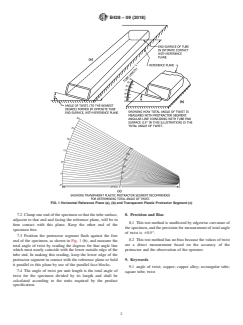
5.1 Horizontal Reference Plane (see Fig. 1 (a) and (b)) of
ization established in the Decision on Principles for the
sufficient length to support the tube specimen and a clamping
Development of International Standards, Guides and Recom-
device to hold one end of the specimen against the reference
mendations issued by the World Trade Organization Technical
plane.
Barriers to Trade (TBT) Committee.
5.2 Transparent Plastic Protractor Segment engraved with
2. Referenced Documents
angle lines as shown in Fig. 1 (c).
2.1 ASTM Standards:
5.3 Parallel Face Blocks.
B846 Terminology for Copper and Copper Alloys
3. Terminology
6. Test Specimen
3.1 For definitions of terms related to copper and copper
6.1 The test specimen shall be cut to a minimum length of
alloys, refer to Terminology B846.
10 in. and a maximum length of 15 in.
4. Significance and Use
7. Procedure
4.1 The rectangular or square copper alloy tube covered by
this test method may be used in applications in which control 7.1 Place the tube specimen lengthwise on the reference
of twist is important to proper fit in final assembly and to
plane. Whenever the specimen has noticeable edgewise
curvature, place the specimen so that a side having convex
curvature is in contact with the reference plane. Further
This test method is under the jurisdiction ofASTM Committee B05 on Copper
placement requirements are as follows:
and Copper Alloys and is the direct responsibility of Subcommittee B05.06 on
Methods of Test.
7.1.1 For rectangular tube, place a major outer dimension
Current edit
...