

ASTM B1003-16(2023)
(Specification)Standard Specification for Seamless Copper Tube for Linesets
General Information
- Abstract
ABSTRACT
This specification applies to seamless copper tube for linesets intended for use in air conditioning units. The pressure rating established is 700 psi at 250 °F and incorporates fully annealed and brazed copper tubing.
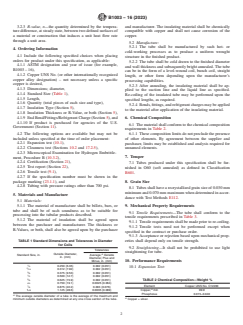
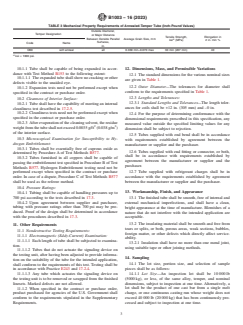
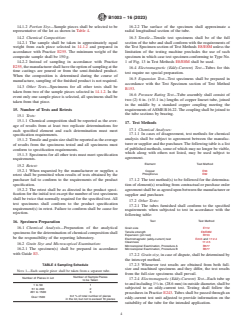
SCOPE
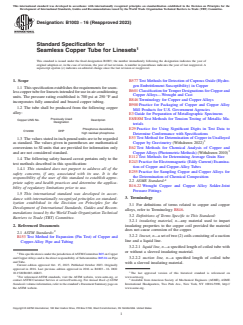
1.1 This specification establishes the requirements for seamless copper tube for linesets intended for use in air conditioning units. The pressure rating established is 700 psi at 250 °F and incorporates fully annealed and brazed copper tubing.
1.2 The tube shall be produced from the following copper alloy:
Copper UNS No.
Previously Used
Designation
Description
C12200
DHP
Phosphorus deoxidized,
high residual phosphorus
1.3 The values stated in inch-pound units are to be regarded as standard. The values given in parentheses are mathematical conversions to SI units that are provided for information only and are not considered standard.
1.4 The following safety hazard caveat pertains only to the test methods described in this specification:
1.4.1 This standard does not purport to address all of the safety concerns, if any, associated with its use. It is the responsibility of the user of this standard to establish appropriate safety and health practices and determine the applicability of regulatory limitations prior to use.
1.5 This international standard was developed in accordance with internationally recognized principles on standardization established in the Decision on Principles for the Development of International Standards, Guides and Recommendations issued by the World Trade Organization Technical Barriers to Trade (TBT) Committee.
- Status
- Published
- Publication Date
- 14-Oct-2023
- Technical Committee
- B05 - Copper and Copper Alloys
- Drafting Committee
- B05.04 - Pipe and Tube
Overview
ASTM B1003-16(2023), titled Standard Specification for Seamless Copper Tube for Linesets, establishes requirements for seamless copper tubes specifically designed for use in air conditioning unit linesets. Developed by ASTM International, this standard details the necessary material, manufacturing, and testing requirements to ensure copper tube products deliver consistent performance, reliability, and safety. The specification supports a pressure rating of 700 psi at 250 °F and mandates the use of fully annealed and brazed copper tubing, making it ideal for high-performance HVAC applications.
Key Topics
- Material Requirements: The standard specifies copper tubes manufactured from the C12200 alloy, known as phosphorus deoxidized, high residual phosphorus copper, ensuring optimal corrosion resistance and mechanical properties.
- Physical Properties: Tubes must meet precise dimensional tolerances and mechanical properties, including tensile strength and elongation, guaranteeing durability under specified working pressures.
- Manufacturing Process: Tubes must be cold drawn to the finished size and then bright annealed. Manufacturers may provide tubes as coils, straight lengths, or other suitable forms.
- Insulation: Requirements for applied insulating materials are outlined, including compatibility with copper and agreed R-values or thickness for enhanced thermal efficiency.
- Testing and Quality Assurance: The standard covers test methods for expansion, interior cleanness, hydrogen embrittlement, tensile properties, and eddy-current examination, ensuring product integrity and compliance.
- Marking and Packaging: Clear guidelines are provided for product identification, package marking, and packaging to protect products during shipping and storage.
Applications
- HVAC Systems: The seamless copper tubes defined by ASTM B1003 are specifically engineered for use in air conditioning units, making them essential components for both residential and commercial HVAC linesets.
- Refrigeration: The high pressure and temperature ratings also make these tubes suitable in certain refrigeration applications requiring reliable copper lines.
- Construction and Building Services: Their robust mechanical properties and corrosion resistance benefit construction projects that demand long-lasting pipeline materials.
- Field Replacement and Servicing: The specification supports field service applications where replacement or repair of linesets is needed, ensuring compatibility and performance with existing systems.
Using ASTM B1003-16(2023) compliant seamless copper tubes provides assurance of consistent quality, safety, and performance in demanding environments. HVAC professionals, engineers, and contractors benefit from predictable installation and service outcomes, reducing the risk of failure and unplanned downtime.
Related Standards
- ASTM B153 - Expansion (Pin Test) for Copper and Copper Alloys
- ASTM B601 - Temper Designations for Copper and Copper Alloys
- ASTM B846 - Terminology for Copper and Copper Alloys
- ASTM E3 - Metallographic Specimen Preparation
- ASTM E8/E8M - Tension Testing of Metallic Materials
- ASTM E112 - Grain Size Determination
- ASTM E243 - Electromagnetic (Eddy Current) Examination of Copper Tubes
- ASME B16.22 - Wrought Copper and Copper Alloy Solder-Joint Pressure Fittings
These referenced standards provide additional guidance on specific test methods, terminology, material classifications, and fitting compatibility, ensuring seamless integration and comprehensive quality control within the HVAC and refrigeration industries.
Keywords: ASTM B1003, seamless copper tube, linesets, air conditioning, HVAC, refrigeration, C12200, high pressure copper tubing, copper lineset specification, copper tube standard, annealed copper tube.
Relations
- Effective Date
- 15-Oct-2023
- Effective Date
- 01-Jan-2024
- Effective Date
- 01-May-2022
Get Certified
Connect with accredited certification bodies for this standard

Institut za varilstvo d.o.o. (Welding Institute)
Slovenia's leading welding institute since 1952. ISO 3834, EN 1090, pressure equipment certification, NDT personnel, welder qualification. Only IIW Au
Sponsored listings
Frequently Asked Questions
ASTM B1003-16(2023) is a technical specification published by ASTM International. Its full title is "Standard Specification for Seamless Copper Tube for Linesets". This standard covers: ABSTRACT This specification applies to seamless copper tube for linesets intended for use in air conditioning units. The pressure rating established is 700 psi at 250 °F and incorporates fully annealed and brazed copper tubing. SCOPE 1.1 This specification establishes the requirements for seamless copper tube for linesets intended for use in air conditioning units. The pressure rating established is 700 psi at 250 °F and incorporates fully annealed and brazed copper tubing. 1.2 The tube shall be produced from the following copper alloy: Copper UNS No. Previously Used Designation Description C12200 DHP Phosphorus deoxidized, high residual phosphorus 1.3 The values stated in inch-pound units are to be regarded as standard. The values given in parentheses are mathematical conversions to SI units that are provided for information only and are not considered standard. 1.4 The following safety hazard caveat pertains only to the test methods described in this specification: 1.4.1 This standard does not purport to address all of the safety concerns, if any, associated with its use. It is the responsibility of the user of this standard to establish appropriate safety and health practices and determine the applicability of regulatory limitations prior to use. 1.5 This international standard was developed in accordance with internationally recognized principles on standardization established in the Decision on Principles for the Development of International Standards, Guides and Recommendations issued by the World Trade Organization Technical Barriers to Trade (TBT) Committee.
ABSTRACT This specification applies to seamless copper tube for linesets intended for use in air conditioning units. The pressure rating established is 700 psi at 250 °F and incorporates fully annealed and brazed copper tubing. SCOPE 1.1 This specification establishes the requirements for seamless copper tube for linesets intended for use in air conditioning units. The pressure rating established is 700 psi at 250 °F and incorporates fully annealed and brazed copper tubing. 1.2 The tube shall be produced from the following copper alloy: Copper UNS No. Previously Used Designation Description C12200 DHP Phosphorus deoxidized, high residual phosphorus 1.3 The values stated in inch-pound units are to be regarded as standard. The values given in parentheses are mathematical conversions to SI units that are provided for information only and are not considered standard. 1.4 The following safety hazard caveat pertains only to the test methods described in this specification: 1.4.1 This standard does not purport to address all of the safety concerns, if any, associated with its use. It is the responsibility of the user of this standard to establish appropriate safety and health practices and determine the applicability of regulatory limitations prior to use. 1.5 This international standard was developed in accordance with internationally recognized principles on standardization established in the Decision on Principles for the Development of International Standards, Guides and Recommendations issued by the World Trade Organization Technical Barriers to Trade (TBT) Committee.
ASTM B1003-16(2023) is classified under the following ICS (International Classification for Standards) categories: 23.040.15 - Non-ferrous metal pipes. The ICS classification helps identify the subject area and facilitates finding related standards.
ASTM B1003-16(2023) has the following relationships with other standards: It is inter standard links to ASTM B1003-16, ASTM E8/E8M-24, ASTM E8/E8M-22. Understanding these relationships helps ensure you are using the most current and applicable version of the standard.
ASTM B1003-16(2023) is available in PDF format for immediate download after purchase. The document can be added to your cart and obtained through the secure checkout process. Digital delivery ensures instant access to the complete standard document.
Standards Content (Sample)
This international standard was developed in accordance with internationally recognized principles on standardization established in the Decision on Principles for the
Development of International Standards, Guides and Recommendations issued by the World Trade Organization Technical Barriers to Trade (TBT) Committee.
Designation: B1003 − 16 (Reapproved 2023)
Standard Specification for
Seamless Copper Tube for Linesets
This standard is issued under the fixed designation B1003; the number immediately following the designation indicates the year of
original adoption or, in the case of revision, the year of last revision. A number in parentheses indicates the year of last reapproval. A
superscript epsilon (´) indicates an editorial change since the last revision or reapproval.
1. Scope B577 Test Methods for Detection of Cuprous Oxide (Hydro-
gen Embrittlement Susceptibility) in Copper
1.1 This specification establishes the requirements for seam-
B601 Classification for Temper Designations for Copper and
less copper tube for linesets intended for use in air conditioning
Copper Alloys—Wrought and Cast
units. The pressure rating established is 700 psi at 250 °F and
B846 Terminology for Copper and Copper Alloys
incorporates fully annealed and brazed copper tubing.
B900 Practice for Packaging of Copper and Copper Alloy
1.2 The tube shall be produced from the following copper
Mill Products for U.S. Government Agencies
alloy:
E3 Guide for Preparation of Metallographic Specimens
Previously Used
E8/E8M Test Methods for Tension Testing of Metallic Ma-
Copper UNS No. Description
Designation
terials
E29 Practice for Using Significant Digits in Test Data to
Phosphorus deoxidized,
C12200 DHP
high residual phosphorus
Determine Conformance with Specifications
1.3 The values stated in inch-pound units are to be regarded E53 Test Method for Determination of Copper in Unalloyed
Copper by Gravimetry (Withdrawn 2022)
as standard. The values given in parentheses are mathematical
conversions to SI units that are provided for information only E62 Test Methods for Chemical Analysis of Copper and
Copper Alloys (Photometric Methods) (Withdrawn 2010)
and are not considered standard.
E112 Test Methods for Determining Average Grain Size
1.4 The following safety hazard caveat pertains only to the
E243 Practice for Electromagnetic (Eddy Current) Examina-
test methods described in this specification:
tion of Copper and Copper-Alloy Tubes
1.4.1 This standard does not purport to address all of the
E255 Practice for Sampling Copper and Copper Alloys for
safety concerns, if any, associated with its use. It is the
the Determination of Chemical Composition
responsibility of the user of this standard to establish appro-
2.2 ASME Standard:
priate safety and health practices and determine the applica-
B16.22 Wrought Copper and Copper Alloy Solder-Joint
bility of regulatory limitations prior to use.
Pressure Fittings
1.5 This international standard was developed in accor-
3. Terminology
dance with internationally recognized principles on standard-
ization established in the Decision on Principles for the
3.1 For definitions of terms related to copper and copper
Development of International Standards, Guides and Recom-
alloys, refer to Terminology B846.
mendations issued by the World Trade Organization Technical
3.2 Definitions of Terms Specific to This Standard:
Barriers to Trade (TBT) Committee.
3.2.1 insulating material, n—any material used to impart
insulating properties to the copper coil provided the material
2. Referenced Documents
does not cause corrosion of the copper.
2.1 ASTM Standards:
3.2.2 lineset, n—a set of two (2) coils consisting of a suction
B153 Test Method for Expansion (Pin Test) of Copper and
line and a liquid line.
Copper-Alloy Pipe and Tubing
3.2.2.1 liquid line, n—a specified length of coiled tube with
or without a sleeved insulating material.
This specification is under the jurisdiction of ASTM Committee B05 on Copper
and Copper Alloys and is the direct responsibility of Subcommittee B05.04 on Pipe 3.2.2.2 suction line, n—a specified length of coiled tube
and Tube.
with a sleeved insulating material.
Current edition approved Oct. 15, 2023. Published October 2023. Originally
approved in 2016. Last previous edition approved in 2016 as B1003 – 16. DOI:
10.1520/B1003-16R23. The last approved version of this historical standard is referenced on
For referenced ASTM standards, visit the ASTM website, www.astm.org, or www.astm.org.
contact ASTM Customer Service at service@astm.org. For Annual Book of ASTM Available from American Society of Mechanical Engineers (ASME), ASME
Standards volume information, refer to the standard’s Document Summary page on International Headquarters, Two Park Ave., New York, NY 10016-5990, http://
the ASTM website. www.asme.org.
Copyright © ASTM International, 100 Barr Harbor Drive, PO Box C700, West Conshohocken, PA 19428-2959. United States
B1003 − 16 (2023)
3.2.3 R-value, n—the quantity determined by the tempera- and manufacturer. The insulating material shall be chemically
ture difference, at steady state, between two defined surfaces of compatible with copper and shall not cause corrosion of the
a material or construction that induces a unit heat flow rate copper.
through a unit area.
5.2 Manufacture:
5.2.1 The tube shall be manufactured by such hot- or
4. Ordering Information
cold-working processes as to produce a uniform wrought
4.1 Include the following specified choices when placing
structure in the finished product.
orders for product under this specification, as applicable:
5.2.2 The tube shall be cold drawn to the finished diameter
4.1.1 ASTM designation and year of issue (for example,
and wall thickness and subsequently bright annealed. The tube
B1003 – 16),
can be in the form of a level-wound coil, bunch coil, straight
4.1.2 Copper UNS No. (or other internationally recognized
length, or other form depending upon the manufacturer’s
copper alloy designation) – not necessary unless a specific
processing capabilities.
copper is desired,
5.2.3 After annealing, the insulating material shall be ap-
4.1.3 Dimensions; diameter,
plied to the suction line and the liquid line as specified.
4.1.4 Standard Size (Table 1),
Re-coiling of the insulated tube may be performed upon the
4.1.5 Length,
specified lengths, as required.
4.1.6 Quantity (total pieces of each size and type),
5.2.4 Bends, fittings, and refrigerant charges may be applied
4.1.7 Insulation Type (Section 5),
to the material after application of the insulating material.
4.1.8 Insulation Thickness or R-Value, or both (Section 5),
4.1.9 End Bend/Fittings/Refrigerant Charge (Section 5), and
6. Chemical Composition
4.1.10 If product is purchased for agencies of the U.S.
6.1 The material shall conform to the chemical composition
Government (Section 11).
requirements in Table 2.
4.2 The following options are available but may not be 6.1.1 These composition limits do not preclude the presence
included unless specified at the time of order placement:
of other elements. By agreement between the supplier and
4.2.1 Expansion test (10.1), purchaser, limits may be established and analysis required for
4.2.2 Cleanness test (Sections 10.2 and 17.2.5),
unnamed elements.
4.2.3 Microscopical Examination for Hydrogen Embrittle-
7. Temper
ment, Procedure B (10.3.2),
4.2.4 Certification (Section 21),
7.1 Tubes produced under this specification shall be fur-
4.2.5 Test report (Section 22),
nished in O60 (soft annealed) as defined in Classification
4.2.6 Tensile test (9.1),
B601.
4.2.7 If the specification number must be shown in the
package marking (23.1.1), and 8. Grain Size
4.2.8 Tubing with pressure ratings other than 700 psi.
8.1 Tubes shall have a recrystallized grain size of 0.030 mm
minimum and 0.070 mm maximum when determined in accor-
5. Materials and Manufacture
dance with Test Methods E112.
5.1 Materials:
5.1.1 The material of manufacture shall be billets, bars, or
9. Mechanical Property Requirements
tube and shall be of such soundness as to be suitable for
9.1 Tensile Requirements—The tube shall conform to the
processing into the tubular products described.
tensile requirements prescribed in Table 3.
5.1.2 The material of insulation shall be agreed upon
9.1.1 Tensile requirements shall be made prior to re-coiling.
between the purchaser and manufacturer. The thickness or
9.1.2 Tensile tests need not be performed except when
R-Values, or both, shall also be agreed upon by the purchaser
specified in the contract or purchase order.
9.1.3 Acceptance or rejection based upon mechanical prop-
TABLE 1 Standard Dimensions and Tolerances in Diameter
erties shall depend only on tensile strength.
for Coils
9.2 Straightening—It shall not be prohibited to use light
Tolerances
straightening for tube.
Outside Diameter, A
Average, Outside
Standard Size, in.
in. (mm)
Diameter, Plus and
Minus, in. (mm)
10. Performance Requirements
⁄4 0.250 (6.35) 0.002 (0.051)
10.1 Expansion Test:
⁄16 0.312 (7.92) 0.002 (0.051)
⁄8 0.375 (9.53) 0.002 (0.051)
⁄2 0.500 (12.7) 0.002 (0.051)
⁄8 0.625 (15.9) 0.002 (0.051)
TABLE 2 Chemical Composition—Weight %
⁄4 0.750 (19.1) 0.0025 (0.064)
Element Copper UNS No. C12200
⁄8 0.875 (22.2) 0.003 (0.076)
A
1 ⁄8 1.125 (28.6) 0.0035 (0.089) Copper, min 99.9
Phosphorus 0.015–0.040
A
The average outside diameter of a tube is the average of the maximum and
A
minimum outside diameters as determined at any one cross section of the tube. Copper + silver.
B1003 − 16 (2023)
TABLE 3 Mechanical Property Requirements of Annealed-Temper Tube (Inch-Pound Values)
Outside Diameter,
Temper Designation
or Major Distance
Tensile Strength, Elongation in
Between Outside Parallel Average Grain Size, mm
A
ksi (MPa) 2 in. min %
Surfaces,
Code Name
in.
O60 soft anneal all 0.030 min–0.070 max 30 min (207 min) 40
A
ksi = 1000 psi.
10.1.1 Tube shall be capable of being expanded in accor- 12. Dimensions, Mass, and Permissible Variations
dance with Test Method B153 to the following extent:
12.1 The standard dimensions for the various nominal sizes
10.1.1.1 The expanded tube shall show no cracking or other
are given in Table 1.
defects visible to the unaided eye.
12.2 Outer Diameter—The tolerances for diameter shall
10.1.2 Expansion tests need not be performed except when
conform to the requirements specified in Table 1.
specified in the contract or purchase order.
12.3 Lengths and Tolerances:
10.2 Cleanness of Interior Surface:
12.3.1 Standard Lengths and Tolerances—The length toler-
10.2.1 Tube shall have the capability of meeting an internal
ances for coils shall be +12 in. (305 mm) and –0 in.
cleanliness test described in 17.2.5.
10.2.2 Cleanliness tests need not be performed except when
12.4 For the purpose of determining conformance with the
specified in the contract or purchase order.
dimensional requirements prescribed in this specification, any
10.2.3 After evaporation of the cleaning solvent, the residue
measured value outside the specified limiting values for any
2 2
weight from the tube shall not exceed 0.0035 g/ft (0.038 g/m )
dimension shall be subject to rejection.
of the interior surface.
12.5 Tubes supplied with end bend shall be in accordance
10.3 Microscopical Examination for Susceptibility to Hy-
with requirements established by agreement between the
drogen Embrittlement:
manufacturer or supplier and the purchaser.
10.3.1 Tubes shall be essentially free of cuprous oxide as
12.6 Tubes supplied with end fitting or connector, or both,
determined by Procedure A of Test Methods B577.
shall be in accordance with requirements established by
10.3.2 Tubes furnished in all coppers shall be capable of
agreement between the manufacturer or supplier and the
passing the embrittlement test specified in Procedure B of Test
purchaser.
Methods B577. Hydrogen Embrittlement testing need not be
performed except when specified in the contract or purchase 12.7 Tube supplied with refrigerant charges shall be in
order. In case of a dispute, Procedure C of Test Methods B577 accordance with the requirements established by agreement
shall be used as the referee method. between the manufacturer or supplier and the purchaser.
10.4 Pressure Ratings:
13. Workmanship, Finish, and Appearance
10.4.1 Tubing shall be capable of handling pressures up to
700 psi according to the tests described in 17.3.
13.1 The finished tube shall be smooth, free of internal and
10.4.2 Upon agreement between supplier and purchaser,
external mechanical imperfections, and shall have a clean,
tubing with pressure ratings other than 700 psi may be pro-
bright appearance at the time of manufacture. Blemishes of a
duced. Proof of the design shall be determined in accordance
nature that do not interfere with the intended application are
with the procedures described in 17.3.
acceptable.
13.2 The insulating material shall be smooth and free from
11. Other Requirements
tears or splits, or both, porous areas, weak sections, bubbles,
11.1 Nondestructive Testing Requirements:
foreign matter, or other defects which directly affect service-
11.1.1 Electromagnetic (Eddy-Current) Examination:
ability.
11.1.1.1 Each length of tube shall be subjected to examina-
13.2.1 Insulation shall have no more than one mend joint,
tion.
using suitable tape or other joining methods.
11.1.1.2 Tubes that do not actuate the signaling device on
the testing unit, after having been adjusted to provide informa-
14. Sampling
tion on the suitability of the tube for the intended application,
shall conform to the requirements of this test. Testing shall be 14.1 The lot size, portion size, and selection of sample
pieces shall be as follows:
in accordance with Practice E243 and 17.2.4.
11.1.1.3 Any tube which actuates the signaling device on 14.1.1 Lot Size—An inspection lot shall be 10 000 lb
the testing unit is to be removed or scrapped from the finished (5000 kg), or less, of the same alloy, temper, and nominal
linesets. Marked defects are not allowed. dimensions, subject to inspection at one time. Alternatively, a
11.1.2 When specified in the contract or purchase order, lot shall be the product of one cast bar from a single melt
product purchased for agencies of the U.S. Government shall charge, or one continuous casting run whose weight does not
conform to the requirements stipulated in the Supplementary exceed 40 000 lb (20 000 kg) that has been continuously pro-
Requirements. cessed and subject to inspection at one time.
B1003 − 16 (2023)
14.1.2 Portion Size—Sample pieces shall be selected to be 16.2.2 The surface of the specimen shall approximate a
representative of the lot as shown in Table 4. radial longitudinal section of the tube.
14.2 Chemical Composition: 16.3 Tensile—Tensile test specimens shall be of the full
14.2.1 The sample shall be taken in approximately equal section of the tube and shall conform with the requirements of
weight from each piece selected in 14.1.2 and prepared in the Test Specimen section of Test Methods E8/E8M unless the
accordance with Practice E255. The minimum weight of the limitation of the testing machine precludes the use of such
composite sample shall be 150 g. specimen in which case test specimen conforming to Type No.
14.2.2 Instead of sampling in accordance with Practice 1 of Fig. 13 in Test Methods E8/E8M shall be used.
E255, the manufacturer shall have the option of sampling at the
16.4 Electromagnetic (Eddy-Current) Test—Tubes for this
time castings are poured or from the semi-finished product.
test require no special preparation.
When the composition is determined during the course of
16.5 Expansion Test—Test specimens shall be prepared in
manufacture, sampling of the finished product is not required.
accordance with the Test Specimen section of Test Method
14.3 Other Tests—Specimens for all other tests shall be
B153.
taken from two of the sample pieces selected in 14.1.2. In the
16.6 Pressure Rating Test—Tube assembly shall consist of
event only one sample piece is selected, all specimens shall be
two (2) 6 in. (+3/-1 in.) lengths of copper lineset tube, joined
taken from that piece.
in the middle by a standard copper coupling meeting the
15. Number of Tests and Retests requirements of ASME B16.22. The coupling shall be joined to
the tube sections by brazing.
15.1 Tests:
15.1.1 Chemical composition shall be reported as the aver-
17. Test Methods
age of results from at least two replicate determinations for
17.1 Chemical Analyses:
each specified element and each determination must meet
17.1.1 In cases of disagreement, test methods for chemical
specification requirements.
analysis shall be subject to agreement between the manufac-
15.1.2 Tensile and grain size shall be reported as the average
turer or supplier and the purchaser. The following table is a list
of results from the spe
...