

ASTM D7796-21
(Test Method)Standard Test Method for Analysis of Ethyl tert-Butyl Ether (ETBE) by Gas Chromatography
General Information
- Abstract
SIGNIFICANCE AND USE
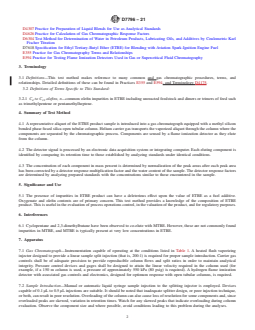
5.1 The presence of impurities in ETBE product can have a deleterious effect upon the value of ETBE as a fuel additive. Oxygenate and olefin contents are of primary concern. This test method provides a knowledge of the composition of ETBE product. This is useful in the evaluation of process operations control, in the valuation of the product, and for regulatory purposes.
SCOPE
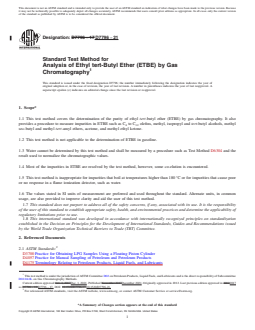
1.1 This test method covers the determination of the purity of ethyl tert-butyl ether (ETBE) by gas chromatography. It also provides a procedure to measure impurities in ETBE such as C4 to C12 olefins, methyl, isopropyl and tert-butyl alcohols, methyl sec-butyl and methyl tert-amyl ethers, acetone, and methyl ethyl ketone.
1.2 This test method is not applicable to the determination of ETBE in gasoline.
1.3 Water cannot be determined by this test method and shall be measured by a procedure such as Test Method D6304 and the result used to normalize the chromatographic values.
1.4 Most of the impurities in ETBE are resolved by the test method, however, some co-elution is encountered.
1.5 This test method is inappropriate for impurities that boil at temperatures higher than 180 °C or for impurities that cause poor or no response in a flame ionization detector, such as water.
1.6 The values stated in SI units of measurement are preferred and used throughout the standard. Alternate units, in common usage, are also provided to improve clarity and aid the user of this test method.
1.7 This standard does not purport to address all of the safety concerns, if any, associated with its use. It is the responsibility of the user of this standard to establish appropriate safety, health, and environmental practices and determine the applicability of regulatory limitations prior to use.
1.8 This international standard was developed in accordance with internationally recognized principles on standardization established in the Decision on Principles for the Development of International Standards, Guides and Recommendations issued by the World Trade Organization Technical Barriers to Trade (TBT) Committee.
- Status
- Published
- Publication Date
- 30-Nov-2021
- Technical Committee
- D02 - Petroleum Products, Liquid Fuels, and Lubricants
- Drafting Committee
- D02.04.0L - Gas Chromatography Methods
Buy Documents
ASTM D7796-21 - Standard Test Method for Analysis of Ethyl tert-Butyl Ether (ETBE) by Gas Chromatography
REDLINE ASTM D7796-21 - Standard Test Method for Analysis of Ethyl tert-Butyl Ether (ETBE) by Gas Chromatography
Overview
ASTM D7796-21: Standard Test Method for Analysis of Ethyl tert-Butyl Ether (ETBE) by Gas Chromatography is an internationally recognized method developed by ASTM for determining the purity and composition of ETBE. This standard is essential for laboratories and industry professionals seeking reliable and reproducible results when testing the purity of ETBE and quantifying the presence of impurities such as olefins, alcohols, ethers, acetone, and methyl ethyl ketone. Ensuring the quality and correct composition of ETBE is critical, as impurities can negatively impact its value and effectiveness as a fuel additive.
Key Topics
- Purpose: Quantitative determination of ETBE purity and identification of impurities using gas chromatography.
- Impurity Measurement: Measures C4 to C12 olefins, methyl, isopropyl and tert-butyl alcohols, methyl sec-butyl and methyl tert-amyl ethers, acetone, and methyl ethyl ketone in ETBE samples.
- Applicability: Not suitable for determining ETBE content in gasoline. Water cannot be measured with this method and should be determined separately (e.g., ASTM D6304).
- Limitations:
- Not appropriate for impurities that boil above 180°C.
- Ineffective for substances with poor or no response in a flame ionization detector, such as water.
- Procedural Details:
- Involves the use of a gas chromatograph equipped with specific columns and detection systems.
- Requires calibration with certified standards and careful consideration of resolution and response factors.
- SI units are the preferred measurement standard.
Applications
ASTM D7796-21 is widely used in the petroleum and chemical industries, particularly by:
- Fuel Additive Producers: Guaranteeing the ETBE's composition meets regulatory and performance criteria before use in blending or distribution.
- Quality Control Laboratories: Routine analysis to assess production consistency and detect process-related impurities that can affect fuel quality.
- Regulatory and Environmental Compliance: Generating data required for meeting environmental regulations regarding oxygenates in fuels.
- Process Optimization: Identifying sources of impurities aids in refining and optimizing production processes for ETBE.
The method provides critical information for decision-making in product valuation, operational control, and adherence to legal specifications for fuels.
Related Standards
For broader context and enhanced analytical capabilities, the following ASTM standards are commonly referenced with D7796-21:
- ASTM D3700: Practice for Obtaining LPG Samples Using a Floating Piston Cylinder
- ASTM D4057: Practice for Manual Sampling of Petroleum and Petroleum Products
- ASTM D4175: Terminology Relating to Petroleum Products, Liquid Fuels, and Lubricants
- ASTM D4307: Practice for Preparation of Liquid Blends for Use as Analytical Standards
- ASTM D4626: Practice for Calculation of Gas Chromatographic Response Factors
- ASTM D6304: Test Method for Determination of Water in Petroleum Products, Lubricating Oils, and Additives by Coulometric Karl Fischer Titration
- ASTM D7618: Specification for Ethyl Tertiary-Butyl Ether (ETBE) for Blending with Aviation Spark-Ignition Engine Fuel
- ASTM E355 & E594: Practices for Gas Chromatography Terms and Flame Ionization Detector Testing
Conclusion
Adoption of ASTM D7796-21 ensures accurate, consistent assessment of ETBE purity and impurities, supporting compliance, operational excellence, and product quality in the fuel industry. Reliable data generated through this test method are crucial for both internal quality assurance and external regulatory reporting. For the most effective control of ETBE product quality, this standard should be used alongside related ASTM procedures and best laboratory practices.
Relations
- Refers
ASTM D4175-23a - Standard Terminology Relating to Petroleum Products, Liquid Fuels, and Lubricants - Effective Date
- 15-Dec-2023
- Effective Date
- 01-Oct-2023
- Refers
ASTM D4175-23e1 - Standard Terminology Relating to Petroleum Products, Liquid Fuels, and Lubricants - Effective Date
- 01-Jul-2023
- Refers
ASTM D4626-95(2019) - Standard Practice for Calculation of Gas Chromatographic Response Factors - Effective Date
- 01-Dec-2019
- Effective Date
- 01-Sep-2019
- Effective Date
- 01-Oct-2015
- Effective Date
- 01-May-2013
- Effective Date
- 01-Nov-2012
- Effective Date
- 01-Nov-2011
- Refers
ASTM D4057-06(2011) - Standard Practice for Manual Sampling of Petroleum and Petroleum Products - Effective Date
- 01-Jun-2011
- Effective Date
- 01-May-2010
- Effective Date
- 01-May-2010
- Effective Date
- 15-Jul-2007
- Effective Date
- 01-Mar-2007
- Effective Date
- 15-Feb-2007
Buy Documents
ASTM D7796-21 - Standard Test Method for Analysis of Ethyl tert-Butyl Ether (ETBE) by Gas Chromatography
REDLINE ASTM D7796-21 - Standard Test Method for Analysis of Ethyl tert-Butyl Ether (ETBE) by Gas Chromatography
Get Certified
Connect with accredited certification bodies for this standard

ECOCERT
Organic and sustainability certification.

Element Materials Technology
Materials testing and product certification.

ABS Group Brazil
ABS Group certification services in Brazil.
Sponsored listings
Frequently Asked Questions
ASTM D7796-21 is a standard published by ASTM International. Its full title is "Standard Test Method for Analysis of Ethyl tert-Butyl Ether (ETBE) by Gas Chromatography". This standard covers: SIGNIFICANCE AND USE 5.1 The presence of impurities in ETBE product can have a deleterious effect upon the value of ETBE as a fuel additive. Oxygenate and olefin contents are of primary concern. This test method provides a knowledge of the composition of ETBE product. This is useful in the evaluation of process operations control, in the valuation of the product, and for regulatory purposes. SCOPE 1.1 This test method covers the determination of the purity of ethyl tert-butyl ether (ETBE) by gas chromatography. It also provides a procedure to measure impurities in ETBE such as C4 to C12 olefins, methyl, isopropyl and tert-butyl alcohols, methyl sec-butyl and methyl tert-amyl ethers, acetone, and methyl ethyl ketone. 1.2 This test method is not applicable to the determination of ETBE in gasoline. 1.3 Water cannot be determined by this test method and shall be measured by a procedure such as Test Method D6304 and the result used to normalize the chromatographic values. 1.4 Most of the impurities in ETBE are resolved by the test method, however, some co-elution is encountered. 1.5 This test method is inappropriate for impurities that boil at temperatures higher than 180 °C or for impurities that cause poor or no response in a flame ionization detector, such as water. 1.6 The values stated in SI units of measurement are preferred and used throughout the standard. Alternate units, in common usage, are also provided to improve clarity and aid the user of this test method. 1.7 This standard does not purport to address all of the safety concerns, if any, associated with its use. It is the responsibility of the user of this standard to establish appropriate safety, health, and environmental practices and determine the applicability of regulatory limitations prior to use. 1.8 This international standard was developed in accordance with internationally recognized principles on standardization established in the Decision on Principles for the Development of International Standards, Guides and Recommendations issued by the World Trade Organization Technical Barriers to Trade (TBT) Committee.
SIGNIFICANCE AND USE 5.1 The presence of impurities in ETBE product can have a deleterious effect upon the value of ETBE as a fuel additive. Oxygenate and olefin contents are of primary concern. This test method provides a knowledge of the composition of ETBE product. This is useful in the evaluation of process operations control, in the valuation of the product, and for regulatory purposes. SCOPE 1.1 This test method covers the determination of the purity of ethyl tert-butyl ether (ETBE) by gas chromatography. It also provides a procedure to measure impurities in ETBE such as C4 to C12 olefins, methyl, isopropyl and tert-butyl alcohols, methyl sec-butyl and methyl tert-amyl ethers, acetone, and methyl ethyl ketone. 1.2 This test method is not applicable to the determination of ETBE in gasoline. 1.3 Water cannot be determined by this test method and shall be measured by a procedure such as Test Method D6304 and the result used to normalize the chromatographic values. 1.4 Most of the impurities in ETBE are resolved by the test method, however, some co-elution is encountered. 1.5 This test method is inappropriate for impurities that boil at temperatures higher than 180 °C or for impurities that cause poor or no response in a flame ionization detector, such as water. 1.6 The values stated in SI units of measurement are preferred and used throughout the standard. Alternate units, in common usage, are also provided to improve clarity and aid the user of this test method. 1.7 This standard does not purport to address all of the safety concerns, if any, associated with its use. It is the responsibility of the user of this standard to establish appropriate safety, health, and environmental practices and determine the applicability of regulatory limitations prior to use. 1.8 This international standard was developed in accordance with internationally recognized principles on standardization established in the Decision on Principles for the Development of International Standards, Guides and Recommendations issued by the World Trade Organization Technical Barriers to Trade (TBT) Committee.
ASTM D7796-21 is classified under the following ICS (International Classification for Standards) categories: 71.080.60 - Alcohols. Ethers; 75.160.20 - Liquid fuels. The ICS classification helps identify the subject area and facilitates finding related standards.
ASTM D7796-21 has the following relationships with other standards: It is inter standard links to ASTM D4175-23a, ASTM D4626-23, ASTM D4175-23e1, ASTM D4626-95(2019), ASTM E594-96(2019), ASTM D4307-99(2015), ASTM D7618-13, ASTM D3700-12, ASTM E594-96(2011), ASTM D4057-06(2011), ASTM D4307-99(2010), ASTM D7618-10, ASTM D6304-07, ASTM E355-96(2007), ASTM D3700-07. Understanding these relationships helps ensure you are using the most current and applicable version of the standard.
ASTM D7796-21 is available in PDF format for immediate download after purchase. The document can be added to your cart and obtained through the secure checkout process. Digital delivery ensures instant access to the complete standard document.
Standards Content (Sample)
This international standard was developed in accordance with internationally recognized principles on standardization established in the Decision on Principles for the
Development of International Standards, Guides and Recommendations issued by the World Trade Organization Technical Barriers to Trade (TBT) Committee.
Designation: D7796 − 21
Standard Test Method for
Analysis of Ethyl tert-Butyl Ether (ETBE) by Gas
Chromatography
This standard is issued under the fixed designation D7796; the number immediately following the designation indicates the year of
original adoption or, in the case of revision, the year of last revision. A number in parentheses indicates the year of last reapproval. A
superscript epsilon (´) indicates an editorial change since the last revision or reapproval.
1. Scope* 2. Referenced Documents
2.1 ASTM Standards:
1.1 This test method covers the determination of the purity
ofethyl tert-butylether(ETBE)bygaschromatography.Italso D3700 Practice for Obtaining LPG Samples Using a Float-
ing Piston Cylinder
provides a procedure to measure impurities in ETBE such as
C to C olefins, methyl, isopropyl and tert-butyl alcohols, D4057 Practice for Manual Sampling of Petroleum and
4 12
Petroleum Products
methyl sec-butyl and methyl tert-amyl ethers, acetone, and
methyl ethyl ketone. D4175 Terminology Relating to Petroleum Products, Liquid
Fuels, and Lubricants
1.2 This test method is not applicable to the determination
D4307 Practice for Preparation of Liquid Blends for Use as
of ETBE in gasoline.
Analytical Standards
1.3 Water cannot be determined by this test method and
D4626 Practice for Calculation of Gas Chromatographic
shall be measured by a procedure such as Test Method D6304
Response Factors
and the result used to normalize the chromatographic values.
D6304 Test Method for Determination of Water in Petro-
leum Products, Lubricating Oils, and Additives by Cou-
1.4 Most of the impurities in ETBE are resolved by the test
lometric Karl Fischer Titration
method, however, some co-elution is encountered.
D7618 Specification for Ethyl Tertiary-Butyl Ether (ETBE)
1.5 This test method is inappropriate for impurities that boil
for Blending with Aviation Spark-Ignition Engine Fuel
at temperatures higher than 180 °C or for impurities that cause
E355 Practice for Gas Chromatography Terms and Relation-
poor or no response in a flame ionization detector, such as
ships
water.
E594 Practice for Testing Flame Ionization Detectors Used
1.6 The values stated in SI units of measurement are in Gas or Supercritical Fluid Chromatography
preferred and used throughout the standard. Alternate units, in
3. Terminology
commonusage,arealsoprovidedtoimproveclarityandaidthe
user of this test method.
3.1 Definitions—This test method makes reference to many
1.7 This standard does not purport to address all of the common and gas chromatographic procedures, terms, and
safety concerns, if any, associated with its use. It is the relationships. Detailed definitions of these can be found in
responsibility of the user of this standard to establish appro- Practices E355 and E594, and Terminology D4175.
priate safety, health, and environmental practices and deter-
3.2 Definitions of Terms Specific to This Standard:
mine the applicability of regulatory limitations prior to use.
3.2.1 C to C olefins, n—common olefin impurities in
4 12
1.8 This international standard was developed in accor-
ETBE including unreacted feedstock and dimers or trimers of
dance with internationally recognized principles on standard-
feed such as trimethylpentene or pentamethylheptene.
ization established in the Decision on Principles for the
Development of International Standards, Guides and Recom-
4. Summary of Test Method
mendations issued by the World Trade Organization Technical
4.1 Arepresentative aliquot of the ETBE product sample is
Barriers to Trade (TBT) Committee.
introduced into a gas chromatograph equipped with a methyl
silicon bonded phase fused silica open tubular column. Helium
carrier gas transports the vaporized aliquot through the column
This test method is under the jurisdiction of ASTM Committee D02 on
where the components are separated by the chromatographic
Petroleum Products, Liquid Fuels, and Lubricants and is the direct responsibility of
Subcommittee D02.04.0L on Gas Chromatography Methods.
Current edition approved Dec. 1, 2021. Published December 2021. Originally
approved in 2012. Last previous edition approved in 2017 as D7796 – 17. DOI: For referenced ASTM standards, visit the ASTM website, www.astm.org, or
10.1520/D7796-21. contact ASTM Customer Service at service@astm.org.
*A Summary of Changes section appears at the end of this standard
Copyright © ASTM International, 100 Barr Harbor Drive, PO Box C700, West Conshohocken, PA 19428-2959. United States
D7796 − 21
process. Components are sensed by a flame ionization detector pressure of approximately 550 kPa (80 psig) is required). A
as they elute from the column. hydrogenflameionizationdetectorwithassociatedgascontrols
and electronics, designed for optimum response with open
4.2 The detector signal is processed by an electronic data
tubular columns, is required.
acquisition system or integrating computer. Each eluting com-
ponent is identified by comparing its retention time to those 7.2 Sample Introduction—Manual or automatic liquid sy-
established by analyzing standards under identical conditions. ringe sample injection to the splitting injector is employed.
Devices capable of 0.1 µL to 0.5 µL injections are suitable. It
4.3 The concentration of each component in mass percent is
should be noted that inadequate splitter design, or poor
determined by normalization of the peak areas after each peak
injection technique, or both, can result in poor resolution.
area has been corrected by a detector response multiplication
Overloadingofthecolumncanalsocauselossofresolutionfor
factor and the water content of the sample. The detector
some components and, since overloaded peaks are skewed,
response factors are determined by analyzing prepared stan-
variation in retention times. Watch for any skewed peaks that
dards with the concentrations similar to those encountered in
indicate overloading during column evaluation. Observe the
the sample.
component size and where possible, avoid conditions leading
to this problem during the analyses.
5. Significance and Use
7.3 Open Tubular Column —This test method utilizes a
5.1 The presence of impurities in ETBE product can have a
fused silica open tubular column with non-polar methyl sili-
deleterious effect upon the value of ETBE as a fuel additive.
cone bonded (cross-linked) phase internal coating such as one
Oxygenateandolefincontentsareofprimaryconcern.Thistest
of the following:
method provides a knowledge of the composition of ETBE
product. This is useful in the evaluation of process operations Column length 50 m 100 m 150 m
Film thickness 0.5 µm 0.5 µm 1.0 µm
control, in the valuation of the product, and for regulatory
Internal diameter 0.20 mm 0.25 mm 0.25 mm
purposes.
Other columns with equal or greater resolving power may be
used. A minimum resolution between trans-2-pentene and
6. Interferences
tert-butanol, and between cis-2-pentene and tert-butanol of 1.3
6.1 Cyclopentane and 2,3-dimethylbutane have been ob-
is required. The 150 m column is expected to decrease the
served to co-elute with MTBE. However, these are not com-
likelihood of co-elution of impurities.
monly found impurities in MTBE, and MTBE is typically
7.4 Electronic Data Acquisition System—Any data acquisi-
present at very low concentrations in ETBE.
tion and integration device used for quantification of these
7. Apparatus analyses shall meet or exceed these minimum requirements:
7.4.1 Capacity for at least 50 peaks per analysis,
7.1 Gas Chromatograph—Instrumentation capable of oper-
7.4.2 Normalized area percent calculations with response
ating at the conditions listed in Table 1. A heated flash
factors,
vaporizing injector designed to provide a linear sample split
7.4.3 Identification of individual components based on re-
injection (that is, 200:1) is required for proper sample intro-
tention time,
duction. Carrier gas controls shall be of adequate precision to
7.4.4 Noise and spike rejection capability,
provide reproducible column flows and split ratios in order to
7.4.5 Sampling rate for fast (<1 s) peaks,
maintain analytical integrity. Pressure control devices and
7.4.6 Positive and negative sloping baseline correction,
gages shall be designed to attain the linear velocity required in
7.4.7 Peak detection sensitivity compensation for narrow
the column used (for example, if a 150 m column is used, a
and broad peaks, and
7.4.8 Non-resolved peaks separated by perpendicular drop
TABLE 1 Typical Operating Conditions or tangential skimming as needed.
Column Temperature Program
Column length 50 m 100 m 150 m
8. Reagents and Materials
Initial temperature 40 °C 50 °C 60 °C
8.1 Carrier Gas, helium, 99.99 % pure. (Warning—
Initial hold time 13 min 13 min 13 min
Program rate 10 °C ⁄min 10 °C ⁄min 10 °C ⁄min
Compressed gas under high pressure.)
Final temperature 180 °C 180 °C 180 °C
Final hold time 3 min 7 min 20 min
8.2 Fuel Gas, hydrogen, 99.99 % pure. (Warning—
Injector
Extremely flammable gas under pressure.)
Temperature 200 °C
Split ratio 200:1
8.3 Ethyl tert-Butyl Ether, 99.99 % pure. (Warning—
Sample size 0.1 µL to 0.5 µL
Flammable liquid. Harmful if inhaled.)
Detector
Type flame ionization
8.4 Oxidant, air, oil free. (Warning—Compressed gas un-
Temperature 250 °C
der high pressure.)
Fuel gas hydrogen ('30 mL ⁄min)
Oxidizing gas air ('300 mL ⁄min)
Make-up gas nitrogen ('30 mL/min)
Carrier Gas
Petrocol DH series columns from Supelco, Inc., Bellefonte, PA were used to
Type helium
Average linear velocity 20 cm ⁄s – 24 cm/s obtain the retention data and example chromatogram shown in this standard. Other
suitable columns are available commercially.
D7796 − 21
8.5 Make-Up Gas, nitrogen, 99.99 % pure. (Warning— 9.3 Transfer an aliquot of the cooled sample into a pre-
Compressed gas under high pressure.) cooled septum vial, then seal appropriately. Obtain the test
specimen for analysis directly from the sealed septum vial, for
8.6 Reference Standards:
either manual or automatic syringe injection.
8.6.1 tert-Amyl methyl ether.(Warning—Flammableliquid.
Harmful if inhaled.)
10. Preparation of Apparatus
8.6.2 Butane. (Warning—Flammable liquid. Harmful if
10.1 Install and condition column in accordance with manu-
inhaled.)
facturer’s or supplier’s instructions. After conditioning, attach
8.6.3 tert-Butanol. (Warning—Flammable liquid. Harmful
column outlet to flame ionization detector inlet and check for
if inhaled.)
leaks throughout the system. When leaks are found, tighten or
8.6.4 sec-Butyl methyl ether. (Warning—Flammable liquid.
replace fittings before proceeding.
Harmful if inhaled.)
8.6.5 4,4-Dimethyl-2-neopentyl-1-pentene. (Warning— 10.2 Adjust the carrier gas flow rate so that an average
Flammable liquid. Harmful if inhaled.) linear velocity at the starting temperature of the run is between
21 cm⁄s and 24 cm⁄s, as determined in Eq 1. Flow rate
8.6.6 Isobutylene. (Warning—Flammable liquid. Harmful
if inhaled.) adjustment is made by raising or lowering the carrier gas
pressure (head pressure) to the injector. The following starting
8.6.7 Methanol.(Warning—Toxicflammableliquid.Harm-
ful if inhaled or ingested.) point pressures can be useful to adjust the carrier gas flow:
8.6.8 2-Methyl-2-butene. (Warning—Flammable liquid.
Column length 50 m 100 m 150 m
Starting point pressure, 262 (38) 275 (40) 552 (80)
Harmful if inhaled.)
kPa (psig)
8.6.9 Methyl tert-butyl ether, 99+ % pure. (Warning—
10.2.1 Average Linear Gas Velocity:
Flammable liquid. Harmful if inhaled.)
8.6.10 2,2,4,6,6-Pentamethyl-3-heptene. (Warning— µ 5 L⁄t (1)
ave m
Flammable liquid. Harmful if inhaled.)
where:
8.6.11 n-Pentane. (Warning—Flammable liquid. Harmful
L = the length of the
...
This document is not an ASTM standard and is intended only to provide the user of an ASTM standard an indication of what changes have been made to the previous version. Because
it may not be technically possible to adequately depict all changes accurately, ASTM recommends that users consult prior editions as appropriate. In all cases only the current version
of the standard as published by ASTM is to be considered the official document.
Designation: D7796 − 17 D7796 − 21
Standard Test Method for
Analysis of Ethyl tert-Butyl Ether (ETBE) by Gas
Chromatography
This standard is issued under the fixed designation D7796; the number immediately following the designation indicates the year of
original adoption or, in the case of revision, the year of last revision. A number in parentheses indicates the year of last reapproval. A
superscript epsilon (´) indicates an editorial change since the last revision or reapproval.
1. Scope*
1.1 This test method covers the determination of the purity of ethyl tert-butyl ether (ETBE) by gas chromatography. It also
provides a procedure to measure impurities in ETBE such as C to C olefins, methyl, isopropyl and tert-butyl alcohols, methyl
4 12
sec-butyl and methyl tert-amyl ethers, acetone, and methyl ethyl ketone.
1.2 This test method is not applicable to the determination of ETBE in gasoline.
1.3 Water cannot be determined by this test method and shall be measured by a procedure such as Test Method D6304 and the
result used to normalize the chromatographic values.
1.4 Most of the impurities in ETBE are resolved by the test method, however, some co-elution is encountered.
1.5 This test method is inappropriate for impurities that boil at temperatures higher than 180 °C or for impurities that cause poor
or no response in a flame ionization detector, such as water.
1.6 The values stated in SI units of measurement are preferred and used throughout the standard. Alternate units, in common
usage, are also provided to improve clarity and aid the user of this test method.
1.7 This standard does not purport to address all of the safety concerns, if any, associated with its use. It is the responsibility
of the user of this standard to establish appropriate safety, health, and environmental practices and determine the applicability of
regulatory limitations prior to use.
1.8 This international standard was developed in accordance with internationally recognized principles on standardization
established in the Decision on Principles for the Development of International Standards, Guides and Recommendations issued
by the World Trade Organization Technical Barriers to Trade (TBT) Committee.
2. Referenced Documents
2.1 ASTM Standards:
D3700 Practice for Obtaining LPG Samples Using a Floating Piston Cylinder
D4057 Practice for Manual Sampling of Petroleum and Petroleum Products
D4175 Terminology Relating to Petroleum Products, Liquid Fuels, and Lubricants
This test method is under the jurisdiction of ASTM Committee D02 on Petroleum Products, Liquid Fuels, and Lubricants and is the direct responsibility of Subcommittee
D02.04.0L on Gas Chromatography Methods.
Current edition approved Oct. 1, 2017Dec. 1, 2021. Published November 2017December 2021. Originally approved in 2012. Last previous edition approved in 20122017
as D7796 – 12.D7796 – 17. DOI: 10.1520/D7796-17.10.1520/D7796-21.
For referenced ASTM standards, visit the ASTM website, www.astm.org, or contact ASTM Customer Service at service@astm.org.
*A Summary of Changes section appears at the end of this standard
Copyright © ASTM International, 100 Barr Harbor Drive, PO Box C700, West Conshohocken, PA 19428-2959. United States
D7796 − 21
D4307 Practice for Preparation of Liquid Blends for Use as Analytical Standards
D4626 Practice for Calculation of Gas Chromatographic Response Factors
D6304 Test Method for Determination of Water in Petroleum Products, Lubricating Oils, and Additives by Coulometric Karl
Fischer Titration
D7618 Specification for Ethyl Tertiary-Butyl Ether (ETBE) for Blending with Aviation Spark-Ignition Engine Fuel
E355 Practice for Gas Chromatography Terms and Relationships
E594 Practice for Testing Flame Ionization Detectors Used in Gas or Supercritical Fluid Chromatography
3. Terminology
3.1 Definitions—This test method makes reference to many common and gas chromatographic procedures, terms, and
relationships. Detailed definitions of these can be found in Practices E355 and E594, and Terminology D4175.
3.2 Definitions of Terms Specific to This Standard:
3.2.1 C to C olefins, n—common olefin impurities in ETBE including unreacted feedstock and dimers or trimers of feed such
4 12
as trimethylpentene or pentamethylheptene.
4. Summary of Test Method
4.1 A representative aliquot of the ETBE product sample is introduced into a gas chromatograph equipped with a methyl silicon
bonded phase fused silica open tubular column. Helium carrier gas transports the vaporized aliquot through the column where the
components are separated by the chromatographic process. Components are sensed by a flame ionization detector as they elute
from the column.
4.2 The detector signal is processed by an electronic data acquisition system or integrating computer. Each eluting component is
identified by comparing its retention time to those established by analyzing standards under identical conditions.
4.3 The concentration of each component in mass percent is determined by normalization of the peak areas after each peak area
has been corrected by a detector response multiplication factor and the water content of the sample. The detector response factors
are determined by analyzing prepared standards with the concentrations similar to those encountered in the sample.
5. Significance and Use
5.1 The presence of impurities in ETBE product can have a deleterious effect upon the value of ETBE as a fuel additive.
Oxygenate and olefin contents are of primary concern. This test method provides a knowledge of the composition of ETBE
product. This is useful in the evaluation of process operations control, in the valuation of the product, and for regulatory purposes.
6. Interferences
6.1 Cyclopentane and 2,3-dimethylbutane have been observed to co-elute with MTBE. However, these are not commonly found
impurities in MTBE, and MTBE is typically present at very low concentrations in ETBE.
7. Apparatus
7.1 Gas Chromatograph—Instrumentation capable of operating at the conditions listed in Table 1. A heated flash vaporizing
injector designed to provide a linear sample split injection (that is, 200:1) is required for proper sample introduction. Carrier gas
controls shall be of adequate precision to provide reproducible column flows and split ratios in order to maintain analytical
integrity. Pressure control devices and gages shall be designed to attain the linear velocity required in the column used (for
example, if a 150 m column is used, a pressure of approximately 550 kPa (80 psig) is required). A hydrogen flame ionization
detector with associated gas controls and electronics, designed for optimum response with open tubular columns, is required.
7.2 Sample Introduction—Manual or automatic liquid syringe sample injection to the splitting injector is employed. Devices
capable of 0.1 μL to 0.5 μL injections are suitable. It should be noted that inadequate splitter design, or poor injection technique,
or both, can result in poor resolution. Overloading of the column can also cause loss of resolution for some components and, since
overloaded peaks are skewed, variation in retention times. Watch for any skewed peaks that indicate overloading during column
evaluation. Observe the component size and where possible, avoid conditions leading to this problem during the analyses.
D7796 − 21
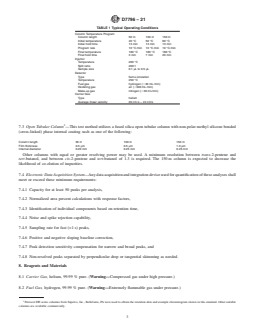
TABLE 1 Typical Operating Conditions
Column Temperature Program
Column length 50 m 100 m 150 m
Initial temperature 40 °C 50 °C 60 °C
Initial hold time 13 min 13 min 13 min
Program rate 10 °C ⁄min 10 °C ⁄min 10 °C ⁄min
Final temperature 180 °C 180 °C 180 °C
Final hold time 3 min 7 min 20 min
Injector
Temperature 200 °C
Split ratio 200:1
Sample size 0.1 μL to 0.5 μL
Detector
Type flame ionization
Temperature 250 °C
Fuel gas hydrogen ('30 mL ⁄min)
Oxidizing gas air ('300 mL ⁄min)
Make-up gas nitrogen ('30 mL/min)
Carrier Gas
Type helium
Average linear velocity 20 cm ⁄s – 24 cm/s
7.3 Open Tubular Column —This test method utilizes a fused silica open tubular column with non-polar methyl silicone bonded
(cross-linked) phase internal coating such as one of the following:
Column length 50 m 100 m 150 m
Film thickness 0.5 μm 0.5 μm 1.0 μm
Internal diameter 0.20 mm 0.25 mm 0.25 mm
Other columns with equal or greater resolving power may be used. A minimum resolution between trans-2-pentene and
tert-butanol, and between cis-2-pentene and tert-butanol of 1.3 is required. The 150 m column is expected to decrease the
likelihood of co-elution of impurities.
7.4 Electronic Data Acquisition System—Any data acquisition and integration device used for quantification of these analyses shall
meet or exceed these minimum requirements:
7.4.1 Capacity for at least 50 peaks per analysis,
7.4.2 Normalized area percent calculations with response factors,
7.4.3 Identification of individual components based on retention time,
7.4.4 Noise and spike rejection capability,
7.4.5 Sampling rate for fast (<1 s) peaks,
7.4.6 Positive and negative sloping baseline correction,
7.4.7 Peak detection sensitivity compensation for narrow and broad peaks, and
7.4.8 Non-resolved peaks separated by perpendicular drop or tangential skimming as needed.
8. Reagents and Materials
8.1 Carrier Gas, helium, 99.99 % pure. (Warning—Compressed gas under high pressure.)
8.2 Fuel Gas, hydrogen, 99.99 % pure. (Warning—Extremely flammable gas under pressure.)
Petrocol DH series columns from Supelco, Inc., Bellefonte, PA were used to obtain the retention data and example chromatogram shown in this standard. Other suitable
columns are available commercially.
D7796 − 21
8.3 Ethyl tert-Butyl Ether, 99.99 % pure. (Warning—Flammable liquid. Harmful if inhaled.)
8.4 Oxidant, air, oil free. (Warning—Compressed gas under high pressure.)
8.5 Make-Up Gas, nitrogen, 99.99 % pure. (Warning—Compressed gas under high pressure.)
8.6 Reference Standards:
8.6.1 tert-Amyl methyl ether. (Warning—Flammable liquid. Harmful if inhaled.)
8.6.2 Butane. (Warning—Flammable liquid. Harmful if inhaled.)
8.6.3 tert-Butanol. (Warning—Flammable liquid. Harmful if inhaled.)
8.6.4 sec-Butyl methyl ether. (Warning—Flammable liquid. Harmful if inhaled.)
8.6.5 4,4-Dimethyl-2-neopentyl-1-pentene. (Warning—Flammable liquid. Harmful if inhaled.)
8.6.6 Isobutylene. (Warning—Flammable liquid. Harmful if inhaled.)
8.6.7 Methanol. (Warning—Toxic flammable liquid. Harmful if inhaled or ingested.)
8.6.8 2-Methyl-2-butene. (Warning—Flammable liquid. Harmful if inhaled.)
8.6.9 Methyl tert-butyl ether, 99+ % pure. (Warning—Flammable liquid. Harmful if inhaled.)
8.6.10 2,2,4,6,6-Pentamethyl-3-heptene. (Warning—Flammable liquid. Harmful if inhaled.)
8.6.11 n-Pentane. (Warning—Flammable liquid. Harmful if inhaled.)
8.6.12 cis-2-Pentene. (Warning—Flammable liquid. Harmful if inhaled.)
8.6.13 trans-2-Pentene. (Warning—Flammable liquid. Harmful if inhaled.)
8.6.14 2,4,4-Trimethyl-1-pentene. (Warning—Flammable liquid. Harmful if inhaled.)
8.6.15 2,4,4-Trimethyl-2-pentene. (Warning—Flammable liquid. Harmful if inhaled.)
8.6.16 Dimethyl ether. (Warning—Extremely flammable gas. Harmful if inhaled.)
8.6.17 Diethyl ether. (Warning—Flammable liquid. Harmful if inhaled.)
8.6.18 2,2,4-Trimethylpentane. (Warning—Flammable liquid. Harmful if inhaled.)
8.6.19 Ethanol. (Warning—Flammable liquid.)
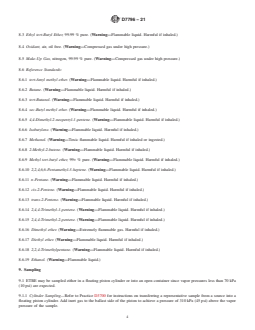
9. Sampling
9.1 ETBE may be sampled either in a floating piston cylinder or into an open container since vapor pressures less than 70 kPa
(10 psi) are expected.
9.1.1 Cylinder Sampling—Refer to Practice D3700 for instructions on transferring a representative sample from a source into a
floating piston cylinder. Add inert gas to the ballast side of the piston to achieve a pressure of 310 kPa (45 psi) above the vapor
pressure of the sample.
---------
...