

ASTM E594-96(2019)
(Practice)Standard Practice for Testing Flame Ionization Detectors Used in Gas or Supercritical Fluid Chromatography
General Information
- Abstract
SIGNIFICANCE AND USE
4.1 Although it is possible to observe and measure each of the several characteristics of a detector under different and unique conditions, it is the intent of this recommended practice that a complete set of detector specifications should be obtained at the same operating conditions, including geometry, flow rates, and temperatures. It should be noted that to specify a detector’s capability completely, its performance should be measured at several sets of conditions within the useful range of the detector. The terms and tests described in this recommended practice are sufficiently general so that they may be used at whatever conditions may be chosen for other reasons.
4.2 The FID is generally only used with non-ionizable supercritical fluids as the mobile phase. Therefore, this standard does not include the use of modifiers in the supercritical fluid.
4.3 Linearity and speed of response of the recording system or other data acquisition device used should be such that it does not distort or otherwise interfere with the performance of the detector. Effective recorder response, Bonsall (5) and McWilliam (6), in particular, should be sufficiently fast so that it can be neglected in sensitivity of measurements. If additional amplifiers are used between the detector and the final readout device, their characteristics should also first be established.
SCOPE
1.1 This practice covers the testing of the performance of a flame ionization detector (FID) used as the detection component of a gas or supercritical fluid (SF) chromatographic system.
1.2 This recommended practice is directly applicable to an FID that employs a hydrogen-air or hydrogen-oxygen flame burner and a dc biased electrode system.
1.3 This recommended practice covers the performance of the detector itself, independently of the chromatographic column, the column-to-detector interface (if any), and other system components, in terms that the analyst can use to predict overall system performance when the detector is made part of a complete chromatographic system.
1.4 For general gas chromatographic procedures, Practice E260 should be followed except where specific changes are recommended herein for the use of an FID. For definitions of gas chromatography and its various terms see recommended Practice E355.
1.5 For general information concerning the principles, construction, and operation of an FID, see Refs (1, 2, 3, 4).2
1.6 The values stated in SI units are to be regarded as standard. No other units of measurement are included in this standard.
1.7 This standard does not purport to address all of the safety concerns, if any, associated with its use. It is the responsibility of the user of this standard to establish appropriate safety, health, and environmental practices and determine the applicability of regulatory limitations prior to use. For specific safety information, see Section 5.
1.8 This international standard was developed in accordance with internationally recognized principles on standardization established in the Decision on Principles for the Development of International Standards, Guides and Recommendations issued by the World Trade Organization Technical Barriers to Trade (TBT) Committee.
- Status
- Published
- Publication Date
- 31-Aug-2019
- Technical Committee
- E13 - Molecular Spectroscopy and Separation Science
- Drafting Committee
- E13.19 - Separation Science
Overview
ASTM E594-96(2019): Standard Practice for Testing Flame Ionization Detectors Used in Gas or Supercritical Fluid Chromatography establishes a standardized methodology for evaluating the performance of flame ionization detectors (FID) within gas chromatography (GC) and supercritical fluid chromatography (SFC) systems. Developed by ASTM International, this standard ensures that FIDs are tested under controlled and consistent operating conditions, supporting accurate measurement of detector parameters such as sensitivity, linear range, noise, and minimum detectability.
FIDs are widely used for their excellent sensitivity and linear response towards hydrocarbons and are the detector of choice in many analytical and industrial laboratories utilizing GC or SFC. This practice is designed to be adaptable, allowing users to test FIDs at operational conditions relevant to their specific applications.
Key Topics
- Standardized Test Methods: ASTM E594 outlines procedures for measuring critical parameters of FIDs, including sensitivity, detection limits, linearity, noise, drift, and dynamic range. Measurements must be conducted under defined geometries, carrier gas flow rates, and temperatures.
- Independence from System Components: The practice specifically addresses the performance of the FID independently from columns, interfaces, and other chromatographic components, enabling analysts to better predict overall system performance upon detector integration.
- Applicability: This standard applies directly to FIDs utilizing hydrogen-air or hydrogen-oxygen flames and a DC-biased electrode system. It does not include guidance on the use of modifiers in supercritical fluids, as FIDs are generally used only with non-ionizable supercritical fluids.
- Calibration and Data Acquisition: Guidance is provided to ensure the linearity and speed of the recording/data acquisition systems meet the requirements, avoiding distortion or loss of measurement accuracy.
- Safety Considerations: Safe handling practices for compressed gases and cryogenic liquids in chromatographic applications are emphasized, referencing applicable industry standards and guidelines.
Applications
FIDs tested according to ASTM E594 are used in a variety of settings where precise and sensitive detection of organic compounds is required:
- Analytical Laboratories: Ensuring reliable quantification of hydrocarbons and other organic substances in environmental, petrochemical, food, and pharmaceutical samples.
- Process Monitoring: Monitoring purity and composition of gases in industrial processes and quality control.
- Research and Development: Optimizing separation and detection parameters in the development of new analytical methods for GC and SFC.
- Regulatory Compliance: Supporting laboratories and industries in meeting international, national, and sector-specific analytical standards that require validated detector performance.
The consistent application of ASTM E594 enables more accurate comparison of detector characteristics across instruments and laboratories, enhancing the reliability of chromatographic analysis.
Related Standards
When testing and using FIDs in chromatography, the following standards are also relevant:
- ASTM E260 - Standard Practice for Packed Column Gas Chromatography: Provides general procedures for gas chromatographic analyses.
- ASTM E355 - Standard Practice for Gas Chromatography Terms and Relationships: Clarifies definitions and terminology for gas chromatographic methods.
- CGA P-1, G-5.4, P-9 (Compressed Gas Association Standards): Cover safe handling, storage, and use of compressed and cryogenic gases.
- Other ASTM Detector Standards: These include additional test methods and best practices for other detector types and chromatographic system components.
For laboratories and industries using gas chromatography or supercritical fluid chromatography, ASTM E594-96(2019) is an essential resource for assuring the quality and comparability of analytical results when utilizing flame ionization detectors.
Relations
- Effective Date
- 01-Sep-2019
- Effective Date
- 01-Sep-2019
- Effective Date
- 01-Nov-2011
- Effective Date
- 01-Mar-2007
- Effective Date
- 01-Mar-2006
- Effective Date
- 01-Jan-2001
- Effective Date
- 01-Jan-2001
- Effective Date
- 01-Jan-2001
- Effective Date
- 01-Jan-2001
- Effective Date
- 01-Sep-2019
- Effective Date
- 01-Sep-2019
- Effective Date
- 01-Sep-2019
- Effective Date
- 01-Sep-2019
- Effective Date
- 01-Sep-2019
- Effective Date
- 01-Sep-2019
Get Certified
Connect with accredited certification bodies for this standard

ECOCERT
Organic and sustainability certification.

BSMI (Bureau of Standards, Metrology and Inspection)
Taiwan's standards and inspection authority.

Eurofins Food Testing Global
Global leader in food, environment, and pharmaceutical product testing.
Sponsored listings
Frequently Asked Questions
ASTM E594-96(2019) is a standard published by ASTM International. Its full title is "Standard Practice for Testing Flame Ionization Detectors Used in Gas or Supercritical Fluid Chromatography". This standard covers: SIGNIFICANCE AND USE 4.1 Although it is possible to observe and measure each of the several characteristics of a detector under different and unique conditions, it is the intent of this recommended practice that a complete set of detector specifications should be obtained at the same operating conditions, including geometry, flow rates, and temperatures. It should be noted that to specify a detector’s capability completely, its performance should be measured at several sets of conditions within the useful range of the detector. The terms and tests described in this recommended practice are sufficiently general so that they may be used at whatever conditions may be chosen for other reasons. 4.2 The FID is generally only used with non-ionizable supercritical fluids as the mobile phase. Therefore, this standard does not include the use of modifiers in the supercritical fluid. 4.3 Linearity and speed of response of the recording system or other data acquisition device used should be such that it does not distort or otherwise interfere with the performance of the detector. Effective recorder response, Bonsall (5) and McWilliam (6), in particular, should be sufficiently fast so that it can be neglected in sensitivity of measurements. If additional amplifiers are used between the detector and the final readout device, their characteristics should also first be established. SCOPE 1.1 This practice covers the testing of the performance of a flame ionization detector (FID) used as the detection component of a gas or supercritical fluid (SF) chromatographic system. 1.2 This recommended practice is directly applicable to an FID that employs a hydrogen-air or hydrogen-oxygen flame burner and a dc biased electrode system. 1.3 This recommended practice covers the performance of the detector itself, independently of the chromatographic column, the column-to-detector interface (if any), and other system components, in terms that the analyst can use to predict overall system performance when the detector is made part of a complete chromatographic system. 1.4 For general gas chromatographic procedures, Practice E260 should be followed except where specific changes are recommended herein for the use of an FID. For definitions of gas chromatography and its various terms see recommended Practice E355. 1.5 For general information concerning the principles, construction, and operation of an FID, see Refs (1, 2, 3, 4).2 1.6 The values stated in SI units are to be regarded as standard. No other units of measurement are included in this standard. 1.7 This standard does not purport to address all of the safety concerns, if any, associated with its use. It is the responsibility of the user of this standard to establish appropriate safety, health, and environmental practices and determine the applicability of regulatory limitations prior to use. For specific safety information, see Section 5. 1.8 This international standard was developed in accordance with internationally recognized principles on standardization established in the Decision on Principles for the Development of International Standards, Guides and Recommendations issued by the World Trade Organization Technical Barriers to Trade (TBT) Committee.
SIGNIFICANCE AND USE 4.1 Although it is possible to observe and measure each of the several characteristics of a detector under different and unique conditions, it is the intent of this recommended practice that a complete set of detector specifications should be obtained at the same operating conditions, including geometry, flow rates, and temperatures. It should be noted that to specify a detector’s capability completely, its performance should be measured at several sets of conditions within the useful range of the detector. The terms and tests described in this recommended practice are sufficiently general so that they may be used at whatever conditions may be chosen for other reasons. 4.2 The FID is generally only used with non-ionizable supercritical fluids as the mobile phase. Therefore, this standard does not include the use of modifiers in the supercritical fluid. 4.3 Linearity and speed of response of the recording system or other data acquisition device used should be such that it does not distort or otherwise interfere with the performance of the detector. Effective recorder response, Bonsall (5) and McWilliam (6), in particular, should be sufficiently fast so that it can be neglected in sensitivity of measurements. If additional amplifiers are used between the detector and the final readout device, their characteristics should also first be established. SCOPE 1.1 This practice covers the testing of the performance of a flame ionization detector (FID) used as the detection component of a gas or supercritical fluid (SF) chromatographic system. 1.2 This recommended practice is directly applicable to an FID that employs a hydrogen-air or hydrogen-oxygen flame burner and a dc biased electrode system. 1.3 This recommended practice covers the performance of the detector itself, independently of the chromatographic column, the column-to-detector interface (if any), and other system components, in terms that the analyst can use to predict overall system performance when the detector is made part of a complete chromatographic system. 1.4 For general gas chromatographic procedures, Practice E260 should be followed except where specific changes are recommended herein for the use of an FID. For definitions of gas chromatography and its various terms see recommended Practice E355. 1.5 For general information concerning the principles, construction, and operation of an FID, see Refs (1, 2, 3, 4).2 1.6 The values stated in SI units are to be regarded as standard. No other units of measurement are included in this standard. 1.7 This standard does not purport to address all of the safety concerns, if any, associated with its use. It is the responsibility of the user of this standard to establish appropriate safety, health, and environmental practices and determine the applicability of regulatory limitations prior to use. For specific safety information, see Section 5. 1.8 This international standard was developed in accordance with internationally recognized principles on standardization established in the Decision on Principles for the Development of International Standards, Guides and Recommendations issued by the World Trade Organization Technical Barriers to Trade (TBT) Committee.
ASTM E594-96(2019) is classified under the following ICS (International Classification for Standards) categories: 17.180.30 - Optical measuring instruments; 71.040.50 - Physicochemical methods of analysis. The ICS classification helps identify the subject area and facilitates finding related standards.
ASTM E594-96(2019) has the following relationships with other standards: It is inter standard links to ASTM E594-96(2011), ASTM E260-96(2019), ASTM E260-96(2011), ASTM E355-96(2007), ASTM E260-96(2006), ASTM E260-96(2001), ASTM E355-96(2001), ASTM E260-96, ASTM E355-96, ASTM D7165-22, ASTM D7500-15(2019), ASTM D8442-22, ASTM D3525-20, ASTM D7169-23, ASTM D6296-22. Understanding these relationships helps ensure you are using the most current and applicable version of the standard.
ASTM E594-96(2019) is available in PDF format for immediate download after purchase. The document can be added to your cart and obtained through the secure checkout process. Digital delivery ensures instant access to the complete standard document.
Standards Content (Sample)
This international standard was developed in accordance with internationally recognized principles on standardization established in the Decision on Principles for the
Development of International Standards, Guides and Recommendations issued by the World Trade Organization Technical Barriers to Trade (TBT) Committee.
Designation: E594 − 96 (Reapproved 2019)
Standard Practice for
Testing Flame Ionization Detectors Used in Gas or
Supercritical Fluid Chromatography
This standard is issued under the fixed designation E594; the number immediately following the designation indicates the year of
original adoption or, in the case of revision, the year of last revision.Anumber in parentheses indicates the year of last reapproval.A
superscript epsilon (´) indicates an editorial change since the last revision or reapproval.
1. Scope ization established in the Decision on Principles for the
Development of International Standards, Guides and Recom-
1.1 This practice covers the testing of the performance of a
mendations issued by the World Trade Organization Technical
flame ionization detector (FID) used as the detection compo-
Barriers to Trade (TBT) Committee.
nent of a gas or supercritical fluid (SF) chromatographic
system.
2. Referenced Documents
1.2 This recommended practice is directly applicable to an
2.1 ASTM Standards:
FID that employs a hydrogen-air or hydrogen-oxygen flame
E260Practice for Packed Column Gas Chromatography
burner and a dc biased electrode system.
E355PracticeforGasChromatographyTermsandRelation-
1.3 This recommended practice covers the performance of ships
the detector itself, independently of the chromatographic
2.2 CGA Standards:
column, the column-to-detector interface (if any), and other
CGAP-1 Standard for Safe Handling of Compressed Gases
systemcomponents,intermsthattheanalystcanusetopredict
in Containers
overall system performance when the detector is made part of
CGAG-5.4Standard for Hydrogen Piping Systems at Con-
a complete chromatographic system.
sumer Locations
CGAP-9The Inert Gases: Argon, Nitrogen, and Helium
1.4 For general gas chromatographic procedures, Practice
CGAV-7Standard Method of Determining Cylinder Valve
E260 should be followed except where specific changes are
Outlet Connections for Industrial Gas Mixtures
recommended herein for the use of an FID. For definitions of
CGAP-12Safe Handling of Cryogenic Liquids
gas chromatography and its various terms see recommended
HB-3Handbook of Compressed Gases
Practice E355.
1.5 For general information concerning the principles,
3. Terminology
construction, and operation of an FID, see Refs (1, 2, 3, 4).
3.1 Definitions:
1.6 The values stated in SI units are to be regarded as
3.1.1 drift—the average slope of the baseline envelope
standard. No other units of measurement are included in this 1
expressed in amperes per hour as measured over ⁄2 h.
standard.
3.1.2 noise (short-term)—the amplitude expressed in am-
1.7 This standard does not purport to address all of the
peres of the baseline envelope that includes all random
safety concerns, if any, associated with its use. It is the
variations of the detector signal of a frequency on the order of
responsibility of the user of this standard to establish appro-
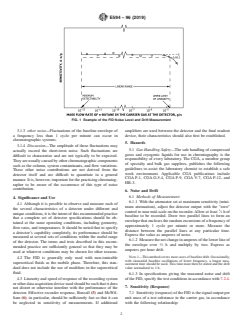
1 or more cycles per minute (see Fig. 1).
priate safety, health, and environmental practices and deter-
3.1.2.1 Discussion—Short-term noise corresponds to the
mine the applicability of regulatory limitations prior to use.
observed noise only. The actual noise of the system may be
For specific safety information, see Section 5.
larger or smaller than the observed value, depending upon the
1.8 This international standard was developed in accor-
method of data collection or signal monitoring from the
dance with internationally recognized principles on standard-
detector, since observed noise is a function of the frequency,
speed of response, and the bandwidth of the electronic circuit
measuring the detector signal.
This practice is under the jurisdiction ofASTM Committee E13 on Molecular
Spectroscopy and Separation Science and is the direct responsibility of Subcom-
mittee E13.19 on Separation Science. For referenced ASTM standards, visit the ASTM website, www.astm.org, or
Current edition approved Sept. 1, 2019. Published September 2019. Originally contact ASTM Customer Service at service@astm.org. For Annual Book of ASTM
approved in 1977. The last previous edition approved in 2011 as E594–96(2011). Standards volume information, refer to the standard’s Document Summary page on
DOI: 10.1520/E0594–96R19. the ASTM website.
2 4
The boldface numbers in parentheses refer to the list of references appended to Available from Compressed Gas Association (CGA), 14501 George Carter
this recommended practice. Way, Suite 103, Chantilly, VA 20151, http://www.cganet.com.
Copyright © ASTM International, 100 Barr Harbor Drive, PO Box C700, West Conshohocken, PA 19428-2959. United States
E594 − 96 (2019)
FIG. 1 Example of the FID Noise Level and Drift Measurement
3.1.3 other noise—Fluctuations of the baseline envelope of amplifiers are used between the detector and the final readout
a frequency less than 1 cycle per minute can occur in device, their characteristics should also first be established.
chromatographic systems.
5. Hazards
3.1.4 Discussion—The amplitude of these fluctuations may
5.1 Gas Handling Safety—The safe handling of compressed
actually exceed the short-term noise. Such fluctuations are
gases and cryogenic liquids for use in chromtography is the
difficult to characterize and are not typically to be expected.
responsibility of every laboratory. The CGA, a member group
Theyareusuallycausedbyotherchromatographiccomponents
of specialty and bulk gas suppliers, publishes the following
such as the column, system contaminants, and flow variations.
guidelines to assist the laboratory chemist to establish a safe
These other noise contributions are not derived from the
work environment. Applicable CGA publications include
detector itself and are difficult to quantitate in a general
CGAP-1, CGAG-5.4, CGAP-9, CGAV-7, CGAP-12, and
manner.Itis,however,importantforthepracticingchromatog-
HB-3.
rapher to be aware of the occurrence of this type of noise
contribution.
6. Noise and Drift
6.1 Methods of Measurement:
4. Significance and Use
6.1.1 With the attenuator set at maximum sensitivity (mini-
4.1 Although it is possible to observe and measure each of
mum attenuation), adjust the detector output with the “zero”
the several characteristics of a detector under different and
controltonearmid-scaleontherecorder.Allowatleast ⁄2hof
uniqueconditions,itistheintentofthisrecommendedpractice
baseline to be recorded. Draw two parallel lines to form an
that a complete set of detector specifications should be ob-
envelopethatenclosestherandomexcursionsofafrequencyof
tained at the same operating conditions, including geometry,
approximately 1 cycle per minute or more. Measure the
flow rates, and temperatures. It should be noted that to specify
distance between the parallel lines at any particular time.
a detector’s capability completely, its performance should be
Express the value as amperes of noise.
measured at several sets of conditions within the useful range
6.1.2 Measurethenetchangeinamperesofthelowerlineof
of the detector. The terms and tests described in this recom-
the envelope over ⁄2 h and multiply by two. Express as
mended practice are sufficiently general so that they may be
amperes per hour drift.
used at whatever conditions may be chosen for other reasons.
NOTE1—Thismethodcoversmostcasesofbaselinedrift.Occasionally,
4.2 The FID is generally only used with non-ionizable
with sinusoidal baseline oscillations of lower frequency, a longer mea-
supercritical fluids as the mobile phase. Therefore, this stan-
surement time should be used. This time must then be stated and the drift
dard does not include the use of modifiers in the supercritical
value normalized to 1 h.
fluid.
6.1.3 In specifications giving the measured noise and drift
4.3 Linearity and speed of response of the recording system oftheFID,specifythetestconditionsinaccordancewith7.2.4.
orotherdataacquisitiondeviceusedshouldbesuchthatitdoes
7. Sensitivity (Response)
not distort or otherwise interfere with the performance of the
detector. Effective recorder response, Bonsall (5) and McWil- 7.1 Sensitivity(response)oftheFIDisthesignaloutputper
liam (6), in particular, should be sufficiently fast so that it can unit mass of a test substance in the carrier gas, in accordance
be neglected in sensitivity of measurements. If additional with the following relationship:
E594 − 96 (2019)
A
i C = initial concentration of the test compound introduced
o
S 5 (1)
m
into the flask, g/mL,
F = carriergasflowrate,correctedtoflasktemperature(see
f
where:
Annex A1), mL/min,
S = sensitivity (response), A·s/g,
t = time, min, and
A = integrated peak area, A·s, and
i
V = volume of flask, mL.
f
m = mass of the test substance in the carrier gas, g.
7.4.3 Calculatethesensitivityofthedetectoratanyconcen-
7.2 Test Conditions:
tration as follows:
7.2.1 Normalbutaneisthepreferredstandardtestsubstance.
60E
7.2.2 The measurement must be made within the linear
S 5 (3)
C F
f f
range of the detector.
7.2.3 The measurement must be made at a signal level at
where:
least 200 times greater than the noise level.
S = sensitivity, A·s/g,
7.2.4 The test substance and the conditions under which the
E = detector signal, A,
detector sensitivity is measured must be stated. This will
C = concentration of the test substance at time, t, after
f
include, but not necessarily be limited to, the following:
introducton into the flask, g/mL, and
7.2.4.1 Type of detector,
F = carriergasflowrate,correctedtoflasktemperature(see
f
7.2.4.2 Detector geometry (for example, electrode to which
Annex A1), mL/min.
bias is applied),
NOTE 2—This method is subject to errors due to inaccuracies in
measuring the flow rate and flask volume. An error of 1% in the
7.2.4.3 Carrier gas,
measurement of either variable will propagate to 2% over two decades in
7.2.4.4 Carrier gas flow rate (corrected to detector tempera-
concentration and to 6% over six decades.Therefore, this method should
ture and fluid presssure),
not be used for concentration ranges of more than two decades over a
7.2.4.5 Make-up gas,
single run.
7.2.4.6 Make-up gas flow rate, NOTE 3—A temperature difference of 1°C between flask and flow-
measuring apparatus will, if uncompensated, introduce an error of ⁄3 %
7.2.4.7 Detector temperature,
into the flow rate.
7.2.4.8 Detector polarizing voltage,
NOTE 4—Extreme care should be taken to avoid unswept volumes
7.2.4.9 Hydrogen flow rate,
betweentheflaskandthedetector,asthesewillintroduceadditionalerrors
7.2.4.10 Air or oxygen flow rate, into the calculations.
NOTE 5—Flask volumes between 100 and 500 mLhave been found the
7.2.4.11 Method of measurement, and
most convenient. Larger volumes should be avoided due to difficulties in
7.2.4.12 Electrometer range setting.
obtaining efficient mixing and likelihood of temperature gradients.
NOTE 6—This method may not be used with supercritical-fluid mobile
7.3 Methods of Measurement:
phases unless the flask is specifically designed and rated for the pressure
7.3.1 Sensitivitymaybemeasuredbyanyofthreemethods:
in use.
7.3.1.1 Experimental decay with exponential dilution flask
7.5 Method Utilizing Permeation Devices:
(7) (see 7.4).
7.5.1 Permeation devices consist of a volatile liquid en-
7.3.1.2 Utilizing the permeation device (8) under steady-
closed in a container with a permeable wall.They provide low
state conditions (see 7.5).
concentrations of vapor by diffusion of the vapor through the
7.3.1.3 UtilizingYoung’s apparatus (9) under dynamic con-
permeablesurface.Therateofdiffusionforagivenpermeation
ditions (see 7.6).
device is dependent only on the temperature. The weight loss
7.3.2 Calculation of FID sensitivity by utilizing actual
over a period of time is carefully and accurately determined;
chromatograms is not preferred because in such a case the
thus, these devices have been proposed as primary standards.
amountoftestsubstanceatthedetectormaynotbethesameas
7.5.2 Accurately known permeation rates can be prepared
that introduced.
by passing a gas over the previously calibrated permeation
7.4 Exponential Dilution Method:
device at constant temperature. Knowing this permeation rate,
7.4.1 Purge a mixing vessel of known volume fitted with a
R, the sensitivity of the detector can be obtained from the
t
magneticallydrivenstirrerwiththecarriergasataknownrate.
following equation:
The effluent from the flask is delivered directly to the detector.
60E
Introduce a measured quantity of the test substance into the
S 5 (4)
R
t
flask to give an initial concentration, C , of the test substance
o
in the carrier gas, and simultaneously start a timer.
where:
7.4.2 Calculatetheconcentrationofthetestsubstanceinthe
S = sensitivity, A·s/g,
carrier gas at the outlet of the flask at any time as follows (see
E = detector signal, A, and
Annex A1):
R = permeationrateofatestsubstancefromthepermeation
t
device, g/min.
C 5 C exp@2F t/V # (2)
f o f f
NOTE 7—Permeation devices are suitable only for preparing relatively
where:
low concentrations in the part-per-million range. In addition, only a
limited range of linearity can be explored because it is experimentally
C = concentration of the test substance at time t after
f
difficult to vary the permeation rate over an extended range. Thus, for
introduction into the flask, g/mL,
detectorsofrelativelylowsensitivityorofhighernoiselevels,thismethod
---------------------
...