

ASTM E925-09(2022)
(Practice)Standard Practice for Monitoring the Calibration of Ultraviolet-Visible Spectrophotometers whose Spectral Bandwidth does not Exceed 2 nm
General Information
- Abstract
SIGNIFICANCE AND USE
4.1 This practice permits an analyst to compare the performance of an instrument to the manufacturer's supplied performance specifications and to verify its suitability for continued routine use. It also provides generation of calibration monitoring data on a periodic basis, forming a base from which any changes in the performance of the instrument will be evident.
SCOPE
1.1 This practice covers the parameters of spectrophotometric performance that are critical for testing the adequacy of instrumentation for most routine tests and methods2 within the wavelength range of 200 nm to 700 nm and the absorbance range of 0 to 2. The recommended tests provide a measurement of the important parameters controlling results in spectrophotometric methods, but it is specifically not to be inferred that all factors in instrument performance are measured.
1.2 This practice may be used as a significant test of the performance of instruments for which the spectral bandwidth does not exceed 2 nm and for which the manufacturer's specifications for wavelength and absorbance accuracy do not exceed the performance tolerances employed here. This practice employs an illustrative tolerance of ±1 % relative for the error of the absorbance scale over the range of 0.2 to 2.0, and of ±1.0 nm for the error of the wavelength scale. A suggested maximum stray radiant power ratio of 4 × 10⁻⁴ yields E275 to extensively evaluate the performance of an instrument.
1.3 This practice should be performed on a periodic basis, the frequency of which depends on the physical environment within which the instrumentation is used. Thus, units handled roughly or used under adverse conditions (exposed to dust, chemical vapors, vibrations, or combinations thereof) should be tested more frequently than those not exposed to such conditions. This practice should also be performed after any significant repairs are made on a unit, such as those involving the optics, detector, or radiant energy source.
1.4 The values stated in SI units are to be regarded as standard. No other units of measurement are included in this standard.
1.5 This standard does not purport to address all of the safety concerns, if any, associated with its use. It is the responsibility of the user of this standard to establish appropriate safety, health, and environmental practices and determine the applicability of regulatory limitations prior to use.
1.6 This international standard was developed in accordance with internationally recognized principles on standardization established in the Decision on Principles for the Development of International Standards, Guides and Recommendations issued by the World Trade Organization Technical Barriers to Trade (TBT) Committee.
- Status
- Published
- Publication Date
- 31-Oct-2022
- Technical Committee
- E13 - Molecular Spectroscopy and Separation Science
- Drafting Committee
- E13.01 - Ultra-Violet, Visible, and Luminescence Spectroscopy
Overview
ASTM E925-09(2022) - Standard Practice for Monitoring the Calibration of Ultraviolet-Visible Spectrophotometers whose Spectral Bandwidth does not Exceed 2 nm - is a critical standard for laboratories and analysts who rely on UV-Vis spectrophotometry for routine chemical, analytical, and quality control testing. Published by ASTM International, this standard provides consistent guidelines for verifying and monitoring the calibration and ongoing performance of UV-Vis spectrophotometers, specifically those with a spectral bandwidth of 2 nm or less.
It enables users to compare an instrument’s performance to manufacturer specifications, thus ensuring the continued suitability of the spectrophotometer for accurate and reliable results in analytical measurements. Periodic calibration monitoring using the methods outlined forms a reference base to detect changes or drift in instrument performance over time.
Key Topics
- Calibration Monitoring: Provides procedures for routine monitoring of spectrophotometer calibration, helping to ensure consistent and valid performance.
- Performance Parameters: Focuses on essential parameters such as wavelength accuracy, absorbance accuracy, and stray radiant power ratio, which have the most significant impact on accurate analytical results.
- Reference Materials: Details the use of certified reference materials, including holmium oxide glass or solution standards for wavelength calibration and potassium dichromate solutions or neutral density glass filters for absorbance calibration.
- Error Tolerances: Recommends error tolerances of ±1.0 nm for wavelength accuracy and ±1% relative error for absorbance scale (from 0.2 to 2.0 absorbance units).
- Regular Testing: Emphasizes the necessity of periodic instrument checks, especially after repairs or under physically demanding conditions (e.g., exposure to dust, vibration, or chemical vapors).
- Test Procedures: Outlines procedures for verifying instrument performance, including sample preparation, temperature monitoring, and data recording for calibration results.
- Traceability: Reinforces the importance of traceability to national or accredited standards, with explicit reference to ISO 17025 and ISO Guide 34 for laboratory and reference material competence.
Applications
- Routine Laboratory Analysis: Widely used in labs conducting chemical, pharmaceutical, environmental, food, or materials testing, ensuring analytical data from UV-Vis spectrophotometers remains within specified accuracy ranges.
- Instrument Qualification: Applied in the commissioning and routine qualification of new instruments, transfer of analytical methods between instruments, or after significant repairs involving optics, detectors, or light sources.
- Quality Control: Essential for laboratories seeking to maintain ISO/IEC 17025 accreditation or comply with regulatory requirements that mandate routine instrument verification and documentation.
- Research and Development: Relevant for R&D settings where high-precision spectrophotometry is critical for method development or validation.
- Performance Troubleshooting: Assists in diagnosing performance issues and maintaining instrument integrity over time, supporting high-quality analytical outcomes.
Related Standards
- ASTM E131: Terminology Relating to Molecular Spectroscopy
- ASTM E169: Practices for General Techniques of Ultraviolet-Visible Quantitative Analysis
- ASTM E275: Practice for Describing and Measuring Performance of Ultraviolet and Visible Spectrophotometers
- ASTM E387: Test Method for Estimating Stray Radiant Power Ratio of Dispersive Spectrophotometers by the Opaque Filter Method
- ASTM E1866: Guide for Establishing Spectrophotometer Performance Tests
- ISO/IEC 17025: General Requirements for the Competence of Testing and Calibration Laboratories
- ISO Guide 34: General Requirements for the Competence of Reference Material Producers
- NIST Special Publications: Including SRM 935a potassium dichromate solutions and holmium oxide standards, providing traceable reference values for calibration
Keywords: UV-Vis spectrophotometer calibration, ASTM E925, absorbance accuracy, wavelength accuracy, reference materials, laboratory instrumentation, calibration monitoring, stray radiant power, ISO 17025 compliance.
Relations
- Effective Date
- 01-Aug-2014
- Effective Date
- 01-Mar-2010
- Effective Date
- 01-Oct-2009
- Effective Date
- 01-Oct-2009
- Refers
ASTM E275-08 - Describing and Measuring Performance of Ultraviolet and Visible Spectrophotometers - Effective Date
- 15-Oct-2008
- Effective Date
- 01-Dec-2007
- Effective Date
- 01-Sep-2005
- Effective Date
- 01-Nov-2004
- Effective Date
- 01-Feb-2004
- Effective Date
- 10-Sep-2002
- Effective Date
- 10-Feb-2001
- Effective Date
- 10-Feb-2001
- Effective Date
- 10-Sep-2000
- Effective Date
- 10-Feb-1999
- Effective Date
- 10-Mar-1997
Get Certified
Connect with accredited certification bodies for this standard

ECOCERT
Organic and sustainability certification.

BSMI (Bureau of Standards, Metrology and Inspection)
Taiwan's standards and inspection authority.

Eurofins Food Testing Global
Global leader in food, environment, and pharmaceutical product testing.
Sponsored listings
Frequently Asked Questions
ASTM E925-09(2022) is a standard published by ASTM International. Its full title is "Standard Practice for Monitoring the Calibration of Ultraviolet-Visible Spectrophotometers whose Spectral Bandwidth does not Exceed 2 nm". This standard covers: SIGNIFICANCE AND USE 4.1 This practice permits an analyst to compare the performance of an instrument to the manufacturer's supplied performance specifications and to verify its suitability for continued routine use. It also provides generation of calibration monitoring data on a periodic basis, forming a base from which any changes in the performance of the instrument will be evident. SCOPE 1.1 This practice covers the parameters of spectrophotometric performance that are critical for testing the adequacy of instrumentation for most routine tests and methods2 within the wavelength range of 200 nm to 700 nm and the absorbance range of 0 to 2. The recommended tests provide a measurement of the important parameters controlling results in spectrophotometric methods, but it is specifically not to be inferred that all factors in instrument performance are measured. 1.2 This practice may be used as a significant test of the performance of instruments for which the spectral bandwidth does not exceed 2 nm and for which the manufacturer's specifications for wavelength and absorbance accuracy do not exceed the performance tolerances employed here. This practice employs an illustrative tolerance of ±1 % relative for the error of the absorbance scale over the range of 0.2 to 2.0, and of ±1.0 nm for the error of the wavelength scale. A suggested maximum stray radiant power ratio of 4 × 10⁻⁴ yields E275 to extensively evaluate the performance of an instrument. 1.3 This practice should be performed on a periodic basis, the frequency of which depends on the physical environment within which the instrumentation is used. Thus, units handled roughly or used under adverse conditions (exposed to dust, chemical vapors, vibrations, or combinations thereof) should be tested more frequently than those not exposed to such conditions. This practice should also be performed after any significant repairs are made on a unit, such as those involving the optics, detector, or radiant energy source. 1.4 The values stated in SI units are to be regarded as standard. No other units of measurement are included in this standard. 1.5 This standard does not purport to address all of the safety concerns, if any, associated with its use. It is the responsibility of the user of this standard to establish appropriate safety, health, and environmental practices and determine the applicability of regulatory limitations prior to use. 1.6 This international standard was developed in accordance with internationally recognized principles on standardization established in the Decision on Principles for the Development of International Standards, Guides and Recommendations issued by the World Trade Organization Technical Barriers to Trade (TBT) Committee.
SIGNIFICANCE AND USE 4.1 This practice permits an analyst to compare the performance of an instrument to the manufacturer's supplied performance specifications and to verify its suitability for continued routine use. It also provides generation of calibration monitoring data on a periodic basis, forming a base from which any changes in the performance of the instrument will be evident. SCOPE 1.1 This practice covers the parameters of spectrophotometric performance that are critical for testing the adequacy of instrumentation for most routine tests and methods2 within the wavelength range of 200 nm to 700 nm and the absorbance range of 0 to 2. The recommended tests provide a measurement of the important parameters controlling results in spectrophotometric methods, but it is specifically not to be inferred that all factors in instrument performance are measured. 1.2 This practice may be used as a significant test of the performance of instruments for which the spectral bandwidth does not exceed 2 nm and for which the manufacturer's specifications for wavelength and absorbance accuracy do not exceed the performance tolerances employed here. This practice employs an illustrative tolerance of ±1 % relative for the error of the absorbance scale over the range of 0.2 to 2.0, and of ±1.0 nm for the error of the wavelength scale. A suggested maximum stray radiant power ratio of 4 × 10⁻⁴ yields E275 to extensively evaluate the performance of an instrument. 1.3 This practice should be performed on a periodic basis, the frequency of which depends on the physical environment within which the instrumentation is used. Thus, units handled roughly or used under adverse conditions (exposed to dust, chemical vapors, vibrations, or combinations thereof) should be tested more frequently than those not exposed to such conditions. This practice should also be performed after any significant repairs are made on a unit, such as those involving the optics, detector, or radiant energy source. 1.4 The values stated in SI units are to be regarded as standard. No other units of measurement are included in this standard. 1.5 This standard does not purport to address all of the safety concerns, if any, associated with its use. It is the responsibility of the user of this standard to establish appropriate safety, health, and environmental practices and determine the applicability of regulatory limitations prior to use. 1.6 This international standard was developed in accordance with internationally recognized principles on standardization established in the Decision on Principles for the Development of International Standards, Guides and Recommendations issued by the World Trade Organization Technical Barriers to Trade (TBT) Committee.
ASTM E925-09(2022) is classified under the following ICS (International Classification for Standards) categories: 17.180.30 - Optical measuring instruments; 71.040.50 - Physicochemical methods of analysis. The ICS classification helps identify the subject area and facilitates finding related standards.
ASTM E925-09(2022) has the following relationships with other standards: It is inter standard links to ASTM E169-04(2014), ASTM E131-10, ASTM E387-04(2009), ASTM E169-04(2009), ASTM E275-08, ASTM E1866-97(2007), ASTM E131-05, ASTM E169-04, ASTM E387-04, ASTM E131-02, ASTM E275-01, ASTM E275-93, ASTM E131-00a, ASTM E169-99, ASTM E1866-97. Understanding these relationships helps ensure you are using the most current and applicable version of the standard.
ASTM E925-09(2022) is available in PDF format for immediate download after purchase. The document can be added to your cart and obtained through the secure checkout process. Digital delivery ensures instant access to the complete standard document.
Standards Content (Sample)
This international standard was developed in accordance with internationally recognized principles on standardization established in the Decision on Principles for the
Development of International Standards, Guides and Recommendations issued by the World Trade Organization Technical Barriers to Trade (TBT) Committee.
Designation: E925 − 09 (Reapproved 2022)
Standard Practice for
Monitoring the Calibration of Ultraviolet-Visible
Spectrophotometers whose Spectral Bandwidth does not
Exceed 2 nm
This standard is issued under the fixed designation E925; the number immediately following the designation indicates the year of
original adoption or, in the case of revision, the year of last revision.Anumber in parentheses indicates the year of last reapproval.A
superscript epsilon (´) indicates an editorial change since the last revision or reapproval.
INTRODUCTION
In the application of spectrophotometric methods of analysis it is the responsibility of the analyst
to verify and validate that the instrument is functioning properly and is capable of providing
acceptable analytical results. It is preferable that the verification of instrument performance be
accomplished through the use of reference materials whose properties have been accurately
determined.Suchmaterialsarereadilyavailable,andtheiruseinthetestsandmeasurementsdescribed
in this practice is satisfactory for evaluating the performance of spectrophotometers whose spectral
bandwidth does not exceed the value for which the intrinsic or certified properties are valid. A
compromise maximum permissible spectral bandwidth of 2 nm is recommended for the reference
materials and error tolerances recommended here.
This practice covers some of the essential instrumental parameters that should be evaluated to
ensure the acceptability of the analytical data routinely obtained on the instrument. These parameters
include the accuracy of the wavelength and absorbance scales and stray radiant power levels.
Theaccuracyofthewavelengthscaleinboththeultraviolet(UV)andvisibleregionsisdetermined
using the sharp absorption bands of a holmium oxide glass or solution filter. The absorbance scale
accuracy in the UV region (235nm to 350 nm) is determined using acidic solutions of potassium
dichromate. In the visible region (440nm to 635 nm) the absorbance accuracy is determined using
individuallycertifiedneutraldensityglassfilters.Theuseofthesereferencematerialsprovidesavalid
andrelativelysimplemeanstotesttheerrorsinthewavelengthandabsorbancescalesofsmallspectral
bandwidth spectrophotometers in the spectral ranges indicated. A simplified version of the opaque
filter method is provided as a test for excessive stray radiant energy.
1. Scope 1.2 This practice may be used as a significant test of the
performance of instruments for which the spectral bandwidth
1.1 Thispracticecoverstheparametersofspectrophotomet-
does not exceed 2 nm and for which the manufacturer’s
ric performance that are critical for testing the adequacy of
specifications for wavelength and absorbance accuracy do not
instrumentation for most routine tests and methods within the
exceed the performance tolerances employed here. This prac-
wavelength range of 200nm to 700 nm and the absorbance
tice employs an illustrative tolerance of 61% relative for the
rangeof0to2.Therecommendedtestsprovideameasurement
error of the absorbance scale over the range of 0.2 to 2.0, and
of the important parameters controlling results in spectropho-
of 61.0 nm for the error of the wavelength scale.Asuggested
tometricmethods,butitisspecificallynottobeinferredthatall
-4
maximum stray radiant power ratio of4×10 yields <1%
factors in instrument performance are measured.
absorbance bias at an absorbance of 2. These tolerances are
chosen to be compatible with many chemical applications
while comfortably exceeding the uncertainty of the certified
This practice is under the jurisdiction ofASTM Committee E13 on Molecular
values for the reference materials and typical manufacturer’s
Spectroscopy and Separation Science and is the direct responsibility of Subcom-
specifications for error in the wavelength and absorbance
mittee E13.01 on Ultra-Violet, Visible, and Luminescence Spectroscopy.
Current edition approved Nov. 1, 2022. Published November 2022. Originally
scales of the instrument under test. The user is encouraged to
approved in 1983. Last previous edition approved in 2014 as E925–09 (2014).
develop and use tolerance values more appropriate to the
DOI: 10.1520/E0925-09R22.
2 requirements of the end use application. This procedure is
Routine tests are defined as those in which absorbance data obtained on a
sample are compared to those of a standard sample preparation. designed to verify quantitative performance on an ongoing
Copyright © ASTM International, 100 Barr Harbor Drive, PO Box C700, West Conshohocken, PA 19428-2959. United States
E925 − 09 (2022)
basis and to compare one instrument’s performance with that 2.3 ISO Publications:
of other similar units. Refer to Practice E275 to extensively ISO17025General Requirements for the Competence of
evaluate the performance of an instrument. Testing and Calibration Laboratories
ISOGuide34General Requirements for the Competence of
1.3 This practice should be performed on a periodic basis,
Reference Material Producers
the frequency of which depends on the physical environment
within which the instrumentation is used. Thus, units handled
3. Terminology
roughly or used under adverse conditions (exposed to dust,
3.1 Definitions:
chemical vapors, vibrations, or combinations thereof) should
3.1.1 For the definitions of terms used in this practice, refer
be tested more frequently than those not exposed to such
to Terminology E131.
conditions. This practice should also be performed after any
3.1.2 For a description of the instrumental parameters
significant repairs are made on a unit, such as those involving
evaluated in this practice, refer to Practice E275.
the optics, detector, or radiant energy source.
3.1.3 For a description of quantitative ultraviolet spectro-
1.4 The values stated in SI units are to be regarded as
photometric techniques, refer to Practices E169.
standard. No other units of measurement are included in this
standard.
4. Significance and Use
1.5 This standard does not purport to address all of the
4.1 This practice permits an analyst to compare the perfor-
safety concerns, if any, associated with its use. It is the
mance of an instrument to the manufacturer’s supplied perfor-
responsibility of the user of this standard to establish appro-
mance specifications and to verify its suitability for continued
priate safety, health, and environmental practices and deter-
routine use. It also provides generation of calibration monitor-
mine the applicability of regulatory limitations prior to use.
ing data on a periodic basis, forming a base from which any
1.6 This international standard was developed in accor-
changes in the performance of the instrument will be evident.
dance with internationally recognized principles on standard-
ization established in the Decision on Principles for the
5. Reference to this Calibration-Monitoring Procedure
Development of International Standards, Guides and Recom-
5.1 Reference to this practice in any spectrophotometric
mendations issued by the World Trade Organization Technical
calibration-monitoring scheme shall constitute due notification
Barriers to Trade (TBT) Committee.
that the adequacy of the spectrophotometer performance has
been evaluated by means of this practice. Performance is
2. Referenced Documents
considered to be adequate when the data obtained are within
2.1 ASTM Standards:
the stated tolerances from the true values.
E131Terminology Relating to Molecular Spectroscopy
E169PracticesforGeneralTechniquesofUltraviolet-Visible
6. Instrument Operation
Quantitative Analysis
6.1 In obtaining spectrophotometric calibration data the
E275PracticeforDescribingandMeasuringPerformanceof
analyst must select the proper instrumental operating condi-
Ultraviolet and Visible Spectrophotometers
tions to realize satisfactory instrument performance. Operating
E387TestMethodforEstimatingStrayRadiantPowerRatio
conditions for individual instruments are best obtained from
of Dispersive Spectrophotometers by the Opaque Filter
the manufacturer’s literature because of variations in instru-
Method
ment design.
E1866Guide for Establishing Spectrophotometer Perfor-
mance Tests
6.2 When using reference materials, all the components of
2.2 NIST Publications: the spectrophotometer must be functioning properly. In
NISTSpecialPublication260-54Certification and Use of
addition, the temperature of the specimen compartment should
AcidicPotassiumDichromateSolutionsAsAnUltraviolet be between 20 and 25°C. Matched solution cells should be
Absorbance Standard
used for calibration purposes.
NISTSpecialPublication260-102Holmium Oxide Solution
6.3 Each of the above factors in instrument operation is
Wavelength Standard from 240 to 640 nm—SRM 2034
important in the determination of wavelength and absorbance
NISTSpecialPublication260-116Glass Filters as a Stan-
accuracy.
dard Reference Material for Spectrophotometry—
Selection,Preparation,Certification,andUseofSRM930
7. Determination of Wavelength Accuracy in the
and SRM 1930
Ultraviolet and Visible Spectral Regions
NISTSpecialPublication260-140Technical Specifications
7.1 Discussion—The holmium oxide glass filter (1, 2) or
for Certification of Spectrophotometric NTRMs
solution standard (NISTSpecialPublication260-102) may be
For referenced ASTM standards, visit the ASTM website, www.astm.org, or
contact ASTM Customer Service at service@astm.org. For Annual Book of ASTM Available from International Organization for Standardization (ISO), ISO
Standards volume information, refer to the standard’s Document Summary page on Central Secretariat, Chemin de Blandonnet 8, CP 401, 1214 Vernier, Geneva,
the ASTM website. Switzerland, https://www.iso.org.
4 6
Available from NationalTechnical Information Service (NTIS), 5301 Shawnee The boldface numbers in parentheses refer to a list of references at the end of
Rd., Alexandria, VA 22312, http://www.ntis.gov. this standard.
E925 − 09 (2022)
used for evaluating wavelength accuracy. The glass and solu- that digital filter widths should be smaller than the full-width-
tion standards are both available commercially from reference half-maximum recommendation of that guide.
material producers, in the sealed cuvette format (a cuvette- 7.1.4 In the absence of drift or slippage in the wavelength
shaped metal holder is used for the glass) or as a bottled drive train, repeatability of the band positions should be on the
solution, prepared from high purity Holmium Oxide (> order of 60.1 nm for a given instrument, especially with the
99.99%),wherevalueassignmentisbyselfassertion(Note1). use of a computer based peak location algorithm.
Apurchasershouldrequirecertificationbythesupplierthatthe
7.2 Procedure:
wavelengths of the absorption bands are within 0.2-nm of the
7.2.1 Examine the holmium oxide reference material and
values given in Ref. (2), and reported below. The appropriate
remove any surface contamination using a soft brush or
solution standard is 4% (mass fraction) holmium oxide in
lint-free cloth. Measure the temperature of the sample com-
10% (volume fraction) perchloric acid, contained in a 10-mm
partment by placing an appropriate sensor into the cell com-
pathlengthcuvette.Forthismaterial,thetransmittanceminima
partment of a stabilized instrument and replacing the compart-
of 18 absorption bands have been certified by a multi-
mentcoversecurely.Placethesensorascloseaspossibletothe
laboratory inter-comparison, at the highest level, allowing the
actual position that will be occupied by the standard. After a
peakvalueassignmentsasanintrinsicwavelengthstandard (3).
suitable period of time record the temperature reading, remove
Absorbance maxima or transmittance minima must be located
the sensor, and resume normal operations.
within 61 nm of the wavelengths given below:
7.2.2 Record the blank absorbance or transmittance (air
A B
Glass Filter Dilute Acidic Solution
versus air) spectrum at the desired resolution and at the
C
241.5 nm 241.1 nm
appropriate wavelength intervals and scan speeds, in order to
. . . 249.9 nm
perform any necessary baseline adjustments. The wavelength
279.3 nm 278.1 nm
287.6 nm 287.2 nm
intervalsshouldbenogreaterthanthespectralbandwidthused.
333.8 nm 333.5 nm
Acquire the appropriate spectrum of the holmium oxide
. . . 345.4 nm
360.8 nm 361.3 nm reference material with respect to air and baseline correct if
385.8 nm 385.6 nm
necessaryusingtheblankspectrum.Recordthewavelengthsof
418.5 nm 416.3 nm
D thepositionsoftherelevantbands,andcomparethesevaluesto
453.4 nm . . .
the expected values. If large discrepancies (>1 nm) exist
459.9 nm 467.8 nm
. . . 485.3 nm
between the true and measured wavelengths, repeat the proce-
536.4 nm 536.6 nm
dure at a slower scan speed and smaller spectral bandwidth, if
637.5 nm 640.5 nm
possible, to verify the nonconformity.
A
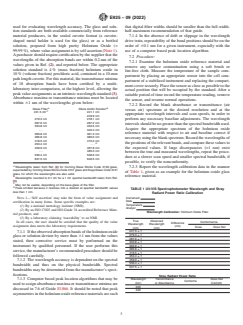
Wavelengths taken from Ref. (2) for Corning Glass Works Code 3130 glass, 7.2.3 Report the wavelength calibration data in the manner
supercededbyCorningGlassWorksCode3131glassandKoppGlassCode3131
of Table 1, given as an example for the holmium oxide glass
glass, for which the wavelengths are also valid.
B reference material.
Wavelengths rounded to 0.1 nm for a 1 nm spectral bandwidth taken from Ref.
(3).
C
May not be usable, depending on the base glass of the filter.
D
Peak omitted because it resolves into a doublet at spectral bandwidth values
TABLE 1 UV-VIS Spectrophotometer Wavelength and Stray
less than 1 nm.
Radiant Power Ratio Calibration
Instrument
NOTE 1—‘Self assertion’ may take the form of value assignment and
Date
certification in many forms. Some specific examples are:
Temperature
(1) By a national metrology institute (NMI),
Analyst
(2) By an ISO17025 and ISOGuide34 accredited Reference Mate-
Wavelength Calibration: Holmium Oxide Filter
rial producer, and
(3) By a laboratory claiming ‘traceability’to an NMI.
True Observed
In all cases, the user should be satisfied that the quality of the value Conformance
Difference
Wavelength Wavelength
assignment data meets the laboratory requirements.
(nm)
Does Does Not
(nm) (nm)
241.5 ± 1
7.1.1 Iftheobservedabsorptionbandsoftheholmiumoxide
279.3 ± 1
glass or solution deviate by more than 61 nm from the values
287.6 ± 1
stated, then corrective service must by performed on the
333.8 ± 1
360.8 ± 1
instrument by qualified personnel. If the user performs this
385.8 ± 1
service, the manufacturer’s recommended procedure should be
418.5 ± 1
followed carefully.
453.4 ± 1
459.9 ± 1
7.1.2 The wavelength accuracy is dependent on the spectral
536.4 ± 1
bandwidth and thus on the physical bandwidth. Spectral
637.5 ± 1
bandwidthsmaybedeterminedfromthemanufacturer’sspeci-
fications.
Stray Radiant Power Rati
...