

ASTM E2911-23
(Guide)Standard Guide for Relative Intensity Correction of Raman Spectrometers
General Information
- Abstract
SIGNIFICANCE AND USE
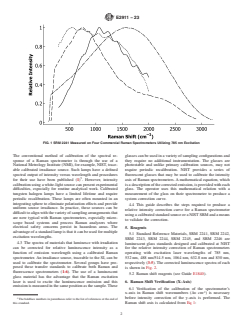
4.1 Generally, Raman spectra measured using grating-based dispersive or Fourier transform Raman spectrometers have not been corrected for the instrumental response (spectral responsivity of the detection system). Raman spectra obtained with different instruments may show significant variations in the measured relative peak intensities of a sample compound. This is mainly as a result of differences in their wavelength-dependent optical transmission and detector efficiencies. These variations can be particularly large when widely different laser excitation wavelengths are used, but can occur when the same laser excitation is used and spectra of the same compound are compared between instruments. This is illustrated in Fig. 1, which shows the uncorrected luminescence spectrum of SRM 2241, acquired upon four different commercially available Raman spectrometers operating with 785 nm laser excitation. Instrumental response variations can also occur on the same instrument after a component change or service work has been performed. Each spectrometer, due to its unique combination of filters, grating, collection optics and detector response, has a very unique spectral response. The spectrometer dependent spectral response will of course also affect the shape of Raman spectra acquired upon these systems. The shape of this response is not to be construed as either “good or bad” but is the result of design considerations by the spectrometer manufacturer. For instance, as shown in Fig. 1, spectral coverage can vary considerably between spectrometer systems. This is typically a deliberate tradeoff in spectrometer design, where spectral coverage is sacrificed for enhanced spectral resolution.
FIG. 1 SRM 2241 Measured on Four Commercial Raman Spectrometers Utilizing 785 nm Excitation
4.2 Variations in spectral peak intensities can be mostly corrected through calibration of the Raman intensity (y) axis. The conventional method of calibration of the spectral response of a Raman...
SCOPE
1.1 This guide is designed to enable the user to correct a Raman spectrometer for its relative spectral-intensity response function using NIST Standard Reference Materials2 in the 224X series (currently SRMs 2241, 2242, 2243, 2244, 2245, 2246), or a calibrated irradiance source. This relative intensity correction procedure will enable the intercomparison of Raman spectra acquired from differing instruments, excitation wavelengths, and laboratories.
1.2 The values stated in SI units are to be regarded as standard. No other units of measurement are included in this standard.
1.3 Because of the significant dangers associated with the use of lasers, ANSI Z136.1 or suitable regional standards should be followed in conjunction with this practice.
1.4 This standard does not purport to address all of the safety concerns, if any, associated with its use. It is the responsibility of the user of this standard to establish appropriate safety, health, and environmental practices and determine the applicability of regulatory limitations prior to use.
1.5 This international standard was developed in accordance with internationally recognized principles on standardization established in the Decision on Principles for the Development of International Standards, Guides and Recommendations issued by the World Trade Organization Technical Barriers to Trade (TBT) Committee.
- Status
- Published
- Publication Date
- 31-Mar-2023
- Technical Committee
- E13 - Molecular Spectroscopy and Separation Science
- Drafting Committee
- E13.08 - Raman Spectroscopy
Overview
ASTM E2911-23: Standard Guide for Relative Intensity Correction of Raman Spectrometers provides a comprehensive procedure for correcting the relative intensity response of Raman spectrometers. Developed by ASTM International, this standard is essential for laboratories, industry, and researchers needing accurate and comparable Raman spectra. Raman spectrometers can have significant variation in spectral peak intensities due to differences in optical transmission, detector efficiency, and instrument design choices. The correction outlined in ASTM E2911-23 enables reliable intercomparison of Raman spectra acquired from different instruments, excitation wavelengths, and laboratories by calibrating the intensity (y) axis against known standards.
Key Topics
Instrumental Response Correction
Grating-based dispersive and Fourier transform Raman spectrometers display unique, wavelength-dependent spectral responses. Differences in spectral coverage and detector efficiency lead to variations in relative peak intensity measurements. These differences can result from the use of different excitation wavelengths or even component changes on a single instrument.Calibration Methods
The guide details how to use NIST Standard Reference Materials (SRMs) such as SRM 2241, 2242, 2243, 2244, 2245, and 2246, or a calibrated irradiance source, to perform relative intensity correction. Calibrated irradiance sources, often traceable to National Metrology Institutes (e.g., NIST), and luminescent glass standards offer reproducible reference responses across a range of Raman excitation wavelengths.Correction Procedures
The standard provides clear instructions on measuring calibration spectra, removing background noise, addressing polarization biases, and generating correction curves. It emphasizes matching experimental conditions (e.g., optical path, acquisition settings) when measuring both samples and standards.Validation and Verification
Validation using known compounds such as cyclohexane is recommended. The standard outlines how to use band area ratios as a quality check, ensuring that intensity correction is applied accurately.Safety Considerations
Raman spectroscopy employs lasers, which present significant safety hazards. The standard requires adherence to ANSI Z136.1 or equivalent laser safety standards and emphasizes the user’s responsibility to implement appropriate safety, health, and environmental practices.
Applications
Interlaboratory Comparisons
Enables reliable comparison of Raman data gathered on different spectrometers by correcting for differences in instrument response.Routine Analytical Work
Facilitates accurate and consistent quantitation in materials analysis, pharmaceuticals, forensics, and chemical research where peak ratios are critical.Instrument Installation and Maintenance
Essential after servicing or changing components to ensure instrument response has not shifted, maintaining data integrity over time.Multi-Wavelength Studies
Supports accurate cross-comparison when using various laser excitation sources for Raman spectroscopy.Quality Control in Manufacturing
Critical for industries relying on Raman spectroscopy as a process analytical tool, ensuring data produced is accurate and comparable over time and across equipment.
Related Standards
- ASTM E1840: Guide for Raman Shift Standards for Spectrometer Calibration
- ASTM E2529: Guide for Testing the Resolution of a Raman Spectrometer
- ANSI Z136.1: Safe Use of Lasers
- NIST Standard Reference Materials: SRMs 2241-2246 for Raman calibration
Practical Value
Implementing ASTM E2911-23 standardizes Raman spectrometer response corrections, improving data accuracy and reproducibility. This fosters confidence in spectral data for regulatory, industrial, and research applications, ultimately enhancing the value Raman spectroscopy provides across scientific disciplines.
Keywords
Raman intensity correction, ASTM E2911-23, Raman spectroscopy calibration, spectral responsivity, NIST SRM, instrument calibration, laser safety, laboratory standards.
Relations
- Effective Date
- 01-Mar-2010
- Effective Date
- 01-Mar-2007
- Effective Date
- 01-Dec-2006
- Effective Date
- 01-Dec-2006
- Effective Date
- 01-Sep-2005
- Effective Date
- 10-Sep-2002
- Effective Date
- 10-Sep-2000
- Effective Date
- 10-Oct-1996
- Effective Date
- 10-Oct-1996
Get Certified
Connect with accredited certification bodies for this standard

ECOCERT
Organic and sustainability certification.

BSMI (Bureau of Standards, Metrology and Inspection)
Taiwan's standards and inspection authority.

Eurofins Food Testing Global
Global leader in food, environment, and pharmaceutical product testing.
Sponsored listings
Frequently Asked Questions
ASTM E2911-23 is a guide published by ASTM International. Its full title is "Standard Guide for Relative Intensity Correction of Raman Spectrometers". This standard covers: SIGNIFICANCE AND USE 4.1 Generally, Raman spectra measured using grating-based dispersive or Fourier transform Raman spectrometers have not been corrected for the instrumental response (spectral responsivity of the detection system). Raman spectra obtained with different instruments may show significant variations in the measured relative peak intensities of a sample compound. This is mainly as a result of differences in their wavelength-dependent optical transmission and detector efficiencies. These variations can be particularly large when widely different laser excitation wavelengths are used, but can occur when the same laser excitation is used and spectra of the same compound are compared between instruments. This is illustrated in Fig. 1, which shows the uncorrected luminescence spectrum of SRM 2241, acquired upon four different commercially available Raman spectrometers operating with 785 nm laser excitation. Instrumental response variations can also occur on the same instrument after a component change or service work has been performed. Each spectrometer, due to its unique combination of filters, grating, collection optics and detector response, has a very unique spectral response. The spectrometer dependent spectral response will of course also affect the shape of Raman spectra acquired upon these systems. The shape of this response is not to be construed as either “good or bad” but is the result of design considerations by the spectrometer manufacturer. For instance, as shown in Fig. 1, spectral coverage can vary considerably between spectrometer systems. This is typically a deliberate tradeoff in spectrometer design, where spectral coverage is sacrificed for enhanced spectral resolution. FIG. 1 SRM 2241 Measured on Four Commercial Raman Spectrometers Utilizing 785 nm Excitation 4.2 Variations in spectral peak intensities can be mostly corrected through calibration of the Raman intensity (y) axis. The conventional method of calibration of the spectral response of a Raman... SCOPE 1.1 This guide is designed to enable the user to correct a Raman spectrometer for its relative spectral-intensity response function using NIST Standard Reference Materials2 in the 224X series (currently SRMs 2241, 2242, 2243, 2244, 2245, 2246), or a calibrated irradiance source. This relative intensity correction procedure will enable the intercomparison of Raman spectra acquired from differing instruments, excitation wavelengths, and laboratories. 1.2 The values stated in SI units are to be regarded as standard. No other units of measurement are included in this standard. 1.3 Because of the significant dangers associated with the use of lasers, ANSI Z136.1 or suitable regional standards should be followed in conjunction with this practice. 1.4 This standard does not purport to address all of the safety concerns, if any, associated with its use. It is the responsibility of the user of this standard to establish appropriate safety, health, and environmental practices and determine the applicability of regulatory limitations prior to use. 1.5 This international standard was developed in accordance with internationally recognized principles on standardization established in the Decision on Principles for the Development of International Standards, Guides and Recommendations issued by the World Trade Organization Technical Barriers to Trade (TBT) Committee.
SIGNIFICANCE AND USE 4.1 Generally, Raman spectra measured using grating-based dispersive or Fourier transform Raman spectrometers have not been corrected for the instrumental response (spectral responsivity of the detection system). Raman spectra obtained with different instruments may show significant variations in the measured relative peak intensities of a sample compound. This is mainly as a result of differences in their wavelength-dependent optical transmission and detector efficiencies. These variations can be particularly large when widely different laser excitation wavelengths are used, but can occur when the same laser excitation is used and spectra of the same compound are compared between instruments. This is illustrated in Fig. 1, which shows the uncorrected luminescence spectrum of SRM 2241, acquired upon four different commercially available Raman spectrometers operating with 785 nm laser excitation. Instrumental response variations can also occur on the same instrument after a component change or service work has been performed. Each spectrometer, due to its unique combination of filters, grating, collection optics and detector response, has a very unique spectral response. The spectrometer dependent spectral response will of course also affect the shape of Raman spectra acquired upon these systems. The shape of this response is not to be construed as either “good or bad” but is the result of design considerations by the spectrometer manufacturer. For instance, as shown in Fig. 1, spectral coverage can vary considerably between spectrometer systems. This is typically a deliberate tradeoff in spectrometer design, where spectral coverage is sacrificed for enhanced spectral resolution. FIG. 1 SRM 2241 Measured on Four Commercial Raman Spectrometers Utilizing 785 nm Excitation 4.2 Variations in spectral peak intensities can be mostly corrected through calibration of the Raman intensity (y) axis. The conventional method of calibration of the spectral response of a Raman... SCOPE 1.1 This guide is designed to enable the user to correct a Raman spectrometer for its relative spectral-intensity response function using NIST Standard Reference Materials2 in the 224X series (currently SRMs 2241, 2242, 2243, 2244, 2245, 2246), or a calibrated irradiance source. This relative intensity correction procedure will enable the intercomparison of Raman spectra acquired from differing instruments, excitation wavelengths, and laboratories. 1.2 The values stated in SI units are to be regarded as standard. No other units of measurement are included in this standard. 1.3 Because of the significant dangers associated with the use of lasers, ANSI Z136.1 or suitable regional standards should be followed in conjunction with this practice. 1.4 This standard does not purport to address all of the safety concerns, if any, associated with its use. It is the responsibility of the user of this standard to establish appropriate safety, health, and environmental practices and determine the applicability of regulatory limitations prior to use. 1.5 This international standard was developed in accordance with internationally recognized principles on standardization established in the Decision on Principles for the Development of International Standards, Guides and Recommendations issued by the World Trade Organization Technical Barriers to Trade (TBT) Committee.
ASTM E2911-23 is classified under the following ICS (International Classification for Standards) categories: 17.180.30 - Optical measuring instruments; 71.040.50 - Physicochemical methods of analysis. The ICS classification helps identify the subject area and facilitates finding related standards.
ASTM E2911-23 has the following relationships with other standards: It is inter standard links to ASTM E131-10, ASTM E1840-96(2007), ASTM E2529-06e1, ASTM E2529-06, ASTM E131-05, ASTM E131-02, ASTM E131-00a, ASTM E1840-96, ASTM E1840-96(2002). Understanding these relationships helps ensure you are using the most current and applicable version of the standard.
ASTM E2911-23 is available in PDF format for immediate download after purchase. The document can be added to your cart and obtained through the secure checkout process. Digital delivery ensures instant access to the complete standard document.
Standards Content (Sample)
This international standard was developed in accordance with internationally recognized principles on standardization established in the Decision on Principles for the
Development of International Standards, Guides and Recommendations issued by the World Trade Organization Technical Barriers to Trade (TBT) Committee.
Designation: E2911 − 23
Standard Guide for
Relative Intensity Correction of Raman Spectrometers
This standard is issued under the fixed designation E2911; the number immediately following the designation indicates the year of
original adoption or, in the case of revision, the year of last revision. A number in parentheses indicates the year of last reapproval. A
superscript epsilon (´) indicates an editorial change since the last revision or reapproval.
1. Scope E2529 Guide for Testing the Resolution of a Raman Spec-
trometer
1.1 This guide is designed to enable the user to correct a
2.2 ANSI Standard:
Raman spectrometer for its relative spectral-intensity response
Z136.1 Safe Use of Lasers
function using NIST Standard Reference Materials in the
224X series (currently SRMs 2241, 2242, 2243, 2244, 2245,
3. Terminology
2246), or a calibrated irradiance source. This relative intensity
3.1 Definitions—Terminology used in this practice con-
correction procedure will enable the intercomparison of Raman
spectra acquired from differing instruments, excitation forms to the definitions in Terminology E131.
wavelengths, and laboratories.
4. Significance and Use
1.2 The values stated in SI units are to be regarded as
4.1 Generally, Raman spectra measured using grating-based
standard. No other units of measurement are included in this
dispersive or Fourier transform Raman spectrometers have not
standard.
been corrected for the instrumental response (spectral respon-
1.3 Because of the significant dangers associated with the
sivity of the detection system). Raman spectra obtained with
use of lasers, ANSI Z136.1 or suitable regional standards
different instruments may show significant variations in the
should be followed in conjunction with this practice.
measured relative peak intensities of a sample compound. This
1.4 This standard does not purport to address all of the
is mainly as a result of differences in their wavelength-
safety concerns, if any, associated with its use. It is the
dependent optical transmission and detector efficiencies. These
responsibility of the user of this standard to establish appro-
variations can be particularly large when widely different laser
priate safety, health, and environmental practices and deter-
excitation wavelengths are used, but can occur when the same
mine the applicability of regulatory limitations prior to use.
laser excitation is used and spectra of the same compound are
1.5 This international standard was developed in accor-
compared between instruments. This is illustrated in Fig. 1,
dance with internationally recognized principles on standard-
which shows the uncorrected luminescence spectrum of SRM
ization established in the Decision on Principles for the
2241, acquired upon four different commercially available
Development of International Standards, Guides and Recom-
Raman spectrometers operating with 785 nm laser excitation.
mendations issued by the World Trade Organization Technical
Instrumental response variations can also occur on the same
Barriers to Trade (TBT) Committee.
instrument after a component change or service work has been
performed. Each spectrometer, due to its unique combination
2. Referenced Documents
of filters, grating, collection optics and detector response, has a
2.1 ASTM Standards:
very unique spectral response. The spectrometer dependent
E131 Terminology Relating to Molecular Spectroscopy
spectral response will of course also affect the shape of Raman
E1840 Guide for Raman Shift Standards for Spectrometer
spectra acquired upon these systems. The shape of this re-
Calibration
sponse is not to be construed as either “good or bad” but is the
result of design considerations by the spectrometer manufac-
turer. For instance, as shown in Fig. 1, spectral coverage can
This guide is under the jurisdiction of ASTM Committee E13 on Molecular
Spectroscopy and Separation Science and is the direct responsibility of Subcom- vary considerably between spectrometer systems. This is
mittee E13.08 on Raman Spectroscopy.
typically a deliberate tradeoff in spectrometer design, where
Current edition approved April 1, 2023. Published May 2023. Originally
spectral coverage is sacrificed for enhanced spectral resolution.
approved in 2013. Last previous edition approved in 2013 as E2911 – 13 which was
withdrawn July 2022 and reinstated in April 2023. DOI: 10.1520/E2911–23.
4.2 Variations in spectral peak intensities can be mostly
Trademark of and available from NIST Office of Reference Materials, 100
corrected through calibration of the Raman intensity (y) axis.
Bureau Drive, Stop 2300, Gaithersburg, MD 20899-2300. http://www.nist.gov/srm.
For referenced ASTM standards, visit the ASTM website, www.astm.org, or
contact ASTM Customer Service at service@astm.org. For Annual Book of ASTM
Standards volume information, refer to the standard’s Document Summary page on Available from American National Standards Institute (ANSI), 25 W. 43rd St.,
the ASTM website. 4th Floor, New York, NY 10036, http://www.ansi.org.
Copyright © ASTM International, 100 Barr Harbor Drive, PO Box C700, West Conshohocken, PA 19428-2959. United States
E2911 − 23
FIG. 1 SRM 2241 Measured on Four Commercial Raman Spectrometers Utilizing 785 nm Excitation
The conventional method of calibration of the spectral re- glasses can be used in a variety of sampling configurations and
sponse of a Raman spectrometer is through the use of a they require no additional instrumentation. The glasses are
National Metrology Institute (NMI), for example, NIST, trace- photostable and unlike primary calibration sources, may not
able calibrated irradiance source. Such lamps have a defined require periodic recalibration. NIST provides a series of
spectral output of intensity versus wavelength and procedures fluorescent glasses that may be used to calibrate the intensity
for their use have been published (1) . However, intensity axis of Raman spectrometers. A mathematical equation, which
calibration using a white-light source can present experimental is a description of the corrected emission, is provided with each
difficulties, especially for routine analytical work. Calibrated glass. The operator uses this mathematical relation with a
tungsten halogen lamps have a limited lifetime and require measurement of the glass on their spectrometer to produce a
periodic recalibration. These lamps are often mounted in an system correction curve.
integrating sphere to eliminate polarization effects and provide
4.4 This guide describes the steps required to produce a
uniform source irradiance. In practice, these sources can be
relative intensity correction curve for a Raman spectrometer
difficult to align with the variety of sampling arrangements that
using a calibrated standard source or a NIST SRM and a means
are now typical with Raman spectrometers, especially micro-
to validate the correction.
scope based systems and process Raman analyzers where
electrical safety concerns persist in hazardous areas. The
5. Reagents
advantage of a standard lamp is that it can be used for multiple
5.1 Standard Reference Materials, SRM 2241, SRM 2242,
excitation wavelengths.
SRM 2243, SRM 2244, SRM 2245, and SRM 2246 are
4.3 The spectra of materials that luminesce with irradiation
luminescent glass standards designed and calibrated at NIST
can be corrected for relative luminescence intensity as a for the relative intensity correction of Raman spectrometers
function of emission wavelength using a calibrated Raman
operating with excitation laser wavelengths of 785 nm,
spectrometer. An irradiance source, traceable to the SI, can be 532 nm, 488 nm/514.5 nm, 1064 nm, 632.8 nm and 830 nm,
used to calibrate the spectrometer. Several groups have pro-
respectively (3-5). The corrected luminescence spectra of each
posed these transfer standards to calibrate both Raman and is shown in Fig. 2.
fluorescence spectrometers (1-6). The use of a luminescent
5.2 Raman shift reagents (see Guide E1840).
glass material has the advantage that the Raman excitation
laser is used to excite the luminescence emission and this
6. Raman Shift Verification (X-Axis)
emission is measured in the same position as the sample. These
6.1 Verification of the calibration of the spectrometer’s
-1
x-axis in Raman shift wavenumbers (υ cm ) is necessary
before intensity correction of the y-axis is performed. The
The boldface numbers in parentheses refer to the list of references at the end of
this standard. Raman shift axis is calculated from Eq 1:
E2911 − 23
FIG. 2 Certified Models of the Corrected Luminescence Spectra of SRMs 2241 through 2246 as a Function of Raman Shift
from the Specified Laser Excitation Wavelength
∆υ 5 ~υ 2 υ ! (1) or other optical elements) as used for sample data collection.
0 s
Excitation laser power, however, is sample dependent and the
where:
relative response correction of the spectrometer will be inde-
-1
υ = the wavenumber in units of Raman shift (cm ),
pendent of this parameter. Acquisition time should be adjusted
-1
υ = the laser frequency in wavenumbers (cm ),
to optimize the signal-to-noise ratio (SNR).
υ = the wavelength axis of the spectrometer expressed in
s
-1 7.1.2 The relative IRF is defined as the ratio of the measured
wavenumbers (cm ),
spectrum of the standard source, S (υ ), to the known standard
L
6.2 The laser frequency can be measured using a wavemeter
output, I (υ ). The inverse of this relation is used to calculate
L
while the absolute wavenumber axis of the spectrometer is
a relative intensity correction curve as in Eq 2:
calibrated with emission pen lamps. Several references (7-10)
I ~∆ υ! 5 I ~∆ υ!⁄S ~∆ υ! (2)
CORR L L
have detailed the use of the appropriate emission lamps for the
relevant Raman frequency range. Users should defer to the
where:
vendor’s instructions for the purpose of Raman shift axis
I (υ ) = the relative intensity correction curve,
CORR
calibration or verification. However, independent validation of
I (υ ) = the known standard output,
L
the Raman shift axis may be performed by referring to Guide
S (υ ) = the measured spectrum of the standard source
L
E1840.
(see 7.1.4).
7. Relative Instrument Response Function Calibration 7.1.3 Once determined, this correction curve is used to
correct the measured Raman spectrum of a sample, S (υ ),
(Y-Axis):
MEAS
for the system dependent response according to Eq 3:
7.1 General Procedure for Relative Response Calibration:
S ∆ υ 5 I ∆ υ × S ∆ υ (3)
7.1.1 The most practical approach to calibrating a relative ~ ! ~ ! ~ !
CORR CORR MEAS
instrumental response function (IRF) involves the use of a
where:
standard of known spectral flux (intensity versus wavelength).
S (υ ) = the corrected Raman spectrum of the sample,
CORR
The standard source is aligned to the spectrometer such that the
I (υ ) = the relative intensity correction curve,
CORR
emitted optical radiation is directed into the optical path to
S (υ ) = the measured Raman spectrum of the sample
MEAS
emulate Raman scattered radiation collected by the spectrom-
(see 7.1.4).
eter from the sample position. The best accuracy is achieved
when the calibration source radiation and Raman scatter of the 7.1.4 Prior to calculating the relative intensity correction
sample travel the same illumination path through the collection curve or corrected sample Raman spectrum, the measured
optics of the spectrometer. The standard source spectrum is spectra should be corrected by removing contributions to the
measured using, as nearly as possible, the same instrumental signal not originating from the sample or calibration source
parameters (for example, spectral coverage, slit width, filters, being measured. Background signal can arise from processes
E2911 − 23
independent of light incident on the detector, such as detector 7.1.7 Conventional units used for Raman spectrometers
-1 -1 -1
bias and thermal charge generation. Correction for these employing photon counting detectors are photons sec (cm )
on a relative scale. Additional units relating to area and solid
processes is often referred to as dark correction or dark
angle may also be included. With the excitation laser wave-
subtraction. Corrections for other sources of background
length known, the photon flux in terms of Raman shift, Ф (υ ),
p
interference, such as ambient lighting or luminescence from
may be calculated for a spectrometer system. This approach is
optical components in a system, can also be performed. These
utilized for the corrected luminescence spectra of the NIST
procedures may be combined into a single measurement and
SRM series for relative Raman intensity correction.
automated during the spectral acquisition. Throughout the
remainder of this guide, the term “background” will be used 7.2 Relative Response Calibration using NIST SRMs:
generally to refer to spectral background contributions both 7.2.1 SRMs 2241 through 2246 are glass artifact standards
that transfer a relative irradiance calibration from a NIST
dependent and independent of light incident on the detector.
certified spectral irradiance source to a user’s spectrometer.
The suitability of a particular approach to background correc-
Under laser excitation at the specified wavelength the SRM
tion depends on instrumentation as well as application and,
luminescence provides a source of known relative spectral
therefore, a specific procedure cannot be universally prescribed
intensity, described by a certified mathematical model, over the
(see 7.4.4.1). For the calibration source, the measured spectrum
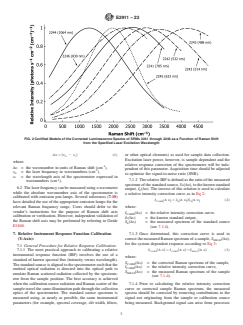
spectral range of certification. Shown in Fig. 2 are the certified
is typically corrected by subtraction of a background spectrum
models of the corrected luminescence spectra of SRMs 2241
recorded by blocking or removing the calibration source or
through 2246 as a function of Raman shift from the specified
leaving the detector shutter closed and measuring a spectrum
laser excitation wavelength. The corrected spectra of these
using the same acquisition time used to measure the calibration
SRMs were determined by the general response calibration
source. The measured sample spectrum is similarly corrected
procedure described above using a NIST calibrated primary
by subtraction of a background spectrum; however, since the
standard source and/or calibrated black-body furnace radiators.
spectrum depends on integration time, this will typically be
With the SRM a relative intensity correction curve is generated
different from the background spectrum used for the calibration
using the certified mathematical model obtained from the
source. Furthermore, the procedure for measuring a back-
appropriate SRM certificate (11) and a measured luminescence
ground spectrum may differ between a calibration source and
spectrum of the glass standard on the spectrometer system.
sample spectrum. Other variables, such as environmental
7.2.2 To acquire the luminescence spectrum of the SRM, the
conditions, can also be important (for example, correction at
surface of the glass should be placed at approximately the same
one temperature may not be universal).
position from which the Raman spectrum of the sample is
7.1.5 Due to polarization biases that can be present in collected. It is important that the laser excitation be incident
only on the frosted surface of the glass. The shape of the
Raman instrumentation, typically due to the diffraction grating
spectral luminescence will have some sensitivity to the place-
and sample orientation dependent components of the Raman
ment of the glass surface relative to the collection optics of the
tensor, a polarization scrambler is recommended in the Raman
spectrometer, which is minimized by scattering from the
light-collection optics, most preferably in a region of colli-
frosted surface (see 7.4.2). Measurement conditions should be
mated light. Raman spectral bands that exhibit various degrees
set to obtain a spectrum of optimum signal-to-noise ratio. The
of polarization will not be properly intensity-corrected without
luminescence spectrum of the glass must be acquired over the
the use of a scrambler (see 7.4.1).
same Raman range as that of the sample and with the same data
7.1.6 Calibration data for light sources are typically pro-
point density and in the same manner (for example, static,
vided in energy output versus wavelength. While the SI unit for
stepping or scanning acquisition modes).
-3
spectral irradiance has units of W m , numerous other units are
7.2.3 The certified relative spectral intensity of the SRM,
in common use with energy in terms of mW or μW, area in
I (υ ), is calculated using the certified equation listed in the
SRM
terms of cm , and spectral bandpass in terms of cm, μm or nm.
appropriate SRM certificate. I (υ ) has been normalized to
SRM
Modern Raman spectrometer systems generally count photons -1
unity and is a relative unit expressed in terms of photons sec
-2 -1 -1
and the wavelength axis is expressed in Raman shift wavenum-
cm (cm ) . The elements of I (υ ) are obtained by
SRM
-1
bers (υ , cm ). More appropriate units in this case are in terms
evaluating the certified equation at the same data point spacing
-1
of photon flux as a function of wavenumber (cm ). A gener-
used for the acquisition of the luminescence spectrum of the
alized relationship between spectral irradiance in energy versus
SRM and of the Raman spectrum of the sample. Together with
wavelength and photons versus wavenumbers can be expressed
the measured luminescence spectrum of the SRM, S (υ ),
SRM
as Eq 4:
the relative intensity correction curve is calculated using Eq 5:
Ф ~υ! 5 C·λ ·Ф ~λ! (4) I ∆ υ 5 I ∆ υ ⁄S ∆ υ (5)
~ ! ~ ! ~ !
p e CORR SRM SRM
where: where:
Ф (υ) = a photon flux in terms of absolute wavenumbers I (υ ) = the relative intensity correction curve,
p CORR
-1
I (υ ) = the calculated certified relative spectral inten-
(cm ),
SRM
Ф (λ) = an energy flux in terms of wavelength, sity of the SRM,
e
C = a constant that depends on the energy and wave- S (υ ) = the measured luminescence spectrum of the
SRM
length calibration units. SRM.
E2911 − 23
-1
7.2.4 This relative intensity correction curve, I (υ ), the 801 cm band are listed in Table 1 as a function of
CORR
corresponds to that derived in Eq 2 of the general procedure wavelength of excitation. The integration range for each of the
described in 7.1 and the intensity corrected Raman spectrum is bands is listed in column 2. The first column represents a
calculated as in Eq 3. An example of the procedure for reference Raman shift value for each band. Listed in column 3
correction of instrumental response variation is illustrated in are average ratios obtained from frequency independent cross
Fig. 3. Shown in the top two panels on the left are the certified sections (for example, corrected for the υ (υ –υ ) scattering
0 0 i
(corrected) spectrum of SRM 2241, I (υ ), generated from dependence) of corrected data using excitation wavelengths
SRM
the certified model (a 5th degree polynomial for SRM 2241) 514.5 nm, 532 nm, 632.8 nm and 785 nm. The remaining
provided in the SRM certificate and the measured lumines- columns list the theoretical value of the ratio incorporating the
cence spectrum of SRM 2241, S (υ ), obtained on a υ (υ –υ ) scattering dependence (7) for various common
SRM 0 0 i
commercial Raman system using 785 nm laser excitation. The excitation lasers wavelengths. These laser wavelength depen-
system-dependent relative intensity correction curve, dent peak area ratios relative to the 801-band (A /A ) are
i 801
I (υ ), calculated using Eq 5, is shown in the middle panel. calculated from the values in column 2 according to Eq 6:
CORR
The bottom two panels show the measured sample Raman o 3
A σ υ 2 υ !
~
i i i
5 (6)
spectrum, S (υ ), and the corrected sample Raman
o 3
MEAS
A σ ~υ 2 801!
801 801 0
spectrum, S (υ ), calculated as the product I (υ ) ×
CORR CORR
where:
S (υ ). Both the SRM and sample spectra were corrected
MEAS
o
by subtraction of background spectra collected using identical σ = the laser independent Raman cross section of band i,
i
o
σ = the laser independent Raman cross section of the
acquisition parameters but with the SRM/sample removed.
Comparisons of the uncorrected spectra and corresponding 801-band,
-1
υ = the excitation laser wavenumber (cm , absolute),
background spectra are shown on the right hand side of Fig. 3. 0
υ = the position of band i in Raman shift wavenumbers
Some minor but discernible structure is observed in the i
-1
(cm ).
background spectra, which is attributable to luminescence from
the optical elements in the excitation and colle
...