

ASTM D7577-12(2021)
(Test Method)Standard Test Method for Determining the Accelerated Iron Corrosion Rating of Denatured Fuel Ethanol and Ethanol Fuel Blends
General Information
- Abstract
SIGNIFICANCE AND USE
5.1 This test is designed to be used as a rapid measure of the overall relative corrosivity of Ethanol Fuel Blends (Specification D5798) and Denatured Fuel Ethanol (Specification D4806) to iron (steel).
5.2 The test can be used to compare corrosion inhibitor dosage levels and effectiveness of various corrosion inhibitors as they pertain to protecting iron (steel) materials from corrosion.
SCOPE
1.1 This test method measures the ability of inhibited and uninhibited Ethanol Fuel Blends defined by Specification D5798 and Denatured Fuel Ethanol defined by Specification D4806 to resist corrosion of iron should water become mixed with the fuel, using an accelerated laboratory test method. Corrosion ratings are reported based on a visual, numbered rating scale.
1.2 The values stated in SI units are to be regarded as standard. The values in parentheses are for information only.
1.3 This standard does not purport to address all of the safety concerns, if any, associated with its use. It is the responsibility of the user of this standard to establish appropriate safety, health, and environmental practices and determine the applicability of regulatory limitations prior to use. Specific hazard statements are given in Sections 7 and 8.
1.4 This international standard was developed in accordance with internationally recognized principles on standardization established in the Decision on Principles for the Development of International Standards, Guides and Recommendations issued by the World Trade Organization Technical Barriers to Trade (TBT) Committee.
- Status
- Published
- Publication Date
- 30-Apr-2021
- Technical Committee
- D02 - Petroleum Products, Liquid Fuels, and Lubricants
- Drafting Committee
- D02.14 - Stability, Cleanliness and Compatibility of Liquid Fuels
Overview
ASTM D7577-12(2021) is the internationally recognized standard test method for Determining the Accelerated Iron Corrosion Rating of Denatured Fuel Ethanol and Ethanol Fuel Blends. Published by ASTM International, this method offers a reliable and rapid laboratory procedure for evaluating the relative corrosivity of ethanol-based automotive fuels-specifically, those meeting the requirements of ASTM D5798 and ASTM D4806-when in contact with iron or steel. The standard establishes a visual, numeric rating system to assess corrosion, making it possible to quantitatively compare both inhibited and uninhibited fuel samples and to evaluate the effectiveness of corrosion inhibitors.
Key Topics
- Test Method Purpose: Measures the relative corrosion rate of iron exposed to denatured fuel ethanol and ethanol fuel blends in the presence of water, simulating conditions experienced in automotive fuel systems.
- Visual Rating System: Corrosion is assessed on a detailed numerical scale, facilitating consistent reporting and comparison across laboratories.
- Applicability: Designed for both inhibited (with corrosion inhibitors) and uninhibited ethanol fuels and blends, this method helps evaluate the impact of fuel formulations and additive packages on corrosivity.
- Sample Preparation: Test rods made of standard steel are immersed in a heated mixture of ethanol fuel and water, with corrosion rated after exposure according to detailed surface appearance criteria.
- Reproducibility: The standard provides precision data, supporting consistent, repeatable results across different labs and operators.
Applications
ASTM D7577-12(2021) is an essential tool for:
- Fuel Producers: Assessing the corrosivity of ethanol-based fuels to ensure compliance with performance and durability expectations, and for developing new fuel blends.
- Additive Manufacturers: Comparing and optimizing dosages and performance of corrosion inhibitors within ethanol fuels and blends.
- Automotive Industry: Informing materials selection and design for fuel system components that may come into contact with ethanol fuels, helping prevent premature corrosion and equipment failure.
- Quality Control Laboratories: Monitoring lot-to-lot consistency and investigating field issues related to fuel-related corrosion.
- Regulators and Contract Specifiers: Verifying that ethanol fuels and blends meet industry and regulatory requirements for corrosion performance.
Related Standards
For a holistic approach to fuel ethanol and corrosion testing, the following ASTM standards are commonly referenced:
- ASTM D4806: Specification for Denatured Fuel Ethanol for Blending with Gasolines for Use as Automotive Spark-Ignition Engine Fuel.
- ASTM D5798: Specification for Ethanol Fuel Blends for Flexible-Fuel Automotive Spark-Ignition Engines.
- ASTM D665: Test Method for Rust-Preventing Characteristics of Inhibited Mineral Oil in the Presence of Water-provides foundational methodologies adapted in D7577.
- ASTM D4175: Terminology Relating to Petroleum Products, Liquid Fuels, and Lubricants.
- ASTM E177: Practice for Use of the Terms Precision and Bias in ASTM Test Methods.
Practical Value
By following ASTM D7577-12(2021), laboratories and manufacturers can achieve:
- Rapid and consistent evaluations of ethanol fuel corrosivity to iron and steel.
- Quality assurance through standardized rating scales and reproducible procedures.
- Optimization of corrosion inhibitors, supporting longer life for automotive fuel systems.
- Regulatory compliance with national and international fuel quality standards.
Keywords: ASTM D7577, iron corrosion, ethanol fuel blends, denatured fuel ethanol, corrosion inhibitor, fuel quality, automotive fuel, laboratory test method, corrosion rating, accelerated corrosion testing.
Relations
- Effective Date
- 01-Mar-2024
- Effective Date
- 01-Mar-2024
- Refers
ASTM D4175-23a - Standard Terminology Relating to Petroleum Products, Liquid Fuels, and Lubricants - Effective Date
- 15-Dec-2023
- Effective Date
- 01-Dec-2023
- Refers
ASTM D2699-23b - Standard Test Method for Research Octane Number of Spark-Ignition Engine Fuel - Effective Date
- 01-Nov-2023
- Refers
ASTM D2699-23a - Standard Test Method for Research Octane Number of Spark-Ignition Engine Fuel - Effective Date
- 01-Oct-2023
- Refers
ASTM D4175-23e1 - Standard Terminology Relating to Petroleum Products, Liquid Fuels, and Lubricants - Effective Date
- 01-Jul-2023
- Effective Date
- 01-Dec-2019
- Effective Date
- 15-Sep-2019
- Effective Date
- 01-Jul-2019
- Effective Date
- 01-May-2019
- Effective Date
- 01-Mar-2019
- Effective Date
- 01-Feb-2019
- Effective Date
- 01-Dec-2018
- Effective Date
- 01-Dec-2018
Get Certified
Connect with accredited certification bodies for this standard

ECOCERT
Organic and sustainability certification.

Element Materials Technology
Materials testing and product certification.

ABS Group Brazil
ABS Group certification services in Brazil.
Sponsored listings
Frequently Asked Questions
ASTM D7577-12(2021) is a standard published by ASTM International. Its full title is "Standard Test Method for Determining the Accelerated Iron Corrosion Rating of Denatured Fuel Ethanol and Ethanol Fuel Blends". This standard covers: SIGNIFICANCE AND USE 5.1 This test is designed to be used as a rapid measure of the overall relative corrosivity of Ethanol Fuel Blends (Specification D5798) and Denatured Fuel Ethanol (Specification D4806) to iron (steel). 5.2 The test can be used to compare corrosion inhibitor dosage levels and effectiveness of various corrosion inhibitors as they pertain to protecting iron (steel) materials from corrosion. SCOPE 1.1 This test method measures the ability of inhibited and uninhibited Ethanol Fuel Blends defined by Specification D5798 and Denatured Fuel Ethanol defined by Specification D4806 to resist corrosion of iron should water become mixed with the fuel, using an accelerated laboratory test method. Corrosion ratings are reported based on a visual, numbered rating scale. 1.2 The values stated in SI units are to be regarded as standard. The values in parentheses are for information only. 1.3 This standard does not purport to address all of the safety concerns, if any, associated with its use. It is the responsibility of the user of this standard to establish appropriate safety, health, and environmental practices and determine the applicability of regulatory limitations prior to use. Specific hazard statements are given in Sections 7 and 8. 1.4 This international standard was developed in accordance with internationally recognized principles on standardization established in the Decision on Principles for the Development of International Standards, Guides and Recommendations issued by the World Trade Organization Technical Barriers to Trade (TBT) Committee.
SIGNIFICANCE AND USE 5.1 This test is designed to be used as a rapid measure of the overall relative corrosivity of Ethanol Fuel Blends (Specification D5798) and Denatured Fuel Ethanol (Specification D4806) to iron (steel). 5.2 The test can be used to compare corrosion inhibitor dosage levels and effectiveness of various corrosion inhibitors as they pertain to protecting iron (steel) materials from corrosion. SCOPE 1.1 This test method measures the ability of inhibited and uninhibited Ethanol Fuel Blends defined by Specification D5798 and Denatured Fuel Ethanol defined by Specification D4806 to resist corrosion of iron should water become mixed with the fuel, using an accelerated laboratory test method. Corrosion ratings are reported based on a visual, numbered rating scale. 1.2 The values stated in SI units are to be regarded as standard. The values in parentheses are for information only. 1.3 This standard does not purport to address all of the safety concerns, if any, associated with its use. It is the responsibility of the user of this standard to establish appropriate safety, health, and environmental practices and determine the applicability of regulatory limitations prior to use. Specific hazard statements are given in Sections 7 and 8. 1.4 This international standard was developed in accordance with internationally recognized principles on standardization established in the Decision on Principles for the Development of International Standards, Guides and Recommendations issued by the World Trade Organization Technical Barriers to Trade (TBT) Committee.
ASTM D7577-12(2021) is classified under the following ICS (International Classification for Standards) categories: 71.080.60 - Alcohols. Ethers; 75.160.20 - Liquid fuels. The ICS classification helps identify the subject area and facilitates finding related standards.
ASTM D7577-12(2021) has the following relationships with other standards: It is inter standard links to ASTM A108-24, ASTM D2699-24, ASTM D4175-23a, ASTM D665-23, ASTM D2699-23b, ASTM D2699-23a, ASTM D4175-23e1, ASTM D665-19, ASTM D4806-19a, ASTM D5798-19b, ASTM D5798-19a, ASTM D4806-19, ASTM D5798-19, ASTM D4806-18a, ASTM D5798-18a. Understanding these relationships helps ensure you are using the most current and applicable version of the standard.
ASTM D7577-12(2021) is available in PDF format for immediate download after purchase. The document can be added to your cart and obtained through the secure checkout process. Digital delivery ensures instant access to the complete standard document.
Standards Content (Sample)
This international standard was developed in accordance with internationally recognized principles on standardization established in the Decision on Principles for the
Development of International Standards, Guides and Recommendations issued by the World Trade Organization Technical Barriers to Trade (TBT) Committee.
Designation: D7577 − 12 (Reapproved 2021)
Standard Test Method for
Determining the Accelerated Iron Corrosion Rating of
Denatured Fuel Ethanol and Ethanol Fuel Blends
This standard is issued under the fixed designation D7577; the number immediately following the designation indicates the year of
original adoption or, in the case of revision, the year of last revision. A number in parentheses indicates the year of last reapproval. A
superscript epsilon (´) indicates an editorial change since the last revision or reapproval.
1. Scope D2699 Test Method for Research Octane Number of Spark-
Ignition Engine Fuel
1.1 This test method measures the ability of inhibited and
D4175 Terminology Relating to Petroleum Products, Liquid
uninhibited Ethanol Fuel Blends defined by Specification
Fuels, and Lubricants
D5798 and Denatured Fuel Ethanol defined by Specification
D4806 Specification for Denatured Fuel Ethanol for Blend-
D4806 to resist corrosion of iron should water become mixed
ing with Gasolines for Use as Automotive Spark-Ignition
with the fuel, using an accelerated laboratory test method.
Engine Fuel
Corrosion ratings are reported based on a visual, numbered
D5798 Specification for Ethanol Fuel Blends for Flexible-
rating scale.
Fuel Automotive Spark-Ignition Engines
1.2 The values stated in SI units are to be regarded as
E177 Practice for Use of the Terms Precision and Bias in
standard. The values in parentheses are for information only.
ASTM Test Methods
1.3 This standard does not purport to address all of the E2251 Specification for Liquid-in-Glass ASTM Thermom-
safety concerns, if any, associated with its use. It is the
eters with Low-Hazard Precision Liquids
responsibility of the user of this standard to establish appro-
priate safety, health, and environmental practices and deter- 3. Terminology
mine the applicability of regulatory limitations prior to use.
3.1 Definitions:
Specific hazard statements are given in Sections 7 and 8.
3.1.1 For definitions of terms used in this test method, refer
1.4 This international standard was developed in accor-
to Terminology D4175.
dance with internationally recognized principles on standard-
3.1.2 Fuel C, n—a volumetric mixture of 50 volume percent
ization established in the Decision on Principles for the
reference fuel grade toluene and 50 volume percent reference
Development of International Standards, Guides and Recom-
fuel grade isooctane.
mendations issued by the World Trade Organization Technical
3.1.2.1 Discussion—Specifications for reference fuel grade
Barriers to Trade (TBT) Committee.
toluene and reference fuel grade isooctane can be found inTest
Method D2699.
2. Referenced Documents
3.2 Abbreviations:
2.1 ASTM Standards:
3.2.1 HDPE, n—high density polyethylene
A29/A29M SpecificationforGeneralRequirementsforSteel
3.2.2 PTFE, n—Polytetrafluoroethylene
Bars, Carbon and Alloy, Hot-Wrought
A108 Specification for Steel Bar, Carbon and Alloy, Cold-
4. Summary of Test Method
Finished
D665 Test Method for Rust-Preventing Characteristics of
4.1 Apolished steel test rod is immersed in a mixture of the
Inhibited Mineral Oil in the Presence of Water
testsampleandwaterataratioof10partsfuelsampleto1part
D1193 Specification for Reagent Water
water and held at a temperature of 37 °C to 39 °C (98 °F to
102 °F) for 1 h.
4.2 At the end of 1 h, the test rod is removed, rinsed and
This test method is under the jurisdiction of ASTM Committee D02 on
Petroleum Products, Liquid Fuels, and Lubricants and is the direct responsibility of rated according to a numeric corrosion rating scale.
Subcommittee D02.14 on Stability, Cleanliness and Compatibility of Liquid Fuels.
Current edition approved May 1, 2021. Published June 2021. Originally
5. Significance and Use
approved in 2012. Last previous edition approved in 2016 as D7577 – 12 (2016).
DOI: 10.1520/D7577-12R21.
5.1 Thistestisdesignedtobeusedasarapidmeasureofthe
For referenced ASTM standards, visit the ASTM website, www.astm.org, or
overall relative corrosivity of Ethanol Fuel Blends (Specifica-
contact ASTM Customer Service at service@astm.org. For Annual Book of ASTM
tion D5798) and Denatured Fuel Ethanol (Specification
Standards volume information, refer to the standard’s Document Summary page on
the ASTM website. D4806) to iron (steel).
Copyright © ASTM International, 100 Barr Harbor Drive, PO Box C700, West Conshohocken, PA 19428-2959. United States
D7577 − 12 (2021)
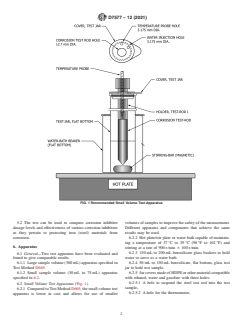
FIG. 1 Recommended Small Volume Test Apparatus
5.2 The test can be used to compare corrosion inhibitor volumes of samples to improve the safety of the measurement.
dosage levels and effectiveness of various corrosion inhibitors Different apparatus and components that achieve the same
as they pertain to protecting iron (steel) materials from results may be used.
corrosion.
6.2.2 Hot plate/stir plate or water bath capable of maintain-
ing a temperature of 37 °C to 39 °C (98 °F to 102 °F) and
6. Apparatus
stirring at a rate of 900 r⁄min 6 100 r⁄min.
6.2.3 150 mL to 200 mL borosilicate glass beakers to hold
6.1 General—Two test apparatus have been evaluated and
water to serve as a water bath.
found to give comparable results.
6.1.1 Large sample volume (300 mL) apparatus specified in 6.2.4 50 mL to 150 mL borosilicate, flat bottom, glass test
Test Method D665. jar to hold test sample.
6.1.2 Small sample volume (30 mL to 75 mL) apparatus
6.2.5 JarcoversmadeofHDPEorothermaterialcompatible
specified in 6.2.
with ethanol, water and gasoline with three holes:
6.2.5.1 A hole to suspend the steel test rod into the test
6.2 Small Volume Test Apparatus (Fig. 1).
sample,
6.2.1 ComparedtoTestMethodD665,thesmallvolumetest
apparatus is lower in cost and allows for use of smaller 6.2.5.2 A hole for the thermometer,
D7577 − 12 (2021)
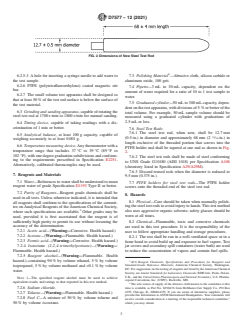
FIG. 2 Dimensions of New Steel Test Rod
6.2.5.3 Ahole for inserting a syringe needle to add water to 7.3 Polishing Material —Abrasive cloth, silicon carbide or
the test sample. aluminum oxide, 100 grit.
6.2.6 PTFE (polytetrafluoroethylene) coated magnetic stir
7.4 Pipette—3 mL to 30 mL capacity, dependent on the
bar.
amount of water required for a ratio of 10 to 1 test sample to
6.2.7 The small volume test apparatus shall be designed so
water.
that at least 50 % of the test rod surface is below the surface of
7.5 Graduated cylinder—50 mLto 300 mLcapacity, depen-
the test material.
dentonthetestapparatus,withdivisionsof5 %orbetterofthe
6.3 Grinding and sanding apparatus,capableofrotatingthe
total volume. For example, 50 mL sample volume should be
steel test rod at 1700 r⁄min to 1800 r⁄min for manual sanding.
measured using a graduated cylinder with graduations of
2.5 mL or less.
6.4 Timing device, capable of taking readings with a dis-
crimination of 1 min or better.
7.6 Steel Test Rods:
7.6.1 The steel test rod, when new, shall be 12.7 mm
6.5 Analytical balance, at least 100 g capacity, capable of
(0.5 in.) in diameter and approximately 68 mm (2 ⁄16 in.) in
weighing accurately to at least 0.001 g.
length exclusive of the threaded portion that screws into the
6.6 Temperature measuring device,Anythermometerwitha
PTFE holder and shall be tapered at one end as shown in Fig.
temperature range that includes 37 °C to 39 °C (89 °F to
2.
102 °F),withonedegreegraduationsubdivisionsandconform-
7.6.2 The steel test rods shall be made of steel conforming
ing to the requirements prescribed in Specification E2251.
to UNS Grade G10180 (AISI 1018) per Specification A108
Alternatively, calibrated thermcouples may be used.
(chemistry listed in Specification A29/A29M).
7.6.3 Discard reused rods when the diameter is reduced to
7. Reagents and Materials
9.5 mm (0.375 in.).
7.1 Water—Referencestowatershallbeunderstoodtomean
7.7 PTFE holders for steel test rods—The PTFE holder
reagent water of grade Specification D1193 Type II or better.
screws onto the threaded end of the steel test rod.
7.2 Purity of Reagents—Reagent grade chemicals shall be
8. Hazards
used in all tests. Unless otherwise indicated, it is intended that
8.1 Physical—Care should be taken when manually polish-
all reagents shall conform to the specifications of the commit-
ing the steel test rods to avoid injury to hands.This test method
tee onAnalytical Reagents of theAmerican Chemical Society,
also uses aggressive organic solvents; safety glasses should be
where such specifications are available. Other grades may be
worn at all times.
used, provided it is first ascertained that the reagent is of
sufficiently high purity to permit its use without lessening the
8.2 Chemical—Flammable, toxic and corrosive chemicals
accuracy of the determination.
are used in this test procedure. It is the responsibility of the
7.2.1 Acetic acid—(Warning—Corrosive. Health hazard.)
user to follow appropriate handling and storage procedures.
7.2.2 Acetone—(Warning—Flammable. Health hazard.) 8.2.1 The test shall be run in a well-ventilated space or in a
7.2.3 Formic acid—(Warning—Corrosive. Health hazard.) fume hood to avoid build up and exposure to fuel vapors. Test
jar covers and secondary spill containers (water bath) are used
7.2.4 Isooctane (2,2,4-trimethylpentane)—(Warning—
Flammable. Health hazard.) to reduce the concentration of vapors and contain fuel spills.
7.2.5 Reagent alcohol—(Warning—Flammable. Health
hazard.)–containing 90 % by volume ethanol, 5 % by volume
ACS Reagent Chemicals, Specifications and Procedures for Reagents and
Standard-Grade Reference Materials, American Chemical Society, Washington,
isopropanol, 5 % by volume methanol and <0.1 % by volume
DC. For suggestions on the testing of reagents not listed by theAmerican Chemical
water.
Society, see Analar Standards for Laboratory Chemicals, BDH Ltd., Poole, Dorset,
U.K., and the United States Pharmacopeia and National Formulary, U.S. Pharma-
NOTE 1—The specified reagent alcohol must be used to achieve
copeial Convention, Inc. (USPC), Rockville, MD.
equivalent results and ratings to that reported in this test method.
The sole source of supply of the abrasive cloth known to the committee at this
7.2.6 Sodium chloride. time is available as Part No. 8230A76 from McMaster-Carr Supply Co., PO Box
4355, Chicago, IL, 60680-4355. If you are aware of alternative suppliers, please
7.2.7 Toluene—(Warning—Flammable. Health hazard.)
provide this information toASTM International Headquarters. Your comments will
7.2.8 Fuel C—A mixture of 50 % by volume toluene and
receive careful consideration at a meeting of the responsible technical committee,
50 % by volume isooctane. which you may attend.
D7577 − 12 (2021)
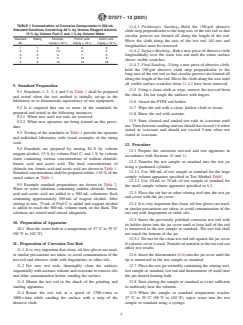
TABLE 1 Concentration of Corrosive Components in 500 mL
11.4.1 Preliminary Sanding—Hold the 100 grit abrasive
Standard Solutions Containing 84 % by Volume Reagent Alcohol,
cloth strip perpendicular to the long-axis of the test rod so that
15 % by Volume Fuel C and 1 % by Volume Water
circular grooves are formed all along the length of the rod.
Standard Rating Chloride, Formic acid, Acetic acid,
Move the cloth along the axis of the test rod. All rust and
No. mg/kg±10% mg/kg±10% mg/kg±10%
irregularities must be removed.
1 1 000
11.4.2 Surface Marking—Rub a new piece of abrasive cloth
22 1.5 0 5
3 3 515
longitudinally over the static test rod until the entire surface
44 5 10 5
shows visible scratches.
5 5 15 10 20
11.4.3 Final Sanding—Using a new piece of abrasive cloth,
hold the 100 grit abrasive cloth strip perpendicular to the
long-axis of the test rod so that circular grooves are formed all
along the length of the rod. Move the cloth along the axis until
all visible surface scratches from 11.4.2 have been removed.
9. Standard Preparation
11.5 Using a clean cloth or wipe, remove the test-rod from
9.1 Standards 1, 2, 3, 4 and 5 in Table 1 shall be prepared
the chuck. Do not tough the surfaces with fingers.
and tested when the test method is initially set-up in the
laboratory or to demonstrate equivalency of test equipment. 11.6 Attach the PTFE rod holder.
9.2 It is required that one or more of the standards be 11.7 Wipe the rod with a clean, lintless cloth or tissue.
prepared and tested in the following instances:
11.8 Rinse the rod with a
...