

ASTM E2297-23
(Guide)Standard Guide for Use of UV-A and Visible Light Sources and Meters used in the Liquid Penetrant and Magnetic Particle Methods
General Information
- Abstract
SIGNIFICANCE AND USE
5.1 UV-A and visible light sources are used to provide adequate illumination levels for liquid penetrant and magnetic particle examination. UV-A sources, UV-A radiometers, visible light sources, and illuminance photometers are used to verify specified viewing conditions.
5.2 Fluorescence is typically produced by irradiating the fluorescent dyes/pigments with UV-A radiation. The fluorescent dyes/pigments absorb the UV-A radiation and re-emit light energy in the visible spectrum. This process allows fluorescence to be observed by the human eye.
5.3 UV-A sources may emit visible light above 400 nm (4000 Å), which may reduce the visibility of fluorescent indications. High intensity UV-A sources may cause UV fade, causing fluorescent indications to degrade or disappear.
SCOPE
1.1 This guide addresses the use of UV-A/Visible light sources and meters used for the examination of materials by the liquid penetrant and magnetic particle processes. This guide may be used to establish practices and procedures to measure irradiance and illuminance levels.
1.2 This guide also acts as a reference:
1.2.1 To assist in the selection of irradiance and illumination sources and meters that meet the applicable specifications or standards.
1.2.2 For use in the preparation of internal documentation dealing with liquid penetrant or magnetic particle examination of materials and parts.
1.3 Units—The values stated in SI units are to be regarded as standard. The values given in parentheses are mathematical conversions to inch-pound units that are provided for information only and are not considered standard.
1.4 This standard does not purport to address all of the safety concerns, if any, associated with its use. It is the responsibility of the user of this standard to establish appropriate safety, health, and environmental practices and determine the applicability of regulatory limitations prior to use.
1.5 This international standard was developed in accordance with internationally recognized principles on standardization established in the Decision on Principles for the Development of International Standards, Guides and Recommendations issued by the World Trade Organization Technical Barriers to Trade (TBT) Committee.
- Status
- Published
- Publication Date
- 14-Jan-2023
- Technical Committee
- E07 - Nondestructive Testing
- Drafting Committee
- E07.03 - Liquid Penetrant and Magnetic Particle Methods
Buy Documents
ASTM E2297-23 - Standard Guide for Use of UV-A and Visible Light Sources and Meters used in the Liquid Penetrant and Magnetic Particle Methods
REDLINE ASTM E2297-23 - Standard Guide for Use of UV-A and Visible Light Sources and Meters used in the Liquid Penetrant and Magnetic Particle Methods
Overview
ASTM E2297-23: Standard Guide for Use of UV-A and Visible Light Sources and Meters Used in the Liquid Penetrant and Magnetic Particle Methods provides comprehensive guidelines for selecting, applying, and measuring UV-A and visible light sources and meters during nondestructive testing (NDT) using liquid penetrant or magnetic particle inspection methods. This standard supports organizations in verifying appropriate viewing conditions, ensuring the reliability and accuracy of inspections by defining required lighting parameters and measurement practices.
UV-A and visible light sources are crucial in these methods, as adequate illumination is essential for the detection of indications, especially when using fluorescent dyes and pigments. The guide is aimed at helping users establish consistent practices, select suitable instrumentation, and document procedures in line with industry requirements for material examination.
Key Topics
UV-A and Visible Light Source Selection
- Guidelines for choosing appropriate UV-A and visible light sources based on emission characteristics and application needs.
- Emphasis on the critical role of UV-A sources in producing fluorescence for penetrant and magnetic particle inspection.
Instrumentation: Radiometers and Photometers
- Use of UV-A radiometers and illuminance photometers to measure irradiance and illuminance levels.
- Requirements for instrument calibration, filter selection, and ensuring accurate spectral response.
- Importance of verifying that meters are appropriate for the specific light range being measured.
Measurement Practices
- Standardized procedures for measuring UV-A and visible light intensity at specified distances.
- Establishment of irradiance thresholds (commonly 1000 μW/cm² at 38.1 cm) for compliance with inspection standards.
- Recommendations to monitor lamp output and address factors that affect intensity, such as lamp age and contamination.
Safety Considerations
- Best practices for minimizing exposure to UV-A radiation.
- Use of protective equipment (eyewear, clothing) and lamp filters to ensure operator safety and prevent harmful exposure.
Supporting Documentation
- Guidance on developing internal procedures and documentation supporting regulatory and quality compliance in NDT.
Applications
This standard is widely utilized within industries that require nondestructive evaluation of materials and components, including aerospace, automotive, manufacturing, and maintenance sectors. Key practical applications include:
Quality Control and Assurance
- Ensures reliable defect detection during liquid penetrant and magnetic particle testing.
- Supports implementation of consistent, repeatable inspection processes.
Equipment Selection and Procurement
- Assists in selecting UV-A and visible light sources, radiometers, and photometers that satisfy relevant specifications.
Procedure Development
- Used as a reference for preparing internal guidelines, training materials, and standard operation procedures.
Regulatory and Standards Compliance
- Aligns NDT processes with internationally recognized practices and ISO/IEC measurement requirements.
Related Standards
This guide references and complements a range of important ASTM, ISO, IEC, and ANSI standards:
ASTM Standards
- ASTM E165 – Practice for Liquid Penetrant Testing for General Industry
- ASTM E709 – Guide for Magnetic Particle Testing
- ASTM E1208, E1209, E1210, E1219, E1220 – Various practices for liquid penetrant testing
- ASTM E1444/E1444M – Practice for Magnetic Particle Testing for Aerospace
- ASTM E3022 – Measurement of Emission Characteristics for LED UV-A Lamps
- ASTM E3024 – Magnetic Particle Testing for General Industry
ISO/IEC Standards
- ISO 3059 – Non-Destructive Testing – Viewing Conditions
- ISO/IEC 17025 – Competence of Testing and Calibration Laboratories
- ISO 10012 – Measurement Management Systems
- IEC 62471 – Photobiological Safety of Lamps and Lamp Systems
ANSI and Other References
- ANSI/NCSL Z540.3 – Calibration of Measuring and Test Equipment
- ICNIRP Publications – Safety related to UV exposure
By adhering to ASTM E2297-23, organizations improve the reliability of nondestructive testing, enhance workplace safety, and ensure consistency with global best practices in inspection illumination and measurement.
Relations
- Effective Date
- 01-Feb-2024
- Effective Date
- 01-Dec-2019
- Effective Date
- 01-Mar-2019
- Effective Date
- 01-Jan-2018
- Effective Date
- 15-Jun-2017
- Effective Date
- 01-Feb-2017
- Effective Date
- 01-Aug-2016
- Effective Date
- 01-Jun-2016
- Effective Date
- 01-Feb-2016
- Effective Date
- 01-Dec-2015
- Effective Date
- 01-Sep-2015
- Effective Date
- 01-Sep-2015
- Effective Date
- 01-Jun-2014
- Effective Date
- 01-Jun-2014
- Effective Date
- 01-Dec-2013
Buy Documents
ASTM E2297-23 - Standard Guide for Use of UV-A and Visible Light Sources and Meters used in the Liquid Penetrant and Magnetic Particle Methods
REDLINE ASTM E2297-23 - Standard Guide for Use of UV-A and Visible Light Sources and Meters used in the Liquid Penetrant and Magnetic Particle Methods
Get Certified
Connect with accredited certification bodies for this standard

BSMI (Bureau of Standards, Metrology and Inspection)
Taiwan's standards and inspection authority.
IMP NDT d.o.o.
Non-destructive testing services. Radiography, ultrasonic, magnetic particle, penetrant, visual inspection.
Inštitut za kovinske materiale in tehnologije
Institute of Metals and Technology. Materials testing, metallurgical analysis, NDT.
Sponsored listings
Frequently Asked Questions
ASTM E2297-23 is a guide published by ASTM International. Its full title is "Standard Guide for Use of UV-A and Visible Light Sources and Meters used in the Liquid Penetrant and Magnetic Particle Methods". This standard covers: SIGNIFICANCE AND USE 5.1 UV-A and visible light sources are used to provide adequate illumination levels for liquid penetrant and magnetic particle examination. UV-A sources, UV-A radiometers, visible light sources, and illuminance photometers are used to verify specified viewing conditions. 5.2 Fluorescence is typically produced by irradiating the fluorescent dyes/pigments with UV-A radiation. The fluorescent dyes/pigments absorb the UV-A radiation and re-emit light energy in the visible spectrum. This process allows fluorescence to be observed by the human eye. 5.3 UV-A sources may emit visible light above 400 nm (4000 Å), which may reduce the visibility of fluorescent indications. High intensity UV-A sources may cause UV fade, causing fluorescent indications to degrade or disappear. SCOPE 1.1 This guide addresses the use of UV-A/Visible light sources and meters used for the examination of materials by the liquid penetrant and magnetic particle processes. This guide may be used to establish practices and procedures to measure irradiance and illuminance levels. 1.2 This guide also acts as a reference: 1.2.1 To assist in the selection of irradiance and illumination sources and meters that meet the applicable specifications or standards. 1.2.2 For use in the preparation of internal documentation dealing with liquid penetrant or magnetic particle examination of materials and parts. 1.3 Units—The values stated in SI units are to be regarded as standard. The values given in parentheses are mathematical conversions to inch-pound units that are provided for information only and are not considered standard. 1.4 This standard does not purport to address all of the safety concerns, if any, associated with its use. It is the responsibility of the user of this standard to establish appropriate safety, health, and environmental practices and determine the applicability of regulatory limitations prior to use. 1.5 This international standard was developed in accordance with internationally recognized principles on standardization established in the Decision on Principles for the Development of International Standards, Guides and Recommendations issued by the World Trade Organization Technical Barriers to Trade (TBT) Committee.
SIGNIFICANCE AND USE 5.1 UV-A and visible light sources are used to provide adequate illumination levels for liquid penetrant and magnetic particle examination. UV-A sources, UV-A radiometers, visible light sources, and illuminance photometers are used to verify specified viewing conditions. 5.2 Fluorescence is typically produced by irradiating the fluorescent dyes/pigments with UV-A radiation. The fluorescent dyes/pigments absorb the UV-A radiation and re-emit light energy in the visible spectrum. This process allows fluorescence to be observed by the human eye. 5.3 UV-A sources may emit visible light above 400 nm (4000 Å), which may reduce the visibility of fluorescent indications. High intensity UV-A sources may cause UV fade, causing fluorescent indications to degrade or disappear. SCOPE 1.1 This guide addresses the use of UV-A/Visible light sources and meters used for the examination of materials by the liquid penetrant and magnetic particle processes. This guide may be used to establish practices and procedures to measure irradiance and illuminance levels. 1.2 This guide also acts as a reference: 1.2.1 To assist in the selection of irradiance and illumination sources and meters that meet the applicable specifications or standards. 1.2.2 For use in the preparation of internal documentation dealing with liquid penetrant or magnetic particle examination of materials and parts. 1.3 Units—The values stated in SI units are to be regarded as standard. The values given in parentheses are mathematical conversions to inch-pound units that are provided for information only and are not considered standard. 1.4 This standard does not purport to address all of the safety concerns, if any, associated with its use. It is the responsibility of the user of this standard to establish appropriate safety, health, and environmental practices and determine the applicability of regulatory limitations prior to use. 1.5 This international standard was developed in accordance with internationally recognized principles on standardization established in the Decision on Principles for the Development of International Standards, Guides and Recommendations issued by the World Trade Organization Technical Barriers to Trade (TBT) Committee.
ASTM E2297-23 is classified under the following ICS (International Classification for Standards) categories: 17.180.20 - Colours and measurement of light; 19.100 - Non-destructive testing. The ICS classification helps identify the subject area and facilitates finding related standards.
ASTM E2297-23 has the following relationships with other standards: It is inter standard links to ASTM E1316-24, ASTM E1316-19b, ASTM E1316-19, ASTM E1316-18, ASTM E1316-17a, ASTM E1316-17, ASTM E1316-16a, ASTM E1444/E1444M-16, ASTM E1316-16, ASTM E1316-15a, ASTM E1316-15, ASTM E3022-15, ASTM E1316-14, ASTM E1316-14e1, ASTM E1316-13d. Understanding these relationships helps ensure you are using the most current and applicable version of the standard.
ASTM E2297-23 is available in PDF format for immediate download after purchase. The document can be added to your cart and obtained through the secure checkout process. Digital delivery ensures instant access to the complete standard document.
Standards Content (Sample)
This international standard was developed in accordance with internationally recognized principles on standardization established in the Decision on Principles for the
Development of International Standards, Guides and Recommendations issued by the World Trade Organization Technical Barriers to Trade (TBT) Committee.
Designation: E2297 − 23
Standard Guide for
Use of UV-A and Visible Light Sources and Meters used in
the Liquid Penetrant and Magnetic Particle Methods
This standard is issued under the fixed designation E2297; the number immediately following the designation indicates the year of
original adoption or, in the case of revision, the year of last revision. A number in parentheses indicates the year of last reapproval. A
superscript epsilon (´) indicates an editorial change since the last revision or reapproval.
1. Scope* E165 Practice for Liquid Penetrant Testing for General
Industry
1.1 This guide addresses the use of UV-A/Visible light
E709 Guide for Magnetic Particle Testing
sources and meters used for the examination of materials by the
E1208 Practice for Fluorescent Liquid Penetrant Testing
liquid penetrant and magnetic particle processes. This guide
Using the Lipophilic Post-Emulsification Process
may be used to establish practices and procedures to measure
E1209 Practice for Fluorescent Liquid Penetrant Testing
irradiance and illuminance levels.
Using the Water-Washable Process
1.2 This guide also acts as a reference:
E1210 Practice for Fluorescent Liquid Penetrant Testing
1.2.1 To assist in the selection of irradiance and illumination
Using the Hydrophilic Post-Emulsification Process
sources and meters that meet the applicable specifications or
E1219 Practice for Fluorescent Liquid Penetrant Testing
standards.
Using the Solvent-Removable Process
1.2.2 For use in the preparation of internal documentation
E1220 Practice for Visible Penetrant Testing Using Solvent-
dealing with liquid penetrant or magnetic particle examination
Removable Process
of materials and parts.
E1316 Terminology for Nondestructive Examinations
1.3 Units—The values stated in SI units are to be regarded E1417/E1417M Practice for Liquid Penetrant Testing
E1418 Practice for Visible Penetrant Testing Using the
as standard. The values given in parentheses are mathematical
conversions to inch-pound units that are provided for informa- Water-Washable Process
E1444/E1444M Practice for Magnetic Particle Testing for
tion only and are not considered standard.
Aerospace
1.4 This standard does not purport to address all of the
E3022 Practice for Measurement of Emission Characteris-
safety concerns, if any, associated with its use. It is the
tics and Requirements for LED UV-A Lamps Used in
responsibility of the user of this standard to establish appro-
Fluorescent Penetrant and Magnetic Particle Testing
priate safety, health, and environmental practices and deter-
E3024 Practice for Magnetic Particle Testing for General
mine the applicability of regulatory limitations prior to use.
Industry
1.5 This international standard was developed in accor-
dance with internationally recognized principles on standard- 2.2 ANSI Standard:
ization established in the Decision on Principles for the ANSI/NCSL Z540.3 Requirements for the Calibration of
Development of International Standards, Guides and Recom- Measuring and Test Equipment
mendations issued by the World Trade Organization Technical 4
2.3 ICNIRP Document:
Barriers to Trade (TBT) Committee.
International Commission on Nonionizing Radiation Pro-
tection Statement (ICNIRP Publication-2010) on Protec-
2. Referenced Documents
tion of Workers Against Ultraviolet Radiation
2.1 ASTM Standards:
2.4 ISO/IEC Standards:
IEC 62471 Photobiological Safety of Lamps and Lamp
Systems
This guide is under the jurisdiction of ASTM Committee E07 on Nondestruc-
tive Testing and is the direct responsibility of Subcommittee E07.03 on Liquid
Penetrant and Magnetic Particle Methods.
Current edition approved Jan. 15, 2023. Published March 2023. Originally Available from American National Standards Institute (ANSI), 25 W. 43rd St.,
approved 2004. Last previous edition approved in 2015 as E2297 – 15. DOI: 4th Floor, New York, NY 10036, http://www.ansi.org.
10.1520/E2297-23. Available from International Commission on Nonionizing Radiation Protection
For referenced ASTM standards, visit the ASTM website, www.astm.org, or (ICNIRP), https://www.icnirp.org.
contact ASTM Customer Service at service@astm.org. For Annual Book of ASTM Available from International Organization for Standardization (ISO), ISO
Standards volume information, refer to the standard’s Document Summary page on Central Secretariat, Chemin de Blandonnet 8, CP 401, 1214 Vernier, Geneva,
the ASTM website. Switzerland, https://www.iso.org.
*A Summary of Changes section appears at the end of this standard
Copyright © ASTM International, 100 Barr Harbor Drive, PO Box C700, West Conshohocken, PA 19428-2959. United States
E2297 − 23
ISO/CIE 17166:2019(E) Erythema Reference Action Spec- 4. Summary of Guide
trum and Standard Erythema Dose
4.1 This guide describes the properties of UV-A sources and
ISO 3059 Non-Destructive Testing – Penetrant Testing and
visible light sources used for liquid penetrant and magnetic
Magnetic Particle Testing – Viewing Conditions
particle examination. This guide also describes the properties
ISO 10012 Measurement Management Systems – Require-
of radiometers and photometers used to measure UV-A or
ments for Measurement Processes and Measuring Equip-
visible light as applicable, while conducting a liquid penetrant
ment
or magnetic particle examination.
ISO/IEC 17025 General Requirements for the Competence
of Testing and Calibration Laboratories
5. Significance and Use
2.5 ASNT Documents:
5.1 UV-A and visible light sources are used to provide
ASNT Handbook, Volume 1, Liquid Penetrant Testing
adequate illumination levels for liquid penetrant and magnetic
ASNT Handbook, Volume 8, Magnetic Particle Testing
particle examination. UV-A sources, UV-A radiometers, visible
light sources, and illuminance photometers are used to verify
3. Terminology
specified viewing conditions.
3.1 The definitions that appear in Terminology E1316,
5.2 Fluorescence is typically produced by irradiating the
relating to UV-A radiation and visible light used in liquid
fluorescent dyes/pigments with UV-A radiation. The fluores-
penetrant and magnetic particle examinations, shall apply to
cent dyes/pigments absorb the UV-A radiation and re-emit light
the terms used in this guide. The terms source and lamp are
energy in the visible spectrum. This process allows fluores-
used interchangeably in this guide.
cence to be observed by the human eye.
3.2 Definitions:
5.3 UV-A sources may emit visible light above 400 nm
3.2.1 high-intensity UV-A source, n—a UV-A source or lamp
(4000 Å), which may reduce the visibility of fluorescent
that produces UV-A irradiance greater than 10 000 μW ⁄cm
(100 W ⁄m ) at 38.1 cm (15 in.). indications. High intensity UV-A sources may cause UV fade,
causing fluorescent indications to degrade or disappear.
3.2.2 illuminance, n—the amount of visible light, weighted
by the luminosity function to correlate with human perception,
6. Equipment
incident on a surface, per unit area. Typically reported in units
of lux (lx), lumens per square meter (lm/m ), or footcandle
6.1 Ultraviolet (UV)/Visible Irradiation Spectrum
(fc).
6.1.1 UV sources emit radiation in the ultraviolet section of
the electromagnetic spectrum, between 100 nm (1000 Å) to
3.2.3 illuminance photometer, n—an instrument incorporat-
400 nm (4000 Å). Ultraviolet radiation is a part of the
ing a sensor and optical filters to measure illuminance.
electromagnetic radiation spectrum between the violet/blue
3.2.4 irradiance, n—the power of electromagnetic radiation
color of the visible spectrum and the weak X-ray spectrum.
incident on a surface, per unit area. Typically reported in units
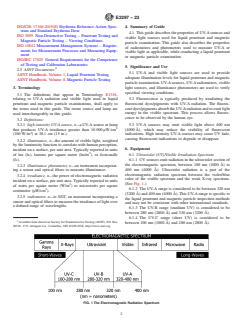
2 (See Fig. 1.)
of watts per square meter (W/m ) or microwatts per square
6.1.2 The UV-A range is considered to be between 320 nm
centimetre (μW/cm ).
(3200 Å) and 400 nm (4000 Å). This UV-A range is specific to
3.2.5 radiometer, n—in NDT, an instrument incorporating a
the liquid penetrant and magnetic particle inspection methods
sensor and optical filters to measure the irradiance of light over
and may not be consistent with other international standards.
a defined range of wavelengths.
6.1.3 The UV-B range (medium UV) is considered to be
between 280 nm (2800 Å) and 320 nm (3200 Å).
6.1.4 The UV-C range (short UV) is considered to be
Available from American Society for Nondestructive Testing (ASNT), P.O. Box
between 100 nm (1000 Å) and 280 nm (2800 Å).
28518, 1711 Arlingate Ln., Columbus, OH 43228-0518, http://www.asnt.org.
FIG. 1 The Electromagnetic Radiation Spectrum
E2297 − 23
6.1.5 The visible spectrum is considered to be between visible light in the 450 to 760 nm (4500 to 7600 Å) range, but
400 nm (4000 Å) and 760 nm (7600 Å). This range of visible do not effectively transmit light in the 350 to 380 nm (3500 to
light is specific to the liquid penetrant and magnetic particle 3800 Å) range.
inspection methods and may not be consistent with other 6.3.3 Three non-traditional light guide materials for im-
international standards.
proved UV-A transmission in borescopes, fiberscopes, or
video-image-scopes, are liquid light guides, silica or quartz
6.2 Mercury Vapor UV-A Sources
fibers, or special new glass fibers.
6.2.1 Mercury vapor UV-A sources utilize a lamp contain-
6.3.3.1 Silica or quartz fibers are good transmitters of UV-A
ing a mercury-gas plasma that emits radiation specific to the
energy, but are brittle and cannot be bent into a tight radius
mercury atomic transition spectrum. There are several discrete
without breaking, nor can they accommodate the punishing
element emission lines of the mercury spectrum in the ultra-
stresses of repeated scope articulation.
violet section of the electromagnetic spectrum. The irradiance
6.3.3.2 Liquid light guides are very effective transmitters of
output is dependent on the gas pressure and the amount of
UV-A, but have minimum diameter limitations at 2.5 mm and
mercury content. Higher values of gas pressure and mercury
also exhibit problems with collapsing, kinking, or loss of
content result in significant increase in its UV emission.
fluids.
Irradiance output is also dependent on the input voltage and the
6.3.3.3 A special glass fiber configuration offers the best UV
age of the lamp bulb. As the bulb ages, mercury diffuses into
performance plus durability. Special glass fiber light bundles
the enclosing glass, causing the emission to decrease.
combine high UV output with the necessary flexibility and
6.2.2 Mercury vapor UV-A sources used for NDT must have
durability required in these scopes.
appropriate filters, either internal or external to the lamp, to
6.3.4 Electronic digital borescopes have one end composed
pass UV-A (6.1.2) and minimize visible light (6.1.5) output that
of a small LED source and a digital embedded camera. As the
is detrimental to the fluorescent inspection process. These
guide only carries electric signals, the length can be several
UV-A pass filters should also block harmful UV-B (6.1.3) and
meters.
UV-C (6.1.4) radiation.
6.2.3 Mercury vapor bulbs used for fluorescent NDT are
6.4 UV-A Pencil Lamps
generally low- or medium-pressure vapor sources.
6.4.1 The pencil lamp is one of the smallest sources of
6.2.3.1 Low-pressure bulbs (fluorescent tubes) are coated
UV-A radiation. It is generally a lamp coated with conversion
with a special phosphor in order to maximize the UV-A output.
phosphors that absorb the 254 nm (2540 Å) line of energy and
Typically, low-pressure lamps are used in wash stations or for
convert this energy into a band peaking at 365 nm (3650 Å).
general UV-A irradiance in the inspection room.
The lamp may be encased in a tubular glass filter that absorbs
6.2.3.2 Medium-pressure bulbs do not have phosphor coat-
visible light while transmitting maximum ultraviolet intensity.
ings but operate at higher electrical power levels, resulting in
The pencil lamp is useful for fluorescent analysis and boro-
significantly higher UV-A output.
scopic inspection in inaccessible locations.
6.2.4 Medium-pressure lamps are typically used for fluores-
NOTE 1—Pencil lamps produce low levels of UV-A radiation.
cent examination. A well designed medium pressure UV-A
lamp with a suitable UV-A pass filter should emit less than 1 %
6.4.2 As with all metal vapor discharge lamps, the output of
of its total intensity outside of the UV-A range. A lamp based a quartz pencil lamp slowly decreases throughout its life. The
on the American National Standards Institute’s Specification H actual useful life will primarily be dependent upon dust and
44 GS-R100, is a 100 watt mercury-vapor bulb in the Par 38 other contaminants collecting on the lamp and its reflecting and
configuration, and normally uses a Kopp 1041 or Kopp 1071 transmissive elements. UV-A intensity loss also occurs as the
UV filter. Other lamps using the same bulb but with an lamp ages.
alternate UV-A pass filter with similar transmission character-
6.5 High Intensity UV-A Sources
istics will not differ greatly in UV-A output, but may produce
6.5.1 Metal Halide UV-A Sources—The high intensity flood
more visible light in the blue/violet part of the spectrum.
fixture normally uses a high wattage metal halide bulb with a
6.3 UV-A Borescope, Fiberscope, or Video-image-scope
reflector. The high intensity of this lamp will produce a great
and Special UV-A Source Systems
deal of heat, so some type of cooling fan must be used.
6.3.1 Borescopes, fiberscopes, and video-image-scopes are
6.5.2 Micro-Discharge (MDL) Lamp UV-A Sources—The
thin rigid or flexible tubular optical telescopes. They are
MDL lamp uses a 35-watt metal halide bulb and therefore
nondestructive inspection quality control instruments for the
produces very little heat. Normally, a cooling fan is not
visual detection of surface discontinuities in small bores,
required. These lamps use a high-pressure arc bulb containing
castings, pipe interiors, and on internal components of complex
xenon gas or a mixture of mercury vapor and xenon gas.
machinery.
6.5.3 High Intensity UV-A lamps have broad emission
6.3.2 The conventional optical glass fiber used as a light
spectra, which may include more than one peak within the
guide in borescopes, fiberscopes, and video image scopes may
UV-A range (6.1.2). For use in fluorescent NDT, these lamps
be a poor transmitter of UV-A radiation. These fibers transmit
must have appropriate filters, either internal or external t
...
This document is not an ASTM standard and is intended only to provide the user of an ASTM standard an indication of what changes have been made to the previous version. Because
it may not be technically possible to adequately depict all changes accurately, ASTM recommends that users consult prior editions as appropriate. In all cases only the current version
of the standard as published by ASTM is to be considered the official document.
Designation: E2297 − 15 E2297 − 23
Standard Guide for
Use of UV-A and Visible Light Sources and Meters used in
the Liquid Penetrant and Magnetic Particle Methods
This standard is issued under the fixed designation E2297; the number immediately following the designation indicates the year of
original adoption or, in the case of revision, the year of last revision. A number in parentheses indicates the year of last reapproval. A
superscript epsilon (´) indicates an editorial change since the last revision or reapproval.
1. Scope*
1.1 This guide describesaddresses the use of UV-A/Visible light sources and meters used for the examination of materials by the
liquid penetrant and magnetic particle processes. This guide may be used to help support the needs for appropriate light intensities
and light measurement.establish practices and procedures to measure irradiance and illuminance levels.
1.2 This guide also provides acts as a reference:
1.2.1 To assist in the selection of light irradiance and illumination sources and meters that meet the applicable specifications or
standards.
1.2.2 For use in the preparation of internal documentation dealing with liquid penetrant or magnetic particle examination of
materials and parts.
1.3 Units—The values stated in SI units are to be regarded as standard. The values given in parentheses are mathematical
conversions to inch-pound units that are provided for information only and are not considered standardstandard.
1.4 This standard does not purport to address all of the safety concerns, if any, associated with its use. It is the responsibility
of the user of this standard to establish appropriate safety and healthsafety, health, and environmental practices and determine
the applicability of regulatory limitations prior to use.
1.5 This international standard was developed in accordance with internationally recognized principles on standardization
established in the Decision on Principles for the Development of International Standards, Guides and Recommendations issued
by the World Trade Organization Technical Barriers to Trade (TBT) Committee.
2. Referenced Documents
2.1 ASTM Standards:
E165 Practice for Liquid Penetrant Testing for General Industry
E709 Guide for Magnetic Particle Testing
E1208 Practice for Fluorescent Liquid Penetrant Testing Using the Lipophilic Post-Emulsification Process
E1209 Practice for Fluorescent Liquid Penetrant Testing Using the Water-Washable Process
E1210 Practice for Fluorescent Liquid Penetrant Testing Using the Hydrophilic Post-Emulsification Process
This guide is under the jurisdiction of ASTM Committee E07 on Nondestructive Testing and is the direct responsibility of Subcommittee E07.03 on Liquid Penetrant
and Magnetic Particle Methods.
Current edition approved July 15, 2015Jan. 15, 2023. Published September 2015March 2023. Originally approved 2004. Last previous edition approved in 20102015 as
E22973–04(2010).E2297 – 15. DOI: 10.1520/E2297-15.10.1520/E2297-23.
For referenced ASTM standards, visit the ASTM website, www.astm.org, or contact ASTM Customer Service at service@astm.org. For Annual Book of ASTM Standards
volume information, refer to the standard’s Document Summary page on the ASTM website.
*A Summary of Changes section appears at the end of this standard
Copyright © ASTM International, 100 Barr Harbor Drive, PO Box C700, West Conshohocken, PA 19428-2959. United States
E2297 − 23
E1219 Practice for Fluorescent Liquid Penetrant Testing Using the Solvent-Removable Process
E1220 Practice for Visible Penetrant Testing Using Solvent-Removable Process
E1316 Terminology for Nondestructive Examinations
E1417E1417/E1417M Practice for Liquid Penetrant Testing
E1418 Practice for Visible Penetrant Testing Using the Water-Washable Process
E1444E1444/E1444M Practice for Magnetic Particle Testing for Aerospace
E3022 Practice Forfor Measurement of Emission Characteristics and Requirements for LED UV-A Lamps Used in Fluorescent
Penetrant and Magnetic Particle Testing
E3024 Practice for Magnetic Particle Testing for General Industry
2.2 ANSI Standard:
ANSI/NCSL Z540.3 Requirements for the Calibration of Measuring and Test Equipment
2.3 ICNIRP Document:
International Commission on Nonionizing Radiation Protection Statement (ICNIRP Publication-2010) on Protection of Workers
Against Ultraviolet Radiation
2.4 ISO/IEC Standards:
IEC 62471 Photobiological Safety of Lamps and Lamp Systems
ISO/CIE 17166:2019(E) Erythema Reference Action Spectrum and Standard Erythema Dose
ISO 3059 Non-Destructive Testing – Penetrant Testing and Magnetic Particle Testing – Viewing Conditions
ISO 10012 Measurement Management Systems – Requirements for Measurement Processes and Measuring Equipment
ISO/IEC 17025 General Requirements for the Competence of Testing and Calibration Laboratories
2.5 ASNT Documents:
ASNT Handbook, Volume 1, Liquid Penetrant Testing
ASNT Handbook, Volume 8, Magnetic Particle Testing
3. Terminology
3.1 The definitions that appear in Terminology E1316, relating to UV-A radiation and visible light used in liquid penetrant and
magnetic particle examinations, shall apply to the terms used in this guide. The terms source and lamp are used interchangeably
in this guide.
3.2 Definitions:
3.2.1 high-intensity UV-A source—source, n—a light source UV-A source or lamp that produces UV-A irradiance greater than
2 2
10 000 μW ⁄cm (100 W ⁄m ) at 38.1 cm (15 in.).
3.2.2 illuminance—illuminance, n—the amount of visible light, weighted by the luminosity function to correlate with human
perception, incident on a surface, per unit area. Typically reported in units of lux (lx), lumens per square metremeter (lm/m )), or
footcandle (fc).
3.2.3 illuminance photometer, n—an instrument incorporating a sensor and optical filters to measure illuminance.
3.2.4 irradiance—irradiance, n—the power of electromagnetic radiation incident on a surface, per unit area. Typically reported
2 2
in units of watts per square metremeter (W/m ) or microwatts per square centimetre (μW/cm ).
3.2.5 radiometer—radiometer, n—in NDT, an instrument incorporating a sensor and optical filters to measure the irradiance of
light over a defined range of wavelengths.
4. Summary of Guide
4.1 This guide describes the properties of UV-A sources and visible light sources used for liquid penetrant and magnetic particle
Available from American National Standards Institute (ANSI), 25 W. 43rd St., 4th Floor, New York, NY 10036, http://www.ansi.org.
Available from International Commission on Nonionizing Radiation Protection (ICNIRP), https://www.icnirp.org.
Available from International Organization for Standardization (ISO), ISO Central Secretariat, Chemin de Blandonnet 8, CP 401, 1214 Vernier, Geneva, Switzerland,
https://www.iso.org.
Available from American Society for Nondestructive Testing (ASNT), P.O. Box 28518, 1711 Arlingate Ln., Columbus, OH 43228-0518, http://www.asnt.org.
E2297 − 23
examination. This guide also describes the properties of radiometers and light meters used to determine if adequate light levels
(UV-A or visible, or both) are present photometers used to measure UV-A or visible light as applicable, while conducting a liquid
penetrant or magnetic particle examination.
5. Significance and Use
5.1 UV-A and visible light sources are used to provide adequate lightillumination levels for liquid penetrant and magnetic particle
examination. Radiometers and light metersUV-A sources, UV-A radiometers, visible light sources, and illuminance photometers
are used to verify that specified light levels are available.specified viewing conditions.
5.2 Fluorescence is typically produced by irradiating the fluorescent dyes/pigments with UV-A radiation. The fluorescent
dyes/pigments absorb the energy from the UV-A radiation and re-emit light energy in the visible spectrum. This energy transfer
process allows fluorescence to be observed by the human eye.
5.3 UV-A light sources may emit visible light above 400 nm (400 Å), (4000 Å), which may reduce the visiblityvisibility of
fluorescent indications. High intensity UV-A light sources may cause UV fade, causing fluorescent indications to degrade or
disappear.
6. Equipment
6.1 Ultraviolet (UV)/Visible LightIrradiation Spectrum
6.1.1 UV light sources emit radiation in the ultraviolet section of the electromagnetic spectrum, between 180 nm (1800100 nm
(1000 Å) to 400 nm (4000 Å). Ultraviolet radiation is a part of the electromagnetic radiation spectrum between the violet/blue color
of the visible spectrum and the weak X-ray spectrum. (See Fig. 1.)
6.1.2 The UV-A range is considered to be between 320 nm (3200 Å) and 400 nm (4000 Å). This UV-A range is specific to the
liquid penetrant and magnetic particle inspection methods and may not be consistent with other international standards.
6.1.3 The UV-B range (medium UV) is considered to be between 280 nm (2800 Å) and 320 nm (3200 Å).
6.1.4 The UV-C range (short UV) is considered to be between 180 nm (1800100 nm (1000 Å) and 280 nm (2800 Å).
6.1.5 The visible spectrum is considered to be between 400 nm (4000 Å) and 760 nm (7600 Å). This range of visible light is
specific to the liquid penetrant and magnetic particle inspection methods and may not be consistent with other international
standards.
6.2 Mercury Vapor UV-A Sources
6.2.1 Most Mercury vapor UV-A sources utilize a lamp containing a mercury-gas plasma that emits radiation specific to the
mercury atomic transition spectrum. There are several discrete element emission lines of the mercury spectrum in the ultraviolet
FIG. 1 The Electromagnetic Radiation Spectrum
E2297 − 23
section of the electromagnetic spectrum. The irradiance output is dependent on the gas pressure and the amount of mercury content.
Higher values of gas pressure and mercury content result in significant increase in its UV emission. Irradiance output is also
dependent on the input voltage and the age of the lamp bulb. As the bulb ages, mercury diffuses into the enclosing glass, causing
the emission to decrease.
6.2.2 Mercury vapor UV-A sources used for NDT must have appropriate filters, either internal or external to the light source, lamp,
to pass UV-A (6.1.2) and minimize visible light (6.1.5) output that is detrimental to the fluorescent inspection process. These UV-A
pass filters should also block harmful UV-B (6.1.3) and UV-C (6.1.4) radiation.
6.2.3 Mercury vapor bulbs used for fluorescent NDT are generally low- or medium-pressure vapor sources.
6.2.3.1 Low-pressure bulbs (luminescent(fluorescent tubes) are coated with a special phosphor in order to maximize the UV-A
output. Typically, low-pressure lamps are used in wash stations or for general UV-A lightingirradiance in the inspection room.
6.2.3.2 Medium-pressure bulbs do not have phosphor coatings but operate at higher electrical power levels, resulting in
significantly higher UV-A output.
6.2.4 Medium-pressure lamps are typically used for fluorescent examination. A well designed medium pressure UV-A lamp with
a suitable UV-A pass filter should emit less than 0.25 % to 1 % of its total intensity outside of the UV-A range. A typical lamp is
based on the American National Standards Institute’s Specification H 44 GS-R100, is a 100 watt mercury-vapor bulb in the Par
38 configuration, and normally uses a Kopp 1041 or Kopp 1071 UV filter. Other lamps using the same bulb but with an alternate
UV-A pass filter with similar transmission characteristics, or bulbs based on the Philips HPW 125-watt bulbcharacteristics will not
differ greatly in UV-A output, but may produce more visible light in the blue/violet part of the spectrum.
NOTE 1—The Philips HPW 125-watt bulb has been restricted from use in the inspection station by many aerospace companies.
6.3 UV-A Borescope, Fiberscope, or Video-image-scope and Special UV-A Light Source Systems
6.3.1 Borescopes, fiberscopes, and video-image-scopes are thin rigid or flexible tubular optical telescopes. They are non
destructive nondestructive inspection quality control instruments for the visual detection of surface discontinuities in small bores,
castings, pipe interiors, and on internal components of complex machinery.
6.3.2 The conventional optical glass fiber used as a light guide in borescopes, fiberscopes, and video image scopes may be a poor
transmitter of UV-A radiation. These fibers transmit whitevisible light in the 450 to 760 nm (4500 to 7600 Å) range, but do not
effectively transmit light in the 350 to 380 nm (3500 to 3800 Å) range.
6.3.3 Three non traditional non-traditional light guide materials for improved UV-A transmission in borescopes, fiberscopes, or
video-image-scopes, are liquid light guides, silica or quartz fibers, or special new glass fibers.
6.3.3.1 Silica or quartz fibers are good transmitters of UV-A energy, but are brittle and cannot be bent into a tight radius without
breaking, nor can they accommodate the punishing stresses of repeated scope articulation.
6.3.3.2 Liquid light guides are very effective transmitters of UV-A, but have minimum diameter limitations at 2.5 mm and also
exhibit problems with collapsing, kinking, or loss of fluids.
6.3.3.3 A special glass fiber configuration offers the best UV performance plus durability. Special glass fiber light bundles combine
high UV output with the necessary flexibility and durability required in these scopes.
6.3.4 Electronic digital borescopes have one end composed of a small LED source and a digital embedded camera. As the guide
only carries electric signals, the length can be several meters.
6.4 UV-A Pencil Lamps
6.4.1 The pencil lamp is one of the smallest sources of UV-A radiation. It is generally a lamp coated with conversion phosphors
that absorb the 254 nm (2540 Å) line of energy and convert this energy into a band peaking at 365 nm (3650 Å). The lamp may
Kopp 1041 UV and Kopp 1071 UV are registered trademarks of Kopp Glass Inc., Pittsburgh, PA.
E2297 − 23
be encased in a tubular glass filter that absorbs visible light while transmitting maximum ultraviolet intensity. The pencil lamp is
useful for fluorescent analysis and boroscopic inspection in inaccessible locations.
NOTE 1—Pencil Lampslamps produce low levels of UV-A radiation.
6.4.2 As with all metal vapor discharge lamps, the output of a quartz pencil lamp slowly decreases throughout its life. The actual
useful life will primarily be dependent upon dust and other contaminants collecting on the lamp and its reflecting and transmissive
elements. UV-A intensity loss also occurs as the lamp ages.
6.5 High Intensity UV-A Light Sources
6.5.1 Metal Halide UV-A Sources: Sources—The high intensity flood fixture normally uses a high wattage metal halide bulb. This
lamp will also contain some type of specially coated parabolic bulb with a reflector. The high intensity of this lamp will produce
a great deal of heat, so some type of cooling fan must be used.
6.5.2 Micro-Discharge (MDL) Lamp UV-A Sources: Sources—The MDL lamp uses a 35 watt 35-watt metal halide bulb and
therefore produces very little heat. Normally, a cooling fan is not required. These lamps use a high-pressure arc bulb containing
xenon gas or a mixture of mercury vapor and xenon gas.
6.5.3 Xenon Bulb UV-A Sources: These lamps use a high-pressure arc bulb containing xenon gas or a mixture of mercury vapor
and xenon gas.
6.5.3 High Intensity UV-A sourceslamps have broad emission spectra, which may include more than one peak within the UV-A
range (6.1.2). For use in fluorescent NDT, these lamps must have appropriate filters, either internal or external to the light source,
to pass UV-A (6.1.2) and minimize visible light (6.1.5) output that is detrimental to the fluorescent inspection process. These UV-A
filters should also block harmful UV-B (6.1.3) and UV-C (6.1.4) radiation.
Warning—UV-A light sources may emit visible light above 400 nm (4000 Å), which may reduce the visibility of fluorescent
indications. High intensity UV-A sources may cause UV fade, causing fluorescent indications to disappear.Caution—UV-A
sources may emit visible light above 400 nm (4000 Å), which may reduce the visibility of fluorescent indications. High intensity
UV-A sources may cause UV fade, causing fluorescent
...