

ASTM E3025-22
(Guide)Standard Guide for Tiered Approach to Detection and Characterization of Silver Nanomaterials in Textiles
General Information
- Abstract
SIGNIFICANCE AND USE
4.1 Natural and manufactured textiles fibers can be treated with chemicals to provide enhanced antimicrobial (fungi, bacteria, viruses) properties. In some cases, silver nanomaterials may be used to treat textile fibers (1).6 Silver nanomaterials are used to treat a wide array of consumer textile products, including, but not limited to, various clothing; primary garments (shirts, pants), outer wear (gloves, jackets), inner wear (socks and underwear), children’s clothing (sleepwear); children’s plush toys; bath towels and bedding (sheets, pillows); and medical devices (for example, wound dressings and face masks) (2).
4.2 There are many different chemical and physical forms of silver that are used to treat textiles and an overview of this topic is provided in Appendix X1.
4.3 Several applicable techniques for detection and characterization of silver are listed and described in Appendix X2 so that users of this guide may understand the suitability of a particular technique for their specific textile and silver measurement need.
4.4 There are many different reasons to assay for silver nanomaterials in a textile at any point in a product’s life cycle. For example, a producer may want to verify that a textile meets their internal quality control specifications or a regulator may want to understand the properties of silver nanomaterials used to make a consumer textile product under their jurisdiction or what quantity of silver nanomaterial is potentially available for release from the treated textile during the washing process or during product use. Regardless of the specific reason, a structured approach to detect and characterize silver nanomaterials present in a textile will facilitate measurements and data comparison. Detection and characterterization of silver in textiles is one component of an overall risk assessment.
4.5 The approach presented in this guide (see Fig. 1) consists of three sequential tiers: obtain a textile sample (Section 7), detection o...
SCOPE
1.1 This guide covers the use of a tiered approach for detection and characterization of silver nanomaterials in consumer textile products, which can include some medical devices (for example, wound dressings or face masks), made of any combination of natural or manufactured fibers.
1.2 This guide covers, but is not limited to, fabrics and parts (for example, thread, batting) used during the manufacture of textiles and production of consumer textile products that may contain silver-based nanomaterials. It does not apply to analysis of silver nanomaterials in non-consumer textile product matrices nor does it cover thin film silver coatings with only one dimension in the nanoscale.
1.3 This guide is intended to serve as a resource for manufacturers, producers, analysts, policymakers, regulators, and others with an interest in textiles.
1.4 This guide is presented in the specific context of measurement of silver nanomaterials; however, the structured approach described herein is applicable to other nanomaterials in consumer textile products, including some medical devices.
1.5 Units—The values stated in SI units are to be regarded as standard. No other units of measurement are included in this standard.
1.6 This standard does not purport to address all of the safety concerns, if any, associated with its use. It is the responsibility of the user of this standard to establish appropriate safety, health, and environmental practices and determine the applicability of regulatory limitations prior to use.
1.7 This international standard was developed in accordance with internationally recognized principles on standardization established in the Decision on Principles for the Development of International Standards, Guides and Recommendations issued by the World Trade Organization Technical Barriers to Trade (TBT) Committee.
- Status
- Published
- Publication Date
- 14-Nov-2022
- Technical Committee
- E56 - Nanotechnology
- Drafting Committee
- E56.06 - Nano-Enabled Consumer Products
Buy Documents
ASTM E3025-22 - Standard Guide for Tiered Approach to Detection and Characterization of Silver Nanomaterials in Textiles
REDLINE ASTM E3025-22 - Standard Guide for Tiered Approach to Detection and Characterization of Silver Nanomaterials in Textiles
Overview
ASTM E3025-22: Standard Guide for Tiered Approach to Detection and Characterization of Silver Nanomaterials in Textiles provides a comprehensive, structured methodology for identifying and analyzing silver nanomaterials in consumer textile products. This guide is particularly relevant for textiles treated with silver to impart enhanced antimicrobial properties, covering natural and manufactured fibers as well as medical textiles such as wound dressings and face masks.
By utilizing a tiered, stepwise approach, ASTM E3025-22 enables manufacturers, analysts, regulators, and other stakeholders to select suitable, commercially available analytical techniques for both detection and detailed characterization of silver nanomaterials in textiles. The standard also improves consistency in measurement and data interpretation within the field of nano-enabled textiles.
Key Topics
- Tiered Analytical Strategy: Emphasizes a cost-effective, progressive method for detecting and characterizing silver nanomaterials in textiles, minimizing unnecessary testing.
- Sampling Guidance: Provides best practices for obtaining representative textile samples from various stages in the product life cycle, accounting for the potential heterogeneity in silver distribution.
- Detection of Silver: Discusses multiple qualitative and quantitative techniques for detecting silver, including bulk analytical methods and more sensitive confirmatory techniques.
- Characterization of Nanomaterials: Details methods for determining the physical and chemical properties of silver nanomaterials, such as particle size, distribution, shape, and chemical form.
- Data Reporting: Specifies essential reporting elements to ensure transparency, repeatability, and comparability of results.
- Applicability: Designed for stakeholders ranging from manufacturers and quality assurance specialists to regulators and policymakers.
Applications
The tiered approach outlined in ASTM E3025-22 has broad application within the textile industry and related sectors:
- Antimicrobial Textiles: Verification and characterization of silver nanomaterials in products such as athletic wear, hospital linens, socks, and bedding, where silver is used to reduce microbial growth.
- Medical Devices: Application to textiles used in wound dressings, face masks, and other healthcare textiles requiring antimicrobial properties.
- Quality Control: Supports internal quality assurance programs by confirming the presence and characterization of silver nanomaterials against claimed specifications.
- Regulatory Compliance: Facilitates consistent data generation for products subject to national and international regulations on nanomaterials in consumer goods.
- Risk Assessment: Enables robust measurement strategies essential for evaluating potential exposure and release of silver nanomaterials during textile use, laundering, or disposal.
Related Standards
ASTM E3025-22 references and aligns with several other significant standards and guidelines to promote methodological consistency:
- ASTM D123: Terminology Relating to Textiles.
- ASTM D6413: Test Method for Flame Resistance of Textiles (Vertical Test).
- AATCC 135: Dimensional Changes of Fabrics after Home Laundering.
- ISO/TS 80004-1: Nanotechnologies-Vocabulary.
- ISO/IEC Guide 99: International Vocabulary of Metrology (VIM).
- ISO/DTR 18196: Nanotechnologies-Measurement Technique Matrix for Nano-Objects.
- U.S. 16 CFR Parts 1615, 1616: Flammability Standards for Children’s Sleepwear.
These standards collectively underpin the selection of terminology, sampling techniques, and measurement methodologies for the detection and characterization of silver and other nanomaterials in textiles.
Keywords: ASTM E3025-22, silver nanomaterials, textiles, antimicrobial textiles, detection methods, characterization, tiered approach, quality control, regulatory compliance, nano-enabled textiles.
Relations
- Effective Date
- 01-Mar-2017
- Effective Date
- 15-Sep-2015
- Effective Date
- 01-Sep-2015
- Effective Date
- 01-Apr-2015
- Effective Date
- 15-Jun-2013
- Effective Date
- 15-Jun-2013
- Effective Date
- 15-May-2013
- Effective Date
- 01-Feb-2012
- Effective Date
- 01-Feb-2012
- Effective Date
- 15-Oct-2011
- Effective Date
- 01-Jul-2011
- Effective Date
- 15-Jan-2009
- Effective Date
- 15-Jan-2009
- Effective Date
- 15-Jan-2009
- Effective Date
- 15-Jul-2008
Buy Documents
ASTM E3025-22 - Standard Guide for Tiered Approach to Detection and Characterization of Silver Nanomaterials in Textiles
REDLINE ASTM E3025-22 - Standard Guide for Tiered Approach to Detection and Characterization of Silver Nanomaterials in Textiles
Get Certified
Connect with accredited certification bodies for this standard

Control Union Certifications
Global certification for agriculture and sustainability.

Hohenstein Institut
Textile testing and certification.

Bureau Veritas Bangladesh
Bureau Veritas certification services in Bangladesh.
Sponsored listings
Frequently Asked Questions
ASTM E3025-22 is a guide published by ASTM International. Its full title is "Standard Guide for Tiered Approach to Detection and Characterization of Silver Nanomaterials in Textiles". This standard covers: SIGNIFICANCE AND USE 4.1 Natural and manufactured textiles fibers can be treated with chemicals to provide enhanced antimicrobial (fungi, bacteria, viruses) properties. In some cases, silver nanomaterials may be used to treat textile fibers (1).6 Silver nanomaterials are used to treat a wide array of consumer textile products, including, but not limited to, various clothing; primary garments (shirts, pants), outer wear (gloves, jackets), inner wear (socks and underwear), children’s clothing (sleepwear); children’s plush toys; bath towels and bedding (sheets, pillows); and medical devices (for example, wound dressings and face masks) (2). 4.2 There are many different chemical and physical forms of silver that are used to treat textiles and an overview of this topic is provided in Appendix X1. 4.3 Several applicable techniques for detection and characterization of silver are listed and described in Appendix X2 so that users of this guide may understand the suitability of a particular technique for their specific textile and silver measurement need. 4.4 There are many different reasons to assay for silver nanomaterials in a textile at any point in a product’s life cycle. For example, a producer may want to verify that a textile meets their internal quality control specifications or a regulator may want to understand the properties of silver nanomaterials used to make a consumer textile product under their jurisdiction or what quantity of silver nanomaterial is potentially available for release from the treated textile during the washing process or during product use. Regardless of the specific reason, a structured approach to detect and characterize silver nanomaterials present in a textile will facilitate measurements and data comparison. Detection and characterterization of silver in textiles is one component of an overall risk assessment. 4.5 The approach presented in this guide (see Fig. 1) consists of three sequential tiers: obtain a textile sample (Section 7), detection o... SCOPE 1.1 This guide covers the use of a tiered approach for detection and characterization of silver nanomaterials in consumer textile products, which can include some medical devices (for example, wound dressings or face masks), made of any combination of natural or manufactured fibers. 1.2 This guide covers, but is not limited to, fabrics and parts (for example, thread, batting) used during the manufacture of textiles and production of consumer textile products that may contain silver-based nanomaterials. It does not apply to analysis of silver nanomaterials in non-consumer textile product matrices nor does it cover thin film silver coatings with only one dimension in the nanoscale. 1.3 This guide is intended to serve as a resource for manufacturers, producers, analysts, policymakers, regulators, and others with an interest in textiles. 1.4 This guide is presented in the specific context of measurement of silver nanomaterials; however, the structured approach described herein is applicable to other nanomaterials in consumer textile products, including some medical devices. 1.5 Units—The values stated in SI units are to be regarded as standard. No other units of measurement are included in this standard. 1.6 This standard does not purport to address all of the safety concerns, if any, associated with its use. It is the responsibility of the user of this standard to establish appropriate safety, health, and environmental practices and determine the applicability of regulatory limitations prior to use. 1.7 This international standard was developed in accordance with internationally recognized principles on standardization established in the Decision on Principles for the Development of International Standards, Guides and Recommendations issued by the World Trade Organization Technical Barriers to Trade (TBT) Committee.
SIGNIFICANCE AND USE 4.1 Natural and manufactured textiles fibers can be treated with chemicals to provide enhanced antimicrobial (fungi, bacteria, viruses) properties. In some cases, silver nanomaterials may be used to treat textile fibers (1).6 Silver nanomaterials are used to treat a wide array of consumer textile products, including, but not limited to, various clothing; primary garments (shirts, pants), outer wear (gloves, jackets), inner wear (socks and underwear), children’s clothing (sleepwear); children’s plush toys; bath towels and bedding (sheets, pillows); and medical devices (for example, wound dressings and face masks) (2). 4.2 There are many different chemical and physical forms of silver that are used to treat textiles and an overview of this topic is provided in Appendix X1. 4.3 Several applicable techniques for detection and characterization of silver are listed and described in Appendix X2 so that users of this guide may understand the suitability of a particular technique for their specific textile and silver measurement need. 4.4 There are many different reasons to assay for silver nanomaterials in a textile at any point in a product’s life cycle. For example, a producer may want to verify that a textile meets their internal quality control specifications or a regulator may want to understand the properties of silver nanomaterials used to make a consumer textile product under their jurisdiction or what quantity of silver nanomaterial is potentially available for release from the treated textile during the washing process or during product use. Regardless of the specific reason, a structured approach to detect and characterize silver nanomaterials present in a textile will facilitate measurements and data comparison. Detection and characterterization of silver in textiles is one component of an overall risk assessment. 4.5 The approach presented in this guide (see Fig. 1) consists of three sequential tiers: obtain a textile sample (Section 7), detection o... SCOPE 1.1 This guide covers the use of a tiered approach for detection and characterization of silver nanomaterials in consumer textile products, which can include some medical devices (for example, wound dressings or face masks), made of any combination of natural or manufactured fibers. 1.2 This guide covers, but is not limited to, fabrics and parts (for example, thread, batting) used during the manufacture of textiles and production of consumer textile products that may contain silver-based nanomaterials. It does not apply to analysis of silver nanomaterials in non-consumer textile product matrices nor does it cover thin film silver coatings with only one dimension in the nanoscale. 1.3 This guide is intended to serve as a resource for manufacturers, producers, analysts, policymakers, regulators, and others with an interest in textiles. 1.4 This guide is presented in the specific context of measurement of silver nanomaterials; however, the structured approach described herein is applicable to other nanomaterials in consumer textile products, including some medical devices. 1.5 Units—The values stated in SI units are to be regarded as standard. No other units of measurement are included in this standard. 1.6 This standard does not purport to address all of the safety concerns, if any, associated with its use. It is the responsibility of the user of this standard to establish appropriate safety, health, and environmental practices and determine the applicability of regulatory limitations prior to use. 1.7 This international standard was developed in accordance with internationally recognized principles on standardization established in the Decision on Principles for the Development of International Standards, Guides and Recommendations issued by the World Trade Organization Technical Barriers to Trade (TBT) Committee.
ASTM E3025-22 is classified under the following ICS (International Classification for Standards) categories: 07.120 - Nanotechnologies; 59.080.01 - Textiles in general. The ICS classification helps identify the subject area and facilitates finding related standards.
ASTM E3025-22 has the following relationships with other standards: It is inter standard links to ASTM D123-17, ASTM D123-15b, ASTM D123-15a, ASTM D123-15, ASTM D123-13ae1, ASTM D123-13a, ASTM D123-13, ASTM D123-12e1, ASTM D123-12, ASTM D6413-11a, ASTM D6413-11, ASTM D123-09e1, ASTM D123-09, ASTM D123-09e2, ASTM D6413-08. Understanding these relationships helps ensure you are using the most current and applicable version of the standard.
ASTM E3025-22 is available in PDF format for immediate download after purchase. The document can be added to your cart and obtained through the secure checkout process. Digital delivery ensures instant access to the complete standard document.
Standards Content (Sample)
This international standard was developed in accordance with internationally recognized principles on standardization established in the Decision on Principles for the
Development of International Standards, Guides and Recommendations issued by the World Trade Organization Technical Barriers to Trade (TBT) Committee.
Designation: E3025 − 22
Standard Guide for
Tiered Approach to Detection and Characterization of Silver
Nanomaterials in Textiles
This standard is issued under the fixed designation E3025; the number immediately following the designation indicates the year of
original adoption or, in the case of revision, the year of last revision. A number in parentheses indicates the year of last reapproval. A
superscript epsilon (´) indicates an editorial change since the last revision or reapproval.
1. Scope 2. Referenced Documents
1.1 This guide covers the use of a tiered approach for 2.1 ASTM Standards:
detection and characterization of silver nanomaterials in con- D123 Terminology Relating to Textiles
sumer textile products, which can include some medical D6413 Test Method for Flame Resistance of Textiles (Ver-
devices(forexample,wounddressingsorfacemasks),madeof tical Test)
any combination of natural or manufactured fibers.
2.2 AATCC Standards:
AATCC 135 Dimensional Changes of Fabrics after Home
1.2 This guide covers, but is not limited to, fabrics and parts
Laundering
(for example, thread, batting) used during the manufacture of
textiles and production of consumer textile products that may
2.3 ISO Standards:
contain silver-based nanomaterials. It does not apply to analy-
ISO 10136-1 Glass and Glassware—Analysis of Extract
sis of silver nanomaterials in non-consumer textile product
Solutions—Part 1: Determination of Silicon Dioxide by
matrices nor does it cover thin film silver coatings with only
Molecular Absorption Spectrometry
one dimension in the nanoscale.
ISO 16140 Microbiology of Food and Animal Feeding
Stuffs—ProtocolfortheValidationofAlternativeMethods
1.3 This guide is intended to serve as a resource for
ISO/IEC Guide 99 International Vocabulary of Metrology—
manufacturers, producers, analysts, policymakers, regulators,
Basic and General Concepts andAssociated Terms (VIM)
and others with an interest in textiles.
ISO/TR 18196 Nanotechnologies—Measurement Technique
1.4 This guide is presented in the specific context of
Matrix for the Characterization of Nano-Objects
measurement of silver nanomaterials; however, the structured
ISO/TS 80004-1 Nanotechnologies—Vocabulary—Part 1:
approach described herein is applicable to other nanomaterials
Core Terms
in consumer textile products, including some medical devices.
2.4 U.S. Code of Federal Regulations:
1.5 Units—The values stated in SI units are to be regarded
16 CFR Parts 1615 and 1616 Standards for the Flammability
as standard. No other units of measurement are included in this
of Children’s Sleepwear
standard.
3. Terminology
1.6 This standard does not purport to address all of the
safety concerns, if any, associated with its use. It is the
3.1 Definitions—For additional definitions related to
responsibility of the user of this standard to establish appro-
textiles, see Terminology D123; for additional definitions
priate safety, health, and environmental practices and deter-
related to nanotechnology, see ISO/TS 80004-1; and for
mine the applicability of regulatory limitations prior to use.
additional definitions related to measurements, see ISO/IEC
1.7 This international standard was developed in accor-
Guide 99.
dance with internationally recognized principles on standard-
ization established in the Decision on Principles for the
Development of International Standards, Guides and Recom-
For referenced ASTM standards, visit the ASTM website, www.astm.org, or
mendations issued by the World Trade Organization Technical
contact ASTM Customer Service at service@astm.org. For Annual Book of ASTM
Standards volume information, refer to the standard’s Document Summary page on
Barriers to Trade (TBT) Committee.
the ASTM website.
Available from American Association of Textile Chemists and Colorists
(AATCC), P.O. Box 12215, Research Triangle Park, NC 27709-2215, http://
This guide is under the jurisdiction of ASTM Committee E56 on Nanotech- www.aatcc.org.
nology and is the direct responsibility of Subcommittee E56.06 on Nano-Enabled Available fromAmerican National Standards Institute (ANSI), 25 W. 43rd St.,
Consumer Products. 4th Floor, New York, NY 10036, http://www.ansi.org.
Current edition approved Nov. 15, 2022. Published December 2022. Originally Available from U.S. Government Printing Office, Superintendent of
approved in 2016. Last previous edition approved in 2016 as E3025 – 16. DOI: Documents, 732 N. Capitol St., NW, Washington, DC 20401-0001, http://
10.1520/E3025-22. www.access.gpo.gov.
Copyright © ASTM International, 100 Barr Harbor Drive, PO Box C700, West Conshohocken, PA 19428-2959. United States
E3025 − 22
3.1.1 analyte, n—element or constituent to be determined. dren’s plush toys; bath towels and bedding (sheets, pillows);
ISO 10136-1 and medical devices (for example, wound dressings and face
masks) (2).
3.1.2 consumer textile product, n—textile product intended
to satisfy human wants and needs. D123
4.2 Therearemanydifferentchemicalandphysicalformsof
3.1.3 manufactured fiber, n—class name for various genera
silver that are used to treat textiles and an overview of this
of filament, tow, or staple produced from fiber-forming sub-
topic is provided in Appendix X1.
stances that may be: (1) polymers synthesized from chemical
4.3 Several applicable techniques for detection and charac-
compound, (2) modified or transformed natural polymers, or
terization of silver are listed and described in Appendix X2 so
(3) glass. D123
that users of this guide may understand the suitability of a
3.1.4 measurand, n—quantity intended to be measured or a
particular technique for their specific textile and silver mea-
quantity that is being determined by measurement. ISO/IEC
surement need.
Guide 99
4.4 There are many different reasons to assay for silver
3.1.5 nanomaterial, n—material with any external dimen-
nanomaterials in a textile at any point in a product’s life cycle.
sion in the nanoscale or having internal structure or surface
Forexample,aproducermaywanttoverifythatatextilemeets
structure in the nanoscale. ISO/TS 80004-1
their internal quality control specifications or a regulator may
3.1.6 nanoscale, n—range from approximately 1 to 100 nm.
want to understand the properties of silver nanomaterials used
ISO/TS 80004-1
to make a consumer textile product under their jurisdiction or
3.1.7 natural fiber, n—class name for various genera of
what quantity of silver nanomaterial is potentially available for
fibers (including filaments) of (1) animal, (2) mineral, or (3)
release from the treated textile during the washing process or
vegetable origin. D123
during product use. Regardless of the specific reason, a
3.1.8 qualitative method, n—method of analysis whose
structured approach to detect and characterize silver nanoma-
response is either the presence or absence of the analyte
terials present in a textile will facilitate measurements and data
detected either directly or indirectly in a certain amount of
comparison. Detection and characterterization of silver in
sample. ISO 16140
textiles is one component of an overall risk assessment.
3.1.9 quantitative method, n—method of analysis whose
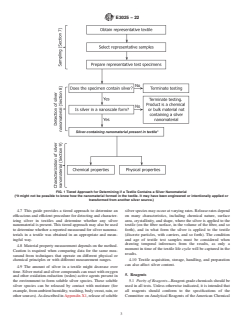
4.5 The approach presented in this guide (see Fig. 1)
response is the amount of the analyte measured either directly
consists of three sequential tiers: obtain a textile sample
(enumeration in a mass or a volume), or indirectly (colour
(Section 7), detection of a silver nanomaterial (Section 8), and
absorbance, impedance, etc.) in a certain amount of sample.
characterization of a silver nanomaterial (Section 9). If no
ISO 16140
forms of silver are detected in a textile sample using appropri-
3.1.10 textile, n—generaltermforfibers,yarnintermediates,
ate (fit for purpose) analytical techniques then testing can be
yarns, fabrics, and products that retain all the strength,
terminated. If silver is detected, but present in a non-nanoscale
flexibility, and other typical properties of the original fibers or
form, the textile is a chemical or bulk silver-containing
filaments. D123
material. Silver ions may be released from silver-containing
3.2 Definitions of Terms Specific to This Standard:
materials, and under reducing conditions these can transform
3.2.1 characterization, n—identification and quantification
into nanoscale silver-containing particles. If nanoscale silver is
ofoneormorerelevantphysicalorchemicalpropertyvaluesof
detected, one concludes that the textile contains a silver
the analyte.
nanomaterial. Subsequent measurements can characterize the
3.2.2 detection, n—qualitative recognition of the presence
chemical and physical properties of the silver nanomaterial.
of the target analyte in a sample.
4.6 Numerous techniques are available to detect and char-
3.2.3 silver, n—element with atomic number 47 that can be
acterize silver nanomaterials in textiles.The breadth of options
in the form of ions, metallic or zero-valent (Ag ), alloys,
can cause confusion for those interested in developing an
composites, oxide, or salt compounds, or combination thereof.
analytical strategy and selecting appropriate techniques. Some
techniques apply only to certain chemical forms of silver and
4. Significance and Use
all have limited ranges of applicability with respect to a
4.1 Natural and manufactured textiles fibers can be treated
measurand. No single technique is suitable to both detect and
with chemicals to provide enhanced antimicrobial (fungi,
fully characterize silver nanomaterials in textiles. This guide
bacteria, viruses) properties. In some cases, silver nanomate-
describes and defines a tiered approach using commercially
rials may be used to treat textile fibers (1). Silver nanomate-
available measurement techniques so that manufacturers,
rialsareusedtotreatawidearrayofconsumertextileproducts,
producers, analysts, policymakers, regulators, and others may
including, but not limited to, various clothing; primary gar-
make informed and appropriate choices in assaying silver
ments (shirts, pants), outer wear (gloves, jackets), inner wear
nanomaterials in textiles within a standardized framework.The
(socks and underwear), children’s clothing (sleepwear); chil-
user is cautioned that this guide does not purport to address all
conceivable textile analysis scenarios and may not be appro-
6 priate for all situations. In all instances, professional judgment
The boldface numbers in parentheses refer to a list of references at the end of
this standard. is necessary.
E3025 − 22
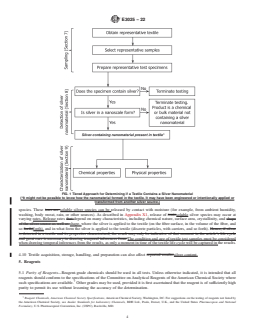
FIG. 1 Tiered Approach for Determining if a Textile Contains a Silver Nanomaterial
(*It might not be possible to know how the nanomaterial formed in the textile. It may have been engineered or intentionally applied or
transformed from another silver source.)
4.7 This guide provides a tiered approach to determine an silver species may occur at varying rates. Release rates depend
efficacious and efficient procedure for detecting and character- on many characteristics, including chemical nature, surface
izing silver in textiles and determine whether any silver area, crystallinity, and shape, where the silver is applied to the
nanomaterial is present. This tiered approach may also be used textile (on the fiber surface, in the volume of the fiber, and so
to determine whether a reported measurand for silver nanoma- forth), and in what form the silver is applied to the textile
terials in a textile was obtained in an appropriate and mean- (discrete particles, with carriers, and so forth). The condition
ingful way. and age of textile test samples must be considered when
drawing temporal inferences from the results, as only a
4.8 Material property measurement depends on the method.
moment in time of the textile life cycle will be captured in the
Caution is required when comparing data for the same mea-
results.
surand from techniques that operate on different physical or
chemical principles or with different measurement ranges. 4.10 Textile acquisition, storage, handling, and preparation
can also affect silver content.
4.9 The amount of silver in a textile might decrease over
time. Silver metal and silver compounds can react with oxygen
5. Reagents
and other oxidation-reduction (redox) active agents present in
the environment to form soluble silver species. These soluble 5.1 Purity of Reagents—Reagent-grade chemicals should be
silver species can be released by contact with moisture (for used in all tests. Unless otherwise indicated, it is intended that
example,fromambienthumidity,washing,bodysweat,rain,or all reagents should conform to the specifications of the
othersources).AsdescribedinAppendixX1,releaseofsoluble Committee on Analytical Reagents of the American Chemical
E3025 − 22
Society where such specifications are available. Other grades sample is known or could be heterogeneous, test specimens
may be used, provided it is first ascertained that the reagent is should be cut from the samples to capture variability. The
of sufficiently high purity to permit its use without lessening locations and dimensions of the test specimens will depend
the accuracy of the determination. upon the specific sample and will be described in the report.
NOTE 1—If the distribution of silver in a textile is known to be
6. Tiered Approach
homogeneous, representative samples (and test specimens) can be cut
6.1 Thistieredapproachisacost-effectivestrategythatuses
from any location of the article, for example, from different locations
across the width of a textile.
progressively more specialized instrumentation to elucidate
whether a silver nanomaterial is present in a textile and to
7.4 Examples of textile, sample, and test specimen collec-
measure its chemical and physical properties (see Fig. 1) (3).
tion practices for processes that span an article’s life cycle are
described in Test Method D6413, AATCC 135, and 16 CFR
6.2 Initially, a robust bulk analytical technique is used for
Parts 1615 and 1616.
qualitative detection of silver regardless of form (for example,
ions,Ag ,AgCl,alloy,composite)orsizeinatextilespecimen.
7.5 Textiles,samples,andtestspecimensshouldbestoredin
a manner that will not alter the properties of any silver present
6.3 If silver is detected in a textile specimen, additional
and potentially bias the intended data collection objectives.
measurements are made to determine if any of it is a silver
Storage considerations include, but are not limited to,
nanomaterial.
temperature, relative humidity, exposure to direct sunlight, and
6.4 If a silver nanomaterial is present in a textile, comple-
atmosphere.
mentary and confirmatory techniques are used to characterize
its chemical and physical properties.
8. Detection
7. Sampling
8.1 Qualitative determination of silver within prepared test
7.1 The first step of the tiered approach is to obtain a textile specimenscanincludeindirectordirectmeasurementmethods,
that represents the life-cycle stage for which measurement is or both. Test specimens should be initially measured using a
needed using an appropriate sampling strategy (Fig. 1). De- robust bulk analytical technique, preferably with capability for
pending upon the user’s specific measurement need, a textile high throughput detection of silver (see Appendix X2 for
may be obtained from the fabric-processing stage, finishing examples). In this step, silver measurements do not need to be
treatment stage, finished lot or end-product stage, or any other made using a quantitative method and do not need to differ-
part of its life cycle. Consider whether to obtain threads, entiate between forms.
decorative trim, and other components used to assemble a
8.1.1 If no silver is detected, a more sensitive bulk analyti-
textile product.The sampling plan should be fit for its intended cal technique [lower method detection limit (MDL)] should be
purpose to deliver the required or specified variation for a
used to determine if silver is present in a test specimen. This
heterogeneous material. confirmatory measurement does not need to be quantitative.
8.1.2 If measurement for silver is below the MDL of the
7.2 Cut the desired number of representative samples from
more sensitive technique, the result serves as confirmation that
the textile using an appropriate sampling strategy that captures
silver is not present in a measureable quantity in the textile
the areas that may contain silver nanomaterials. In the absence
specimen. Therefore, all testing should be terminated at this
of knowledge about the distribution of silver in a textile, a
step.
conservative approach assumes that any silver is distributed
heterogeneously until proven otherwise. If the distribution of
8.2 If silver is qualitatively detected above the MDL of
silverinatextileisknownorassumedtobeheterogeneous,the
either the initial or confirmatory bulk analytical technique,
user should cut samples to capture this variability using some
additional measurements are needed to elucidate the form of
form of random sampling that describes the measurement
silverinthetextilespecimen.Thisstepisnecessarybecause,as
distribution for their specific needs.Apower calculation can be
noted in Appendix X1, textiles may be treated with silver
used to estimate the number of samples needed to achieve a
materialsinformsthatrangefromsilversaltsandnanoparticles
desired level of precision for the user’s specific needs (4).
to micrometer scale silver fibers, and the aforementioned
7.2.1 The locations and dimensions of samples will also
elemental detection step is not designed to discriminate be-
depend upon the size of the specific textile article; they may be
tween physical forms. As such, by itself, detection of silver is
cut from a portion of a large textile (for example, bed linens,
not sufficient to determine whether a textile contains a silver
pants) or it may be the entire textile for smaller articles (for
nanomaterial.
example, finger or palm of a glove).
8.3 Available techniques to determine whether a silver
7.3 Cut the desired number of test specimens from each
nanomaterial is present in a textile include ultraviolet-visible
representative sample. If the distribution of silver in a textile
(UV-vis) absorbance spectroscopy, electron microscopy, scan-
ning probe microscopy, and single particle inductively coupled
plasma-mass spectroscopy (SP-ICP-MS). A summary of these
Reagent Chemicals, American Chemical Society Specifications, American
Chemical Society, Washington, DC. For suggestions on the testing of reagents not
techniques is provided in Appendix X2. The choice of tech-
listed by the American Chemical Society, see Analar Standards for Laboratory
nique might be limited to the type of instrumentation to which
Chemicals, BDH Ltd., Poole, Dorset, U.K., and the United States Pharmacopeia
a user has access, though any measurement made in 8.1 should
and National Formulary, U.S. Pharmacopeial Convention, Inc. (USPC), Rockville,
MD. be confirmed using a more sensitive technique in 8.2.
E3025 − 22
8.4 UV-vis absorbance spectroscopy measures the absor- specimen produced using an ion exchanger treatment are
bance signal due to the surface plasmon resonance (SPR) of carriers and not a silver nanomaterial.
metallic silver nanomaterials. The absorbance wavelength will
8.7.2 Textile treatments with silver salts can include both
shift as particle size increases or if particles agglomerate. This
neat silver salt particles (AgCl, Ag SO , and so forth) and
2 4
technique is applicable if the metallic silver nanomaterial is on
microcomposites composed of salt particles attached to a
or near the surface of the textile fiber and provides only an
carrier material (for example, titanium dioxide). The form of
indirect indication of the presence of metallic silver nanoma-
particles visible in textiles produced using silver salts could be
terials. The absence of an UV-Vis absorbance spectroscopy
neat silver-containing salt particles or silver-containing par-
signal cannot be taken as evidence that a silver nanomaterial is
ticles attached to the carrier material, depending upon the
not present in a textile. If the metallic silver nanomaterial is
treatment application. Chemical detection techniques would be
encased in the volume of the fibers, it will not exhibit SPR.
required to differentiate silver-containing particles from carrier
Further, if silver is present as silver ions or as a silver alloy,
material.
oxide, or salt, these also do not exhibit SPR.
8.7.3 Treatment of textiles with elemental or zero-valent
8.5 SP-ICP-MS is a firmware and software based modifica- silver (Ag ) can involve a variety of physical forms, which
tion of the traditional ICP-MS analytical technique. In SP-ICP- might add complexity to measuring particle dimensions by
MS, the observed steady state signal represents the ionic, microscopy. For example, silver nanomaterials can be incor-
dissolved contribution form of the element (here, Ag) and porated into the volume of the fibers themselves. Determining
discrete peaks or ion plumes represent individual nanopar- the size of elemental silver particles by electron microscopy
ticles. Software algorithms identify and separate the two may be challenging for textiles in which particles were
signals and report the ionic, and dissolved element concentra- incorporated into the volume of the fibers during manufactur-
tions as well as the nanoparticle size, size distribution, and ing. In this situation, an appropriate solvent may be used to
concentration of particles. The intensity of each discrete peak dissolve the fibers without affecting the silver particles and
is proportional to the number of ions detected at the instrument would minimize sample preparation artifacts. The exact sol-
detector as well as to the mass of the particle. This observed vent will depend on the specific type of natural or manufac-
mass to charge ratio is converted to particle size and a plot of tured fiber. For example, spandex fibers can be dissolved using
particle size distribution. SP-ICP-MS is not capable of distin- N,N-dimethylformamide, N,N-dimethylacetamide, or by heat-
guishingprimaryparticlesfromaggregatesoragglomerates.At treating and washing with acetone or ethanol (6).
present, only liquid samples may be analyzed by commercially
8.8 If silver is found in the textile but is not present in a
available SP-ICP-MS instruments and, as such, textiles must
nanoscale form (for example, ions in a carrier or particulate
first be prepared for analysis. To determine silver nanomateri-
with all dimensions >100 nm), then it can be considered a
als in textiles by SP-ICP-MS, one must extract the nanomate-
chemical or bulk silver-containing material. There still may be
rials from the textile or dissolve the textile fibers in an
potentialforreleaseofsilverionsthattransformintonanoscale
appropriate solvent that will not alter the nanomaterial. Ana-
silver-containing particles; see discussion in X1.4.
lysts must prepare dilute liquid suspensions of the nanomate-
rials to prevent coincidence of multiple particles at the detector 8.9 If a portion of the silver-containing particles have any
simultaneously, which results in positive bias of particle size. external dimension in the nanoscale or have internal structure
or surface structure in the nanoscale, then one concludes that
8.6 Among the techniques described in Appendix X2,
silver nanomaterial is present in the textile. This conclusion
electron microscopy and scanning probe microscopy provide
only addresses the dimensional aspect of the silver and does
direct visual confirmation of the form and dimensions of
not address any potential or actual nanoscale-specific chemical
particles, which makes these techniques especially useful for
or physical properties that might exist (see Section 9).
evaluating whether particles are present in nanoscale form.
Employing electron and scanning probe microscopy for visu-
8.10 A textile can contain silver-containing particles in the
alization and measurement of any nanoscale particles present
nanoscale and non-nanoscale form.
in a textile specimen are of particular use since they can be
augmented with chemical detection techniques, such as energy
9. Characterization
dispersive X-ray analysis or selected area electron diffraction
9.1 If a silver nanomaterial is present in a textile, additional
to determine if they actually contain silver. This chemical
measurements can be made to characterize its chemical or
measurement does not need to be quantitative.
physical properties. A summary of several applicable tech-
8.7 The type of treatment (ion exchanger, salt, metal) used
niques for characterizing the chemical and physical properties
on a textile is an important consideration when using electron
of silver nanomaterials is provided in Appendix X2.
microscopy to determine the form and dimensions of silver
present in the detection step of the tiered approach. 9.2 Properties of nanomaterials that may be of interest for
8.7.1 Withsilverionexchangers,silverisappliedtoatextile characterization include bulk elemental composition, surface
+
in the form of discrete silver ions (Ag ) that are distributed composition, speciation, and crystal structure (7), and will
within carrier particles such as porous zeolite or glass. Zeolites depend on the user’s measurement goals. The Organization for
are alumina silicates that are typically in the micrometer scale Economic Cooperation and Development (OECD) published a
(5). Electron microscopy augmented with chemical detection framework in 2019 that the user may wish to refer to when
techniques is useful to verify if visible particles in a textile selecting their measurement goals (8).
E3025 − 22
9.2.1 It is important to recognize that there currently is no units, and crystal form and physico-chemical structure are
chemical analytical technique that can quantitatively differen- qualitative properties, so no units can be assigned.
tiate between amounts (in the bulk or on the surface), species,
9.3 There are numerous physical properties of nanomateri-
or crystal structures of nanoscale and non-nanoscale silver in a
als that may be of interest for characterization, and the specific
textile. Only in the case where all silver in a sample is in the
properties will depend on the user’s measurement goals.
form of a nanomaterial would a measurement correspond only
Among the most commonly cited physical properties for
to nanoscale silver. As such, multiple complementary and
characterization of nanomaterials are size, size distribution,
confirmatory techniques are necessary to characterize the
shape, and spatial distribution (7). In the context of textiles,
chemical properties of silver in textiles.
spatial distribution refers to where the nanomaterial is located
9.2.1.1 Quantitative determination of the total amount of
in the fibers (on the surface, in the fiber volume, and so forth).
silver present in a textile specimen can be assayed using
9.3.1 Direct visualization by electron microscopy or scan-
solution-based techniques that require acid-assisted digestion
ning probe microscopy is the most suitable technique for
of the textile matrix and silver before analysis or certain direct determination of particle physical properties though some
measurement techniques such as X-ray fluorescence spectros-
indirect techniques such as X-ray scattering and spectroscopy
copy
...
This document is not an ASTM standard and is intended only to provide the user of an ASTM standard an indication of what changes have been made to the previous version. Because
it may not be technically possible to adequately depict all changes accurately, ASTM recommends that users consult prior editions as appropriate. In all cases only the current version
of the standard as published by ASTM is to be considered the official document.
Designation: E3025 − 16 E3025 − 22
Standard Guide for
Tiered Approach to Detection and Characterization of Silver
Nanomaterials in Textiles
This standard is issued under the fixed designation E3025; the number immediately following the designation indicates the year of
original adoption or, in the case of revision, the year of last revision. A number in parentheses indicates the year of last reapproval. A
superscript epsilon (´) indicates an editorial change since the last revision or reapproval.
1. Scope
1.1 This guide covers the use of a tiered approach for detection and characterization of silver nanomaterials in consumer textile
products products, which can include some medical devices (for example, wound dressings or face masks), made of any
combination of natural or manufactured fibers.
1.2 This guide covers, but is not limited to, fabrics and parts (for example, thread, batting) used during the manufacture of textiles
and production of consumer textile products that may contain silver-based nanomaterials. It does not apply to analysis of silver
nanomaterials in non-consumer textile product matrices nor does it cover thin film silver coatings with only one dimension in the
nanoscale.
1.3 This guide is intended to serve as a resource for manufacturers, producers, analysts, policymakers, regulators, and others with
an interest in textiles.
1.4 This guide is presented in the specific context of measurement of silver nanomaterials; however, the structured approach
described herein is applicable to other nanomaterials used to treat consumer textile products. in consumer textile products,
including some medical devices.
1.5 Units—The values stated in SI units are to be regarded as standard. No other units of measurement are included in this
standard.
1.6 This standard does not purport to address all of the safety concerns, if any, associated with its use. It is the responsibility
of the user of this standard to establish appropriate safety safety, health, and healthenvironmental practices and determine the
applicability of regulatory limitations prior to use.
1.7 This international standard was developed in accordance with internationally recognized principles on standardization
established in the Decision on Principles for the Development of International Standards, Guides and Recommendations issued
by the World Trade Organization Technical Barriers to Trade (TBT) Committee.
2. Referenced Documents
2.1 ASTM Standards:
D123 Terminology Relating to Textiles
This guide is under the jurisdiction of ASTM Committee E56 on Nanotechnology and is the direct responsibility of Subcommittee E56.06 on Nano-Enabled Consumer
Products.
Current edition approved May 1, 2016Nov. 15, 2022. Published May 2016December 2022. Originally approved in 2016. Last previous edition approved in 2016 as
E3025 – 16. DOI: 10.1520/E3025-16.10.1520/E3025-22.
For referenced ASTM standards, visit the ASTM website, www.astm.org, or contact ASTM Customer Service at service@astm.org. For Annual Book of ASTM Standards
volume information, refer to the standard’s Document Summary page on the ASTM website.
Copyright © ASTM International, 100 Barr Harbor Drive, PO Box C700, West Conshohocken, PA 19428-2959. United States
E3025 − 22
D6413 Test Method for Flame Resistance of Textiles (Vertical Test)
2.2 AATCC Standards:
AATCC 135 Dimensional Changes of Fabrics after Home Laundering
2.3 ISO Standards:
ISO 10136-1 Glass and Glassware—Analysis of Extract Solutions—Part 1: Determination of Silicon Dioxide by Molecular
Absorption Spectrometry
ISO 16140 Microbiology of Food and Animal Feeding Stuffs—Protocol for the Validation of Alternative Methods
ISO/IEC Guide 99 International Vocabulary of Metrology—Basic and General Concepts and Associated Terms (VIM)
ISO/DTRISO/TR 18196 Nanotechnologies—Measurement Technique Matrix for the Characterization of Nano-Objects
ISO/TS 80004-1 Nanotechnologies—Vocabulary—Part 1: Core Terms
2.4 U.S. Code of Federal Regulations:
16 CFR Parts 1615 and 1616 Standards for the Flammability of Children’s Sleepwear
3. Terminology
3.1 Definitions—For additional definitions related to textiles, see Terminology D123; for additional definitions related to
nanotechnology, see ISO/TS 80004-1; and for additional definitions related to measurements, see ISO/IEC Guide 99.
3.1.1 analyte, n—element or constituent to be determined. ISO 10136-1
3.1.2 consumer textile product, n—textile product intended to satisfy human wants and needs. D123
3.1.3 manufactured fiber, n—class name for various genera of filament, tow, or staple produced from fiber-forming substances that
may be: (1) polymers synthesized from chemical compound, (2) modified or transformed natural polymers, or (3) glass. D123
3.1.4 measurand, n—quantity intended to be measured or a quantity that is being determined by measurement. ISO/IEC Guide
3.1.5 nanomaterial, n—material with any external dimension in the nanoscale or having internal structure or surface structure in
the nanoscale. ISO/TS 80004-1
3.1.6 nanoscale, n—range from approximately 1 to 100 nm. ISO/TS 80004-1
3.1.7 natural fiber, n—class name for various genera of fibers (including filaments) of (1) animal, (2) mineral, or (3) vegetable
origin. D123
3.1.8 qualitative method, n—method of analysis whose response is either the presence or absence of the analyte detected either
directly or indirectly in a certain amount of sample. ISO 16140
3.1.9 quantitative method, n—method of analysis whose response is the amount of the analyte measured either directly
(enumeration in a mass or a volume), or indirectly (colour absorbance, impedance, etc.) in a certain amount of sample. ISO 16140
3.1.10 textile, n—general term for fibers, yarn intermediates, yarns, fabrics, and products that retain all the strength, flexibility, and
other typical properties of the original fibers or filaments. D123
3.2 Definitions of Terms Specific to This Standard:
3.2.1 characterization, n—identification and quantification of one or more relevant physical or chemical property values of the
analyte.
3.2.2 detection, n—qualitative recognition of the presence of the target analyte in a sample.
3.2.3 silver, n—element with atomic number 47 that can be in the form of ions, metallic or zero-valent (Ag ), alloys, composites,
oxide, or salt compounds, or combination thereof.
Available from American Association of Textile Chemists and Colorists (AATCC), P.O. Box 12215, Research Triangle Park, NC 27709-2215, http://www.aatcc.org.
Available from American National Standards Institute (ANSI), 25 W. 43rd St., 4th Floor, New York, NY 10036, http://www.ansi.org.
Available from U.S. Government Printing Office, Superintendent of Documents, 732 N. Capitol St., NW, Washington, DC 20401-0001, http://www.access.gpo.gov.
E3025 − 22
4. Significance and Use
4.1 Natural and manufactured textiles fibers can be treated with chemicals to provide enhanced antimicrobial (fungi, bacteria,
viruses) properties. In some cases, silver nanomaterials may be used to treat textile fibers (1). Silver nanomaterials are used to
treat a wide array of consumer textile products, including, but not limited to, various clothing; primary garments (shirts, pants),
outer wear (gloves, jackets), inner wear (socks and underwear), children’s clothing (sleepwear); children’s plush toys; bath towels
and bedding (sheets, pillows); and medical devices (wound dressings) (for example, wound dressings and face masks) (2).
4.2 There are many different chemical and physical forms of silver that are used to treat textiles and an overview of this topic is
provided in Appendix X1.
4.3 Several applicable techniques for detection and characterization of silver are listed and described in Appendix X2 so that users
of this guide may understand the suitability of a particular technique for their specific textile and silver measurement need.
4.4 There are many different reasons to assay for silver nanomaterials in a textile at any point in a product’s life cycle. For
example, a producer may want to verify that a textile meets their internal quality control specifications or a regulator may want
to understand the properties of silver nanomaterials used to make a consumer textile product under their jurisdiction or what
quantity of silver nanomaterial is potentially available for release from the treated textile during a washing process. the washing
process or during product use. Regardless of the specific reason, a structured approach to detect and characterize silver
nanomaterials present in a textile will facilitate measurements and data comparison. Detection and characterterization of silver in
textiles is one component of an overall risk assessment.
4.5 The approach presented in this guide (see Fig. 1) consists of three sequential tiers: obtain a textile sample (Section 7), detection
of a silver nanomaterial (Section 8), and characterization of a silver nanomaterial (Section 9). If no forms of silver are detected
in a textile sample using appropriate (fit for purpose) analytical techniques then testing can be terminated. If silver is detected, but
present in a non-nanoscale form, the textile can be treated as a bulk material; however, there still may be potential for release of
silver ions that is a chemical or bulk silver-containing material. Silver ions may be released from silver-containing materials, and
under reducing conditions these can transform into nanoscale silver-containing particles. If silver is detected in nanoscale form it
can be concluded that it is a silver nanomaterial in the textile sample and subsequent measurements can be made to characterize
itsnanoscale silver is detected, one concludes that the textile contains a silver nanomaterial. Subsequent measurements can
characterize the chemical and physical properties.properties of the silver nanomaterial.
4.6 Numerous techniques are available for the detection and characterization of to detect and characterize silver nanomaterials in
textiles which textiles. The breadth of options can cause confusion for those interested in developing an analytical strategy and
selecting appropriate techniques. Some techniques are applicable apply only to certain chemical forms of silver and all have limited
ranges of applicability with respect to a measurand. No single technique is suitable to both detect and fully characterize silver
nanomaterials in textiles. As such, this guide is an attempt to describe and defineThis guide describes and defines a tiered approach
that uses using commercially available measurement techniques so that manufacturers, producers, analysts, policymakers,
regulators, and others may make informed and appropriate choices in assaying silver nanomaterials in textiles within a standardized
framework. The user is cautioned that this guide does not purport to address all conceivable textile analysis scenarios and may not
be appropriate for all situations. In theseall instances, professional judgment is necessary.
4.7 This guide is intended to provide provides a tiered approach to be used to determine an efficacious and efficient procedure for
detecting and characterizing silver in textiles to make a determination as to and determine whether any silver nanomaterial is
present. This tiered approach may also be used to determine whether a reported measurand for silver nanomaterials in a textile was
obtained in an appropriate and meaningful way.
4.8 Measurement of many material properties is method dependent. As such, caution is Material property measurement depends
on the method. Caution is required when comparing data for the same measurand from instrumentstechniques that operate on
different physical or chemical principles or with different measurement ranges.
4.9 The amount of silver in a textile has a tendency to might decrease over time as silver time. Silver metal and silver compounds
can react with oxygen and other oxidation-reduction (redox) active agents present in the environment to form soluble ionicsilver
The boldface numbers in parentheses refer to a list of references at the end of this standard.
E3025 − 22
FIG. 1 Tiered Approach for Determining if a Textile Contains a Silver Nanomaterial
(*It might not be possible to know how the nanomaterial formed in the textile. It may have been engineered or intentionally applied or
transformed from another silver source.)
species. These ions are soluble silver species can be released by contact with moisture (for example, from ambient humidity,
washing, body sweat, rain, or other sources). As described in Appendix X1, release of ionicsoluble silver species may occur at
varying rates. Release rates that depend on many characteristics, including chemical nature, surface area, crystallinity, and shape
of the silver source as well as shape, where the silver is applied to the textile (on the fiber surface, in the volume of the fiber, and
so forth)forth), and in what form the silver is applied to the textile (discrete particles, with carriers, and so forth). Hence, if silver
is detected in a textile and its properties characterized, the result may only be indicative of that moment in the article’s life cycle
and great care is necessary in drawing temporal inferences from The condition and age of textile test samples must be considered
when drawing temporal inferences from the results, as only a moment in time of the textile life cycle will be captured in the results.
4.10 Textile acquisition, storage, handling, and preparation can also affect reported results.silver content.
5. Reagents
5.1 Purity of Reagents—Reagent-grade chemicals should be used in all tests. Unless otherwise indicated, it is intended that all
reagents should conform to the specifications of the Committee on Analytical Reagents of the American Chemical Society where
such specifications are available. Other grades may be used, provided it is first ascertained that the reagent is of sufficiently high
purity to permit its use without lessening the accuracy of the determination.
Reagent Chemicals, American Chemical Society Specifications, American Chemical Society, Washington, DC. For suggestions on the testing of reagents not listed by
the American Chemical Society, see Analar Standards for Laboratory Chemicals, BDH Ltd., Poole, Dorset, U.K., and the United States Pharmacopeia and National
Formulary, U.S. Pharmacopeial Convention, Inc. (USPC), Rockville, MD.
E3025 − 22
6. Tiered Approach
6.1 AThis tiered approach is a cost-effective strategy that uses progressively more specialized instrumentation to elucidate whether
a silver nanomaterial is present in a textile and to measure its chemical and physical properties (see Fig. 1) (3).
6.2 Initially, a robust bulk analytical technique is used for qualitative detection of silver regardless of form (for example, ions, Ag ,
AgCl) AgCl, alloy, composite) or size in a textile specimen.
6.3 If silver is detected in a textile specimen, additional measurements are made to determine if any of it is a silver nanomaterial.
6.4 Results from these measurements should provide the user with sufficient data to decide whether a silver nanomaterial is present
in a textile.
6.4 If a silver nanomaterial is present in a textile, complementary and confirmatory techniques are used to characterize its chemical
and physical properties.
7. Sampling
7.1 The first step of the tiered approach is to obtain a textile that is representative of represents the life-cycle stage for which
measurement is needed using an appropriate sampling strategy (Fig. 1). Depending upon the user’s specific measurement need, a
textile may be obtained from the fabric-processing stage, finishing treatment stage, finished lot or end-product stage, or any other
part of its life cycle. Considerations should also be given Consider whether to obtain threads, decorative trim, and other
components used to assemble a textile product. The sampling plan should be fit for its intended purpose and just good enough to
deliver the required or specified variation for a heterogeneous material.
7.2 Once obtained, Cut the desired number of representative samples need to be cut from the textile using an appropriate sampling
strategy that captures the areas that may contain silver nanomaterials. In the absence of knowledge about the distribution of silver
in a textile, a conservative approach is to assume assumes that any silver is distributed heterogeneously until proven otherwise.
If the distribution of silver in a textile is known or assumed to be heterogeneous, the user should cut samples to capture this
variability using some form of random sampling that describes the measurement distribution for their specific needs. A power
calculation can be used to estimate the number of samples needed to achieve a desired level of precision. precision for the user’s
specific needs (4).
7.2.1 The locations and dimensions of samples will also depend upon the size of the specific textile article; they may be cut from
a portion of a large textile (for example, bed linens, pants) or it may be the entire textile for smaller articles (for example, finger
or palm of a glove).
7.3 Finally, aCut the desired number of test specimens are cut from each representative sample. If the distribution of silver in a
textile sample is known or could be heterogeneous, test specimens should be cut from the samples to capture variability. The
locations and dimensions of the test specimens will depend upon the specific sample.sample and will be described in the report.
NOTE 1—If the distribution of silver in a textile is known to be homogeneous, representative samples (and test specimens) can be cut from any location
of the article, for example, from different locations across the width of a textile.
7.4 Examples of textile, sample, and test specimen collection practices for processes that span an article’s life cycle are described
in Test Method D6413, AATCC 135, and 16 CFR Parts 1615 and 1616.
7.5 Textiles, samples, and test specimens should be stored in a manner that will not alter the properties of any silver present and
potentially bias the intended data collection objectives. Storage considerations include, but are not limited to, temperature, relative
humidity, exposure to direct sunlight, and atmosphere.
8. Detection
8.1 Qualitative determination of silver within prepared test specimens can include indirect or direct measurement methods, or
both. Test specimens should be initially measured using a robust bulk analytical technique, preferably with capability for high
E3025 − 22
throughput detection of silver (see Appendix X2 for examples). In this step, silver measurements do not need to be made using
a quantitative method and do not need to differentiate between forms.
8.1.1 If no silver is detected, a more sensitive bulk analytical technique [lower method detection limit (MDL)] should be used to
determine if silver is present in a test specimen. This confirmatory measurement does not need to be quantitative.
8.1.2 If measurement for silver is below the MDL of the more sensitive technique, the result serves as confirmation that silver is
not present in a measureable quantity in the textile specimen. Therefore, all testing should be terminated at this step.
8.2 If silver is qualitatively detected above the MDL of either the initial or confirmatory bulk analytical technique, additional
measurements are needed to elucidate the form of silver in the textile specimen. This step is necessary because, as noted in
Appendix X1, textiles may be treated with silver materials in forms that range from silver salt salts and nanoparticles to
micrometremicrometer scale silver fibers, and the aforementioned elemental detection step is not designed to discriminate between
physical forms. As such, by itself, detection of silver is not sufficient to determine whether a textile contains a silver nanomaterial.
8.3 Available techniques to determine whether a silver nanomaterial is present in a textile include ultraviolet-visible (UV-vis)
absorbance spectroscopy, electron microscopy, scanning probe microscopy, and single particle inductively coupled plasma-mass
spectroscopy (SP-ICP-MS). A summary of these techniques is provided in Appendix X2. The choice of technique might be limited
to the type of instrumentation to which a user has access, though any measurement made in 8.1 should be confirmed using a more
sensitive technique in 8.2.
8.4 UV-vis absorbance spectroscopy measures the absorbance signal due to the surface plasmon resonance (SPR) of metallic silver
nanomaterials. The absorbance wavelength will shift as particle size increases or if particles form agglomerates. agglomerate. This
technique is applicable if the metallic silver nanomaterial is on or near the surface of the textile fiber and provides only an indirect
indication of the presence of metallic silver nanomaterials. Hence, the The absence of an UV-Vis absorbance spectroscopy signal
cannot be taken as evidence that a silver nanomaterial is not present in a textile becausetextile. If the metallic silver nanomaterial
may be is encased in the volume of the fibers or the silver may be present in the form of fibers, it will not exhibit SPR. Further,
if silver is present as silver ions or in the form of as a silver alloy, oxide, or salt nanomaterials whichsalt, these also do not exhibit
SPR.
8.5 SP-ICP-MS is essentially a firmware and software based modification of the traditional ICP-MS analytical technique. In
SP-ICP-MS, the observed steady state signal represents the ionic, dissolved contribution form of the element (that is, (here, Ag)
and discrete peaks or ion plumes represent individual nanoparticles. Software algorithms are used to identify and separate the two
signals and report the ionic, and dissolved element concentrationconcentrations as well as the nanoparticle size, size distribution,
and concentration of particles. The intensity of each discrete peak is proportional to the number of ions detected at the instrument
detector as well as to the mass of the particle and this information is used to convert the observed mass to particle. This observed
mass to charge ratio is converted to particle size and a plot of particle size distribution. SP-ICP-MS is not capable of distinguishing
primary particles from aggregates or agglomerates. At present, only liquid samples may be analyzed by commercially available
SP-ICP-MS instruments and, as such, textiles must first be prepared for analysis. For determination of To determine silver
nanomaterials in the textiles, either the nanomaterials need to be extracted textiles by SP-ICP-MS, one must extract the
nanomaterials from the textile or dissolve the textile fibers needs to be dissolved in an appropriate solvent that will not negatively
affect alter the nanomaterial. It is also necessary to Analysts must prepare dilute liquid suspensions of the nanomaterials to prevent
coincidence or the detection of multiple particles simultaneously at the detector simultaneously, which results isin positive bias of
particle size.
8.6 Among the techniques described in Appendix X2, electron microscopy and scanning probe microscopy provide direct visual
confirmation of the form and dimensions of particles, which makes these techniques especially useful for evaluating whether
particles are present in nanoscale form. Employing electron and scanning probe microscopy for visualization and measurement of
any nanoscale particles present in a textile specimen are of particular use since they can be augmented with chemical detection
techniques, such as energy dispersive X-ray analysis or selected area electron diffraction to determine if they actually contain silver.
This chemical measurement does not need to be quantitative.
8.7 The type of treatment (ion exchanger, salt, metal) used on a textile is an important consideration when using electron
microscopy to determine the form and dimensions of silver present in the detection step of the tiered approach.
+
8.7.1 With silver ion exchangers, silver is applied to a textile in the form of discrete silver ions (Ag ) that are distributed within
E3025 − 22
carrier particles such as porous zeolite or glass. Zeolites are alumina silicates that tend to have size are typically in the
micrometremicrometer scale (45). As such, electron Electron microscopy augmented with a chemical detection techniques is useful
to verify if visible particles in a textile specimen produced using an ion exchanger treatment are carriers and not a silver
nanomaterial.
8.7.2 Textile treatments with silver salts can include both neat silver salt particles (AgCl, Ag SO , and so forth) and
2 4
microcomposites comprisedcomposed of salt particles attached to titanium dioxide as a carrier material. Hence, depending upon
the treatment application, the a carrier material (for example, titanium dioxide). The form of particles visible in textiles produced
using silver salts could be neat silver-containing salt particles or silver-containing particles attached to the carrier material. The
latter would require discrimination using chemical detection techniques material, depending upon the treatment application.
Chemical detection techniques would be required to differentiate silver-containing particles from carrier material.
8.7.3 Treatment of textiles with elemental or zero-valent silver (Ag ) involves can involve a variety of physical forms that
potentially makes determination of silver particle dimensions complex. Manufacturers may use silver in the physical form of
filaments (threads) or a coating on polymer fibers, apply particles to the surface of textiles or fibers, incorporate particles forms,
which might add complexity to measuring particle dimensions by microscopy. For example, silver nanomaterials can be
incorporated into the volume of the fibers themselves. Determining the size of elemental silver particles by electron microscopy
may be challenging for textiles in which particles were incorporated into the volume of the fibers themselves, or attach
microcomposites comprised of silver metal particles adhered to or embedded in an inert carrier material. Hence, inspection of the
physical form of particles in textiles produced using silver metal could yield dimensions of silver metal particles in or on fibers
or require discrimination of silver metal particles from theduring manufacturing. In this situation, an appropriate solvent may be
used to dissolve the fibers without affecting the silver particles and would minimize sample preparation artifacts. The exact solvent
will depend on the specific type of natural or manufactured fiber. For example, spandex fibers can be dissolved using
N,N-dimethylformamide, N,N-dimethylacetamide, or by heat-treating and washing with acetone or ethanol carrier (6material
).using chemical detection techniques to probe the composition of particles.
8.7.3.1 Determination of the size of elemental silver particles by electron microscopy may be challenging for textiles in which
particles were incorporated into the volume of the fibers during manufacturing. In this situation an appropriate solvent may be used
to dissolve the fibers without dissolution of silver particles and would minimize sample preparation artifacts. The exact solvent will
depend on the specific type of natural or manufactured fiber. For example, spandex fibers can be dissolved using N,N-
dimethylformamide, N,N-dimethylacetamide, or by heat-treating and washing with acetone or ethanol (5).
8.8 If the silver is found in the textile but is not present in a nanoscale form (for example, ions in a carrier or particulate with all
dimensions >100 nm), the textile >100 nm), then it can be treated as considered a chemical or bulk material that does not contain
silver nanomaterial; however, there silver-containing material. There still may be potential for release of silver ions that transform
into nanoscale silver-containing particles.particles; see discussion in X1.4.
8.9 If a portion of the silver-containing particles have any external dimension in the nanoscale or have internal structure or surface
structure in the nanoscale, then it can be concluded one concludes that silver nanomaterial is present in the textile. This conclusion
only addresses the dimensional aspect of the silver and does not address any potential or actual nanoscopic-specificnanoscale-
specific chemical or physical properties that might exist (see Section 9).
8.10 It is possible that silver-containing particles can be present as both a nanomaterial and a non-nanoscale form in a textile.A
textile can contain silver-containing particles in the nanoscale and non-nanoscale form.
9. Characterization
9.1 If a silver nanomaterial is present in a textile, additional measurements can be made to characterize its chemical or physical
properties. A summary of several applicable techniques for characterization of characterizing the chemical and physical properties
of silver nanomaterials is provided in Appendix X2.
9.2 There are numerous chemical properties Properties of nanomaterials that may be of interest for characterization and the
specific properties will depend on the user’s measurementinclude bulk elemental composition, surface composition, speciation, and
crystal structure goals.(7), Among the most commonly cited chemical properties for characterization of nanomaterials are bulk
elemental composition, surface composition, speciation, and crystal structure and will depend on the user’s measurement goals.
The Organization for Economic Cooperation and Development (OECD) published a framework in 2019 that the user may wish
to refer to when selecting their measurement goals (68).
E3025 − 22
9.2.1 It is important to recognize that there currently is no chemical analytical technique that can quantitatively differentiate
between amounts (in the bulk or on the surface), species, or crystal structures of nanoscale and non-nanoscale silver in a textile
(only if textile. Only in the case where all silver in a sample is in the form of a nanomaterial would a measurement correspond
only to nanoscale silver).silver. As such, multiple complementary and confirmatory techniques are necessary to characterize the
chemical properties of silver in textiles.
9.2.1.1 Quantitative determination of the bulk (total) total amount of silver present in a textile specimen can be assayed using
solution-based techniques that require acid-assisted digestion of the textile matrix and silver before analysis or certain direct
measurement
...